Devotees of Brighid, fans, and the simply “Brighid-curious” may enjoy John Beckett’s post “Solas Bhride: A Goddess Speaks Softly in Many Forms”, a reflection on his recent pilgrimage to Ireland.
/|\ /|\ /|\
In 2015, I posted the still-popular “Beltane and Touching the Sacred.” In it I said (updated for the current next Full Moon at the end of April 2018):
Here we are, about two weeks out from Beltane/May Day — or Samhuinn if you live Down Under in the Southern Hemisphere. And with a Full Moon on April 29 (0058 GMT April 30) there’s a excellent gathering of “earth events” to work with, if you choose. Thanks to the annual Edinburgh Fire Festival, we once again have Beltane-ish images of the fire energy of this ancient Festival marking the start of Summer.
You may find like I do that Festival energies of the “Great Eight”* kick in at about this range — half a month or so in advance. A nudge, a hint, a restlessness that eases, a tickle that subsides, or shifts toward knowing, with a glance at the calendar. Ah! Here we are again!
I’m off again in a few weeks for the 2nd Mid-Atlantic Gathering — MAGUS 2018, with the theme “Sacred Time, Sacred Space”. Looking for a fore-/after-taste? Here’s last year’s post.
/|\ /|\ /|\
Effective people, says Philip Carr-Gomm in his little book Lessons in Magic, “use both their cauldrons and their wands”.
Often a short quote like that is enough to launch me, set me off on reflection and contemplation and experimentation. (Echoing the near-endless spate of how-to books and guides to personal transformation, the idea of being “more effective” underlies the Protestant work ethic, its distortions in the American disdain for the poor as deserving their struggle, and much besides of bad and good.)
Put “effective” into the most crass terms: how to get what you want.
We often assume creativity — inspiration — comes first, and any manifestation second. But just as with so many things, it can be illuminating to examine assumptions as much for what they leave out as in. What can we learn, I ask, from both its truths and falsehoods?
The most famous creation story portrays both a creator and an “earth without form and void, and darkness … on the face of the deep”. Some translations suggest we can reasonably render the first few lines like this: “When God was creating the heavens and the earth, the earth was formless and empty, and darkness hovered over the waters”. In other words, creativity needs material to work on. And the material in this version of the story is already present. Creation in such a case is a forming and shaping of cosmic substance already in existence.
You could say the cauldron is the scene — the stage for creation, the setting. Without it, no workshop, no lab, no tubes of paint and brushes and palettes. No place for anything to “take place” — an idiom itself full of significance and teaching. Everything hovering, like the spirit of the god over the waters in the Genesis account, but no entry-point into manifestation. Waiting in creative tension, but with no results. Brooding on the nest, but no eggs to sit and warm and hatch.
And here’s the wand — or a compass in this case. Some kind of magical tool or instrument helps focus our creative energy.
French — ca. 1250
But Carr-Gomm rightly lists the cauldron first. Cauldron — Grail — womb of Mary in the Christian story — these precede creation. And they’re not passive, either, Mary is invited — not compelled — to nurture and carry the divine child. Her assent isn’t automatic, or pro-forma. Blessing our materials — inviting their participation — helps our creative process. Indeed, some kind of blessing is the key that makes creativity possible. We just often do it unconsciously. Ritual can help prod us to greater awareness. (As with all careless acts, ritual done badly can send us deeper asleep.)
For the Grail in the Arthurian mythos truly “has a mind of its own”. Though it may seem to be “just an object” — the goal of male knightly questing — it’s the Grail that chooses who ultimately satisfies its steep requirements, who may catch a glimpse, and when it will materialize and manifest.
The Wikipedia entry for “Holy Grail” notes that Chrétien de Troyes, the first to put the story in its Medieval form in the 1100s with Perceval as questing knight,
… refers to this object not as “The Grail” but as “a grail” (un graal), showing the word was used, in its earliest literary context, as a common noun. For Chrétien a grail was a wide, somewhat deep dish or bowl, interesting because it contained not a pike, salmon, or lamprey, as the audience may have expected for such a container, but a single Mass wafer which provided sustenance for the Fisher King’s crippled father. Perceval, who had been warned against talking too much, remains silent through all of this and wakes up the next morning alone. He later learns that if he had asked the appropriate questions about what he saw, he would have healed his maimed host, much to his honour.
So much of value here to note: the importance of a middle way between extremes, applicable to easily perceived tools in hand as well as more subtle tools like language. Don’t talk too much, but don’t shut up entirely..
With the slipperiness inherent in non-physical things and experiences, and the names we give to them, the san graal or “holy grail” becomes in Medieval French also the sang real “royal blood”, launching one of the oldest conspiracy theories still popular today concerning the possible existence of surviving lineal descendants of Jesus and Mary Magdalene. Add to this the World War II legends of a struggle between Hitler and “the forces of Light” for possession of the historical Grail and its immense powers, and you set the stage for the flowering of a new generation of Grail myths and legends. Archetypes continually regenerate; indeed, the Grail is among many other things an illustration of just such archetypal power.
And as we know from our own experiences with creativity, there are indeed many grails each time we manifest something — even if you prefer that they’re all subsidiary to a single magical One and Holy Grail. (Which in a certain sense they are.) Another question to ask, practice to experiment with: “What is the grail in this situation?”
Now this is all well and good, you say. Good fun, diverting, the stuff of fat best-sellers and million-dollar movie scripts and much silliness in pop culture and media. What of the wand? And what does any of this have to do with me?
Fear not. The wand gets at least its fair share of star billing before the end.
To take a turn through pop culture, why does Harry Potter take Hagrid’s advice and seek out Ollivander’s, apart from Hagrid’s plug that “there ain’t no place better”? Harry needs a wand. He survived the attack on him as an infant, with the scar as mute but vivid testimony of its potency.
But for any serious and conscious creative-magical work (all creativity is inherently magical), he’ll need a wand. It’s simply a matter of time before we ourselves come to the same conclusion.
“I wondered when I’d be seeing you, Mr. Potter!” says Ollivander.
And as with active Grail, the wand, we learn from Ollivander’s, and elsewhere, “chooses the wizard”. [Note how tall the interior of the shop is in the video clip — the airiness and “head-space” appropriate to a wand. And it’s at Ollivander’s words “I wonder” as he goes for the third wand that we hear again the hallmark and mysterious musical theme.]
And of course, with the tradition of clusters of three long associated with things magical, the third wand’s the charm.
Franz Bardon, no slouch when it comes to personal experience, magic and occult instruction, observes in his fine text Initiation into Hermetics that
Everything that can be found in the universe on a large scale is reflected in a human being on a small scale” (pg. 31) and “A true initiate will never force anyone who has not reached a certain level of maturity to accept his truth” (pg. 55).
Again, as with so many things, truth is better treated as experimental — to be tested through our own direct experience, rather than either swallowed credulously, or rejected out of hand — both falling short of the magical quality inherent in threes. Either-or too often simply misses the point we seek.
A wand extends and sharpens the creative ability — the inspiration and clarity of East, the dawn, air, what a bird sees when it flies, the overview, the big picture, the influx of Light from the sun. Its time is spring — the perfect tool in the hand of a gardener, whose version may take the form of trowel or spade.
Consult the recent and masterly exposition Wandlore and you’ll discover a major key:
The most basic hidden secret of magic is that the wizard must go within … inside the mind, and there, encountering Hermes, lord of communication, be led into the otherworlds.
As Carr-Gomm notes in The Druid Tradition, talking of Iolo Morgannwg, the brilliant creative mind behind much of the Druid Revival, but with important teaching more widely applicable and relevant to today’s headlines,
… when it comes to working with the esoteric, we are to large extent under the influence of Mercury, or Lugh, the god of communication between human and divine worlds … But Mercury is also the god of thieves and of deception — of stage magic, and the manipulation of illusion as well as of high magic — the manipulation of consciousness and the causal world. Those who have not clarified their relationship with Mercury fall prey to both aspects of his influence, and it is then hard for the academic [or anyone! — ADW] to understand how the same person can combine genuine material with the fraudulent, how they can channel both divinely inspired insights into Druidry and complete nonsense, how they can be upright and honest and engage in deception or delusion (pg. 27).
And rather than belabor the benefits of walking a spiritual path, and also to cover a truly immenseamount of ground, the end result, recorded in T. S. Eliot’s grand poem The Four Quartets, in the last line of the final section “Little Gidding“, is that “the fire [of wand and purified will] and the rose [of the Grail and the perception of spiritual unity] are one”.
/|\ /|\ /|\
Image: Christ with compass: “he set a compass upon the face of the depth” (Proverbs 8:27)
Carr-Gomm, Philip. Lessons in Magic. Lewes, East Sussex: Oak Tree Press, 2016.
Bardon, Franz. Initiation into Hermetics. Merkur Publishing, Inc., 2016.
MacLir, Alferian Gwydion. Wandlore: The Art of Crafting the Ultimate Magical Tool. Woodbury, MN: Llewellyn Books, 2011.
Carr-Gomm, Philip. The Druid Tradition. Rockport, MA: Element Books, Inc. 1991.
For an evocative single-page note of just some of the material behind Eliot’s poem, see here.
What? Well, we’ve heard a great deal, at least in the U.S., about trigger warnings— flags to alert you to media content that might possibly cause you distress.
(These days I find myself asking what doesn’tcause distress to somebody, somewhere.)
So why not look for trigger blessings instead?
You know — signs, clues, hints, flags that something out there (or in here) might possibly bring you joy, strength, inspiration, the will to carry on.
Do such things even exist?
They do. And often we mediate them to each other. Hello. I am your trigger blessing for today. Grandchild singing tunelessly, pet warm in your lap, neighbor waving on the way to work, kind stranger who lets you into line — many of our blessings come through persons. And we can be a blessing to others.
Not a bad goal, and prayer, for one day a week, to start: let me be a blessing to others. Then, having asked, watching for the moments I can make it happen.
Not for my sake (though serving brings its own rewards) but because it’s so clear others very much need blessing. Just as much, it turns out, as I do.
/|\ /|\ /|\
Since working with the Enchantments of Brighid, you could say I haven’t had anything remarkable to show for it. Led a workshop discussion on Past Lives, Dreams and Soul Travel. Caught a miserable sinus infection, along with my wife, after a weekend trip to celebrate her dad’s 85th birthday. (The old guy’s in better shape, in some ways, than I am.) Had a few dreams I’ll get to in a moment. Enjoyed the growing light that February brings to the northeast U.S., whatever the weather. Felt a stirring of creativity easily attributable to chance, or cycles of change. Nothing especially unusual here. Move along.
Except …
Enchantment often works best under cover. No one’s contacted Industrial Light and Magic, or WETA, or the local CGI crew, to mock up a trailer for the work of Brighid. The goddess, or our own life patterns if you prefer, can pull it off without the splashy special effects.
Though they’re present, if I look behind the glamours and bad mojo of our deeds, our headlines and our endlessly squawking media to all the other things, better ones, that are happening all the time.
My wife and I are making plans for a family and friends gathering to celebrate our 30th anniversary. An online Old English group I founded just held its first Skype meeting to practice the language, with 8 of us chatting awkwardly, with a good deal of laughter, for 40 minutes. Ideas are percolating, following on the Druid-and-Christian themes I’ve explored here in numerous posts, for a session at the 2nd Mid-Atlantic Gathering this coming May — a breakout discussion group I suggested will talk about the many intersections of the Druid and Christian experience.
Our finances, always interesting, continue to be interesting, but just in new ways. It turns out we won’t starve after all. (Or if we do, I’ll document it here.)
And the dreams …
In the first, from 31 January, I face Thecu, many-armed and -faced, pointing toward the east and to either the 4th or 3rd of her 9 runes of storm. Near her, a patch of intense darkness. My spiritual Guide and Teacher from my other path appears, says it’s always a choice: leave it alone or walk through. Bless the darkness — no reason to fear it. New fears, old fears: the old are a marker; the new, often, no more than distractions, unless I let them teach me something.
The second, from 4 February: I am warning others of an approaching tornado, but no one can hear me.
In the third, which my dream journal records for 9 February, I’m with a group of students from my former boarding school, though in the way of dreams I don’t recognize anyone. We’re talking about diversity, when one student shouts “Be careful!” Then I’m flying over trees, leading with my left toe. I arrive at an abandoned house somehow connected with my parents. I shout, “You never shared your pain with me!” and wake, at ease, reflective.
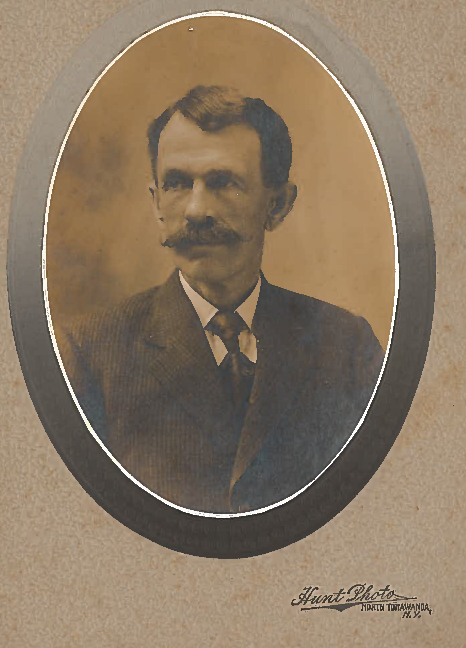
While going through old documents and photographs, I come on an image of my dad’s grandfather Albert whom I’ve never seen before, age and sepia blending, formal pose and 114 years all combining to distance him and bring him near. Yes, Ancestors, I’m still here, still listening.
Turns out more than enough is happening to keep any respectable Druid very well occupied.
One of the Enchantments of Brighid is openness to possibility. The goddess specializes in healing, poetry and smithcraft — skills of change, transformation and receptivity to powerful energies to fuel those changes and transformations. We seek inspiration and know sometimes it runs at high tide and sometimes low. As this month draws to a close, we have a moon waxing to full, an aid from the planets and the elements to kindle enchantments, transformations, shifts in awareness.
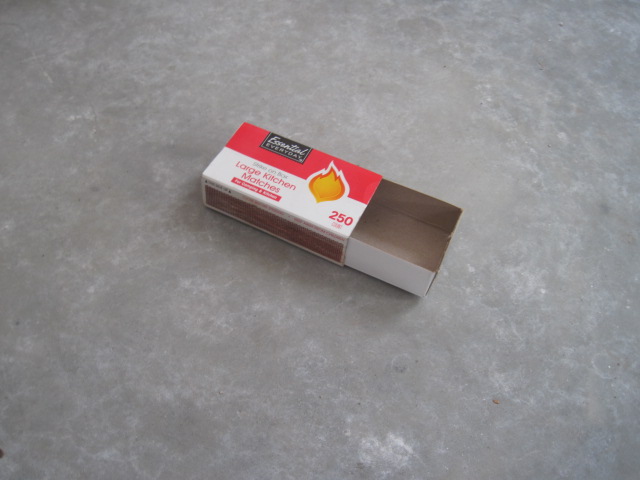
A day ago we finished a box of wooden matches. The box holds 250, and since we use them only for lighting our stove, that means we go through just part of a box every year. Emptying a box doesn’t happen that often, so it’s noticeable.
I like the imagery of the “empty” box. Though combustible itself, its main purpose is to contain matches and provide a strike surface. An old box has a worn strike surface, and one might be tempted to toss the whole thing in the fire. But I’m keeping it for these 19 days of Brighid, and it occurs to me now that it deserves a place on my altar. The sacredness of the everyday? Well, where else can the holy mystery abide in the worlds of matter, energy, space and time. As a friend likes to say, a mest (or messed) world can be a good and powerful stage for life and joy to happen.
Not to stretch things too far — how far is that, anyway? — I am a box, and so are you. Our spaces can hold all manner of things, and it’s our intention that determines what those might be. Insubstantial in itself, the box is nevertheless a potential locus for fire and mystery, or scores of other things. We take from the box a mood or a match, strike it and lay it to paper and kindling. We don’t create the fire, but without the box, the match, the intention and the movement to bring fire and kindling together, we don’t get flames.
To me the empty box is a “found” spiritual tool (my favorite kind), one I can work with physically and also in the imagination from where magic pours forth. Kitchen magic, or woodstove magic, if you will. What belongs inside it? What are some of the matches I wish to light? Where do I find them? (Where have I found them in the past? What new sources of them open up each day?)
/|\ /|\ /|\
On a small piece of paper I write a prayer to Brighid, and I fold and close it in the box.
For those of you incubating your own enchantment of Brighid to coincide with the upcoming 19 days of the goddess, you have the moon to aid you. Waxing now, it reaches full at nearly the midpoint of the 19 days, on the 31st of January — a fine symmetry, whether you choose to align with it or not.
The Solar Question for today, the 20th of the month, in Caitlin Matthews’ Celtic Devotional (Gloucester, MA: Fair Winds Press, 2004) asks “What is the source of your spiritual guidance?” The Lunar Meditation* for the fourth day of the moon (counting the New Moon, Jan. 17, as day 1) is “the wonder of life”. If I’m facing a period of spiritual dryness, if I have no other ready guidance, “the wonder of life” is a fitting source. Watching and listening, I can find in something small as the sun sparkling on an icicle a subtly radiant doorway into the Enchantment of Brighid.
Because magic so often starts small, no more than a tickle, a spark, a whisper. Till it builds.
Imbolc, the February 1st or 2nd holiday, part of the seasonal cycle of the “Great Eight” Pagan festivals, has long been associated with Brighid. Goddess, saint, patron of poets, smiths and healers, Brighid is a potent presence for many Druids. Christian Druids can honor her in either or both traditions, and her legends and symbols — effective points of access to her — are many.
Among the traditions that have gathered around her is the significance of the number 19 — whether part of the ancient awareness of the moon’s Metonic cycle, or the Christian tradition for determining Easter, curiously associated with the full moon, or the 19 nuns at Kildare connected with Saint Brighid. Or the practice of 19 days of magic focused on devotion to the goddess-saint, which this post examines. As a Druid-Christian link, the number and practices associated with Imbolc and Brighid can join the others I’ve talked about in other posts here as yet another means to transcend argument or debate, and find blessing.
Nineteen days with Imbolc in the center (on Feb. 1), the 10th day, begin January 23 and take us to February 10.
As this circle is cast, the enchantment of the apparent world fades … We stand together in the eye of the sun here and now …
So goes part of OBOD standard ritual. Why, you might be asking, if Druids say they wish to attune themselves to the natural world, do they practice ritual that sees the natural world as both enchanted and apparent?
Well, we still stand “in the eye of the sun”. Partly it’s “talking self” (see this and this post) that distracts us, that enchants us in the sense of holding us spellbound (and self-bound) rather than freeing us to grow. Circles concentrate energy and attention, contain them for the duration of the ritual, and can help charge us as instruments of the divine in order that we may “know, dare, will and keep silent”, as the old adage goes. So we circle alone and together to watch that particular enchantment fade, so that others can manifest more clearly. It’s a choice of enchantments. Do you like the current ones at work in the world? “She changes everything she touches, and everything she touches changes”. Sign me up!
Spending the interval from now till the beginning of the 19 days, a week from today, determining what service to offer, what magic to work, is time well spent.
I’ll be following up here with my experiences.
/|\ /|\ /|\
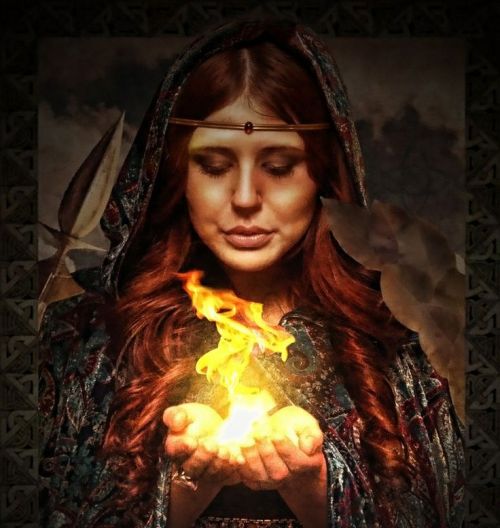
Image: Brighid. My preference is for deity images that aren’t sentimental or “airbrush pretty”. Contemporary artists often portray sexy gods and goddesses, which is fine, but as an image for meditation I’d rather not use soft porn.
[Note: The first section was drafted when the temperatures were 10-20 degrees warmer than the arctic front the northern U.S. is experiencing now.]
Winter offers subtle lessons about surfaces and depths. Test the skim of ice on the pond, and see how thick it is. Will it bear the weight of the roof-shovel I just used to clear last night’s snowfall off the solar panels? It looks so solid already, though daytime temps have risen well above freezing every day for the past several weeks. Has the overnight cold pierced deeply enough that I can step out onto the surface? Not yet, not yet. This weekend, though, with two days of forecast highs of 19 F (-7 C) and lows of -2 F (-19 C) might just do the trick. Then we Vermonters can begin to walk on water, too.
We count on surfaces, when they’re strong enough, to make the depths irrelevant. Easier, quicker, reckless. Wise fools, all of us.
/|\ /|\ /|\
Got a New Year’s resolution or two? Has willpower helped you keep them in the past?
The tools of magic, observes author, magician and Archdruid emeritus of AODA (Ancient Order of Druids in America) J. M. Greer,
are useful because most of the factors that shape human awareness are not immediately accessible to the conscious mind; they operate at levels below the one where our ordinary thinking, feeling, and willing take place. The mystery schools have long taught that consciousness has a surface and a depth. The surface is accessible to each of us, but the depth is not. To cause lasting changes in consciousness that can have magical effects on one’s own life and that of others, the depth must be reached, and to reach down past the surface, ordinary thinking and willing are not enough (J. M. Greer, Mystery Teachings from the Living Earth, Weiser Books, 2012, pg. 88).
Many moderns looking for changes opt for therapy instead. It can be a “safer” alternative. One advantage the latter can provide, if we want to call it that, is its generally less abrupt change. Magic can, after all, raise a ruckus. A cursory study of the history of magical orders bears this out — they blow themselves up with impressive regularity, because almost always one or more members haven’t successfully integrated the changes their own practice brings about. The Hermetic Order of the Golden Dawn is almost the textbook case, exhibit A. The parties involved in the Order’s implosion “should have known better”, certainly — incidentally proving that knowledge, one of our most popular current gods, isn’t enough. The problem isn’t that magic is powerless, but the opposite: it’s altogether dynamic, beyond the expectations of dabbler and seasoned practitioner alike.
For one thing, that means the charges, oaths, warnings, exhortations and gateways hedging many traditional magical texts, charms, rituals and practices, while sometimes glammed up and all showy and theatrical to make the point even more obvious (as well as sell books and movie tickets), do indeed conceal real teeth and spiritual gravity.
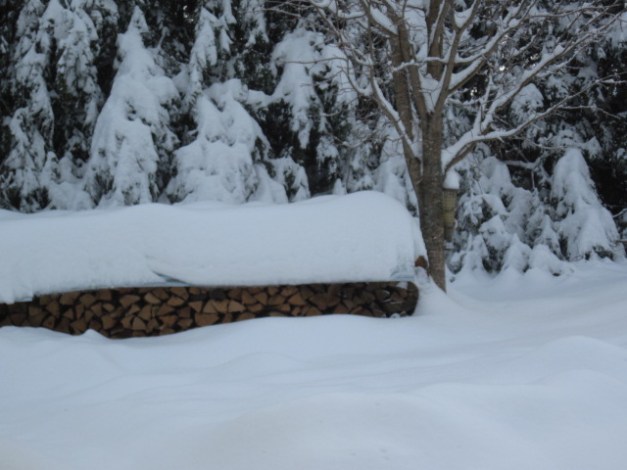
woodpile yesterday afternoon — surfaces and depths, partly visible
Cause and effect aren’t fake news. The physics of this world starts to establish itself quite viscerally in all our psyches around the time we first burn a finger on a stove, fall on ice, or mash a finger with a hammer. We merely lie to ourselves when we think we can “get away” with things less physical, as if analogous laws don’t also come into play. What has a beginning has an end. Apply force and a reaction follows, and so on. Post-traumatic stress disorder is a most painful illustration of just such laws.
It’s a perfectly exact measure of my immaturity whenever I think such rules don’t apply to me.
/|\ /|\ /|\
My application to conduct a workshop at the 2018 Mid-Atlantic Gathering U.S. (MAGUS) was recently declined. A minor detail, except for the fine irony that my workshop proposal centered on the magical use of symbols to empower ritual — point, line, triangle/awen, square, pentagram and even the MAGUS symbol itself, a unicursal hexagon.
“One of the essential lessons every magician must learn”, Greer notes (with what feels like the edge of a small smile creeping into his words), “is that magic sometimes fails”. Do your best, but this time the yeast just doesn’t rise. Make plans to get together with friends, and a flat tire or dead car battery sidetracks them. We know these things intimately in daily life, yet somehow expect magic always to smooth the way with its effortless power. Side by side with this image, of course, lies the contrasting image of the magician as master of willpower, all clenched muscles and scowls and fiery will burning through obstacles at any cost. Will is on many people’s minds right now, with all those New Year’s resolutions still radiant and full of promise.
Surface will is the kind we invoke to tip the ball into the basket or the net if we’re spectators cheering for our team. We try to “push” with our thoughts. Will-at-depth feels much different. We’ve all “been in the zone”, felt ourselves a part of a larger flow, when whatever we’re doing wholly absorbs our attention, time collapses as hours feel like minutes, and consciousness shifts to what we could aptly call “magic time”. Hold an intention clearly, without conflict, and action lines up to follow it. I don’t so much “will” something to happen as I open a way for energy to flow as effectively as possible, without distraction or second guessing. When actions flow from the center of who we are, they come smoothly, what the Dao De Jing call wu-wei or “no strain”, almost as if there is no barrier — we and the action are simply parts of the same thing in motion.
(“Almost as if there is no barrier” is my consciousness before and after being “in the zone”. It can’t account for what happens, because it’s the rational consciousness, not the magical creative one that actually makes things happen.)
Or as R. J. Stewart clarifies, “magical arts are not employed to ‘get whatever you want’, but to unlock whatever you are not, thus revealing or releasing whatever you may be” (Stewart, Living Magical Arts, pg. 20).
May you find, if you will, surprising and heartening depths beneath your surfaces.
This post offers honor to the bards — in this instance, to Lorna Smithers, a British awenydd or dedicant to the awen-inspiration which pervades our experience, which the bard is called to witness and manifest.
Lorna’s most recent post and poem puts words to this season after Samhuinn. Are you feeling it in your bones and mood, the dark half of the year? (Those of you in the southern hemisphere have recently entered the light half.) Turn then to Lorna’s lines, and cherish the treasures of darkness.
The Oak King cedes his place to the Holly in the Wheel of the Year.
If you’re looking for a chant to take you through to Yule, to Midwinter, try out Lorna’s poem as a charm that opens like this, first in Welsh and then in English*:
Allan o dywyllwch caf fy ngeni
Allan o waed caf fy ngeni
Allan o ysbryd caf fy ngeni …
Out of darkness I am born
Out of blood I am born
Out of spirit I am born …
For if we “sing from Annwn” (further lines from her poem), that very deep Otherworld, we consciously join “the souls of the dead and of living initiates to the cauldron”.
And they are one and the same.
For weare the Dead, to those now in the Otherworld. We’ve left them to live here. But all of us are “initiates to the cauldron”, link between worlds.
O friends, read her post!
/|\ /|\ /|\
*Sound matters. I love that Lorna was moved to compose in both languages. If you know even a little Welsh, attend to the sound of these lines. For help with the Welsh ll, this Wikipedia sound file is useful.
OBOD’s weekly email “Inspiration for Life” offers good advice here, but frequently my question after reading is this: how exactly do I go about practicing any insight it contains? And of course part of any answer sends me back to digging through what I’ve learned. It prods me to open my spiritual toolkit once again.
Here’s a recent weekly prompt, as I think of it, for a possible focus I might take up during the week:
Don’t feel bad about feeling bad. Don’t be frightened of feeling afraid. Don’t be angry about getting angry. There is no need to give up when we are feeling depressed. Nor should we be dismayed at the grief which often accompanies the outgrowing of anything which needs outgrowing. We can be glad that our soul is speaking to us and pushing us onwards. We frequently need to persevere with a period of inner turmoil before the dust can settle and be swept out the door. — Donna Goddard
/|\ /|\ /|\
First comes an experience, and then any emotional response to it we may have. Sometimes there isn’t one, though often one comes, just not right away. My wife and I moved out of state for a promising new job, quit within a month, and moved back to Vermont in mid-September. In various ways I’ve been dealing with more fallout from that over the past thirty days than I did in late September, when the event happened, or shortly after we returned.
These delays frequently catch us off guard because of the time gap between initial event and response. Then we react to our reactions, without looking at the cause. Sometimes our secondary reaction takes up our attention and energy far more than the original experience or emotion. So we fill too many waking — and dreaming! — hours grappling with the effects of effects, rather than being cause in our own lives. And if like me you’ve truly mastered this peculiarly modern and dysfunctional art, you now feel guilty for a second, third or even fourth-level reaction: your response to your response at emotions stirred by the initial experience. How craftily we perform these perverse and twisted magics against ourselves!
Fortunately, the same skill we use in tying ourselves in knots can serve to aid us in climbing free. It needs only our fire to turn it to our purposes.
So I summon my magic, starting with the Law of Reversed Effort. Rather than resisting the guilt, inertia and listlessness, I realize they’ve become so heavy they start to drop off me, pulled by their own weight and gravity. They puddle in a mess around my feet. Stepping away, I begin to rise, calling for help if I wish from teacher, friend, familiar or other beneficent spiritual presence as I ascend.
As I rise, I pass through clouds, and then suddenly I’m above them. Here the sun shines with an intense brightness I can feel warming my skin. I continue to ascend, the earth growing smaller and smaller beneath me. It’s now a blue-green ball of coolness beneath me, the solar system around me. Then that too recedes. The whole galaxy swims around me, then clusters of galaxies, shining strands of stars and families of stars. Piercing the sphere of the cosmos like a soap bubble, I rise yet further, into another and larger universe. I slow and pause, absorbing the sense of light and freedom and expansiveness.
When I am ready, I descend back the way I came, through galaxies, back to the solar system, back to earth, and down into my body again. When I feel my physical form sitting on the chair, I savor the sense of lightness and ease, and give thanks. Then I open my eyes, savoring the gift, and record the experience.
/|\ /|\ /|\
In this world rich with experience, it’s fine that I am not always the cause. But it’s immensely helpful, in such an interconnected world, to remember that things don’t happen tome, as if I’m a stone, but for me, because I’m an integral part of the web. It’s feedback for what we’re all doing. Just this shift in awareness can begin to free me to find useful insights, spiritual tools, and paths forward, right in the middle of circumstances that otherwise may feel like dead-ends. Because choosing to be the effect of thoughts about experiences will return me to remarkably useless perceptions, like “That’s just your imagination!” which of course is perfectly true, but not, however, in the sense that this accusation comes.
Imagination is spiritual sight. It’s never just one thing. In fact, it constantly, unfailingly, eternally (internally!), tries to show us multiple, innumerable other ways to see, to perceive, to understand, to celebrate, to create. It shows us ourselves, and everyone and everything else, as we can be. Not in a Disney, fluff-bunny or Hallmark sense, but in the truer sense of potential buried and awaiting all the transformations that human consciousness is designed to achieve and manifest. Here, where it’s needed most. In the middle of the sturm and drang, the drama, the doom, the headlines, the media chatter. Yes, right in the middle of it all, a birth, a growth, a flowering.
Imagination at work is nudging the roll of the cosmic dice, when the Dungeon Master sets us to establishing who and what we will be in this iteration of the Great Game. Because we know we’re the dice, the throw that sets them rolling, the twinkle in the eye of the Master, and the numbers that come up which we then agree to play with, as well as the Players themselves.
/|\ /|\ /|\
Or if that package of metaphors doesn’t work for you, fire is always burning. Honor it. We decide what to use it to ignite, warm, inspire.
Air is always breathing and flowing around us. Respect it. We decide what to breathe on, and endow with careful attention, thought, planning, symbolism, imagery.
Water is always pooling and rippling. We decide what needs nourishing at the roots, where the true dream lives, what we deeply feel, and how our hearts guide us along the paths we instinctively know already. Acknowledge it.
Lastly and most kindly, earth is ready beneath us, supporting us, stage for manifesting all we make of our lives from this moment forward. Love it.
/|\ /|\ /|\
Peering out the windows of this train at strange new territory passing by, talking with curiously-attired strangers in the car, supping with voices and images of beasts and birds in my ears, dozing off with conversations still echoing. You know, the life of a writer obsessed for a time with characters and story.
At 27,201 words, I’m somewhat under my target word-count for Nanowrimo. The lovely impossible experience of any sustained period of writing means the simultaneous tyranny of daily word-sprints and counts and updates and bemoaning the calendar and days passing, along with a complete, blissful disregard for all these things, as I bathe in a refreshing pool under gentle sunlight, that has appeared in the middle of my story, a moment of solitude surrounded by moss and mists and a distant valley calling me to explore.
So here’s the task I set myself in the previous post:
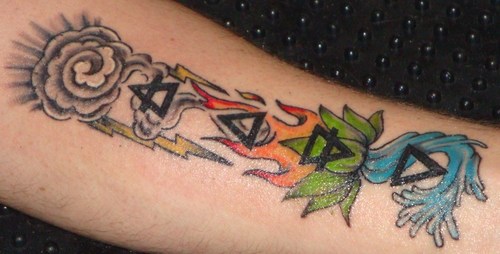
… I’ll take up ritual and its close alliance with emotion. Through rite and ritual, powered by where emotion can guide me, I can begin to (1) find out what I need to know (Air), (2) clear the way for the will to act (Fire), (3) empower my imagination (Water), and (4) help myself heal (Earth).
This morning, after fasting from coffee for three days, my wife and I dove back into our joint addiction. That meant, in addition to washing the carafe, cleaning the coffee mill of the remains of a brand that we found irritated our stomachs and left us with weird dreams. In spite of an organic label and a source we trusted, that particular brand goes on our NO list.
Yes, I’ll readily admit it: we’re coffee snobs. I say, if you have a habit, addict responsibly. Why pay a barista to do what we can do at home much more cheaply and satisfyingly.
Thus armed with our indulgence and our insufferably caffeinated arrogance, we perform the daily ritual. First, the banishing, or cleaning. Then the invoking, or grinding and brewing. Finally, the savoring, black or with milk or half-and-half. Or sometimes, if a new brand turns out especially bitter, a spoonful of maple syrup. This is also known as the sense of ritual well-performed. In other words, as with most cooking — and magic — season to taste. There are recipes to learn, and then there are local variations and individual adjustments. Both prove needful.
Coffee invites assessment and comparison. (My mistyped original read “incites”, which is also true.) So should ritual. We brew coffee almost daily, because we like it enough to find it worth the effort. Anticipation heightens the preparation, the performance. Not all batches are the same, and I can always fine-tune what I do. Feeling can guide me well, but not exclusively.
If it’s to have any benefit, ritual (or magic) needs similar practice, and the doing of it IS the ritual, IS the practice of magic. I should enjoy the experience enough that it’s worth the effort, the outlay of time, material, and energy.
Otherwise, why do it? Can I answer that question sensibly? (A lack of common sense has oft defeated many an evil overlord.) A more modest Druid like me has much to learn from the great and (ig)noble. Success, for evil or good, depends on feet planted on the good earth, first of magics. (After all, Yesod, “Foundation”, is a low, easily-reachable branch on the Tree of Life. It’s “a vehicle allowing movement from one thing or condition to another …” says Wikipedia. Or as Basics in Kabbalah puts it, “The foundation (yesod) of a building is its ‘grounding’, its union with the earth (malchut).” A measure and sounding of our time: you can find such formerly hidden knowledge simply by following an internet link. Do we dismiss such magical familiars because they have made our lives too easy?)
What will I write onto and into my skin? What will I invite deeper?
So back to the four elements, to the task enumerated at the start of this post. I learn (Air) which coffee to buy — and whether today is even a coffee day — apply the heat (Fire) to water (Water!) and ground the rite (coffee, Earth, pun included) at its conclusion — a pour of hot black nectar into our two waiting mugs. Any excess of thinking or willing gets balanced by this cauldron of feeling, of desire and pleasure and outcome. Hold the mugs in our hands, warmth and aroma as much a part of it all as taste on the tongue. Incidental effects, like the temporary sharpening of attention, the rise of blood pressure (I’m chronically low), the motivational effects to a sluggish intestinal tract, are all side benefits not to be disdained.
OK — I’ve taken the analogy further than it can bear, or perhaps not far enough. We tend to think of ritual and magic in abstract terms, when in fact they’re a series of concrete choices and actions and manifestations. Humans are magical transformers, with time and space our field of play. Whatever we manifest has its causes: as with the universe outside our skin, so with the universe inside. This isn’t just metaphysics but actual physics. If the definition of insanity is to expect different results from doing the same thing, then sanity can begin simply by trying something new.
And “old-new” might be a very good alternative name for our uni-verse, our “one-turning” which offers ritual as one of its keys and clues.
And what of healing? I wrote in March of this year, in the post “Healing From the Past“:
I add to my practice a henge-meditation. We needn’t bother ourselves to make any such claim as “Druids built Stonehenge” in order to make use of the spiritual dynamic it offers as a source of healing. Merlin sets the precedent: Stonehenge-as-symbol, in Geoffrey’s telling is older than its present home in southern England anyway. Not its origin but its power is what we need. Magic thrives when our intent makes the occasion a necessity: our focus is single and sharp not from force of will but from desire, emotion, need, want, hope, imagination, planning and preparation, ritual foundation, and love.
A final note: to make ritual “economical” in terms of any wear and tear on the practitioner, which means us, (1) start small, (2) keep records, (3) experiment to find what works and what doesn’t. As with coffee, check in frequently: how does it feel? Does the brew need tweaking? Make this aspect part of the process — though not its sole determinant. Ritual and magic, done skilfully, are among the most scientific as well as loving things we do.
Who knows when odd reading can lead to insight — and material for a blogpost?
Take, for instance, this delicious (to me, anyway) fragment:
“Emotions alert us to specific issues, and they do so without any subterfuge. If we are aware enough … our emotions will be able to contribute the energy we need to move into and out of any situation imaginable, because they contribute the specific energy and information we need to heal ourselves” (Karla McLaren. Emotional Genius: Discovering he Deepest Language of Soul. Laughing Tree Press, 2001).
This kind of statement makes me sit up and pay attention. Partly because any large claim switches on my crap detector, but also because I immediately want to try it out. You know, set up an experiment to test the claim.
In this case, like most of us, I’ve got a running start on just such a test. We can all name stories, movies, songs that grab us and move us. Even — if they reach deep enough, if we’re open and vulnerable to their magic — on the fifth, tenth or thirtieth read, viewing, hearing. Among your top contenders you may count a childhood favorite. The quality of these repeated experiences, at least for me, leaves no doubt: gods are alive, magic is afoot. Magic is alive, gods are afoot. (Leonard Cohen nails it again.)
In fact, so completely may the magic live for you that you guard it zealously and jealously. You watch who you choose to tell about it, because you’ve learned the hard way how another’s misunderstanding or mockery can sting, and even, if it’s carefully targeted, ruin a beloved experience for you.
The number and quality of claims McLaren makes are quite remarkable. Here they are again in list form. Emotions:
— alert us to specific issues.
— don’t lie or mislead — they offer no subterfuge.
— contribute the energy we need to move into and out of any situation imaginable.
— contribute the specific energy and information we need to heal ourselves.
Or, to put it elementally and alchemically, emotions identify what we need to know (Air), clear the way for the will to act (Fire), empower the imagination (Water), and help us heal (Earth).
McLaren also wisely includes a kicker, escape clause, out, safety switch: If we are aware enough … Of course. Isn’t that always the issue at the heart of things?
Stay with me here. (As the Rocky Horror narrator exclaims, “It’s just a jump to the left!”) Working with adolescents in a boarding school for sixteen years let me reflect on my own emotional growth or lack of it, even as I served as an adviser to hundred of students over the years. Because I advised freshman and senior girls, I frequently saw emotion more openly expressed than I might have with boys. How often I’d witness some variation of “I’m so upset/amazed/impressed/in love! Oh my god, I can’t believe X. I was A and now I’m B. I’m so upset/amazed/impressed/in love!”
The lesson here is emotion can be so strong that at first we have no distance from it, no perspective or comparison. We recycle it, loop with it, rehearse it. “All or nothing” is the adolescent’s stereotypical default setting, partly because so many experiences arefirsts and really don’t offer any basis for comparison: first love, first significant failure, first challenging success, first death of a close friend or family member, first major social embarrassment, first large moral choice, and so on. Emotions don’t lie, but when the tide sweeps in and then out again, how do you make your way through the wreckage to picking yourself up and drying out and moving forward?
With some progress towards maturity comes that invaluable ability to detach, step back, gain perspective on one’s own situation and experience. (We might say that IS maturity.) Only then can emotion alert us to specific issues. (If you look at the media and the world right now, we see repeated spikes of emotion with far too little detachment, reflection, proportion, perspective. Keep a person, a community or a nation in the first stage of emotion and they’ll never reach the second stage, let alone any of others. That way mature judgment dies.)
While cooler heads may lament the manipulation of whole groups by the technique of constantly lighting new fires, all while stoking the flames of old ones, there’s a useful lesson in the power of emotion. To lift a line from “Storybook Love”, the theme song to The Princess Bride, “it’s as real as the feelings I feel”.*
And it is. Emotion is real. The gifts of emotion, however, come in what we find after strong feeling. Feel the feeling, yes, I’ve learned. (Can’t do much if I’m repressing it. Genii still in a bottle, that trick.) Then work with it — from outside. Return whenever I need to fine-tune my understanding by checking in with the authenticity of the feeling. Just don’t invite it to take up residence and watch as it tracks in dirt and hangs its laundry over my windows.
Anger. Fear. Lust. Self-pity. Doubt. Feel any of these lately? These are among my top five most potent negative emotions. They’re also five of my teachers. I’ve learned more from anger and fear than I could tell you in any reasonable-sized book.
Awe. Curiosity. Amazement. Gratitude. Love. Another five, among the most potent positive emotions. Also fabulous teachers. Alchemized versions of the preceding negatives, shaped by the spiritual work we’re each called to do in our lives.
Emotion, our elemental Guide of the West, serves us best when we respect its proper domain. Its role is not to usurp our sovereignty by taking the throne.
In the next post I’ll take up ritual and its close alliance with emotion. Through rite and ritual, powered by where emotion can guide me, I can begin to (1) find out what I need to know (Air), (2) clear the way for the will to act (Fire), (3) empower my imagination (Water), and (4) help myself heal (Earth).
That is, I can begin to take McLaren at her word, and try out the claims she makes.
“Go ahead”, writes travel writer Rosie Schaap in an article in today’s (27 June 2017) New York Times, “say their names:”
Avalon and Tintagel. Believe deeply enough, and they might emerge from the mouth as through an enchantment-induced vapor, as though borne on the breath of a dragon. (Especially after at least four people have corrected your pronunciation of Tintagel: Be gentle with that “g,” it’s tin-TAJ-l.) And, indeed, these two sites in the southwest of England are epic and romantic, the stuff of myth and mystery.
Strip this opening paragraph of its hemming and hedging, its “mights” and “as thoughs”, and you have a compact magical working, a true spell, ready made. You know what setting you need, that will invite and launch you, right? Light incense or a candle, invoke with the two names, visualize being borne on the breath of a dragon, and you arrive in the southwest of England without the need for British Airways, Heathrow or Gatwick, customs or currency exchange.
Feel the mist cool on your skin, see the green and pleasant land, hear the clash of swords as you pass the guard, hear seagulls and curlews crying, as you walk out onto the spit of land where the gray stones of Tintagel Castle tower again. Yes, you’ve been here before. What’s the message for you this time? What do you need to know that has brought you here? What offering will you make in return for the gift you receive? Offer it with your thanks. Then return, return, return.
If even a feather of the wing of magic brushed your cheeks, you felt it. What is “real” on the other planes, after all, but what we pay attention to, what we animate with our love and creativity, our desire and energy? We practice the real to make it real, or else we let it go for something else that draws us more strongly. Our call.
“Myth and mystery” are “stuff” indeed — the potent formative ingredients for an “enchantment-induced” reality. (Aren’t ALL realities induced by something? Why not choose and shape for ourselves what that something is, rather than accepting a mass-produced substitute? We’ve given too much away, and now feel the lack yawning and gnawing inside. Reclaim!)
Leap with me here, to that old Foreigner song from the 70s — “I want to know what love is”. It always struck me with its odd assumption that anybody else must know better than I do what love is. Why?
I wanna know what love is
I want you to show me
I wanna feel what love is
I know you can show me.
I’ve got just one question: Who’s this “you”?! With my experience of love as with my reality: why let anyone else ever determine it, at the very least until I know theirs is superior to mine?! Take a look around: just how worthy are many of these other claims to a superior reality? Do we like what we’re seeing?!
Indeed, as Lou Gramm goes on to sing, “I gotta take a little time, a little time to think things over. I gotta read between the lines …”
I swear this on the midsummer Sword of Light: I will not abdicate my spiritual sovereignty to anyone for anything less. I will practice love, as I practice reality, accepting the best I can achieve. Because as Lou also sings for us all, “I’ve traveled so far to change this lonely life …”
I have this sneaking suspicion that they’re versions of the same thing, love and reality, siblings of the same mother. Funny how love and reality so often harmonize. What we love is what is real for us. If one’s going well, usually the other is, too. They’re what I do to myself, for myself, as I do to and for others. And as they do to and for me. You who teach me, I keep learning from You what love is.)
Yearning is the first step that lets us know we need more — you hear something of that yearning as Lou sings — that we’re dying a little each day without it, that what yearn for is something we’ll recognize when we experience it. But we have a say in how we get there, and that effort will shape what we experience when we arrive. As we do, every day.
Depending on your media choices, you may have heard of the recent (Feb. 24) magical attempt to “bind Trump”. You can check out one version here. The more elaborate versions plan for similar recurring monthly rituals during the waning moon until the President has been removed from office. Sympathetic magic, but highly problematic.
The effort and its announcement set off predictable responses in many quarters, from Breitbart (“A group of witches is attempting to use black magic to neutralize U.S. President Donald Trump by casting a ‘binding spell’ to prevent him from governing”) to People Magazine (“organizers of the demonstration have vowed to cast binding spells on the 70-year-old on the midnight of every waning crescent moon until Trump is removed from office”). The National Catholic Register issued its own take here, highlighting from its perspective the negative (literally diabolical) energies powering such binding spells, and pointing out the dangers of such workings and also the ineffectiveness of curses on the faithful Christian. AM New York offers a suitably occult image to head its article. (I urge you to read this post and all its links with an eye alert to unintended ironies.)
Patheos blogger and Druid John Beckett posted a balanced, thoughtful and thorough assessment here: “Why I’m Not Participating in the Mass Binding of Donald Trump and What I’m Doing Instead”.
As some wiser heads have pointed out, it’s true magic can “grease the rails”. Used skilfully, it helps move energies along trajectories already established. Magic catalyzes change — it aids tendencies, and adds to existing momentum.
Try to magic your way through a strong headwind, however, whether physical, political or psychic, and your chances of success drop significantly. You’re going up against the flow of things. Planning a morning sail? With any sense, you check a barometer and weather reports before weighing anchor. You have a careful look at the skies yourself, taking into account local conditions and your own prior experience. If those signs are good, consider your crew, your boat, the tides. Watch the seabirds, the wind, the smell of the weather over water as you stand on the shore. Ponder those clouds on the horizon. In other words, to switch metaphors, magic can be part of the recipe, but neglect flour, water, eggs and sugar, and even the best magical yeast has nothing to work on.
Among several other cogent points, Beckett astutely sums up the issues with selecting Trump as an appropriate magical target: “Trump is a Symptom of a Deeper Problem, Not Its Cause. Blow up the Death Star, stake the head vampire, kill Hitler, and everything is all good and fine. Our popular culture tells us that if you remove the head, the body will die. Reality is rarely that simple”.
For my part, I prefer blessings, partly because I have to question my motives and the extent of my knowledge. Binding successfully asks a lot of the magical worker. In my experience, blessings, even low-level ones, practiced over time, transform consciousness more subtly but at least as effectively, and — significantly — without the conflict, coercion and energy blowback of most bindings.
“Let there be peace on earth, and let it begin with me” isn’t bad as an initial practice, till you can see your way more clearly. In the interim, you may find peace isn’t actually what you wanted anyway. Clarify your motives and you’re already a step ahead of most who work for change, with or without magic.
Trump’s campaign slogan, widely mocked, is “Make America Great Again” (MAGA). As a positive if vague goal, it’s one to assist, while reinterpreting it more inclusively, regardless of whether its original formulation is some sort of white nationalist code. Reinterpreting — a form of steering — is something magic can do well.
And as someone primed to look for signs, and work creatively with them, I’ll take that campaign slogan acronym MAGA and reinterpret it in Druidic terms — as a female magical energy: magus, mage or magician, and its feminine form, maga. What feminine magical energies are lacking in my own consciousness (to say nothing of those at work publicly shaping one of our current realities)? Stopping’s harder than steering what’s already in motion. What energies can I manifest, starting in my own life, to find balance from which to act most effectively? And then how can I encourage those energies to flow outward from there?
For that is what we are: magical transformers, all of us. We distribute what we accept and create. Together, we make the worlds.
*Solwom wesutai syet. SOHL-wohm WEH-soo-tie syeht. “May it be for the good of the whole.” That’s where I strive to root my magic to begin, however often I may get blown off course. (And part of my own magical work is to find ways to let the winds pass by. Trees bend when they can, rather than break. Weak? Passive? How about “still around to make a difference”!)
Got questions? Dispute my assessments and conclusions? Doubt what I or other authors have asserted at the links provided? Try these things out for yourself. Then your opinion is founded on knowledge and personal experience, not supposition and untried assumptions. In the process, you’ll grow and understand your life better than before. That’sa good foundation for any magic.
“I’m here to have an argument.” (Welcome to our daily flying circus.) I’m enlisting the aid of high art and low craft to get through this post.
This post is an argument — not a disagreement, but an argument in the older sense of the word: a proof, a seeking of an accurate assessment of our world. Did the title put you off? It’s going to get worse. Maybe you should just enjoy the Monty Python video, and let the net distract you from there.
Are you allergic to magic, having tried it and found it to be mostly flash and bluster? Does it simply not rouse in you any response — the kind of response you’ve learned to listen for, the kind you’ve come to trust intuitively along your spiritual journey?
You can sigh justifiably — go ahead! — as I pursue yet another topic tangential to your interests or needs. Check back in later. If you’ve been coming here for any length of time, you know I’ll roll around again soon enough to something you can use. Till then, compost and ruminate. It will do you more good. This post really isn’t a downer, but it’s one that will get few or no likes, and recede ignored into the archives.
Because mostly with this blog I’m arguing with myself, of course. (You’re all much too kind and rarely call me on my crap, for which I think I thank you.) But like a madman, I do the arguing semi-publicly, flopping and writhing on the sidewalk, because what else is worth doing, if I don’t also put myself on the line? Do I mean what I do and say, or not? All right then.
[If you’re not like me or most other humans, you move through life blissfully, largely untroubled by the shifts and turns of living in this world with a body that ages and will eventually die. If indeed you belong to that singularly uncommon group, please leave now. I have nothing to say to you. However, you perhaps have something to teach me. It’s likely you’re spending down a karmic store from a previous life. Spend wisely. But if in fact you’re an enlightened being here for the upliftment of others, and you have no personal life or what we now like to call issues but used to be more accurately called hang-ups*, please open your school/temple/retreat/grove/workshop and get on with your mission. The world needs your wisdom.
*hang-ups: those weak spots in our make-up that serve as ideal targets for tests and challenges and other people’s hang-ups. Shrike-like (warning: video at link!), they hang us up on the thorns of uncomfortable truths behind our comfortable illusions before they rip into us. Because pain is often the creator of awareness. I don’t know about you, but some of my most valuable learning has come at the price of pain. And — after the pain has passed — it’s usually worth it. Cancer, deaths in the family, end of relationships, arson, loss of friends: like most of us, I’ve had my share. And like you, I’m still here. The best revenge is living well.]
Having dispatched some of my readership with one or the other of the last few paragraphs, I ask those of you who remain to consider the following. If you want to grow or make changes in the world, or both, and you’ve been frustrated, recently or for a bad long while, here’s an observation worth trying out in the laboratory of the every day. To put it in concrete terms, if during the upcoming holidays you’re up against a Clinton or Trump supporter in your immediate circle (or, with a change of nation, Brexit or Erdogan or Putin or Modi, etc.) who just doesn’t see the world your way, step back a moment and prepare to get magical:
The tools of magic are useful because most of the factors that shape human awareness are not immediately accessible to the conscious mind; they operate at levels below the one where our ordinary thinking, feeling, and willing take place. The mystery schools have long taught that consciousness has a surface and a depth. The surface is accessible to each of us, but the depth is not. To cause lasting changes in consciousness that can have magical effects on one’s own life and that of others, the depth must be reached, and to reach down past the surface, ordinary thinking and willing are not enough. — J. M. Greer, Mystery Teachings from the Living Earth, Weiser Books, 2012, pg. 88.
For “magical” effects, read “transformational.” I’m a sucker for a good transformation. Aren’t you?
It may be that our wands, like Ron’s, simply need replacing. We’re all “truth (im)moral high ground rights victory” and what we really need is just a new, and appropriately charmed, stick of wood.
To add to the mix, I’ll add a line from the Hebrew Bible (Proverbs 16:32) that’s resonated with me since I was a teenager (read in your own appropriate pronoun): “He that is slow to anger is better than the mighty; and he that ruleth his spirit than he that taketh a city.”
Yes, I’m as subject to confirmation bias as the next person. I like this passage because I’ve seen in my immediate family the ravages that anger can leave. I’ve also shed any expectation that another person will or can do the work in my life that only I can do. (Politicians top that list, no surprise. Blame is always easier than change, and they’re so obligingly convenient to blame.)
Round this off with Gandhi’s admonition to be the change we wish to see in the world, and I’ve got a lot of changing to do. But better me than you, I remind myself: if I’m hard to change, you’re even worse. The world — by which I mean you and anyone else in my circle — refuses to do almost anything I want. Me, on the other hand, I’ve hand some success in shaping. Small steps, to be sure. “I love you, you’re perfect, now change.”
How to reach the depths? Like others who’ve learned the hard way, Greer lays out a number of testable, practical suggestions. (Because they’re not “new and improved” they get less attention than they merit.) You’ve already heard me grapple with a number of them on this blog.
What I’m proposing, then, once a week going forward, whatever else I’m doing, is an account of my own experience with some of these specific practices , together with my results. I like the spiritual laboratory of experience, not because I “succeed” but because my failures are often remarkably instructive. I learn how to hear and integrate wisdom or make room for enlarged awareness in my own odd life much better by making “mistakes” with it than I ever could merely by reading or giving intellectual assent to others’ ideas.
A sign I need to grow: I’m either strongly attracted to, or repelled by, a person, place, thing, idea, or feeling.
Once again we’re about a week out from the holiday, close enough it tugs pleasantly at awareness. Here in Vermont, in the northeast U.S. where I live, the last few days in the 70s F/20s C confirm that winter’s gone, though nights below freezing are still a possibility. I remind myself from now till June that it snowed on my May birthday the year I was born. Weather, life: stick around long enough and you find anything’s possible.
Outward from the merely personal to a group I practiced with the longest: students at the boarding school where I worked for 16 years. Our last and best effort was a truly elaborate Beltane. We devoted a lot of time to preparation, reserved a spot on the school’s Great Lawn (associated with the annual graduation picnic for the whole school community and parents), put up attractive color posters (see the image to the right), and even inspired our student president to spring for the cost of a whole roast pig.
Beyond our small group of eight, just three other people came.
We’d even begun forming a magic study group, devising our own sigil with input from each member, and generally carrying on in magically appropriate ways: sharing and describing our imaginative/astral visions until they took on a life of their own, balancing our elemental energies, ascertaining each member’s strengths and limits for later ritual work, and so on. To those who exclaim “What?! Are you insane?! Working magic with adolescents?! Nutter! Whackjob! Fool!” I reply only that we had multiple safeguards in place.
To the left is one version of our sigil, drawn with magic marker on a student’s sketchpad, which I share here — “Guard the Mysteries! Constantly reveal them!” — for the benefit of those curious about the lineage and origins of such things.
Some readers may cluck their tongues knowingly and go on to detect “influences.” To which I say only: That’s fine. But these kids didn’t “know” anything about the Golden Dawn or Euro-alchemy or similar things. Spend time in ritual and you too will find that valid images continually reconstitute themselves in the imagination. If I had the sketches each of them made to include here, the connections pointed to a shared experience out of which they crafted the sigil. The Cross, the Cup, the infinity symbol, an upsilon, the axial symmetry — as far as we were concerned, we were onto an experience and a realm worth exploring. Our truth against the world’s.
As for the sparse attendance at Beltane: each group forms around and operates on its own harmonic. We ate well, sent leftovers home with everyone, and chalked up our rather large budget shortfall to the frequent mismatch between inner and outer worlds. Our next fundraiser only just recouped the outlay; balance restored.
/|\ /|\ /|\
Beltane, like the other “Great Eight” festivals* of contemporary Druidry and Paganism generally, draws on a swirl of energies as democratic and mongrel and vital as you could wish for. Find a circle to celebrate with, or if you prefer or are gifted with solitary practice, get outdoors, invite the season, contemplate on images and energies alive and at work in your awareness. Bring them into some physical form to ground and manifest them in your world. We all need reminders to help us through those “difficult” days with humor and grace and even, spirits friendly and stars favorable, with gratitude. What better than something that’s come into your world through you?
/|\ /|\ /|\
*The “Great Eight” festivals of the Wheel of the Year
October 31 – November 2: Hallowe’en, Samhain/Samhuinn, All Hallows Eve, All Saints Day, All Souls Day, Todos Santos, Day of the Dead, Dia de Muertos.
December 20-22: Yule, Winter Solstice, Alban Arthan.
February 1-2: Imbolc, Oimelc, St. Brigid’s Day, Groundhog Day, Candlemas.
March 20-22: Spring Equinox, Ostara, Alban Eilir.
May 1: May Day, Beltane, Bealtainne, Walpurgis Night.
June 20-22: Summer Solstice, Midsummer, St. John’s Day, Litha, Alban Hefin.
August 1: Lughnasad/Lunasa, Lammas(tide).
September 20-22: Autumn Equinox, Alban Elfed, Mabon.
“Ah, the seed has long lain there fallow, only at Imbolc do you at last feel it stirring beneath the snows.”
/|\ /|\ /|\
Marie-Louise von Franz
“One must start where there is still a flow of energy, even if it is just a thin flow, even if it seems silly” — Mary-Louise von Franz, Animus and Anima in Fairytales (Inner City Books, 2002).
Before and at and around Imbolc, the god Lugh draws me powerfully. Naturally, because time isn’t linear, and the workshop talk I’ve agreed to at Lughnasadh, a six-month conjunction with Imbolc and another fire festival, is now at work (was, before I agreed to it), by the god’s hand, or my own, or — more confusing and interesting — both at once. Snow on the ground, the land still in the grip of the Frost Giants (I like mixing myths, personally, at least by season), and here comes Lugh to prod me into action with his spear. Or if not action, exactly, some kind of attention.
The shape of the talk as it comes to me now in bits and starts will deal among other thiings with the matter of encountering a god, but also of any new course of action, of imagination, of inspiration. These wear different cloaks, but from what I can see, under them they’re the same, or at least siblings, equal parts trust and terror at times. Energy — which is what we are at heart, intelligent energy on the move.
So the seed, the nudge to change, to move, to grow — it comes and roots itself in us. And when the root-strength that cracks sidewalks and shoves boulders aside and generally plays havoc with human ideas of permanence and endurance finally gets to work, things move.
And often enough the seed then dies in the ground. What nourishes it? We stomp on it, uncomfortable thing, reminding us that something outside us wants to work its will with us, here, too. Right in the middle of streaming Netflix and election madness and ISIS and the woeful state of things and our own personal misery and joy, the particular flavor and color of crazy that the current year puts on each morning, mourning. Just because.
But let trickle reach seed and GERMINATION! Watch out! Funny, the vegetation god from the House of Bread (which is “Bethlehem” translated, as John Michael Greer obligingly reminds us) puts it this way in a Gospel, which really is supposed to be good news after all. Or as a Bard thinks of it, a song for the queens and kings we could be:
And he taught them many things by parables, and said unto them, Listen, a sower went out to sow: And it happened, as he sowed, some seed fell by the wayside, and the birds of the air came and devoured it. And some fell on stony ground, where not much earth was; and immediately the seed sprang up, because it had no depth of earth: But when the sun rose, it was scorched; and because it had no root, it withered away. And some fell among thorns, and the thorns grew up, and choked it, and it yielded no fruit. And other fell on good ground, and yielded fruit that sprang up and increased; and brought forth, some thirty, and some sixty, and some a hundredfold. And he said to them, Those who have ears to hear, let them hear.
/|\ /|\ /|\
We can play a part here in germination. (Says who? Well, I can argue about it, or I can try it out for myself. Which is more fun?) Where is my fertile ground? What god/dess is planting there? Where’s that trickle? Ah, there.
And so it begins. If I’ve learned anything to pass along, it’s the magic when seed and trickle meet. I can’t make seeds, but I can maintain a greenhouse for them. I can’t start the trickle, but I can pay attention when one comes — I’ve got ears to hear — and help it flow or block it. There. To work.





 Trump’s campaign slogan, widely mocked, is “Make America Great Again” (MAGA). As a positive if vague goal, it’s one to assist, while reinterpreting it more inclusively, regardless of whether its original formulation is some sort of white nationalist code. Reinterpreting — a form of steering — is something magic can do well.
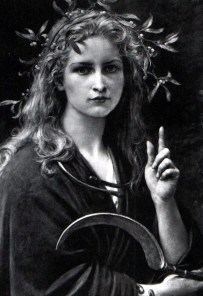 And as someone primed to look for signs, and work creatively with them, I’ll take that campaign slogan acronym MAGA and reinterpret it in Druidic terms — as a female magical energy: magus, mage or magician, and its feminine form, maga. What feminine magical energies are lacking in my own consciousness (to say nothing of those at work publicly shaping one of our current realities)? Stopping’s harder than steering what’s already in motion. What energies can I manifest, starting in my own life, to find balance from which to act most effectively? And then how can I encourage those energies to flow outward from there?
 To add to the mix, I’ll add a line from the Hebrew Bible (Proverbs 16:32) that’s resonated with me since I was a teenager (read in your own appropriate pronoun): “He that is slow to anger is better than the mighty; and he that ruleth his spirit than he that taketh a city.”
 Round this off with Gandhi’s admonition to be the change we wish to see in the world, and I’ve got a lot of changing to do. But better me than you, I remind myself: if I’m hard to change, you’re even worse. The world — by which I mean you and anyone else in my circle — refuses to do almost anything I want. Me, on the other hand, I’ve hand some success in shaping. Small steps, to be sure. “
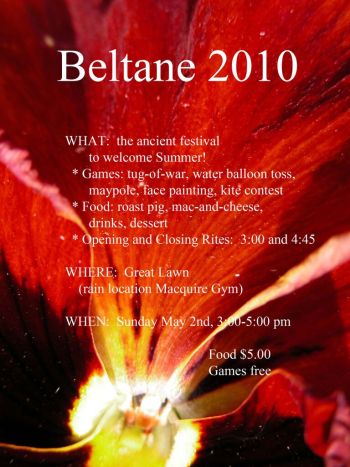 Outward from the merely personal to a group I practiced with the longest: students at the boarding school where I worked for 16 years. Our last and best effort was a truly elaborate Beltane. We devoted a lot of time to preparation, reserved a spot on the school’s Great Lawn (associated with the annual graduation picnic for the whole school community and parents), put up attractive color posters (see the image to the right), and even inspired our student president to spring for the cost of a whole roast pig.
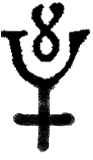 To the left is one version of our sigil, drawn with magic marker on a student’s sketchpad, which I share here — “Guard the Mysteries! Constantly reveal them!” — for the benefit of those curious about the lineage and origins of such things.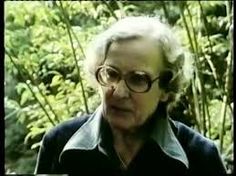


 A Druid Way