[Related posts: Shinto & Shrine Druidry 1 | 2 | 3 || Shinto — Way of the Gods || Renewing the Shrine 1 | 2 || My Shinto 1 | 2 ]
Almost two decades ago now, in the early 1990s, my wife and I lived for a year in Hikone, a medium-sized city in central Japan, about an hour’s train ride north of Kyoto. The city’s most visible claim to fame is Hikone Castle, a 380-year-old wooden fortress that dominates the downtown skyline. But the most enduring memory I took from Japan and have never forgotten is the profound impression of its many Shinto shrines — roughly 80,000 of them, according to various sources — that dot the landscape and invite the casual visitor as well as the reverent worshiper. I usually found myself somewhere between the two. But this wasn’t ever a problem. Visitors, including foreigners, are welcome.
Shinto shrines are impressive for their openness. Many (especially the smaller and rural ones) are free to visit (though of course donations are gratefully accepted), wonderfully peaceful, and lovingly tended. Not once did I see any graffiti or vandalism in the dozen or so shrines I frequented, in either countryside or city. Often enough I was the only person present, which allowed for a meditative experience of the grounds and atmosphere. Here’s a shot of the entrance to Taga Taisha, about 20 minutes from our apartment in Hikone.
During matsuri or festivals, however, a shrine can be absolutely mobbed, and that’s a wholly different experience, also not to be missed! You can catch something of the energy of a festival in this shot below of Tenso Jinja shrine. The celebrants in the background carry a mikoshi, a portable shrine, back to Tenso Jinja after a day of parading it around the town. Usually there’s a musical accompaniment, and the bearers of the mikoshi can get very enthusiastic in their chants, drawing quite a crowd. In retrospect, the experience felt very Druidic — all that energy, all the communal good feeling, everyone included.
Shinto is the “way of the kami,” the Japanese word used to translate both English “god” (and “God”) as well as “spirit,” “ancestor” or “essence.” From the Shinto perspective, the world of the kami overlaps with ours. Everything has its kami, and the natural world is full of places that manifest the particularly strong presence of kami.
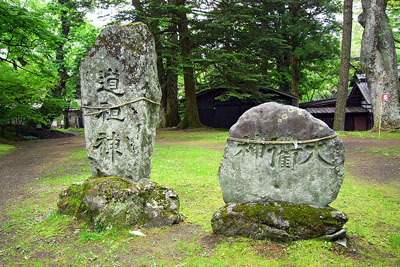
Thus, natural objects pervaded with kami often receive a small marker shrine and sometimes other identifying signs, like at Hatagoiwa just off the coast in Ishikawa prefecture. Note the rope linking the large ocean rocks, as well as the small red shrine atop the larger rock.
Shinto focuses on practice more than belief. One of its key practices is purification, so that we can participate in the world of the kami more consciously and harmoniously. For that reason, the entrance to a Shinto shrine typically includes a temizuya (literally “hand-water-spot”) or basin for ritual washing before proceeding further. Here you can see the basin and the bamboo dippers for washing.
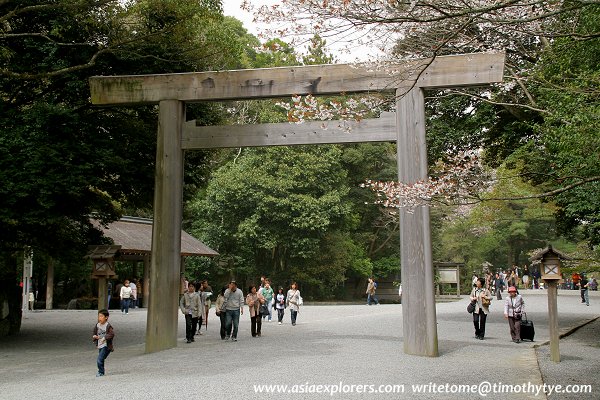
The marker signalling the sacred space of a shrine is the torii gate, through which all visitors pass. The torii may be simple, like this wooden one at Ise, one of the oldest and most famous shrines.
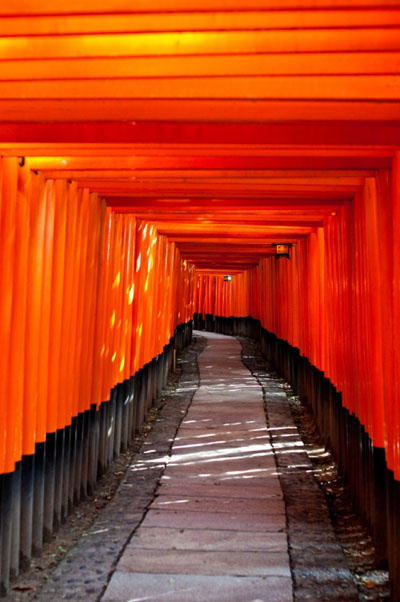
Or it can be wonderfully elaborate, like the main entrance of Fushimi-Inari Jinja near Kyoto, and inside, its sloping corridor of seemingly endless red torii.
Lest you feel this is all well and good, but for all that still remote from your life, there’s a major Shinto shrine in Washington state, near Seattle, named Tsubaki Grand Shrine. And among its kami is Kokudo Kunitama-no-Kami, who protects the North American continent.
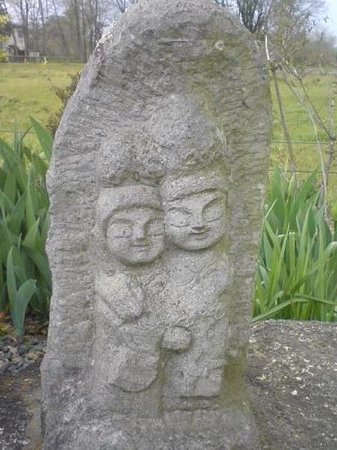
Here’s a shot of the interior of a shrine, featuring dosojin, or kami representing an ancestral married couple. Dosojin are protective spirits, and often placed along borders and boundaries.
The last shot is of a dosojin more recognizably human, marking a field border.
“When I wake up, the other side of the bed is cold,” says Katniss Everdeen, opening Suzanne Collins’ novel The Hunger Games as both narrator and protagonist, and launching a major theme and complex of imagery in the book.
The widely-anticipated movie version of the novel arrives in a little over a month, in late March. The transformation of novel into film, with its inevitable directorial choices, budgetary limitations and too-specific casting of too-attractive young actors, will enchant some and disappoint others. No film can perfectly incarnate the word-world of a book to everyone’s satisfaction. (Here’s a link to an official trailer, in case you’re curious and haven’t yet seen it.) But it’s the novel I wish to focus on here.
The presence or absence of warmth is a recurring theme: heat — passion — violence — fire continually trade places throughout the story. Human warmth is, after all, what initially launches Katniss into the story. She volunteers on the spur of the moment to take the place of her beloved sister Prim, in the annual national lottery that selects a pair of youths from each of the twelve districts of a future North America and drops them into a televised death match. It’s blood sport with a vengeance.
**Spoiler Alert**
Prim is now safe, thanks to Katniss. But once Katniss is taken from her home, along with the other chosen youths who are now her rivals, she is pampered, buffed, polished, trained — and made over to show off an explicit fire imagery her stylists have conceived for her. As part of the lead-up to the competition, along with her rivals, she is interviewed and paraded on a nationally broadcast special program. But first, the finishing touches.
The team works on me until late afternoon, turning my skin to glowing satin, stenciling patterns on my arms, painting flame designs on my twenty perfect nails. Then Venia goes to work on my hair, weaving strands of red in a pattern that begins at my left ear … They erase my face with a layer of pale make-up and draw my features back out. Huge dark eyes, full red lips, lashes that throw off bits of light when I blink. Finally, they cover my entire body in a powder that makes me shimmer in gold dust. (127-128, pprbk. edition)
After the makeover, Katniss is dressed in her costume for the evening.
I can feel the silken inside as they slip it down over my body, then the weight. It must be forty pounds … The creature standing before me in the full length mirror has come from another world. Where skin shimmers and eyes flash and apparently they make their clothes from jewels … the slightest movement gives the impression I am engulfed in tongues of fire. (128)
I’m not perceiving something new here — other authors have gone further — there’s a book out titled The Girl Who Was on Fire which explores this theme in the novel in depth. Soon the gritty, violent death-match will replace this world of artifice and polish, and with the starkest contrast leave a trail of bodies dispatched bloodily, and even the survivors gashed, burnt, deafened, half-poisoned, dehydrated and starving. But the elemental world the novel has conjured persists in these sharply unglamorous forms. Fire of the spirit, the singular drive to survive. Fire of anger at the political motivation underlying the contest which deploys needless violence and death. Fire for cooking, fire as weapon, water for thirst and bathing, earth — a cave — for protection. Fire of human passion, whether genuine or contrived for show.
The Hunger Games has already achieved the dubious distinction of banned book status, as if it advocated violence instead of patently demonstrating against it. But violence nevertheless permeates our world, and the younger readers who have taken this book to heart and made it into a phenomenon respond enthusiastically to a story and an author who acknowledges this fact honestly. Further, Katniss offers a strong female protagonist in place of the one-dimensional tag-along female romantic interest more typical of plot-driven stories with male leads. She manages to confront imminent death, make hard choices, and still retain her integrity in the face of what is after all adult manipulation and advocacy of institutionalized violence for political ends. The same human capacity for strong feeling that draws us toward violence can also lead us to bonds of strong affection and loyalty that are one antidote to violence. If that is fighting fire with fire, it often works.
An altar is an important element of very many spiritualities around the world. It gives a structure to space, and orients the practitioner, the worshipper, the participant (and any observers) to objects, symbols and energies. It’s a spiritual signpost, a landmark for identifying and entering sacred space. It accomplishes this without words, simply by existing. The red color of the Taoist altar below immediately alerts the eye to its importance and energy.
As a center of ritual action and visual attention, an altar is positioned to draw the eye as much as any other sense. In Christian churches like the one below, everything is subordinated to the Cross and the altar immediately below it. Church architecture typically highlights this focus through symmetry and lighting. But in every case, enter the sacred space which an altar delineates, and it tells you what matters by how it is shaped and ordered and organized.
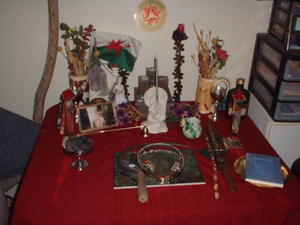
Part of OBOD* training is the establishment and maintenance of a personal altar as part of regular spiritual practice. Here’s a Druid altar spread on a tabletop. Nothing “mundane” or arbitrary occupies the space — everything has ritual or spiritual purpose and significance to its creator.
Such obviously physical objects and actions and their appeal to the senses as aids in spiritual practice all spring from human necessity. We need the grounding of our practices in the physical world of words, acts and sensations in order to “bring them home to us,” and make them real or “thingly,” which is what “real” (from Latin res “thing”) means.
Religions and spiritual teachings accomplish this in rich and diverse ways. We have only to think of Christian baptism, communion and the imposition of ashes at Easter; Hindu prasad and tilak; Jewish bris/brit (circumcision) and tallit (prayer shawl) and so on.
Atheists who focus exclusively on belief in their critiques and debates thus forget the very real, concrete and physical aspects of religious and spiritual practice which invest actions, objects and words with spiritual meaning that cannot be dismissed merely by pointing out any logical or rational cracks in a set of beliefs. Though you may present “evidence that God doesn’t exist” that seems irrefutable to you, you haven’t even begun to touch the beauty of an altar or spiritual structure, the warmth of a religious community of people you know and worship with, the power of a liturgy, the smell of incense, the tastes of ritual meals, the sounds of ritual music and song.
Just as we hear people describe themselves as “spiritual without being religious” as they struggle to sift forms of religion from the supposed “heart” of spirituality, plenty of so-called “believers” are “religious without being spiritual.” The forms of their spiritual and religious practice are rich with association, memory and community, and can be as important as — or more so than — a particular creed or set of beliefs.
Having said all of this, I’ve had a set of experiences that incline me away from erecting a physical altar for my Druid practice. So I’m working toward a solution to the spiritual “problem” this presents. Let me approach it indirectly. Once again, and hardly surprising to anyone who’s followed this blog or is as bookish as I am, the trail runs through books.
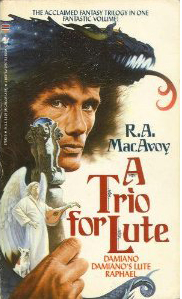
Damiano, the first volume in a fabulous (and sadly under-known) trilogy by R. A. MacAvoy, and recently reissued as part of an omnibus edition called Trio for Lute, supplies an image for today’s post. Damiano Delstrego is a young Renaissance Italian who happens to be both witch and aspiring musician. His magic depends for its focus on a staff, and we see both the strengths and limitations of such magical tools in various episodes in the novel, and most particularly when he encounters a Finnish woman who practices a singing magic.
When I read the trilogy at its first publication in the 80s, the Finnish magic sans tools seemed to me much superior to “staff-based” power. (Partly in the wake of Harry Potter and the prevalence of wands and wand-wielders in the books and films, there’s a resurgence of interest in this aspect of the art, and an interesting new book just published reflecting that “tool-based” bias, titled Wandlore: the Art of Crafting the Ultimate Magical Tool).
So when I then read news of church burnings, desecrated holy sites, quests for lost spiritual objects (like the Holy Grail) and so on, the wisdom of reposing such power in a physical object seemed to me dubious at best. For whatever your own beliefs, magic energy — whether imbued by intention, Spirit, habit, the Devil, long practice, belief in a bogus or real power — keeps proving perilously vulnerable to misplacement, loss or wholesale destruction. Add to this Jesus’ observation that we are each the temple of Spirit, and my growing sense of the potential of that inner temple of contemplation — also a feature of OBOD practice — and you get my perspective.
Carrying this admitted bias with me over the years, when I came last year to the lesson in the OBOD Bardic series that introduced the personal altar, I realized I would need both contemplation and creativity to find my way.
My solution so far is a work in progress, an alpha or possibly a beta version. My altar is portable, consisting of just five small stones, one for each of the classic European five elements — four plus Spirit. Of course I have other associations, visualizations and a more elaborate (and still evolving) practice I do not share here. But you get the idea. (If you engage in a more Native-American nourished practice, you might choose seven instead: the four horizontal directions, above [the zenith], below [the nadir] and the center.)
I can pocket my altar in a flash, and re-deploy it on a minimal flat space (or — in a pinch — right on the palm of my hand). One indulgence I’ve permitted myself: the stones originate from a ritual gift, so they do in fact have personal symbolic — or magical, if you will — significance for me. But each altar ritual I do includes both an invitation for descent and re-ascent of power or imagery or magic to and away from the particular stones that represent my altar. Lose them, and others can take their place for me with minimal ritual “loss” or disruption. Time and practice will reveal whether this is a serviceable solution.
This post is already long enough, so I’ll defer till later any discussion of the fitness of elemental earth/stone standing in for the other elements.
/|\ /|\ /|\
*OBOD — the particular “flavor” of Druidry I’m studying and practicing.
On first sight (or much later, depending on the particular script we’re following), the world can be a forbidding place. We all go through emotional and psychological winters at times. Nothing seems to provide warmth or comfort, so we hunker down and endure. And we can get so good at this kind of half-life that we mistake merely surviving for full-hearted thriving. Well-meaning friends or family who try to console us with various messages of hope or endurance (“This too shall pass”) can’t budge us from our heaviness.
The hidden changes implicit in the imminent shift of energy and consciousness which Druids symbolize and celebrate in Imbolc also find expression in the starkly beautiful lines of “First Sight” by British poet Philip Larkin.
First Sight
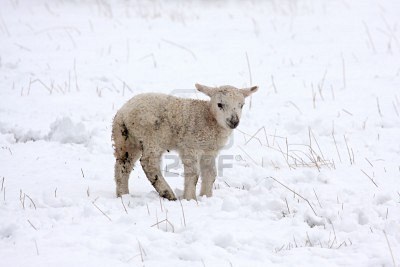
Lambs that learn to walk in snow
When their bleating clouds the air
Meet a vast unwelcome, know
Nothing but a sunless glare.
Newly stumbling to and fro
All they find, outside the fold,
Is a wretched width of cold.
As they wait beside the ewe,
Her fleeces wetly caked, there lies
Hidden round them, waiting too,
Earth’s immeasurable surprise.
They could not grasp it if they knew,
What so soon will wake and grow
Utterly unlike the snow.
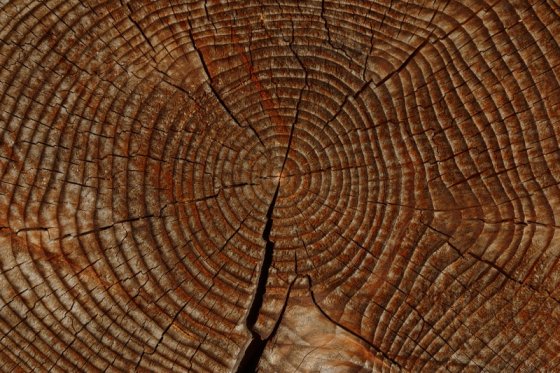
For that is how at least some changes arrive — immeasurable, ungraspable, unlike anything that went before, so that we can’t even anticipate or recognize them ahead of time. Nothing of the past prepares us. The new comes on us “utterly unlike” the present. Only long memory serves to recognize them sometimes, and hail and welcome them — memory often consciously denied to us in one human lifetime, but accessible through dream and intuition and the “far memory” that we may call “past lives” or the “collective unconscious” or the “knower behind the thoughts” or “gut instinct.” This is memory as trees know it, the rings of years that grow into the wood, the cell memory we humans also carry with us, the salts of ancient oceans that pulse in the same proportions in our blood.
This is the promise of light renewed, that miracle we often cynically dismiss but deeply long for, the story we are always telling ourselves: maybe this time, maybe next week, one more year. This marriage, that job, this new chance, here, now, finally, at last.
It’s important to note that this event is not “supernatural” or “religious” in the commonly understood sense of “coming from outside our world” or depending on a deity. We don’t need to look that far, though we’re welcome to if we wish. It is earth’s immeasurable surprise, after all, issuing from this world, this land, dirt under our feet, air that surrounds us, sun on our skin. Put another way, the whole world is telling us “Pay attention!”
Another Irish name for Imbolc is Oimelc — “ewe’s milk.” In the agrarian societies all our ancestors came from, the pregnant ewes have been preparing for the lambs to come, their udders swelling with milk. There are signs of change and renewal all around us, but in our rush towards “anywhere but here,” we’ve often lost sight of and contact with the markers that would center and align us with the natural order of balance and harmony we crave.
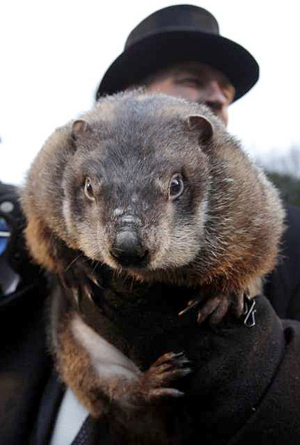
In North America, the equivalent “secular” holiday is Groundhog’s Day, which one way or another says winter will in fact eventually end. Punxsutawney Phil emerges from the earth and his plump hibernation sleepiness to prophesy renewal, either seeing his shadow on a sunny day, or huddling under February clouds as secular augurs read the omens and declare them to the assembled faithful. (We don’t so much abandon ritual and religion as slip it past the censor of the modern and supposedly irreligious mind, clothing it in other guises less objectionable. If you doubt it, take a look at the grand mythologizing that surrounds Phil on sites like this one.)
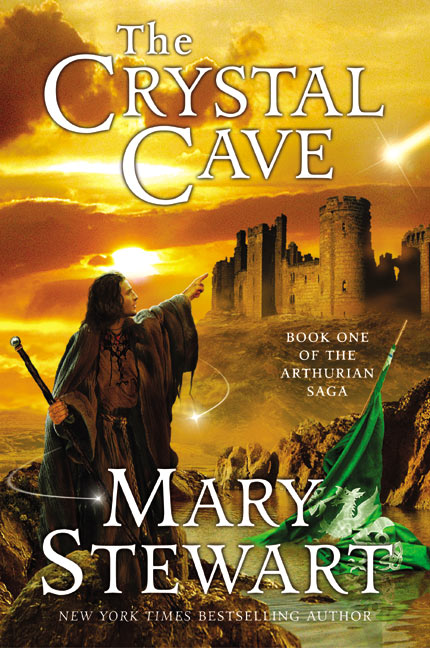
Historical novelist Mary Stewart writes vividly of 500 C.E. Britain in her “Merlin Trilogy,” which begins with The Crystal Cave and the childhood and youth of Merlin the enchanter, who will become Arthur’s chief adviser. Here (1970 edition, pp. 174-5) are Merlin and his father Ambrosius discussing the Druids. At this time, in Stewart’s conception, laws are already in place banning Druid gatherings and practices. Merlin has recently discovered that the tutor his father has arranged for him is a Druid.
* * *
I looked up, then nodded. “You know about him.” It was a conclusion, not a question.
“I know he is a priest of the old religion. Yes.”
“You don’t mind this?”
“I cannot yet afford to throw aside valuable tools because I don’t like their design,” he said. “He is useful, so I use him. You will do the same, if you are wise.”
“He wants to take me to the next meeting.”
He raised his brows but said nothing.
“Will you forbid this?” I asked.
“No. Will you go?”
“Yes.” I said slowly, and very seriously, searching for the words: “My lord, when you are looking for … what I am looking for, you have to look in strange places. Men can never look at the sun, except downwards, at his reflection in things of earth. If he is reflected in a dirty puddle, he is still the sun. There is nowhere I will not look, to find him.”
Of course, anyone who followed this noble-sounding principle to even reasonable lengths would have a very interesting and possibly very exhausting time of it. As I mentioned in my post about Open Source religion, when virtually every human practice with any numinous quality about it can be and has been pressed into service as a vehicle for religious encounter and a means to experience a god or God, then sacred sex won’t even top the list of things a person might do “to find him.”
Yet Merlin (and Stewart) have a point. Spiritual inquiry and practice require a kind of courage, if they are to remain fresh and not decline into dead forms and mere gestures of religion. It is these things that the media quite rightly criticize. When I’m in the grip of a quest, I only hope I can continue to be brave enough to follow out conclusions and — if need be — “look in strange places.” It looks like courage to an observer, but I find that ultimately it’s a kind of honesty with oneself. I want to keep looking. Anything less feels suffocating and aggressively pointless, like painting garbage or eating styrofoam. Any self-disgust we feel almost always arises from living a lie, which poisons our hours and toils and pleasures.
“Things of earth” cannot ultimately satisfy the inner hunger we feel, but they are valuable pointers, sacraments in the full sense, vehicles of the sacred. To return to everyone’s favorite numinous topic, pursue sex of any variety, sacred or otherwise, and you’ll prove again for yourself one of Blake’s Proverbs of Hell: “The road of excess leads to the palace of wisdom.” Of course, along the way, as a witty recent post on Yahoo Answers has it, it may often happen that “The road of excess leads to the All-You-Can-Eat Buffet of Gluttony, which leads to the Bordello of Lust, which then leads to the Courthouse of Divorce, the Turnpike of Bankruptcy, the Freeway of Despair, and finally, the Road to Perdition.” Blake did after all call these the Proverbs of Hell.
We just don’t discuss what comes after Hell. Blake says it’s wisdom. Hard-earned, yes. And there are easier ways, which is one good thing that the Wise are here for. Rather than following any prescription (or Prescriber) blindly, I hope to ask why, and when, and under what conditions the strictures or recommendations apply.
So we return and begin (again) with the things of earth, these sacred objects and substances. As sacraments, earth, air, fire and water can show us the holy, the numinous. Their daily embodiments in food and drink and alcohol, precious metals and gems and sex, pleasure and learning and science, music and literature and theater, sports and war and craft, are our earliest teachers. They are part of the democracy of incarnate living, the access points to the divine that all of us meet and know in our own ways.
Drink deep, fellow traveler, and let us trade tales over the fire. And when you depart, here’s an elemental chant by Libana, well-known in Pagan circles, to accompany you on your going.
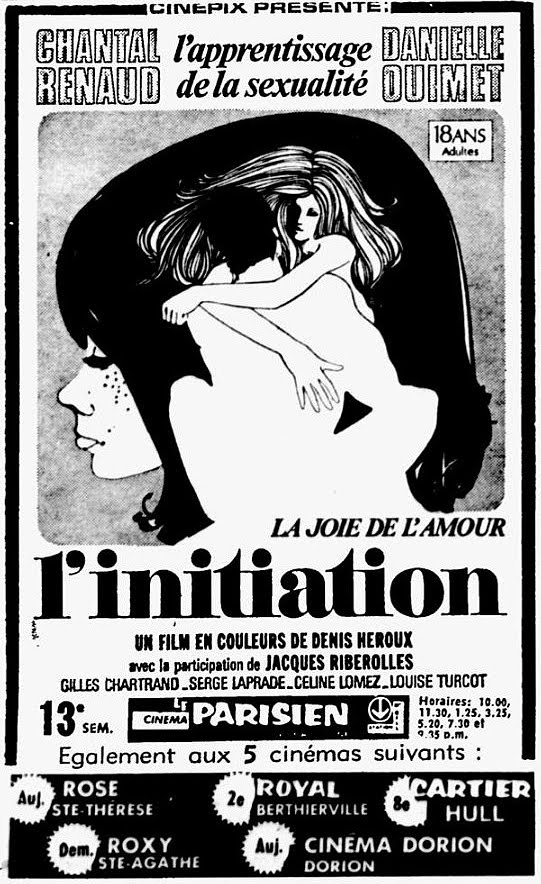
With energies flowing around us from so many end-of-year holidays and celebrations, it seemed fitting to think and write about initiation. It’s one more piece of a Religious Operating System (ROS), it’s an important key to Druidry and — most importantly — it’s something we all experience. For good reason, then, the subject cuts a large swath through spiritual, religious and magical thought and practice. As author Isaac Bashevis Singer opens his book The Chosen, “Beginnings are difficult times.” That’s one reason New Year’s resolutions often end up on the cutting room floor of the film version of our lives. (Some ways to keep them alive and well and not merely part of the special extended version of our lives that may not see wide release into the “real” world will be the subject of a post upcoming in the next few days.)
Some opportunities for initiation recur each year, and are built into our cultures. Right now the festival holidays of Hanukkah, Christmas, Diwali, Kwanzaa and so on are opportunities for annual initiation — if we let their celebrations reach into us and change us. As breaks from “profane” or ordinary time, holidays take us into altered if not sacred space, and then return us to our lives somehow — ideally, anyway — changed. Of course, specific religions and spiritual paths each offer their own initiations. For Christians, it’s baptism (and for Catholics and some other denominations, confirmation as well). A Jew passes through a bar or bat mitzvah, and so on.
But we needn’t look so far or so formally. First kiss, first love, first sexual experience, first drink (consider the particular sequence of these in your own life). Driver’s license, prom, graduation, military draft. Each transforms as a rite of passage. We “pass through” and come out on the other side, different, in ways others may or may not notice. We ourselves may not fully absorb the changes until much later.
As with the kinds of freedom I considered in a previous post, there seem to be both “transitive” and “intransitive” initiations — initiations which enable or empower the initiate to do something — typically in the future — and initiations which recognize a standard or awareness already attained, and put a “seal of approval” on it. Of course these need not be separate. Both kinds can occur simultaneously. Initiation is a “beginning” (from Latin initio “start, beginning”) both a path or direction that another agency, power or person starts us on, and also something one does or experiences oneself.
Some big initiations are inclusive. Like annual holidays, we all experience them. Though we may not often think of it, death — our own, or that of a loved one, or of a public figure with symbolic power, like a John F. Kennedy or a Princess Diana — can be a powerful, transformative initiation. Through the grief and the inevitable breaks in familiar routine that come with the first shock, the family gatherings, the arrangements and the funeral itself, we’re brought to face loss, change, mortality, and endings and beginnings in ways. We may take on new, unfamiliar roles, like caretaker, mourner, survivor, with all the challenge and growth they can bring. The first death we encounter (apart from pets), given the usual number of years between generations, comes almost like clockwork sometime in our teens, with the passing of a grandparent. In the freshman dorm at the boarding school where I teach and serve as adviser, there are four or five deaths of grandparents each year, and all the myriad changes they carry with them for those involved. It’s a close study in family dynamics (and our capacity as advisers to provide support) to witness how kids and their families deal with it all.
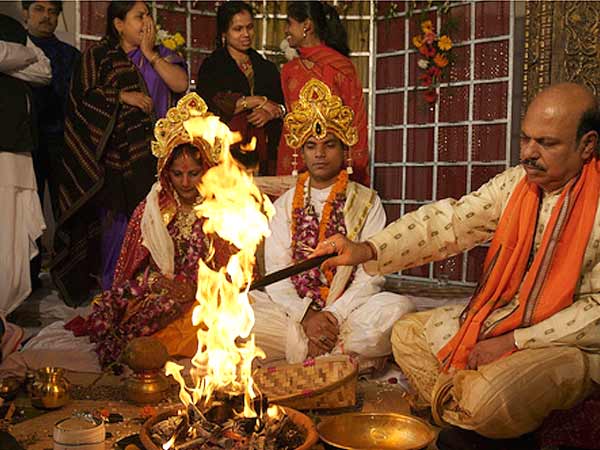
Marriage often seems to occupy a sort of middle ground as far as these categories operate. On the one hand, no one is married in the eyes of either the law or a religious organization until they pass through the requisite ceremony. Yet we all know couples who are already “so married” that the ceremony confers nothing that they don’t already manifest in abundance. In this case, the initiation of marriage simply recognizes and formalizes a connection and a state of relationship that already exists and — if the ritual or ceremony still carries any power — blesses and charges the thing consecrated. My wife and I have two anniversaries, ten days apart, and each conveyed to us different energies. First was a spiritual ceremony by a cleric in our tradition, and second came the state ceremony, performed by a justice of the peace. Interesting, too, who we see as performing or undergoing the initiation. Ideally, to my mind, the one experiencing the initiation should play at least some part, if not an active role, in its enactment. For initiation takes place both outwardly, where it is often witnessed by the state if not also by family, and more importantly inwardly, on the subtle planes (which deserve their own post or series of posts).
“Where is wisdom to be found?” goes the old query. Initiation is one major source. Not all initiations “show” right away, or even ever. What we begin may never end. It can take a lifetime to sort out the effect of even “lesser” initiations, to say nothing of the big ones. Those “long” words, never and always, very much belong with initiations.
One of the appeals of earth-centered religions and spiritualities is their celebration of a world we can see and touch, smell and taste and hear right now. No membership in the right in-group, no attainment of a prerequisite spiritual state, no promised future to wait for. Instead, democratic access to the sacramental gifts of this life: the pleasures of simply being alive, of breathing air (assuming you have decent air to breathe), of eating and touching and loving the things of this world, of caressing the people you cherish, of hearing their voices and enjoying their physical presence. Transient, fragile, time-bound, brief — and all the more dear for that.
At the winter solstice our ancestors knew from studying the sky and watching the sunlight on markers of wood and stone that “when the days begin to lengthen, the cold begins to strengthen.” My father, a dairy farmer, used to repeat the old saying around this time of year with a kind of grim satisfaction. More frozen pipes in the barn, more days the tractors would start only with difficulty, more days to chip away ice and plow snow. But when I talk with my students, mostly dwellers of suburbia and “urbia,” and learn they don’t know this or many other pieces of earth-wisdom, I realize again that I stand as a member of a transitional generation. My parents and grandparents inherited much of the lore and skill of our agricultural past, and have passed a portion of it on to me. But so many of the rising generation have lost most of it.
Anyone can have that curious sensation of “secondary memory” that outreaches one’s own lifetime, grafted on through relatives and ancestors. The only grandmother I knew well was born in 1894, and so I can recall experiences that did not actually happen to me, but which — through her retelling, and with accompanying photos or other artifacts — have assumed the guise of shadowy half-memory, as if they indeed left their imprint directly on my own life and thought and perception, rather than through telling alone. But in the case of hard-earned knowledge of how to live and anticipate change and thrive on earth, they are not the incidents peculiar to one life only, but part of the lore of the tribe.
Solstice feels something like that to me. It’s the oldest pan-human holiday we can discern, predating those of particular cultures and religions by thousands of years. There’s nothing “pagan” about it — it’s a matter of observable fact, rather than belief, as are the equinoxes. Neolithic monuments and markers attest to the reach of such knowledge around the planet. An essay by scientist and author Arthur C. Clarke, the title of which has drifted out of reach of immediate recall, begins like this: “Behind every person now alive stand one hundred ghosts, for that is the ratio by which the dead outnumber the living.” The first time I read that, I felt a delicious shiver of mortality and awe. Yes, the ratio may have shifted (though I hope never to live on a world where that proportion favors the living over the dead — imagine for an instant the conditions that implies), but the image endures. And of those assembled dead, perhaps half or more knew and celebrated the solstice. For five hundred or a thousand or more generations, people acknowledged the shift of the planet in its relation to the sun. The southern hemisphere of course complements the northern in its seasons — their summer is well-launched, and now the days begin to shorten. The body knows these shifts, while the mind may take its own interval to catch up. We feel such changes in our bones, on our skin. In a couple of weeks, by mid-January, the change shows more clearly. Morning and evening commuters will enjoy more light, and the year turns.
Another of the keys, then, to connect to my previous post on a Religious Operating System, is lore itself: the knowledge of cycles and patterns we can measure and demonstrate for ourselves. No need for the fascination and hysteria surrounding 2012 and the supposed End of the World “predicted” by the Mayan calendars. Does no one remember Y2K?! Or any of half a hundred “prophecies” of the end over the last few millenia? The Maya were simply engrossed in the measure of time, and by their reckoning one major cycle ends and another begins. Their obsession made for precise astronomical reckoning. Changes are coming, certainly. Have they ever not come?
Lore includes some dross and superstition, which can almost always be dispatched by dint of careful observation and experiment. And while some generations may forsake the wisdom which their ancestors long thought worthy of preservation, it is — eventually — recoverable. If the peak- and post-oil folks are right, we face a sharp decline in material wealth and technology powered by a rapidly diminishing supply of cheap energy, and not enough people now know how, or are prepared, to flourish as people did for most of human history: wood fires, gardens and food animals, home remedies, animal and human labor, solar and wind power on a modest scale. But little or no electricity, or any of the hundreds of devices it powers, or petroleum products and technologies. We live with a false sense of security, as if the entire West were one large gated community. All it takes is a power outage of a day or two, as happened with Hurricane Irene for so many, to cast us out of our ease and return us to the human experience of all generations until the last few. We could see the real “99%” as all those who lived before the last century and its admittedly artificial standards of material luxury and abundance for a portion of the planet. But the solstice includes those hundred ghosts and the living, all witnesses of the day that signals the return of light and hope to the world. May it bring those things to you.
/|\ /|\ /|\
The solstice for the U.S. actually takes place at 12:30 am Eastern Standard Time on Thursday 12/22. So calendars favor the majority — for all but the east coast, the Solstice is indeed today rather than early tomorrow morning.
Those inclined to criticize contemporary Druidry have made much about how the specific practices and beliefs of ancient Druids are forever lost to us simply because they left no written records, and because the references to Druids in the works of classical Greek and Roman authors are mostly based on secondhand accounts and sometimes markedly biased. Without such historical continuity, they claim, it is impossible to be a “real” Druid today, and thus all contemporary Druidry is a kind of whistling in the wind, at best a version of dress-up for adults. But what such writers and speakers often forget is the surviving body of legend, myth, teaching and wisdom in Celtic literature. Here is Druidry in compact and literary form, meant to be preserved as story, a link-up with the perennial wisdom that never dies.
To pick just one example, the stories from the Mabinogion, the Welsh collection of myth, legend and teaching have wonderful relevance and serve as a storehouse of much Druid teaching. Sustained meditation on these stories will reveal much of use and value to the aspirant after a Druidry that is authentic simply because it is grounded in knowledge and practice. As a pragmatist more than a reconstructionist, I’m much more interested in what works than in what may be historically accurate. The former leads one to inner discoveries. The latter is engaging as a worthwhile scholarly endeavor first, and only as a possible source of spiritual insight second. And that is as it should be. History is not spirituality, though it can inform it. But even if we can accurately deduce from an always incomplete archaeological record what a Bronze Age Druid may have done, it’s still not automatically fit and appropriate for a contemporary 21st century person to adopt. That’s a decision we must make apart from the reconstruction, which cannot guide us by itself. Stories, however, though formed in a particular culture, often reach toward universals far better than physical objects and actions.
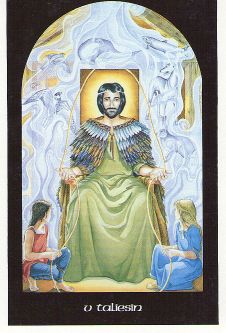
The story of Taliesin (this link is to a public domain text — more modern and well annotated versions are available) in the Mabinogion moves us into a world of myth and initiation. In the tale, the boy Gwion passes through ordeals and transformations, becoming at length the poet and sage Taliesin, whose name means “shining brow” — one who has a “fire in the head” and is alive with wisdom and poetic inspiration. As with figures from other traditions whose heads are encircled with halos, or shining with an otherworldly brightness, Taliesin belongs to the company of the “twice-born,” who have fulfilled their humanity by making the most of it. In my next post, I’ll talk about the first key in the story — persistence.
/|\ /|\ /|\
First image is a triskele or triskelion, a pan-European symbol associated with the Celts.
Second image is of Taliesin from Caitlin and John Matthews’ Arthurian Tarot.
“Behold, I send you forth as sheep in the midst of wolves: be ye therefore wise as serpents, and harmless as doves.” (Matthew 10:16)
A regular menagerie of a sentence! Sheep, wolves, serpents and doves. If inanimate things like stones can testify to divinity (see previous post) and proclaim truth in the face of human delusion, then certainly birds and beasts can do the job, too.
Here Jesus is admonishing his followers, as he commissions them to spread his teaching, that the world is full of wolves. His disciples won’t appear on the scene with an army at their beck and call. They don’t carry letters of introduction, or a case of free product samples to tempt the potential client. No email blast or flurry of tweets precedes their arrival. No, if they’re to succeed, they’ll need specific attributes which he characterizes as the wisdom of serpents and the harmlessness of doves. And note that you can’t transpose those qualities; who would welcome a person “wise as a dove” or “harmless as a serpent”?! Bad advertizing. It’s a recipe for disaster. But more importantly, would serpent-wisdom and dove-harmlessness actually work? Hold that thought.
A persistent tradition in the UK at least eight centuries old has Jesus spending some of the “lost” years — between his appearance in the temple at 12 and the start of his public ministry around age 30 — in Britain, studying with Druids. William Blake, associated with revival Druidry during his lifetime in the 19th century, penned the famous hymn “Jerusalem” (this version hails from the last night of the ’09 Proms, a popular annual summer music series in the U.K.). The lyrics were put to music about a century later, and the piece has become a perennial favorite, a kind of unofficial British national anthem:
And did those feet in ancient times
walk upon England’s mountains green?
and was the holy lamb of God
on England’s pleasant pastures seen?
These lines of the opening stanza seem innocuous enough, if fanciful. A Middle-Easterner would surely have it rough during a British winter — it isn’t always “green.” The tradition continues from there, claiming that after Christ’s death, Joseph of Arimathea (who provided a tomb for the body) either sent part of the Grail to England, or made the journey himself and founded a church in Glastonbury, or planted there a thorn tree long venerated as holy.* Whatever the truth of these events, it makes for a striking symbol and image.
But Blake continues, and this is when his poem turns odd:
And did the Countenance Divine,
Shine forth upon our clouded hills?
And was Jerusalem builded here,
Among these dark Satanic Mills?
Bring me my Bow of burning gold;
Bring me my Arrows of desire:
Bring me my Spear: O clouds unfold!
Bring me my Chariot of fire!
I will not cease from Mental Fight,
Nor shall my Sword sleep in my hand:
Till we have built Jerusalem,
In England’s green & pleasant Land.
As a proto-Druid, Blake gets his ecological digs in here: the “dark Satanic mills” of the early industrial revolution are already at work spewing smoke and ash over London. While most Druids today have no intention of attempting to “build Jerusalem in England’s green & pleasant land,” the song brings divinity one step closer. Who complains if some versions of our ancient history bring with them a delicious shiver of magic or imaginative religious reconstruction? But is the way to achieve divinity on our shores through “mental fight” and metaphorical battle? The sudden shift to the quadruple imperative of “Bring … bring … bring … bring” summons up images of a bronze-age charioteer. But what of the “arrows of desire”? Here the image is of Eros, Cupid, the piercing quality of sudden strong feeling. Is it the poet speaking as “I” in the last stanzas? Or as someone else? Is it Blake’s idea of Jesus?
You may not remember, but I asked you a few paragraphs back to hold the thought of serpent-wisdom and dove-harmlessness. Some of the “wisdom” accrues from the belief that serpents are uncanny beasts, for they are able to shed their skin and achieve a kind of rebirth or immortality. And the serpent in the Garden that haunts the Western pysche tempted Eve not to the Tree of Life (Eve! EVE!! The other tree! Eat from the OTHER tree!!) but the Tree of Knowledge. As I tease my students, “Major mistake. Become immortal first, and then get the knowledge of good and evil.” The harmlessness of doves is less problematic. Though city dwellers may have their foremost associations with pigeons as flocking beggars in parks, or as producers of statue-staining and public-building-defacing birdshit.
But consider again. If you know something — I mean really know something of life-changing power — you need to come across as seriously harmless. Otherwise people have this nasty tendency to string you up, burn you at the stake, remove the supreme discomfort of your ideas and presence at all costs. Your wisdom puts you in mortal danger. So reassure people first, and work your changes quietly, harmlessly. A major piece of strategy! Some devious or disgusting trick you’d expect to discover about that other political party — the one you don‘t belong to and affect to despise as the epitome of all things vile and loathsome. Is that why this year’s political reality-show contestants (I mean presidential candidates) come across as less than competent? (Repeat after me: “All candidates vile and and loathsome, all con-men big or small, all morons foul and putrid, Democrats/Republicans have them all!”**)
So animals embody a divinely-commissioned strategy for survival. The wisdom of the serpent, long despised, is not dead, but sleeps in each of us, waiting the touch of the divine longing to rouse and waken it in the service of life. The son of God (we are all children of the divine) summons it forth from us. It lives, tree of knowledge and tree of life united, identical, twining its way around our hearts, which know — when our heads deny it — which way to go, what we need, where to find answers others say are “forbidden” or “not for mortals to know.” On the contrary — they’re specifically intended for mortals to realize.
/|\ /|\ /|\
*The Glastonbury thorn has lately made headlines. It (there are actually several in the area, believed to spring from a single parent) was hacked down two years ago this month (with some historical precedent, if you read the article) and then recovered enough by March of 2011 to put forth a new shoot. Another demonstration, as if we needed it, that old things do not just disappear because we hack at them or find them out of place or inconvenient. They have a habit of return, of springing back to life. Another habit from the natural world for us to imitate …
**This uncharacteristically acerbic side-note is not part of the actual blog.
“And some of the Pharisees from among the multitude said unto him, Master, rebuke thy disciples. And he answered and said unto them, I tell you that, if these should hold their peace, the stones would immediately cry out.” (Luke 19:39-40)
What shall we do till the stones start to speak,
or whom can we turn to and trust in these days?
Can we hear even echoes of truths that we seek,
catch mere flickers of fire to illumine our ways?
The stones broadcast secrets we now scarcely hear —
the earth bears true witness, though leaders stay mute,
to remind us of love that is stronger than fear.
Goal and path rise within us — there’s no other route.
The animals know much — in each neighboring eye
is the ghost of the knowledge hard-won from their days:
make the most of each moment, for this body will die —
tomorrow’s new compost, though it shouldn’t amaze
us when walls turn to doors: we walk through them to find
the doors of our hearts were more narrow by far.
Trust the paint-box you’re given, though your dear ones are blind,
though your culture berates you, fear sets up a bar.
We must watch as we journey, be mindful of stones
that mumble or shout, rousing sleepers to wake.
Learn to feel the right path in the set of our bones,
trust the deep self to know the next step to take.
OK, indulge me in a fit of professional pique. Grr. And afterward, having carefully checked my counterpoints below, show me where I went wrong. Until then, my case stands against careless authors and bad linguistics.
I spent undergrad and grad years studying linguistics, both in class to get degrees, and on my own, to “follow the bent of my genius, which is a very crooked one,” as Thoreau says of himself.
So when any published authority who should know better does a bad job with linguistics, it provokes my ire and righteous indignation. Stings me to creative invective, expressed in various naturally-occurring and invented languages. If you’re a fan, think Firefly and Joss Whedon‘s creative use of “gorram” and Chinese for the characters when they need a good brisk curse to capture their feelings that won’t get censored by feckless Anglo censors. (So I slightly misused feckless. It’s such a great word, I’m automatically forgiven. Why isn’t there a feckful?!)
When it involves an attempt to set the record straight about Druids, we particularly need careful scholarship, along the lines of Ronald Hutton, whose consistently excellent and thoroughly researched books shrink Romantic inflation, while leaving the essential mystery. In fact, that could be a definition of mystery: what remains intact, even more vital, after the facts have been established. Mystery isn’t obscurity, but a depth beyond easy ratiocination. It transcends language, though intuition and imagination are both on to it. It’s home turf for them.
People believe all kinds of nonsense about language, and often on flimsy evidence — perhaps because in the West, most people know only one language, so the ways of them durn furriners will always be inscrutable — not a true mystery, but the consequence of mere ignorance.
A classic example I’ve cited before: “Samhain is the Celtic god of death.” It really isn’t, but people get seduced by the appearance of authority and mistake it for the real thing. This is reminiscent of Kipling’s Monkey People in The Jungle Book: “If we all say so, it must be true.” The linguistic falsehood is still reprehensible, but it’s understandable here in propaganda like the anti-Pagan tract in which this Samhain citation appears.
On to the source of my wrath.
A Brief History of the Druids by Peter Berresford Ellis is a necessary book, providing analyses of evidence for an understanding of Druidry that aren’t available in print elsewhere. He’s cited as “a foremost authority on the Celts,” is the author of half a dozen books on the Celts, and for the most part deserves this accolade and others.
But …
How is it, then, on page 96, that he can foolishly, carelessly assert that “the very word Teutonic is derived from the Celtic word for tribe, tuath in Irish”? This is simply wrong. “Teutonic” comes from Latin teutonicus, and refers to the Germanic tribes. The cognate word — the “sister word” in Germanic, because both Celtic and Germanic are daughter languages of Proto-Indo-European (PIE) — is thiudan-, related to King Theoden in Tolkien’s Lord of the Rings, and Deutsch, the German word for ‘German.’ However much Ellis would like the sound laws of PIE to reflect his desire for Celtic to be the mother tongue, they don’t and it’s not. Neither is Germanic, of course. However, Proto-Indo-European IS. And Ellis knows this, but lets his carelessness sway him into a baldly wrong, and worse, misleading assertion. The Celts indeed contributed much to Germanic culture, and that includes words as well as objects, but tuath isn’t one of them.
Here’s another example among others from this one book. On page 111, once again, Ellis wants Celtic to rule the roost. “When we turn back to Medb we find that her very name means ‘an intoxicating liquor’, [sic] and is the origin of the English mead.” And once again, the Irish medb and the English mead are cognate, or “born together,” from PIE *medhu. The English word doesn’t derive from the Irish. Both however do descend from the same parent — and that is PIE. [The * indicates a linguistic reconstruction.]
One instance of such false derivation in a scholarly work is possibly a “mistake” or oversight. Several instances become part of a consistent pattern of misuse of scholarship in the service of an agenda. It makes me question and doubt his other claims (not a bad thing, says my inner rebel; find out for yourself); and he gives just enough evidence to convince someone who doesn’t know enough about historical development of the Indo-European languages generally, and Celtic and English specifically, to challenge his assertions. It sounds right. But it isn’t. Boo — hiss!
Not the end of the world. But shoddy. Very shoddy. OK, enough ranting. <end rant>
Thank for indulging. Back to your regularly scheduled program.
/|\ /|\ /|\
Nano update: hit the 20,000 mark — in fact, passed it last night, with 20177 words. Somehow this feels more substantial in many ways than passing the 10K mark, which seemed such a milestone at the time — not merely twice as many words, but a kind of undeniable solidity or substance that can’t be denied or dismissed. Got some new (potential) characters, too, knocking to be let in. Will have to see whether this story needs an incubus to muddy the waters, or a preacher bent on saving Nick (Alza’s “chosen”), or a girlfriend (and second succubus?!) for Nick’s best friend Paul. Anyway, onward …

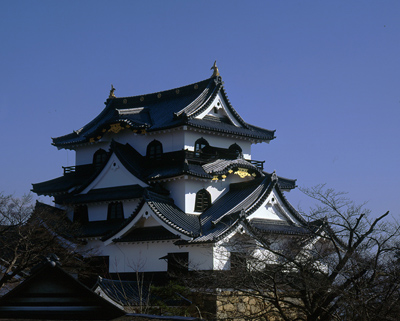 Almost two decades ago now, in the early 1990s, my wife and I lived for a year in Hikone, a medium-sized city in central Japan, about an hour’s train ride north of Kyoto. The city’s most visible claim to fame is Hikone Castle, a 380-year-old wooden fortress that dominates the downtown skyline. But the most enduring memory I took from Japan and have never forgotten is the profound impression of its many Shinto shrines — roughly 80,000 of them, according to various sources — that dot the landscape and invite the casual visitor as well as the reverent worshiper. I usually found myself somewhere between the two. But this wasn’t ever a problem. Visitors, including foreigners, are welcome.
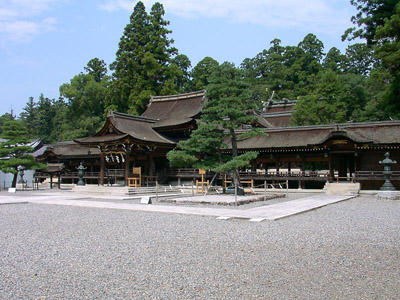 Shinto shrines are impressive for their openness. Many (especially the smaller and rural ones) are free to visit (though of course donations are gratefully accepted), wonderfully peaceful, and lovingly tended. Not once did I see any graffiti or vandalism in the dozen or so shrines I frequented, in either countryside or city. Often enough I was the only person present, which allowed for a meditative experience of the grounds and atmosphere. Here’s a shot of the entrance to Taga Taisha, about 20 minutes from our apartment in Hikone.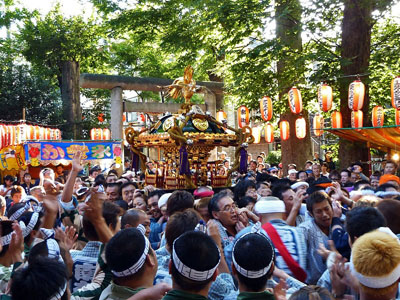
 Thus, natural objects pervaded with kami often receive a small marker shrine and sometimes other identifying signs, like at Hatagoiwa just off the coast in Ishikawa prefecture. Note the rope linking the large ocean rocks, as well as the small red shrine atop the larger rock.
 Shinto focuses on practice more than belief. One of its key practices is purification, so that we can participate in the world of the kami more consciously and harmoniously. For that reason, the entrance to a Shinto shrine typically includes a temizuya (literally “hand-water-spot”) or basin for ritual washing before proceeding further. Here you can see the basin and the bamboo dippers for washing.
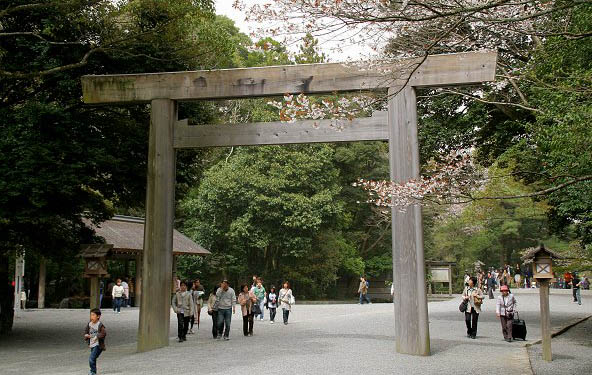 The marker signalling the sacred space of a shrine is the torii gate, through which all visitors pass. The torii may be simple, like this wooden one at Ise, one of the oldest and most famous shrines.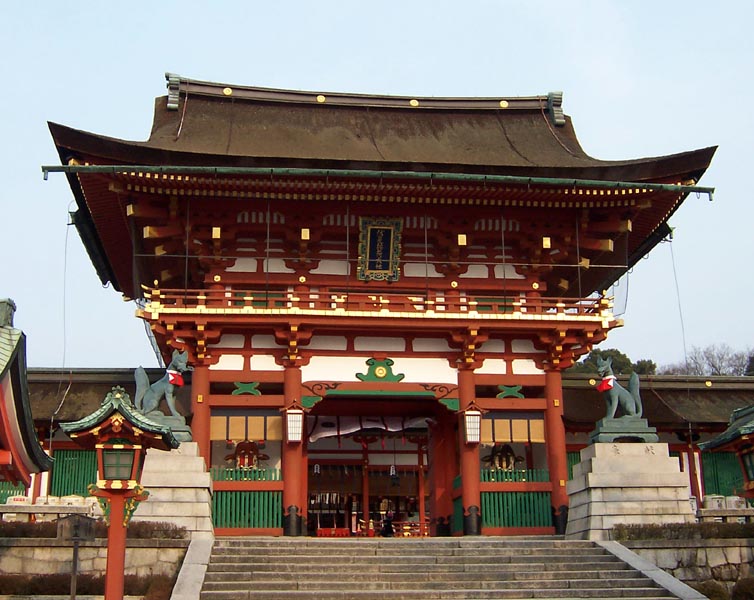












 A Druid Way