No need this morning to look far for what first strikes the eye: fog outside, and a window-screen in the foreground. As with our own human consciousness, what’s up front and in our faces draws the camera’s auto-focus to the screen, in spite of one shot (in a series of attempts) where I thought I’d finally gotten the camera to focus on distance. Probably could have, too, if I knew my camera better. When the human eye focuses on distance, the screen blurs and fades. Right there is a whole chapter of spiritual practice, attention and mechanical behaviors. Where’s my focus? What am I looking at? I decided the indoors version with the foregrounded window screen should stay — it was still offering something to think about further.
Fog-weaving, and awareness. With temps well above freezing, and enough snow to melt and turn to low-hanging mist, it was a perfect day to drive in and out of banks of fog as the elevation changes in our Vermont hills. Often it’s easy to slip into altered states of consciousness, walking a fogged-in landscape. Driving through one, it’s much less safe to try!
About a year and a half back, I wrote about fogweaving with Lugh while climbing our local Mt. Ascutney:
Fog-weaving at such times needs so little effort. The climb quickens the breath, and the cool air is lush with oxygen. Without the chatter of any human companion as a distraction, and with the fog collapsing the field of vision to just a few dozen yards in any direction, your attention narrows in on step after deliberate step. Light trance comes on like cloud itself. Without thought you can slip through to the “realm next door” between one step and the next, and you may sense the god dreaming on the peak. And rather than needing human action or imagination to weave or conjure vision, the fog itself curtains or reveals what is already there.
Awareness is a tricky thing: we move each day into and out of so many different kinds of awareness that we often don’t notice they’re best for different purposes — they’re most definitely not interchangeable. Or as I try to explain this phenomenon in the page on Magic:
… each day we all experience many differing states of consciousness, moving from deep sleep to REM sleep to dream to waking, to daydream, to focused awareness and back again. We make these transitions naturally and usually effortlessly — so effortlessly we usually do not notice or comment on them. But they serve different purposes: what we cannot do in one state, we can often do easily in another. The flying dream is not the focus on making a hole in one, nor is it the light trance of daydream, nor the careful math calculation. And further, what we ordinarily do quite mechanically and often without awareness, we can learn to do consciously.
With the tickle of a dream the previous night to set the tone, I woke with another dream in my head early this morning: I have a son who’s seeking me out.
(In the category of “too much info” but helpful context: it’s even possible such a child exists. My graduate school girlfriend turned down my marriage proposal, warned me she’d never tell me even if it turned out she was pregnant, and on that note I opted to leave the U.S. and the whole intolerable situation in the fall of 1987 to teach in China. We haven’t been in contact since. So — to cut short any further confessions — I woke this morning wondering, yet again, what the dream could be saying.)
Looking up close, I see screen. Focusing on the distance, I see fog. Where’s my focus?What am I looking at?
A dream this morning. I haven’t been sleeping well for the past several days, but with that wakefulness, it’s been easier to catch and record dreams before they fade into the next sleep cycle of the night. In the dream I’m trying to cross a stream flowing through a forest, but it takes me a bit until I find stepping stones, and even then, the first one’s half-submerged. The stream’s neither wide nor deep, but for some reason in the dream I don’t want to get my feet wet. The water runs very clear, and I know in the dream there’s something — what it is I can’t tell — something unusual about the forest.
Then this morning as I’m going out to fetch wood for the two fires, house and studio, I need to start: hornet’s nest on the eaves of the woodshed. I wasn’t thinking about this Omen Days practice until almost the moment I looked up, and then there it was. A nest of gray paper, empty now, but mostly intact, a season’s work to build a growing house that entomologists say the hornets almost never return to for the following year. In the photo everything’s shades of gray, though it’s a color shot: even the evergreen in the background comes across in black and white, rather than green.
Now it’s certainly easy enough to argue yourself out of as well as into a divination. There’s a kind of trust involved, that the universe really does talk to us, and not just through such crabbed and sometimes tortuous means as a divination can be, or as we can make it with all our second-guessing — the cosmos talking constantly, ceaselessly — wind in the trees, birds, beasts, clouds, our own skins, those touch-points where we seem to end and Everything Else begins, though we intermingle like high school students at a formal dance, awkwardly sometimes, though sometimes with heat in our blood. “How can we tell the dancer from the dance?”
Crossing a stream, leaving a house: like most signs and symbols, they mean best when they “mean personal”. You could, I suppose, go look them up in a symbol dictionary, the kind that sells for a couple of bucks in the checkout line at the grocery, or a pricier version summoned from deep in the bowels of Amazon. But why would I want somebody else’s take on what is, after all, mylife? I’m not mocking the impulse, only reining it in. Live a few decades, and your own hand-made symbol dictionary is better, for you, than anyone’s.
Like any good mount, a dream-interpretation horse, or a symbol-horse, needs a sensible rider, or what use is riding at all? I might as well walk. I can, it’s true, just let the animal-self roam free, and there are excellent times and places for that, too. (Take your animal guide for a run, if you haven’t done so recently. Mine’s sure eager for it.) But right now the journey asks the best of both of us, and so I ride my symbol-horse, and my horse carries me. Leaving a house can signify death, but just as important, transformation, and growth: the hermit-crab outgrowing the old shell and moving into a newer one — vulnerable during the change, true, but doing what it does, what it needs to do to live at all. And where is it, specifically, that I don’t want to “get my feet wet”? That’s sure kindling for another dream, another divination, a prayer, especially when I don’t usually pray.
Finding stepping-stones to cross a stream: earlier in the day yesterday, I’d done a tarot divination as a way to gain insight into a character for a novel I’m working on. The significator was the Wheel of Fortune — apt for the antagonist, who’s experimenting outright on his life — as we all are. And for such symbols and signs and communications — since I mentioned Dickens in the previous post, then I’ll invite him, since it looks like he’s along for the ride anyway — we can ask Scrooge’s question in A Christmas Carol: “Are these the shadows of the things that Will be, or are they shadows of the things that May be only?”
As with most divinations, if we think we’re asking a question of the future, then we get what we understand to be the future’s answer, which may be useful or not, or hard to read, or no answer at all. Scrooge has met with “ghosts” or spirits of Past, Present and Future, and not one of this Temporal Triad is the sole determining factor. Scrooge himself is. In his experience, the future gives no “answers”, but shows the shadows of things that are even now taking shape. These, in turn, interact with all the Ancestors have left us, and set in our hands for an inheritance.
/|\ /|\ /|\
This picture from a couple of days ago, looking out across the stone in our yard, reveals ice-sparkle I couldn’t see without the zoom that focuses this image. To the naked eye it’s a general glow. But this is hawk’s view, more sharp-eyed than I am unaided, without the help of lenses and devices — our human-craft. A different kind of divination, like the signs and symbols available when we look with a microscope, or telescope, or listen with a telephone, or stand in ritual and attend to those without skin on who just might have something to say to those of us wearing it for the moment. Look differently, and see anew. Every sense whispers “Try this”.
Earlier today my co-admin Steve on the Druid and Christianity Facebook group posted this link to one of Caitlin Matthews’ blogposts from several years back about “Omen Days” — the southern Celtic (Wales and Brittany) tradition of using the Twelve Days of Christmas for divination. As an intercalary period, one literally “between the calendar(s)”, from Christmas to Twelfth Night or Epiphany on January 6, the days have long been considered “time out of time”, and therefore especially apt for such practices. Like the holy space of a ritual, set aside from ordinary time, the Twelve Days are — or can be — magical.
In some versions of the divination, each day aligns with one month of the year: December 26th with January, December 27th with February, and so on, offering a particular flavor to the practice.
Looking, too, for a link between solar and lunar calendars, it seemed fitting to me to make it 13 days, starting on Christmas Day, rather than just 12 by starting the day-count after, on the 26th. But there is a new moon on the 26th this year, and that can play into any decision.
And when we consider that this period after the solstice is a liminal one, open as at Samhain to the Ancestors and the spiritual realm, it’s worth reflecting on Dickens’ choice to set his “sacred holiday ghost story” of A Christmas Carol during this interval, with its Druidic as well as Christian series of three spirits, and we can enjoy as well such a context for other stories, like those of the Wild Hunt, active in the winter and so around Yule, and the Medieval “Day of Misrule”, the inversion of “normal” order, on Twelfth Night itself.
In the same post, Matthews mentions dvoverie, a Russian word meaning dvo “two” ver–ie “faiths” — or holding “two beliefs”, a word to describe the persistence of an old worldview after the arrival of a new one. (The Russian ver– is cognate with our Latin-derived verity — “truth”. Two truths for one.)
For a while this cultural expression was thought to characterize or be unique to Russia, especially prevalent among folk practices. Think of our ongoing custom of treating the sun as if it rises and sets each day, in spite of astronomical awareness that it’s the earth that moves, not the sun. Though this source go so far as to call dvoverie “an academic myth”, as if dismissing something as a “myth” makes it untrue, rather than simply ahistorical, I’d argue we’re all quite “dvoverian”, and in more ways than we might imagine.
In some Christian circles, it’s true, the lament persists that certain symbols, practices and beliefs are “Pagan”, “not Biblical”, etc. Pagans sometimes return the favor. (Personally, I find such “purity tests” too often lead to sub-optimal results, just like they do for many women today in only slightly different circumstances, and for often similar reasons.) I’d prefer to ask those symbols, practices and beliefs: “Are you worthwhile? Do you grant insight, increase our understanding, grow our capacity for gratitude and love?”
(And lest we too quickly conclude that divination is never a Christian practice, we have only to look at the Apostles drawing lots in order to identify Matthias as a replacement for Judas Iscariot in the Book of Acts, or at ancient practices in Israel. St. Thomas Aquinas among many others exercised himself on the topic in his Summa Theologica.)
Let’s make Omen Days a “dvoverian” experiment.
/|\ /|\ /|\
My divination today follows the practice of asking my question outdoors, then spinning around eyes closed, opening them to the first thing seen, or asking the question indoors and then going outdoors to observe whatever offers itself. In either case, the sign or omen is what first comes to the attention.
“What can these divinations teach me?”
For me it was jet-trail and birdsong — the seen and the heard at the same time. I looked up to see the jet-trail, and then I became aware of the song. The trail had no sound, the song no visible bird. A useful reminder that a single sense rarely provides all the evidence, or any kind of “complete picture” (note the bias toward the visual in such expressions!).
If you live in an urban area near an airport, of course, this may prove no omen at all for you. (That’s why omens are not universal signs, in spite of our best attempts to codify the cosmos.) But in southern Vermont, a plane of any size passing over is unusual. Except for June or July, when the nearest airbase sometimes makes training runs for days at a time over Vermont (and usually seems to halt each time the complaints reach a certain threshold), a flyover merits attention.
The birdsong belonged to a song sparrow, a very common bird, a cheery voice for our northern winters. No, it wasn’t a Raven, or some other bird with mythic weight and portent to weigh down an omen till it crumbles under its own gravity. If I want to push it even a little, I might recall the Gospel verse: “Are not two sparrows sold for a penny? Yet not one of them will fall to the ground outside your Father’s care”.
Here’s a Youtube video of a song sparrow in our neighboring state of New York:
The worlds of human (jet) and animal (bird) need not be opposed, and aren’t at heart separate worlds at all, in spite of our unwise attempts to uphold such a false division. The Song all around and within us keeps rising, in spite of our jet-trails, in spite of our restlessness to be somewhere else other than where we are. We hear it. How can we heed it more fully?
2020: jet-trail and birdsong — a divination of our times.
Much of what I write here is inward-facing. Writing’s a core component of my spiritual practice. For me it’s a vital means of discovery, of turning over an experience or perspective until — often enough to keep me going — it falls into place, takes on a new aspect once it gets put in words, gains a solidity or heft that lets me examine it more clearly, or links up with daily events, the weather, the experience of wearing skin, conversations, dreams, things Others are communicating as they go about their varied lives. Words through these short days and long nights, words that at least sometimes prove useful to you as well, a solstice gift.
to the west, across the road from our living room window
Tonight my wife and I included among our celebrations of Solstice one event we’ve attended for several years running. A local church hosts ‘Into the Silence’, inviting a duo called Coracle to play Celtic-themed music and recorded natural soundscapes like whale-calls, birdsong, coyotes, or — like tonight — “owls with sleet falling”. The music alternates with periods of silence. There’s no introduction or closing, no announcements, in fact no human voices at all, beyond a few whispers, and some creaks from the wooden pews, velcro fasteners and zippers opening as participants settle in. The only illumination comes from a score of candles on the altar that a congregant lights at the beginning, and from a solitary Christmas tree trimmed with tiny white bulbs. In some ways it’s ideal “Druid Church”. The possibility of spiritual encounter feels larger without words.
/|\ /|\ /|\
Now that my wife has finally recovered from a bout of food poisoning, she’s back in her weaving studio. This morning when I went out to start a fire there, the thermometer on the wall read 29 F / -2 C. Considering the last few nights have been below 0 F / -18 C, that’s heartening. It also turned out to be a sunny day, which helped the stove to get indoor temps up to a more comfortable range, so she could work for some hours on her warp.
The pleasure of kindling a fire in the house each day all winter, with a second one in the studio some days, sweeping ash, chopping wood, never diminishes for me. Yes, some mornings like this one, I’m shivering as I begin it, and sometimes the wood takes a while longer than usual to lift the stoves into the most efficient zone where they can burn hot and clean, but the work itself answers the effort. (If you only let her, Brighid blesses it.) As Thoreau quips in Walden,
Every man looks at his wood-pile with a kind of affection. I love to have mine before my window, and the more chips the better to remind me of my pleasing work. I had an old axe which nobody claimed, with which by spells in winter days, on the sunny side of the house, I played about the stumps which I had got out of my bean-field. As my driver prophesied when I was plowing, they warmed me twice—once while I was splitting them, and again when they were on the fire, so that no fuel could give out more heat.
Warmth, a direct connection between labor and result, recovery from illness, sunlight, outside air and snow both cold and dry enough that the coverlet of white powders off when I bang each log against the pile. Pleasures of solstice — gifts, all of them. And when we returned an hour ago from the solstice celebration of music and silence, a sky dotted with the distant fires of stars.
Solstice — sometimes called the “world’s oldest holiday” …
Arthur, the “Christmas King”, because according to some traditions like those established by Geoffrey of Monmouth in his “Medieval bestseller” Historia Regum Britanniae, (History of the Kings of Britain) and Malory’s Le Morte d’Arthur, Arthur’s birth (or death) takes place on Christmas, just as his coronation (and wedding to Guinevere) take place at Pentecost. Alban Arthan, one name for the winter solstice — the “Light of Arthur”, as it’s sometimes translated.
A multitude of holiday carols, because there are plenty, whether or not you’re Christian, to sing and celebrate the season. Like some kind of hemispheric fanboy, I can never resist the Australian adaptation of Christmas to summertime temperatures and kangaroos (“boomers”) rather than reindeer, in the form of Rolf Harris’s 1960 holiday song “Six White Boomers“, with its chorus (according to some versions):
Six white boomers, snow white boomers,
racing Santa Claus through the blazing sun.
Six white boomers, snow white boomers,
on his Australian run.
(This gives the silly, snarky meme “OK, boomer” a whole new feel.)
time of the Oak and Holly kings/image courtesy learnreligions.com
The battle between Holly King and Oak King. (Brothers, enemies, both needed for balance. According to some accounts, they’re servants of the goddess Arianrhod, with the vanquished king retiring to the astral plane until his opposite, victorious solstice.)
Blended traditions that tell how the crown of thorns Christ wore to his crucifixion, and the Cross itself, were both made from the holly. The “rising of the sun” and the “running of the deer” in the ancient carol, “The Holly and the Ivy”:
Antiphony’s gorgeous and light-hearted version of Kim Baryluk’s “Solstice Carol” (and the Wyrd Sisters’ meditative version):
Contrasts. Nowhere in the year is there such a contrast between light and dark, hot and cold — whether you’re on the eve of Summer Solstice and the Long Light, or the Winter, and the Long Dark.
If we change just one of F. Scott Fitzgerald’s words (“longest”) in The Great Gatsby, he has Daisy Buchanan, that quintessential summer person, exclaim, “Do you always watch for the shortest day of the year and then miss it? I always watch for the shortest day of the year and then miss it”. (Those of you in the southern hemisphere can take your Gatsby solstice straight up, summery, and un-revised.)
Because the “Great Eight” festivals of the calendar are worth remembering, let’s not “miss it”, but watch and celebrate the shortest day.
A day the whole planet shapes is one of the gifts of solstice.
Older festivals, and revived ones, acknowledge the otherworldly aspect of the season. The central European tradition of Krampus as the alter ego and companion of St. Nicholas balances the season with a parade of gruesome and frightening figures.
Likewise, the Welsh custom of wassailing with Mari Lwyd, the “Grey Mare”, is equal parts festive and otherworldly. Here’s one of the traditional Welsh songs, “Mari Lwyd”, by Carreg Lafar:
The first lines announce the wassailers:
Here we come
Dear friends
To ask permission to sing …
And here’s a very impromptu and lively short clip of outdoor singers and answering singers indoors:
We can say that such human responses to the seasonal change are another gift of the solstice.
The third gift is the monuments that cultures and civilizations have built worldwide to mark and commemorate the seasons — especially the solstices and equinoxes. Standing stone complexes like Stonehenge, menhirs, passage tombs like Newgrange, earthworks like Serpent Mound, and so on all celebrate and commemorate a planetary event many have long recognized as significant.
Here’s a 2013 video of the creation and lighting of a labyrinth made from 2500 tea-lights at the Holy Cross Church in Frankfurt am Main, Germany:
I’ve found there’s so often a link between “finding something to write about” and paying attention to whatever might be my spiritual “work of the day”. Start with one, and the other follows you like a stray, till you take it home and make it a member of your household.
These things circle back on themselves, or more accurately — like so much else — they spiral. They’re not exactly the same each time they reappear, because we’re not the same. No point in a lesson about something I’ve mastered, when there’s so much else a dream could tackle. (Yes, I’m a big believer that our dreams are intelligent and insightful, in spite of our best efforts to ignore them — maybe because we try to ignore them.)
I had a recurring dream throughout my 20s of being back in high school. This kind of thing — a dream-revisiting of a supposedly finished part of our lives — isn’t uncommon. (The worlds interweave much more than we often understand.) Even in the dreams, I often felt blocked, frustrated, sometimes knowing I’d already graduated, but was back because of unfinished business. Sometimes I recognized other people in the dreams, sometimes not.
I kept asking for clarity and resolution, and eventually I did “go back to high school”: I taught in one for a decade and a half. The dreams stopped shortly before the job offer came through: I finally graduated in one dream, years older than my dream classmates. Even in the dream I felt a vast sense of relief.
I’ve come to see that the past wasn’t the only thing I had to deal with. The dreams were offering preparation for the future, too. But it took re-reading of my dream journals from that period to make these connections, the shifting patterns of dozens of high school dreams, to understand part at least of what was happening.
The title of this post, “Winning the Dream”, is partly to point out (to myself, as much as anybody) how badly “winning” fits either our dreaming or waking selves. We dream the same way we live, not to beat off all competitors (though up to a point anyone can pursue this interesting but ultimately exhausting set of life choices), but because we’re here, and this is what we do. To live, to dream, with the awen thrumming in your blood is an amazing, daunting, humbling, unmissable thing.
/|\ /|\ /|\
Sometimes, the best transition is no transition at all. One minute you’re asleep, the next you’re awake. My dream, and my life, both leave it to me to figure out.
I suspect — one of my favorite words (rather than “believe”) — that awen is the link here — awen and genius. To work with these two (the same thing?) is to be what the Welsh call an awenydd (ah-WEHN-eeth) — one in touch with spirit: “Spirit energy in flow is the essence of life”, as Emma Restall Orr puts it in Living Druidry (Piatkus Books, 2004).
/|\ /|\ /|\
Genius. Funny word, much changed from its early sense compared to how we commonly use it these days.
Here’s a sample of the older usage, from Dickens’ A Christmas Carol. Scrooge is walking home in the evening shortly before Christmas:
The yard was so dark that even Scrooge, who knew its every stone, was fain to grope with his hands. The fog and frost so hung about the black old gateway of the house, that it seemed as if the Genius of the Weather sat in mournful meditation on the threshold.
In such older usage we hear something of the Latin origin of the word — genius as “spirit”, as in genius loci, or “spirit of place”. Places, families, individuals each had their associated genius or spirit. (Nowadays we might be more likely to say “atmosphere”, or “vibe”.) From there the meaning of genius grew to include a person connected to an especially impressive spirit — one way others could explain a person of exceptional talents, gifts, virtuosity, or unusual ability. Genius came to mean “great talent”: She’s a genius in the lab. And now it’s also an adjective, common in memes and advertising: Try this genius solution to all your storage challenges!
But if you and I and everybody else enjoys an associated genius, we might be wise to check in first with the genius each of us has, rather than chasing after ones that aren’t native to us. (In fact, as I look at my life, I could well characterize most of its events as a study in either chasing non-native genius, or checking in with native genius.)
Different traditions give the genius a frequently confusing range of names — guardian angels, daemons, jinn, and so on. Some of the more polarized traditions may label the spirits of other traditions as unequivocably evil, though they often viewed their own entities as a much more mixed bag. Acceptable former gods become saints, and vice-versa, while others get tarred with the label devils. (A god or goddess survives if they can ride such changes over centuries and millennia, and work creatively with openings when they arrive.)
/|\ /|\ /|\
Yesterday morning the hospice client I work with (scroll down to section 4 at the link, if you’re interested) was talking again about labyrinths as spiritual tools, and remarked, “You can only access the wisdom of place if you know the place you’re in”. Everything we experience is real, you might say, putting it another way. We just need to determine which world it’s real in. It doesn’t fit here? Change the this-here to other-here and it just might snap into place, complete the puzzle, fill in the mozaic, carry the melody to its close.
Know the place, know the person, and you know a great deal about the genius, or governing spirit.
In many ways, then, “winning the dream” means know the genius of whatever you’re doing, where you’re at, what you’re into.
Five questions for sussing out genius:
1) What spirit is driving it? Is it something familiar, something I’ve worked with before? Or something new? A song came through last fall, and I don’t do songs. But maybe that’s the point: it’s time to start singing. A new way spirit is striving to get through, to express what it is, what I am. Or I’m thrown in with people I normally wouldn’t talk with, because we don’t seem to have anything in common. Well, you’re both breathing, right? You share 95% of what’s happened ever since you both started with that in-breath, out-breath thing you’re both doing. The rest, as they say, is mere details.
I stopped off this last Monday for a one-time hospice volunteer respite-visit for the family of a neighborhood 92-year old. They had medical appointments themselves, and volunteers give them precious time away, knowing someone is staying with the family member.
His hearing is still pretty good, though his eyesight means he himself can’t read any more. But nine decades means you’ve seen a good deal. I read a little to him, and we talked. What you “read” at 92 is different than at 20 — but no less valid. As the body wears down, you’re already prepping for the transition, the next rung of the spiral. You can see it in his eyes, sharp and bright as any bird’s. He’s still taking it all in, alert to the surprise of the ordinary, as much as anything else: the taste of his lunch, the warmth of the nearby woodstove (they set his bed just a few feet away), the fall of clumps of snow melting from the roof as the temperature climbed well above freezing — to be here at all, to wear this body, even with its aches and pains, defeats and deficits. Sitting and talking with him, it feels like he’s mastered the skill of being present.
2. What apparent opposites are in play? Spirit so often manifests this way. Polarities set the stage, define the players of the game, map out a particular curve on the spiral, mediate energies at work in the situation. Identify with one or the other, and I may lose sight of the overall dynamic, where it’s actually going, and define myself solely by opposition or resistance. Which may well be the point, or it may completely miss it, depending … But do I know? Have I seen what’s in play, at play, what the drama is today?
3. What’s the flow? Polarities may set the charge moving, but it’s our presence that mediates spirit, that determines what flows toward and away from us. Taoism is a wise study of this particular aspect of being alive, and has much to teach about riding the currents, sailing where we need to go, surfing the waves of the cosmos as they manifest in the weather, the Others in our lives, the kiss of a dog’s nose, the aroma of cooking, the punch of cold air when I open the door to December.
4. What’s the form? The flow arrives into forms and beings, walls and doorways, shaped by awen and wyrd and choice and momentum. Form is a becoming, rather than anything like an endpoint. In worlds of time and space, form is “re-forming” constantly, whether on a slow scale of millennia, like a mountain, or much more rapidly, as in the stages of the life of a mayfly. Do I recognize the forms with and around me, and what energies are arriving through them? Have I included myself as one of those forms? (Exempt myself and I miss a good half of whatever’s going on, what it’s saying to me.)
5. What’s the alignment? What things are being adjusted, modified, “edited”, re-formed, and then opened up again to Spirit? (The cycle begins again, the spiral reforms on a different harmonic.) Where and how — and when? — can I join in, do my part, make a play, run with it?
Beckett, John. Paganism in Depth: A Polytheist Approach. Woodbury, MN: Llewellyn Publications, 2019.
If you’re “new-ish” to Druidry, Paganism, etc., and you’re looking for a pocket definition of what all this stuff is, what it entails, what at heart it’s doing on the scene, here’s another Pagan and Druid writer, J. M. Greer, with a definition that works for many:
Above all else, Druidry means following a spiritual path rooted in the green Earth … It means embracing an experiential approach to religious questions, one that abandons rigid belief systems in favor of inner development and individual contact with the realms of nature and spirit (Druidry – A Green Way of Wisdom).
/|\ /|\ /|\
Like his first book, The Path of Paganism: An Experience-Based Guide to Modern Pagan Practice (Llewellyn, 2017), this second book by John Beckett delivers on its title. I’m repeating here my preface to that review:
John is a fellow OBOD Druid. We’ve met at several OBOD Gatherings, and I’ve gratefully used and credited his excellent photos in several previous posts here. We’ve talked on occasion, but I don’t know him well, except as a reader of his excellent blog. I participated in his moving Cernunnos rite at East Coast Gathering several years ago.
Usually I only review books I feel I can discuss insightfully and enthusiastically: The Path of Paganism certainly qualifies. I’m adding this personal note as brief background and for completeness.
John’s Dedication page to this new book makes subtle and far-reaching points:
For those who serve their gods and communities when it’s easy and when it’s hard, who take their Paganism ever deeper even when there’s no map, and who trust their own senses when encountering things that some say cannot be: you are building something sacred and beautiful. This book is dedicated to you.
I don’t “do Druidry” primarily as a polytheist — in spite of what you might conclude, at least on the basis of my previous post about Thecu, and intermittent posts over time about Brighid, whom I listen to most closely, as triple goddess of healing, smithcraft and poetry. But I find much of value in this book, just as I did in John’s previous one. As John remarks about the “big tent” of Paganism, there’s room for a wide range of belief, because it’s practice that binds us together, and a well of common experiences.
“dragon-stone”, Mt. Ascutney, August ’19
Go deeper, “where there are no maps”, and you learn even more deeply to trust what’s true — that is, what bears out that initial quality in your subsequent lived experience. Inner guidance proves valid, insights bear fruit, spiritual help clears the way to good things. There’s “troth” there — all those lovely older English words are clearly linked (and likely sprung from the same root as Druid, the initial d- regularly softened to t- in Germanic languages like English*) — something we can trust, solid as a tree, because of its inherent truth, so that we can form abiding relationships — multiple troths (as in betrothed) — with other beings and places where it manifests. These things quite literally “come true” — they arrive with a particular quality or atmosphere we learn to greet with joy, and to cherish, out of previous experiences with them.
As John perceptively notes:
Our mainstream culture talks about “having faith” that everything will work out OK even if we have no reason to expect it will. Pagans aren’t big on that kind of faith … There is a very utilitarian ethic to spiritual practice: do the work and you get the benefits. Don’t do the work and you won’t. Oftentimes the gods are gracious and give us things we have not earned. Their generosity is a virtue we would do well to emulate. But some things cannot be given, only obtained through sustained effort. No one could give me the experience of running a marathon or the wisdom I gained in doing it. I cannot command the presence of the gods in my life, but without years of devotional practice I would rarely hear them, much less understand what they’re telling me. Whether you want to be a marathon runner or a magician, a concert pianist or a priest, there is a high cost to being the best you can be. The down payment is due in advance and the ongoing payments never end. I’ve found them to be the best investments I’ve ever made (pgs. 206-207).
These comments come late in John’s book. If they showed up in the first paragraph, they might well bewilder or scare off many readers, and perhaps rightly so. His Introduction puts the book’s sections in helpful context. Here I’ll cite one in particular:
The Interlude of this book is titled “I like It Here — Why Do I Have To Leave?” Sometimes we find a certain level of skill and commitment and think we’ve found where we need to be for the rest of our lives. But in a year or two or ten, we start hearing a call to move on again. This section explores what that call looks, sounds, and feels like, why we might want to leave a place where we’re comfortable, and how we can begin the journey (pg. 4).
Finding our own pace, and place, is a lifetime’s quest that no one else can do for us (in spite of holy hucksters and Gucci gurus to the contrary). Nor does John claim “his” Paganism is for everyone. He writes, as he makes clear, as an “Ancestral, Devotional, Ecstatic, Oracular, Magical, Public, Pagan Polytheist” — and after he explains each adjective, he observes:
This is the religion I practice. Your journey will likely take you somewhere different — perhaps somewhat different, perhaps very different. But the methods and practices presented in this book will help you find your way regardless of the direction you take and what your deep Paganism does or doesn’t include (pg. 6).
What strikes me as a practitioner of two different spiritual paths is how much and how well the guidance in this book applies to any path. Of course its explicit polytheist and Pagan assumptions will not serve everyone, but the sections on examining our foundational assumptions, on regular spiritual practice, devotion, study, inclusion, ecstasy, communication with deity, community building, the risks and costs of deep dedication all bear the marks of thoroughly lived spirituality that anyone who has done similar work can attest to and recommend to others. The counsel can seem at times deceptively simple, because 99% of any glitter, hype and buzz has been scoured away by the inward work required.
And not everyone needs to do such work:
In the hyper-individualistic twenty-first century … everyone expects a church to cater to them. And many churches do … They’re struggling to “remain relevant” and they’re desperate to attract members no matter what it takes. My Facebook feed includes some Christians searching for “what meets my needs” and other Christians complaining about entertainment replacing worship. Given these two cultural forces, it’s no surprise many people in our wider society (from which Paganism and polytheism largely draw their members) don’t know what to make of religions that 1) don’t claim to be for everyone, and 2) don’t attempt to cater to everyone …
So what are you going to do when you go looking for a group to practice with and a community to be a part of? You don’t want to change your identity to satisfy them, and they aren’t going to change their identity to satisfy you. Is there really no room for you in any religion? That can’t be right, or we wouldn’t have covens and orders and churches and such. You can’t get 100 percent of what you want in a group or a tradition. But you can probably get 70 percent, or 80 or maybe even 98 (pgs. 65-67).
John then discusses his involvement with several distinct traditions and organizations, including ADF, Unitarian Universalists, and OBOD, concluding:
There is room for me in all these organizations even though none are an exact match with my own beliefs and practices — that is, with my own religious identity … When I’m in one of their services or rituals I respect their boundaries and priorities and participate with them. When I hear UUs speak of “God” in monotheistic or even non-theistic language, I remember that in this context, the singular “God” is not what’s most important. What’s most important is a group of people coming together to form an open, caring, active religious community (pg. 68).
I’ll end with another excerpt from John’s most recent blogpost (link above), because in it he focuses specifically on polytheist practice and experience relevant to this review and how we might read his book:
A calling from a God doesn’t make you special and it certainly doesn’t give you any authority over others. Mainly it gives you more work to do. A fully-formed religion has room for both dedicated religious specialists and for those who simply want to honor the Gods and live ordinary lives.
/|\ /|\ /|\
*initial d- softened to t- in Germanic languages like English: this is a regular historic sound change in the Germanic languages (but not their “cousins” — see below) as they evolved from Proto-Indo-European. The same change regularly shows up elsewhere, for example:
Latin decem “ten”, Greek deka, Sanskrit dasa, Welsh deg, English ten;
Latin ducere “lead”, English tug (and Old English here–toga “army leader”);
Latin deus “God, god”, Sanskrit dyaus, Old English Tiw (as in Tue’s day);
Latin duo “two”; Sanskrit dva(u), Greek duo, Welsh dau, English two;
Latin dens, dentis “tooth”; Sanskrit dan, dantah, Greek odon, odontos, Welsh dant, English tooth.
I’ve written before about Thecu [ 1 (1 Jul ’17) | 2 (10 July ’17)| 3 (11 July ’17)| 4 (18 Feb. ’18)| 5 (2 Aug. ’18) | 6 (16 Aug. ’18)], sometimes rather obliquely, recording the few details I’ve learned about this goddess. I had to look up the dates of the posts — three in close succession from two and half years ago, then three more, six months apart, over a year ago. After that, noting that my first experience with Thecu dates from 2015, it was easy to conclude that divine time just doesn’t flow like mortal human time.
Early this morning a little more material came through. Always a light sleeper, I tend to wake between 1:00 and 3:00 am most nights, often for just a short time. A few pages of a book usually send me back asleep till dawn.
This time, though, I was doing the writing I was reading:
Thecu Storm-bringer, Storm-rider, Storm-seeker … I needed to listen to her name — these three variations come through.
Thecu-yel “house of Thecu” — is this a temple or shrine? Brief visual impression of a stone vault in a high place, open to the sky.
offering of a cup of plain water
metal sheet incised with a nine-rayed star and the runes she previously showed me
I am her mov— a “house-beam” of Thecu-yel (???)
Here then are some things she’s apparently asking me to do: provide an offering cup or bowl, and prepare a small metal sheet with a nine-rayed star, each ray ending in one of the runes I’ve written about receiving previously. A few glimpses of cultural practice, some more words, names of things. No sense of urgency, and no promise on my part to see these things done. We’re in early stages yet, deity and human feeling out the terrain between us.
/|\ /|\ /|\
Creativity and gods? you may be thinking. Well, I’m right there with you. We can forget that every relationship is a creation, a set of gestures and responses on both sides, doing and saying this, not bothering with that. Phoning or texting or meeting at least once a week, or every few months, in that charming/ dimly-lit/ busy/ quiet little coffee-shop/ corner pub/ boulevard deli/ open-air market. Or standing in each other’s kitchens after ritual, plate of potluck balanced precariously in one hand as we wave with the other, underscoring a point we’re making.
One of the messy, creative parts is discernment. True, at this point anyway, it’s pretty clear Thecu’s not drumming up followers. Nor am I the sort who’d join them in carrying banners into the streets to announce her advent, transcribing her holy books, doing the talk-show circuit to proclaim her most recent dramatic revelation, and so on.
I am curious about the words and names that came through, even as I wonder how much of that is my conlanging self at play. As with Paganism generally, what matters more — at least to Thecu, apparently — than any belief I may have about all this is my response to it. I’ll either do or not do what she’s shown me.
Of course I could write all this off as over-active imagination. (How many doors of possibility do we not walk through, with just that excuse dangling around our necks?) Or — with only slightly less transparency of process, along with a great deal more ego — I could declare myself her duly appointed priest-on-the-spot, and launch the book-and-workshop thing, inflated with my own stuff to make up for the sharply-limited amount of material the goddess herself has provided up to now. Padding for the sacred …
Instead, my curiosity fired as she probably knew it would be, I’ll do what Thecu has intimated, and we’ll both take it from there.
To close, I’m re-posting the prayer below from the 2nd link above:
How do I pray to you, goddess of storms?
Let this my prayer be a litany of questions.
How may I best honor you?
You gave me a glimpse, no more,
of landscape, cliffs lapped with green,
mist-hung and mournful,
with this foreign name to call you.
What is your service, what
may I do for you? Why
make yourself known to me?
Unlikely am I, no familiar of shrines,
a god’s service, formal prayer.
Then, too, I know so little of you.
Does naming you for others answer
your purposes? How do I answer you,
goddess of storms? Here are words,
intention, listening. Let this litany
of doubts and questions be first prayer.
Today my adjectives arrive in a four-pack, all waiting, ready as a title. Actually, they sojourned toward me last night, but I was too tired to do more than note them and carry them into sleep. (What more to say with them?)
Not a bad way for a writer to compost.
Let’s start with holy, north, and earth. Each of us has a holy place — a home, city, spiritual retreat, dream, relationship, cause, purpose, goal — a place where we can store our treasures and sacred objects, a place that grounds us. (And if you don’t have one right now, you’re probably on quest to find one, among all the other things you’re doing.)
What’s your Jerusalem, your Mecca, your Well of Brighid? What’s your north star, your soul’s home, your rest and your dreaming?
Each of us is a holy place, a sacred discovery we may have great trouble with, not seeing spirit looking out of eyes looking into our own.
Spinning, spinning. On to the east and late sunrise, courtesy of these long nights before the Winter Solstice. Wise, the east, realm of thought, of reflection. The hard-earned wisdom of every life, things we’ve learned, things we’ve always known, things we’re still discovering. It was among ferns that I first learned about eternity, sings Robert Bly, because deep-down, the echo, the rhyme, is just as important as the meaning. Ah, bards!
Obscene, the south? Work with me a moment. It’s the fire that gets us into trouble, as often as not. The untamed in us will have its way, in spite of our better judgment. “If I repent of anything”, Thoreau quips in Walden, “it is very likely to be my good behavior. What demon possessed me that I behaved so well?” (Can we also ask, what angel directed me, that I behaved so badly?)
Fire will have our way with us, in spite of other wills, all clamoring for us to do theirbidding. Depending on how repressed (or connected) you are, obscene can be your modus operandi — when the going gets tough, you get bawdy. As if the universe finally is playing your song — backwards. Trickster emerges from his burrow, from her mountain pass — one glance and you see you’re twins. You wear each other’s skin. Chaos — because fighting fire with fire. In our native element …
And West — joyous, the playfulness of water cascading, the tide unceasing, the crash of the surf calling us. Where will water float me to, this time? Pilot for my boat, old friend, let’s weigh anchor and be off again! River, stream, blood in my veins, in these earliest rhythms I know it again, eternal journey. I emerge out of it, I merge back into it.
It asks nothing, it asks my all: “Labour is blossoming or dancing”, sings W B Yeats, “where
The body is not bruised to pleasure soul,
Nor beauty born out of its own despair,
Nor blear-eyed wisdom out of midnight oil.
O chestnut tree, great rooted blossomer,
Are you the leaf, the blossom or the bole?
O body swayed to music, O brightening glance,
How can we know the dancer from the dance?
Dancer, dance — holy, wise, obscene and joyous.
/|\ /|\ /|\
I spin a quarter turn to the right, then start the cycle again. Holy is now the east, from where the day’s first light blesses us all. Wise is the south, that animal fire un-quenched in us, kindling life, kindling each other. Obscene is now the west: how wet and juicy everything is! — being born, eating, bleeding, loving, sweating, dying. We swim through lives. And joyous is the earth: to be here at all, snow and sun, leaf and love and loss, every place it’s happening, solid, rooted, here.
(Turn another quarter turn to start, then — when you’ve finished, another. How do the Four line up this time? Two meditations for you, to continue two more quarter turns, to look and listen, to explore.)
No surprise (though I’m often slow on the uptake), after the period of inner work I detailed in the recent “Listening to Inwardness” series, that creativity should be the theme of these posts. The awen, like water, seems to follow the paths of least resistance in our lives, so for me it manifests in language creation, and in returns to themes I’ve looked at already but need to spiral with. And in physical reminders, too, as this body ages, to exercise, to eat healthy, to stretch, to listen.
And that means a challenge I’m noting for myself, even as I record it here for you: creativity left unmanifest, ignored for too long, can out itself through my weaknesses, too, amplifying them, doing a full-on “mercury retrograde” to my daily life on the spot, when a hundred little things that might go wrong will absolutely find a way to do so, if they can. If that divine energy that is creative always has got nowhere else to go, I’ll have a right royal row with my wife, stub my toe on the woodstove base, get splinters in my palm while chopping wood, break a clean plate while emptying the dishrack — all in the same morning. Like electricity, creativity will ground itself along the most direct path to earth.
Another instance of the messiness of creativity rests in our spiritual encounters and how we respond to their challenges and opportunities — to those places and moments where something rattles our cages, and with any grace induces us to sort out what’s habit and inertia and no longer helpful to our lives, and what remains valid on a new round of the spiral of our journey. Person, place or thing, it doesn’t matter: each asks us to bring the fire in us to bear on problem solving, on spiritual creativity at work in daily life — in a word, at finding joy. But ignore the lesson-opportunity-blessing, and just as with the smaller moments, so the bigger ones, as R. J. Stewart observes:
It may seem to be hardship imposed from without, almost at random, but magical tradition suggests that it flows from our own deepest levels of energy, which, denied valid expression by the locks upon our consciousness, find an outlet through exterior cause and effect (Stewart, Living Magical Arts, pg. 20-21)
Creativity is one of the most enjoyable ways to “unlock” that I’ve experienced. But it’s almost guaranteed to be messy!
I’ve posted elsewhere on this blog my own attempts to plumb some of the numinous encounters and intersections of Druidry and Christianity, a deep and rich vein to explore, as writers and teachers like John Philip Newell have done in several books.
Here’s Newell in his 2012 book A New Harmony* on the “sound of the beginning” — a pretty close description for the awen, at least as some Druids experience it:
New science speaks of being able to detect the sound of the beginning in the universe. It vibrates within the matter of everything that has being. New science is echoing the ancient wisdom of spiritual insight. In the twelfth century Hildegard of Bingen taught that the sound of God resonates ‘in every creature’. It is ‘the holy sound’, she says, ‘which echoes through the whole creation.’ If we are to listen for the One from whom we have come, it is not away from creation that we are to turn our ears, it is not away from the true depths of our being that we are to listen. It is rather to the very heart of all life that we are to turn our inner attention. For then we will hear that the deepest sound within us is the deepest sound within one another and within everything that has being. We will hear that the true harmony of our being belongs to the universe and that the true harmony of the universe belongs to us. … Everything arises from that sacred sound.
So far, so Druid. But in the same book, Newell then turns toward issues that often receive less insightful treatment in too much of Druidry. Spend time in Druid communities and you encounter firsthand what they struggle with, too: addiction, abuse, imbalance, illness, spiritual immaturity and blindness, ignorance, superstition, fear, anger. In other words, with the human weaknesses that beset every other human community.
Newell observes:
Knowing and naming brokenness is essential in the journey towards wholeness. We will not be well by denying the wrongs that we carry within us as nations and religions and communities. Nor will we be well by downplaying them or projecting them onto others. The path to wholeness will take us not around such awareness but through it, confronting the depths of our brokenness before being able to move forward towards healing. As Hildegard of Bingen says, we need two wings with which to fly. One is the ‘knowledge of good’ and the other is the ‘knowledge of evil’. If we lack one or the other we will be like an eagle with only one wing. We will fall to the ground instead of rising to the heights of unitary vision. We will live in half-consciousness instead of whole-consciousness.
Both Druidry and Christianity still tend to be “one-winged”, and in opposite ways. (That’s partly why each could learn much from the other.) To grossly over-generalize, Druids celebrate the good, and glory in images of that old Garden and those ancient Trees, while underplaying the human evils that beset Druids and their communities as much as anyone, and forestall them from entering more fully. Christians may understand and even fixate more on the evils, and have much indeed to say about sin, but underplay and even distrust the gifts and capacities, lessons and potentials of a world that can catalyze the spiritual growth and maturity they often refuse.
/|\ /|\ /|\
Part of this particular creativity lies in the practice of listening across traditions. John Beckett writes in a recent blogpost apropos of traditions, DNA, supposed bloodlines, and their dubious guidance for “choosing your religion”:
We dream of finding a heritage that’s mine, that provides connection and meaning.
Too many of us, though, fail to understand that mine means “where I belong” and not “what belongs to me.”
Rather than looking for roots in DNA, put down roots with the land where you are: observe it, touch it, eat it. Honor the spirits and other persons who share it with you.
Or to paraphrase a certain Galilean: Why do you seek the living among the dead?
/|\ /|\ /|\
Awen a ganaf — o dwfyn ys dygaf, says Taliesin, in his poem Angar Kyfandawt. “(It’s) the awen that I sing — (it’s) from the deep that I bring it”. (Or in my flowering Celtic ritual language, Bod an awen a canu mi, o’n duven a tenna mi.) But the bard continues (rendering by K. Hughes, From the Cauldron Born):
It’s a river that flows; I know its might,
I know how it ebbs, and I know how it flows,
I know when it overflows, I know when it shrinks …
/|\ /|\ /|\
*Newell, John Philip. A New Harmony: The Spirit, the Earth, and the Human Soul. Jossey-Bass, 2012. Republished as A New Ancient Harmony: A Celtic Vision for the Journey Into Wholeness. Material Media, 2019.
In previous posts [A Celtic Conlang |Invoke for a Tongue 1 – 2 | Druid Ritual Language 1–2–3 ] I’ve written about the inspiration and the rudiments of creating a ritual Celtic language. And one of the first obvious places to try it out is with the Druid’s Prayer.
(As a small offering, this is in partial repayment of a sacred vow to Brighid and Ogma, mentioned in “Invoke for a Tongue” above.)
June trail on Mount Ascutney to the north
The prayer’s widely known, though it hasn’t yet fulfilled the preamble it’s often given in OBOD ritual — “Let us join in the prayer that unites all Druids”. Yet the energy released just by saying those words (preamble, or prayer, or both), even if they’re not “true”, deserves a separate meditation all its own: “the truth against the world”. (In Welsh, that’s y gwir yn erbyn y byd. And it sounds good in both languages. But what is it?)
You can find a few other forms of the prayer at this link, but here’s the OBOD version I hear most often in the States, so I’ll work with it, because it’s familiar.
Grant, O Spirit, Thy protection;
And in protection, strength;
And in strength, understanding;
And in understanding, knowledge;
And in knowledge, the knowledge of justice;
And in the knowledge of justice, the love of it;
And in that love, the love of all existences;
And in the love of all existences,
the love of spirit and all goodness.
In OBOD group ritual, “Spirit” works for most of us as an acceptable choice in the first line, among other versions of the prayer that offer “God, Goddess”, etc. — one of which we may prefer for private rites. (I tend to sing the awen much more often than I offer any sort of prayer, but that’s my animism talking. As verbal as I often am, a non-verbal approach short-circuits a lot of my mental crap and attunes me more quickly than most “talky” methods can.)
With some basic knowledge of Celtic languages*, I can set myself the challenge of respecting the sensibility and intent of this prayer as I “other” it into a fledgling ritual Celtic language. For a start, I’ve got an approximate dozen words to work on, most of them nouns: all, existence, goodness, grant, justice, knowledge, love, protection, spirit, strength, the, understanding, and your (thy). And that’s not even counting the title of the prayer, which in Welsh is Gweddi’r Derwydd “Druid’s Prayer” or Gweddi’r Orsedd “Gorseth Prayer”.
One of the great gifts of this kind of David-PetersonGame-of-Thronesconstructed-languages special-interest “nerdiness-on-steroids” activity is that it compels one to look very closely at the words we say year in and year out. Great gobs of assumptions, some inherited — no surprise — from Christianity, pervade the Druid’s Prayer: does Spirit grant anything in response to this prayer, and if so, under what conditions? What does “protection” mean, concretely? What kind of “strength” are we asking for? How are “knowledge” and “understanding” different? (They’re tricky to translate!) “Justice” means different things to different people — is it the same thing we mean by “equality”? Or something else? How many of us actually do “love justice” in any useful sense, if we look at the world right now as any sort of evidence? And “existences”? Is that the same thing as “anything that exists”? Then why not just say “all things”? And so on.
Now that I’ve irritated at least some of my readers in the process of unraveling this prayer, and emptied it of almost any meaning until I can answer even some of these questions for myself, let’s move on to unmaking it in another mode — everyone’s favorite torture from secondary school: grammar!
Because we’ve got a few Celtic grammatical processes to work out, too, for our language: (1) the imperative of grant, which is simply a more formal word for give; (2) the vocative or “direct address” form for spirit, rendered above as “O Spirit”, which can mutate the following noun (one of my students was named Megan; she hated that in Irish her name became, more or less, a Wegan “O Megan”); (3) any grammatical changes that happen to nouns following a possessive pronoun, here thy, or your; and (4) any changes that happen to nouns in phrases like “in protection”, or after other nouns, like “knowledge of justice”. (For those of you in the know, these are the famed Celtic mutations that bedevil the learner.)
But for the purposes of the draft below, I’m ignoring all four of these. Time for tweaking later.
Pesad an Derwidhe
Ri, a’h Isprid, do iscod;
ha’n iscod, nerth;
ha’n nerth, doithus,
ha’n doithus, gothved,
ha’n gothved, gothved cowireth,
ha’n gothved cowireth, i cared,
ha o’i cared, cared pob an bode,
ha’n cared pob an bode, cared Isprid
ha pob an mat.
This works out, more-or-less literally, to the following: Prayer of the Druids.Give, o Spirit, your shielding, and in shielding, strength; and in strength, wisdom; and in wisdom, knowledge; and in knowledge, knowledge of fairness; and in knowledge of fairness, its love, and out of its love, love of all worlds/existences, and in love of all of worlds/existences, love of Spirit, and of all goodness.
I know you have a range of reactions to this: (1) Cool! (2) Uh, what? (3) Why go to the trouble of making and teaching yourself a fake Celtic language when six real ones already exist? (4) Does Spirit care what language we use? (5) You’ve changed some of the meanings in the prayer. (6) Get a life! (7) I love this! And so on.
(1) Ah, you too suffer from the same pleasant affliction I do regarding language — this stuff is awesome, our most amazing creation ever!
(2) The tryptophan still hasn’t worn off yet. This is just a dream. You’ll wake up in a few more hours and everything will be fine. Stay away from any more turkey, though.
(3) Only six? There are several other Celtic conlangs out there. The more the better, I say. And if you want to make one, you need to know something about “real” Celtic languages. Besides, if I can speak it, and you could if you wanted, and we could pray in it, and find meaning and comfort using it, what exactly makes it fake?
(4) Yes and no. Unverified Personal Gnosis says it can swing both ways. Spirit doesn’t care, and spirits may care deeply.
(5) Meanings change every time we mean them. Take a look at the different versions of the prayer. I’m still reflecting on “God, impart Thy strength; And in strength, power to suffer; And to suffer for the truth …”
(6) I’ve had several so far, and will probably have several more.
(7) You sound like you’re a happy person in general.
I’m copying this prayer into my day-book, so that I’ll have it on hand at my bedside, and I can think and dream with it, trying it out. Already it feels more usable to me than either the English or Welsh version. And if I use it and gain benefit from it — if it sparks further development of this language for prayer and ritual — that’s a definite good, to my thinking.
/|\ /|\ /|\
*some basic knowledge of Celtic languages: If you have a gift for languages, you can pick up a linguistic knowledge of one in a handful of hours — a sense of what the basic word order is, where the complexities lie, points of potential common ground with any other language you may know, and so on. It’s like visiting a city in a foreign country with a good map and helpful suggestions from natives: an afternoon can give you a general sense of how the main streets lie, what some of the prime tourist spots are, where to eat, how to “sample” the city without pretending to the intimate knowledge only a native or long-time resident can acquire fully.
When I began this series of posts on the 21st of November, it wasn’t immediately clear to me that the practice it recounts would run for seven days, ending today, the 27th. But one of the benefits of my year-long work with Wayne London, MD*, in his exploration of the spiritual potential of the labyrinth, has been a deepening understanding of symbolism and ritual.
Often we tend to think of symbols as arbitrary, confusing them with signs like +, %, !, etc. But symbols run deeper, and often cross cultures (though they may change in some of their associations). Even more confusing are objective things, like the sun, that can also function as symbols. So while we can begin to list what the sun “means” — light, growth, warmth, illumination, a god, Jesus, the center of a solar system, and so on, that doesn’t exhaust its symbolic power. Experience the sun vividly, like at sunrise or sunset, watch it pierce the clouds and clear the sky, see it in a dream, and you begin to know its symbolic power in other ways.
The opposite tendency, of course, is to assume that a symbol, because it lies deeper than a sign, and often operates at more subtle levels, is therefore universally “true” or always appropriate, apt or fitting. Encounter the imagery and symbolism of a radically different culture, though, and you can see how symbols depend on lived experience. Water for a desert people can mean something much different from what it does for an ocean-side tribe whose lives revolve around fish and boats, storms and tides. Rain as a symbol in a song or a dream carries a different power.
One of the ways that Dr. London has worked with the seven-path labyrinth is to link it to the Hindu system of chakras (and also to the human sleep cycle). In this case, the number seven has a particular symbolic power, as it does in both Christianity and Druidry, of course, as well as in numerous other cultures — obviously including Hindu culture.
In part, this symbolism of seven comes from a quartering of the moon’s cycle of 28 days, so that like many cross-cultural symbols, it augments its force by linkages to an objective reality. The largely planet-wide acceptance of a seven-day week points to a kind of symbolic “fit” with human experience.
Did the original builders of labyrinths perceive something of this symbolic fit or aptness? Is that why the seven-path labyrinth is by far the most common form of this pattern on the planet? (Investigate the 11-path Chartres labyrinth!) Who knows! But what remains to us is a set of associations that organize themselves around seven in a multitude of ways. Examine the evidence in such popularizations as Michael Schneider’s A Beginner’s Guide to Constructing the Universe: The Mathematical Archetypes of Nature, Art and Science (Harper Collins, 2014), and you begin to see how number symbolism is a particularly deep-lying symbolic sequence in our human experience and perceptions of the physical (and non-physical) world. Fear not, if you’re not mathematically inclined — Schneider’s book relies on images and diagrams, art and hands-on exercises, to bring home his several points.
Like any map, a symbol cannot include everything that it represents. It’s a selection, a set of choices and decisions about priorities. No map can “contain the universe”, nor can any symbol recall to consciousness the entirety of what it symbolizes. This is less a “limitation” of the symbol than it is a given parameter of consciousness in a world of space and time. To insist it be otherwise — to demand that one truth represent the cosmos — is like insisting that the ocean wash over everything. While that might sound at first like an ideal, in practical terms it means we all would drown.
/|\ /|\ /|\
In his work, Dr. London therefore begins where the seven-path labyrinth begins, at path 3. If we follow the path sequence, as the labyrinth itself suggests — 3-2-1-4-7-6-5 (see previous post for the path numbering) — we find that the extremes of 2-1 and 7-6 are always bounded by returns to the center. (We reach the center of the labyrinth not by path 7 which is “the closest”, but by path 5). To make this clearer, Dr. London notes, we can rewrite the labyrinth path sequence like this: 3-(2-1)-4-(7-6)-5. Our departure, like our arrival, emerges at or near a center: 3, 4, or 5. This fits at least with my sense of a return to the world of lived experience.
Rather than a linear journey ascending the chakras to the full flowering of realization at the 7th chakra as an endpoint, then, Dr. London’s work with the labyrinth suggests a different and more spiraling journey.
Walking the labyrinth, then, is a ritual vision quest (is there any other kind?), following a sequence we cannot miss. This isn’t a maze, but a labyrinth, with a pathway in, and also out. We begin with enough consciousness to enter at path 3 — the manipura chakra, the solar plexus, the gut instinct, the self-assertion to choose to “perform the ritual” — to begin a quest, though we may not know where it will take us. What hero or heroine does, when they set out? Setting out on path 3, as Dr. London observes, “we leave the world of time and space”.
Without that choice, we do not walk with enough awareness to benefit directly from the quest. We are merely swept along by circumstance. (Here, Dr. London’s work on the connection of the sleep cycle to the labyrinth enters the picture in a fascinating way — if we’re not conscious enough to do spiritual work with intention, the sleep cycle nevertheless reconnects us to the cosmos and divinity at a minimal “survival-maintenance level” each night. We are never wholly abandoned to the limitations of life lived in time and space. In theistic terms, the presence of God always reaches out to us. In non-theistic terms, our connection to the cosmos endures — nothing can sever it. “Sleep on it” remains good advice. Again, “we leave the world of time and space” as we enter the realm of sleep).
If we’ve gotten this far — again, we’re starting at the middle, as with Dante’s opening lines to the Inferno, “in the middle of the journey of our life” — we’ve already been walking these paths, knowing they are not entire ends in themselves, but important elements along the way. We simply cannot walk a whole path without them.
/|\ /|\ /|\
As a symbol, and as a map of the spiritual quest, I find Dr. London’s work useful in my own life, as a spiritual yardstick along the way. We’re still editing a forthcoming publication enlarging substantially on these ideas, tentatively titled “Spiritual and Healing Aspects of the Classic Seven-Path Labyrinth”. His work on what he calls the Grid at the second link below is also ongoing.
Beneath the snow, the holly — behind the clouds, the sun …
Where the verse is going, I have no idea. I’m still listening for the rest of it.
I like how the tiny red holly berries in this photo from yesterday morning are barely visible under the light dusting of snow, but also how once you see one or two, you start to see lots of them. Living as I do in New England and enjoying our glorious winters, I’ll still readily admit to a special fondness for things that stay green all year …
/|\ /|\ /|\
In Part One of this series, I observed:
If one mythic image for the Summer Solstice is Stonehenge on Salisbury plain — “in the eye of the sun” — a corresponding image for Winter Solstice is the passage tomb of Newgrange, deep in the earth.
440 BCE coin from Knossos — Wikipedia image
For most of us, a solstice visit to Newgrange in Ireland isn’t in the works this season, but a ready and powerful alternative — one native to the whole planet, really — is the labyrinth.
Working with the labyrinth can parallel the inwardness that places like Newgrange invite us to experience.
[The Wikipedia entry at the link in the previous sentence deals with the double meaning and usage of the word. The Cretan labyrinth associated with the minotaur — the deadly monster at the center — is actually a maze, intended to bewilder those who enter and cause them to lose their way at the very least, if not get eaten. “Amazed” is originally confused. But as the entry goes on to note, many even early representations of that most famous of labyrinths were unicursal — not really mazes at all. Instead, like the coin image to the left, they have a single course or path — one way in, and one out. You can’t get lost.
It’s as if the deeper symbol overtook the old story of Theseus, Ariadne and the monster, or ignored it. The labyrinth is not a trap, then, but becomes an image of return, rebirth, a “there and back again” experience that a certain Hobbit would recognize immediately.]
It’s this labyrinth, the classic “seven-path” version, that I want to explore here*, in part for the value of the number seven and its associations.
Walking the labyrinth has been demonstrated to have beneficial effects. Much of the evidence is admittedly anecdotal and needs further study. But the one thing that is clear from the experience of many people is that as a meditative experience, walking a labyrinth can induce a profound state of centeredness and re-equilibration. Much like the parallel and balanced movements of tai-chi, movement through the labyrinth consists of alternating directions, whether moving out from within, or in from the outside.
If we number the pathways in order from outside to the center, we get a diagram like this. Whether the labyrinth opens right or left, the sequence of pathways is the same: 3214765. (In addition to forming a pleasing musical sequence if the notes are matched up 1C 2D, etc., on the C-scale, many other associations are possible. Chakras … Tarot cards … I leave this to you as a series of meditations to explore.)
The steps to draw a labyrinth are simple, once you learn the “seed” or starting design for the figure.
The picture above is taken from Mid-Atlantic Geomancy, where you can also find the seeds to draw three-, eleven- and fifteen-path labyrinths. (Once you learn one, you’ll see how the others follow organically.) I also wanted to include a picture with the name Jeff Saward (link to pic and brief bio), because he has done so much valuable work on labyrinths over the decades.
Here’s a Youtube video suitable for kids on how to draw a seven-path labyrinth. It incidentally also illustrates how even drawing the figure can have a meditative quality:
/|\ /|\ /|\
*In recent decades, in case you happened not to notice, there’s been a revival of interest in labyrinths. New Age authors have seized on the labyrinth as a form of “spiritual technology”. Churches as well as parks, and growth-and-retreat centers, offer labyrinth walks and meditations. You can find permanent ones made from wood, green hedges, stone, sea-shells, and other more unusual substances, as well as portable ones made of tea-lights, or painted on canvas that can be unrolled for use, and then rolled back up and stored or carried to a new location. The World-wide Labyrinth Locator can help you find some of the more permanent ones in your region.
The high and honorable ideal of spiritual work that I’d declared in the previous post began yesterday with a day of moving. (In hindsight, how appropriate! What needs to move in our consciousness, to free up space and energy for change? Things ask me that question, but unless I’m paying attention, I may not bother to make any answer. An opportunity missed. And it was one I’d asked for, by the act of making spiritual commitment.)
Moving — no, not a whole house. My wife and I rented a U-haul truck to salvage five used metal filing cabinets for the non-profit historical society she works for. We drove “across the water” of the Connecticut River to pick up a rental truck in New Hampshire, located the engineering firm that was moving to new digs, had finished digitizing its files, and no longer needed the cabinets, shifted them from the third floor of their offices in downtown Concord, NH, into a narrow elevator, loaded them into the rental truck, drove them the 100 miles to Vermont through November rain and sleet, and without the help of two obliging young engineers and their moving dolly, slid and rocked and manhandled them into the historical society’s storage barn (only certain reinforced areas of the old floor are strong enough to bear any weight), dropped off the rental truck at the nearest depot 25 miles away, and finally returned home.
I mention these details not because they’re “special” but because they’re quite evidently not. You’ve all done similar things — one day or most days busy with “mundane” details, challenges, inconveniences, delays, grappling with the physics of objects and the temperaments of people, as if the spiritual and the this-world were different things, rather than one large thing with many faces. We always tend to separate the two, thinking they operate under different rules, rather than in a harmonic of the same rules, and in the process we miss the very thing we’re looking for.
What was I looking for? I awoke this morning in a foul mood, amplified by sore muscles courtesy of the previous day’s move, and lay in bed watching every objection to happiness parade across my consciousness. Well, this oughta be fun, I snarled to myself. Time for some house-cleaning, by which I meant a serious attitude adjustment. My consciousness is my home, after all. I need not abdicate it to things I neither want or need.
I’d photographed the two images below yesterday afternoon, shortly after getting home from the move, and they seem to characterize where I was, where I still am, as I begin a period of “spiritual” work. There’s only one work, says my inner Druid Council. How can I bring more light and joy into the sphere where I’m working? Otherwise, what’s the point?
November twilight — between the worlds?
But if I’m looking to generate spiritual “lift”, the same way a plane taxis down a runway until it can take off, I need to allow for both time and energy inputs. Try to stay “up” all the time, and I’ll run out of fuel. The old biplanes of a century ago could glide to a landing with engines off. Modern jets typically have a “critical engine” — as in “if no engine, then not enough speed to stay aloft”. As in … crash. In addition to generating lift, I want to glide, not crash. I may not “get there” as fast, but I won’t shatter, either.
Every moment opens up a pathway between the worlds, but some are simply more visible than others, easier to navigate. Twilight , with clouds scudding across the sky in the rising wind, is one of those moments. The Dark Half of the Year sounds properly dramatic — and it is. But it can also mislead me, if I’m not heedful. The Dark Half still holds out a great deal of light, just as the Light Half still includes darkness. The proportions have shifted, that’s all. Are shifting still. Something to keep me on my toes, alert to possibility.
Twilight — an invitation to dream, to watch clouds, to wait as the day fades, as the first deer venture onto the meadow across the road, as the silhouettes of birds wing across a deepening sky, as the first stars peer out from between the clouds.
stone with lichens
From the kitchen window this stone with its lichen cloak looks yellow now, in November, though up close it’s more subtle, a paling green. A complete Martian landscape, in my own back yard. Lichen is one of the oldest of living things, a partnership of fungi and bacteria, a whole neighborhood. Some six percent of the earth’s surface is covered with lichen, announces the Wikipedia entry . Varieties abound — some 20,000 species. (If the Druid “mentor of the day” takes electronic form, then Wikipedia, today you are my go-to guru. Start where you are, whispers Inwardness. Yes, I hear voices: don’t you?! What matters is which ones we listen to, right?)
In the previous post, I asked, “If I make and mark a dedicated passage of days to mirror and invite a specific passage of influence from one plane to another, what will happen?”
Here then are a few of the happenings. A clearing of the way, a deepening, a coming face-to-face with things as they are, not as I want them to be. Images of where I am and what I’ve asked for. But passages opening, too, because nothing “stays the same”. We each stand with a foot in many worlds. (OK, says the imp in me. If that’s true, then how many feet do I have?!) Passage happens all the time.
Some of the purposes of a period of dedication: to pay attention, to notice the passage, to recall its textures and sounds and colors, and perceive the wisdom it carries with it, to notice as it carries me, too, to someplace new, how that feels, what it offers. To transform.
I keep on arriving, immigrant to shores both familiar and strange. I step out of the boat, half aware of the waves slapping the gunwales, often less than half aware of the pilot, the oars, the sail, the mast. Now onto the beach, up from the shore, on the edges of new country.
Vista, possibility. New vantage points. Welcome, and challenge. Respite, refuge, home — adventure, too — when I’m ready.
Between one moment and the next, eternity happening constantly. Once again, the awen-self a little more awake, and busy with shaping what comes, the partnership of all our days.


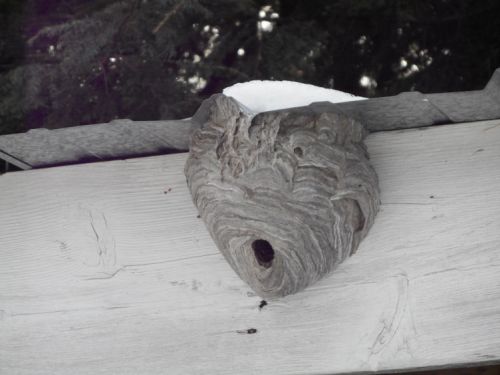
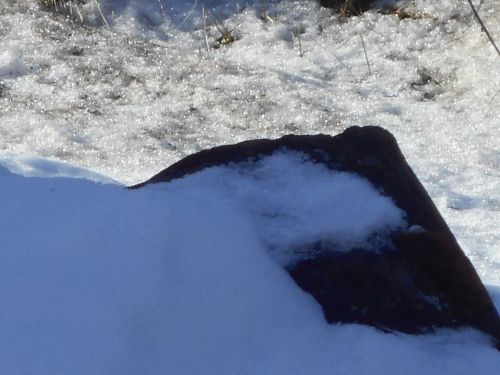


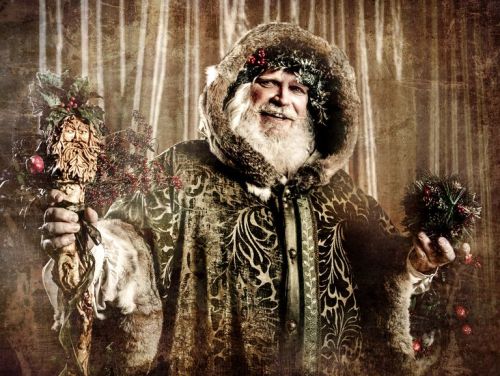

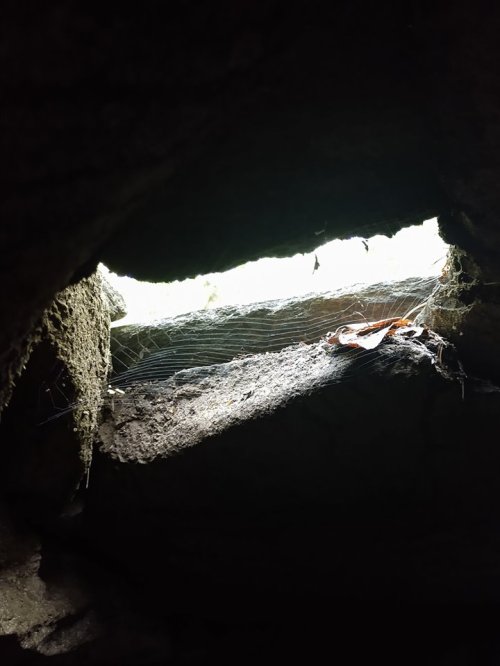


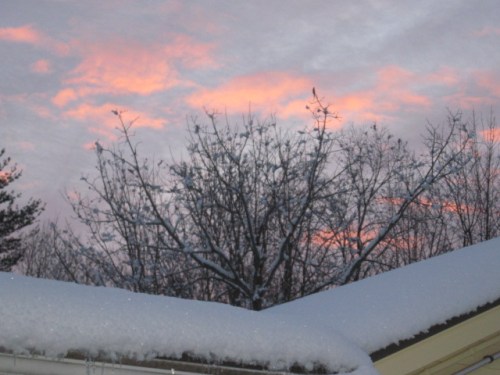
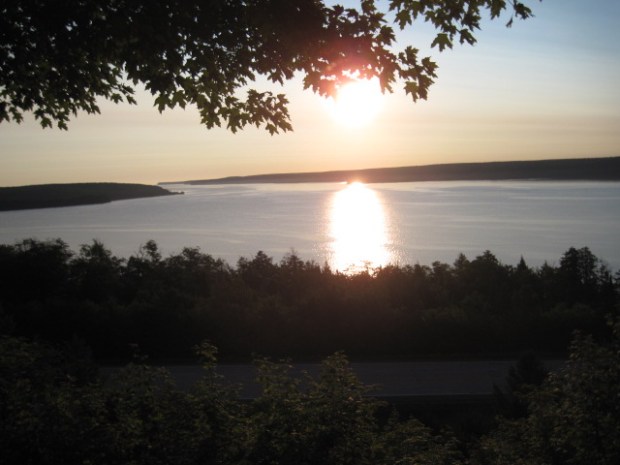
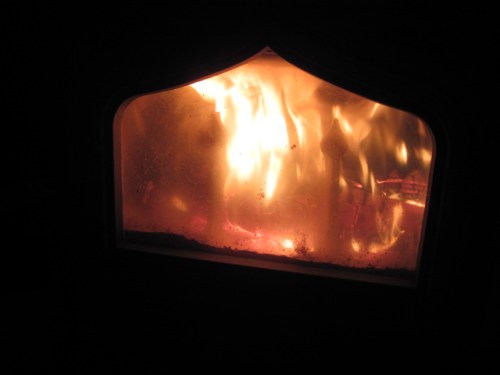
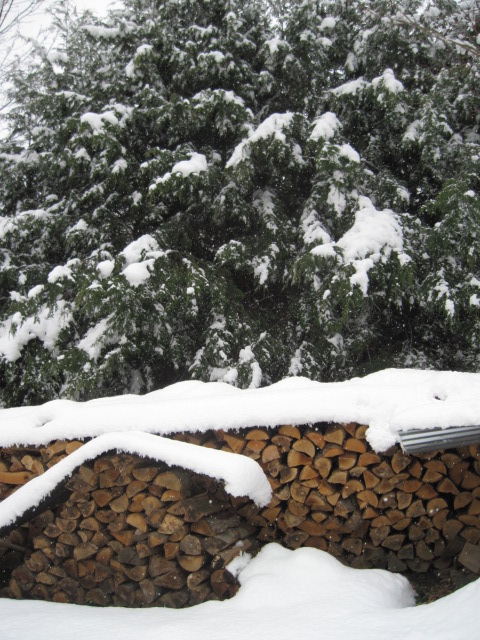
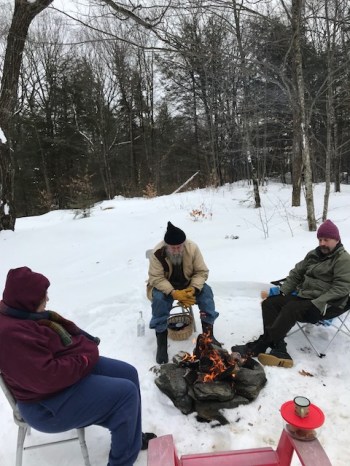 When I began this series of posts on the 21st of November, it wasn’t immediately clear to me that the practice it recounts would run for seven days, ending today, the 27th. But one of the benefits of my year-long work with Wayne London, MD*, in his exploration of the spiritual potential of the labyrinth, has been a deepening understanding of symbolism and ritual.
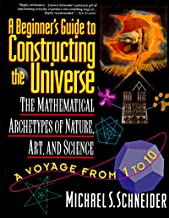 In part, this symbolism of seven comes from a quartering of the moon’s cycle of 28 days, so that like many cross-cultural symbols, it augments its force by linkages to an objective reality. The largely planet-wide acceptance of a seven-day week points to a kind of symbolic “fit” with human experience.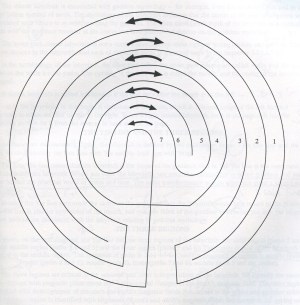
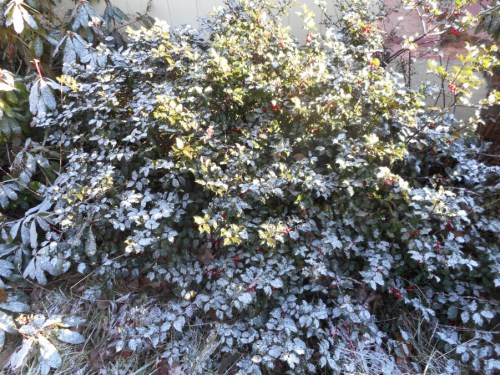
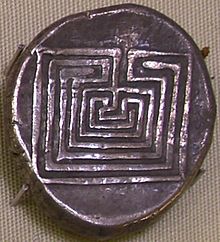
 If we number the pathways in order from outside to the center, we get a diagram like this. Whether the labyrinth opens right or left, the sequence of pathways is the same: 3214765. (In addition to forming a pleasing musical sequence if the notes are matched up 1C 2D, etc., on the C-scale, many other associations are possible. Chakras … Tarot cards … I leave this to you as a series of meditations to explore.)
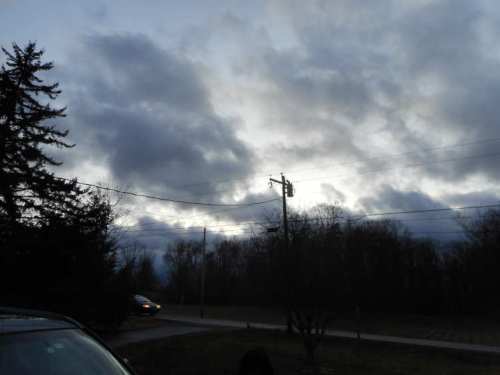


 A Druid Way
