Now that I’ve reached the end of this series on some possible shared spaces between Druids and Christians, I’d like to pause and take stock.
How many of us have experienced anger, frustration or a kind of spiritual PTSD from our contacts with Christianity? How many have found one or more of these posts irritating or painful? Yet how many still feel drawn to something alive in Christianity or Christian practice?
From the wild stats this particular series has generated, I have to conclude it’s provoked a whole complex, difficult medley of thoughts and feelings. Consider, as I have, new readers from outside the circle of the most common visitors — North Americans and a few western Europeans, with the occasional Australian or New Zealander. This series, however, has drawn readers from Iraq, China, Turkey, India, Japan, Hungary, Singapore, Greece, Pakistan — and a readership from all of these nations showed up not just for single post but for most of this series.
And what should appear here as the 9th theme? Magic? Prayer? Initiation? Heresy — the right to choose — along with heterodox beliefs and practices? The Otherworld? Divine kingship? All promise rich materials as fitting ways to close. I’ll probably tackle at least a few of these in the coming weeks. If only because a series like this, like a devotional practice undertaken with love over time, almost always generates a momentum no finite thing can contain.
Or what about a shift of terminology? Would that help at all with any of these themes? If instead of “Baptisms of the Elements”, we called them “Elemental Sacraments”, would that easier name make a difference? Would it make it any easier to move beyond instinctive antipathies and past traumas?
Christian Druids and Druid Christians have already found ways to integrate their practice and ritual, celebrating spirit as it actually manifests, regardless of creeds. Some of the best links happen in community and fellowship. We experience something together beyond words, even as we struggle to embody it in language. But it’s that initial encounter, not the subsequent formulation in speech or writing, that constitutes the source of spiritual energy.
Praised be You, my Lord, through Brothers Wind and Air,
And fair and stormy, all weather’s moods,
by which You cherish all that You have made.
Praised be You my Lord through Sister Water,
So useful, humble, precious and pure.
Praised be You my Lord through Brother Fire,
through whom You light the night
and he is beautiful and playful and robust and strong.
Praised be You my Lord through our Sister,
Mother Earth
who sustains and governs us …
Here is insight and wisdom and reverence indeed, one that may find resonance for both Druids and Christians.
An “incarnational” Druidry, one that shares with Christians a deep gratitude for natural beauty and for the mystery of birds and beasts, for the holy gifts of choice and speech, thought and reason, for birth and dying and rebirth, and for the voice of the sacred in dream, vision, prayer and ritual, and for the transformational power that a spirit-filled person can manifest, whatever the tradition, will earn respect and a hearing in any quarter a Druid would want to find one.
Likewise, a humble Christianity, one which seeks first to model love of self and other, of spiritual freedom, of service and stewardship of the created world, of care for the body, and delight in our kinship with the natural world, one which reads with reverence the Book of Nature, will move and persuade and welcome Druids and other Pagans far more than any scriptural proofs or the tongue of condemnation, doctrine or preaching.
“Let our deeds and our shining faces be our testimony”.
How do I keep the inward doors open? (How do I even begin to locate them and find their handles?) How do I pick up on subtle nudges? How do I hear the quiet inward speech of things — the “still small voice” as older versions of Christian scripture call it? We all get the big events — no need to go looking for them. They burst on the scene, kicking down the door a few times in a life, unmistakably loud and messy, whether good or bad, and usually a mix. But they break through, and everything shifts.
“Go out and stand on the mountain in the presence of the Lord, for the Lord is about to pass by.” Then a great and powerful wind tore the mountains apart and shattered the rocks before the Lord, but the Lord was not in the wind. After the wind there was an earthquake, but the Lord was not in the earthquake. After the earthquake came a fire, but the Lord was not in the fire. And after the fire came a gentle whisper. When Elijah heard it, he pulled his cloak over his face and went out and stood at the mouth of the cave. Then a voice said to him, “What are you doing here, Elijah?” (1 Kings 19:11-13).
With wind and earthquake and fire, how do we ever catch the whisper? And then, even if we manage to hear the “still small voice”, we may find that instead of resolution or insight or growth, we’re left with questions, like Elijah. Our own lives interrogate us. “What am I doing here? How did things end up like this?”
Most traditions urge a daily practice. As much of Christianity has become focused on belief rather than practice, it has lost much of what monastic practice has preserved. A site on Trappist monasticism notes:
The practice of lectio divina, (divine reading), is foundational to monastic life. So important is divine reading to the spiritual well-being of a monk that, traditionally, we devoted some of the best hours of the day to this practice. Lectio Divina is a discipline whose fruits are experienced over time. One needs to understand the practice and then commit to it with some regularity.
Practice matters. Not because it makes our lives “safe” or “easy”: no life is that I know of. If I think about it, most lives resemble the character throw in role-playing games (RPGs) like Dungeons and Dragons. You toss the game dice for talents, strengths and weaknesses. You may for instance roll a high intelligence, but your physical body is weak. You can’t rely on it. If you’re allowed to roll again, your strength, your vitality, may be high this time, but you’re none too bright. Or on the third throw, both intelligence and strength come up high, but your temper makes your life a train-wreck of impulse and blame.
A daily practice helps build spiritual stamina. It’s something like what our grandparents and great-grandparents used to call “inner resources”, though they may rarely have shown us how to develop ’em. (Merely “following the rules” doesn’t usually help.) But they knew enough to recognize people who had them. (In RPGs like Dungeons and Dragons, you can improve even weak qualities of your character over time, through experience. Funny thing!)
One of my teachers says that even if we could know the future, we’d have a hard time accepting just the good things to come in our lives. (That they might not always resemble “good things” from our present standpoint rarely occurs to us.) We build stamina over time, so that the big lifting is more manageable, and the daily lifting can become a small pleasure in itself.
A daily practice helps us hear that whisper, catch the still small voice. And that in turn can help us ride the worst of the big bad events, and make the most of the big good events (and little ones, too). And that can lead to all kinds of wonderful things. But the practice itself doesn’t deliver them. It catalyzes. It doesn’t guarantee.
One Druid I know makes it a point, whatever the weather, to visit a small outdoor shrine in his backyard each morning, before he heads off to work. He says a short prayer, or holds a meditation, makes an offering, etc. His practice builds over time, with things added or discarded. If, under pressure of a tight schedule or occasional family craziness, he misses his practice one morning, he feels the lack. But that in itself has deep value — it’s one way to recognize the value of a practice. It’s a good habit. The gods know we all cherish enough bad ones.
So working with the habit-forming tendencies we all have, we put them to work here and there. We start small. A daily practice can be a form of magic, of empowering ourselves to live more fully. Because really, what else is there? If we’re so sunk in difficulty that every day is a struggle just to survive, we’ve got nothing extra to share with anyone or anything. Our work is simply to endure. And sometimes that has to be enough. But beyond survival, one goal can be to spend our surplus as we choose, consciously, with intention. The goal is to find ways to get to a surplus in the first place, so we have something to spend, something to give back, to build on, to build up.
As Philip Carr-Gomm has written, “In a world sorely lacking in meaningful ritual, it can feel like a balm to the soul to engage in actions that are not obviously utilitarian, that are designed to help us enter into a deeper sense of engagement with life –- to give expression to our belief in a world of Spirit that infuses this physical world with energies that bring healing and inspiration.” If such ideas seem foreign or strange, that’s a measure of how far we’ve wandered from ways of living proven over millennia to help us make the most of our few decades here.
The Christian “Lord’s Prayer” is brief, and usefully so. Or if you’re a Catholic, the Rosary is comparably short. Most traditions offer short usable rites like prayers or visualizations. Along with similar prayers, OBOD Druids and others may practice a Light Body exercise.
Repetitions done mindfully can be remarkable in their effects over time, hard to describe until you try them out. Like any exercise, they build strength and stamina. We can propose to ourselves any number of fine practices, elaborate rituals, intense mystical exercises. But the small one we actually follow through on every day for a month will be the one that begins to convince us of its value, and of the value of a practice.
The key is to find what works, and what I can stick with. I keep a record. Did this for a week. Liked it. Kept it up for a year. Discarded it. Felt the lack. Picked it up again and added it back in to the mix a year later. Forgotten I’d made that experiment till I re-read my journal from that time.
Finding what works for me, ultimately, is a practice all its own, one of the most “practical practices” I can try.
/|\ /|\ /|\
I’ll close with a Youtube clip of “Pirililou”, which as its description states, is
an old Gaelic Chant sung at the Western ocean’s edge to the soul of the departed, in the first days after death, to assist the soul travelling from this world to the next ones. It is said to imitate the call of a shore bird … a bird dedicated to Bridhe and St Brigit, who assist the birth of souls in this world as well as the next.
As a meditation before sleep (that practice journey we all make nightly), this kind of meditation can lead to deep insight. Have we, after all, been fully born into this world, never mind any other one? Playing (singing, composing) a short devotional song that moves you deeply, and listening (performing) with intention, can make for the beginning of a profound practice.
Beckett, John. The Path of Paganism: An Experienced-based Guide to Modern Pagan Practice. Woodbury, Minnesota: Llewellyn, 2017.
[Note: John is a fellow OBOD Druid. We’ve met at several Gatherings, I’ve gratefully used and credited his excellent photos in several previous posts here. We’ve talked on occasion, but I don’t know him well, except as a reader of his excellent blog [link below]. I participated in his moving Cernunnos rite a few years ago.
Usually I only review books I feel I can discuss insightfully and enthusiastically; The Path of Paganism certainly qualifies. I’m adding this personal note as brief background and for completeness.]
John Beckett knows intimately the Pagan call to service. More importantly, he heeds it. On his Patheos blog and in this book, he serves both newcomers and experienced Pagans alike with insights and examples from his own experience at every turn. Rather than adding to the seemingly ever-growing list of “Paganism 101” books for beginners, replete with tables of correspondences, ready-made (and therefore usually too-generic) rituals, how-to’s and endless reading lists, John offers something far more useful.
Here is a book that can guide the reader into a personal exploration of what the path of Paganism can mean and where it may lead. While he sometimes suggests a range of possible answers, he’s more interested in helping us find questions worth asking. He may give us his answer, but it remains his. He never runs afoul of our sovereignty by claiming it’s THE answer. His examples, drawn from his experience, are meant to charge us up to find our own.
Rather than advocating for a particular Pagan ethics, for instance (Recycle! Eat organic! Protest X policy! Boycott Y or Z Company!), he says instead, “Go for a walk … When we establish our connections to the natural world, it begins to affect us. We start to feel the intrinsic value of nature, and we start thinking about what reverent care might look like” (pg. 58). He trusts the integrity of readers to decide for themselves.
Thus in a section on ritual, he writes: “A member of your Pagan group has asked you for an initiation. After some conversation you’re convinced the desire is genuine … You’re not part of an organization that has an established initiation ritual … Now what do you do? As with any new endeavor, begin by educating yourself. Fortunately, even though the details of most initiations are shrouded in secrecy, there’s a lot of information available on the internet – more than enough to give you a good idea of what to do and how to do it” (281). This is solid advice whether you want to self-initiate or initiate others.
As a ‘hard polytheist” or believer in the reality of distinct spiritual entities, John doesn’t shy away from hard questions. In a chapter titled “The Gods,” he notes, “If you’re on the cusp of being ready to hear, you may not know what to listen for. You may be inclined to interpet a religious experience in a nonreligious manner” (pg. 74) Rather than attempting to persuade or convert anyone to belief, however, John offers some useful tests to help anyone understand their experience. “If a god is calling you, odds are good they want you to do something: make an offering, tell a story, do something to help their work, or do something to make yourself ready to do something bigger at some point in the future. Be prepared to respond with action” (pg. 75). This is advice I can use right now: put into practice my current understanding, testing it for its validity.
John opens his book by observing, “No matter how you came to this point right here right now, wanting to learn more about Paganism, you aren’t starting from scratch” (pg. 1). As John makes his intention clear, this book can help activate things you already know. With supportive and enthusiastic reviews from Damh the Bard, Kristoffer Hughes of the Anglesey Druid Order, Kirk Thomas of ADF, and author and blogger Jason Mankey, this book will leave you highlighting parts of the text to try out and check back in with months and years down the road.
We commonly expect healing to arrive from the future — from a doctor’s prescription we’ll have in hand after an upcoming appointment, from an outpatient procedure in a clinic, from a series of therapy sessions or an interval of exercises.
We don’t expect healing to lie in the past, waiting for us to recognize it.
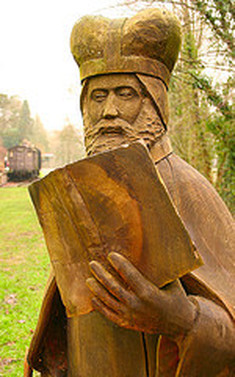
The historian-mythographer Geoffrey of Monmouth (1100-1155), whose glorious Historia Regum Britanniae (History of the Kings of Britain) blends history and legend almost seamlessly, is one primary source for the Arthurian legend. In the Eighth Book of this magnum opus, also gives us an early glimpse of legends about Stonehenge, supplying a foundation, however wobbly, for the idea that the stones originated in Ireland — or even further afield.
If we follow Geoffrey, in fact, the impetus behind Stonehenge is the desire for a war memorial:
The sight of the place where the dead lay made the king [Aurelius Ambrosius], who was of a compassionate temper, shed tears, and at last enter upon thoughts, what kind of monument to erect upon it. For he thought something ought to be done to perpetuate the memory of that piece of ground, which was honoured with the bodies of so many noble patriots, that died for their country [in the fighting against Hengist]. — Historia, Bk. 8, 10.
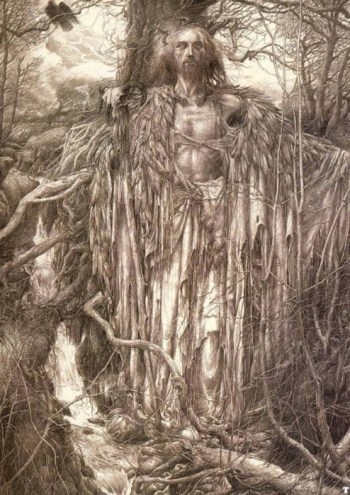
Unable to find among his own builders and engineers the technical ability to construct what he envisions, the king seeks out Merlin and asks for his help:
Merlin made answer:
Mysteries of this kind are not to be revealed but when there is the greatest necessity for it. If I should pretend to utter them for ostentation or diversion, the spirit that instructs me would be silent, and would leave me when I should have occasion for it. … [But] if you are desirous to honour the burying-place of these men with an everlasting monument, send for the Giant’s Dance, which is in Killare, a mountain in Ireland. For there is a structure of stones there, which none of this age could raise, without a profound knowledge of the mechanical arts. They are stones of a vast magnitude and wonderful quality; and if they can be placed here, as they are there, round this spot of ground, they will stand forever.
Merlin is, of course, just the person to manage this feat. The Giant’s Dance comes east to the plains of Salisbury, to “stand forever”. But wait — Merlin hasn’t finished. There’s more. The stones themselves are charmed, and of a provenance far from their apparently temporary Irish resting-place. Merlin declares:
They are mystical stones, and of a medicinal virtue. The giants of old brought them from the farthest coast of Africa, and placed them in Ireland, while they inhabited that country. Their design in this was to make baths in them, when they should be taken with any illness. For their method was to wash the stones, and put their sick into the water, which infallibly cured them. With the like success they cured wounds also, adding only the application of some herbs. There is not a stone there which has not some healing virtue. — Historia, Bk. 8, 11.
We seek for future cures, while the Merlins of our spiritual history attempt to alert us to sources of healing all around us. There is not a stone there which has not some healing virtue.
How many healings casually happen to me all the time? A scratch scabs over and even the mark fades with time. A cold passes and I recover, the hacking cough subsiding to a tickle and then to nothing. The purging of food poisoning wracks me and wrings me out, but my temperature control eventually leaves fevers and chills behind, I regain my appetite, and the memory of the nausea and dizziness and malaise slowly withdraws.
If we want the marvelous, the cause and occasion must match the healing outcome. The ordinary will not do: Mysteries of this kind are not to be revealed but when there is the greatest necessity for it.
What do we require? A wise guide and that guide’s counsel, certainly. But more: the conjunction of the potential and the place where it needs to be founded. The stones must be brought to a specific location for the desired result … if they can be placed here, as they are there …
It’s significant that the stones do not remain in Ireland. While giants placed them there for their own purposes, it takes human agency to bring them to their final location. Almost as if they had been waiting all along for human awareness to catch up to them, to finish their journey.
/|\ /|\ /|\
I don’t need to disdain modern medicine to avail myself of ancient healing. We do need the latter. Modern medicine often does an excellent job alleviating symptoms, but leaves the deeper roots of the problem untouched, often because invisible, underground. The taproot of an illness or other problem may nourish itself in causes invisible to a materialist eye. I may continue to feed its source even as I claim to long for healing. Why else is it, in our modern and supposedly healthier age, that so many Americans — more than ever before — rely on prescriptions (link to Harvard University studies) against anxiety, depression, insomnia, and so on? The stats have made headlines, but no one wants to address the root cause, because it’s sunk in the rich darkness of our cultural blindspots.
/|\ /|\ /|\
I add to my practice a henge-meditation. We needn’t bother ourselves to make any such claim as “Druids built Stonehenge” to make use of the spiritual dynamic it offers as a source of healing. Merlin sets the precedent: Stonehenge-as-symbol, in Geoffrey’s telling is older than its present home in southern England anyway. Not its origin but its power is what we need. Magic thrives when our intent makes the occasion a necessity: our focus is single and sharp not from force of will but from desire, emotion, need, want, hope, imagination, planning and preparation, ritual foundation, and love.
If I don’t move the stones here, their virtue can’t find me. Inner work is just as necessary as finding the right doctor, the proper regimen, the appropriate treatment.
Curious that the words of Jesus fit here so well: “The stone which the builders reject has become the cornerstone”. There is not a stone there which has not some healing virtue.
Truth’s subject to leakage at any time. Mostly, though, when that happens — when truth does manage, against the odds, to seep in — we strive vigorously to plug the hole any time more than a little discomfort spills out into our lives.
Praise then such discomforts, for what they can, even occasionally, reveal to us.
/|\ /|\ /|\
A burst of activity from Canadian viewers has been showing up on the page stats — one of a few places more wintry than here. A shout-out to Canadians trying to feel spring in February. It’s there — just under the snow, and behind the patience that, with this most recent bout of storms, is wearing thin for all but the most ardent lovers of winter.
/|\ /|\ /|\
“The world is a spiritual vessel. It cannot be improved,” says the Tao Te Ching, ch. 29. Of all the books based on wise and penetrating observation of the world and its dynamics, for me the “TTC” holds a singular position. So I’ve pondered this verse ever since I encountered it as a teen-ager.
To speak to this assertion (which, if you follow the above link, can be read many ways), and unpack and qualify it for myself and my readers, here are two of John Michael Greer’s responses to comments on his recent Feb. 1, 2017 blogpost “Perched on the Wheel of Time“:
The notion that one person can transform the world is very deeply rooted in our culture, and it’s not entirely untrue; like most damaging beliefs, it’s a half-truth. Each of us can change the world, but how we can change it is determined by our cultural and historical context — and of course it’s also true that in a world in which everyone can change the world, no one person gets to change everything! It can be a real struggle, though, to break through the binary between “you can change everything” and “no one can change anything,” and grasp the many ways in which we all, to use a New Age term, help co-create the future.
It can be a valuable Druid practice to break through binaries, finding at least a third position between two poles. And discovering and walking the line revealed by repeated blundering into a damaging belief/half-truth — there’s another name for life, for the modest wisdom a person can accrue over several decades. How much can I co-create? Where are my energies best spent in trying? Can I co-operate with even one other person around me — like a friend or partner, for starters — to maximize our co-creative acts?
And if this world can’t be “improved”? Well, certainly local conditions improve and deteriorate all the time, shaped in considerable part by the actions of individuals. Any overall equilibrium, though? I must ruefully admit that does seem to remain the same. But that’s not a reason to disengage. Greer expands on his perspective in a later comment on the same post, which I find persuasive as well:
…the Druid teachings I follow hold that this world, the world of human beings experiencing greed and hunger and a distinct lack of the brotherhood of man, is a necessary stage or mode of consciousness through which every soul must pass in due time. When we outgrow it, we move to a different stage or mode of consciousness, and the world stays the way it is so that it can provide the same experience to those who need it. Thus there’s only so much change you can make in the world — though there’s some, and making such changes are an important part of grappling with this mode of being. The changes that matter are those you make to yourself.
If a succinct statement of my bias is possible, Greer captures it in his last sentence here. “The changes that matter (most) to me are those I make to myself.”
First, because in the grand scheme of things I find change difficult. I’m assuming you do, too.
Second, because the changes I actually pull off, ones I make to myself, usually affect my immediate environment, where they’re more visible than they would be elsewhere. That means I get more feedback from them on what I’ve done, and whether it’s what I actually wanted. You know: life as laboratory.
Third, because I continue to learn the hard way that my understanding is often so imperfect in so many domains that I’d rather improve it and share what I’ve learned than botch my immediate environment out of ignorance or stupidity — and more likely, both. Humility is a really useful tool in my kit. Almost always I’ve ignored it at my peril.
And as for matters of scale, I’ve also met wise individuals in my life. Not many, but a few, human and non-human. But very, very few wise local governments, and even fewer wise nations. And that gives me guidance for where my energies are best spent — at least for me, in this cycle.
/|\ /|\ /|\
So when anyone — whether Jesus or Donald Trump — offers up a version of “I alone can save you”, I need a lot of proof and demonstration before I’m willing to divert my energies to them from working in my own life.
I think I could turn and live with animals, they are so placid and
    self-contain'd,
I stand and look at them long and long.
They do not sweat and whine about their condition,
They do not lie awake in the dark and weep for their sins,
They do not make me sick discussing their duty to God,
Not one is dissatisfied, not one is demented with the mania of
    owning things,
Not one kneels to another, nor to his kind that lived thousands of
    years ago,
Not one is respectable or unhappy over the whole earth.
/|\ /|\ /|\
It’s not what you look at that matters, it’s what you see. — Henry David Thoreau/OBOD’s weekly “Inspiration for Life”.
The Hopi of the American Southwest call one of their ceremonial pipes natwanpi — literally, “instrument of preparation”. As words do, this one stuck with me ever since I read it, decades ago now. No wonder: we need markers for passage into sacred time, because otherwise it can burn and blow right past us. Or, to shift metaphors, if we don’t catch the sacred wave, we can’t surf in sacred time. We miss that tidal flow, then wonder why life can seem flat or dis-spirited.
With a beloved festival like Imbolc calling us, what better time to consider how we can attune to sacred times and sacred tides?
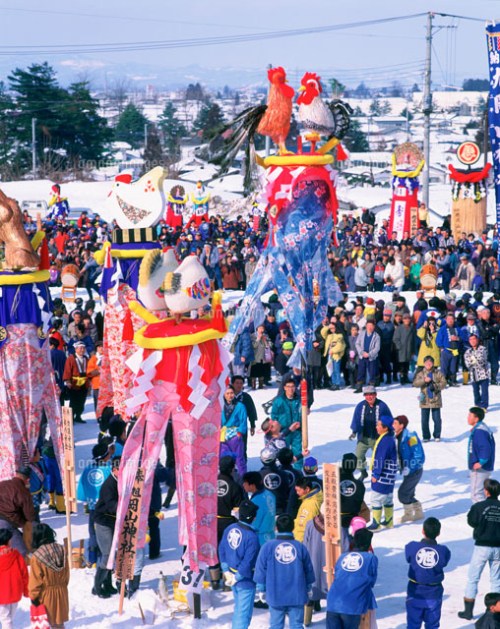
Shinto, that perennially popular topic here at A Druid Way, offers a mid-January festival called Bonden-sai which feels harmonious with Druid practice. Of course it has cultural flavors and overlays unique to Japan and Shinto, but its focus asks for and offers a kind of natwanpi. (Besides, a cold, gray, snowy northern January can use some color and liveliness.)
Bonden-sai, Akita Prefecture
The bonden for which the festival is named is called a “sacred wand”, though as you can see from the bonden in the picture above, “pillar” or “column” better suggests its appearance. (Let the chickens on some of the bonden above enlarge your sense of “sacred”!) A typical bonden, the Japanese National Tourist Organization (JNTO) helpfully informs us, measures
almost four meters in length … [and] serves as a marker for the gods descending to this world. In ancient times, bonden used to be made of paper or rice straw, but in recent years, they are often made by decorating a bamboo basket with colorful fabric. The bonden wands are carried by groups of children, townspeople, or even company employees. Each group entrusts the bonden with their prayers for an abundant harvest, good health for their families and success in business.
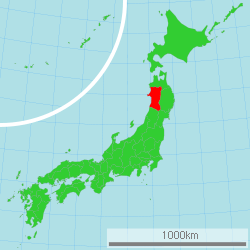
Bonden-sai is intimately associated with Akita Prefecture in Northwest Japan. Akita is also famed for its onsen (hot springs) and mountains, and Mount Taiheizan, the symbol of Akita City, is a major site for the festival. Bonden-sai there means a vigorous race up the mountain with your bonden to procure the blessings of the gods.
Shinto and Japanese culture, so long linked, have celebrated the sacred in so many things that the secular West allows to pass unremarked. Whether it’s drinking tea or sake, or bathing, or marking the calendar with a plethora of festivals, Japan models practices the West and particularly western Paganism learn from, build on and delight in.
Because when the gods are dead, the human heart also dies a little every day. You certainly don’t have to “believe” in them as any kind of prerequisite, any more than you have to believe in anything in particular to celebrate Halloween or Christmas or MLK Day. The gods themselves can serve as a kind of natwanpi, a means of preparation. Belief, like so much else, is a tool, a strategy, a technique for connecting to things other than ourselves. Use it skilfully, delicately, consciously, I’m learning, and it repays the respectful treatment.
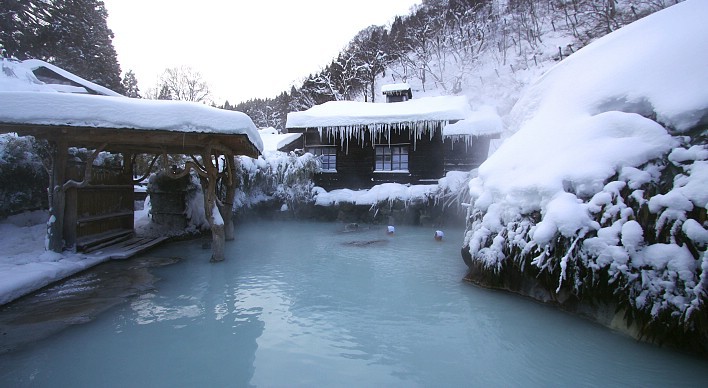
Nyuto Onsen (hot springs), Akita Prefecture
Ultimately it’s the impulse to celebrate that’s the flame to cherish. And if it chances on occasion to be gods that help it happen, as one of the forms the sacred can take, why exclude them out of hand, just because they’re gods?
As for me, I try to take advantage of any natwanpi that comes my way. And if I succeed and connect only 30% of the time, well, isn’t that a very respectable baseball batting average?!
Sometimes ya gotta love acronyms. (No, not you specifically. People in general. Not that I’ve ever met a person-in-general. Only individuals, who annoyingly refuse to conform to abstractions. Thank the gods.)
Especially if you can find ways to play with acronyms as well as learn something useful from the ideas they compact into memorable form.
So first, let’s look at the A.S. part of the acronym in the title.
This post is inspired by an article in Scientific American from a little over a year ago Nov. 2015) titled “Perception Deception“. (Link to the author Michael Schermer’s blog — scroll down to November 2015 and the article.) In it, the author examines recent studies that point to our — and that includes all species — perceptions of reality as useful rather than necessarily accurate.
(Does it have to be either-or, the author plaintively asks at one point?)
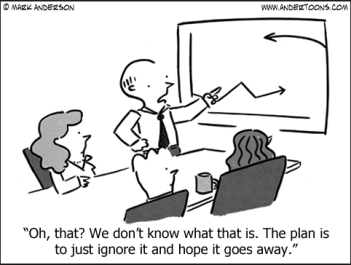
In other words, it doesn’t matter how close to reality our perceptions are, as long as they give us advantages in survival and reproduction. Or, as the article puts it, they have Adaptive Significance. The sun doesn’t “rise” or “set”, to use a trivial example; instead, the earth rotates. But unless we’re attempting a spacecraft launch, we don’t need a more “accurate” understanding. Living as if the sun rises and sets grants us perfectly reasonable adaptive capacities.
We don’t need to go far at all to find larger and more weighty human examples. If your parents told you growing up not to talk with strangers and you put that precept into practice, it’s just possible you avoided some serious unpleasantness. There’s adaptive significance: you survived by escaping kidnapping, abuse, death, or recruitment into cult or gang or band groupie-dom.
But we know that most crimes statistically involve people who know us, so the ultimate adaptive significance of that parental instruction may turn out to be low. If that makes us into distrustful adults who find it difficult to open up to others, we may never connect with another person to reproduce and pass along our genes to a new generation. Low adaptive significance for the individual. But paradoxically high for the species: excessively fearful individuals self-select and remove their genes from the genetic melange of the human future. In other words, and among other things, heroes remain possible.
The premier example the studies cite is the Australian jewel beetle:
Females are large, shiny, brown and dimpled. So, too, are discarded beer bottles dubbed “stubbies,” and males with mount them until they die by heat, starvation or ants. The species was on the brink of extinction because its senses and brain were designed by natural selection not to perceive reality but to mate with anything big, brown, shiny and dimpled (Scientific American, Nov. 2015, pg. 75).
Now apart from providing wonderfully vivid and useful ammunition to cartoonists, misanthropists and meme-lovers about the relative intelligence of males and their sex drives, the example seems to me to undermine the point the researchers actually wished to make. Here is a perfect example of how perception needs to match reality quite faithfully, or it won’t confer that sought-after adaptive significance.
In other words, species also need to possess what the article terms Veridical Perception — the VP of the acronym — if they’re going to survive. Or as my mother repeatedly counselled the teenaged me, you have to live in (and perceive) the real world.
(She neglected to add: “Just not all the time”.)
It’s true that human culture can shelter from reality some highly inaccurate perceptions, and for long periods. To quote a whimsical example, Humpty Dumpty exclaims,”Why, I’ve believed as many as six impossible things before breakfast!” The mutual support we give each other, and human law, medicine, societal expectation and life experience, all help moderate and temper and refine our perceptions of reality to help minimize the damage inaccurate perceptions can cause. But wackadoos and wackadooism still persist. We can just generously think of them as genetic outliers. Experiments in adaptive significance, not veridical perception.
It is also an argument of the article that species with high adaptive significance consistently out-survive species endowed only with veridical perception.
Yet despite what current politics and media suggest, most humans live in approximately the same perceptive universe. Our differences loom large only in certain select domains. In spite of the noise these few domains are generating right now, the immediate adaptive significance of most of our behaviors remains high. (It’s flaws in their long-term adaptive significance that remain our great challenge.) Drive down the highway and — while a few accidents do indeed happen — the marvel is that most people see the universe in ways similar enough that we don’t take out all other drivers on the road in a single day of apocalyptic Hollywood bloodshed, simply because what you see as a red light I see as green. The relative absence of “carnage” — a loaded word in the U.S. right now — is an encouraging thought.
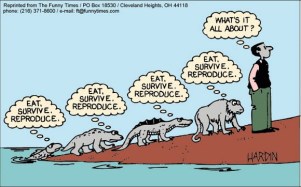
But side by side with adaptive significance, we might remember that evolution doesn’t “progress”. Where and how the arc of history may bend will apparently always be an experimental question, not an ideological statement.
A sparrow flying around today isn’t an “improved” or “more” evolved version of an ancestral theropod or archaeopteryx. The same is true of modern humans: we’re not any better suited to life in cities or at a desk in corporate America (or on the tundra or in the jungle) than our Cro-Magnon or Neanderthal forebears. We’re distinctly not “new and improved”. What we are is adapted, and adaptable.
It doesn’t have to be a choice: our behaviors more often possess adaptive significance when they also arise from veridical perception. We thrive when we “do the true”.
Veridical Perceptions with Adaptive Significance
And what about Druidry, just one of our many attempts at a veridical perception, at an accurate grip on reality? Does it also confer any adaptive significance? Is it just a Western 21st century middle-class indulgence? Does it offer an edge that can help us navigate tough times and steer us through these beginnings of a centuries-long post-industrial transition?
The next post will look at some possible responses to these questions.
[OK, what follows is a rant. Continue for your own discomfort. I say little that’s new here. Just retuning and returning with notes I’ve sounded before. Mostly, as with blogging, I’m talking to myself, but out loud. Say it to see how it sounds. Flavo(u)r to taste. You indulge me by sometimes liking what I write, if it has any merit you can use. And your comments, as always, are welcome.]
“Collapse now”, counsels John Michael Greer, “collapse now and avoid the rush” as industrial civilization devolves and careers along an increasingly wobbly course. Greer, whose words and ideas have intermittently appeared here, is a “talk-walker”, someone who lives what he advises others to practice. An increasingly widely read blogger and master gardener, as well as author and mage and archdruid emeritus of the Druid order AODA, Greer lives largely off the grid. Owning no car, and growing a large portion of his food, Greer and his lived choices make his words carry more weight with me than the renowned physicist Stephen Hawking.
Of course, Greer’s choices are just one possible set, and not even the best for many of us. But they’re his, not manufactured for and sold to him by someone else.
And Stephen Hawking? Just yesterday he wrote in an article in the U.K.’s Guardian newspaper that, yes, he’s lived a life of extraordinary privilege; that, yes, elites like him and his circle have long ignored the plight of working-class folks; and that, yes, recent elections and votes in the U.S. and U.K. and elsewhere betoken a cry of anger and anguish. But he can still write in an astonishing stew of ignorance and arrogance that
what matters now, far more than the choices made by these two electorates, is how the elites react. Should we, in turn, reject these votes as outpourings of crude populism that fail to take account of the facts, and attempt to circumvent or circumscribe the choices that they represent? I would argue that this would be a terrible mistake.
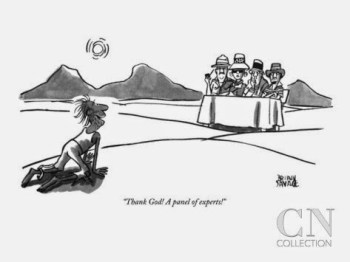
No, in fact, the reaction of elites matters far less. It will be quite predictable. We’ve seen it repeated endlessly over the span of millennia. They won’t do what they could do, because it’s really not even theirs to do, though we’ve often abdicated choice to them. But as we always have, we choose day by day to put into action the causes that bring us where we go next.
That’s neither good or bad in itself: it’s simply how cause and effect have worked, and will continue to work. But so often it’s not in the self-interest of any elite to do what the “electorate” may want or need. That’s what makes them the elite. Plotting a course of self-interest is how they got to beelite. That’s what “people do” in such circumstances.
And — always — people can do something else. I can, and so can you. I did yesterday, and you did too.
Not according to Hawking, though. Current trends and practices
in turn will accelerate the already widening economic inequality around the world. The internet and the platforms that it makes possible allow very small groups of individuals to make enormous profits [Hawking’s link] while employing very few people. This is inevitable, it is progress, but it is also socially destructive.
Inevitable, progress, socially destructive. There it is, in a nutshell, the reason we’re collapsing. The first two assumptions are just that, assumptions. The third factor looms before and around us, resulting from the first two.
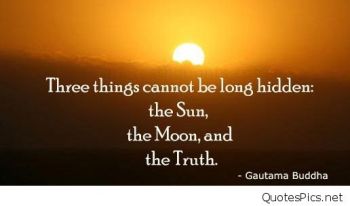
We’ve demonstrated over time, far better than any New Age workshop or guru ever could, how we create our reality. Assumptions are, after all, powerful magical techniques. Hold them strongly enough, inject them with emotion and attention, and they shape consciousness. They make up the outer circumstances, often the inner ones, of life. One life, a billion lives, in high tech or on a factory floor or in a studio or classroom or garden. One life, a billion lives, filled with pain, joy, a mix.
“With resources increasingly concentrated in the hands of a few, we are going to have to learn to share far more than at present,” says Hawking. But who will start today? You, privileged physicist Stephen Hawking? Whenever I read or hear “must” and “have to”, I know someone’s avoiding actually doing that “must” or “have to”, or, more likely, is shunting it off onto someone else’s shoulders. I try to minimize that in this blog, but my percentage slips from time to time.
Waiting for “elites” to act is exactly the wrong course of action. We each take steps each day to build whatever balance we have in our own lives. Sharing resources? One way I share is to “consume less”, of course. Will I recycle this bag or box, or throw it in the trash? Will I replace these lightbulbs with higher-efficiency ones, or maybe just not use lights as much? Candles, or darkness. Will I reduce my car-trips, combining tasks and appointments? Will I sell the car, and use public transport? (It may not be available.) Will I unplug appliances that eat energy even when they’re “off”? Will I grow anything at all that I can prepare myself and eat, rather than buy from halfway around the planet? Will I downsize a habit, a car, a house, a hoard of possessions, an attitude, a life?
One and one and one and one and one and one and one and one and one and one make ten. “Suddenly” a lot? Nope. Accumulating every day. We knowthis. The world now vividly reveals the human psyche. (The fact that it also does many other things needn’t be lost on us either, in our species-centric obsessions. Other lives have their say.) Our Western popular culture now gives us The Hunger Games, Divergent, The 100, Terra Nova, Incorporated, The 3%, and so on.
The beauty of our individuality is that there’s no “single solution” but a multitude of choices, because we’re a multitude of people.
The city-dweller in a third-world nation foraging for scraps through piles of refuse exhausts her options and migrates with her family to another region where she can grow a small garden. Or find work. Or mount a protest with others large enough it draws media attention to a problem. Or, sometimes, die trying any of these. Sometimes we can shame ourselves into fixing things. Sometimes we just turn away. Every choice matters, every choice contributes to the pool. Nothing is lost. All that we do returns to us, so we can see our choices more clearly. Why else have worlds like this, where choice is possible and makes such a difference?
Americans, of course, are all elites in their own way. We’ve seen the figures, how we consume a very large percentage of the world’s resources, far larger than our share. Greer counsels “collapsing now” as something prudent, as an act of self-interest, because our two choices are not really choices at all. We can collapse more gradually, with foresight and preparation, or we can collapse painfully, in places violently, resisting change all the way down. Collapsing or not collapsing are no longer the options. How we collapse is.
It’s not some unique event, the collapse of a civilization and economy. History doesn’t so much repeat itself as find endless variations on a small set of themes. The collapse of a petroleum-consumption-empire-supported lifestyle doesn’t mean “the End” but it does mean massive change in a certain set of imbalances.
It’s safe to say large portion of the readership of this blog is blanketed, for now, against the worst sufferings these changes can bring. If you have both the leisure and opportunity to ponder the words of a privileged white blogger, you’re statistically pretty likely to be privileged yourself. Yes, we’ve been “inconvenienced” by changes already. Yes, our “standard of living” may be declining. Most of us aren’t yet starving, in prison, or dead. But our heads and hearts are troubled, our bank accounts are scary-shrinking, our stresses, health, credit-cards, relationships and uncertainties maxed out. We’ve had a foretaste, certainly. Those of us who live more on the fringes in any way will, like canaries in the mine, bear more of the assault of change. We’re already beginning our own forms of collapse, of hopefully creative down-sumption.
The healing, creativity, practical tool-kit, and hope that Druidry offers, like other spiritual paths also do, involve steps we can take now and daily. Whether we actually take any of them, whether we see them as beautiful and wise opportunities to begin to reclaim ourselves and our world, or as RAORPSEMFs, Ridiculous Avoidances Of Real Problems Somebody Else Must Fix, will determine to a great extent how the next minute, month and decade will go for any of us.
Smithers, Lorna. The Broken Cauldron. Norfolk, UK: Biddles Books, 2016.
Change the names, goes the old Latin tag from Horace, and it’s a story about us.
Smithers, a Lancashire awenydd, poet, blogger at Signposts in the Mist, and devotee of Gwyn ap Nudd, has mediated in her latest book a challenging prophetic vision of psychic and environmental shattering in the image of the Cauldron, that ancient and present manifestation of birth, wisdom and regeneration. Spiritual vessel, military-industrial grail, the Cauldron contains both dream and nightmare.
Through prose retellings of Celtic myth and legend, through poems that grapple with this world and that Other that has always deeply haunted us, Smithers links voices, times and places. She revisits the central Druidic myth: Gwion Bach’s transformational encounter with — and theft of — the Three Drops of Inspiration. Holding it up for careful scrutiny, she underscores its immense cost to species and planet. In one retelling she speaks in the voice of Ceridwen’s grotesque son Afagddu, “Utter Darkness”. It is for him that Ceridwen has set the Cauldron brewing in the first place, hoping for his transformation, posting the hapless Gwion to tend it. In a painfully apt contemporary twist, Gwion’s a negligent employee at a chemical plant, daydreaming through a reactor disaster, though acquitted in the subsequent court case.
But Afagddu’s gifted with his own preternatural wisdom, knowing Ceridwen still apologizes for him, even as she dreams of him “suave, clean-shaven, the head of the company in a priceless suit with ironed-in creases” (pg. 74). How we persist in our stubborn lusts and blind dreams.
The five subtitled sections of the book capture something of its span: “The Broken Cauldron and the Flashing Sword”, “Ridiculous”, “Drowned Lands”, “Operation Cauldron” and “Uranium”.
What will we do, we whose minds are “shrunken and empty of gods”? Smithers’ patron deity accuses us all in the person of Arthur, whose profaning raids on the Otherworld have gained humanity a magical treasure, true, but loosed a devastating tide of death. In a triad of admonition to human raiders on Annwn, the Otherworld, Gwyn ap Nudd declares: “Lleog, lay down your sword. Taliesin, cast your mind from praise poems. Arthur, be true to your bear-skin past, hear your bones and the star of the north” (pg. 10).
Listen to our bones, heed the stars: a quest each of us may still accept or decline.
For it is the Otherworld that restrains the increasingly violent rebalancing we have brought on ourselves. And it is there we find “a cauldron that is whole and filled with stars, the infinite reflection of the womb of Old Mother Universe” (pg. 7).
As a solitary, Smithers turns here from a mythos that has long troubled her. She declares her preference for Afagddu, refusing “complicity in the mysteries of Taliesin” whose limitless hunger to despoil and pillage and consume “can only lead to the world’s end” (pg. 8).
It lies in grappling with the double edged-ness of the “flashing swords” of the raiders on Annwn, I would add, that we may at last learn wisdom. Can we learn to gauge and compensate for both gain and cost? Whether we do or no, the Otherworld will assert its balance. A unique book.
It’s the fate of too many worthy people to receive attention at their deaths that would have served everyone better had it flourished while they were still alive. Fortunately, this needn’t be the case with Bill Mollison, father of the permaculture movement, simply because his ideas most definitely live on after his passing.
I’ll confess upfront: I know only a little about Mollison and permaculture. So let’s allow him to speak for himself, as he amply can. You can read a transcript here of a 2005 interview with Mollison that appeared in Green Living magazine. There Scott London, the interviewer, summarizes Mollison’s achievement quite succinctly in a short introduction:
Permaculture — from permanent and agriculture — is an integrated design philosophy that encompasses gardening, architecture, horticulture, ecology, even money management and community design. The basic approach is to create sustainable systems that provide for their own needs and recycle their waste.
Mollison developed permaculture after spending decades in the rainforests and deserts of Australia studying ecosystems. He observed that plants naturally group themselves in mutually beneficial communities. He used this idea to develop a different approach to agriculture and community design, one that seeks to place the right elements together so they sustain and support each other.
Mollison’s sensibilities and actions have won him many fans among Druid-y types. (For a splendid Druid blog and blogger walking the talk, which you might enjoy if you don’t already know of it and her, visit The Druid’s Garden.)
Still largely unknown outside of his native Australia, Mollison’s ideas have impacted agricultural practices. As London notes:
Scott London: A reviewer once described your teachings as “seditious.”
Bill Mollison: Yes, it was very perceptive. I teach self-reliance, the world’s most subversive practice. I teach people how to grow their own food, which is shockingly subversive. So, yes, it’s seditious. But it’s peaceful sedition.
So many bellwethers, prophets, forerunners we’ve ignored to our cost. For as Mollison notes in the course of the interview,
In the early 1970s, it dawned on me that no one had ever applied design to agriculture. When I realized it, the hairs went up on the back of my neck. It was so strange. We’d had agriculture for 7,000 years, and we’d been losing for 7,000 years — everything was turning into desert. So I wondered, can we build systems that obey ecological principles? We know what they are, we just never apply them. Ecologists never apply good ecology to their gardens. Architects never understand the transmission of heat in buildings. And physicists live in houses with demented energy systems. It’s curious that we never apply what we know to how we actually live.
Applying what we know to how we live: if we seek a clear life goal, a sane and humane practice, and a justification and outline for a spiritual path, that’s an excellent place to start.
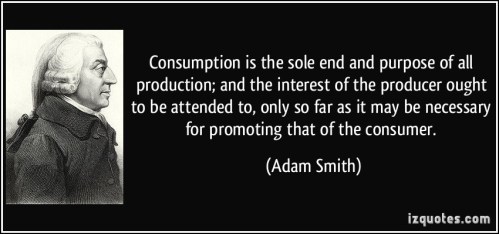
For an instructive contrast (to say no more right now), consider the words of Adam Smith (1723-1790), which might well have appeared just yesterday, unchanged, in the Times or Guardian or Wall Street Journal:
Over the last several cold damp nights and cool partly cloudy days here in New England, many of us who heat with wood have lit the first fires of autumn. (Some days building and feeding a fire is the best theology I can muster.)
More than one Vermont Druid I know makes it an autumn ritual, invoking Brighid and celebrating the turning of the year in this private, immediately practical and also beautifully symbolic way. Way more fun than turning up a thermostat. You celebrate starting from where you are and what you’re doing. Where else, after all, can I begin?
Stay alert, I tell myself. This can be one of the times Druidry demonstrates its wonder and power and joy. We don’t always need the big ritual circles and dords* sounding their ancient welcomes, though these, too, can be apt and lovely. Sometimes, though, the best Druidry for the moment is pocket-sized.
Pocket Druidry. At last year’s East Coast Gathering, Kris Hughes led a workshop demonstrating another form of it. In the early days of Revival Druidry, the Welsh poet and Druid Iolo Morganwg conceived a literal pocket Druidry, constructing a ritual circle for a gathering of friends on the Summer Solstice of 1792, out of stones drawn from his pocket.
World in your hand, circle in your pocket. Our lives, especially in the last century or so, seem to repeat a pattern: demonstrate our immense power to shape and re-create the world, then withdraw, standing back in dismay and doubt when it doesn’t turn out as we hoped. We’re still practicing, still in the elementary grades, with all the meanings that suggests. Learning to use the elements at hand, still in the early stages.
With the love of triads and threes that marks so much of Celtic art and story, it’s no surprise that the Celtic conception of our spiritual journeys should mirror this same triplicity. From the starting point of Annwn, the Celtic Otherworld, we move forth and back through three states of manifestation and consciousness, in a kind of dance that sees us revisiting old lessons until we’ve fully mastered the material, spiralling through different forms and perspectives.
Most of us hang out for a considerable time in this present world of Abred, this place of testing and proving. From here we proceed to Gwynfyd, a world of liberty and freedom beyond the pale shadows of these forces in our present world. Back and forth between Abred and Gwynfyd, with dips into Annwn here and there. And last comes Ceugant, an unbounded, infinite realm. By definition, no end point, but a new beginning. The horizon recedes.
Morganwg’s compilation Barddas (section 227) explains this cosmology through a kind of Druidic catechism of question and answer. I’ve modernized some of the archaic language in the following excerpt:
Q. What were you before you became human in the circle of Abred?
A. I was in Annwn, the least possible thing capable of life, and the nearest possible to absolute death, and I came in every form, and through every form capable of a body and life, to the state of human in the circle of Abred, where my condition was severe and grievous during the age of ages, ever since I was parted in Annwn from the dead.
Q. Through how many forms have you come?
A. Through every form capable of life, in water, in earth, and in air.
As the Beatles sing it, “It’s a long and winding road …”
One of my teachers notes that human beings recently refused a chance to rise to the next level of awareness by accepting responsibility for themselves and their actions. Some days it feels like we’re throwing tantrums because we didn’t get what we thought we wanted. Rather than awareness, we default to outrage.
In the circle we’re presently in, we refuse to accept cause and effect, continuing to live on a merely emotional, reactive level, without fuller consciousness, at least very often. We’ll readily respond to the energy tides sweeping around us, and contribute to them willingly, but deny that any of them has longer-term effects we need to weigh before leaping in, or that we always have a choice. But that’s how I feel, we say. Yes. So now own it, and go from there, counsel our guides and sages. Maybe not by diving immediately into the very next feeling that presents itself just because it knocks at the door of consciousness.
Ask why? Ask who benefits? Ask how do I live from a place of honor?
Don’t think, say our advertisers and politicians and insta-gurus galore. Don’t think. React!
Seedtime and harvest, whispers the wisdom of the earth.
The glory and wonder and marvel of it all, in the face of the sufferings we keep bringing on ourselves and each other, are the possibilities of joy unbounded that we glimpse too rarely — that view through the window, over the next hill, in a day- or night-dream, which nevertheless keep us going in spite of everything.
This — the Barddas counsels us — this is simply the way we get there. (If you find another and better way, please do let me know!) Through experiencing fully every possibility and option and choice, and living their consequences.
Less comforting that I was looking for, but a provocative insight, nonetheless. It goes remarkably far in explaining the predicaments (plural) we’re in. They’re the lesson at hand. The necessary lesson. Whatever comes, though, matters less than what we do with it. Especially with the sense of deja-vu that we’ve faced this all before. Wait, I say. Sometimes it feels like I’m still in somebody else’s lesson. Why do I have to sit in class waiting for them to get it?
For some, yes, the lesson’s familiar, a kind of review. Others need to go through the whole thing, maybe for the first time. They may never have encountered it before. But the final piece I know I’m still working on, the piece that keeps me here (I can’t speak for you), is that I have the choice to learn and show compassion. To serve. It’s not about me after all.
That’s all? I ask, grumbling or swearing, depending. Obviously I do need to be here, I say ruefully, a moment later, if only because I’ll need compassion from others soon enough, when a hard lesson comes my way. As it will, guaranteed.
Along with each lesson, that peculiar joy: This isn’t all there is. Keep going. Keep loving, in spite of all evidence to contrary. It’s human evidence, says the sage in the heart. You made it, you live it, you learn it, you move on.
And the goal? I ask. Ah, now. The big question. Your answer today is more important than anybody else’s. Because it will shape what you do next …
/|\ /|\ /|\
IMAGE: Brighid in her form as triple goddess of healing, smithcraft and fire.
*A Youtube video of a large dord being played — sounding remarkably like a didgeridoo.
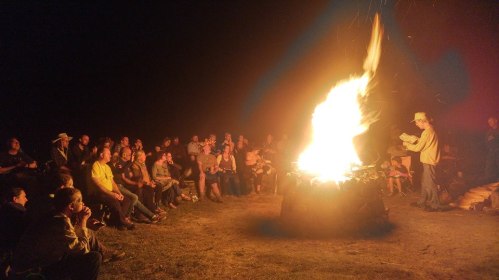
Here’s the poem* I read by the fire** at Saturday night’s eisteddfod at ECG ’16. I’m also submitting it to Touchstone so you may run across it there if it’s accepted.
/|\ /|\ /|\
Drinking with the Ancestors
This poem ain’t no teetotal ritual:
let’s raise each cup, now, individual,
every mug and glass fill up now
and start drinking with the Ancestors.
Chat ‘em up — don’t merely greet ‘em;
the Dead are chummy when you meet ’em.
This good liquor in your tummy
gets you thinking: toast the Ancestors!
By and with the spirits near us —
“Don’t invoke us if you fear us” —
good advice, if we lose focus,
glasses clinking with the Ancestors.
A few more rounds, more pints and glasses,
may find us falling on our asses.
We strive to heed old voices calling
though we’re blinking at the Ancestors.
Yes, when morning comes, perhaps uncertain
if we dreamed or drew some curtain
on a world where it truly seemed
that we were linking with our Ancestors,
good liquor works its own true magic,
so never blame it – downright tragic,
if “hung over” is what we name it:
feel like sinking toward the Ancestors?
They come in all shapes, and in all sizes:
some are heroes, some no prizes
(they’re like us in all our guises)
familiar patterns – star or rose
tattoos we’re inking for the Ancestors.
Listen: they are singing, they are cussing,
they can advise us if we’re sussing
out the paths our lives might take
or leave shivers in their wake
that have us shrinking from our Ancestors.
Before a soul decides to curse them,
mutter charms that will disperse them
foil their harms and then reverse them,
all these stinking, damned Ancestors!
(Ah, do please remember)
we’re their consequence, not moot –
we got their genetic seed and root,
and we’re the payoff, crown and fruit,
we’re their future, built to suit,
so cheers to drinking with our Ancestors!
/|\ /|\ /|\
*I’d drafted the piece at ECG ’12, with the title/last line echoing in my head all weekend, then revised it a few days before this year’s Gathering.
**Hex remarked when he posted the image, “You have the complete attention of a long horned fyre god here, and it is blessing you with its aura.”
The seasonal festivals may start to come upon you like the visits of old friends. You don’t need to be anything other than who you are for them, of course. Fat chance, anyway, of sustaining even a polite deception with someone who knows you this well. I can shove the unsorted laundry into a closet, ready the guest room with fresh sheets, maybe offer a vase of goldenrod and queen anne’s lace this time of year. Clear the top of a dresser or nightstand and set out a few found objects to share: quartz or shale or mica from a recent hike, driftwood from a stream or beach walk. Such gestures never go to waste. They welcome the guest and lift the mood of the host, if lifting is needed.
Sometimes it is. We felt a seasonal shift here in southern Vermont about a week ago, a subtle movement of energies and weather and light as they whisper together and ease us toward the equinox, the evocatively named Alban Elfed, “Light on the Water.” The birds knew it, too — maybe something in their song clued us in to pay attention in the first place.
Of course the linguist in me tries to quibble that neither word “actually means” light or water, but instead simply the quotidian equinox (of) autumn, but then rummaging around the OBOD website I’m caught up in wonder by Coifi’s observations in a lovely post:
This is the Feast of the Autumn Equinox. The Light of the Sun in the Wheel of the Year stands in the West, in the Place of balance between the Light and the Darkness. This is a time of the Great Tides. This is the Gateway of the Year.
This Feast is known by many names to many people, for the Truth is reflected from many mirrors. It has been celebrated as Alban Elfed and Harvest. Our ancestors called it by names long forgotten, and our children will call it by names as yet unconceived.
So it is that literal gets overtaken by the figurative, just as speech does by song. Or not overtaken, not exactly. Whether I let them or not, they start dancing, each bowing to the other. Here is one of the Earth’s truths that says listen. The ancestors gave it names, as do we with our Alban Elfed and Mabon and Harvest Home, and as will our descendants. Each will know it, both the waning light, and the promise of Return.
A further quibble that the festivals are “just modern inventions” dissolves when you can point to old stones and other markers: the earth, again, is a witness here. From the plains of Wiltshire with its over-famous Henge to a hilltop in southern Ohio with its Serpent Mound, the inhabitants of many lands have been drawn to find ways to mark off days and seasons with structures whose physical remains simultaneously hush and awaken the mind.
For “light on the water,” as it turns out to my now-placated left brain, is indeed apt, a festival that celebrates a brief balance of light and dark in the quarter of the ritual year that belongs to the west and to water. “Light on the water” brings with it a twilit mood, a sunset reminder of the reality of life on earth, both dark and bright.
For the whole planet, northern and southern hemispheres both, experiences a balance of light and dark before the days continue to shorten or lengthen, depending on where you stand. The time, friends, is a whole-planet festival. Come! Join in!
But what of activism? readers may rightly ask, especially after my last post.
One of the most evil perspectives — I use the word evil intentionally; a great peril of our times is that the force of the word has weakened to something almost laughable, even as the thing it names continues to spread, infect and damage our world in forms both subtle and painfully blatant, a truly demonic state of affairs — one of the most evil perspectives we cherish is that ecological awareness is somehow a luxury, or a liberal fantasy, just one option among other better and more profitable choices, or an idea whose time is past because it hasn’t produced “results.”
R. J. Stewart succinctly sums up the matter: our true selves and the land are one.
Cause and effect really do still operate, however inconvenient we find them. But merely fighting polarized symptoms lines up more adversaries for us to attack, without ending the war.
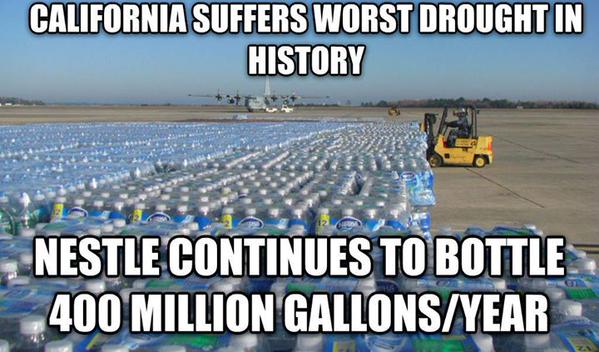
For corporate greed like Nestle’s is just a symptom our modern world makes possible — other eras had and will have their own symptoms.
Yes, we can spend ourselves in noble battle, whatever our position, and if we push far enough, we can “prove” ourselves “right” — and bleed out in the process, kissing this incarnation goodbye. The particular forms that evil takes in this era conform to the lessons we need to learn at this stage of our consciousness.
In a sense, we create the lessons through our weaknesses and imbalances. How painful that continues to be for me to learn! So I want to uncover how to reduce such weakness, rather than spend a life lining up future adversaries that I create out of my ignorance and resistance to a set of lessons I refuse to learn. If indeed the world is a spiritual vessel that cannot be “improved” then what can be “done” with it? Do we even know yet? And how far are we willing to go to find out?
These questions seem to me far more vital than almost any others I’ve encountered. And I know that stance is luxury itself. I’ll admit right here: if I’m the one of those dying of thirst stemming from drought mixed with corporate greed, you who fight to put water back in my hands are my friends in ways a self-named Druid blogger sitting in hydrated Western comfort simply cannot be. So I readily accuse myself on that front, should you turn the focus that way.
But beyond mere easy outrage and less easy symptom-combat and triage, what can I learn and grow from and share? That seems more and more my dharma, the task I find keeps landing on my doorstep unsought.
I want to stare down the hardest questions, because I learn the most from them. But by this I don’t mean to set up tents and squat there in some new “Occupy Existence” movement. The existential is a starting point, not a garden to grow food in. I look at hard questions out of selfishness: I want the biggest bang for my buck out of this lifetime. No guarantees I get more than one (though available signs are promising). As John Beckett notes in a recent blogpost, who among us will lie on our deathbeds and lament most of all that we didn’t sign up for extended cable?!
/|\ /|\ /|\
Yesterday the second of three cords of firewood arrived. To get from this …
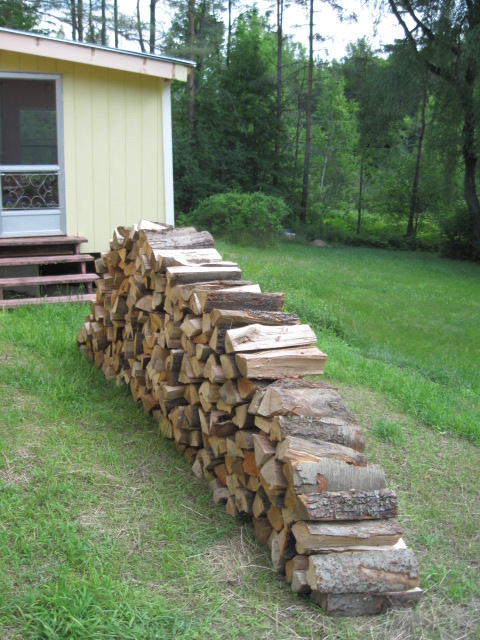
even to this modest beginning
always seems a daunting task. But each year, piece by piece, we eventually get it done. Daily, daily, daily, a practice builds. When I find the right pace, the task itself becomes a kind of pleasure. if I listen, the task itself teaches me. I alternate which arm carries a bundle, and which arm steadies it. I feel each side getting a good workout. I stop when sunburn threatens or aching muscles bring me to the point of diminishing returns. The fatigue of needful effort feels good.

 Or what about a shift of terminology? Would that help at all with any of these themes? If instead of “Baptisms of the Elements”, we called them “Elemental Sacraments”, would that easier name make a difference? Would it make it any easier to move beyond instinctive antipathies and past traumas?
 John Beckett knows intimately the Pagan call to service. More importantly, he heeds it. On his
  The historian-mythographer Geoffrey of Monmouth (1100-1155), whose glorious Historia Regum Britanniae (History of the Kings of Britain) blends history and legend almost seamlessly, is one primary source for the Arthurian legend. In the
  Unable to find among his own builders and engineers the technical ability to construct what he envisions, the king seeks out Merlin and asks for his help: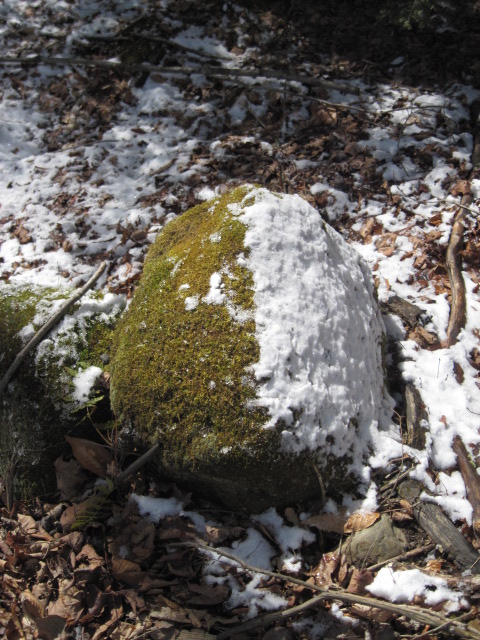
 Bonden-sai is intimately associated with Akita Prefecture in Northwest Japan. Akita is also famed for its onsen (hot springs) and mountains, and Mount Taiheizan, the symbol of Akita City, is a major site for the festival. Bonden-sai there means a vigorous race up the mountain with your bonden to procure the blessings of the gods.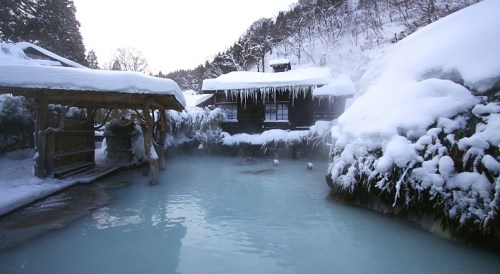
 In other words, it doesn’t matter how close to reality our perceptions are, as long as they give us advantages in survival and reproduction. Or, as the article puts it, they have Adaptive Significance. The sun doesn’t “rise” or “set”, to use a trivial example; instead, the earth rotates. But unless we’re attempting a spacecraft launch, we don’t need a more “accurate” understanding. Living as if the sun rises and sets grants us perfectly reasonable adaptive capacities.
 But side by side with adaptive significance, we might remember that evolution doesn’t “progress”. Where and how the arc of history may bend will apparently always be an experimental question, not an ideological statement.
 That’s neither good or bad in itself: it’s simply how cause and effect have worked, and will continue to work. But so often it’s not in the self-interest of any elite to do what the “electorate” may want or need. That’s what makes them the elite. Plotting a course of self-interest is how they got to
  The city-dweller in a third-world nation foraging for scraps through piles of refuse exhausts her options and migrates with her family to another region where she can grow a small garden. Or find work. Or mount a protest with others large enough it draws media attention to a problem. Or, sometimes, die trying any of these. Sometimes we can shame ourselves into fixing things. Sometimes we just turn away. Every choice matters, every choice contributes to the pool. Nothing is lost. All that we do returns to us, so we can see our choices more clearly. Why else have worlds like this, where choice is possible and makes such a difference?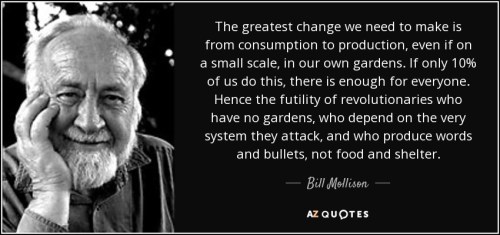
 Over the last several cold damp nights and cool partly cloudy days here in New England, many of us who heat with wood have lit the first fires of autumn. (Some days building and feeding a fire is the best theology I can muster.)

 For “light on the water,” as it turns out to my now-placated left brain, is indeed apt, a festival that celebrates a brief balance of light and dark in the quarter of the ritual year that belongs to the west and to water. “Light on the water” brings with it a twilit mood, a sunset reminder of the reality of life on earth, both dark and bright.
 But what of activism? readers may rightly ask, especially after my last post.
 Cause and effect really do still operate, however inconvenient we find them. But merely fighting polarized symptoms lines up more adversaries for us to attack, without ending the war.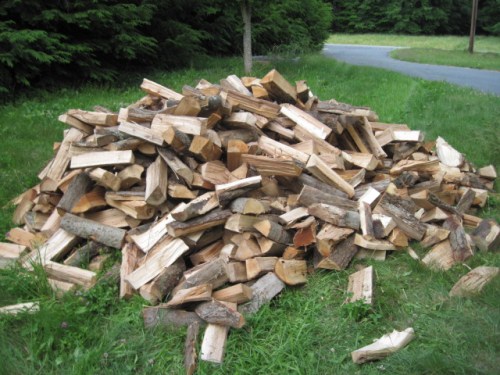


 A Druid Way