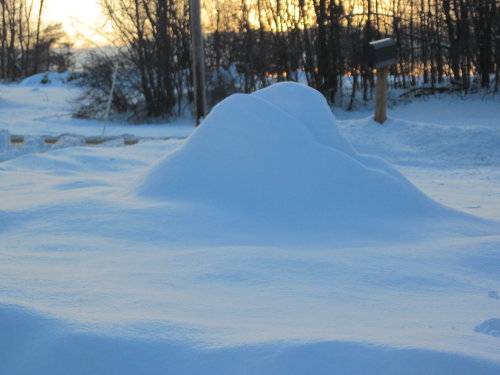
It’s not really a henge at all, of course — just a large boulder we removed from our garden space a couple years ago and set along the north-south axis in our front lawn. A simple bed underneath it, a few other small rocks to steady it. Grass grown back now. Lichens finding the stony surface to their liking, adding their dull green patina to the stone. But the word henge came to me as I looked out the front window at the solstice evening. So I’ll go with it. The heavy band of cloud along the horizon behind the trees presages rain. The mailbox — it seems out of place. But let’s go with that, too, I say to myself. Is this a message?
Mystery is a landscape. OK, I think. There’s always more to see. Even a finite object like a boulder presents a myriad of perspectives. By the time I’ve looked at even a small number of them, the boulder has subtly changed. The light on it has shifted, lichens on its surface beneath the snow cover are growing and dying, and a small, small portion of its substance has crumbled and fallen.
That’s part of it. Hmm, I say to myself. This second sentence, like the first, feels like a communication from outside myself. Is this the start of another Druid dialog? Don’t get hung up on the source, I chide myself, or you’ll miss what comes next. You can worry about doubt and truth and origins later.
The snow’s gone blue in the twilight. The bare trees — “an infinity of tragic shapes, to make thinking difficult,” as Charles Simic says in one of his short poems. Lovely, or inaccurate, or a distraction, depending on your reaction. But decidedly other — not my own primary experience, but the report of another person’s.
Landscape reveals itself when we walk through it. Mystery at its fullest is participation, not just standing apart and analyzing. Then it may be obscurity, or incomprehension. Yes, I can read a scene like a Tarot card, but I can also move into it, inhabit it. Which is a good way to work with Tarot, too. Mystery needn’t be alien or unfriendly. It can and often does reside in the utterly familiar — until all is changed and it steps forward, or we see it again.
Mystery’s not just a quality of experience, though, but a presence. I get why the Lakota call it wakan tanka, “great mystery.” Not “a god” or “gods” but “great mystery.” It’s something specific, even as it remains mystery. The merely obscure darkens. Mystery, on the other hand, deepens.
[The following rite is freely adapted from Ceisiwr Serith‘s Deep Ancestors.* In particular, the Proto-Indo-European (in bold) differs in conception from Serith’s reconstructions. Serith knows both his PIE and his ritual; the changes here match my esthetics and inner sensibility, which I trust — for me. Your mileage may differ. I repeat the words I speak to close my own rites: Solwom wesutai syet! [sohl-WOHM WEH-soo-tie syeht] May it be for the good of all!]
Gumete gurtibos solwom deiwom.
[GOO-meh-teh goor-TEE-bohs sohl-WOHM day-WOHM]
Come to praise all the gods.
Usme keidont — klute tos. [OOS-meh KAY-dohnt — KLOO-teh tohs]
They are calling you — hear them.
Gumete ognim,
[GOO-meh-teh OHG-neem]
Come to the fire,
gumete spondetekwe!
[GOO-meh-teh spohn-deh-TEH-kweh]
come and worship!
Tusyomes, tusyomes, tusyomes! [toos-YOH-mehs, toos-YOH-mehs, toos-YOH-mehs!]
[Let us hush, hush, hush!]
May we all maintain a holy silence.
May we be pure
that we might cross through the sacred.
May we cross through the sacred
that we might attain the holy.
May we attain the holy
that we might be blessed in all things.
Goddess who burns on the hearth, in our homes,
we call you to join us here
bringing our prayers to the gods
forming the means by which we sacrifice.
May the holy arise in our midst, the pure and the blessing.
Shining Lady, unite us all,
for by worshiping at a common hearth
we are made one family, one people.
Asapotya**, Lady of the Hearth, your household is here.
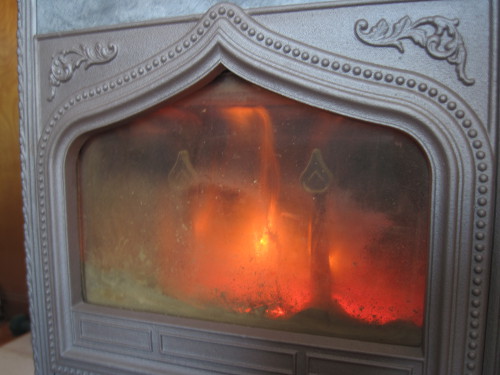
Our soapstone stove, alight with Brigid’s blessing.
/|\ /|\ /|\
A blessed solstice to all!
/|\ /|\ /|\
*Serith, Ceisiwr. Deep Ancestors. Tucson, AZ: ADF Publishing, 2007. Pp. 122-124. Serith is a long-time and respected member of ADF who maintains the Nemos Ognios grove north of Boston.
**A possible reconstructed name of my own devising. The Proto-Indo-European (PIE) word *asa becomes (among other words) Latin ara “altar.”
The * indicates that the word is reconstructed — we have no written record of it — from actual words in one or more of the descendant or “daughter” languages. In general, the more extant “descendant” words deriving from a PIE “ancestor” word, the better the evidence for that particular PIE ancestor. Historical linguists have worked on PIE for over 200 years: we have a few thousand “restored” words that most agree on. One advantage Indo-Europeanists have in making such reconstructions is the large number of documents in older forms of languages like Greek, Sanskrit, Latin, Gothic, Avestan and Old Church Slavonic.
Image: fire on shore. Be sure to visit Richard Gingras’ fabulous images of fires at the URL indicated for the image.
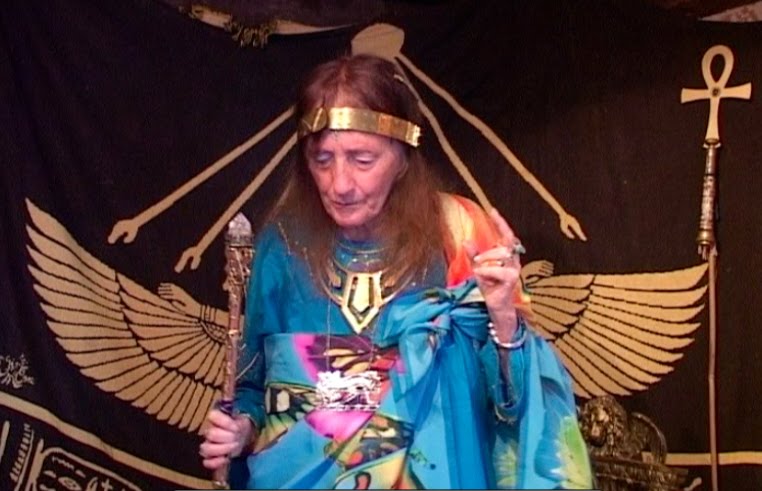
The passing last month of Olivia Durdin-Robertson, author, painter, and priestess of Isis, was remarkably non-reported in the American press. The London Times (preview only) and Telegraph, and the Irish Times, however, all carried extensive obituaries. Colorful and delightfully eccentric, and co-founder with her late brother Lawrence of the international Fellowship of Isis in 1976, Robertson inspired many in a rediscovery of the feminine divine. Her writings, art, liturgies, rituals and personal example helped give a form to a widespread longing to experience the Goddess.
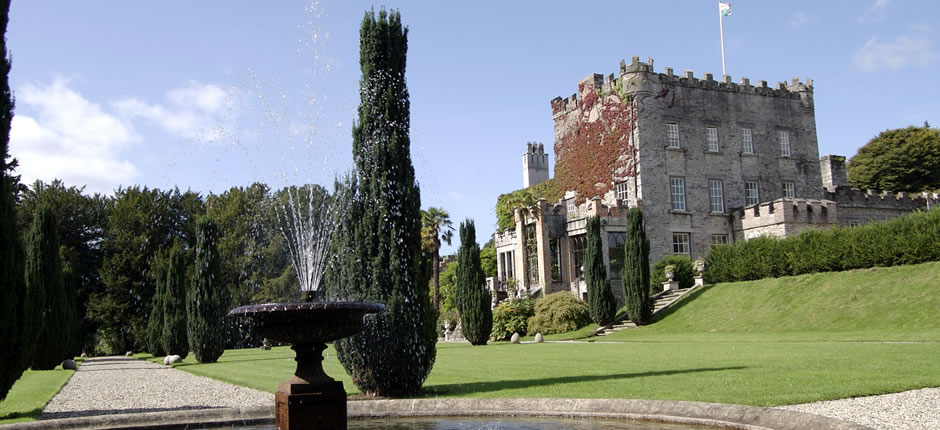
Robertson was a member of the Irish landed gentry, and the family’s splendid Huntington Castle in County Carlow became under her influence a devotional center and extended series of shrines to the Goddess.
I’m writing about Robertson not only because her life and work deserve to be known, but also for more personal reasons. As I’ve tried with varying success to record (Goddess and Human, Of Orders and Freedoms, Messing with Gods, Potest Dea-A Dream Vision), the Goddess is alive and on the move, even in my life. I say “even” because many trends often seem to pop up, flourish and fade before I even discover their existence. And I can be remarkably obtuse even when spirit knocks on the door.
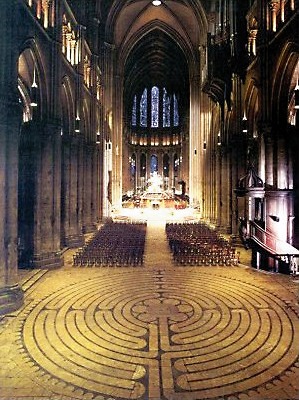
But the Goddess, through Her grace, is no mere trend. Will we look back at the present as another period of renewed veneration for Her, similar to the century or so of inspiration behind the construction of over 100 glorious Romanesque and Gothic cathedrals dedicated to the Virgin Mary in medieval Europe? (The most famous is Chartres, which many know both for the cathedral and for its labyrinth.* The best website is in French, worth visiting for its images even if you don’t know the language. On the horizontal menu, click on “La Cathedral” and then on “Panoramiques 360” — if you have sufficient bandwidth, the virtual tour is well worth your while.)
The most recent appearance of the Goddess (or a goddess — She/They may figure it all out someday) in my life is a series of meditation experiences this October over the span of a week. Isis called to me. The nature of the call wasn’t completely clear, and I also didn’t pay adequate attention. Goddesses aren’t really my thing, I might say, in an arrogant ignorance I intermittently see the extent of. As if the divine in any of its forms is something to dismiss as a matter of personal taste. But I have two color images of Isis I printed from the web (though they’re in a jumble of a side devotional area I haven’t finished ordering and dedicating), and I am continuing to work with meditation and vision to see what comes of it. I pulled a couple of her books** off my shelves, too — evidence she is a presence whether I attend to her well or not.
I mention this because now it feels more significant, in retrospect, with Robertson’s passing. Another reminder this life is finite, and that such opportunities, to the degree they manifest in time, do not wait forever, even if they may reoccur and reappear.
And if you can see from my admissions here how patient the divine can be with human slowness, indifference, ego, stubbornness and a few other choice weaknesses I’m probably missing at the moment, there’s really hope and encouragement for anyone at all.
*A good starting point for learning more about labyrinths is the extensive site of the Labyrinth Society.
**M. Isidora Forrest’s excellent Isis Magic (Llewellyn, 2001, recently out in a second edition), and Rosemary Clarke’s The Sacred Magic of Ancient Egypt (Llewellyn, 1st ed., 2nd printing, 2008).
I’m sitting here in nerd rapture with an interlibrary loan copy of Ranko Matasovic’s Etymological Dictionary of Proto-Celtic. There — I may just possibly have driven away 99% of my readership with a single sentence.
On the off-chance you’re still with me, let me explain. In “Talking Old” I tried to convey my delight in the sounds and shapes of our ancestral language — I say “our” because over half the planet speaks an Indo-European language, itself a pretty remarkable fact. Proto-Celtic is a daughter of Indo-European and mother of the six modern Celtic tongues: Manx, Breton, Cornish, Welsh, Irish, and Scottish Gaelic. So Indo-European is our “grandmother tongue,” or maybe great-grandmother. Beyond the nerd appeal that only Celticists, conlangers and a few other assorted dweebish types can comprehend, Proto-Celtic is a window into Celtic history and culture, a fragment of our human past — and a potential source for a ritual-liturgical-magical language in the Celtic tradition.
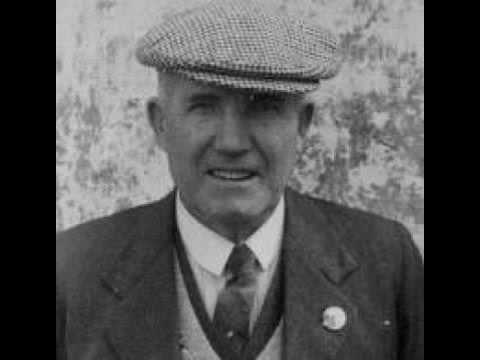
The Celtic languages today are struggling. Manx has been brought back from the last edges of extinction — with the last native speaker of Manx, Ned Maddrell (image to the right) passing in 1974. Take a look-listen at this short video of Manx children and a couple of teachers talking in and about the language. Cornish died out about 200 years ago, but has been revived and has, depending on your source, a few thousand speakers, and along with the other Celtic languages, a cultural fire banked under it to keep it alive. Scottish Gaelic is threatened but has speakers in the tens of thousands, and Welsh and Irish are also at risk, but have active communities of speakers. Breton struggles against an official French-only policy, and retreats annually, as older speakers die, and younger people turn to French to get ahead. If you’re interested, check out these links to some short clips of speech in these languages.*
The Etymological Dictionary I’m currently drooling over, confirming everyone’s worst impressions and stereotypes of nerds, provides linguistic reconstructions of Proto-Celtic words — something like a museum restoring missing portions of an old painting or piece of furniture. As the restoration proceeds, the face of one of your ancestors takes shape before your eyes, and you hear a whisper on the wind of a voice speaking a language gone for over a thousand years. That’s the closest I can come to the sensation of reading and pronouncing slowly to myself the restored words.
But while you shake your head at one more poor fool taken in by cultural seances and linguistic necromancy, I’m wandering mist-covered hills and listening to ghosts reincarnate in dream, as long as I hold the book open. I make my very own Samhain-on-the-spot, the veil between the worlds thins, and I converse with the dead, with the Otherworld, with the generations stored in my DNA and blood and bone. Perhaps you could call it racism in the best sense of the word — a celebration of all who have gone before me and who, by living, have delivered me to this moment of my own life, as I write these words. It doesn’t last, but it also endures forever.
As a linguist and conlanger it wouldn’t be hard for me to reconstruct a couple of different usable versions of a Celtic language. One version could be a somewhat simplified Proto-Celtic, another a sister tongue to Welsh, Breton and Cornish, ieth gelteg, a Celtic language. Would it be “authentic”? About as authentic as I am, descendant of so many bloodlines that like everyone else on the planet, I’m a mongrel. Who would want to speak such a mongrel tongue? That’s not my concern — I’d restore it for some of the same reasons a museum sets about a restoration: for what it can tell us about our past, and about ourselves as preservers of our past, and for its “thingliness,” its solidity and existence in our world. These are potent magical reasons on their own.
Why not learn a living and threatened Celtic language instead? Do something more practical! I can hear the critics and naysayers. Can’t you best connect with your supposed past through those alive today, speaking a descendant tongue just as you are a descendant person? Well, I have. I know a fair bit about the Celtic languages, as I do about some other endangered and dying languages. And I look at them as I look at the branch of my own ancestral line, destined to die out because my wife and I have no children. Half of all our current languages are destined to die before the end of this century, along with a comparable number of plant and animal species. Some have seen a reflection of one in the other. Given how closely tied human rights, tribal survival and environmental degradation are, it’s not a stretch to see human languages and ecosystems as mirrors for each other. “What we do to the web, we do to ourselves.”
The analogies of blood and speech start to break down, the Samhain door of linguistic reconstruction begins to shudder shut, and I’m back in my diminutive study, holding the hardbound book, more than an inch thick, and shivering a little. I stand up and step into the living room to stoke the fire in our soapstone woodstove which has subsided to embers during my extended reverie. And I wonder and remember and plan and dream again. Celtic twilight is not the same as Celtic dawn, though at any point the light level might look the same.
*Here are short Youtube clips of Irish (a 2-minute weather report), Welsh (a Welsh teenager talking in both languages), Cornish (a story in English and two varieties of Cornish, with a strong English accent), Irish again (4 minutes, this time showing how Manx and Irish speakers can understand each other), Scottish Gaelic (2:14; also a weather report) and Breton (2:10 — short interviews, subtitled in French, that you might mistake at first for French, so strong is the French influence on Breton pronunciation).
(Special thanks to Amethyst, where a version of this review first appeared in the November issue.)
Magic of the North Gate is an intriguing book for those like me who have studied McCarthy’s previous works and might have expected another in the same vein. An inviting departure from her involvement in more temple-oriented magic, this book reflects a change of lifestyle as well for its author. A teacher, ritual magician and Hermeticist, McCarthy now resides in Dartmoor National Park in the southwest of the U.K. Think of a Golden Dawn mage taking up residence in Yellowstone or Yosemite. The book remains characteristically humble, wise, unexpectedly funny, and profound – qualities too often lacking in books on magic. Add to these its emphasis on being of service to the land, and it is altogether a valuable resource.
Throughout the book’s nine chapters, McCarthy recounts her rich experiences over the years of working with land spirits and nature magic. A resident for a time in the western U.S., she passes along many helpful observations in her stories and suggestions applicable both for the typically more settled inner and outer terrain of the United Kingdom, and the wilder landscapes of North America. To put it another way, her book often prompts a reader to meditate, reflect and then adapt her many ideas to the reader’s own landscape, circumstances, abilities and experience. No mere recipe book, this.
Nevertheless, along the way you discover that you’ve gained valuable insights on how to approach gardening and building outdoor shrines, advice on honoring the fairies and welcoming local deities, or strategies to deal with approaching storms and “death alleys” on infamous stretches of highways. She discusses ways of honoring old bones you may unearth, effecting a “deity transfer” to a statue, and interacting with Native American peoples, sanctuaries and spirits who will respect your heritage and ancestors if you own them outright, in keeping with how you respect theirs. The eighth chapter, “The Dead, the Living and the Living Dead,” offers much material for exploration and contemplation. As McCarthy observes, “A major skill to learn in life that has major bearing on the death of a magician is discipline of controlling wants and needs … it is a major tool” in making the transition through death (230).
The final chapter, “Weaving Power into Form,” likewise provides ample material to explore in one’s own practice. McCarthy’s Hermeticist training and experience re-emerge, particularly in her emphases and terminology in later chapters, to good effect, since she has contextualized what she says there by establishing a foundation in preceding chapters for her particular flavor of earth magic. Her insights into ways of working with the energies of the temples of the directions and elements are also helpful.
McCarthy’s writing style is both conversational and reflective. Her book reads in part like a journal and follows its own organic and occasionally circular order, though her nine chapters do deliver what their titles promise. Often, though not always, the points she makes are less a “how-to” – though she offers much advice clearly grounded in experience – than a “what-happens-when.” To give just a few for-instances across the chapters, here are some excerpts:
“Magic in its depth creates boundaries of energetic opposition and tension. This is part and parcel of how power works – it also protects the integrity of the inner worlds as well as beefing up the magician … It can also act as an idiot filter …” (17-18).
“If I had known about [the impact on the physical body] beforehand, I would still have explored, but would have looked after my body better and would have made a point of reaching for inner contacts to help teach me about how to handle my body through this work. Hence this part of the chapter” (39).
“Land spirits don’t do ‘sorry’; if you break a promise then the deal is off” (130).
“You may notice that your home or building does not appear upon the land, which is normal if it is a modern building. Buildings, unless they are consecrated spaces or temples, tend to take hundreds of years to fully appear in the inner landscape of the land” (133).
I will return to this book to re-consider and annotate the portions I’ve highlighted and queried in a different way than I will her other books, The Work of the Hierophant, and the Magical Knowledge trilogy (Foundations, The Initiate, and Adepts). The latter texts help fill in gaps in my more intellectual understanding of kinds of work I will very likely not pursue in this life, though there, too, McCarthy’s earned wisdom transfers to other kinds of practice. But Magic of the North Gate is a more immediate companion and touchstone for what I am exploring already, in my own way, on my handful of acres on the New England hilltop where I live and anywhere else I set foot.
/|\ /|\ /|\
McCarthy, Josephine. Magic of the North Gate. Oxford: Mandrake of Oxford, 2013.
I mentioned OGRELD in an earlier post — acronym for that “One Genuine Real Live Druidry” that never existed. But for a non-existent thing, it’s proven surprisingly lively in my thoughts. Every time I scratch my head and say about somebody else, “How can you dothat?” when they do or believe or say something that doesn’t match my quirky and partial understanding of the universe, OGRELD raises its fictitious head, pretty frisky for something that isn’t.
But then “existent” and “non-existent” together comprise a pretty useless category anyway, from what I can see. Hit a paradox, seek for a unifying truth behind it: basic tool in my toolkit. Do I really think that what became my mother and my father flashed into existence from nothing some eight decades ago, mucked around, made a life, made me (thank you!!), and disappeared again forever? That’s far less likely, far harder to believe — a major mismatch with my and others’ experience of the universe — than an alternative take on things: that what manifested as my parents, as me, as all the birds and animals and plants and everything here and there and everywhere, the Ten Thousand Things, is something the universe excels at doing.
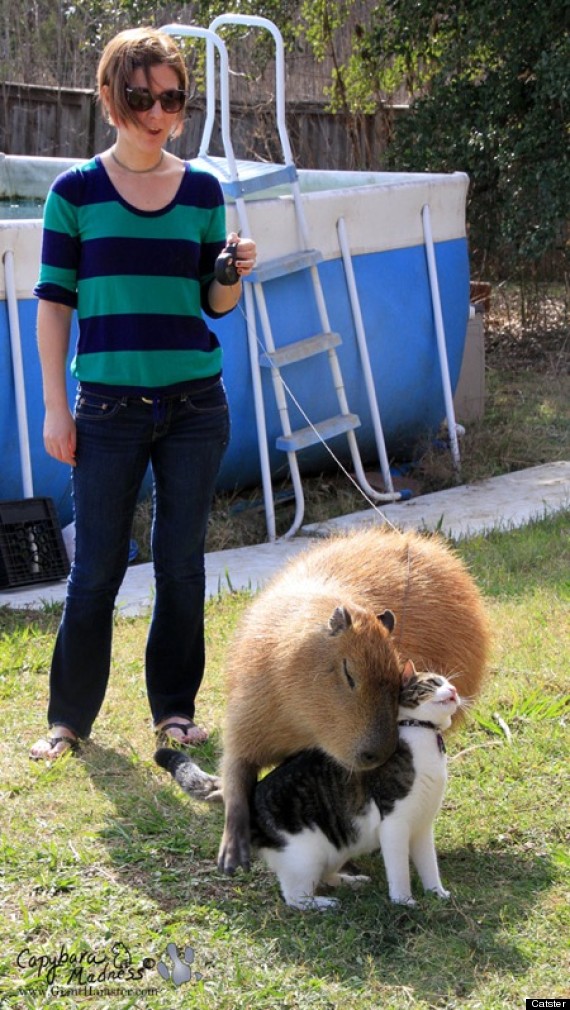
Rodent of Unusual Size
Why? Because, first of all, it just keeps doing it. Blessedly, bountifully, provocatively, right under our noses, before our eyes, in our ears, right on hand, at the tips of our tongues. And that, more than anything, spells out my sense of any immortality that may be: this wonderful energy keeps changing form, so don’t get too attached to forms. Roll with it. Dance with it. See where it wants to go next, and follow. Get sufficiently intoxicated in the flow, and its apparent ending is just a wave against a rock, a splash in the endless current. Real? Definitely. Splashy and messy? Yup. But not the whole story by any means. The story goes on with the current. The form (the previous chapter, where we left our hero/ine dangling from a rope above the rapid or the ‘gators or the Rodents Of Unusual Size*) gets left behind. Life 101. What do they teach in schools nowadays?! Move along, move along. These aren’t the Druids you’re looking for.*
But our sneaking suspicion of a truth underlying things also brings with it an annoying tendency for us to think that anything out here, in the manifest world, equals that underlying truth completely, finally, once and for all. That’s a mistake in categories — doesn’t work that way. Instead, it arrives provisionally. Approximately. We encounter any “underlying truth” through time, not all at once. You get your piece, I get mine. For today. Tomorrow we need to reconnect, re-source, re-build. Not “two steps forward, one back,” but instead, keep moving or stagnate, bleed and breathe or fossilize, innovate or institutionalize. Where we are today is always somewhere on that continuum (and almost never at either pole, however much the shrillness of current headlines wants us to believe otherwise. Exhibit A: Anti-Christ Obama / Exhibit B: A New Hope).
So OGRELD can seduce us along every one of its points. “One”? Unity is a tough one for human beings. We see it as a goal, but it usually happens intermittently, then we retreat to our local tribes.
“Genuine” and “Real”? Think of the money in both advertising and purchasing for whatever is “authentic, genuine, real.” But in spite of how those qualities have gotten cheapened, or rather because of it, we long for them more than ever. (The Velveteen Rabbit became real because he was loved. Could be we’ve been looking in the wrong places. “Genuine” and “Real” aren’t in other things, but in ourselves, or nowhere. Whether that’s an improvement, a miracle, a discovery, a revelation, Good News, depends on where you’ve been spending your time and energy.)
Even “Live” can be problematic. (That’s one sign of human genius: we can make problems out of everything.) It’s a game — as long as we remember we agreed to play, and as long as we know that the solution or the victory or the endgame is a solution for today. Tomorrow the games reboot. We’re back with the starting pieces and our own ingenuity and creativity. If we know it’s a game, it’s delightful. If we take it too seriously, it’s pure and absolute Hell for everybody. Oh, we know these things. OGRELD (fill in your preferred means of deliverance here: god, sex, liquor, drugs, the Singularity, Progress, Apocalypse), lead us into your truth!
And “Druidry,” the final component? It’s just as problematic as the rest. It’s not for everyone — not because it excludes, tolerant** little sucker that it is — but because, as with most “solutions” we pose to the problems we created, we exclude ourselves from it. We’re better at no than at yes. If you’re looking for an idol to worship (and we all have one or more already), make sure it’s the best damn idol money can’t buy.
So make a list: what do you want in your job/mate/religion/diet/life? Then interrogate that list. If you actually hadX, what would that let you do or be? Keep going through a few more cycles of interrogation: if you then had Y, what would thatlet you do or be? Stop when exhausted, or when you’ve arrived that the truth that underlies the “truth.” (If you don’t know what thatis, there’s a project/problem for you. Have at it!)
/|\ /|\ /|\
*There are times when an excess of pop-culture movie references can mar an otherwise perfectly decent blog post.
**Some brands of Druidry are more tolerant than others. In some forms of Druidry, you’re encouraged to invest your time and energy exploring almost any tradition and practice EXCEPT Christianity — shamanism, Egyptian polytheism, Reiki, permaculture, Hinduism, Voudon, veganism, Asatru, Wicca, Buddhism and onward to the ends of the earth. But not Christianity. (If you think Jesus didn’t also teach good Druid principles, you’ve missed substantial insights from both Druidry AND Christianity.) Not true for all flavors of Druidry by any means, but Christian Druids tend to hang out together, or practice solitary, or stay closeted, or drift away, from what I’ve seen. But see OBOD’s page on Christianity and Druidry.
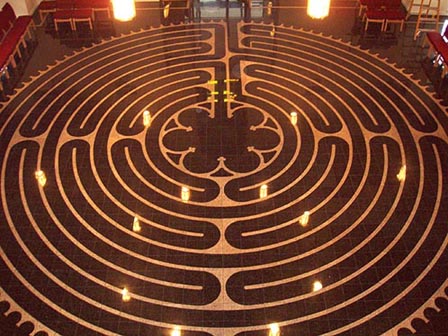
Images: labyrinth — a fine instance of Druid (Pagan) and Christian imagery working synergistically; “Rodents Of Unusual Size”: photos and accompanying article at The Huffington Post, from an article from June ’13.
We’ve read it, heard it, thought it, and many self-identify with it. It leaps faith boundaries; there are respectable atheists who lay claim to it. Meme, cop-out, canary in the mine, badge of honor, ticket to bad-ass-dom or philosopher status, tired PC label. High-mileage, time-to-change-the-tires, still-up-for-that-road-trip hippy van of the post-post-modern zeitgeist-fest that is for today what “finding yourself” was for a whole other lost generation not so long ago. You ask, and … there it comes, wait for it … “I’m spiritual, but not religious.”
Don’t misunderstand: I’m not mocking the impulse, just the frequent obliviousness of people who think it’s original with them. According to a Gallup poll from over a decade ago, 33% of Americans apply the SBNR label to themselves. I doubt that that percentage has dropped at all in the interim. If anything, it’s probably risen.
The phrase annoyed United Church of Christ pastor and author Lillian Daniel enough that she wrote a 2011 guest blog entry for The Huffington Post: “Spiritual But Not Religious? Please Stop Boring Me.” Responses to the post helped supply enough material that the original page grew into a book-length collection of essays —When “Spiritual But Not Religious” is Not Enough. [As a side note, only the first half of her book directly engages the topic of the title.]
The “enoughness” of Daniel’s title refers to the importance of community, without which she feels a private spirituality can slide too easily into laziness and self-indulgence. Of course that can happen. Who holds people accountable for slipping into bad habits, if they seek to find their own truth, in their own way? [Turns out there ARE some “forces at large” who can keep us in line; for that, keep reading.] How do we avoid a kind of heedless religion of gratitude, if you live in the West and are comfortably middle- or upper-class? After all, that life can be pretty good much of the time: no starvation, war, oppression, plague and so on. How do we escape a superficial enjoyment of nature as the whole of our easy religion? (In particular, Daniel inveighs against the “Aren’t sunsets glorious?” crowd who think that their love of beauty is both original and that it “covers all sins.”)
Yes, there’s a Puritanical streak present in Daniel’s irritation (Puritanism defined by H. L. Mencken as “the haunting fear that someone somewhere is having a good time”). A fair portion of the SBNR’s may well come across as hedonist agnostics without a care (though I’ve yet to actually meet one), while the good people in congregations like Daniel’s engage each other in all their human imperfection, and are called to be better for it. But given the litany of ills the world faces, which any reflective person can see are attributable at least in part to the ongoing gluttony of first-world nations in their consumption of the planet’s resources, irritation is a perfectly reasonable response. Given the imperial overreach of those same nations in their attempt to bully and harangue the world so that their gullets remain as stuffed as possible, irritation might even be a good starting point for making an actual change — though Daniel goes nowhere near so far.
But there’s more of substance going on here, which Daniel is understandably reluctant to examine, since it cuts to the heart of her religion. Part of an “actual change” has already been going on for decades.
We can grasp one corner of the change in the words of now retired Episcopal bishop John Shelby Spong. Spong notes in his Q & A for 11-7-2013 that those he terms the “non-religious” often are still spiritual:
Lots of people who do go to church are “non-religious.” Lots of people who say they don’t believe in God are profoundly spiritual and searching people.
What I seek to describe with the phrase “the non-religious” are those for whom the traditional religious images have lost their meaning. There is no God above the sky, keeping record books, ready to answer your prayers and come to your aid. There is no tribal deity lurking over your nation or any other nation as a protective presence. There is no God who will free the Jews from Egyptian slavery; put an end to the Inquisition or stop the Holocaust. If these goals are to be accomplished, human beings with expanded consciousness will have to be the ones to accomplish them. This means that the category we call “religious” is too narrow and limited to work for us in the 21st century.
The question I seek to answer is that when we move beyond the religious symbols of the past, as I believe our whole culture has already done, do we move beyond the meaning those outdated symbols once captured for us, or is the meaning still there looking for a way to be newly understood and newly symbolized? The word “God” is a human symbol. I believe though that the word God stands for a reality that the word itself cannot fully embrace and that no human being can define. To worship God in our generation means not that we must move beyond God, but it does mean that we will have to move beyond all previous human definitions of God. So to be “non-religious” is just a way of saying that the religious symbols of the past have lost their meaning. That does not mean the search for God is over; it means the quest for new and different symbols has been engaged.
Some of what’s unintentionally ironic in Spong’s words here, intended to push against “Churchianity” and provoke mainstream Christians in its Pagan-like tolerance, is that many Christians would agree with him, and many Pagans and Druids in particular wouldn’t. For the polytheists among the latter, gods and goddesses are indeed real. Where Pagans and Druids doshare common ground with Spong is in their conviction that there is a spiritual “reality that the word itself cannot fully embrace and that no human being can define.” But while it may be that some specifically Christian “religious symbols of the past have lost their meaning,” Pagan symbols feel new again. Paganism is growing because “the quest for new and different symbols has been engaged”; that’s what makes Neo-Paganism: so much is new. Talk to a Druid who’s encountered Cernunnos or Morrigan, who serves either as priestess or priest. Talk to a Wiccan who draws down the Moon.
Finally, if the posts on blogs like those on my sidebar of links are any indication, Pagans and Druids who may be solitaries and practice alone (as often out of necessity as out of choice) face their fair share of profound challenges in their spiritual practice that foster growth and unfolding, deeper awareness, and an enriched capacity to love. After all, Christian saints over nearly two millennia who retreated to hermitages and isolation from human others in order to deepen their spirituality also frequently found what they sought. It betrays a misunderstanding of spirituality to think we can’t practice alone. Fools and sages are pretty evenly distributed across the planet and throughout spiritual traditions. The sage I seek may live, not on the other side of the planet, but next door in the trailer, the one with the Chevy up on cement blocks in the front yard. The fool is often standing in front of me when I look in the mirror.
/|\ /|\ /|\
Daniel, Lillian. When “Spiritual But Not Religious” Is Not Enough. New York: Jericho Books, 2013.
In this post I enthuse about an early and continuing inspiration in my practice, and inevitably drag in other more idiosyncratic but hopefully still relevant associations along the way. So first, the “old magician” of the title. Scottish-born R. J. Stewart (b. 1949), a composer and author, is among the handful of contemporary practicing magicians whose work has done much to clear away accumulated Medieval and Victorian superstition and obscurity from magic. Why, for instance, should I intone or vibrate a particular name during a ritual, unless I know what it is and what it’s meant to accomplish?
Inspired by Celtic tradition and the teachings of his mentor Ronald Heaver (1900-1980), Stewart has developed practices designed to heal both magician and environment, among other reasons Druids may be interested in him. (His website deserves a visit if you want to learn more about him and his magic.) Along the way, with his Inner Convocations and Inner Traditions practices, he’s also helped to articulate a comprehensible theory of how magic works and can be effectively practiced, reflected in workshops, audio projects, and books like Living Magical Arts (hereafter LMA). That book was my first deep introduction to magic more than two decades ago, and I sit with my dog-eared copy in front of me now.
I value LMA in part because in it Stewart states basic truths succinctly and clearly — truths I find I need to come back to again and again. His work derives from personal experience. That means that unlike too many texts on “magic,” it is no pastiche of the work of others, or a mere catalog of magical correspondences that do little by themselves to advance actual magical practice. On the page, correspondences may look nice (or scary, depending on your own personal fear factor) and decorative for the armchair magician — and who isn’t one of those, with all the books on magic you could read and leave lying around to impress or intimidate guests?! But anyone half-way into a serious first-year study of magic can (re)create from experience their own list of equally effective correspondences. That doesn’t render them somehow invalid or useless, but shows that they’re dependent variables rather than constants. I wanted the constants, “unrealist” that I can sometimes be.
The fact that magical traditions worldwide share much common ground in things like tables of correspondences, while annoyingly refusing to agree on some presumed “basics,” like which direction is associated with which element, should of course give us a clue about what “matters,” what’s convention, and what the difference is. (For more on this, see Mike Nichols’ wonderful “13 Reasons Why Air Should Be North,” now promoted to the status of a “Sacred Text” at ISTA, the Internet Sacred Text Archive, which if you don’t know, you should know, if only to “waste” large amounts of time exploring.)
In LMA, Stewart offers overviews, rationales, and a coherent and profound magical philosophy for what he presents. As he defines it, “magic is a set of methods for arranging awareness according to patterns.” Worked with consciously, these patterns can help catalyze a transformation: “the purpose of magical arts is to enable changes within the individual by which he or she may apprehend further methods [of magic and transformation] inwardly.” This transformation can come about because “magic attempts to relate human consciousness to divine consciousness through patterns inherent in each.”
One reason for the magical dimension of human reality is simply that, as biologists have been discovering, we’re pattern-seekers and pattern-makers in profound ways. That’s how we make sense of the world, the “one great bloomin’ buzzin’ confusion” of things*. Find the pattern — or impose one, if nothing helpfully steps forward as a clue to whatever’s going on in front of our noses. Note that this predilection towards pattern-making is neither “good” or “bad” by itself — though it makes sense to assume, as at least a provisional view of reality, that if pattern-recognition is so successful as a survival strategy across so many species, it may actually have something to say about what “reality” is like, or how it comes across to consciousnesses still evolving to “grok” it.
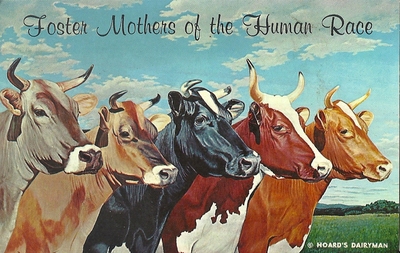
For we share this “blueprint of consciousness” with other mammals, which is why I suspect we were ever able to domesticate animals like dogs, cats, sheep, geese, ducks, chickens, cows, horses, and pigs that have contributed so hugely to human civilization. They’ve served us as sources of food, clothing, transportation, power for machines, defense, pest control, and companionship. (Growing up, I remember a picture my dad displayed prominently in our house of five cows, each one representing a different breed of dairy cattle, with the caption “Foster Mothers of the Human Race.” We kept a herd of the familiar black and white Holsteins, the most common breed in the U.S., the breed most people think of when they think “cow,” but the other four breeds were still important enough to our farm family that as a child I also knew Brown Swiss, Jersey, Ayrshire and Guernsey cattle on sight.) If domestication isn’t a marvelous and far-reaching act of magic, what is?
So pattern-making is a “keeper” in our toolkit of magical strategies and techniques. I sense the shades of my born-again and otherwise Christian ancestors flinching and cringing and flagellating themselves. But magic is not a religion, and is certainly not anti-religion, but rather “a coherent set of traditions regarding human potential.” Or it’s becoming one, in the hands of competent modern magicians like Stewart. And he goes on to assert that the god and goddess images of religion are imaginative images “engineered to a high standard of performance.” What that means is that magicians, without ever denying the power or value of such images, work through and beyond them because they want to experience and work with the reality which lies behind images and which energizes them.
Stewart’s style both in LMA and later books is educated and not a breezy, colloquial one. If you’re hearing worship in my words, try again. I don’t expect everyone will (or should) agree with Stewart. I don’t always. But his common-sense, grounded, characteristically practical outlook is refreshing and unusual when you look at the sometimes careless, unscholarly, irresponsible and misleading books on the market which promise a lot and don’t deliver. Use your reason and intelligence fully, as Stewart would urge, because they’re tools too. He remarks late in the book, “if the intellect can be turned to prove to itself that conditioned life patterns are false, it becomes a useful tool towards liberation.” No quick fixes here (I’m usually suspicious of books which promise those anyway), but a path worthy of prolonged dedication.
/|\ /|\ /|\
Stewart, R. J. Living Magical Arts. Blandford Press, U.K. 1987.
*attributed to author and psychologist William James (1842-1910)
In the Celtic worldview (and also for anyone in the Northern Hemisphere it’s abundantly clear), we’ve entered the “dark” half of the year. “Dark” drags in its wake many associations, many millennia old in primate consciousness, of fear, death, danger — all things we instinctively flee, unless we pause to examine cultural conditioning to see why this should be so. If you’re still moved to flee after such a pause, at least you’ll be running with eyes open. Watch out for the lemmings up ahead.
And here is another lesson about Orders and freedoms. The planet we live on follows its own rhythms, regardless of our druthers, and as natives here, willy-nilly we move with the earth under our feet. Earthquake, hurricane, flood, volcano; spring, summer, fall, winter. We’re tenants, not landlords. As much as we try to banish winter cold and darkness, they abide just inches beyond our noses as we peer out our triple-glazed windows. And that’s fitting, of course. Among all its other wonders, the planet grew this wonderful fore-brain of ours that makes childbearing a challenge when it’s time to pass a large skull through a small birth canal, but that same large brain helps us live in temperate and even arctic climates, as well as virtually everywhere else there’s legroom. A balance between order and freedom, limit and innovation, change and stasis. We’re a part and apart, at the same time, courtesy of a species the planet’s still experimenting with, and probably always will be, till we die out or evolve, some of our descendants, into something else.
OK, you say. Got it. Had it before I came here. Heard the lecture, took the tour. Tell me something I don’t know. And these are precisely the challenges to throw at allour ways of thinking, not just the privileged few that happen to irritate us because the horrid Others say them. First assignment, due on your next day of reckoning, at your local time, or whenever is most inconvenient. All our assumptions need a stir on the compost heap. Political affiliations, marriages, jobs, habits, hobbies, what’s vulgar or profane (Miley Cyrus? Death camps? CEO incomes? Ignorance? Missed chances to use petroleum to prepare for a world without it? Endless lolcats? Taupe and mauve and puce?). The once-over should include everything— especially whatever’s a wholly-owned subsidiary of your left hemisphere. What don’twe know? Got a hunch about that. Isn’t our ignorance one more miserable discomfort, to join the ignoble quartet above — death, dark, fear, danger? We don’t look because it’s hard. It asks us to start over. Not to reinvent ourselves, but to return to what we threw away because it seemed old, to pick it up, and see it again for the first time as utterly, endlessly new. One thing becomes another, in the Mother, in the Mother. Look it up, or consult the nearest young thing growing. The Goddess makes all things new.
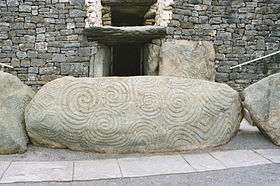
No Order can “teach” us such “wild wisdom.” All it can do is point the way back to our bones, blood and sinew that always held it, gift that doesn’t turn away from us merely because we turned from it. Change, cycle, spiral. We see it celebrated, repeated (doing what it’s being) in Celtic art. We can feel it in the flow of Tai Chi, the circular movements of dance and swimming, the serve and volley and return of tennis, sex, night and day, birth and death. What goes around comes around. What you do comes back to you. Is this not a great gift, that we see the results of our actions? Nothing is lost, and all is stored like seed in the earth, and returned at the next springing forth. Only a short-sighted people would fear the fallow time, forgetting the blossom time after. Only blind people would act as if this is all there is. “This” by definition is never all there is. Reconnecting with the natural world “lengthens” the sight. Vistas re-established. Perspectives re-balanced. Cure at hand for too much left hemisphere, too little humility. When was the last time we praised a world leader for that trait? And why is that? OK, call me Groucho.
At the recent East Coast Gathering, Damh the Bard told a version of the fine story of the Hare and the Moon. The Moon had a choice piece of wisdom to impart to the people of earth, and asked the Hare to carry the message. “Tell them this: you are all going to die,” said the Moon, and like a shot the Hare was off, bearing the Moon’s message to the people of earth in great leaps and bounds. Of course, Moon had been showing the lesson each month, passing through darkness to fullness, waning and waxing, shrinking and growing, endlessly, patiently teaching. But the people had forgotten, and when they received Hare’s partial message, they wailed bitterly at their wretched fate. “We’re all going to die!” But the Hare, impetuous fellow that he was, had not stayed to hear the second half of the message, which was delayed in reaching the Earth: “… and you all will be reborn.” For Hare’s over-haste and obliviousness, when he returned, the Moon split his lip, and to this day the harelip is a reminder to hold in the heart the whole message, to find wholeness in the many pairings that a true cycle treats as “One Thing, moving” — a Uni-verse.
So what are Druids to do who feel Orders may not be for them, or at least not right now? The whole world beckons. If, as Robert Frost says in “Carpe Diem,” which must by all signs be the true religion of America*, “The present / Is too much for the senses, / Too crowding, too confusing— / Too present to imagine,” a few years later, his splendid poem “Directive” urges: “Drink.” This too can be religion, can be spirituality, can be a saving and healing practice that does not split the two, if you will have it: “Drink, and be whole again beyond confusion.”
/|\ /|\ /|\
*Carpe Diem: (Latin) literally, “seize the day”; Nike’s Just Do It; YOLO — you only live once; “in heaven there is no beer; that’s why we drink it here.”
Lorna Smithers’ comments about Druid Orders on the last post, “Facing a Critique,” have revolved fruitfully in my thoughts for the last couple of days. I have to laugh at finding myself, if not defending groups and organizations, at least examining their virtues as evenhandedly as possible, given that I’m not much of a “joiner” either, though I’m a member of OBOD.
Smithers reflects:
It was my preconceptions about the middleclassness and conservatism of Druidry that made me steer well clear of it until a couple of years ago until Phil Ryder of The Druid Network gave a talk at my local pagan society, voicing that it isn’t all about robes, ceremony and tradition but forming relationships with the land and communities in which we live. Which identifies it more with radical ecology and grass roots movements than middle class conservatism.
Many people instinctively shy from joining groups for the reasons Smithers gives: they’re confining to the person who wants and needs to do more than follow convention and the group-think that too often can arise from, and mar, such organizations. To many people, the energy and effort required to acclimate to a group don’t equal the advantages that come with belonging. And there are definite advantages, which I’ll talk about later.
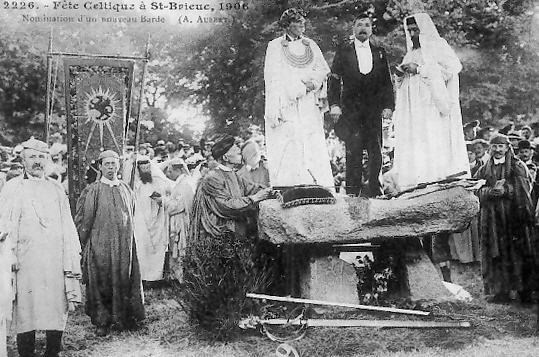
A 1906 Breton gorsez (gorsedd)
Druid groups are of course no more exempt from these weaknesses than any other human institution. And for a number of secular Druid groups, some of the satisfactions of belonging are indeed the “robes, ceremony and tradition.” The Welsh, Cornish and Breton gorseddau (the Welsh plural of gorsedd“gathering”) are specifically intended to promote poetry, music and scholarship, and the annual public gatherings are rich with ceremony and symbolism — and robes.
Smithers continues:
I’ve never been able to bring myself to join an Order such as OBOD and pay for their tuition because I don’t want my relationship with nature and the divine to be determined by anybody else’s structure, and I believe one’s local land and community, its spirits and deities are the greatest teachers.
If ever there was a succinct manifesto not just for the solitary Druid, but for all Druids, there it is: “one’s local land and community, its spirits and deities are the greatest teachers.”
Yet we need some kind of structure, even if it’s free-form: a shape for our journeying, a cairn along the forest path. Where to find it? William Blake is credited with saying, “I must create a system, or be enslaved by another man’s.” Sexist pronouns aside, his words ring true. The challenge for the solitary is to be open and receptive enough to perceive what she is being taught, to catch the lessons of the spirits and deities and local land and community. Orders can help in teaching techniques of openness. And the community of the like-minded, of one’s fellows, or of a more formal Order is often the leaven that forms in us an opening to new experience. We catch awen from others’ inspiration, we take flame from neighboring fires.
In my experience, a good half of spirituality is “caught” not “taught.” Or the teaching simply says listen! In the presence of others, human and non-human, we find what we seek when we inhabit fully our ears and eyes and tongues and noses and skins. What we need, to quote Moses at his most Druidic, is right here: “It is not up in heaven, so that you have to ask, ‘Who will ascend into heaven to get it and proclaim it to us so we may obey it?’ Nor is it beyond the sea, so that you have to ask, ‘Who will cross the sea to get it and proclaim it to us so we may obey it?’ No, the word is very near you; it is in your mouth and in your heart so you may obey it.”* To obey is to listen and then to heed what we have heard, to follow what we know in our hearts, what we recognize is present to guide and heal and inspire us.
Emma Restall Orr
Emma Restall Orr, for a decade the joint chief of the British Druid Order (BDO), has pondered deeply some of the challenges of identity, authority, hierarchy and freedom in and outside formal “orders.” Her several short articles in the excellent BDO booklet Druidry: Rekindling the Sacred Fire deserve repeated reading. Here in “So What is the BDO?” she pinpoints the issues:
In keeping with so much of modern Druidry, the BDO exists as a paradox. And like modern Druidry, it is rather difficult to describe. A good place to begin might be to declare that the BDO exists largely as a concept: a means by which things get done, an organized non-organization. Druidry is sometimes easier to define through what it is not, and so is the BDO. It is not a source of teaching for an ancient faith or culture reconstructed. It is not aiming to proclaim a definitive Druidry, be it 3000 years old, 200 or 10. We have a mailing list of subscribers who receive our journal and various other leaves of information, then there are others who belong to our groves but do not subscribe, and many more who attend our affiliated gorseddau [gatherings]. Essentially these are the members and friends of the British Druid Order. Yet the ‘membership’ exists only in this personal way. It is horrifying the number of people, Druid chiefs to media men, who ask what is the membership of the BDO in order to judge its influence and validity. For us, the very existence of a ‘membership’ brings up connotations of an organization to which some people belong and others don’t. And once we find ourselves with an organization with this list of people attached, each one of them investing their energy and their loyalty, those who run the organization begin to find themselves taking responsibility for — and, the gods forbid, speaking on behalf of — that membership, who in turn on some level look to the organizers, and before you know it people are defining positions, and the great confusion of hierarchy and politics ensues. The whole problem of who does represent the membership quickly arises and next comes the democracy or dictatorship debate … Such political considerations are not part of the spiritual tradition that the BDO encourages or practices (65).**
The anti-authoritarian tone of Orr’s words finds a sympathetic reception on both sides of the Atlantic; if anything, Orders like ADF are every bit as structured as OBOD, and many people prefer to remain solitary or at least unaffiliated. John Michael Greer, a member of both orders, and head of a third, AODA, is uniquely positioned to comment about structures and hierarchies. In an article on the ADF website, he notes:
Each type of organization has its advantages and disadvantages. The minimalist approach followed by OBOD has resulted in a streamlined and efficient structure that needs to devote very little time to organizational matters, and has played a large part in helping OBOD go from the edge of extinction to become the largest Druid order in the world in only ten years. On the other hand, its success depends almost entirely on the personal qualities of the Chosen Chief, and members who are dissatisfied with OBOD policies have very few options other than voting with their feet. By contrast, ADF has achieved impressive organizational continuity and has extensive checks and balances in place to prevent malfeasance; this has been paid for by a need for so much involvement in organizational issues that many other matters have had to be neglected for years running.
What this means for actual practice, and what Druids can do whom the land calls and who divine that Orders are not for them, are among the things I’ll tackle in Part 2.
“Druidry is a middle-class phenomenon. What with your workshops, books, weekends and camps, and especially the pricey study materials for groups like OBOD, who else but somebody middle-class could afford it? It’s like so much of the New Age: take away the cash cow that supplies the milk and it’ll collapse. Your ‘nature spirituality’ or ‘green religion’ is just middle-class consumption of good marketing. It’s not the real thing. Where’s the outreach to all levels of society?”
OK, let’s listen to this mostly economic critique. On the face of it, it may seem pretty damning. If Druidry is simple good marketing and money-driven, it’s like so many other trends and fashions: it depends on a manufactured need, or at least a market-boosted one. Take away the marketing and it fades away.
Outdoors the October sky is gray. I gaze out the window, sending a brief acknowledgement to the directions, thanking Spirit for the gift of this life, breathing and being aware of my breath, centering my attention before proceeding with this blog post.
If we look at ancient Druidry, through the filter of its classical recorders who did not always have its best interests at heart, it appears to be a distinct caste. Druids had status and power, and were definitely not the mass of society. They were an elite, with all the pluses and minuses that go with it. There was little we would call “middle-class” about Celtic society. Slaves, warriors, traders, farmers, craftspeople … but no one with that strange combination of material luxury, education, and political clout that looks remotely like what we mean by “middle class” today or for the last 100 years. By our standards or even by Medieval ones when something like a middle class began to emerge, most ancient Celts were wretchedly poor.
As for the over-marketing of the New Age and spirituality and all our current hopes and dreams and fears, that’s one of the creeping plagues of capitalism. If it can be packaged to make money, someone will package it. The retreats and workshops and therapists and healers and “sacred” this and “spiritual” that fill a need, or they wouldn’t exist. But they don’t touch the heart of knowing yourself for part of the world, feeling your body and the earth and trees, birds and insects and fish and animals, sun and clouds and stars all as kindred. The awen that is always streaming out of silence and calling us to sing back does not go away when the money stops clinking and whispering at the cash register. It only becomes more profound. There we can find the heart of Druidry.
Let’s look at the cost of study materials like those of OBOD right up front. If you decide to enroll in the Bardic course, you receive monthly course mailings, access to a tutor, online forums, a subscription to the OBOD magazine Touchstone, and supplemental materials throughout the year. Many people take more than a year — sometimes several years — to complete the work of the grade, but there’s no additional cost. The text-based Bardic study materials cost £215 — at the current exchange rate, that works out to $344 — a little less than a dollar a day. Many people spend more on cigarettes and alcohol. That’s the cost of joining one specific teaching and initiatic order. Printing and mailing cost money. But it is admittedly beyond the reach of many on tight budgets.
Of course, you can be a Druid for free, starting at this moment. You live on this earth, and you can follow your intuition and common sense and spiritual need and shape your own way throughout your own life, paying no one for any teaching, and bowing to no one and nothing except those you feel deserve it. Yes, the support and encouragement of what others have discovered and thought and written is invaluable along the way. Many valuable books and other materials are free online, or available at libraries. But if you want to receive and study OBOD’s Druid teachings, they cost money to reproduce and ship. If you want to study with ADF, or AODA, or the British Druid Order, there are fees because there are administrative costs and physical materials you receive. If you think Druidry is the next big way to make money, form your own order, market your One Genuine Real Live Druidry, and have at it.
One of the joys of living Druidry is a sense in the West at least that we’re recapturing something lost, something beautiful and profound, but also something utterly vital and practical. Many tribal peoples have preserved their traditional wisdom for living on earth without destroying it. Such wisdom is hard won. Tribes that practiced slash-and-burn agriculture, for instance, often found their land damaged after a few cycles and needed to move. Poor farming practices meant not just environmental degradation but often starvation and death.
As one flavor of Druidry, OBOD offers itself as “a spiritual way and practice that speaks to three of our greatest yearnings: to be fully creative in our lives, to commune deeply with the world of Nature, and to gain access to a source of profound wisdom.”* That may on occasion be good marketing, but it’s also uncommonly good sense to live in a way that makes our decades here all they can be, to walk lightly on the earth.
Sometimes when I grow weary of one particular voice, my own, the one chattering in my head, I “talk old.” For me that means to use words from Proto-Indo-European, the reconstructed mother tongue of a hundred languages, ranging from Irish in the West to Hindi in the East. It means to play, to sing, to delight in the most lasting, the most insubstantial, intangible human artifacts we have.
Words like *deiwos “god (divine),” *ogni “fire (ignite),” *udor “water” are mantras for me, songs I sing to myself when no else is listening. (The * means the word is reconstructed. For me, the * means “Pay attention! Talking old is going on!”) Words no one speaks now, unless it’s some historical linguist, a professional muttering over a journal article she’s writing, or an amateur and word-mystic like me who gets lost in the shape and sound of “talking old.” Here are words our ancestors used, to talk to each other and to name their world. *kolnos, mountain … and I’m off, among moss and trees floating into view and disappearing again in the mist. *wlkwos, almost unpronounceable: the wolf, vilkas, ulf, vrka, lupa, lobo, those shapes of gray fur with fierce teeth that flash into view around a fire at night, only to vanish again, and then those unearthly howls echo from the hills and up and down our spines. We say unearthly — yet the only place we hear them is on earth. Home that is not home forever.
Individual words come fairly easily. There are whole dictionaries of Indo-European you can pore over, lists of cognates from a range of languages, the vowels and consonants shifting, the resemblances still striking, like at a family reunion where maybe a generation will skip, and then a nose or line of eyebrow or chin will reappear on a toddler asleep in the lap of her grandmother, and the kinship shows clear again. Blood will tell.
Sentences are harder, but still possible. The best we can do now often feels like speaking with a strong accent. We can get close enough we’d probably be understood here and there, across the six thousand years that separate the present from early Proto-Indo-European times, simple things the best, reaching the furthest across the miles and millennia. *Twom ognibyo wikyo, “I hallow you with fire,” and instantly I’m present at the rite, the flames dancing in our eyes, the smoke drifting and clearing. *Nomen bhero, “I carry a name,” I bear it, like a beloved cup that has passed down several generations, the edges softened, a few chips around the rim, the color or design worn in places.
Or maybe it’s been renewed, lovingly reworked so that its energy and substance will last a few more generations, the way we can still trace the meanings of so many names, handed on like heirlooms through a family. “That was your great-grandfather’s name, that was your aunt’s, you and your cousin both have the same middle name from your grandmother’s family.” *mater, *bhrater, *swesor, *pater, *sunu, *dhugater: mother, brother, sister, father, son, daughter — across thousands of years the family persists, its names still holding their old shapes and sounds, recognizable across a score of languages, the human links we share. *oinos, *dwou, *treyes, *kwetwores — one, two, three, four, and I count minutes, the pleasures of being alive, the four directions, the four seasons.
I “talk old” to the point that I’ve created several simplified forms of Indo-European as a constructed language or conlang, and used it to write simple prayers and poems. I “talk old” whenever English gets diluted by advertisers and politicians and careless speakers who squander its beauty and significance in talk that’s literally cheap, of little value. Poetry saves language because it always is trying to mean more, sometimes straining a language to its limits. Though paradoxically (signpost of how many truths!) the best poetry comes effortlessly, as if the universe speaks English, or Urdu, or Swahili, and everyone everywhere could understand the words, if they wanted to, if they just happened to be listening. Then “talking old” is simply speech, the human voice shaping experience, in love with possibility, the universe surprising us still, once again, always.
“Faith begins as an experiment and ends as an experience” — William Ralph Inge.
I’m feeling contrary: you could just as well aver that the reverse of Inge’s assertion is also true. Faith or awareness often begins with an experience and ends as an experiment — and more importantly, one that may never come to any sort of definitive conclusion. A personal example: without ever seeking her out, I encountered the Goddess — or a goddess* — on my father’s dairy farm in western New York state in 1983. (Those who know her ways might say that this time I was only and — finally — paying attention, because she’d been there all along.)
I was walking a low-lying and boggy field on the edge of our 170 acres that apparently nobody cultivated in the last several decades. The November afternoon was still but cold, and the ground underfoot was firm after a recent hard frost. I stopped in a half-grove of old tree stumps, fallen branches and new growth, and sat for a while to take in the scene. Late afternoon light leaked out of the sky. The sky loomed above me, overcast with a gray that anyone living in lake-effect country knows well. Look at it this way: the western New York climate where I grew up rivals Seattle’s for fewest sunny days a year.
I’d graduated from college that spring, and this fallow time was a gift, though not an easy one. The great luxury and curse of being the son of a family farmer is that there’s always work: hay each summer to bale and stack in the dark mow over the milking barn, manure to haul and spread daily, fence posts to replace and fencing to strengthen when the ground has thawed, the rhythm of milking morning and night, morning and night, every day of the year, and a hundred minor tasks of repair and maintenance in every season for a semi-skilled hand that easily fill the days. One result is that unlike my peers with degrees in hand I felt no pressing urgency about what to do next. It would clarify, and meantime there were cows to milk and soon, this being November and Wyoming County, New York, the first snowfall of a long winter to shovel and plow.
I sat on a dead log for a while, to take in the quiet. Maybe the sound of a distant car on our country roads, but that was all. Or a dog’s bark, perhaps, from the nearest house, over half a mile distant. Then vision came: a great, towering figure some fifty or sixty feet tall, feminine and indisputably present, though I could still see the grove, unchanged, through it all. Still November afternoon. Still my breath smoking in the chill. No words, just the upsweep of attention to more than the physical, though vision didn’t exclude anything. This was addition, not replacement. Then, after two or three minutes, the sense of her presence subsided and twilight resumed its place as single reality.
What can words do with such a thing? No communication beyond presence. She did not come to prove or disturb, to overwhelm or convert. No summons or command, no benediction even, beyond the ample gift of those minutes, though the experience wrapped itself like a robe around me for hours after. Though I carried it with me, I never spoke of it to anyone till almost two decades later, to a group of students in a campus alternative spirituality group at the school where I used to teach, who asked me a pointed personal question when we were talking about the Goddess in Wicca. And that was a decade ago now. So thirty years ago this fall. Sometimes such things happen seemingly out of time, out of reach of any response beyond memory, vital in itself as shelter or altar, and our lives have to catch up for those experiences and their aftermath to have a place to inhabit. For in forgetting we have just one more way we can censor the divine in its reaching out to us, as it constantly does, in its multitude of forms and means. It is important that awake people stay awake, says Stafford in the poem from a couple of posts ago. We all wake and sleep constantly, shuffling our days and moments to make a kind sense that will not swamp the little boat of the self, but which if we are not careful will also wash us up on a shoal and strand us while the river flows on and on around us.
There’s a place now in my worlds for a goddess. Not that I am yet or maybe ever called to do more, usually, than acknowledge her from time to time. My focuses remain in other places, but she is here in the same way the clouds are that roll overhead and change the face of the sky. But she has on occasion made her potency immediately alive in my awareness: this March ’12 post is one such result.
/|\ /|\ /|\
*When the divine chooses a permanent form which all people encounter the same way, I’ll clarify my terminology. (Not happening!) Or when the particular goddess who reached out to me connects with me again, or I with her, I’ll ask her name. Sometimes I think the gods themselves haven’t got all it sorted out yet.
I have no photo, but this image from Pathfinder Ridge will do.
In I Remember Nothing*, one of the last things screenwriter Nora Ephron wrote before her death in June 2012, the final short chapter is titled “What I Will Miss.” It’s simply a list, tinged with an anticipatory nostalgia that became clear in retrospect after her passing — and testimony to a life in which the most memorable things aren’t really things (unless you count people as mere objects — if you do, go away) so much as experiences. Here’s the entire list:
My kids
Nick [her husband of twenty years, Nicolas Pileggi]
Spring
Fall
Waffles
The concept of waffles
Bacon
A walk in the park
Shakespeare in the Park
The bed
Reading in bed
Fireworks
Laughs
The view out the window
Twinkle lights
Butter
Dinner at home just the two of us
Dinner with friends
Dinner with friends in cities where none of us lives
Paris
Next year in Istanbul Pride and Prejudice
The Christmas tree
Thanksgiving dinner
One for the table
The dogwood
Taking a bath
Coming over the bridge to Manhattan
Pie
The wonder and beauty of this list is that however different your list is, you get the love here. Yes, Ephron’s financial success means that among her items are Paris and Istanbul and more dining out than many of us can afford. But there’s no disagreeing about what should or shouldn’t be on Ephron’s list, because we each have our own list. Her list doesn’t negate mine. It celebrates her life while it leaves room for everyone else’s — it positively invites me, in fact, to celebrate mine, just by being a list, a tally, a memoir of pleasure.
Earth religion calls us to celebrate and cherish the things of this world because this is where and when we live. The brute acid irony of the present age, filled as it is with increasing numbers of people who say this life is the only one we get, is that it is also an age of the greatest ongoing and criminal destruction of the planet. If we will miss the things on our lists, and the quality of our fondness, if not the exact identity of our items, closely resembles that of everyone else alive now, it should make the same kind of deep visceral sense that a warm breeze on the skin or a cool drink in the throat does to help each other increase our fondness and spread the capacity for delight, and to preserve their sources, instead of denying joy to others while simultaneously pissing in the common well. If we were even one tenth the materialists we think we are, we’d worship the material, revere the physical, treating it lovingly and respectfully, rather than bitch-slapping it like an abusive spouse.
Now it’s true that if my wife and I indulged more often in even some of the things on our own lists, we’d be what her grandmother used to say of others with a sniff: “fat and happy.” And the sum of earth religion doesn’t mean merely to stuff ourselves silly with everything Dr. Oz says is bad for us, or vacuum up experiences like we’re snorting coke. But not enjoying the world is along the lines of holding your breath to get what you want. After you wake with a touch of headache, you may be no closer to getting what you want, and you’ll have missed out on pie, or butter, or bacon, or time spent with friends, or whatever your pleasure of the moment was, while you went ahead and had your tantrum. And you’ll have denied pleasure and joy to others, one of the cheapest and deepest forms of joy out there.
/|\ /|\ /|\
When I consider what if anything may survive my death (yes, even here the possessive creeps in, as though I own my death, one among the many other objects to bequeath to my heirs and assigns), it’s very likely that a love of these things won’t be among them. While I adore blueberries, and that love connects me to a weekend when I was five and I stayed with my grandmother who fed them to me while my parents attended the World’s Fair in New York City, it’s not an essential piece of me. Even my love of silence, which we might reasonably expect to run deeper, is in part a reaction to the noise of nearly two decades of working with adolescents in groups. So what IS essential?
A leap and a turn: stay with me. Much is made of finding one’s True Will in magic, the Hermetic equivalent of salvation or realization or enlightenment people seek elsewhere. As Frater Acher remarks in his introduction to Josephine McCarthy’s Magic of the North Gate, “Isn’t peeling away layer after layer of ego-driven wishes and desires to finally find and fulfill my True Will what drove mages for at least … well, at least since Crowley succeeded in establishing the highly ambiguous term “True Will” as the most successful fig leaf since the philosophy of hedonism to turn your life into a self-centered journey of narcissism?”** We can take a clue from Blake (as long-time readers know, one of my go-to figures among the Wise) who said “Eternity is in love with the productions of time.” This life matters. It’s not a rehearsal, though it is practice, in the sense that musicians and artists practice to keep growing and to continually refine their art. Infinity in the palms of our hands, eternity in our hours: we’ve all had a taste, a hint, the briefest glimpse, though it slips away again into yesterday and tomorrow. Here and now is where and when we always begin again.
In his poem “Love calls us to the things of this world,” Richard Wilbur echoes St. Augustine, who with Christian diffidence in his love of the physical, exclaims of his awareness of the divine, “I have learnt to love you late, Beauty at once so ancient and new! I have learnt to love you late! You were within me, and I was in the world outside myself. I searched for you outside myself and, disfigured as I was, I fell upon the lovely things of your creation. You were with me, but I was not with you. The beautiful things of this world kept me far from you and yet, if they had not been in you, they would have no being at all.” (Book X, paragraph 27), trans. R. S. Pine-Coffin. Augustine struggles to reconcile the paradox of the physical as both distraction and divine presence — incarnation. Here is Wilbur’s poem in response, in conversation, a fine coda for this entry:
*Ephron, Nora. I Remember Nothing: and Other Reflections. New York: Vintage Books, 2010, pp. 134-5.
**McCarthy, Josephine. Magic of the North Gate. Oxford, UK: Mandrake of Oxford, 2013, pp. 7-8.
Updated 5 October 2013; corrected works to productions in Blake quotation “Eternity is in love with the productions of time.” Same idea, faulty memory for exact wording.
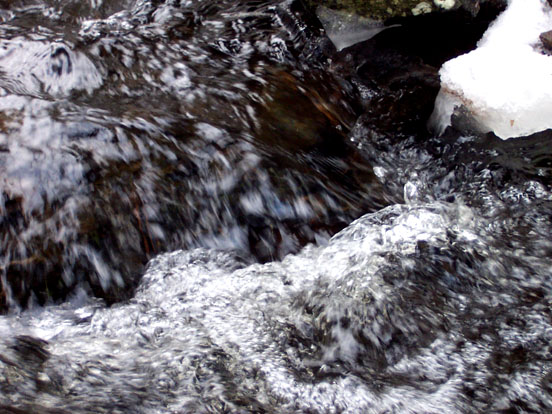
A water meditation, to be read slowly to oneself, in the same way water flows and falls.
“The highest good is like water,” whispers chapter eight of the Tao Te Ching. Jump in a pool or lake on a summer day, or take a hot shower after working up a sweat, and who would disagree? Whisky, brandy and other distilled spirits have variously been called aqua vitae, “water of life.” And “whiskey-bey” or uisce beatha, the Gaelic for whisky, is literally “water of life.” St. Patrick reportedly used the term aqua vitae both for alcohol and the waters of baptism. Jesus baptized with water (and — with the coming of the Holy Spirit at Pentecost — with fire: with both masculine and feminine elements). The Spirit of God hovered over the surface of the deep in the Biblical account of creation in Genesis, as if water were there all along, part of the primal substance God found on hand, in the dark, and used to create everything else. Water the divine unconscious, adapting to whatever form it finds. All things turn toward water.
“The highest good is like water.” Water itself says this, if I listen. Splash of the ocean’s tide, fall of water in a cascade or fountain. “Earth my body, water my blood,” goes the Pagan chant. It’s in us, of us — we’re of it. The human body is mostly water, we hear from many quarters. Hydrate!! We answer to what we’re made from, the amniotic fluids that bathe and nourish the growing fetus. The womb shelters a pool, a miniature sea. The Great Mother, Stella Maris, Star of the Sea.
Medieval magicians called water a “creature,” a created being, and the personification of water in the figure of the undine puts a face to the endlessly changing aspect that water wears. To be a water druid is first to listen to water. I never learned to swim till I reached my twenties, and a recurring dream throughout my childhood of falling into water and drowning left me with fear of heights over water. (Heights by themselves, though, are no problem for me.) There was my path through and to water. I listened, though part of the act was listening to fear. But that got my attention like nothing else could, so I count it useful. I strive to listen wider.
“Water benefits all beings without contending with them, and flows to the lowest places men disdain. In this manner it approaches the Way.” Tao, the way that water flows. “dao ke dao fei chang dao”: the way that can be followed as a way isn’t the way the way goes, to “English” it rather clumsily. Water flows, following its nature without thinking about it.
I don’t need to look any further for a sacrament, a way to make things sacred. Drinking, bathing, being born is worshiping, Attention, intention, makes the offering. The words of the old Anglican wedding vow “With this Ring I thee wed, with my body I thee worship” get it right. If we want to worship, we can begin with the body, with the waters ringing our planet and flowing in our blood. We don’t need to disdain the body because it’s “only” flesh, but celebrate it. To be alive is a holy act. The elements help us remember this, signify it, and make it so. Thus sings the Water Druid.
/|\ /|\ /|\
Images: waterfall; Mei Yang Selvage‘s remarkable painting of the character “tao” or dao, with the final elonngated bottom stroke forming the boat the man poles.










 A Druid Way


