Now that we’re nearing the month-away point for the Winter Solstice in the northern hemisphere, the Summer Solstice in the southern half of the world, it repays listening to inwardness, to meditate on shapes and images for these two planetary and spiritual events.
Here in a picture is near-solstice light, solstice darkness, light snow dusting our backyard, looking approximately southeast, earlier this morning. In this picture, of course, it’s our back shed that hides the morning star, but on a larger scale, the planet itself blocks the sun, till time moves us back into the light.
If one mythic image for the Summer Solstice is Stonehenge on Salisbury plain — “in the eye of the sun” — a corresponding image for Winter Solstice is the passage tomb of Newgrange, deep in the earth. Till time moves us back into the light. At both summer and winter turning points, the Light still shines. We just see it differently, one in plain day, the other in hidden night, the waking and sleeping of the awen-self, creative always, but often in different modes. You can feel the winter-you drowsing, while the summer-you longs to be up and doing. Sometimes you sense the tug between the two right down in your sinews and bones.
I’ve posted here before of our local Vermont stone chambers, and of Ohio’s Serpent Mound — the serpent power alive in things — in us, too, as one of those things, willing at intervals to shed its skin and be reborn. We can feel such restlessness in us at each turn of the planet, each shift of the sun.
As J. M. Greer observes in his Mystery Teachings from the Sacred Earth,
Everything in existence exists and functions on one of several planes of being or is composed of things from more than one plane acting together as a whole system. These planes are discrete, not continuous, and the passage of influence from one plane to another can take place only under conditions defined by the relationship of the planes involved.
This isn’t some kind of Druid theology, of course. It’s not dogma, not something to be swallowed simply because an authority says the words. But it is a valuable experiential observation one person has made and presented to others, something to be explored, poked and prodded, unpacked and tried on to see if it fits usefully or not.
Participation in ritual can help set up those conditions that allow “the passage of influence from one plane to another”. So, too, can personal practice. I can invite such passage by making one out of my days: marking out a dedicated period of inner and outer work, hallowing it with attention and intention.
As above, so below; as within, so without: if I make and mark a dedicated passage of days to mirror and invite a specific passage of influence from one plane to another, what will happen?
What follows below is just my end of an interesting exchange in a Facebook Druidry group in response to a post of this article of a little over a year ago from the Irish Times: “A Magical Vision is Hidden in the Irish Language — We Need to Rediscover It”.
While I have only a nodding acquaintance with Irish (my chief interest is in the Welsh and the Cornish of some of my ancestors), the Romantic in me says Yes! Anything to re-enchant the cosmos! Some languages ARE inherently more evocative than others, whether from their histories, their associations, or other causes.
If, in an alternate world, Irish were the language of the oppressors, that might not be so; we then might turn to English and marvel at itstreasure-trove of words like glitter, gleam, twilight, sparkle, gloaming, sussuration, foresight, insight, hindsight, learn by heart, lore, soothe, cleanse, bask, glean. Or its poetic names for things: bone-house for skeleton, day’s eye for the daisy; heart’s ease, love-lies-bleeding, baby’s breath; coltsfoot, lady’s mantle … Or its names for a host of non-physical creatures: basilisk, ghoul, ghost, unicorn, wyvern, griffin, manticore, fae, undine, sylph, brownie, werewolf …
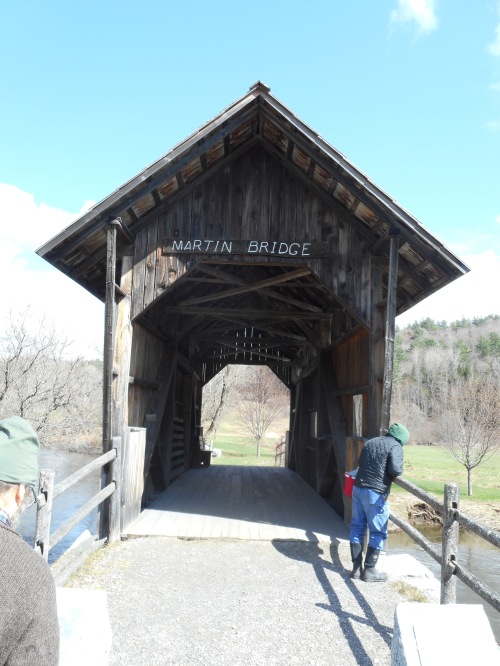
Bridge near a community stone circle in Northern Vermont
Meanwhile, however, the linguist in me (two Master’s degrees — don’t ask!) notes that languages struggling to keep a foothold in people’s lives tend to receive this ‘hidden wisdom, magical vision, etc.’ treatment in the press. The same is true for the traditions and languages of Native peoples here in the States: in a reversal of centuries of discrimination, the vision of the Other is now superior to what the dominant culture/language/people know or understand. (Older languages in general seem to preserve evidence of more subtle ways of looking at the cosmos that we have tended to discount and cast off in our mad rush into modernity. Old English itself offers marvelous linguistic resources for a Pagan way of viewing the world, to give just one example.)
My third reaction — because the resolution of opposites through a missing third element is always good Druid (magical) practice — says that these two perspectives can be combined to our benefit. Learn the language – in this case, Irish — and then I will be more qualified to determine for myself if such claims (and counter-claims) are true.
Meanwhile, I can enjoy them anyway and let them set me challenges I can choose, if I wish or am shown by the gods, to accept.
It’s finally arrived! You open a sturdy, medium-sized box and read the small paper insert that rests on top of the packing material. Paper? It might even be papyrus, or vellum …
Dear Valued Customer,
Thank you for purchasing this Seeker’s Spirituality Starter-Kit. We’ve designed your Kit to the specifications you provided us (see your Interview Response Summary, Appendix A and your Karmic Parameters Chart, Appendix B) to help launch you on a marvelous journey that can, if you choose, become a life-long adventure.
While we have made every effort to insure that your kit more than meets your expectations and delivers years of service, please contact our Satisfaction Support Team with any concerns or questions you have about performance.
+ For personalized directions based on your unique spiritual set-points, see Part One.
+ For instructions on how to customize your Seeker’s Spirituality Starter-Kit to fine-tune its performance, see Part Two.
+ For advice on encounters with non-physical entities, see Part Three.
+ For what to do in the event that absolutely nothing happens after you’ve tried everything, you’re convinced spirituality is a hot load of crap, and you not only want your money back, but you’ll see us in court, see Part Four.
+ For techniques to magick yourself home after an accidental mis-teleportation, see Part Five.
Antelope Canyon, Arizona: Pexels.com
Part One: Your Unique Spiritual Set-points
Among the many transformations spiritual practice can achieve is a shift in our limiting spiritual set-points. These set-points may include being a complete waste of space, an entity currently constrained by self-imposed, indefensible attitudes, false assumptions, enervating predilections, stupid choices, mindless habits, untested postulates, internalized stress, ingrained prejudices, blatant ignorance, and a generalized media-saturated drugged stupor.
Our apologies: the spiritual sub-contractor who drafted the above paragraph has been identified and sacked. His agenda does not align with our corporate best practices. Please consult the revised version that follows:
Contrary to debilitating propaganda we may have internalized from childhood, parenting, school, religion, mass culture, the arts and the influence of any particularly dubious friends, each of us is a unique spiritual being. Fortunately, this demonstrable spiritual fact outweighs all the accumulated negativity of the previously mentioned influences. This point is so vital that it bears repeating: each of us is a unique spiritual being, and each of us is greater than any forces arrayed against us.
Based on the information you provided us, we suggest implementation of these three principles as you try out your Seeker’s Spirituality Starter Kit:
(a) As one of the Wise was careful to teach, the sacred was made for people, not the other way around. Exploring just what that means to each of us is a first and worthy step for many people.
Here is a long human history of seeking for what is sacred, best, magical, joyous and transformative. And here are some practices, powers, places, perspectives, people and purposes that might help. Respect yourself as you respect these things: but if any of them do not nourish what is deepest and best in you, after you have made a reasonable trial of their potential, do not put any more of your energy into them.
(b) While “try everything once” isn’t always the best advice, most of us probably have, in one life or another. Such experiences go far toward explaining the instinctive reactions many of us have, and some of us lack, to certain kinds of opportunities that provide steady headlines for local and sometimes national news.
As another of the Wise has taught us, “How do I make good decisions? From experience. How do I gain experience? From making bad decisions”.
c) “You shall know the truth, and the truth shall set you free”. As a statement of spiritual destiny, and also as a means of measuring progress, this wisdom-saying bears out extensive experimentation. After all, the Druids counseled others on walking and spiraling the Circles of Abred [1] [2] [3]. Asking, testing, re-asking, and pushing deeper into “What is the truth of this moment?” can feed the most freedom-hungry soul. (Hint: it may partly be star-light and the music of the spheres.)
You glance at the other section titles, but you want to get started. Those other sections can wait. Still, it’s probably smart to quickly review what’s there …
Part Two: Customizing your Seeker’s Spirituality Starter-Kit
Hmm. Worth looking at, for sure, but I’ll probably know more after I get started.
Part Three: Advice on Encounters with Non-physical Entities
That’s not gonna happen. They don’t exist. No worries there.
Part Four: When Absolutely Nothing Happens: A Few Words to the Oblivious and the Litigious-Minded
Something’s always happening.
Part Five: Techniques to Magick Yourself Back Home after an Accidental Mis-teleportation. Also known as “The Silver Apples of the Moon, the Golden Apples of the Sun”
Worth reading, I guess. Might learn something, though it sounds like a kind of Harry-Potter footnote …
Appendix A: Interview Response Summary
Appendix B: Karmic Parameters Chart
Later. These big-box stores — always too much. Shouldn’t have bought the economy-pack …
So much of the genius of Druidry grounds itself in the here and now. Its metaphors concern growing things, the seasons, the changes and encounters and opportunities shaped by living in time and space. (The physical world is the ultimate spiritual metaphor.) Our communion is with life lived with other beings, including some without their skins on. But no one asks me to believe in them, or at least no more than I ask them to believe in me. Which can be lots, or not at all.
And so it is that the awen isn’t something to pray to (though I could), but to say and sing and listen to, in a group or alone. The crowded sapling I replanted last autumn doesn’t require my belief (though I’m free to believe my belief will help) but rather the space to grow, and regular watering until its root system re-establishes itself. The birds or beasts I share my life with need food and shelter and care. I may consider them dear companions, or manifestations of deity, but when they wake me asking for a meal, or to nudge me for a caress, no incense is required.
Some may choose to explore further, to part the veils that exist everywhere, that make physical things more and more transparent for Spirit, or that also can preserve a reassuring earthly solidity a little longer, if we need it. Face-to-face with a local part of the world I encounter just a few paces from here, a part I can paint and ponder, photograph and feel, I know enough of divinity to take another step, if I choose.
I’ve had trouble for a few years now with a frequent sense of constriction just before waking. Traditional medicine points to things like sleep apnea, poor diet, sleep paralysis, and similar physical causes. But I’ve eliminated these things as primary, though some may be effects of a more underlying cause. If ever I doubted that I leave my body every night, here’s proof, when proof’s no longer needed: I’m definitely outside, and frequently reluctant to return. Often in near-to-waking dreams I’m entering a tunnel, climbing a narrowing stairway, pushing myself into a corner, sliding into a tight, confining and claustrophobic space. Ah, said a friend proficient at getting out of the body, when I shared some details of this experience, I know that feeling. I came to realize a part of me was too large to fit comfortably inside a human form. Sometimes you need to make inner adjustments with what you try to bring back with you. Hmm.
“I was more independent than any farmer in Concord,” remarks Henry David Thoreau, in the “Economy” chapter of Walden, “for I was not anchored to a house or farm, but could follow the bent of my genius, which is a very crooked one, every moment. Beside being better off than they already, if my house had been burned or my crops had failed, I should have been nearly as well off as before”. Unlike Henry, I have a house, but my genius is as bent as any, and perhaps the curvature makes following it into a bone-house, if not back out again, more difficult than it need be. I hear the word shapeshift echo behind my hearing, like something spoken in the next room, though no one else is home — and I ponder new ways to explore this dream-waking challenge. What shape might better fit, if a human one proves too narrow? A new practice to explore.
Grounded in the here and now, I have a center from which to explore. Maybe that’s both aid and obstacle. Hermes Trismegistus, Thrice-Greatest Hermes, is said to have remarked, “God is an infinite sphere, the center of which is everywhere, the circumference nowhere.” So I reflect that creation as deity sees it is happening wherever the center is, and finishes at the circumference. Whatever that means, it may mean that it begins where I sense a center. I needn’t go looking for it anywhere else.
Hermes Thrice-Greatest, in Latin Mercurius ter Maximus — MtM for someone like me in love with acronyms — is simply another doorway, a mask spirit wears, as we all are to each other, another chance to ponder all the ways and plays of spirit peeking out from everything. The more closely I explore this blessed physical world of metaphorical and very real earth, air, fire and water, the more carefully it explores me. Thoreau knows what I’m sensing; a few lines of his became one of my mantras, long ago:
Time is but the stream I go a-fishing in. I drink at it; but while I drink I see the sandy bottom and detect how shallow it is. Its thin current slides away, but eternity remains. I would drink deeper; fish in the sky, whose bottom is pebbly with stars — Walden.
The Wikipedia entry for genius offers a useful etymology for extended meditation:
In ancient Rome, the genius (plural in Latin genii) was the guiding spirit or tutelary deity of a person, family (gens) or place (genius loci). The noun is related to the Latin verbs “gignere” (to beget, to give birth to) and “generare” (to beget, to generate, to procreate), and derives directly from the Indo-European stem thereof: “ǵenh” (to produce, to beget, to give birth). Because the achievements of exceptional individuals seemed to indicate the presence of a particularly powerful genius, by the time of [Caesar] Augustus, the word began to acquire its secondary meaning of “inspiration, talent”. The term genius acquired its modern sense in the eighteenth century, and is a conflation of two Latin terms: genius, as above, and ingenium [cf. ingenious], a related noun referring to our innate dispositions, talents, and inborn nature. Beginning to blend the concepts of the divine and the talented, the Encyclopédie [an 18th-century French encyclopedia]article on genius (génie) describes such a person as “he whose soul is more expansive and struck by the feelings of all others; interested by all that is in nature never to receive an idea unless it evokes a feeling; everything excites him and on which nothing is lost”.
Again and again I return to earth, to the physical, this first and last mystery, vessel for otherwise intangible spirit, which still looks at me even as I gaze at it. And I consider a genius of my locus, a spirit of place — an altar, if I see it so — the stone in our front yard, mantled with snow and lichen on this November day.
May all that you meet talk to you, teach you, comfort you, challenge you, guide you, prepare you.
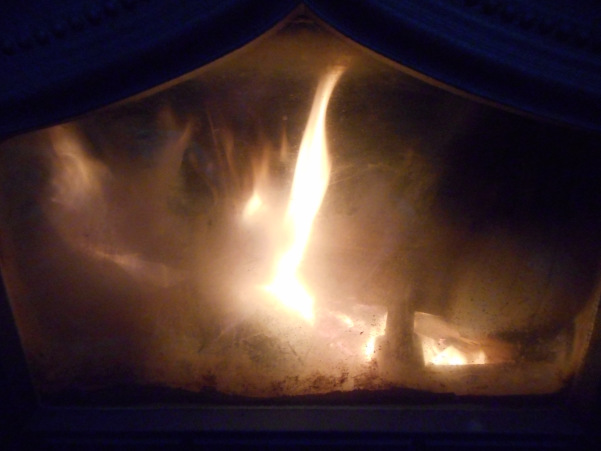
the winter’s kindling, and 8-years-dry oak firewood, for lighting the woodstove
We’re drawn to where the action is. And in the Dark Half of the year, that’s often inward. Things may go to sleep, but they’re dreaming, and so it is with us. “To every thing there is a season, and a time for every purpose” — not only “under heaven”, as the saying continues, but over and around and within heaven as well.
Southern Hemisphere, enjoy your Turn to the Bright Half of the year, as all the composting, nurturing, imagining, dreaming, and magical preparation burst forth in the physical world as gardens, fruition, construction, birth, renewal — that messy, joyous recreation of the world. Beltane is not somehow “past”, like a carton of milk beyond its “best by __” date, but engaged, active, igniting bird talk and tree bud and a host of things half seen, but nonetheless busy for all that we may not (mostly) be aware of them. Then again, in the half-light of increasingly longer days, you can sometimes catch a glimpse …
And for us “dark-half-ers”, care of the body can become a practice we may explore more fully. What does this bone-house (Old English bánhús“skeleton, body”) ask of me, in order to keep on serving me a while longer? What can I touch — and what touches me — that needs my attention and reverence? Where am I right now? The house is cooling as the temperature drops outside, as rain makes way for snow later today, a polar front dipping down from Canada. Time to step away from blogging and light a fire.
Sometimes, too much light: woodstove with flashbulb
“it takes dark to see fire best”: same burn, without flash
Likewise, Brighid isn’t only a goddess for Imbolc, or for the Bright Half. She’s at least as busy minding and reminding us to keep the flame lit the rest of the year, too. Or, if you’re not for the gods (though the gods may be for you), what else asks for your tending? And what is tending you, perhaps outside your knowledge? Particularly in America, loneliness is a common affliction. How deeply are we tended by things we have forgotten! But how do we reconnect, rediscover?
Fire-dreaming can help, says the woodstove. Rain on the roof, too, says November. Light, sound. The savors of root- and bulb-vegetable umami — onions, beets, garlic, turnips, potatoes. Don’t forget tastes, says the kitchen.
A beloved neighbor three miles down the road died suddenly over the weekend, out raking leaves, and we drop off a homemade raspberry cake for his widow. His Siamese is grieving, too — she was his cat, and where is he now? Touch, knows my wife, fitting action to word, making friends gently — respect for the Siamese temperament. Comfort, animal comfort of contact, beyond words.
I am the hallow-tide of all souls passing, writes Caitlin Matthews in “Song of Samhain”, from her Celtic Devotional (pg. 22):
I am the bright release of pain
I am the quickener of the fallen seed-case
I am the glance of snow, the strike of rain.
I am the hollow of the winter twilight,
I am the hearth-fire and the welcome bread,
I am the curtained awning of the pillow,
I am unending wisdom’s golden thread.
I pick up that thread again, and I pick it up, always dropping it, always — always — finding it again.
Those of you on Facebook may find much valuable reflection in this 31 October ’19 Samhain post from a regular series by the Anglesey Druid Order/Urdd Derwyddon Môn in Wales. Check out the other posts, too — a very worthwhile monthly series of good insight and perspective, from a member of the Welsh Order run by the estimable Kristoffer Hughes.
/|\ /|\ /|\
Last night before our main ritual, we performed two Ovate initiations with Mystic River Grove — Samhain being particularly appropriate for Ovate work in the inner realms, the Otherworld, the ancestors, divination, etc. We all already do considerable imaginal work, consciously or not, and while photos can help nourish that capacity, at times it also feels right to forbear from posting pictures of private ritual sites, so no images this time.
By “imaginal work”, I mean the content of imagination, dream, and visualization, as well as self-conscious association and emotional loading of experiences. We come to new experiences well-equipped by our previous ones, for ill or good, to accept or reject or transform — and all of this often happens outside of conscious awareness. It can be the task of magic and of ritual and personal work to make such things more conscious, to work more deliberately with the Cauldron of images we each carry around with us, and out of which we supply much of the color and tenor and flavor of our days. Our instinctive likings and antipathies for people, places and things spring from this “pre-loading” of consciousness, and to take charge of our own reactions and responses can serve us very well.
Rather than mechanically pursuing or fleeing things that attract or repel us, we can begin to ask whether they are for our benefit or not. Rather than assuming the attraction or repulsion lies in the person or thing, we can begin to learn that it lies in us — the external is merely a convenient channel through which those energies reach us. Because one way or another, they will — we’re open to them, we’ve invited them in some way, and placed ourselves in agreement with them. The difficult thing that can strengthen us, the seductive thing that may weaken or distract us — this is the Long Work, the magnum opus we are all engaged in: to live out the consequences of our choices, yes; but even more, to choose wisely in the first place, to choose with love and foresight and wisdom how we will spend our lives, even as everyone and everything around us is doing the same.
/|\ /|\ /|\
A year ago I drew a personal Tarot reading for the coming year and shared it here.
With 3 of the 10 cards coming from Pentacles, resources and the physical world will be a prime focus of the year personally and for the planet. Balancing feminine energies to the mature male energies in play are an immediate aspect of the present and near future. Destiny and past influences at work, though not inevitable, are ones we have both initially set in motion and strengthened by our sharp focus on materiality. Our outer fixation on security and stability may feel reasonable, given such destabilizing forces at work. But while our hopes and dreams focused on these things are valid, pursuing them along a still-material path, even with a renewed youthful vigor, will not return us to what is stable and safe. Other directions we have recently begun to explore can prove more beneficial. We’ll see moon-like changes, darkness and light alternating in phases.
I’ll return to this in a year and see how I did.
As a take on the times, both public and private, little here should be a surprise. (Was my reading too vague, or too influenced by my own perspectives? Quite possibly both.) “Our outer fixation on security and stability may feel reasonable … but pursuing them along a still-material path, even with a renewed youthful vigor, will not return us to what is stable and safe”. I take this most of all as a guide for my own focus: anything I wish to manifest outwardly rises from within, and that is where it is easier, more prudent and far-ranging to work, to spend my energies and time. Whether my region, my nation, my planet chooses to do that is much more out of my hands, unless I opt to engage it through a very large gesture. I could — so could each of us — but most of us will not, through a combination of inertia, distraction and providence. We see such radical gestures — in the U.S., often accompanied by guns — from people who despair of any other avenue for change, or outcome.
(We always see individual actors attempting these things — check the headlines of your own country or region for the relevant political, military, cultural and economic actors at work in your spheres — but few achieve what they imagine they are pursuing. To look for a moment at my own country, whether Donald Trump or Elizabeth Warren or Bernie Sanders or Joseph Biden becomes president in 2020, most of the issues we face right now will still remain for us to deal with. A change of one face, or even of the faces clustered around that one face, will not easily shift large causes we have already set in motion over time. As egregores of particular vigor, nations have karma, too.)
As for personal applicability of the reading, I find in it valuable reminders of long-term trends and tendencies in my own behavior and outlook that I continue to grapple with and learn from. (Want to know what these are? You have only to read what I’ve been posting here all along!)
Consider doing your own divination, with your preferred oracle. Most of us are already doing this anyway: among our chosen oracles might be a best friend, partner, coin toss, stock market report, a horoscope, whim, toss of the dice, impulse, and so on.
/|\ /|\ /|\
So — onward to a reading for the coming year, with the Celtic Cross spread. I make frequent references below to Rachel Pollack’s excellent 78 Degrees of Wisdom: A Book of Tarot, Thorsons/Element, 1997, both because many value her insights, and also because they offer me a corrective to my own biases.
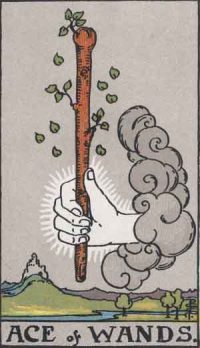
1: Ace of Wands (reversed) — the present, the Self, the querent’s state of mind.
2: 10 of Cups — the immediate influence, problem, challenge, etc.
3: Hanged Man (reversed) — destiny — in some spreads placed above as the “crown” of past experiences.
4: King of Pentacles — distant past, or some spreads, the future.
5: Page of Cups — recent past, or conscious focus.
6: King of Wands — future influence; or the unconscious, the underlying or the true driving force of a situation.
7: 7 of Cups (reversed) — The querent; the querent’s self-perceptions.
8: Knight of Pentacles — external influences.
9: 8 of Wands — inner emotions.
10: Temperance — outcome or final result.
Wands and Cups predominate in this spread — for me, a reminder of the need to balance fire energy with water, active with receptive, conscious with intuitive. Always good advice! But how might that work, more specifically? How do we “grasp” the fire of Ace of Wands? What “hand” or means do we use? Rachel Pollack in her magisterial 78 Degrees of Wisdom comments: “At the beginning of some situation, no card could signal a better start” (pg. 183). I take reversed simply to mean the challenges attendant on manifesting the energy of a card, or missing the opportunity it brings. The “crossing card” of the 10 of Cups is a Grail, the completing or fulfilling Cup — a balance to the fire of Wands. The third card, a reversed Hanged Man, to me signifies that every time I ignore shamanic, yogic, inner wisdom, I miss the insight of inner experience.
The four elements suggested by the shape of the hanged figure can serve our spiritual intention only when they are in the service of spirit: allowed to be fully themselves, not distorted through social expectation, but liberated from it. Given my age in this incarnation, the personal applicability of Card 4, the King of Pentacles, suggests past (even past-life) successes, which could lead to present complacency, which the fire of wands should help allay. The figure’s greenness in this deck also suggests the natural world. Moving on, Pollack comments that “the Pages all have a student quality” (pg. 192), suggesting that from the Page of Cups issues an appropriateness for a study program or course of discipline to develop intuition or psychic/inner awareness.
While Court cards like the King of Wands suggest people who exert influence in the querent’s life, they can just as well signify aspects of the querent, and also need not be associated with expected gender: male doesn’t have to mean “man”, but a kind of energy (now clouded and confused by our current political correctness, of course, but no more than at other times, with their own preconceptions and misunderstandings) — Angela Merkel or Lady Gaga, Elizabeth Warren or my wife.
The “final four”: for the 7 of Cups, Pollack insightful notes, “it is a mistake to think that daydreams are meaningless because of their content; on the contrary, they often spring from deep psychological needs and images. [But] they lack meaning because they do not connect to anything outside themselves” (pg. 198). The reversed Knight of Pentacles, Pollack suggests, offers a paradox inherent in Knight, even not reversed: “deeply grounded in, yet unaware of, the magic beneath him, he identifies himself with his functions. He needs to discover the real source of his strength, within himself and in life” (pg. 238). The 8 of Wands suggests completion of a cycle, “the addition of Pentacles’ grounding to Wands’ energy” (Pollack, pg. 172), and I’m finishing my 60th year, the fifth of a series of 12-year cycles, significant on the other path I also follow.
The outcome of all these forces and influences, in play for the year, the self, the world?
Temperance — and yet again, Pollack proves insightful. “If a reading shows a person split between say, Wands and Cups, activity and passivity … then Temperance, moderation, and acting from an inner sense of life, can give a clue to bringing these together” (pg. 109).
Adding the digits of its number 14, Temperance is a higher harmonic of 5, the Hierophant. We live in an era that has increasingly often rejected priests or outer spiritual authorities over our lives, so “perhaps the interpretation of the Hierophant as representing secret doctrines suits our age better. For then the doctrine does not tell us what to do, but instead gives us direction to begin working on ourselves” (pg. 55).
This reading suggests much of value to me, but also of value to our nation and planet. The perennial spiritual quest remains perennial, because we always will need the springs and founts of wisdom to be found in the quest.
Happy All Hallows’ Eve! (Do we truly mean ALL Hallows? Will we honor ALL holy things?) A “hallow”, historically, is a saint (from Old English halga), not just any holy thing. But I’m taking the word in the latter, larger sense of any expression of the numinous or sacred. It could be the day, but also your cat, your neighbor, or that rock in your back yard. Even, occasionally, in the church down the road (though out of negative experiences, many Pagans would draw the line there, as if the holy could be found everywhere butthere. And of course the churches often return the favor. Aren’t we all just hot messes?!).
That’s too much holy, I mutter. Give me one holy thing, and I can (mostly) handle it. But everything holy upsets my sense of “mostly profane, with dollops of holy here and there, if I’m lucky”. Yes, it’s hard to live on the heights all the time.
Finding your holy thing can be a bundle of work. But we keep giving each other hints, and from time to time the holy still peeks out at us from the eyes of things, from each other, and also from sun-rises and -sets, moons, fires, songs, mountain-tops, fogs and clear days, moments of connection and intimacy and kindling.
/|\ /|\ /|\
I’ve written before about Romuva, the Baltic Pagan religion that managed to survive and has been growing again. The local analogue to Hallowe’en is Vėlinės — you can see an image and read about the holiday here.
Here’s a video of Romuva chant and ceremony by Kūlgrinda, the musical group founded by the late reviver of Romuva, Jonas Trinkunas (1939-2014), in a public celebration. The group forms one of the symbols of the Romuva religion around the 4:03 mark. The minor-key singing can send a pleasurable shiver up your spine.
S. Vermont, Windmill Hill Pinnacle, looking west. Photo courtesy B. Blair.
Yesterday six of us, along with two malamutes, hiked the trail to the Pinnacle of Windmill Hill here in Southern Vermont. We’re well past the peak of autumn colors, but a blunt beauty remains, as oranges and yellows, ochers and burnt siena take the stage. The sky, restless, is already into November, brooding grayly over it all.
A week or so ago a friend was grieving for the end of a rich garden. The season can work that grief in us, ransacking the fields of our inward spaces, piling on change and loss and uncertainty in a thick melange, along with the aging of our mortal bodies, and whatever other challenges we face at the moment. Throw in the diminishing daylight here in the northern hemisphere, and the frosts and fogs and die-off of green vegetation, and it can hurt like The End, rather than a stage of the journey. One of the remedies she shared was her rediscovery of gratitude for the body, how the simple act of attention to breathing can bring solace. It goes in, it goes out. Draw in strength on the in-breath, then breathe out all that needs to go, that passes in time.
/|\ /|\ /|\
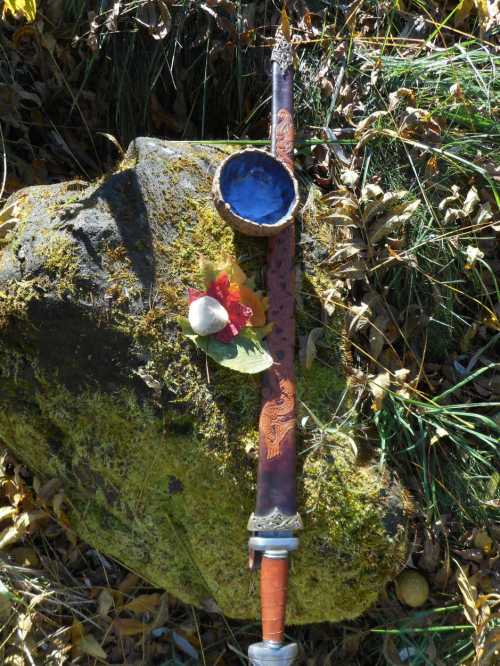
Sometimes altars find us, rather than the other way around. A large boulder I’ve been meaning to drag and roll to my backyard grove has gained a partial moss and lichen mantle, so I took leaves I’d gathered on the hike yesterday, and a ritual bowl, a quartz stone and my ceremonial sword out into the afternoon sunlight and laid them across the uneven surface and took the photo.
At the bottom right you can see one of the egg-shaped black walnuts that have been banging on the metal roof of our garden shed when they fall, or rustling as they subside in the grass.
The sword points south, toward the top of the picture, but the other directions don’t line up according to the SEA (standard elemental associations). To the east (left in the picture), our fishpond does its part to throw off the elemental alignments. The stone itself makes do for north, and also the earth, upholding everything else, while the leaves stand in for air. Even the sun seems to have found a different place in the sky than west, the shadows suggesting morning, not mid-afternoon.
You can call the altar a prayer, or a prayer your altar. Sometimes we need to “finesse our fanes”, to turn them on, help them reach us where we are, even as we stretch to find them, extending a tendril of thought, of feeling.
Breathe, and activate air. Drink, and water “comes back online”. Stand on the autumn earth, leaves crackling underfoot, melt from the morning frost glistening on your shoes. Sometimes presence already is prayer, our listening an offering, the few remaining crickets and grasshoppers sluggish in the low sun.
/|\ /|\ /|\
The Faery Grail … is ultimately about the giving of food as a ritual of hospitality that creates communion between faeries and humans: the wisdom that it purveys is the neighborly consideration of all life that arises in human awareness as a consequence. Those who offer and drink from the cup in peace are the children of one universe, in communion with the natural world even as their ancestors were, who enjoy the ancestral feast. When the rules of faery courtesy are broken by violence, rapine and theft, the Faery Accord in broken. This is ultimately what causes the blight upon the human world that we call the Wasteland: the riches of the Rich Fisher no longer flow. Humanity enters into a warfare with Faery, displaced people wander the land without protection, and even the court of Arthur is visited by mocking and embarrassing tests. Fertility fails when the waters of the Faery Grail are withdrawn: but when they flow again, the land becomes fertile and is repopulated. People are brought once more into communion with their ancestral belonging (Matthews, The Lost Book of the Grail, pg. 274).
Faery Grail or Holy Grail, Christian or non-Christian, both cause and cure are the same, Matthews observes. (It is a symptom of our division and separation that we misunderstand and argue even about that, and suffer.)
Not as the world gives, do I give to you, says the Galilean Druid. Having scorned the gift, and abused the hospitality offered to us, how can we know the giver?
A topic for meditation and ritual and discernment, as the turn of the year that is Samhain approaches.
/|\ /|\ /|\
“Many people”, this morning’s spam solemnly observes, “today іgnore the ability to see out of [t]heir [v]iew”. Like much spam, it’s badly edited, unidiomatic, and — often — true, albeit in sometimes truly weird ways.
How well do I see “out of my view”? Can I even begin to see out of someone else’s view until I see out of my own? Am I ever “in view of myself”, or am I the one thing I can never actually see? I don’t know about you, but with such questions I can easily pass a whole morning.
If there’s a supreme strength to the practice of Druidry, it’s in its potential to connect us where connection is badly needed — to the world that begins wherever we find ourselves, to our places, starting with our skin and bones, and flowing outward to the skin and bones of the world all around us. But though we named it uni-verse, “one-turn”, somehow we don’t quite believe our own label or the perception behind it — that it’s all turning together, intimately linked in every way. Hence, it often remains a potential, giving us a lifetime of work to explore how it — and we — manifest.
And if there’s a supreme weakness to Druid practice, it’s a naive belief that “it’s all good” — that everything would be fine if we’d just “get back in touch with nature” — that the “human project” can finds its whole purpose and satisfaction within this glorious physical world. Sustainable, reverent, cooperative, harmonious — these are enough.
We need more, because our own consciousness asks for more. Because when this “apparent world” fades, we confront other worlds with different challenges and questions. Now what?! A deist might say, “Pilgrim on earth, thy home is heaven; stranger, thou art the guest of God”. An animist has likely already encountered beings beyond the physical orders we encounter here — beings that wear different bodies than earth ones, clothed in astral or other forms. Even a staunch materialist would probably concede, along with Hamlet, that “There are more things in heaven and earth, Horatio, than are dreamt of in your philosophy”. By “philosophy”, helpful footnotes inform us, Hamlet appears to mean our modern word science. And if there’s one thing most Druids would prudently admit, we’ve barely begun to scratch the surface. Of almost anything.
“As a spiritual tradition based on reverence for and connection with the powers of nature”, writes Emma Restall Orr in her Druidry and Ethical Choice, “more than anything else Druidry teaches us to honour life … Druid ethics are built upon the release of ignorance and the respectful creation of deep and sacred relationships”.
Release of ignorance, I keep whispering wryly to myself — out of humbling, extensive personal experience — is a full-time job.
But if I’m honest (I’m continuing the conversation, if only with myself), the work I’ve done with my recent Triad is far from complete. My Western and particularly my American individualism needs radical tempering. I mentioned in a post a few weeks ago that I was reading and would soon review Caitlin Matthews’ The Lost Book of the Grail (Rochester, Vermont: Inner Traditions, 2019). Now feels like an appropriate time — but I’ll blend it with further expatiation on that Triad. If the book’s worth my time, or yours, let me show something of that value in my own life.
First, here’s Matthews:
The Grail knights quest on behalf of those who are locked outside the story of hope, reconciliation, or healing, in order to move the stagnation of stasis into another hopeful condition. In the many psychologically based commentaries upon the Grail legend, from Joseph Campbell onward, there has developed a very modern stress upon the individuality of the Grail hero’s journey. However, this stress on the individual has served rather to point out the division in modern consciousness–often expressed as a vague loss of nature or holism–from the collective. The living context of this division speaks of how we are split off from ancestral or faery roots: and those who seek for help today are often weakened or unable to heal because they do not think, work, or imagine from a collective basis. How can we heal if we leave out the rest of the world from the equation? (Matthews, pg. 239).
Samhain is a wonderful time to look for ancestral guidance, to an ancestor who may be myself in a previous incarnation, waiting to reach out to a descendant (who may or may not be me again). And given how, in myth and legend, Otherworld time often runs differently than here, backwards, perpendicularly, non-linearly, a-causally even, we can heal in many directions, receiving and offering healing across what looks like temporal obstacles and barriers. I am inseparable from the collective, I walk with the body my ancestors have bestowed on me, I accomplish whatever work I do with their hands; I look out at you with their eyes. And so do you, with yours.
My little economies in the post on the recent triad — what do I need, what can I do, what needs to be done — ignore that collective. They’re a starting point. But merely squeezing a few more bucks out of some substitutions and shifts of priorities in my one household, while possibly helpful, ignores larger trends and patterns, and closes my eyes to our collective experience until it impinges on my little self to the point where I can no longer avoid responding. (Compound that with a fear of the Other stoked by far too many politicians in too many countries, and you get, not collective consciousness and honour and action, but collective targeting and collective hating and collective bashing. Because, let’s face it, fear is easy, and cheap, earns money for political campaigns, runs like a reflex off the reptile brain in us all, and moves people to pick up causes, banners, and bombs.)
Even gathering with the Massachusetts grove for Samhain on Nov. 1 will help awaken me to a more collective awareness. Stand in ritual with others, and the walls can come down. I can hear the many voices of those who stand around us, skins on or off.
Rather than a set of OSFA* instructions for how to manifest the subtitle — “The Sevenfold Path of the Grail and the Restoration of the Faery Accord” — Matthews gives us stories and lore and many pointers for our own ways.
[*OSFA — one size fits all]
Here’s Matthews again, talking about origins and directions — the Grail is a kind of vector or arrow through and around time, continually answering human need:
The beginnings of the Grail myth go back to the very dawn of human consciousness, and to the desire of human beings to make some kind of direct contact with the divine, to receive healing, and to make right the wrongs of the world. The Grail appears as a vessel of mercy that, through different spiritual agencies, offers an opportunity to those qualified by courage and belief to bring that mercy. Whether we look to ecstatic and initiatic drinks of the ancient mystery cults, or to the miraculous manna found by the Israelites in their desert wanderings, or to Celtic myths of cauldrons that provide plenty, wisdom or eternal life, we find a collection of vessels from many cultures; each contains a substance that enables those who discover it to be healed, nourished, and experience divine communion (Matthews, pg. 22).
Two pointers right there: courage, and belief. Don’t have either? No problem — there are many others to explore, until I can serve them. I don’t need to have courage, but I can serve it. I make a chant of it:
Your cauldron I drink from it. Your body I wear it. Your hands I raise them. Your spirit It flames in me.
Ah, here we are, two weeks out from Samhain, Summer’s End, Samhuinn, All Hallows Eve. (And for those in our sibling hemisphere, Beltane approaches.)
And here for your delectation is an excellent 8-minute clip of Scotland’s Beltane Fire Society’s 2017 celebration of Samhuinn:
With it you can experience a taste of the whole event, different each year: celebration, and mystery.
/|\ /|\ /|\
Hallowe’en, we often forget, is a hallowed evening, a sacred time, however we may treat it today. (The sacred doesn’t just vanish when we ignore it. It jabs us in our most tender spots instead, until we wake up again and pay attention. Exhibit A: Almost every headline you can find today.)
the sacred is a celebration. Cultures throughout human history set aside days and places to witness and commemorate seedtime and harvest, greatest light and deepest dark. The solstices and equinoxes are human events as much as astronomical ones, and predate any written scripture by thousands of years. We likewise mark births and deaths, and we make vows and promises to uphold our marriages, friendships, communities and nations.
Moses (ever tried a desert solstice celebration?!) gets to say it in Deuteronomy 30, that what we seek
isn’t too difficult for you or beyond your reach. It’s not up in heaven, so that you have to ask, “Who’ll ascend into heaven to get it and proclaim it to us so we may do it?” Nor is it beyond the sea, so that you have to ask, “Who’ll cross the sea to get it and proclaim it to us so we may do it?” No, the word is very near you; it’s in your mouth and in your heart so you may obey it.
Oh, hear talk of “obeying” and perhaps you resist. I know I often do. Too many times we’ve been ruinously misled by over-trust and heedless obedience. (Republican or Democrat, or whatever the party platform, it hasn’t let up yet.)
As author Peter Beagle describes it, “We are raised to honor all the wrong explorers and discoverers—thieves planting flags, murderers carrying crosses. Let us at last praise the colonizers of dreams” (“Introduction”, The Tolkien Reader). What we can rightly “obey” shares an affinity with dream. It’s what resounds in us most deeply, if we turn off the jangle of the other voices. Rightly, if not always safely. The sacred is no more “safe” than love is. Both can lead very far from where we thought our lives would go. But the “wrong” voices? What is mass culture but a form of consciously-accepted schizophrenia, if we end up listening to every voice except the first one, the original?
For any authority the sacred wields is not a “command” so much as the first law of our being. To “disobey” it, or attempt to deny or ignore the sacred, is like trying to live outside our own skins. A human without the sacred is exactly that — something eviscerated, no longer alive. We use the sacred itself when we deny it — we employ energies on loan to us even as we refuse them or cast them aside. What else will we do with them?
May our doing, our discovery, our celebration, take us ever deeper to the sacred heart of things.
In this post I’d like to touch briefly on a couple of magical and musical principles — the two things often overlap, if you’re paying attention. This is to some extent a Druid-Christian post, so some of you may want to spend time doing other things, if that flavor of Druidry — or Christianity — doesn’t work for you. (For instance, the video here drives my wife absolutely up the wall.)
Below is a 5-minute video of a catchy Christian worship song, “Everything Comes Alive”, from Toronto-based “Catch the Fire” [Wikipedia entry | official website], a non-denominational Charismatic movement. It’s part of an album compiled from a 2016 Revival. Recently it was posted to a Christian Druidry Facebook group, where it garnered likes, but — last I checked — no comments. I’d like to do some thinking out loud with and around it, to make some observations, and hope they will be useful to readers.
First, the video, featuring vocalist Alice Clarke, one of the movement’s worship leaders:
The song clocks in at 120 beats/minute — a tempo that’s splendid for inducing trance — and the Wikipedia entry on trance is particularly detailed and useful, whatever your orientation and interest, and deserves a careful reading, rather than me trying to paraphrase it here. And a look at the gathered worshipers shows many of them well on their way into trance as the song progresses, with its repeating choruses and singable lyrics and melody.
A subsection on general brain activity is revealing — rather than an either-or state, trance is a matter of degree and proportion among the four kinds of brainwaves:
There are four principal brainwave states that range from high-amplitude, low-frequency delta to low-amplitude, high-frequency beta. These states range from deep dreamless sleep to a state of high arousal. These four brainwave states are common throughout humans. All levels of brainwaves exist in everyone at all times, even though one is foregrounded depending on the activity level. When a person is in an aroused state and exhibiting a beta brainwave pattern, their brain also exhibits a component of alpha, theta and delta, even though only a trace may be present.
Music, not to belabor the point, is one of the most widespread and also acceptable ways of changing consciousness. It’s also among the safest. (How many of us “zone out” to a favorite song?!) Of interest is the attention that Catch The Fire pays to quality musicianship — whatever your musical tastes, the keyboardist is skilled, and Clarke has an appealing, ethereal voice. They clearly understand its value and power as a prime expression of spirituality. Or to put things in terms of the article on brain activity, “What am I foregrounding today — or right now?”
Though many Christians might take issue with calling their form of worship a magical act, it fits the definitions and standards quite nicely. Much of the difference between denominational Christianity and Druidry in their musical choices depends on past practices, local influences and expectation, much less on the effect of the music on consciousness. From meditative reflection to transitional interlude to invoking the Spirit, the awen, the Muse, the gods, the Presence, “music magics the moment”.
[E]ach day we all experience many differing states of consciousness, moving from deep sleep to REM sleep to dream to waking, to daydream, to focused awareness and back again. We make these transitions naturally and usually effortlessly — so effortlessly we usually do not notice or comment on them. But they serve different purposes: what we cannot do in one state, we can often do easily in another. The flying dream is not the focus on making a hole in one, nor is it the light trance of daydream, nor the careful math calculation. And further, what we ordinarily do quite mechanically and often without awareness, we can learn to do consciously.
As we ponder how to effect the changes in our consciousness and lived experience that we desire (“that we need, that we can do, that needs to be done”), it pays to employ such readily available means as music. Within everyone’s reach is music in some form, either recorded, live from acknowledged performers, or made on the spot by ourselves. We can chant, play a recorder or whistle, find a percussion instrument among pails and cans, create a rattle from pebbles and resonant container of many shapes and sizes, and include such things in our spiritual practice, whether daily, or on special ritual occasions. (I have a small singing bowl I ring as I enter my backyard grove.)
Music draws beneficent energies to us, in our own consciousness, and from other beings around us.
Three things to work for: what I need, what I can do, what needs to be done.
(Adjust as needed to fit your path — that may be one of things that you need, that you can do, that needs to be done.)
You could think of these three as three concentric circles. The smallest? What I need. Though it may consume my waking hours (even hound me in dreams), it’s still small. However large my need feels, it’s also smaller than what I can do — the next circle. My need is smaller than my life. And even that circle of what I can do, of my living today, lies enclosed in what needs to be done, the largest, outermost circle. Fortunately, I’m not the only one working on what needs to be done. Most of that largest outer circle we will tackle together.
How do I know this? Because that’s what we all already do every day. And by “we” I mean humans, spirits, birds, beasts, bugs, beeches, and everything else known and unknown. We’re in this together. The noise that passes for news, for much of social media, for political fear-mongering, is a very small part of our Great Doing. Meanwhile, sun and moon are faithful. (If the sun and moon should doubt, they’d immediately go out, sings William Blake.) If there’s one thing our ancestors have to teach us, it’s survival. We’re here because of them. We’re a remarkable part of their Doing, a testimony, a witness, an arrow of hope shot into the sky, a carrier pigeon winging a prayer towards whatever god is listening.
And an equally “urgent” corollary to the Triad: I can work toward all three of its elements. While need may appear to stand between me and my next step, I can still work toward, with and (if need be!) around that need. And part of that is discerning whether it’s a need or a want. What economies can I practice, in the old sense of the word — laws (nomos) of the household (oikos) — Greek oikonom-ia, Latin (o)economia?
And such economies are indeed plural, for we all juggle several of them, balancing them against each other, splurging in some places, paring back in others. My wife and I make do with one car, but it’s showing its age at over 350,000 miles (560,000 km), now eating upwards of a quart of oil a week — we know we’ll need to replace it within the year. But doing at least some shopping online cuts back on driving, often enough, to more than one store just to find what we need, so keeping our home internet connection — at first glance a luxury we could sidestep by going to local libraries with free wifi and computers — turns out to pay for itself in gas and time saved. Come winter, we need to add clearing the driveway with a snowblower, with its own diet of gas and oil. (That itself was an economy — the cost of hiring a neighbor with a snowplow for a single season pays for a snowblower.)
Such relative economies differ for each household and nation. What appears a clear indulgence to one may be a clear necessity to another. A car is nearly a necessity in the States, as absurd as that may sound to much of the planet that gets along fine without one. No car, no phone, and you don’t stand much of chance even to qualify for 80% of the jobs available.
Life, I keep learning (the gods keep teaching), is never OSFA — one size fits all. We find a balance as we can. And this isn’t just a gluttonous West vs. struggling Third World: if my wife and I had remained in Japan, we’d never have needed a car — the train system is that good. Economies are still local, despite the global economy we keep hearing about.
And these are just physical needs. So often my physical life stands in for what’s happening with me spiritually — the physical is indeed a metaphor for the spiritual, a ready barometer, especially when I’m not connecting with the divine cleanly enough to hear its guidance in any other way. Assuming this is a random universe is not only supremely boring, it’s way more fun to see how spirit can reach somebody even as thick as I can be, and through the most “mundane” circumstances. That pesky stomach bug, the delay in traffic, the unexpected medical invoice for what insurance doesn’t cover, the collapse of carefully-laid plans for Saturday’s outing to see the autumn leaves — all are my teachers, if I haven’t checked in lately with spirit. My daily life drags me kicking and screaming to the altar, if I don’t (won’t) walk there on my own. It’s quite simple, really, whispers spirit. Offer flowers, or blood.
The Instructions of Cormac, the Irish Teagasca, comprises a guide for rulers, and more specifically, according to legend, the collected wisdom that King Cormac of Ireland leaves for his son and heir Cairbry. You can find several versions online (here, and at Ancient Texts here). Cormac’s reign is variously dated somewhere in the period between the 2nd and the 4th centuries CE.
People ask from time to time where Druidry, or the larger Pagan world, finds any kind of moral code or ethical guidance, as if, apart from a divinely inspired holy book, there can be no form of wisdom or morality worth the knowing. But in fact most cultures generate such traditions of wisdom and upright interactions among people — that’s how any group manages to survive and thrive. We forget that virtue, rather than some artificial standard that mysterious “others” devise, is simply what emanates from the actions and character of any person who is a vir— a complete, fulfilled human being. Is the ideal often a challenge to achieve? Sure. What’s the point of a cheap ideal?
What qualities, then, should a good leader — in this case, a king — exhibit? How can we recognize a great ruler? Making allowances for a millennium and half of cultural change and distance, The Instructions as one source of guidance hold up well:
Let him (the king) restrain the great,
Let him exalt the good,
Let him establish peace,
Let him plant law,
Let him protect the just,
Let him bind the unjust,
Let his warriors be many and his counselors few,
Let him shine in company and be the sun of the mead-hall,
Let him punish with a full fine wrong done knowingly,
and with a half-fine wrong done in ignorance.
Moving beyond just the ruler, what should the whole tribe aspire to?
“To have frequent assemblies,
To be ever inquiring, to question the wise men,
To keep order in assemblies,
To follow ancient lore,
Not to crush the miserable,
To keep faith in treaties,
To consolidate kinship,
Fighting-men not to be arrogant,
To keep contracts faithfully,
To guard the frontiers against every ill.”
Likewise, what qualities can we recognize in one who fails the test, who can offer nothing more than contention and dispute?
“O Cormac, grandson of Conn”, said Cairbry, “What is the worst pleading and arguing?”
“Not hard to tell”, said Cormac.
“Contending against knowledge,
contending without proofs,
taking refuge in bad language,
a stiff delivery,
a muttering speech,
hair-splitting,
uncertain proofs,
despising books,
turning against custom,
shifting one’s pleading,
inciting the mob,
blowing one’s own trumpet,
shouting at the top of one’s voice”.
Or as J. R. R. Tolkien has his characters say in The Two Towers:
“Eomer said, ‘How is a man to judge what to do in such times?’
‘As he has ever judged’, said Aragorn. ‘Good and evil have not changed since yesteryear, nor are they one thing among Elves and another among Men. It is a man’s part to discern them, as much in the Golden Wood as in his own house’.”
Part of our trouble today is our discomfort at such quaint old words and ideas as good and evil. Political Correctness, so quick to arm the supposedly Woke to call out and cancel those who offend against its strictures, seems curiously powerless to address the larger problem of outright wickedness in each of us. (Pagan communities struggle with evil in their midst as much as anyone.)
Political Correctness too often turns out to be just another fundamentalism, as if we don’t have enough of them already. If we heed the wise words of the Galilean master, we need to cast out the beams and tree trunks from our own eyes and hearts and minds, before we pluck the slivers from others. Otherwise, it’s all just trees, but no forest. There’s no overview or clear vision of how to proceed.
So I apply these standards first to myself, then to those in, and running for, office — because they have made bold to set themselves up as a standard for others, and as people qualified to lead. If you also choose to apply a standard first to yourself, and then to others, may you come at length to lay aside shallow partisanship for a deeper, wider, wiser view.
This is the principal reason why this blog rarely addresses the hot political topics of the day: I have more than enough to do each day to discern where I need to work on myself. Those with greater virtue than I possess can turn to reforming others. In fact, be my guest!
Because what I realize I want is spiritual freedom, and no one and nothing else can give that to me — not a party, nor a politician, a policy, a partner, a profession, or a privilege. I have to earn such freedom myself, like we all do. The road is long. Few people gain such freedom without some kind of spiritual practice. That’s one of the few things I’ve learned that I can confidently pass along, and I try to do so on this blog.
1) I’m working my way through Caitlin and John Matthews‘ recent (2019) The Lost Book of the Grail: The Sevenfold Path of the Grail and the Restoration of the Faery Accord. When I’m finished I’ll post a review here.
Perceval à la Recluserie/Perceval at the Hermitage, XV century. Wikipedia/public domain
The “lost book” of the title is 484 lines of Old French verse from the 1200s called “The Elucidation”, which has been mostly ignored by scholars, though it serves as prologue to the works of Chrétien de Troyes , the French trouvere or troubador who can be fairly said to have launched the Arthurian tradition. Caitlin Matthews and Gareth Knight include their new joint translation of “The Elucidation” in this book.
2) Pillbug, Part 9427
This section isn’t important. You’ve got better things to do. The content has been generated from statistics caused by a wormhole in social media. OK — you’ve been warned.
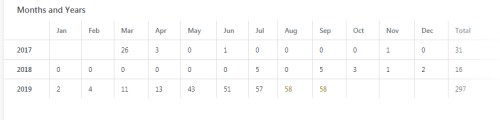
Why does a post from March 2017 that’s still received no likes in the more than two and half years since it was posted show a 5-month increase in readership? (Yes, I know such things are circular — some of you will now read it merely because I mention it here. I’m trying to minimize that source of views by making you look via the Search box if you really want to read it.)
Here’s one snapshot of the stats for the post that WordPress supplies to the numbers-obsessed:
I conclude one or more the following:
+ The post conceals a vital hidden meaning, or cosmic code, that I myself don’t recognize, but that perceptive readers have detected and are studying scrupulously.
+ The post has become a loathsome example of clickbait and you’re just pranking your friends to get them to visit it, laughing maniacally when another feedback loop like this post confirms your success.
+ You’re deeply bored.
3) Like many of you, I distinctly felt the shift around the Autumn Equinox as we continue to enter more fully into the dark half of the year (the bright half for everyone down under). Now is a time of turning inward and attending to rebalancing, harvest, composting, integration and dreaming. (Or renewal, seeding and taking root, augmenting, blossoming and vision.)
I work with an aging hospice patient who’s dedicated his professional life as a doctor and medical researcher to exploring, understanding and addressing the effects of the shifts in the earth’s magnetic field, daily, monthly and seasonally, on the seasonally-sensitive among us. And that includes a wide number of us, when we assemble changing energy levels, seasonal-affectivity and other mood disorders, people sensitive to electrical storms, neuro-degenerative illness, alcoholism, Parkinson’s, schizophrenia, certain cancers, irritable bowel syndrome, residence at high latitudes, etc. One particular prescription he offers is to engage with “the meander” in all its forms: walking labyrinths, doing sacred pilgrimages, and attending to balanced meditative physical rhythms of many kinds (tai chi, etc.) to reset our internal harmonics.
4) Tarot reading this morning: hierophant (5), high priestess (2), moon (18). In the dark of the moon today, with a new moon this evening for the eastern U.S., that feels worth my attention on our sacred identities as mediators of holy energies, and the moon beginning a new cycle.
5) “Patience”, says my lectio divina for today, my holy devotions, “is the greatest discipline along the spiritual journey. By patience you can endure hardships, karmic burdens, slander, the pricks of disease and pain. Keep your focus on the goal, returning every time you swerve away”.
6) Some of my Pagan friends on social media have expressed deep delight in this over-the-top column from 26 Sept. 2019 in The Federalist, a strongly right-leaning publication. Headed by a close-up pic of climate activist Greta Thunberg, the article opens, “Climate Worship Is Nothing More Than Rebranded Paganism. We’re seeing sexualized dances, hallucinogens, worshiping nature, confessing sins in pagan animism, worshiping purified teen saints, all to promote a supposedly greater cause”.
“Where do I sign up?” wrote one of my friends.
“Ah, I’m finally starting to remember the Sixties!” wrote another.
“Aw, sh*t! I’ve been doing it wrong!” exclaimed a third.
7) In his poem “The Spoils of Annwfn” Taliesin writes:
Apart from seven, none came back up from Caer Siddi [an Underworld fortress].
I am one who is splendid in (making) fame: the song was heard
In the four-turreted fort, fully revolving.
It was concerning the cauldron that my first utterance was spoken:
It [i.e. the cauldron] was kindled by the breath of nine maidens.
The cauldron of the Chieftain of Annwfn: what is its faculty?
— Dark (ornament) and pearls around its rim–
One of several translators of the poem for a book published a little over a century ago observed that it is “one of the least intelligible of the mythological poems” (Charles Squire, “The Mythology of the British Islands”. London, 1905).
But sometimes ya just gotta run with what comes. I can always work it out later. Meanwhile, why strive to interrupt the awen as it flows, issuing from the Deep (one of the meanings of Annwfn) within us?
With the pervasive influence of belief-religions like Christianity, Islam and Judaism on many of the readers of this blog, we tend to think of the dividing line between “who’s in” and “who’s out” as something marked by belief, when there are numerous other options available. It’s not just “paper or plastic?” There’s canvas bags, and boxes, and carry-it-out-in-my-hands-without-any-container-needed-thank-you, to name a few. And if we look over some of the terms available to describe this range of approaches and objects of our attention and intention — terms like atheist — they often bring way too many non-useful associations with them. Often atheist really isn’t a particularly useful term for many who just don’t bother with deity, as deity has never bothered with them. Hence the term ungodded in the title of this post, an awkward attempt to get at this phenomenon.
After all, orthodox Hindus aren’t normally labelled a-carnists, non-meat-eaters, though most are vegetarian. It’s simply their default setting. If I’ve never paid any particular attention to deity at all, I’m not so much an atheist as an alter-cosmist — I live in a different cosmos, where the question doesn’t arise, or hasn’t done so recently. At least until the door-to-door folks come calling with their pocket sermons and their flyers and leaflets and their “either you’re in or you’re out”-trips. Binarists, every one of ’em, devotees of a binary black-white, either-or world that ignores an immense and uncharted middle ground. Worshipers of Binaria, goddess of absolute distinctions in a world of shaded and subtle continuum inherent in almost everything.
Marduk and his dragon Mushkhushshu — public domain/Wikipedia
Or to take another tack, I don’t believe in my ancestors so much as understand they exist(ed), from the evidence of my own existence right now, though many of their names and faces are lost in time. (The same happens to gods. Marduk, son of Enki, anyone? Does your non-belief make you an a-Mardukist?! Or can we concur that most of us check the box marked N.A. — “not applicable”?)
Some ancestors contribute to my genes and bloodline directly, while the others subside into the background, distant cousins, every one of them. Imagine — and I mean imagine — that god/desses fill some of those same spaces. Powers that made and are making a difference, even though I never meet them directly. Imagine the cosmos filled with nothing else than cousins. My counterpart in Azerbaijan gets along perfectly well without my knowledge or belief, and he’s a mortal man. What of god/desses? Can’t they do at least as much?
“Oh brave new world, that has such people [deities?] in it!” — Miranda, Shakespeare, The Tempest, 5.1.186-187.
Gravity existed long before anyone believed in it. We could call it a goddess, except that we (mostly) haven’t conceptualized that Power in such a way. And no, I’m not suggesting that we pray to Gravitas at her altars — although doing so would doubtless reveal some world-widening insights we haven’t yet reached. Any scientist worth her training knows that dedication to her field reveals secrets obtainable in no other way. What else is devotion, after all, but a means of contact, a chance to widen the world and make use of the divine gift of our imagination and creativity? What else, you might ask, are we for? (Try that out as a subject for meditation and practice for a month of days, in any way you like, and get back to us with what you discover.)
R. J. Stewart offers an “American Goddesses Meditation” as a way to explore deity that you might connect to quite naturally. (Why not use what’s nearby first?! If you’re not an inhabitant of the States, adapt to your locale — who’s a goddess in your area? There might be rivers, mountains, and so on that deserve attention, if only for experimental devotion. Who gets represented in statues, names, images — even and especially if they don’t at first come across as goddesses? And you can try the same with gods, if you’re so inclined. Many deities are partly or proximally incarnate — they have a physical form you can use to approach them, much as the Orthodox in some traditions have icons, statues, etc. Looked at one way, some of the most seemingly Protestant and Evangelical among Americans are polytheists, also worshiping a hard, metallic and martial war-god, carrying around his talismans and charms in the form of AK-47s, Glocks, etc.)
Liberty — Wikipedia/public domain
If, on the other hand, you do practice devotion or dedication to some form of deity, it behooves you to try out non-belief, for what it can offer you that nothing else can. By that I mean, among other things, rather than fearing doubt, to harnessit as a tool for insight and exploration. One of my teachers exhausted doubt as a factor when he finally pursued it to its deepest ends — ran it to earth, so to speak — and realized that for him it no longer exerted power. Doubt became merely boring, not worth the time (like chewing gum you’ve worked on for hours). Doubt no longer offered an illicit thrill, or troubled his inner worlds. As far as doubt is concerned, then, he’s now an atheist.
Can I be an atheist towards fear, or anger, or some other Power that asks for my worship and energy and attention? Who and what else do I worship that doesn’t deserve it, or that I’ve outgrown? (And to turn the wheel another quarter turn, who and what might I be overlooking or ignoring that merits more attention than I grant today? Chances are great there’s something more I can discover about this endlessly amazing universe.)
[“Why, when God’s world is so big, did you fall asleep in a prison, of all places?” — Rumi.]





 1: Ace of Wands (reversed) — the present, the Self, the querent’s state of mind.
 Wands and Cups predominate in this spread — for me, a reminder of the need to balance fire energy with water, active with receptive, conscious with intuitive. Always good advice! But how might that work, more specifically? How do we “grasp” the fire of Ace of Wands? What “hand” or means do we use? Rachel Pollack in her magisterial 78 Degrees of Wisdom comments: “At the beginning of some situation, no card could signal a better start” (pg. 183). I take reversed simply to mean the challenges attendant on manifesting the energy of a card, or missing the opportunity it brings. The “crossing card” of the 10 of Cups is a Grail, the completing or fulfilling Cup — a balance to the fire of Wands. The third card, a reversed Hanged Man, to me signifies that every time I ignore shamanic, yogic, inner wisdom, I miss the insight of inner experience.
 Temperance — and yet again, Pollack proves insightful. “If a reading shows a person split between say, Wands and Cups, activity and passivity … then Temperance, moderation, and acting from an inner sense of life, can give a clue to bringing these together” (pg. 109).

 The Instructions of Cormac, the Irish Teagasca, comprises a guide for rulers, and more specifically, according to legend, the collected wisdom that King


 A Druid Way