Wonderful series; I hope you’ll continue. I’m another square peg – endlessly resisting all attempts to assimilate, no matter where I wander. Somehow, I keep finding myself coming back to Christianity but not “that” Christianity, I say to myself – not the rigidly human-focused, hierarchical, be-a-good-girl version of my childhood. No, not that one but the magical, connected, generously giving version that was part of my childhood too – the one that did not exclude anyone or anything… I recognize glimpses of it in your writing and think Yes! That’s it! That’s it! What exactly is it though? I don’t really know yet but it’s worth the journey to find out.
From this and other recent comments, we can begin to suss out the kind of practice, experience and reconnection many of us are seeking. I’ll be drawing from Denise’s comment above a number of signposts, because in it she hits on a series of crucial aspects of a spiritual quest, Druid or otherwise. And because I’m a Druid blogger, I’m choosing and focusing on Seven Signposts we can identify there. I’ll launch each signpost with an excerpt from the comment:
“another square peg — resisting all attempts to assimilate”
We’re social beings, even the most formidably anti-social and hermit-like among us, predisposed to find a niche when we’re with others of our kind, like other intelligent and social mammals. So not feeling at home in our world can be a sometimes painful indicator that a spiritual journey is under way. Something’s shaken loose and ejected us from easy comfort with our situations and our social circles. It matches an inner resistance to the conventional niches on offer in our lives, if they don’t nourish and feed us as they should, as they used to, but no longer can.
So we shy away from sham spiritual landing pads, not trusting the footing they offer us. “I yearn to find where and how I fit, but I’ll be damned if I have to sell out to do so”, we seem to keep whispering to ourselves. A certain integrity deep inside us, one we instinctively hear and trust, warns us off the varied boxes, chains, handcuffs and cages we see around us, even as we can see the comfort they appear to bring to others. That makes it doubly hard to explain why we won’t join them in an adjoining cell. “If it works for them …” But it keeps on not working for us.
And in turn, this sense of not fitting in can often lead to …
“wander(ing)”
“Not all who wander are lost”, Tolkien reminds us, writing of the royal-heir-in-waiting Aragorn, but also of course of each of us — heirs like many mythic figures of more than meets our physical eyes. Lineage, heritage, ancestral bequest — it’s there. Or in 90s speak, “Exiled much?”
But the arms of our immense spiral journey can circle so widely, so far over the horizon, that we may have little sense of anything like a spiral at all, only of our wandering, our meandering, generally off the kind of track so many others around us seem to be following. (Though that, too, can be an illusion, given how good we are at “keeping up appearances” for each other.) At times, those same others may envy what they see in us as freedom, while not seeing the cost we keep paying. And we may envy the stable, settled, found-my-niche folks who envy us in turn, and for the same reason: dissatisfaction with The Way Things Are Now.
“keep finding myself coming back”
So we still face one of several paradoxes we’ve gotten to know far too well. Paired somewhat oddly with the previous meander, our wandering in out-of-the-way spaces and places intermittently offers that delicious sense of return. We can also feel like we’re circling around an inner shrine or ideal, even as we’re often barely half-aware it’s there. And if I notice a movement of return, it can often slip past, like one more part of my larger wanderings, which may not be comforting. Am I making any headway at all, or just circling the same dead-end? Is this zeroing in on something valid, or endlessly backtracking to something I’ve already tried and rejected?
And what is it that we’re coming back to? Often we can identify it as …
“magical, connected, generous”
We know these qualities because — somehow, somewhere — we’ve stood in the heart of such worlds, lands that feel more like home than home, places of wonder, communion, and flow. Or maybe we can pinpoint exactly when we experienced such realms, when we entered and when we left. In either case, yearning for them has at times consumed us, or still burns in the background as a steady low flame, a kind of pilot light of the spirit, alight through years or decades or — we may have a sense — through lifetimes.
Here at the midpoint, the fourth out of seven signposts, we stand where we’re going, we’ve arrived again where we’ve never been before, and other paradoxical ways of attempting to get into words the sense of …
“recogniz(ing) glimpses”
The haunting, beguiling, infuriating sense of recognition stalks us, not letting go. It’s both in us and outside, out front and behind, a kind of spiritual transfusion, a re-kindling, the light of a star for us “in dark places, when all other lights go out”, as Galadriel says to Frodo in Fellowship of the Ring. These archetypal, primal spiritual presences stand behind the varied forms of religions and cultures, never wholly removed from us, however dim our sight at the moment. They endure because we do, reaching us in ways we can perceive and understand, connect with, honor and revere, work with, pass on, adapt to our circumstances — but ideally not make a dogma out of, despite our best efforts to nail them down, clasp them in our hands, own them outright, box and sell them, fight and die for them. (Maybe instead I could live for them?!)
“No one comes to Spirit except through me”, to cite a “difficult” text of just one tradition, need not be a claim to religious exclusivity and spiritual imperialism: it can be a simple statement of spiritual reality. “If I want to get closer, I need to find the original, authentic me within”. Or if I ignore this counsel, I’ll come round the long way, better supplied the next time I meet up with a moment of spiritual reconnection with the acuity to sort wheat from chaff, gold from dross. A few more notches on my belt, scars on my face, tools for my need.
“There are two paths you can go by”, sing Led Zeppelin. “In the long run, there’s still time to change the road you’re on”. Yup, I’m in it for the long run. And a multitude of paths: we’re each on trails of our own, criss-crossing others, at times walking the main track, at others turning aside at a fork, a fallen tree across the way, a washed-out bridge over a chasm, a fiery guardian brandishing a cruel-looking scimitar.
“what exactly is it?”
“I’ll know it when I see it”. “It takes one to know one”. The melody we carry in our hearts will burst forth in the right circumstances, harmonizing with the First Song, the awen echoing in all things, the Word, the Bani, the Shabda, the Kalaam-i-Haqq, the Hu, the Voice of the Silence, and a thousand other names. In one sense the spiral we’re on never ends — we circle, always closer. In another sense, we’re the endpoint, we’re the spiral itself, and the spiritual quest can feel like chasing our own tails till we’re dizzy with it.
I take it as one measure of my place on the spiral whether my sense of “what exactly it is” happens to line up with others’ senses of it. If our sensibilities align, I know the gift of a way-station along my journey, and fellowship here. I may be able to work and grow with others, and find solace and companionship with them. If our senses don’t happen to line up just now, I walk solitary for a time. Familiar with both arms of the spiral, I try to honor where I am at the moment, and make the most of it. No judgment, no better-or-worse-than. Strive to honor the integrity of your own walk, counsel my guides and teachers.
“worth the journey”
In spite of everything, or because of it, we also carry an intimate sense that nothing else matters but this … whatever-it-is. Worth the journey, equal to and surpassing the pain, deserving our deepest dedication.
If, like me, you’ve “stepped away” on occasion, well, that too is a path, and will end up teaching more than the solitary person who walks it. We teach each other, most of all when no other teachers seem to paying attention to us, or we’re late to class, or we’ve lost the assignment, mislaid the text, dropped out, failed, skipped town, run off with a comely classmate to parts unknown. All our oldest tales tell of something similar. We’re in good company along the road.
/|\ /|\ /|\
We keep listening because we keep hearing hints. We keep looking because of what we’ve already seen. We walk across the darkened chamber because we have a sense of where at least some of the furniture looms, where a door behind this cabinet opens onto a realm of light.
The wisdom and practices of Christianity and Druidry together amplify each other, and for those who find resonance and insight in that happy confluence, a few more posts on the subject are in order.
And then it will be Spring Equinox — Autumn Down Under — and this old world will continue to knock in our bones and drum in our blood, while the spirit in us burns bright or dull, according to the myriad paths we traverse.
May Friend and Flame, Word and Melody light and cheer you as you go.
A series of recent comments here has been helpful to me, even as I try to gauge how to approach these posts, and how far and where to take them.
I had breakfast with a Druid friend this morning, a short while before he’ll be off for an extended cross-country skiing trip, far from regular tourist routes, hiking in and out, and camping and staying in trail-side shelters. I value him in part because he’s a good listener, and as a consistent character trait, he seeks to find balance in his own reactions to his daily inner and outer life, even as he shares them with others. It makes for some priceless insights, if I shut up to catch them.
Such reflection is a gift, something to cherish and encourage in others. I try to listen here in the same spirit, when you comment in posts about what’s going on in your worlds and experiences. Often of course I don’t not know enough of your circumstances to comment usefully, but I keep listening partly for that very reason. Who knows the whole story, even of our own lives? (The late ABC commentator Paul Harvey called his popular broadcast The Rest of the Story. We keep paying attention, if we’re wise, because the story hasn’t ended yet by any means, and we’re all part of it, telling our piece as we live it. And if you suspect reincarnation is an accurate aspect of the story, its chapters can grow quite lengthy indeed.) Listening, patience, gratitude: a triad cutting across all traditions, proven countless times over and over in its profound power.
Krista writes:
Dean, I’m always especially interested when you write on this particular topic. Having been raised in the Christian Faith, and having had no quarrel with the Christianity of my youth, my own Druid practice always has something of a Christian flavor to it even though I no longer consider myself a Christian. But I don’t consider myself Pagan either. Always was a bit of a square peg. So throughout my Druid journey I’ve become very comfortable blending and assimilating and it works quite well in my private practice. It’s a bit more challenging in community practice, but I’m working on it and I adapt when it’s called for. I think it would do the Druid community a world of good to acknowledge, and have more discussion about, different Druid perspectives rather than focusing almost exclusively on the Pagan perspective. Thanks for taking it on!
How many of us hear even a part of our own experiences in what Krista shares here? Neither Christian or Pagan. It’s a perspective and an experience I suspect is more common than we recognize. “Square-pegged-ness” could probably define a number of us, and in fact much contemporary spiritual practice across traditions echoes this sense of having to find and tread our own paths. Because what price “purity” of belief or practice strictly within the confines of one tradition or school, church or community, if spiritually we’re suffocating or starving there? It can take a deal of work just to recognize such a priority, and honor such a spiritual imperative.
The influx of the divine that swirled and took shape in and around Christianity still has valid things to teach us, even as individual churches and whole communions and major denominations struggle to find their way. The existence today of over 20,000 Protestant denominations, to say nothing of other Christian traditions, testifies to the difficulty of satisfying the questing individual soul with system and conformity, doctrine and creed.
Group practice and community often mean more to many people than words of affirmation recited at a particular portion of the weekly service, though they may describe much of value, too. But the flame that burns at the heart of what is called Christianity does not appear to keep itself neatly smouldering within any bounds set by humans, any more than it does in other spiritualities. If it did, how much would it really be worth? Instead, it kindles and warms anyone who brushes up against it for any length of time. Inconveniently so, dynamically so, wonderfully and provocatively and endlessly “inspiritingly” so.
What other perspectives or flavors of Druidry do we often overlook, besides the Christian one(s)?
Until we can begin to answer that question adequately, I’m borrowing, for the space of a quotation anyway, some monotheistic but non-Christian flavor from Tolkien’s Silmarillion, hearing in it an echo of Druidic awen, and a further gift of the elemental fire that kindles us all:
Then the themes of Ilúvatar shall be played aright, and take Being in the moment of their utterance, for all shall then understand fully his intent in their part, and each shall know the comprehension of each, and Ilúvatar shall give to their thoughts the secret fire, being well pleased.
And disabledhikernh writes:
Thank you for this post. I am hard pressed to find other Druid Christians, so I have felt kind of isolated as such. Now I don’t 🙂
Isolation, that challenge to solitaries — and how many of us are solitary, even if we enjoy a local community of others, before and after we gather with them? The anvil of solitude can forge us spiritually in ways nothing else can, though the costs can be correspondingly high.
(One of my spiritual practices, for what it’s worth, found in other interesting places, too: If this experience is happening for me rather than only to me, what can I take from it? Where can I travel with it? What doors does it open, and not just close? What beauties glow behind the doors? What deities flare and bloom there? How far, I whisper to myself, half in fear, half in wonder, how far can I really go?)
Stevehas been sharing something of his journey in previous comments, and writes:
This series of posts is proving to be a thoughtful and thought provoking treatment of what is a “delicate” subject in many circles. When I first encountered some of your earlier posts on the intersection of druidry and christianity I admit to taking a very cautious approach, almost an attitude of “this is too good to be true”. With time to read and think about what you are saying it seems more likely that you are speaking from hard won, first hand experience. Thank you for doing this.
“Delicate” is apt. Steve’s caution here sounds at least as hard-won — and needful — as any experience of mine, and vice-versa. My caution in how definitively I assert something, how deep I dig, how far I push, what I ask that I can’t answer, is ongoing. Rather than encounter walls, or provoke readers unnecessarily with observations I can’t back up from experience, I want to explore respectfully — mostly so I miss as little as possible of value as I go.
One of the most startling overlaps or intersections of traditions for me happened during an initiation. I still don’t know altogether what it “means”, though it was over five years ago now. In a clear inner encounter, all the more unexpected because I hadn’t opened a Bible in many years, I saw how
out of his mouth came a sharp two-edged sword; and his face was like the sun shining in its strength (Revelation 1:20).
Rather than “meaning” anything at first, the experience shaped me within its own context, just like other profound experiences, whether of pain or joy, grief or wonder, which we analyze only later, and put labels on, as we “process” them, seeking to incorporate or reject them, expanding or contracting them to “fit” what we can accept at the time. At the time, this experience confirmed for me the energy and love behind the initiation, flagging it as powerfully memorable.
Milan’s bosco verticale — vertical forest, completed in 2018*.
(After a car accident over three decades ago now, I surveyed the overturned and totaled car I’d been driving, walked gingerly over a puddle of broken glass to retrieve my wallet, flung from the dash out the window by the impact, massaged a sore neck that was my only physical outcome of the event, and marveled in gratitude that no one had been hurt. Anything the accident “meant” came only later: Insurance claims. My sometimes-psychic brother, agitated all morning before my phone call home to explain what happened and ask to be picked up. The eventual replacement of the car. The job interview I was returning from, the mantra I’d been chanting, my mindset, the weather, the other driver, and so on.)
Part of the gift of the initiation experience is that I was largely able to let go of what it “meant” at first and focus on accepting its effects on my awareness. What it “meant” and “means” has continued to unfold, though not necessarily along “orthodox” lines. And that no doubt drives some of what I write here. Images and metaphors as divine “transparencies” or hierophanies, ways to connect to the limitless, ways it “shines through”, are part of our spiritual furniture, and part of my bias or individuality or inner architecture. They may or may not be yours, but you have yours.
I bless and consecrate you with water … with spirit, and with fire.
/|\ /|\ /|\
How often we’re put off by language — or drawn in and inspired, and for mostly the same reasons. The first piece of wise Druid counsel above comes, in fact, from Luke 5:16, describing what Jesus often did. Seems like a piece of uncommon good sense these days for anyone to practice, a sacred intention to add to our hours.
Another version* puts it like this: “Jesus often went away to other places to be alone so that he could pray”. Does that feel like anything most of us need to do regularly, to get off by ourselves so we can hear ourselves and our awen speak, and not merely listen to the strident echoes of the “24-hour news cycle”? Hear what life is constantly saying to the chakras and energy centers of our being**.
The second line above comes from Matthew 3:11-12, where John the Initiating Chief (Christians may know him as John the Baptist) names the powers he and Jesus invoke when blessing and hallowing others who seek out that particular ritual. Water, spirit, fire. What is baptism but blessing — literally, dipping in water and other holy substances or elements? A baptism in an initiation, and vice versa, symbolized by elements that have always been holy worldwide: water and fire, and spirit that animates them all. Call them elemental sacraments as I have, if that brings them into closer kinship and familiarity and comfort.
/|\ /|\ /|\
One of my teachers observed that just as we can choose to go through initiations organized and conducted by others, we can initiate intentions and directions in our own lives. An actual ritual can help to impress this on the mind and senses, reifying it, to use technical language — making it “thingly”, bringing it through “right down to the physical”.
So I find my own ways of slipping away into wilderness to pray, listen to the trees, sing the awen, and prepare.
And initiation? Many have long looked at the Biblical Book of Revelation as a guide to our inner spiritual architecture, with the seven churches it describes in detail as the varying focus and health of our seven inner energy centers, typified in various traditions as chakras or by other names, the spiritual eye among them, along with the halos on pictures of saints, the sacred heart, the gut instinct, and so on — yet another piece of the philosophia perennis, the Perennial Wisdom we cloak with our regional robes, names and forms, then “name and claim” as the Sole Truth of the cosmos (which we just so happen to be in exclusive possession of).
So you have a vision, and it’s natural to be told to get it down in words before it fades:
Write, therefore, what you have seen, what is now and what will take place later. The mystery of the seven stars that you saw in my right hand and of the seven golden candles is this: The seven stars are the messengers of the seven Gatherings, and the seven candles are the seven Gatherings. (Revelation 1:20).
Then you work to initiate your vision, with the Messengers (Instant or otherwise), and the Light sources you find at hand, LED, spiritual, human. A little paraphrase that I assert does no injustice to the original, and we’re on Druid territory. And why not vice versa? Rework a Druid ritual in Christian terms, and see what you may discover.
We can initiate or baptize our complete body, energies centers all working together, to (re)call it to its holy purpose as an Ancestor-in-the-Making, a Walker-between-the-Worlds, a Holy One. If the world around us, or some other world we’ve walked in lately, seems sacred or holy, or some other ideal summons us, we can “level ourselves up”, to use the language of gamers — shift energy and consciousness, so that we mirror and embody — incarnate — that holiness, rather than working against it.
So I choose the time of ritual with care, honoring the harmonics of the planets and stars, the tides of earth and our lives. Three days, or maybe seven, beforehand, I slip away to the wilderness and pray. As part of my ritual — perhaps the core of initiation, or perhaps other words come — I say, “I bless and consecrate you with water … with spirit, and with fire”.
And perhaps I close with some version of the blessings from recent posts, drinking what seems right to drink, making an offering from that drink to whoever it feels right to honor at the moment of the rite:
I now invoke the mystery of communion, that common unity that unites all beings throughout the worlds. All beings spring from the One; by One are they sustained, and in One do they find their rest. One the hidden glory rising through the realms of Abred; One the manifest glory rejoicing in the realms of Gwynfydd; One the unsearchable glory beyond all created being in Ceugant; and these three are resumed in One.
May the blessing of the Uncreated One, of the Creative Word and of the Spirit that is the Inspirer be with us always …
/|\ /|\ /|\
*Easy-to-Read Version, 2006, Bible League International.
**Whoever has ears, let them hear what the Spirit says to the churches (Rev. 2:29).
It’s almost never “just me”. Even when we “dare to bare” our hearts on social media (a perilous adventure), where this plaintive question seems to pop up frequently. Living in a cosmos of other beings, it’s almost always something more, ultimately so likely that it’s safe to make it a default setting on our outlooks. (Sometimes, however, you do need to choose the best audience to share it with. Many humans understand much less of such things than most trees, for instance. Looking for solidarity and confirmation? Share it with a tree first!) Encounters everywhere, reminding us, calling to us, engaging us to look beyond “just me”.
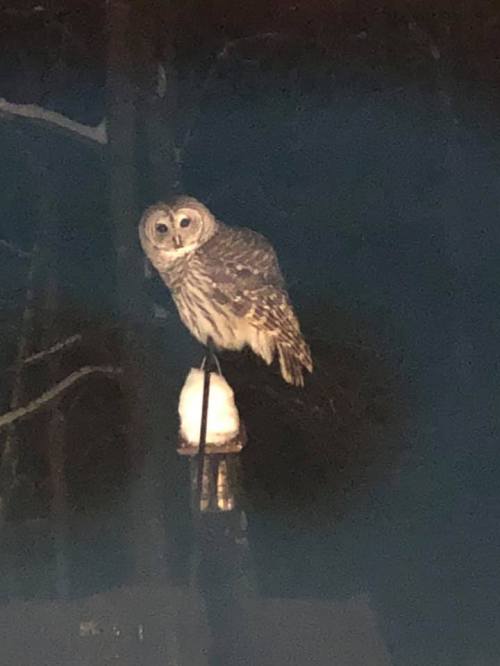
Here’s a night visitor to a Vermont Druid in the northern part of the state — a lovely barred owl (Strix varia).
Barred owl, 15 Feb. 2019. Photo courtesy Sue S.
Wherever we are, whatever we’re doing, it’s always about more than just me.
In the previous post I looked at the beginnings of a Druid-Christian ritual, letting the two traditions talk to each other through their images, rather than drawing on theology or metaphysics. (Druids and Pagans generally do have theologies — many of us just haven’t explored them in great depth or gotten them down in writing yet. Practice usually is more interesting, anyway.)
Name a purpose, and we can draft a Druid-Christian rite for it. Want a wedding, or a blessing, or an initiation? Both traditions have rich materials to draw on. Among other references and resources, Isaac Bonewits discusses ritual design at length in his book Neopagan Rites: A Guide to Creating Public Rituals that Work. Note Isaac’s focus on public: I use private Druid-Christian rituals that might not appeal to others, given our different histories and experiences with religions.
Shansui, the Chinese word for landscape: “mountains (and) water”
Already tired from too much thinking? Use the image above. Enter the scene. Walk that beach. Feel the warm, wet sand between your toes. Feel the wind play through your hair. Listen to the awen of the waves, calling. Salt air, seagulls.
Looking for a calendar, a whole set of practices and observances? The Pagan festival year lines up quite well with classical Christianity, for reasons that have been thoroughly (endlessly) explored and documented. Who knows how many Pagans sit in pews with Christian relatives at Yule and Easter, knowing other names, and sensing both kindred and at times estranged presences and energies?
For foundations for daily practice, one need look no further than the example of J M Greer’s The Gnostic Celtic Church, where Greer notes:
… personal religious experience is the goal that is set before each aspirant and the sole basis on which questions of a religious nature can be answered.
Greer also asserts as a piece of (Universalist) belief:
… that communion with spiritual realities is open to every being without exception, and that all beings — again, without exception — will eventually enter into harmony with the Divine.
What do I want and need? Do I even know? How can I find out?
The world’s spiritual traditions offer hundreds of variations on practices to answer just such questions. It’s good to check in from time to time, asking such things, living with the questions till they bud and leaf into answers, or into more beautiful questions.
As Mary Oliver sings, “So many questions more beautiful than answers …”
We change, and our practices need to keep up. Singing the awen, or other sacred word, is one tested and proven practice most traditions put forth for those seeking a new path, or a new branching along a path we know already. I sing till things clarify. Often for me this may take weeks, or months even … “Patience”, says one of the Wise. “Is not this our greatest practice?”
(But I just want to get to patience NOW …)
Smudge the whole cosmos, if necessary
Greer outlines practices for those interested in exploring a “Gnostic, Universalist, and Pelagian” Druidry. The ceremonies, rituals and meditations include the Hermitage of the Heart, the Sphere of Protection, the Calling of the Elements, the Sphere of Light, a Solitary Grove Ceremony (all but the first deriving from Druid AODA practice), and a Communion Ceremony that ritualizes the “Doctrine of the One”:
I now invoke the mystery of communion, that common unity that unites all beings throughout the worlds. All beings spring from the One; by One are they sustained, and in One do they find their rest. One the hidden glory rising through the realms of Abred; One the manifest glory rejoicing in the realms of Gwynfydd; One the unsearchable glory beyond all created being in Ceugant; and these three are resumed in One. (Extend your hands over the altar in blessing. Say …)
If you tried out Greer’s prayer above, who or what did you bless? If you didn’t, why not try it now? Say the words aloud …
Looking for a short form? Abred (AH-bred), Gwynfydd (GWEEN-veeth), Ceugant (KAY-gant).
/|\ /|\ /|\
I’ve looked before at these lovely Welsh names for the levels of being according to Celtic lore:
With the love of triads and threes that marks so much of Celtic art and story, it’s no surprise that the Celtic conception of our spiritual journeys should mirror this same triplicity. From the starting point of Annwn, the Celtic Otherworld, we move forth and back through three states of manifestation and consciousness, in a kind of dance that sees us revisiting old lessons until we’ve fully mastered the material, spiralling through different forms and perspectives.
Most of us hang out for a considerable time in this present world of Abred, this place of testing and proving. From here we proceed to Gwynfyd, a world of liberty and freedom beyond the pale shadows of these forces in our present world. Back and forth between Abred and Gwynfyd, with dips into Annwn here and there. And last comes Ceugant, an unbounded, infinite realm. By definition, no end point, but a new beginning. The horizon recedes.
/|\ /|\ /|\
And lest someone coming to the beginnings of Druid-Christian practice from the Christian side wonders how to begin with all of this stuff, consider this.
Nicholas Whitehead opens his curious book Patterns in Magical Christianity like this:
Christianity is a magical religion. This is not so controversial a statement as some might think. For all religious traditions are potentially magical by the simple fact that they embody or employ symbols, myths and rites that are mediatory, that intend or enable the translation of spiritual energies between levels of reality (pg. 13).
The author outlines a set of characteristics of such magical symbols, noting they
“are inherently appropriate”. He gives the example of a plant, with roots in earth, flower in the air, and “within its stem the life bearing sap rises and falls. Because of its intrinsic structure, the plant is a symbol for the ideal spiritual life … we live upon the earth, with our roots within the land. We are nurtured by the soil in which we live. Yet, without losing our connection to it, it is our destiny to rise above the land, to flower in the crowning glory of the light … Again note that we cannot make the plant into a symbol. It is simply is a magical symbol by virtue of its inherent structure and its role in the rhythmic life of the cosmos”.
“always participate in a greater reality”.
“enable the translation of energies between levels of reality”.
“are trans-rational”.
“are polyvalent”.
“tend to assemble in groups” (pg. 16).
Of course there’s a tremendous amount to unpack here — which is why it takes Whitehead a book to do so, along with a set of exercises he has developed in a workshop in order to put these precepts to the experimental test. Rather than debate them, which is a head trip I (mostly) don’t plan to take, they’re worth simply trying out, just as one would test the statement that water freezes at a certain temperature, rather than debating whether the claim is true. Of course adding salt, raising a wind over the surface, setting the container in a vacuum, and so on, all change the experimental parameters.
In the same way, my beliefs, intention, mindset when I experiment, past experiences, and spiritual awareness will all figure quite largely in any results I achieve. I’ve found I’m more interested in learning how certain things are valid or operational for me. That is, do they help me get somewhere worth reaching? Otherwise, an inner nudge or whisper usually alerts me: Move along — these aren’t the droids you’re looking for. Later I can play the thought and reason game for what it’s worth. Sometimes a lot, sometimes quite little.
/|\ /|\ /|\
IMAGES: Pexels.com
Greer, John Michael. The Gnostic Celtic Church: A Manual and Book of Liturgy. Everett, WA: Starseed Publications (Kindle)/Lorian Press (paper), 2013.
Whitehead, Nicholas. Patterns in Magical Christianity. Sunchalice Books, 1996. (More recent editions exist, though I haven’t yet been able to find one.)
Ritual, remarks British Druid and author Emma Restall Orr,
is the process of taking time out of the rush of life in order to remember what is sacred, that when we return to the road we do so with a soul once again open to inspiration and creativity. How we do it – and how long it takes – to be effective depends on how scattered by distraction and tangled in need we are. It can be as simple as pausing, breathing deeply, acknowledging the gift of life, the land beneath, the sky above. It can take weeks of preparation, days of fasting, hours of concentration, to fall into the moment of realization about how we can live awake and with honour, not just believing nature is sacred, but unconditionally treating her as such.
ritual bathing
Judging by the continuing readership for a group of posts here on Druidry and Christianity, the vital possibilities of such a concord live still for you as much as they do for me. They branch and grow, and rich fruit hangs from their boughs.
Our instincts aren’t wrong. The two traditions are twinned in ways we may never untangle, but we can explore what they can contribute to each other right now. One way to do that — certainly not the only way* — is through ritual.
Already we hold hints and fragments in our hands. In the Christian Bible, Luke relates the experiences of a rich man, the chief tax collector Zacchaeus. “And he was seeking to see who Jesus was, but on account of the crowd he could not, because he was small in stature. So he ran on ahead and climbed up into a sycamore tree to see him, for he was about to pass that way” (Lk. 19-3-4). Sometimes we need to shift perspective, to climb out of our lives to see them more clearly.
Later in the same chapter, (Lk. 19:37-40), the followers of Jesus are overcome with joy and are peacefully celebrating. But their exuberance apparently touches a nerve — it seems excessive and undignified to the Pharisees, among the Powers-That-Be of the day:
And some of the Pharisees in the crowd said to him [Jesus], “Teacher, rebuke your disciples.” He answered, “I tell you, if these were silent, the very stones would cry out.”
Have we not all felt such joy, that the stuffy, fearful, joyless ones around us want to rebuke us for our happiness?!
/|\ /|\ /|\
[The rite begins. Parts not yet assigned.]
Let the Great Gates open. For we hear voices crying in the wilderness … (1)
Climb your own sycamore! What will you ever see until you do?!
The stones are crying out at our silence (2).
If our houses of prayer and celebration have become dens for thieves, then it is meet and fitting that we repair to the green places of old (3).
For the Wise have counselled us, “Stand at the crossroads and look; ask for the ancient paths, ask where the good way is, and walk in it, and you will find rest for your souls” (4).
Our teachers are at hand: “Ask the beasts, and they will teach you; the birds of the heavens, and they will tell you, or the bushes of the earth, and they will teach you; and the fish of the sea will declare to you” (5).
Let our prayers rise like incense (6), born of earth, moistened in its making, lit by fire, wafting through air.
“They have dressed the wounds of our people with scant care, saying, ‘Peace, peace,’ when there is no peace at all” (7).
We will answer the call to peace, and serve. Let us give peace now to the quarters, and renew the Great Work again …
“May the blessing of the Uncreated One, of the Created Word and of the Spirit that is the Inspirer be always with us. May the world be filled with harmony and Light” (8).
/|\ /|\ /|\
Some readers, writes Philip Carr-Gomm in his foreword to Nuinn’s Book of Druidry,
might be pleased to learn of such a dialogue between Druidry and Christianity, particularly when it results in specific action being taken to initiate a new impulse within the Christian movement. Others might be disappointed, hoping Druidry was exclusively ‘pagan’. But Druidry is a way of working with the natural world, and is not a dogma or religion … Druidry honours, above all, the freedom of the individual to follow his own path through life, offering only guides and suggestions, schemes of understanding, methods of celebration and mythical ideas — which can be used or not as the practitioner sees fit (pg. 14).
Rev. Alistair Bate, author of the OBOD website article “Reflections on Druidic Christology“, comments from a sensitivity to the contact points of the two traditions:
A more orthodox rendering of Chief Nuinn’s triadic formula might be “May the blessing of the Uncreated One, of the Creative Word and of the Spirit that is the Inspirer be always with us”. This, I believe, would not only be more truly in tune with the bardic experience, but would also resonate with the Om/Creation idea found in the Hindu tradition. As we envision Awen, the primordial sound, echoing out of the void, we connect with our own creative inspiration as part of that first creative Word, which is in Christian terms, at once Christ and his Spirit.
And with greater enthusiasm, perhaps, than comparative or historical theological accuracy, Bate concludes his article, summoning to his aid the words of probably the single most influential Christian thinker and writer:
In the 4th century St Augustine declared, “That which is called the Christian Religion existed among the Ancients, and never did not exist, from the beginning of the Human Race until Christ came in the flesh, at which time true religion, which already existed began to be called Christianity”. That the religion of our most ancient ancestors is in essence very similar to that of our more recent ancestors is the conviction that keeps some of us simultaneously both Druid and Christian.
And as many others have long noted, the Galilean master is at his most Druidic when he speaks with images of the natural cycle of things:
Truly, I tell you, unless a kernel of wheat falls to the ground and dies, it remains only a seed; but if it dies, it bears much fruit (John 12:24).
An extensive Druid-Christian liturgy could be written with just the nature images that pervade Christian and Jewish scripture.
/|\ /|\ /|\
IMAGES: Pexels.com
*Other practices one could initiate, as Emma Orr notes above, might be “as simple as pausing, breathing deeply, acknowledging the gift of life, the land beneath, the sky above”. Or correspondingly complex, and “take weeks of preparation, days of fasting, hours of concentration, to fall into the moment of realization about how we can live awake and with honour …” We decide what it is we need, rather than any authority over us. And often the best decisions arise from experimentation, and from an openness to trying something new.
You hear a lot about “top-down” and “bottom-up” initiatives. Start from the grass-roots. Or identify good leaders and let the growth come from their inspired guidance through hard times. But I’d claim that most of our best ventures build and grow from the center outwards. We’re all involved in this kind of initiative, and as a result we instinctively know what to do, even if we tell ourselves — or others have convinced us — otherwise. So the center is a good place to start.
Whether it’s an embryo, a crystal, a sapling, a story idea, a garden, a relationship, a ritual, a company or a nation, there’s a core, a center from which energy, ideas, blood all flow. This center — and this is an important key — also replicates itself everywhere, establishing new centers of activity and growth. Some — many — are within us. A tree sends out roots, plants send out runners, healing occurs and spreads from re-energized tissues and bones, and human nudges and hunches and gut feelings point us toward inner and outward changes. All living things seed themselves, passing on their dynamic potential to another generation, on multiple levels.
Druid attention to the ancestors, if it’s prudent, never seeks to excuse poor choices, bad parenting, or painful and difficult legacies passed down through generations. Each living thing is awash in a sea of tendencies that pair up with inherent directions and characteristics in its environment. I won’t ever have the body or metabolism of a long-distance runner, but that’s not really the issue: I can keep the body I do have as fit as possible, starting from the center of where I already live each day. The small daily changes I make are ones I’m more likely to stick with, even as the small changes my body makes as it ages prompt me, if I’m paying attention, to make adjustments for strength, endurance, energy and so on. Then when larger shifts and changes occur, I can better adapt to them. The same holds true for my inner bodies, emotion and thought and vision, memory and intuition.
Partly this comes out of practice with the small changes first, and partly out of stores and reserves put in place by going with the flow rather than fighting every single direction that living in a physical realm urges on us all. Electric cars coast downhill and save energy for the next climb. Hibernating species store up resources against the hard times. So, if I’m paying attention, can I, both physically and spiritually, prepare myself for each turn of the spiral. The “how” becomes part of my practice, if I let it, and the next challenge I face becomes my chance at re-calibration. Quite simply, is it working? Even to ask that question at all opens many doors.
Out of our sometimes violent human history and its consequent long conditioning, we may fall back on military metaphors, which don’t always yield the optimal mindset. You have to pick your battles, we say. No general wins on every front. More helpful is a range of metaphors, a rich gathering of stories to tell and learn from.
If it seems that spiritual laws swallow up individuality in statements about general tendencies, groups and patterns larger than one human life, it’s important to remember that it was humans who first noticed these principles, studied them, plumbed their potentials. And humans have always chosen either to disregard them or to work consciously with them. Intention is powerful. Animals largely follow an instinctive path. Humans have wider choices. Conscious and creative cooperation with the spiritual principles of existence is a powerful key to our individual human fulfillment. Through such means, we can manifest what has not yet been seen or experienced or even imagined, in forms of power and beauty and usefulness, for others as well as for ourselves.
As we become ancestors ourselves to our descendants of blood and spirit, passing along this “connective tissue” of life-giving thoughts and actions to succeeding generations, that’s one deep way to repay the gifts we’ve been given. It will then be their task to choose what works best for them, to honor and build on what they’ve received, and add their own stamp and color and flavor to the lives they live.
This is a brief post to celebrate flavors of Druidry elsewhere. Below, a shape of awen formed of human shadows — photo by Welsh Druid Kristoffer Hughes.
* * * * *
Australian Druids just celebrated Lughnasadh, and Serpentstar, the free OBOD newsletter for Australia, has just published its most recent issue — you can read it online or download it as a PDF here. Lovely images and articles offer a glimpse of the Land and Druids Down Under.
* * * * *
Cornwall actively promotes its language and culture, and that includes Cornish Druidry. Here’s a prayer to Brighid in Cornish, with an English version, from Trelawney Grenfell-Muir:
Brigid a’n Kugoll, gwra agan kyrghynna.
Arlodhes an Eyn, gwra agan kovia.
Gwithyades an Oeles, gwra agan enowi.
Yn-dann dha gugoll, gwra agan kuntelles,
Gwra agan daswul dhe gov.
Brigid of the Mantle, encompass us,
Lady of the Lambs, protect us,
Keeper of the Hearth, kindle us.
Beneath your mantle, gather us,
And restore us to memory.
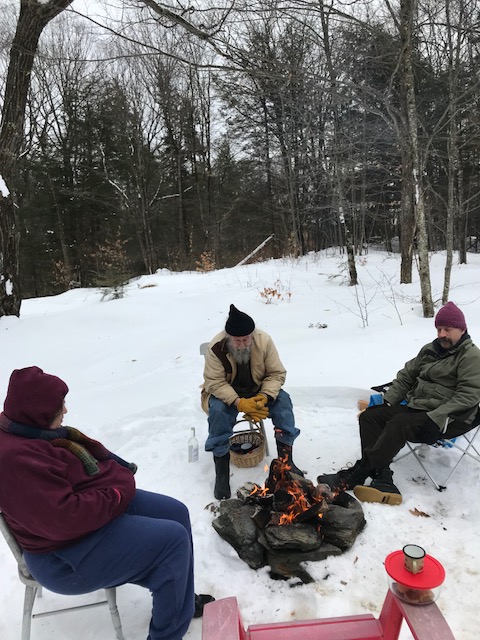
After the recent frigid temperatures in New England and across many of the northern states, 34 F/1 C earlier today felt positively balmy. Here are some friends and I (to the right) sitting in a cleared circle in the snow round an Imbolc fire. (The smartphone camera makes it look like we’re wearing acorns on our heads.)
photo courtesy Spring K.
Little wonder, given how appealing the orange flames are, that words for fire, hearth and focus/focal point are connected in many of the Romance languages: Spanish fuego, French feu, Portuguese fogo, Italian fuoco, all from Latin focus “domestic hearth” which includes among its senses “house, family”. With a fire we’re halfway home — a house at its most basic is a roof and walls around a fire, where a family may flourish, conserving its vital heat.
Meeting Merlin at a remote inn on a winter day, King Arthur in Mary Stewart’s The Last Enchantment strides in and exclaims to the inn-keeper, “Wine we will not wait for, nor fire”. Warmed by these two essentials, a mortal can begin to consider other matters. And perhaps sense the spring-tide slumbering beneath the snows, sure as the sky, still waiting.
Praised be Brighid: “Goddess of fire, Goddess of healing, Goddess of Spring, welcome again!”*
Keeping the cold at bay with our trusty woodstove has taken most of my energies over the past several days, so I’m simply reposting six previous meditations on Brighid for this Imbolc 2019. [Note: These appear in reverse chronological order.]
To recap: I rely on sacred sound, on awen, as my first and go-to practice. (Let’s call it East for now, since I need air to sing it.) Without the daily retuning it affords me, I find “all bets are off”. It clears the way, keeps me facing my own best interest more of the time, inspires me, keeps the creative stream flowing, helps me with compassion for others going their ways. In short, I like myself better when a sacred melody is my heartsong. Life flows more smoothly.
Some personal assembly is required for the “spiritual components” I’ve mentioned in this series. I can’t force a flower to open. What I do needs to flow from me gratefully, gracefully, as if I let myself out of a cage I didn’t know barred me from wider, richer experience. I may stand at the door a little dazed at first, but then the world outside the bars invites me. Spirituality offers a series of recipes. I don’t need to make and live on bread alone, or just green curries, but practice means I’ll improve on what I’ve started already. For what it’s worth, consider: “The fox knows many things, but the hedgehog knows one thing well”. (When you fully understand that, you can explain it to me!)
Or to paraphrase what I remind myself: The awen is already flowing in your life. Find out where!
If you want a poem version of the reminder, try Mary Oliver’s “Wild Geese”. Yup, awen coming thru: “your imagination calls to you like the wild geese, harsh and exciting, over and over announcing your place in the family of things”.
TWO
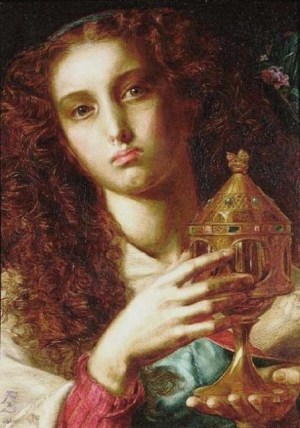
Elaine of Corbenic*, King Pelles’ daughter, bearing the Sancgraal/Frederick Sandys, 1861
The Elements, part of my “family of things”. Water, and West. Grail — Cauldron — Feminine Principle — Goddess — Virgin Mary — Yang and Yin together again. Octave, door, spiral key. Working with the Grail bears similarities to a form, like a kata in martial arts. Alone, it may not seem like much. As part of a path, a spiritual choreography, it opens out into unexpected country.
How I assemble, and what parts I choose, that becomes my practice.
I have a lovely blue-green vase given to me by a former student. It sits on a shelf, and needs dusting from time to time, especially after the winter season with ash from the woodstove. I also eat from a commonplace bowl that’s gotten chipped from wear, and lives part of its life submerged in soapy water along with all the other dishes I’m washing. Both are forms of the Grail. One sees daily use. The other looks pretty. Sometimes I feel a Grail in my heart, a divine space of possibility. The Grail ismy heart, is everybody’s heart — our hearts together form the Grail.
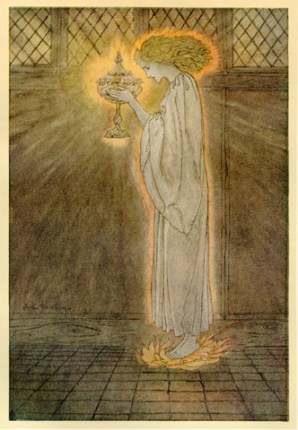
Another image of Elaine, by Arthur Rackham, 1917.
Seen from one side (the Grail has no sides), I’m on a Grail Quest. Seen from the other side, the Grail is the first thing I started out with, or that started out with me, as I tagged along childlike. It gave me away to the world (a way to all the worlds), knowing I’d always come back.
[*Elaine of Corbenic, the Grail Maiden of Arthurian legend, is the mother of Galahad with Lancelot.]
THREE
Earth, north. I sit gingerly at the keyboard, easing my back where I pulled a muscle yesterday on our icy driveway, carrying in an armful of firewood and nearly falling, catching myself with a wrench. Boar snorts at my shoulder, saying you know what to do. I reach to touch his bristles, reminding myself to relax, to shift, rock, ease the muscles from sitting too long in one posture. I stand up to look out the window at blue twilight on the snow, and stretch.
Grounding what I experience is key to bringing its use fully into my worlds. I practice this, writing, embodying shapes I’ve seen in vision, drawing (badly) the sword from yesterday. Though sword is east, it’s also undeniably a physical object — north, steel, mined from earth. Holding it, even in imagination, I ground the experience further. Holding a piece of metal or wood in my hand as a ritual equivalent, feeling its solidity and inertia, I ground further. Grail-in-all-things, goddess-in-all-things.
FOUR
Fire, south. Sun each day, moon each month, two great spirals for practice, a daily sun salutation, surya namaskar. A monthly moon meditation. Knight connects a version of this rhythm to polarity working with the Grail, too. Two ritual-contemplation questions arising in meditation today: “What is the sun of the moon? What is the moon of the sun?” I don’t need to understand everything before it becomes part of me. In fact, with much that I value deeply, like my wife, my marriage, understanding happens only after it has become part of me, and I of it, not before.
FIVE
First star tonight in the eastern sky tonight, Grail-star. Quintessence. Yes, earth my body, water my blood, air my breath, fire my spirit — so the old Pagan song instructs me. But spirit-greater-than-fire is here — spirit the essence of all four, and more, pouring inexhaustibly from the Grail across the cosmos.
With my forefinger I trace a pentagram in the twilight sky in the Seven Directions, another form I use: four quarters, zenith above, nadir below and center.
For the good of all beings, for the good of the whole, for the good of each one, may it be so.
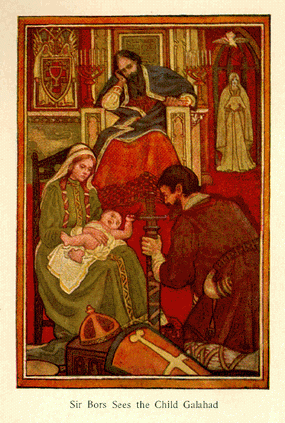
Bors has given me a sword. I see and feel it pass from his hands to mine. Now among my tasks: how to determine its nature — how and when do I make use of it — and what are appropriate thanks and service for this gift?
To what degree does this brief inner experience, which I recorded this morning in my journal, arise not from holy sources, but from my personal Grail practice and from such reading as the following, from Knight’s The Secret Tradition in Arthurian Legend?
Galahad, Percivale and Bors accompany the Holy Grail back to Sarras, from whence it came. The maimed king is healed, and the three knights are borne away in the ship with the silver altar above which hovers the glory of the Holy Grail … [I]n due time, Galahad’s wish is granted, and he leaves this life and ascends … Percivale remains in Sarras, and only Bors … returns to tell the tale. In this sense Bors is in the line of succession of great revelatory mystics and prophets, and the keepers and sustainers of the inner mystery traditions (Knight, pgs. 270-271).
If I want to track the experience to its birth, the answer to an either-or question of origins probably matters. But if I want to learn what it can teach me, that question matters much less. (I can explore it at my leisure later, when I’m not storming a castle, or de-rusting my chainmail.)
Mara Freeman asserts in her book Grail Alchemy: “the legends of the Holy Grail open up paths to the spiritual dimensions like no body of lore has done before or since”. I take this as a deeply experiential challenge, not one to be answered by mere intellectual debate, but by results. Once I’ve made a serious sustained effort, I’ll know whether or not these legends — and my practice — open up paths to spiritual dimensions — for me.
(Any desire I have for my way to work for anybody else may be simple generosity, but such an innocent motive can all too quickly sidle up to my insisting it’s the only way — and that should instantly set off all our crap detectors. I keep reciting Postman’s corollary like the holy mantra it is: the main source of bullshit I face is myself. Exhibit A — Bors gives me a sword: an experience to assess and explore for what it can offer. Well and good. But I’m hot stuff because of that experience: deep piles of fresh, steaming bullshit.)
The same holds true with animal guides. (As a wise Druid asked at last fall’s East Coast Gathering, “Why is it everyone’s animal guide is Wolf or Raven or Bear? What about tomato cutworm?”)
I’ve written elsewhere of my experiences with wild boar. Again, the test of any guide, tool or experience is (or can be) utterly practical. As the Galilean master asks, Does it bear “good fruit”? That’s how to “know” in powerful and grounded ways.
Sometimes I can’t quite reach the inward space I need to inhabit for healing. But I can reach for my inner guide, through long familiarity, and touch the bristly fur on his back. Touch was one of my first experiences of my guide — totally unremarkable to me, when I was looking for something more dramatic — and less “mundane”, less physical. For whatever reason, I can readily feel his fur, his pleasure at our connection. Only later, as I note in the post linked in the previous paragraph, did I read in the Druid Animal Oracle the entry for Torc, the Boar: “… he is a representative of the Goddess — his skin can heal you” (Philip and Stephanie Carr-Gomm, The Druid Animal Oracle, Fireside/Simon and Schuster, 1994, p. 39). And I began to appreciate this “earthed” mode of access for what it was, a priceless gift. Once again — you’d think I’d know this by now as one of my ongoing biases — I overlooked the obvious, minimized a non-flashy spiritual connection.
Freeman continues with wise admonitions about “how to tell if you have made it all up or you are being deluded”. After all, you may be wondering where my precious and much-vaunted crap detector is in all of this. Freeman says,
… the imagination is the language of the soul. It is the equivalent of our most important sensory organ — sight — only turned inward rather than outward. Every non-physical thing that exists expresses itself as energy, or Force. The imagination is a creative mechanism that enables us to give Form to Forces of the non-physical planes. (Introduction, Kindle location 349).
I’d generalize Freeman’s words slightly here: Every thing that exists expresses itself. How else do we know it except through its expressions? If I arbitrarily rule out any non-physical expression from my interest or attention — and here we can include emotion, hunch, imagination, intuition, gut feeling, creative impulse, dream, memory, love — I merely impoverish myself. Why on the deep earth or in the starry heavens would I want to do that?!
Several versions of the following story exist:
Once not so long ago there was a great drought in a province of China. The situation grew increasingly dire. The Catholics made processions, the Protestants offered prayers, and the Chinese burned joss-sticks and lit firecrackers to frighten off the drought-demons; but no sign of rain or wisp of cloud appeared in the empty sky. Finally the people said: “We will fetch a rain-maker”. And from another province a dried-up old man appeared. The only thing he asked for was a quiet little house somewhere, and there he locked himself in for three days. On the fourth day clouds gathered and there was a great storm at a time of year when little rain was expected, and the town was filled with rumours about the wonderful rain-maker. Asked what he had been doing during the three days that had caused the rain to fall on the fourth, the old man said: “I come from another country where things are in order. Here they are out of order; they are not as they should be by the ordinance of Heaven. Therefore the whole country is not in Tao, and I also am not in the natural order of things, because I am now here in a disordered country. So I had to wait three days until I was back in Tao, and then, naturally, the rains came”.
This wisdom story is easily reworded to speak in Druid terms. Like most good stories, it leaps cultures without significant diminution.
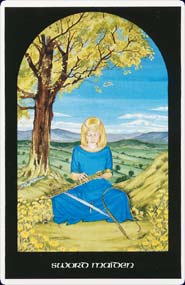
Another instance: many years ago I bought a used copy of Caitlin and John Matthews’ The Arthurian Tarot. I spent several days familiarizing myself with the images, and skimming the accompanying text (The Hallowquest Handbook, subsequently enlarged) which, beyond the usual short descriptions of each card, details a number of pathworkings and other exercises for the Grail seeker. One of the cards that particularly drew me again and again was the Sword Maiden. Here is the Matthews’ description:
Under a tree sits the Sword Maiden embroidering a scabbard … Dindrane, Perceval’s sister, is part of the Grail quest. She cuts off her hair in order to weave a belt for the sword which Galahad shall carry. She grasps ideas and materializes them; perceptive and discerning, she is vigilant in the cause of truth and justice; she cuts through difficulties by taking the way of self-sacrifice.
When years later I read that Knight calls Dindrane “the perfect female initiate” (The Secret Tradition, pg. 270) and wrote of Bors that “he represents the initiate … rooted in the world” I realized that I had the makings of a personal practice of polarity working for a Grail quest. Rather than typifying or idealizing any stereotypically gendered element of expression, I see them as energies, inner and outer, available to the Grail seeker in mythic and archetypal forms.
Postman notes in the article I cited in the previous post:
So you see, when it comes right down to it, crap-detection is something one does when he starts to become a certain type of person. Sensitivity to the phony uses of language requires, to some extent, knowledge of how to ask questions, how to validate answers, and certainly, how to assess meanings … What crap-detecting mostly consists of is a set of attitudes toward the function of human communication: which is to say, the function of human relationships.
You might without too much distortion call crap-detection a kind of secular Grail Quest. Or the inverse: the Grail Quest is a holy version of crap detecting — in following it, I’m looking for and working toward a full(er) and healthier relationship with the cosmos and the beings in it, expressed in language and ritual as far as they can take me: naming things as lovingly and accurately as possible, knowing them by their expressions, and also pointing and following beyond words into being (t)here.
And you might think after that last post, there’s nothing more I can add to the subject. I boxed myself in with a few home truths. You make your own path by walking it. Done. QED. End of story. Except …
One quality of a valid path is that it rewards the walking of it. It’s not valid merely because somebody else says so. The only authority worth recognizing is ultimately the truth we each sense within, in the doing of it. (Good parenting means in part supplying the rudiments of crap detection to our children. Pass along even the minimum we picked up over some decades of living, then, when the time is right, let them risk burning their own fingers, if they must, while we stand by with first aid.)
In some places this capacity for judgment used to be called critical thinking, and for past generations, inner resources. In many places we seem to have abandoned them. If we haven’t already refined that organ of good sense so that it serves us reasonably well, wherever and whatever it is, we can begin work right there. Life will, quite ruthlessly and uninvited, lend a firm hand.
As Ernest Hemingway once quipped, when asked what was needed, before anything else, to succeed at writing: “a built-in, shock-proof, crap detector”. One reason this tool matters so deeply, and in wider fields, is this: “At any given time, the chief source of bullshit with which you have to contend is yourself”. (This corollary to Hemingway comes from Neil Postman’s invaluable classic essay, “Bullshit and the Art of Crap Detection”, available online here.)
And Postman’s corollary also means knowing when to turn off the crap detector, consciously and intentionally, for purposes you choose. And the reason for this is significant:
“Each man’s crap-detector is embedded in his value system; if you want to teach the art of crap-detecting, you must help students become aware of their values”.
[Postman is talking to English teachers in this lecture/essay; he’s also talking before our current heightened sensitivity to pronouns, so cut him some slack if his wisdom outweighs his sexism for you.]
A pause here to regroup and reconnoiter:
my single most useful tool is a crap-detector;
its default target, when no others present themselves, is me;
my use of a crap-detector is an art;
and if I hope to learn how to use mine well, I need to know what matters deeply to me, because that’s where both my values and my crap live.
Where’s the Grail in all this, again? Bear with me. You’re here, if you’re following my promise in the first post in this series, to discover something about myway. Yours will, by the fact of your irreducible uniqueness, be different from mine, but also similar enough you may take away something useful.
Now you may already know all this — or think you do. In which case, write your own book, or run that weekend workshop, and tell us how it’s done (AKA how you do it). Apart from privileging your crap over mine, and separating me from some of my money in the process, I doubt you’ll be ahead in the end. I might be, if the experience helps me refine my crap detector.) The best things in life may, unlike your workshop, truly be free, but I work the hardest for them. But that way, oddly enough, I discover they’re splendidly my own, in a way yours can never be. They cost something far more valuable than money. They’re “free” in another sense because that’s what they make me. So: catch you on another rung of the spiral.
/|\ /|\ /|\
a Grail image
As a form, a container for energies and aspirations, the Grail earns my respect. (It passes my crap detector.) As an object for contemplation and visualization, together with regular practice of the cauldron sound I’ve described, I’ve begun to learn what matters to me, which is partly to say what works for me, what kindles me, what echoes in my bones, what seeks me out because it’s mine, and what I belong to in ways I’m still discovering. The Grail can be a passport to our native country. With it, I cango home again.
And as always, I try to heed the best bards. T. S. Eliot says in his “Four Quartets” (a vastly superior poem, in my arrogant opinion, to “The Waste Land” because I come away from it better equipped for joyful growth): “We shall not cease from exploration, and the end of all our exploring will be to arrive where we started and know the place for the first time”. Grail is perennially “first time” in its power to renew and heal, and in that way it’s a virgin experience. Spiritual renewal and rebirth bears this signature quality.
Paradoxes, like those in the preceding paragraph, are for me a sign and signal of approaching four-dimensional truth. As a Wise One once said, the opposite of a superficial truth is a falsehood. But the opposite of a profound truth is, often, another profound truth.
True poets and bards, they recognize this by instinct, and (at least in their better moments) never try to own it, only to announce the strange good news to us all through their words and songs. And we may catch ourselves shivering in recognition, another sign. This awe-tinged joy sparking in us, this inner alertness and attention and focus, is another quality the Grail can mediate, a quality I’ve learned to recognize with my crap-detector, which yields and bows. (Of course I can and should turn it back on — later — to assess what and where and, on occasion, what next.)
Regarding public domain status of the Rider-Waite tarot: “In the United States, the deck fell into the public domain in 1966 (publication + 28 years + renewed 28 years), and thus has been available for use by American artists in numerous different media projects”.
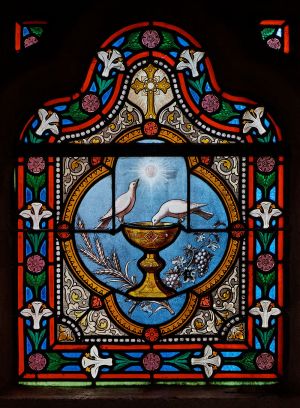
Christianized image of the Grail — Quimper Cathedral, Brittany
A path toward the Grail — whatever form your Grail happens to assume — may not look much like anybody else’s. It may not even look like a path at all. You call it your life. (As Druid Kris Hughes likes to say, “What other people think of us is none of our business”.)
We talk so freely in terms of a path, or a journey, that often we forget it’s a metaphor and take it as simple fact. Seven hundred years ago, Dante began his great poem the Divine Comedy “in the middle of the journey of our life”, suggesting that there’s just the one journey we all take. (He turns personal immediately after that, when he exclaims that he “came back to himself in a dark wood, where the direct way was lost” — where he had lost it. “The only way out is through”, says Robert Frost. “You got to get in to get out”, sing Genesis.)
Following on the metaphor, I try to “get somewhere” over time, teachers and parents urge me “make my own way”, it’s important to “look back” from time to time, to see “how far we’ve come”, to take stock “along the way”, to wonder “where we’re going”, “how long the journey will be”, and “when we’ll arrive”. We follow a yellow brick road to some Oz or other, or climb a Led Zeppelinesque stairway to heaven, or party along an AC/DC highway to hell, we look for guides and signposts, we’re told there’s no map, or just one, or millions. (If such pervasive metaphors interest you, check out George Lakoff’s Metaphors We Live By.)
The great Spanish poet Antonio Machado exclaims “we make the road by walking”* in Campos de Castilla (and in other collections).
Druid-like, I trust bards over bureaucrats, because objectively they listen to wider possibilities of awen.
The one essential is our participation in the cauldron sound, as I attempted to describe in the previous post, Grail 1. We all do this already, of course, by being born, blood thrumming with our heartbeats, attuning to the musics of our cultures, the sounds of our languages, the ceaseless waves of the sea. Birth grants us a “minimum daily requirement” of the all-pervading sound. But a quality journey asks for more, for some effort on our part. We can, of course, choose to tread water through our lives — one option, to be sure, and one that can appeal if life seems too hard otherwise.
The cauldron sound accompanies us as we set out, and with our conscious attention and participation, grows loud enough to help us find a path, guide us to walk it as only we can, and help us know when we’re done that the joys were worth all the pains.
Or as Carlos Castaneda’s teacher Don Juan Matus puts it, with the calm authority of one who has found out for himself:
Anything is one of a million paths. Therefore you must always keep in mind that a path is only a path; if you feel you should not follow it, you must not stay with it under any conditions. To have such clarity you must lead a disciplined life. Only then will you know that any path is only a path and there is no affront, to oneself or to others, in dropping it if that is what your heart tells you to do. But your decision to keep on the path or to leave it must be free of fear or ambition. I warn you. Look at every path closely and deliberately. Try it as many times as you think necessary. — The Teachings of Don Juan: A Yaqui Way of Knowledge.
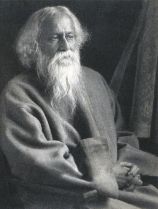
R Tagore
To say it another way, I strive “to be the cause in my own life”, not “the effect of other people’s emotions, viewpoints, and efforts to control us”.** The cauldron sound, “the one companion of my life”, as Bengali poet Rabindranath Tagore sings, assists me in listening to my own song amidst the clamor of the “apparent world”, as OBOD ritual terms it. Some hear it as a subtle nudge, an intuition. Others hear it in the words of friends, a chance conversation with a stranger, a song lyric, a dream, a brightness in something read, or overheard at the grocery store. Awen will get through.
/|\ /|\ /|\
*“Wanderer, your footsteps are the road, and nothing more; wanderer, there is no road, the road is made by walking. By walking one makes the road, and upon glancing behind one sees the path that never will be trod again. Wanderer, there is no road — Only wakes upon the sea” — A Machado.
**Klemp, Harold. ECK Wisdom on Spiritual Freedom. 2018.
Want a good overview of the awen in the life of another Druid? Don’t just take my word for it. Read Druid-in-two-traditions Dana Driscoll’s account here. [I’ve written about it, among other times, here and here.]
Looking for the lost melody of your life? For that sense of spiritual freedom you may have touched as a child? For the heart-song that so often eludes us in the busy-ness of 21st century living?
If there’s such a thing as a “container” for the awen, beyond the bodies of all things, it’s the Celtic Cauldron, proto-grail, womb, goddess symbol, under- and other-world vessel, humming on the edges of our awareness. To participate in its sound is to begin to manifest some of its properties. Put myself in sympathetic vibration with it, and I discover its powers of transformation. It accomplishes change through vibration — no surprise, when we know that every atom of the cosmos vibrates at its own particular frequency. That’s also part of why every major spiritual tradition on the planet includes chant, song, mantra, spoken prayer. The whole thing sings. When the bard Taliesin exclaims in one of his poems, “The awen I sing, from the deep I bring it”, he points us toward the pervasiveness of awen, its habitation in the heart of things, its flow through us, both lesser and greater, as we sing, and bring.
Dana observes, “One of the most simple things to do is to invoke Awen regularly as part of your practice.”
A tangent. An article from a few days ago somewhat ruefully acknowledges that there’s actually a specific day — January 17 — when Americans see many of their New Year’s resolutions fail. (Your own culture, if you’re not a Yank, may exhibit lesser or greater persistence.) Since we seem to addicted to bad news these days, feel free to indulge here in some delicious negative thinking, if you wish. But then read closer: “Contrary to widespread public opinion, a considerable proportion of New Year resolutions do succeed,” notes a psychology professor in the article. Even at the 6-month point, according to studies, some 40% of resolutions — and their “resolvers” — stick with it. While the data pool may well need refining, still, that’s an astonishing figure. Better than the best baseball average. While “two outta three ain’t bad”, as the Meatloaf song tells us, even “one outta three” is pretty damn good, in so many human endeavors. And if you’ve read this blog for a while, you know my strategy for success with resolutions. Start so small that it’s next to impossible not to begin. “Oh, anyone can find 30 seconds a day”.
And this holds true with so many practices, spiritual or otherwise. A habit is simply an expression of equilibrium. The resistance to change is the resistance of all set-points and stasis and inertial systems — their first “response”, if we think of them for a moment as conscious beings, is to absorb the new thing rather than change on account of it. It’s a survival mechanism, after all, evolved over eons, to prevent dangerous over-reactions and hyper-compensations to what are often only temporary blips in the environment. We can’t afford to be thrown off by “every little thing”.
Why would this apply to something like the awen, a pervading cosmic sound and vibration? It’s already flowing through us, at a sustaining level, keeping us alive, the heart beating, the electrical system of the body sparking along. But upset that equilibrium unwittingly, kick the carefully calibrated network of bodily systems, and you risk the same thing rash occultists and yogis do when they raise the kundalini unprepared, force their way onto the astral plane too abruptly, shift the body’s and psyche’s equilibria by force of will, and then face all the unexpected consequences — illness, accident, poor judgment, disharmony — all the attendant symptoms of dis-ease, of a complex equilibrium under abrupt, too-rapid or even violent change.
So I begin small, and gradual, and see how it goes, if it’s worthwhile, if it adds to and builds on my life — as I already live it. This latter point is keenly important, I find. And I encourage you to try the awen, or — if you’re drawn elsewhere — its kin in other traditions. (Maybe one living near you: Om, Hu [link to an mp3 sound file], etc.) Give it a year of serious practice, and I will personally guarantee positive change, or your karma back. Other practices have their established value, but sacred sound is special.
The “rewards” of such a practice are not always easy to “calculate”. (Revealing that we even use such language). But practice, as you’ll discover, opens many doors we didn’t even know were there. As OBOD Chosen Chief Philip Carr-Gomm notes,
Try opening to Awen not when it’s easy, but when it’s difficult: not when you can be still and nothing is disturbing you, but when there’s chaos around you, and life is far from easy. See if you can find Awen in those moments. It’s harder, much harder, but when you do, it’s like walking through a doorway in a grimy city street to discover a secret garden that has always been there – quiet and tranquil, an oasis of calm and beauty. One way to do this, is just to tell yourself gently “Stop!” Life can be so demanding, so entrancing, that it carries us away, and we get pulled off-centre. If we tell ourselves to stop for a moment, this gives us the opportunity to stop identifying with the drama around us, and to come back to a sense of ourselves, of the innate stillness within our being. And then, sometimes, we are rewarded with Awen at precisely this moment.
“The Holy Grail won’t go away” — and for very good reasons.

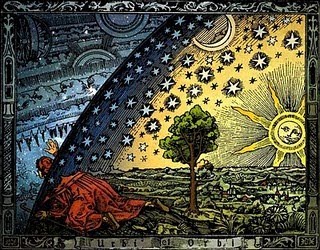 Denise comments:







 When years later I read that Knight calls Dindrane “the perfect female initiate” (The Secret Tradition, pg. 270) and wrote of Bors that “he represents the initiate … rooted in the world” I realized that I had the makings of a personal practice of polarity working for a Grail quest. Rather than typifying or idealizing any stereotypically gendered element of expression, I see them as energies, inner and outer, available to the Grail seeker in mythic and archetypal forms.

 Want a good overview of the awen in the life of another Druid? Don’t just take my word for it. Read Druid-in-two-traditions Dana Driscoll’s account


 A Druid Way


