Archive for the ‘earth spirituality’ Tag

Over a year ago, my wife’s aunt and uncle decided to celebrate their 50th anniversary by gathering family on Maui in Hawai’i, and very generously footing the bill for lodging as extra inducement, so we planned our car trip this summer to bring us to the west coast of the U.S., where airfares were — barely — doable on our rapidly-shrinking budget. Imagine seventeen of us — five families, with ages from 5 to 81 — piled into three rental condos.
I suspect the more green-minded among you are already saying, “But air travel’s so polluting.” And I’ll respond outright: it is. No argument there. So I’ll try to make up for such extravagance and excessive consumption through my witness, and through an attempt at some range in my reporting.
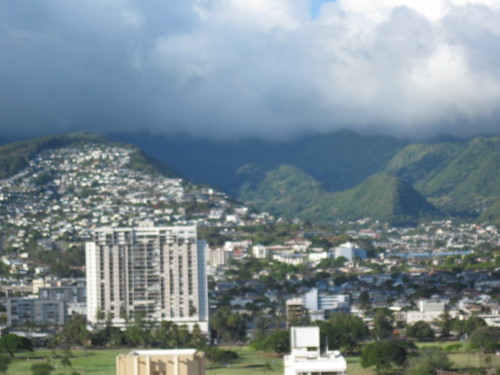
Yes, of course the islands are lovely. Even the sun-blessed sprawl of Honolulu can’t conceal the emerald hills that overlook the high-rises. Here’s a slightly blurry view to the north from Waikiki from our hotel room …

And, yes, you really can find the heart-stopping beauty you’ve heard about, often without stepping away from right where you are. Overhead, in a tree in full blossom, or in a striking run of notes of an unfamiliar bird-call, around a corner, or in one of the splendid national parks.
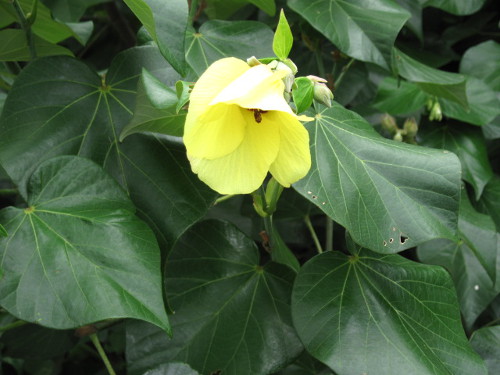
[BELOW: My wife’s photo of a Hau flower, Wai’anapanapa State Park, Hana Highway, Maui]

But what delights me the most — neither my wife nor I are “sun and beach” people, though the steady crash of surf and the breeze off the water lull even the two of us into “aloha” mode most effectively — is the growing presence and importance of traditional Hawai’ian culture and language. Without a sense of where I am, mere newness or charm quickly turns flat and lifeless. It becomes plastic. It’s easy to fall into one-dimensional tourist mode, paying for flat and plastic experiences with plastic. We’ve all heard this, probably done it ourselves, so we know what we’re talking about.
But the handful of long-time residents we’ve encountered, along with tour-guides and wait staff, all seem to agree on a healthy cultural trend. Much was lost during the last two hundred years of Western influence and interference — that sadly all-too-common story in so many places — but much has been preserved. There’s a pride in the native Hawai’ian heritage that may be one of the best predictors for the future survival of old crafts and stories, language and custom. One more place to cheer, however tentatively. If tourist dollars provide one motivation in holding onto surface charm and, gods willing, deeper cultural uniqueness, well, let’s utilize whatever works.
[Along with cultural ferment, it’s important to add, the island is striving in fits and starts to go green ecologically. Aging and polluting diesel-powered electricity generation is being supplemented (and eventually will be taken off-line) — by three hilltop banks of wind-power stations. And Larry Ellison (of Oracle software fame) has purchased 98% of the neighboring island of Lana’i (the former Dole pineapple island), with plans to make it eventually self-sufficient in food and power, and generate revenues by selling excess solar/wind power to other islands.]
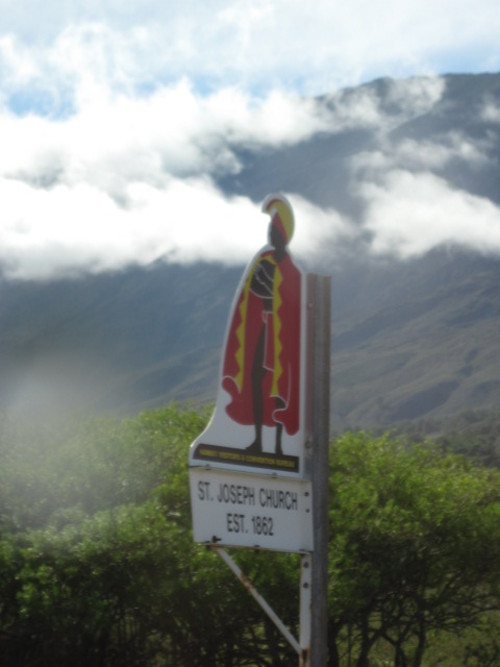
New-ish road-signs featuring the traditional ali’i or chief, like this one marking a church, say a lot. Native traditions and images, disparaged in colonial times, or made downright illegal like speaking Hawai’ian was, start to regain something of their original stature and significance, however incomplete, through their use as symbols and icons.

Since we’ve arrived we’ve frequently heard the Hawai’ian saying “Maui nō ka ʻoi” — “Maui’s the best”* — and without shamelessly trying to fake a non-existent familiarity with the archipelago (we’re here on Maui just 6 days, after all), we’re still inclined to think this particular island deserves its status: small enough to escape much of the busy-ness and hype of Oahu where we spent two days, and dramatically varied enough to provide rain-forest, tropical, upland, mountain and desert landscapes, all within a day’s drive on the “ring road” around east Maui.
In the end, though, for me as a brief visitor and interloper, it’s not the beaches but the mountains that call with the clearest voice of the spirits of place. He ali’i ka’aina, goes another local proverb: the land is a chief. He kauwa ke kanaka — we are its servants. To belong to a land …
Maui’s chief mountain is Haleakala, “House of the Sun,” though clouds often skirt the slopes. How instinctively we realize: mountains earn and deserve our attention as vivid gestures of our planet, and as ancient and powerful spiritual tools. Viewing them, meditating in their presence, ascending them, whether on a clear day or through a cloud cover that may cloak them in mystery, can mirror and induce a spiritual ascent.
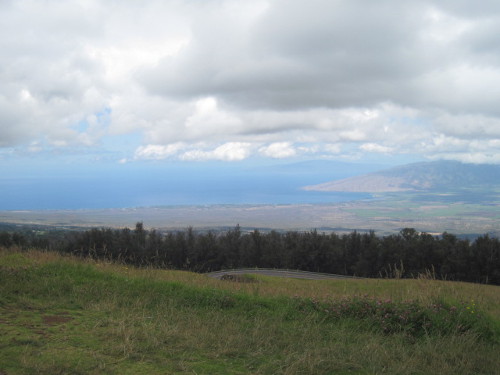
Here we are part-way up and facing west, overlooking west Maui. You can see the ocean on the left, arching inward to central Maui.

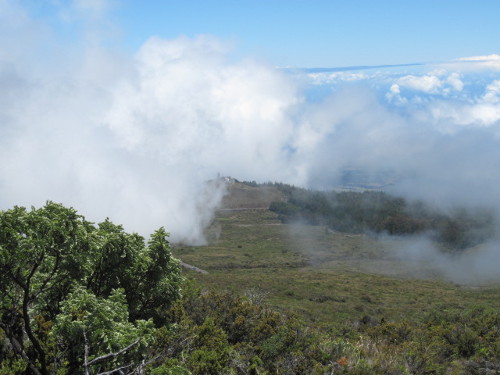
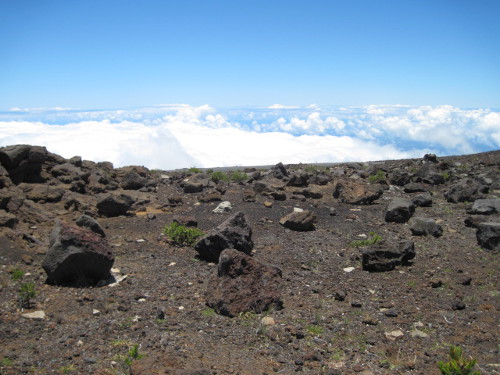
Vegetation thins as you climb above the clouds, till bare volcanic rock dominates. This is no longer the beach and sun of tourist brochures, but land still being born, raw from creation.

Hikers can make the climb on foot; if you haven’t already noticed your car’s temperature gauge, the sign announces how far you have come above the sea.

When you enter Haleakala National Park at either the coastal or mountain visitor center, you can pick up a bilingual pamphlet (Hawai’ian appearing first, too!) that clearly attests to the re-emerging potency of native Hawai’ian culture. Yes, you can not pick it up, or pick it up and not read it, or read and forget it. But … After a short paragraph explaining the principle of kuleana, responsibility to the land, “passed on to us from our kupuna (ancestors),” the visitor is admonished: “Therefore, as you enter this sacred place, this kuleana is now placed upon you.”
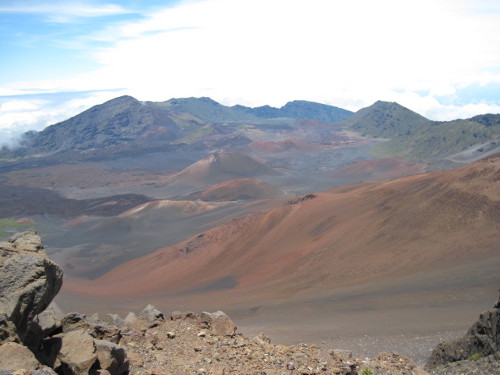
Here is the otherworldly crater at the peak.

Imagine such words in every park, every public place across the land! “Therefore, as you enter this sacred place, this responsibility is now placed upon you.” Then imagine people respecting and heeding such words. Here is a start, a seed. Let there be many such seed-places around the world. May we plant them. May they grow from here, from every such place. We need them so desperately. And may beauty help lead us where we need to go. This for me has been a gift of Maui.
/|\ /|\ /|\
*Maui Nō Ka ʻOi is also the name of a local island magazine, full of touristy articles and images.
[A version of this post appeared in my column in the online Druid magazine Amethyst. My thanks to the editors for providing their well-edited forum for OBOD’s East Coast Gathering (ECG) community.]
I offer this post on the chance it may prove useful if you’re grappling with some aspect of animal guides, power animals, personal totems — the usages and terminologies haven’t settled down yet.
Last September, as I sat engrossed in the ECG 2013 workshop on Animal Guides, I simply had to laugh at myself. It had become clear to me over the weekend that sometimes your animal guide pursues you, rather than the other way around. In my case I’ve learned that gods, spirits, and guides often have to shout and do handstands to get me to notice at all. I’m just grateful they think it’s worth Their while.
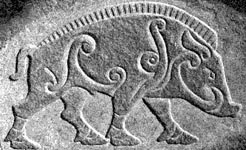 With Boar, my obliviousness ran deeper than usual, and lasted much longer. Maybe (I say, trying to excuse myself in any way I can find) it’s only because I’ve looked at my obtuseness more closely than usual. Maybe following two paths has scrambled the inner circuits. Maybe my inner discipline needs work (whose doesn’t?!). Laughter may be appropriate – and fitting for Boar, who can be a bit of a trickster anyway. As long as laughing isn’t all you do, I hear inwardly. Clues pile up. Here are some I’ve managed to account for so far.
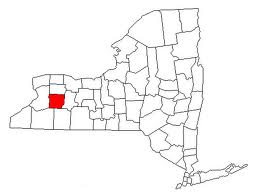
My father, a city boy who grew up in Niagara Falls, NY, became a full-time dairy farmer a few years before I was born. For some reason he could judge pigs well, recognize the outstanding animal, pick out the prize pig. In fact he won several judging competitions when I was still a baby. But the ability perplexed him. He’d mention it from time to time, amused. (Now I ask myself, is Pig or Boar some kind of family or ancestral totem? One more quest to add to my list of quests.)
I was born in the year of the Boar, according to the Eastern 12-year calendar. OK, I thought. Interesting piece of trivia. Entertainment, really. Chinese restaurant lore. Fortune cookie material. My nominally Christian family never paid any attention to such things. And in my adolescent arrogance and ignorance, I considered myself professionally immune to astrology, which I was sure was for wackadoos. It didn’t help that it was part of the national conversation at the time. If you’re old enough to remember the Reagan presidency and the First Lady’s Nancy Reagan’s admitted fascination with astrology, you know what I’m talking about.
 When I was in my early teens, and walking the Wyoming County fairgrounds in late August, a show pig at our local county fair lunged at me as I passed – a serious, front-legs-over-the-top-of-the-pen, get-to-you-if-I-could attempt. I was passing by a good ten feet away, one person in a crowd of visitors to the week-long fair in our agricultural county. What set the pig off? Something I was wearing? A scent of sweat or lunch or shampoo? Pitch or timbre of my voice? I never did find out. But I’ll note that I was fascinated around this time by the Greek myth of the Calydonian Boar Hunt, and the relationship between Meleager and Atalanta, a fleet-footed huntress sent by the goddess Artemis, who had also sent the boar. Why? To punish the king of Calydon for his neglect of the rites due to the gods. (You have to understand: goddesses feature in another of my lists of embarrassing interactions with the universe. Sometimes when I get it down on paper it’s just downright embarrassing. But, I can hope, maybe my embarrassment will be useful to others.)
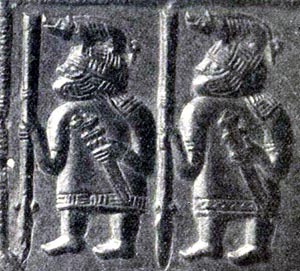
 I reflect, too, on my long* fascination with Old English, Anglo-Saxon society, and the war (and boar) themes in poems like Beowulf. To the left you can see the stylized (and outsized) boars on the warriors’ helms.
To cite just two instances from one poem, at one point the poet equates the warriors directly to the boar and to its symbolic importance as a fighter: “The armies clashed — boar struck boar” (lines 1327-8). And some hundred lines later, Beowulf’s own helmet is described in detail: “A smith crafted it, set boar-images around it, so that ever after no sword or war-axe could bite it” (1452-1454).
 Fast forward a decade and I’m teaching English in Japan in Musashino, a western suburb of Tokyo. One weekend my wife and I were visiting Asakusa Jinja, a large Shinto shrine in downtown Tokyo. As I was poring over trinkets for a cheap souvenir, a servant of the shrine insisted that I take a small carved wooden boar token. It didn’t appeal to me at the time – I thought some of the other images were more artistic renderings. But I made a small offering and went home with the image.
The Wild Boar serves as the mascot at a private high school where I taught for almost two decades. Every day classes were in session, I entered the campus dining hall passing beneath a stuffed head of a wild boar mounted over the entrance. The animal had been shot decades ago by one of the first headmasters of the school, an avid hunter.
About a dozen years ago, my wife and I took a vacation to Italy and the Tuscan hill country, where not once but twice I ate wild boar, and was sick both times. You’d think at some point it might have dawned on me that I shouldn’t eat my animal guide.
 In fact, a few years ago an alum donated to the school a replica of Il Porcellino, a famous boar figure from Florence, Italy by the Renaissance sculptor Pietro Tacca. I now walked past Boar twice a day, outdoors and in. I can’t claim the universe rearranged itself for my benefit (or embarrassment), but the effect was the same.
Why such resistance on my part? I still don’t know entirely. But Boar appeared in a vision during the East Coast Gathering drumming session with Thomas Deerheart and Maya Minwah, and gave me some very specific health advice for a longstanding issue I’m dealing with. Ever since then I’ve been drawn to touch Boar, run my hands over his coarse fur, feel the ridge along his back.
 The Druid Animal Oracle entry for Torc, the Boar, notes: “… he is a representative of the Goddess—his skin can heal you” (Philip and Stephanie Carr-Gomm, The Druid Animal Oracle, Fireside/Simon and Schuster, 1994, p. 39). It’s important to note I finally read the Oracle only after I wrote a second draft of this column (yet another resistance – I’ve had the volume on my shelves for over a year).
We say “my guide” or “my power animal,” but I’m finding that for me at least it’s the other way around. I belong to them. Whatever I think I’m looking for, it’s been looking for me even longer. The hunter is hunted. They track me down till I’m cornered and I have to listen, till I can’t ignore them any longer.
Recently Magpie has caught my attention again. I’m trying to listen better this time to whatever this new guide wants to communicate. What with running with Boar, and flying with Magpie, at least I’ve got the opportunity for plenty of inner exercise.
/|\ /|\ /|\
As I look over these notes, several points stand out. (I’ll put them in first person and speak only for myself, not to presume too much about who you are, or what your experience may be.) First, to my mind, is the desire (I don’t know how else to put it) of the Other — Spirit or spirits, guides, deities, totems — to connect with me. Second I must concede my own obliviousness. I ask for help, or a “sign,” but even when it lies down in front of me and trips me up, I STILL manage to ignore it.
Next is the likelihood that once I start looking, the coincidences begin stacking up until it’s clear there’s more than coincidence going on. Common themes emerge. The animal I seek is also seeking me — in dreams, “accidents,” images, unaccountable emotional reactions to seemingly “unimportant” things– in all the different ways it can reach me, in case one or more channels of communcation are blocked (usually on my end).
Animal images in poems also cry and echo for the nerd-Bard that I am. We repress the animal guides in and around us, so that like other repressed things, they eventually spring, animal-like, into our psyches elsewhere, in sometimes strange and nightmarish images, in art, dream, eventually, even, in national obsessions and pathologies. If they pool and accumulate enough cultural energy, they manifest in personal and societal outward circumstances, in political and cultural movements, in wars and other conflicts. Think of W. B. Yeats’ apocalyptic poem “The Second Coming,” which famously ends “what rough beast, its hour come round at last,/Slouches towards Bethlehem to be born?”
Or consider Philip Levine’s “Animals are Passing from Our Lives” in the voice of a pig approaching its slaughter. Apocalyptic and angry poems like these, like most art, aren’t “about” only one thing. Run them to earth and they keep meaning something more. We use animals (animals use us) to communicate what we sometimes cannot say directly. Among all the other things they do, animals help us express that deep love, that bitter grief, anger and darkness, comfort and healing, that simply may not be able to manifest in any other way.
/|\ /|\ /|\
Images: boar; boar-helmed warriors; Asakusa Jinja; Il Porcellino; Druid Animal Oracle.
*Like many English majors, I studied Old English as an undergrad and grad student. Like some others, my interests in things Tolkien and Old English stimulate and nourish each other. Since then I’ve kept up my amateur’s interest by attending conferences, writing and presenting papers, shoring up my grasp of the language in discussions and translations on online forums, and in rendering portions of OE poems and prose into modern English, as with the lines above. I say “amateur,” because with the exception of occasionally teaching the poem in translation to high schoolers, I pursue my interest out of personal obsession rather than professional necessity.
[Part 2 here]
Kuklunomes. Karla, our ritual leader, half-sings, half-speaks the word in Priyosta Grove’s dedicated language. Let’s form the circle.
Swonago! says Russ, as he strikes a singing bowl forcefully. The sound ripples through the clearing. We’ve been experimenting with opening gestures and words. These seem to work for us now. I can feel without looking that the others are listening, as I am, as the sound fades.
Already the five of us who’ve gathered have been falling out of speech and into a ritual hush. April wind blows chill through our grove, though the sun in a cloudless sky feels blessedly warm on our faces. I open my eyes. Dry brown grass whispers around us and underfoot, but the rains have greened things as well. Almost everyone still wears long sleeves, though a few dare to bare a little more. Russ strikes the bowl a second time, and cries Swonago! just as Angie and Dan enter the grove. They’re somewhat flushed, and release hands as they separate to walk to opposite sides of the circle. Our resident young couple has plainly been making out. Karla smiles at Angie, who’s tousled and a little breathless.
For the invocation, Karla passes to Michelle the staff she’s handcarved. For each gathering she decorates it anew. This time, on one end of the staff, three bird feathers, and a neat braid of colored ribbons cut from scraps from the Beltane rite last year. Michelle raises it toward Karla in acknowledgement, than lifts it high over our heads. The words to come are hers. We each bring a piece of this rite, having rehearsed it through a flurry of emails and briefly in a conference call a week ago, fighting static over a bad connection. All becomes part of Grove tradition, stories to retell, to share with newcomers when the time is right, to remind us who we are.
Gods, spirits, ancestors of blood and the heart’s bond, Michelle chants in a minor-key singsong, we call you to sift our intent, to join our rite, and to bless what we share here and always.
The words ripple up and down my spine. I glance around the circle again, wanting to take it all in. Dan and Angie’s eyes are closed. Both their heads tilt slightly as they listen. To the casual observer, we’re just as casual: no robes or massive Pagan bling. Look closer and you might see a few discrete pentagrams, a few modest-sized pendants and earrings. One bearded fellow we know only as Dragon wears jeans and an embroidered white dress-shirt, a fluid Celtic pattern worked in red. Michelle has brought water in our lovely aquamarine offering bowl that she found some years ago at a household auction and gifted to Priyosta Grove. Friendship, it translates, or Amity. An ongoing goal for us, an intention. Michelle passed the bowl to Dragon when Karla handed her the staff. Some of the rite we’re improvising now, relaxed at what’s scripted and what arrives free-form.
Dragon steps forward to bless the circle with water. He’s at ease, smiling slightly, as he sprinkles each of us in turn.
Western gods and spirits, lakes and rivers, blood in our veins, oceans circling, he chants slowly, turning to each of us, we call you here, now.
Dragon’s name, I’m beginning to sense, fits him well after all. I remember how I rolled my eyes a little when I first heard him introduce himself, then scolded myself as a Pagan snob.
Now, briefly, I flash onto a serpentine form, awash in a frothy sea — a water dragon. Its arcing wings shoot a cascade of cool, refreshing water over us. I shudder involuntarily in surprise at the vividness of what I experience. A confirmation, something to tell him after, if it feels right.
I look around again at the others. All of us are in fact wearing ritual garb. The point is comfort and ritual dedication. We’ve changed into these clothes, but they’re modern, like our ritual. Priyosta has never come close to discussing anything like a “ritual dress code,” let alone tried to make one a formal policy — nobody has the balls, nor could they get it to stick anyway — but over our eight years of existence, we’ve established our own unwritten sensibility. One piece of jewelry you’ve dedicated and worn to many rites over time is almost always better than thirty pounds of robes and bling from “Auntie Gaia’s Mystyk Cauldron and Proud Pagan Emporium.” In big circles and at major festival gatherings, some of us might dress up more. For this and for our other local rituals, we dress “in” — that one piece of clothing or jewelry that helps remind us as we breathe the smoking sage, feel the water of the blessing, that solvas son yagnei — all things are holy.
We continue inviting the Quarters, and settle in to the Rite. We tell what feels appropriate, and pass over the rest, belonging to the Grove alone.
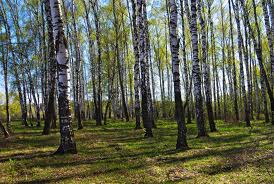
It’s not a major festival that’s brought us together this time. Priyosta doesn’t always manage to meet for every one of the “Eight Greats.” You follow the Wheel as you can. But it’s time for our own thanksgiving. The papers are signed and filed, the last check cleared our now very small grove bank account, the land title arrived on Monday. This little hilltop with its stand of birches is now officially “ours” to care for. A former hunter’s camp, much of it had been badly trashed, but we got it for back taxes and not a whole lot more. A trust, for our grove to hold and heal, and when the time comes, to pass on. We keep its location private, to preserve it from further heedless indifference.
/|\ /|\ /|\
Image: birch grove.
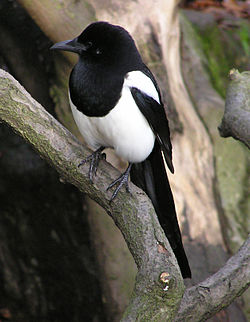 Magpie religion says pick it up if it’s shiny. Add it to your collection. Don’t worry if it “matches” or “fits” — shininess is its own category. It stands out from everything else.
Magpie religion is normally practiced alone, though its origin lies in the genetic stamp all Magpies carry. Aloneness is not a bad thing — the Magpie, at least the Eurasian variety, passes the mirror test for self-awareness. Magpie doesn’t need a flock to find its own way. The world of shiny awaits.
Magpie religion says don’t worry so much about God, an afterlife, and so on. Magpie religion means be a Magpie as best you can, and that means “do Magpie things.” You’ll begin to see that God comes to you. Sometimes wearing feathers. Sometimes not.
Magpie religion means, while you sit on your branch, if you can, sing.
Magpie religion seeks no converts. If you’re born a Magpie, you’re already a member. You belong. If you’re something else, BE that something else. No copy-cats, or copy-birds. Everything belongs, has its shiny. Go find it, says Magpie religion. Bring it back to the nest.
Magpie religion says beautiful exists on its own terms. It needs no excuses. It also doesn’t need a runway, an ad campaign, backers or models. It doesn’t go in or out of style.
Magpie religion says “Magpie” doesn’t signify anything, even if death or bad weather happens to come along. Other beings signify using “Magpie.” Magpie doesn’t mind. It could mean more shiny.
Magpie religion says the order is important: magpie first, then religion. Remember that when you sort your shiny.
Magpie religion says don’t worry if others call you Magpie, which is a silly name, after all. By BEING Magpie, you make the name beautiful. Ruffle those feathers, preen a little. You’ve earned it.
Magpie religion says if someone wants to make an animal guide out of you, introduce the Trickster. Then fly away.
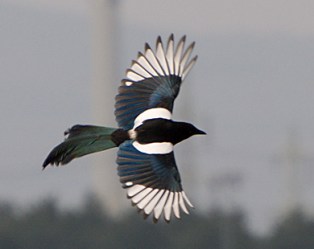 Magpie religion says you carry bright and dark in your own bodies. No need to go far to seek them, to “understand” them. You stand under them already. Literally. Without trying. Want a vision, check a mirror, see yourself — recognize it.
Magpie religion says “Magpie religion” is a set of sounds, a set of ripples and sparks in your nervous system. Where are you flying today?
/|\ /|\ /|\
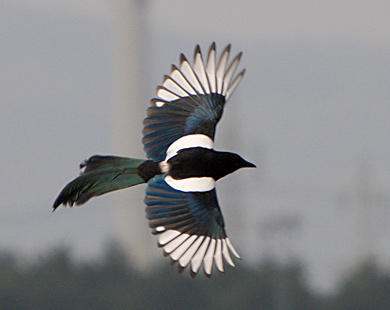
Images: sitting; in flight
The Eurasian magpie, the variety studied more extensively, also appears to possess episodic memory — the ability to recall/distinguish “what, where, when.” Magpies have been observed using tools, and groups of Magpies showing what has been interpreted as grief over the death of one of their number. The Magpie is not only one of the most intelligent of birds, but of all animals — an intelligence now recognized to have arisen independently in both corvids (crow and magpie-like birds) and primates. See Eurasian magpie for more info.
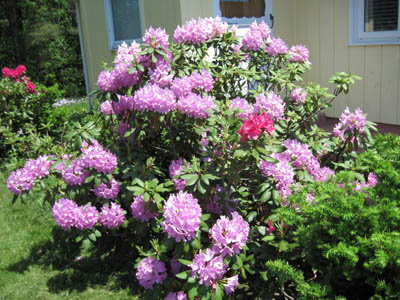 Here are Yin and Yang, our two rhododendrons — a single red flower grows on the pink bush in the foreground, with a branch of the red bush showing in the background. Plant envy? Unfortunately the red bush doesn’t have a single pink flower, or the image would be complete. In a month they’ll be back to their usually ungainly woody scraggly selves, with no hint of the glory they present each May. Is the aftermath the only time we appreciate what we had — when it’s finally gone?
The aftermath is the consequences, the results, the outcome. But we never hear of a “foremath,” whatever it is that stands before the event, the “math” — literally the “mowing” in Old English.
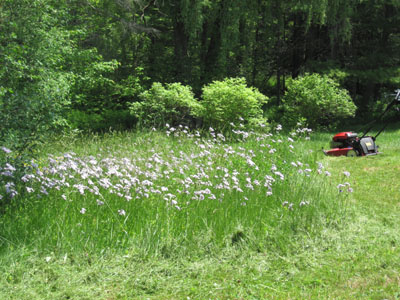 Most of our yard is the typical rural patch of grass, which given half a chance will turn to sumac, crabgrass, chicory, dandelions and even slender saplings inside six months. In the few years that we’ve owned the house, we’ve let whole quadrants go uncut for a season. Sometimes it’s from pure practical laziness — we’ve no one to impress, after all, and no condo association to yelp at us — and it saves gas and time, until we get around to putting in more of the permanent plantings that won’t require cutting. Until then, we’re getting the lay of the land, seeing how soil and drainage and sun all work together (our three blueberry bushes, visible in the background in the second photo, thrive on the edge of our septic leachfield), and which local species lay claim first when we give them a chance to grow and spread. The moles that love our damp soil also tunnel madly when we leave off mowing for the summer. We think of it as natural aeration for the earth.
The northwest corner, shown here, shaded by the house itself for part of the day, yields wild strawberries if we mow carefully, first exposing the low-lying plants to sun, and then waiting while the berries ripen. Patches of wildflowers emerge — common weeds, if you’re indifferent to the gift of color that comes unlabored-for. I like to hold off till they go to seed, helping to ensure they’ll come back another year, and making peace with the spirits of plant species that — if you can believe the Findhorn experience and the lore of many traditional cultures — we all live with and persistently ignore to our own loss.
This year we’ve “reclaimed” most of the lawn for grass, as we expand the cultivated portion with raised beds and berry patches. But I remind myself that we haven’t left any of it “undeveloped” — the unconscious arrogance of the word, applied to land and whole countries, suggests nature has no intention or capacity of its own for doing just fine without us. Who hasn’t seen an old driveway or parking lot reverting to green? Roots break up the asphalt remarkably fast, and every crack harbors a few shoots of green that enlarge the botanical beach-head for their fellows. Tarmac and concrete, macadam and bitumen are not native species.
And what would any of us do, after all, without such natural events like the routine infection of our guts by millions of beneficial bacteria to help with digestion? A glance at the entry for gut flora at Wikipedia reveals remarkable things:
Gut flora consist of microorganisms that live in the digestive tracts of animals and is the largest reservoir of human flora. In this context, gut is synonymous with intestinal, and flora with microbiota and microflora.
The human body, consisting of about 10 trillion cells, carries about ten times as many microorganisms in the intestines. The metabolic activities performed by these bacteria resemble those of an organ, leading some to liken gut bacteria to a “forgotten” organ. It is estimated that these gut flora have around 100 times as many genes in aggregate as there are in the human genome.
Bacteria make up most of the flora in the colon and up to 60% of the dry mass of feces. Somewhere between 300 and 1000 different species live in the gut, with most estimates at about 500. However, it is probable that 99% of the bacteria come from about 30 or 40 species. Fungi and protozoa also make up a part of the gut flora, but little is known about their activities.
Research suggests that the relationship between gut flora and humans is not merely commensal (a non-harmful coexistence), but rather a mutualistic relationship. Though people can survive without gut flora, the microorganisms perform a host of useful functions, such as fermenting unused energy substrates, training the immune system, preventing growth of harmful, pathogenic bacteria, regulating the development of the gut, producing vitamins for the host (biotin and vitamin K), and producing hormones to direct the host to store fats.
Such marvels typically set off echoes in me, and because much of my training and predilection is linguistic in nature, the echoes often run to poems. A moment’s work with that marvelous magician’s familiar Google brings me the lines of “Blind” by Harry Kemp:
The Spring blew trumpets of color;
Her Green sang in my brain–
I hear a blind man groping
“Tap-tap” with his cane;
I pitied him in his blindness;
But can I boast, “I see”?
Perhaps there walks a spirit
Close by, who pities me–
A spirit who hears me tapping
The five-sensed cane of mind
Amid such unsensed glories
That I am worse than blind.
Isn’t this all a piece of both the worst and the best in us? We can be fatally short-sighted and blind, but we can also imagine our own blindness, see our own finitude — and move beyond it to a previously unimagined larger world.
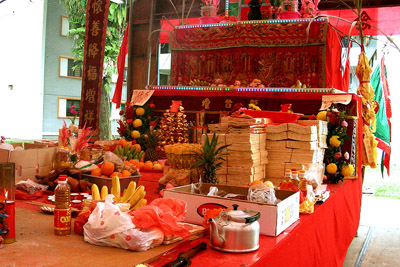
An altar is an important element of very many spiritualities around the world. It gives a structure to space, and orients the practitioner, the worshipper, the participant (and any observers) to objects, symbols and energies. It’s a spiritual signpost, a landmark for identifying and entering sacred space. It accomplishes this without words, simply by existing. The red color of the Taoist altar below immediately alerts the eye to its importance and energy.
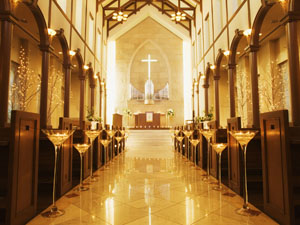
As a center of ritual action and visual attention, an altar is positioned to draw the eye as much as any other sense. In Christian churches like the one below, everything is subordinated to the Cross and the altar immediately below it. Church architecture typically highlights this focus through symmetry and lighting. But in every case, enter the sacred space which an altar delineates, and it tells you what matters by how it is shaped and ordered and organized.
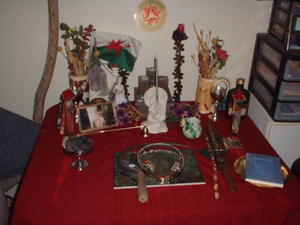
Part of OBOD* training is the establishment and maintenance of a personal altar as part of regular spiritual practice. Here’s a Druid altar spread on a tabletop. Nothing “mundane” or arbitrary occupies the space — everything has ritual or spiritual purpose and significance to its creator.

Such obviously physical objects and actions and their appeal to the senses as aids in spiritual practice all spring from human necessity. We need the grounding of our practices in the physical world of words, acts and sensations in order to “bring them home to us,” and make them real or “thingly,” which is what “real” (from Latin res “thing”) means.
Religions and spiritual teachings accomplish this in rich and diverse ways. We have only to think of Christian baptism, communion and the imposition of ashes at Easter; Hindu prasad and tilak; Jewish bris/brit (circumcision) and tallit (prayer shawl) and so on.
Atheists who focus exclusively on belief in their critiques and debates thus forget the very real, concrete and physical aspects of religious and spiritual practice which invest actions, objects and words with spiritual meaning that cannot be dismissed merely by pointing out any logical or rational cracks in a set of beliefs. Though you may present “evidence that God doesn’t exist” that seems irrefutable to you, you haven’t even begun to touch the beauty of an altar or spiritual structure, the warmth of a religious community of people you know and worship with, the power of a liturgy, the smell of incense, the tastes of ritual meals, the sounds of ritual music and song.
Just as we hear people describe themselves as “spiritual without being religious” as they struggle to sift forms of religion from the supposed “heart” of spirituality, plenty of so-called “believers” are “religious without being spiritual.” The forms of their spiritual and religious practice are rich with association, memory and community, and can be as important as — or more so than — a particular creed or set of beliefs.
Having said all of this, I’ve had a set of experiences that incline me away from erecting a physical altar for my Druid practice. So I’m working toward a solution to the spiritual “problem” this presents. Let me approach it indirectly. Once again, and hardly surprising to anyone who’s followed this blog or is as bookish as I am, the trail runs through books.

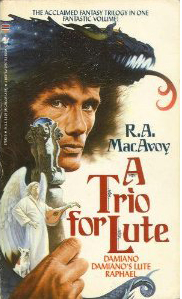
Damiano, the first volume in a fabulous (and sadly under-known) trilogy by R. A. MacAvoy, and recently reissued as part of an omnibus edition called Trio for Lute, supplies an image for today’s post. Damiano Delstrego is a young Renaissance Italian who happens to be both witch and aspiring musician. His magic depends for its focus on a staff, and we see both the strengths and limitations of such magical tools in various episodes in the novel, and most particularly when he encounters a Finnish woman who practices a singing magic.
When I read the trilogy at its first publication in the 80s, the Finnish magic sans tools seemed to me much superior to “staff-based” power. (Partly in the wake of Harry Potter and the prevalence of wands and wand-wielders in the books and films, there’s a resurgence of interest in this aspect of the art, and an interesting new book just published reflecting that “tool-based” bias, titled Wandlore: the Art of Crafting the Ultimate Magical Tool).
So when I then read news of church burnings, desecrated holy sites, quests for lost spiritual objects (like the Holy Grail) and so on, the wisdom of reposing such power in a physical object seemed to me dubious at best. For whatever your own beliefs, magic energy — whether imbued by intention, Spirit, habit, the Devil, long practice, belief in a bogus or real power — keeps proving perilously vulnerable to misplacement, loss or wholesale destruction. Add to this Jesus’ observation that we are each the temple of Spirit, and my growing sense of the potential of that inner temple of contemplation — also a feature of OBOD practice — and you get my perspective.
Carrying this admitted bias with me over the years, when I came last year to the lesson in the OBOD Bardic series that introduced the personal altar, I realized I would need both contemplation and creativity to find my way.
My solution so far is a work in progress, an alpha or possibly a beta version. My altar is portable, consisting of just five small stones, one for each of the classic European five elements — four plus Spirit. Of course I have other associations, visualizations and a more elaborate (and still evolving) practice I do not share here. But you get the idea. (If you engage in a more Native-American nourished practice, you might choose seven instead: the four horizontal directions, above [the zenith], below [the nadir] and the center.)
I can pocket my altar in a flash, and re-deploy it on a minimal flat space (or — in a pinch — right on the palm of my hand). One indulgence I’ve permitted myself: the stones originate from a ritual gift, so they do in fact have personal symbolic — or magical, if you will — significance for me. But each altar ritual I do includes both an invitation for descent and re-ascent of power or imagery or magic to and away from the particular stones that represent my altar. Lose them, and others can take their place for me with minimal ritual “loss” or disruption. Time and practice will reveal whether this is a serviceable solution.
This post is already long enough, so I’ll defer till later any discussion of the fitness of elemental earth/stone standing in for the other elements.
/|\ /|\ /|\
*OBOD — the particular “flavor” of Druidry I’m studying and practicing.
Images: Singapore Taoist altar; Christian altar; Druid altar; Amazon/Trio for Lute.
/|\ /|\ /|\
Updated: 27 July 2013
One of the appeals of earth-centered religions and spiritualities is their celebration of a world we can see and touch, smell and taste and hear right now. No membership in the right in-group, no attainment of a prerequisite spiritual state, no promised future to wait for. Instead, democratic access to the sacramental gifts of this life: the pleasures of simply being alive, of breathing air (assuming you have decent air to breathe), of eating and touching and loving the things of this world, of caressing the people you cherish, of hearing their voices and enjoying their physical presence. Transient, fragile, time-bound, brief — and all the more dear for that.
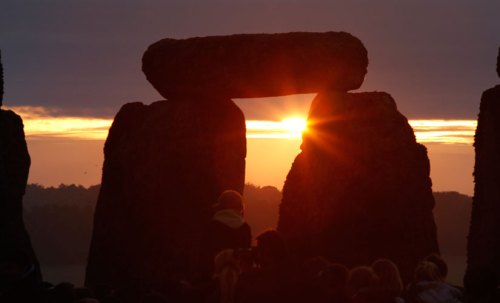 At the winter solstice our ancestors knew from studying the sky and watching the sunlight on markers of wood and stone that “when the days begin to lengthen, the cold begins to strengthen.” My father, a dairy farmer, used to repeat the old saying around this time of year with a kind of grim satisfaction. More frozen pipes in the barn, more days the tractors would start only with difficulty, more days to chip away ice and plow snow. But when I talk with my students, mostly dwellers of suburbia and “urbia,” and learn they don’t know this or many other pieces of earth-wisdom, I realize again that I stand as a member of a transitional generation. My parents and grandparents inherited much of the lore and skill of our agricultural past, and have passed a portion of it on to me. But so many of the rising generation have lost most of it.
Anyone can have that curious sensation of “secondary memory” that outreaches one’s own lifetime, grafted on through relatives and ancestors. The only grandmother I knew well was born in 1894, and so I can recall experiences that did not actually happen to me, but which — through her retelling, and with accompanying photos or other artifacts — have assumed the guise of shadowy half-memory, as if they indeed left their imprint directly on my own life and thought and perception, rather than through telling alone. But in the case of hard-earned knowledge of how to live and anticipate change and thrive on earth, they are not the incidents peculiar to one life only, but part of the lore of the tribe.
Solstice feels something like that to me. It’s the oldest pan-human holiday we can discern, predating those of particular cultures and religions by thousands of years. There’s nothing “pagan” about it — it’s a matter of observable fact, rather than belief, as are the equinoxes. Neolithic monuments and markers attest to the reach of such knowledge around the planet. An essay by scientist and author Arthur C. Clarke, the title of which has drifted out of reach of immediate recall, begins like this: “Behind every person now alive stand one hundred ghosts, for that is the ratio by which the dead outnumber the living.” The first time I read that, I felt a delicious shiver of mortality and awe. Yes, the ratio may have shifted (though I hope never to live on a world where that proportion favors the living over the dead — imagine for an instant the conditions that implies), but the image endures. And of those assembled dead, perhaps half or more knew and celebrated the solstice. For five hundred or a thousand or more generations, people acknowledged the shift of the planet in its relation to the sun. The southern hemisphere of course complements the northern in its seasons — their summer is well-launched, and now the days begin to shorten. The body knows these shifts, while the mind may take its own interval to catch up. We feel such changes in our bones, on our skin. In a couple of weeks, by mid-January, the change shows more clearly. Morning and evening commuters will enjoy more light, and the year turns.
Another of the keys, then, to connect to my previous post on a Religious Operating System, is lore itself: the knowledge of cycles and patterns we can measure and demonstrate for ourselves. No need for the fascination and hysteria surrounding 2012 and the supposed End of the World “predicted” by the Mayan calendars. Does no one remember Y2K?! Or any of half a hundred “prophecies” of the end over the last few millenia? The Maya were simply engrossed in the measure of time, and by their reckoning one major cycle ends and another begins. Their obsession made for precise astronomical reckoning. Changes are coming, certainly. Have they ever not come?
Lore includes some dross and superstition, which can almost always be dispatched by dint of careful observation and experiment. And while some generations may forsake the wisdom which their ancestors long thought worthy of preservation, it is — eventually — recoverable. If the peak- and post-oil folks are right, we face a sharp decline in material wealth and technology powered by a rapidly diminishing supply of cheap energy, and not enough people now know how, or are prepared, to flourish as people did for most of human history: wood fires, gardens and food animals, home remedies, animal and human labor, solar and wind power on a modest scale. But little or no electricity, or any of the hundreds of devices it powers, or petroleum products and technologies. We live with a false sense of security, as if the entire West were one large gated community. All it takes is a power outage of a day or two, as happened with Hurricane Irene for so many, to cast us out of our ease and return us to the human experience of all generations until the last few. We could see the real “99%” as all those who lived before the last century and its admittedly artificial standards of material luxury and abundance for a portion of the planet. But the solstice includes those hundred ghosts and the living, all witnesses of the day that signals the return of light and hope to the world. May it bring those things to you.
/|\ /|\ /|\
The solstice for the U.S. actually takes place at 12:30 am Eastern Standard Time on Thursday 12/22. So calendars favor the majority — for all but the east coast, the Solstice is indeed today rather than early tomorrow morning.
Henge image.









 A Druid Way