One of the glories of repetition is enchantment. We can enchant ourselves into another space and place with repetition. Mindless repetition, no. But eager, delighted repetition, inviting the change, welcoming it as you sense it begin to steal over you — that’s a very different thing. Things do, after all, “come true.” Bringing feeling into it enlivens the charm, animates it with a spark of our own energy. Who after all tires of the ocean, though one wave follows another?
Verbal magic is one of the first magics we learn. Perhaps you’ve heard a child repeat a word endlessly, exploring the taste of it in the mouth, the joy in the rhythm of it. Maybe with a tuneless little tune accompanying it. And maybe, if you’re blessed (and you are), you’ve caught yourself with just such a tune on your lips, engaged in some repetitive task, or doing “nothing,” which is often a chance to do a very great something, a spelling of oneself into an Else-where and Else-when, a door opening to wonder.
/|\ /|\ /|\
Now feel the change when you read these next words. You’ve heard them, some version of them, maybe said them to yourself or another, even in jest. Bitter words we hear far too often. Loser. Nobody. Waste of space. And “Life’s a bitch and then you die.” Some variation of this very evil charm that drags on people’s vision of themselves and their world and steals away possibility. Verbal magic, alas (and also thank the powers), is very real.
/|\ /|\ /|\
Now that you’ve had a small glimpse of the two magics contrasted (which is really the same magic, used for uplifting and destructive purposes), let me offer a restorative charm that deserves loving repetition. A charm for transforming the “I.” A spell to memorize, to whisper to oneself at need. A blessing to say over your children each night as they fall asleep. A charm to recite gazing into the eyes of an animal or human you love and who loves you. A charm to recite at dawn or sunset, the light looking into us and saying its silent word. A charm to remember what the ecstatic I is made of, a charm for the music that is the awen vibrating in us all:
I am the luck of every joy,
I am the light of the sun’s beams,
I am the door of lordly welcome,
I am the pole star of guidance,
I am the step of the deer on the height,
Mine is the step of the white-faced mare,
Mine is the grace of the swimming swan,
I am the jewel in each mystery.
Nine waves around me,
Nine winds above me,
Nine paths within me,
Nine fires about me,
Nine wells beneath me,
Nine wisdoms given me,
Nine gifts bestowed on me,
Nine skills awoken within me,
Ninefold the blessing in either hand.*
/|\ /|\ /|\
*adapted from Matthews, Caitlin. A Celtic Devotional. Gloucester, MA: Fair Winds Press, 2004, pgs. 138-139.
In a 15 Feb 2008 post “Taboo Your Words,” Eliezer Yudkowsky writes:
The illusion of unity across religions can be dispelled by making the term “God” taboo, and asking them to say what it is they believe in; or making the word “faith” taboo, and asking them why they believe it … When you find yourself in philosophical difficulties, the first line of defense is not to define your problematic terms, but to see whether you can think without using those terms at all. Or any of their short synonyms. And be careful not to let yourself invent a new word to use instead. Describe outward observables and interior mechanisms; don’t use a single handle, whatever that handle may be.
There’s a truly breathtaking number of assumptions I could examine in this short excerpt. To name only a few: that any unity across religions is or isn’t an “illusion”; that any such unity hinges on either “God” or belief; that the only acceptable kinds of evidence are “outward observables and interior mechanisms”; that arguments or philosophical defenses establish truth; and that language, let alone philosophical discussion, is even possible without “handles,” which is what all words are. (In the beginning was the Word …)
But let’s set those issues aside — because we can. I recommend taking on this challenge for what it can teach you. Take an hour and get down in words what it is you actually believe, and why. Whatever else is calling to you online, including this blog, can wait.
For Druids, the word to make temporarily taboo is definitely “nature.”
After all, we use it as shorthand for an enormous range of referents: an object of our reverence; a source of our metaphors; the set of patterns, relationships and movements of energies that we claim accounts for all life, including the workings of human consciousness; the antithesis to human excess and imbalance, often symbolized by urban blight; a kind of deity or pantheon of deities; a characteristic quality that is the opposite of the word “artificial”; everything that exists, including those human activities that produce counter-currents and eddies in its ever-flowing stream; an impersonal force or being, and so on.
So I’ll take on Yudkowsky’s challenge: what is it that I believe, and why?
I believe that to be alive is a chance, if I take it, to be part of something vastly larger than my own body, emotions, and thoughts (or if I’ve learned any empathy, possibly also the bodies, emotions and thoughts of people I care about). These things have their place, but they are not all.
I believe this because when I pay attention to the plants and animals, air, sky, water and the whole wordless living environment in and around me, I am lifted out of the small circle of my personal concerns and into a deeper kinship I want to celebrate. I discover this sense of connection and relationship is itself celebration. Because of these experiences, I believe further that if I focus only on my own body, emotions, and thoughts, I’ve missed most of my life and its possibilities. Ecstasy is ec-stasis, standing outside. Ecstatic experiences lift us out of the narrowness of the life that advertisers tell us should be our focus and into a world of beauty and harmony and wisdom.
I believe likewise that the physicality of this world is something to learn deeply from. The most physical experiences we know, eating and hurting, being ill and making love, dying and being born, all root us in our bodies and focus our attention on now. They take us to wordless places where we know beyond language. Even to witness these things can be a great teacher.
I believe in other worlds than this one because, like all of us, I’ve been in them, in dream, reverie, imagination and memory, to name only a few altered states. I believe that our ability to live and love and die and return to many worlds is what keeps us sane, and that the truly insane are those who insist this world is the only one, that imagination is dangerous, metaphor is diabolical, dream is delusion, memory is mistaken, and love? — love, they tell us, is merely a matter of chemical responses.
I believe that humans, like all things, are souls and have bodies, not the other way around — that the whole universe is animate, that all things vibrate and pulse with energy, as science is just beginning to discover, and that we are (or can be) at home everywhere because we are a part of all that is.
I believe these things because human consciousness, like the human body, is marvelously equipped for living in this universe, because of all its amazing capacities that we can see working themselves out for bad and good in headlines and history. In art and music and literature, in the deceptions and clarities, cruelties and compassions we practice on ourselves and each other, we test and try out our power.
Some three weeks away, now, there’s a Full Moon on Christmas Day, at 6:11 am, Eastern Standard Time (U.S.). It will set less than an hour later where I live, so I won’t obsess over exact astronomical details or feel any need to rouse myself on a dark winter morning to witness it, but instead enjoy it the evenings before and after.
The Solstice, however, is different, and merits a different welcome. While I’m not sure I’ll keep the traditional night-long vigil through the longest night to greet the dawn, I will be up late, laying one last charge of wood in the woodstove, and contemplating the coming new year. And the afternoon before and after I’ll take part in a Solstice ritual in two different towns.
Why? Do the seasonal festivals really matter?
Yes, this is a pile of sticks and small branches in an old orchard and pasture near where I live. You can see the long shadows of the tree-trunks — it’s late afternoon in November, a week ago. The owner cut a dying tree from the treeline that stands to the left, outside the picture. He’s already chopped, split and picked up the firewood, and gathered the remainder here.
Is it useful? No. It’s just brush. Burn it or dump it in a gully.
Is it useful? Yes. It’s kindling for a whole winter, and twigs for wreathes and crafts.
Is it useful? Who knows? That depends on how someone uses it.
Sometimes I find you have to ask the same question at least three times to get enough answers to work with.
Follow through on each answer and you get a different outcome. Is one of them the “right” answer? Who is asking?
/|\ /|\ /|\
One of the suggestions for solitary celebration of the Winter Solstice that I’ve adapted and adopted from OBOD is this simple rite:
On the longest night, go through the house and turn off all lights. Spend time feeling and acknowledging the darkness. Then light a single candle, and go from room to room, lighting a candle in each one. Say what feels right for you to say.
[This is an early version of what is becoming a page on Ritual, a link from the header menu above.]
From small rituals like shaking hands vs. bowing, or saying your culture’s equivalents of “please” and “thank you,” to family traditions at the holidays, and outward to public ceremonies like reunions, annual festivals, weddings, funerals, ship-launchings, inaugurations, dedications, etc., ritual pervades all human cultures.
Even animals exhibit ritualized behavior, if we count courtship displays, and dominance/submission behavior in pack and herd animals. What is instinctive in animals becomes conscious among humans, and though anthropologists and psychologists have developed a range of explanatory theories, none captures all the richness, variety and potential power of ritual.
Whenever I catch myself thinking “empty ritual,” I realize I’m what’s missing. Ritual is simply a form, like a recipe or dance move or martial arts kata. And like a kata, it’s “a routine or pattern of behavior that is practiced to various levels of mastery,” as the Wikipedia entry for kata puts it.
So if my heart isn’t in it, if the pattern-making doesn’t hold my attention, if it doesn’t carry significance to me, it will naturally feel empty to me — because I haven’t filled it with my dedication, my energy and imagination, my preparation, my sense of participating in something larger than myself. The essential component is me. If we want meaningful rituals, it’s up to us to create them.
Families and friends develop rituals to celebrate their relationship — you may have our own examples of a favorite gathering-place, in-group slang and allusions to past shared events opaque to outsiders, and so on. Humans are meaning-seekers and pattern-makers. Ritual is one expression of how human consciousness works.
/|\ THE WHEEL OF THE YEAR
Ritual is simply another tool, and Druidry as an earth-centered spirituality includes the ritual celebration of the seasons. The eight-fold seasonal cycle common to Wicca and Druidry and many Pagans generally is a modern conception. It appears to be the happy result of a collaboration, or at least of mutual influence, between Gerald Gardner and Ross Nichols. In the middle of the last century they were inspired to merge the four Fire Festivals of the Celts of early February, May, August and November with the equinoxes and solstices. The names we give the holidays may vary, but roughly every six weeks you can find a festival marking the turning of the Wheel of the Year.*
Ritual can be magically simple, and needn’t take place only on one of the “Great Eights.” Ritual needs nothing more than you and your intention. You visit a favorite meadow or grove or stone outcropping, and you whisper to yourself a favorite poem, maybe even a verse — simplicity itself — like “This is my rock” by David McCord:
This is my rock
and here I run
to steal the secret of the sun;
This is my rock,
and here come I
before the night has swept the sky;
This is my rock,
this is the place
I meet the evening face to face.
/|\ /|\ /|\
*The Wheel of the Year
October 31 – November 2: Hallowe’en, Samhain/Samhuinn, All Hallows Eve, All Saints Day, All Souls Day, Todos Santos, Day of the Dead, Dia de Muertos.
December 20-22: Yule, Winter Solstice, Alban Arthan.
February 1-2: Imbolc, Oimelc, St. Brigid’s Day, Groundhog Day, Candlemas.
March 20-22: Spring Equinox, Ostara, Alban Eilir.
May 1: May Day, Beltane, Bealtainne, Walpurgis Night.
June 20-22: Summer Solstice, Midsummer, St. John’s Day, Litha, Alban Hefin.
August 1: Lughnasad/Lunasa, Lammas(tide).
September 20-22: Autumn Equinox, Alban Elfed, Mabon.
With a dramatic title like that, this post really has to deliver! But all I mean by it are the usually small ways we destroy, unmake, sabotage, undermine and discourage … ourselves.
Successful psychic attacks by others are remarkably rare. Those we work against ourselves are all too common. I can’t. I shouldn’t. I don’t. I won’t. And of course, let’s not discount the low-level psychic garbage of much contemporary media, with its insistence that it knows better than we do what the truth is about the world, its prospects, our futures in it, the roots of our safety and happiness, and so on. You can almost feel “know, dare, will, be silent” seeping out of you and spinning down the drain. “If it bleeds, it leads” may sell advertising space and draw viewers and readers, but it’s less than optimal energy to nourish ourselves with, to try to live on.
One of Best Buy’s holiday logos
The solution isn’t merely to surround ourselves with a silver shield, though that’s often a good starting visualization. Whatever comes at you that you don’t want or need reflects off and away. Such a technique works well in traffic, in public places with a stew of emotions, like airports, bus stations — and any Black Friday shopping you’re daredevil enough to attempt. You can read the mindset already in place with advertising from sources like Best Buy and AARP that proclaim “Win the Holidays.” Can we make this season any more stressful?! Yes, but we don’t have to. This too is a choice we make.
And the desire I’ve witnessed in myself and many others from time to time, to retreat, withdraw, barricade the gates, is all too hobbit-like in its naivete. “The wide world is all about you,” Gandalf reminds Frodo. “You can fence yourselves in, but you cannot for ever fence it out.” The Survivalist mentality is understandable, but wrong-headed. What to do?
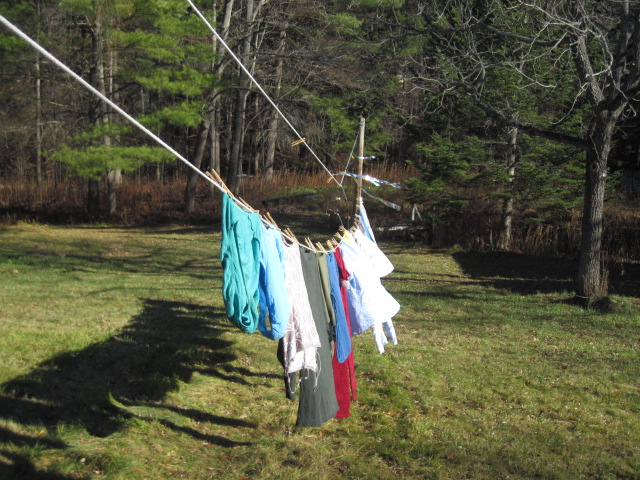
elemental laundry magic — water, earth, air, fire
Sometimes the best magic there is to practice a simple shift of attention. Instead of someone else controlling what I will think and image and focus on, I can choose, if I wish. We all surrender this power of choice much too often, and daily. Does any advertizer, for instance, really have my best interests at heart?! But love purifies the market of the heart.
One of the most soothing of day-to-day tasks for me is laundry, especially when I can hang it outdoors and it comes in later, dry and sun-spiced — for free.
Laundry?, you say, more than a little outraged, perhaps. Consider the sly admonition of the Tao Te Ching, chap. 8:
The highest good is like water. Water gives life to the ten thousand things and does not strive. It flows in places men reject and so is like the Tao. In dwelling, be close to the land. In meditation, go deep in the heart. In dealing with others, be gentle and kind. In speech, be true. In ruling, be just. In business, be competent. In action, watch the timing. No fight: No blame.
We reject what can be most helpful, because it is simple. It doesn’t appeal to our vanity, to our sense that our problems must be large and important, because we are, so we may dismiss it.
Some of these recent sunny November days have seen our backyard with laundry magic at work, bowing in a cool breeze. But even the drying racks near the woodstove work their own charm. Elemental powers, I have summoned you, and you have served me well. I thank you for your gifts of earth, water, air and fire. Both the laundry basket and my heart come away lighter, cleaner. Hail, and farewell.
Such daily magic has more power than we suspect. I smile even as I write about this, and you may too, scoffing at my innocence or simple-mindedness. But in fact simplicity can be another most potent magic. The clear, simple task, with its attainable objective, is one key to using energy well. Breaking down more complex challenges into simpler tasks is good practice, as any successful efficiency expert, organizational consultant, psychologist, trainer, businessperson, housekeeper — and magician — knows.
When we reclaim such small spaces for ourselves, we witness small successes. Of such small successes and satisfactions is a good day built, and then a week, a month, a life. I don’t need to “win” any holiday. The spaces for love and celebration are always open for us, gifts we can then give to ourselves and each other, possibilities to reclaim in the small but cumulative and thereby powerful ways that magic usually works. To end on a final Tolkienian note and paraphrase Gildor Inglorion’s words to Frodo, “Joy (like courage) is found in unlikely places.”
In the Pagan calendar the north quarter is the direction of winter and earth. We’re already both in it and going deeper. Darkness falls before it’s even 5:00 pm. I imagine my ancestors in their hut, rushlights burning. Firelight flickers on the walls, and a cauldron — a practical one, nothing magic except the daily magical tranformation of cooking — a cauldron hangs over the flames, full of stew, roots and grains and berries, and whatever meat the hunters may bring in. Despite its hardships, winter can taste umami, rich and dark and all earth-savory. Like no other season, it can return us to awareness of our mortal, imperfect, stubborn bodies.
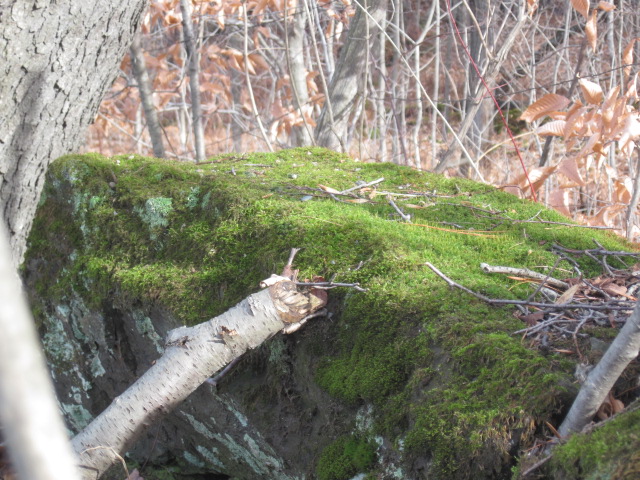
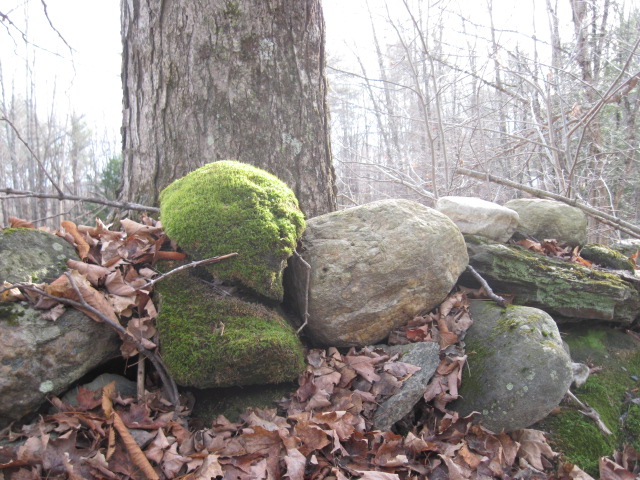
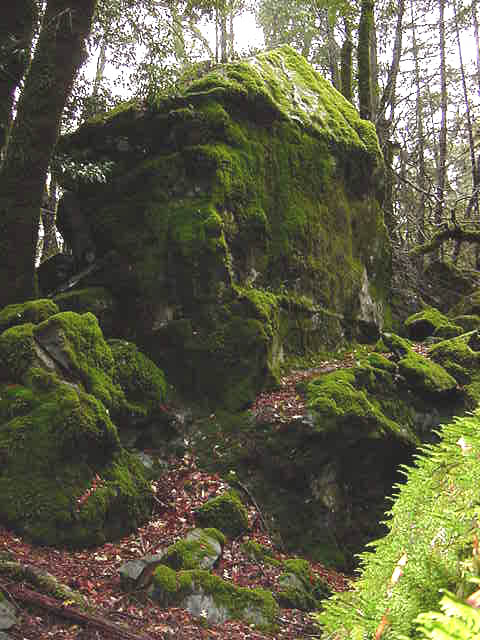
Though we haven’t yet hit the Solstice and the official start of Winter, you feel it in the temperatures as you shiver each time the door opens. You see it in the look of the mostly barren trees — and see it denied by the green mosses which apparently have no problem with these nightly hard frosts and bright chill days.
We’re here partly to witness everything. And our doings and our not-doings are also part of what we witness.
Witness. Martyr, in Greek, revealing one problem of witnessing dangerous things.
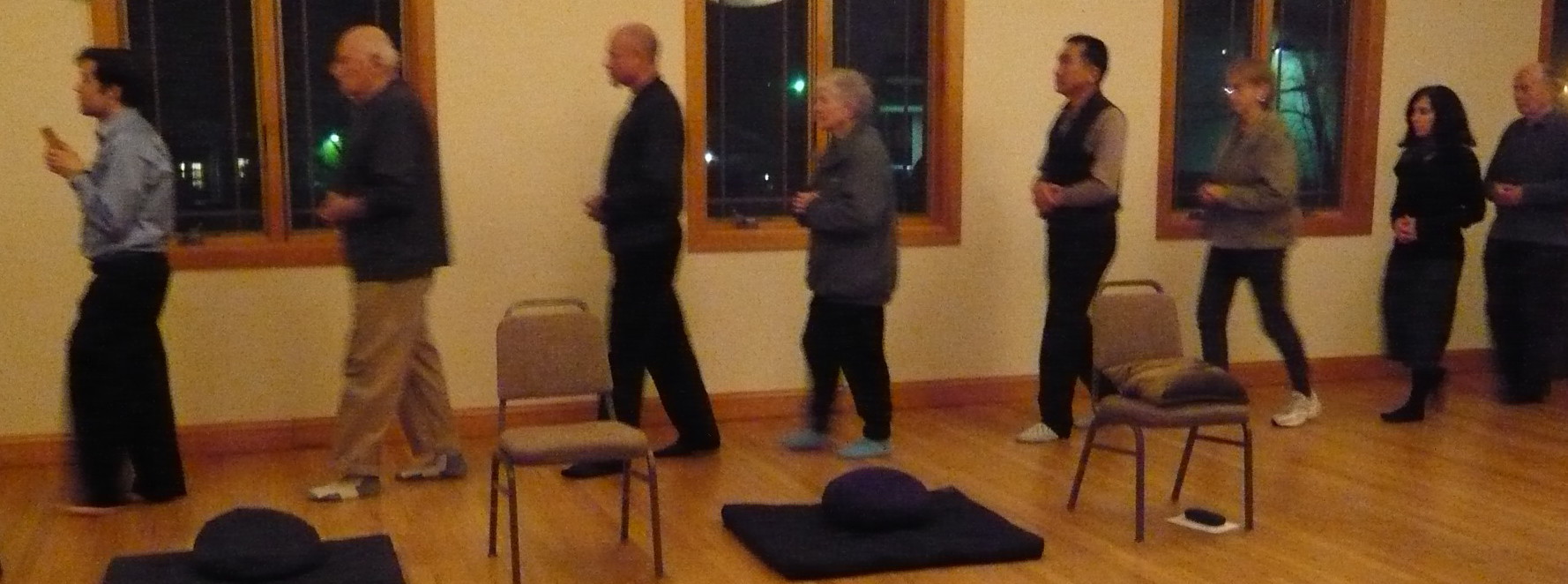
There are many safer witnessings, of course. I like Japanese Buddhist kinhin, “walking meditation,” with the literal meaning, from the Chinese it comes from (I discover, courtesy of my magical familiar, Wikipedia), of “going through like the thread in a loom.” A back-and-forth that produces a fabric, a weaving of disparate threads into a whole.
My weaver wife’s out of state visiting relatives, and I make a note to share this small discovery with her when she gets back at the end of the week. Practitioners of Zen do kinhin in alternation with periods of sitting meditation, which is what za-zen or Zen means. I encountered kinhin in Japan, and tried it a few times, the slow version, a deliberate, meditative pace. For the typical American, it can of course drive you absolutely mad — and revealing that irritation is very much part of the point.
“It’s all meditation,” I can imagine them saying, though much of the discipline is paying attention, which generally means not talking. A wonderful, terrible commentary on our whole political scene.
There’s another version of kinhin that offers a brisk almost-jog, and that’s the version I prefer, this time of year at least, to get the blood flowing and keep this middle-aged body busy enough that the mind quiets and the world joins me as a companion, rather than standing off at a distance as a mere object for thinking.
So what’s the goal of such mindfulness? Attention, the shutting down of the chatter that too often fills our heads, that gets overfed by the social media we know we’re addicted to. A balance or equilibrium with everything that feels astonishingly wonderful when we slip into it, because we mostly stand outside of it the rest of the time. Yes, to continue an image that meditators sometimes use, prolonged practice endows your awareness with a kind of fragrance you start to carry around with you the rest of the time. You can be more mindful in everything you do.
And for me there’s a key. Mindfulness by itself is another tool, not an Answer. It can help me act more effectively. Otherwise, the water flows, the sun rises and sets all by itself, good things, surely — and moss covers me, also as surely as it does a stone set in the right balance of light and moisture. Compared with the stone, moss darts across the surfaces of things, greening them and slowly grinding them into dirt. Dirt — the end result of billions of years of animal life. We all come from the Mother, and to Her we all return. Sing it, brothers and sisters!
Except that’s not the whole story. Our human capacity for doing, so fraught with bad decisions, holds immense power for whatever we choose. Mindfulness can too easily become just another addiction, a way of blissed-out watching while the majority of humans slowly murder each other and erase themselves from the planet. The earth doesn’t need saving, but we do, and the plain evidence of millennia is that nobody else is gonna do it for us.
Renunciation of my power leaves the rest with power over me. One ring, old J. R. R. Tolkien, one ring does rightfully belong to me. I”ve worn it since birth, I’ll wear it till I die. The chance to become more fully who and what I am. And what is that? That’s the walking meditation I strive to practice, that’s the trick of time and space, to figure it out for ourselves in all the years we have. Not an Answer, not a Final Solution (we know how well that worked), but a tool for living.
In the meantime, the mosses watch and (g)listen.
/|\ /|\ /|\
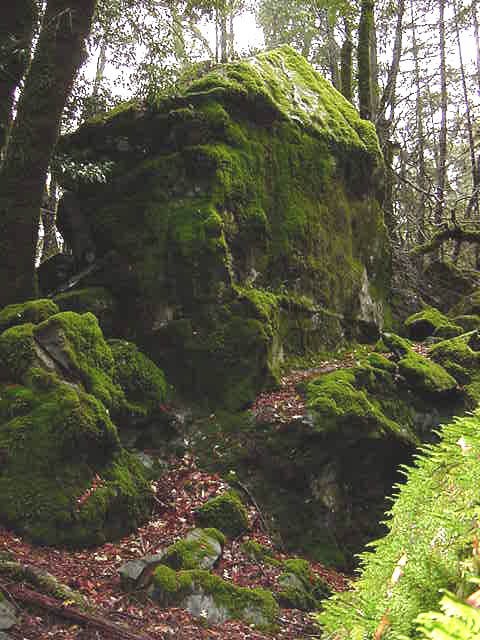
IMAGES: mosses — both shots — me, from yesterday afternoon’s walk; kinhin.
“Three reasons for supplicating the Mighty Ones: because it is a pleasure to you, because you wish to be a friend of the Wise, because your soul is immortal” — traditional.
/|\ /|\ /|\
Like many I revere Brigid. This time of year it’s easy in our house — the fire in our woodstove reminds me of one of her domains, and the lovely orange and blue flames of well-seasoned wood could wake any heart to poetry. I honor her in thought whenever I recall her, I honor her in action by lighting the fire, a daily practice this time of year. To see the wood take flame, to feel the house temperature begin to rise each morning once a good burn gets going and I can close the flue — how could these not be a pleasure, a cause for celebration?
I love that none of the usual default reasons that our monotheistic culture provides for supplication or prayer come up in this Triad: to save your soul, or to avoid hell, or to please a god or God, or to make up for some human weakness. No, the reasons here are splendidly other, and the first — the first! — is pleasure. Ask yourself, “Do I actually like the company of the Divine? If not, why spend time pretending I do? But if I do … ‘Can I have some more, please?'”
Or perhaps I don’t know either way. So why not find out? One reason to revere and honor and supplicate — lovely old word! — the Mighty Ones is find out what happens if I do.
And to be a friend of the Wise? For me that means I value wisdom, value those who aspire to it, and aspire to it myself. It’s a measure of our times that wisdom isn’t a word we hear very much. Maybe because it’s fallen out of favor. Maybe because many have abandoned it for cheaper thrills online and off. The company and friendship of the Wise! This, too, is a pleasure I hope you’ve had.
/|\ /|\ /|\
Yesterday out of a mix of nostalgia and procrastination at improving my Nanowrimo word-count, I was skimming through James Hilton’s Lost Horizon, which gave us the fabulous Shangri-La. (I first read the novel in high school, at the insistence of an English teacher who also pulled us through Hermann Hesse’s Steppenwolf. You can practically determine my age to within a few years just by those details, if you happen to follow — or yourself suffered through — trends in U.S. secondary education. You can find Hilton’s work online at Project Gutenberg Australia here.)
Hilton gives us the following wonderful exchange between Roberta Brinklow, a British missionary, one of a number of Westerners stranded in the Himalayas at the monastery of Shangri-La, and the English-speaking Chinese monk Chang, who is the principal go-between for the little band of Brits and the Tibetan natives.
“What do the lamas do?” she continued.
“They devote themselves, madam, to contemplation and to the pursuit of wisdom.”
“But that isn’t DOING anything.”
“Then, madam, they do nothing.”
“I thought as much.” She found occasion to sum up. “Well, Mr. Chang, it’s a pleasure being shown all these things, I’m sure, but you won’t convince me that a place like this does any real good. I prefer something more practical.”
“Perhaps you would like to take tea?”
I don’t know about you, but I enjoy stories that deal with the meeting of cultures and the delightful misunderstandings that inevitably result. Of course, my sympathies in this instance lie where Hilton’s also appear to — with the long-suffering Chang.
What good does wisdom do?! Oh darlin’, if you have to ask …
/|\ /|\ /|\
And the best reason of all which the Triad gives us (if like us the Celts saved the best for last)? Because we recognize the gods are our kin — because what is immortal in us answers the call of what is immortal in them.
I don’t need to have any belief about this either way (“More slackness!” as Hilton’s Miss Brinklow might have said). I can experiment instead. Am I immortal? Let’s see if I can actually get some inkling either way. Do the gods have something worth my learning, something that may touch on just this issue? Why not supplicate them and find out for myself? Could there be a connection between an experience of the divine and a greater understanding of what it is to be human?
Wherever did we begin to imagine that such questions ought to be matters of belief rather than personal experience?! As if we were asked about the taste of fresh berries and cream on the basis of our knowledge of somebody else’s report, rather than the bowl of them sitting right in front of us! Here’s a spoon. Dig in …
If I ask what? then I’m alone in a world of things, none of which says anything to me, though I may listen as long as I like. After all, why ask a thing?! Trying too hard, I can almost believe I’m just another thing myself.
But let me ask who? and then the world wakes to wonder. Atoms like me, earthed like me, kindred, sky-breathed like me this November afternoon. Yes, sparked like me, too, being here, in this place, now. Oh, let me lose no more songs that greet and open! You carry them, clouds — water too, and day gray on the hills.
/|\ /|\ /|\
If I ask who, this stone
whirling with its billion atoms
mostly empty space they say (though
touching it you’d never believe)
its presence, its jacket of moss
this stone talks, not loud
if anyone listens.
Talks to itself, hasn’t yet
heard hey! from anyone else
through a skin thick
against weatherdance and stormscrape
I believe a free hand
on its rough cool reaches,
I begin to learn its witness
slow offshear in wind and heat,
flake and shard and century chip.
Stone long alone will not yield soon
but with a palm against a sunside flank
you can feel it heed sun nonetheless
warming at the distant inquiry of light.
/|\ /|\ /|\
Who? is a song that wakes worlds. I wake you, you wake me, we rouse together singing.
The questions matter, though they’re one half of it. Mouth and ear, at the proportion of one to two, right for wisdom when the oak lets fall its hard fruit. Earth, you know. Who says so? A sapling, in a spring or two.
“Stop thinning your hair for good!” promises the spam in my inbox.
OK then, my inner imp says. I’ll start thinning my hair for evil.
/|\ /|\ /|\
Because sometimes you can just tell it’s going to be one of those days …
I depart for a job interview in a neighboring town with about 15 minutes extra time built in, and I hit a traffic delay. I’ve Google-mapped the location — twice — but when I arrive, can I find it? I cannot. I have an older cell phone, one of the flip-phones that’s so last century. I tenderly call it my “stupidphone” because I’m too cheap to pay what still seem to me exorbitant data plan rates for smartphones. When I call the number for the interviewer, what I get is the immediately recognizable beep-and-squeal of a fax line. I call the other number I have for them and the line’s busy. Some days you’re just not meant to do what you set out to do.
The god aren’t so much crazy as determined to make you pay attention to your goals. Is this really what you want? How badly will you work for it? They ask. You check in with your goals and intentions and practice and find, yes, there’s a place that needed your love and energy. Or you’ve paid it too much attention already. Sometimes I’m the thing that makes the line busy, that re-routes all traffic to dead ahead in front of me. Sometimes the universe puts up road blocks just to get me to wake up a little more to my part in it all. We can never be wholly detached, apart, because we’re each a part. No man is an island, entire of itself, sings John Donne (Meditation XVII). Each man is a piece of the continent, a part of the main. O American, proud of your illusory independence, crying in your loneliness, it never occurs to you the two are connected, and so you stand on your own two feet, oblivious to the earth beneath them holding you up.
/|\ /|\ /|\
Not that I’m allowed to stay oblivious forever.
“I want to know what love is,” sings Foreigner. “I want you to show me.” Well, I think. No use waiting around for that to happen. Love can start here, with me. Even the smallest bit can be kindling for a fire. Once lit, it surprises me how well it keeps burning. Yet by doing my part, I realize love was pouring through all the while. I just couldn’t see it until I returned it. The circuit wasn’t complete until I stepped into it. I was the missing piece. Each of us is part of a circuit, self and Spirit that is the other pole, the thing that lets self be self. We know it when the circuit’s complete, when we’re plugged in, and also how desperately we need that completion, how it feels when it’s turned off. You know what love is, the trees sing, even without their leaves. We constantly show you.
/|\ /|\ /|\
If there were a Druid agenda it would start in the silence of a November dawn. It would pour from the sky like rain or light or possibility, it would skip from leaf to stone like the chipmunk that scavenges beneath the bird feeder in the front yard, then sits up and gazes at me as long as I make no sudden movements. Sometimes beauty, truth, they’re shy creatures.
“You meet with things dying, I with things newborn,” says the old shepherd in Shakespeare’s A Winter’s Tale. Isn’t it always “Scene Three, Bohemia, a desert country near the sea”? That’s where we find ourselves, that is the tale of winter, a time of encounter with death and life on a Sunday afternoon. What, my life asked me today, is your Druidry not about? What doesn’t it touch on? Have you kept yourself from yourself, held a piece of you in reserve, not spent it all on this precious life? What is it you’re waiting for?!
/|\ /|\ /|\
“Whatever gets the words on the page is right,” says one of the pep talks Nanowrimo offers on its site for this month. Please take that out of context, says my inner imp, running with it like a mad dog with a bone. The perfect defense for pretty much anything I do wrong. Just getting the words on the page is all …
My novel this year involves a gang called the Red Fists, the Chenek Duz, incarcerated on the prison planet of Resken. A few days ago their names came through in a rush, and all in Gelem, a language I’ve invented just enough of for the story so far. The ringleader is Lodzat Moy, scarred from radiation burns and missing one eye from an assassination gone awry. With him is young and innocent-seeming Am Hezel, tech genius Dinshir Gagek, the thief Soknu Munt and the black-tempered, murderous Yar Fen. They get thrown together, through unlikely circumstances I’m struggling to make more likely, with a circle of artsy freshmen studying at the College of St. Swithins. I’m still working out the hows and whys. It’s fun to see it unfold. A kidnapping, a dream thief, a case of wrongful imprisonment, and bad love. What more could a writer ask for?
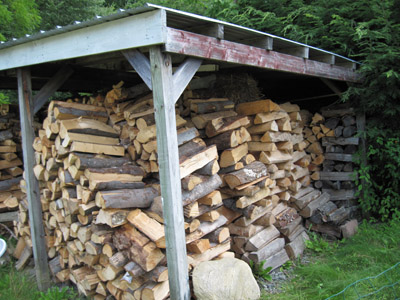
Our lean-to, with wood drying for next winter, ’16-’17.
After a long absence, Wadin Tohangu stopped by again to talk. The old Druid grinned broadly at my surprise in seeing him. Though I shouldn’t have been so surprised, I know. Usually, if I’ve been thinking about him, he appears sooner or later.
The unseasonably warm November weather in the 70s over the last few days made it a perfect time to be outdoors. I was carrying log lengths of willow to our woodpile after some trimming and pruning work by a tree service company we’d hired a few weeks ago. Willow is a soft wood and isn’t all that suitable for burning. It doesn’t provide much heat, but it can be useful to work with for other purposes. Some of it might form the edging for a new compost pile, and rot back into the earth itself.
Without any preamble, Wadin got to the point. “You’ve been doing some firming up of your understanding. I can see changes in you.”
“That’s … interesting,” I said, letting an armful of logs fall to stack later. “I feel less certain about a lot of things I thought I knew. Like what love is, and what my purpose or focus should be, for instance. You’re sure you’re not seeing doubt and uncertainty instead?”
He chuckled, and pushed a log into a firmer position between two others. “Part of deepening understanding can mean you rely less on ready verbal formulas and definitions, and in their place you turn more to any wisdom you’ve earned. It may feel less certain, because you can’t summon it in quite such a convenient mental form, or immediately rattle it off if someone asks. Do you do any cooking?”
“Um, yes,” I said, still surprised sometimes by Wadin’s quick shifts as he developed a point. “Mostly baking, actually.” I turned to walk back to the pile of fresh-cut willow lengths. The wheelbarrow I’d normally use to make quicker work of this had a flat tire. But I didn’t mind. The weather was just too splendid to miss.
“Well,” said Wadin, keeping pace beside me, “if you bake bread, for instance, you know at several points that familiarity with the process lets you make decisions about timing that you learn best by practice, not by rule.”
“True,” I said, grabbing an armful of logs. Wadin did the same. “Bread dough that’s going to rise well has a certain feel to it. And up to a point, there are tricks and back-ups you can do with a batch that’s not turning out so well.”
“But,” he said, shifting the logs into a more comfortable position, “that feeling and those tricks aren’t easy to put directly into words, even though you know them well.”
“True,” I said.
“People often treat understanding the same way. They may say, ‘I want answers,’ but they could find that a tool might be more useful to them in the end than any answer.” He dropped the logs and brushed his hands.
“Would you explain that a little more?” I asked him.
“Answers tend to have a compact form,” he replied. “Someone else has done at least part of the thinking, so when we ask a question, the answer arrives with a definite shape and size, and maybe even drags with it some definitions, or some do’s or don’t’s attached to it. It may not fit our needs and awareness. It can be like a key in a lock. Sometimes the key just doesn’t fit. Nothing turns. Even though that key may open plenty of other useful doors, it doesn’t open this one.”
“I guess I understand what you mean. So what about tools?” I picked up three more smaller logs. Wadin grabbed the last couple of strays.
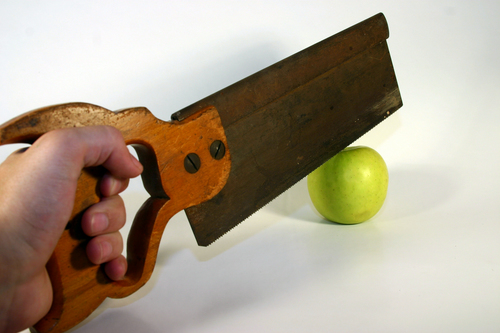
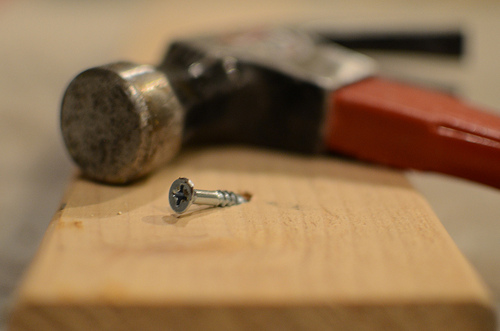
“A tool isn’t meant to provide a final conclusion,” he said. “It simply helps with a particular step, or with a set of steps. It’s part of an open-ended process. A screwdriver applies force, or rather torque, in a way that the human hand unaided cannot. It doesn’t do this by itself — a human hand must wield it. But a screwdriver allows us to open or close things with screws, or do some light prying of covers, perhaps. The screwdriver goes back in its slot (at least in a neat work-area) until you need it again.”
“O.K.” I said, thinking.
“An answer, though, often implies a close, an ending.” He dropped his armful on the pile. “A tool keeps things moving. One helpful strategy is to practice seeing all your answers as tools. There’s nothing final about them, and neither is there anything wrong with that. They’re exactly what they’re supposed to be. They just help move you to the next step you need to take. Put them away when they don’t achieve that, keep them all in good condition, and find another tool that will do what you need at that moment.”
“So you’re talking about a kind of flexibility.” I leaned against a woodshed post.
“Yes,” he said. “The same tools are generally available to everybody, but in the hands of a master craftsman, the right tool saves time, accomplishes the task smoothly, and contributes to the flow of work. The master doesn’t curse his tools, or despair when the tool he insists on using doesn’t do what he wants it to. He knows what each tool can do, just as he knows how each tool feels when he uses it. Part of his mastery is knowing from the feel of the tool in his hand whether it can accomplish what he intends.”
“And part of the joy of mastery is knowing there’s always more to learn. What would it mean, after all, if there was nothing more to aspire to? If you truly knew it all, you’d get bored. What’s the point? The beauty of mastery is its delight in always learning something new, not being discouraged by it, but inspired instead by endless possibility. Sharing what you have learned, communicating that delight simply by doing, and marveling how each person develops an individual style. All right. That’s enough for today.” He smiled and turned toward the afternoon sunlight. I blinked, and he was gone.
If I asked “Is he real?” or “Was he really here?” any answer I received probably wouldn’t be as useful as what I learned. His gift wasn’t some kind of proof that he “existed,” but simply a few more tools he left for me to work with. Answer, tool. A useful distinction. I sent out gratitude, confident it would reach its destination.
Yes — at it again. A rough draft of a novel in 30 days. 50,000 words. No, you don’t need a concept or a website like National Novel Writing Month — Nanowrimo for short — to write any time. But the sense of a community and a horde (300,000 people online qualifies as a horde in my book) of other writers madly hyped on caffeine or other stimulant of choice, all tapping and scribbling out uncensored, fervent prose, can help stir the synapses towards actually getting the words down. Think of it as one possible demonstration of Bardic arts.
“Not a problem for you — after all, you maintain this blog, right?” you say. Try 1667 words a day of fiction for a month. Not such an impossibility– serious writers often set something like that as their daily word limit every day of their writing lives. Never done something like it? It can firm your resolve or leave you in the dust. I’ve been in both places. “So how ya doin’ so far?” you ask. Well, everybody starts small. That’s an hour’s work. Onto the rest of the month!
Ah, Samhain, you’re here again. This solemn time to honor our dead and acknowledge the things that have passed from our lives. This joyous time to celebrate the harvest and the warmth of friends and loved ones to carry us through the dark half of the year. This reminder of the balance inherent in all transient things. Our work, if we choose, with the earth.
Halloween-time, to carve a pumpkin, set out the candy for the trick-or-treaters, remember to put the car in the garage the previous evening so next morning the windows aren’t all frosted over. Time for mulled cider, fallen leaves, bonfires, the possible gift of a few more mild, bright days before the snow comes. As a friend remarked yesterday, Halloween is the true start of our winter, here in the Northeastern U.S. where I live. The earth doing its thing. Earth-work.
/|\ /|\ /|\
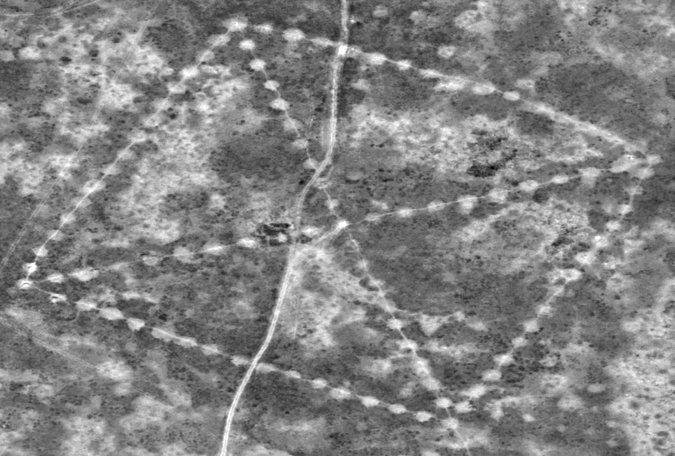
Ushtogaysky Square, Kazakhstan — immense millennia-old earthworks make headlines …
NASA photo at the New York Times link above
X marks the spot of a different kind of earth-work. (We’re always at the center.) I jump from this macrocosmic image to the microcosm of my personal work on earth. After you’ve finished groaning, come with me, to see whether whatever I can mine from it has any value for you, for this blog. Here goes …
Over the past several days a virus has been racking my joints and muscles and leaving me achy, feverish, weak. In other words, no gift to take along with me to an early Samhain celebration an OBOD friend was hosting last night. He lives “across the water” in New Hampshire, and the dozen or so folks he expected to join him included out-of-towners bringing kids and planning to sleep over. (The Samhain ritual took place later in the evening, after a typical Halloween party for the younger set).
So I stayed home instead, built up the fire, hydrated myself with tea and soups, and slept. Sometimes what we leave behind gets pried from us through mild (or great) suffering. Sometimes, of course, we can leave it more willingly. And we can try to make something of it, if there’s anything left of us in the moment, and turn to old spiritual technologies like fasting that may have slipped out of fashion but have never lost their worth.
We already fast when we refuse to accept the memes of fear and despair and business-as-usual of too much modern life. We purge. We deny some negative shard a foothold, most effectively by replacing it with a positive alternative. If you’re interested in anything, why not start where it’s actually already a part of your life? In my life, if I look around, this seems to be true of many more things than I’d ever believed possible. How many access-points and footholds and innate spiritual “flux-capacitors” (courtesy of the Back to the Future wiki) we have for almost anything we can imagine. Transform, transform, whispers the cosmos.
Many people think fasting belongs to Christianity. No meat — fish is fine! — on Fridays. Look Medieval, and maybe skeletal monks and nuns come to mind. Ascetics whipping themselves with a cat of nine tails.
There’s the Yom Kippur fast. Or, if you have a Muslim co-worker or friend, you’ve possibly heard them talk about keeping the fast for the month of Ramadan. Not to pick on Muslims, as the ubiquitous Gene Wilder memes like the one to the left would wrongly imply: anyone can be obnoxious and obvious about such practices, which is one reason they go through cycles and fall out of favor for a while. Mirror, mirror on the wall.
For about a decade I fasted once a week. This was a significant practice of the other spiritual path I follow. Like many disciplines, fasting’s less daunting after you actually do it a few times. You learn how your body reacts, how to ease into it the day before, how to come off a fast, what food and drink work best for your own particular circumstances and body chemistry and goal. Partial fast, water or juice fast, complete fast. (Ooh, you’re hardcore.)
Headaches from dehydration? Sure. Greater susceptibility to cold, since you’re not stoking the furnace several times during the day? Yep. Bad breath? Perfectly possible. Absolute joy at breaking a fast — how delicious almost any decent (or indecent) food tastes, how much the fast may have subtly reset some of your programming, how your dream recall can be improved, how an old habit may loosen its hold, how you have more faith in and less fear of your own body? Check, check, check.
A fast can be difficult, sure. But not, I usually found, because of hunger. That comes and goes, and it’s often the least challenging aspect of fasting. No, to many others besides just me, one of the truly interesting parts of a fast is what it may reveal about attitudes, attachments and mindsets that deserve a careful look. And it’s just the scrutiny they don’t usually get in the scramble to ingest the daily three squares, plus the obligatory snacking an overfed Westerner like me makes sure to practice as faithfully as any religious devotee. Food Yoga, anyone? Follow the Calorie Sutra? Junk-food Gita? The venerable Maha-salsa-and-chips? Down with that.
A physical fast also begins to open up unforeseen and potential valuable energies for other things than preparing, consuming and digesting food. Plenty of books and other resources address those advantages.
And for clarity and vision-questing around Samhain, a fast can offer one more valuable tool to those who want to look beyond the usual boundaries and curtains over our awareness.
As I’ve aged, and as accumulated physical issues make a food-fast a cause of more problems than benefits, I’ve turned more to mental fasts. (This could be one alternative to people struggling with food issues like bulimia and anorexia.) In addition to its purpose as a ritual offering, a devotion which deserves its own post, keeping the attention on a chosen object, image, mantra, deity, etc., for a twenty-four hour period drops all kinds of issues front and center stage. Lacking things to work on? Feeling like I fully qualify for Ancient Honorable Thrice-Sanctified Adeptus XI? Nothing quite like a fast to reveal my crap-of-the-day and put me in my place.
So I take inventory every hour and return, return, return the attention to its focus. Technology helps. (Got the latest fast-app?! A simple e-timer can help a lot. Try a “tasteful chime,” as one friend calls it.)
How good is my concentration? Is my chosen focus for the day even worthwhile? What is devotion, anyhow? What distracts me the most? What claims to be more important, or insists it’s a valid priority? How do I respond to others who ask why I may seem a little absent-minded or distracted today? Do I listen carefully enough to perceive who really wants to know, and who — if I tell them — may mock what they don’t understand? How much of this particular fast is just an exercise of ego or will-power, and how much is meaningful devotion?
OK, you get the idea. Illness can provide a natural push toward a mental fast. You can’t jump into your normal routine, you may find yourself in bed, and rather than relying on cable, Netflix, Hulu, net-surfing or some other drug of choice to fill every single minute you’re not moaning for sympathy, soaking in warm water to soothe your unhappy bone-house*, tossing and turning because you can’t sleep, or downing pills, extracts, roots, powders, potions or elixirs, why not use even a fraction of the time to experiment … on yourself? Best laboratory ever! No? Still not convinced?
I’m a sucker for squeezing every experience for what I can gain from it. (At least that’s what I tell myself. Some future fast will without a doubt show me where that’s no longer true, or never was.)
Meanwhile, I’m looking forward to a holiday fest this evening with some friends and neighbors. Just the four of us. A mostly veggie potluck meal, because that’s what’s come from our gardens. A short blessing (probably the one that opens my About page) in lieu of a longer ritual. And the fasting I did yesterday, imperfect, illness-prodded, leaves me grateful to today to be feeling better. No small thing.
Here for your delectation is a short Youtube clip from the 2014 Edinburgh Samhuinn Fire Festival:
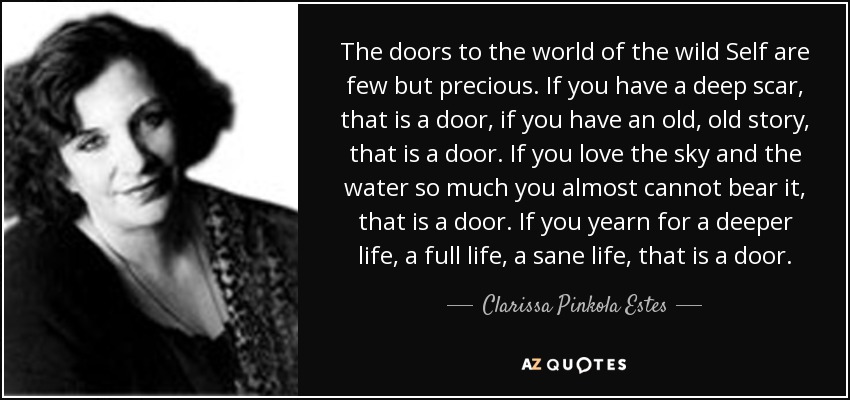
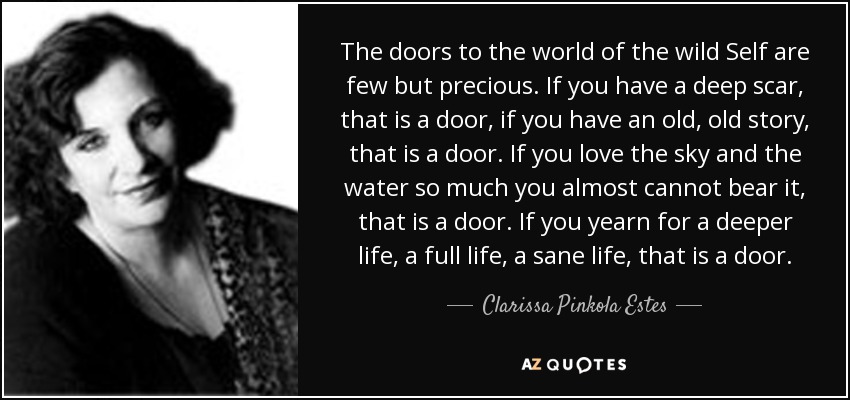
You can find out more about Clarissa Pinkola Estés here.
In part, the doors Estés refers to are a matter of human time. Live long enough and you’ll very likely wear such scars, carry such stories, cherish such loves. One way to find common ground with others is to focus on these doors. And one of the best ways to access them is by careful listening to ourselves and to each other.
Often enough, we may fear such a world and such a self as much as we yearn for it. A doorway means change. Even if it just opens onto another room, it’s not the room we were in a moment ago. Fears can outline such a door, too — including fear of a door itself. If you’re anything like me, you know or have been someone who at one time or another has walked into a cage and exulted as it clanged shut behind you, reassured that at least you wouldn’t have to walk through yet another damned door.
How to recapture the sense of the preciousness of these doors, as Estes calls it? For in the end our own longing compels us to find them and walk through. Ritual is one way, though by no means the only. By defining boundaries in ritual we can make a door easier to see and peek through. If the past is difficult country for me, I can approach it with safeguards in place. Ritual can help with its prescribed beginnings and endings, its containers of energy and wisdom we can safely draw on at need for balance and perspective and protection. A holiday like the upcoming Samhain, like Hallowe’en, a holy evening for remembering who and what has passed from our lives, offers a safe space to honor and to say farewell to what is gone. Sometimes all that is needed is for us to agree that we can finally let go.
One of the most moving Samhain celebrations I’ve ever experienced was organized by a high-school student — I’ll call her C. — who during her senior year led the Alternative Spiritualities group I advised while teaching at my former school. C. was an atheist who deeply understood the power of ritual theater. Under her leadership, our meetings often were focused discussions about perception and consciousness. Ritual, however, happened just once.
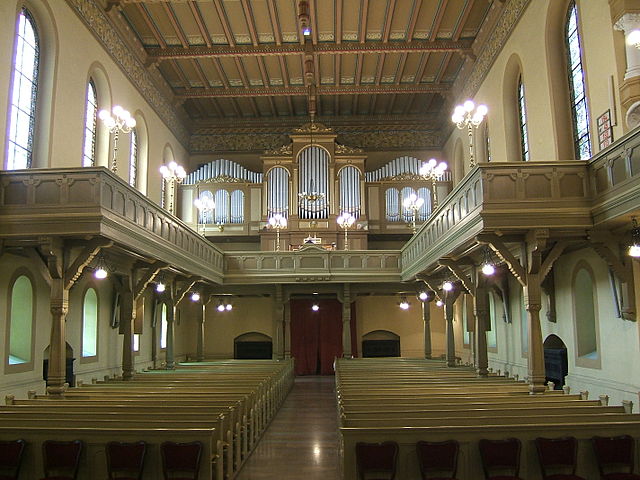
Interior of a Protestant church, looking from the altar toward the rear entrance.
Halloween fell on a Saturday that fall, as it does this weekend. Just after sundown a group of perhaps a dozen students and I gathered in our school chapel with its old, austere New England style, opened the windows — it was a mild October evening — and lit incense and candles. You take, and make, doors where you find them.
C. briefly explained what we’d be doing, then gathered us in a circle, led us in a simple chant and circle dance, and at length asked us to recall someone or something we wanted to say goodbye to. Any script C. had was entirely in her head. The ritual flowed smoothly because everyone knew its purpose and no one was worried about making mistakes. After all, you couldn’t go off-script. Both tears and laughter fit any moment of that evening.
We each wrote the name of this person or thing on a slip of paper and folded it tightly. One person collected them, and then ceremonially burnt them in a large bucket of sand in the center of our circle on the chapel floor. We chanted as the smoke rose, and I saw several students crying quietly. We cleaned up and sat on the altar steps for candy and snacks and soda, sugaring ourselves into a lighter mood. Many students said at our next meeting the following week how meaningful the experience was for them.
Reclaiming the wild self is work we’re all doing. Much of what I try to write about here is an attempt to document my journey to do just that, along with my sidesteps, mishaps, meanderings and insights along the way. We may call this spiritual objective by different names, but the deep yearning in us is the same, if we stop and talk with and listen to each other. We can if we wish walk part of the way in each other’s company.
May you find such doorways on your own journey, and may they be blessings.
When we stand in Circle (and whatever circles we stand in, we all stand in at least one circle together), we don’t all need to face the same direction to face a common center. Ritual gives us a common language.
“Trickle-out economics” is my favorite kind: not up or down, but outward — from one person to others. We let someone in line, we hold a door, we do our best, we make someone else’s path a little easier, not for thanks but because the action itself builds, because what goes around comes around, not in some strict accounting where I’ve gotta be sure I get my share, but because we all drink the water and breathe the air. The Commons may not be a very popular idea right now, but it still exists nevertheless. And it exists every day, in ways I impact with my actions right now. Include the psychic spaces we live in and it’s very large and very accessible to the influence of each of us.
Fear is rarely productive of positive action. Whatever I can do to reduce fear in my life will help me make better decisions right now. It also makes life more fun. Whether it’s cutting back on media like endless news about political disfunction that doesn’t help me live well, or turning to media like good music that does, focusing on areas and ways I can act will keep me from squandering my energy and attention worrying about what everybody else is doing and thinking. Less fear in me also calms others around me.
Anything above .300 is a commendable batting average. We don’t need to be perfect. In fact, it’s usually easier to get better when we don’t aim for perfect but for improved. Meatloaf sings that “two out of three ain’t bad” but baseball says “one out of three is already pretty good.” Most things have a rule of thumb. Life mostly consists not of bending the rules in our favor but in finding rules that actually work often enough to be useful guides.
The natural world is a pretty good teacher. Its functions and systems have been in place longer than human civilizations, so they’re honed and refined to a high degree for fulfilling their own purposes and needs. Watching birds, clouds, water, trees, bugs and beasts go about their patterns and habits and lives teaches us valuable things because we’re part of the same system, built on a similar pattern, designed to function in comparable ways. Watching nature is also some of the best therapy you can get for free. There’s a reason for that fishtank in the doctor’s or dentist’s office.
Solwom wesutai syet — “may it be for the good of the whole” in reconstructed Proto-Indo-European* — ain’t a bad mantra at all. I use it in my own practice, and it helps keep me balanced. It doesn’t always fit every particular situation, but when it does, it connects me with a human life-way that’s proved its value over millennia.
/|\ /|\ /|\
*sohl-wohm weh-soo-tie syeht. solwom — genitive plural of solwos “all, whole, entire”; wesutai — dative singular of wesuta good (abstract noun formed from wesu, su- “good”); syet — optative form of the verb esti “is” — “may it be.” “Of-all for-the-good may-it-be” — may it be for the good of all.
An excursus on tradition, culture and purpose follows. If you’re not interested and you just want to pick up the story of Gawain and his deadly appointment where the last post left off, scroll down to the first break below marked by the triple awen /|\.
You’re still here? Part of my intent in this series of posts about Arthur and Gawain is to begin examining a native source of wisdom that’s not wholly Celtic in origin. The story of Taliesin from the Welsh tradition has been fruitfully mined by many modern Druid orders. But we can also seek more widely and find fertile sources of insight, wisdom and technique within other English language traditions, demonstrating how much of our lore, Arthurian and other, truly is a marvelous mix of multi-cultural magic. And this holds true with many cultural and linguistic traditions — what we need are explorers to locate and bring these half-forgotten treasures back to wider awareness. The sense of restlessness, rootlessness and apathy that beleaguers many people today has both real causes and real solutions.
In other words, as vital and growing traditions like Wicca and Druidry already have demonstrated, we don’t need to focus our spiritual journey only on Shamballa, or join an ashram in India, or sit under a Bo tree in meditation in a quest for wisdom and enlightenment beyond the physical and financial means of most people outside those traditions. These are all fine and worthy resources — but closer ones have also always stood lurking shadow-like on the edge of our vision.
Of course, it’s not a case of either-or, but both-and. The cultural garb that wisdom occupies, and the training any one culture gives in moving within that specific garb, properly belong to that culture. Wearing that cultural garb, to continue the metaphor, when I’m not entitled to it by participation in that culture, is indeed a kind of impostership. That’s cultural (mis)appropriation.
Tlingit totem and community house
But the wisdom which the cultural garb clothes is the common inheritance of all of humanity. I can’t rightly erect a Tlingit totem in my living room or front yard, to cite a single example, and claim to be a Tlingit shaman empowered to pass on Tlingit cultural forms to cash-flush weekenders looking for a quick psychological pick-me-up in a workshop — or even a serious course of study. But shamanism itself is a worldwide phenomenon with common features across cultures, and it can be learned without raiding anyone’s cultural heritage.
And so stories like Sir Gawain and the Green Knight offer immediate hints of ways that Druidic and Christian themes, images, precepts and practices may be fruitfully explored and adapted to modern life without injury to or theft from either tradition. Even questions like “But can you be both Christian and Druid?” are found to dissolve in actual practice, when each way illuminates the other. It’s typically those on the outside of a practice who ask that question, after all. We’d rather justify our opinions to others than genuinely test their validity for ourselves.
It betrays an unseemly and groundless fear of a universe permeated with the divine, if we shy from investigating any of its corners and crannies. Certainly such fears have no place in modern Paganism, nor should they find any home in Christianity either. For the latter tradition, to put the matter in explicit Christian and Biblical language, such fears betray a painful lack of faith in an all-powerful God who declared his original creation “good,” whose Son incarnates out of love of that creation in order to redeem all things, and whose divine will is sovereign.
The fact that whole traditions like Christianity have become toxic for many people is actually a most helpful guide when we come to look at Celtic Christianity, and particularly at movements like the Gnostic Celtic Church, which gently points out that the practice of sacramental nature spirituality “can be pursued apart from the various pathologies of political religion” (article at GCC link above) and serve all life, not just an in-group.
Beyond such immediate hints, then, deeper study, practice and contemplation of stories like Sir Gawain and the Green Knight reveal a wealth of images, lessons, techniques and perspectives useful not just to “those on a spiritual path” but to anyone alive today.
All right — back to our regularly scheduled program.
/|\ /|\ /|\
Over the next three days at Bertilak’s Castle, Dec. 29th, 30th and 31st, Gawain faces a perfect triad of temptation, reward and opportunity. It’s just hard for him (and us) to tell which is which. On each of the three days Bertilak returns from the hunt, he has different game to offer his guest, and though his wife plays the same game of flirtation with Gawain while her lord is away, she skilfully ratchets up the sexual tension each time. She speaks:
And right here you lie. And we are left all alone,
with my husband and his huntsman away in the hills
and the servants snoring and my maids asleep
and the door to this bedroom barred with a bolt.
She should know — she’s the one who barred it behind her!
I have in my house an honored guest
so I’ll take my time; I’ll be talking to him for a while.
You’re free to have my all,
do with me what you will.
I’ll come just as you call
and swear to serve your will.
(Armitage translation, pg. 103)
The Middle English of those last four lines is even more explicit: ” Ye ar(e) welcum to my cors (body)”!
The delicate challenge of the situation, as the original audience to this poem knew well, is one founded in the Medieval traditions of Courtly Love: if Gawain is to uphold his reputation and preserve both his own honor and the Lady’s, he must do what she asks, while at the same time not giving in to the temptation she clearly offers him.
Toward the end, before they negotiate things to just a kiss, she even scolds him: you can’t be the famous Gawain, she exclaims, or you would have acted long before now and taken what I offered.
Well, then, he replies, “I schal kysse at your comaundement … so pleade it no more.” Thus he succeeds this first time in walking a very fine line. His good name and the Lady’s still secure, he bounds up from bed, dresses and dashes off to Mass.
Immediately the scene shifts to the hunt, with explicit details over some 40 lines of the gutting, butchering and feeding of the innards to the dogs, with the dressed carcass at length hauled back to the Castle. The first day the hunters bring back deer — a haul of venison the biggest Gawain’s “seen in seven years.” And in exchange he gives Bertilak a kiss — all he’s had from the Lady. They renew their pact.
Day Two moves things along, with the hunt in pursuit of a boar this time, and the same graphic description of flaying the carcass and butchering it. “Back at the Castle” in Gawain’s chamber, the lovely Lady makes it clear to Gawain that he should take from her what he wants and what she’s already offered, and if he’s rebuffed, why then he’s certainly got the youthful strength to take by force.
But that’s not the custom in my land, replies Gawain, nor the practice for “each gift that is geven not with good wylle.” The Lady chides him again: For somebody so famous, lord, can it be you’re truly ignorant of love, or don’t know how to take full advantage of a lady who’s shown she’s interested?
But at last they bargain things down to two kisses this time, and so once again Gawain barely escapes with reputation and honor intact.
That evening, on Bertilak’s return, Gawain delivers the two kisses according to their pact, which they again renew. He resists all teasing inquiries about the how’s and who’s of the kisses.
The Lady, meanwhile, is still so intent on Gawain, “so loving … with stolen glances and secret smiles,/ that it muddled his mind and sent him half mad …” (Armitage, pg. 131). Somehow he keeps his composure — it’s a near thing — and does not turn from her rudely for his own self-preservation, but courteously engages her all evening.
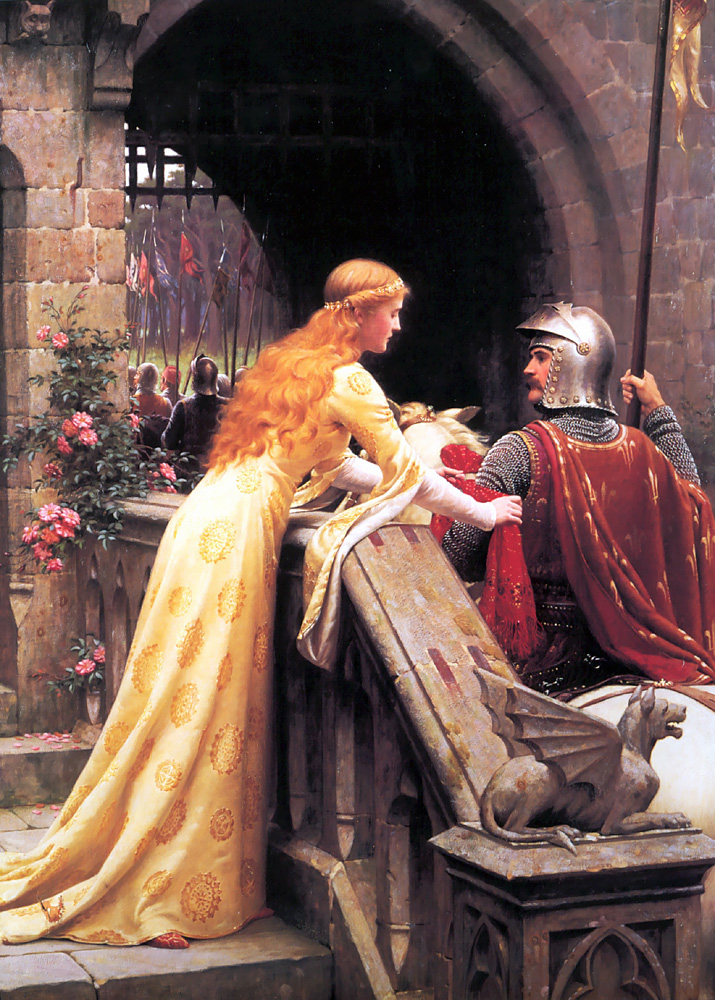
Edmund Leighton’s God Speed!
Bertilak for his part delights in his guest’s honor — so far. Gawain begs to leave early the next morning to be sure of arriving on time, but Bertilak will hear none of it. He declares to his guest: You’ll reach the Chapel well before dawn in the light of the first day of the New Year, so don’t concern yourself with that. “For I have fraysted [tested] you twice, and faythful I fynd thee. Now ‘third time throw best,’ think in the morn./ Make we merry while we may!” and they drink and at length agree to fulfill their original pact through the third day. If you’re thinking at this point that Bertilak has a pretty good idea what goes on at home while he’s out on his winter hunts — well, you’re not wrong!
It’s Day Three, the third hunt takes Bertilak and company off on the trail of a fox, and we know from prior experience with threes and with past stories that this third time will be the true test.
And so it is. The Lady certainly pulls out all the stops. The next morning she arrives at Gawain’s chamber scantily clothed, her shoulders and back both bare, the cut of her shimmering robe scarcely covering her breasts, clusters of tiny gems sparkling in the tresses of her hair. As before, she bars the door from inside, and in Gawain “a passionate heat takes hold in his heart” (Armitage, pg. 137). The Lady lowers herself onto him and kisses him, and when he doesn’t take things further, berates him for not loving her now that things have gone so far between them. “Telle me that now trwely,” she insists: there must be somebody else. Another lady, perhaps?
No! says Gawain. No one!
“That is a worde,” answers the Lady, “that worst is of alle.” You reject me for no other reason than myself. But surely then you have some gift, some token to give me, to ease the ache of memory when I recall you and our meeting?
Alas, Gawain replies, on this journey I brought nothing to such an unknown land that would serve. The best I could do would be one of my gloves.
Well, says the lovely Lady, “though I have naught of yours, yet shall you have of mine.”
First she offers a ring, which he refuses. And then a green silk girdle, which he treats likewise — until she reveals something of its worth:
“And now he sends back my silk,” the lady responded,
“so simple in itself, or so it appears,
so little and unlikely, worth nothing, or less.”
But if he only knew its value: “the body which keeps it
buckled robustly around him,
will be safe against those who seek to strike him
against any trickery in the world.
Gawain finally relents at that, hoping, we understand, to up his chances at surviving the axe-blow tomorrow. Then tell my lord nothing, the Lady entreats him. Gawain consents to this as well, and
His thanks are heartfelt then.
No sooner can he say
how much it matters, when
three kisses come his way.
(Armitage, pgs. 144-5)
Bertilak returns, receives from Gawain the three kisses (and nothing else), and laments he has only a stinking fox-hide to offer in return. They feast and drink again, the lord celebrates Gawain’s perfect gift of three kisses, agrees to offer him a guide to the Chapel in the morning, and they part to their bed-chambers.
The Medieval poet closes this third of four “fitts” or sections of his poem like this:
If Gawain sleeps soundly or not, I can’t say.
For he had muche in the morn to mind, if he would, in thought.
Let him lie there stille,
he has near what he sought;
If you will a while be stylle,
I schall telle you how they wrought.

 One of the glories of repetition is enchantment. We can enchant ourselves into another space and place with repetition. Mindless repetition, no. But eager, delighted repetition, inviting the change, welcoming it as you sense it begin to steal over you — that’s a very different thing. Things do, after all, “come true.” Bringing feeling into it enlivens the charm, animates it with a spark of our own energy. Who after all tires of the ocean, though one wave follows another?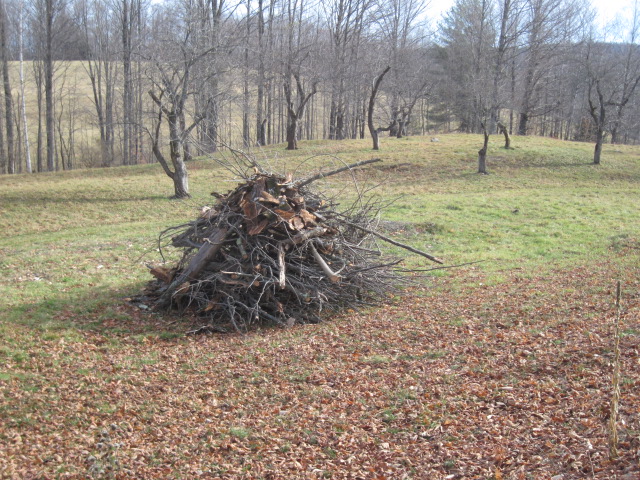











 A Druid Way