“Now, my daughters and sons,” said the old woman, “because all things in this world dance with their opposites, and the Bright is the left hand of the Dark, it is meet that I, who am old and may not live to see the end of the next winter, should be the one who tells you of the Order of the Black Awen, Urdd Awen Ddu.”
She paused, and seeing her shiver I drew the blanket more closely around her. There was just a handful of us still gathered round the fire. Her words might have seemed overblown or contrived at any other time. But the fire and the evening and the mead had each done their work. We were ready to hear almost anything. The dew had descended a couple of hours ago, but the night chill only now was lapping at our skin. Dragon built up the fire again, and raked the coals together so the new logs would kindle sooner. The old woman smiled at us and continued.
“I give the Order its Welsh name, too, because it offers a valuable lesson. Taken apart from its meaning, the sound of it is lovely: oorth ah-wen thoo.* And so too its birth. All things carry in their breasts a spark of the Imperishable Flame at the heart of the world, the breath of the Formless. Anciently the Wise of the East knew this, and the Sage of the Way wrote in his book, ‘From the One comes Two; from the Two, Three; and from the Three the Ten Thousand Things.’ Without that balance, chaos follows. We might even welcome the appearance of the counterpart, the opposite, in a way, without doubting it will cost us dearly when we face it, as we eventually must. But it is the third of the Three that issue from the One which we will turn to for our way forward.”
She spoke now quite deliberately, not expecting questions as she had earlier, when a lot of good-natured banter enlivened the fire circle, and anyone who held forth and pontificated, never mind the subject, soon had to give it up and relearn if necessary the arts of true conversation, of actual give and take, rather than expecting a reverent silence from the rest of us. That earlier hour also saw the old woman depart for a nap after a brief appearance, so that she would be fresh for later. Which was now. And now we wanted her to hold forth, because she had something of considerable value to share with us, and because what she said was new to us. The singing and drinking carried us here, where we needed to listen. Night had shaped this place and space. So we were quite content mostly to listen and ponder her words.
Questions, however, bothered her not at all, and she sat at her ease when we occasionally asked them. Earlier she asked a good few of her own, though her hearing sometimes played tricks on her. Someone inquired where she had first encountered this Order, and this led to a sad but funny story that must keep for another time. Though she must have been in her late nineties and stooped, and the age-spotted skin of her hands slid loosely over her bones, her thought darted swift and sure, and her gaze out of eyes filmy with cataracts was nonetheless keen.
“Now this Order, dedicated as it is to things we must oppose who cherish the balance, comes into existence because we exist. Each thing calls forth its companion, its counterpart, and Dark is ever the companion and counterpart of Bright. It is a peculiar and perilous folly of these days to suppose we can all ‘just get along.’ We cannot. The world simmers always, and sometimes, as it must, it spills over into open conflict. When a Dark Order forms, the action of the Light has made some advance, yes, but it also stands in peril for that reason. The cause of the Light (or the Dark, for all that) is no mere cliche or child’s fantasy, and such a challenge from the Dark, one that claims and divides the awen, is one that we must answer.”
/|\ /|\ /|\
*the th of this respelling of the sound dd in Welsh urdd and ddu is voiced, as in English this, them, not as in thick, thin.
A brief triad from a weekend workshop on spiritual possibility and growth: “Wait, listen, don’t run away”. The breakout group that came up with this piece of wisdom laughed when it emerged, recognizing themselves in it. My impatience, obliviousness and fear sabotage so many spiritual gifts before I can even receive them. I resist the very opportunity I’ve asked for, or turn — run — away from it. Maybe it arrives decked out in dirty clothes — one whiff and I wrinkle my nose in disgust. Or it slinks in all shifty-eyed and lurky, then lounges at the bar, hitting on attractive patrons of both genders, when I expected elegance, grace, tact, self-restraint. Or — just to reveal how contrary I’ve become — it clearly exudes all those things and I’m bored already, longing for excitement, surprise, mystery. But if I can’t even recognize what I asked for when it lands on my doorstep, how can I receive it and work with it?
“Wait, listen, don’t run away” (WLDRA) counsels me that human time is just a subset of a larger cycle. A different pace might open doors — or let me see those already open before I speed past. Or if I really have to keep moving, let me at least pay attention. Salamander in a vernal pool today, creeping toward a patch of sun. Wait and listen on a day like today “when the world is mud-luscious” as e e cummings describes it in his poem “in Just-.” It gets easier, when the world begins to answer that patience. Not always. Just enough to keep me trying. Enough that surprise can still fill me like sap. I feel it all up and down my nerves and joints and sinews, sticky-sweet.
“Don’t run away (yet).” Sometimes it’s not fear that shoves me off, but a weariness with the same-old that drives me out of doors and away. And one second later, after my back is turned and I’m off to the next new thing, there it stands behind me, a little breathless, waiting — like I could have been — partner, companion, familiar other, element of the universe just my size, carved out of the vast flows of energy by my need and calling. And do I welcome it? Do I even see it at all? Ah, friend of so many missed chances yourself, you know the answer. I do not. But I could. Can, the next time. “Wait, listen, don’t run away.”
(Bard-crazy, I play with that abbreviation WLDRA. Trying to pronounce it, it comes out wooldruh, almost like wuldor, the Old English word for “glory.” Wuldra gehwa “each of (the) glories” — and I’m off in words. Conjure them and they will appear. The word, the thing it names. If I wait, listen, and manage, this time, to stay put long enough to witness and welcome and wonder at what comes.)
As someone who has been pretty lost traveling off the map and will be lost again, I feel it’s a personal obligation to leave signposts, even if they’re only helpful to a small few people.
As an outsider to the major druid orders I do get a wee bit angry by those in the know only sharing to those who are paid up or part of a clique when perhaps their words could have helped us lost ones.
But perhaps if I’d had their guidance I wouldn’t have found my god in the mist…
As often happens, I’m indebted to a reader for an idea, and sometimes — like this time — a title, too. Thanks, Lorna.
I must say at the outset that I don’t know Lorna’s experience. And, partly, our ignorance of others’ experiences is what this post starts to address. I’m merely thinking with the words and impressions her comment gives me.
The courage to travel off what maps there are comes hard-won. Sometimes we may get dropped there seemingly by chance. Other times we manage to end up there all by our ourselves, out of sheer defiance of the boundary-keepers, or at the bidding of a deity, or through a kind of blessed carelessness that makes us miss the signs that might have saved us a wrong turn off the trail and the adventure before us. The familiar falls away, and like those medieval maps casually warn, the terrain (physical is spiritual, and vice versa) fairly shouts that “here be dragons.” No one returns unchanged, though it can cost a deal of trouble to convey to another person a glimpse of what happened or what the change consists of. We may not yet know ourselves.
Lorna notes she takes it as a personal obligation to leave signposts. Her sense that she’ll be “lost again” may have something to do with it. In a truly trackless realm, one starts to understand how even a little guidance can hearten a traveler more than stumbling on a cache of food, or a chance companion welcoming you to sit by a cheery fire. No, it’s not madness or a curse or some private doom that closes in on you, its breath on your skin, its claws at your neck, though it can feel like it. But traveling where no other has set foot can teach and toughen you, though it may never allow you to take your ease on such journeys.
I wonder, too, whether someone who’s walked off the path more than once has all that much to learn from “those in the know only sharing to those who are paid up or part of a clique when perhaps their words could have helped us lost ones.” Is that sharing over-rated? Does it amount to more than what we ourselves gain by going our own way? We return with the authority of our own experiences, along with perhaps a few more cuts and gashes and scars to show for our boldness. The greater wisdom may well lie with the sojourner in the wilderness, rather than with the elder at the evening circle, the author of a classic holding forth at a reading, the Chief Druid disclosing supposedly advanced teachings in a members-only workshop. Can the most valuable teachings be shared in words?
I suspect each of us encounters such tracklessness in our own ways, and some of the most welcome aid we can offer is the simple encouragement of knowing we’re not alone in being alone. Compassionate travelers signpost as they can. But I’ll quickly concede I may never have been as lost and found as others who journey there, survive and return to recount their hardships and discoveries. In the end, perhaps we can’t know such things secondhand, only experience them firsthand. Or to speak personally, perhaps I forfeit knowing as long as I keep to the well-lit trail, the easier ascent, the way clear-cut and signposted by hardy forerunners. But for just such a reason, I can strive to honor all fellow travelers. Then, when I do turn aside from the way where the grass lies flattened from many feet passing, when I enter the cave alone, swim the cold swift river, find foot- and hand-holds on the sheer face of the mountain, I may meet without intermediary what calls to me most deeply. Initiation tracks us when we think we’re tracking something else.
As Lorna concludes, “perhaps if I’d had their guidance I wouldn’t have found my god in the mist.”
[Here’s the second half of a topic begun in the previous post.]
In the way the universe moves, as soon as I focus on health and healing, results come back from blood-work a few weeks past. The naturopath I consult phones me to share the data, and the numbers aren’t altogether positive. We agree to some diet, exercise and supplement changes, and a follow-up blood-draw in three months to see whether some of the more worrisome numbers are a blip or part of a concerning trend.
I mention this not to garner any sort of sympathy — I’ve been vague enough here I hope that’s clear — but to consider for a moment a couple of things. I use my life as material because I’m in it. I trust it’s part of our common experience, and countless experiences of feedback prove to me that, mostly, it is. (I reserve just a few quirks as my own indulgences.) From my perspective, we’re all in this life-lab together, here to try things out. I understand my own experience better than anyone else’s, and every writer can’t help but mine autobiography for material, however coy or deflective they may be about that fact when you ask.
So here goes. First, you may call it the merest coincidence that in post 14 in this series I examine health, and the next day medical tests come through, and I take it as part of a divination. The pending results were on my mind, you say, and naturally enough they emerged in a post. Nothing mysterious about it. Well, I don’t know about mystery. (That’s why they call it mystery.) But I’ve found that strikingly few things are “mere coincidence.” The dangers of over-reading such circumstances as “signs” or “spirit communications” or “meaningful data” pale in comparison to missing the opportunities for discovery, growth and change that such events offer. As an unreconstructed animist, I know that everything’s alive (especially rocks, and even more especially Vermont rocks!), everything’s affected and influenced by everything else, and everything talks constantly about it all. I like to join that conversation.
Second, I get to try out my spiritual toolkit, as soon as I remember I have one. (You shouldn’t be surprised at our capacity for ignoring resources already in our hands. We love sympathy, until it gets boring or annoying, and then we often swat it away. I loathe self-pity, and have been known to turn away well-intentioned compassion at every turn.)
I take hawk-guise and soar over the problem or challenge. Below, on the field of my life, personalities and forces and energies can stand out more clearly. As the seer of my own life, I can regroup quite literally. Who and what shall I pair or separate? What lies off the horizon that touches on this moment? What offers itself to me? Where I can I offer myself to others? If I want this clue, this cure, this healing, where I can be a part of such a cure and healing and solution for others? How can I take without giving? Yes, of course. But how I can give without taking? What circles and cycles wait for me to complete them, ones that only I can? Not because I am “special” or “gifted” or “unique,” but simply because I am. I exist, in this place, in this time. The stubbornness of the particular is a clue to meaning, as well as much else of value.
Yes, I’ll even concede that “every problem has a spiritual solution,” if we can also agree that “spiritual” may sometimes mean a warm bath, a glass of wine or mead, time and space for reflection. Sometimes it’s a bit longer than that. I turn and see it’s a whole life-project: part of the reason I seem to be here at all, one of a small set of Big Kahunas, a major theme for this incarnation. Druidry reminds me constantly that this physical world is a vital resource and a field for discovery. With all its pain and uncertainty and possibility and simple pleasure, it’s a toolkit all its own, one of astounding quality and diversity and energy. Herbs, totems, power objects, shrines, wise trees and beasts, spirits, fatigue, rest, hot and cold, the seasons, human physical contact and presence. I could devote (I feel I have devoted) many lives just to exploring these things, never mind the array of things on other levels of reality.
Salmon, Dragon, Bee, companions on the Way, I thank you for your wisdom, and through the transmutations of identity and experience, I offer some wisdom of my own.
Sometimes divination highlights what is absent. As soon as I started working with the Druid Animal Oracle, I discovered the deck lacked two cards, though two other cards had duplicates. What is the lesson of compensation here? The deck lacks the Salmon and the Water Dragon, but has two each of the Earth Dragon and the Bee. Lack and excess: an imbalance to ponder carefully.
The line that lights up for me from the reading of the missing Water Dragon is this: “It is often best for healing and wholeness to be achieved slowly.” I have been patient, I thought, since my cancer surgery and radiation, working with diet, meditation, supplements and exercise. Still more to do.
I will take the doubled Earth Dragon as a reversal, and the line I focus on here from the reading feels relevant: Somehow I am “relating in an inappropriate way to my inner reserves and potential.” The connection between this imbalance and the delay in healing feels clear.
Likewise, I will take the double Bee as an indication of reversal or imbalance, with the reading’s focus: “I am out of place, unsure of my role in the world.” Ever since leaving my old job, I’ve lacked the same degree of focus, though the move to Vermont and the more sane pace of life here have been gifts.
Finally, the missing Salmon, oldest of creatures in at least one Druid tradition, reveals a message that has been seeking me out this week from other sources: reversed effort. The Salmon returns to the place of its birth; it is “able to jump upstream not by fighting against the current, but by utilizing its knowledge of the reverse current which flows beneath the surface current.”
After sleeping on this divination tonight, I will conclude the work of the reading in tomorrow’s post.
“But wait! There’s more!” Whenever any cycle ends, it marks the beginning of another larger cycle that contains it. Time, it appears, curls back on itself, or rests inside its own loops and curves like an infinite series of Russian nesting dolls. If there’s indeed any end to cycles, no one’s seen it yet. Dragons may know, but they’re not telling. (Some suspect they may dip in and out of time at will. Dragon wisdom is well worth pursuing, but it can be a difficult teaching, this lore of fire and music at the heart of the world.)
The sweep of energies surrounding cyclical change can be confusing, and to anyone within the radius of a particular cycle, the opening of the next cycle may be obscured in the debris — physical, emotional, psychic, spiritual — of the closing one. Creation, including the destruction of the ends of the old cycle to clear the way for the new, is messy. Even the birth of the new in the midst of the old, not replacing but augmenting it, can be hard. The two things human dread most: change, and the same old thing.
Those of us outside the cycle may nod or smile knowingly, feeling even a little bit superior to it all, if the ends of the cycle don’t happen to lick our ankles or caress the napes of our necks. Ah, but then it’s our turn.
The Spring-in Winter of April ’16 in VT
The field of energies at work in the physical cosmos looks to be in rough equilibrium. That doesn’t mean stasis. Change still ripples and tears through from time to time. Yes, we face our storms and floods, earthquakes and volcanoes, and occasional meteors. And yes, they can be devastating and destructive. But overall — and life itself’s the best evidence here — the planet’s remarkably stable, and has been over very long periods of time. How else can a world be a home?
I find myself in a chair set down near a soundstage. The floodlights are off, though there’s a rather dim and diffuse glow coming from some back lighting, and there’s a bustle of stagehands as a scene change gets under way. Next to me a Druid sits at his ease in the director’s chair, sunglasses perched atop his head, flipflops dangling from his outstretched feet. In this short break in the filming he looks to be sleeping, but a moment later he opens his eyes and favors me with a wink. He leans toward me and whispers, “Avoid comparing the raw footage of your own life to other people’s highlight reels.”
J3D — “Just Three Drops” — is shorthand for the experience of Gwion Bach, the servant boy in the Welsh story who tends the cauldron of transformation for … how long? Yes, perhaps you’ve already guessed it — a year and a day. The magic brewing in the cauldron is, alas, destined for another, and Gwion is sternly charged to keep the fire carefully. Never let it die out. Always maintain a steady flame. Haul wood, carry water. Be sure the contents continue to simmer and seethe and stew as they slowly wax in power.
After Gwion faithfully tends the fire for that long, sooty and tedious year of drudgery, at last the mixture nears completion. One day the cauldron boils up, spattering a little, and three drops spill onto Gwion’s hand, burning it. Instinctively he lifts the burn to his mouth to soothe it. Voila! In that moment he imbibes the inspiration, awen, chi, spirit, elemental force meant for another, and so begins the series of transformations that will make him into Taliesin, Bard and initiatory model for many Druids and others who appreciate good wisdom teaching.
An accident? Has Gwion’s year of service led to this? Was it sheer luck, a “simple” case of being in the right place at the right time? Does blind chance govern the universe? (Why hasn’t something like this happened to ME?) Is the experience repeatable? Where’s a decent cauldron when you need one? Can I get those three drops to go? J3D caps, shirts, towels, belt-buckles on sale now! Buy 3 and save.
J3D in some ways can mislead you. “Visit us for your transformational needs. Just three drops, and you too can become a Bard-with-a-capital-B!” The ad seduces with the promise of something for almost nothing. (May the spirits preserve us from clickbait Druidry!) Such glibness leaves out the inconvenient preparation, the lengthy prologue, the awkward context, the unmentioned effort, the details of setting everything depends on. (Doesn’t it always?) It’s true: Just three drops are all you need, AFTER you’ve done everything else. They’re the tipping point, the straw that moved the camel to its next stage of camel-hood. J3D, J3D, J3D! The crowds are chanting, they’re going wild!
Curiously, J3D is a key to getting to the place and time where J3D’s the key. It’s the sine qua non, the “without which not,” the essential component, the one true thing.
Fortunately, the way the universe appears to be constructed, we can locate, if not the ultimate J3D, still very useful versions of it, tucked away in so many nooks and crannies of our lives. If I didn’t know better, I’d even suspect that the universe in its surprising efficiencies has shaped every environment for optimum benefit of the species that have adapted themselves to live there. Which means pure change and perfect intention are pretty much the same thing, depending on the local awen you’re sipping from. Paradox is the lifeblood of thinking about existence. Or as one of the Wise once put it, the opposite of an average truth may well be a falsehood. But the opposite of a profound truth is often enough another profound truth.
When the first glow is gone, the spark has dimmed, the lustre has worn off, you’re probably at the first drop. When any possibility of an end has faded from sight, when you’ve forgotten why you’re doing it and you’re going through the paces out of what feels like misplaced devotion or pure inertia, if you even have enough energy to stop and think at all, you’re likely in the neighborhood of drop 2. When you’ve given up theories, regrets, anger, hope, denial, bargaining, and grief itself, and you simply tend that fire because you’re able to tend that fire, and lost in reverie you feel a sudden burning, the third drop announces itself.
At that point the experience may well appear as three quick drops in succession, erasing any memory of the earlier drops, the practice for the final event, slog to get to that point. Or the long intervals between each drop find themselves renewed, deepened, intensified in the pain the third drop brings. Somehow, though, all that has gone before either falls away, or the pain of change is so intense it fills your whole awareness, crowding out all else, a white and scalding fire from horizon to horizon. Or in a vast hall of silence, the only sound is a whisper of the soft flesh of your hand soothed by tongue and lip. Then you know the transformation is upon you.
As one of my teachers says, “The further you go, the fewer maps are available to chart the path.”
We can start with the literal. Most spiritual teachings have intro books. Why aren’t there more written guides from people who’ve gone beyond the basics? (This is a common Pagan lament about the endless proliferation of “Paganism and Witchcraft 101” books. Along with this glut is a rival dearth of anything beyond a very select handful of titles that address the needs and lives of people who could compose their own 101 guides.)
Partly this because fewer people actually travel there, beyond the harbor, past the breakwaters and out into the open sea, and even fewer talk (or write) about it. Some practice the law of silence. The universe has a way of teaching humility. Others may make a show of invoking silence, too often to build a cloak of marketable mystery around themselves. And many more may be at something of a loss to talk of the increasingly subtle awareness and insight and discovery that comes from long practice. Add to this the passage of time and the changes in jobs, health, family obligations, marital status — “where they’re at in their lives.” But you can often sense something of the lived experience from the atmosphere such folk carry with them. Their silences can be worth more than others’ speech. Their presence can be soothing and healing. They’ve learned to serve, to give back, even if (especially if) it’s not in obvious ways. If they’re not yet recognized elders of the tribe, they’re well on their way to becoming them.
For many, their experiences are singular enough and grow out of sufficiently unique circumstances and backgrounds and preparation that it would also simply take a long time to explain to others why they now do what they do, and how they have shifted their practices and their understanding accordingly. In some sense, any comprehensible account of their paths would amount to a full spiritual biography. The tests they apply now are often different, too, from those of the past: Does it work? Does it build? Does it open rather than close? Does it foster and nourish life? Does it respect necessary cycles of change, death and rebirth? Does it answer what a god or spirit or guide requires? Does it give back?
And really, this is (mostly) as it should be. We make our paths by walking, and the farther we go, the more we walk uncharted ways. The questions themselves change as we go, we learn to turn inward for answers largely because no one stands around handing out pamphlets with anything useful to apply to our own life circumstances and understanding. One question that emerges is this: “Will we leave maps and signposts behind for others?” If someone asks to be our student or apprentice, how do we answer? And do we share what we can?
In Tolkien’s legendarium, his two trees of Valinor, Telperion and Laurelin, are silver and gold, both fruit-bearing, and the originals of the moon and sun.
/|\ /|\ /|\
Either-or? How about both-and?
/|\ /|\ /|\
The jury’s just heard the last of the testimony. The voices of the four defendants — two humans, one animal, one deity — still seem to echo in the paneled courtroom.
The DA rises slowly from his chair and approaches the jury to give them their charge before sending them off to deliberate. As he stands before them, he leans forward a little, resting his hands on the railing at the front of the jury box. At such close range, they can see shadows under his eyes. His suit is rumpled, and the once-crisp blue tie is stained and hangs loosely knotted. His trim physique looks pale, and his eyes rather glassy behind the heavy metal-framed glasses he has worn each day as this case goes forward. He speaks:
OK, folks. You’ve heard everyone involved tell their side. The facts are clear: God plants a garden in Eden, puts the man there, makes all kinds of trees grow out of the ground, good to look at and good for food. In the middle of that garden stand two trees. Let me refresh your memories here: the tree of life and the tree of the knowledge of good and evil.
The DA pauses and wipes his mouth with the back of his hand. He looks around slowly, catching many eyes. Then he resumes his summary.
God tells the man, “You’re free to eat from any tree in the garden except the tree of the knowledge of good and evil. When you eat from it, you will die.” Note that God doesn’t say “if” but “when.”
God realizes it’s not good for the man to live alone, and after a dry run with animal companions who just don’t fit the bill, he puts the man to sleep, and from him makes a woman.
The serpent says to the woman — and everyone agrees on his words — “Did God really say, ‘You must not eat from any tree in the garden’?”
The woman answers, “We may eat fruit from the trees in the garden,but God did say, ‘You must not eat fruit from the tree that is in the middle of the garden, and you must not touch it, or you will die.’” It’s here that confusion enters the record. Does Eve know which of the two trees to avoid? Or has this all-important distinction already been lost?
I know we’ve arrived at the appearance of “he said-she said,” but it’s important to note everyone still agrees what was said.
“You certainly won’t die,” the serpent says to the woman.“God knows when you eat your eyes will be opened, and you’ll be like God, knowing good and evil.” Again, “when,” not “if.” Up to this point everyone agrees on what was said.
Now the serpent claims he tried to get Eve’s attention at this point, before she moved from her spot in the middle of the Garden, staring at the Trees of Knowledge and Life, and took that famous fruity bite. His words don’t appear in any of our official transcripts, and here’s the first disagreement. But I repeat his testimony here:
“Hey, Eve. Eve! EVE! A piece of advice. Eat from the Tree of Life FIRST! The tree of LIFE!”
Again the DA pauses, rubbing his eyes and cleaning his glasses, which he prefers over contacts. This time he takes so long that the judge is just about to admonish him, when he suddenly resumes, as if startled out of a dream.
When Eve sees the fruit of the tree is good for food and good to look at, and also desirable for gaining wisdom, she takes some and eats it. My next question to you is this: how does she know these things before she eats?
Folks, to make short work of the rest of the story, which again nobody contests, God finds them. There’s an ugly episode of shirking responsibility and buck-passing to the serpent who can’t blame anybody else (though you might look again at God).
God curses the three of them, serpent, Adam and Eve. And this is my final observation to you. In spite of what we’ve heard today, neither Adam nor Eve dies for many more centuries.
Consider these things carefully, and you can only arrive at one verdict. All right, ladies and gentlemen. You’re dismissed.
/|\ /|\ /|\
But what is the verdict? Is there, can there be really only one, in spite of how we often interpret the story? A better question or at least a more Druidic one: what’s the range of possibilities?
My apologies to those of you who know this story well. I taught it in high school for a decade and a half in a “Bible as Literature” unit, and we looked at characterization, at gender, at issues of truth and specificity, and the implications of distinctions like if and when, and what the story may subversively teach below and around and in spite of what we’re traditionally told it teaches. (A small detail: as many of you also know, there’s no apple anywhere to be found.) And we looked at over-reading the story, too, which teachers are infamous for doing, and which I do here.
I’ve also manipulated the story, and added to it, for my purposes. The “if/when” distinction, however, does appear in the New International Version, which comes in for its share of criticism for instances like this, and many others.
Student atheists in my class often didn’t know the story, Jews and Christians who actually did know it (and not all did as well as they thought they did) expressed often widely disparate views on what the takeaway is or could be. It’s safe to say all our eyes were opened. If we left some discussions feeling uncomfortable, it was a useful discomfort.
Among the reasons I like this story as a Druid is that trees are mediators of such potent energies as wisdom, moral law, and life. And as the song “The Wisdom of Trees” says, “Church bells ring, and I’m glad they do, but …”
/|\ /|\ /|\
Let’s refuse to choose between wisdom and life. Like Thérèse of Lisieux, when presented with a choice, will I say “I choose all”?
“Lately I have succumbed to an old atavistic urge: the worship of trees.”
So goes the opening line to the Telling the Bees’ marvelous song “The Worship of Trees.” On the particular Youtube version below, these words come just a little after the 1-minute mark. Druids are named for their association with trees, and I can think of no better way to communicate a Druidic response to the previous post, where in one section I talked about salvation as just one religious and spiritual alternative in spiritual practice. Druidry doesn’t seek salvation so much as wisdom and connection. If this is atavism, let’s make the most of it!
“Something deep inside of me yearns to be free.” This freedom is not merely a negative “freedom-from,” but a positive “freedom-for.” What do we long to do, what wouldwe do, if we could? Unlike in “spiritual pollution” religions, in Druidry sin doesn’t eternally hold us back (though poor choices can for a time). The blessings of the natural world can heal more than we imagine. Especially when we see how large the borders of the “natural” reach, and how we and our bodies and our sciences and arts and spiritualities, our planet and solar system and galaxy, fit cozily in one small cosmic cubby.
“Lately I have touched the sublime, out of sight out of mind: the worship of trees.” It’s dangerous to state absolutes about something as fluid as Paganism or Druidry specifically, but I will nonetheless: most Druids accept the existence in some form of more than one plane of existence. Note I don’t say “believe “– it’s not a creed to recite each full moon, but an experiential awareness that the cosmos vibrates up and down a very wide range, and our human experience is only part of the bandwidth. Ecstatic experience can for a time open us to other portions of the band, and broaden our sense of its range and of what’s humanly possible too.
“Lately I have been flung into rustication: the worship of trees.” Part of the Druid experience — again, here I can generalize — is a sense of being part of something much larger than human only, something that sweeps us up in its flow and carries us with it along with everything else, in a direction that isn’t different from where we’re going anyway. It’s a harmonic of existence, and so it’s not something to fear or resist, but to study and harmonize with in our own ways, as each species does. Note that the existence of so many distinct species shows the flow needn’t extinguish individuality — it can also manifest through it. What is it in the flow that calls us with such a strong imperative? Only as humans can we deny or ignore the summons, though ultimately we’re borne along willy-nilly anyway.
“I’m too far in …”: some practices and ways of being in the world aren’t wholly “safe.” They may change you, change the environment, and have unforeseen (though not unforeseeable) consequences. John Beckett talks of “a certain forest god” he serves, Cernunnos, whose worship isn’t always comfortable or easy.
And to take things one more step, to the madness which exists in so many shapes we might say we’re all mad to a degree. We have our fixations, obsessions, relentless habits and cherished opinions. Some days it doesn’t take much to shove us a little further in one direction or another that may well land us outside what’s socially acceptable. The gods may be fine with our eccentricity. It’s other humans who get left shaking their heads — or burning down our houses and chasing us out of town. But in that madness, an ecstasy may empower you to open doors no one else can open, and you fulfill a great purpose that answers that “yearning to be free deep inside” which not just you but many feel. And like the leaves a tree drops each autumn, madness is one way to receive and transmute energy.
After all, I ask myself, would I really value a religion or spirituality that doesn’t include an edge?!
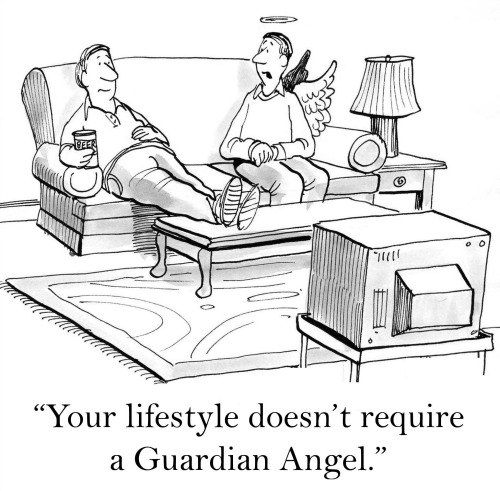
“Your Guardian Angel is trying to tell you something,” reads a spam message that’s begun showing up in one of my accounts.
Not trying hard enough, are you? my inner imp mutters.
Everything I receive today is a message from Spirit, whispers my child-Druid, blissfully in love with existence.
Hold all things and wait for them to clarify, counsels the Stoic who from time to time inhabits my head and heart.
Anyone else have anything to add? OK, all aboard, I sigh. Let’s get this bus on the road.
/|\ /|\ /|\
Mean. A funny word. As polysemy* goes, three core meanings is about par for the course. The meanings of some words like “jack” run into the double digits. And Chinese, with only a couple of hundred possible syllables to begin with, probably nears the practical limit of just how many meanings one word can bear.
So here we go with mean: “to signify or intend; cruel; average.” An unlikely triad, but such groupings can serve as one more potential tool for divination. You know: find the links and you’ve revealed another strand in the Web. Is ANYTHING really completely random? If it manifests at all, it’s automatically part of a community of other manifestations. Its voice mingles and blends with others; it both influences and is influenced by its surroundings. So here goes.
The “average” or most common meaning of life in one Buddhist view is suffering. Indifferent natural processes give birth to, nourish, reproduce, wear down, destroy and recycle all physical things. Life is often cruel. But that’s one meaning among many.
Life, goes the cliche, is what you make it. No, not entirely. Existence, several traditions say, is a network. Life will indeed respond to our intention, but we cannot** fly at will, live forever, attract our dream lover, materialize vast wealth, or vanquish our enemies, in spite of all the small-print ads to the contrary in the back of those magazines. Whatever we mean to the cosmos, it means back to us. We’re not playing solitaire but catch — with a cast of billions. There: to signify, cruel, average. And a whole lot more.
/|\ /|\ /|\
The quotation in my inbox this morning from the weekly OBOD “Inspiration for Life” email list reads: “Although the world is full of suffering, it is also full of the overcoming of it.” –Helen Keller
/|\ /|\ /|\
Fluff-bunny Pagan driving you crazy? We’ve all performed that invaluable service for others at one time or another. A love affair with the universe is something to be cherished. That said, those of us less giddy or better acquainted in any way with the Morrigan or Arawn or Ereshkigal or Osiris or any of their peers can perform an equally invaluable service by modeling how to move gracefully through life. By the gift of the gods, we can encourage others (and ourselves) to let more life in and not be daunted by a full-spectrum existence that knows that alone, neither the light nor the dark tells the whole tale.
/|\ /|\ /|\
The infinitely poignant beauty of creation is inseparable from its diabolic destructiveness. How to live in such a turbulent world with wisdom, tolerance, empathy, care and nonviolence is what saints and philosophers have struggled over the centuries to articulate. What is striking about the Buddhist approach is that rather than positing an immortal or transcendent self that is immune to the vicissitudes of the world, Buddha insisted that salvation lies in discarding such consoling fantasies and embracing the very stuff of life that will destroy you. (Stephen Batchelor. Living with the Devil, p. 10.)
I’ll examine some Druid approaches and some alternatives to “salvation” in the next post.
/|\ /|\ /|\
*polysemy: having many meanings. The second root is related to semantic, semaphore, etc.
**cannot: the trick is to choose the plane most appropriate for doing what you want to achieve. What’s hard or next to impossible on one plane can be effortless on another. A little flexibility (and some lucid dreaming) go a long way to get most people flying: according to stats, some 90% of the population reports having at least one flying dream. Add falling dreams, which are often a kind of fearful version of the flying dream, and the percentage is nearly 100. And who hasn’t jerked awake when nearly asleep? Halfway out, we come back to the body sharply enough to shake it a little.
Staring at the pecs and thighs of the gods,
stupid voyeur that I am, that immortal gloss
and sheen no tanning bed or airbrush skill can give,
or sampling on the sly from that moonshine still
where they refill their goblets, at last I think
I see them true, the outsized celebrities they’ve
always been for us: golden child, outcast, neurotic,
sex-addict, the pantheon’s drunk, slut, tyrant, monster —
the whole extended family a Jerry Springer dream finale.
But hear one speak with power, watch the mask slip,
face and form fade out to nothing like our own.
Now stone or star, volcano, cave, or lake, she or he
fires your heart or brands your brain, and you’ll
never live the same. The gods aren’t yours.
You’re theirs. Beyond wrong or right,
death, life or other toys to play with, you belong.
A (dreamily): If you call, they will respond …
B (annoyed): Who are “they” and why should I care?
A: Oh, well, uh, you don’t need to care. I was just saying …
B: Then why mention it?
And thus another chance at discovery gets shut down. Yes, of course it’s happened to me as it no doubt has to you, and more than once. But I’m more interested in how often I’ve provided this unkind service for somebody else. If in the midst of human self-pity or fatigue or temper, I can’t muster enthusiasm for another manifestation of Spirit, can I at least offer silence? (These days that can count as an invitation.) My own actions I have some control over. I’m not answerable for other people’s, thank the gods.
Fortunately, the awen does not depend on human kindness or indifference. It flows from deeper wells, and it will out. I can slow it, temporarily shunt it aside from blessing me or the local situation or the whole cosmos, but never altogether block it. The Galilean Master knew this: “I tell you, if you keep quiet the stones will cry out.”*
/|\ /|\ /|\
The call went out and I responded. In this case, for afternoon “exploratories” — informal classes in a skill or craft at a neighborhood high school, after regular classes end for the day. I jumped through the hoops of paperwork, the routine police background check, got fingerprinted (digitally), so I could then offer a six-session class on conlanging.** I even went to a school meeting a week ago to talk it up with my “Top Ten Reasons to Join the Conlang Class.”*** Now I’m waiting to see if initial interest turns into enrollments and makes the class happen. The teacher who organizes the exploratories helped: he’s a fan of conlangs himself and knows a few kids he thinks might find them “just the right amount of weird to be cool,” as he put it.
So what’s particularly Druidic about conlangs? Well, not everything has to demonstrate an immediate link to Druidry, does it? Conlanging is something this Druid does, and you’ve read this post up to this point, so stay with me. But if you think about it, language and language craft are after all domains of the Bard, and my Bardic self is always responding to the call of language and words and sound and human awareness of the cosmos as we talk and think about it.
/|\ /|\ /|\
Take the Welsh phrase from a recent post, y gwir yn erbyn y byd, and you’ve got a fine example of conlanging to work with.
(Wait, you say. Welsh is a real language. Well, so are many conlangs, if by “real” you mean that they exist and people use them to communicate and you can say anything with them that you can say in your native language. How much more “real” can anything be? If by “real” you mean they have thousands or millions of speakers, well, Welsh stands around the 500,000 speaker mark, depending on who’s counting. Many Native American languages have only a few dozen speakers left. Mere numbers are just that. Besides, as a wise one once said, some of the same minds that created all human languages are at work on conlangs. At this point, the word real starts to look less than altogether useful and more like a comment on the person who uses it.)
One of the initially daunting things about a foreign language is simply that it “looks (and sounds) foreign.” But this Welsh phrase has almost a one-for-one correspondence to English. The different words mask vast similarities that make both Welsh and English human languages, and make them learnable and usable. Here’s a word-for- word rendering of the Welsh:
y gwir yn erbyn y byd
the truth in despite (of) the world
What this means for conlangers is that surface differences are one key to conlanging.
(The “fake glasses and a moustache” school of conlanging gets a lot of mileage out of surface differences. Make your conlang too much of a cleverly disguised English, though, and conlangers will call you on merely making a relexification, which is a learned way of saying you’re just replacing word by word, rather than creating a unique language where a one-for-one translation is usually impossible. But don’t worry: many conlangers go through a fascination with relexification. Tolkien himself made a childhood relex called Nevbosh, which means New Nonsense. He and his cousins played with it and even could make limericks in it. He probably also learned a fair deal from its making.)
Welsh and English both have articles: the and y(n). They both have nouns. They make phrases in a very similar way. And sentences. Yes, Welsh and English word order differs in a few important ways. Sounds interact somewhat differently. From a conlanger’s point of view, that’s window-dressing to play with.
In English we say “just add -s to make a noun plural.” What could be simpler? So you may shake your head when you hear that Welsh forms plurals in over a dozen different ways. But consider: English “cats” adds -s. But “dogs” adds a -z, though it’s still written -s. And “houses” adds an -iz, though it’s written -es. Add in ox/oxen, wolf/wolves, sheep/sheep, curriculum/curricula, and so on, and you get a different picture. Native speakers make most of these shifts instinctively. The same happens in other languages. That’s the reason that when a child says “I goed to school” we may think it’s cute. We may correct her (or not), but if we think about it a moment, we understand that she’s mastered the rule but not yet the exception.
All hail the awen of human intelligence!
Go a little ways into conlanging, and you may discover a taste for something different from (here British English requires “to” rather than “from”) SAE — “Standard Average European.” There’s a rather dismissive word for it in the conlanging world: a “Euroclone” — a language which does things that most other European languages do. Nothing wrong with it. I’ve spent years elaborating more than one of my own. But many other options are out there to try out, in the same way that the eight notes of an octave aren’t the only way to play the available sonic space.
Take Inuit or Inuktikut. Just the feel of the names shows they inhabit a different linguistic space than English does. I-nuk-ti-kut. For a conlanger, that’s a sensuous pleasure all its own, a kind of musical and esthetic delight in the differences, the revelation of another way to configure human perception and describe this “blooming buzzing confusion” as psychologist William James characterizes a baby’s first awareness of the world. But of course that “BBC” does get converted into human language. (Language origins continue to fascinate researchers.)
In the case of Inuktikut, “… words begin with a root morpheme to which other morphemes are suffixed. The language has hundreds of distinct suffixes, in some dialects as many as 700. Fortunately for learners, the language has a highly regular morphology. Although the rules are sometimes very complicated, they do not have exceptions in the sense that English and other Indo-European languages do.” (I’ll be lifting material wholesale from the Wikipedia entry.)
Agglutinating or polysynthetic languages like Inuktikut tend to be quite long as result of adding suffix to suffix. So you get words like tusaatsiarunnanngittualuujunga “I can’t hear very well” that end up as long as whole English sentences. As the entry innocently goes on to acknowledge, “This sort of word construction is pervasive in Inuit language and makes it very unlike English.”
Tusaatsiarunnanngittualuujunga begins with theword tusaa “to hear” followed by the suffixes tsiaq “well”; junnaq “be able to”; nngit “not”; tualuu “very much” and junga “1st person singular present indicative non-specific.” The suffixes combine with sound changes to make the word/sentence Tusaatsiarunnanngittualuujunga. So if you want to create something other than English or your average Euroclone, Inuktikut is one excellent model to study for a glimpse of the range of what’s possible.
Now if this sort of thing interests you, you’re still reading. If not, you’re saying “Well, he’s just geeked out on another post. Where’s the Druidry, man?” For me, Druidry has wisdom and insight about all human activity, and can deepen human experience. I’m in it for that reason. May you find joy and wisdom as you live your days and follow your ways.
**conlanging: the making of con(structed) lang(uages). Tolkien’s one of our patron saints. You can find other posts about conlanging on this blog here. Here’s the obligatory Wikipedia entry. And here’s a link to the Language Creation Society., cofounded by David Peterson, one of the best-known conlangers working today, and creator of Dothraki, Castithan, Sondiv, and a dozen other conlangs.
***Top Ten Reasons to Join the Conlang Class
10: Languages are cool — conlangs are even cooler: Game of Thrones has Dothraki & Valyrian, Avatar has Na’vi, Star Trek has Klingon, Lord of the Rings & The Hobbit have Elvish, there’s Castithan in Defiance, Sondiv from Star-Crossed, Esperanto, Toki Pona, etc.
9: I’ve been conlanging for decades, can help you get started, gain a sense of the possibilities, & keep going after the class ends.
8. Making conlangs can help you go “inside language” (like Lewis said of Tolkien) & discover amazing things about our most powerful human tool.
7: Conlanging is one of the cheapest arts & crafts I know: all you really need is pen & paper. (Of course, a computer can help.)
6: Nerds need to stick together or our 3 big Nerd Secrets will get out — we’re all nerds in some way, nerds are cool, & nerds have more fun.
5: You’ll learn enough to participate in the international conlang community which is very active online & also in print.
4: You too can learn to say things like Klingon Tlingan Hol dajatlaH & Valyrian sikudi nopazmi & Elvish Elen sila lumen omentielvo — & more importantly, you’ll know what they actually mean.
3: You can join the Language Creation Society & create languages for others for fun & profit.
2: You can keep a secret diary or talk to friends in your conlang & no one else will know what you’re saying.
1: You’ll have your own conlang & script by the end of the last class.
The fish-pond the previous owner built on the east side of our two and a half acres skews the elemental associations I inherit from my Euro-Druidry. So I read my pond-rune for its wisdom, in spite of the dislocation. Water to the East, the pond a surrogate for the Atlantic surging beyond it a mere hundred miles further off. Be ready to shift your perspective for what it can teach you, says my Druid guide.
Over-caffeinated this morning, I’m giddy as I try out this re-orientation, going for the literal first. Widdershins and we’re off, a banishing of the old order. Air to the North, then? Because nothing halts Canadian weather from turning intermittently south to us, troubling and training our meteorologists all year long to keep humble. It fits, too, because that first warm day of spring is air breathing its promise of new life, before the earth has quite let go its permafrost. Frost-heave warning signs still mark the worst of the bumps and dips in Vermont back-roads as the ground slowly gives up winter.
the grove to the west, as the sky clears
Earth to the West, a tree-covered rise just across the road in front of our house. From time to time I build a dream-shrine there, or imagine it alive with some rite in progress, all without disturbing in the least the neighbor who actually owns the land. For three seasons the trees gather the light each day at sunset, their branches embracing orange and peach and golden afterglow, except for summer’s green crowding out all other colors.
And last to the South and Fire. Most immaterial of the elements, only you remain unchanged. I’m intrigued. The polarities work, too. Earth and Water, both traditionally feminine, face each other across the east-west axis, as do Air and Fire, traditionally masculine, across the north-south one. In fact, the realignment accords reasonably well with Mike Nichols’ article “Rethinking the Watchtowers: 13 Reasons Air Should Be in the North.” Here’s the second from his list of reasons:
PARALLEL CULTURES: Although arguing from parallel cultures may not be as convincing, it is still instructive to examine other magical aboriginal cultures in the Western hemisphere. For example, the vast majority of Native American tribes (themselves no slouches in the area of magic!) place Air in the North, which they symbolize by the Eagle. (Aboriginal cultures lying south of the equator typically have different associations, for reasons I will discuss next.)
Here’s a set of new meditations ready to hand: what follows from such a re-alignment? What new insights? What new ritual possibilities? As Druids emerge across the planet and walk their own lands, how do we adapt our practices and teachings, and what do the adaptations and changes teach us in turn? The pulse of our world is one, yes, even as each vein and artery flows with its own unique current and energy and direction, nourishing distinct organs and tissues. The metaphor’s merely another tool, and the question as always is: does it help us feel our way into accord with the spirits of the land where we dwell?
/|\ /|\ /|\
Oh earth of my bones, earth of my ancestors’ abode, earth that my feet and this house and our lives all rest on, I give thanks for breath and blood and day, the four elements in their shifting guises now complete. The fifth, Spirit Within, Spirit at the Center, hail and always welcome.
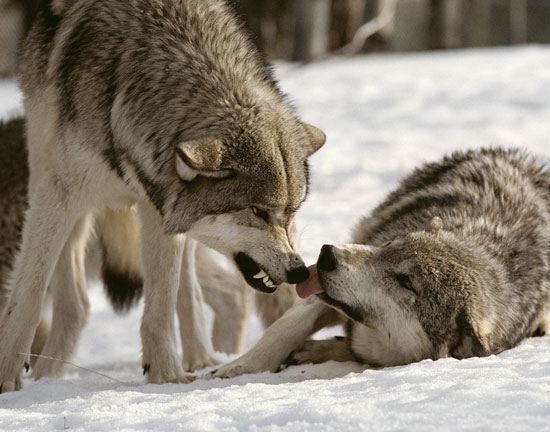
I take as my divination today an odd dream early this morning: I’m a member of a wolf pack, and my fellows have drawn me aside, possibly to be disciplined, after I am tested for truth-telling. The issue at stake, apart from truth, I don’t know. (There isn’t one?) But I feel the just authority and deserved power of my pack leader, I readily make my submission, lying flat on the ground, waiting patiently as I can, licking my chops, panting a little. At length I’m freed, though I lose the final threads of the dream and the actual issue in contention as I wake.
Who determines truth? Is it our pack? Often among social animals it’s indeed the group, for better and worse, like the words of the marriage vow, recognizing a truth about life. For submitting to a consensus is a form of contract. But such a formulation of truth results not just from others’ perceptions — a consensus averages them, bundles them together to even out the extremes, and not only may be no more accurate than my perception or yours, but may well be less.
Mere majority is no guarantor of value. “We all say so,” exclaim the Monkey People in Kipling’s Jungle Book, “and so it must be true.” Democracy, indeed, is the worst form of government — except for all the others. It’s a first approximation to that inner wisdom. Mix in other adulterating motives like the obscuring force of anger, envy, fear and so on, and the spinning moral compass still comes to rest to show that no group deserves more authority than the individual. A group may indeed have usurpedsuch authority, snapped it up if we have ceded it, or claimed it in the absence of the rightful possessor, but that’s a different matter. The point persists behind Iolo Morgannwg’s Welsh aphorism Y gwir yn erbyn y byd — “the truth against the world” — regardless of whether we claim that inner sovereignty as our birthright, or heedlessly opt to forfeit it to whoever is the latest big noise to arrive on the scene.
A part of that sovereignty, true, urges us to seek wise counsel when our own vision falters (as it will from time to time), or does not offer sufficient guidance. But the choice to seek, follow, modify or ignore that counsel remains ours alone. It seems nowadays we’ve only a loose grip at best on the good meaning of discrimination: the ability to make vital distinctions that matter. For the opposite of discrimination is not indiscriminate approval or contempt. Rather it’s an abdication. Someone else, take up my crown and sceptre! It’s too hard! But as we come to know at cost, the only thing more difficult than struggling to uphold our sovereignty is the obscene suffering and atrocious despair we face when we let it slip through our fingers. Holocaust survivor and philosopher Elie Wiesel has said it well (adjust the pronouns to fit): “It is by his freedom that a man knows himself, by his sovereignty over his own life that he measures himself.” Without sovereignty, then, how can we know or measure accurately?
I offer as exhibits 1 and 2 most major headlines today and the lived experience of anyone over 10 years old. Among other wisdom paths, Druidry rightly asserts that it’s our inner sovereignty that comes first. All else follows from the state of our inner kingdom. It’s long work, this upholding of our sovereignty. And if like me you feel the evidence points towards reincarnation, well, we keep coming back till we get it right.Some things we know are true, against whatever the world throws down to snuff it out. Otherwise, what’s the cosmos doing, if not manifesting gloriously, excessively, magnificently, every single possibility along with a consciousness, feathered, finned, furred, to engage it, turn it back onto itself, plumb its depths, endlessly forming and re-forming.
There’s a wooden chair in the Parliament House in Machynlleth, Wales, that bears those challenging words across the headpiece. For it too is a Siege Perilous, like that “perilous chair” at Arthur’s Round Table, that stands empty awaiting the one who wins through to the Grail, the seat that proves fatal, mortal, to the mortal who sits down unworthy. This life is perilous indeed — mortal — the Ancestors weren’t wrong about that in all their stories. We’re winning through, though by all appearances none of us have quite yet “won.” But we’ve come far enough, through both hardship and joy, to recognize the seat for what it is, to puzzle out the significance of the inscription there, to feel it in our bones. We’ve caught more than one glimpse of Grail in a human face, a landscape, plumbed it in the heart’s cry, caught echoes of the Grail Song, every one of us, against all the odds the world sets for us. We can even imagine sitting down eventually.
I suspect, too, that any endpoint is part of the model and not the reality it attempts to represent. It’s an asymptote, to get mathematical for a moment, if you recall that intriguing figure from school: undrawable, really — endlessly closing in on but never reaching a final point, a terminus, some ultimate destination. It’s the horizon infinitely receding. It’s the Mystery that lies behind and inside everything, the charge that impels all things. Taoists say it’s “like a well: used but never used up. It is like the eternal void: filled with infinite possibilities. It is hidden but always present. I don’t know who gave birth to it. It is older than God” (chapter 4).
/|\ /|\ /|\
Images: wolves; chair in Parliament House, Machynlleth, Wales.

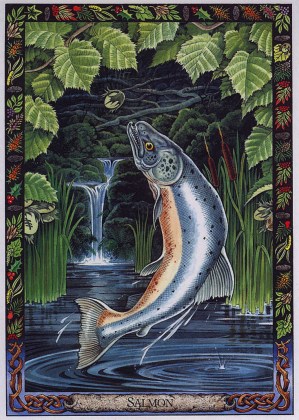 Finally, the missing Salmon, oldest of creatures in at least one Druid tradition, reveals a message that has been seeking me out this week from other sources: reversed effort. The Salmon returns to the place of its birth; it is “able to jump upstream not by fighting against the current, but by utilizing its knowledge of the reverse current which flows beneath the surface current.”
 Let’s refuse to choose between wisdom and life. Like
 The “average” or most common meaning of life in one Buddhist view is suffering. Indifferent natural processes give birth to, nourish, reproduce, wear down, destroy and recycle all physical things. Life is often cruel. But that’s one meaning among many.
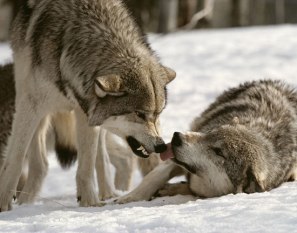 I take as my divination today an odd dream early this morning: I’m a member of a wolf pack, and my fellows have drawn me aside, possibly to be disciplined, after I am tested for truth-telling. The issue at stake, apart from truth, I don’t know. (There isn’t one?) But I feel the just authority and deserved power of my pack leader, I readily make my submission, lying flat on the ground, waiting patiently as I can, licking my chops, panting a little. At length I’m freed, though I lose the final threads of the dream and the actual issue in contention as I wake.
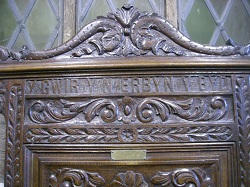 There’s a wooden chair in the Parliament House in Machynlleth, Wales, that bears those challenging words across the headpiece. For it too is a


 A Druid Way