A current article about an autistic boy denied First Communion (link to USA Today) in his family’s church raises interesting questions. The child is “100% non-verbal”, and the family’s priest says that speaking is an essential part of the ritual — participants in a First Communion must be able to say certain words as part of their preparation.
If the formof a rite is all-important, this makes sense: if you can’t access the form, the ritual benefit doesn’t accrue to you, so there’s no point in you participating.
Does Druid ritual work the same way? In many ways, and at first glance, it certainly does. While anyone who can respect a ritual space and other people in it is usually very welcome at any of the “Great Eight” seasonal rituals*, if those people are autistic, it’s true they may not be able to process — through language — all that takes place.
And a Druid group initiation typically relies even more on language: a set of questions and responses, verbal cues and directions to follow, speaking sacramental ritual words, and so on.
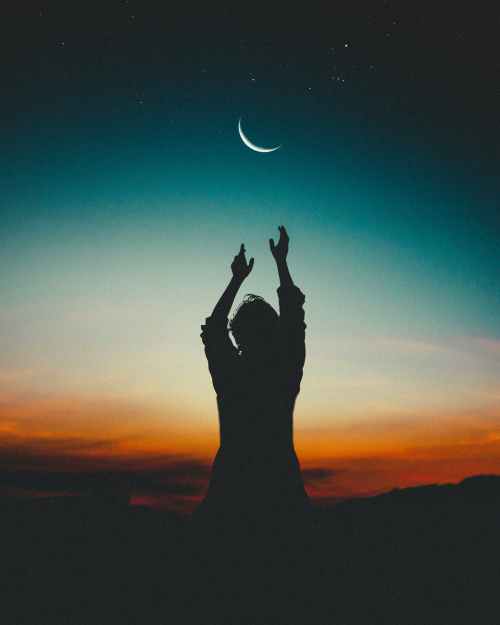
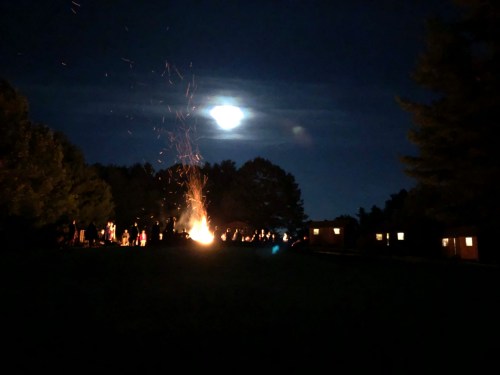
No words needed to reach for the moon …
But anyone who’s been moved non-verbally by an experience knows language is just one of many means at our disposal to experience and honor each other, access energy, manifest intent, link to spiritual presence, the sacred. People carry babies into both Christian and Pagan ritual spaces, cats and dogs often wander freely in and out of Pagan sacred circles, and small children are welcome as long they’re not disruptive.
If you’re in a sacred space and have silenced your own inner chatter enough to permit yourself some alertness to Others, you may know the presence of entities who don’t “talk” and can still communicate just fine. How many of us have heeded “nudges” and “gut feelings” to our advantage? We don’t “need” ritual to encounter the sacred: we all participate in it all the time. Life is sacrament: ritual helps to sharpen our consciousness of this spiritual fact.
Would a Druid Order or less formal Gathering “ban an autistic person from an initiation”? Instead, let’s reframe the question: how might Druids accommodate those who rely on other modes than language to access the sacred? Could we prepare them with appropriate modes of experience and instruction to participate? Could we then compose a ritual for them both to catalyze an experience and to welcome them into another state of awareness?
These questions begin to suggest their own answers. Creating “appropriate modes of experience and instruction” would most probably ask for close collaboration between a ritual designer and the families and friends of autistic people. After all, they possess crucial insight into means: they know better than anyone that the autistic person particularly likes this animal and has papered her bedroom walls with pictures of it, shows especial connection to X place, connecting to its trees and stones, has always preferred the colour Y, loves that song by Z, and so on.
Out of such things, both instruction and a “capstone” ritual can be drafted. Good ritual design means hallowing such associations, and making much of them. The personal details of our lives are already the rough material that spirit uses to reach us in a myriad of ways, and human differences like autism needn’t “make a difference” in this spiritual truth.
If we take it to heart, using the vehicle of Christian language, that the “Sabbath was made for man, and not man for the Sabbath”, we know that forms are secondary to spiritual purpose. Yes, a legalistic mindset can also quote scripture for its purpose — “For verily I say unto you, Till heaven and earth pass, one jot or one tittle** shall in no wise pass from the law, till all be fulfilled” — and we’ve seen all too often how the “jot-and-tittlers” of the world tend to latch onto power and lord it over others wherever they can.
But in the middle of where I am right now, rather than worrying over-much about what other people are doing, I can attend to my own life: how am I called today to help spirit flow into this situation, this moment, this time and place? My work is to answer that call, that question, that spiritual summons, with all the love and creativity I can muster.
/|\ /|\ /|\
*The approximate dates of the “Great Eight” seasonal rituals of the “Wheel of the Year” of much Druidry and modern Paganism:
Samhain/Hallowe’en/All Hallows, Oct. 31/Nov. 1
Yule/Winter Solstice/Alban Arthan, December 21
Imbolc/Groundhog Day/Candlemas, February 1/2
Spring Equinox/Alban Eilir/Ostara, March 21
Beltane/May Day, May 1
Summer Solstice/Litha/Alban Hefin, June 21
Lunasa/Lughnasadh/Lammas, August 1
Autumn Equinox/Mabon/Alban Elfed, September 21
**The English equivalent is “dotting your i’s and crossing your t’s”.
to get the news from poems
yet men die miserably every day
for lack
of what is found there.
OK, W. C. Williams, I’ll bite. What’s “the news”? What is it that’s “found there” in poems and songs? Is it really different — better — more necessary — than other things, found in other places? If it is, how can you — or I — trust it?
How we answer these questions (any Bards worth their salt pose difficult ones) goes far to showing us for what we are, where we find what we need, and whether any number of us are dying from a lack of it.
Wouldn’t it be great if I could — at last! — track down that skittish, reluctant poem, lasso it, corral it, hog-tie it and get it to give up its … what?
For all its seeming colloquial innocence, the poem fragment threatens to stalk mythic ground. More about that in a bit.
/|\ /|\ /|\
There’s a funny, wry essay (if you’re into actually reading things called “essays”!) called “The Arrogance of Poetry”, by Mark Halliday. (It appeared almost two decades ago now, in the Georgia Review in 2003. Here’s a Jstor link to the first page of it, where you can get a taste, and see if you want to sign in and read the rest of it for free.)
Halliday speaks a common truth: “We are romantics: we keep expecting the marvelous ___ that will change our lives. We try to ___ intelligently, even skeptically, but we are ready to fall in love”.
Fill in the blanks from your own experience. Versions, versions. It’s no surprise that Halliday’s has “poem” and “read”, but I suspect you can do better, because it’s your life we’re talking about, after all.
Right now — Sunday, a sunny afternoon in late February, my belly reasonably full of a very late breakfast of eggs and toast — I’d fill the two blanks with “insight” and “live”: “We keep expecting the marvelous insight that will change our lives. We try to live intelligently, even skeptically …”
Maybe you write “deity” and “worship”. Or perhaps for you it’s “person” and “date”, or “high” and “use”. If you’re flush with cash, it could even be “decorator” and “remodel”, or “designer” and “dress”.
/|\ /|\ /|\
Poem, song, Other, Grail. We storm the castle, only to find it empty and cold. We hold the Grail in our hands, but then fail to recognize it before we set it down and walk away. Perceval, Lancelot, Galahad. Guinevere, Elaine, Isolde. So many stories.
Then move the trees, the copses nod,
Wings flutter, voices hover clear
“O just and faithful knight of God!
Ride on! the prize is near”.
Yes. Always over the next hilltop, around the next curve. A sensible Druid might sit down and stretch out under the trees, instead, and listen to those wings, voices, leaves. Who knows who will get “there” sooner?
/|\ /|\ /|\
The “daily practice” I’m always yammering about is one of the few things I know for sure.
I bring the bowl to the Fountain, hold it out, and once again it fills. It’s not much, just a modest bowl, rough pottery, nothing fancy, carrying enough for a deep drink, or a day’s cooking. Tomorrow I’ll need to refill it. When I bring it inside, I set it by a window. Sometimes the sun glitters on the surface of the water. Then the sparkle flashes across the opposite wall, blinding bright for a moment.
/|\ /|\ /|\
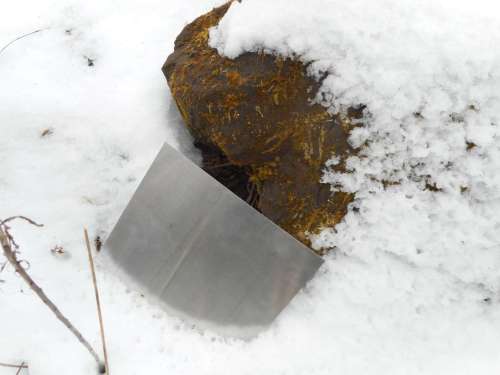
I bring in the sheet of metal I’ll use to incise the runes of storm that Thecu asked for. I’d left the gray metal tilted against a stone in the backyard, a landmark in case a storm came and covered it before I’d fetched it in. Across the stone surface, a tracery of lichens — some green from snowmelt — say nothing.
“Why am I dealing with these things now, at 71?” a dear older friend asked recently. “Couldn’t I have tackled it earlier along the way?” After a pause, he answered his own question: “But I didn’t have the necessary perspective any sooner than this to handle what I discovered about myself, and about the work I needed to do”. I spiral like we all do, when I think I’m merely circling. Last year, this year, next year. More of the same old thing, or something new, unexpected, challenging. Often both together. Arms of the spiral.
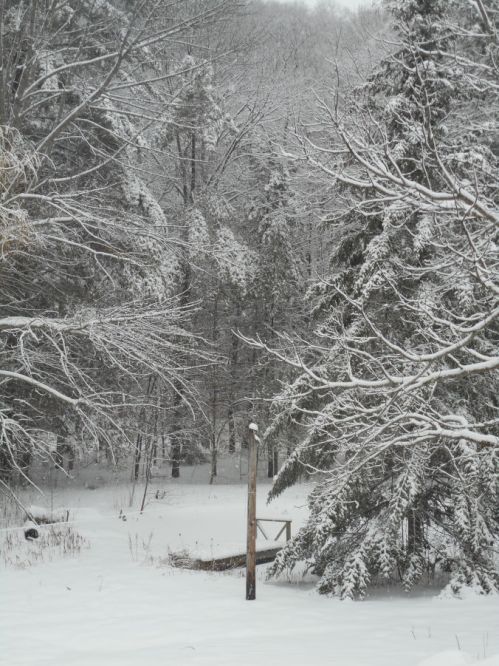
Silver-white back yard, 11:42 am EST, 10 Feb 2020
Anyone who’s read this blog for any length of time knows my focus rests primarily on the inner texture and quality of my journey. Among other things, I’m a Druid, and sometimes I’ll post about a more outer-facing “Druid” subject — a sacred grove, an altar, images from a group ritual I took part in. But mostly I write about aspects of my own spiritual growth, or lack of it; about my questions, doubts, strategies, techniques, discoveries — things I hope are also useful in some degree to anyone who practices a spiritual path over time. Especially after the initial gloss has worn off, the honeymoon is past, the foothills are behind you, and the first outlines of your life’s work present themselves. And usually not in a form you expect, or even recognize right away.
This is the point when I find it’s often fitting to laugh helplessly, laugh so hard you end up gasping for breath. Or maybe it’s not fitting, but I do it anyway. Because you can’t take yourself too seriously. (Well, of course you can, and we all know those who do, but they’re often not the easiest people to be around. By the grace of forbearing friends and family, may I learn to grow out of my own vanity. If you’ve been with this blog long enough, you know most of what we work on falls into two categories, ego project or container issue.)
Enough of you recognize something of your own experience in what I write here that you keep coming back. Or at least you find the spectacle of my journey entertaining, because in fact it’s nothing like yours at all. You’re crafting a wand, planting a sustainable garden, protesting inert government officials to get off their asses, raising children to honour the earth and each other, or you’re single, widowed, newly launched into a different life than you foresaw, but living your path as best you can, in all its singular beauty and strangeness, in churches, temples, bedroom shrines, backyard altars, cathedrals of trees, holy places of the heart. You belong to a god or gods, or you’re non-theistic, you know the signs and songs and pass-words of your beliefs and practices and community, even if they no longer describe you fully, or maybe especially if they do.
Or you’re undergoing your own inner apprenticeship, something near-impossible to talk about, even with dear friends, and especially with family, who are often the last to know, or to come to grips with how dear Sue or Bill or Jimmie has “changed” and grown into something exotic and possibly uncomfortable and maybe more than a little threatening to an old dynamic that no longer works for all the people it used to link and to explain to each other. Or you’re bound firmly, as far as you can tell, in a circle that for whatever reason you need to stay in for now, in order to survive at all.
All you know, to quote that Victorian or maybe Edwardian novel, is that for your family, you are no longer PLU — “People Like Us”. Elvis has left the building. The horses have broken through the fence and gallop, heedless of human cries, across the plain and away.
Or you’re not changing. Everything and everyone elsehas changed. You’re becoming more of who you’ve always been. Why can’t they seethat?!
Right in the midst of such tumult, it can feel like the very last thing that’s happening is “what it’s all for”. Instead it feels the exact opposite of that. Let the dust settle and the rubble stop bouncing, though, and a different outline can begin to emerge.
(Try to map spiritual geography most people will recognize and you miss the mark 50% of the time. Still, in baseball, that’s a mightily impressive record.)
/|\ /|\ /|\
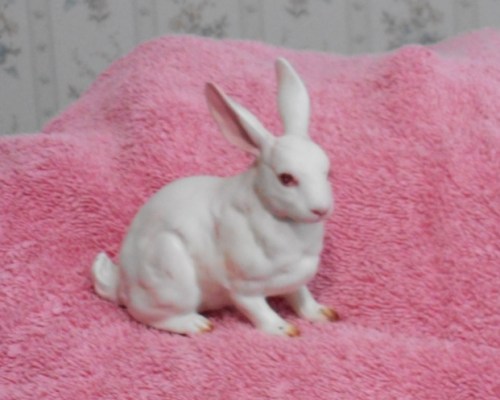
I know now that what it’s really all about is the white rabbit.
My mother’s elder sister gave me this porcelain hare when I was seven. We’d visit her just once a year, for a long weekend — my mother and I traveled to Iowa most springs to stay with that side of the family. I remember thinking some seven-year-old boy version of “But I can’t play with it — it’s too delicate”. It was a “shelf-sitter” for sure, but even then it carried a charm it’s never lost for me. Its pinkness never bothered me as “girly” or wrong for a boy (I shot the image above on a pink towel to emphasize the painted highlights). For all I know the figure was a commonplace object several decades ago — some of you may have one just like it sitting on a mantle. But all I knew then was that someone had entrusted me with a delicate object, one valuable for its own sake, not for what I could do with it. It arrived, as such gifts sometimes can, at a moment when I could appreciate it.
In all the many moves of my life — at last count, 22, including to and from China, Japan, Korea, and six states in the U.S. — it’s traveled without damage. I thought of it for a long time as an Easter rabbit — not THE Easter Rabbit, but a rabbit associated with springtime. Now it’s an Imbolc hare as well.
Blessings of Imbolc
hare to you, warmth of white fur
soft as dream, close as the dreaming sky
against your skin. Grace of paws
in the snow to you, delicate toes,
each touching with its own print.
Blessings of animal presences to you.
Alertness of hare to you, ears pointed
towards the awen, that whisper
each of us hears, time’s changes tumbling
round us. Fleet foot of the hare
to you, the answering dance of hare,
a dive into a burrow, or a mad dash
(dash of the Mad March hare, a month early)
for the nearby hedge and through,
through to all the bright fields opening beyond.
(I’ve posted rants before, and alerted readers up front. What follows is another, lit with caffeine, a dose of the cabin fever of a typical long New England winter, and maybe even some insight.)
What’s a spiritual path for?
We can say, using a mixed bag of traditional language, that its goal is to reconnect us with cosmic law, attune us to deity, re-balance us, align us with the flow of the Ten Thousand Things, show us God’s will, conform us to the ways of Spirit, and so on. (Sometimes it’s to save us. Other times it spends us like the prodigal sons and daughters we are. Either way, value gets exchanged.)
Or we can use the language of modern commerce and say we want to optimize our results, so we can increase efficiency, profits, and customer satisfaction. (Pay particular attention here: do you respond, like I sometimes do, more to this formulation of the goal than to the first? Ask yourself why, and then ask what follows from your response.)
If you’ve read the classic Seven Habits of Highly Effective People (maybe pausing to ask “Why seven?”), you know there’s little new under the sun. The magic of the book isn’t the habits themselves so much as it is its streamlining and re-ordering of principles we’ve always known, which is a magical act: to optimize flow, to organize what we need to understand and feel and do, all in ways our minds and emotions and bodies can recognize and put into motion.
We need and seek out such new re-formulations of old wisdom in every age.
Or if a book’s not your thing, you can find an even more compact form of the Seven Habits at the author’s website. They’re an excellent primer for whatever we intend to achieve.
Memes are another form of magic. If something “goes viral”, that means it’s found the optimal way to spread, to replicate, to make its mark. Using image and word, it shapes itself as a key to locks everywhere. It activates upon arrival. Like an object within range of the motion sensors on the sliding doors of our psyches, it opens us and enters.
Advertisers deploy music, light, voice, color, rhythm, beauty, movement and image — magical techniques, every one of them — and opening us, they implant desires in us for things we never knew we wanted.
Mages look with vast amusement at our materialistic culture that often mocks magic or “doesn’t believein it”, even as we encounter and often yield to magical influences every single day of our lives. In the process, magical techniques earn billions of dollars for their users, bending our thoughts, emotions, and credit cards to the wills of corporate and political magicians who’ve mastered some of the cruder techniques of glamouring other people. This isn’t paranoia but simple fact: what else is advertising for? What are political campaigns ultimately intended to accomplish? A catchy slogan, a memorable logo, an appealing face and even a dollop of charisma, and you’re halfway there.
You could say that beginning spirituality is nothing other than beginning to (re)build our “defenses against the dark arts” a la Harry Potter. Anyone half-awake (and I don’t mean “woke”) knows the need for such D.A.D.A. is at an all-time high today. Exhibit A: today’s headlines and media feeds any time we choose to look at them.
While carnival- and circus-owners and confidence-men long ago discovered “There’s a sucker born every minute”, we can (to mix a metaphor or two) learn not to suck. The old Hippocratic oath “Do no harm” may not resound in many ears like it used to, but everyone still needs to swear some version of it. We can update it to the jargon of a 21st-century version: Don’t be a jerk. This can be our Silver Rule, since clearly so many of us no longer want to know or practice the Golden version. The Medieval world and its Latin speakers had their own con-men, and their own cynical, world-weary warning: Mundus vult decipi. “The world wants to be deceived”.
Looking for a guide for electing government officials, choosing life partners, spiritual guides, car dealers? If you can’t find anyone who works with the habits of effective people, then “simplify, simplify”. Find one who’s at least trying to practice the new Silver Rule and shows some persistence at it. And with any discernment, and the blessings of even one small god or goddess, we can begin to practice it ourselves. (So I begin again, which is I suspect 9/10 of any spiritual path worth walking.)
/|\ /|\ /|\
Thecu and Brighid, storm goddess and triple goddess, both in their own ways forging, healing and inspiring us:
When storms pound the walls of the world, empower me with wisdom.
When thunder rages, forge my sinews into strength for myself and others.
When human contrivances fail and fall in tempests, illuminate my path forward.
When the bridge breaks, guide me to build a boat to cross with.
When fires blast, fix my will to continue what my ancestors began.
When the shores vanish, show me your compass.
When darkness shrouds my North Star, show me light within.
Now this is a prayer of petitions and visualization. (Adjust the pronouns at need.) But sometimes such forms can feel too demanding. I often like a more meditative version as well, one that encourages me to see these things already in manifestation, not merely waiting to appear. Just a few tweaks — acknowledging the presence of the goddesses already, of spirit at work before I even begin to think the words …
When storms pound the walls of the world, you empower me with wisdom.
When thunder rages, you forge my sinews into strength for myself and others.
You illuminate my forward path, when human contrivances fail and fall in tempests.
When the bridge breaks, you guide me to build a boat to cross with.
When fires blast, you fix my will to continue what my ancestors began.
You show me your compass before the shore has vanished.
When darkness shrouds my North Star, you show me light within.
Here we are, on an excellent day to test our actual as opposed to our rationalized beliefs: It’s “Magic Sunday”. What’s that, you ask (if you haven’t already read the day’s numerological clickbait)?
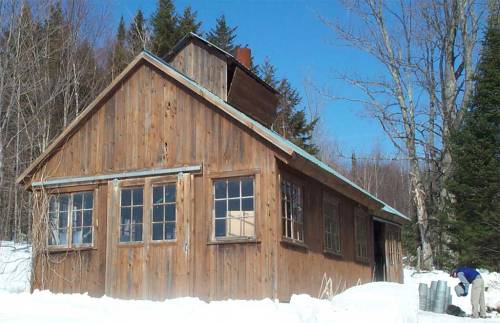
A “sugar-shack”, New England Imbolc — the start of maple syrup making
Whether you deploy the European sequence of day-month-year, or the North American one of month-day-year, today is 02-02-2020. A palindrome, the same sequence backwards and forwards. You can read more about it in the middle-market, slightly left-leaning USA Today. (I monitor a range of about a dozen papers spanning the political spectrum. Leftist hysteria balances rightist hysteria, sort of like stomach acid and an antacid, except not.)
After reading the article, ask yourself: do you feel your mood or perspective even slightly altered, knowing the rarity of a palindrome date like today’s 02022020 sequence last occurred some 900 years ago? (See Palindrome Day | palindrome date.) Of course, if you keep reading, other similar dates loom in the next two years. Anticlimactic?
Try doing a task today, specifically focusing on the rarity of the date as a source of empowerment — even, or especially, if you don’t believe in such things.
/|\ /|\ /|\
Now add to this the celebration of today, at least in North America, as Groundhog Day (No shadow! Early Spring! Go, Punxsutawney Phil!). And Imbolc. Does thatchange anything for you?
The foregoing is an illustration of our varying susceptibility to what’s been called “magical thinking”.
I find the term less than useful, because it’s often disparaging: irrational, superstitious, and so on. Instead, let’s look at all such things simply as inputs. Inputs surround us continuously: the weather, our diet, home, job, nationality, other affiliations, memberships and identities both chosen and inherited. What do we grant access to our mood, attitude, perspective, belief system, emotions? What operates largely below our level of awareness, as a sort of background hum? What do we resolutely shut out so decisively that it can gain little traction with us (even if it impinges subconsciously)? Do we even know?
Take it as a “Druid challenge”, or a bit of research, a holy ritual, a game — whatever makes it useful and engaging to you.
And if so inclined, try a form of alchemical magic most everyone uses — coffee, or a little sugar, in the form of maple products, sweets, cookies, candy — to satisfy that midwinter carbohydrate craving — and give you a “magical” sugar or caffeine buzz. Now that you’ve magicked yourself, explore what comes next.
Mantle of Brighid about me,
Memory of Brighid within me,
Protection of Brighid around me
keeping me from harm,
from ignorance, from heartlessness,
this day and night,
from dawn till dark,
from dark till dawn.
— John O’Donohue (adapted), The Four Elements, Transworld Ireland, 2010, pg. 109. (Also available in Random House editions.)
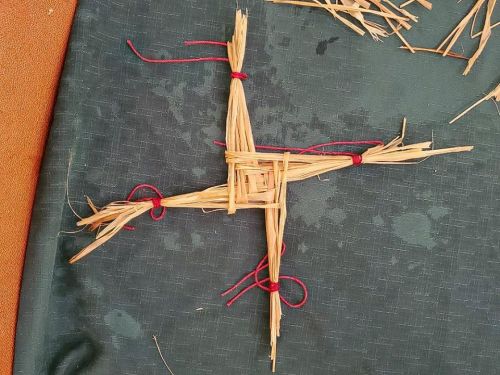
Crafting Brighid’s crosses. Photo courtesy Gerfalc Hun.
Previous posts touching this theme [ 1 | 2 | 3 | 4 | 5 ] have drawn a range of responses. Some readers took issue with the word “fake”, rather than reflecting on the often spurious claims to legitimacy and authority that prompted its use in the first place. Some took it as an insult, like Robert Frost’s bird “who takes/Everything said as personal to himself.”
Another noted, though don’t I recall mentioning gods, that
the deities … do not need belief in order for them to exist, nor do they need faith. They existed before we even came onto the earth, we are born and surrounded by them and gain consciousness of their presence …
Of course, such an observation is itself a statement of faith. A staunch materialist is equally convinced that the physical world and its processes are sufficient to explain everything — no “gods” needed.
Attend a Pagan gathering, a Muslim masjid at prayer, a Christian church service, a Jewish synagogue or temple on the Sabbath, a Hindu puja, and so on, and while statements of belief may be part of the event, the communal experience dominates. People gather for celebration, for spiritual reconnection, for a dip into sacred time and space.
Druid, this dip’s for you.
Argumentation and logic and pure intellect have their place, but if they were all, we wouldn’t have much in the way of human culture. Would even music or art exist? For so many of the purposes they serve are akin to religion and spirituality — something more than molecules moves our hearts. And without that, would some of the more unlikely religions such as Dudeism or the Jedi faith (link to lively interview on British TV!), to name just two, ever have gotten off the ground? What are we to make of this impulse that surfaces in every human culture and enriches it beyond measure, in an astonishing abundance and a variety of forms and colors? Does it have “evolutionary value”? Why might it persist?
/|\ /|\ /|\
We can add fake to other dangerous four-letter words like true, evil, just, only: you know, “It was just a dream”; “It’s only your imagination”, and so forth. (We won’t even mention three-letter words like why, or two letter words like if.)
“My fake Druidry is faker (and therefore more interesting and exciting) than yours, so there!”
/|\ /|\ /|\
From “Meditations of the ‘One Genuine Real Live Druidry’ Ogreldi Druid”:
There’s always more to learn.
Spirit refuses to sit obediently within any human container. That includes death.
The Land where you live is your teacher today.
A magic as big as your heart: begin now.
We all live in more than one world. Check your passports before entering.
When does a wall become a window, then a door?
The awen sings in your blood and heart, in your neighbors’, in the stars, in the spider’s in the corner. What songs have you heard today?
The Ancestors still talk.
Make an ally of darkness.
Everything starts dancing, when you look closely enough.
Evil is misplaced force.
Find the fire.
A moon for mundane tasks, a year and a day for magical ones.
Everything is true through which we become better.
Nothing is mundane. Absolutely everything is. A sage bought this at the market of truth, but it’s not the final word on the matter.
What shatters the veil of form?
/|\ /|\ /|\
We now return you to your regularly scheduled program.
Those of you who don’t already know and follow Lorna Smithers’ excellent blog may want to read her latest post, a lovely meditative poem she follows with a brief comment. “Hour One — Candlelit Illumination” conveys a feel for what we do when we listen, when we approach and sense spirit, when we follow through on vows, when we dedicate ourselves to a spiritual path. “I have no temple”, she writes. “Only a candle …” And that’s spiritual plenitude.
/|\ /|\ /|\
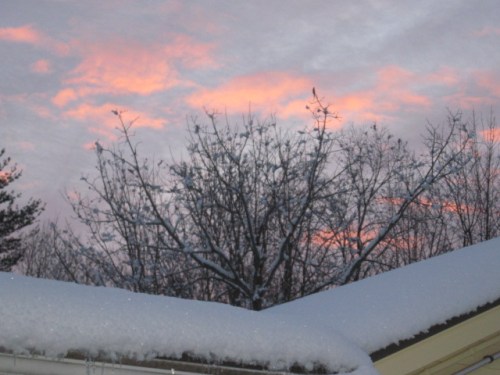
“It was winter’s tide, and the winter was grim and cold and frosty and with ice bound …”, writes Bede (672-735) in the Old English translation of his Latin History. But we really don’t need a translation in this case, especially with the visual of my snowy backyard about a week or so ago. Across more than a millennium, ancestors are speaking in older languages as well as newer ones, reminding us of a vast pool of shared experiences.
As we become ancestors ourselves, what are we contributing? (Does that feel like a difficult or awkward question?)
Sometimes it’s survival. We may not credit ourselves enough for that, but it’s a signal accomplishment all its own. (The Ancestors are cheering!) We’re still here. Yes, we may be losing things along the way — hair, dreams, relationships, sanity. But bards make sure we remember this turn of the spiral, too, not that we’re likely to forget — as we gain survivor’s wisdom, and survivor’s grace.
You know that grace when you meet it, more easily in another person than in yourself, sometimes. The other person looking into your eyes knows, and their eyes tell you they know — if you know. Then that mutual recognition flares up between you. They too are “acquainted with the night“, to shout out to another bard. And in spite of all, they’re still here.
No, we haven’t (yet) lost ourselves, though Things seem determined to tug pieces of us off and away. After the bigger tugs, you arrive back in your life like flotsam on a strange shore, unsure of your footing, the light, the press of earth beneath your feet, the weight and substance of your own flesh. You feel strange to yourself, as if you’re in your dream body. (And that’s precisely where you are, like you always have been. Now you just notice it a little more.)
Lorna documents her intense experience of a “winter of harsh descent” as she dedicates herself to her patron deity, in a second post from a year ago, which you can find here. The spiritual intangibles that arise from such experiences are things few other people may recognize in you, or be able to hear if you try to talk about them. But the Ancestors know them very well, and make a good audience. (They’re playing the Long Game, after all.) A journal entry, a poem, a song, a prayer, a meditation, a moment of silence “in their direction” — whatever level of dedication you offer, they will welcome.
/|\ /|\ /|\
I’m slow to answer to the vision from Thecu, or intuition or hallucination or whatever it was and is, and its directives. Slow, but I get there — partly because I’m curious. (If I build it, will she come?) The goddess certainly can’t count on me for very much, at least not yet. But outdoors in the snow for a few days of purification, I’ve set the metal sheet on which I’ll inscribe her runes. Tomorrow I’ll bring it in.
If I pray, or make a vow, in a constructed language like the one I used to translate the Druid’s Prayer two months ago, is the prayer worthy, or the vow valid?
One direct test: does the spiritual world take them seriously? How do I know? And what, in turn, can that tell me about intention, creativity, awen and gods I may not worry about “believing” in, but whom I’m happy to work with, if I ask and if they choose?
(O Bríd and Oghma, for the gift of speech already I thank you …)
eastern counter-glow over our roof at sunset
“Sound”, says the Old Irish In Lebor Ogaim, The Book of Ogams or the Ogam Tract, “is the mother of Og(h)ma, and matter his father”. Sound becoming language, the tongue of human beings, mediated by a god. The awen you sing, from the deep you bring it. And I pray you will.
No, I’m not claiming for my nascent Celtic con-lang any sort of special divine or holy status. (At least not in advance.) All languages are holy, or could be. But yes, I am working magic, going with an intention, asking blessings on it, charging it with desire, putting in a sustained effort, sailing with the wind, trusting to its fulfillment in time, doing my part, perceiving it from the vantage point of already-manifested, working with the as-if principle, feeling it as much as thinking it — because feeling charges an intention till it begins to spark, and it kindles (mostly) along paths we’ve laid for it, following the principle of the path of least resistance.
“I look forward to seeing where this goes as you work through the details”, writes Steve.
So do I, whether he was referring to the language or the prayer behind it, or both, or something else. “Working through the details”, the concrete form or mold into which we invite the magic to pour, helps give it shape. But whether it fills that form, or another more open to its flow, isn’t wholly up to us. If you’ve been at all involved in the building of a house or barn, with concrete being poured, you’ve run across stories of the concrete forms blowing out, and the heavy wet stuff flowing everywhere you didn’t want it. Magic is alive, god/dess is afoot, as much when I stub a toe or mash a finger as when the magic shifts my life to wonder and growth. Force flowing into form.
More than a little humility can help keep us from acts of outright stupidity in the face of divine power manifesting. Insisting that magic go a certain way is like commanding the tide: the tide always wins. But not seeing it as a contest, but as a chance to sail on the seas of magic, lets me ride the waves, tack across the wind, or run with it, and reach harbor. A light hand on the tiller, a boat that isn’t an ego project, a “vanity vessel”, but a seaworthy ship.
Expecting the wind to drive my boat out onto the waves, steer it where I want to go, and deliver me without any further effort on my part beyond the “ask”, is folly beyond telling. To put it more crudely and memorably, in words a friend said to me recently, it’s just naive as f*ck.
/|\ /|\ /|\
So what lies “outward from prayer”? (Between sacred and profane may lie the merest hair’s breadth. Live, pure, wise, fire and true are also among our four-letter words.)
Make the turn, just don’t insist on logic as the link.
The Great Triad of Jesus is familiar to many, but too often we forget the hard-earned admonition that immediately precedes it:
Give not that which is holy unto the dogs, neither cast ye your pearls before swine, lest they trample them under their feet, and turn again and rend you.
Ask, and it shall be given you; seek, and ye shall find; knock, and it shall be opened unto you: For every one that asketh receiveth; and he that seeketh findeth; and to him that knocketh it shall be opened.
I know I squander the holy far too often, casting it aside like a paper wrapper around the candy of what I think I “really want”. After all that asking, seeking and knocking, I just let it slide from my fingers. So I take up the task again, asking, seeking, knocking — until I find that supple, elusive thing I need like blood and breath.
/|\ /|\ /|\
I’m slowly reading two related books (like many “bookies”, I almost always have more than two going at any one time), to listen to them echo and ricochet off each other: Thomas Kunkel’s Enormous Prayers: A Journey into the [Catholic] Priesthood, and Rev. Lora O’Brien’s A Practical Guide to Pagan Priesthood. The first volume I’d salvaged free from the last day of a used-book sale where any remainders were given away to clear space. The second I recently bought used, though it appeared in 2019.
We still grant to “priest” and “priestess” an aura of magic and mystery — tarnished, yes, by years of unfolding Catholic scandal among others, while also reclaiming, often from non-Christian sources, new resonance and imagery and sacred fire. As one priest in Kunkel’s book exclaims, “… people are starving today for mystery, the power that grounds, suffuses and surpasses all things, that ever-present but elusive reality … as a result, our souls are withering from underuse and lack of nourishment.” And we know this because “people have a sickness that no psychologist or physician can cure …”
We need to move beyond prayer to find that use and that nourishment. Fortunately, many are beginning to wake again to themselves, and to reclaim that holy task, rather than yielding it to any other.
Priests and priestesses? Needed, yes. Needed very much at times. But not essential. The life we each hold (a trust, a sacred heirloom, a gift from the ancestors) is enough.
And may you know blessing as you too reclaim, and name, and flame.
/|\ /|\ /|\
Kunkel, Thomas. Enormous Prayers: A Journey into the Priesthood. Boulder, CO: Westview Press, 1998.
O’Brien, Rev. Lora. A Practical Guide to Pagan Priesthood. Woodbury, MN: Llewellyn, 2019.
Much of Paganism is defining spaces, places and the awareness we bring to them. At its heart it’s a kind of continual prayer: O let me wake into the holy in every moment.
This is sacred time, go the words of standard OBOD ritual. This is sacred space. We name it to remind ourselves, to evoke it through intention and attention, but also to recognize what’s already there. We can create sacred space because sacred space shapes us from birth. It’s our heritage, our birthright, unless we give it away.
So we call it back.
With Imbolc a little over a week away, those who honor Brighid find themselves turning even more closely to her presence and influence. Year-round already and always, yes, for those who revere her, but also more keenly when her festival nears.
“We are entering the dark half of the year”, writes Teo Bishop in a post for the Autumn Equinox, “and now more than ever is the moment to engage with your daily practice”.
(When isn’t it the moment to engage? I don’t know about you, but my “dark half of the year” doesn’t politely wait for September. You’re no doubt tired of my repeating this theme of the need for a practice. Please understand: with a blog I have built-in reminders and prompts for my own practice. If I’m not practicing, the words don’t come easily. Blogging is one of my spiritual barometers. It’s also a prod in the behind. By posting fairly regularly, I also get to check in on my worlds, I’m reminded to listen to where I need to open up to the holy energies we all bathe in each day.)
“One of the most common responses I see to the idea of developing a daily practice”, Bishop continues, “is that there is no time. This assumes that a practice must be a long, complicated ritual, full of gestures and ritual phrases. It paints a practice as yet another way that the struggle of our day to day life is a weight on our shoulders.
But the daily practice can be framed another way.
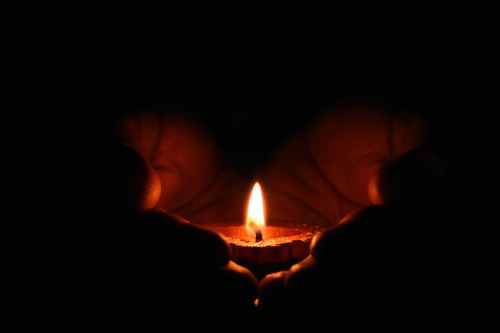
Let it begin with something small. Light a candle, take one, deep breath, then extinguish the flame.
That’s all.
It won’t take but a second”.
In that second the Holy Flame expands to fill our consciousness — or it can, if we permit it. A simple practice that goes far to making a seemingly-mundane moment a sacred one.
ADF ritual puts out the sacred fire at one point, describing it this way:
Extinguished without
but burning within.
The living fire flames within us.
Fire work, or apprenticing yourself to the element … can begin with a fire pit, or candle-lighting, if an outdoor fire isn’t practical for you. From such simple work with each of the Elements, a profound and beautiful practice can grow over time. This is also one of the freedoms in which a Druid can wholeheartedly participate in a Christian or Jewish service, in part through some of its seemingly “smallest” ritual gestures and events.
Or as mage and author Josephine McCarthy describes it,
My deepest personal experience of that is with the lighting and tuning of the candle flame. The intent to light a candle to prepare the space for a ritual act developed from that simple stance, to an act of bringing into physical manifestation an elemental expression that lights through all worlds and all times: it becomes the light of divinity within everything (J. McCarthy. Magical Knowledge, pg. 70).
As a focus for meditation, for out-of-body work, for reverence, for kindling the spirit in times of heaviness and despair, fire has no equal.
/|\ /|\ /|\
Brighid so beautifully merges sacred and profane, because her triad of aspects, as goddess of smithcraft and the forge, of bardic inspiration and the awen, and of healing and the vital flame, all circle around holy fire. Lighting a candle can be purest prayer.
It’s very old, this focus on fire. (Focusitself is an old word for “hearth” or “altar”. We make an altar of what we focus on). We read in the Rig-Veda 1.26.8, “For when the gods have a good fire, they bring us what we wish for. Let us pray with a good fire”.
One way to understand this passage, of course, says simply that “if we build it, they will come”. On occasion that’s exactly right. Dedication is its own reward. Often, though, the arrival of gods lies in our building — the impulse to light the fire, the desire for kindling light and flame, is itself divine presence.
There’s a tree by the well in the woods that’s covered in garlands,
Clooties and ribbons that drift in the cool morning air,
That’s where I met an old woman who came from a far land,
Holding a flame o’er the well, and chanting a prayer.
Devotion has put the clooties and ribbons there. Devotion allows the encounter with the old woman. Who is it that’s “holding a flame o’er the well”? The singer, yes. The old woman, too. And both at once. I increase my chances of holy encounter when I sing a prayer with a flame. “For where two or three are gathered together in my name, there am I in the midst of them”, says the Divine Son and Sun. First, we need to gather. When I’m aware of that Other, the flame kindles.
Damh continues:
She told me she’d been a prisoner trapped in a mountain,
Taken by the Queen of Winter at Summer’s End,
But in her prison she heard a spell the people were chanting,
Three days of Summer, and snowdrops are flowering again.
She spoke of the Cell of the Oak where a fire is still burning,
Nineteen Priestesses tend the eternal flame,
Oh but of you, my Lady, we are still learning,
Brighid, Brigantia, the Goddess of Many Names.
Part of our human magic is to participate with the divine in making holy — sanctifying, hallowing the time and space. We can never reduce it to rote: “Oh but of you, my Lady, we are still learning”. The gods “switch us on” when we devote ourselves to their holy fire. But we do the same for them. Rarely will they force open a door we keep resolutely shut.
Where is the fire still burning?
/|\ /|\ /|\
Seven Flames for Meditation
1) What does it take—literally and intentionally—in order to kindle you, and in order for you to kindle other things in your life?
2) What offering, if any, do you make to help you kindle? What else could you bring into your practice? What could you discard?
3) What is sacred to you? How do you find, invite, welcome, increase the sacred? What sacred ways are a part of your life right now that can help you kindle?
4) What ways, if any, do you tend to discount, push away, ignore, or feel “aren’t my way of connecting with the sacred”? What can you learn from your attitude towards them?
5) Where are you already kindled? What is burning, warm, or fiery in your life right now?
6) Where do you desire kindling? (Where do you need to bank a fire and cool off?!) Or to put it another way, what needs to catch fire in your life?
7) How has sacred fire already honored your practice and now flames inwardly for you?
In this post I want to talk briefly about how I composed the “Tree Prayer” I posted last July. The earlier post has enjoyed a recent burst of new attention, so it looked like a good candidate for further discussion.
Oak, shade my path. I welcome your wisdom.
Birch, green my way. I call on your courage.
Hemlock, heal my heart. I fast under your foliage.
Pine, scent my dreaming. I gather your gifts.
Tree companions all, I seek the shelter of your boughs.
May my days make return for your abundance.
One of the goals of the bard is to get those words into memory that we want to keep there. Songs, poem, rhyme, mantra, chant — all rely on rhythm and echo (which is what rhyme is) to transmit words into brains so they stick. Whether for prayer or entertainment, history or mnemonic, the form that we give our words makes them either easier or harder to recall.
(A snappy campaign slogan can help win an election, just as a bad one can sink it. Likewise with advertising. If you’re like me, you’ve got ad jingles in your head you never needed to memorize — repetition alone did the trick. I date myself with an old car-sales jingle that lasted into the 1960s: “See the USA in a Chevrolet …” Long before I was anywhere near driving age, or had any need to know about it, Detroit supplied me with corporate earworm propaganda, linking Dinah Shore, patriotism and purchasing that particular brand.)
I’ve long been fond of alliteration, also sometimes known as “consonant rhyme”. While a vowel rhyme could work fine, I find it can also be a distraction. There’s also too much “moon-tune-June” rhyming all around: greeting cards, song lyrics, and — gods help us — even dirty limericks in restrooms. So alliteration it is.
First, I chose local trees, species I can see from the house: oaks in the back yard, a line of hemlocks defining our northern property, pines along the eastern periphery, and birches across the road to the west. If you’d like to shape your own tree prayer, look to trees that stand near you for help. Maybe you want a seven-tree prayer, combining the properties of seven with a variety of local species that matter to you. Maybe you want to use the Druid triad form, and name just three.
What do “my” trees offer? Most of our oaks are mature, and thus excellent shade trees. As the pre-eminent “tree of the Druid”, sharing with it the *dru, *deru, *doru- root in many Proto-Indo-European languages, they endure as “trees of wisdom”.
Birches are pioneer trees, among those species that first appear in barren or “disrupted” areas where an eco-system has faced a fire or other dramatic change. They’re also the tree often associated with bards, sharing the same first letter in several languages (and opening the ogham alphabet), so “green my way” came pretty naturally.
The hemlocks are long-lived, tough (though the hemlock woolly adelgid continues to wreak havoc among them) and possess astringent and antiseptic medicinal properties that a good herbal will elaborate on. “Heal my heart” combines these qualities.
Finally, the smell of pine yields an easy association: “scent my dreaming” picks its way among words that suggest pleasant smells (English shows a curious paucity of “good-smell” words, though we have stench, reek, stink, fume, etc., for bad ones. Japanese has the verb kaoru “have a good smell” and the girl’s name Kaori “fragrance”.)
As with vowel rhyme, less can sometimes be more. I asked readers to try out and live with the tree prayer, and some of the comments suggested people were doing just that. Work with a prayer that involves another being, and often you’ll get nudges on its sound and form that work for you.
The first four lines of the prayer took me approximately an hour of meditation and drafting and revision.
The title comes from a casual workshop comment on the awen with Welsh Druid Kristoffer Hughes at East Coast Gathering a couple years ago. As we take our first steps in this fabulously crazy year of 2020, it’s a superlatively appropriate question to ask.
“May your bridge be a star, and your star a bridge” — Winston-Salem, NC. April ’19
Or to take it for a spin, account for your life in your own way, on your own terms, and you may well see a change — especially if you respond to some of its challenges with mu— that great Zen keyword which in at least some traditions means “un-ask the question”.
Let’s consider for a moment the joys of those being our options: a touch of insanity, or unsurpassed excellence. Make these specifically Druidmadness and marvelousness, and you just might be onto something. Especially if you mix them …
The counsel of a bard — Gerard Manley Hopkins, that blessed fool of Victorian England, writes in “As Kingfishers Catch Fire” (you know you’re near bardic territory with such titles):
Each mortal thing does one thing and the same:
Deals out that being indoors each one dwells;
Selves — goes itself; myself it speaks and spells,
Crying Whát I dó is me: for that I came.
What I do is me … the greatest spell any of us will ever work. Each thing in the universe is dear for its individuality, its singularness. Irreplaceable you.
Now to turn this potent enchantment to a purpose, rather than watch it subside into itself like a melted-down candle. How many of us are quite literally mis-spelled? That is to say, there are definite spells or enchantments in play, but they do not work wholly or even partly for our benefit. The spell is working counter to our purposes. (How many of the knights in Arthurian myth quest nobly for the Grail, and never catch even a glimpse of it? Or to quote author Feenie Ziner, who writes about her son’s quest in the wilderness for a truer vision than 70s America offered him, on any great moral journey, the devil is always a stowaway. We take the mis-spelling right along with us, we yield to almost any spiritual enchantment that comes along, especially if it’s cleverly packaged, and we give it space in our rucksacks and backpacks, a place on our storage shelves.)
So often we can hear other bards answering. They’re in endless conversation with each other, when they’re not sitting stunned after a visit from gods, or mead has simultaneously fired and rewired their inward sight, or a spell of solitude eventually returns them hungry for the magic of simple, daily things — a crackling fire, the wet nose or soft fur of a pet, the comfort of a friend’s presence when nobody needs to say anything at all. And sometimes they talk most when they find themselves right in the middle of these simple things. Because in the end, where else is there?
As the late author, mystic and former priest John O’Donohue puts it in Eternal Echoes*,
Each one of us is alone in the world. It takes great courage to meet the full force of your aloneness. Most of the activity in society is subconsciously designed to quell the voice crying in the wilderness within you. The mystic Thomas a Kempis said that when you go out into the world, you return having lost some of yourself. Until you learn to inhabit your aloneness, the lonely distraction and noise of society will seduce you into false belonging, with which you will only become empty and weary. When you face your aloneness, something begins to happen. Gradually, the sense of bleakness changes into a sense of true belonging. This is a slow and open-ended transition but it is utterly vital in order to come into rhythm with your own individuality. In a sense this is the endless task of finding your true home within your life. It is not narcissistic, for as soon as you rest in the house of your own heart, doors and windows begin to open outwards to the world. No longer on the run from your aloneness, your connections with others become real and creative. You no longer need to covertly scrape affirmation from others or from projects outside yourself. This is slow work; it takes years to bring your mind home.
The work of both Druid and Christian — as it is the work of anyone walking a “path with heart” — is to turn from the “seductions of false belonging”. Christians may call this “the world”, and offer strategies for dealing with it that are specific to their tradition. Such guidelines can be most helpful if, as my teacher likes to say, they’re truly a line to my guide, and not an obstacle to testing and knowing for myself.
More often than not, Druidry simply presents its particular practices and perspectives on living in harmony with nature, trusting that anyone who follows them deeply enough will discover much the same thing. Rather than do’s and don’t’s, it suggests try this out for yourself and see. (Imagine a more directive Druidry, a more experiential Christianity. What could happen?!)
One thing I admire about O’Donohue, and seek in other writers and teachers and traditions, and try to model myself if I can, is never to present a problem or criticize a behavior without also offering at least some strategies for negotiating it. Show me a how— and preferably more than one. A palette of choices.
Here O’Donohue spotlights one of the challenges the human world offers us — the seduction of false belonging, whether spiritual, political, romantic, economic, etc. — and identifies an answering response or strategy of finding our true home, of resting in the house of our own heart, of bringing the mind home.
Now these poetic expressions are lovely and metaphorical — at least until we begin to experience them for ourselves, and find out what they can mean for us. Every human life offers opportunities to do so, though one of the “seductions of false belonging” urges us to discount them, to treat them as idle fantasies, as pipe-dreams, to replace our instincts with advertising slogans. Cynicism about spiritual opportunities abounds, because like so much else, hucksters have sought to monetize them, to profit off our naivete and first attempts to build that true home, to rest in the heart-house. Nothing drives us from such homes like mockery and shame.
Mis-spell me, spell me wrong, and I’ll look everywhere but in a song to tell me what I need to know, where I want to go. Home is the poem I keep writing with my life.
As I’ve mentioned in previous posts, one of my daily go-to practices involves singing the awen, what I’ve also called the “cauldron sound” in Druid terms. Others know it as the hu, the original voice that sings in everything. Hindus call it om, and Christians term it the Word of God, the “amen, the faithful and true witness”. You encounter mention of it in many different traditions around the planet, because it appears to have an objective reality (and that’s something to explore, rather than accept — or reject — dogmatically).
Here’s a short video of Philip Carr-Gomm and Eimear Burke leading a chant of the Irish equivalent imbas: One key is to experiment — find the song, the word, the home that fits. And hermit-crab-like, move when it no longer can house you, or shelter your spirit.
And one Druidic extension of these practices can be to search out and experiment with sounds and voices specific to our individual heart-homes and houses. Our spirit animals can be helpful in this pursuit, alerting us to inward places to visit, and situations to avoid, or plunge into. Or as the Galilean master noted, “In my father’s house are many dwelling-places”.
/|\ /|\ /|\
*O’Donohue, John. Eternal Echoes: Celtic Reflections on Our Yearning to Belong. HarperPerennial, (reprint of 1999 original), 2000.
The source of my omen for Day 12 is you, my readers. In your continued re-reading of my April 2017 post on the Grail Cross (and your silence in response to my requests for feedback!), I find a useful omen for our days ahead: we need both Grail and Cross energies. In the absence of your reasons, I can only supply my own, and that is as it should be.
The Grail Cross is a union of symbols, a conjunction of two traditions, yes — but both celebrating and indicating things much larger than human tradition: the divine not just accessible in nature, right here where we live, here in the flesh, but the same thing, on a different arm of the spiral. If I’m not feeling it, and knowing it, that’s something I can change. How you and I change it will shape much of our experience in this new year. Not politicians, not employers, not partners or celebrities — give away my power to them and they can’t — even with the most loving of intentions — give me what I need, what the world needs. Rightly understood and calibrated, these two needs are one, even as Grail and Cross are a union. Immanent and transcendent, if you need or want those words.
In the Tarot reading in the previous post, the cards for “recent past” and “possible outcome” are both Cups, or Grails. The moon is the Self or significator. Do I really need clearer pointers?
Well, maybe I do. I don’t know about you, but I can be notoriously thick, and slow to understand even when signs, spirits, gods and the weather all point in the same direction. So I look for the final omen of these Omen Days, number 13, on January 6.
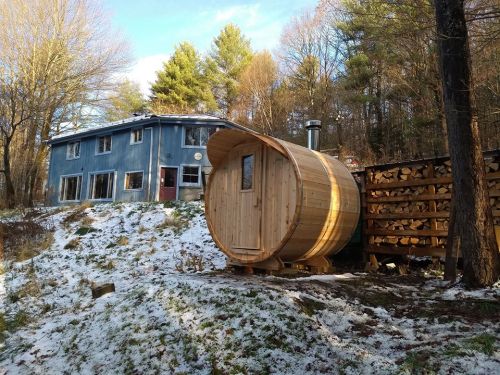
sauna photo courtesy BW.
My friend B invites me to share his recently-constructed sauna on Twelfth Night (or Thirteenth Night, in terms of the omens I’ve been taking for this series). We thaw and warm and relax in the cedar space, alternating with brief stands in the evening snow outside, watching the moon that’s full today, feeling our sweat dry, returning when the wind bites cold on our heated bodies.
sauna photo courtesy BW
In this dim, round, warm, womb-like space, we sit and sweat and talk. B has added a few things not shown in this second picture: a tomten stone at the foot of the stove, in honor of the local land spirits, a thermometer near the top of the round interior, a small venting hole and cover to help regulate the temperatures. For most of our hour in and intermittently outside the sauna, the temps hover around 200-210 F / 93-99 C — blissful, exquisite heat, in which the body yields, sweats, unknots, and finally reacquaints itself with what the Finns call löyly — the sauna steam as a celebration of all the elements together, working in concert: fire in the stove, earth in the rocks above it, water ladled from a sauna bucket onto the rocks for the final steam bath, and the steamy air that rises from them. (B is meditatively carving a sauna ladle from cherry wood he found as windfall on his land.)
Three days into the new year, and the omen for Day 10 (3 January) is a Tarot reading I did on the 1st, but put aside for other tasks. But it’s been in my attention to return to it and take another look as I post it here. Third time, or third day in this case, is the charm.
The question I posed for the reading is this: What needs our attention in the coming year?
(In light of everything in play just past the start of this new year, this innocent-seeming question already feels more than over-loaded!) But how much of our task is focus, attention to what matters, without which we scatter and “lay waste our powers”. We can see much of the past decade as a painfully clear illustration of just such a scattering. But also, a gathering and centering in response, as we belatedly come, however imperfectly, to attention.
1. Significator or Self: Moon
2. Cross or cover: 2 of Cups
3. Basis: 7 of Pentacles
4. Recent past: Ace of Cups
5. Possible Outcome: 9 of Cups
6. Near Future: 10 of Pentacles
7. Self: 10 of Wands
8. Environment: Empress
9. Hopes and Fears: Queen of Pentacles
10. Outcome: 6 of Wands
Rather than attempting a point-by-point explication now, I’ll look for an overview I’ll return to and expand on through the coming months, refining and revising my understanding.
For now, then, the Moon:
The true task of the third line [of the Tarot major arcana] is not revelation but bringing that inner ecstasy back to consciousness. The Star [the card preceding Moon] contained no road back. It shows us dwelling in the glories of darkness transformed into light. To use that light, we must pass through distortion and fear.
The Star experience lies beyond words or even form, though it implies forms emerging with the streams of water. In the moon we see this process happening, as visions, myths and images. The Moon is the card of the imagination as it moulds the energy of the Star into shapes that the consciousness can apprehend. — Pollack, Seventy-eight Degrees of Wisdom, pg. 125.
How to “use that light” and “pass through distortion and fear” seems a fitting take on a principal challenge of 2020, and a concise answer to my question for the reading: “What needs our attention in the coming year?” I’ll take up the other cards in coming posts as explications of possible ways to go about this double task.
“Let moon meet answering fire”
DAY 11
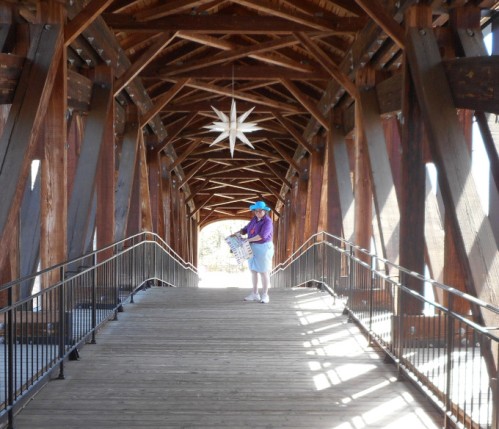
For Omen Day 11 (4 January), a late-arriving Christmas card featuring the Star in the East. Sometimes we seek the omen, sometimes it seeks us. They meet in a handshake, an embrace, yin and yang of incarnate experience, with us the conduits, the lightning rods, and the capacitors of what we are pleased to call “our” lives.
Could we but see the whole, these mutual seekings comprise its two halves, yin and yang, which themselves contain the characters for sun and moon. In the character simplification that mainland China pursues, yin 阴 and yang 阳 clearly display their respective elements of 月 moon and 日 sun.
Several Druid orders draw on this ancient understanding and make it a formal part of their training, instructing students to pursue the Sun path and the Moon path, with the third component, the Earth path, the synthesis energized by the interaction of the first two. And in the intermingling of Threes and Fours, those ancient symbols and numerical powers that color much of modern Druidry, we could name four paths: earth, moon, sun and stars. It’s no accident that’s where Dante’s Divine Comedy ends: l’amor che move il sole e l’altre stelle — “the love which moves the sun and the other stars”.
Yesterday, too, the blogpage here on Magic received five views, so the omen feels confirmed — the “messy creativity” of five-star magic.
Christmas … What’s born in us? A magical birth, the Child of Light, image of the being always being born in us as we grow and love, die and are reborn in each moment, so a post on magic, a riff on another’s post from a couple of months ago, comes together here.
The Five Counsels of Magical Living
Use what’s on hand.
The hand — four fingers of the elements, a “fifth” of spirit: the five-pointed star of magic, symbol and potency of spiritual traditions Pagan and Christian both. Always a festival celebrating something both new in the world, and always present — divinity incarnate that we can touch and see and hear. (If this world is not a holy place flush with divinity, what world is?)
For balance, I gather the four elements, ask the blessing of the fifth that is always pouring forth unasked. (The asking helps me focus.) Earth my body, water my blood, yes. Words of the old chant. But earth also in each thing, solid and durable, whether difficult or easy, manifesting itself clearly to the senses, saying I am here. Water in the blood, and in snow, rain, clouds, sky, emotion and imagination, intuition and dream, possibility flowing all around me, saying I am here. Slightly less palpable, but only slightly.
Air my breath, and also the breathing of all things on and around us, wind on my face, speech and thought hastening past, wings across the skin, a hint of vista, and distances covered in a moment by thought fast as any falcon. Air saying I am here.
And fire …
Hallow your space-time.
What is the time? We’re always checking the clock, “reading the time”, parceling out our minutes and hours. But how do we hallow it, make it holy, sacred? Do I know? Where can I find out? It doesn’t happen by itself, except insofar as being here is a holy act on its own. Necessary, beautifully necessary: but not sufficient. We get a “minimum daily requirement” of the sacred, enough to keep us breathing, our hearts beating, and the planet spinning, not enough — without our own efforts — to achieve what we’re here to achieve. Don’t know what this is? Few do, completely. Run it “to earth” as the old hunting metaphor has it — such seeking is part of achieving. It is holy, the space-time of our lives that we and the gods together weave and clothe ourselves with.
Make me ever sky-clad to spirit, so I can know its nearness …
Focus (on) magic that’s already happening.
What’s already happening? Do I know? (Not from headlines, which rarely tell us what’s really happening, only its consequences. We look at mere symptoms and try to divine their causes, rather than starting with causes and working things out from there.)
Kindle a fire from “dead” trees and living flame bursts forth. Draw a breath and this body lives to move us through experience till it kindles, too, with spiritual energy. The awen is always singing. Am I listening? Where do I hear it? How can I listen more? From the deep we all bring it … How and where are we shaping it? In Annwfn, Abred, Gwynfyd, Ceugant? Where will my actions manifest? How can I improve my choosing?
Magic mirrors where my mind is, mortal and immortal merging …
Put words to it.
Name it, whisper my days. The magical journal, the blog, the diary, the impulse to record, to trace the path we’ve taken this far, is a spiritual one, whatever else may lie behind it. A good half of our naming becomes the next charm, the new spell, the in-cantation, where we sing ourselves into the Ancient Song of existence that is always arriving out of silence.
Name it and “hame” it — manifest it. The “hame”, Old English hama, is a covering, the “natural shape” of things, but also — magically — its astral form. In The Lord of the Rings, Gandalf gains the epithet Greyhame or “gray mantle” for the cloak he wears. But even as it cloaks or covers him, manifesting him so that others can perceive him, it also conceals his inner nature as one of the Maiar. He is a “spirit of fire” no less than Feanor.
Words make up the golden thread that links earth and the other worlds. Sound, shape, thought, figures carved in stone or wood, printed in ink, fashioned of electrons on a screen.
Let words hame me, let me hame my words, till I can draw the magic deeper into time and space and assist it to take form. Let the Word become flesh. Resist it, and it will take form anyway, but often a nightmarish one, out of the distortions our creative use of our power to block also makes of it. We see monuments of our mis-making all around us in this present world, to temper our future makings, if we choose to learn.
Aim for and with the hame to tame it, reclaim it, see it in others, the same It.
Renew how you ground.
Unbalanced, we fumble through our hours and lives. Ungrounded, we electrocute ourselves with stress, anger, fear, dis-ease. Without a steadying spiritual practice, how can we stay earthed? We all already have a practice — it’s time to explore it more deeply, draw on it, shift it where it needs shifting, reinforce it where it needs reinforcement, grow it and cherish it.
/|\ /|\ /|\
Pollack, Rachel. Seventy-eight Degrees of Wisdom. Element Books, 1997. (This is an omnibus edition of what were formerly published as two separate volumes.)
Looking for tips on making a radical change in 2020? Here are some actually good ideas from The Guardian, in an article titled “Everyone thought I was mad — how to make a life-changing decision and stick to it” — not the usual “New Year’s Resolutions” clickbait. The 10 strategies it offers are, of course, all (un)common sense, that birthright so many of us abandon under the onslaught of dark-magic* advertising, politics, social media, bad education, lack of imaginative reading, etc. — the soul-less enterprise that infiltrates much of what we call life, but is really a bad substitute, sold and re-sold to us, when the Real Thing is always and forever free.
Yes, Others really do want to exploit our wills for their benefit — one of the good things coming out of our times is how transparently clear that’s finally become to many. And that need not lead us to despair, but can tell us how powerful we really are, or can be, unless and until we listen to numerous forms of bad counsel that run against our own better judgment. Yield too much, and it can take us lifetimes to regain and restore what we gave up. Or you may be a “just-this-one-life-that’s-it” kind of person, but you still see how far too many of us relinquish our sovereignty and holy self-hood to others who deserve it not at all.
Smartest radical change I ever made? Walking away from a teaching job at a private boarding school that included not only a high salary (for a school-teacher), but also health insurance and housing and utilities, but that was also quite literally making me sick (cancer diagnosis in 2009). At one point I was homeless and jobless, too — but alive.
Second smartest change? Marrying my wife, though at the time I was unemployed and broke, and had just returned from an overseas teaching job in Changsha, Hunan Province, China that paid me $250 U.S. per month. The strategies in the article are wise ones — take it from someone who’s made some radical changes in his life, and never regretted those he made (only those he didn’t!).
Third smartest change? Taking that China job I just referred to, though it paid so little. Because it opened doors to all the subsequent jobs I ever had, though I didn’t foresee that at the time. And the perspective of being a foreigner, going deep into another culture as speaking even some of the language can help you do, as well as seeing my country from a distance, from the outside, and as a foreigner myself for a short while after I returned — I can set no price on the profound value of those experiences.
/|\ /|\ /|\
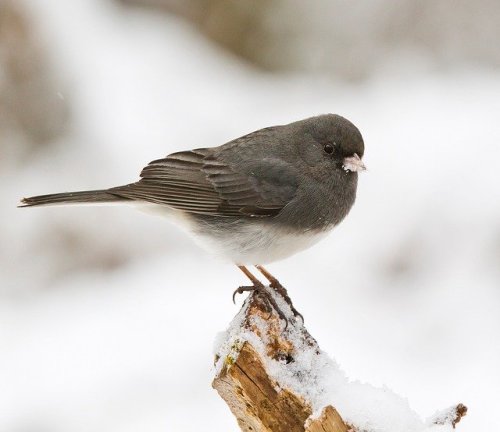
The junco’s for Omen Day 7. Tuesday, on my way to drop off a draft of our labyrinth paper to my hospice client, I spotted a flock of juncos foraging near my car as I exited the community where my client lives. Juncos were such frequent wintertime companions in my childhood in upstate New York that I was pained but not surprised to read how their range has shrunk over 50% in the interim. Below’s an image of the dark-eyed subspecies I saw, clearly featured against the snow. Or as Linnaeus described it in his 18th-century classification, F[ringilla] nigra, ventre albo — “A black finch with white belly”.
What we take for granted is often the most vulnerable, or least permanent: whether it’s democracy, life, health, friendships or a bird, they can all prove equal in their fragility. We forget we are a part of this world, not apart from it. What we do matters, helping to shape the whole we all live in and through.
dark-eyed junco — junco hyemalis
Omen Day 8 didn’t even ask me to leave the house: the sourdough starter we revived for yesterday’s New Year’s Day breakfast of waffles. We’d refrigerated it for several days, and the night before, it was time to revive and feed it, ready it for another meal.
It’s natural to find the cute and furry things amenable to a nice, safe middle-class Druidry. But the prickly, grotesque, dangerous, or simply odd and invisible ones? Not so much. All praise, then, to the lactobacillus that gives all things sourdough their tangy character, and thrives together with us in our bodies all our lives, strengthening, healing and rebalancing so many of our essential biological systems! Three hurrahs for such mutualism!
Let me find ways, o Spirit of 2020, to be more surprised, and less fearful, more grateful, and less suspicious.
/|\ /|\ /|\
One of the traditional practices for the Omen Days is to go outdoors, close your eyes, spin yourself around, and take the omen from the first thing you see when you re-open your eyes. But of course there are many ways to read the cosmos. I’ve done it with dreams, with the “obvious/non-obvious” thing immediately underfoot, and so on. For me the deeper point of taking an omen is to pay attention, to actually attend to what I may have overlooked, to begin to explore the richness of the supposedly ordinary and everyday. If I’ve expanded where I look, noticed more of the daily amazement of living that offers itself to all of us, I count that omen a successful one.
Omen Day 9, looking for your sign, I finally see it.
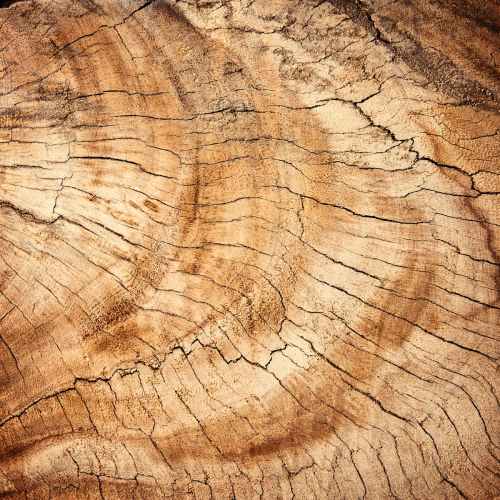
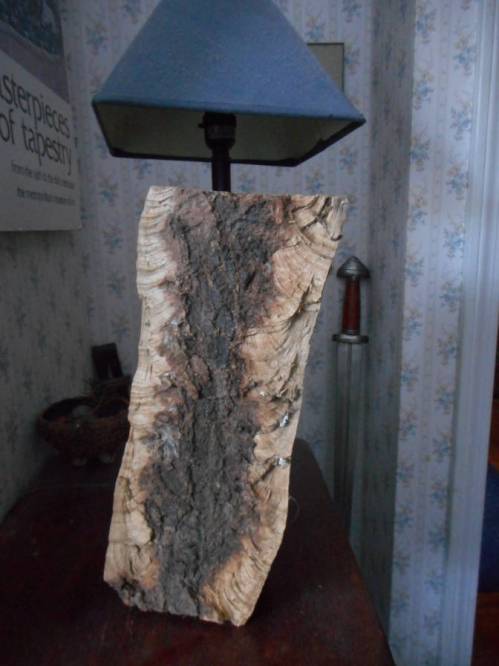
Going out to the woodpile, I participate in its manifestation, by being alive, in this place, here, now. A log, the heartwood brown and rough. Nothing “special”, perhaps, but beauty, given freely. That counts in my book as “special”. I bring it indoors, the condensation damp on my hands, and set it on a side table to photograph. In the picture it looks like the lampshade’s growing out of the wood — fittingly enough: firewood, a source of heat and light.
/|\ /|\ /|\
Another bard offering words — William Stafford’s “The Dream Of Now”. This isn’t an expansive poem of the summer solstice, exulting in long days and heat and passion, but a poem about that core toughness in us, that sees us through winter along with all the other things fluffing out feathers and fur against the cold, or sleeping deep in the Earth till she warms again.
When you wake to the dream of now
from night and its other dream,
you carry day out of the dark
like a flame.
When spring comes north and flowers
unfold from earth and its even sleep,
you lift summer on with your breath
lest it be lost ever so deep.
Your life you live by the light you find
and follow it on as well as you can,
carrying through darkness wherever you go
your one little fire that will start again.
*dark-magic: magic that doesn’t let our own light in; magic practiced against our own better interests, something we almost always participate in, because our consent is required, until we notice and begin to wake up again. Always weaker than light-magic, though its power comes from convincing us otherwise by whatever means available: deceit, obscurity, false promises, appeals to our weaknesses (cleverly scouted out in advance) … Another reason to learn and practice magic: absolutely everyone and everything else all around us already practices it.






 A Druid Way
