As visual creatures we’re programmed to respond to faces. We project faces and human figures onto landscapes, the moon’s surface, cloud formations, etc. We make quick judgments about others on the basis of their faces and habitual facial expressions. And up to a point, we’re often justified in doing so. After all, we feel most comfortable around those who look like us. The “looking” part is key. Eyes tell us a great deal, and who hasn’t wanted at some point to remove the sunglasses from a stranger’s face so we can “read” the person’s eyes?

Hello Kitty
In particular, the properties of “cuteness” — large eyes relative to head size, rounded features, a set of proportions frequently common to young animals and humans — induce a “cuddle response” which the Austrian Konrad Lorenz asserted motivates adults to care for the young. Subsequent study has confirmed that the response is universal, crossing cultures — and incidentally allowing such things as Japanese cartoons like Hello Kitty to catch on in the West.
Of course there’s a large element of “warm and fuzzy” sentimentality in such images, and in how we react to them. Marketers know this and capitalize on it. And environmentalists, not surprisingly, find they can succeed more easily in garnering support to protect an endangered bird or animal that happens to have some features of cuteness over one that may be grotesque or otherwise off-putting. The Ugly Animal Preservation Society makes this point through its official mascot, the Blobfish. As the UAPS president notes, the group is “dedicated to raising the profile of some of Mother Nature’s more aesthetically challenged children. The panda gets too much attention.”

Blobfish
Perhaps this is why cultural images that actually possess real power can shock and startle us into waking up a little, because our increasingly sentimental cultures seem to have produced fewer of them in recent times. We may even fear the archetypal and subconscious energies that emerge in such images, because they can reveal the hollowness of much of our emotional and spiritual lives, as well as pointing out ways towards greater depth and integrity. We don’t know where we are with such images, and we may turn away in discomfort or disgust, or accuse the visionary or artist who helps manifest them, or misunderstand our own dreams where such archetypal images and figures may also appear, instead of understanding them as prompts to look inward.
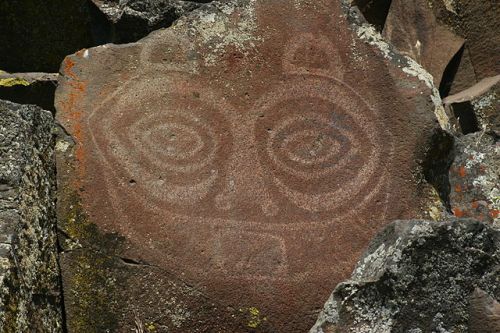
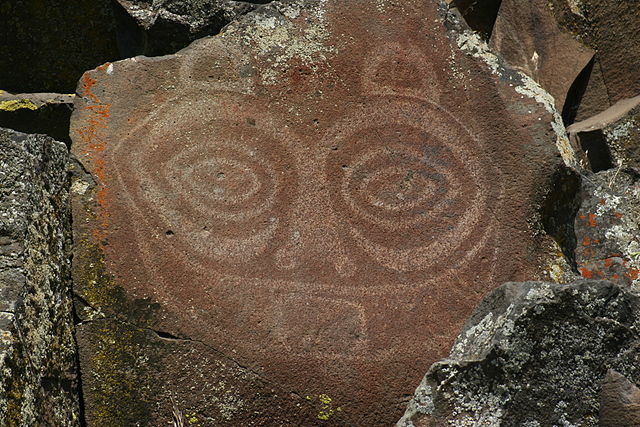
Tsagaglalal
The Wishram Indians of Oregon U.S. tell a story about Tsagaglalal (tsah-GAHG-lah-lahl) “she who watches,” whose image appears on a stone above the site of an ancient village. In part it’s also a story about Coyote, the archetypical Trickster figure of the Americas. Warning Tsagaglalal of a coming time when women will no longer be chiefs, Coyote tests Tsagaglalal’s resolve to protect her people. When he finds her worthy, he changes her to stone to guard the village she overlooks.
Visitors can see the combined petroglyph/pictograph of “She Who Watches” at Columbia Hills State Park near Dallesport, Washington. A guide now accompanies you — the image has been vandalized in the past.
[On a side note, when we lose our connection to the sacred, we may access a subsidiary glimmer of the original energy through the act of profaning it. Degradation and blasphemy do generate power of a sort. Human spiritual history testifies to this in figures and movements who have explored their possibilities. If they were too public in their explorations, they outraged the sensibilities of the wider culture. In the end, such practices seem consistently not to deliver what it is we seek anyway. Like the “withering away of the state” in Communism, human limitations sully the abstract ideal.]
/|\ /|\ /|\
Images: Hello Kitty; Blobfish; Tsagaglalal;

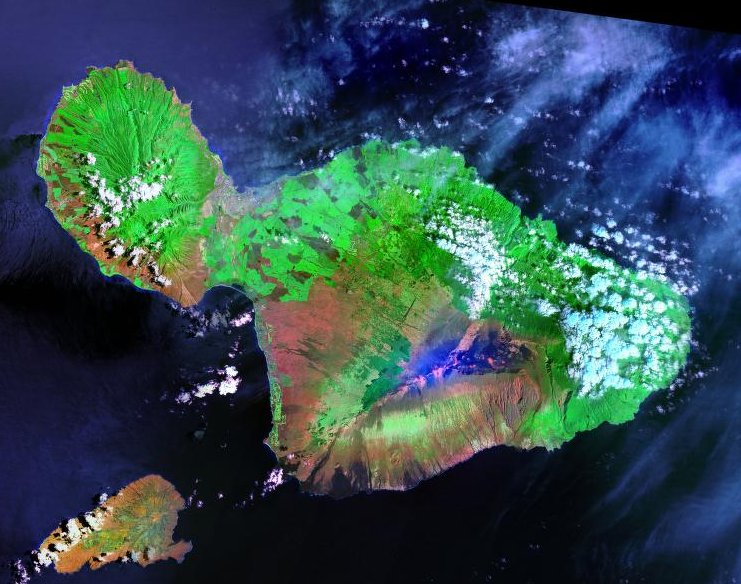
Maui — Landsat satellite view. Blue area is Haleakala — max. elev. 10, 023 ft.
Hi Lorna — thanks for your recent comment on “The Land is a Chief.” As usual, you dig beneath the surface and grapple with good challenges. You note, “To return … a sense of the sacred to landscapes … that have been viewed as profane” — that’s surely a major goal, if not one of THE central goals, of much Pagan and earth-based spirituality. At least I hope it is, or will be — it still feels like it’s in embryo form nowadays, in many places. Because there’s also a strong self-oriented strain that sometimes overshadows physical and spiritual work with the health of the land. It prioritizes self-fulfillment and personal realization and growth — important processes, yes — over the healing of the place(s) we find ourselves.
Of course it shouldn’t be an either-or: “You can’t have one without the other.” Many people struggle with spiritual ills that are manifesting, among other forms, as health challenges. Our honoring and reverencing of the old gods and spirits is one healthy “symptom” of practices for healing the land AND ourselves. We can’t hear and communicate and work with them if we’re too out of balance with ourselves and the land.
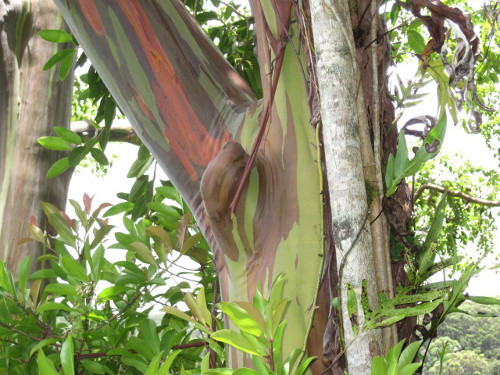
BELOW: Eucalyptus* near Huelo, East Maui, Hawai’i
I wonder, though, how much we’ve romanticised “traditional” cultures for their practices and beliefs — beyond what the “average” person in those cultures may actually have done or thought or believed. But maybe such romanticizing is part of a healthy corrective, needed today, to help re-balance our attitudes and motivations towards our treatment of the planet over the past two centuries. At least it gives us an ideal to work for: if we’ve damaged a landscape, we can heal it, and redeem our obligation, fulfilling our ancient commitment and responsibility as spiritual and physical beings in this world.
That sounds and feels right. We (often) say and dream it and proclaim it. But like you, I’m not sure whether or how (or how much) it will happen. For you rightly phrase it as an open question: will it “ever be possible to return such a sense of the sacred to landscapes that for at least the last couple of centuries have been viewed as profane?” We’ll answer that question with our lives, not just our words. And people of the next couple of centuries will judge and live with the results.
/|\ /|\ /|\
Image: Maui satellite view.
*My wife took this vivid image as part of a color study she is doing of native hues and patterns. Eucalyptus trees flourish along the Hana Highway, a very winding road along the northeastern coastline of Maui. Much of the area is tropical rainforest, though if you continue beyond Hana along the highway, the land transitions to desert in the southeast. One of the marvels of Maui and the other islands in the Hawai’ian chain is just how much climate diversity they exhibit over just a handful of miles in planetary terms.

Over a year ago, my wife’s aunt and uncle decided to celebrate their 50th anniversary by gathering family on Maui in Hawai’i, and very generously footing the bill for lodging as extra inducement, so we planned our car trip this summer to bring us to the west coast of the U.S., where airfares were — barely — doable on our rapidly-shrinking budget. Imagine seventeen of us — five families, with ages from 5 to 81 — piled into three rental condos.
I suspect the more green-minded among you are already saying, “But air travel’s so polluting.” And I’ll respond outright: it is. No argument there. So I’ll try to make up for such extravagance and excessive consumption through my witness, and through an attempt at some range in my reporting.
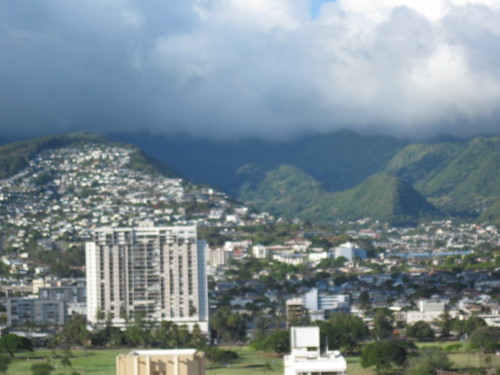
Yes, of course the islands are lovely. Even the sun-blessed sprawl of Honolulu can’t conceal the emerald hills that overlook the high-rises. Here’s a slightly blurry view to the north from Waikiki from our hotel room …

And, yes, you really can find the heart-stopping beauty you’ve heard about, often without stepping away from right where you are. Overhead, in a tree in full blossom, or in a striking run of notes of an unfamiliar bird-call, around a corner, or in one of the splendid national parks.
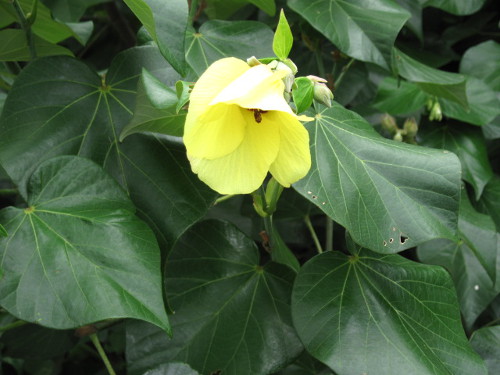
[BELOW: My wife’s photo of a Hau flower, Wai’anapanapa State Park, Hana Highway, Maui]

But what delights me the most — neither my wife nor I are “sun and beach” people, though the steady crash of surf and the breeze off the water lull even the two of us into “aloha” mode most effectively — is the growing presence and importance of traditional Hawai’ian culture and language. Without a sense of where I am, mere newness or charm quickly turns flat and lifeless. It becomes plastic. It’s easy to fall into one-dimensional tourist mode, paying for flat and plastic experiences with plastic. We’ve all heard this, probably done it ourselves, so we know what we’re talking about.
But the handful of long-time residents we’ve encountered, along with tour-guides and wait staff, all seem to agree on a healthy cultural trend. Much was lost during the last two hundred years of Western influence and interference — that sadly all-too-common story in so many places — but much has been preserved. There’s a pride in the native Hawai’ian heritage that may be one of the best predictors for the future survival of old crafts and stories, language and custom. One more place to cheer, however tentatively. If tourist dollars provide one motivation in holding onto surface charm and, gods willing, deeper cultural uniqueness, well, let’s utilize whatever works.
[Along with cultural ferment, it’s important to add, the island is striving in fits and starts to go green ecologically. Aging and polluting diesel-powered electricity generation is being supplemented (and eventually will be taken off-line) — by three hilltop banks of wind-power stations. And Larry Ellison (of Oracle software fame) has purchased 98% of the neighboring island of Lana’i (the former Dole pineapple island), with plans to make it eventually self-sufficient in food and power, and generate revenues by selling excess solar/wind power to other islands.]
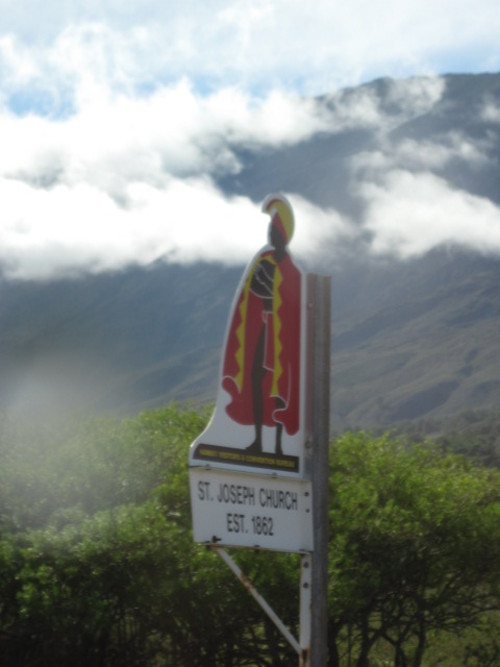
New-ish road-signs featuring the traditional ali’i or chief, like this one marking a church, say a lot. Native traditions and images, disparaged in colonial times, or made downright illegal like speaking Hawai’ian was, start to regain something of their original stature and significance, however incomplete, through their use as symbols and icons.

Since we’ve arrived we’ve frequently heard the Hawai’ian saying “Maui nō ka ʻoi” — “Maui’s the best”* — and without shamelessly trying to fake a non-existent familiarity with the archipelago (we’re here on Maui just 6 days, after all), we’re still inclined to think this particular island deserves its status: small enough to escape much of the busy-ness and hype of Oahu where we spent two days, and dramatically varied enough to provide rain-forest, tropical, upland, mountain and desert landscapes, all within a day’s drive on the “ring road” around east Maui.
In the end, though, for me as a brief visitor and interloper, it’s not the beaches but the mountains that call with the clearest voice of the spirits of place. He ali’i ka’aina, goes another local proverb: the land is a chief. He kauwa ke kanaka — we are its servants. To belong to a land …
Maui’s chief mountain is Haleakala, “House of the Sun,” though clouds often skirt the slopes. How instinctively we realize: mountains earn and deserve our attention as vivid gestures of our planet, and as ancient and powerful spiritual tools. Viewing them, meditating in their presence, ascending them, whether on a clear day or through a cloud cover that may cloak them in mystery, can mirror and induce a spiritual ascent.
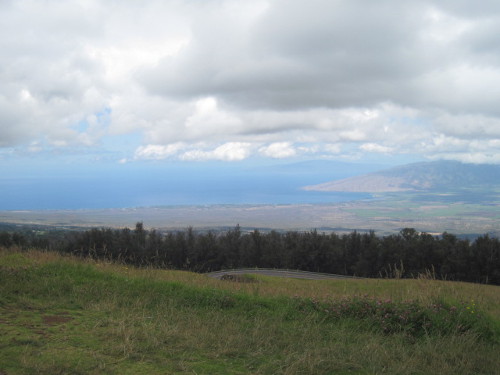
Here we are part-way up and facing west, overlooking west Maui. You can see the ocean on the left, arching inward to central Maui.

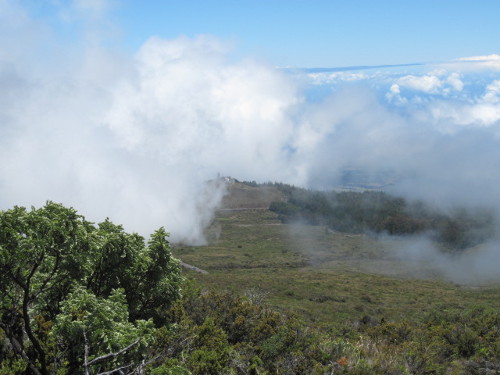
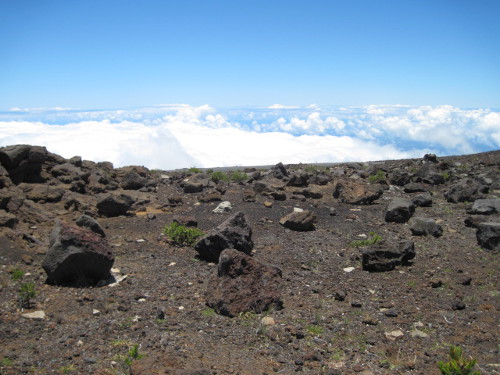
Vegetation thins as you climb above the clouds, till bare volcanic rock dominates. This is no longer the beach and sun of tourist brochures, but land still being born, raw from creation.

Hikers can make the climb on foot; if you haven’t already noticed your car’s temperature gauge, the sign announces how far you have come above the sea.

When you enter Haleakala National Park at either the coastal or mountain visitor center, you can pick up a bilingual pamphlet (Hawai’ian appearing first, too!) that clearly attests to the re-emerging potency of native Hawai’ian culture. Yes, you can not pick it up, or pick it up and not read it, or read and forget it. But … After a short paragraph explaining the principle of kuleana, responsibility to the land, “passed on to us from our kupuna (ancestors),” the visitor is admonished: “Therefore, as you enter this sacred place, this kuleana is now placed upon you.”
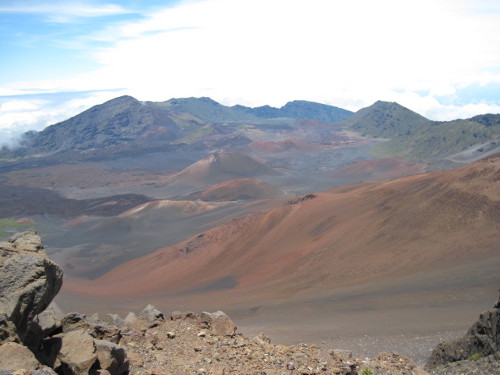
Here is the otherworldly crater at the peak.

Imagine such words in every park, every public place across the land! “Therefore, as you enter this sacred place, this responsibility is now placed upon you.” Then imagine people respecting and heeding such words. Here is a start, a seed. Let there be many such seed-places around the world. May we plant them. May they grow from here, from every such place. We need them so desperately. And may beauty help lead us where we need to go. This for me has been a gift of Maui.
/|\ /|\ /|\
*Maui Nō Ka ʻOi is also the name of a local island magazine, full of touristy articles and images.
After New Mexico and Arizona, we drove two long days, without tourist stops, on our way to Washington and the Olympic Peninsula (OP). Of course Utah, Idaho and Oregon have their own pleasures, but we’d focused our itinerary on some key destinations like the OP and its temperate rain-forests (with a side trip to Victoria BC). Besides, we were also due in Tacoma at a weaving conference my wife would attend. The contrast between high desert and rain-forest re-energized our tourist hunger.
With Seattle and Tacoma as our base (cheaper — and more easily available — hotels), we first set out counterclockwise, north then westward on Rt. 101, the ring-road around the OP. Dining opportunities were one major draw. With Hood Canal (below) oysters and clams and Dungeness crab from the Strait of Juan de Fuca to choose from, you too can fulfill your devotion to terroir with fresh and local cuisine, especially if good seafood is at all your weakness.
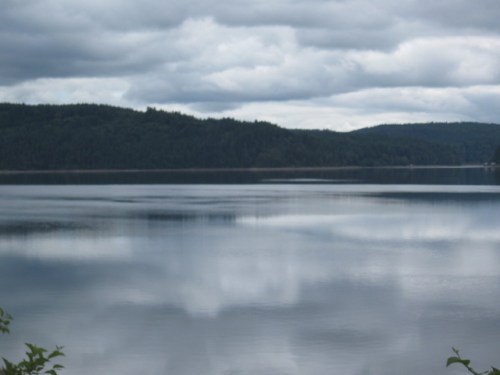
Along Rt. 101 we passed through Sequim WA (locals say”Skwim”), which now ranks with Tucumcari as one of my favorite U.S. place-names, and a contender for an innocent word that nevertheless sounds suggestive. Dosewallips runs a close second or third. (As anyone knows who lives in or has visited the UK, place-names there merit their own special category of oddness and delight: as a random sampling, Dorking, Icknield Way, Dalwhinnie and Hail Weston do no more than scratch the surface. Check out the comprehensive and searchable Dictionary of British Place Names).
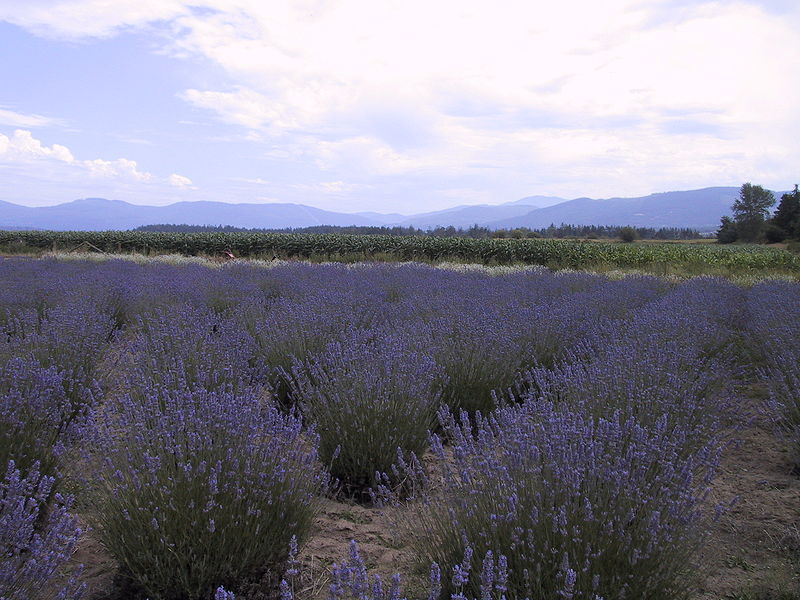
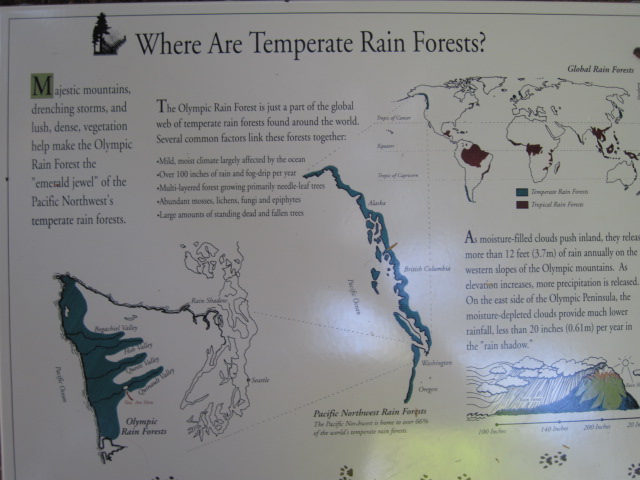
One of Sequim’s claim to fame, given its unique climate, is lavender farming. Though within crow-flying distance of rain forest with 12 feet (3.6 m) of rain per year, Sequim often sees no more than 16 inches (41 cm). As they tend to do world-wide, the mountains here dominate the weather, with the ocean-facing west slopes capturing the bulk of the precipitation, leaving the lea-side much drier. Image credit: Sequim WA lavender field

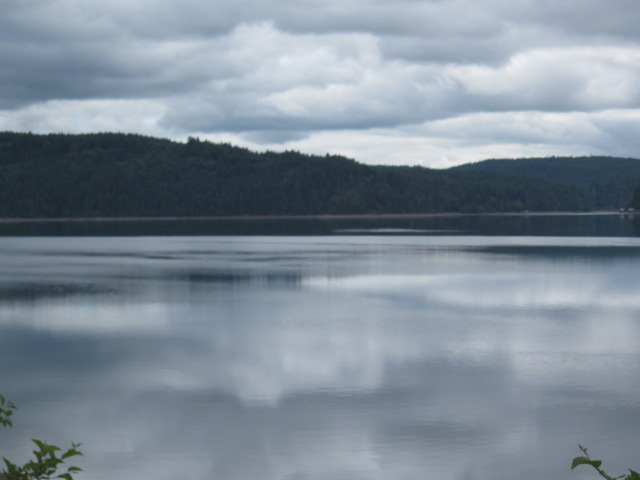
Rt. 101 hugs the south shore of Lake Crescent starting some 15 miles west of Port Angeles (jumping-off point for a ferry ride and day-trip — or longer — to the lovely Victoria, BC) and is a beautiful spot to explore, too.

But the lovelier leg of the trip, we felt, came the second day, clockwise this time, heading west out of Tacoma, again on Rt. 101, but this time north around the western reaches of the OP.
In the southwest OP, Rt. 101 curves inland up a fjord-like glacial channel into the mountains of the Olympic National Forest, revealing the jewel of Lake Quinault. The Quinault Indians (most “Native Americans,” we were told repeatedly, apparently prefer the older name) are another tribal group that’s survived into the 21st century.
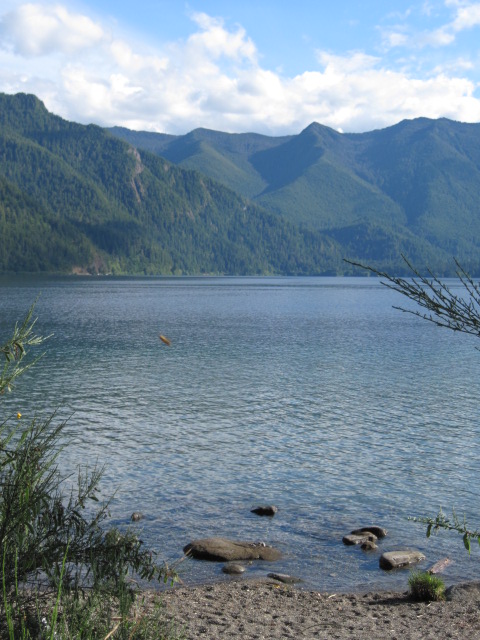
On the lake’s south shore is a fragment of relatively unspoiled rain forest.

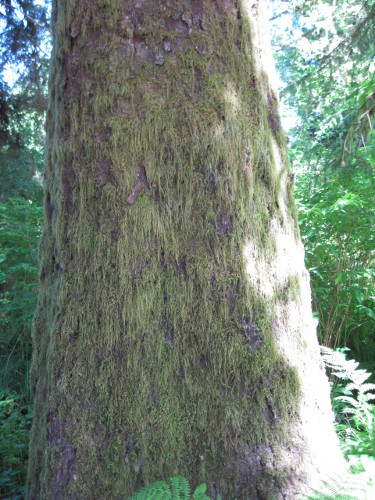
Below, in best tree-hugging mode, I give myself a visual reminder of how large so many of even the “average” trees are. Here we walked among many Greenhenges.

Ferns thrive, too, in the wet climate.

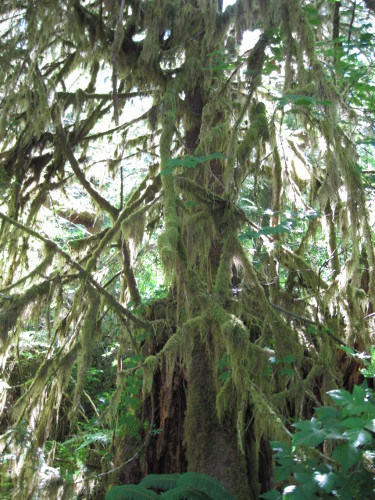
Everywhere you look is lush and replete with delicate mosses.
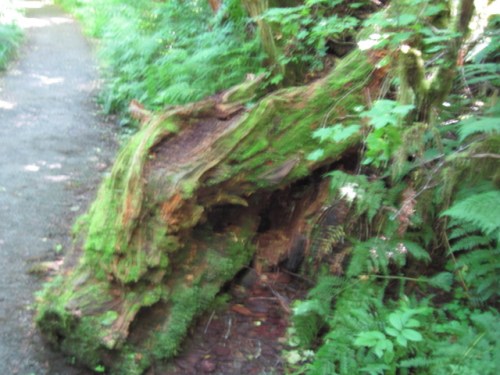
One sign explained how fallen giants serve as “nurse trees” for the next generation.

Such signs become quickly redundant with scenes like the one just below.
/|\ /\\ /|\
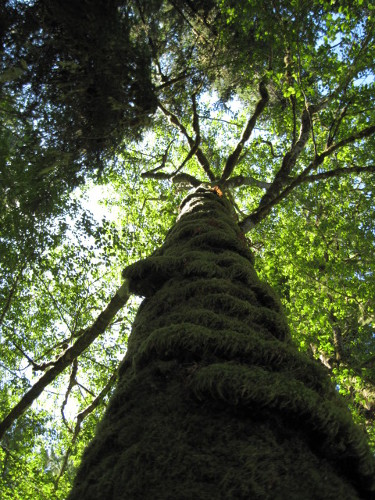
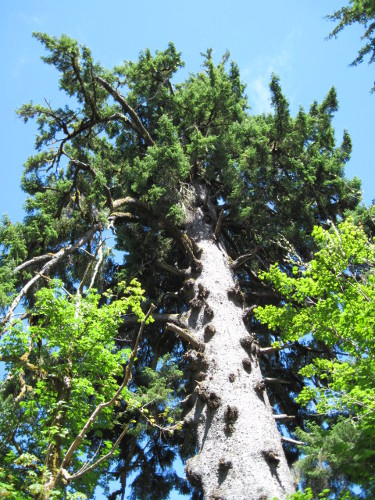
I’ll close with several more images from the forest. The final three form a forest triptych: the crown of the great Sitka spruce and its whorled trunk.




Visitors know New Mexico enjoys an eye-catching landscape — the state nickname “Land of Enchantment” burnished on its license tags (or plates, depending on your regional dialect) is no oversell. But what struck us more was the frequency of change in the landscape. The more familiar canyons and cliffs of Arizona aren’t quite here yet, but the New Mexican dells, dales, arroyos, vales, valleys, peaks, buttes and rises, along with fluctuations, almost by valley at times, in rainfall, vegetation and wildlife, underground water sources, altitude and geology, make for lovely and dramatic varying terrain.
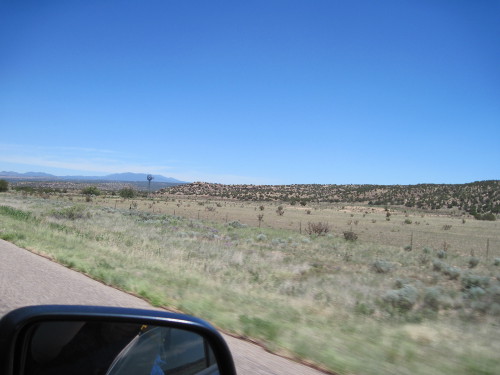
Part of the surprise is that west from Texas into New Mexico, the landscape at first changes not at all. Here through our bug-stained windshield is the arrow-straightness of interstate 40 and dry, flat prairie.

But soon enough distant mountains shadow the skyline. If you’re intent on traffic (speed limit 75 mph) or keeping cool under a southern sun and escaping hynosis from the lull of hours passing, you may not notice them at first.

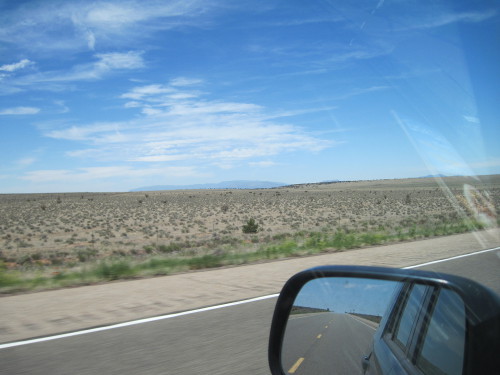
The geologic “ripples” slowly and steadily edge closer till they insist on being seen. The land insinuates itself into your awareness, serpentine.
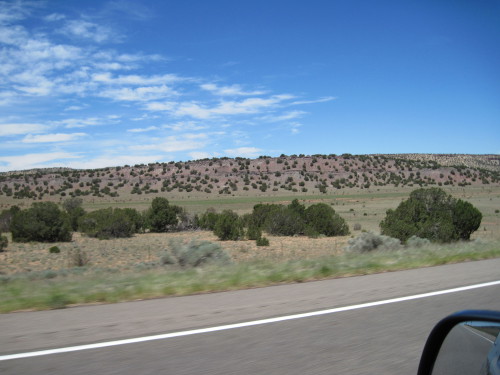
And by Tucumcari NM, the buttes start in earnest. Many like the one below are so etched by wind and heat and rain and time that they seem unreal, the work of a whimsical or apprentice set designer. Here, too, wet and dry stand side by side. As heedless easterners accustomed to the default of lush greenery and nearly endless water, we took to heart the endlessly repeated evidence of the vital importance of water here.
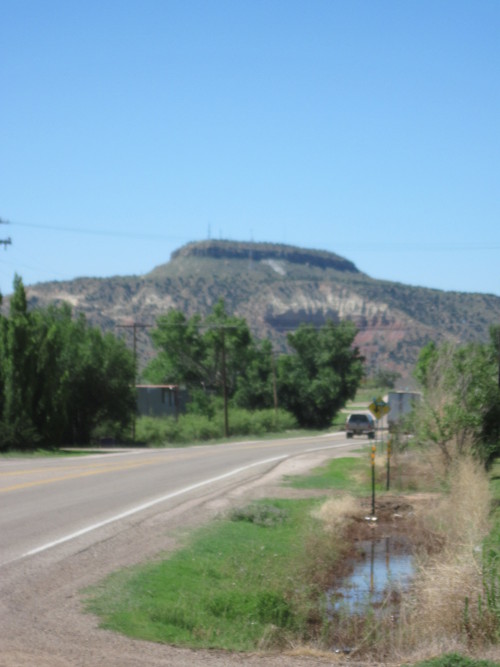
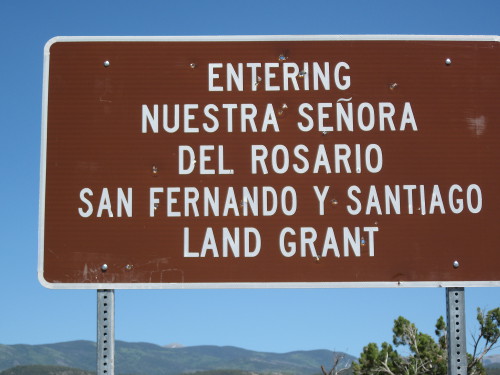
Part of the pleasure of New Mexico — for me at least — is the omnipresence of Spanish — in place names, on road signs, menus, shops and gas stations. Not that I actually know much Spanish — only a bare reading knowledge, along with some cognates from French (high school level) and Latin (badly self-taught).
Here Anglo-Americans like us can’t pretend the planet speaks only English — it obviously doesn’t, and places like New Mexico, just like Northern Vermont and New Hampshire with the proximity of Francophone Canada to the north, can serve as gentle and pleasant reminders — introductions to an accessible foreignness. Almost every American can point to a smattering of a dozen or so Spanish words they half-know, courtesy often of Hollywood and Tex-Mex cuisine and its less noble fast-food relatives. And Spanish — real Spanish — runs deep here.

This greener region was part of the “weaving tour” we took, northeast from Santa Fe, through Española, from there to Chimayó, into the highlands and through hill towns like Truchas (elevation 8000 ft., rivalling the Grand Canyon), and on to Mora with its Tapetes de Lana, the trees so far holding onto their green in the growing heat of summer. And by “weaving” I mean quite literally the craft of weaving — my wife had mapped out in advance weavers and studios she wanted to visit.
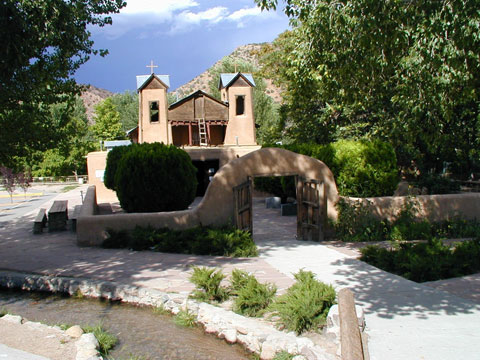
In Chimayó we made a brief pilgrimage to El Santuario de Chimayó, a stop urged on us besides by one of the local Spanish weavers my wife and I visited. Wikipedia names the humble and beloved sanctuary and community church “the most important Catholic pilgrimage center in the United States.”

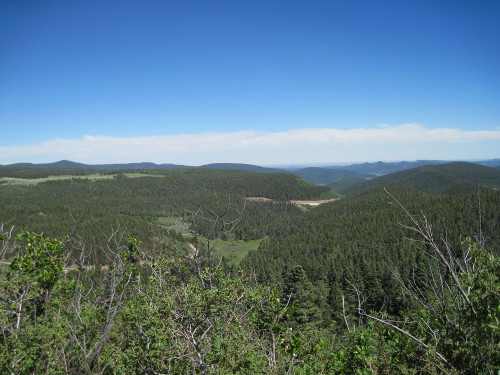
ARIZONA: OAK CREEK CANYON and NORTHERN SEDONA
After several days of exploring outward from our base of Santa Fe, which enjoys a very walkable and historic downtown, the Plaza, we drove on to Arizona. (With an eye for tourist dollars, Santa Fe developers overdid the adobe, with plenty of “faux-dobe,” as native cynics call it, nevertheless lending Santa Fe an admittedly distinctive look all its own. The endless shades of pink and beige and unnameable variants between them simply mirror the land they derive from.)

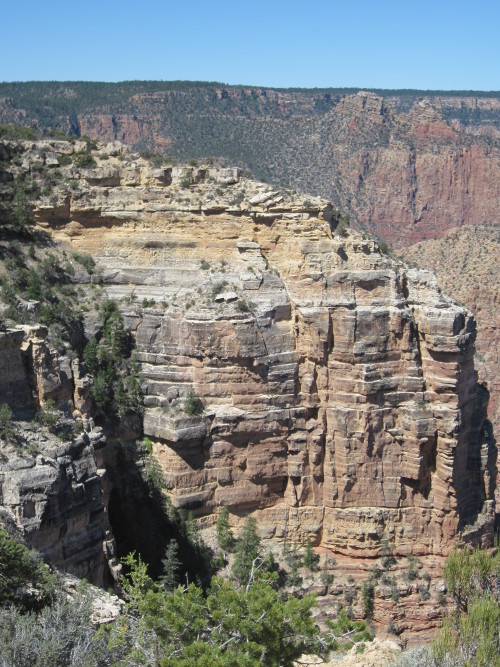
Friends in Sedona beckoned us south from the big state draw of the Grand Canyon, which would keep for the following day. This is a landscape that keeps whispering I have been here a long time, I am still here, and I will be here long after you are gone..
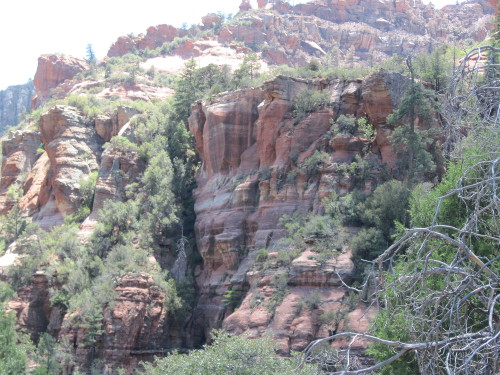
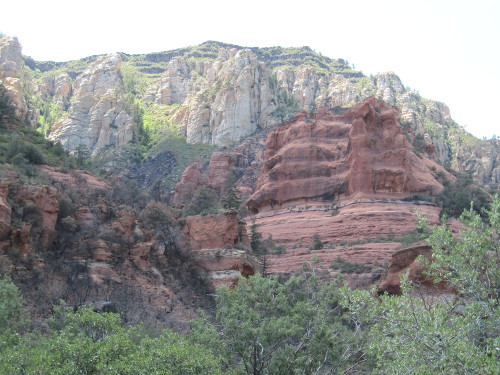
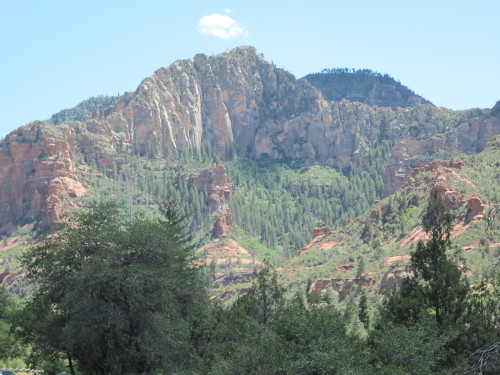
Sedona hogs most of the tourism for central Arizona, apart from Flagstaff as a portal to Grand Canyon, but a stunning preamble lies between Flagstaff and Sedona itself, along Oak Creek Canyon. Besides, whenever we could we like to get off interstates if mere distance traveled isn’t our main objective. So off interstate 17 and onto 89A takes you through these striking canyons.



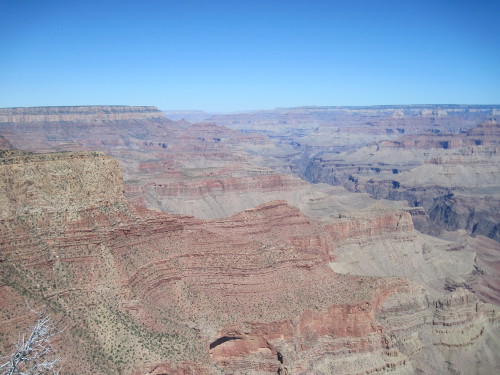
GRAND CANYON
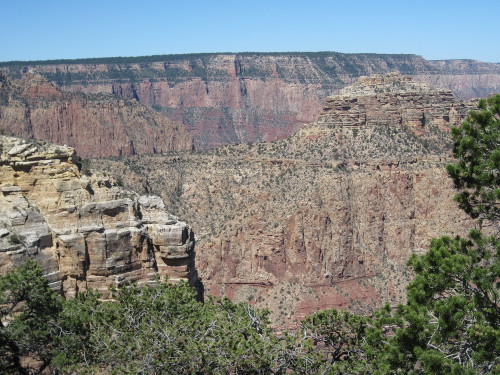
Mather Point is the main overlook, the most photographed spot, a sort of “Grand Canyon Standard,” if one is needed. Yes, it deserves its primacy of place — and the crowds follow. But plenty of equally fabulous lookout points to the east deserve a stop, and draw far fewer visitors in comparison, making for a quieter, more meditative experience. (Our Sedona friends, and hotel staff as well, said to arrive at the south rim early in the morning. Good advice — we departed from the Canyon around 10:00 am, just when it seemed everyone else was arriving.)



NORTHERN ARIZONA, or (as we came to think of it) MARS …

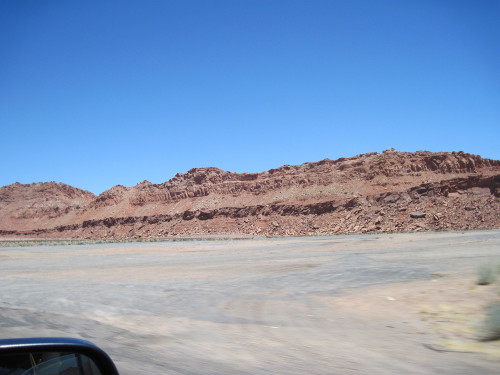

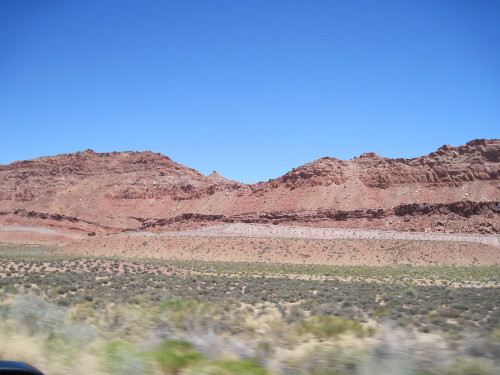
Here’s the environment around Rt. 89 again, the northern piece of it, west of Page, AZ and SE of Kanab, UT, well north of the North Rim of the Grand Canyon, though still called the Grand Canyon Highway, on its way through some wonderfully stark country. The image looks somewhat fuzzy until you realize you’re looking across a plain to a ridge some 30 miles away — the camera foreshortens the distance without clearly resolving the scale of what it captures.

And a mere six or seven miles up and out of the valley, forests take over again, once sufficient elevation — and rainfall — lifts them above the heat of the plain. A few miles further west into hills and we pass Jacob Lake Inn. The coolness as we drive by, windows down, is delightful.

Images: Santa Fe Adobe; El Santuario de Chimayo; all other images by the author.
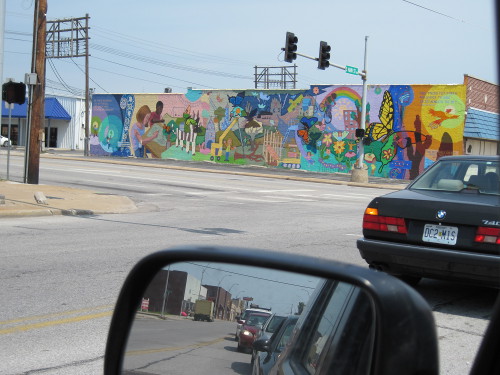
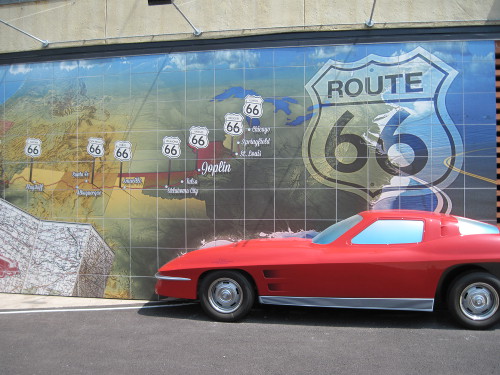
Adruidway takes a break from its (ir)regularly scheduled blog to offer you images from the initial westbound leg of our trip. The historic Route 66, variously known as the “Mother Road” and the “Will Rogers Highway,” endures in fragments across the country. It first opened in 1926 as one of the first roads in the U.S. Highway System. We drove a particularly picturesque 12-mile section from Joplin MO into Kansas. Here’s an elaborate south-facing mural at an intersection in Joplin where we (eventually) picked up Rt. 66. Alert viewers will note we’re not in the left-turn lane — we missed the signs and overshot the turn itself because the mural drew our attention.

A second mural on the side of a True Value hardware store celebrates the old cross-country highway, which flourished in the first half of the last century.
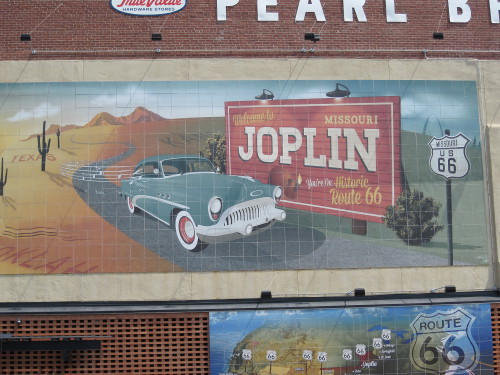
Walk closer and peer over the low wall and you see the sporty red model below, which looks ready to roar off. But it’s actually just half a car, permanently attached to the wall.

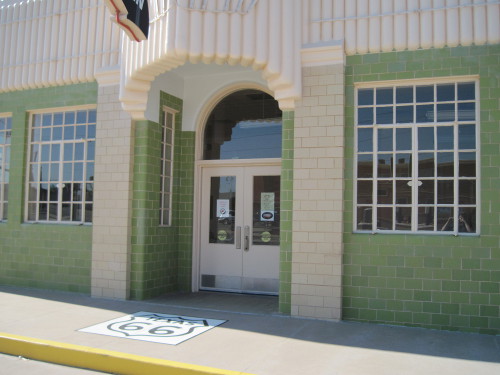
Another fragment of Rt. 66 surfaces in Shamrock TX, where this old Conoco gas station has been beautifully restored.
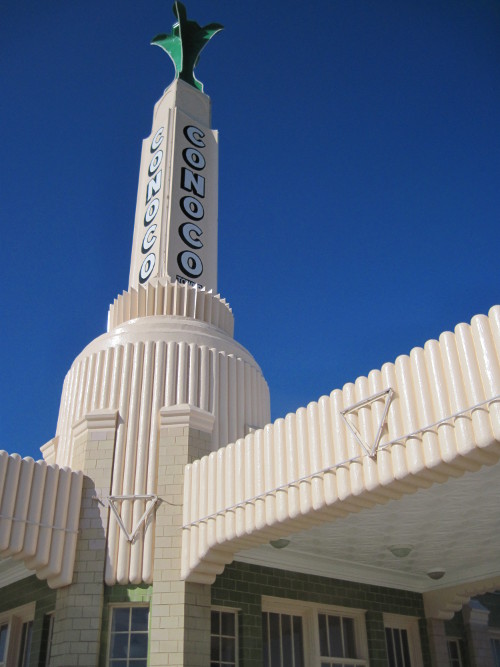
The station now enjoys a second life housing the Shamrock TX Chamber of Commerce.

But its main claim to fame? A digital version of the station features in the popular 2006 Pixar film Cars, where the town was renamed “Radiator Springs.” And the red tow-truck in the background is the original for the character Mater.
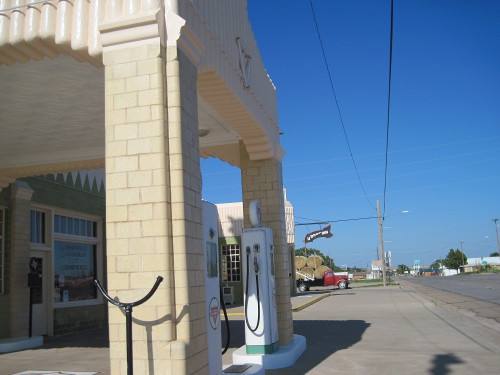
Take a look at the “price at the pump,” of the 1960s era, forever frozen in time: 27 cents per gallon.

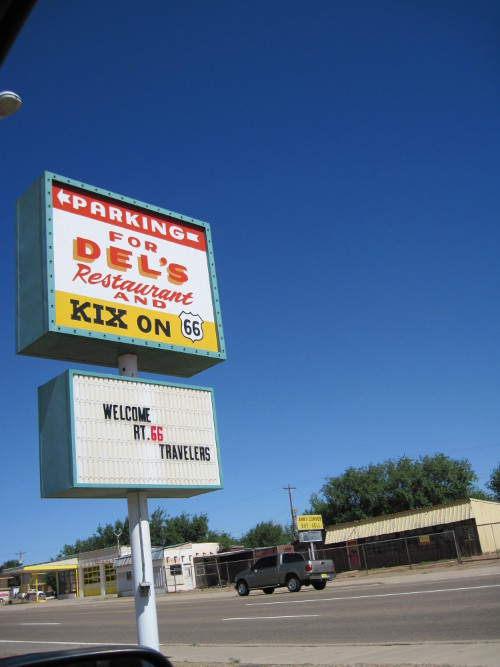
The last fragment of Rt. 66 we drove pops up in Tucumcari NM (one of my all-time favorite place-names). Dell’s restaurant still offers you “kicks on Rt. 66,” echoing the 1946 song written by Bobby Troup and first recorded the same year by Nat King Cole.
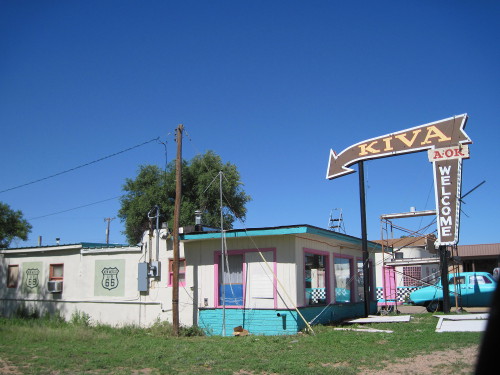
So many other things to photograph. Here’s the Kiva motel, reassuring passersby it’s “A-OK.” We loved how many surviving structures celebrate the exuberance of the old route with vivid colors.
 In her comment on a post from August ’13, Lorna Smithers makes a distinction particularly vital for “Bardic types” that I want to take up here, especially in light of my last post:
The division between what remains in the journal and what to communicate is a question I confront continuously as a Bard, for unlike with a path that focuses solely on personal transformation through magic, Bards are expected to share their inspiration.
I find that some experiences are ok to share immediately, others need time to gestate for the meanings to evolve and take on a clearer form, and a select few may always stay secret.
I see good craftmanship to be the key [to] sharing experiences. In contrast to the vomit of ‘compulsive confession’, well-wrought craft lifts the raw material into the realms of art, creating works that affirm the awe and wonder of the magical world.
That Bardic instinct to share inspiration that may or may not have been shaped by art can get us in trouble. The desire to bring into physical expression something that’s going on in your inner worlds can lead to what Lorna accurately calls vomit. Sometimes, of course, awen really does drop a piece of loveliness in your lap. It arrives fully-formed, and you run with it, dazed and delighted and puppy-like in your enthusiasm to share the wonder of it with all and sundry, but that (the gift of inspired loveliness, not the puppy-like response) usually only happens when you’ve done plenty of the hard slog of shaping already, alone or with only yourself and your gods for support of a vision no one else may even know anything about.
Sometimes the time and energy your pour into nurturing your creativity can make you defensive if you haven’t “produced” anything visible. If you’re a writer, for instance, you’re not a “real” writer till you’ve “published.” Few will care about the months, years or decades of work that may lie shelved in boxes or occupy megs of space on a computer. The same holds true in comparable ways for anyone who’s devoted time and energy to a craft or art.
 Artists who should know better sometimes like to hint, or let it be inferred, that this business of “awen on command” is how they work all the time, both mystifying us “ordinary mortals” and also doing a disservice to their craft and the nature of inspiration. Talent, oddly enough, responds well to practice, and no one works most of the time without effort.
The Anglo-Saxon bard was called a sceop, pronounced approximately “shop,” “one who shapes” inspiration into language and song. And the word bard comes from an Indo-European root *gwer- that means “to praise” or “to sing,” indicating two of the roles of the Celtic bard. The same root appears in Latin gratia, and English grace — a whole cluster of relationships — the gift and our response, our gratitude, and the quality in things blessed with awen, the loveliness and fluidity and rightness they often evince.
But if I opt to share something that’s not ready or right to share, I’ll usually regret it. Let me enthuse or gab about a story or an inner experience before its proper time, and it may lose its luster. It no longer thrills me enough to work with it, and I take what was a gift and cast it aside, its charm lost. The spell is broken, and I am no longer spell-bound, or able to do anything with it. Like the old fairy story of the goblin jewels, in the daylight of the blog, or the careless conversation with another, the one-time treasures that sparkled and shone under moonlight have turned to dead leaves. One or two such painful experiences is usually enough to teach anyone the virtues of silence, restraint and self-discipline.
 Another half (there are almost never just two halves, but three, four, five or more) of the whole, however, is that keeping the flow going, trusting the awen enough to go with what you get, and allowing the work to manifest, brings in more. Jesus did know what he was talking about when he said (paraphrased to modernize the language), “To people that already have, more will be given, and from people that don’t, even what they have will be taken away.” While this may sound at first like contemporary government policy and destructive legislation and current economics, it holds true on the inner planes, in the worlds of inspiration and imagination.
Lorna herself is an exemplar of this Bardic trust and inspiration. As an Awenydd, one who receives and shapes the gift of awen, she demonstrates in poetry and photography on her blog and in performance the mutual bonds with the Otherworld and spirits of place that make up her path.
And so it was with considerable interest that I read her account “Personal Religion?” well into writing this post, while I was checking that the URLs were right for the links to her blog. She experiences a strong reaction on hearing about the OBOD Golden Anniversary celebrations, and launches into a series of probing personal questions without immediate answers which I urge you to read directly. The challenges she faces are those of one attempting to be faithful to a call, and she follows a path with honor. Her struggles illustrate the living nature of the Pagan path, with its many branches and trails. Her practice flourishes precisely because she strives to be faithful to her own vision, which may not always grow and bloom under the “big tent” of orders like OBOD.
Making that struggle visible is valuable — posting it for others to read, ponder and benefit from.
/|\ /|\ /|\
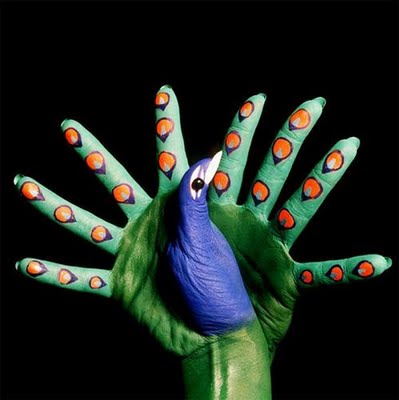
Images: handbird; hard at work; walking.
In the lovely and iconic image below, courtesy of Cat Treadwell, Druids climb Glastonbury Tor earlier this month as part of OBOD’s Golden Anniversary. Fifty years ago, Ross Nichols (1902-1975) — poet, Druid and school-teacher — formed the Order of Bards, Ovates and Druids. As a member of the Bardic grade, of course I yearned to attend. For a delightful acccount of the event, go here for Joanna van der Hoeven’s 9 June 2014 post “Celebrating 50 Years of OBOD” on her blog “Down the Forest Path.”

OBOD 50th Celebration — Druids climb Glastonbury Tor. Image Courtesy of Cat Treadwell
Does it matter whether Druids and Glastonbury share a historical connection? Ultimately, only to historians. The lived experience of Druidry, as of any flourishing tradition, means that what we do today shapes our experience more than what may or may not have happened in the past. When my fellow Druids assembled in the town and on the Tor, the sense of community, the sharing of ritual, the reunion of friends, the inspiration of the talks and workshops, the sense of history, and the beauty and much-vaunted “vibe” of Glastonbury, all converged. And the same kind of convergence is true of personal experience as well.
Though OBOD’s Golden Anniversary celebration tugged deeply at me, my wife and I had already committed resources to a trip within the U.S. I couldn’t manage both, so I had to forgo what was by all accounts a moving and delightful celebration. But I couldn’t sustain much self-pity, because our own itinerary included a return to Serpent Mound in southern Ohio. I’d visited before in 2008, and experienced a strong past-life recall there. I saw and heard further details this time. Among them were a specific name (of a tribe? a person? I don’t — yet — know), voices singing, images of the tribe’s shaman, and of my death near the Mound in an inter-tribal conflict.
 But these details, while moving and significant to me, matter less than the impact which these kinds of experiences make in general. As an instance of “unverified personal gnosis,” my experiences don’t require any belief on my part, though of course I may choose to believe all sorts of things as a result. Nor do such experiences legitimize any attempts I may make to persuade others that my experience was “real” or that they should act differently towards me — or their own lives — as a result. What the experience did establish for me is a strong personal resonance with a place and a culture, and a doorway to potential future choices and insights about my life and personal circumstances that I might not have been able to access in any other way. Whether I choose to act on that experience is my responsibility. (What is significant to me right now is that the details of my experience form the basis for a decent historical novel, for instance — one way to dramatize my personal experience and — with further hisorical research — turn it into art. I feel I can explore and concretize its significance most vividly and vitally this way. And who knows what further confirmations such research may provide?)
 The Serpent is “a 1,348-foot (411 m)-long, three-foot-high prehistoric effigy mound located on a plateau of the Serpent Mound crater along Ohio Brush Creek in Adams County, Ohio” (Wikipedia entry, and the sign above). On the ground, it’s not a particularly impressive structure — at first. A 30-foot viewing tower near the tail of the Serpent allows some height and perspective for the kind of photos I took. Shadows in pictures taken early or late in the day help highlight the shape and outline of the Serpent.
Both the age and purpose of the Mound are a matter of debate. Many published sources estimate the time of its construction around 1000 or 1100 CE. But the Ohio Historical Society guide at the site assured us that recent archeological studies, due to be published later this month, revive the claim (with apparently solid evidence) that the mound dates from an earlier period around 2000 years ago. Artifacts recovered from the mound include charcoal, beads and other jewelry, flint knives and arrow-heads, and deer-bone tools.

Aerial shots like the one below begin to convey the size and significance of the mound:

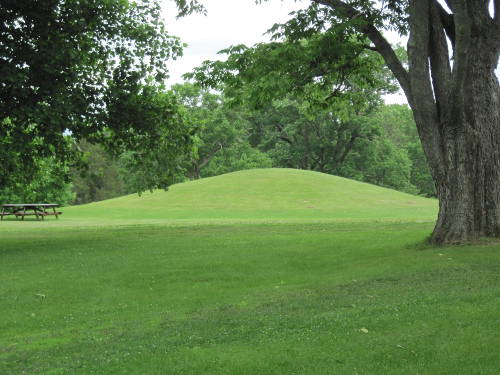
Add to this the presence, both at Serpent Mound and elsewhere in Ohio, of separate conical mounds like the one below (the picnic table in the foreground gives an approximate yardstick to estimate its size), and for me at least the sense of Adena tribal presence and purposefulness grows in my heart, a living thing.
/|\ /|\ /|\
Image: Aerial shot of the Mound. All other images by me.
“In this year of celebration of the Golden Anniversary of the Order,” writes OBOD Chief Philip Carr-Gomm, “it seems fitting that we should turn our attention to celebration as a natural and spiritual response to the fundamental turning-points in life.” (Here, under the the listing for “17-21 September.”)
I’ll be posting over the next day or so from Santa Fe, NM, as part of an extended car trip around the U.S. Now we just have to get there — up and soon to be on Rt. 40 west from Amarillo, TX. Happy (approaching) solstice to all.
[Part 1 here]

Vikuklunomes!*
So it goes, so we go:
Uncircle! and the Elements flash and dance,
mingle, spin and dissolve, three, a dozen,
scores, just one, an alchemy gods conceive,
humans guess at — join, sometimes —
give birth to, even:
waterfall of fire, tower of wind,
burn of dust that is our bones in us
dancing too. Can’t help it.
In the center
spirit rests, while power
loosed like a bird from its long cage
circles on wings that feather our faces,
flies off to its home, still roosting
in our hearts, eaves of thought,
door to tomorrow, hearth of dreaming.
/|\ /|\ /|\
Image: Druid Order of London; Cadet Chapel Falcon Circle at the Air Force Academy.
These images accompany two very different articles (here and here), worth reading, which sample some of the work still to be done for spiritual and religious freedom and more informed understanding. (Oh my brothers and sisters, this is my prayer; may we learn to take wing and fly free of fear.)
*vikuklunomes: [vee-koo-kloo-NOH-mehs] vi- “reversing prefix” + kukl- “circle, wheel” + -un- “become” + -omes “first person plural– we/let’s”; a verb in Dingva, one of my conlangs (constructed languages) based on Proto-Indo-European. Noun form: vikukluna [vee-koo-KLOO-nah] “uncircling, unforming a circle.” An incomplete and older version of Dingva appears here.
[Related posts: Shinto & Shrine Druidry 1 | 2 | 3 || Shinto — Way of the Gods || Renewing the Shrine 1 | 2 || Boku no Shinto — My Shinto 1 | 2 ]
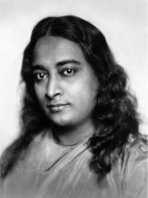
Paramahamsa Yogananda
“Its technique will be your guru.” With these words (ch. 11 of his famous Autobiography, online here), a young Paramahansa Yogananda (1893-1952), founder of Self-Realization Fellowship (SRF) and a principal exponent of Kriya Yoga in the West, counsels a peer he has just initiated into the tradition he follows himself. With these words he also points toward a kind of spiritual path that Westerners, rightly wary of super-sized personalities and god-realized con-men, can approach and walk. A flexible and potent technique can be a trustworthy, profound and endlessly patient guide.
Technique as guru: as a practitioner of OBOD Druidry and Eckankar, I know firsthand that a technique responds to practice and devotion as much as any teacher. Religious and spiritual practice will always be as much art as science, because they welcome (and can profoundly benefit from) our subjectivity, even as they also point to their scientific aspect — definite and repeatable results we can achieve from dedication and regular practice. My emotions, my commitment, my ambition and drive, my struggles and dreams can all contribute to my practice — leaven it and enrich it and make it “mine.”

“other” as double: both of us angry at each other
My anger at the driver who cut me off in traffic last week, on my way back from dropping my wife off to stay with her cousin, can help me uncover other unexplored pools of anger I can work to identify, learn from, and transform. Anger by itself need not be bad, only unconscious anger, anger I act from unthinkingly, little different from a live wire I brush against in the dark, unintentionally — or attach to a light fixture and illuminate another step along the way. Without the experience of anger, I might well miss the wire altogether, and forfeit a chance at illumination.
I can, if I listen, come to see that my whole life is laboratory — not only what I close the door on at 4:00 or 5:00 pm each weekday and return home from. The individualistic-narcissistic-tending “MY spirituality” gets whittled down to more beneficial size through ongoing spiritual practice. And paradoxically reveals a personalized curriculum tailored to me, right now and here. Anger? Yup — that’s on my curriculum, though it may not be on yours. And my life is ideally set up to help me work with precisely that curriculum point, just as yours is for your distinct points. Yes — we share a “common core,” too.
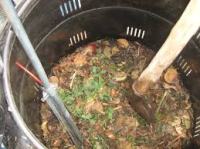
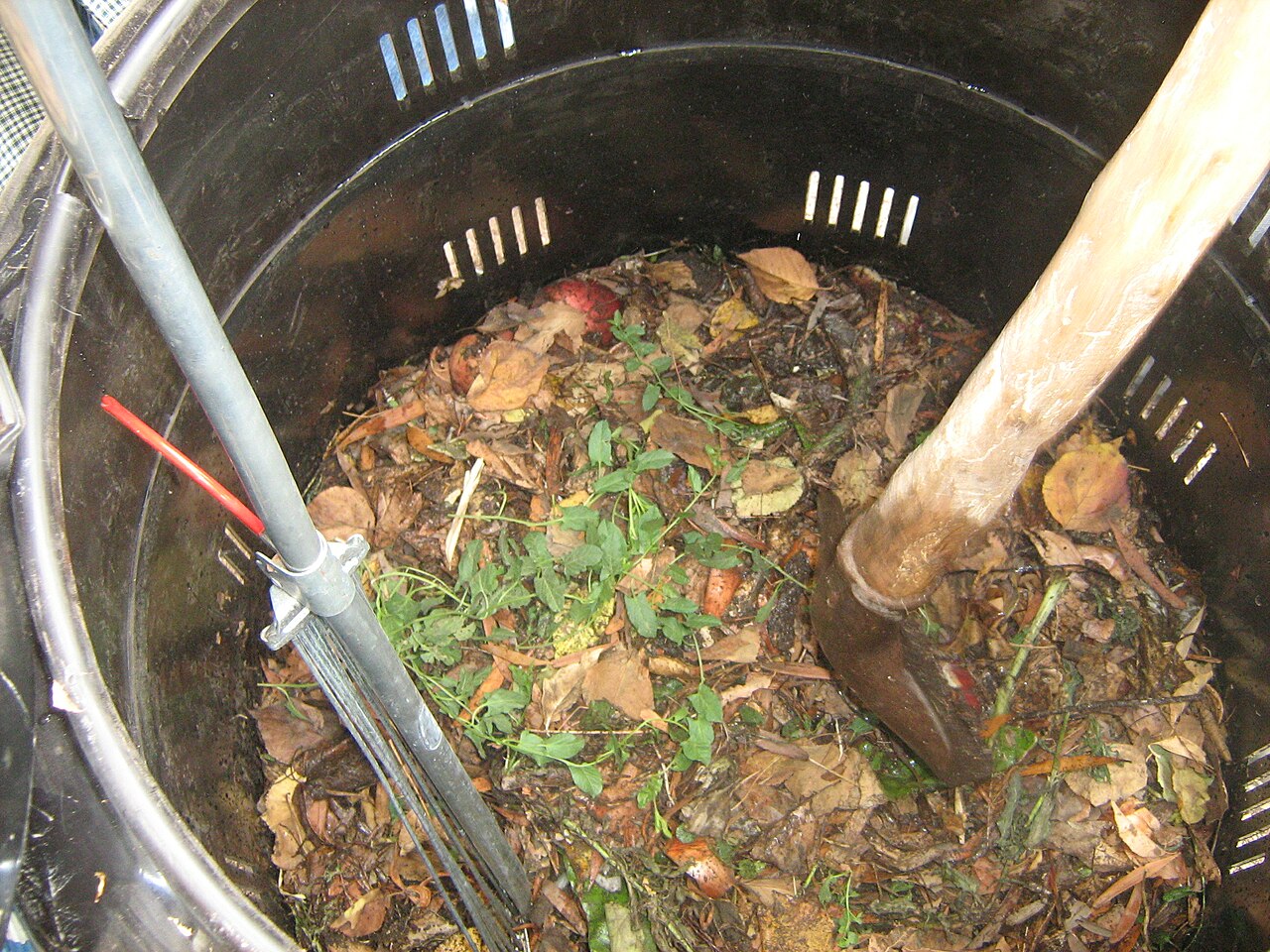
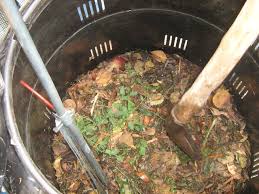
compost: just another point along a transition
A practice like Druidry that places me in the natural world immediately begins to slim down ego in concrete ways and immediately accessible ways: merely walk out the door, and at once it’s clear I’m not the center, nor even the “most important” thing in the universe. I constantly meet the “spirit other”: animals, birds, trees, and beings without skin on — or bark, or fur, or scales. I am a paragraph in a chapter, not the whole story. And that’s a good thing, because the world is guru, too. Hard limits of some kind are the only way a world can work (try seriously to imagine one without them), but if I engage them wisely, they build spiritual strength rather than frustration, nihilism and despair. This physical body is eventual compost, like everything else: but not yet. And this interval is all. (Whether it is also “only” is an experiential question, one which only experience can accurately answer, not some dogma to be believed or rejected.)
“My Shinto,” my Way of the Spiritual Order of Things — let’s call it WOTSOOT — begins with the circumstances of my life today. Here I am, a 55 year-old white male, a teacher, a cancer survivor, married, nearsighted, in fair health. The initial details of your personal WOTSOOT naturally vary less or more from mine. They’re also often quite superficial — party chitchat, gossip in my cul-de-sac. Because I am also a point and vector of conscious energy situated in widening networks of energy exchange. I breathe, and chlorophyll all around me gets inputs it needs. Bacteria on my skin and in my gut flourish, and help me flourish too, if I stay alert to their balance. I sweat and crap and piss, and nutrients move where other beings can begin to use them. I consume some of these other beings — not too many, if the system is to remain in equilibrium — just as some them will consume me. New networks arise, as older ones shift or die. And part of my practice is: all praise* to the WOTSOOT!
Such processes of the physical realm are both fairly well understood and all too rarely incorporated into larger networks that spiritual teachings of all kinds tell us glow and ripple and transform and pervade the universe. Scientific insight begins to catch up here and there with spiritual wisdom. Not dogma, not theology, not creeds — that’s merely paparazzi spirituality — but insights into living networks — the shin-to, the “spirit-way.” As I write and you eventually read this, we use an electronic network we’ve crafted that simulates in surprising ways organically occurring ones, and we can acknowledge the remarkable power and potential of such interactive patterns of energy and information flow as analogs to the ones we are born into.

One valuable key to working with the WOTSOOT that I keep reminding myself of is “small steps. ” This works both as a starting point and a successful process, too. Any attempt at change, on any level, meets what we experience as resistance, because of inertia and equilibrium implicit in networks. (Otherwise, without inertia or resistance, they’d never have a chance to grow and develop at all, shifting and falling apart at the least push or pull from outside. They wouldn’t become “things,” which are semi-lasting whorls and eddies in the flow of WOTSOOT.)
We all have heard that “If it works, don’t fix it,” which is fine, except that a corresponding inherent tendency toward change means that even as it’s working, it’s also changing, or accumulating energy toward change. Often the changes are small, and if we model ourselves on this larger pattern, our small changes will accord with the flow around us. (Small ongoing changes help us avoid really disabling larger ones, that can manage to accumulate a staggering wallop of energy if we don’t make those smaller changes.)
“Change your life,” counsels your friendly neighborhood deity of choice. Okay: but do it in manageable chunks, unless a cataclysm conveniently presents itself to you, ready-made. I have a profoundly messy office right now: too much for a single day of cleaning, without a herculean effort. Sometimes I can muster one. But one box today, one shelf tomorrow? That I can manage most days. Thus both my spiritual paths exhort me to daily practice. (With two paths, as long as I get in at one least set of practices, I’m usually ahead of the game. I double my options — and find overlaps and interweave and insight from such doubled options — the paths are no longer nearly so separate, but feed each other and me.)

our local VT electrical utility
In concrete terms of just one network, in one person’s life? — Let’s choose the physical for convenience, since we’ve established and can understand a set of fairly common labels like physical measures. My wife and I have reduced our “garbage” to an average of 8 pounds a week — mostly non-biodegradable packaging and other non-compostables at this point — and I’m working to bring it down from there. (Why? Throw it “away”? Nothing goes “away” — it always ends up somewhere, and the nastier it is, the deeper it usually sinks its fangs in my butt when it returns. Part of my practice, then, is shrinking my “away” — out of pure self-interest, mind you!) Everything else we’re able to compost or recycle, thanks to recycling options in our region of southern Vermont. We continue to tweak our car and woodstove emissions by wise use, insulation, consolidation of trips, carpooling, etc. Infrastructure shifts will eventually impact these, as mass transit improves and efficiencies increase, or whole modes (like petroleum-sourced energy) eventually fall out of use. Only this February 2014, out of the past 24 months, did we use more electricity than our solar panels generated, so we’re in the black there. But a chunk of that comes from liberal surplus buy-back subsidies from GMP, our local electrical utility company.
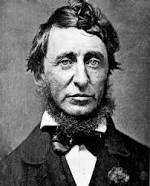
Cap’n Henry T.
All told, apart from property taxes, our annual shelter costs run roughly $600 — for firewood. I mention all this as evidence for one person’s start at working with one network among many — by no means an endpoint, nor a claim for any kind of praise or desire for virtue** or self-satisfaction. It’s part of practice, a point along a continuum, remembering my practice is both a “what to live for,” and also a “how to live” at all. And again I repeat: your practice, because you are you, necessarily differs. As H. D. Thoreau observes, “I desire that there may be as many different persons in the world as possible; but I would have each one be very careful to find out and pursue his own way, and not his father’s or his mother’s or his neighbor’s instead.”
/|\ /|\ /|\
Images: Paramahansa Yogananda; that “other” driver; compost; Calvin and Hobbes resolution; Green Mountain Power; Thoreau.
*I don’t know about you, but I can feel gratitude without needing a target, a recipient or respondent: a magnificent cloudy sky or bright flash of plumage or swirling blizzard evokes awe and gratitude I love to express. Do I need to say I’m grateful to Anyone? Can’t I simply be grateful for? Of course! Gratitude feels good. Why deny myself such pleasure? There’s a motivation if you need it: practice gratitude out of selfishness, because it makes you feel good, if for no other reason! Or if I choose to thank a spirit or Spirit, that in no way detracts from my gratitude. A target for it is another kind of pleasure I choose not to deny myself.
**Except for virtue in the older sense of “strength” or “power.” This kind of “original virtue” is literally “manliness” — what a vir “man” ideally accomplishes that makes him worthy to be called vir — to de-gender it, “what humans do at their best.” And what’s “best”? That which accords with the Way, the Tao or pattern of the universe.
Updated: 7 July 2014
[Related posts: Shinto & Shrine Druidry 1 | 2 | 3 || Shinto — Way of the Gods || Renewing the Shrine 1 | 2 || Boku no Shinto — My Shinto 1 | 2 ]
Following the magical principle of polarity to wing myself toward what I really want to write about, in the title for this post I’ve done something quite un-Nihonteki, un-Japanese — un-Shinto, in fact. Japan’s native spirituality focuses on harmony between human and spiritual realms, a harmony which finds a powerful objective expression in the natural world. “Seek Spirit? Look around!” Yet I used boku, I wrote “I” — as if “I” could possess Shinto, as if it were a thing among other things that a person could own or control or claim. The i returns to its proper size in balanced relationship. An outsized I is part of the challenge the West currently faces, as well as each of us individually. Be yourself, we’re told. What the hell does that mean, anyway? Still too much. (Too much is not enough, says the lower-case zen master/fool in my ear.)
Sometimes I just need to back into it, the destination that feels nearby, though I can’t see it. “Returning is the motion of the Tao” (chapter 40). Because if I try it head-on, all the old defenses go up like a bad reflex. An old i holds on even as a new one moves in. They spar a little. But what are wood and water doing while I stare at an i?
“who are you, little i” asks e. e. cummings in a poem of that title, “(five or six years old)/peering from some high/ window; at the gold/of november sunset” — let’s make it May instead: we can, and e. e. won’t mind. Will cheer us on, I suspect — “(and feeling: that if day/has to become night/this is a beautiful way)”
Participate in our own becoming. A call, if we choose to hear and heed it. Make it day when it’s night (for our next trick, do it without using electricity). Or vice versa, turning off the glare of the spotlight on the self which isn’t the whole story.
After all, “five or six years old” is about right: didn’t that crazy Galilean say we need to become like little children again? Is that “being yourself”?
Like is important: we can all imagine it, approach it, approximate it. Journey towards it. Try out “yes” till it drops the ” ” — that little chicken scratch that distracts us from so much. Or become the chicken that makes the scratch. That’s a power we’re granted, too. Shape-shift at will and need. One thing becomes another, in the Mother, in the Mother. Thanks, Mom. Can faking it make it real? Well, the pressure’s off if all I need to do is fake it.
(e. e., you saw it, said it elsewhere: “i thank You God for most this amazing/day: for the leaping greenly spirits of trees/and a blue true dream of sky; and for everything/which is natural which is infinite which is yes”). And if “You God” doesn’t work for you, insert your own addressee of choice.
Need a spell to make it happen? “Power of choice I grant thee, I grant thee, I grant thee.” O.K., proceed.
/|\ /|\ /|\
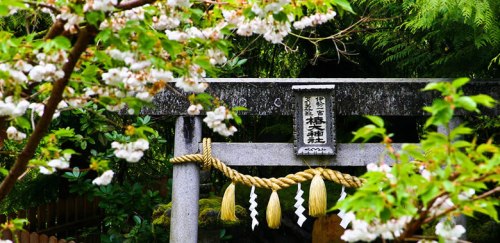
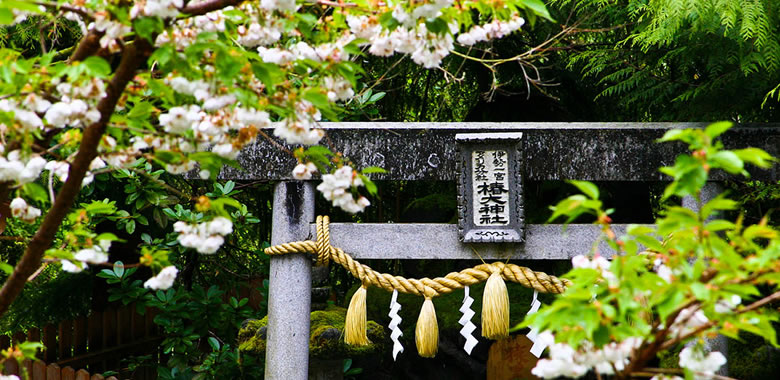
Entrance, Tsubaki Grand Shrine, Washington state
Site stats show that my previous posts on Shinto are among the most popular here at A Druid Way. The reason for that can’t be too far to find. We crave like a food-hunger a spiritual reality that does not depend on belief (or at least not on belief alone), but is present to us whenever we’re present to it — and even when we’re not. We may hunger for a Way or Ways, just like we yearn for dark chocolate or hot sauce or beef or fresh limes in guacamole (insert your favorite food hunger here), a harmony that we can begin to fall back into at any moment, wherever we are, just by shifting our attention, and restore a sense of balance and integrity. And not just a sense of them, but its reality — a poise for living that shows in our words and deeds. We’ve all known this harmony, witnessed it in others, however briefly, which is why we can feel so disheartened when we lack it, when we’ve lost it, fallen out of it. We know it’s possible because it’s there, in living memory, however far we stand from it right now, in this grubby, muddy present moment.
We’ve even got a Shinto shrine in the U.S., the Tsubaki Grand Shrine in Washington State, if we need the reminder. Which is what a shrine, among other things, persistently tries to be. It’s here, all around us, what we seek. And a few among us imported Shinto as a recognition of that consciousness, as a support for us when we lose our way. From it we can jump-start our own (there’s a possessive pronoun again) American Shinto, if we desire it, if we give it space to manifest. The kami know and dwell in America, too.
Though it’s not a perfect instrument, a song, a painting, a poem can remind us, point us in directions that can restore and heal. “The Spirit,” says Mary Oliver in her simply-titled “Poem,”
                        likes to dress up like this:
                          ten fingers,
                            ten toes,

                      shoulders, and all the rest
                        at night
                          in the black branches,
                            in the morning

                      in the blue branches
                        of the world.
                          It could float, of course,
                            but would rather

                      plumb rough matter.
                        Airy and shapeless thing,
                          it needs
                            the metaphor of the body,

                      lime and appetite,
                        the oceanic fluids;
                          it needs the body's world,
                            instinct

                      and imagination
                        and the dark hug of time,
                          sweetness
                            and tangibility,

                      to be understood,
                        to be more than pure light
                          that burns
                            where no one is--

                      so it enters us--
                        in the morning
                          shines from brute comfort
                            like a stitch of lightning;

                      and at night
                        lights up the deep and wondrous
                          drownings of the body
                            like a star.
(And so I ask myself, what isn’t Spirit?! Is that being yourself?)
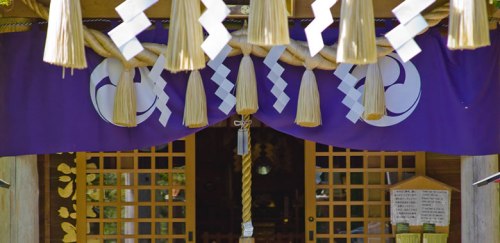
Tsubaki Grand Shrine — harmony
“The Japanese,” says a BBC Religions page,
see shrines as both restful places filled with a sense of the sacred, and as the source of their spiritual vitality – they regard them as their spiritual home, and often attend the same shrine regularly throughout their lives. Shrines need not be buildings – rocks, trees, and mountains can all act as shrines, if they are special to kami.
Physical world as spiritual home: what a change that would make in us if we carried that knowing with us all day long.
A large shrine can contain several smaller sub-shrines. Shinto shrines can cover several thousand acres, or a few square feet. They are often located in the landscape in such a way as to emphasise their connection to the natural world, and can include sacred groves of trees, and streams.
How many of us find the kami in a garden, a window pot we lovingly water, a bird feeder stocked through winter, or whatever season in your area that otherwise challenges the small feathered lives around us?
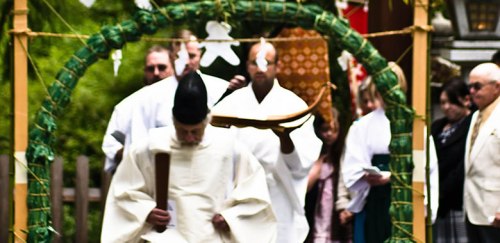
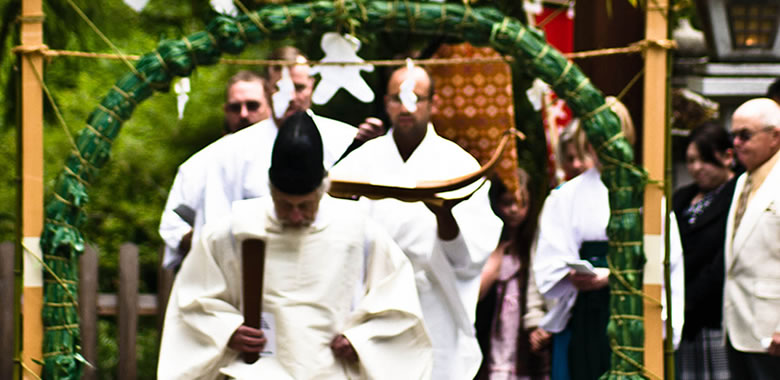
Tsubaki Grand Shrine ritual
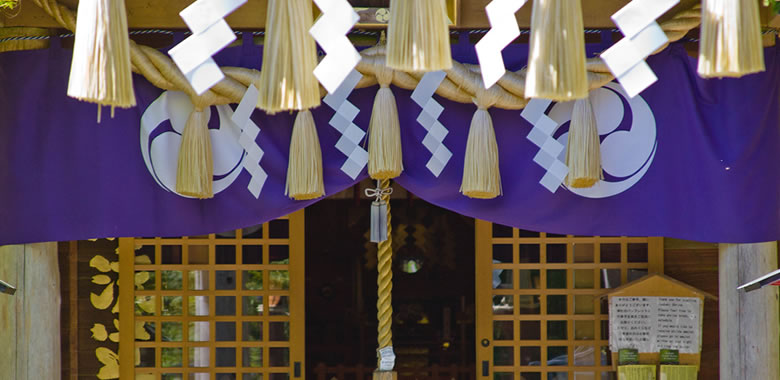
Various symbolic structures, such as torii gates and shimenawa ropes, are used to separate the shrine from the rest of the world.
Separation as a reminder — not that one exists like some line in the sand, but one we need, in order to notice what’s right in front of our noses.
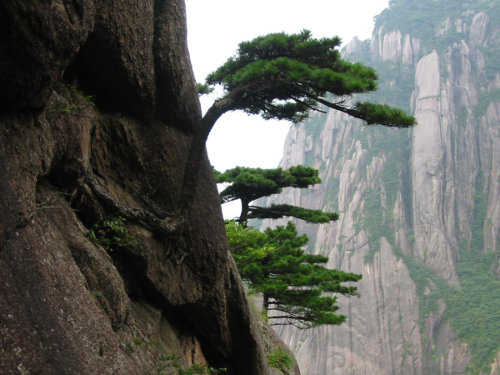
And so I remember to bow at the willow at the bottom of the hill where our house sits. I talk to the crocuses. Sometimes I forget. Then I remember again. Muslim mystics chant the dhikr, literally the “Remembrance” of that one Name ringing just behind our day-to-day awareness. Or many names, each waiting to be cherished, each a kami, each a potential doorway to what we seek. In a world of seven billion persons, a grand synthesis, a God for everyone, may not be feasible at this point in our consciousness. But we can reverence that lopsided pine down at the corner, honor the robins and starlings on our lawn, respect our own bodies on this earth, and begin, again, to find our ways. Isn’t that much of the promise of spring (and of so many of our human stories) — starting over? The growing shout of green, the rising sap, birdsong and peepers calling into the night, what we call spring fever in our veins and nerves and sinews, obeying an old law we’ve almost forgotten.
In answer to a query about the viability of some form of American Shinto, about “What is Shinto to the West,” a Westerner observes,
Well, Shinto in the West is automatically different from Shinto in Japan. For some reason, Japanese immigrants and their descendents don’t seem to keep practicing Shinto very much, perhaps because of the difficulty in practicing a shrine-centered, community-oriented faith in a place with nearly no shrines (I can count the ones I know of on one hand!) and a very small and scattered community.
So, most of the North American practitioners I know of are of European ancestry, trying to practice Shinto alone and without shrines, and learning what they know from books. Many have some sort of cultural connection to Japan – either they’ve studied it academically like you, or else they have married a Japanese person, or they lived part of their life there, or have learned a bit about Japanese spirituality through the martial arts community. We have to adapt the religion to our new environment, e.g. finding replacements for unavailable supplies, translating prayers from Old Japanese into English, and trying to answer hard questions like, should we honour the spirits of Japan or try to identify the spirits of our own environment?
Druids have built their own shrines, and begun to listen to the spirits here on the North American continent, which differ from European or Asian ones. Just the act of listening opens many doors. What we often lack is the support of a community in our practice. Many have the strength of self-discipline to sustain a solitary practice, but others need the interaction, inspiration and community spirit that can help through the arid periods where nothing seems to be happening and we’re stopped dead in the water.
For that reason alone many Americans stick with Christianity or Judaism, because it offers that support, even if they also seek out other founts of spiritual nourishment in places their Abrahamic fellow-religionists might balk at. It’s the reason behind “spiritual but not religious,” which ultimately is often hard to pull off in practical terms, because spirit seeks a form, a practice, if only to come true to us, to enter our physical lives in manifest ways, as Oliver’s poem above reminds us. We do this and not that because it works. Any claims about earlier or better or more spiritual or, Goddess help us all, divinely inspired and uniquely true forever and always, come along after.
Part 2 here.
/|\ /|\ /|\
Mary Oliver. Dream Work, Atlantic Monthly Press (Boston, MA), 1986.
Images: trees on cliff; Tsubaki Grand Shrine images (homepage auto-sequence), accessed 9 May 2014.
[A version of this post appeared in my column in the online Druid magazine Amethyst. My thanks to the editors for providing their well-edited forum for OBOD’s East Coast Gathering (ECG) community.]
I offer this post on the chance it may prove useful if you’re grappling with some aspect of animal guides, power animals, personal totems — the usages and terminologies haven’t settled down yet.
Last September, as I sat engrossed in the ECG 2013 workshop on Animal Guides, I simply had to laugh at myself. It had become clear to me over the weekend that sometimes your animal guide pursues you, rather than the other way around. In my case I’ve learned that gods, spirits, and guides often have to shout and do handstands to get me to notice at all. I’m just grateful they think it’s worth Their while.
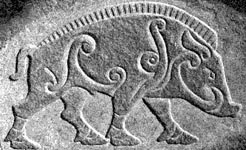 With Boar, my obliviousness ran deeper than usual, and lasted much longer. Maybe (I say, trying to excuse myself in any way I can find) it’s only because I’ve looked at my obtuseness more closely than usual. Maybe following two paths has scrambled the inner circuits. Maybe my inner discipline needs work (whose doesn’t?!). Laughter may be appropriate – and fitting for Boar, who can be a bit of a trickster anyway. As long as laughing isn’t all you do, I hear inwardly. Clues pile up. Here are some I’ve managed to account for so far.
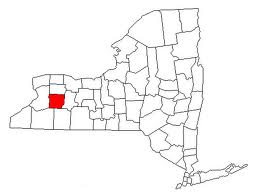
My father, a city boy who grew up in Niagara Falls, NY, became a full-time dairy farmer a few years before I was born. For some reason he could judge pigs well, recognize the outstanding animal, pick out the prize pig. In fact he won several judging competitions when I was still a baby. But the ability perplexed him. He’d mention it from time to time, amused. (Now I ask myself, is Pig or Boar some kind of family or ancestral totem? One more quest to add to my list of quests.)
I was born in the year of the Boar, according to the Eastern 12-year calendar. OK, I thought. Interesting piece of trivia. Entertainment, really. Chinese restaurant lore. Fortune cookie material. My nominally Christian family never paid any attention to such things. And in my adolescent arrogance and ignorance, I considered myself professionally immune to astrology, which I was sure was for wackadoos. It didn’t help that it was part of the national conversation at the time. If you’re old enough to remember the Reagan presidency and the First Lady’s Nancy Reagan’s admitted fascination with astrology, you know what I’m talking about.
 When I was in my early teens, and walking the Wyoming County fairgrounds in late August, a show pig at our local county fair lunged at me as I passed – a serious, front-legs-over-the-top-of-the-pen, get-to-you-if-I-could attempt. I was passing by a good ten feet away, one person in a crowd of visitors to the week-long fair in our agricultural county. What set the pig off? Something I was wearing? A scent of sweat or lunch or shampoo? Pitch or timbre of my voice? I never did find out. But I’ll note that I was fascinated around this time by the Greek myth of the Calydonian Boar Hunt, and the relationship between Meleager and Atalanta, a fleet-footed huntress sent by the goddess Artemis, who had also sent the boar. Why? To punish the king of Calydon for his neglect of the rites due to the gods. (You have to understand: goddesses feature in another of my lists of embarrassing interactions with the universe. Sometimes when I get it down on paper it’s just downright embarrassing. But, I can hope, maybe my embarrassment will be useful to others.)
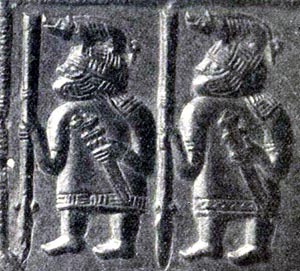
 I reflect, too, on my long* fascination with Old English, Anglo-Saxon society, and the war (and boar) themes in poems like Beowulf. To the left you can see the stylized (and outsized) boars on the warriors’ helms.
To cite just two instances from one poem, at one point the poet equates the warriors directly to the boar and to its symbolic importance as a fighter: “The armies clashed — boar struck boar” (lines 1327-8). And some hundred lines later, Beowulf’s own helmet is described in detail: “A smith crafted it, set boar-images around it, so that ever after no sword or war-axe could bite it” (1452-1454).
 Fast forward a decade and I’m teaching English in Japan in Musashino, a western suburb of Tokyo. One weekend my wife and I were visiting Asakusa Jinja, a large Shinto shrine in downtown Tokyo. As I was poring over trinkets for a cheap souvenir, a servant of the shrine insisted that I take a small carved wooden boar token. It didn’t appeal to me at the time – I thought some of the other images were more artistic renderings. But I made a small offering and went home with the image.
The Wild Boar serves as the mascot at a private high school where I taught for almost two decades. Every day classes were in session, I entered the campus dining hall passing beneath a stuffed head of a wild boar mounted over the entrance. The animal had been shot decades ago by one of the first headmasters of the school, an avid hunter.
About a dozen years ago, my wife and I took a vacation to Italy and the Tuscan hill country, where not once but twice I ate wild boar, and was sick both times. You’d think at some point it might have dawned on me that I shouldn’t eat my animal guide.
 In fact, a few years ago an alum donated to the school a replica of Il Porcellino, a famous boar figure from Florence, Italy by the Renaissance sculptor Pietro Tacca. I now walked past Boar twice a day, outdoors and in. I can’t claim the universe rearranged itself for my benefit (or embarrassment), but the effect was the same.
Why such resistance on my part? I still don’t know entirely. But Boar appeared in a vision during the East Coast Gathering drumming session with Thomas Deerheart and Maya Minwah, and gave me some very specific health advice for a longstanding issue I’m dealing with. Ever since then I’ve been drawn to touch Boar, run my hands over his coarse fur, feel the ridge along his back.
 The Druid Animal Oracle entry for Torc, the Boar, notes: “… he is a representative of the Goddess—his skin can heal you” (Philip and Stephanie Carr-Gomm, The Druid Animal Oracle, Fireside/Simon and Schuster, 1994, p. 39). It’s important to note I finally read the Oracle only after I wrote a second draft of this column (yet another resistance – I’ve had the volume on my shelves for over a year).
We say “my guide” or “my power animal,” but I’m finding that for me at least it’s the other way around. I belong to them. Whatever I think I’m looking for, it’s been looking for me even longer. The hunter is hunted. They track me down till I’m cornered and I have to listen, till I can’t ignore them any longer.
Recently Magpie has caught my attention again. I’m trying to listen better this time to whatever this new guide wants to communicate. What with running with Boar, and flying with Magpie, at least I’ve got the opportunity for plenty of inner exercise.
/|\ /|\ /|\
As I look over these notes, several points stand out. (I’ll put them in first person and speak only for myself, not to presume too much about who you are, or what your experience may be.) First, to my mind, is the desire (I don’t know how else to put it) of the Other — Spirit or spirits, guides, deities, totems — to connect with me. Second I must concede my own obliviousness. I ask for help, or a “sign,” but even when it lies down in front of me and trips me up, I STILL manage to ignore it.
Next is the likelihood that once I start looking, the coincidences begin stacking up until it’s clear there’s more than coincidence going on. Common themes emerge. The animal I seek is also seeking me — in dreams, “accidents,” images, unaccountable emotional reactions to seemingly “unimportant” things– in all the different ways it can reach me, in case one or more channels of communcation are blocked (usually on my end).
Animal images in poems also cry and echo for the nerd-Bard that I am. We repress the animal guides in and around us, so that like other repressed things, they eventually spring, animal-like, into our psyches elsewhere, in sometimes strange and nightmarish images, in art, dream, eventually, even, in national obsessions and pathologies. If they pool and accumulate enough cultural energy, they manifest in personal and societal outward circumstances, in political and cultural movements, in wars and other conflicts. Think of W. B. Yeats’ apocalyptic poem “The Second Coming,” which famously ends “what rough beast, its hour come round at last,/Slouches towards Bethlehem to be born?”
Or consider Philip Levine’s “Animals are Passing from Our Lives” in the voice of a pig approaching its slaughter. Apocalyptic and angry poems like these, like most art, aren’t “about” only one thing. Run them to earth and they keep meaning something more. We use animals (animals use us) to communicate what we sometimes cannot say directly. Among all the other things they do, animals help us express that deep love, that bitter grief, anger and darkness, comfort and healing, that simply may not be able to manifest in any other way.
/|\ /|\ /|\
Images: boar; boar-helmed warriors; Asakusa Jinja; Il Porcellino; Druid Animal Oracle.
*Like many English majors, I studied Old English as an undergrad and grad student. Like some others, my interests in things Tolkien and Old English stimulate and nourish each other. Since then I’ve kept up my amateur’s interest by attending conferences, writing and presenting papers, shoring up my grasp of the language in discussions and translations on online forums, and in rendering portions of OE poems and prose into modern English, as with the lines above. I say “amateur,” because with the exception of occasionally teaching the poem in translation to high schoolers, I pursue my interest out of personal obsession rather than professional necessity.
Steve, thanks for visiting and for your comment. I’d actually visited the site of your worthy Celtic conlang, Galathach, prior to writing my posts on “A Druid Ritual Language.” I would have included Galathach as well, but then along with other deserving candidates I might have mentioned, the post would have gone MUCH longer.
I know you’ve taken some flack by critics regarding the “authenticity” of your reconstruction and revival. From my perspective, the proof is in the passion: you’ve actually done the work and you have a well-elaborated language to show for it, while they quibble over details and apply criteria that I suspect never interested you in the first place! After all, you’re very clear and transparent about your process at the outset. As you note explicitly in your introduction,
Drawing on the existent available material, and making use of the surviving Brittonic languages, as well as the Gaelic languages, for support and comparative studies of such things as vocabulary, semantics and grammatic structure, a modernised version of the Gaulish language is here presented. Departing from the state in which Gaulish was last attested, that is Late Gaulish, the language of circa the fifth century CE, a series of sound changes, phonetic evolutionary processes and grammatic innovations are postulated. As such, a hypothetical evolution of the language is constructed, the proposed outcome of which is a practically useable modern Celtic language, to be situated in the framework of the modern Celtic languages.
While the process of reconstructing or reassembling a language is challenging, it has been done as conscientiously as possible, starting from the original material and attempting to stay as faithful as possible to it, while applying a set of changes which could have been reasonably expected to have happened to the language had it not ceased to be spoken. These changes are based on evolutionary processes which can be observed in the available authentic material, as well as on related processes which have occurred in the related surviving languages. As much as possible, justification for changes and adaptation is provided by drawing from the original material. Creative imagination, or, to put it differently, making up random stuff , has been kept to a minimum. These various changes, adaptations and processes will be discussed in detail in the various sections dealing with them in the body of this document.
The notable point is that Galathach now exists, when it didn’t before, and as you say, it has a full grammar and a (soon to be) dictionary. Nicely done!! Already that puts it in the top 5 or 10% of conlangs, hordes of which rarely get beyond a short wordlist, if that, or a provisional sketch of grammar. (Incidentally, there’s nothing wrong with that; most conlangers have many sketches and usually — unless you’re David Peterson of Dothraki/Game of Thrones fame — only one or two conlangs elaborated to any degree.) Your reconstruction/modernization of Galathach hAtheviu, “Revived Gaulish,” is documented, reasoned, consistent, and reflective of a devotion to things both Celtic and “conlang-y.”
So I’m happy to commend it and refer others to it (repeating that it IS a conlang rather than one of the six living Celtic tongues, just so everyone is clear). That said, it certainly is Celtic in blood and bone! And if a grove or an individual uses it for ritual, it becomes a living language by choice and art, equal to any other. As conlangers like to say, Fiat Lingua! Let there be (more) such languages! Humans made languages, so it’s a quibble of a peculiar kind to call one language “natural” and another “artificial.” (Conlanging has always seemed to me a particularly Druidic activity, but then I’m clearly doubly biased myself as both conlanger and Druid.) May Galathach thrive!
/|\ /|\ /|\
[Part 2 here]
Kuklunomes. Karla, our ritual leader, half-sings, half-speaks the word in Priyosta Grove’s dedicated language. Let’s form the circle.
Swonago! says Russ, as he strikes a singing bowl forcefully. The sound ripples through the clearing. We’ve been experimenting with opening gestures and words. These seem to work for us now. I can feel without looking that the others are listening, as I am, as the sound fades.
Already the five of us who’ve gathered have been falling out of speech and into a ritual hush. April wind blows chill through our grove, though the sun in a cloudless sky feels blessedly warm on our faces. I open my eyes. Dry brown grass whispers around us and underfoot, but the rains have greened things as well. Almost everyone still wears long sleeves, though a few dare to bare a little more. Russ strikes the bowl a second time, and cries Swonago! just as Angie and Dan enter the grove. They’re somewhat flushed, and release hands as they separate to walk to opposite sides of the circle. Our resident young couple has plainly been making out. Karla smiles at Angie, who’s tousled and a little breathless.
For the invocation, Karla passes to Michelle the staff she’s handcarved. For each gathering she decorates it anew. This time, on one end of the staff, three bird feathers, and a neat braid of colored ribbons cut from scraps from the Beltane rite last year. Michelle raises it toward Karla in acknowledgement, than lifts it high over our heads. The words to come are hers. We each bring a piece of this rite, having rehearsed it through a flurry of emails and briefly in a conference call a week ago, fighting static over a bad connection. All becomes part of Grove tradition, stories to retell, to share with newcomers when the time is right, to remind us who we are.
Gods, spirits, ancestors of blood and the heart’s bond, Michelle chants in a minor-key singsong, we call you to sift our intent, to join our rite, and to bless what we share here and always.
The words ripple up and down my spine. I glance around the circle again, wanting to take it all in. Dan and Angie’s eyes are closed. Both their heads tilt slightly as they listen. To the casual observer, we’re just as casual: no robes or massive Pagan bling. Look closer and you might see a few discrete pentagrams, a few modest-sized pendants and earrings. One bearded fellow we know only as Dragon wears jeans and an embroidered white dress-shirt, a fluid Celtic pattern worked in red. Michelle has brought water in our lovely aquamarine offering bowl that she found some years ago at a household auction and gifted to Priyosta Grove. Friendship, it translates, or Amity. An ongoing goal for us, an intention. Michelle passed the bowl to Dragon when Karla handed her the staff. Some of the rite we’re improvising now, relaxed at what’s scripted and what arrives free-form.
Dragon steps forward to bless the circle with water. He’s at ease, smiling slightly, as he sprinkles each of us in turn.
Western gods and spirits, lakes and rivers, blood in our veins, oceans circling, he chants slowly, turning to each of us, we call you here, now.
Dragon’s name, I’m beginning to sense, fits him well after all. I remember how I rolled my eyes a little when I first heard him introduce himself, then scolded myself as a Pagan snob.
Now, briefly, I flash onto a serpentine form, awash in a frothy sea — a water dragon. Its arcing wings shoot a cascade of cool, refreshing water over us. I shudder involuntarily in surprise at the vividness of what I experience. A confirmation, something to tell him after, if it feels right.
I look around again at the others. All of us are in fact wearing ritual garb. The point is comfort and ritual dedication. We’ve changed into these clothes, but they’re modern, like our ritual. Priyosta has never come close to discussing anything like a “ritual dress code,” let alone tried to make one a formal policy — nobody has the balls, nor could they get it to stick anyway — but over our eight years of existence, we’ve established our own unwritten sensibility. One piece of jewelry you’ve dedicated and worn to many rites over time is almost always better than thirty pounds of robes and bling from “Auntie Gaia’s Mystyk Cauldron and Proud Pagan Emporium.” In big circles and at major festival gatherings, some of us might dress up more. For this and for our other local rituals, we dress “in” — that one piece of clothing or jewelry that helps remind us as we breathe the smoking sage, feel the water of the blessing, that solvas son yagnei — all things are holy.
We continue inviting the Quarters, and settle in to the Rite. We tell what feels appropriate, and pass over the rest, belonging to the Grove alone.
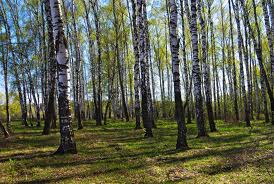
It’s not a major festival that’s brought us together this time. Priyosta doesn’t always manage to meet for every one of the “Eight Greats.” You follow the Wheel as you can. But it’s time for our own thanksgiving. The papers are signed and filed, the last check cleared our now very small grove bank account, the land title arrived on Monday. This little hilltop with its stand of birches is now officially “ours” to care for. A former hunter’s camp, much of it had been badly trashed, but we got it for back taxes and not a whole lot more. A trust, for our grove to hold and heal, and when the time comes, to pass on. We keep its location private, to preserve it from further heedless indifference.
/|\ /|\ /|\
Image: birch grove.



































 A Druid Way