 Some of you may recall a minor kerfluffle from the Christian Right a decade or so ago, when then Anglican Archbishop Rowan Williams joined the Welsh Gorsedd of Bards and appeared in — gasp! — “pagan” Druid robes and hood. One of the many ironies of that moment and others’ reactions to it is that of all Druid groups, the Welsh Gorsedd is among the most secular and the least woo-woo (a highly technical sociological term).
So here’s a worthy sequel: an excerpt from a 2009 lecture Williams gave titled “The Climate Crisis — a Christian Response.” During his talk he offers Druidic perspectives:
I once suggested that one necessary contribution to a better awareness of these issues was to make sure we went out of doors in the wet from time to time (a suitable lesson from Noah…), and – if we haven’t got gardens of our own – make sure we took opportunities of watching the changing of the seasons on the earth’s surface. This may seem trivial compared with the high drama of ‘saving the world’; but if this analysis is correct, our underlying problem is being ‘dissociated’, and we ought to be asking constantly how we restore a sense of association with the material place and time and climate we inhabit and are part of.
A transcript appears on the link page — it’s worth skimming for additional insights like this, a thoughtful and mature Christian grappling with the same realities we all face, and feeling his way into a diagnosis that accords with earth-centered insights and experiences — one that also doesn’t deny Christian wisdom either.
/|\ /|\ /|\
Image: Rowan Williams/BBC News.
 “Wessex Harvest” is a poem written in 1948 by distinguished British archaeologist Stuart Piggott (1910-1996). I quote it here because it evokes autumn and an autumnal mood. Also because some of Piggott’s uncharitable remarks about contemporary Druidry, especially in his 1985 book The Druids (Ancient Peoples and Places), haven’t earned him much applause in some Pagan quarters. He distinguishes, quite appropriately, between “Druids as known,” “Druids as inferred,” and “Druids as wished-for,” and drops contemporary Druidry squarely in the latter category. The Druid Revival also earns Piggott’s scorn at times.
But of course, as AODA archdruid J. M. Greer is fond of remarking, mere age is no indicator of quality in anything. If we actually could dig up a 10,000-year old Druidry, would that make it better? And “wished-for” happens to be a quality inherent in most of the great accomplishments of human culture. What “actually” exists as “known” first arrives imagined, wished-for, waiting — oddly enough — like a poem not yet written down. No Druidry of any period simply appeared on the scene without prior human imagination and effort, to be buried like a dog’s bone and subsequently turn up in the archaeological record just for convenience.
Piggott’s poem shows a more intuitive and perceptive side of the man, which is helpful in seeing him more accurately and completely — more charitably. So here it is:
Wessex Harvest
Now the ancient Wessex hills
seize their lost splendour–
once, Stonehenge-building, their princes
proud with their Wicklow gold
strode in the sunshine;
now earth inherits
their dust, who are chalk-graved,
dry frail and brittle
pale bones under barrows–
poor fragments, those great ones.
But see, the austere lines
of downland are gladdened
splendid now, flaunting
armour of red-gold plate,
corn-stooks its studding;
new from old treasure
is this year’s miraculous
rebirth in the harvest.
And so in all years
is nothing forgotten,
always the far dead things
new life begetting.
In this poem, unlike in his other work, Piggott shows that he does perceive how things like Druidry might re-emerge, finding “rebirth in the harvest” where “far dead things” really can and do “beget new life.”
/|\ /|\ /|\
Images: Stuart Piggott — Wikipedia.
Our bodies already know the Goddess – this is our oldest magic.
I relied on this insight in planning for the workshop at this year’s East Coast Gathering, whose theme was “Connecting with the Goddess.”
/|\ /|\ /|\
Goals and plans I had for the workshop:
The heart of the workshop is a hands-on look at various ways to make a physical book/scroll/altar object that explores/invites/incorporates ritual, ogham/runes, art, prayer, poems, questions, magic and daydreaming into a concrete “link” to the Goddess as we experience Her — or desire to experience Her. Think “book” as “portable paginated/folding/roll-up ongoing altar-in-process.” I’ll talk about inspiration, nudges, hints and ways to listen, inviting and hoping for participant sharing and input! The seed for the workshop comes out of the fact that I’m a prime example of somebody who doesn’t have a consistent Goddess practice (though She’s seeing to it that’s shifting, too), but when She wants my attention, She gets it, like with this book, and workshop.
It’s probably a good thing we don’t always hear how ambitious we sound. Young or old, you eventually learn to deal with the inevitable gap between vision and manifestation. If you’ve managed to hold on to any of that original and wonderful idealism of youth, you also realize that the gap isn’t a reason to despair, or to dispense with vision, but rather a sign of just how important vision is.
The physical world, so important for manifestation, by its nature tends to lag behind the swiftness with which vision can appear. But that lag is precisely part of this world’s immense value: its inertia and density allow for greater permanency and resistance to change, so that we can experience the results of vision over time — and fine-tune it if we choose. Unlike in dream, where the subtle stuff of vision or imagination can wisp away so quickly, physical manifestation tries to linger.
/|\ /|\ /|\
The Goddess is generous. Or alternatively, if you prefer the cynical version, I belong to the OCD Order of Druids. Creativity, as the saying goes, is messy. I over-planned for the workshop, ending up with far more material than any mortal could begin to do justice to in a mere hour, and this post is my penance, or confession. Or further indulgence. And maybe — in the way it often arrives when we’re not paying attention, even in spite of ourselves — a spark of awen.
/|\ /|\ /|\
 “Creating A Goddess Book,” with focus on “book” in order to free it from the psychological shrine many Druids, and Pagans generally, tend to put books in. Instead of paper, a book of leather, or metal, or cloth — individual sheets, or a single longer scroll. A nudge to try out the qualities of other substances than paper, than the admittedly inviting blank books on sale in chain bookstores, or even Ye Friendlie Lokal Paygan Shoppe.
Each workshop participant received a packet to practice with, consisting of a rectangle (approx. 3″ x 4″) of vegetable-cured leather and a similar-sized rectangle of .019″ aluminum, wrapped in a larger swath of canvas cut from a shop drop-cloth from Home Depot. A wood- and leather-burning tool, a few screwdrivers, some markers of various kinds, a few words about inspiration and the importance of working to manifest things on the physical plane as one powerful way to connect with the Goddess. Suggestions for inscribing/writing/ incising a short prayer, vow, magical name, etc. Reference tables of Ogham and runes for those who wanted to inscribe words with some privacy, as a personal meditation. I pointed out that you could cut all three materials with kitchen scissors. Besides the wood-burner, no fancy tools required. Then I shut up and let participants have at the materials. Done!

Hex Nottingham’s leather and metal “pages” — photo courtesy Hex Nottingham
Except for the next flash of inspiration in the planning process, which would not let go: a “Nine-Fold Star of the Goddess” you can try out here at one of several websites that illustrate the steps.
/|\ /|\ /|\
A sampling, with some commentary and additions, from the workshop handout:
“Spirit must express itself in the world of matter or it accomplishes nothing. Insights of meditation and ceremony gain their full power and meaning when reflected in the details of everyday life.” — J. M. Greer, The Druidry Handbook, p. 138.
This world, here, is the realm of mystery. Spirit is simple — it’s this world that’s so surprising and complex in its changes and ripples, its folds and spirals and timings. Make something, I tell myself, labor with the body, and then I can often approach the Goddess more easily, dirt under my fingernails, sweat on my face. She likes bodies. I’m the one who keeps forgetting this, not her.
“Work with a Goddess long enough and you learn to hear Her call. You learn to pick her voice out above the noise of contemporary society, above the words of teachers and friends, and even above your own thoughts and feelings. Sometimes what you hear is not what you expect.” — John Beckett, “A Rite of Sacrifice,” Mar. 4, 2014.
“Shaper, you have made and shaped me. Honor and serenity are yours. I am your garment, you the indwelling spirit. Work with me in everything I do, that all may know you. Energizer, quicken me. Measurer, clear my path. Protector, guard me safely. Initiator, take my hand. Challenger, transform me. Savior, be my help. Weaver, make my pattern bright. Preserver, heal me. Empowerer, make me wise.” — adapted from Caitlin Matthews, Elements of the Goddess, p. 118.
Rilke’s fragment, a whole meditation in itself, or a daily morning prayer.
Oh, I who long to grow,
I look outside myself, and the tree
inside me grows.
— Rainer Maria Rilke
And Larkin’s poem “Water”:
Water
If I were called in
To construct a religion
I should make use of water.
Going to church
Would entail a fording
To dry, different clothes;
My liturgy would employ
Images of sousing,
A furious devout drench,
And I should raise in the east
A glass of water
Where any-angled light
Would congregate endlessly.
— Philip Larkin
After delighting in this poem, make an exercise of it. Choose one of the elements. It can be water, as in the poem, or one of the others. Finish the sentence: “If I were called in to construct a _____, I should make use of [element].” Keep going: a series of statements, a meditation on the one you just wrote, a free association. Whatever gets you putting words down. You can try this over several days with all the elements, or at a different pace, if you’re working with the elements on your own.
The ECG schedule this year put the Goddess Book workshop immediately after Thursday’s Opening Ritual, so people arrived still bubbling from the ceremonial jump-start for the weekend.
“In every world, in every form, in every way, I am near you, I uphold you, I comfort you, I guide you, I deliver you from each limitation until my freedom is yours. Your body is my chalice, your heart my echo, your form my shadow, your pulse my footstep, your breath my passing.” — from my own Goddess book.
/|\ /|\ /|\

1. Once you hold the Star of the Goddess in your hand, write the names of the four elements and Spirit, one near each of the points. Complete this step before reading further.
2. Which elements sit on either side of Spirit? Contemplate on their positions there. Are they elements that help support your spiritual life? Are they especially active? Are these the elements that need extra attention and balance?
3. Consider a section in your Goddess book for vows: experiment with them, not as harsh, unyielding obligations, but as tools for studying resolve, testing experience, practicing manifestation of your intent, and so on. They need not be “public” – write them in ogham, runes, etc. Start small and easily achievable.
/|\ /|\ /|\
Dedicating a Goddess Book: Blood, sweat, tears, spit, etc. can mark our books with our earthiness: a commitment to be honest with the Goddess about our path, its ups and downs, to remember her presence with us, and to acknowledge what we need, what we doubt, what we’re willing to work for – whatever feels right to include. Make a ritual of it. Do it quietly, simply, without fanfare, with silence making its own ritual. Or call out all the stops, bells and whistles. Then dance, feast and celebrate.
/|\ /|\ /|\
Allow a Goddess book — it could be a single sheet or “page” specifically intended for this purpose — to return slowly to the elements on an outdoor altar. Or bury it in the Mother’s good earth. Thus is the vow fulfilled that the Mother takes into Herself, as She will take all things back in time, and return them again.
“All things are holy to you. This book like all things lies among the faces you show to me; may I learn from you daily, drink deep from your well, and body you forth as your child.” — from my Goddess book.
/|\ /|\ /|\
A small ritual. Take a few deep breaths. Sing the awen, or other name or word that grounds and focuses you. Holding your cupped hands in front of you, say: “I make this altar for the Goddess, a space where she may act in my life.”
Holding the Star, or your journal, or other ritual object meaningful to you, or nothing else at all, ask yourself: What specific space or doorway exists in my life for the Goddess to manifest or to act in? Pay attention to hints, images and answers as they come.
/|\ /|\ /|\
And again: Our bodies already know the Goddess – this is our oldest magic.
/|\ /|\ /|\
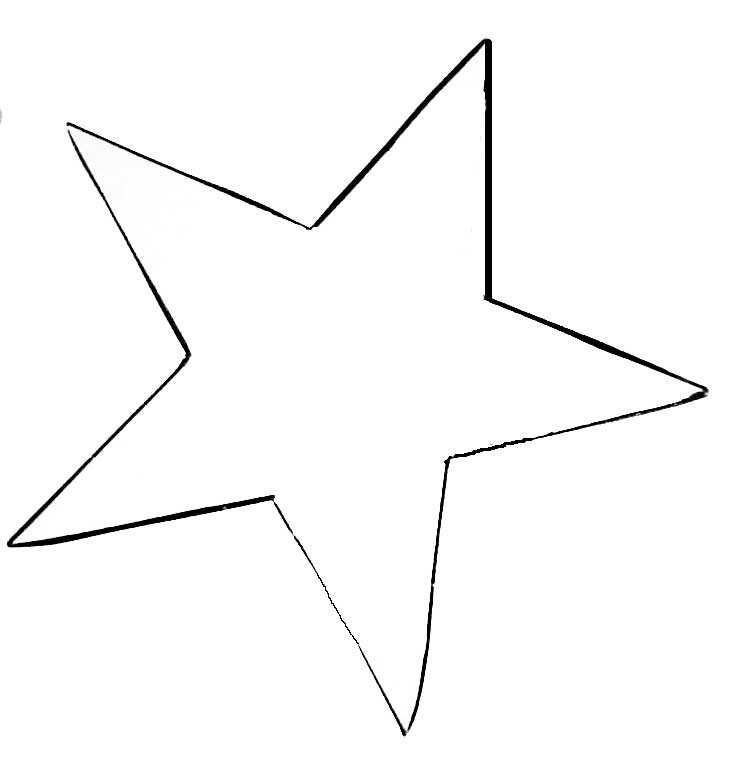
Images: ogham; star.
 Not responsible for spontaneous descent of Awen or manifestation of the Goddess. Unavailable for use by forces not acting in the best interests of life. Emboldened for battle against the succubi of self-doubt, the demons of despair, the phantoms of failure. Ripe for awakening to possibilities unforeseen, situations energizing and people empowering.
Catapulted into a kick-ass cosmos, marked for missions of soul-satisfying solutions, grown in gratitude, aimed towards awe, mellowed in the mead of marvels. Optimized for joy, upgraded to delight, enhanced for happiness. Witness to the Sidhe shining, the gods gathering, the Old Ways widening to welcome.
 Primed for passionate engagement, armed for awe-spreading, synchronized for ceremonies of sky-kissed celebration. Weaned on wonder, nourished by the numinous, fashioned for fabulousness. Polished for Spirit’s purposes, dedicated to divine deliciousness, washed in the waters of the West, energized in Eastern airs, earthed in North’s left hand, fired in South’s right. Head in the heavens, heart with the holy, feet in flowers, gift of the Goddess, hands at work with humanity. Camped among the captives of love, stirred to wisdom in starlight, favored with a seat among the Fae, born for beauty, robed in the world’s rejoicing, a voice in the vastness of days.
Knowing, seeing, sensing, being all this, you can never hear the same way again these two words together: “only human”!
/|\ /|\ /|\
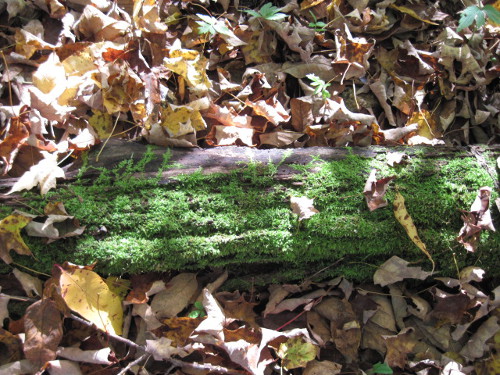
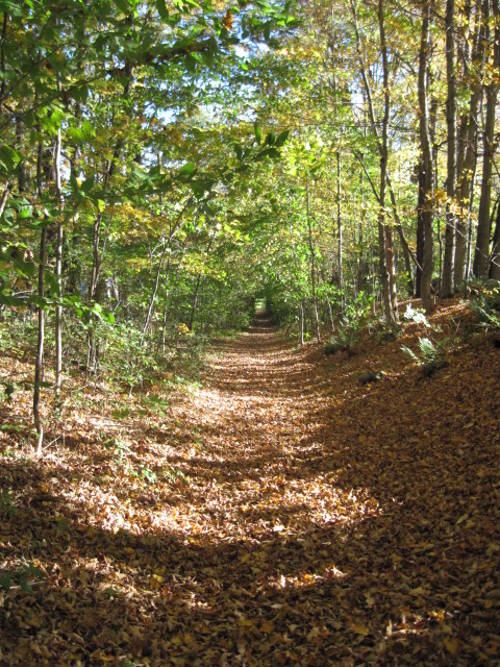
Images: three from a sequence taken yesterday, 3 Oct 14, on a blessed autumn day in southern Vermont two miles from my house.
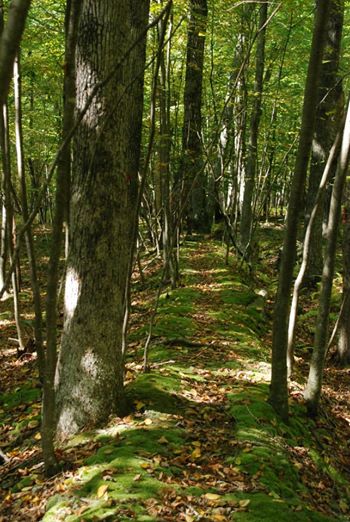
Camp Netimus path — photo courtesy of Carolyn Batz
[Here are reviews of ECG 12 and ECG 13.]
East Coast Gathering (ECG) ’14 just celebrated its fifth Alban Elfed/ autumn equinox in the wooded hills of NE Pennsylvania. Along with this year’s theme of “Connecting to the Goddess,” 114 people reconnected to each other and the land, the lovely land. New participants and old remarked on the kindness of place, the welcoming spirit of Netimus, a flourishing girls’ camp founded in 1930 that now plays host off-season to other groups, too.
[For another perspective on this year’s Gathering, visit and read John Beckett’s excellent blog “Under the Ancient Oaks.”]
After a wet summer in the Northeast, the camp showed richly green — mosses, lichens, leaves and light all caressing the gaze wherever you looked. And keeping to our tradition of inviting guests from the U.K., we welcomed Kristoffer Hughes of the Anglesey Druid Order and returning guests Penny and Arthur Billington, this time accompanied by their daughter Ursula, a mean fiddler with Ushti Baba (Youtube link).
For me what distinguished this year’s Gathering, my fourth, was the pure joy in so many people’s faces. And it just grew over the weekend. Over and around travel fatigue, colds, tricky schedules and stresses and waiting commitments — everything — they didn’t matter: the tribe was together again. To you all (from an interfaith week I participated in): “Thank you for the blessings that you bring. Thank you for the blessings that you are.”
/|\ /|\ /|\
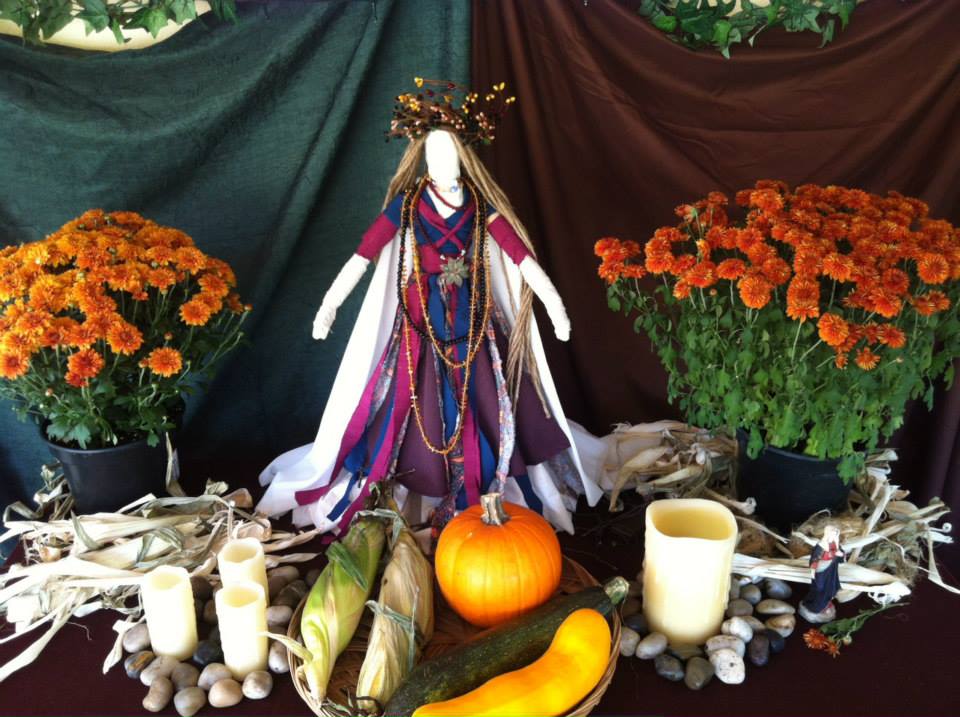
Dana’s Goddess Shrine in a tent on our ritual field was also a wonderful addition and a focus for many of us.
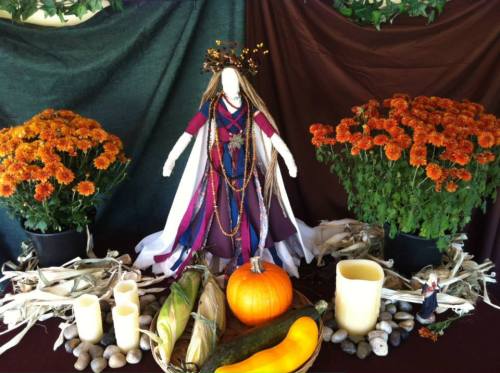
Goddess Shrine — photo courtesy of Nadia Chauvet
Natural offerings accumulated over the weekend — mosses, lichen-streaked stones, acorns, leaves, a small sun-bleached animal skull — were returned to Netimus, and the other items packed up for next time. A workshop I led, on making a Goddess Book, drew me back to the shrine several times for reflection and inspiration. (Here’s the link I mentioned at Camp to a video on making the “Nine-Fold Star of the Goddess” — seeing the steps in 3D should help make my hand-drawn images on the handout easier to read once you practice a few times. A series of divinations and meditations were to follow which I never got to in the workshop — though over-planning is usually better than under-planning. Material for a subsequent post!)
I continue to meditate on a surprising goddess experience during Penny’s workshop, which I may be able to write about in an upcoming post. One of the potencies of such gatherings of like-minded people is the spiritual crucible that can form and catalyze discoveries in ways not always easily accessible in solitary practice.
/|\ /|\ /|\
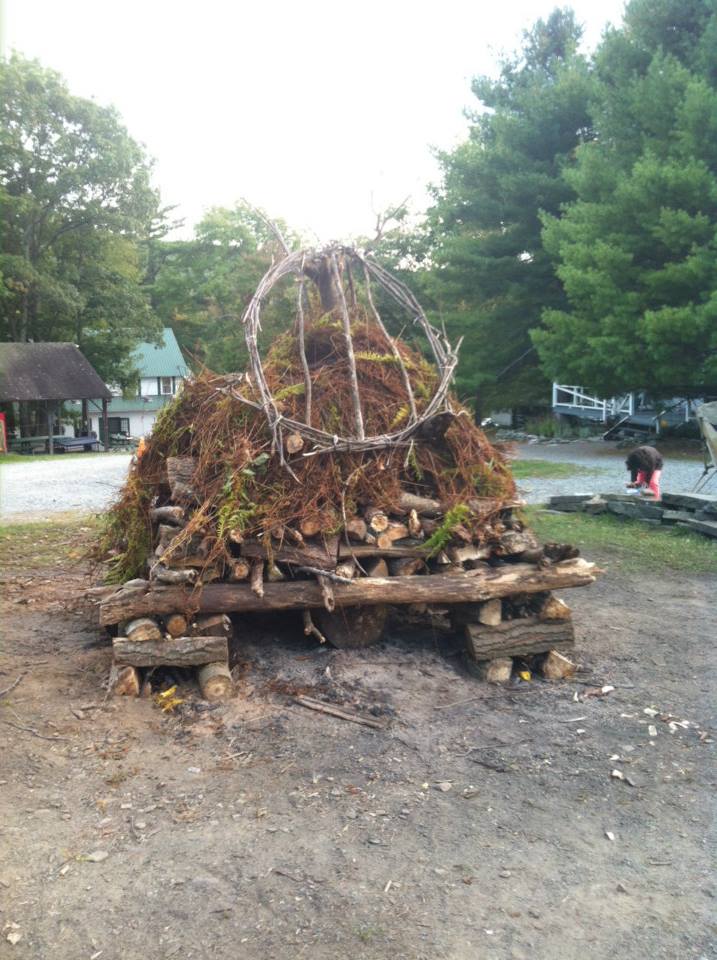
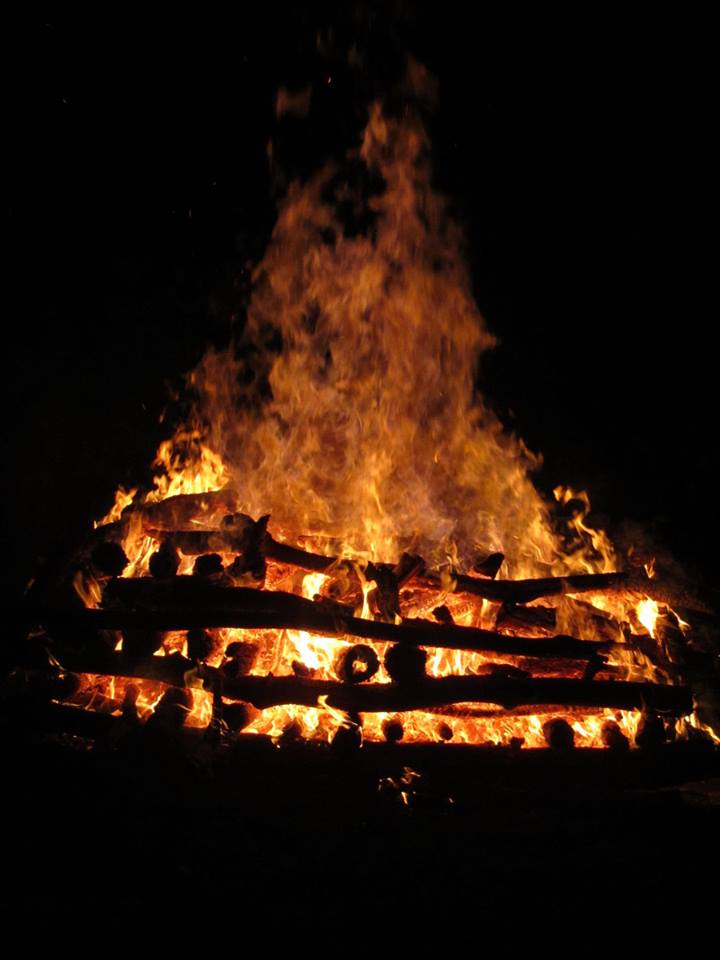
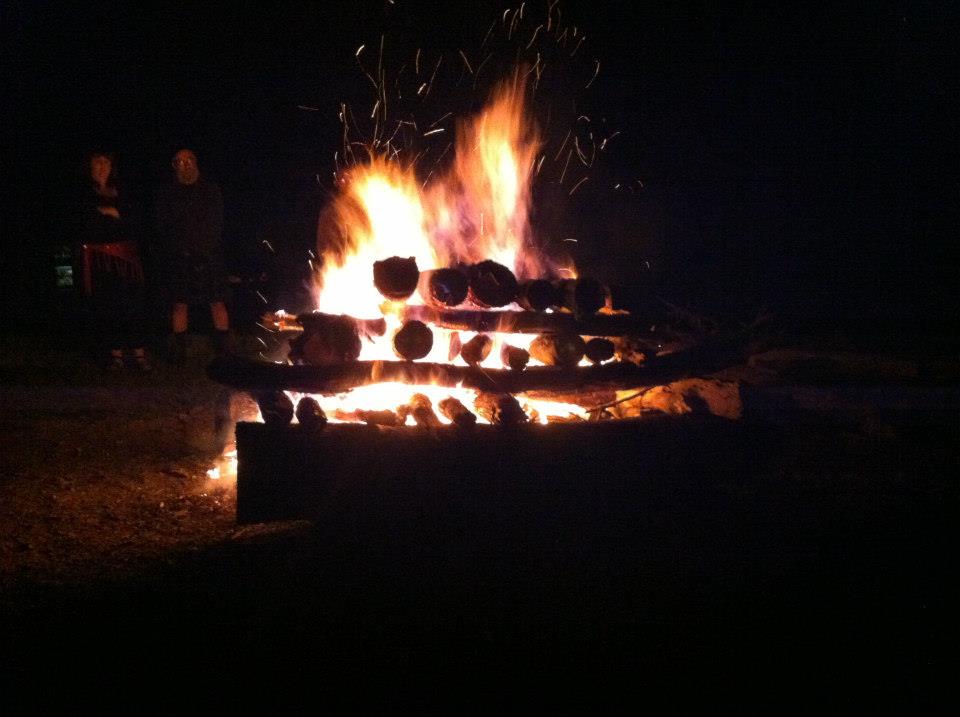
Our fire-keepers outdid themselves this year, building enormous pyres (one with an awen worked in wood) to provide the centerpiece of each evening’s gathering after supper, workshops and initiations had concluded.
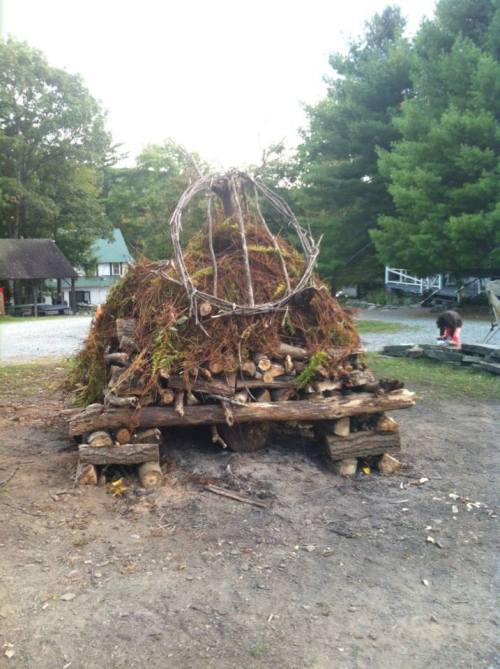
Awen bonfire ready — photo courtesy Nadia Chauvet

evening bonfire — photo courtesy John Beckett
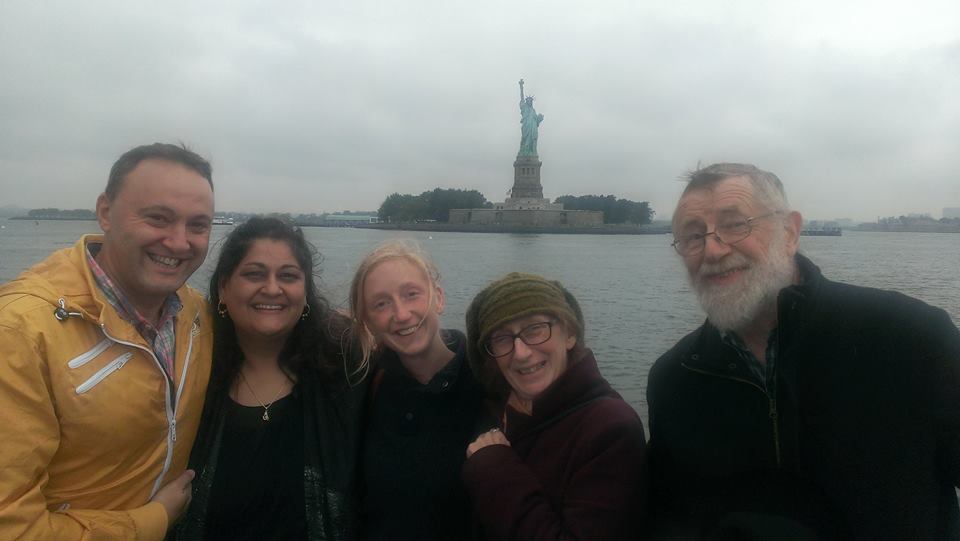
As always it’s people who carry the spirit of Druidry. Here as they tour New York City, just prior to the camp, are Kristoffer, Renu, Ursula, Penny and Arthur.
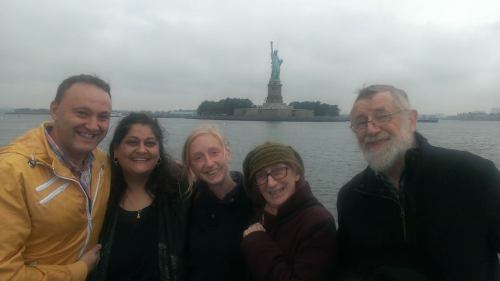
Renu with our UK guests in NY — photo courtesy Renu Aldritch
I’ll return to A Druid Way (and the fourth post in the “American Shinto” series) when I get back from the annual East Coast Gathering (ECG) this coming weekend. This year’s 5th ECG shares in some of the energy of the OBOD 50th anniversary earlier this summer in Glastonbury, UK. For many U.S. Druids, the Gathering is the principal festival event of the year, a chance to renew old friendships, enter sacred time and space, and reaffirm ties to the special landscape of Camp Netimus in NE Pennsylvania. This year’s Gathering theme is “Connecting with the Goddess.”
In the interim, here are three images from last year’s Gathering — a visual invocation of the Alban Elfed/Autumnal Equinox energies of the Camp.
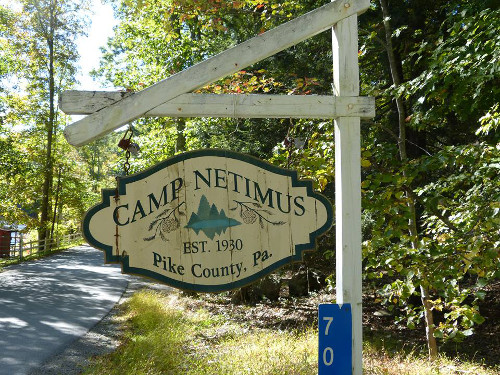
Camp Netimus sign — photo courtesy Krista Carter

Steps up to fire circle from Main Lodge — photo courtesy of Wanda GhostPeeker

The evening bonfire
[Related posts: Shinto & Shrine Druidry 1 | 2 | 3 || Shinto — Way of the Gods || Renewing the Shrine 1 | 2 || My Shinto 1 | 2 ]
Below are images from our recent visit to Spirit in Nature in Ripton, VT, some eight miles southeast of Middlebury as the crow flies. An overcast sky that day helped keep temperature in the very comfortable low 70s F (low 20s C). At the entrance, Spirit in Nature takes donations on the honor system. The website also welcomes regular supporters.
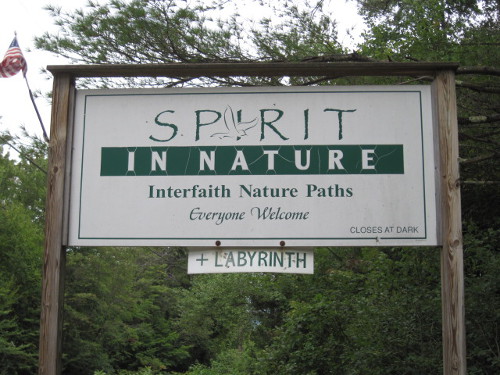
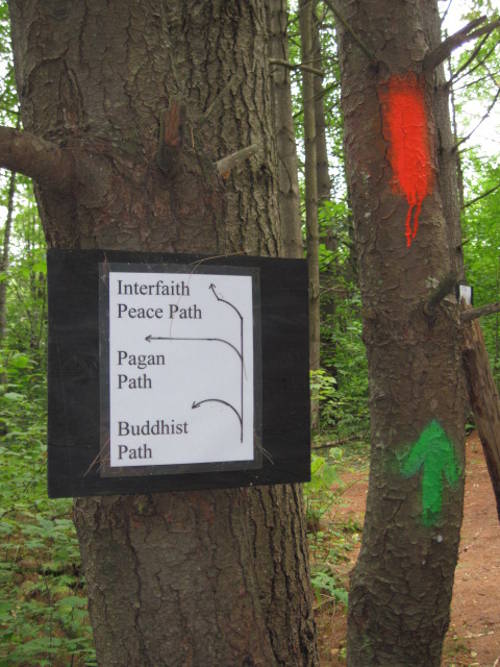
As an interfaith venture, Spirit in Nature offers an example of what I’ve been calling Shrine Druidry, one that allows — encourages — everyone into their own experience. Everyone who chooses to enter the site starts out along a single shared path.

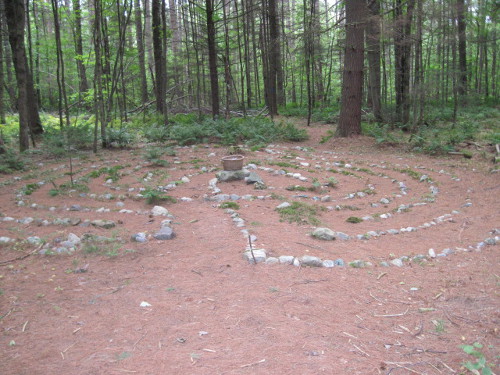
The labyrinth helps engage the visitor in something common to many traditions worldwide: the meditative walk. The labyrinth imposes no verbal doctrine, only the gentle restraint of its own non-linear shape on our pace, direction and attention.
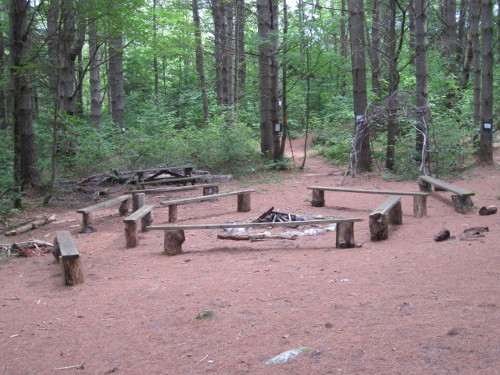
Beyond the labyrinth, a fire circle offers ritual and meeting space. Here again, no doctrine gets imposed. Instead, opportunity for encounter and experience. Even a solitary and meditative visitor can perceive the spirit of past fires and gatherings, or light and tend one to fulfill a present purpose.
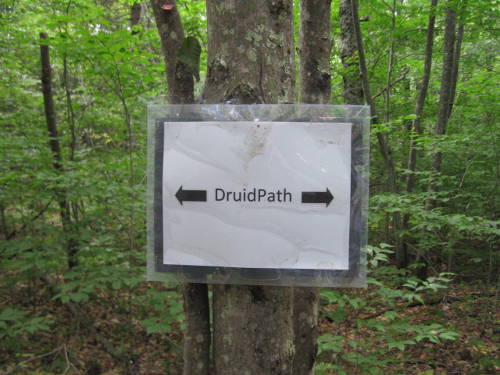
Beyond the circle, the paths begin to diverge — color-coded on tree-trunks at eye-level — helpful in New England winters, when snow would soon blanket any ground-level trail markers. When we visited, in addition to the existing paths of 10 traditions, Native American and Druid paths branched off the main way, too new to be included on printed visitor trail maps, but welcome indicators that Spirit in Nature fills a growing need, and is growing with it.
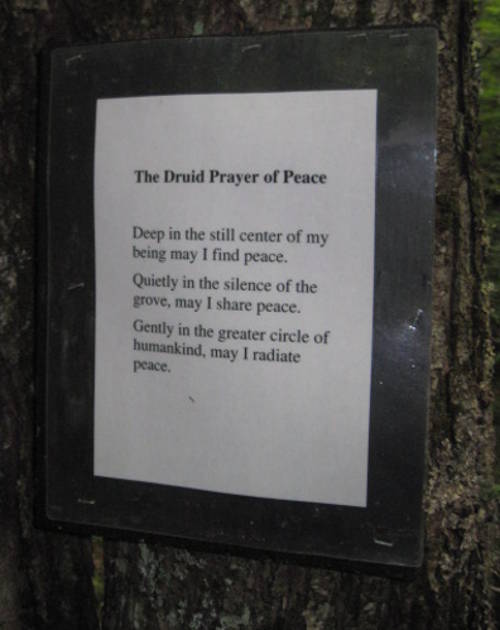
The Druid Prayer captures a frequent experience of the earth-centered way: with attention on stillness and peace, our human interior and exterior worlds meet in nature.
The trails we walked were well-maintained — the apparently light hand that brings these trails out of the landscape belies the many hours of volunteer effort at clearing and maintenance, and constructing bridges and benches.
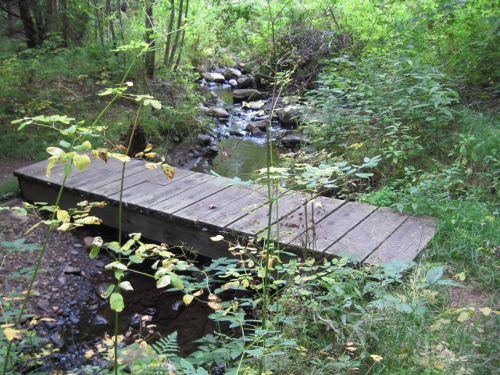
A bench, like a fire pit and a labyrinth, encourages a pause, a shift in consciousness, a change, a dip into meditation — spiritual opportunities, all of them. But none of them laid on the visitor as any sort of obligation. And as we walk the trail, even if I don’t embrace the offered pause, the chance itself suggests thoughts and images as I pass that the silence enlarges. I sit on that bench even as I walk past; I cross the bridge inwardly, even if it spans a trail I don’t take.
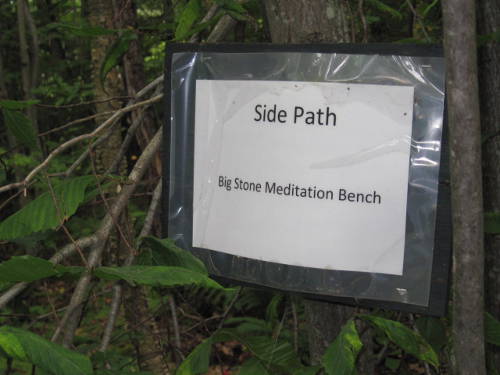
Sometimes a sign presents choices worthy of Yogi Berra’s “When you come to a fork in the road, take it.”
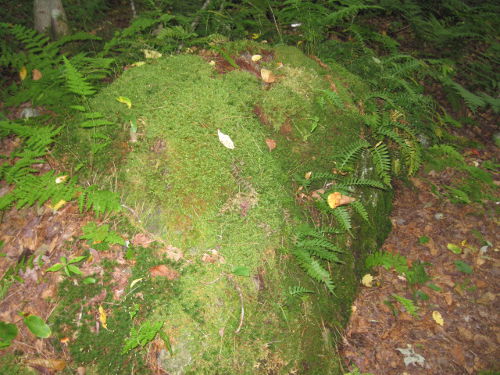
Perhaps it’s fitting to close with the North, direction of earth, stone, embodiment, manifestation — all qualities matching the interfaith vision of this place.
/|\ /|\ /|\
This is the 200th post at A Druid Way. Thanks, everyone, for reading!
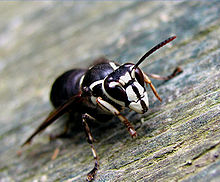
A bald-faced hornet up close
Dolichovespula maculata is the resplendent Latin name of a North American insect variously called the bald-faced hornet (BFH after this), the blackjacket, or the bull wasp. “Long wasp spotted” is one literal translation of the Latin (the Im-maculate Conception was “spotless”), and captures well enough their appearance. They’re bigger than most wasps and hornets in the U.S., with a temperament to match. I didn’t take the pic of this brisk specimen to the right (though the larger pics below are mine). The BFH defends its nest vigorously if approached too closely or disturbed.
A short side note: childhood stings, and a love of honey and a relatively bug-free outdoors, taught me a healthy respect and appreciation for bees and wasps, and I’ve learned more about them over the years, some of it firsthand. Most wasps and bees are beneficial, of course, wasps in particular often feeding on insect pests. We’ve had a wetter summer than most this year here in Vermont. Normally that would bring hordes of insects, but we’ve had markedly fewer mosquitos and other pests this summer than any year since we’ve moved here. And the hornets get the credit — we’ve watched them bring back insect after insect to the nest.
The vital honeybees, major pollinators and crucial to many human plant foods, continue to face sharp declines around the world from causes that still aren’t competely understood, and they need our protection. As a U.S. Dept. of Agriculture bluntly puts it, under the heading “Why Should The Public Care about What Happens to Honeybees,” “About one mouthful in three in our diet directly or indirectly benefits from honey bee pollination.” Their troubling decline is thus not a small problem. (You can read about one Druid’s adventures in beekeeping here at the fine blog The Druid’s Garden.)

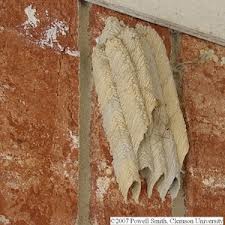
Mud-dauber wasp nest
We’ve been in our Vermont house since winter 2008, and we’ve co-existed well enough with bumblebees, honeybees, yellowjackets and the more familiar (to us) mud-dauber wasps, which, with a ready supply of mud from our pond, often build their tubular homes above the same back door. They’re also more placid species; we eye each other when either my wife or I go out the back door, or hang or retrieve laundry. Hello, busy people. We come in peace. Carry on, carry on.
It’s important to note here that neither of us is allergic to bees or wasps — an allergy would make this a very different post. Occasionally one or two wasps buzz around our heads, investigating. Once or twice one landed on our hair or an arm or face for few seconds, then flew off again. No stings. We’ve heard stories from neighbors of BFHs landing on a person, plucking off an insect about to bite, and flying off. They’re definitely not timid.
This summer, after we returned from our 7-week cross-country road trip, not one or even two but three BFH nests loomed under our eaves. It was our first encounter “up close and personal” with this species. The BFH nest below is approximately football- or coconut-sized, and much larger ones, housing 400 or 500 or more wasps, have been reported. (The papery exterior shields a series of combs that resemble a beehive’s, helping balance out temperature fluctuations. We’ve had several 24-hour periods recently ranging from 45 at night to 90 during the day.) On the windowless and doorless north side of our house, a nest would hang away from foot traffic,and possibly escape our notice for days or weeks. One of the two other BFH nests hangs from the eaves over our bedroom window, but that has a good screen and tight-fitting crank-out windows.

One of the bald-faced hornet nests under our eaves
This nest, however, hangs just left of one of our back doors, right next to our clothesline. So far, we’re following a policy of “wait and see.”
Bald-faced hornets don’t (yet) winter over in the Northeast. New queens born in the autumn typically survive underground, while workers die off. Everything we’ve heard about BFHs indicates they also don’t return to an old nest the next year. A lot of work for a single year! Just to be safe, however, we’ll remove the nests late this fall — after several good hard frosts.

too close to a door …
Treating the eaves early next spring with Ivory soap as a natural repellent will be our first follow-up. We’ve heard that painting the eaves sky-blue has also worked for some home-owners in southern states, where this hornet is more common. With global climate changes, we’ll probably continue to see more of them here in the north.
Peaceful co-existence is our goal. Meditation and inner conversations with the wasps, thanking them for keeping down the pests, but asking them not to nest on our house, is another equally important remedy I’m now learning and practicing.
/|\ /|\ /|\
Images: bald-faced hornet close-up; mud-dauber wasp nest.
[Related posts: Shinto & Shrine Druidry 1 | 2 | 3 || Shinto — Way of the Gods || Renewing the Shrine 1 | 2 || My Shinto 1 | 2 ]
The continuing interest among visitors here at A Druid Way in the posts on Shinto says hunger for the Wild, for spiritual connection to wilderness and its rejuvenating spirit, and potentially for Shrine Druidry, remains unabated. No surprise — in our hunger we’ll turn almost anywhere. What forms our response to such hunger may take is up to us and our spiritual descendants. Spirit, the goddesses and gods, the kami, the Collective Unconscious, Those Who Watch, your preferred designation here _____, just might have something to say about it as well.
What we know right now is that we long for spirit, however we forget or deny it, papering it over with things, with addictions and with despair in this time of many large challenges — a hunger more alive and insistent than ever. And this is a good thing, a vital and necessary one. In an artificial world that seems increasingly to consist of hyped hollowness, we stalk and thirst for the real, for the healing energies the natural world provides all humans as a birthright, as participants in its “spiritual economy” of birth, growth, death and rebirth.
As physical beings we live in a world where breathing itself can be a spiritual practice, where our heartbeats sound out rhythms we are born into, yet often and strangely have tried to flee. Even this, my sadness and loss, can be prayer, if I listen and let them reach and teach me, if I walk with them toward something larger, yet native to blood and bone, leaf and seed, sun and moon and stars. Druidry, of course, is simply one way among many to begin.
/|\ /|\ /|\
If you know Kipling‘s Just So stories, you’re familiar with “The Cat That Walked By Himself.” The cat in question consistently asserts, “All places are alike to me.” But for people that’s usually NOT true. Places differ in ease of access, interest, health, natural beauty, atmosphere — or, in convenient shorthand, spirit. Shrines acknowledge this, even or especially if the shrine is simply a place identified as Place, without any sacred buildings like Shinto has — a place celebrated, honored, visited as a destination of pilgrimage, as a refuge from the profane, as a portal of inspiration.
Here’s a local (to me) example of a place in Vermont I’ll be visiting soon and reporting on, one that sounds like an excellent direction for a Shrine Druidry of the kind people are already starting to imagine and create. It’s called Spirit in Nature, and it’s a multi-faith series of meditation trails with meditation prompts. Its mission statement gets to the heart of the matter:
Spirit in Nature is a place of interconnecting paths where people of diverse spiritual traditions may walk, worship, meet, meditate, and promote education and action toward better stewardship of this sacred Earth.
Spirit in Nature is a non-profit, 501 (c)3 tax-exempt organization, always seeking new members, local volunteers to build and maintain paths, financial contributions, and interest from groups who would like to start a path center in their own area.
/|\ /|\ /|\
So much lies within the possible scope of Shrine Druidry it’s hard to know where to start. Many such sites (and more potential sites) already exist in various forms. Across Europe, and to a lesser degree in North America (public sites, that is: private Native American and Pagan sites exist in surprising numbers), are numerous sacred-historical sites (some of which I’ll examine in a coming post), often focusing around a well, cave, tree, waterfall, stone circle, garden, grove, etc. Already these are places of pilgrimage for many reasons: they serve as the loci of national and cultural heritage and historical research, as commemorative sites, spiritual landmarks, orientations in space and time, as treasures of ethnic identity — the list goes on. Quite simply, we need such places.

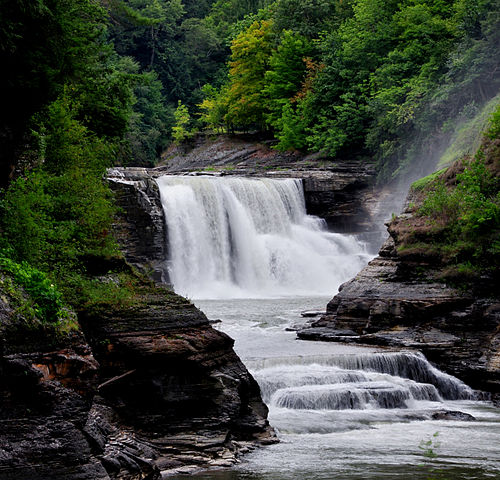
Lower Falls, Letchworth St. Pk, NY. Image by Wikipedia/Suandsoe.
The national park system of the U.S., touted as “America’s Best Idea” (also the title of filmmaker Ken Burns’ series), was established to preserve many such places, though without any explicit markers pointing to spiritual practice. But then of course we already instinctively go to parks for healing and restoration, only under the guise of “vacations” and “recreation.” And many state parks in the U.S. extend the national park goal of preserving public access to comparatively unspoiled natural refuges. Growing up, I lived a twenty-minute bike ride from Letchworth State Park in western NY: 14,000 acres of forest surrounding deep (in places, over 500 feet) gorges descending to the Genesee River. Its blessing follows me each time I remember it, or see an image of it, and in attitudes shaped there decades ago now. May we all know green cathedrals.
I’ll talk more about shrines on other scales, small and large, soon, and tackle more directly some of the similarities and differences between Shinto and Druidry. I’ll also look at some of the roles practitioners of earth-centered spiritualities can — and already do — play in connection to the creation and support of shrines.
/|\ /|\ /|\
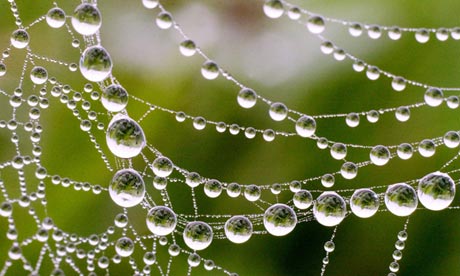
Images: spider web; Lower Falls at Letchworth State Park, New York.
[Related posts: Shinto & Shrine Druidry 1 | 2 | 3 || Shinto — Way of the Gods || Renewing the Shrine 1 | 2 || My Shinto 1 | 2 ]
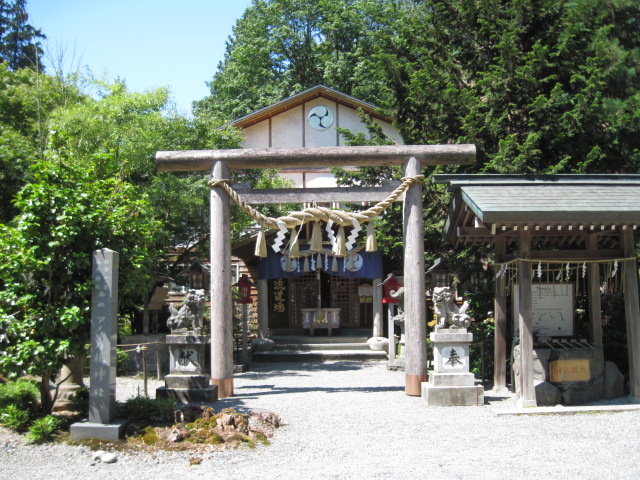
 I’ve mentioned Shinto and Tsubaki Grand Shrine before in these pages — a lovely shrine in Granite Falls, WA, about an hour north-northeast of Seattle. Recently during our car tour that included the Pacific Northwest, my wife and I “made omairi” or paid a visit on a sunny July day. The idiom “pay” is illuminating: some kinds of visits can be the fulfillment of a religious vow, a pilgrimage we dedicate to a spirit or an ideal — acts, in other words, performed at least potentially in fuller consciousness than usual. True, “the bow can’t always be bent,” as the old occult proverb goes; we “have to live in the real world,” as my mother used to admonish me. But you quickly find that cultivating regular times of intention and focus brings spiritual advantages just as it does other kinds of advantage in other aspects of life.
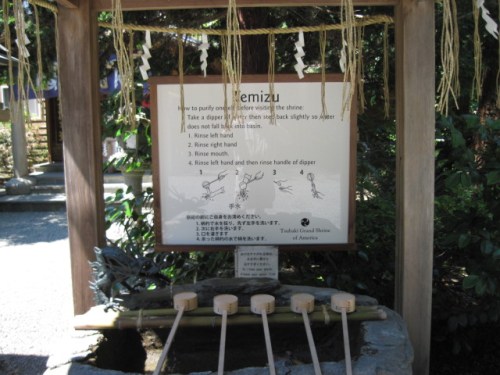 Tsubaki finds a working balance in explaining just enough about itself and about Shinto to the visitor who may know little about either. Shrines express unique and individual presences, and Tsubaki is no different. We can argue till the cows come home and make their own butter whether such distinctiveness comes from human intention solely, or from a happy cooperation of human and divine. What remains is the shrine itself, beyond mere debate: a place to visit, breathe, absorb, reflect on, and if you feel called to do so, revere and commune.
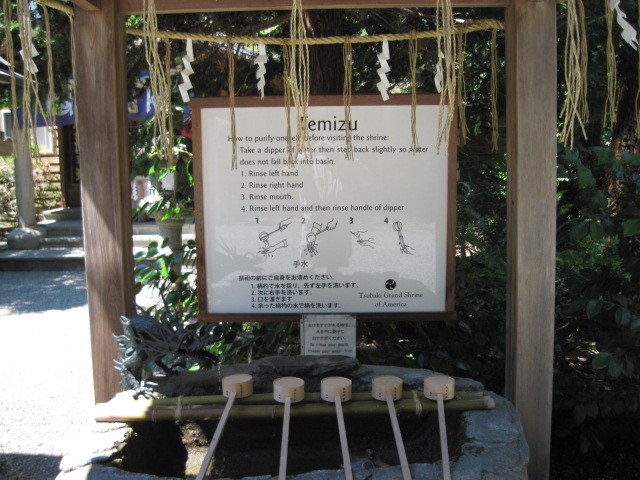
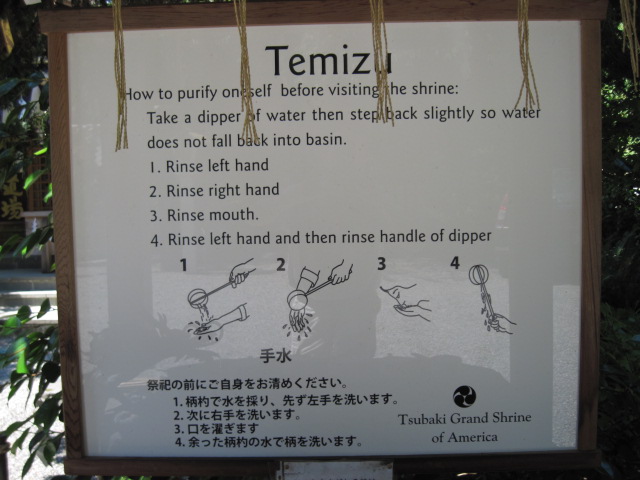
Tsubaki aids visitors in doing this. Here is the shrine’s temizuya, literally, “hand-water-place,” a feature at most shrines, offering an opportunity for ritual purification. The shrine offers a bilingual placard explaining the temizu ritual. Participating (or not) is left beautifully up to us, especially on a day like this was, with no one around but one silent shrine tender, sweeping and cleaning. But the temizuya does stand ready as one invitation among many to make our own discoveries through performing a small ritual action.
 Of course, a shrine need not always explain. Tsubaki, like so much of Shinto, also demonstrates the value of silence in fostering encounters with the natural world. They are not separate things; the human is part of the world of the kami, of spirit.
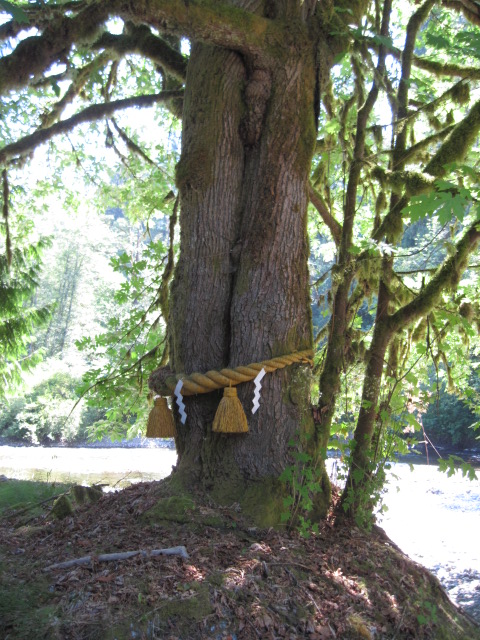
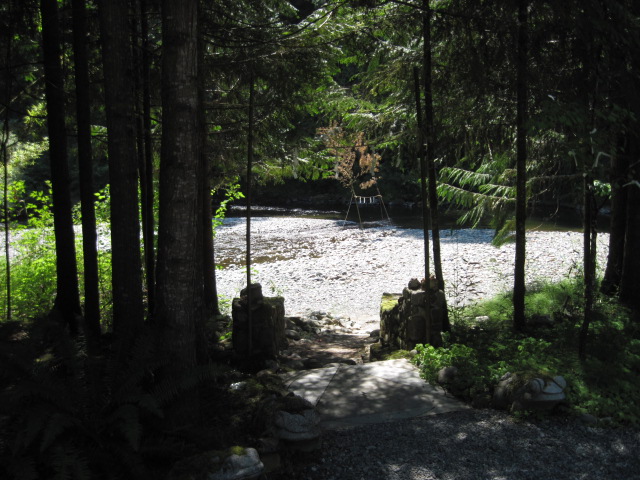
From another viewpoint, a shrine simply acknowledges what is already present, whether it chooses to point our attention to it, or bring us together by putting us in the same place. Here is the path from the central shrine down to the gravelly bed of the Pilchuck River. There you can see another small shrine (in the center of the picture, looking something like a tall sawhorse draped with white flags) standing near the water’s edge.


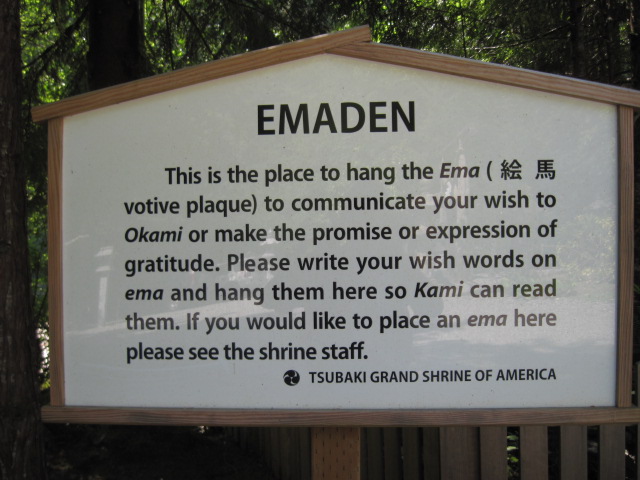
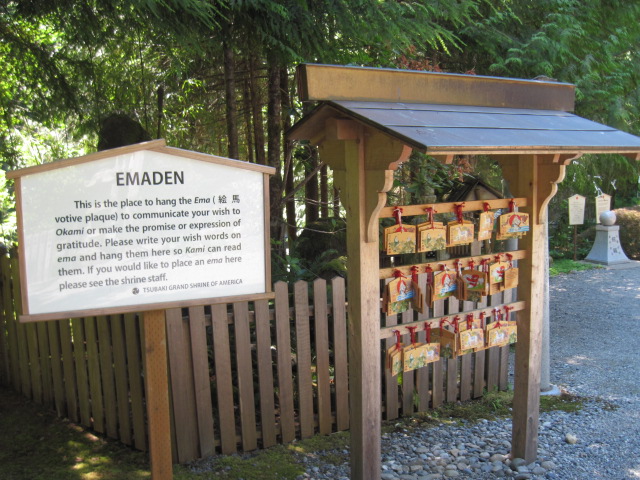
The plaque above adjoining the emaden explains another Shinto practice. Below is the emaden itself.
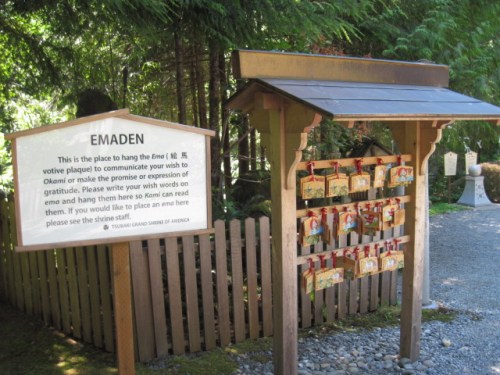
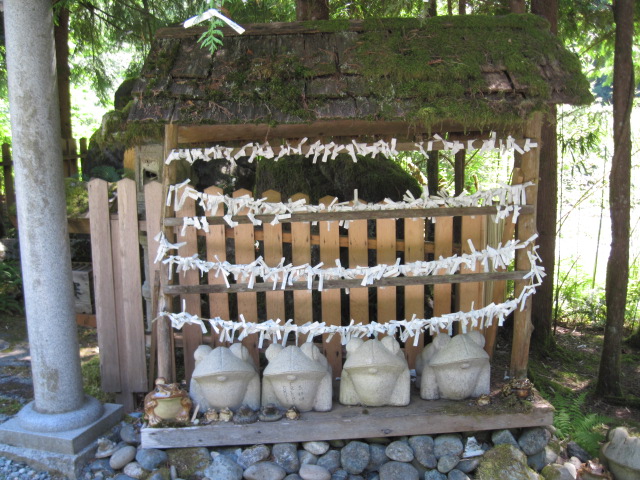
Less formal are the written prayers tied to natural features like trees and to man-made objects. And many Westerners have become familiar with Tibetan prayer flags. Odd that in the West a prayer is considered primarily a verbal action. The silent written prayer can stay in place; we can walk away, knowing our petition or vow or praise or thanks remain, where we made them. We wish for a change, a response, to manifest at least in part in this natural world. Then let our petition, our expression, our acknowledgement of spirit linger in the world, till the world’s elemental and spiritual forces reclaim them.

In addition to other kami, Tsubaki also enshrines America Kokudo Kunitama-no-Kami, the kami protector of the North American continent.
In the next post, I’ll look at some possibilities for what Shrine Druidry could look like as an expression of Druidic experience.
/|\ /|\ /|\
Updated 9 Oct 2015
(Scam, scam, scammity scam. Oh, is this mic live?!)
“One Weird Trick Most Gods Don’t Want You to Know.” A bestselling strategy if there ever was one. Almost fail-proof. Get in on what THEY’VE been keeping from us, Honest Suffering Upright Citizens that we are. Who doesn’t want IN? (Another 100 cable channels! Salvation by proxy! Acne-free in seven days!) Click here. Operators are standing by. No credit? No problem! No money down! Just open a vein! (Can’t get no) satisfaction guaranteed!
(Can any truly worthwhile thing be bought?)
But YES! one god really does want you to know: introducing capital-L Loki, AKA the Trickster, the Wheeler Dealer, the Original Houdini of the Truth Trap, the Cosmic Con, Bad Penny, Black Sheep, the One in Every Family, Every Religion’s Got One Somewhere. Him! Well, who should know better than the Master, right? (Deep down, that part of us all that’s a little loki-in-training. Who whispers Alternatives, in spite of all the noises-against-the-voices we can dump into our ears. Crank up the volume. Maybe they’ll go away.) Figures that the only source for reliable info turns out to be a Trickster.
And he’ll tell you: Religion’s all a scam, an empty fantasy, a fool’s errand, a wild goose chase. This god-or-not and belief- and worship- and daily-practice thing is, like you always suspected, just an endless maze of mind-tricks brought on like a nightmare, courtesy of an overactive cerebrum, that gift of Evolution that just keeps on giving, that two-hemisphere marvel and misfit that — in spite of all its tricks and traps and delusions and the stories it tells about itself and how wonderful it is — will still leave us all just as dead in a hasty handful of decades as if we’d devoted our lives entirely to pleasure. Just like the good old boys and girls over at Epicurean Central always told us we should. Yes, go out and download the app for it.
 Thanks, Loki. Now a word from our sponsors.
Not.
Except …
Godding isn’t what it used to be.
(Even with a nose-and-chin like Tom Hiddleston‘s.)
Even the gods you used to be able to count on turn out to be … puny.
One weird trick most gods don’t want you to know is that their truth or falseness has little to do with what they can teach you, how interaction with them can change your life, and so on.
Just because they don’t exist has very little to do with anything at all. Existence isn’t an absolute. It de-pends.
And like those pesky anatomical pend-ant or hanging things, the so-called “fact” of existence or non-existence can get us pretty confused about reality*, which is, after all, only another name for thing-ness. Anything that’s not a “thing” tends to get left off the List. Which is another weird trick most gods hope we’ll kinda ignore. For our own good, of course. Lists. Everyone’s got one, gods included. (Gods especially.)
What to wear, say, think, do, attend to and let slide. Everyone’s been be-godded, infected with at least one god, right down to our nail-beds and stomach linings: sex, wealth, image, status, art, pleasure, the “right views,” seniority, rationalism, salvation, comfort — even “just being left alone.” Gods everywhere. No place free of ’em. Hanging from the rafters, crawling around and inflaming our skin like some sort of divine psoriasis. No god-be-gone, available now while supplies last. Annoying little (BIG!) suckers.
Even death won’t free us when-not-if — un-gods help us all! — we’re reborn into some vastly cooler, endlessly hip world where everyone is fashionably thin (or plump), calmly atheist and perfectly dressed, coiffed, housed, spoused, aroused and soused. Tastefully conformist down to the designer toe-rings. No gods here, nasty things — had mine removed eons ago, old chap. Do yourself a huge favor, darling.
And so, illusion-free at last, eternity or oblivion (choose your mirror image) is ours!
Paradoxes to amuse children.
(Loki’s laughing all the way to Valhalla.)
And the Goddess? The Goddess is laughing at him.
/|\ /|\ /|\
Images: Loki and The Hulk from The Avengers.
*Reality, from Latin res, thing; realis; re-al or pertaining to things or their qualities, like the ability to slap you in the face, fall on your big toe, eat you for breakfast, if you don’t pay attention to them. Which gods like War still do, come to think of it. Details at 6:00 (or 18:00) tonight!
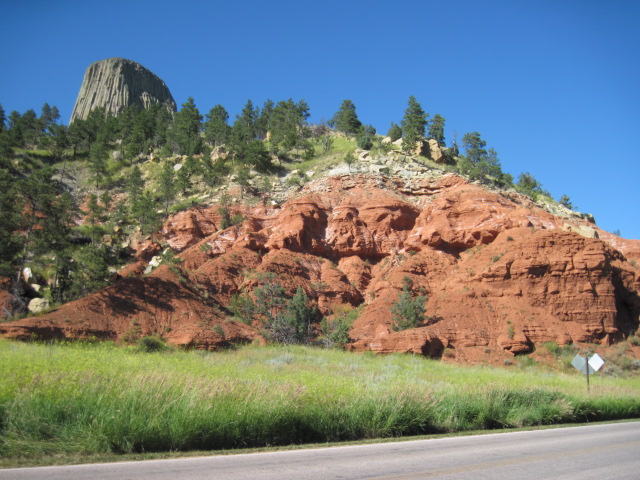
From a distance, Devil’s Tower National Monument in Wyoming looms over the landscape, prominent against the horizon, but once you enter the park surrounding it, it seems to vanish, only to reappear in fits and starts at first, peeping over colorful hills and cliff faces.
Geologically, we’re told, the tower is properly an igneous intrusion or eroded laccolith, two fun pieces of scientific jargon, technically descriptive, but lacking something nonetheless. And “Devil’s Tower”? Why should the baddie of Judeo-Christianity get any credit at all for this splendid rock formation? Let him stick to devilled eggs and devil’s food cake.
Those of us over a certain age may recall the Tower’s appearance as dramatic staging in the final portion of the ’77 Spielberg sci-fi film Close Encounters of the Third Kind, a pop-culture association that now seriously dates us.
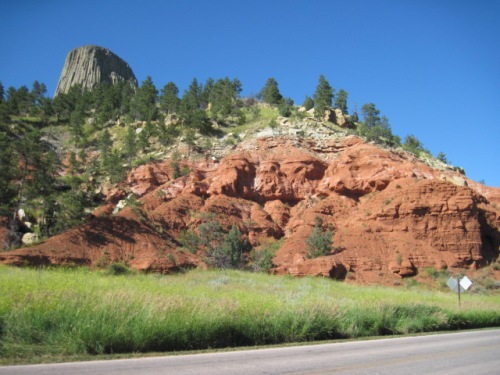
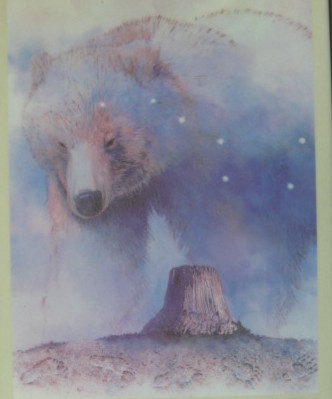
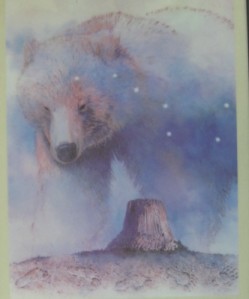 My wife and I arrived late in the day, which helped throw the tower’s dramatic vertical striations into high relief. A park information kiosk quietly points out that the English name “Devil’s Tower” is comparatively recent. Native names from several different tribes associate the formation with the bear — the Cheyenne, Arapaho, Crow and Lakota all call it some variation of “Bear’s Lodge” or “Bear’s House” and their traditional stories describe bears marking the great stone with their claws.* (You can read several versions under the section “Native American Folklore” here.)
Both name and thing started shifting for me as I read this: a good name illuminates the thing, and the thing itself lives more brightly and fully under a good name. I can still feel the association “stick” — now a piece at least of that older (and to me more apt) story has become part of this landscape. Devil’s Tower, yes. But the “real” name, well, that’s a different matter. Invoke the place in memory by the older name — in this case a good one — and its naming story comes with it. Misname something, or someone, and you may not be able to see that thing or person clearly or truthfully.
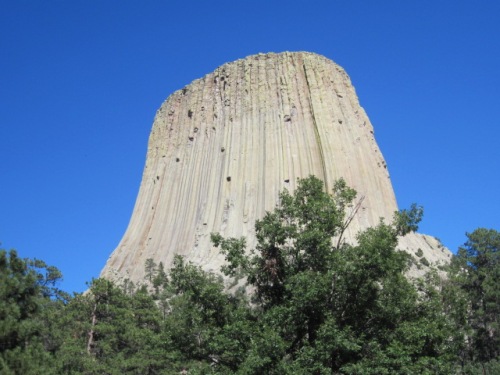
Bear’s Lodge, now I pass along a little of your story to others, so they too may enjoy the rightness of a good name.
/|\ /|\ /|\
*The tower remains a sacred site for several tribes. “In 2005,” the Wikipedia article notes, “a proposal to recognize several Native American ties through the additional designation of the monolith as Bear Lodge National Historic Landmark” faced political opposition and the argument that a “name change will harm the tourist trade and bring economic hardship to area communities.”
Image: Bear over Devil’s Tower — park info kiosk.
You may know some of “them.” (What’s it say about us that we say “them”?) They’re often wonderful people, they raise families, they “contribute to society,” they’re fun to be around — and they may seem not to have a religious or spiritual bone in their bodies. And that’s not only something to “tolerate” or “accept.” It’s just as it should be. “I desire that there may be as many different persons in the world as possible; but I would have each one be very careful to find out and pursue his own way, and not his father’s or his mother’s or his neighbor’s instead,” says H. D. Thoreau.
Two couples whose company my wife and I delight in and seek out certainly qualify as non-religious: you can see their unease or discomfort if the topic happens to come up in conversation. An innocent question, or a comment in passing. “What’s that pin you’re wearing?” or “What did you do last month when you were in Minneapolis?” And hearing our answer, a kind of stiffness, a change in expression, a wilting, or wariness. “Oh no,” you can practically hear them thinking. “We’re going there again.”
And my wife and I laugh about it afterward. You get it, right? So often we’ve been the defensive ones, either avoiding the topic altogether, or passing off our beliefs with a quick, casual acknowledgment and then turning the talk in another direction, or (sigh) girding ourselves to explain, justify, account yet again for our non-mainstream practices and events and perspectives. The lesson for us continues to be this: if the opportunity opens up, find a way to talk about day-to-day benefits rather than beliefs, seek the common ground we all know from living on this planet, demonstrate it as a part of our lives, which they do care about. Then move on. Build trust, keep the lines of communication open, share your vulnerability and — as needed — shut up. You know: basic relationship stuff.
On our recent car trip, which I’ve touched on in the last several posts, we managed to reconnect with colleagues from over 25 years ago, a couple I worked with during my year of teaching in Changsha in the People’s Republic of China in the late 80s. We’d fallen out of touch: the first of their three children arrived, three of the four of us were back in school, several of us were patching together jobs out of already unconventional work histories, and both of our families moved at least a couple of times to accomplish these things.
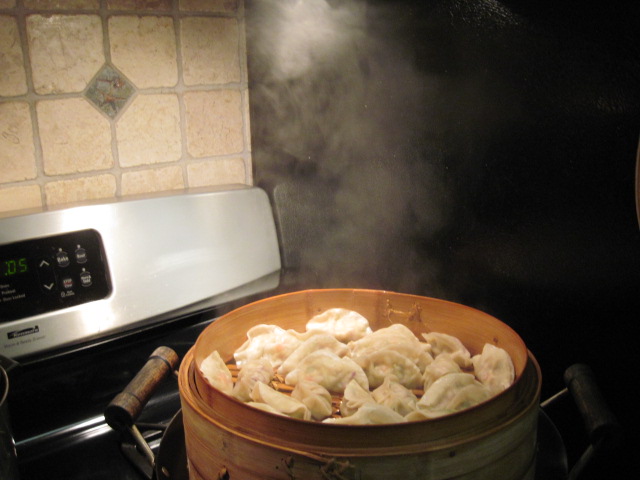
 We joked about our reunion later, over a dinner of home-made jiaozi. Making and eating them had become a lovely family tradition for them after China. The four of us and their youngest daughter, now 19, stood around their dining room table, filling and wrapping and talking, brushing the jiaozi wrappers with the cornstarch-water mix to seal them, then watching as the plump crescent dumplings steamed. Earlier we’d met for lunch in a restaurant, in case any of us had become raving loonies in the interim, and a convenient escape was needed. Eight hours later, we all knew we had nothing to fear. And the best demonstration, in the moment, of spirituality in all of our lives? Friendship, hospitality, a shared meal, simple pleasure in each other’s company. A touch of nostalgia didn’t hurt either.
/|\ /|\ /|\
Image of jiaozi steaming: me. Actual kitchen, steamers, stove, etc., courtesy of S. T.
Edited: 2 Aug. 2014

Margot Adler in 2004. Picture: Wikipedia OTRS, by Kyle Cassidy
Quietly, steadily, Margot Adler helped Paganism gain wider understanding and respectability. Her passing at 68 from cancer this last Monday, 28 July ’14, also leaves a gap on the airwaves. Often people seem to know her either for her work as a veteran reporter and correspondent for National Public Radio (NPR), or for her seminal book on Paganism and her involvement in Wicca, but less often for both. Yet the combination is a key to her life and significance, and helped to give her and what she had to say particular impact, harder to ignore because of her reasoned and thoughtful public voice over the decades.
The NPR website provides a couple of short audio segments acknowledging her work and her passing. This one includes brief mention of her involvement in Paganism toward the end, around the 3:40 mark, and includes a link to the other segment. Both segments include written transcripts as well.
Adler’s signature book, Drawing Down the Moon: Witches, Druids, Goddess-Worshippers, and Other Pagans in America Today, to give its full title, was first published in 1979 by Viking Press. The Amazon page for the 4th revised 2006 edition enthuses:
Almost thirty years since its original publication, Drawing Down the Moon continues to be the only detailed history of the burgeoning but still widely misunderstood Neo-Pagan subculture. Margot Adler attended ritual gatherings and interviewed a diverse, colorful gallery of people across the United States, people who find inspiration in ancient deities, nature, myth, even science fiction. In this new edition featuring an updated resource guide of newsletters, journals, books, groups, and festivals, Margot Adler takes a fascinating and honest look at the religious experiences, beliefs, and lifestyles of modern America’s Pagan groups.
 A 2005 article in the Religion Journal of the New York Times, “Witches, Druids and Other Pagans Make Merry Again in the Magical Month of May,” observed that “the book is credited with both documenting new religious impulses and being a catalyst for the panoply of practices now in existence.”
My 1981 Beacon Press* paperback edition has begun to yellow with age. Paging through it as I write this post, I remember how I read and re-read it, fascinated by practices, perspectives and beliefs that variously called to that 20-something me from a place both familiar and strange, echoed my own experience, or surprised me with their outright oddness.
If modern Druids and Pagans more generally have relied heavily on books to launch and sustain them, that’s because it’s often principally or solely through literacy, books, and reading that many Pagans learn they aren’t alone after all, that others like them really do exist, and that the spiritual energies they finally must acknowledge are at work in them deserve expression rather than repression — that the way opening before them is possibly even worth the risks and hardships that may come with it. The brave Solitaries in their personal practices, and the Pagan groups that have formed and continue to form, resemble those of many other new religious and spiritual movements that coalesce and arise, and have arisen historically, within cultures typically oblivious, resistant or actively hostile to the opportunities, perspectives and critiques such movements offer. Where else, after all, would you expect Pagans to begin?! Where and how else do any new spiritual and religious movements begin, but by those with a shared experience or vision recognizing each other, and drawing nourishment from the common ground between them?
That original book cover of Drawing Down the Moon looks tame today, but it made me want to hide it from casual view, even from my parents who were very accepting of whatever their bookish son was currently reading. So what happened next with me? Very little, outwardly. But the book and its many voices, together with its author’s reflections on the Pagan movement, fell onto fallow ground. I can trace its impact directly to my involvement in Druidry now. And from what I’ve heard, I surmise this proved true for many others as well. Roots and branches of many lives.
So all this is to say thank you to Adler for her book and also for the questions she raises in it, most of which remain valid. While various streams and strands in Paganism have grown and strengthened since the time of the first edition of Adler’s book, the challenges she perceives for Paganism persist. I’ll close with an example:
Neo-Pagans, Adler asserts (pp. 385-386*)
have so many different visions that together they seem broad enough to sustain the human need for beauty, freedom, and growth. They contain a vision of the earth that is a noble one, a reverent one. I am still inspired by it. These ideas seem capable of stirring great ferment; they seem capable of ending human alienation from the planet. But will they?
… It also seems clear that those who choose to be Pagans do so to nourish and sustain a Pagan vision already inside. This vision exists as a painting exists, or a piece of artwork. And Neo-Pagans are the artists. But the relationship of artists to living on the earth has always been uncertain. Perhaps it is important to emphasize the visions of Pagans rather than the realities of their lives, the poems they write rather than the jobs many are forced to keep, the questions the movement asks rather than the goals already attained. The goals sometimes fall short of transcendence, and Pagans are often imprisoned by the very civilization they criticize.
Of course, that’s partly WHY they criticize it. Plant a dream, and it may well take time to germinate, if conditions are less than welcoming.
“You’re much too journalistic,” Michael told me again and again as we walked around Craftcast Farm in the winter of 1976. “I want to know what people feel like in the circle. That’s what I want your book to tell me. That’s what I want to know.”
Along with her good thinking, and the words of many who have become our Pagan elders, Adler’s book definitely conveys both that atmosphere and the challenges Paganism continues to grapple with.
/|\ /|\ /|\
Images: Margot Adler; book cover of Drawing Down the Moon, first edition.
*Adler, Margot. Drawing Down the Moon: Witches, Druids, Goddess-Worshippers, and Other Pagans in America Today. Boston: Beacon Press, 1981.
Edited 4 Aug 2014
Then there are those times when you’re simply enjoying the kitschier side of your culture. And maybe, in spite of everything, you still encounter a kind of metaphorical economy inherent in things, in which even apparent kitsch can reveal a mystery, or prompt a discovery.
My wife and I were on a return leg of our car-trip yesterday afternoon when we saw a Minnesota highway sign at the town of Blue Earth that caught our attention. A short turn off interstate 90 led us to a parking lot and a small patch of, well, green.
To celebrate the 1978 completion of interstate I-90 as a highway linking Boston to Seattle, Green Giant Foods erected this statue of their Jolly Green Giant mascot in Blue Earth, Minnesota. (Green Man always manages to sneak his way into consciousness, one way or the other.)
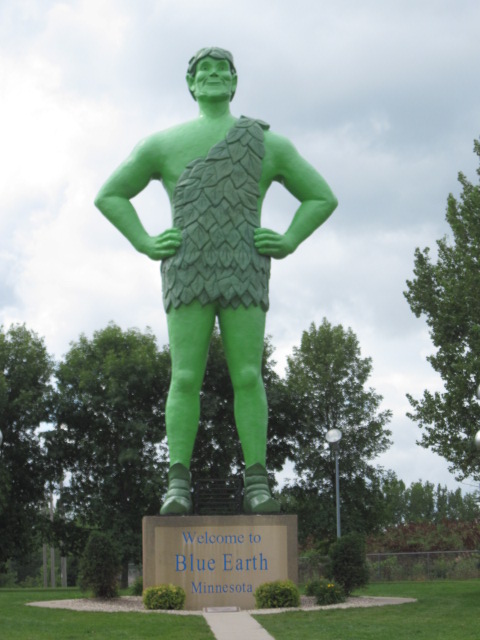
Like some of you older readers, my wife and I grew up hearing the bass voice-over of “Ho, ho, ho … Green Giant!” as the animated cartoon version of the big green guy hawked frozen vegetables on TV. Now here he was “in person,” or as close as we could get. And may this post be a small tribute to His Greenness.
Edited: 30-July-2014

 Some of you may recall a minor kerfluffle from the Christian Right a decade or so ago, when then Anglican Archbishop Rowan Williams joined the Welsh Gorsedd of Bards and appeared in — gasp! — “pagan” Druid robes and hood. One of the many ironies of that moment and others’ reactions to it is that of all Druid groups, the Welsh Gorsedd is among the most secular and the least woo-woo (a highly technical sociological term).











 A Druid Way