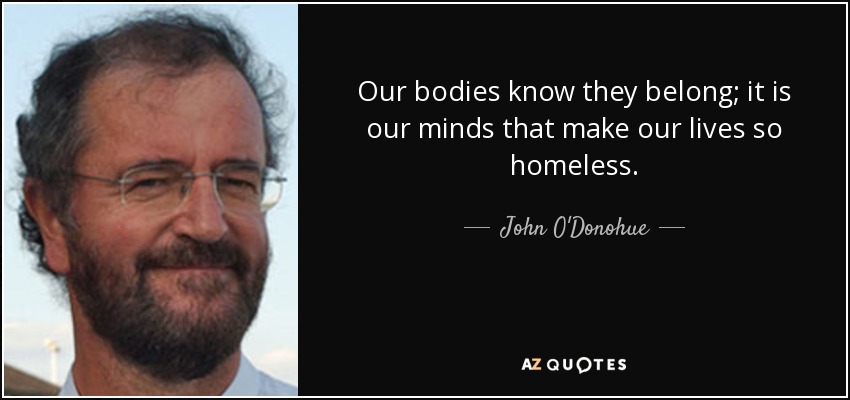
Mantle of Brighid about me,
Memory of Brighid within me,
Protection of Brighid around me
keeping me from harm,
from ignorance, from heartlessness,
this day and night,
from dawn till dark,
from dark till dawn.
— John O’Donohue (adapted), The Four Elements, Transworld Ireland, 2010, pg. 109. (Also available in Random House editions.)
I find in this poem a prayer most fitting for these darkening days till Yule and sun-return (never mind the ritual season). I add to it these visualizations as I say the opening triad of actions:
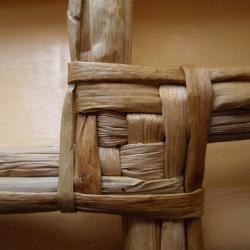
I see and feel the soft, warm cloak of Brighid furl and drop around me. I touch the weave of the cloth. I see the mantle extend outward, expanding the presence of Brighid all around me. “Beneath your mantle you gather us.”
I feel the memory of Brighid arrive as I whisper her name, her presence in thought and feeling, in the hearth-fire, in human warmth and affection, in animal caresses, in the sun’s brightness, hidden behind clouds or yellow in the December sky. Her mantle means we help manifest her, bring her here. “Remind us how to kindle the hearth.”
I feel the awen of the divine kindling in and around me whenever I put off despair and choose better. I sense the awen in others, upholding me even as I uphold them. I name them now, sitting or standing before any fire or flame or light, which I declare Brighid’s fire and flame and light.
O’Donohue writes: “One of the reasons for the modern poverty of spirit is amnesia. Even though there is a great harvest of healing energy within memory, people seem to make so little use of it. Rather than living from this harvest within them, they seem in the demented rush of modern life to live more out of their poverty” (pg. 113).
I hold my hands up before me and say more of this prayer-poem:
To keep it bright,
to preserve the flame,
your hands are ours,
our hands in yours
to kindle the light
both day and night.
And then I close, repeating the opening triad once or twice more as it feels right.
Mantle of Brighid about me,
Memory of Brighid within me,
Protection of Brighid around me.
And I see Brighid’s cross, feel it foursquare, if I receive no other intimation of the goddess. I sein my thoughts, feelings, and actions of the day with it, sometimes continuously through the hours if I need it, to preserve, preserve, preserve the flame.
[OK, what follows is a rant. Continue for your own discomfort. I say little that’s new here. Just retuning and returning with notes I’ve sounded before. Mostly, as with blogging, I’m talking to myself, but out loud. Say it to see how it sounds. Flavo(u)r to taste. You indulge me by sometimes liking what I write, if it has any merit you can use. And your comments, as always, are welcome.]
“Collapse now”, counsels John Michael Greer, “collapse now and avoid the rush” as industrial civilization devolves and careers along an increasingly wobbly course. Greer, whose words and ideas have intermittently appeared here, is a “talk-walker”, someone who lives what he advises others to practice. An increasingly widely read blogger and master gardener, as well as author and mage and archdruid emeritus of the Druid order AODA, Greer lives largely off the grid. Owning no car, and growing a large portion of his food, Greer and his lived choices make his words carry more weight with me than the renowned physicist Stephen Hawking.
Of course, Greer’s choices are just one possible set, and not even the best for many of us. But they’re his, not manufactured for and sold to him by someone else.
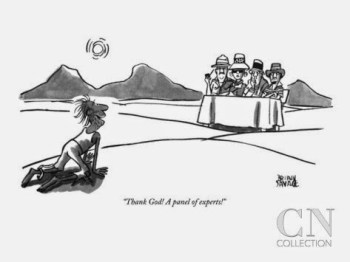
And Stephen Hawking? Just yesterday he wrote in an article in the U.K.’s Guardian newspaper that, yes, he’s lived a life of extraordinary privilege; that, yes, elites like him and his circle have long ignored the plight of working-class folks; and that, yes, recent elections and votes in the U.S. and U.K. and elsewhere betoken a cry of anger and anguish. But he can still write in an astonishing stew of ignorance and arrogance that
what matters now, far more than the choices made by these two electorates, is how the elites react. Should we, in turn, reject these votes as outpourings of crude populism that fail to take account of the facts, and attempt to circumvent or circumscribe the choices that they represent? I would argue that this would be a terrible mistake.
No, in fact, the reaction of elites matters far less. It will be quite predictable. We’ve seen it repeated endlessly over the span of millennia. They won’t do what they could do, because it’s really not even theirs to do, though we’ve often abdicated choice to them. But as we always have, we choose day by day to put into action the causes that bring us where we go next.
That’s neither good or bad in itself: it’s simply how cause and effect have worked, and will continue to work. But so often it’s not in the self-interest of any elite to do what the “electorate” may want or need. That’s what makes them the elite. Plotting a course of self-interest is how they got to beelite. That’s what “people do” in such circumstances.
And — always — people can do something else. I can, and so can you. I did yesterday, and you did too.
Not according to Hawking, though. Current trends and practices
in turn will accelerate the already widening economic inequality around the world. The internet and the platforms that it makes possible allow very small groups of individuals to make enormous profits [Hawking’s link] while employing very few people. This is inevitable, it is progress, but it is also socially destructive.
Inevitable, progress, socially destructive. There it is, in a nutshell, the reason we’re collapsing. The first two assumptions are just that, assumptions. The third factor looms before and around us, resulting from the first two.
We’ve demonstrated over time, far better than any New Age workshop or guru ever could, how we create our reality. Assumptions are, after all, powerful magical techniques. Hold them strongly enough, inject them with emotion and attention, and they shape consciousness. They make up the outer circumstances, often the inner ones, of life. One life, a billion lives, in high tech or on a factory floor or in a studio or classroom or garden. One life, a billion lives, filled with pain, joy, a mix.
“With resources increasingly concentrated in the hands of a few, we are going to have to learn to share far more than at present,” says Hawking. But who will start today? You, privileged physicist Stephen Hawking? Whenever I read or hear “must” and “have to”, I know someone’s avoiding actually doing that “must” or “have to”, or, more likely, is shunting it off onto someone else’s shoulders. I try to minimize that in this blog, but my percentage slips from time to time.
Waiting for “elites” to act is exactly the wrong course of action. We each take steps each day to build whatever balance we have in our own lives. Sharing resources? One way I share is to “consume less”, of course. Will I recycle this bag or box, or throw it in the trash? Will I replace these lightbulbs with higher-efficiency ones, or maybe just not use lights as much? Candles, or darkness. Will I reduce my car-trips, combining tasks and appointments? Will I sell the car, and use public transport? (It may not be available.) Will I unplug appliances that eat energy even when they’re “off”? Will I grow anything at all that I can prepare myself and eat, rather than buy from halfway around the planet? Will I downsize a habit, a car, a house, a hoard of possessions, an attitude, a life?
One and one and one and one and one and one and one and one and one and one make ten. “Suddenly” a lot? Nope. Accumulating every day. We knowthis. The world now vividly reveals the human psyche. (The fact that it also does many other things needn’t be lost on us either, in our species-centric obsessions. Other lives have their say.) Our Western popular culture now gives us The Hunger Games, Divergent, The 100, Terra Nova, Incorporated, The 3%, and so on.
The beauty of our individuality is that there’s no “single solution” but a multitude of choices, because we’re a multitude of people.
The city-dweller in a third-world nation foraging for scraps through piles of refuse exhausts her options and migrates with her family to another region where she can grow a small garden. Or find work. Or mount a protest with others large enough it draws media attention to a problem. Or, sometimes, die trying any of these. Sometimes we can shame ourselves into fixing things. Sometimes we just turn away. Every choice matters, every choice contributes to the pool. Nothing is lost. All that we do returns to us, so we can see our choices more clearly. Why else have worlds like this, where choice is possible and makes such a difference?
Americans, of course, are all elites in their own way. We’ve seen the figures, how we consume a very large percentage of the world’s resources, far larger than our share. Greer counsels “collapsing now” as something prudent, as an act of self-interest, because our two choices are not really choices at all. We can collapse more gradually, with foresight and preparation, or we can collapse painfully, in places violently, resisting change all the way down. Collapsing or not collapsing are no longer the options. How we collapse is.
It’s not some unique event, the collapse of a civilization and economy. History doesn’t so much repeat itself as find endless variations on a small set of themes. The collapse of a petroleum-consumption-empire-supported lifestyle doesn’t mean “the End” but it does mean massive change in a certain set of imbalances.
It’s safe to say large portion of the readership of this blog is blanketed, for now, against the worst sufferings these changes can bring. If you have both the leisure and opportunity to ponder the words of a privileged white blogger, you’re statistically pretty likely to be privileged yourself. Yes, we’ve been “inconvenienced” by changes already. Yes, our “standard of living” may be declining. Most of us aren’t yet starving, in prison, or dead. But our heads and hearts are troubled, our bank accounts are scary-shrinking, our stresses, health, credit-cards, relationships and uncertainties maxed out. We’ve had a foretaste, certainly. Those of us who live more on the fringes in any way will, like canaries in the mine, bear more of the assault of change. We’re already beginning our own forms of collapse, of hopefully creative down-sumption.
The healing, creativity, practical tool-kit, and hope that Druidry offers, like other spiritual paths also do, involve steps we can take now and daily. Whether we actually take any of them, whether we see them as beautiful and wise opportunities to begin to reclaim ourselves and our world, or as RAORPSEMFs, Ridiculous Avoidances Of Real Problems Somebody Else Must Fix, will determine to a great extent how the next minute, month and decade will go for any of us.
“Each mortal thing does one thing and the same”, sings Gerald Manley Hopkins, that wonderful bard who observed his world so loving-wisely. You can read the poem I’m reflecting on here at this site, which includes a bite-sized biography, along with short, helpful observations.
“One thing and the same”, Hopkins says, sounding confident, like he really knows.
What? you ask. The thing we all are, a self that “[d]eals out that being indoors each one dwells”: the “indoors” we each inhabit, the self we look out from onto everything around us. Deal it out, pay it out like divination, rope or money or time.
Hopkins gets it. He goes on: “Selves – goes itself, myself it speaks and spells”. Each self does this, it goes as itself, it “selves”, as if we are all verbs now, and everything we do speaks us and conjures us both out of and into the cosmos. To live at all is a magical act, “to be alive twice” as another poet calls it. From time to time we hear the echo of both lives, the two halves of us we can’t ignore, that kindle in us a human restlessness we can never extinguish. It’s also what we are, what we do as selves.
I’m born and I come upon myself, I gradually become self-aware, the self simply a larger and more engaging preoccupation among all the other things I do. Each of us sits in a self like we sit on benches. The bench of the self weathers in place, this place, the world of heights and depths, times and places.
And what is the “speech” and “spell” it utters? Bard-like, Hopkins says it like he hears it: all these selves “Crying What I do is me: for that I came“.
I’m doing it right now, and it also will take me my entire life to do it completely. When my heart stops and my last breath goes out, I’ll have finished this particular doing, one turn on the spiral, whether I become the lichen near the bench or the shadow of tree-trunks or a tree or a human again, or something else “different”, says Whitman in another poem, bard singing to bard and to all of us, “different from what any one supposed, and luckier”.
Have you felt it, luck in the sunlight, possibility on your skin? There’s Druid-luck just in living, which I can know if I heed the reminders, or ignore them and suffer. Either way, it hurts, says therapist Rollo May. I’ll suffer anyway. OK, on to do something through and around and even, if I have to, with my suffering. What I do is me: for that I came.
“Don’t you know yet?” scolds Rilke. (Damn these bards! The conversation hasn’t stopped since awen first stirred in us. One thing and the same. We recognize it in others, in the voice of the Bards, because we’re doing it too.
What? I ask again. Rilke answers, part of the Song singing all of us here, the voice at the center of things that makes music out of us all, the voice we hear in dreams and silence and sound, laughter and tears and the spaces inside us.
Fling the emptiness out of your arms into the spaces we breathe;
perhaps the birds will feel the expanded air with more passionate flying.
…..
Of course, it is strange to inhabit the earth no longer,
to give up customs one barely had time to learn,
not to see roses and other promising Things in terms of a human future;
no longer to be what one was in infinitely anxious hands;
to leave even one’s own first name behind, forgetting it as easily as a child abandons a broken toy.
Strange to no longer desire one’s desires.
Strange to see meanings that clung together once, floating away in every direction.
And being dead is hard work and full of retrieval before one can gradually feel a trace of eternity.
Retrieval. Of coursewe fear death, if we’ve done it so many times before. A healthy fear of death, something I know, rather than terror of what I don’t know. I’ve done this death thing countless times already. What’s one more?
Well, a great deal. How many years to retrieve this time around, to begin to recall things I’ve never forgotten, maybe, but misplaced, thrown out, ripped up and shredded even, for decades, centuries. A self that emerges out of nothing, returns to it, and also manages a retrieval, with the help of crazy bards and singers on the edges, reminding us. Pointing us back to song that’s still singing us, notes on the wind.
On several occasions my teacher has shared with the small circle of his students his practice of tending with love one thing that he does regularly anyway. Then to do it with intention and focus and care.
The action can be as simple — and simple works well — as tying shoelaces. Getting out of bed. Shaving. Watering a plant. Opening the front door. The technique transforms a quotidian something that has till now just sat there in its ordinariness and now begins to flower in our awareness, once we give it that kind attention. I was going to write kind of attention, but “kind attention” fits, too. Do this, I keep finding, and like pockets or balloons of energy, the world through the particular thing we are cherishing and tending opens itself as a gift. This happened to me on my regular 3-mile loop walk, when I walked with intention. Putting each foot down, lifting the other, breathing, listening.
What remains green when other things are dying?
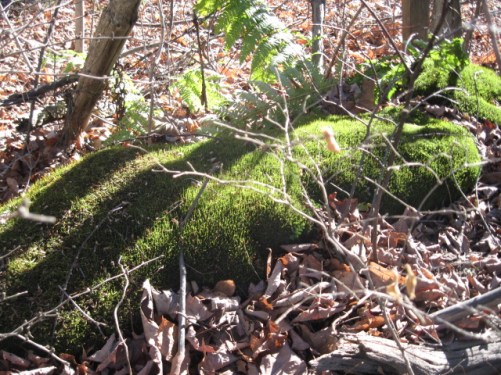
Mosses and lichens nibble at stones, evergreens of a different tribe. I run a hand lightly over them, this first cool green being on the walk.
/|\ /|\ /|\
I give thanks for all that comes free — air and earth, cloud and sunlight, birdsong and breathing.
I give thanks we have language to name such things, our round, treaded words rolling us from perception to perception, good pointers that they are.
Numbers, letters, the signs we make to write speech onto things — little wonder we’ve attributed their origins to gods — Thoth, Hermes, Saraswati. Attend closely enough to roundness and the shape echoes, singing in the ear. Who knew worn round things have such stories to tell?
I will tend you until who you are is more important than my opinion about you.
I give thanks for this world of contrasts where, according to one of the Wise, many beings wait on the threshold, longing to incarnate for the extraordinary lessons it offers. The denser and harder its energies and challenge, the more it offers them opportunities to grow as they can nowhere else.
Shadow and light, new equilibriums possible with each step, so many things whose tending reveals things coming into existence because we have tended them.
Light and dark hold hands — or clasp branches, as the case may be.
What questions does the world answer that we haven’t asked — but could?
/|\ /|\ /|\
Ancestors, relatives, descendants — who really is a stranger in the end, when so many are kin?
From the flat pink-yellow photo paper my great-great-grandparents Ann and James look out on their wedding day.
Did you foresee the Civil War gathering its bayonets and gunpowder, gangrene and despair?
Picture frame like a ship’s porthole — I half expect you to stand and move about and take up your lives as I gaze at you. I give thanks that because of you, I exist. I know you in my bones, though I know little enough aboutyou: this image, and birth, wedding and death dates.
(I’m grateful even for the big noses you both obviously bequeathed to us your descendants.)
The world follows its own dells and channels and boundaries, often ignoring ours.
Build a wall and before long, birds, wind and animals help seed the beginnings of a thicket instead. Tree roots thrusting from below make a ruin of any wall. Trees might have served better to begin with.
I’m grateful walls sometimes simply end abruptly. Should I leap from the capstone? Build a sacred fire on it? Shift it to seek for treasure cached beneath it.
Maybe just listen and see if it has something to say other than whatever I’m thinking. My thoughts may have less to say than its silence.
/|\ /|\ /|\
Then there’s time’s rough handling. Hang around long enough, and the things you’ll lose, as much as anything you’ll gain, will build your character, all our ancestors mutter.
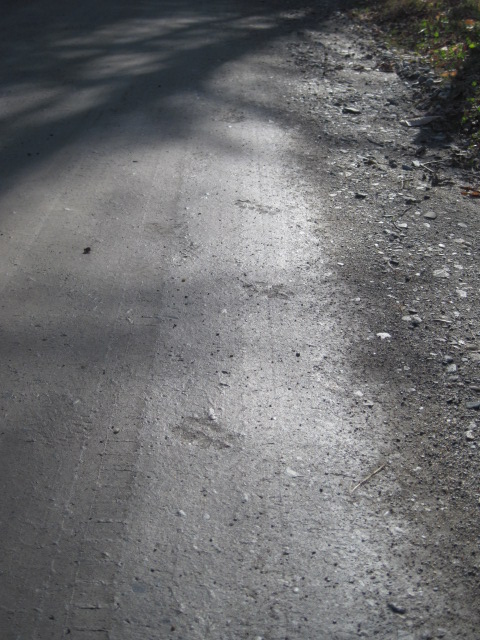
I’m grateful for the tracks of things, however faint, that pull me out of thought and into larger possibility.
I give thanks life meets me halfway — just not always where and how I expect it.
I give thanks, finally, that the path itself doesn’t always stay the same. Sometimes I think it changes underfoot, just to check if we’re paying attention, and not sleepwalking along our ways.
“I’m here to have an argument.” (Welcome to our daily flying circus.) I’m enlisting the aid of high art and low craft to get through this post.
This post is an argument — not a disagreement, but an argument in the older sense of the word: a proof, a seeking of an accurate assessment of our world. Did the title put you off? It’s going to get worse. Maybe you should just enjoy the Monty Python video, and let the net distract you from there.
Are you allergic to magic, having tried it and found it to be mostly flash and bluster? Does it simply not rouse in you any response — the kind of response you’ve learned to listen for, the kind you’ve come to trust intuitively along your spiritual journey?
You can sigh justifiably — go ahead! — as I pursue yet another topic tangential to your interests or needs. Check back in later. If you’ve been coming here for any length of time, you know I’ll roll around again soon enough to something you can use. Till then, compost and ruminate. It will do you more good. This post really isn’t a downer, but it’s one that will get few or no likes, and recede ignored into the archives.
Because mostly with this blog I’m arguing with myself, of course. (You’re all much too kind and rarely call me on my crap, for which I think I thank you.) But like a madman, I do the arguing semi-publicly, flopping and writhing on the sidewalk, because what else is worth doing, if I don’t also put myself on the line? Do I mean what I do and say, or not? All right then.
[If you’re not like me or most other humans, you move through life blissfully, largely untroubled by the shifts and turns of living in this world with a body that ages and will eventually die. If indeed you belong to that singularly uncommon group, please leave now. I have nothing to say to you. However, you perhaps have something to teach me. It’s likely you’re spending down a karmic store from a previous life. Spend wisely. But if in fact you’re an enlightened being here for the upliftment of others, and you have no personal life or what we now like to call issues but used to be more accurately called hang-ups*, please open your school/temple/retreat/grove/workshop and get on with your mission. The world needs your wisdom.
*hang-ups: those weak spots in our make-up that serve as ideal targets for tests and challenges and other people’s hang-ups. Shrike-like (warning: video at link!), they hang us up on the thorns of uncomfortable truths behind our comfortable illusions before they rip into us. Because pain is often the creator of awareness. I don’t know about you, but some of my most valuable learning has come at the price of pain. And — after the pain has passed — it’s usually worth it. Cancer, deaths in the family, end of relationships, arson, loss of friends: like most of us, I’ve had my share. And like you, I’m still here. The best revenge is living well.]
Having dispatched some of my readership with one or the other of the last few paragraphs, I ask those of you who remain to consider the following. If you want to grow or make changes in the world, or both, and you’ve been frustrated, recently or for a bad long while, here’s an observation worth trying out in the laboratory of the every day. To put it in concrete terms, if during the upcoming holidays you’re up against a Clinton or Trump supporter in your immediate circle (or, with a change of nation, Brexit or Erdogan or Putin or Modi, etc.) who just doesn’t see the world your way, step back a moment and prepare to get magical:
The tools of magic are useful because most of the factors that shape human awareness are not immediately accessible to the conscious mind; they operate at levels below the one where our ordinary thinking, feeling, and willing take place. The mystery schools have long taught that consciousness has a surface and a depth. The surface is accessible to each of us, but the depth is not. To cause lasting changes in consciousness that can have magical effects on one’s own life and that of others, the depth must be reached, and to reach down past the surface, ordinary thinking and willing are not enough. — J. M. Greer, Mystery Teachings from the Living Earth, Weiser Books, 2012, pg. 88.
For “magical” effects, read “transformational.” I’m a sucker for a good transformation. Aren’t you?
It may be that our wands, like Ron’s, simply need replacing. We’re all “truth (im)moral high ground rights victory” and what we really need is just a new, and appropriately charmed, stick of wood.
To add to the mix, I’ll add a line from the Hebrew Bible (Proverbs 16:32) that’s resonated with me since I was a teenager (read in your own appropriate pronoun): “He that is slow to anger is better than the mighty; and he that ruleth his spirit than he that taketh a city.”
Yes, I’m as subject to confirmation bias as the next person. I like this passage because I’ve seen in my immediate family the ravages that anger can leave. I’ve also shed any expectation that another person will or can do the work in my life that only I can do. (Politicians top that list, no surprise. Blame is always easier than change, and they’re so obligingly convenient to blame.)
Round this off with Gandhi’s admonition to be the change we wish to see in the world, and I’ve got a lot of changing to do. But better me than you, I remind myself: if I’m hard to change, you’re even worse. The world — by which I mean you and anyone else in my circle — refuses to do almost anything I want. Me, on the other hand, I’ve hand some success in shaping. Small steps, to be sure. “I love you, you’re perfect, now change.”
How to reach the depths? Like others who’ve learned the hard way, Greer lays out a number of testable, practical suggestions. (Because they’re not “new and improved” they get less attention than they merit.) You’ve already heard me grapple with a number of them on this blog.
What I’m proposing, then, once a week going forward, whatever else I’m doing, is an account of my own experience with some of these specific practices , together with my results. I like the spiritual laboratory of experience, not because I “succeed” but because my failures are often remarkably instructive. I learn how to hear and integrate wisdom or make room for enlarged awareness in my own odd life much better by making “mistakes” with it than I ever could merely by reading or giving intellectual assent to others’ ideas.
A sign I need to grow: I’m either strongly attracted to, or repelled by, a person, place, thing, idea, or feeling.
Yes, there are signs and signs. And whole bunches of debate, at intervals, over what “really” constitutes one.
Here’s my in-progress rule of thumb: if it helps me see more deeply, love more richly, create more vibrantly, wonder more amazedly, then it deserves the name “sign.” Coincidence doesn’t enter into it — in fact, it’s irrelevant. (Most days, though, I won’t go as far as Carl Jung and say “Superstition and accident manifest the will of God.”)
What matters with a sign for me, then, is not its origin but its effect. If I don’t invite such causal ripples, funny thing, they tend not to manifest for me. Tune myself away from the universe and it doesn’t vibrate for me like it did. I cut myself off from that original song that’s always singing just beyond my hearing. That’s a form of spiritual death.
If a potential sign doesn’t manage to do any of these positive things, however woo-woo* it appears, I’ve got better things to do than wade in superstition. By which I mean a vague sense of woo, yes, but without anything concrete and transformative that rises out of my encounter or experience. Those are just dime-a-dozen woos.
And if it’s your sign? Go with it! What does it say to you?
But I tend to discount signs others witness and want to “give” to me. To each our own. There’s a reason you and not I witnessed what you witnessed. And vice versa. That neither validates nor invalidates the sign. It simply personalizes it. If, following Leonard Cohen, the “cracks in the world let the light in,” the person or persona lets the sound of awen through. Latin persona: the theatrical mask (and later, a character or role) that lets a voice come out that did not speak before.
If it be your will
That a voice be true
From this broken hill
I will sing to you …
If there is a choice
Let the rivers fill
Let the hills rejoice
Let your mercy spill
On all these burning hearts in hell …
As long, then, as the rivers fill and the hills rejoice, I take it that there is a choice — and it’s our choice.
/|\ /|\ /|\
On to my “sign of the day” — two giant red oak leaves I spotted during my climb up Wantastiquet Mountain, detailed in the previous post.
The larger of the two leaves comes in around 10 in./25 cm. Are they “signs”?!
I find meaning in them. They make me marvel. They come at a needed time. More about that in a minute. They resonate in my thoughts. They also objectively stand out in some way — in this case, a measurable physical dimension. Together, those qualities are enough for me for them to earn the name “sign.”
As a primary tree of Druids, the oak already comes laden with symbolic meanings. (Some plausible etymologies, after all, define druid as “oak or tree knower.”) And now, for me, more: to stand up in a way that expresses my best. To be more visible in my walk (especially since I found the leaves on a mountain walk, and after asking for sign). Not to shy away from living the values that matter to me. To leave a legacy that inspires, even as I have been inspired. Simply, to give my best.
/|\ /|\ /|\
*woo-woo: a deeply scientific term, used here, of course, with ultimate precision. Urban Dictionary obligingly defines it as “any belief not founded on good evidence.”
To begin this post I invoke with the words of a great Bard, the late Leonard Cohen, who sings in his song “Anthem” : “Ring your bells that still can ring./Forget your perfect offering./There’s a crack, a crack in everything./That’s how the light gets in.”
/|\ /|\ /|\
Doing my small part to ring some bells and locate some nearby cracks to work with, it’s been in my thought more and more to explore Wantastiquet. But it took word of another’s recent climb to the peak to prod me into visiting this local treasure. As a Nigerian acquaintance said to me recently, quoting an African proverb, “Those who live nearest the church arrive late.”
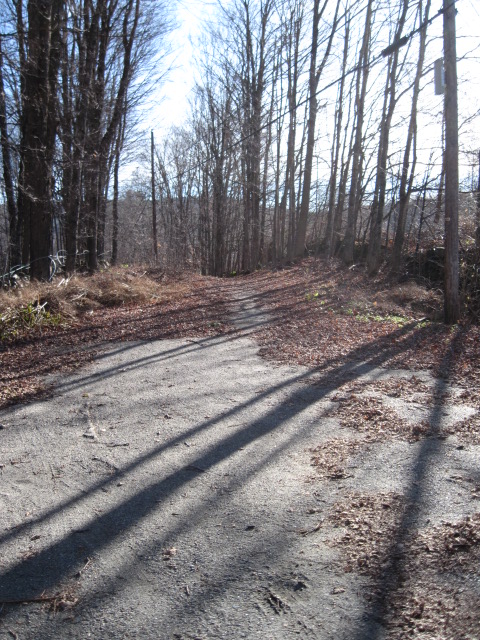
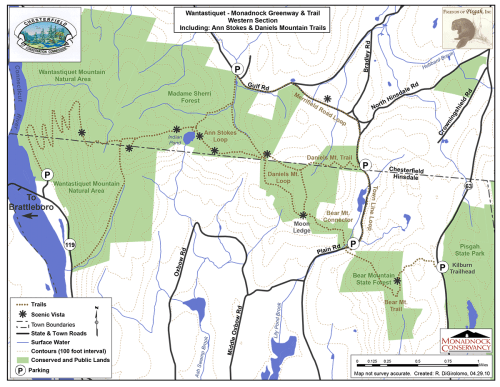
Just over the Connecticut river east into New Hampshire, Wantastiquet Mountain rises to approx. 1350 feet. It’s a moderate 1.5 mile hike to the summit — about an hour’s walk along numerous switchbacks for this 57-year old. From downtown Brattleboro it’s a little over half a mile to the foot of the mountain, so plenty of hikers and their dogs were out enjoying the afternoon. The sunny weather hovered in the mid 50s, oak leaves carpeted the trail all the way to the top, and as mountain treks often do for me, the climb had the feel of pilgrimage. There is a berg-geist, a mountain spirit, if I silence the mind chatter and attend. The rumble of weekend traffic from nearby interstate 91 which the river valley amplifies begins to fade around 500 feet up.
The site is a perfect shanshui — landscape, literally “mountain-water” — one of my favorite Chinese words from a year in the mid-80s spent teaching English in the People’s Republic of China. The Connecticut river valley defines the state line between New Hampshire and Vermont for 150 miles, and seen from the west, the peak appears to ascend right out of the river. Here’s a view from perhaps 70 feet up on the trail, looking back toward Vermont.
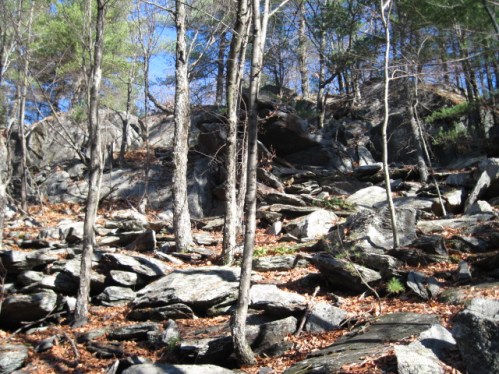
Evergreens march along either side of the path, but the few remaining leaves on oak branches above them account for the trail’s leaf cover.
The pines and oaks busy themselves both splitting the rock and holding it in place.
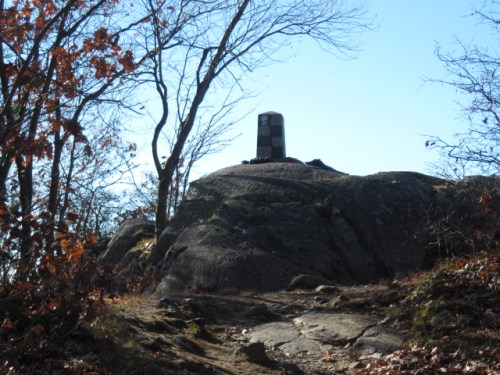
Gathered near the marker at the summit were several resting hikers who left shortly after I arrived.
In the distance, the peaks of Ascutney (45 miles north) and Hogback (13 miles due west) loom through the haze.
I’d gathered a handful of acorns along the way, thinking to plant them as I establish my grove at home. But as I neared the top, an impromptu ritual (my favorite kind) threaded into my attention and I made an offering instead. Finding a clearing a few hundred yards away, I bowed to each direction.
So what do all these high (and abstract) sounding principles in the previous two posts actually mean in practical daily life terms? They mean much to me because they’re part of my practice. Yours will be different.
I talk a lot on this blog about the foundational importance of a regular practice — I’ve learned the value of one from years of experience, failures and successes. Part of your unfolding practice can consist of crafting prayers and rituals and deploying them to help empower you daily — hourly, if needed. Here’s a fine and succinct example (shared with permission) from Catriona Hughes:
Water on my left, fire on my right,
Cleanse and shield me through this fight.
Earth below and sky above,
Help me greet the world with love.
A great deal of the post-election reaction in the U.S. among many has been (and continues to be) fear, blame, anger and grief. Unless these energy flows serve to cause specific and useful changes in our behavior, they wantonly squander our energy without giving us anything like a worthy return. We can give a true gift to ourselves and dedicate the same energies behind them to something we choose, not something reactive — dependent on another’s actions. Otherwise we’re not only left with fear, etc., but we’ve squandered what personal power we do have for that hour or day or month that could have shaped a creative and positive response, and seeded still more over time. Replacement is essential. Our psyches, like nature, abhor a vacuum. Clearing them is the first part. Filling them with what we, not others, choose, is a vital second step.
Something like Frank Herbert’s fine “Litany against Fear” in his Dune series of novels can also answer this need:
I will face my fear. I will permit it to pass over me and through me. And when it has gone past I will turn the inner eye to see its path. Where the fear has gone there will be nothing. Only I will remain.
“Season to taste” fits a life even more than a meal. Find what actually works for you.
Build your own life first. Securing creative sources of shelter, heat, food and water answers our first animal and elemental needs. Ask for help from Spirit and the Four Quarters. Make a form and expression of gratitude part of that daily practice. Blessings and graces — bless the fire as you light it, the food as you eat it, the wind outside as it sweeps past you, the light from the sky as it pours down on you, the animal and plant life all around you, in every season.
Write, sing, dance these things–you choose. Window boxes with herbs or salad greens are within the capacity of all but the most physically restricted of us. Just having something green beside you in the winter months cheers the heart. Eating anything you’ve grown is a return you have gifted to yourself. Note its symbolic power as well — this accompanies any physical act and often matters at least as much to outcomes and influences.
Practices are just that — practice. Refine and adapt as needed. The “best practices” are ones that fit you and feed you. You’ll know this by the doing of it — and gain in confidence and self-knowledge when choosing future practices wisely and heart-fully.
Nurture relationships. Everyone has friends, family, pets, neighbors, co-workers, co-religionists, etc. who can accomplish more together than apart. You know best how to do this, when, on what scale, how often, in your own way.
Practice being an ancestor. Make a point of challenging your own perspectives, beliefs and practices so you can anticipate and ride changes more smoothly. Again, you know best how to do this. The coming days, years and decades will not slacken in the tests and challenges they will bring to us to face. Our ancestors survived their share — and we are living proof. We can do the same.
Know what matters to you, what you believe, what deserves your effort and love. Set it down in writing. Share it with those who matter to you. It may be a list or a theology or two or three practices you want in front of you, within a daily sightline, for a visual reminder as you go about your day. You choose.
Take stock and assess areas above (and others on your own list) — both those that continue to need more attention and those that already flourish and bring you energy and joy. Let your assessment focus on what you’ve learned and what your next steps can be. If you’re like most humans, you’ll benefit from putting these in writing and reviewing them regularly. Once a month — the full or new moon — is a sound time to do so.
There — the beginnings of a practice already, a focused response that will generate, I guarantee, positive results.
Solwom wesutai syet — may it be for the good of all beings.
This post continues the teaching from the previous one. “Above and below” together offer a way to live for the good of all beings, including as a warrior. We need the warrior’s way today at least as much as ever in the past.
The version of the Warrior’s Way of spirituality I attempt to summarize below offers a high challenge I’m still learning and exploring and trying out, after decades of practice, as I continue to walk along two different spiritual paths. I’ve come to see we’re all “slow learners” — it takes many spirals of experience even to begin to understand and live with honor. But how often I stumble simply doesn’t matter — it’s a necessary part of the practice. If I’m not stumbling, I’m probably not practicing. All that does matter is that I try just one more time than I fail.
The warrior’s way doesn’t depend on others for its success. Victory, in fact, isn’t the final point. Are you with me still? Are you asking “Why bother, if it doesn’t lead to victory?”
What makes this the way of a warrior in particular? Any path is a specialization, a focus, a dedication, an ongoing practice. Its whole point is an effective approach. There’s no particular endpoint, but ongoing refinement throughout one’s life. A musician practices because that’s how to be a musician. The warrior’s way is no different.
Ancient cultures held out a code of honor, and the pursuit of excellence, as guides for their warrior heroes. Along with Celtic poems and legends in collections like the Mabinogi, and the figure of Pwyll (left), the Greek epics the Iliad and the Odyssey, for instance, make much of τιμή timē “honor” and ἀρετή aretē “nobility, excellence” as standards to aspire to.
The Hindu epic Mahabharata, which contains the beloved scripture Bhagavad-Gita within its vastness, also presents a similar “warrior’s way.” And just in case we’re not paying attention, the very first stanza of the Gita tells us that the upcoming battle takes place on kurukshetra, yes — the field of the Kuru princes — but also on dharmaksetra, the “Field of Virtue.” Here the rubber hits the road or, you might say, the philosophy hits the fighting.
The opening chapter of the Gita introduces the “spiritual student” and warrior Arjuna (right). He’s downcast at this point — the chapter is aptly called Arjuna Vishada “The Dejection of Arjuna.” The reason becomes quickly apparent — he sees the imminent deaths in battle of those he loves, together with the destruction of a whole social order, and at the outset of the second chapter, he declares bitterly (II:9) na yotsya “I will not fight.”
The profound spiritual counsel he receives from his charioteer, who is also the god Krishna, makes up the rest of the Gita. Arjuna does in fact go on to fight, for reasons that make the Gita very worth studying. (Find a good translation — I can recommend among others the bilingual and carefully annotated version by Winthrop Sargeant, available in paperback.)
These values of honor and excellence or virtue feature dramatically in the larger-than-life examples of heroes, and of course they also come bearing the limits and glories of their respective cultures. As a work in progress, the warrior’s way, like all life-ways, continues to deepen and unfold as we practice it and spiral with it.
A college friend of mine was very into the warrior’s way, to the extent that the only picture on his apartment walls was a large and dramatic painting of a robed figure wielding a weapon of light and bearing the caption “swordsman of spirit.”
Every human life has its battles, inner and outer. The recent political upsets and twists and turns here in America are ultimately a very small part of an immense and ongoing drama. They feel large because they’re ours, and disorienting in part because many of us have been sheltered by privilege and ease from realities others must live daily. But every generation faces down its own challenges, and acts and reacts out of what my grandmother and her generation liked to call “inner resources.” The various “toolkits” of techniques and practices that cultures and spiritual paths offer in order to cultivate these is one of my abiding interests.
Here then are nine principles of one warrior’s way as I understand it and strive to practice it today:
* let my actions unfold from the still point within me, so that each deed serves life
* know I can always return to that still point, whenever I step away from it for any reason
* rest in the embrace of this present moment, the only time I truly have
* remember I and all beings exist because spirit continuously manifests in this world of form, time and space
* keep to a daily practice in order to develop and maintain spiritual strength and connection
* practice compassion for others without letting sympathy bind me to agreement with their state of consciousness — or their lessons will also become mine
* see others as spirit beings like myself, so they may see themselves likewise
* distinguish between mind’s fears, patterns and opinions, and the love and wisdom of spirit, in order to hear my inner guidance more clearly
* recognize the only true battle takes place in my consciousness
Solwom wesutai syet. [sohl-wohm weh-soo-tie syeht] May it be for the good of all.
What we choose to attend to, and how we choose to attend to it, are two sovereign powers that Spirit has gifted to human beings. These two gifts can often seem small or unimportant, especially in the face of difficulty or suffering or injustice, but from them comes all that is great within us. They are the wellsprings of all that we ultimately achieve here and in the other worlds. They are gifts of love and freedom no one can take away from us. We can only relinquish them out of fear. When we build on them and as much as possible make them the foundation of our lives, we are already speaking our own truths against the world.
There will always be challenges and disturbances to test and try us. Finding that still point within is a great help. Any practice that guides us there and strengthens us in the sanctuary of our own spirits is a treasure to cherish.
The land is also always speaking and teaching. The image below is of our pond, yesterday afternoon, a moment of the above-and-below nature of all things. Sometimes the image is clouded and we may miss the reflection. But the original remains. Thus do we, along with all creatures and beings, bring forth what is within us. May it be our best, a sacred choice, a sacred way of walking the path of life.
Just as the Celtic peoples inspired much revival and contemporary Druidry, native practices of other lands we dwell in can be a source of inspiration and an example of living with an open heart. Solwom wesutai syet, the Indo-Europeans said. May it be for the good of all.
From a Dine (Navajo) prayer-song I heard and learned over thirty years ago, which I use as a healing and peace meditation, aloud or silently:
In beauty I walk.
in beauty before me I walk.
In beauty behind me I walk.
In beauty all around me I walk.
In beauty within me I walk.
It is finished in beauty. (3 more times)
And here is another short Dine song for meditation.
And because everything comes in pairs in this world of duality, here’s a second Samhuinn post, this time a 2 1/2 minute clip of the Beltane Fire Society’s Samhuinn Fire Festival from last year. You should be able to view it on Facebook without difficulty — it’s a Facebook rather than Youtube video.
‘Let there be mirth and reverence’, runs the Charge of the Goddess. I can do no better at this moment than repost this lovely song by Loam from East Coast Gathering: ‘Meet Me With Some Nettles in the Wood’. (Note that the settings require you to watch the video on the Youtube site — just one more click.)
(It’s a measure of my twistedness that when I first heard the song I was convinced that title and refrain were ‘beat’ me with some nettles, rather than ‘meet’ me. Sigh.)
So this topic, it appears, is not done with me yet.
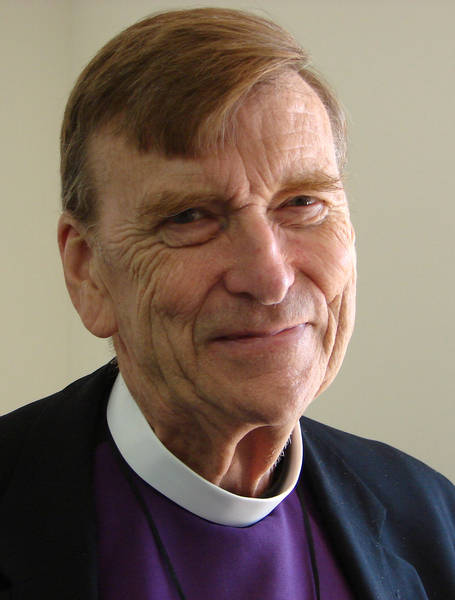
‘The task of religion’, writes retired Bishop John Shelby Spong,
is not to turn us into proper believers; it is to deepen the personal within us, to embrace the power of life, to expand our consciousness, in order that we might see things that eyes do not normally see. It is to seek a humanity that is not governed by the need for security, but is expressed in the ability to give ourselves away. It is to live not frightened by death, but rather called by the reality of death to go into our humanity so deeply and so passionately that even death is transcended.
I admire Spong because so often he points toward values Pagans have long espoused and appreciated in other spiritual paths. (Whether Spong is in fact still Christian in any widely understood sense is for others to determine who concern themselves with such labels.)
A question this raises for me is what makes one a ‘good’ ancestor as opposed to a ‘bad’ one. Is being ‘good’ not a Christian concept? What would it mean a Druid/Pagan context? Something that springs to mind is Emma Restall-Orr’s phrase and book title ‘Living With Honour’.
Spot on. I’ve been a fan of Restall-Orr’s work since I first ran across it. For me, and I suspect many other Druids and Pagans generally, a ‘good’ person is indeed one who aspires to a life of honor.
I’ll return to Restall-Orr near the end, as a springboard, because that’s what I do with her writings generally. But here I want to look at what Spong offers as an outline for just such a life, to see what I can glean from this passage, from the thought of a ‘friendly outsider’ to Druid and Pagan thinking, and where I can go with those insights. Sit with me a little?
1–‘deepen the personal within us’: We’ve met and known people who keep growing throughout their lives, and one measure of this growth is that over time they become ever more deeply themselves. You can’t reduce this to a pat formula or recipe, though it is a quality we recognize in others when we see it. Those who listen to their depths gain a source of direction and clarity that strengthens their identity as a human being. We can detect it when it spills over into their daily actions and their treatment of others.
Call it spirit, conscience, listening to your guides or gods, Thoreau’s oft-cited ‘different drummer’, there’s integrity to such a life. Here’s the Thoreau’s passage from Walden — adjust for gender as needed:
‘If a man does not keep pace with his companions, perhaps it is because he hears a different drummer. Let him step to the music which he hears, however measured or far away. It is not important that he should mature as soon as an apple-tree or oak. Shall he turn his spring into summer? If the condition of things which we were made for is not yet, what were any reality which we can substitute? We will not be shipwrecked on a vain reality’.
Indeed, ‘vain reality’ strikes altogether too close to home for much we can find around us. We know from personal experience that it’s easy enough to get shipwrecked there. ‘Step to the music we hear’, then, is another way to put it. No OSFA — ‘one size fits all’. Such individuals stand out as all the more admirable because we have fewer models nowadays for such a life. Or perhaps they’re always in short supply.
A few words on the How of it: I’ve found these practices helpful in my own experience, and felt the lack of them the more keenly the longer I let them slide: daily contemplation, time spent in the natural world, listening and silence, a craft or skill practiced purely out of love, community service, doing one thing each day without thought of ‘what’s in it for me’, dream study, ritual observance, humor. Joining the Tortoise Order of Druidry — (very) slow and (reasonably) steady.
2–’embrace the power of life, to expand our consciousness, in order that we might see things that eyes do not normally see’: OK, I’ll bite. What is the ‘power of life’? Most Druids and Pagans would assent to this advice. I know I do, but I want to interrogate it as well. My crap-detector just went on high alert. Does merely being born qualify — does it present us with the ‘power of life’? Or what distinguishes this ’embrace’ from me just being a complete asshat and take-take-taking? Quite clearly, it’s the expansion of consciousness that enables a more penetrating vision. For if I go deeply within, I can begin to see more deeply around me. I touch what is most universal in what is most personal. If I’m not doing that, I’m not embracing the power of life. But what does that look like from outside? Vitality paired with vision.
What do the Wise among us perceive? What they’ve always perceived: the wellsprings of life lie in cause and effect, pattern, equilibrium, spiral, departure and eternal return — a movement and an order to things that contemporary life has largely abandoned, and yet which contemporary discoveries have also begun to confirm about a very old worldview indeed.
A few words on the How of it: By keeping up practices like the ones I mentioned above, I find I can more easily distinguish ‘me at my better’ and ‘me at my less than better’. Then my four-part strategy (one for each of the Quarters!): noticing the difference, assessing its cause, accepting responsibility and asking for help go very far towards maximizing what contributes to growth and widening of consciousness and compassion.
3–‘seek a humanity that is not governed by the need for security, but is expressed in the ability to give ourselves away’. Right, then — in place of fear or self-preservation, generosity and boldness. A kind of ebullience in the face of difficulty. We know it’s often those with little who will share most readily what they have. Every culture I know of cherishes hospitality among its values, and takes pride in the welcome of guests. But what does it mean to ‘give ourselves away’?
I’ll hazard a guess that it’s what Hinduism and Buddhism call dharma, which often gets awkwardly under-translated as ‘duty’ or ‘righteousness’ — better, perhaps, is living in accord with that ‘deep reach into the personal’ and that ’embrace of living’ which Spong’s already mentioned.
The U.S. Army makes it into the macho-meme catchphrase ‘Be all you can be’, but it’s not merely military testosterone lockstep cloaked as self-fulfillment. Scholar of Hinduism J. A. B Van Buitenen characterizes it as ‘neither act nor result, but the natural laws that guide the act and create the result to prevent chaos in the world. It is the innate characteristic that makes the being what it is … the pursuit and execution of one’s nature and true calling … it is the dharma of the bee to make honey, of cow to give milk, of sun to radiate sunshine, of river to flow.’
We can refuse our dharma. For humans, it is, after all, a choice. What moves a person seeking honor to follow such a dharma or cosmic principle of inner and outer harmony?
A few words on the How of it: here’s a quotation I used to carry around in my wallet. ‘One who counts his talents and volunteers from a position of strength does not know what service and the sacred are all about’. That may sound judgmental to you, but it helped remind me I never have to be perfect to serve. No one is. Just willing.
4–‘live not frightened by death, but rather called by the reality of death to go into our humanity so deeply and so passionately that even death is transcended’: the fourth value, as I understand Spong here, is a passionate courage that grows out of the previous three values. Look deeply into the self, and I will witness our common bond, the power of life that links all things, that joins me to other people and beings. From this I will long to give back, because that is what this life energy does constantly — to share what I have, knowing death brings no ending to this surge of cosmic energy flowing everywhere around me. To serve life in ways consistent with the previous three principles.
(Wait a bit longer for my fourth entry of ‘words on the How of it’.)
/|\ /|\ /|\
Doreen Valiente’s ‘Charge of the Goddess’ offers eight virtues that have appeared in statements of values among Wiccans and Witches: ‘And therefore let there be beauty and strength, power and compassion, honor and humility, mirth and reverence within you’. You can find a helpful discussion of these at Witchvox here. And Asatru has its ‘Nine Noble Virtues’, which you can explore at Sacred Texts here.
Here are the words of Emma Restall Orr, whom Lorna mentioned earlier: ‘As a spiritual tradition based on reverence for and connection with the powers of nature, more than anything else Druidry teaches us to honour life … Druid ethics are built upon the release of ignorance and the respectful creation of deep and sacred relationships’ — Emma Restall Orr, Druidry and Ethical Choice. ‘Release of ignorance, creation of sacred relationship’ captures it beautifully. These twin principles follow each other in a potent circle, one leading to the other.
/|\ /|\ /|\
A final personal note. I’ve started working with a teacher placement agency to find a position, and one of the supporting documents we’re strongly encouraged to include in our online files for schools to access is a ‘personal statement’ — something beyond the letters of reference, school transcripts and mostly colorless standard application details.
A personal statement is a reflection of your philosophy of education, your belief system in terms of pedagogy, and/or your ideas about teaching and/or administration. It is a way for your voice to shine through your file and reach out to potential schools … In sum, the personal statement is a way for you to add personality and depth to your candidacy and to convey how your background and accomplishments have prepared you for your next professional opportunity.
A few words on the How of it: My statement became ‘Eleven Strands of Philosophy’. The last ‘strand’ quotes and comments on the final lines from Dante’s Paradiso, because they succinctly capture at this point in my life where I hope to arrive, like Dante’s pilgrim self, having traversed three worlds and returned to this middle earth we love: ‘… by now my desire and will were turned,/Like a balanced wheel rotated evenly,/By the Love that moves the sun and the other stars’.
From the OBOD “Inspiration for Life” for 26 October: “Our greatest responsibility is to become good ancestors” — Jonas Salk (1914-1995). Search for information on Salk and you’ll find, beyond his discovery of the life-saving polio vaccine, that the original quotation has “be” for “become,” but “become” fits. It gives us room to grow into the role.
Growth? I don’t know about you, but most days I need all the help I can get. We can be as literal as you like. My father had a mild case of polio in the 1930s when he was a young man, and it stunted the growth of his legs. He would have been as tall as I am at 6’2″. When we sat, we were the same height, but standing, he was six inches shorter than me. He made up for reduced stature by work and persistence (if you’re uncharitable you might have called it cussed stubbornness). Sometimes we can feel like we’re cast against type in our own lives. What now?
If I approach the day, the season, this life, as roles, I can often feel my way into possibility. We’ve all slipped in backstage. From there we tried out for this role — like almost all the others we’re offered — just by being born. Set aside for a moment the question of whether any of us asked to be here. If we do indeed get recycled from one part of this universe into another, perhaps our own ancestors called us, and our parents made bodies for us and brought us back to the longest-running show of them all. Have kids, and we’re doing the same for them. No kids this time around? You won’t escape that easy.
Live in this world more than a handful of years and you’ll meet others you instantly warm up or cool off to. Mere chance? Unlikely. Instead, one big noisy, contentious family reunion. You never liked Great-Uncle Louis, only now (s)he’s your one-year old niece Lucy who just spit up on your new silk shirt.
Or that annoying nephew Luke who always manages to bring back your car with a few more dings and scratches whenever he borrows it. You’d say no but you still owe his mother a few grand from that tight period some years back.
After all, karma’s one of the most efficient ways of polishing rough edges. Get back what you give out. Until you decide to play it differently. A different take. An original interpretation. A dramatic break-through. A sensitive and well-rounded performance that elicits sympathy for a potentially unlovable character.
What roles will I play in this ancestor ritual that is my life? Can I live large enough that I qualify as a “good ancestor”? Do my choices make the future lighter, wiser, more loving? (The signs tell me I’ll get to find out in person. Back in a century or three to check in and live my own consequence.)
Some days I get a foretaste. I wake, sliding slowly out of bed feeling I’m already halfway to ancestor status. You know, when your body’s now the best barometer for tomorrow morning’s weather. Low pressure and my lower back aches. Rain coming and my shoulder throbs. At such times it’s slender consolation that half a millennium hence my thighbone may decorate some family altar, or that my brother’s great-great-great-times-10 granddaughters will drink toasts from my lovingly preserved skull.
No, Salk probably meant something more. While not all of us will fall fighting to defend our land for our descendants, in every age too many of us do.
But just as many of our battles are inward, and many outwardly calm or seemingly easy faces conceal, it may be, most grievous private wars. It’s fitting, then — humbling, sobering and just — that we may well return to see what becomes of our own deeds.
For me there’s no better perspective. I find myself asked to forgive less than glorious forebears. “Judge not, lest you be judged” can cut painfully close. Knowing my own struggles and weaknesses, I’ll toast them with a generous measure of compassion — not because they may “deserve” it, but because they need it, and so do I — even as I honor the great among them, this weekend on Samhain.
Smithers, Lorna. The Broken Cauldron. Norfolk, UK: Biddles Books, 2016.
Change the names, goes the old Latin tag from Horace, and it’s a story about us.
Smithers, a Lancashire awenydd, poet, blogger at Signposts in the Mist, and devotee of Gwyn ap Nudd, has mediated in her latest book a challenging prophetic vision of psychic and environmental shattering in the image of the Cauldron, that ancient and present manifestation of birth, wisdom and regeneration. Spiritual vessel, military-industrial grail, the Cauldron contains both dream and nightmare.
Through prose retellings of Celtic myth and legend, through poems that grapple with this world and that Other that has always deeply haunted us, Smithers links voices, times and places. She revisits the central Druidic myth: Gwion Bach’s transformational encounter with — and theft of — the Three Drops of Inspiration. Holding it up for careful scrutiny, she underscores its immense cost to species and planet. In one retelling she speaks in the voice of Ceridwen’s grotesque son Afagddu, “Utter Darkness”. It is for him that Ceridwen has set the Cauldron brewing in the first place, hoping for his transformation, posting the hapless Gwion to tend it. In a painfully apt contemporary twist, Gwion’s a negligent employee at a chemical plant, daydreaming through a reactor disaster, though acquitted in the subsequent court case.
But Afagddu’s gifted with his own preternatural wisdom, knowing Ceridwen still apologizes for him, even as she dreams of him “suave, clean-shaven, the head of the company in a priceless suit with ironed-in creases” (pg. 74). How we persist in our stubborn lusts and blind dreams.
The five subtitled sections of the book capture something of its span: “The Broken Cauldron and the Flashing Sword”, “Ridiculous”, “Drowned Lands”, “Operation Cauldron” and “Uranium”.
What will we do, we whose minds are “shrunken and empty of gods”? Smithers’ patron deity accuses us all in the person of Arthur, whose profaning raids on the Otherworld have gained humanity a magical treasure, true, but loosed a devastating tide of death. In a triad of admonition to human raiders on Annwn, the Otherworld, Gwyn ap Nudd declares: “Lleog, lay down your sword. Taliesin, cast your mind from praise poems. Arthur, be true to your bear-skin past, hear your bones and the star of the north” (pg. 10).
Listen to our bones, heed the stars: a quest each of us may still accept or decline.
For it is the Otherworld that restrains the increasingly violent rebalancing we have brought on ourselves. And it is there we find “a cauldron that is whole and filled with stars, the infinite reflection of the womb of Old Mother Universe” (pg. 7).
As a solitary, Smithers turns here from a mythos that has long troubled her. She declares her preference for Afagddu, refusing “complicity in the mysteries of Taliesin” whose limitless hunger to despoil and pillage and consume “can only lead to the world’s end” (pg. 8).
It lies in grappling with the double edged-ness of the “flashing swords” of the raiders on Annwn, I would add, that we may at last learn wisdom. Can we learn to gauge and compensate for both gain and cost? Whether we do or no, the Otherworld will assert its balance. A unique book.

 I find in this poem a prayer most fitting for these darkening days till Yule and sun-return (never mind the ritual season). I add to it these visualizations as I say the opening triad of actions:
 That’s neither good or bad in itself: it’s simply how cause and effect have worked, and will continue to work. But so often it’s not in the self-interest of any elite to do what the “electorate” may want or need. That’s what makes them the elite. Plotting a course of self-interest is how they got to
  The city-dweller in a third-world nation foraging for scraps through piles of refuse exhausts her options and migrates with her family to another region where she can grow a small garden. Or find work. Or mount a protest with others large enough it draws media attention to a problem. Or, sometimes, die trying any of these. Sometimes we can shame ourselves into fixing things. Sometimes we just turn away. Every choice matters, every choice contributes to the pool. Nothing is lost. All that we do returns to us, so we can see our choices more clearly. Why else have worlds like this, where choice is possible and makes such a difference?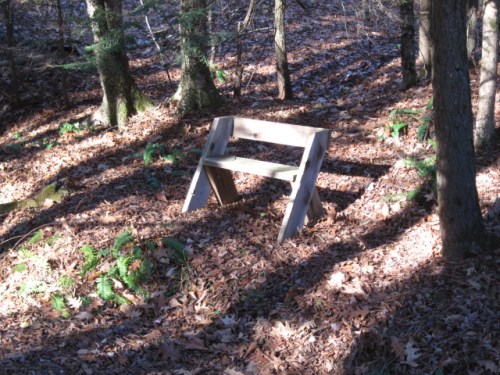

 I give thanks for this world of contrasts where, according to one of the Wise, many beings wait on the threshold, longing to incarnate for the extraordinary lessons it offers. The denser and harder its energies and challenge, the more it offers them opportunities to grow as they can nowhere else.
 Ancestors, relatives, descendants — who really is a stranger in the end, when so many are kin?


 To add to the mix, I’ll add a line from the Hebrew Bible (Proverbs 16:32) that’s resonated with me since I was a teenager (read in your own appropriate pronoun): “He that is slow to anger is better than the mighty; and he that ruleth his spirit than he that taketh a city.”
 Round this off with Gandhi’s admonition to be the change we wish to see in the world, and I’ve got a lot of changing to do. But better me than you, I remind myself: if I’m hard to change, you’re even worse. The world — by which I mean you and anyone else in my circle — refuses to do almost anything I want. Me, on the other hand, I’ve hand some success in shaping. Small steps, to be sure. “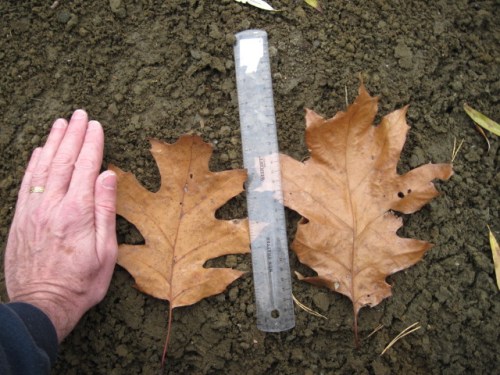


 Ancient cultures held out a code of honor, and the pursuit of excellence, as guides for their warrior heroes. Along with Celtic poems and legends in collections like the Mabinogi, and the figure of Pwyll (left), the Greek epics the Iliad and the Odyssey, for instance, make much of τιμή timē “honor” and ἀρετή aretē “nobility, excellence” as standards to aspire to.
 The opening chapter of the Gita introduces the “spiritual student” and warrior Arjuna (right). He’s downcast at this point — the chapter is aptly called Arjuna Vishada “The Dejection of Arjuna.” The reason becomes quickly apparent — he sees the imminent deaths in battle of those he loves, together with the destruction of a whole social order, and at the outset of the second chapter, he declares bitterly (II:9) na yotsya “I will not fight.”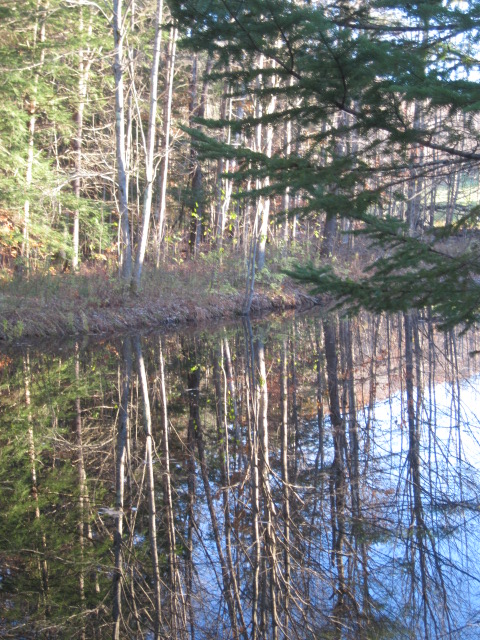
 ‘The task of religion’, writes retired Bishop John Shelby Spong,
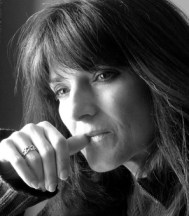 Here are the words of Emma Restall Orr, whom Lorna mentioned earlier: ‘As a spiritual tradition based on reverence for and connection with the powers of nature, more than anything else Druidry teaches us to honour life … Druid ethics are built upon the release of ignorance and the respectful creation of deep and sacred relationships’ — Emma Restall Orr, Druidry and Ethical Choice. ‘Release of ignorance, creation of sacred relationship’ captures it beautifully. These twin principles follow each other in a potent circle, one leading to the other.


 A Druid Way