Archive for the ‘spiritual tools’ Category
I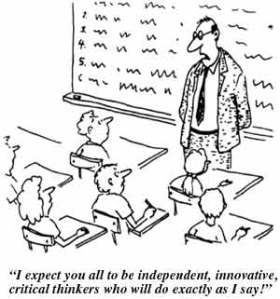 teach at a boarding school, and a few years ago, one of my freshman advisees asked a seemingly innocent question during one of our first meetings. I was still learning the scores of new names teachers must match with faces each fall, but Molly’s inquiry made her stand out from the other students: “What question should I ask, and what’s the answer?”
I vaguely remember replying that I’d have to give her question some thought, but I’d be sure to get back to her. As a bit of playfulness, the matter might have ended there. But Molly brought up the question again, almost every time we saw each other in fact, and it soon became a kind of inside joke. She graduated before I wrote this, but she’s on Facebook, so I’ll be sending this along to her, only half a decade late.
Ideally, teaching and learning invite questions. Good questions distinguish students who are thinking well, and they can move classes in rich and unforeseen directions. Good students and teachers distinguish themselves by the mileage they can get out of each other’s questions. How often I’ve shut students down by dismissing a question out of lack of time, answering it poorly, not hearing it as it was intended, or deferring it in the face of “more important things” and ultimately forgetting it. A class often comes alive with student questions. They break up a teacher monolog, and — better, often, than teacher questions — reveal student thinking, which may well be superior to anything the teacher has planned for the day. For me, following wherever such questions lead at least once a week has proven worth the time again and again.
For questions imply answers. Insofar as it can be put into language, a desire to know carries the seeds of its own response. Often we already “know” much of what an answer should “look like” – which some might say is a problem, because it conditions the kinds of answers we can receive, or those we will devote the most energy looking for. When the man searching for his lost key is asked why he’s looking under a streetlight, he replies, “Because that’s where the light is.”
If we ask simple informational questions, such as “What time is it?” we already know a great deal about the form of the answer. “Half a cup” or “Poughkeepsie” or “grayish green” won’t do for answers in this case. “Not yet” edges somewhat closer, since it has at least something to do with time. “4:18 pm” serves very well, whether or not it’s accurate, because it has the form of the kind of answer we seek. So it satisfies the formal requirement without necessarily satisfying the content requirement.
In the case of “large” questions, though, it can be more difficult to recognize whether an answer even satisfies the formal requirement. But as The Hitch Hiker’s Guide to the Galaxy insinuates, though we may have an answer, even one as specific as 42, without its “inciting” question to steady and direct it like a rudder on a boat, an answer by itself may not help us very much.
Mary Oliver notes in one of her poems, “there are so many questions more beautiful than answers.” Living in our questions is one way to keep a spiritual search alive. Resist the craving for an answer too soon. In her poem “Spring,” she asserts, “‘There is only one question:/how to love this world.” The biggest questions may not have an “answer” in any sense we expect or demand, but they may nonetheless propel us in necessary or powerful directions, ones we need to travel.
Molly’s inquiry is a meta-question – a question about questions. It asks about quality. It also assumes the listener might know more than the speaker, at least about questions and their answers. It implies that another can recognize – and provide – good or worthwhile questions worth asking, can anticipate the kinds of questions you may have, and has good answers.
Now all of this is unfair to load onto a probably offhand and casually teasing question. But by continuing to ask it, Molly slowly transformed it into a kind of riddle or meditation object, deepening its significance. What a lesson there!
One kind of answer to that question is also a general one, and sounds like advice for someone setting out on a journey: ask the best kinds of questions you can, and trust that you also need to seek out your own answers. Those anyone else can supply, except for day-to-day matters, aren’t really worth your time, except as provisional responses, first approximations to the answers you can best provide for yourself. Question authority, because some sacred cows stopped giving milk a long time ago. Question authority to find out if that authority deserves the name — does it feed you stock answers, or does it actually possess the power to lead you toward your own answers? And better, authorize questions — encourage yourself, and others, to keep asking.
/|\ /|\ /|\
Image: cartoon
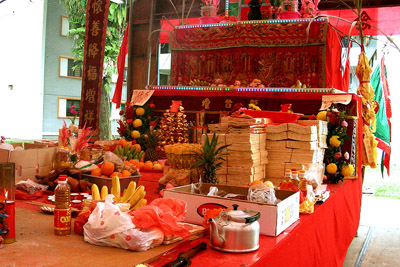
An altar is an important element of very many spiritualities around the world. It gives a structure to space, and orients the practitioner, the worshipper, the participant (and any observers) to objects, symbols and energies. It’s a spiritual signpost, a landmark for identifying and entering sacred space. It accomplishes this without words, simply by existing. The red color of the Taoist altar below immediately alerts the eye to its importance and energy.
As a center of ritual action and visual attention, an altar is positioned to draw the eye as much as any other sense. In Christian churches like the one below, everything is subordinated to the Cross and the altar immediately below it. Church architecture typically highlights this focus through symmetry and lighting. But in every case, enter the sacred space which an altar delineates, and it tells you what matters by how it is shaped and ordered and organized.

Part of OBOD* training is the establishment and maintenance of a personal altar as part of regular spiritual practice. Here’s a Druid altar spread on a tabletop. Nothing “mundane” or arbitrary occupies the space — everything has ritual or spiritual purpose and significance to its creator.

Such obviously physical objects and actions and their appeal to the senses as aids in spiritual practice all spring from human necessity. We need the grounding of our practices in the physical world of words, acts and sensations in order to “bring them home to us,” and make them real or “thingly,” which is what “real” (from Latin res “thing”) means.
Religions and spiritual teachings accomplish this in rich and diverse ways. We have only to think of Christian baptism, communion and the imposition of ashes at Easter; Hindu prasad and tilak; Jewish bris/brit (circumcision) and tallit (prayer shawl) and so on.
Atheists who focus exclusively on belief in their critiques and debates thus forget the very real, concrete and physical aspects of religious and spiritual practice which invest actions, objects and words with spiritual meaning that cannot be dismissed merely by pointing out any logical or rational cracks in a set of beliefs. Though you may present “evidence that God doesn’t exist” that seems irrefutable to you, you haven’t even begun to touch the beauty of an altar or spiritual structure, the warmth of a religious community of people you know and worship with, the power of a liturgy, the smell of incense, the tastes of ritual meals, the sounds of ritual music and song.
Just as we hear people describe themselves as “spiritual without being religious” as they struggle to sift forms of religion from the supposed “heart” of spirituality, plenty of so-called “believers” are “religious without being spiritual.” The forms of their spiritual and religious practice are rich with association, memory and community, and can be as important as — or more so than — a particular creed or set of beliefs.
Having said all of this, I’ve had a set of experiences that incline me away from erecting a physical altar for my Druid practice. So I’m working toward a solution to the spiritual “problem” this presents. Let me approach it indirectly. Once again, and hardly surprising to anyone who’s followed this blog or is as bookish as I am, the trail runs through books.

Damiano, the first volume in a fabulous (and sadly under-known) trilogy by R. A. MacAvoy, and recently reissued as part of an omnibus edition called Trio for Lute, supplies an image for today’s post. Damiano Delstrego is a young Renaissance Italian who happens to be both witch and aspiring musician. His magic depends for its focus on a staff, and we see both the strengths and limitations of such magical tools in various episodes in the novel, and most particularly when he encounters a Finnish woman who practices a singing magic.
When I read the trilogy at its first publication in the 80s, the Finnish magic sans tools seemed to me much superior to “staff-based” power. (Partly in the wake of Harry Potter and the prevalence of wands and wand-wielders in the books and films, there’s a resurgence of interest in this aspect of the art, and an interesting new book just published reflecting that “tool-based” bias, titled Wandlore: the Art of Crafting the Ultimate Magical Tool).
So when I then read news of church burnings, desecrated holy sites, quests for lost spiritual objects (like the Holy Grail) and so on, the wisdom of reposing such power in a physical object seemed to me dubious at best. For whatever your own beliefs, magic energy — whether imbued by intention, Spirit, habit, the Devil, long practice, belief in a bogus or real power — keeps proving perilously vulnerable to misplacement, loss or wholesale destruction. Add to this Jesus’ observation that we are each the temple of Spirit, and my growing sense of the potential of that inner temple of contemplation — also a feature of OBOD practice — and you get my perspective.
Carrying this admitted bias with me over the years, when I came last year to the lesson in the OBOD Bardic series that introduced the personal altar, I realized I would need both contemplation and creativity to find my way.
My solution so far is a work in progress, an alpha or possibly a beta version. My altar is portable, consisting of just five small stones, one for each of the classic European five elements — four plus Spirit. Of course I have other associations, visualizations and a more elaborate (and still evolving) practice I do not share here. But you get the idea. (If you engage in a more Native-American nourished practice, you might choose seven instead: the four horizontal directions, above [the zenith], below [the nadir] and the center.)
I can pocket my altar in a flash, and re-deploy it on a minimal flat space (or — in a pinch — right on the palm of my hand). One indulgence I’ve permitted myself: the stones originate from a ritual gift, so they do in fact have personal symbolic — or magical, if you will — significance for me. But each altar ritual I do includes both an invitation for descent and re-ascent of power or imagery or magic to and away from the particular stones that represent my altar. Lose them, and others can take their place for me with minimal ritual “loss” or disruption. Time and practice will reveal whether this is a serviceable solution.
This post is already long enough, so I’ll defer till later any discussion of the fitness of elemental earth/stone standing in for the other elements.
/|\ /|\ /|\
*OBOD — the particular “flavor” of Druidry I’m studying and practicing.
Images: Singapore Taoist altar; Christian altar; Druid altar; Amazon/Trio for Lute.
/|\ /|\ /|\
Updated: 27 July 2013
 There’s elemental comfort in contemplating the woodpile in our back lean-to (and a second one outdoors) — a reassurance that reaches to the bone. Wood is our primary source of heat, and we spend about $600 a year to heat our small ranch house. Some rooms have electric baseboard which we use only minimally, when we’re away for more than a few days in winter, to save pipes from freezing. Taking a break from splitting, I stand and count days and logs, logs and days. And I give thanks to the waiting trees around our property.
Yes, it’s labor-intensive to feed a stove and keep it drawing well. If you’ve maintained a fire, you know these things, of course — I’m hardly telling you anything new. But for us the payback of wood is true solace: even when the power goes out, and no matter the windchill, we stay warm. Each log is captured sunlight, and if you’ve spent any time in wood heat, you know its delightful penetrating quality, much like sunbathing. (This winter has been mild so far for southern VT — our heaviest single snowfall clocked in at under a foot, and the thermometer dove and hovered just below zero Fahrenheit for only a couple of days last month. Today on our hilltop the mercury hit the mid-40s — briefly.)
Especially at night during a winter outage, with flames or embers our only source of illumination beyond candlelight or short bursts of flashlight, a moment’s reverie can transport us back 10,000 years to a Neolithic cave and the flicker of firelight on stone walls. You sit close to each other for added warmth, and fire-watching feels both utterly ancient and distinctly human. Then the hearth resumes its old and honored place as center of life and civilization. (Brigid, saint and goddess, patron of Candlemas and Imbolc just past, is lady of the hearth-fire.) Without heat on a bitter night, we’re each reduced to King Lear’s “thing itself … unaccommodated man … a poor, bare, forked animal.” At such times, more even than water, heat’s the immediate necessity.
When we first visited the house with a realtor on a bright, cold January day some years back, I remember thinking how much work wood heat would be. But we’ve only needed to start a fire about half a dozen times since late October, when the stove began burning steadily. Since then, the coals are almost always still hot enough in the morning to re-ignite whole logs without kindling. My wife or I wake up most nights now, in the small hours, almost taking turns without consciously planning it, to stoke the fire just once, and return to bed. And we can cook on the stove. Yes, it takes longer, but if the power’s out, time suddenly returns in abundance.
 As for water, beyond our well, we have a small pond at the bottom of our yard. Again, when we first saw the property, all I thought was “mosquito breeding ground,” but I’ve come to see its multiple advantages. No, the water’s not potable (though the minnows, salamanders and frogs don’t seem to mind), but we can boil it if need be. It also serves for irrigation in a drought. Come spring, we’ll be fitting a hand pump to our well-head for water during extended power outages. (I stare at the pond now, this pale February light reducing the scene to white, gray, black, wondering how thick the ice is, how much chipping with an axe to reach the frigid liquid water.)
I record all these details in part because my wife and I spent half an hour yesterday watching clips of the new National Geographic series Doomsday Preppers, premiering next Tues., Feb. 7. While the featured families and individuals carry their preparations to extremes most of us would not, it’s perfectly sensible to maintain a store of several days’ food and drinking water in case of power outages or local natural disasters. Dried, canned and easy-to-prep foods if you have no means of cooking, rice and flour, beans and pasta if you do.
The harshness of local events in the past several months, like the drought in Texas, the severe tornadoes in the Midwest, and hurricane Irene in the Northeast, have persuaded people in ways nothing else could to consider such preparations. If heat isn’t under your control and you live in a temperate (read “cold”) zone, it’s wise to have a fall-back plan. Ditto for cooling, if your home otherwise bakes in the summer. You don’t have to expect “the end of the world as we know it” to use (as my grandmother liked to say) — “the good sense God gave gravel.”
While much is made of Americans’ dependence on electricity and foreign oil, most of us learn pretty quickly, if we have to, how to make do with wind, water, wood and fire. If you grew up in a small town, attended a summer camp, went hiking or just stayed up overnight outside a house, you have a preliminary sense of your abilities and tolerances in the natural world. It’s useful to know these, and build on them. That old sense of self-reliance that’s part of the story we tell ourselves about the “American character” is a good place to begin. And for you readers from other parts of the world, consider the equivalents in your cultures. Make it a game, especially if you have young kids. Think through your options in emergencies and disasters, and if they feel too constraining, work to expand them. We live in such varied circumstances, so no one solution will work for everybody. And that’s as it should be.
Come September, my wife and I will be back in CT, in school housing, with different contingency plans to consider.
A weekend’s reflection and planning will pay off down the road, even if they simply get you through the next minor “inconvenience” more smoothly. As the inconvenience increases, so will the payoff. Live long enough and you know from personal experience that John Lennon spoke true: life is what happens when you’re making other plans.
/|\ /|\ /|\
 One of the more useful skills I’m practicing with Druidry (we all learn our lessons from many sources, in different guises and from different teachers, throughout our lives) concerns binary thinking. It’s easier to recognize when we’re not practicing it ourselves. You’re with us or you’re against us. It’s good or it’s bad. You’re young or you’re old. Hot or cold. 1% or 99%. And so on. Next door in New Hampshire, the state license plates famously read “Live free or die.”
We can get distinctly uncomfortable around ambiguity that doesn’t fall into one or the other of two neat categories. Advertisers after all market to categories, and spend time labeling both products and consumers so they can target their products. WordPress asks for tags and categories. If you have something to sell that doesn’t fit under a label, you can have a devil of a time getting it on the shelves or in front of people’s noses. Likewise, if you want to locate something that doesn’t fit a category, it can sometimes be a long challenge to track it down.
Of course, we can see plenty of this dualistic patterning in action now on a large scale in the States, and without needing to look any further than our presidential primaries. Just tune in, and you’re sure to hear some variant of the following, especially across party lines: one candidate’s or party’s ideas and proposals constitute all Goodness and Light and Upright Living, while the other threatens our very way of life. Filled with greed, selfishness, and all signs of true evil, that Evil Other will — if we make the mistake of listening to/believing in/voting for them, deliver us individually and as a nation into the hands of utter darkness, despair and destruction.

 Of course the drift into binary or polar thinking doesn’t originate or end with politics. As author, blogger and Druid J. M. Greer notes, “Binaries exert a curious magnetism on the human mind. Once we get caught up in thoughts of yes or no, right or wrong, love or hate, truth or falsehood, or any other binary, it can be hard to realize that the two poles of the binary don’t contain all of reality … Druid philosophy offers a useful tactic in situations of this kind. When you encounter a binary, you simply look for a third factor that is not simply a midpoint between the two poles. Find the third factor and you convert the binary into a ternary, a balanced threefold relationship that allows freedom and flexibility.”*
We all know numerous proverbs and images of three-ness. “Third time’s the charm”; the three parts of a syllogism (thesis, antithesis and synthesis); beginning, middle and end; the Three Blind Mice; Brahma, Vishnu and Shiva; Father, Son and Holy Ghost; the examples are nearly endless. What they amount to is a widespread recognition of the liberating and creative power of Three. As the Tao Te Ching says (Ch. 42), “From the One comes Two, from the Two Three, and from the Three the Ten Thousand Things” of existence in this world. The key is not to stop at two if we want to create. Move on to three.
Greer amplifies the discussion of binary thinking in a post on his weekly blog. He notes that
… the hardwired habit of snap judgments in binary form is always right below the surface. In most cases all it takes is a certain amount of stress to trigger it. Any kind of stress will do, and over the years, practitioners of mass thaumaturgy have gotten very good at finding ways to make people feel stressed so that the binary reaction kicks in and can be manipulated to order.
That’s when thinking in binaries goes haywire, the middle ground becomes invisible, and people think, say, and do resoundingly stupid things because they can only see two extreme alternatives, one of which is charged to the bursting point with desire … or fear … Watch the way that many people on the American right these days insist that anybody to the left of George W. Bush is a socialist, or tfor that matter the way that some people on the American left insist that anybody to the right of Hillary Clinton is a fascist. Equally, and more to the point in our present context, think of the way the peak oil debate was stuck for so long in a binary that insisted that the extremes of continued progress and sudden catastrophic collapse were the only possible shapes of the postpetroleum future.
Binary thinking is evolutionarily useful, Greer notes, because it allows us to make snap judgments that can save our lives in crises. But in situations where more careful thinking is not only possible but necessary, our ancient wiring and programming can leave us stranded at one pole or another, in stalemate, with no sense of the way forward.
Greer continues, observing that (in various kinds of Druid and magical training) “Back in the day, beginning students used to be assigned the homework of picking up the morning paper each day, writing down the first nine binaries they encountered, and finding a third option to each binary.” This bit of training can offer a salutary unlocking and rebalancing of the debates of the day — or of any complex problem handicapped and hampered by sharply polarized thinking.
This useful little exercise [of identifying and expanding binaries] has at least three effects. First of all, it very quickly becomes apparent to the student just how much binary thinking goes on in the average human society. Second, it very quickly becomes at least as apparent to the student how much of an effort it takes, at least at first, to snap out of binary thinking. Third and most crucial is the discovery, which usually comes in short order, that once you find a third option, it’s very easy to find more—a fourth, a ninety-fourth, and so on—and they don’t have to fit between the two ends of the binary, as most beginners assume.
Ternary thinking isn’t just a liberating technique for the person who practices it. It carries with it a desirable ripple effect, for
… when a discussion is mired in reactive binary thinking, it only takes one person resolutely bringing up a third option over and over again, to pop at least some of the participants out of the binary trap, and get them thinking about other options. They may end up staying with the option they originally supported, but they’re more likely to do it in a reasoned way rather than an automatic, unthinking way. They’re also more likely to be able to recognize that the other sides of the debate also have their points, and to be able to find grounds for mutual cooperation, because they aren’t stuck in a mental automatism that loads a torrent of positive emotions onto their side of the balance and an equal and opposite torrent of negative emotions onto the other side.
Given how shrill our political dialog has become, and how intransigent and loath to compromise the principal players remain, we could use a healthy dose of such thinking. As one of the Wise has said, “God is what opposites have in common.” For me that means that the “truth” of a matter is less than likely to lie at either extreme of a binary, but somewhere else — not “in the middle” necessarily, as though God were a moderate or centrist deity. The Tao Te Ching also notes (somewhat wryly, I’ve often felt) that “Extremes do not last long.”
But beyond the political sphere, the ternary in other settings leads us directly to the Ten Thousand Things, the world of possibility and options and freedom. To give just one personal example, after my cancer surgery and the follow-up radiation months later, I was weak and suffering from uncomfortable and chronic internal radiation burns in the lower colon. “I’ve got to get better or I’ll have to quit my job,” I thought. “I can’t work like this,” when almost every bathroom visit brought blood and pain. Binary alert! I was able to arrange a medical leave, during which a change of diet, specific exercise, rest, an inspiring class I audited, and several new activities and spiritual practices have helped with healing.
One of the latter is the subtly powerful principle of “both-and.” Rather than stalling in a binary, embrace the whole. So often I hear people saying, “I’m so upset!” or “I can’t believe it!” or some other incantation. The more often they repeat it, the more forceful their mental and emotional state seems to become for them. (Our most common targets of “black magic” are typically ourselves.)
“Both-and” works like this. “I’m upset and I can also be calm.” Both are true. Rather than denying what may be a very real state or situation, include it and move outward to include more. This avoids the resistance or denial that often plagues affirmations or stubbornness or exertions of the will, as if we could force the universe to do what we’re simultaneously insisting it must not to! (I want to be calm, but “I’m so upset!”)
 Whitman, our old American proto-Druid, gets it. “I am as bad as the worst, but, thank God, I am as good as the best.” Both-and, alive and well. And as he also and famously said in “Song of Myself,” “Do I contradict myself? Very well then I contradict myself. I am large, I contain multitudes.”
The Ten Thousand Things all are moving about on their many and beautiful ways. Come walk with me, and with them.
/|\ /|\ /|\
*J. M. Greer, The Druid Magic Handbook, 19.
Images: NH license; Obama; Gingrich; Whitman.
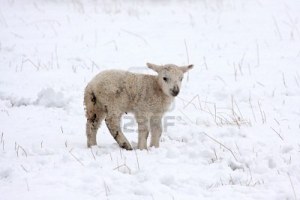 On first sight (or much later, depending on the particular script we’re following), the world can be a forbidding place. We all go through emotional and psychological winters at times. Nothing seems to provide warmth or comfort, so we hunker down and endure. And we can get so good at this kind of half-life that we mistake merely surviving for full-hearted thriving. Well-meaning friends or family who try to console us with various messages of hope or endurance (“This too shall pass”) can’t budge us from our heaviness.
The hidden changes implicit in the imminent shift of energy and consciousness which Druids symbolize and celebrate in Imbolc also find expression in the starkly beautiful lines of “First Sight” by British poet Philip Larkin.
First Sight
Lambs that learn to walk in snow
When their bleating clouds the air
Meet a vast unwelcome, know
Nothing but a sunless glare.
Newly stumbling to and fro
All they find, outside the fold,
Is a wretched width of cold.
As they wait beside the ewe,
Her fleeces wetly caked, there lies
Hidden round them, waiting too,
Earth’s immeasurable surprise.
They could not grasp it if they knew,
What so soon will wake and grow
Utterly unlike the snow.
 For that is how at least some changes arrive — immeasurable, ungraspable, unlike anything that went before, so that we can’t even anticipate or recognize them ahead of time. Nothing of the past prepares us. The new comes on us “utterly unlike” the present. Only long memory serves to recognize them sometimes, and hail and welcome them — memory often consciously denied to us in one human lifetime, but accessible through dream and intuition and the “far memory” that we may call “past lives” or the “collective unconscious” or the “knower behind the thoughts” or “gut instinct.” This is memory as trees know it, the rings of years that grow into the wood, the cell memory we humans also carry with us, the salts of ancient oceans that pulse in the same proportions in our blood.
This is the promise of light renewed, that miracle we often cynically dismiss but deeply long for, the story we are always telling ourselves: maybe this time, maybe next week, one more year. This marriage, that job, this new chance, here, now, finally, at last.
It’s important to note that this event is not “supernatural” or “religious” in the commonly understood sense of “coming from outside our world” or depending on a deity. We don’t need to look that far, though we’re welcome to if we wish. It is earth’s immeasurable surprise, after all, issuing from this world, this land, dirt under our feet, air that surrounds us, sun on our skin. Put another way, the whole world is telling us “Pay attention!”
Another Irish name for Imbolc is Oimelc — “ewe’s milk.” In the agrarian societies all our ancestors came from, the pregnant ewes have been preparing for the lambs to come, their udders swelling with milk. There are signs of change and renewal all around us, but in our rush towards “anywhere but here,” we’ve often lost sight of and contact with the markers that would center and align us with the natural order of balance and harmony we crave.
 In North America, the equivalent “secular” holiday is Groundhog’s Day, which one way or another says winter will in fact eventually end. Punxsutawney Phil emerges from the earth and his plump hibernation sleepiness to prophesy renewal, either seeing his shadow on a sunny day, or huddling under February clouds as secular augurs read the omens and declare them to the assembled faithful. (We don’t so much abandon ritual and religion as slip it past the censor of the modern and supposedly irreligious mind, clothing it in other guises less objectionable. If you doubt it, take a look at the grand mythologizing that surrounds Phil on sites like this one.)
Happy Groundcandleimbolcmasshogday!
/|\ /|\ /|\
Images: lamb; tree ring; Punxsutawney Phil.
What makes a language “sacred”? I find that it’s in sacred language that we most clearly hear echoes of the love we are and the love we seek. Much that I write here is an exploration through the channel or “ray” of wisdom and my search for it. But the channel or ray of love is at least as potent, and for many people more accessible.
Here’s an adaptation of a prose-poem by 17th century Anglican writer Thomas Traherne, who lived only to age 38. In his writing he captures something of this love.
The whole world is the theater for our love.
We are made to love, both to satisfy this necessity within us
and also to answer the love of creation around us.
By love our souls are joined and married to the world around us.
If we focus upon only one part of creation,
we are not loving it too much, but the other parts too little.
Never was anything in this world loved too much.
What a treasure is a grain of sand when it is truly understood!
All infinite goodness and wisdom and power are in it.
What a world this would be if everything were loved as it should be.*
This then is one noble and worthwhile task, if we choose to accept it: to love everything in the world as it should be loved. We hear of those who “love too much,” or those who, like Othello, loved “not wisely but too well.” We may recollect, too, those who love their abusers and do not flee them: here’s a needed perspective on their situation. A complete and powerful guide to living, summed up in ten lines.
/|\ /|\ /|\
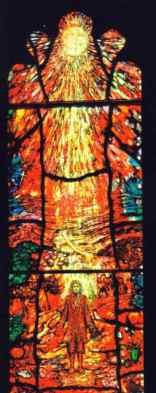 *Sections 65-67, “Second Century,” from Centuries of Meditation by 17th century writer and Anglican priest Thomas Traherne, adapted by Higginbotham, Paganism, 149-150. You can find Traherne’s complete original here.
The image is of a stained glass window “by Tom Denny, reflecting the thinking of Traherne, in Audley Chapel, off Lady Chapel, Hereford Cathedral, dedicated in March 2007.”
So if you found my previous post about fear and death (and nerds — yay!) a bit too off-putting, here’s a reprieve. What else might a new “religious operating system” have on offer?  In a Huffington Post article from some time ago (Sept. 2010) titled “The God Project: Hinduism as Open Source Faith,” author Josh Schrei asserts that the principal distinction between Hinduism and other more familiar Western faiths is not that the former is polytheistic and the latter are monotheistic, but that “Hinduism is Open Source and most other faiths are Closed Source.” (We’re already increasingly familiar with the open-source approach from computer systems like Linux and community-edited resources like wikis.) In this series on what a more responsive and contemporary religious design might look like (here are previous parts one and two), this perspective can offer useful insight.
If we consider god, the concept of god, the practices that lead one to god, and the ideas, thoughts and philosophies around the nature of the human mind the source code, then India has been the place where the doors have been thrown wide open and the coders have been given free rein to craft, invent, reinvent, refine, imagine, and re-imagine to the point that literally every variety of the spiritual and cognitive experience has been explored, celebrated, and documented. Atheists and goddess worshipers, heretics who’ve sought god through booze, sex, and meat, ash-covered hermits, dualists and non-dualists, nihilists and hedonists, poets and singers, students and saints, children and outcasts … all have contributed their lines of code to the Hindu string. The results of India’s God Project — as I like to refer to Hinduism — have been absolutely staggering. The body of knowledge — scientific, faith-based, and experience-based — that has been accrued on the nature of mind, consciousness, and human behavior, and the number of practical methods that have been specifically identified to work with one’s own mind are without compare. The Sanskrit language itself contains a massive lexicon of words — far more than any other historic or modern language — that deal specifically with states of mental cognition, perception, awareness, and behavioral psychology.
 It’s important to note that despite Schrei’s admiration for Hinduism (and its sacred language Sanskrit — more in a coming post), the West has all of these same resources — we just have developed them outside explicitly religious spheres. Instead, psychology, so-called “secular” hard sciences, social experimentation, counter-cultural trends and other sources have contributed to an equally wide spread of understandings. The difference is that far fewer of them would be something we would tag with the label “religion,” especially since the pursuit of things like ecstatic experience — apart from some Charismatic and Pentecostal varieties — generally lies outside what we in the West call or perceive as “religion.”
The underlying principle that drives such a range of activity perceived as “religious” also stands in sharp contrast with religion in the West. (Of course there are exceptions. To name just one from “inside religion,” think of Brother Lawrence and his Practice of the Presence of God.) As Schrei remarks, “At the heart of the Indic source code are the Vedas, which immediately establish the primacy of inquiry in Indic thought.” To put it another way, India and Hinduism didn’t need their own version of the American 60s and its byword “question authority,” because implicit in open-source religion is “authorize questions.” Nor did they need debates over Creation or Evolution, because scientific inquiry could be seen as a religious undertaking. Schrei continues:
In the Rig Veda, the oldest of all Hindu texts (and possibly the oldest of all spiritual texts on the planet), God, or Prajapati, is summarized as one big mysterious question and we the people are basically invited to answer it. “Who really knows? Who will here proclaim it? Whence was it produced? Whence is this creation? The gods came afterwards, with the creation of this universe. Who then knows whence it has arisen?” While the god of the Old Testament was shouting command(ment)s, Prajapati was asking: “Who am I?”
This tendency to inquire restores authority to its rightful place. In an era in the West when so many faux authorities have been revealed as spiritually hollow or actively deceitful, we’ve arrived at a widespread cynical distrust of any claims to authority. But true authorities do still exist. Their hallmark is an invitation to question and find out for ourselves. Jesus says, “Ask and you will know, seek and you will find, knock and it will be opened to you.” These aren’t the words of one who fears inquiry. To paraphrase another of his sayings, when we can learn and know the truth about something, we will meet an increase of freedom regarding it. It will not intimidate us, or lead us to false worship, or mislead us. One identifier of truth is the freedom it conveys to us. 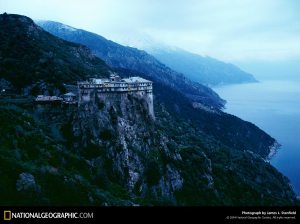
Authorities also benefit us because out of their experience they can guide us toward the most fruitful avenues of inquiry, and spare us much spinning in circles, pursuing wild geese, and squandering the resources of a particular lifetime. Whether we choose to follow good advice is a wholly separate matter. Authorities can point out pitfalls, and save us from reinventing the wheel. At a time when so many look East for wisdom, only recently have we been rediscovering the wisdom of the West hidden on our doorsteps.
Examples abound. The Eastern Orthodox church has preserved a wealth of spiritual practices and living exemplars in places like Mount Athos in Greece. The Pagan resurgence over the last decades has done much useful weeding and culling of overlooked and nearly forgotten traditions rich in valuable methods for addressing deeply the alienation, disruption, dis-ease, physical illness and spiritual starvation so many experience. Individuals within Western monotheisms like Rob Bell and his book Love Wins have served as useful agents for reform and introspection. While it may not be always true, as Dr. Wayne Dyer claims, that “every problem has a spiritual solution,” we’ve only just begun to regain perspectives we discounted and abandoned through the past several centuries, mostly through the seductions of our increasing mastery of a few select processes of the physical plane and their capacity to provide us with comforts, sensations, entertainments and objects unknown until about 75 years ago. We’ve self-identified as “consumers” rather than spiritual beings. Hamlet identified the problem centuries ago: “What is a man if his chief good and market of his time be but to sleep and feed?” Or as another of the Wise asked, “What does it profit a man, if he gain the whole world and lose his soul?” Let us be soul-finders and soul-nourishers. Otherwise, why bother?
/|\ /|\ /|\
Images: open-source cartoon; veda; Mount Athos
The start of the year is a good time to look back and forward too, in as many ways as it fits to do so. If you’ve got a moment, think about what stands out for you among your hopes for this new year, and you strongest memories of the year past. What’s the link between them? Is there one? Here we are in the middle, between wish and memory. In his great and intellectually self-indulgent poem “The Waste Land,” Eliot said “April is the cruelest month, mixing memory and desire.” But April need not be cruel — we can make any month crueler, or kinder — and neither should January. Let’s take a sip of the mental smoothie of memory and desire that often passes for consciousness during most of our waking hours, and consider.
To recap from previous posts, if we’re looking for a workable and bug-free Religious Operating System, we can start with persistence, initiation and magic (working in intentional harmony with natural patterns). You’ll note that all of these are things we do — not things a deity, master or Other provides for us. While these latter sources of life energy, insight and spiritual momentum can matter a great deal to our growth and understanding, nothing replaces our own efforts. Contrary to popular understanding, no one else can provide salvation without effort on our part. We can “benefit” from a spiritual welfare program only if we use the shelter of the divine to build something of our own. Yes, a mother eats so she can feed the fetus growing within her, but only in preparation for it to become an independent being that can eat on its own. We may take refuge with another, but for the purpose of gaining or recovering our own spiritual stamina. If we’re merely looking for a handout and unwilling to do anything ourselves, we end up “running in our own debt,” Emerson termed it. We weaken, rather than grow stronger.
The recent SAT cheating scandal involving the Long Island students paying a particularly bright peer to take the tests for them is a case in point. We condemn such acts as dishonest on the societal and human level. Why do we imagine they’re any more ethical or viable on the spiritual level? Just as no other person can fall in love for us, undergo surgery in our place, eat for us, learn on our behalf, or do anything else for us that so intimately changes and affects us, so nobody else can do the necessary work we all end up doing whenever we’ve grown and changed. It takes effort, and it’s up to us. This usually comes both as a sobering realization and as a wonderfully liberating discovery. Our spirituality and growth are up to us, but that also means they’re in our hands, under our control, responsive to our initiative and effort and attention.
For a ROS to actually work, then, it needs to fit our own individual lives and circumstances. Jesus confronted this squarely when he observed, “The Sabbath was made for man, and not man for the Sabbath.” While we can overdo the jettisoning of old religious forms and habits, convinced they have nothing more to offer us, it can be a very good thing to haul out and burn the old stuff to make way for the new. What have we elevated to “god status” in our lives that, in spite of worship, offerings and adoration, is actually giving us little or nothing and holding us back from growing? For too long we have clutched old forms and outmoded beliefs and held them tightly to our hearts, convinced that forms can liberate us. But they have no more power than we give them. Belief is a ladder we construct. Reach the goal, and the ladder is merely extra weight to carry around. We don’t need it.
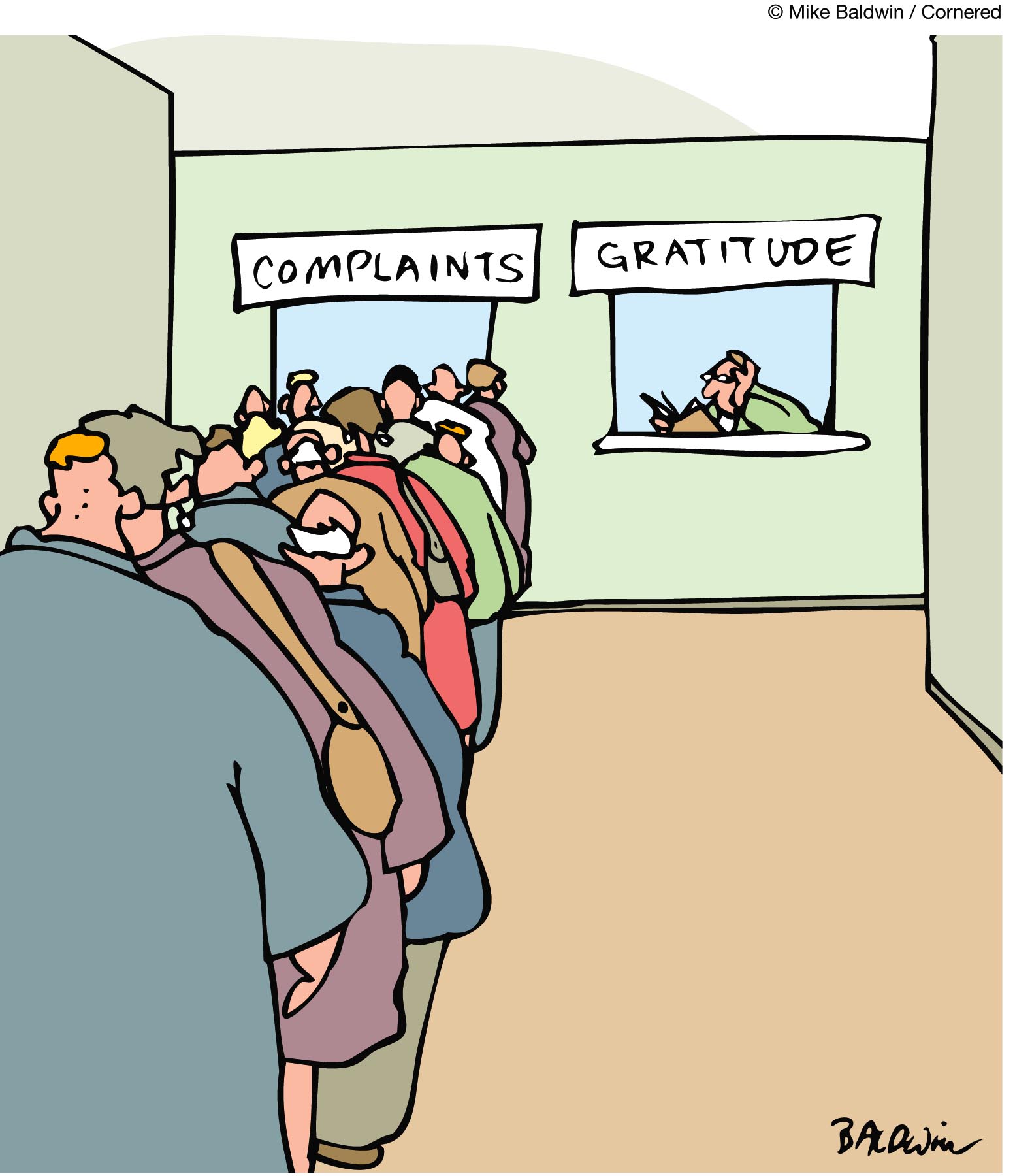
 So you say I’m just supposed to up and cull out-of-date beliefs and dump them? Easy to say (or write), harder to do. One of the most useful items in our spiritual tool-kits is gratitude, the WD-40 of spiritual life. As a solvent, it can loosen hard attitudes, stubborn beliefs, closed hearts and dead growth. We may think of gratitude as an often wimpy sentiment — something softhearted — but I like to call it the grr-attitude. It’s an attitude with teeth, and helps us build a “spiritual firewall” against destructive energies.* Every life without exception, no matter how hard, has something in it to praise and be thankful for. Gratitude, along with persistence, can show us how to make do when every other avenue seems closed. It’s the great “life-unsticker.” It moves us out of spiritual ruts and ravines like nothing else. In fact, an entire life spent in gratitude and persistence, without any other “spiritual garnish,” could carry us remarkably far. It would be a very full life.
I can be grateful for habits and attitudes that have brought me to where I am, and I can often let them go more easily by thinking kindly of them, rather than hating them and beating myself up for being unable to move on from them. But the value of gratitude isn’t just anecdotal. The field of positive psychology is producing significant research findings. Here’s just one example, from Prof. Robert Emmons’ book Thanks! on Amazon: “[R]egular grateful thinking can increase happiness by as much as 25 percent, while keeping a gratitude journal for as little as three weeks results in better sleep and more energy.”*
Every aspect of our lives has spiritual lessons to teach. I even feel gratitude for my cancer, because it has brought me back into balance with myself, revealed friends to me, brought me more love than I could handle, and reminded me again to make the best use of my time here that I can. And that’s just a start. Gratitude is a choice of consciousness. It definitely belongs in any religious operating system.
/|\ /|\ /|\
Cartoon source.
*Emmons’ book Thanks! deserves reading — it’s in paperback, and you can get cheap used copies online (and no, I have no connection with the author! The title was on the list of books for the course I took this fall — one of my subsequent favorites).
The term “spiritual firewall” I’ve derived from the excerpt below. The book helped strengthen my growing understanding of gratitude as a stance or posture toward life that has palpable strength in it, a kind of spiritual toughness and healthy resiliency — with powerful consequences, too — rather than an exercise of mere empty sentiment.
Grateful people are mindful materialists. Deliberate appreciation can reduce the tendency to depreciate what one has, making it less likely that the person will go out and replace what they have with newer, shinier, faster, better alternatives. The ability that grateful people have to extract maximum satisfaction out of life extends to material possessions. In contrast, there is always some real or imagined pleasure that stands in the way of the happiness of the ungrateful person. Consumerism fuels ingratitude. Advertisers purposely invoke feelings of comparison and ingratitude by leading us to perceive that our lives are incomplete unless we buy what they are selling. Here’s a frightening statistic: by the age of twenty one, the average adult will have seen one million TV commercials. By playing on our desires and fears, these ads fabricate needs and cultivate ingratitude for what we have and who we are. Human relationships are hijacked. Consumer psychologists argue that advertising separates children from their parents and spouses from each other. Parents are portrayed as uncool and out of touch with their teenage children, who are encouraged to reject the older generation’s preferences and carve out their own identity around materialistic values. Gratitude for our spouses can have a difficult time surviving the constant parade of perfectly sculpted bodies exuding perpetual sexual desire. In a classic study conducted in the 1980s, researchers found that men who viewed photographs of physically attractive women or Playboy centerfolds subsequently found their current mates less physically attractive, became less satisfied with their current relationships, and expressed less commitment to their partners. Gratitude can serve as a firewall of protection against some of the effects of these insidious advertizing messages. When a person wants what they have, they are less susceptible to messages that encourage them to want what they don’t have or what others have (Emmons, 42-43).
 It’s no accident that this time of year turns us toward thoughts of resolutions. After the family gatherings and excess of the holidays — and let’s be honest, some excess and abandon can be fun, or would be, if our Puritan strain didn’t kick in, and kick us — we can feel slack and listless. We’ve crested the peak of seemingly endless sugar and fat in our holiday diet — unless New Year’s Eve is the bigger holiday for you, in which case you’re just getting in training. In the shadow of the sugar low, just combine these things with cloudy days, at least here in the northeast U.S., and you face a perfect storm of sloth and dejection and mild to severe loathing. At some point our usually inevitable American self-improvement gene then steps forward, and it’s off to fix ourselves.
Whenever we push happiness or improvement into the future, we can be in trouble. If it’s in the form of satisfaction with ourselves, twice the trouble. How many times have we started and quit some scheme of fix-up? Lose weight, get in shape, hold your temper with the left- or right-wing relative who always gets under your skin, forgive your neighbor, keep a diary, save more money each month, clean the basement or garage — paper for all the lists of vows and resolutions could keep Staples in business all by itself. And if you truly enjoy flogging yourself, you key in your list to your favorite electronic device, so you can torture yourself with it several times a day.
You should know I tend not to make many resolutions. Partly, my personal standards are lower, I’ll admit — and that makes things easier. I confess to a startling capacity for indolence. Both my wife and I have had years where we’re either flat out — busy, or flat out — in sloth. Partly as a result of that, I’m a pragmatist. No use flailing and contorting to begin something I won’t finish. Shorten the list, I tell myself. Throw it out altogether. Delete the to-do’s accumulating on your virtual or actual desktop. Be realistic. You’ll be happier not making yourself miserable with what you fail to accomplish. Or just keep it off the list in the first place. Guilt may be a Catholic specialty, but most Americans, regardless of religious ancestry or affiliation, have managed to add it to their personal repertoire of masochism and psychological waterboarding. Thus do I lower expectations. And I’m only exaggerating slightly. Low expectations let me rejoice in walking down a hallway and back — once — after my cancer surgery. Then twice. And so on. In three months I was jogging three miles a day. Which was not my intention, and would have seemed daunting at the outset. I just increased my distance a little each day. The gifts of fresh air and daily sunrise were more than half of my success.
Which brings me to magic.
Not a transition you saw coming, I imagine. Enough for at least a couple of readers to stop in disgust. We’ll ignore the fact that what gets called “magical thinking” is exactly what propels many of our resolutions to change. Such thinking is indeed unrealistic, because — to use the physical metaphor — we try to do the equivalent of the Boston Marathon without first taking up merely a short daily walk. Too often we simply crash and burn.
So let’s define magic as most actual practitioners do: the art of creating changes in consciousness in conformity with the will.
This isn’t the “will” of willpower, as if we could compel the universe to do anything it isn’t already inclined to do. That kind of will is the popular image of the witch or magician, however, muttering arcane mantras and spells, and perhaps waving a wand. It’s Harry Potter magic, which is why many practicing magicians found the Evangelical Christian hysteria (here’s a more balanced overview) over the book series and its supposed promotion of “Satanism” and “witchcraft” to be hysterical, as in funny. See how far you get waving a wand and shouting “Expelliarmus” or “Avada Kedavra.” (“Expecto Patronum”* might get you incrementally closer to achieving something, if only because it may lead you to focus on a positive.)
Actual — as opposed to Hollywood or popular — magic is a matter of discerning the patterns and tendencies of the natural world and its powers and forces, and then aligning oneself with them. Quite simply, any other approach is highly unlikely to succeed. As Druid and occult author J. M. Greer observes, if it “ignores the momentum and flow of natural patterns, it’s clumsy and wasteful of energy. It’s much like trying to cross a lake on a rowboat without paying attention to the winds and the currents. If you ignore these, you can put plenty of effort into rowing and make very little headway, or even end up further away from your goal than you started” (The Druid Magic Handbook, 18). Blindly asserting the will is rowing while oblivious to movements and energies of the larger world. Far from being supernatural, magic is thus deeply involved with the natural world.
 The will involved in magic is much better identified as intentionality, and it’s intentionality that helps our New Year’s resolutions actually succeed. Greer continues: “Real will is effortless. It corresponds, not to struggle and strain, but to what philosophers call ‘intentionality,’ the orientation of the mind that locates meaning in objects of experience” (20). He gives the example of choosing to look at a window, or through a window at something on the other side. The well-known image of faces or a vase offers a similar instance. It’s by intention that we shift our perception. Strain has nothing to do with it. You perceive the two dark faces in profile looking at each other, or you perceive a white vase on a black background. It’s hard to see both simultaneously. But intentionality lets you shift between them. It’s a choice.
One technique, therefore, for training the will or the intentionality, is to do something simple and comparatively effortless. Set yourself a ridiculously easy task, follow through on it, and record your results. The purpose of this training is to reveal and separate all our defeatist and negative self-sabotaging attitudes from an actual act of intentionality. For instance, five times during the day, stand up, turn three times in a circle and sit back down again. Record the date and time on each instance that you do this.
Now presumably nothing interfered with your success, except perhaps a mild feeling of embarrassment. But you set up an intention, and manifested it without strain. You simply did it. Yoda’s words are apropos here: “Do, or do not. There is no try.” The “trying” is the strain, the effort of will to do something you actually don’t want to do. Intentionality bypasses that. You simply do it because you decided to. This is a form of preliminary magical training: doing small, effortless, things you know you can achieve without strain, in order to gain confidence in intention.
Because intentionality is a choice, not a struggle, many aspects of our lives can come under its influence. Greer continues,
If you face a challenge with confidence, for example, you chances of success are much better than if you face the same challenge full of doubts and worries. Intentionality is the reason why. What the confident person sees as potential opportunities, the worried person sees as potential obstacles, and they are both right, because whether something is an opportunity or an obstacle usually depends on how you choose to approach it (Greer, 21)
— that is, on your intentionality.
We use a form of magic whenever we make a resolution — in this sense, we’re all magicians at work.
The difference between intentionality and ordinary ideas of willpower explains many of the failures that bedevil beginners. When you try to use magic to will the world into obedience [in the case of a resolution, you will yourself to change your own behaviors and habits — ADW], you set up an intentionality of conflict between yourself and the world … The harder you try to make the world obey, the more it fights back, because all your efforts reinforce the intentionality and amplify the conflict. Change your intentionality to one of moving in harmony with the world, and the conflict disappears (Greer, 21).
This is not unfamiliar territory to Christians, either, or shouldn’t be. Jesus says, “Agree with thine adversary quickly, while thou art in the way with him.” “Turn the other cheek,” and so on. In other words, don’t make additional and entirely unnecessary trouble for yourself. Don’t stand in your own way.
Because we often practice “black magic” on ourselves, sabotaging and short-circuiting our own best intentions with negative thinking and self-limiting behavior, and setting up conflicting, opposing intentionalities, we waste time and energy “rowing against the current.” Many beginning magicians
try to use magic to achieve financial prosperity, and it’s common for their efforts to backfire and leave them poorer than they started. Why? In many cases, their magic focuses on wanting what they don’t have. This sets up an intentionality of wanting and not having, and so they end up wanting money and not having it. As with so many things in life, the more energy they put into chasing something, the faster it runs away (Greer, 22).
Because Greer has such insightful and useful things to say about intentionality — and thus resolutions — I want to let him have (almost) the final word:
If you want to use magic to become prosperous, your intentionality has to focus on being prosperous, not on wanting to be prosperous. One effective approach starts with noticing the prosperity already in your life — if you have a roof over your head, three meals a day, and the leisure to read this book, after all, you have more prosperity than half the people on this planet — and letting the change in focus from wanting to having gently redefine your intentionality toward wealth. Another useful strategy focuses on seeing opportunities for abundance around you. This redefines your surroundings as a source of opportunity, and as [our life energy] follows intentionality, and shapes experience, opportunities appear (Greer, 22).
So to sum up, practice intentionality with actions that don’t haul negative habits of thinking along with them. Focus on having and being, rather than on wanting and lacking. Experiment. Use the power of choice to shift consciousness — to see the vase, the faces, or whatever your intentionality is. Repeat as needed.
/|\ /|\ /|\
Images: resolutions and faces/vase
Postscript: when I was searching for the first image, a list of resolutions, I came across pictures of computer screens, too — another meaning of resolution — the pixel resolution or clarity of image that a screen possesses. Likewise, my clarity in visualizing the goal — of having or being what I desire — is key to “keeping” my resolutions. Imagining what it is like being and having what I desire is halfway to my manifesting it. I already know something of what it feels like to succeed. (I’m using this strategy as I revise my nanowrimo draft.)
*”Expecto patronum” — (Latin, literally, “I await a patron/protector”) summons a familiar or symbolic representation of the self to protect one against negative energies, such as Dementors in the HP series. Harry’s patronus is a stag, as was his father’s. Of the three spells I cite above, this one is good defensive magic and actually works well against nightmares. The following is part of the entry from the Harry Potter wiki on the Patronum spell:
A Patronus is a kind of positive force, and for the wizard who can conjure one, it works something like a shield, with the Dementor feeding on it, rather than him. In order for it to work, you need to think of a memory. Not just any memory, a very happy memory, a very powerful memory… Allow it to fill you up… lose yourself in it… then speak the incantation “Expecto Patronum”.
-
—Remus Lupin teaching Harry Potter the Patronus Charm
Go to Part 1 | Part 2 | Part 3 | Part 4 | Part 5 | Part 6
 With energies flowing around us from so many end-of-year holidays and celebrations, it seemed fitting to think and write about initiation. It’s one more piece of a Religious Operating System (ROS), it’s an important key to Druidry and — most importantly — it’s something we all experience. For good reason, then, the subject cuts a large swath through spiritual, religious and magical thought and practice. As author Isaac Bashevis Singer opens his book The Chosen, “Beginnings are difficult times.” That’s one reason New Year’s resolutions often end up on the cutting room floor of the film version of our lives. (Some ways to keep them alive and well and not merely part of the special extended version of our lives that may not see wide release into the “real” world will be the subject of a post upcoming in the next few days.)
Some opportunities for initiation recur each year, and are built into our cultures. Right now the festival holidays of Hanukkah, Christmas, Diwali, Kwanzaa and so on are opportunities for annual initiation — if we let their celebrations reach into us and change us. As breaks from “profane” or ordinary time, holidays take us into altered if not sacred space, and then return us to our lives somehow — ideally, anyway — changed. Of course, specific religions and spiritual paths each offer their own initiations. For Christians, it’s baptism (and for Catholics and some other denominations, confirmation as well). A Jew passes through a bar or bat mitzvah, and so on.
But we needn’t look so far or so formally. First kiss, first love, first sexual experience, first drink (consider the particular sequence of these in your own life). Driver’s license, prom, graduation, military draft. Each transforms as a rite of passage. We “pass through” and come out on the other side, different, in ways others may or may not notice. We ourselves may not fully absorb the changes until much later.
 As with the kinds of freedom I considered in a previous post, there seem to be both “transitive” and “intransitive” initiations — initiations which enable or empower the initiate to do something — typically in the future — and initiations which recognize a standard or awareness already attained, and put a “seal of approval” on it. Of course these need not be separate. Both kinds can occur simultaneously. Initiation is a “beginning” (from Latin initio “start, beginning”) both a path or direction that another agency, power or person starts us on, and also something one does or experiences oneself.
Some big initiations are inclusive. Like annual holidays, we all experience them. Though we may not often think of it, death — our own, or that of a loved one, or of a public figure with symbolic power, like a John F. Kennedy or a Princess Diana — can be a powerful, transformative initiation. Through the grief and the inevitable breaks in familiar routine that come with the first shock, the family gatherings, the arrangements and the funeral itself, we’re brought to face loss, change, mortality, and endings and beginnings in ways. We may take on new, unfamiliar roles, like caretaker, mourner, survivor, with all the challenge and growth they can bring. The first death we encounter (apart from pets), given the usual number of years between generations, comes almost like clockwork sometime in our teens, with the passing of a grandparent. In the freshman dorm at the boarding school where I teach and serve as adviser, there are four or five deaths of grandparents each year, and all the myriad changes they carry with them for those involved. It’s a close study in family dynamics (and our capacity as advisers to provide support) to witness how kids and their families deal with it all.
 Marriage often seems to occupy a sort of middle ground as far as these categories operate. On the one hand, no one is married in the eyes of either the law or a religious organization until they pass through the requisite ceremony. Yet we all know couples who are already “so married” that the ceremony confers nothing that they don’t already manifest in abundance. In this case, the initiation of marriage simply recognizes and formalizes a connection and a state of relationship that already exists and — if the ritual or ceremony still carries any power — blesses and charges the thing consecrated. My wife and I have two anniversaries, ten days apart, and each conveyed to us different energies. First was a spiritual ceremony by a cleric in our tradition, and second came the state ceremony, performed by a justice of the peace. Interesting, too, who we see as performing or undergoing the initiation. Ideally, to my mind, the one experiencing the initiation should play at least some part, if not an active role, in its enactment. For initiation takes place both outwardly, where it is often witnessed by the state if not also by family, and more importantly inwardly, on the subtle planes (which deserve their own post or series of posts).
“Where is wisdom to be found?” goes the old query. Initiation is one major source. Not all initiations “show” right away, or even ever. What we begin may never end. It can take a lifetime to sort out the effect of even “lesser” initiations, to say nothing of the big ones. Those “long” words, never and always, very much belong with initiations.
Go to Part 1 | Part 2 | Part 3 | Part 4 | Part 5 | Part 6
/|\ /|\ /|\
Image credits: Knighthood — “The Accolade” by Edmund Blair Leighton
Sex and love
Oriya Indian wedding
Persistence, and its twin patience, may be our greatest magic. Sacred writings around the globe praise its powers and practitioners. So it’s hardly surprising, here in the too-often unmagical West, with its suspicion of the imagination, and its demand for the instantaneous, or at least the immediate, that we are impatient, restless, insecure, harried, stressed, whiny, dissatisfied and ungrateful. We bustle from one “experience” to the next, collecting them like beads on a necklace. The ubiquitous verb “have” leaves it mark in our speech, on our tongues: we “have” dinner, we “have” class or a good time, we even “have” another person sexually, and one of the worst sensations is “being had.” We do not know self-possession, so other things and people possess us instead.

The “slow food” movement, the pace appropriate for savoring, craftsmanship, care, reflection, meditation and rumination (slow digestion!) all run counter to the ethos of speed, promptness, acceleration that drive us to a rush to orgasm, speeding tickets, the rat race, stress-related illness, and so on. None of these problems or the observations about them are new, of course. But we remain half-hearted in our efforts or understanding of how to “pursue” their remedy. We chase salvation as much as anything else, as a thing to collect or gather or purchase so we can be about our “real” business, whatever we think that is. Spirituality gets marketed along with orange juice. For a sum, you can be whisked off to a more exotic locale than where you live your life, spend time with a retreat leader or guru or master or guide, and “have” (or “take”) a seminar or class or workshop.
Anyone who has adopted a spiritual practice and stuck with it has seen benefits. Like regular exercise, it grants a resilience and stamina I can acquire in no other way. I sit in contemplation and nothing much happens. A week or a month goes by, and my temper might have subtly improved. Fortunate coincidences increase. My dream life, or a chance conversation, or a newspaper article, nudges me toward choices and options I might not have otherwise considered. But usually these things arrive so naturally that unless I look for them and document them, I perceive no connection between spiritual practice and the increased smoothness of my life. From a slog, it becomes more of a glide. But the very smoothness of the transition makes it too subtle for my dulled perceptions at first. It arrives naturally, like the grass greening in the spring, or that gentle all-day snow that mantles everything.
I abandoned a particular daily practice after many years, for complicated reasons deserving a separate post, and I needed only to read the notebooks I kept from that earlier time to recall vividly what I had lost, if my own life wasn’t enough to show me. My internal climate faced its own El Nino. I was more often short with my wife, mildly depressed, more often sick with colds, less inspired to write, less likely to laugh, more tired and more critical of setbacks and annoyances. Set down in writing this way, the changes sound more dramatic — didn’t I notice them at the time? — but as a gradual shift, they were hardly noticeable at any one point. I still had my share of good days (though I didn’t seem to value them as much), and my life was tolerable and rewarding enough. “But I was making good money!” may be the excuse or apology or justification we make to ourselves, and for a time it was true enough of me. Then came the cancer, the near-breakdown, the stretch of several years where I seemed to move from doctor to doctor, test to test, treatment to treatment. If you or anyone you know has endured this, you get what I’m talking about. It’s distinctly unfun. And while I won’t say lack of practice caused this, it’s an accompanying factor, a “leading indicator,” a constituent factor. Doctors might very profitably begin their diagnoses with the question, “So how’s your spiritual practice?” Our spiritual pulse keeps time with our physical lives. They’re hardly separate things, after all. Why should they be?
In the story of Taliesin I mentioned in my last post, the boy Gwion, so far from the future Taliesin he will become, is set by the goddess Cerridwen to watch a cauldron as it cooks a magical broth meant to transform her son Afagddu, a mother’s gift to her child. A year and a day is the fairy-story time Gwion spends at it. A full cycle. The dailiness of effort and persistence. The “same-old,” much of the time. Gwion’s a servant. The cauldron sits there each morning. The fire beneath it smoulders. Feed the fire, stir the liquid. It cooks, and Gwion “cooks” along with it, the invisible energy of persistence accumulating as surely as the magical liquor boils down and grows in potency. Through the spring and summer, insects and sweat. Through autumn and winter, frost and chill and ice. The cauldron has not changed. Still at it? Yes. The broth slowly thickens as it bubbles and spatters.
 One day a few drops (in some versions, three drops) fly out onto one of Gwion’s hands, burning. Instinctively he lifts the hand to his mouth, to lick and soothe it with his tongue. Immediately the magic “meant for another” is now his. He did, after all, put in the time. He sat there daily, through the seasons, tending the cauldron, stirring and keeping up the fire, swatting insects, breathing the smoke, batting sparks away, eyes reddened. Yes, the “accident” of the spattered drops was at least partly the result of “being at the right time in the right place.” It is “luck” as well as “grace,” both operative in his life. Part, too, was the simple animal instinct to lick a burn. And the greater portion was the effort, which catalyzed all the rest into a unified whole. Effort, timing, luck, chance, grace: the “package deal” of spirituality.
And the consequence? For Gwion, his growth has just begun. It is his initiation, his beginning. In his case it distinctly does NOT mean an easier path ahead for him. In fact, just the opposite — more on that in a coming post.
 The Hopi of the American Southwest call their ritual ceremonial pipe natwanpi, “instrument of preparing.” The -pi suffix means a vehicle, a means, a tool. Tales like this story of Gwion can become a natwanpi for us, if we choose — part of our preparation and practice, a tool, a way forward.
/|\ /|\ /|\
Fast food
Transformation
Hopi blanket
 Those inclined to criticize contemporary Druidry have made much about how the specific practices and beliefs of ancient Druids are forever lost to us simply because they left no written records, and because the references to Druids in the works of classical Greek and Roman authors are mostly based on secondhand accounts and sometimes markedly biased. Without such historical continuity, they claim, it is impossible to be a “real” Druid today, and thus all contemporary Druidry is a kind of whistling in the wind, at best a version of dress-up for adults. But what such writers and speakers often forget is the surviving body of legend, myth, teaching and wisdom in Celtic literature. Here is Druidry in compact and literary form, meant to be preserved as story, a link-up with the perennial wisdom that never dies.
To pick just one example, the stories from the Mabinogion, the Welsh collection of myth, legend and teaching have wonderful relevance and serve as a storehouse of much Druid teaching. Sustained meditation on these stories will reveal much of use and value to the aspirant after a Druidry that is authentic simply because it is grounded in knowledge and practice. As a pragmatist more than a reconstructionist, I’m much more interested in what works than in what may be historically accurate. The former leads one to inner discoveries. The latter is engaging as a worthwhile scholarly endeavor first, and only as a possible source of spiritual insight second. And that is as it should be. History is not spirituality, though it can inform it. But even if we can accurately deduce from an always incomplete archaeological record what a Bronze Age Druid may have done, it’s still not automatically fit and appropriate for a contemporary 21st century person to adopt. That’s a decision we must make apart from the reconstruction, which cannot guide us by itself. Stories, however, though formed in a particular culture, often reach toward universals far better than physical objects and actions.
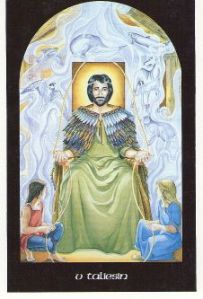 The story of Taliesin (this link is to a public domain text — more modern and well annotated versions are available) in the Mabinogion moves us into a world of myth and initiation. In the tale, the boy Gwion passes through ordeals and transformations, becoming at length the poet and sage Taliesin, whose name means “shining brow” — one who has a “fire in the head” and is alive with wisdom and poetic inspiration. As with figures from other traditions whose heads are encircled with halos, or shining with an otherworldly brightness, Taliesin belongs to the company of the “twice-born,” who have fulfilled their humanity by making the most of it. In my next post, I’ll talk about the first key in the story — persistence.
/|\ /|\ /|\
First image is a triskele or triskelion, a pan-European symbol associated with the Celts.
Second image is of Taliesin from Caitlin and John Matthews’ Arthurian Tarot.
/|\ /|\ /|\
Updated 9 September 2013
 “Whenever I get bored or depressed, I do laundry,” said an acquaintance. “Afterwards I may still be bored or depressed, but at least I’ve done something that needed doing. And often enough I feel better.” As a treatment, the success rate of this strategy may or may not equal that of therapy or medication, but as far as clean clothes production goes, it’s got the other two beat hands down. At least I can be depressed and dressed.
How different the quiet of depression and the quiet of peace! (I’m writing about peace and using exclamation points. Hm.) One deadens and stifles, the other ripples outward and invites attention, a kind of relaxed wakefulness. We say we want peace, and the holiday season bombards us with prayers and songs and sermons and wishes for it. There are prayers for peace in the ceremonies of many religious teachings and spiritual practices, Druidry included. But rather than asking somebody else for it, I can begin differently. Peace starts in the center, and that’s where I am — or where I can put myself, with the help of recollection and intent. “Come back to yourself,” my life keeps saying, “and remember who you are and what it is you want.” If I start peace (or anything else) within myself, however small, however tentative, it spreads from there outward. After all, it works for every other state I create, whether positive or negative — and I know this from sometimes painful experience! “Be the change you wish to see in the world” is still some of the best advice ever given. If I want change, who else do I expect to bring it about? And if someone else did, how in the world would such changes be right for me? Gandhi knew the secret lies in the approach.
 In my early twenties, Lou Gramm and Foreigner were singing “I want to know what love is. I want you to show me.” It’s a lovely ballad — I’ve got it playing on Youtube the second time through as I write this paragraph, nostalgia back in full force — but it’s precisely backward in the end. As loveless as I can sometimes feel, if I start the flow, jumpstart it if necessary, I prime the pump, and it will launch within me from that point. Do that, and I become more loveable in a human sense, because in the divine sense I’ve made myself another center for love to happen in, and from which it can spread.
But neither love nor peace are things I can hold on to as things. “We are not permitted to linger, even with what is most intimate,” says the German poet Rilke in his poem “To Holderin” (Stephen Mitchell, trans.)  “From images that are full, the spirit plunges on to others that suddenly must be filled; there are no lakes till eternity. Here, falling is best. To fall from the mastered emotion into the guessed-at, and onward.” Whatever I long for in a world of time and space needs to be re-won every day, though in that process of re-winning, not always successful, it begins to gather around me like a fragrance, a habit. Both the customary behavior, and the clothing a monk or nun wears, have the same name. The connection’s not accidental.
The American “farmer-poet” Wendell Berry captures it in these lines:
Geese appear high over us
pass, and the sky closes. Abandon,
as in love or sleep, holds
them to their way, clear
in the ancient faith: what we need
is here. And we pray, not
for a new earth or heaven, but to be
quiet in heart, and in eye,
clear. What we need is here.
So if we’re looking for a “religious operating system,” a ROS, we’ve got some design parameters that poets and others tell us are already in place. “What we need is here.” But try telling that to an unemployed person, or someone dying of a particularly nasty disease. And of course, if I tell someone else these things, I’ve missed the point. What they need is indeed here, but my work is to find out this truth for myself. I can’t do others’ work for them, and it wouldn’t be a good world if I could (though that doesn’t stop me sometimes from trying). I don’t know how their discoveries will change their lives. I only know, after I do the work, how my discoveries will change mine.
A recent article in the New York Times about the rise of the Nones, people who aren’t affiliated with any religion, but who aren’t necessarily atheists, offers this observation, from which I drew the title for this blog entry:
“We need a Steve Jobs of religion. Someone (or ones) who can invent not a new religion but, rather, a new way of being religious. Like Mr. Jobs’s creations, this new way would be straightforward and unencumbered and absolutely intuitive. Most important, it would be highly interactive. I imagine a religious space that celebrates doubt, encourages experimentation and allows one to utter the word God without embarrassment. A religious operating system…
I’ll be examining this further in upcoming posts.
/|\ /|\ /|\
Laundry, Foreigner album cover, and Rilke.

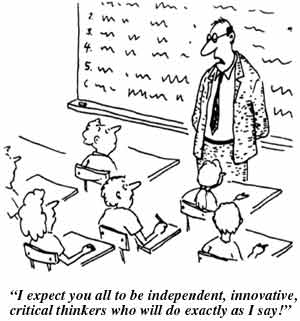 teach at a boarding school, and a few years ago, one of my freshman advisees asked a seemingly innocent question during one of our first meetings. I was still learning the scores of new names teachers must match with faces each fall, but Molly’s inquiry made her stand out from the other students: “What question should I ask, and what’s the answer?”
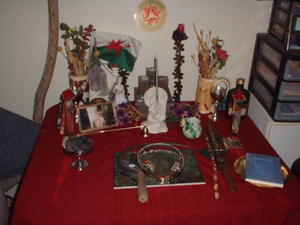
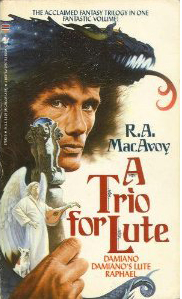






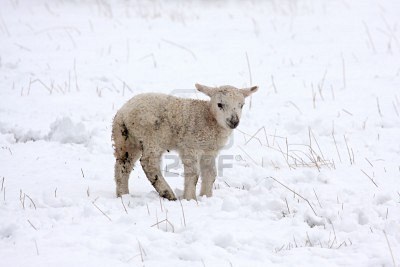









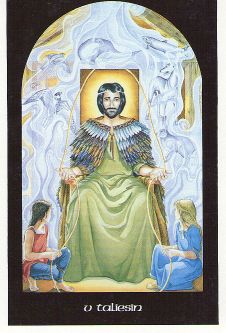




 A Druid Way