Archive for the ‘poetry’ Category
[Earth Mysteries 1 | 2 | 3 | 4 | 5 | 6 | 7]
So here we are at the last installment of this seven-parter. Indigestion and too much caffeine. No, not the series, though you may be thinking or feeling that, too. Looking back over earlier ones I realize each post has gotten more random than the preceding one. Not sure if I’ve done Greer a favor, writing about his seven keys — keys belonging to all of us — but doing it in such a way that they’re more “notes for a revolution” than anything like a review. You can’t just dump a bunch of principles by themselves on people and expect them to see how they fit, exactly. Which is what I’ve sorta done anyway. Inoculation by reading.
Like I said, they’re more notes for a revolution, so that when it comes, you’ll recognize the advance guard and maybe the sound of the explosions and know you’ve seen and heard something like this before, and maybe deal with it better or more inventively than your brother or neighbor out here panhandling and prospecting with the rest of us. “Look what I found! It’s a … well, I don’t have a name for it, but it might be useful at the weekly swap-and-steal.” Heaven consists of the spare parts of creation that didn’t get used elsewhere. We’re destined to mine the scrap heaps for the gold everyone’s tossed there by mistake.
Here goes with the last Law. (Of course it’s never the last law. There’s always another one, like yet another stray that won’t leave, moping around for scraps. Throw it a bone, or a filet. Watch what it does with it.)
“Everything that exists comes into being by a process of evolution. That process starts with adaptation to changing conditions and ends with the establishment of a steady state of balance with its surroundings, following a threefold rhythm of challenge, response and reintegration. Evolution is gradual rather than sudden, and it works by increasing diversity and accumulating possibilities, rather than following a predetermined line of development.”*
A shiver of awe and delight coursed through me when I first read this one. Maybe nobody knows where humanity is headed — it’s not something mapped out beforehand. “The wind blows where it wishes and you hear the sound of it, but do not know where it comes from and where it is going; so is everyone who is born of the Spirit,” says the Beloved Disciple in the eighth verse of his third chapter. (What, you didn’t know portions of the Bible are a Druid stealth device? Look twice before crossing.)
Sure, our DNA has something to say about it, and so do the causes we’re always setting in motion. These will shape our experience and our future. But they’re our causes. We can change. And we want to “accumulate possibilities” because these mean freedom. The dead-end singleness of conformity and bland homogeneity leave us hankering for the quaint, the queer, the mysterious, the odd, the doesn’t-fit, the original, the new, the surprising, the fresh. After all, we left Eden (some versions have us kicked out, but the result’s the same) and we’ve been on quest ever since. But “pave paradise and put up a parking lot”? Not what we really want, is it?
In “To Holderin,” the German poet Rilke writes to a compatriot:
Lingering, even among what’s most intimate,
is not our option. From fulfilled images
the spirit abruptly plunges towards ones to be filled:
there are no lakes until eternity. Here falling
is our best. From the mastered emotion we fall over
into the half-sensed, onward and onward …
We suspect so much more of reality than we let on. Or than it does. It’s not safe to do so, but it’s right, in the best senses of the word. Who ever wanted what is merely safe, when fuller life offers itself to us? Well, some people do, and often enough they get what they desire, and before long beg to be freed of it. Poetry means “making” in Greek, and we all make, we’re all makers, poets of our lives. Song is our native tongue, or could be. It’s that melody playing just beyond hearing that we’re always trying to capture, to get back to. That crashing sound? That’s just another person banging around the music room in the dark, trying to pound out a melody.
While we’re listening to Germans, here’s Martin Heidegger: “To be a poet in a destitute time means to attend, singing, to the trace of the fugitive gods. This is why the poet in the time of the world’s night utters the holy.” Cool, just so long as we know the holy really isn’t safe at all. No place to hide. Here’s Rilke again:
Here is the time for the sayable, here is its homeland.
Speak and bear witness. More than ever
the Things that we might experience are vanishing, for
what crowds them out and replaces them is an imageless act.
An act under a shell, which easily cracks open as soon as
the business inside outgrows it and seeks new limits.
Between the hammers our heart
endures, just as the tongue does
between the teeth and, despite that,
still is able to praise …
Sometimes you get the sense from Rilke, like from other madmen and seers, that you’ve always known what he means, that in fact you’ve done what he’s saying, even though you may not be able to say it yourself. But he manages to. We leave saying to the poets as if they’re somebody, but not us, who forgets you aren’t supposed to say these things, or that nobody expected you could say them. But you say them anyway. And get inconveniently booted to the curb by your neighbors, who take over “for your own good,” and after you comes flying what you thought was your life.
So you pick yourself up, brush off the worst of the dust, and keep going, without a life if you have to. Not as if nothing has happened, but as if everything has, and it keeps on happening. Who else do things happen to, but us? We’re mistaken if we think that disconcerting little factoid that reaches the news but which happens in “some other part of the world” — outer Don’t-bug-me, central I-don’t-care-yo! — isn’t our concern. Next week I’ll find refugees from there in my basement, peering up at me. My new psychic friends, walking my dreams, if I don’t see them actually fishing through my garbage, desperate for food or love or those pieces of my life I decided weren’t worth my time.
Oh, Druids are a little bit crazy, more so on certain days of the week than others, and most of all under certain phases of the moon. We’d cry if we weren’t laughing so hard, and sometime it sounds much the same. But the spirit lightens a little, and we see the outlines of a Friend where before was only a little mannikin of sadness or despair. We keep doing this for each other just often enough to go on, suspecting ourselves of the worse motives, and probably right to do so. But there’s a fire over the horizon, and singing, and the party’s going on without us. It’s the same fire in our heads.
Shapes move and stumble around the fire, vaguely familiar, so that after joining them it seems we know them, we left them years ago, but this is a reunion where we see everyone’s suffered and grown, though some have become knotty and twisted, like old trees. But there’s a few among us brave enough to hug them anyway, and bring them into the Dance. And so we dance, all night, the last stars twinkling when we finally stumble home to bed and a delicious, bone-weary sleep. And later, who knows what waking?
/|\ /|\ /|\
*Greer, John Michael. Mystery Teachings from the Living Earth. Weiser, 2012.
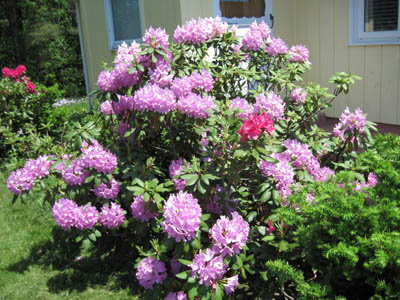 Here are Yin and Yang, our two rhododendrons — a single red flower grows on the pink bush in the foreground, with a branch of the red bush showing in the background. Plant envy? Unfortunately the red bush doesn’t have a single pink flower, or the image would be complete. In a month they’ll be back to their usually ungainly woody scraggly selves, with no hint of the glory they present each May. Is the aftermath the only time we appreciate what we had — when it’s finally gone?
The aftermath is the consequences, the results, the outcome. But we never hear of a “foremath,” whatever it is that stands before the event, the “math” — literally the “mowing” in Old English.
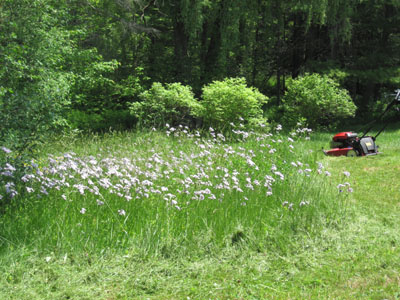 Most of our yard is the typical rural patch of grass, which given half a chance will turn to sumac, crabgrass, chicory, dandelions and even slender saplings inside six months. In the few years that we’ve owned the house, we’ve let whole quadrants go uncut for a season. Sometimes it’s from pure practical laziness — we’ve no one to impress, after all, and no condo association to yelp at us — and it saves gas and time, until we get around to putting in more of the permanent plantings that won’t require cutting. Until then, we’re getting the lay of the land, seeing how soil and drainage and sun all work together (our three blueberry bushes, visible in the background in the second photo, thrive on the edge of our septic leachfield), and which local species lay claim first when we give them a chance to grow and spread. The moles that love our damp soil also tunnel madly when we leave off mowing for the summer. We think of it as natural aeration for the earth.
The northwest corner, shown here, shaded by the house itself for part of the day, yields wild strawberries if we mow carefully, first exposing the low-lying plants to sun, and then waiting while the berries ripen. Patches of wildflowers emerge — common weeds, if you’re indifferent to the gift of color that comes unlabored-for. I like to hold off till they go to seed, helping to ensure they’ll come back another year, and making peace with the spirits of plant species that — if you can believe the Findhorn experience and the lore of many traditional cultures — we all live with and persistently ignore to our own loss.
This year we’ve “reclaimed” most of the lawn for grass, as we expand the cultivated portion with raised beds and berry patches. But I remind myself that we haven’t left any of it “undeveloped” — the unconscious arrogance of the word, applied to land and whole countries, suggests nature has no intention or capacity of its own for doing just fine without us. Who hasn’t seen an old driveway or parking lot reverting to green? Roots break up the asphalt remarkably fast, and every crack harbors a few shoots of green that enlarge the botanical beach-head for their fellows. Tarmac and concrete, macadam and bitumen are not native species.
And what would any of us do, after all, without such natural events like the routine infection of our guts by millions of beneficial bacteria to help with digestion? A glance at the entry for gut flora at Wikipedia reveals remarkable things:
Gut flora consist of microorganisms that live in the digestive tracts of animals and is the largest reservoir of human flora. In this context, gut is synonymous with intestinal, and flora with microbiota and microflora.
The human body, consisting of about 10 trillion cells, carries about ten times as many microorganisms in the intestines. The metabolic activities performed by these bacteria resemble those of an organ, leading some to liken gut bacteria to a “forgotten” organ. It is estimated that these gut flora have around 100 times as many genes in aggregate as there are in the human genome.
Bacteria make up most of the flora in the colon and up to 60% of the dry mass of feces. Somewhere between 300 and 1000 different species live in the gut, with most estimates at about 500. However, it is probable that 99% of the bacteria come from about 30 or 40 species. Fungi and protozoa also make up a part of the gut flora, but little is known about their activities.
Research suggests that the relationship between gut flora and humans is not merely commensal (a non-harmful coexistence), but rather a mutualistic relationship. Though people can survive without gut flora, the microorganisms perform a host of useful functions, such as fermenting unused energy substrates, training the immune system, preventing growth of harmful, pathogenic bacteria, regulating the development of the gut, producing vitamins for the host (biotin and vitamin K), and producing hormones to direct the host to store fats.
Such marvels typically set off echoes in me, and because much of my training and predilection is linguistic in nature, the echoes often run to poems. A moment’s work with that marvelous magician’s familiar Google brings me the lines of “Blind” by Harry Kemp:
The Spring blew trumpets of color;
Her Green sang in my brain–
I hear a blind man groping
“Tap-tap” with his cane;
I pitied him in his blindness;
But can I boast, “I see”?
Perhaps there walks a spirit
Close by, who pities me–
A spirit who hears me tapping
The five-sensed cane of mind
Amid such unsensed glories
That I am worse than blind.
Isn’t this all a piece of both the worst and the best in us? We can be fatally short-sighted and blind, but we can also imagine our own blindness, see our own finitude — and move beyond it to a previously unimagined larger world.
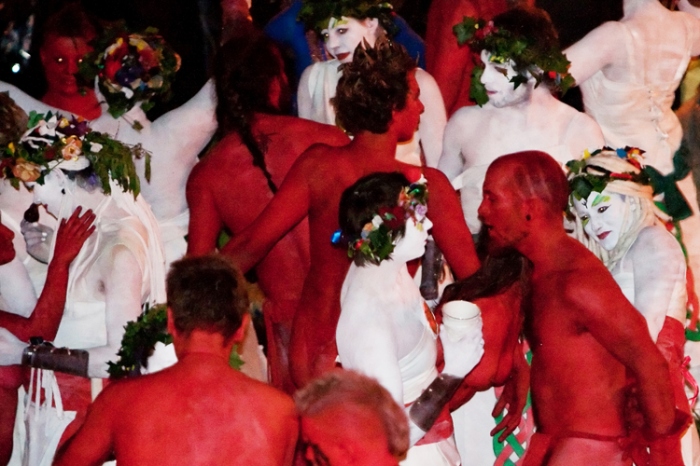
 Ah, Fifth Month, you’ve arrived. In addition to providing striking images like this one, the May holiday of Beltane on or around May 1st is one of the four great fire festivals of the Celtic world and of revival Paganism. Along with Imbolc, Lunasa and Samhain, Beltane endures in many guises. The Beltane Fire Society of Edinburgh, Scotland has made its annual celebration a significant cultural event, with hundreds of participants and upwards of 10,000 spectators. Many communities celebrate May Day and its traditions like the Maypole and dancing (Morris Dancing in the U.K.). More generally, cultures worldwide have put the burgeoning of life in May — November if you live Down Under — into ritual form.
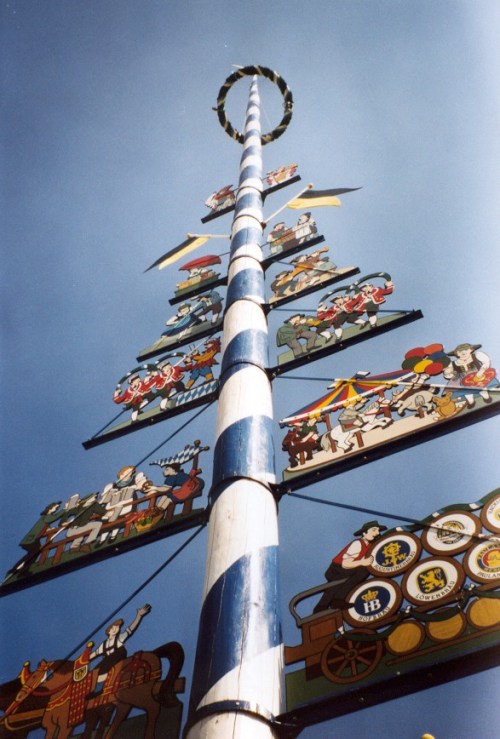 I’m partial to the month for several reasons, not least because my mother, brother and I were all born in May. It stands far enough away from other months with major holidays observed in North America to keep its own identity. No Thanksgiving-Christmas slalom to blunt the onset of winter with cheer and feasting and family gatherings. May greens and blossoms and flourishes happily on its own. It embraces college graduations and weddings (though it can’t compete with June for the latter). It’s finally safe here in VT to plant a garden in another week or two, with the last frosts retreating until September. At the school where I teach, students manage to keep Beltaine events alive even if they pass on other Revival or Pagan holidays.
 The day’s associations with fertility appear in Arthurian lore with stories of Queen Guinevere’s riding out on May Day, or going a-Maying. In Collier’s painting above, the landscape hasn’t yet burst into full green, but the figures nearest Guinevere wear green, particularly the monk-like one at her bridle, who leads her horse. Guinevere’s affair with Lancelot eroticized everything around her — greened it in every sense of the word. Tennyson in his Idylls of the King says:
For thus it chanced one morn when all the court,
Green-suited, but with plumes that mocked the may,
Had been, their wont, a-maying and returned,
That Modred still in green, all ear and eye,
Climbed to the high top of the garden-wall
To spy some secret scandal if he might …
 Of course, there are other far more subtle and insightful readings of the story, ones which have mythic power in illuminating perennial human challenges of relationship and energy. But what is it about green that runs so deep in European culture as an ambivalent color in its representation of force?
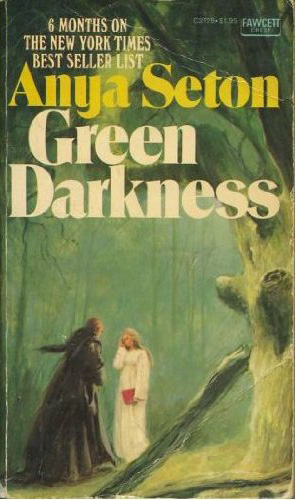
Anya Seton’s novel Green Darkness captures in its blend of Gothic secrecy, sexual obsession, reincarnation and the struggle toward psychic rebalancing the full spectrum of mixed-ness of green in both title and story. As well as the positive color of growth and life, it shows its alternate face in the greenness of envy, the eco-threat of “greenhouse effect,” the supernatural (and original) “green giant” in the famous medieval tale Sir Gawain and the Green Knight, the novel and subsequent 1973 film Soylent Green, and the ghostly, sometimes greenish, light of decay hovering over swamps and graveyards that has occasioned numerous world-wide ghost stories, legends and folk-explanations.
(Wikipedia blandly scientificizes the phenomenon thus: “The oxidation of phosphine and methane, produced by organic decay, can cause photon emissions. Since phosphine spontaneously ignites on contact with the oxygen in air, only small quantities of it would be needed to ignite the much more abundant methane to create ephemeral fires.”) And most recently, “bad” greenness showed up during this year’s Earth Day last month, which apparently provoked fears in some quarters of the day as evil and Pagan, and a determination to fight the “Green Dragon” of the environmental movement as un-Christian and insidious and horrible and generally wicked. Never mind that stewardship of the earth, the impetus behind Earth Day, is a specifically Biblical imperative (the Sierra Club publishes a good resource illustrating this). Ah, May. Ah, silliness and wisdom and human-ness.
We could let a Celt and a poet have (almost) the last word. Dylan Thomas catches the ambivalence in his poem whose title is also the first line:
The force that through the green fuse drives the flower
Drives my green age; that blasts the roots of trees
Is my destroyer.
And I am dumb to tell the crooked rose
My youth is bent by the same wintry fever.
The force that drives the water through the rocks
Drives my red blood; that dries the mouthing streams
Turns mine to wax.
And I am dumb to mouth unto my veins
How at the mountain spring the same mouth sucks.
The hand that whirls the water in the pool
Stirs the quicksand; that ropes the blowing wind
Hauls my shroud sail …
Yes, May is death and life both, as all seasons are. But something in the irrepressible-ness of May makes it particularly a “hinge month” in our year. The “green fuse” in us burns because it must in order for us to live at all, but our burning is our dying. OK, Dylan, we get it. Circle of life and all that. What the fearful seem to react to in May and Earth Day and things Pagan-seeming is the recognition that not everything is sweetness and light. The natural world, in spite of efforts of Disney and Company to the contrary, devours as well as births. Nature isn’t so much “red in tooth and claw” as it is green.
Yes, things bleed when we feed (or if you’re vegetarian, they’ll spill chlorophyll. Did you know peas apparently talk to each other?). And this lovely, appalling planet we live on is part of the deal. It’s what we do in the interim between the “green fuse” and the “dead end” that makes all the difference, the only difference there is to make. So here’s Seamus Heaney, another Celt and poet, who gives us one thing we can do about it: struggle to make sense, regardless of whether or not any exists to start with. In his poem “Digging,” he talks about writing, but it’s “about” our human striving in general that, for him, takes this particular form. It’s a poem of memory and meaning-making. We’re all digging as we go.
Digging
Between my finger and my thumb
The squat pen rests; as snug as a gun.
Under my window a clean rasping sound
When the spade sinks into gravelly ground:
My father, digging. I look down
Till his straining rump among the flowerbeds
Bends low, comes up twenty years away
Stooping in rhythm through potato drills
Where he was digging.
The coarse boot nestled on the lug, the shaft
Against the inside knee was levered firmly.
He rooted out tall tops, buried the bright edge deep
To scatter new potatoes that we picked
Loving their cool hardness in our hands.
By God, the old man could handle a spade,
Just like his old man.
My grandfather could cut more turf in a day
Than any other man on Toner’s bog.
Once I carried him milk in a bottle
Corked sloppily with paper. He straightened up
To drink it, then fell to right away
Nicking and slicing neatly, heaving sods
Over his shoulder, digging down and down
For the good turf. Digging.
The cold smell of potato mold, the squelch and slap
Of soggy peat, the curt cuts of an edge
Through living roots awaken in my head.
But I’ve no spade to follow men like them.
Between my finger and my thumb
The squat pen rests.
I’ll dig with it.

/|\ /|\ /|\
Beltane Fire Society image; Maibaum; John Maler Collier’s Queen Guinevere’s Maying; Soylent Green; Green Darkness; peat.
The challenge: to write a coherent and meaningful post in about an hour — before I’m out the door and off to another commitment during a particularly busy couple of weeks — without a topic already in mind. What will get tossed up on the beach of consciousness? The trick is to keep writing, trusting that something will come. Ah, there it is: trust.
I trusted the presence of Skaði sufficiently to create a separate shrine-page for her, as I mentioned a couple of posts ago. To ask whether I believe in her feels like it misses the point: she appeared in my consciousness, amenable for an exchange. I made a choice to engage, she honored her part, and I mine. What’s interesting to me is that we would never ask a similar question about a human-human interaction. Do I “believe” in the shop-clerk who sold me a sandwich at the cafe where my wife and I had lunch yesterday? The question never arises. What do our interactions imply for the future, in the case of either shop clerk or goddess? That’s something we’ll negotiate as we go. From what I can tell, none of us would have it any other way. If I patronize the shop regularly enough, the clerk and I may learn each other’s names, we might make small talk, I might eventually come to have a “usual” that I predictably order, and so on. With the goddess, the terms might be similar: future interactions will build a history between us. With that kind of growing trust, is belief necessary?
Trust is a curious thing. Like water or mustard or fire, too much or not enough suggests there’s a happy middle ground. Trust is also earned: babies may come by it naturally, and the other blessed innocents of the world may not yet have had it betrayed out of them, but usually ya gotta deserve it to get it. I trust the sanity of the clerk not to poison the food the shop sells, and Skaði and I trust each other enough at this point to fulfill any exchanges we have agreed on. Liking may enter the relationship down the road, which may broaden outside the immediate context of simple exchange if both parties are willing. But that’s not a given. Right now we have a starting point — that’s all.
Other kinds of trust operate at deeper levels. There’s a kind of trust, after all, every time you open door of your room, your apartment, your house, when you step outdoors on a sunny today like today is shaping into, a trust that the air is breathable, that the universe, at least in the foreseeable future, is not out to kill you — that it might even cooperate with you long enough that you can accomplish something worthwhile. If you’re fortunate enough, aware enough, lucky enough, or just attentive enough, you might even call it love. I’ll close with Kathleen Raine‘s fine poem “The Marriage of Psyche,” written 60 years ago now, in 1952. It feels like it fits here — the sense of amazement, of wonder at beauty that lifts you out of yourself. A gift. Read it to yourself out loud, to hear its rhythms.
He has married me with a ring, a ring of bright water
Whose ripples travel from the heart of the sea,
He has married me with a ring of light, the glitter
Broadcast on the swift river.
He has married me with the sun’s circle
Too dazzling to see, traced in summer sky.
He has crowned me with the wreath of white cloud
That gathers on the snowy summit of the mountain,
Ringed me round with the world-circling wind,
Bound me to the whirlwind’s centre.
He has married me with the orbit of the moon
And with the boundless circle of stars,
With the orbits that measure years, months, days, and nights,
Set the tides flowing,
Command the winds to travel or be at rest.
At the ring’s centre,
Spirit, or angel troubling the pool,
Causality not in nature,
Finger’s touch that summons at a point, a moment
Stars and planets, life and light
Or gathers cloud about an apex of cold,
Transcendent touch of love summons my world into being.
/|\ /|\ /|\
Updated 25 May 2014: next to last line of Raine’s poem corrected from “gold” to “cold.”
Go to Part 1 | Part 2 | Part 3 | Part 4 | Part 5 | Part 6
I speak for myself, of course. It’s all that any of us can do. But as I approach what is most deeply true for me, I find I can begin to speak true for others, too. Most of us have had such an experience, and it’s an instance of the deep connections between us that we often forget or discount. I’m adding this Part Two because the site stats say the earlier post on initiation continues to be popular.
/|\ /|\ /|\
Within us are secrets. Not because anyone hides some truths from us, but because we have not yet realized them. The truest initiations we experience seem ultimately to issue from this inner realm of consciousness where the secrets arise. Deeper than any ocean, our inner worlds are often completely unknown to us. “Man is ‘only’ an animal,” we hear. Sometimes that seems the deepest truth we can know. But animals also share in profound connections we have only begun to discover. We can’t escape quite so easily.
Our truest initiations issue from inside us. Sometimes these initiations come unsought. Or so we think. Maybe you go in to work on a day like any other, and yet you come home somehow different. Or you’re doing something physical that does not demand intellect and in that moment you realize a freedom or opening of consciousness. Sometimes it can arrive with a punch of dismay, particularly if you have closed yourself off from the changes on the move in your life. In its more dramatic forms initiation can bring with it a curious sense of vulnerability, or even brokenness — the brokenness of an egg that cracks as this new thing emerges, glistening, trembling. You are not the same, can never be the same again.
The German poet Rilke tries to catch something of this in his poem “Archaic Torso of Apollo.” He’d been blocking at writing the poems he desired, poems of greater depth and substance, instead of the often abstract work he’d composed until then, and his friend the sculptor Rodin sets him to studying animals. Rilke admires Rodin’s intensely physical forms and figures, and Rilke ends up writing about a classic figure of Apollo that is missing the head. Yet this headless torso still somehow looks at him, holds him with eyes that are not there. Initiation is both encounter, and its after-effects.
We cannot know his legendary head
with eyes like ripening fruit. And yet his torso
is still suffused with brilliance from inside,
like a lamp, in which his gaze, now turned to low,
gleams in all its power. Otherwise
the curved breast could not dazzle you so, nor could
a smile run through the placid hips and thighs
to that dark center where procreation flared.
I may witness something that is simply not there for others, but nonetheless it is profoundly present for me. Or I see something that is not for the head to decipher, interpret, judge and comment on. There’s nothing there for the intellect to grasp. In the poem, the head of the sculpture of Apollo is missing, and yet it sees me, and I see or know things not available to my head. I feel the gaze of the sculpture. I encounter a god. Or just a piece of stone someone shaped long ago into a human figure, that somehow crystallizes everything in my life for me right now. Or both.
The sensation of initiation can be as intensely felt and as physical as sexuality, “that dark center where procreation flared.” It hits you in your center, where you attach to your flesh, a mortal blow from a sword or a gesture that never reaches you, but which still leaves you dizzy, bleeding or gasping for breath. Or it comes nothing like this, but like an echo of all these things which have somehow already happened to you, and you didn’t know it at the time — it somehow skipped right past you. But now you’re left to pick up the pieces of this thing that used to be your life.
Otherwise this stone would seem defaced
beneath the translucent cascade of the shoulders
and would not glisten like a wild beast’s fur:
would not, from all the borders of itself,
burst like a star: for here there is no place
that does not see you. You must change your life.
You feel Rilke’s discovery in those last lines*, the urgency, the knowledge arriving from nowhere we can track. I have to change, and I’ve already changed. I know something with my body, in my gut, that my head may have a thousand opinions about. I may try to talk myself out of it, but I must change. Or die in some way. A little death of something I can’t afford to have die. There is no place in my life that does not see me, that feeling rises that I can’t escape, and yet I must escape. It’s part of what drives some people to therapy. Sometimes we fight change until our last breath, and it takes everything from us. Or we change without knowing it, until someone who knows us says, “You’ve changed. There’s something different about you. I can’t put my finger on it,” or they freak at the changes and accuse us, as if we did it specifically to spite them. “You’re not the person you used to be,” meaning you’re no longer part of the old energy dynamic that helps them be who they are, and now they must change too. Initiation ripples outward. John Donne says, “No man is an island, entire of itself. Each man is a piece of the continent, a part of the main.” Sometimes it’s my own initiation, sometime I’m feeling the ripples from somebody else’s. The earthquake is in the neighborhood, right down the street, in the next room, here — or across the ocean. But ripples in each case.
Sometimes we “catch” initiation from others, like a fire igniting. We encounter a shift in our awareness, and now we see something that was formerly obscure. It was there all along, nothing has changed, and yet … now we know something we didn’t before. This happens often enough in matters of love. The other person may have been with us all along, nothing has changed … and yet now we feel today something we didn’t feel yesterday. We know it as surely as we know our bones. We can feel the shift under our skin. The inner door is open. Do we walk through?
Go to Part 1 | Part 2 | Part 3 | Part 4 | Part 5 | Part 6
/|\ /|\ /|\
*Mitchell, Stephen, trans. The Selected Poetry of Rainer Maria Rilke (English and German edition). Vintage, 1989.
Some teachings run you through their rituals.
Find your own way – individuals
know what works beyond the shown way:
try out drinking with the Ancestors.
Chat ‘em up — don’t merely greet ‘em;
such rites are chummy: do more than meet ’em.
(Spend your weekends with a mummy?)
But I like drinking with my Ancestors.
Another round of pints and glasses
will have us falling on our asses.
Leave off ritual when they’re calling —
you’ll be drinking with your Ancestors.
By and with the spirits near us —
“Don’t invoke us if you fear us” —
good advice: if you lose focus
though you’re drinking with your Ancestors,
in the morning you’ll be uncertain
if you just dreamed or drew the curtain
on some world where it more than seemed
that you were drinking with your Ancestors.
Alcohol works its own magic,
and not all good – it’s downright tragic
if you’re just hung over from what could
have been you drinking with your Ancestors.
They come in all shapes, and in all sizes:
some are heroes, some no prizes
(they’re like us in all our guises).
Listen: they are singing, they are cussing,
they can advise us if we’re fussing
over where our lives might go
or put on a ghostly show.
We’re the upshot, on the down low.
We’re the payoff, crown and fruit
(we got their genetic trash, and loot),
we’re their future – “build to suit.”
So start drinking with your ancestors.
* * *
Ancestor “worship” is sometimes a misnomer, though not always — some cultures do in fact pray to, propitiate and appease the spirits of the ancestral dead in ways indistinguishable from worship. But others acknowledge what is simply fact — an awful lot (the simple fact that we’re here means our ancestors for the most part aren’t literally “an awful lot”) of people stand in line behind us. Their lives lead directly to our own. With the advent of photography it’s become possible to see images beyond the three- or four-generation remove that usually binds us to our immediate forebears. I’m lucky to have a Civil War photo of my great-great grandfather, taken when he was about my age, in his early fifties. In the way of generations past, he looks older than that, face seamed and thinned and worn.
The faces of our ancestral dead are often rightfully spooky. We carry their genetics, of course, and often enough a distant echo of their family traditions, rhythms, expectations, and stories in our own lives — a composite of “stuff,” of excellences and limitations, that can qualify as karma in its most literal sense: both the action and the results of doing. But more than that, in the peculiar way of images, the light frozen there on the photograph in patches of bright and dark is some of the purest magic we have. My great-great-grandfather James looks out toward some indeterminate distance — and in the moment of the photo, time — and that moment is now oddly immortal. Who knows if it was one of his better days? He posed for a photo, and no doubt had other things on his mind at the time, as we all do. We are rarely completely present for whatever we’re doing, instead always on to the next thing, or caught up in the past, wondering why that dog keeps barking somewhere in the background, wondering what’s for dinner, what tomorrow will bring, whether any of our hopes and ambitions and worries justify the energy we pour into them so recklessly.
And I sit here gazing at that photo, or summoning his image from what is now visual memory of the photo, as if I met him, which in some way I now have. Time stamps our lives onto our faces and here is his face. No Botox for him. Every line and crease is his from simply living. And around him in my imagination I can pose him with his spouse and children (among them my great-grandfather William) and parents, and so on, back as far — almost unimaginably far — as we are human. Fifty thousand years? Two hundred thousand? A million? Yes, by the time that strain reaches me it’s a ridiculously thin trickle. But then, if we look back far enough for the connection, it’s the same trickle, so we’re told, that flows in the veins of millions of others around us. If we can trust the work of evolutionary biologists and geneticists, a very large number of people alive on the planet today descend from a relative handful of ultimate ancestors. Which seems at first glance to fly in the face of our instinct and of simple mathematics, for that spreading tree of ancestors which, by the time it reaches my great-great-grandfather’s generation, includes thirty people directly responsible for my existence (two parents, four grandparents, eight great-grandparents and sixteen great-great grandparents). Someone called evolution the “ultimate game of survivor.” And now I break off one line, stalling forever this one particular evolutionary parade, because my wife and I have no children.
The poem of mine that opened this entry, “Drinking with the Ancestors,” suggests we can indeed meet and take counsel with members of this immense throng through the exercise of inhibition-lowering and imagination-freeing imbibing of alcohol. Of course there are also visualization exercises and still other techniques that are suitably alcohol-free — more decorous and tame. Depending on who you want to talk to among your clan, you can have an experience as real as most face-to-face talks with people who have skin on. The difference between us in-carnate and ex-carnate folks is indeed the carne. No sudden dispensation of wisdom automatically accrues to us just because we croak. A living idiot becomes a dead idiot. Likewise a wise soul is wise, in or out of flesh.
It seems fitting to end with an experience of the ancestors. Not mine, this time — I keep such things close, because often when we experience them, they are for us alone, and retain their significance and power only if we do not diminish them by laying them out for others who may know nothing of our circumstances and experiences. Wisdom is not a majority vote. Even my wife and I may not share certain inner discoveries. We’ve both learned the hard way that some experiences are for ourselves alone. But it’s a judgment call. Some things I share.
So in my place I give you Mary Stewart’s Merlin, in her novel The Hollow Hills*, recounting his quest for Excalibur, and an ancestor dream-vision that slides into waking. The flavor of it captures one way such an ancestral encounter can go, the opposite end of the easy beery camaraderie that can issue from making the libations that welcome ancestral spirits to a festival or party, as in my poem. Note the transition to daytime consciousness, the thin edge of difference between dream and waking.
I said “Father? Sir?” but, as sometimes happens in dreams, I could make no sound. But he looked up. There were no eyes under the peak of the helmet. The hands that held the sword were the hands of a skeleton … He held the sword out to me. A voice that was not my father’s said, “Take it.” It was not a ghost’s voice, or the voice of bidding that comes with vision. I have heard these, and there is no blood in them; it is as if the wind breathed through an empty horn. This was a man’s voice, deep and abrupt and accustomed to command, with a rough edge to it, such as comes from anger, or sometimes from drunkenness; or sometimes, as now, from fatigue.
I tried to move, but I could not, any more than I could speak. I have never feared a spirit, but I feared this man. From the blank of shadow below the helmet came the voice again, grim, and with a faint amusement, that crept along my skin like the brush of a wolf’s pelt felt in the dark. My breath stopped and my skin shivered. He said, and I now clearly heard the weariness in the voice: “You need not fear me. Nor should you fear the sword. I am not your father, but you are my seed. Take it, Merlinus Ambrosius. You will find no rest until you do.”
I approached him. The fire had dwindled, and it was almost dark. I put my hands out for the sword and he reached to lay it across them … As the sword left his grip it fell, through his hands and through mine, and between us to the ground. I knelt, groping in the darkness, but my hand met nothing. I could feel his breath above me, warm as a living man’s, and his cloak brushed my cheek. I heard him say: “Find it. There is no one else who can find it.” Then my eyes were open and it was full noon, and the strawberry mare was nuzzling at me where I lay, with her mane brushing my face (226-7).
/|\ /|\ /|\
*Stewart, Mary. The Hollow Hills. New York: Fawcett Crest Books, 1974.
This warmth won’t last, though it makes me say
earth feels like home on a sunny day.
But let sky darken and wind turn chill
And old winter wields dominion still.
* * *
While the warm hours last, birds try out songs we haven’t heard for months, and the woodworkers appear. Not carpenters or cabinet-makers, but those people who come out of the woodwork on fine days like this, delightfully odd folks you swear you’ve never seen before, or at least not on this planet. Probably I play the role myself for at least one other person, with my day’s stubble and turtleneck, wool socks with Birkenstocks. “There are things more important than comfort,” says author Ursula LeGuin, “unless you are an old woman or a cat.” Though I can’t qualify as the former, I’ve been feeling feline these last few days, so I pay no mind.
In our co-op parking lot an old woman is singing to herself, a rhythmic song in another language that keeps time with her cane striking the ground. A sky-blue 60s Cadillac makes its way around the parking lot, then subsides with a splutter. A couple climb out, then look up like they’ve never seen sky before and, heads tilted back, they drink it in for a full minute or more. Their pleasure is contagious. It’s a day people greet strangers simply because we’ve resurfaced, emerged from the bunker of ice and snow and cold and hunkering down, into a world of thaw and mud and sudden warmth on the skin.
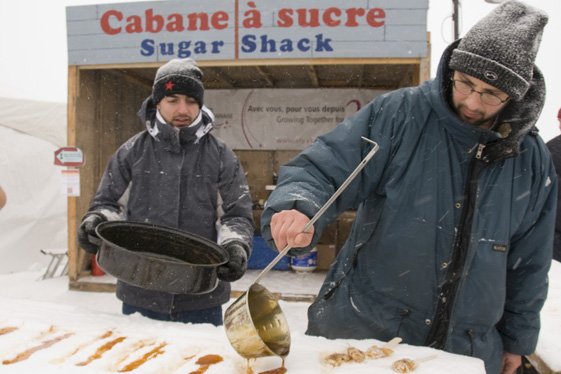
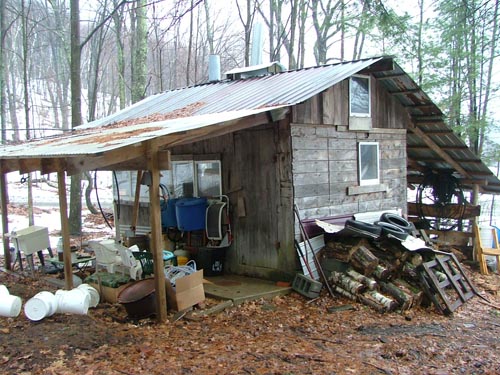 Sugar shacks smoke trough the night as the sap rises and the “sweet trees” yield their juice. You pass what you think is just a stand of trees, and there’s a faint square glow from a shack window, someone patiently (or impatiently) at work through the evening. Boil down the sap over a low heat, a wood fire as often as not, more and still more, then just keep going beyond all reason, and you eventually get a single lovely brown gallon for every thirty to forty of pale sap you’ve lugged in. If you do sugaring for more than yourself and family and maybe a few friends, you upgrade and invest in an evaporator. And if through the hours and days you manage not to scorch the slowly condensing syrup, that first taste on pancakes (or over a bowl of crisp new snow, a northern treat more rare this year) makes sore muscles and bloodshot eyes and smoky clothing worth it.
The French further north have their cabanes a sucre, where the temperatures haven’t risen quite so high and more of the white stuff remains.
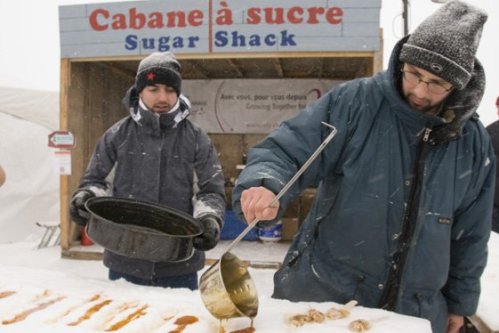
And sweeter still, in less than ten days, the vernal equinox, with day then overtaking night. Hail, growing light!
/|\ /|\ /|\
Images: Sugar shack; cabane.
“I heard you saw the movie yesterday. So what’s it about?” “Jean and Bill are arguing again. What’s that about?” “OK, he tried to explain and it still doesn’t make sense to me. But you understand those kinds of things, so tell me about it.” And there’s the old-time newspaper seller’s cry: “Extra, extra! Read all about it!!”
This elusive quality of aboutness is core to so many of our ways and days. We spend years in education (and life) dividing things up into their parts and labeling them, and then at least as much time putting them back together, searching for the links and connections between them, so that we can “grasp” them, “get” them, understand them. Re-assemble and it might resemble what it used to be. We crave community, fellowship and friends along the way at least as much as we prize our American individualism and independence and self-reliance. We long for aboutness.
About is near, close, approximately, almost — good enough for daily reckoning, for horseshoes and hand-grenades. It’s about five miles. We’re about out of time. About is sometimes the guts, the innards, the details, all the juicy pieces. About is also the whole, the overview, the heart of the matter. If you know about cars or cooking, you don’t need to know every specific model or recipe to “know your way around them.” What you don’t know you can usually pick up quickly because of family similarities they share. If you under-stand, you know the sub-stance. Position yourself in the right place and time (apparently beneath what you desire to comprehend, according to the peculiar English idiom), and you’ll get the gist.
Layers, strata. This onion-like reality keeps messing us up with its levels. Its aboutness won’t stay put as just one thing, but consists of stuff piled on other stuff below it. Often you gotta dig down through the fossil layer to reach the starting point. Peel it all away, though, and sometimes all you have is peel. You may know the simple and lovely blessing — there are several versions extant:
Back of the loaf is the snowy flour,
back of the flour is the mill;
back of the mill is the wheat and the shower,
the sun and the Maker’s will.
Sometimes if you pay attention you can catch it like a melody on the wind, something that lingers behind the sunlight. We know more than we know we know. This is the natural mysticism that comes with living, however hard we may try to ignore it. This is the aboutness that underlies our lives and our days, while we scurry from one thing to another, in pursuit of happiness. So it follows us, shaking its head at our antics. It could catch up to us if we stopped, looked and listened, if we made space for it to live with us, rather than renting out a room next door, trying vainly to catch our attention.
Robert Frost is one of my go-to guys for insight, as readers of this blog discover. In “Directive” he begins with that sense of constriction, and our partial memory of a past that shines brighter because of what we’ve forgotten about its difficulties. Yes, the poem’s “about” dying New England towns and abandoned houses, but also about us:
Back out of all this now too much for us,
Back in a time made simple by the loss
Of detail, burned, dissolved, and broken off
Like graveyard marble sculpture in the weather …
If there’s a place and home for us, he goes on to say, it’s reachable only by misdirection. “You can’t get there from here,” because the “here” has no more substance than anything else. It won’t serve as a starting point. Time has wrenched it free of its moorings. Things drift.
The road there, if you’ll let a guide direct you
Who only has at heart your getting lost,
May seem as if it should have been a quarry—
Great monolithic knees the former town
Long since gave up pretense of keeping covered.
And there’s a story in a book about it …
Yes, there’s a story, maybe several stories, a hint or two that maybe somewhere else, or someone else, will do it for it us, will finally deliver to us what we’ve been seeking. The stories of art, of music, of the great myths we want to believe even when we can’t. Sometimes the hints are maddening, sometimes the only comfort we can lay hands on in our seeking.
Make yourself up a cheering song of how
Someone’s road home from work this once was,
Who may be just ahead of you on foot
Or creaking with a buggy load of grain.
Aren’t we almost there? Or is it merely illusion? Is this a path anyone else has traveled and succeeded in the end, or our own unique interstate roaring straight toward disaster? What lies are we telling ourselves today? And are we waking up to them at last? You gotta get in to get out, go the Genesis lyrics (the band, not the Bible). You have to get lost in order to be found. That experience is necessary, though painful. Not one of us is the son who stays at home. We’re all prodigals.
And if you’re lost enough to find yourself
By now, pull in your ladder road behind you
And put a sign up CLOSED to all but me.
Then make yourself at home.
Might as well get comfortable being lost, because it’s gonna last a while. Though we never can be wholly comfortable in illusions. No end in sight. The problem is that we don’t know this until the end actually IS in sight. What illusions do we need that will actually bring comfort for a time, at least? They’re not illusions until we outgrow them, live through and past them. In fact we need truths now that only later become illusions precisely because they will be too small for us anymore.
First there’s the children’s house of make-believe,
Some shattered dishes underneath a pine,
The playthings in the playhouse of the children.
Weep for what little things could make them glad.
Then for the house that is no more a house,
But only a belilaced cellar hole,
Now slowly closing like a dent in dough.
This was no playhouse but a house in earnest.
Our house in earnest, playhouse in our childhood, has collapsed, or will. Our old selves won’t do. They don’t fit. We shuffle them off like snake-skins that bear the imprint of what lived in them, down to scar and scale, and we mourn and mistake them for ourselves, another illusion, standing there in the mirror that consciousness provides.
Who then can show us the way? From this perspective, we need, not salvation, but someone to show us where we can walk on our own two feet. Not out of vanity or stiff-necked pride, but because we have to make our way ourselves. Otherwise it doesn’t stick. It vanishes like a dream on waking. Yes, others have carried us there briefly, by art or alcohol or sex or those moments of ecstasy that come on us unannounced and unsought, glimpses of home through the fog.
Tolkien has Gandalf and Pippin touch on it briefly in The Lord of the Rings:
Gandalf: The grey rain-curtain of this world rolls back, and all turns to silver glass. And then you see it.
Pippin: What? Gandalf? See what?
Gandalf: White shores … and beyond, a far green country under a swift sunrise.
Frost continues, wise old poet-guru. (Sigmund Freud once remarked, “Everywhere I go, I find that a poet has been there before me.”)
Your destination and your destiny’s
A brook that was the water of the house,
Cold as a spring as yet so near its source,
Too lofty and original to rage.
We keep flowing — we’re not meant to stay put. Heaven as stasis, as a static destination, an endpoint, a final arrival, nothing beyond, is a false heaven. Enchantments of different kinds surround us. Some deceive, and some actively conceal what we know we must have in order to live at all. Yet what we seek also and paradoxically lies hidden in plain sight. The water was “the water of the house.” It’s right here. What can we use to gather it up?
I have kept hidden in the instep arch
Of an old cedar at the waterside
A broken drinking goblet like the Grail
Under a spell so the wrong ones can’t find it,
So can’t get saved, as Saint Mark says they mustn’t.
(I stole the goblet from the children’s playhouse.)
Here are your waters and your watering place.
Drink and be whole again beyond confusion.
Be whole again. What was lost is now found. Restoration. Return to what is native to you — your watering place. This is the command that drives us onward, the quest buried in our blood and bones. Reach for it. Whole again beyond confusion.
/|\ /|\ /|\
What makes a language “sacred”? I find that it’s in sacred language that we most clearly hear echoes of the love we are and the love we seek. Much that I write here is an exploration through the channel or “ray” of wisdom and my search for it. But the channel or ray of love is at least as potent, and for many people more accessible.
Here’s an adaptation of a prose-poem by 17th century Anglican writer Thomas Traherne, who lived only to age 38. In his writing he captures something of this love.
The whole world is the theater for our love.
We are made to love, both to satisfy this necessity within us
and also to answer the love of creation around us.
By love our souls are joined and married to the world around us.
If we focus upon only one part of creation,
we are not loving it too much, but the other parts too little.
Never was anything in this world loved too much.
What a treasure is a grain of sand when it is truly understood!
All infinite goodness and wisdom and power are in it.
What a world this would be if everything were loved as it should be.*
This then is one noble and worthwhile task, if we choose to accept it: to love everything in the world as it should be loved. We hear of those who “love too much,” or those who, like Othello, loved “not wisely but too well.” We may recollect, too, those who love their abusers and do not flee them: here’s a needed perspective on their situation. A complete and powerful guide to living, summed up in ten lines.
/|\ /|\ /|\
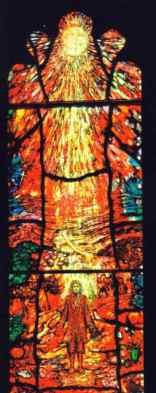 *Sections 65-67, “Second Century,” from Centuries of Meditation by 17th century writer and Anglican priest Thomas Traherne, adapted by Higginbotham, Paganism, 149-150. You can find Traherne’s complete original here.
The image is of a stained glass window “by Tom Denny, reflecting the thinking of Traherne, in Audley Chapel, off Lady Chapel, Hereford Cathedral, dedicated in March 2007.”
 Those inclined to criticize contemporary Druidry have made much about how the specific practices and beliefs of ancient Druids are forever lost to us simply because they left no written records, and because the references to Druids in the works of classical Greek and Roman authors are mostly based on secondhand accounts and sometimes markedly biased. Without such historical continuity, they claim, it is impossible to be a “real” Druid today, and thus all contemporary Druidry is a kind of whistling in the wind, at best a version of dress-up for adults. But what such writers and speakers often forget is the surviving body of legend, myth, teaching and wisdom in Celtic literature. Here is Druidry in compact and literary form, meant to be preserved as story, a link-up with the perennial wisdom that never dies.
To pick just one example, the stories from the Mabinogion, the Welsh collection of myth, legend and teaching have wonderful relevance and serve as a storehouse of much Druid teaching. Sustained meditation on these stories will reveal much of use and value to the aspirant after a Druidry that is authentic simply because it is grounded in knowledge and practice. As a pragmatist more than a reconstructionist, I’m much more interested in what works than in what may be historically accurate. The former leads one to inner discoveries. The latter is engaging as a worthwhile scholarly endeavor first, and only as a possible source of spiritual insight second. And that is as it should be. History is not spirituality, though it can inform it. But even if we can accurately deduce from an always incomplete archaeological record what a Bronze Age Druid may have done, it’s still not automatically fit and appropriate for a contemporary 21st century person to adopt. That’s a decision we must make apart from the reconstruction, which cannot guide us by itself. Stories, however, though formed in a particular culture, often reach toward universals far better than physical objects and actions.
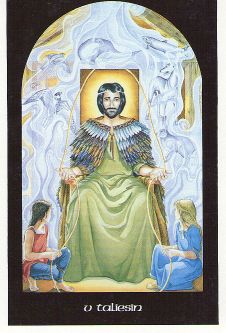
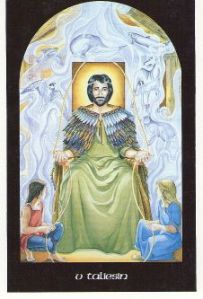 The story of Taliesin (this link is to a public domain text — more modern and well annotated versions are available) in the Mabinogion moves us into a world of myth and initiation. In the tale, the boy Gwion passes through ordeals and transformations, becoming at length the poet and sage Taliesin, whose name means “shining brow” — one who has a “fire in the head” and is alive with wisdom and poetic inspiration. As with figures from other traditions whose heads are encircled with halos, or shining with an otherworldly brightness, Taliesin belongs to the company of the “twice-born,” who have fulfilled their humanity by making the most of it. In my next post, I’ll talk about the first key in the story — persistence.
/|\ /|\ /|\
First image is a triskele or triskelion, a pan-European symbol associated with the Celts.
Second image is of Taliesin from Caitlin and John Matthews’ Arthurian Tarot.
/|\ /|\ /|\
Updated 9 September 2013
 “Whenever I get bored or depressed, I do laundry,” said an acquaintance. “Afterwards I may still be bored or depressed, but at least I’ve done something that needed doing. And often enough I feel better.” As a treatment, the success rate of this strategy may or may not equal that of therapy or medication, but as far as clean clothes production goes, it’s got the other two beat hands down. At least I can be depressed and dressed.
How different the quiet of depression and the quiet of peace! (I’m writing about peace and using exclamation points. Hm.) One deadens and stifles, the other ripples outward and invites attention, a kind of relaxed wakefulness. We say we want peace, and the holiday season bombards us with prayers and songs and sermons and wishes for it. There are prayers for peace in the ceremonies of many religious teachings and spiritual practices, Druidry included. But rather than asking somebody else for it, I can begin differently. Peace starts in the center, and that’s where I am — or where I can put myself, with the help of recollection and intent. “Come back to yourself,” my life keeps saying, “and remember who you are and what it is you want.” If I start peace (or anything else) within myself, however small, however tentative, it spreads from there outward. After all, it works for every other state I create, whether positive or negative — and I know this from sometimes painful experience! “Be the change you wish to see in the world” is still some of the best advice ever given. If I want change, who else do I expect to bring it about? And if someone else did, how in the world would such changes be right for me? Gandhi knew the secret lies in the approach.
 In my early twenties, Lou Gramm and Foreigner were singing “I want to know what love is. I want you to show me.” It’s a lovely ballad — I’ve got it playing on Youtube the second time through as I write this paragraph, nostalgia back in full force — but it’s precisely backward in the end. As loveless as I can sometimes feel, if I start the flow, jumpstart it if necessary, I prime the pump, and it will launch within me from that point. Do that, and I become more loveable in a human sense, because in the divine sense I’ve made myself another center for love to happen in, and from which it can spread.
But neither love nor peace are things I can hold on to as things. “We are not permitted to linger, even with what is most intimate,” says the German poet Rilke in his poem “To Holderin” (Stephen Mitchell, trans.)  “From images that are full, the spirit plunges on to others that suddenly must be filled; there are no lakes till eternity. Here, falling is best. To fall from the mastered emotion into the guessed-at, and onward.” Whatever I long for in a world of time and space needs to be re-won every day, though in that process of re-winning, not always successful, it begins to gather around me like a fragrance, a habit. Both the customary behavior, and the clothing a monk or nun wears, have the same name. The connection’s not accidental.
The American “farmer-poet” Wendell Berry captures it in these lines:
Geese appear high over us
pass, and the sky closes. Abandon,
as in love or sleep, holds
them to their way, clear
in the ancient faith: what we need
is here. And we pray, not
for a new earth or heaven, but to be
quiet in heart, and in eye,
clear. What we need is here.
So if we’re looking for a “religious operating system,” a ROS, we’ve got some design parameters that poets and others tell us are already in place. “What we need is here.” But try telling that to an unemployed person, or someone dying of a particularly nasty disease. And of course, if I tell someone else these things, I’ve missed the point. What they need is indeed here, but my work is to find out this truth for myself. I can’t do others’ work for them, and it wouldn’t be a good world if I could (though that doesn’t stop me sometimes from trying). I don’t know how their discoveries will change their lives. I only know, after I do the work, how my discoveries will change mine.
A recent article in the New York Times about the rise of the Nones, people who aren’t affiliated with any religion, but who aren’t necessarily atheists, offers this observation, from which I drew the title for this blog entry:
“We need a Steve Jobs of religion. Someone (or ones) who can invent not a new religion but, rather, a new way of being religious. Like Mr. Jobs’s creations, this new way would be straightforward and unencumbered and absolutely intuitive. Most important, it would be highly interactive. I imagine a religious space that celebrates doubt, encourages experimentation and allows one to utter the word God without embarrassment. A religious operating system…
I’ll be examining this further in upcoming posts.
/|\ /|\ /|\
Laundry, Foreigner album cover, and Rilke.
“Behold!”
In this single command, Jesus is profoundly Druidic. Catch the moment, he says. Watch the divine as it swirls around and in you. You can witness the marvelous if you simply pay attention. Listen! Look! Seeing and hearing are a good start. Now do more. Put yourself into your attention. Make it purposeful. Don’t just hear — listen. Don’t just see — look.
“If therefore thine eye be single, thy whole body shall be full of light” (Matthew 6:22). A wonderful assertion– one to test, to try out, to prove to oneself, not merely to accept passively. A promise. Singleness of vision, the devotion and dedication to witnessing what is really there, as opposed to what we assume or fear, wish or ignore. Some have seen this passage as a reference to the yogic “third eye” chakra, the Hindu Shiv Netra or Sufi Tisra Til. Why not both, and something else besides?
In the second half of her poem “The Summer Day,” Mary Oliver says:
I don’t know exactly what a prayer is.
I do know how to pay attention, how to fall down
into the grass, how to kneel down in the grass,
how to be idle and blessed, how to stroll through the fields,
which is what I have been doing all day.
Tell me, what else should I have done?
Doesn’t everything die at last, and too soon?
Tell me, what is it you plan to do
with your one wild and precious life?
Shouldn’t all attention bring to light more and better questions? Wouldn’t we be bored to tears with a life of all things answered? Give me bigger and deeper questions, give me earth whole again, give me all I already have. Give me birth in this moment. We are constantly being born, arriving at ourselves, a remembering, a finding out of the utter strangeness of being alive, and being human in this moment, our eternity, the only time there is. The past is only memory, and changing. The future is hopes and fears. Take the now with both hands.
“Behold, I send you forth as sheep in the midst of wolves: be ye therefore wise as serpents, and harmless as doves.” (Matthew 10:16)
A regular menagerie of a sentence! Sheep, wolves, serpents and doves. If inanimate things like stones can testify to divinity (see previous post) and proclaim truth in the face of human delusion, then certainly birds and beasts can do the job, too.
Here Jesus is admonishing his followers, as he commissions them to spread his teaching, that the world is full of wolves. His disciples won’t appear on the scene with an army at their beck and call. They don’t carry letters of introduction, or a case of free product samples to tempt the potential client. No email blast or flurry of tweets precedes their arrival. No, if they’re to succeed, they’ll need specific attributes which he characterizes as the wisdom of serpents and the harmlessness of doves. And note that you can’t transpose those qualities; who would welcome a person “wise as a dove” or “harmless as a serpent”?! Bad advertizing. It’s a recipe for disaster. But more importantly, would serpent-wisdom and dove-harmlessness actually work? Hold that thought.
A persistent tradition in the UK at least eight centuries old has Jesus spending some of the “lost” years — between his appearance in the temple at 12 and the start of his public ministry around age 30 — in Britain, studying with Druids. William Blake, associated with revival Druidry during his lifetime in the 19th century, penned the famous hymn “Jerusalem” (this version hails from the last night of the ’09 Proms, a popular annual summer music series in the U.K.). The lyrics were put to music about a century later, and the piece has become a perennial favorite, a kind of unofficial British national anthem:
And did those feet in ancient times
walk upon England’s mountains green?
and was the holy lamb of God
on England’s pleasant pastures seen?
These lines of the opening stanza seem innocuous enough, if fanciful. A Middle-Easterner would surely have it rough during a British winter — it isn’t always “green.” The tradition continues from there, claiming that after Christ’s death, Joseph of Arimathea (who provided a tomb for the body) either sent part of the Grail to England, or made the journey himself and founded a church in Glastonbury, or planted there a thorn tree long venerated as holy.* Whatever the truth of these events, it makes for a striking symbol and image.
But Blake continues, and this is when his poem turns odd:
And did the Countenance Divine,
Shine forth upon our clouded hills?
And was Jerusalem builded here,
Among these dark Satanic Mills?
Bring me my Bow of burning gold;
Bring me my Arrows of desire:
Bring me my Spear: O clouds unfold!
Bring me my Chariot of fire!
I will not cease from Mental Fight,
Nor shall my Sword sleep in my hand:
Till we have built Jerusalem,
In England’s green & pleasant Land.
As a proto-Druid, Blake gets his ecological digs in here: the “dark Satanic mills” of the early industrial revolution are already at work spewing smoke and ash over London. While most Druids today have no intention of attempting to “build Jerusalem in England’s green & pleasant land,” the song brings divinity one step closer. Who complains if some versions of our ancient history bring with them a delicious shiver of magic or imaginative religious reconstruction? But is the way to achieve divinity on our shores through “mental fight” and metaphorical battle? The sudden shift to the quadruple imperative of “Bring … bring … bring … bring” summons up images of a bronze-age charioteer. But what of the “arrows of desire”? Here the image is of Eros, Cupid, the piercing quality of sudden strong feeling. Is it the poet speaking as “I” in the last stanzas? Or as someone else? Is it Blake’s idea of Jesus?
You may not remember, but I asked you a few paragraphs back to hold the thought of serpent-wisdom and dove-harmlessness. Some of the “wisdom” accrues from the belief that serpents are uncanny beasts, for they are able to shed their skin and achieve a kind of rebirth or immortality. And the serpent in the Garden that haunts the Western pysche tempted Eve not to the Tree of Life (Eve! EVE!! The other tree! Eat from the OTHER tree!!) but the Tree of Knowledge. As I tease my students, “Major mistake. Become immortal first, and then get the knowledge of good and evil.” The harmlessness of doves is less problematic. Though city dwellers may have their foremost associations with pigeons as flocking beggars in parks, or as producers of statue-staining and public-building-defacing birdshit.
But consider again. If you know something — I mean really know something of life-changing power — you need to come across as seriously harmless. Otherwise people have this nasty tendency to string you up, burn you at the stake, remove the supreme discomfort of your ideas and presence at all costs. Your wisdom puts you in mortal danger. So reassure people first, and work your changes quietly, harmlessly. A major piece of strategy! Some devious or disgusting trick you’d expect to discover about that other political party — the one you don‘t belong to and affect to despise as the epitome of all things vile and loathsome. Is that why this year’s political reality-show contestants (I mean presidential candidates) come across as less than competent? (Repeat after me: “All candidates vile and and loathsome, all con-men big or small, all morons foul and putrid, Democrats/Republicans have them all!”**)
So animals embody a divinely-commissioned strategy for survival. The wisdom of the serpent, long despised, is not dead, but sleeps in each of us, waiting the touch of the divine longing to rouse and waken it in the service of life. The son of God (we are all children of the divine) summons it forth from us. It lives, tree of knowledge and tree of life united, identical, twining its way around our hearts, which know — when our heads deny it — which way to go, what we need, where to find answers others say are “forbidden” or “not for mortals to know.” On the contrary — they’re specifically intended for mortals to realize.
/|\ /|\ /|\
*The Glastonbury thorn has lately made headlines. It (there are actually several in the area, believed to spring from a single parent) was hacked down two years ago this month (with some historical precedent, if you read the article) and then recovered enough by March of 2011 to put forth a new shoot. Another demonstration, as if we needed it, that old things do not just disappear because we hack at them or find them out of place or inconvenient. They have a habit of return, of springing back to life. Another habit from the natural world for us to imitate …
**This uncharacteristically acerbic side-note is not part of the actual blog.
“And some of the Pharisees from among the multitude said unto him, Master, rebuke thy disciples. And he answered and said unto them, I tell you that, if these should hold their peace, the stones would immediately cry out.” (Luke 19:39-40)
What shall we do till the stones start to speak,
or whom can we turn to and trust in these days?
Can we hear even echoes of truths that we seek,
catch mere flickers of fire to illumine our ways?
The stones broadcast secrets we now scarcely hear —
the earth bears true witness, though leaders stay mute,
to remind us of love that is stronger than fear.
Goal and path rise within us — there’s no other route.
The animals know much — in each neighboring eye
is the ghost of the knowledge hard-won from their days:
make the most of each moment, for this body will die —
tomorrow’s new compost, though it shouldn’t amaze
us when walls turn to doors: we walk through them to find
the doors of our hearts were more narrow by far.
Trust the paint-box you’re given, though your dear ones are blind,
though your culture berates you, fear sets up a bar.
We must watch as we journey, be mindful of stones
that mumble or shout, rousing sleepers to wake.
Learn to feel the right path in the set of our bones,
trust the deep self to know the next step to take.
A singe grosbeak inspects our feeder, and as I look out through the living room picture window at the bird plumped against the cold, there’s a reflection in the glass of flames from the woodstove inside. In its orange vigor, my fire faces west, Druidically inappropriate, but very welcome on this grade A gray day.
In the northern U.S. that’s an image of this time of year: reflections, of heat inside, of life still proceeding outdoors and in, of the time of year itself.
The interval between Thanksgiving and the December holidays can be a delicious space, a “meanwhile” or middle-time for re-tooling and starting to close up shop on the current year. To feel that it’s often too busy, or merely filled with worsening weather forecasts, as though that is all it has to offer, is to miss something profoundly meditative about these days. What’s the opposite of miss? Attend, intercept, catch, be there. Whatever it is, that’s what I want to do.
There is as well in November and early December a late-autumnal melancholy, it’s true. The peak of Thanksgiving has passed, and some may see the next months as a pretty solid trudge through the valleys (in our boots, scarves and gloves, and hauling snow-shovels) until the climb to the next holiday.
So when I can take a look from this end of the year at a season at the other side of summer, I do. Off to that start of spring transience which mirrors something in us now as well. I followed a link from an article in today’s NY Times and there on the page was the sudden pure pleasure of “Sakura Park,” a poem by the late Rachel Wetzsteon (pronounced “wet-stone”). Take a visit to late spring, six months ago, or six months to come. The cherry trees (the sakura of the title) are in bloom …
Sakura Park
The park admits the wind,
the petals lift and scatter
like versions of myself I was on the verge
of becoming; and ten years on
and ten blocks down I still can’t tell
whether this dispersal resembles
a fist unclenching or waving goodbye.
But the petals scatter faster,
seeking the rose, the cigarette vendor,
and at least I’ve got by pumping heart
some rules of conduct: refuse to choose
between turning pages and turning heads
though the stubborn dine alone. Get over
“getting over”: dark clouds don’t fade
but drift with ever deeper colors.
Give up on rooted happiness
(the stolid trees on fire!) and sweet reprieve
(a poor park but my own) will follow.
There is still a chance the empty gazebo
will draw crowds from the greater world.
And meanwhile, meanwhile’s far from nothing:
the humming moment, the rustle of cherry trees.
Yes, that’s a poet for you — insisting on a connection between cherry petals and the growth of self, when all the cherry need do is be a self beautifully ready to attract bees, produce fruit and fulfill its cherry-tree-ness.
And yes, there’s a whiff of early middle-aged cynicism creeping in here (Wetzsteon died at 42), the dry rot that afflicts so many who tell themselves to be content with meanwhiles. “Give up on rooted happiness!” she urges. There is still green chance and raw luck and sweet grace in the world, but until they salvage something greater than what’s at hand, be content with meanwhiles, the poet advises, the “far from nothing” moments that hum with possibility even now. So it’s back to trees, where maybe we should have remained.
Too often we are literally “self-important.” We worry about the self like a barefoot child abandoned in a parking lot, or an opened can of tuna that will spoil unless we eat or cook or refrigerate it. The cherry tree sends out blossoms unworried about November. Not because November won’t come, but because it’s not November when it’s April. And when November comes, the tree will be a cherry in November, awaiting the next humming moment.
And yes, if I meditate among the swaying branches and crackling leaves this time of year (trying to fluff myself against the cold like an outsized bird, so I can sit or kneel a few minutes without shivering and breaking my focus), the “stolid tree on fire” matters more than it did before, and my own concerns matter less. Restoration that we seek, visit all who long for it. Find it in the silent witnesses of trees. We who listen for “a voice that will save us” forget what burns in front of us, the fire in the stove in the living room, this day passing with us into “later” and darkness and tomorrow, the trees wintering, summering and wintering again, the air itself, with its metallic crispness on the tongue and in the nose, the fire that burns in all things.
/|\ /|\ /|\
 The 50,000-word deadline this Wednesday 11/30 at midnight looms before us “wrimos,” and I’m finally within range. Woo-hah! The Nanowrimo site obligingly lets participants grab icons of progress — anything to keep us writing. Much of what I’m drafting now is detail, filling in missing scenes, background, snatches of dialog with disembodied characters, pieces of Harhanu physiology and psychology — and I suppose, not surprisingly, a brand-new and potentially primary character — because of course what I expressly did not need at this point is a strong new presence telling me “when you are done, you are not done, for I have more” — to paraphrase Omar Khayyam in his Rubaiyat. He already has a name (Tehengin) which he obligingly repeated to me till I got it right. But, probably, I do need him — in some way which I’m sure he’ll inform me about. In detail.
So anyway, here I dance at 44212 words, taking a break to blog, before I return to dance some more. Wish me well in this home stretch.









 A Druid Way


