Archive for the ‘Druidry’ Category
[Related posts: Shinto & Shrine Druidry 1 | 2 | 3 || Shinto — Way of the Gods || Renewing the Shrine 1 | 2 || My Shinto 1 | 2 ]
 I’ve mentioned Shinto and Tsubaki Grand Shrine before in these pages — a lovely shrine in Granite Falls, WA, about an hour north-northeast of Seattle. Recently during our car tour that included the Pacific Northwest, my wife and I “made omairi” or paid a visit on a sunny July day. The idiom “pay” is illuminating: some kinds of visits can be the fulfillment of a religious vow, a pilgrimage we dedicate to a spirit or an ideal — acts, in other words, performed at least potentially in fuller consciousness than usual. True, “the bow can’t always be bent,” as the old occult proverb goes; we “have to live in the real world,” as my mother used to admonish me. But you quickly find that cultivating regular times of intention and focus brings spiritual advantages just as it does other kinds of advantage in other aspects of life.
 Tsubaki finds a working balance in explaining just enough about itself and about Shinto to the visitor who may know little about either. Shrines express unique and individual presences, and Tsubaki is no different. We can argue till the cows come home and make their own butter whether such distinctiveness comes from human intention solely, or from a happy cooperation of human and divine. What remains is the shrine itself, beyond mere debate: a place to visit, breathe, absorb, reflect on, and if you feel called to do so, revere and commune.
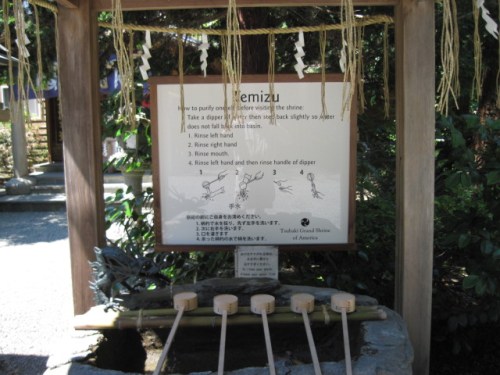
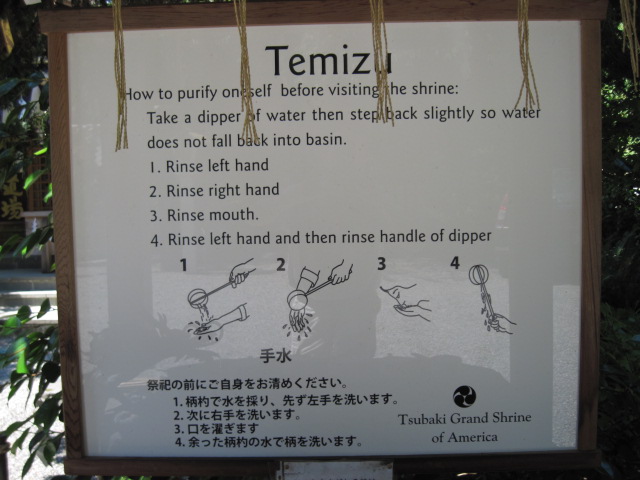
Tsubaki aids visitors in doing this. Here is the shrine’s temizuya, literally, “hand-water-place,” a feature at most shrines, offering an opportunity for ritual purification. The shrine offers a bilingual placard explaining the temizu ritual. Participating (or not) is left beautifully up to us, especially on a day like this was, with no one around but one silent shrine tender, sweeping and cleaning. But the temizuya does stand ready as one invitation among many to make our own discoveries through performing a small ritual action.
 Of course, a shrine need not always explain. Tsubaki, like so much of Shinto, also demonstrates the value of silence in fostering encounters with the natural world. They are not separate things; the human is part of the world of the kami, of spirit.
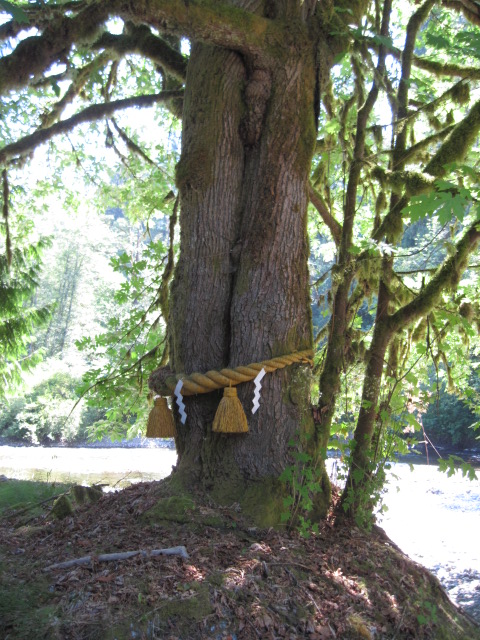
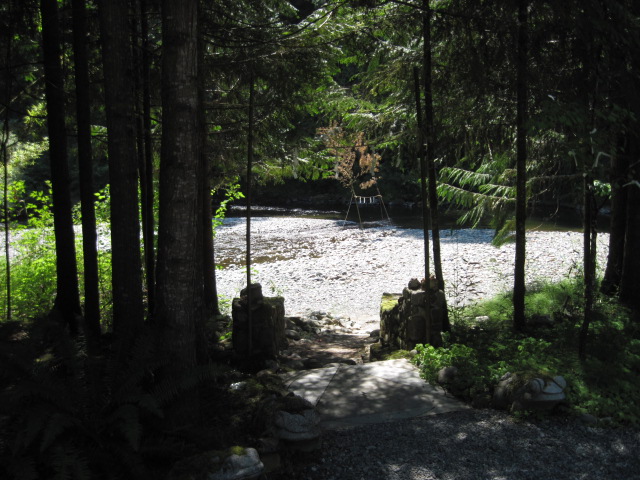
From another viewpoint, a shrine simply acknowledges what is already present, whether it chooses to point our attention to it, or bring us together by putting us in the same place. Here is the path from the central shrine down to the gravelly bed of the Pilchuck River. There you can see another small shrine (in the center of the picture, looking something like a tall sawhorse draped with white flags) standing near the water’s edge.


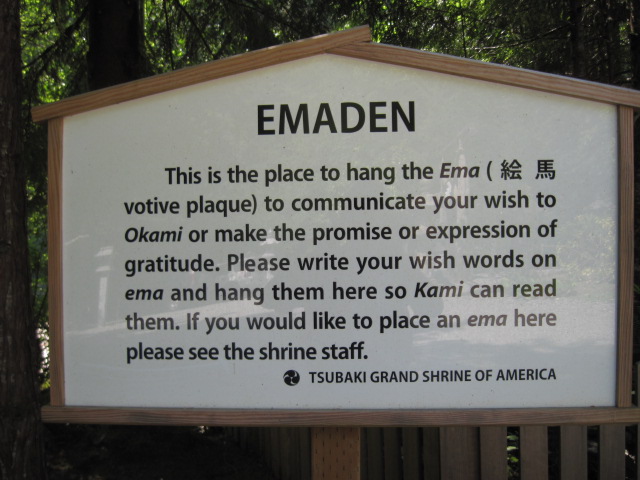
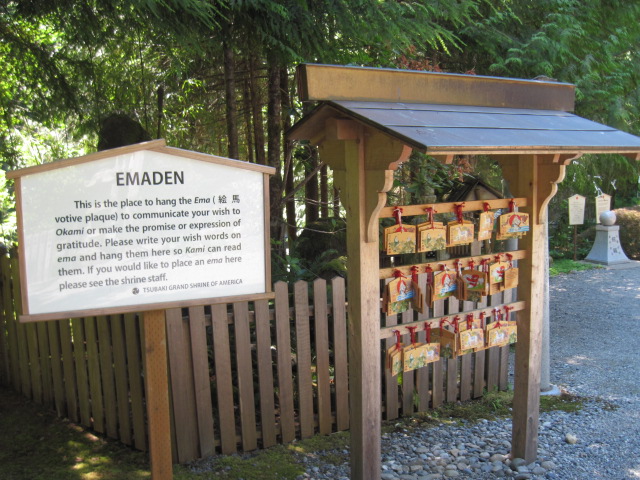
The plaque above adjoining the emaden explains another Shinto practice. Below is the emaden itself.
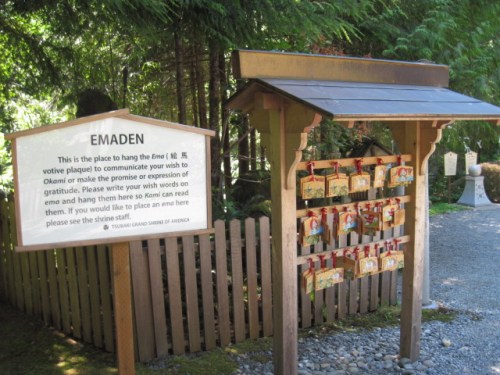
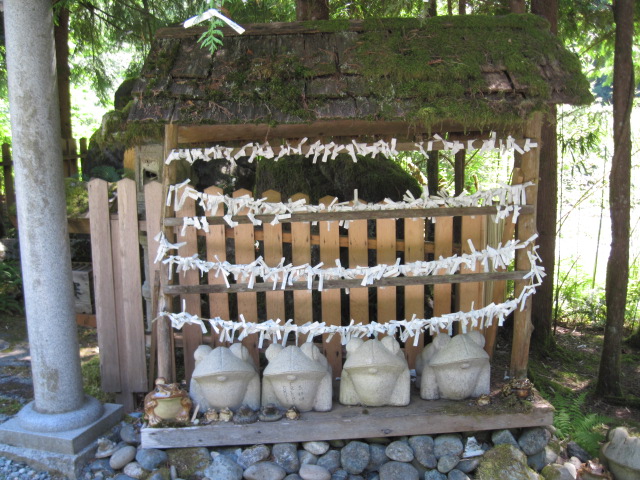
Less formal are the written prayers tied to natural features like trees and to man-made objects. And many Westerners have become familiar with Tibetan prayer flags. Odd that in the West a prayer is considered primarily a verbal action. The silent written prayer can stay in place; we can walk away, knowing our petition or vow or praise or thanks remain, where we made them. We wish for a change, a response, to manifest at least in part in this natural world. Then let our petition, our expression, our acknowledgement of spirit linger in the world, till the world’s elemental and spiritual forces reclaim them.

In addition to other kami, Tsubaki also enshrines America Kokudo Kunitama-no-Kami, the kami protector of the North American continent.
In the next post, I’ll look at some possibilities for what Shrine Druidry could look like as an expression of Druidic experience.
/|\ /|\ /|\
Updated 9 Oct 2015
(Scam, scam, scammity scam. Oh, is this mic live?!)
“One Weird Trick Most Gods Don’t Want You to Know.” A bestselling strategy if there ever was one. Almost fail-proof. Get in on what THEY’VE been keeping from us, Honest Suffering Upright Citizens that we are. Who doesn’t want IN? (Another 100 cable channels! Salvation by proxy! Acne-free in seven days!) Click here. Operators are standing by. No credit? No problem! No money down! Just open a vein! (Can’t get no) satisfaction guaranteed!
(Can any truly worthwhile thing be bought?)
But YES! one god really does want you to know: introducing capital-L Loki, AKA the Trickster, the Wheeler Dealer, the Original Houdini of the Truth Trap, the Cosmic Con, Bad Penny, Black Sheep, the One in Every Family, Every Religion’s Got One Somewhere. Him! Well, who should know better than the Master, right? (Deep down, that part of us all that’s a little loki-in-training. Who whispers Alternatives, in spite of all the noises-against-the-voices we can dump into our ears. Crank up the volume. Maybe they’ll go away.) Figures that the only source for reliable info turns out to be a Trickster.
And he’ll tell you: Religion’s all a scam, an empty fantasy, a fool’s errand, a wild goose chase. This god-or-not and belief- and worship- and daily-practice thing is, like you always suspected, just an endless maze of mind-tricks brought on like a nightmare, courtesy of an overactive cerebrum, that gift of Evolution that just keeps on giving, that two-hemisphere marvel and misfit that — in spite of all its tricks and traps and delusions and the stories it tells about itself and how wonderful it is — will still leave us all just as dead in a hasty handful of decades as if we’d devoted our lives entirely to pleasure. Just like the good old boys and girls over at Epicurean Central always told us we should. Yes, go out and download the app for it.
 Thanks, Loki. Now a word from our sponsors.
Not.
Except …
Godding isn’t what it used to be.
(Even with a nose-and-chin like Tom Hiddleston‘s.)
Even the gods you used to be able to count on turn out to be … puny.
One weird trick most gods don’t want you to know is that their truth or falseness has little to do with what they can teach you, how interaction with them can change your life, and so on.
Just because they don’t exist has very little to do with anything at all. Existence isn’t an absolute. It de-pends.
And like those pesky anatomical pend-ant or hanging things, the so-called “fact” of existence or non-existence can get us pretty confused about reality*, which is, after all, only another name for thing-ness. Anything that’s not a “thing” tends to get left off the List. Which is another weird trick most gods hope we’ll kinda ignore. For our own good, of course. Lists. Everyone’s got one, gods included. (Gods especially.)
What to wear, say, think, do, attend to and let slide. Everyone’s been be-godded, infected with at least one god, right down to our nail-beds and stomach linings: sex, wealth, image, status, art, pleasure, the “right views,” seniority, rationalism, salvation, comfort — even “just being left alone.” Gods everywhere. No place free of ’em. Hanging from the rafters, crawling around and inflaming our skin like some sort of divine psoriasis. No god-be-gone, available now while supplies last. Annoying little (BIG!) suckers.
Even death won’t free us when-not-if — un-gods help us all! — we’re reborn into some vastly cooler, endlessly hip world where everyone is fashionably thin (or plump), calmly atheist and perfectly dressed, coiffed, housed, spoused, aroused and soused. Tastefully conformist down to the designer toe-rings. No gods here, nasty things — had mine removed eons ago, old chap. Do yourself a huge favor, darling.
And so, illusion-free at last, eternity or oblivion (choose your mirror image) is ours!
Paradoxes to amuse children.
(Loki’s laughing all the way to Valhalla.)
And the Goddess? The Goddess is laughing at him.
/|\ /|\ /|\
Images: Loki and The Hulk from The Avengers.
*Reality, from Latin res, thing; realis; re-al or pertaining to things or their qualities, like the ability to slap you in the face, fall on your big toe, eat you for breakfast, if you don’t pay attention to them. Which gods like War still do, come to think of it. Details at 6:00 (or 18:00) tonight!
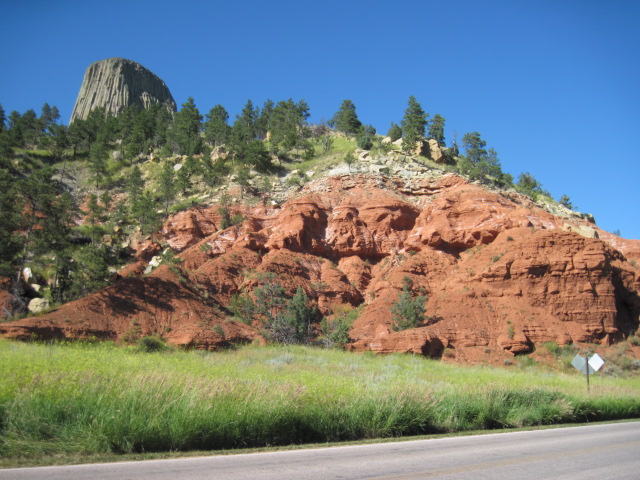
From a distance, Devil’s Tower National Monument in Wyoming looms over the landscape, prominent against the horizon, but once you enter the park surrounding it, it seems to vanish, only to reappear in fits and starts at first, peeping over colorful hills and cliff faces.
Geologically, we’re told, the tower is properly an igneous intrusion or eroded laccolith, two fun pieces of scientific jargon, technically descriptive, but lacking something nonetheless. And “Devil’s Tower”? Why should the baddie of Judeo-Christianity get any credit at all for this splendid rock formation? Let him stick to devilled eggs and devil’s food cake.
Those of us over a certain age may recall the Tower’s appearance as dramatic staging in the final portion of the ’77 Spielberg sci-fi film Close Encounters of the Third Kind, a pop-culture association that now seriously dates us.
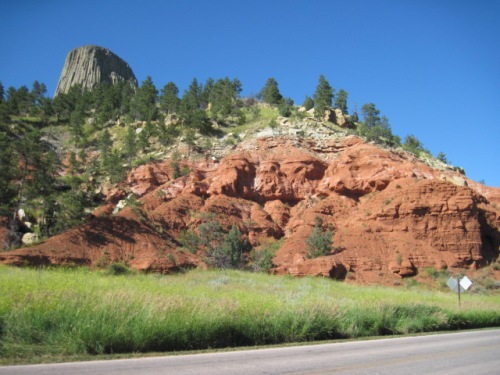
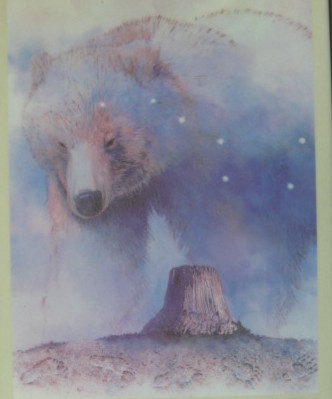
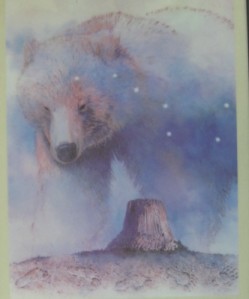 My wife and I arrived late in the day, which helped throw the tower’s dramatic vertical striations into high relief. A park information kiosk quietly points out that the English name “Devil’s Tower” is comparatively recent. Native names from several different tribes associate the formation with the bear — the Cheyenne, Arapaho, Crow and Lakota all call it some variation of “Bear’s Lodge” or “Bear’s House” and their traditional stories describe bears marking the great stone with their claws.* (You can read several versions under the section “Native American Folklore” here.)
Both name and thing started shifting for me as I read this: a good name illuminates the thing, and the thing itself lives more brightly and fully under a good name. I can still feel the association “stick” — now a piece at least of that older (and to me more apt) story has become part of this landscape. Devil’s Tower, yes. But the “real” name, well, that’s a different matter. Invoke the place in memory by the older name — in this case a good one — and its naming story comes with it. Misname something, or someone, and you may not be able to see that thing or person clearly or truthfully.
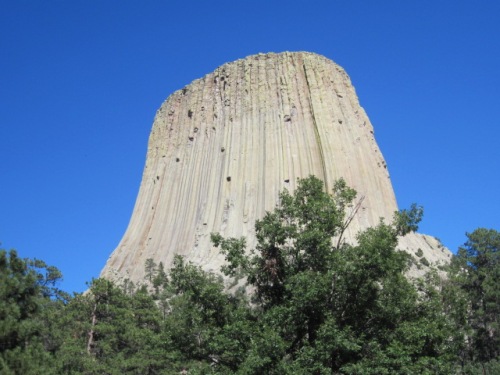
Bear’s Lodge, now I pass along a little of your story to others, so they too may enjoy the rightness of a good name.
/|\ /|\ /|\
*The tower remains a sacred site for several tribes. “In 2005,” the Wikipedia article notes, “a proposal to recognize several Native American ties through the additional designation of the monolith as Bear Lodge National Historic Landmark” faced political opposition and the argument that a “name change will harm the tourist trade and bring economic hardship to area communities.”
Image: Bear over Devil’s Tower — park info kiosk.
You may know some of “them.” (What’s it say about us that we say “them”?) They’re often wonderful people, they raise families, they “contribute to society,” they’re fun to be around — and they may seem not to have a religious or spiritual bone in their bodies. And that’s not only something to “tolerate” or “accept.” It’s just as it should be. “I desire that there may be as many different persons in the world as possible; but I would have each one be very careful to find out and pursue his own way, and not his father’s or his mother’s or his neighbor’s instead,” says H. D. Thoreau.
Two couples whose company my wife and I delight in and seek out certainly qualify as non-religious: you can see their unease or discomfort if the topic happens to come up in conversation. An innocent question, or a comment in passing. “What’s that pin you’re wearing?” or “What did you do last month when you were in Minneapolis?” And hearing our answer, a kind of stiffness, a change in expression, a wilting, or wariness. “Oh no,” you can practically hear them thinking. “We’re going there again.”
And my wife and I laugh about it afterward. You get it, right? So often we’ve been the defensive ones, either avoiding the topic altogether, or passing off our beliefs with a quick, casual acknowledgment and then turning the talk in another direction, or (sigh) girding ourselves to explain, justify, account yet again for our non-mainstream practices and events and perspectives. The lesson for us continues to be this: if the opportunity opens up, find a way to talk about day-to-day benefits rather than beliefs, seek the common ground we all know from living on this planet, demonstrate it as a part of our lives, which they do care about. Then move on. Build trust, keep the lines of communication open, share your vulnerability and — as needed — shut up. You know: basic relationship stuff.
On our recent car trip, which I’ve touched on in the last several posts, we managed to reconnect with colleagues from over 25 years ago, a couple I worked with during my year of teaching in Changsha in the People’s Republic of China in the late 80s. We’d fallen out of touch: the first of their three children arrived, three of the four of us were back in school, several of us were patching together jobs out of already unconventional work histories, and both of our families moved at least a couple of times to accomplish these things.
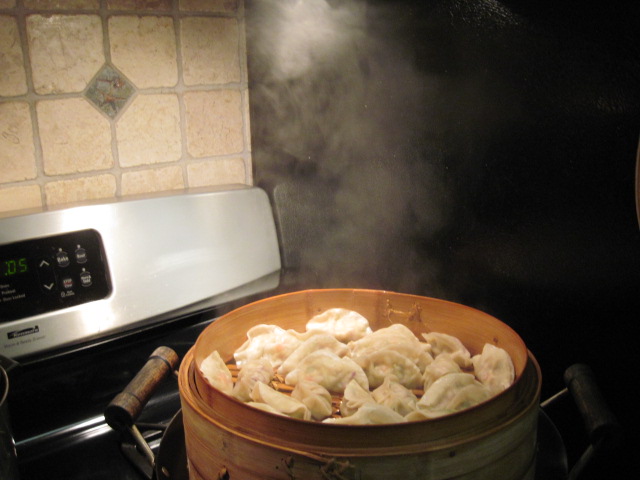
 We joked about our reunion later, over a dinner of home-made jiaozi. Making and eating them had become a lovely family tradition for them after China. The four of us and their youngest daughter, now 19, stood around their dining room table, filling and wrapping and talking, brushing the jiaozi wrappers with the cornstarch-water mix to seal them, then watching as the plump crescent dumplings steamed. Earlier we’d met for lunch in a restaurant, in case any of us had become raving loonies in the interim, and a convenient escape was needed. Eight hours later, we all knew we had nothing to fear. And the best demonstration, in the moment, of spirituality in all of our lives? Friendship, hospitality, a shared meal, simple pleasure in each other’s company. A touch of nostalgia didn’t hurt either.
/|\ /|\ /|\
Image of jiaozi steaming: me. Actual kitchen, steamers, stove, etc., courtesy of S. T.
Edited: 2 Aug. 2014

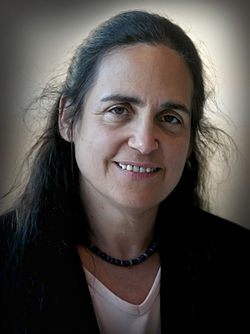
Margot Adler in 2004. Picture: Wikipedia OTRS, by Kyle Cassidy
Quietly, steadily, Margot Adler helped Paganism gain wider understanding and respectability. Her passing at 68 from cancer this last Monday, 28 July ’14, also leaves a gap on the airwaves. Often people seem to know her either for her work as a veteran reporter and correspondent for National Public Radio (NPR), or for her seminal book on Paganism and her involvement in Wicca, but less often for both. Yet the combination is a key to her life and significance, and helped to give her and what she had to say particular impact, harder to ignore because of her reasoned and thoughtful public voice over the decades.
The NPR website provides a couple of short audio segments acknowledging her work and her passing. This one includes brief mention of her involvement in Paganism toward the end, around the 3:40 mark, and includes a link to the other segment. Both segments include written transcripts as well.
Adler’s signature book, Drawing Down the Moon: Witches, Druids, Goddess-Worshippers, and Other Pagans in America Today, to give its full title, was first published in 1979 by Viking Press. The Amazon page for the 4th revised 2006 edition enthuses:
Almost thirty years since its original publication, Drawing Down the Moon continues to be the only detailed history of the burgeoning but still widely misunderstood Neo-Pagan subculture. Margot Adler attended ritual gatherings and interviewed a diverse, colorful gallery of people across the United States, people who find inspiration in ancient deities, nature, myth, even science fiction. In this new edition featuring an updated resource guide of newsletters, journals, books, groups, and festivals, Margot Adler takes a fascinating and honest look at the religious experiences, beliefs, and lifestyles of modern America’s Pagan groups.
 A 2005 article in the Religion Journal of the New York Times, “Witches, Druids and Other Pagans Make Merry Again in the Magical Month of May,” observed that “the book is credited with both documenting new religious impulses and being a catalyst for the panoply of practices now in existence.”
My 1981 Beacon Press* paperback edition has begun to yellow with age. Paging through it as I write this post, I remember how I read and re-read it, fascinated by practices, perspectives and beliefs that variously called to that 20-something me from a place both familiar and strange, echoed my own experience, or surprised me with their outright oddness.
If modern Druids and Pagans more generally have relied heavily on books to launch and sustain them, that’s because it’s often principally or solely through literacy, books, and reading that many Pagans learn they aren’t alone after all, that others like them really do exist, and that the spiritual energies they finally must acknowledge are at work in them deserve expression rather than repression — that the way opening before them is possibly even worth the risks and hardships that may come with it. The brave Solitaries in their personal practices, and the Pagan groups that have formed and continue to form, resemble those of many other new religious and spiritual movements that coalesce and arise, and have arisen historically, within cultures typically oblivious, resistant or actively hostile to the opportunities, perspectives and critiques such movements offer. Where else, after all, would you expect Pagans to begin?! Where and how else do any new spiritual and religious movements begin, but by those with a shared experience or vision recognizing each other, and drawing nourishment from the common ground between them?
That original book cover of Drawing Down the Moon looks tame today, but it made me want to hide it from casual view, even from my parents who were very accepting of whatever their bookish son was currently reading. So what happened next with me? Very little, outwardly. But the book and its many voices, together with its author’s reflections on the Pagan movement, fell onto fallow ground. I can trace its impact directly to my involvement in Druidry now. And from what I’ve heard, I surmise this proved true for many others as well. Roots and branches of many lives.
So all this is to say thank you to Adler for her book and also for the questions she raises in it, most of which remain valid. While various streams and strands in Paganism have grown and strengthened since the time of the first edition of Adler’s book, the challenges she perceives for Paganism persist. I’ll close with an example:
Neo-Pagans, Adler asserts (pp. 385-386*)
have so many different visions that together they seem broad enough to sustain the human need for beauty, freedom, and growth. They contain a vision of the earth that is a noble one, a reverent one. I am still inspired by it. These ideas seem capable of stirring great ferment; they seem capable of ending human alienation from the planet. But will they?
… It also seems clear that those who choose to be Pagans do so to nourish and sustain a Pagan vision already inside. This vision exists as a painting exists, or a piece of artwork. And Neo-Pagans are the artists. But the relationship of artists to living on the earth has always been uncertain. Perhaps it is important to emphasize the visions of Pagans rather than the realities of their lives, the poems they write rather than the jobs many are forced to keep, the questions the movement asks rather than the goals already attained. The goals sometimes fall short of transcendence, and Pagans are often imprisoned by the very civilization they criticize.
Of course, that’s partly WHY they criticize it. Plant a dream, and it may well take time to germinate, if conditions are less than welcoming.
“You’re much too journalistic,” Michael told me again and again as we walked around Craftcast Farm in the winter of 1976. “I want to know what people feel like in the circle. That’s what I want your book to tell me. That’s what I want to know.”
Along with her good thinking, and the words of many who have become our Pagan elders, Adler’s book definitely conveys both that atmosphere and the challenges Paganism continues to grapple with.
/|\ /|\ /|\
Images: Margot Adler; book cover of Drawing Down the Moon, first edition.
*Adler, Margot. Drawing Down the Moon: Witches, Druids, Goddess-Worshippers, and Other Pagans in America Today. Boston: Beacon Press, 1981.
Edited 4 Aug 2014
Then there are those times when you’re simply enjoying the kitschier side of your culture. And maybe, in spite of everything, you still encounter a kind of metaphorical economy inherent in things, in which even apparent kitsch can reveal a mystery, or prompt a discovery.
My wife and I were on a return leg of our car-trip yesterday afternoon when we saw a Minnesota highway sign at the town of Blue Earth that caught our attention. A short turn off interstate 90 led us to a parking lot and a small patch of, well, green.
To celebrate the 1978 completion of interstate I-90 as a highway linking Boston to Seattle, Green Giant Foods erected this statue of their Jolly Green Giant mascot in Blue Earth, Minnesota. (Green Man always manages to sneak his way into consciousness, one way or the other.)
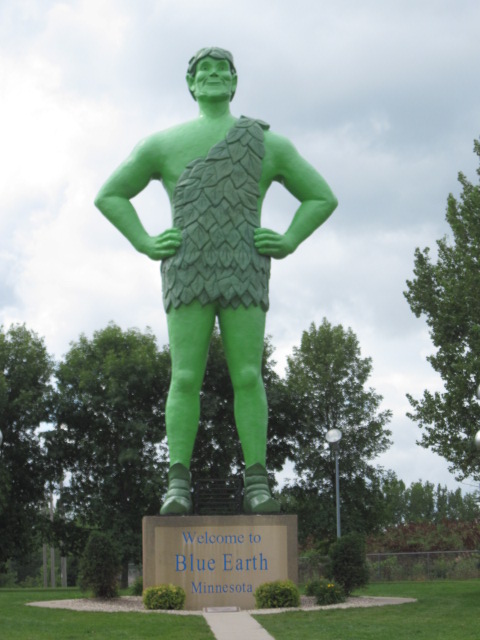
Like some of you older readers, my wife and I grew up hearing the bass voice-over of “Ho, ho, ho … Green Giant!” as the animated cartoon version of the big green guy hawked frozen vegetables on TV. Now here he was “in person,” or as close as we could get. And may this post be a small tribute to His Greenness.
Edited: 30-July-2014
As visual creatures we’re programmed to respond to faces. We project faces and human figures onto landscapes, the moon’s surface, cloud formations, etc. We make quick judgments about others on the basis of their faces and habitual facial expressions. And up to a point, we’re often justified in doing so. After all, we feel most comfortable around those who look like us. The “looking” part is key. Eyes tell us a great deal, and who hasn’t wanted at some point to remove the sunglasses from a stranger’s face so we can “read” the person’s eyes?

Hello Kitty
In particular, the properties of “cuteness” — large eyes relative to head size, rounded features, a set of proportions frequently common to young animals and humans — induce a “cuddle response” which the Austrian Konrad Lorenz asserted motivates adults to care for the young. Subsequent study has confirmed that the response is universal, crossing cultures — and incidentally allowing such things as Japanese cartoons like Hello Kitty to catch on in the West.
Of course there’s a large element of “warm and fuzzy” sentimentality in such images, and in how we react to them. Marketers know this and capitalize on it. And environmentalists, not surprisingly, find they can succeed more easily in garnering support to protect an endangered bird or animal that happens to have some features of cuteness over one that may be grotesque or otherwise off-putting. The Ugly Animal Preservation Society makes this point through its official mascot, the Blobfish. As the UAPS president notes, the group is “dedicated to raising the profile of some of Mother Nature’s more aesthetically challenged children. The panda gets too much attention.”

Blobfish
Perhaps this is why cultural images that actually possess real power can shock and startle us into waking up a little, because our increasingly sentimental cultures seem to have produced fewer of them in recent times. We may even fear the archetypal and subconscious energies that emerge in such images, because they can reveal the hollowness of much of our emotional and spiritual lives, as well as pointing out ways towards greater depth and integrity. We don’t know where we are with such images, and we may turn away in discomfort or disgust, or accuse the visionary or artist who helps manifest them, or misunderstand our own dreams where such archetypal images and figures may also appear, instead of understanding them as prompts to look inward.
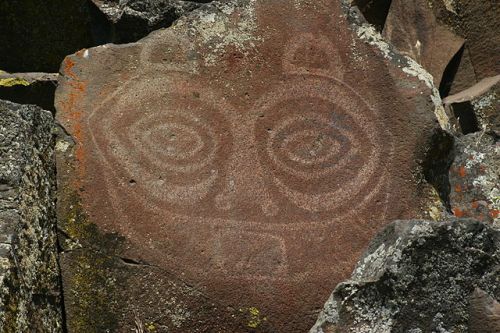
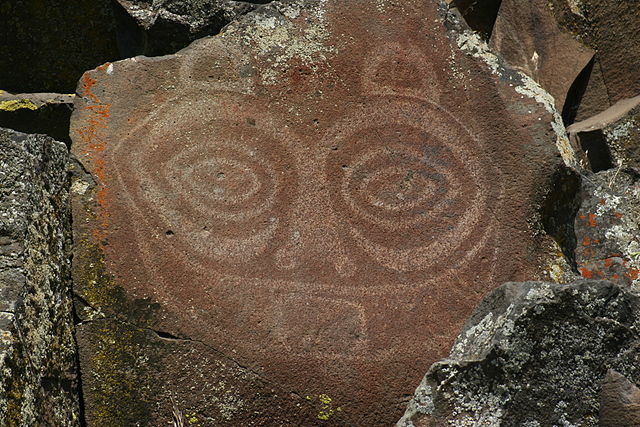
Tsagaglalal
The Wishram Indians of Oregon U.S. tell a story about Tsagaglalal (tsah-GAHG-lah-lahl) “she who watches,” whose image appears on a stone above the site of an ancient village. In part it’s also a story about Coyote, the archetypical Trickster figure of the Americas. Warning Tsagaglalal of a coming time when women will no longer be chiefs, Coyote tests Tsagaglalal’s resolve to protect her people. When he finds her worthy, he changes her to stone to guard the village she overlooks.
Visitors can see the combined petroglyph/pictograph of “She Who Watches” at Columbia Hills State Park near Dallesport, Washington. A guide now accompanies you — the image has been vandalized in the past.
[On a side note, when we lose our connection to the sacred, we may access a subsidiary glimmer of the original energy through the act of profaning it. Degradation and blasphemy do generate power of a sort. Human spiritual history testifies to this in figures and movements who have explored their possibilities. If they were too public in their explorations, they outraged the sensibilities of the wider culture. In the end, such practices seem consistently not to deliver what it is we seek anyway. Like the “withering away of the state” in Communism, human limitations sully the abstract ideal.]
/|\ /|\ /|\
Images: Hello Kitty; Blobfish; Tsagaglalal;

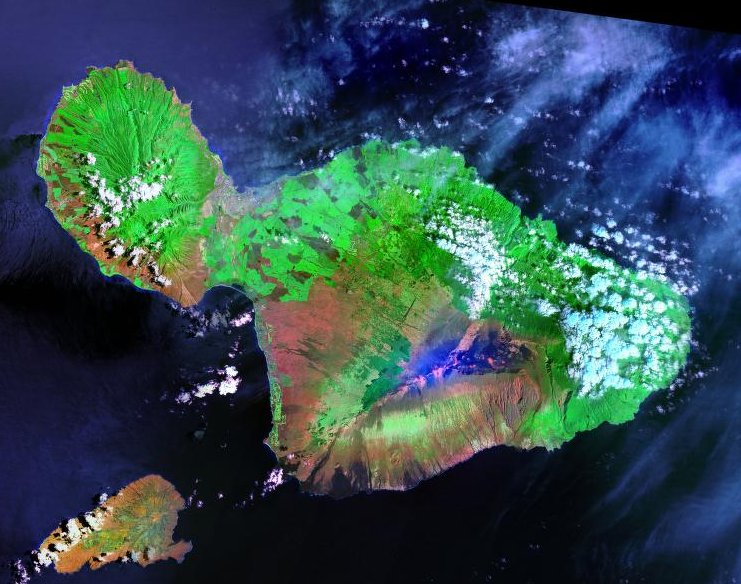
Maui — Landsat satellite view. Blue area is Haleakala — max. elev. 10, 023 ft.
Hi Lorna — thanks for your recent comment on “The Land is a Chief.” As usual, you dig beneath the surface and grapple with good challenges. You note, “To return … a sense of the sacred to landscapes … that have been viewed as profane” — that’s surely a major goal, if not one of THE central goals, of much Pagan and earth-based spirituality. At least I hope it is, or will be — it still feels like it’s in embryo form nowadays, in many places. Because there’s also a strong self-oriented strain that sometimes overshadows physical and spiritual work with the health of the land. It prioritizes self-fulfillment and personal realization and growth — important processes, yes — over the healing of the place(s) we find ourselves.
Of course it shouldn’t be an either-or: “You can’t have one without the other.” Many people struggle with spiritual ills that are manifesting, among other forms, as health challenges. Our honoring and reverencing of the old gods and spirits is one healthy “symptom” of practices for healing the land AND ourselves. We can’t hear and communicate and work with them if we’re too out of balance with ourselves and the land.
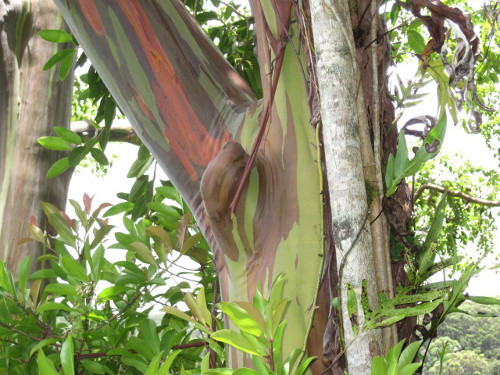
BELOW: Eucalyptus* near Huelo, East Maui, Hawai’i
I wonder, though, how much we’ve romanticised “traditional” cultures for their practices and beliefs — beyond what the “average” person in those cultures may actually have done or thought or believed. But maybe such romanticizing is part of a healthy corrective, needed today, to help re-balance our attitudes and motivations towards our treatment of the planet over the past two centuries. At least it gives us an ideal to work for: if we’ve damaged a landscape, we can heal it, and redeem our obligation, fulfilling our ancient commitment and responsibility as spiritual and physical beings in this world.
That sounds and feels right. We (often) say and dream it and proclaim it. But like you, I’m not sure whether or how (or how much) it will happen. For you rightly phrase it as an open question: will it “ever be possible to return such a sense of the sacred to landscapes that for at least the last couple of centuries have been viewed as profane?” We’ll answer that question with our lives, not just our words. And people of the next couple of centuries will judge and live with the results.
/|\ /|\ /|\
Image: Maui satellite view.
*My wife took this vivid image as part of a color study she is doing of native hues and patterns. Eucalyptus trees flourish along the Hana Highway, a very winding road along the northeastern coastline of Maui. Much of the area is tropical rainforest, though if you continue beyond Hana along the highway, the land transitions to desert in the southeast. One of the marvels of Maui and the other islands in the Hawai’ian chain is just how much climate diversity they exhibit over just a handful of miles in planetary terms.

Over a year ago, my wife’s aunt and uncle decided to celebrate their 50th anniversary by gathering family on Maui in Hawai’i, and very generously footing the bill for lodging as extra inducement, so we planned our car trip this summer to bring us to the west coast of the U.S., where airfares were — barely — doable on our rapidly-shrinking budget. Imagine seventeen of us — five families, with ages from 5 to 81 — piled into three rental condos.
I suspect the more green-minded among you are already saying, “But air travel’s so polluting.” And I’ll respond outright: it is. No argument there. So I’ll try to make up for such extravagance and excessive consumption through my witness, and through an attempt at some range in my reporting.
Yes, of course the islands are lovely. Even the sun-blessed sprawl of Honolulu can’t conceal the emerald hills that overlook the high-rises. Here’s a slightly blurry view to the north from Waikiki from our hotel room …

And, yes, you really can find the heart-stopping beauty you’ve heard about, often without stepping away from right where you are. Overhead, in a tree in full blossom, or in a striking run of notes of an unfamiliar bird-call, around a corner, or in one of the splendid national parks.
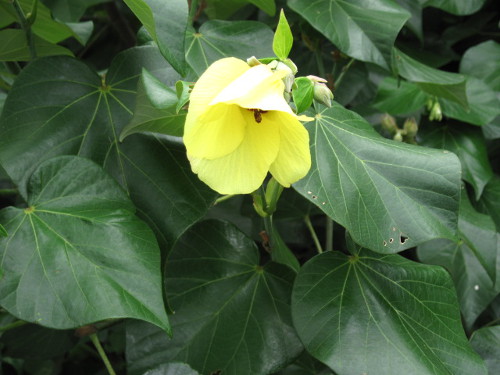
[BELOW: My wife’s photo of a Hau flower, Wai’anapanapa State Park, Hana Highway, Maui]

But what delights me the most — neither my wife nor I are “sun and beach” people, though the steady crash of surf and the breeze off the water lull even the two of us into “aloha” mode most effectively — is the growing presence and importance of traditional Hawai’ian culture and language. Without a sense of where I am, mere newness or charm quickly turns flat and lifeless. It becomes plastic. It’s easy to fall into one-dimensional tourist mode, paying for flat and plastic experiences with plastic. We’ve all heard this, probably done it ourselves, so we know what we’re talking about.
But the handful of long-time residents we’ve encountered, along with tour-guides and wait staff, all seem to agree on a healthy cultural trend. Much was lost during the last two hundred years of Western influence and interference — that sadly all-too-common story in so many places — but much has been preserved. There’s a pride in the native Hawai’ian heritage that may be one of the best predictors for the future survival of old crafts and stories, language and custom. One more place to cheer, however tentatively. If tourist dollars provide one motivation in holding onto surface charm and, gods willing, deeper cultural uniqueness, well, let’s utilize whatever works.
[Along with cultural ferment, it’s important to add, the island is striving in fits and starts to go green ecologically. Aging and polluting diesel-powered electricity generation is being supplemented (and eventually will be taken off-line) — by three hilltop banks of wind-power stations. And Larry Ellison (of Oracle software fame) has purchased 98% of the neighboring island of Lana’i (the former Dole pineapple island), with plans to make it eventually self-sufficient in food and power, and generate revenues by selling excess solar/wind power to other islands.]
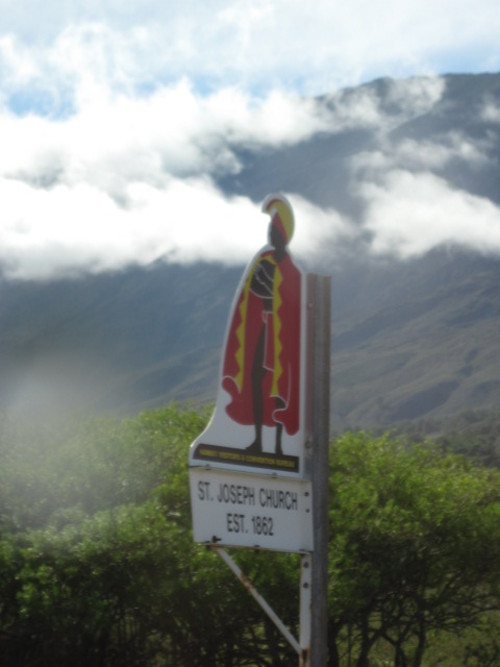
New-ish road-signs featuring the traditional ali’i or chief, like this one marking a church, say a lot. Native traditions and images, disparaged in colonial times, or made downright illegal like speaking Hawai’ian was, start to regain something of their original stature and significance, however incomplete, through their use as symbols and icons.

Since we’ve arrived we’ve frequently heard the Hawai’ian saying “Maui nō ka ʻoi” — “Maui’s the best”* — and without shamelessly trying to fake a non-existent familiarity with the archipelago (we’re here on Maui just 6 days, after all), we’re still inclined to think this particular island deserves its status: small enough to escape much of the busy-ness and hype of Oahu where we spent two days, and dramatically varied enough to provide rain-forest, tropical, upland, mountain and desert landscapes, all within a day’s drive on the “ring road” around east Maui.
In the end, though, for me as a brief visitor and interloper, it’s not the beaches but the mountains that call with the clearest voice of the spirits of place. He ali’i ka’aina, goes another local proverb: the land is a chief. He kauwa ke kanaka — we are its servants. To belong to a land …
Maui’s chief mountain is Haleakala, “House of the Sun,” though clouds often skirt the slopes. How instinctively we realize: mountains earn and deserve our attention as vivid gestures of our planet, and as ancient and powerful spiritual tools. Viewing them, meditating in their presence, ascending them, whether on a clear day or through a cloud cover that may cloak them in mystery, can mirror and induce a spiritual ascent.
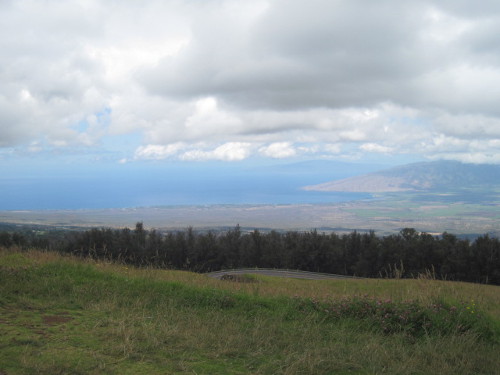
Here we are part-way up and facing west, overlooking west Maui. You can see the ocean on the left, arching inward to central Maui.

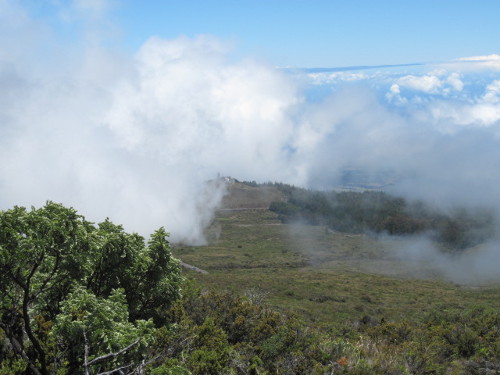
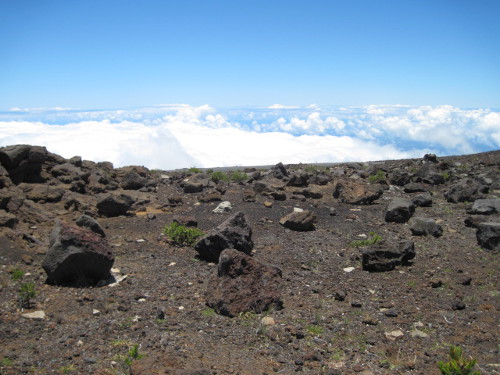
Vegetation thins as you climb above the clouds, till bare volcanic rock dominates. This is no longer the beach and sun of tourist brochures, but land still being born, raw from creation.

Hikers can make the climb on foot; if you haven’t already noticed your car’s temperature gauge, the sign announces how far you have come above the sea.

When you enter Haleakala National Park at either the coastal or mountain visitor center, you can pick up a bilingual pamphlet (Hawai’ian appearing first, too!) that clearly attests to the re-emerging potency of native Hawai’ian culture. Yes, you can not pick it up, or pick it up and not read it, or read and forget it. But … After a short paragraph explaining the principle of kuleana, responsibility to the land, “passed on to us from our kupuna (ancestors),” the visitor is admonished: “Therefore, as you enter this sacred place, this kuleana is now placed upon you.”
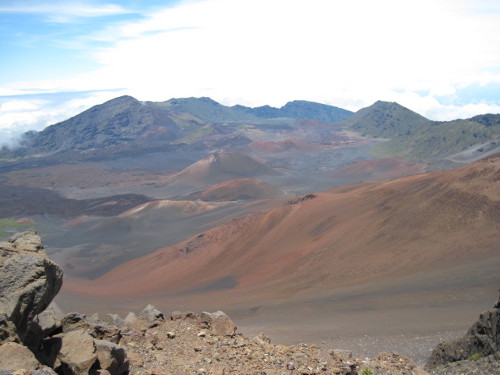
Here is the otherworldly crater at the peak.

Imagine such words in every park, every public place across the land! “Therefore, as you enter this sacred place, this responsibility is now placed upon you.” Then imagine people respecting and heeding such words. Here is a start, a seed. Let there be many such seed-places around the world. May we plant them. May they grow from here, from every such place. We need them so desperately. And may beauty help lead us where we need to go. This for me has been a gift of Maui.
/|\ /|\ /|\
*Maui Nō Ka ʻOi is also the name of a local island magazine, full of touristy articles and images.
After New Mexico and Arizona, we drove two long days, without tourist stops, on our way to Washington and the Olympic Peninsula (OP). Of course Utah, Idaho and Oregon have their own pleasures, but we’d focused our itinerary on some key destinations like the OP and its temperate rain-forests (with a side trip to Victoria BC). Besides, we were also due in Tacoma at a weaving conference my wife would attend. The contrast between high desert and rain-forest re-energized our tourist hunger.
With Seattle and Tacoma as our base (cheaper — and more easily available — hotels), we first set out counterclockwise, north then westward on Rt. 101, the ring-road around the OP. Dining opportunities were one major draw. With Hood Canal (below) oysters and clams and Dungeness crab from the Strait of Juan de Fuca to choose from, you too can fulfill your devotion to terroir with fresh and local cuisine, especially if good seafood is at all your weakness.
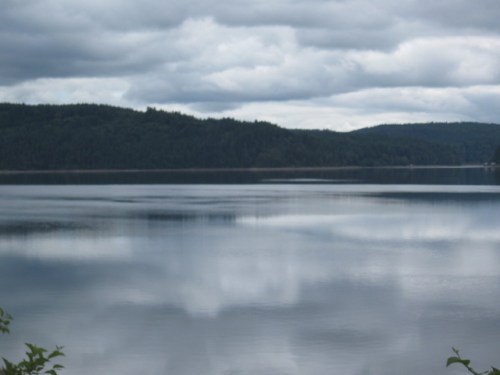
Along Rt. 101 we passed through Sequim WA (locals say”Skwim”), which now ranks with Tucumcari as one of my favorite U.S. place-names, and a contender for an innocent word that nevertheless sounds suggestive. Dosewallips runs a close second or third. (As anyone knows who lives in or has visited the UK, place-names there merit their own special category of oddness and delight: as a random sampling, Dorking, Icknield Way, Dalwhinnie and Hail Weston do no more than scratch the surface. Check out the comprehensive and searchable Dictionary of British Place Names).
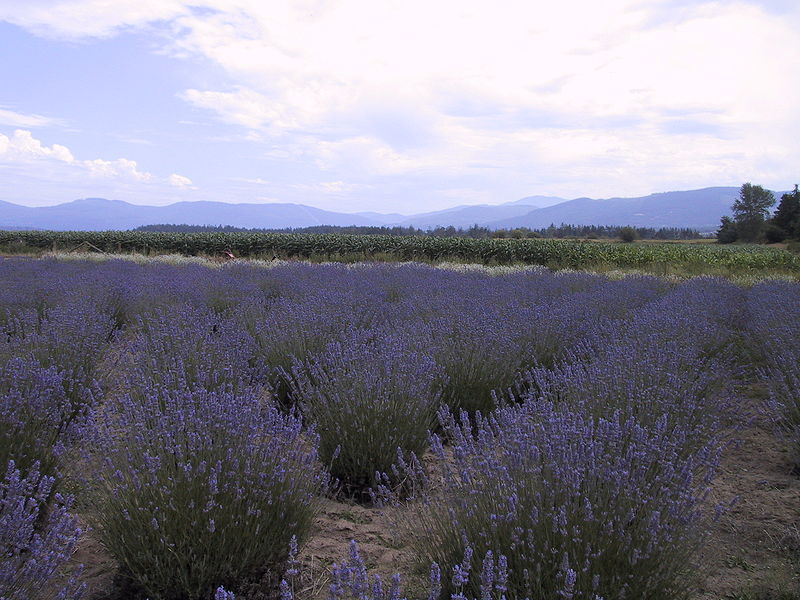
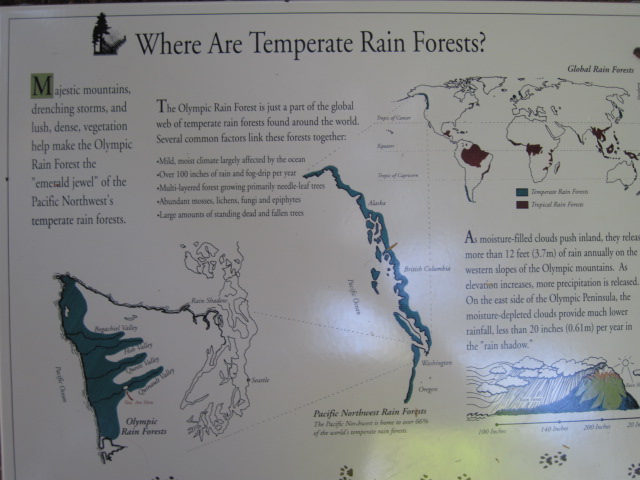
One of Sequim’s claim to fame, given its unique climate, is lavender farming. Though within crow-flying distance of rain forest with 12 feet (3.6 m) of rain per year, Sequim often sees no more than 16 inches (41 cm). As they tend to do world-wide, the mountains here dominate the weather, with the ocean-facing west slopes capturing the bulk of the precipitation, leaving the lea-side much drier. Image credit: Sequim WA lavender field

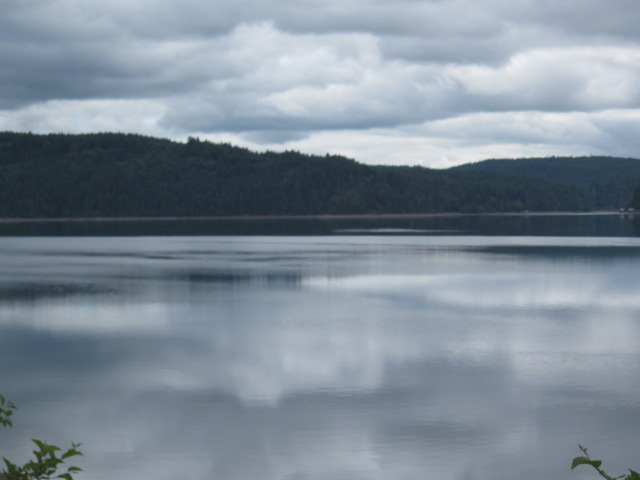
Rt. 101 hugs the south shore of Lake Crescent starting some 15 miles west of Port Angeles (jumping-off point for a ferry ride and day-trip — or longer — to the lovely Victoria, BC) and is a beautiful spot to explore, too.

But the lovelier leg of the trip, we felt, came the second day, clockwise this time, heading west out of Tacoma, again on Rt. 101, but this time north around the western reaches of the OP.
In the southwest OP, Rt. 101 curves inland up a fjord-like glacial channel into the mountains of the Olympic National Forest, revealing the jewel of Lake Quinault. The Quinault Indians (most “Native Americans,” we were told repeatedly, apparently prefer the older name) are another tribal group that’s survived into the 21st century.
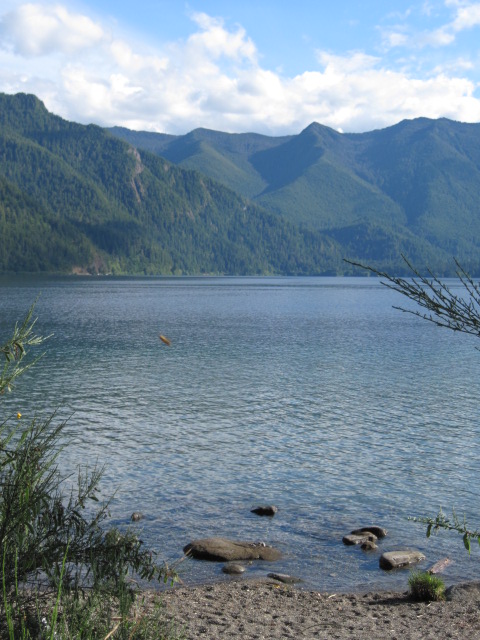
On the lake’s south shore is a fragment of relatively unspoiled rain forest.

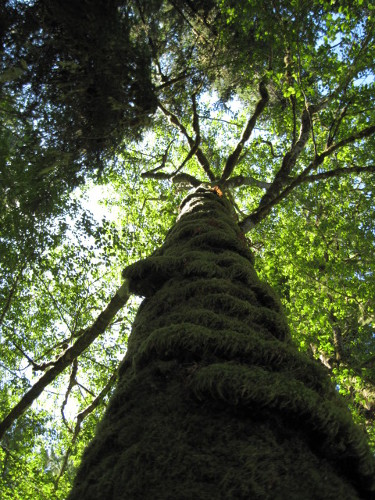
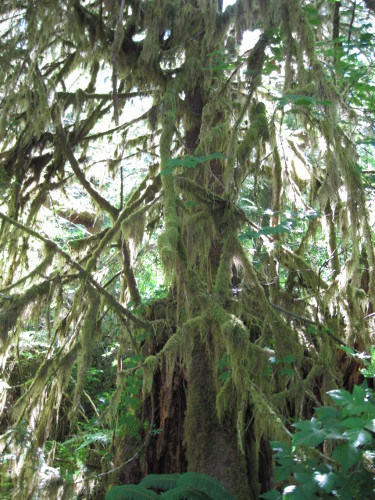
Below, in best tree-hugging mode, I give myself a visual reminder of how large so many of even the “average” trees are. Here we walked among many Greenhenges.

Ferns thrive, too, in the wet climate.

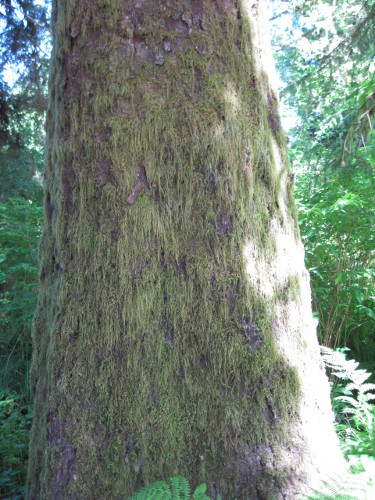
Everywhere you look is lush and replete with delicate mosses.
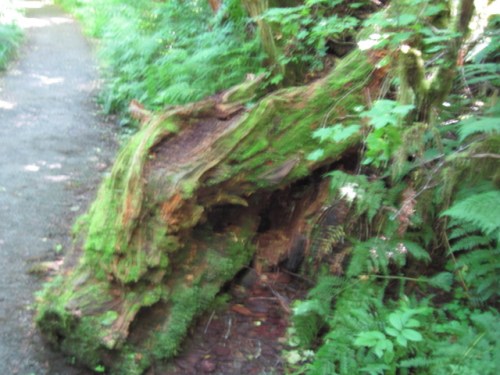
One sign explained how fallen giants serve as “nurse trees” for the next generation.

Such signs become quickly redundant with scenes like the one just below.
/|\ /\\ /|\
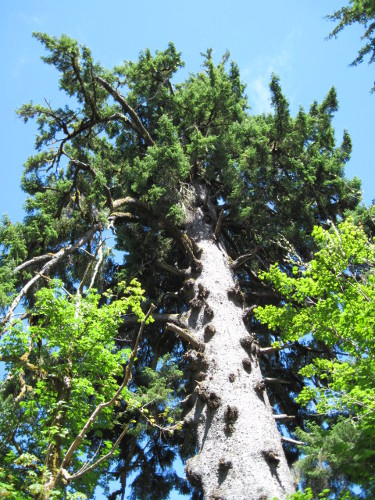
I’ll close with several more images from the forest. The final three form a forest triptych: the crown of the great Sitka spruce and its whorled trunk.




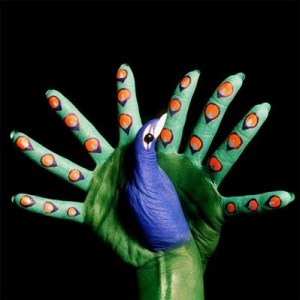 In her comment on a post from August ’13, Lorna Smithers makes a distinction particularly vital for “Bardic types” that I want to take up here, especially in light of my last post:
The division between what remains in the journal and what to communicate is a question I confront continuously as a Bard, for unlike with a path that focuses solely on personal transformation through magic, Bards are expected to share their inspiration.
I find that some experiences are ok to share immediately, others need time to gestate for the meanings to evolve and take on a clearer form, and a select few may always stay secret.
I see good craftmanship to be the key [to] sharing experiences. In contrast to the vomit of ‘compulsive confession’, well-wrought craft lifts the raw material into the realms of art, creating works that affirm the awe and wonder of the magical world.
That Bardic instinct to share inspiration that may or may not have been shaped by art can get us in trouble. The desire to bring into physical expression something that’s going on in your inner worlds can lead to what Lorna accurately calls vomit. Sometimes, of course, awen really does drop a piece of loveliness in your lap. It arrives fully-formed, and you run with it, dazed and delighted and puppy-like in your enthusiasm to share the wonder of it with all and sundry, but that (the gift of inspired loveliness, not the puppy-like response) usually only happens when you’ve done plenty of the hard slog of shaping already, alone or with only yourself and your gods for support of a vision no one else may even know anything about.
Sometimes the time and energy your pour into nurturing your creativity can make you defensive if you haven’t “produced” anything visible. If you’re a writer, for instance, you’re not a “real” writer till you’ve “published.” Few will care about the months, years or decades of work that may lie shelved in boxes or occupy megs of space on a computer. The same holds true in comparable ways for anyone who’s devoted time and energy to a craft or art.
 Artists who should know better sometimes like to hint, or let it be inferred, that this business of “awen on command” is how they work all the time, both mystifying us “ordinary mortals” and also doing a disservice to their craft and the nature of inspiration. Talent, oddly enough, responds well to practice, and no one works most of the time without effort.
The Anglo-Saxon bard was called a sceop, pronounced approximately “shop,” “one who shapes” inspiration into language and song. And the word bard comes from an Indo-European root *gwer- that means “to praise” or “to sing,” indicating two of the roles of the Celtic bard. The same root appears in Latin gratia, and English grace — a whole cluster of relationships — the gift and our response, our gratitude, and the quality in things blessed with awen, the loveliness and fluidity and rightness they often evince.
But if I opt to share something that’s not ready or right to share, I’ll usually regret it. Let me enthuse or gab about a story or an inner experience before its proper time, and it may lose its luster. It no longer thrills me enough to work with it, and I take what was a gift and cast it aside, its charm lost. The spell is broken, and I am no longer spell-bound, or able to do anything with it. Like the old fairy story of the goblin jewels, in the daylight of the blog, or the careless conversation with another, the one-time treasures that sparkled and shone under moonlight have turned to dead leaves. One or two such painful experiences is usually enough to teach anyone the virtues of silence, restraint and self-discipline.
 Another half (there are almost never just two halves, but three, four, five or more) of the whole, however, is that keeping the flow going, trusting the awen enough to go with what you get, and allowing the work to manifest, brings in more. Jesus did know what he was talking about when he said (paraphrased to modernize the language), “To people that already have, more will be given, and from people that don’t, even what they have will be taken away.” While this may sound at first like contemporary government policy and destructive legislation and current economics, it holds true on the inner planes, in the worlds of inspiration and imagination.
Lorna herself is an exemplar of this Bardic trust and inspiration. As an Awenydd, one who receives and shapes the gift of awen, she demonstrates in poetry and photography on her blog and in performance the mutual bonds with the Otherworld and spirits of place that make up her path.
And so it was with considerable interest that I read her account “Personal Religion?” well into writing this post, while I was checking that the URLs were right for the links to her blog. She experiences a strong reaction on hearing about the OBOD Golden Anniversary celebrations, and launches into a series of probing personal questions without immediate answers which I urge you to read directly. The challenges she faces are those of one attempting to be faithful to a call, and she follows a path with honor. Her struggles illustrate the living nature of the Pagan path, with its many branches and trails. Her practice flourishes precisely because she strives to be faithful to her own vision, which may not always grow and bloom under the “big tent” of orders like OBOD.
Making that struggle visible is valuable — posting it for others to read, ponder and benefit from.
/|\ /|\ /|\
Images: handbird; hard at work; walking.
In the lovely and iconic image below, courtesy of Cat Treadwell, Druids climb Glastonbury Tor earlier this month as part of OBOD’s Golden Anniversary. Fifty years ago, Ross Nichols (1902-1975) — poet, Druid and school-teacher — formed the Order of Bards, Ovates and Druids. As a member of the Bardic grade, of course I yearned to attend. For a delightful acccount of the event, go here for Joanna van der Hoeven’s 9 June 2014 post “Celebrating 50 Years of OBOD” on her blog “Down the Forest Path.”

OBOD 50th Celebration — Druids climb Glastonbury Tor. Image Courtesy of Cat Treadwell
Does it matter whether Druids and Glastonbury share a historical connection? Ultimately, only to historians. The lived experience of Druidry, as of any flourishing tradition, means that what we do today shapes our experience more than what may or may not have happened in the past. When my fellow Druids assembled in the town and on the Tor, the sense of community, the sharing of ritual, the reunion of friends, the inspiration of the talks and workshops, the sense of history, and the beauty and much-vaunted “vibe” of Glastonbury, all converged. And the same kind of convergence is true of personal experience as well.
Though OBOD’s Golden Anniversary celebration tugged deeply at me, my wife and I had already committed resources to a trip within the U.S. I couldn’t manage both, so I had to forgo what was by all accounts a moving and delightful celebration. But I couldn’t sustain much self-pity, because our own itinerary included a return to Serpent Mound in southern Ohio. I’d visited before in 2008, and experienced a strong past-life recall there. I saw and heard further details this time. Among them were a specific name (of a tribe? a person? I don’t — yet — know), voices singing, images of the tribe’s shaman, and of my death near the Mound in an inter-tribal conflict.
 But these details, while moving and significant to me, matter less than the impact which these kinds of experiences make in general. As an instance of “unverified personal gnosis,” my experiences don’t require any belief on my part, though of course I may choose to believe all sorts of things as a result. Nor do such experiences legitimize any attempts I may make to persuade others that my experience was “real” or that they should act differently towards me — or their own lives — as a result. What the experience did establish for me is a strong personal resonance with a place and a culture, and a doorway to potential future choices and insights about my life and personal circumstances that I might not have been able to access in any other way. Whether I choose to act on that experience is my responsibility. (What is significant to me right now is that the details of my experience form the basis for a decent historical novel, for instance — one way to dramatize my personal experience and — with further hisorical research — turn it into art. I feel I can explore and concretize its significance most vividly and vitally this way. And who knows what further confirmations such research may provide?)
 The Serpent is “a 1,348-foot (411 m)-long, three-foot-high prehistoric effigy mound located on a plateau of the Serpent Mound crater along Ohio Brush Creek in Adams County, Ohio” (Wikipedia entry, and the sign above). On the ground, it’s not a particularly impressive structure — at first. A 30-foot viewing tower near the tail of the Serpent allows some height and perspective for the kind of photos I took. Shadows in pictures taken early or late in the day help highlight the shape and outline of the Serpent.
Both the age and purpose of the Mound are a matter of debate. Many published sources estimate the time of its construction around 1000 or 1100 CE. But the Ohio Historical Society guide at the site assured us that recent archeological studies, due to be published later this month, revive the claim (with apparently solid evidence) that the mound dates from an earlier period around 2000 years ago. Artifacts recovered from the mound include charcoal, beads and other jewelry, flint knives and arrow-heads, and deer-bone tools.

Aerial shots like the one below begin to convey the size and significance of the mound:

Add to this the presence, both at Serpent Mound and elsewhere in Ohio, of separate conical mounds like the one below (the picnic table in the foreground gives an approximate yardstick to estimate its size), and for me at least the sense of Adena tribal presence and purposefulness grows in my heart, a living thing.
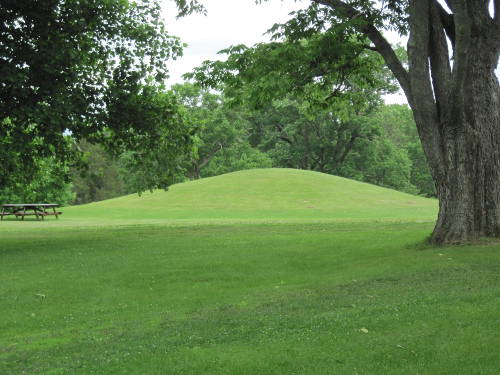
/|\ /|\ /|\
Image: Aerial shot of the Mound. All other images by me.
“In this year of celebration of the Golden Anniversary of the Order,” writes OBOD Chief Philip Carr-Gomm, “it seems fitting that we should turn our attention to celebration as a natural and spiritual response to the fundamental turning-points in life.” (Here, under the the listing for “17-21 September.”)
I’ll be posting over the next day or so from Santa Fe, NM, as part of an extended car trip around the U.S. Now we just have to get there — up and soon to be on Rt. 40 west from Amarillo, TX. Happy (approaching) solstice to all.
[Part 1 here]

Vikuklunomes!*
So it goes, so we go:
Uncircle! and the Elements flash and dance,
mingle, spin and dissolve, three, a dozen,
scores, just one, an alchemy gods conceive,
humans guess at — join, sometimes —
give birth to, even:
waterfall of fire, tower of wind,
burn of dust that is our bones in us
dancing too. Can’t help it.
In the center
spirit rests, while power
loosed like a bird from its long cage
circles on wings that feather our faces,
flies off to its home, still roosting
in our hearts, eaves of thought,
door to tomorrow, hearth of dreaming.
/|\ /|\ /|\
Image: Druid Order of London; Cadet Chapel Falcon Circle at the Air Force Academy.
These images accompany two very different articles (here and here), worth reading, which sample some of the work still to be done for spiritual and religious freedom and more informed understanding. (Oh my brothers and sisters, this is my prayer; may we learn to take wing and fly free of fear.)
*vikuklunomes: [vee-koo-kloo-NOH-mehs] vi- “reversing prefix” + kukl- “circle, wheel” + -un- “become” + -omes “first person plural– we/let’s”; a verb in Dingva, one of my conlangs (constructed languages) based on Proto-Indo-European. Noun form: vikukluna [vee-koo-KLOO-nah] “uncircling, unforming a circle.” An incomplete and older version of Dingva appears here.
[Related posts: Shinto & Shrine Druidry 1 | 2 | 3 || Shinto — Way of the Gods || Renewing the Shrine 1 | 2 || Boku no Shinto — My Shinto 1 | 2 ]
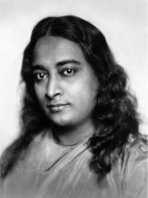
Paramahamsa Yogananda
“Its technique will be your guru.” With these words (ch. 11 of his famous Autobiography, online here), a young Paramahansa Yogananda (1893-1952), founder of Self-Realization Fellowship (SRF) and a principal exponent of Kriya Yoga in the West, counsels a peer he has just initiated into the tradition he follows himself. With these words he also points toward a kind of spiritual path that Westerners, rightly wary of super-sized personalities and god-realized con-men, can approach and walk. A flexible and potent technique can be a trustworthy, profound and endlessly patient guide.
Technique as guru: as a practitioner of OBOD Druidry and Eckankar, I know firsthand that a technique responds to practice and devotion as much as any teacher. Religious and spiritual practice will always be as much art as science, because they welcome (and can profoundly benefit from) our subjectivity, even as they also point to their scientific aspect — definite and repeatable results we can achieve from dedication and regular practice. My emotions, my commitment, my ambition and drive, my struggles and dreams can all contribute to my practice — leaven it and enrich it and make it “mine.”

“other” as double: both of us angry at each other
My anger at the driver who cut me off in traffic last week, on my way back from dropping my wife off to stay with her cousin, can help me uncover other unexplored pools of anger I can work to identify, learn from, and transform. Anger by itself need not be bad, only unconscious anger, anger I act from unthinkingly, little different from a live wire I brush against in the dark, unintentionally — or attach to a light fixture and illuminate another step along the way. Without the experience of anger, I might well miss the wire altogether, and forfeit a chance at illumination.
I can, if I listen, come to see that my whole life is laboratory — not only what I close the door on at 4:00 or 5:00 pm each weekday and return home from. The individualistic-narcissistic-tending “MY spirituality” gets whittled down to more beneficial size through ongoing spiritual practice. And paradoxically reveals a personalized curriculum tailored to me, right now and here. Anger? Yup — that’s on my curriculum, though it may not be on yours. And my life is ideally set up to help me work with precisely that curriculum point, just as yours is for your distinct points. Yes — we share a “common core,” too.
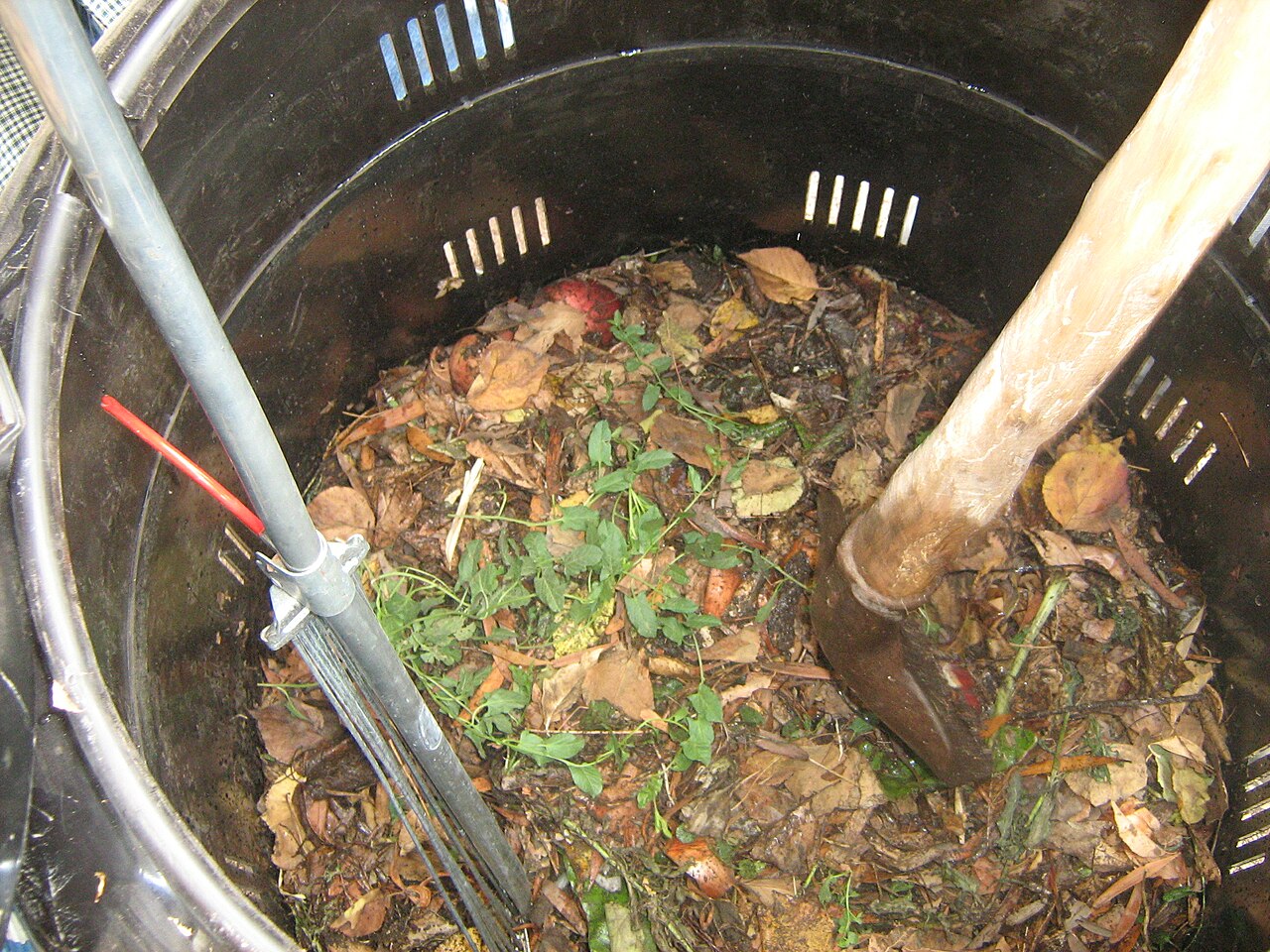
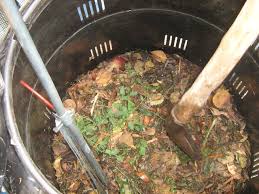
compost: just another point along a transition
A practice like Druidry that places me in the natural world immediately begins to slim down ego in concrete ways and immediately accessible ways: merely walk out the door, and at once it’s clear I’m not the center, nor even the “most important” thing in the universe. I constantly meet the “spirit other”: animals, birds, trees, and beings without skin on — or bark, or fur, or scales. I am a paragraph in a chapter, not the whole story. And that’s a good thing, because the world is guru, too. Hard limits of some kind are the only way a world can work (try seriously to imagine one without them), but if I engage them wisely, they build spiritual strength rather than frustration, nihilism and despair. This physical body is eventual compost, like everything else: but not yet. And this interval is all. (Whether it is also “only” is an experiential question, one which only experience can accurately answer, not some dogma to be believed or rejected.)
“My Shinto,” my Way of the Spiritual Order of Things — let’s call it WOTSOOT — begins with the circumstances of my life today. Here I am, a 55 year-old white male, a teacher, a cancer survivor, married, nearsighted, in fair health. The initial details of your personal WOTSOOT naturally vary less or more from mine. They’re also often quite superficial — party chitchat, gossip in my cul-de-sac. Because I am also a point and vector of conscious energy situated in widening networks of energy exchange. I breathe, and chlorophyll all around me gets inputs it needs. Bacteria on my skin and in my gut flourish, and help me flourish too, if I stay alert to their balance. I sweat and crap and piss, and nutrients move where other beings can begin to use them. I consume some of these other beings — not too many, if the system is to remain in equilibrium — just as some them will consume me. New networks arise, as older ones shift or die. And part of my practice is: all praise* to the WOTSOOT!
Such processes of the physical realm are both fairly well understood and all too rarely incorporated into larger networks that spiritual teachings of all kinds tell us glow and ripple and transform and pervade the universe. Scientific insight begins to catch up here and there with spiritual wisdom. Not dogma, not theology, not creeds — that’s merely paparazzi spirituality — but insights into living networks — the shin-to, the “spirit-way.” As I write and you eventually read this, we use an electronic network we’ve crafted that simulates in surprising ways organically occurring ones, and we can acknowledge the remarkable power and potential of such interactive patterns of energy and information flow as analogs to the ones we are born into.
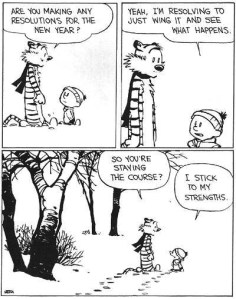
One valuable key to working with the WOTSOOT that I keep reminding myself of is “small steps. ” This works both as a starting point and a successful process, too. Any attempt at change, on any level, meets what we experience as resistance, because of inertia and equilibrium implicit in networks. (Otherwise, without inertia or resistance, they’d never have a chance to grow and develop at all, shifting and falling apart at the least push or pull from outside. They wouldn’t become “things,” which are semi-lasting whorls and eddies in the flow of WOTSOOT.)
We all have heard that “If it works, don’t fix it,” which is fine, except that a corresponding inherent tendency toward change means that even as it’s working, it’s also changing, or accumulating energy toward change. Often the changes are small, and if we model ourselves on this larger pattern, our small changes will accord with the flow around us. (Small ongoing changes help us avoid really disabling larger ones, that can manage to accumulate a staggering wallop of energy if we don’t make those smaller changes.)
“Change your life,” counsels your friendly neighborhood deity of choice. Okay: but do it in manageable chunks, unless a cataclysm conveniently presents itself to you, ready-made. I have a profoundly messy office right now: too much for a single day of cleaning, without a herculean effort. Sometimes I can muster one. But one box today, one shelf tomorrow? That I can manage most days. Thus both my spiritual paths exhort me to daily practice. (With two paths, as long as I get in at one least set of practices, I’m usually ahead of the game. I double my options — and find overlaps and interweave and insight from such doubled options — the paths are no longer nearly so separate, but feed each other and me.)

our local VT electrical utility
In concrete terms of just one network, in one person’s life? — Let’s choose the physical for convenience, since we’ve established and can understand a set of fairly common labels like physical measures. My wife and I have reduced our “garbage” to an average of 8 pounds a week — mostly non-biodegradable packaging and other non-compostables at this point — and I’m working to bring it down from there. (Why? Throw it “away”? Nothing goes “away” — it always ends up somewhere, and the nastier it is, the deeper it usually sinks its fangs in my butt when it returns. Part of my practice, then, is shrinking my “away” — out of pure self-interest, mind you!) Everything else we’re able to compost or recycle, thanks to recycling options in our region of southern Vermont. We continue to tweak our car and woodstove emissions by wise use, insulation, consolidation of trips, carpooling, etc. Infrastructure shifts will eventually impact these, as mass transit improves and efficiencies increase, or whole modes (like petroleum-sourced energy) eventually fall out of use. Only this February 2014, out of the past 24 months, did we use more electricity than our solar panels generated, so we’re in the black there. But a chunk of that comes from liberal surplus buy-back subsidies from GMP, our local electrical utility company.
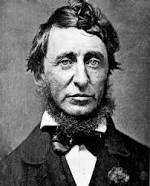
Cap’n Henry T.
All told, apart from property taxes, our annual shelter costs run roughly $600 — for firewood. I mention all this as evidence for one person’s start at working with one network among many — by no means an endpoint, nor a claim for any kind of praise or desire for virtue** or self-satisfaction. It’s part of practice, a point along a continuum, remembering my practice is both a “what to live for,” and also a “how to live” at all. And again I repeat: your practice, because you are you, necessarily differs. As H. D. Thoreau observes, “I desire that there may be as many different persons in the world as possible; but I would have each one be very careful to find out and pursue his own way, and not his father’s or his mother’s or his neighbor’s instead.”
/|\ /|\ /|\
Images: Paramahansa Yogananda; that “other” driver; compost; Calvin and Hobbes resolution; Green Mountain Power; Thoreau.
*I don’t know about you, but I can feel gratitude without needing a target, a recipient or respondent: a magnificent cloudy sky or bright flash of plumage or swirling blizzard evokes awe and gratitude I love to express. Do I need to say I’m grateful to Anyone? Can’t I simply be grateful for? Of course! Gratitude feels good. Why deny myself such pleasure? There’s a motivation if you need it: practice gratitude out of selfishness, because it makes you feel good, if for no other reason! Or if I choose to thank a spirit or Spirit, that in no way detracts from my gratitude. A target for it is another kind of pleasure I choose not to deny myself.
**Except for virtue in the older sense of “strength” or “power.” This kind of “original virtue” is literally “manliness” — what a vir “man” ideally accomplishes that makes him worthy to be called vir — to de-gender it, “what humans do at their best.” And what’s “best”? That which accords with the Way, the Tao or pattern of the universe.
Updated: 7 July 2014

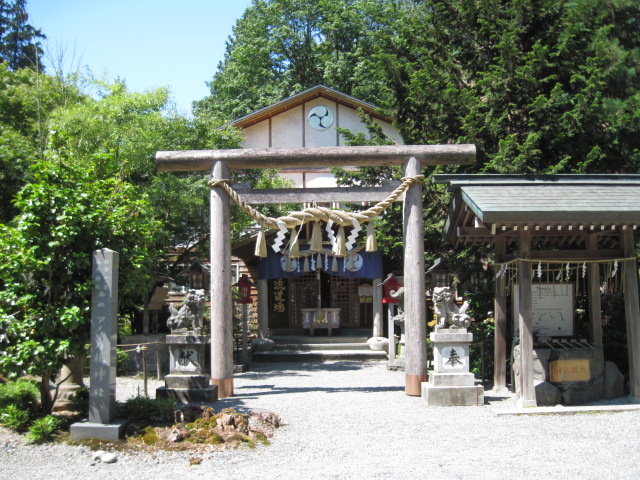 I’ve mentioned Shinto and Tsubaki Grand Shrine before in these pages — a lovely shrine in Granite Falls, WA, about an hour north-northeast of Seattle. Recently during our car tour that included the Pacific Northwest, my wife and I “made omairi” or paid a visit on a sunny July day. The idiom “pay” is illuminating: some kinds of visits can be the fulfillment of a religious vow, a pilgrimage we dedicate to a spirit or an ideal — acts, in other words, performed at least potentially in fuller consciousness than usual. True, “the bow can’t always be bent,” as the old occult proverb goes; we “have to live in the real world,” as my mother used to admonish me. But you quickly find that cultivating regular times of intention and focus brings spiritual advantages just as it does other kinds of advantage in other aspects of life.
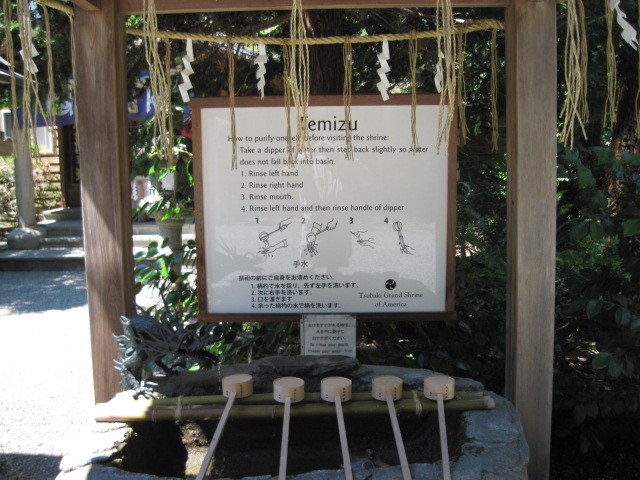 Tsubaki finds a working balance in explaining just enough about itself and about Shinto to the visitor who may know little about either. Shrines express unique and individual presences, and Tsubaki is no different. We can argue till the cows come home and make their own butter whether such distinctiveness comes from human intention solely, or from a happy cooperation of human and divine. What remains is the shrine itself, beyond mere debate: a place to visit, breathe, absorb, reflect on, and if you feel called to do so, revere and commune.
 Of course, a shrine need not always explain. Tsubaki, like so much of Shinto, also demonstrates the value of silence in fostering encounters with the natural world. They are not separate things; the human is part of the world of the kami, of spirit.























 A Druid Way