Someone called Samhain that in passing — “Great Hallows” — and it’s fitting.
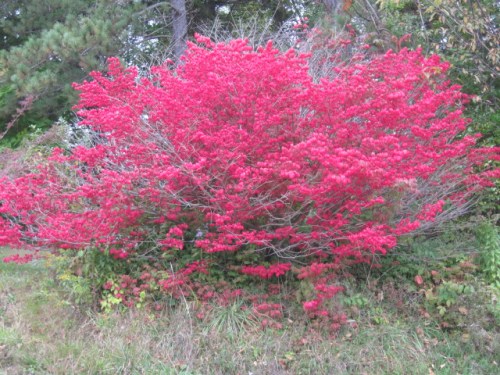
No, you don’t have to enter. But entrances await you, in sleep and waking, in the thought and feeling of a moment, in the earth around you, to leave the daylight world. The season itself recalls you: the cooling earth, that nip in the air, scent of dead leaves and woodsmoke, bursts of color around the next turn that linger in the eye.
Not kings or nobles but shepherds know the hallowed times, like this turn of days towards the greater dark. In TheWinter’s Tale the Shepherd says to the Clown (always a liminal, transitional figure in Shakespeare) “You met with dying things, I with things newborn.” That’s what I meet each Samhain season, both death and life. This is a Great Hallow, a tide of exchange between worlds. Not the tide of equinox, of balance, but what comes after the rebalancing.
Hallow: a word almost lost, a thing changing shape and name, a Samhain sign in itself.
Passage. That’s what Samhain offers, means of passage between the two realms. A holy occasion. Like so many holy things, misunderstood, feared, slandered. But most unfortunate of all? Ignored.
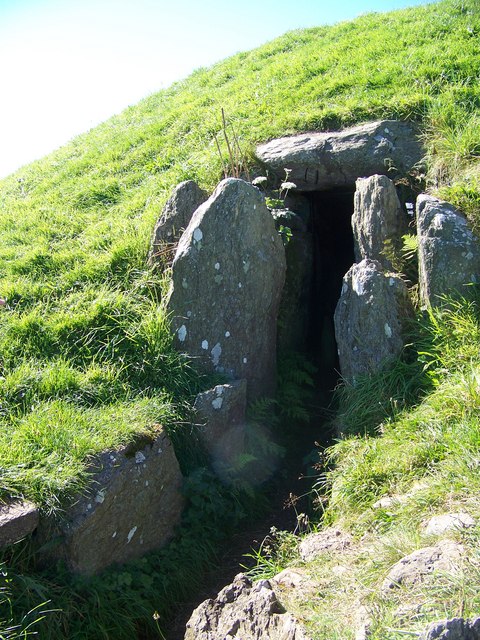
So I look at this image for just a moment, that gulp of time that’s all I need to jump-start wonder all over again. And I summon this liminal place within me, where all places also lie: Bryn Celli Ddu, the “Mound in the Dark Grove,” stand in for each of us and our own mythic image of the Place of Spiritual Exchange. (Here the Dead journey among us, looking for the same thing.)
We — all of us — have hallowed something all year long. Time to recognize it on All Hallows’ Eve.
What is dead, and what lives, in my life? How do they nourish and reflect and illumine each other? What Samhain question is my life asking me today and all this month?
Here at “summer’s end,” which is a good approximation of what Samhain* means, I listen. A full time job, that — all these voices now, as one cycle nears completion and the second takes its birth. Then the greater stillness of Winter, and its own energies and lessons.
(I love how ddu “dark” [approx. “thoo”] in Welsh has that shape and spelling after a feminine noun like celli “hill,” that double dd, following the rules of sound and spelling change that run counter to English habit. Words as wands of transformation for the tongue.)
*irish Samhain, Scottish Gaelic Samhuinne, both from Proto Celtic *samonios. The Coligny calendar names a “three-night festival” trinoxtion samonii, in Gaulish, a older and now extinct relative of Irish and Scottish Gaelic: Gaulish samon “summer, Samhain.”
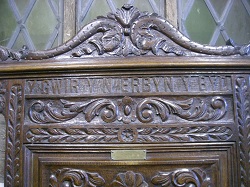
The Welsh proverb A gwir yn erbyn a byd — “the truth against the world” — hasn’t lost any of its force. It still offers a challenge, read one way; and a simple statement about the nature of things, read another. Or maybe they’re the same thing.
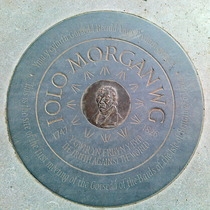
The words appear on a chair in the Welsh parliament house in Machynlleth. The chair itself is fairly recent, the words traceable at least to Iolo Morganwg and the first Gorsedd of the Bards in the 1790s.
This relatively modern chair may serve us as an apt stand-in for the Siege Perilous, the “Perilous Seat” of Arthurian lore. In the old story as Malory retells it in his Morte D’Arthur,” He shall be born that shall sit there in that siege perilous, and he shall win the Sangreal.” Looking beyond pronoun gender, if you have no truth in you that you will maintain in spite of the world’s ways, don’t even think about sitting there. Better than the Hogwarts Sorting Hat, the Chair puts you where you deserve, weeding out the unworthy with death.
What truth, you ask? In each moment I can assert the possibility of spiritual integrity in each person I meet, while striving to manifest it first in myself.
I can’t wait for the other guy. “You first”? If we all do that, who will ever grow? We see around us the eyes of the spiritually dead. (Some days we join them.) The sad conclusions they’ve come to, in the face of suffering and setbacks, have no life in them. They’ve bowed out and accepted a living death. They (we) are the wounded kings and queens of our present-day Wasteland.
In times like this, spiritual integrity can mean living with intention, living counter to the prevailing mood of pessimism and despair. But more importantly, counter to living without any intention at all. You know, the home-from-work, plop down in front of the TV or computer and insta-drug. Waiting to be entertained (is that so bad?), to be led, to be fed, to be used for another’s purposes because we have none of our own. Well, maybe it isso bad.
So I nip in, trailing some accidental courage, and I lay bait for truth, only half-conscious of what I’m doing. Some days that’s the only way I end up getting any. “Gonna get some” has prodigiously awful overtones these days, but I’ll apply it to truth instead. And having baited the truth, maybe even bravely, for a moment or two, my boldness gives out and I turn tail, racing back to my hole and waiting for events. For a change. For something to happen. Almost (I whisper it) anything but this.
And there’s the actual peril for most us, if we brush against our own version of the Siege Perilous. We already all know it firsthand, and Churchill put it into words: “Men occasionally stumble over the truth, but most of them pick themselves up and hurry off as if nothing ever happened.” Even Perilous Seats turn out to disappoint. Nothing happens. Except …
OBOD Druid rituals include in their opening the words “Let us begin by giving peace to the quarters, for without peace can no work be.”
Well, that decides it, then. No work can be, I mutter to myself. We’ve witnessed the efforts towards peace and justice, how each must be founded on the other. Hard work.
The Welsh ritual asks “A oes heddwch?” Is there peace?
The ritual answer is yes. Ritual can after all prefigure reality, open a door to its happening. It IS reality, on another plane, one we may wish to echo and emulate here. Or is peace a possession solely of some Otherworld, never to make its way here? Always a grail that’s over there, not here? “Grail on a shelf.” Good luck with that, shouts a chorus of wannabe truth-speakers.
The Galilean Master said to his devotees, “Peace I leave with you; my peace I give you. I do not give to you as the world gives. Do not let your hearts be troubled, and do not be afraid.” Following the example of the Wise of many lands, we too can learn to give, and not as the world gives, but as our inner truth leads us.
Can there be peace if we each insist on our own truths against the world — against each other’s? Isn’t that in fact the origin of so many conflicts? Especially in America, with everyone shouting “It’s my right!” and no one saying “It’s my responsibility.”
Peace within us doesn’t preclude needful action. It does lay the ground for clarity and compassion out of which all true transformation grows.
And for me that’s a foundational truth I’ve had to learn the hard way. Many others would like to change me to fit their views of the world. The harder and more worthwhile challenge is to change myself to fit my view of the world. If I can’t manage to do that, why expect anyone else to? Or turning it outward, ask me to change in your way only when you can show me you’ve changed. Otherwise, I have my own changes to work on. That cuts down mightily on truths in conflict. And it keeps us all busy failing our way to success, says my inner cynic.
The Welsh ritual:
Y gwir yn erbyn y byd, a oes heddwch? The truth against the world, is there peace? Calon wrth galon, a oes heddwch? Heart to heart, is there peace? Gwaedd uwch adwaedd, a oes heddwch? Shout above responding shout, is there peace?
One good example outweighs a lot of words. (Some questions need to be asked, some answers given, three times so we can hear them.) But once we have the example, then the words draw energy from it, and carry some of that truth that runs “against the world” and toward spiritual integrity and harmony. Words are empty only when hearts are. Full heart, full words.
It’s the fate of too many worthy people to receive attention at their deaths that would have served everyone better had it flourished while they were still alive. Fortunately, this needn’t be the case with Bill Mollison, father of the permaculture movement, simply because his ideas most definitely live on after his passing.
I’ll confess upfront: I know only a little about Mollison and permaculture. So let’s allow him to speak for himself, as he amply can. You can read a transcript here of a 2005 interview with Mollison that appeared in Green Living magazine. There Scott London, the interviewer, summarizes Mollison’s achievement quite succinctly in a short introduction:
Permaculture — from permanent and agriculture — is an integrated design philosophy that encompasses gardening, architecture, horticulture, ecology, even money management and community design. The basic approach is to create sustainable systems that provide for their own needs and recycle their waste.
Mollison developed permaculture after spending decades in the rainforests and deserts of Australia studying ecosystems. He observed that plants naturally group themselves in mutually beneficial communities. He used this idea to develop a different approach to agriculture and community design, one that seeks to place the right elements together so they sustain and support each other.
Mollison’s sensibilities and actions have won him many fans among Druid-y types. (For a splendid Druid blog and blogger walking the talk, which you might enjoy if you don’t already know of it and her, visit The Druid’s Garden.)
Still largely unknown outside of his native Australia, Mollison’s ideas have impacted agricultural practices. As London notes:
Scott London: A reviewer once described your teachings as “seditious.”
Bill Mollison: Yes, it was very perceptive. I teach self-reliance, the world’s most subversive practice. I teach people how to grow their own food, which is shockingly subversive. So, yes, it’s seditious. But it’s peaceful sedition.
So many bellwethers, prophets, forerunners we’ve ignored to our cost. For as Mollison notes in the course of the interview,
In the early 1970s, it dawned on me that no one had ever applied design to agriculture. When I realized it, the hairs went up on the back of my neck. It was so strange. We’d had agriculture for 7,000 years, and we’d been losing for 7,000 years — everything was turning into desert. So I wondered, can we build systems that obey ecological principles? We know what they are, we just never apply them. Ecologists never apply good ecology to their gardens. Architects never understand the transmission of heat in buildings. And physicists live in houses with demented energy systems. It’s curious that we never apply what we know to how we actually live.
Applying what we know to how we live: if we seek a clear life goal, a sane and humane practice, and a justification and outline for a spiritual path, that’s an excellent place to start.
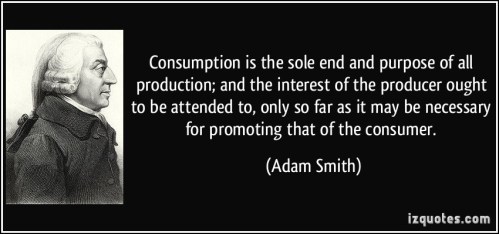
For an instructive contrast (to say no more right now), consider the words of Adam Smith (1723-1790), which might well have appeared just yesterday, unchanged, in the Times or Guardian or Wall Street Journal:
Now this proves very useful advice, I’ve found. All the materialist skepticism to the contrary, imagination springs from an inward compost and leaf-mold, yes, and also a vital, creative capacity we all possess as our human birthright. Even those of us who’ve tried to cast it away, if only because to nourish dream and hope can hurt much more than indulgence in flat despair. That means almost all of us. Maybe our singers and poets and wild-eyed prophets number among those who simply can’t forget any longer.*
And some of the Wise will tell you that imagination is the astral sight: we see by other means than merely light rays reaching the retina and dashing up neurons to the brain. Light everywhere has its place, but physical light does not account for those familiar or haunting landscapes we’ve never visited, companionable (or challenging) beings we have never met, and so on. Or indeed, landscapes and beings we have met before. Just not here.
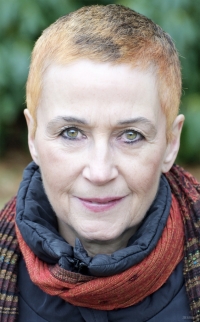
And Hussey’s Ecobardic Manifesto asserts, among its other points, both the return of and our singular need for “the prophetic vocation to look into the inner truth of things and speak, on behalf of the community, what need[s] to be spoken.”
But do we even want to hear “what needs to be spoken”? And if we opt to listen, how do we distinguish this needful message in the midst of the clamor and noise of all the other increasingly hysterical voices around us?
Small steps. I keep returning to this most helpful strategy. Our own practice of silence is a beginning (and advanced) step that helps with discernment of an inner truth we each know for ourselves, if we listen. If we can’t discern it, we can imagine it. Finding a still point beyond the mind chatter. Walk along a quiet sidewalk with trees, find a park, a quiet corner of your apartment or condo or neighborhood. Stillness as practice.
Focus or mantra or prayer. For Christians, scripture like “Be still and know that I am God” makes a powerful start. Pagans have an equivalent range of seed-verses and prayer-songs.
Sometimes the name of deity, or a suitable word like awen or om or amen.
Song or chant in a language you don’t know, to take you out of your talking head (and anybody else’s, too).
Symbol or mandala or image, for those who prefer the non-verbal. Cross, triskele, star, Platonic form, face of a beloved.
Counting your breaths.
Worship kinetically: pick up colorful leaves, play in the mud, lie on your back and watch the clouds. The skills we practiced effortlessly as children have not abandoned us, though we may have “put away childish things” as we raced off to concern ourselves with “matters of importance” and the wide word of adult stress and doubt and angst.
Substances used reverently, like various smudges and smoking herbs, fermented drinks, and so on, have featured in worship and ritual and self-care for millennia.
More important than what I do is doing it often enough that it becomes for me a spiritual practice.
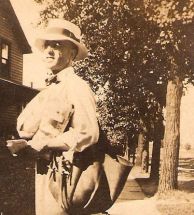
I cannot remember the paternal grandfather I was named for: he died 14 years before I was born. All I have of him are three yellowing photos and a handful of stories. But I imagine him when I honor my ancestors of blood and spirit, and he’s more alive to me as a result. A link, however tenuous, that I (and he, from his side) can strengthen at will.
One of the OBOD Bardic practices is the inner sacred grove. So what kind of place will I make as a spiritual sanctuary for myself and any inner guide whose counsel I seek? I resort to this place to leave a symbol, a dream recalled I want to ponder, or to begin a poem, resolve a problem, express my gratitude, build an altar, light an inner flame, begin and end a ritual, recall during moments of challenge and joy. What I imagine can become as real as anything I build with lumber and mortar, nails and plaster and insulation. (And the grass there doesn’t need weekly mowing. Though the trees, oak and birch, rowan and ash among them, are growing well.)
Imagine, and I remember.
/|\ /|\ /|\
IMAGES: Charlotte Hussey; D W Easton, circa 1925, on his mail route in Niagara Falls, NY.
*”I think we’re living in a culture that’s so demanding: You never feel like you’re good enough. It wears people down. People are exhausted at the end of the day. They go home and have a drink as a way to cope with all of this—a lot of people have to self-medicate because it would be hard for them to look in the mirror otherwise. The whole concept of being conscious—that’s hard work. A lot of people just don’t want to sign up for it.” “Alcohol as an Escape from Perfection.” Atlantic, 10/13, accessed 10/4/16.
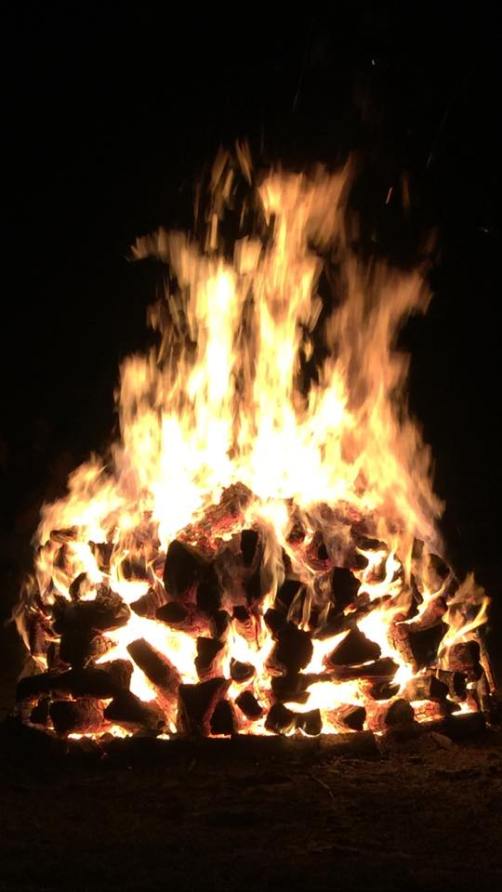
Over the last several cold damp nights and cool partly cloudy days here in New England, many of us who heat with wood have lit the first fires of autumn. (Some days building and feeding a fire is the best theology I can muster.)
More than one Vermont Druid I know makes it an autumn ritual, invoking Brighid and celebrating the turning of the year in this private, immediately practical and also beautifully symbolic way. Way more fun than turning up a thermostat. You celebrate starting from where you are and what you’re doing. Where else, after all, can I begin?
Stay alert, I tell myself. This can be one of the times Druidry demonstrates its wonder and power and joy. We don’t always need the big ritual circles and dords* sounding their ancient welcomes, though these, too, can be apt and lovely. Sometimes, though, the best Druidry for the moment is pocket-sized.
Pocket Druidry. At last year’s East Coast Gathering, Kris Hughes led a workshop demonstrating another form of it. In the early days of Revival Druidry, the Welsh poet and Druid Iolo Morganwg conceived a literal pocket Druidry, constructing a ritual circle for a gathering of friends on the Summer Solstice of 1792, out of stones drawn from his pocket.
World in your hand, circle in your pocket. Our lives, especially in the last century or so, seem to repeat a pattern: demonstrate our immense power to shape and re-create the world, then withdraw, standing back in dismay and doubt when it doesn’t turn out as we hoped. We’re still practicing, still in the elementary grades, with all the meanings that suggests. Learning to use the elements at hand, still in the early stages.
With the love of triads and threes that marks so much of Celtic art and story, it’s no surprise that the Celtic conception of our spiritual journeys should mirror this same triplicity. From the starting point of Annwn, the Celtic Otherworld, we move forth and back through three states of manifestation and consciousness, in a kind of dance that sees us revisiting old lessons until we’ve fully mastered the material, spiralling through different forms and perspectives.
Most of us hang out for a considerable time in this present world of Abred, this place of testing and proving. From here we proceed to Gwynfyd, a world of liberty and freedom beyond the pale shadows of these forces in our present world. Back and forth between Abred and Gwynfyd, with dips into Annwn here and there. And last comes Ceugant, an unbounded, infinite realm. By definition, no end point, but a new beginning. The horizon recedes.
Morganwg’s compilation Barddas (section 227) explains this cosmology through a kind of Druidic catechism of question and answer. I’ve modernized some of the archaic language in the following excerpt:
Q. What were you before you became human in the circle of Abred?
A. I was in Annwn, the least possible thing capable of life, and the nearest possible to absolute death, and I came in every form, and through every form capable of a body and life, to the state of human in the circle of Abred, where my condition was severe and grievous during the age of ages, ever since I was parted in Annwn from the dead.
Q. Through how many forms have you come?
A. Through every form capable of life, in water, in earth, and in air.
As the Beatles sing it, “It’s a long and winding road …”
One of my teachers notes that human beings recently refused a chance to rise to the next level of awareness by accepting responsibility for themselves and their actions. Some days it feels like we’re throwing tantrums because we didn’t get what we thought we wanted. Rather than awareness, we default to outrage.
In the circle we’re presently in, we refuse to accept cause and effect, continuing to live on a merely emotional, reactive level, without fuller consciousness, at least very often. We’ll readily respond to the energy tides sweeping around us, and contribute to them willingly, but deny that any of them has longer-term effects we need to weigh before leaping in, or that we always have a choice. But that’s how I feel, we say. Yes. So now own it, and go from there, counsel our guides and sages. Maybe not by diving immediately into the very next feeling that presents itself just because it knocks at the door of consciousness.
Ask why? Ask who benefits? Ask how do I live from a place of honor?
Don’t think, say our advertisers and politicians and insta-gurus galore. Don’t think. React!
Seedtime and harvest, whispers the wisdom of the earth.
The glory and wonder and marvel of it all, in the face of the sufferings we keep bringing on ourselves and each other, are the possibilities of joy unbounded that we glimpse too rarely — that view through the window, over the next hill, in a day- or night-dream, which nevertheless keep us going in spite of everything.
This — the Barddas counsels us — this is simply the way we get there. (If you find another and better way, please do let me know!) Through experiencing fully every possibility and option and choice, and living their consequences.
Less comforting that I was looking for, but a provocative insight, nonetheless. It goes remarkably far in explaining the predicaments (plural) we’re in. They’re the lesson at hand. The necessary lesson. Whatever comes, though, matters less than what we do with it. Especially with the sense of deja-vu that we’ve faced this all before. Wait, I say. Sometimes it feels like I’m still in somebody else’s lesson. Why do I have to sit in class waiting for them to get it?
For some, yes, the lesson’s familiar, a kind of review. Others need to go through the whole thing, maybe for the first time. They may never have encountered it before. But the final piece I know I’m still working on, the piece that keeps me here (I can’t speak for you), is that I have the choice to learn and show compassion. To serve. It’s not about me after all.
That’s all? I ask, grumbling or swearing, depending. Obviously I do need to be here, I say ruefully, a moment later, if only because I’ll need compassion from others soon enough, when a hard lesson comes my way. As it will, guaranteed.
Along with each lesson, that peculiar joy: This isn’t all there is. Keep going. Keep loving, in spite of all evidence to contrary. It’s human evidence, says the sage in the heart. You made it, you live it, you learn it, you move on.
And the goal? I ask. Ah, now. The big question. Your answer today is more important than anybody else’s. Because it will shape what you do next …
/|\ /|\ /|\
IMAGE: Brighid in her form as triple goddess of healing, smithcraft and fire.
*A Youtube video of a large dord being played — sounding remarkably like a didgeridoo.
“Some people don’t understand when I say these are the things I believe.”
So Damh the Bard sings in his lovely song “The Hills They Are Hollow.” But his song begins, “As I walk upon this green land, this land that I love …”
For me, that’s where Druidry starts, not in belief, but in love and experience of the natural world and the land we live on.
Belief may or may not come later, when doors that will not open to intellect alone open to love. And if you feel the land is sacred, then quite naturally you feel like singing about it: “Let’s sing of the mystery of Sacred Land …”
Recently a visitor to this blog pm’d me to comment on what he perceives as the need for a Druid theology. It’s easy enough to feel that way, surrounded as most Pagans and Druids are by a larger culture still shaped by a religion where creeds matter much more than they do in Druidry.
My correspondent acknowledges he’s a solitary, and such a path can indeed be lonely at times. Alone, I may confront myself more directly and disconcertingly. Alone, I face truths that can be uncomfortable, inconvenient — and profoundly useful to discovery, creativity and growth. Groups can conceal and divert us from the necessary work of the self.
Yet one of the benefits of experiencing group practice is the reminder of the energies we all encounter and work with (or ignore). Yes, we can experience them all in solitary practice, sometimes more personally, vitally and intensely than in a group. Alone, I can move at my own pace, honor and learn from and serve the beings who speak to me, focus on what is meaningful and what lives within and around me.
But attend a Druid group event and you’ll find one of the hallmarks of Druidry is a wide diversity of belief arising out of that practice and experience. Such belief is almost always secondary — important certainly, coloring experience and shaping behavior, influencing interactions with others, nourishing opinions, and clarifying decisions about future practice. Standing together in a circle with your Tribe, belief matters much less. No one asks for a recital of your beliefs as part of any ticket of admission, or denies you because you don’t “believe in” the Morrigan, or you believe that the universe is a berry carried in the mouth of a trout swimming in a much larger ocean. After all, there are days I don’t believe in myself.
We face the altar, feel the sun and wind on our faces, acknowledge the always-turning year, hear the ritual words, and encounter through all our senses the reality of a marvelous cosmos alive with presences, forces and powers anyone can experience.
Walt Whitman says in his Leaves of Grass,
Stop this day and night with me and you shall possess the origin of all poems,
You shall possess the good of the earth and sun, (there are millions of suns left,)
You shall no longer take things at second or third hand, nor look through the eyes of the dead, nor feed on the spectres in books,
You shall not look through my eyes either, nor take things from me,
You shall listen to all sides and filter them from your self.
Polytheists, animists, atheists, duotheists, monotheists, henotheists, eclectics, chaos magicians consciously selecting beliefs appropriate to their goals at the time — in the face of such variety, what can a Druidic theology say about belief in deity, the core of most credal religions — which Druidry clearly isn’t? What would such a theology achieve that Druidry doesn’t already have?
Yes, in the OBOD Alban Elfed ritual, we say the ritual words and recite the Druid’s prayer “which unites all Druids.” But from everything I’ve seen, the unity isn’t one of belief but of willingness to try out ritual for what it is and can be, to honor the sacred moment, and to hear the awen singing in its many forms. “Grant, O Spirit/Goddess/God/Holy Ones, your protection …”
“Why do we use the same ritual each year?” ask some of the regular attendees at the East Coast Gathering. Well, we do and we don’t. One common and shared autumn ritual during a weekend filled with name ceremonies, grade initiations, peace rituals, workshops, songs and the ritual of eating together with new and familiar people isn’t too much to ask.
Because it’s a ground form, a common experience for everyone, nothing too daunting for a first-time attendee, whether OBOD member or visitor, familiar to the experienced ritualist who can fine-tune the ritual pacing, catch the moment when a squadron of hawks soars above the Gathering, or a cloud of dragonflies visits the circle, or owls hoot in the woods. The wind lifts from the east at exactly the moment East is invoked, and everyone can share the connection.
My correspondent says, “Until we have a theology, I fear druidism will not be taken seriously by those outside of our thought … I do believe our fantasy perceptions need crushing and only a theological work can place [our Druidry] alongside other faiths on a level of reality.”
But is reality in fact one thing? Is an insistence on one reality — always somebody else’s, I notice, never mine — what we need now, or have ever needed? Do “the Fae dance on Midsummer’s Eve”? Perhaps we need more, not fewer, “fantasy perceptions” in a world where a large portion of people routinely cannot see the stars at night because of light pollution, where a Guardiancolumnist notes that our language mirrors our declining ability to notice and name the natural world:
The same summer I was on Lewis, a new edition of the Oxford Junior Dictionary published. A sharp-eyed reader noticed that there had been a culling of words concerning nature. Under pressure, Oxford University Press revealed a list of the entries it no longer felt to be relevant to a modern-day childhood. The deletions included acorn, adder, ash, beech, bluebell, buttercup, catkin, conker, cowslip, cygnet, dandelion, fern, hazel, heather, heron, ivy, kingfisher, lark, mistletoe, nectar, newt, otter, pasture and willow. The words taking their places in the new edition included attachment, block-graph, blog, broadband, bullet-point, celebrity, chatroom, committee, cut-and-paste, MP3 player and voice-mail. As I had been entranced by the language preserved in the prose-poem of the “Peat Glossary”, so I was dismayed by the language that had fallen (been pushed) from the dictionary. For blackberry, read Blackberry.
“One of the most striking characteristics of Druidism,” writes Philip Carr-Gomm, “is the degree to which it is free of dogma and any fixed set of beliefs or practices” (What Do Druids Believe? Granta Publications, 2006, pg. 25). “It honours the uniqueness of each individual’s spiritual needs. In this way it manages to offer a spiritual path and a way of being in the world that avoids many of the problems of intolerance and sectarianism that the established religions have encountered.”
And so I submit that it’s always good to know what you believe, as a way of doing what Carr-Gomm describes: honoring the unique form of your spirituality. Get it down in writing for yourself, grapple with it — and keep it on hand so you can revise it as your life takes you in unseen and unforeseeable directions. But never suppose it can serve you as a club to beat others “for not doing it my way” unless you want others to beat you with theirs.
Why let a belief-reaction, a secondary response to the primacy of experience, dominate my consciousness? No, thanks. Beliefs change. Any religion which rests on a credal foundation will always be rocked by a world that shifts beneath it, by words that will forever need updating as understanding changes, by a nagging sense that reality stubbornly persists in not conforming to belief. Rather than blaming Satan or some evil Other, Druidry looks at the world and strives to learn from it. Imperfectly, humbly, joyfully.
Are there beliefs that most Druids share? Sure. But more interesting to me are my own experiences and the conclusions I draw from them. Below I offer part of a previous post from some eight months ago as an approximation of my own theology, always subject to change without notice, as any honest theology should be. Here are six things I believe:
/|\ I believe that to be alive is a chance, if I take it, to be part of something vastly larger than my own body, emotions, and thoughts (or if I’ve learned any empathy, the bodies, emotions and thoughts of people I care about). These things have their place, but they are not all.
/|\ I believe this because when I pay attention to the plants and animals, air, sky, water and the whole wordless living environment in and around me, I am lifted out of the small circle of my personal concerns and into a deeper kinship I want to celebrate. I discover this sense of connection and relationship is itself celebration. Because of these experiences, I believe further that if I focus only on my own body, emotions, and thoughts, I’ve missed most of my life and its possibilities. Ecstasy is ec-stasis, “standing outside.” Ecstatic experiences lift us out of the narrowness of the life that advertisers tell us should be our sole focus and into a world of beauty and harmony and wisdom.
/|\ I believe likewise that the physicality of this world is something to learn deeply from. The most physical experiences we know, eating and hurting, being ill and making love, dying and being born, all root us in our bodies and focus our attention on now. They take us to wordless places where we know beyond language. Even to witness these things can be a great teacher.
/|\ I believe in other worlds than this one because, like all of us, I’ve been in them, in dream, reverie, imagination and memory, to name only a few altered states. I believe that our ability to live and love and die and return to many worlds is what keeps us sane, and that the truly insane are those who insist this world is the only one, that imagination is dangerous, metaphor is diabolical, dream is delusion, memory is mistaken, and love? — love, they tell us, is merely a matter of chemical responses.
/|\ I believe that humans, like all things, are souls and have bodies, not the other way around — that the whole universe is animate, that all things vibrate and pulse with energy, as science is just beginning to discover, and that we are (or can be) at home everywhere because we are a part of all that is.
/|\ I believe these things because human consciousness, like the human body, is marvelously equipped for living in this universe, because of all its amazing capacities that we can see working themselves out for bad and good in headlines and history. In art and music and literature, in the deceptions and clarities, cruelties and compassions we practice on ourselves and each other, we test and try out our power.
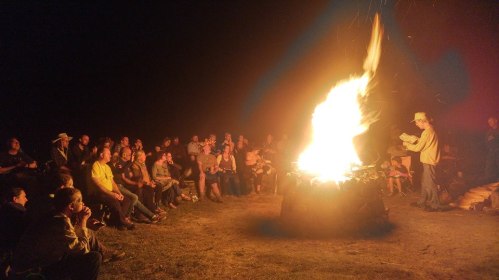
Here’s the poem* I read by the fire** at Saturday night’s eisteddfod at ECG ’16. I’m also submitting it to Touchstone so you may run across it there if it’s accepted.
/|\ /|\ /|\
Drinking with the Ancestors
This poem ain’t no teetotal ritual:
let’s raise each cup, now, individual,
every mug and glass fill up now
and start drinking with the Ancestors.
Chat ‘em up — don’t merely greet ‘em;
the Dead are chummy when you meet ’em.
This good liquor in your tummy
gets you thinking: toast the Ancestors!
By and with the spirits near us —
“Don’t invoke us if you fear us” —
good advice, if we lose focus,
glasses clinking with the Ancestors.
A few more rounds, more pints and glasses,
may find us falling on our asses.
We strive to heed old voices calling
though we’re blinking at the Ancestors.
Yes, when morning comes, perhaps uncertain
if we dreamed or drew some curtain
on a world where it truly seemed
that we were linking with our Ancestors,
good liquor works its own true magic,
so never blame it – downright tragic,
if “hung over” is what we name it:
feel like sinking toward the Ancestors?
They come in all shapes, and in all sizes:
some are heroes, some no prizes
(they’re like us in all our guises)
familiar patterns – star or rose
tattoos we’re inking for the Ancestors.
Listen: they are singing, they are cussing,
they can advise us if we’re sussing
out the paths our lives might take
or leave shivers in their wake
that have us shrinking from our Ancestors.
Before a soul decides to curse them,
mutter charms that will disperse them
foil their harms and then reverse them,
all these stinking, damned Ancestors!
(Ah, do please remember)
we’re their consequence, not moot –
we got their genetic seed and root,
and we’re the payoff, crown and fruit,
we’re their future, built to suit,
so cheers to drinking with our Ancestors!
/|\ /|\ /|\
*I’d drafted the piece at ECG ’12, with the title/last line echoing in my head all weekend, then revised it a few days before this year’s Gathering.
**Hex remarked when he posted the image, “You have the complete attention of a long horned fyre god here, and it is blessing you with its aura.”
The 7th OBODEast Coast Gathering (ECG) took place this last weekend with over 100 Druids, friends and family gathering at Camp Netimus in NE Pennsylvania. [Go here for accounts of previous Gatherings.]
Netimus, a girls’ summer camp, has welcomed us each autumn for Alban Elfed, the Autumn Equinox. The non-human staff of coyotes, hawks, dragonflies, chipmunks and owls lets us know they know we’re present, too, adding their own wild signatures to the rituals, the evening fire circles and the day and night-time hours.
Hex in his drumming workshop
This year we celebrated the turning of the year among ourselves, without the headline special guests that can make registration for the Gathering a matter of internet frenzy and growing wait-lists.
We initiated ten new Bards, two Ovates and two Druids into the Order, as well as holding workshops on fairies, crystal jewelry, drumming, moon wisdom and beekeeping, and gathering in the camp dining hall for meals our devoted kitchen crew volunteers prepare with love, laughter and long hours of hard work.
Each evening brings the fire circle, always a draw. And this year we organized a more competitive eisteddfod, showcasing our singers, storytellers, musicians, dancers, fire-spinners and mead-makers, culminating in a final round on Saturday.
photo courtesy Gabby Roberts
The Ovates gathered mugwort Saturday morning as we prepared our gift to the Tribe during the main Alban Elfed ritual Saturday afternoon. An invasive that can take over, mugwort nevertheless has healing properties, healthful in teas and soothing as a smoked herb, too (when it smells remarkably like pot!).
photo courtesy Krista Carter
Preparing for Ritual
photo courtesy Nadia Chauvet
A nearly full moon rose overhead each night, bathing the Gathering in light, and making the Camp paths and steps a little easier to navigate if, like me, you forgot all three nights to fetch your flashlight from your cabin before dark — needing a light to find your light!
photo courtesy Alec Mayer
The rain — thank you, Spirits of Place! — held off till shortly after the closing ritual Sunday morning.
/|\ /|\ /|\
The reason Camps like this happen at all is that enough people are willing to give of themselves. Rather than complain about what doesn’t happen to their own narrow liking, enough people contribute to what does.
And among the thanks, reminiscences and anecdotes that always leave us both smiling and teary during the final ritual, several comments stood out, like Frank’s. He thanked us for the opportunity to serve. Those people in our lives that we come to value the most are those who give without drama or ego display.
Our closing ritual talked of all four elements, including the humility of water, that takes whatever shape we ask. Alban Elfed, Light on the Water, is a festival of the West, of Water, of balance and change, the dynamic that Druids revere, and strive to navigate with all the grace and wisdom we can muster.
photo courtesy Alec Mayer
Thank you, everyone, two and four-footed, winged, scaled, legless, and unbodied, who made this ECG another splendid opportunity for the Tribe to gather and celebrate and grow.
The seasonal festivals may start to come upon you like the visits of old friends. You don’t need to be anything other than who you are for them, of course. Fat chance, anyway, of sustaining even a polite deception with someone who knows you this well. I can shove the unsorted laundry into a closet, ready the guest room with fresh sheets, maybe offer a vase of goldenrod and queen anne’s lace this time of year. Clear the top of a dresser or nightstand and set out a few found objects to share: quartz or shale or mica from a recent hike, driftwood from a stream or beach walk. Such gestures never go to waste. They welcome the guest and lift the mood of the host, if lifting is needed.
Sometimes it is. We felt a seasonal shift here in southern Vermont about a week ago, a subtle movement of energies and weather and light as they whisper together and ease us toward the equinox, the evocatively named Alban Elfed, “Light on the Water.” The birds knew it, too — maybe something in their song clued us in to pay attention in the first place.
Of course the linguist in me tries to quibble that neither word “actually means” light or water, but instead simply the quotidian equinox (of) autumn, but then rummaging around the OBOD website I’m caught up in wonder by Coifi’s observations in a lovely post:
This is the Feast of the Autumn Equinox. The Light of the Sun in the Wheel of the Year stands in the West, in the Place of balance between the Light and the Darkness. This is a time of the Great Tides. This is the Gateway of the Year.
This Feast is known by many names to many people, for the Truth is reflected from many mirrors. It has been celebrated as Alban Elfed and Harvest. Our ancestors called it by names long forgotten, and our children will call it by names as yet unconceived.
So it is that literal gets overtaken by the figurative, just as speech does by song. Or not overtaken, not exactly. Whether I let them or not, they start dancing, each bowing to the other. Here is one of the Earth’s truths that says listen. The ancestors gave it names, as do we with our Alban Elfed and Mabon and Harvest Home, and as will our descendants. Each will know it, both the waning light, and the promise of Return.
A further quibble that the festivals are “just modern inventions” dissolves when you can point to old stones and other markers: the earth, again, is a witness here. From the plains of Wiltshire with its over-famous Henge to a hilltop in southern Ohio with its Serpent Mound, the inhabitants of many lands have been drawn to find ways to mark off days and seasons with structures whose physical remains simultaneously hush and awaken the mind.
For “light on the water,” as it turns out to my now-placated left brain, is indeed apt, a festival that celebrates a brief balance of light and dark in the quarter of the ritual year that belongs to the west and to water. “Light on the water” brings with it a twilit mood, a sunset reminder of the reality of life on earth, both dark and bright.
For the whole planet, northern and southern hemispheres both, experiences a balance of light and dark before the days continue to shorten or lengthen, depending on where you stand. The time, friends, is a whole-planet festival. Come! Join in!
Moving and stacking the last of the firewood yesterday, I disturb a garter snake three times. Same snake, or three different snakes? It’s there, perhaps, to feed on the fat black crickets that have congregated in the same spaces between the logs and pop away each time I lift another piece and toss it into the wheelbarrow. Or maybe it seeks rough edges to begin another peel, an autumnal sloughing off of old skin.
The three-ness of its appearances alerts me. I’m ready to pause and straighten my back and consider. Small moment-in-passing for snake and human, but wordlessly the snake has gathered my attention. Most of my days offer small moments like this, choices about where I’ll spend my energies beyond the daily necessary. Enough of them working together can define a larger trajectory, a disposition. Right now, though, I’m just attending to 18 inches of trim liquid muscle embossed with muddy green and yellow stripes, breathing lightly and slowly enough I can barely detect a small set of lungs working.
Except for one or two counties in the north part of the state where you can still rouse a rattler or maybe a water moccassin, Vermont has no poisonous snakes, so I’m at my leisure to ponder this one, or these three, up close. They’re sluggish with cooler evenings now, though the temperature still rises most days to the 80s. It takes a toe to prod this one off its perch on a piece of wood, coils oozing into a flow of motion. Sometimes being legless looks like an excellent choice for a species to make. No flailing limbs, just the slim body looping effortlessly behind the head until the whole marvel has poured itself out of sight.
Please understand — I share the common primate reaction to snakes. We yield, often enough, to that little shiver of distaste. But each time snakes usually stop me long enough to examine that response, and if I’m fair to the experience and question it, I find I end up pairing it with something like amazement. Warm and furry, bright-eyed and responsive to human presence — that’s a no-brainer: we easily go soft and mushy, and can lay a good half of our reaction at the feet of Disney and a whole industry of cuteness. Snakes are more alien, wonderfully adapted to their niches in the world, but changed enough from the ubiquitous mammal design we instinctively prefer that they provoke that involuntary shiver. Add to that the touch of cool skin against warm, if you pick up a harmless one to handle, the feel of it like a plastic raincoat.
So, snake, I’ll use what you left for me and ask a question. What do I welcome, what do I fear to touch, out of all I may meet each day? I add a tentative beginning practice of snake-shifting, gliding legless through my choices and meetings and discoveries, to see and smell, taste and feel what is there. Then return and judge, if I must, all I want. But first, encounter.
In the end we all do what we’re told. (It’s a backstage conversation.) We just differ on who we listen to, who we decide to heed. The cicadas from central casting announce August outside my window, under this overcast summer sky on a day of rain, and I sit grappling with this post. Somehow they’ll work their way in, because I listen to practically everything. Bards most of all, because they’re such electric company. Each cicada-Bard croons a Lunasa song, turning and tumbling toward the Equinox now, the days shortening at both ends, darkness nibbling at the warm hands of summer.
Do we really do what we’re told, and follow a script handed to us backstage? “No rehearsal. You’re on in 10 seconds.” Then Pow! Birth! And going off-script means following another script, the one titled rebel or train-wreck, fool or genius, or what have you. What do we have? “What is written is written,” runs the Eastern proverb about fate. “What can I say?” quips Buffy the Vampire Slayer. “I flunked the written.” So many scripts to choose, rehearse, try out. When we read for “human,” how many other lines do we forget? “I am a stag of seven tines,” sings Amergin, “I am a wide flood on a plain, I am a wind on the deep waters …” Memory and imagination, the same, or inversions of each other.
When poet Mary Oliver gives Bardic advice, “Instructions for living a life. Pay attention. Be astonished. Tell about it,” I want to shout “But attention and astonishment are both luxuries!” And they are: ultimate, essential luxuries. Yes, Socrates said, “The unexamined life is not worth living.” Writing teacher Robert McKee turns it around: “The unlived life isn’t worth examining.” Ouch! Take it personally like I do (though quickly I blunt the edge by applying it to characters I’ve written, all those understudies and stand-ins for my life) — take it personally and you may turn another way, determined perhaps this time to swallow life whole. This life is brand-new, never seen before. Old games, true, but new blood.
Backstage I overhear someone whispering, “Worry about living first, and if necessary, leave the examining to somebody else.” Is that meant for me? “You’re on! Break a leg!” Is that meant for me, too?
Broken. Stuckness. Does it happen more to people who overthink their lives, who need to see where each footstep will land before they take a step? Those who strive to word a version of their lives acceptable for a blogpost?
“When I am stuck in the perfection cog,” remarks author Anna Solomon,
–as in, I am rewriting a sentence a million times over even though I’m in a first draft or, I am freaking out and can’t move forward because I am not sure how everything is going to fit together—I find it helpful to tell myself: You will fail.
A soul after my own heart! Failure: our solid stepping stone to success. Because who IS sure how everything is going to fit together?
I have this written on a Post-it note. It might sound discouraging, but I find it very liberating. The idea is that no matter what I do, the draft is going to be flawed, so I might as well just have at it. I also like to look at pictures I’ve taken of all the many drafts that go into my books as they become books, which helps me remember that so much of what I am writing now will later change. When I am aware that my work is not as brave or true as it needs to be, I like to look at a particular photograph of myself as a child. I am about eight, sitting on a daybed in cut-off shorts, with a book next to me. I’m looking at the camera with great confidence, and an utter lack of self-consciousness. This photograph reminds me of who I am at my essence, and frees me up to write more like her. —Anna Solomon, author of Leaving Lucy Pear (Viking, 2016), in a Poets and Writers article:
No rehearsal — it’s all draft, to mix metaphors. And You will fail. But once you do the draft, paradoxically, it becomes rehearsal, revision. Re-seeing. We will look again in astonishment, memory or return, mirroring the same thing, and marvel differently. Our recognition when another tells the tale, when others speak for us because they can, they live here too, they see and speak our hearts’ truth. We know, partly, because of them. They’re versions of us, dying and being born together.
“When death comes,” Mary Oliver says in the poem of the same name,
like the hungry bear in autumn;
when death comes and takes all the bright coins from his purse
to buy me, and snaps his purse shut …
when death comes
like an iceberg between the shoulder blades,
I want to step through the door full of curiosity, wondering:
what is it going to be like, that cottage of darkness?
Oh, Mark Twain gathers himself to answer. I hold my breath. Maybe it’s both like and unlike anything you imagine. Can we fear only what we dimly remember? “I do not fear death,” Twain says. “I had been dead for billions and billions of years before I was born, and had not suffered the slightest inconvenience from it.”
Lunasa thoughts. The autumn in the bones and blood, while the young are dancing. Mead around the fire. We’re both grasshopper and ant in the old fable, gathering and spending it all so profligately. Expecting a pattern, a plan, we’re told to ignore the man behind the curtain. Sometimes there’s neither curtain nor man. Other times, both man and curtain, but as we approach, the spaces between each thread and cell, between each corpuscle and moment, each atom, have grown so large we can fly through appearances, into mystery, into daydream. Great Mystery drops us into the blossom before it’s open, we sip nectar, drowsing at the calyx, the Chalice. Mystery listens as the bees hum around us, gathering pollen. Stored up sweetness for the next season. To know itself, Mystery gazes from everything we meet, we see it in each others’ eyes, so it can see itself.
Attention, says Mary Oliver, attention is the beginning of devotion.
The most valuable and life-changing practice of all, though,
says Philip Carr-Gomm in last week’s OBOD “Inspiration for Life,”
evolves gradually and simply as a different way of being in the world.
If you’re like me and many others, whatever practice you have does keep evolving. Sometimes in spite of your best efforts. A practice doesn’t sit still any more than we do — even if we want it to. “Can’t something stay the same in this too-rapidly changing world?” Apparently not. And it’s helpful to come to see that as a good thing.
From rearranging the objects and cloths on your altar(s) to wholesale changes in your beliefs and suspicions (that’s what I call things I suspect are true, the same way I suspect rabbits or deer of perpetrating the damage in our garden. I don’t need to believe it: I suspect it, even if I’d rather not), change will have its way with you. You get born, promoted, pregnant, dead, partnered, relocated to the other side of the country or the planet, chosen for a god’s obscure mission, or dropped off to sit in the intersection as traffic blasts by you on all sides, just a nose-length away.
Or nothing happens for so long you feel the universe drugged you and left you on a sand bar and swam away long before you woke up with the tide lapping at you toes.
But look back on the path you’ve taken, and both it and you are different. Our adolescent longings to blend in and be like everybody else often lost out to our adolescent longings to follow our hearts, unlike all the seemingly worn-out and spiritually comatose people around us. We don’t need to fear change. And I suspect this is true for you, if you’re reading this blog or others like it. Even the longing for transformation counts. It lies that deep in us that years or decades of resisting the call haven’t stamped it out.
Through working with Druid teachings and ceremonies, changes occur in our attitudes, feelings and behavior which enable us to live more and more frequently in alignment with our sense of purpose and meaning, and with an awareness of the inherent spirituality of all life.
I hope whatever your path, Druid or Christian or atheist or animist or Pastafarian, (and yes, those are the only choices the universe has available at the moment — check back later), you’re “more in alignment with your sense of purpose and meaning.” If not, there’s still the rest of today and all of tomorrow and on from there to make a small change. Then another. And another. Make them so small they’re trivially easy, impossible NOT to make. You know, the sort of changes that come about by accident, by whim, by the energies stirring at the moment you make your choice. Paper or plastic. For here or to go. Mild or hot. Black or with cream.
More than anything else, I’ve found that a series of very small changes becomes a powerful road to success. Instead of the daunting prospect of hours of culling my shelf-groaning hoard of books, I pick just one book a day to consider and then either reshelve or drop into the box for the upcoming library book sale. Tomorrow, it’s two, or maybe three. (I don’t want to overdo it!) If I’m feeling sluggish, I can still manage an initial five push-ups today, then six tomorrow, then seven. Back to five, then ten the day after that, just for the hell of it.
Or a single sentence in a new journal. Then another tomorrow. And so on. Don’t worry, you can tell yourself. You’re not really making any changes. You’re just ___ . Status quo. Move along. The Censor whose vested interest is you, same-as-always unchanged, won’t notice. Be a micro-rebel. Break the rules, but in the smallest of ways. You know you want to.
I get writing done this way during what otherwise is a nasty case of writer’s block. It’s still nasty, but it’s become an ally: surprisingly often I find that some of the best material comes when I work with the block. Compost it. Test it for hidden dragons or home-canned jars of now-brandied peaches from 2004. Sell bags of it on Craigslist at bargain prices. Set a timer for 5 minutes and write without stopping — anything that comes. So many times, in fact, that I’ve lost count: gold and gods along with the garbage.
This may sound simple, but the consequences of achieving, or of working towards this state are profound. We enter a beneficent cycle, in which the more we express the core values of Druidry, the more we find those reflected back to us in the events and relationships in our life.
“Entering a beneficent cycle” sounds lovely. And for those among us who flee shrieking at the intimidation of possible, actual success (“that’s for everybody else but me!” we tell ourselves), note that even just working toward the state is transformational. More good news for the professionally self-sabotaging among us. We open to change like a flower beginning to exhale its perfume. Changes that have already happened waft their fragrance over small things that actually work out. (Every life has them!) Then larger ones. Watch for them. A (Druid) study in itself.
Cue the 1998 film “Shakespeare in Love.” Henslowe, a theatre owner, is talking to Fennyman, his backer, who expects payment. For “the theatre business,” read “our lives”:
Philip Henslowe: Mr. Fennyman, allow me to explain about the theatre business. The natural condition is one of insurmountable obstacles on the road to imminent disaster.
Hugh Fennyman: So what do we do?
Philip Henslowe: Nothing. Strangely enough, it all turns out well.
Hugh Fennyman: How?
Philip Henslowe: I don’t know. It’s a mystery.
Or better, Mystery. And if we’re honest, Great Mystery, as many Native American tribes call it. Or if you need grim dark humor, as my mother used to say, “Worrying about specifics is pointless. Something else will happen to you that you couldn’t have imagined anyway, so don’t waste your energies.”
“As this way of being evolves it becomes possible to find those elusive qualities of serenity and happiness, and to be of service to others and the world around us.”
This, more and more I’ve come to see, is the heart of it. As a recipe both for easing the neuroses and stresses of Daily Life, and for accomplishing something for others that “makes us feel good about ourselves,” you can’t beat service.
Or as my teacher said, take the Frank Sinatra song “It had to be you” and change the lyrics: “It’s not about you” the Universe whispers to us constantly. Time to do something with that.
Surprisingly, once I get attention off myself and onto something worth doing, I’m serving.
Or to draw on the words of still another Bard, here’s Marge Piercy‘s poem “To Be of Use” which closes:
The work of the world is common as mud.
Botched, it smears the hands, crumbles to dust.
But the thing worth doing well done
has a shape that satisfies, clean and evident.
Greek amphoras for wine or oil,
Hopi vases that held corn, are put in museums
but you know they were made to be used.
The pitcher cries for water to carry
and a person for work that is real.
This “different way” Philip talks about at the top of this post isn’t something to convert to, or at least not suddenly. It “evolves gradually and simply.” But it isn’t a facile or glibly tossed off platitude like “do what you love — the money will follow.” Now that may still be good advice, but it’s not something to begin tomorrow without divine guidance or a fat inheritance. The key part, though, is to forget about monetizing the service at all.
Do something, my guide says. Do something you love right now.
Of course people aren’t “equal,” whether “created,” “evolved,” “born lucky,” “favored by the Fae” or anything else. We demonstrate this by almost every action we take, whatever we may say we believe. Whether it’s elections, classrooms, job reviews, dating, playing fields, friendships, family dynamics — the list goes on — one person’s clearly not equal to another. We have criteria, hopes and fears, standards, priorities, memories, expectations, goals, feelings, and values that we almost always take into account.
Even where we might expect equality to matter most, such as in matters of law, where we confuse equality with fairness or justice, we often argue our cases with claims of unique circumstances, histories, medical conditions and so on. We seek exceptions, work-arounds, concessions — because we feel fairness or justice requires it. The particulars and specifics of our lives and experience, talents and quirks and character, all those hallmarks of individual identity, really do matter.
But if we’re not “equal,” as I’m claiming here, what we all are is valuable, unique, and irreplaceable. Most versions of equality, far from helpfully “leveling the playing field,” begin by erasing the individual differences that define our unique value. Equality allows us to be lumped together in easily stereotyped groups. We become interchangeable, a homogenized mass. People start to generalize — “all ___ are ___ ” and when we do, we forget or ignore the value of individual identities. To consider just ethnic or racial terms, whether I’m “just another privileged white male” or “just another poor brown minority,” you can more easily write me off. I have no face, no personality, no distinct identity beyond my equality with everybody else in the category, the label pasted squarely on our foreheads. My unique birth, life and death don’t budge such pre-judgments, which is all that prejudice is, as long as they’re invisible.
[You know the story of the starfish? It’s made the rounds, but it still teaches. The version I’ve heard goes something like this: After a storm, one person encounters another on a beach. Driftwood and debris dot the sand, along with sea life stranded by the storm above the reach of the regular high tide. The second person is gently rescuing starfish and setting them back in the water. “Why bother?” asks the first person. “There are so many others that will die. You can’t save them all. How can it matter?” The other person pauses for a moment, with another wriggling starfish in hand, then sets it in the water. “It matters to this starfish.”]
So what does all this have to do with living on this green earth and loving it? Gardeners, for one, know firsthand: one patch of earth ain’t equal to another. Every location enjoys unique qualities of sun, wind, exposure, soil health, moisture, shade, nearby vegetation, bacteria, earthworms, insects, birds, animals and humans. Likewise for the seedlings, saplings, plantings, harvests, compost heaps, helpful and harmful beasts, bugs and spirits — none are merely “equal.” Or listen to that world just next door; the Morrigan is not Cernunnos. Brighid isn’t Kali. Christianity and Druidry aren’t “equally valid” — a meaningless assertion because of “equal,” not because of “valid.” Each helps catalyze a different life experience of the world. Both are needed. That’s why they’re here. But what good would they do if they were somehow “equal”? And what would that even mean?
The cosmos sweeps along, manifesting both equilibrium, often through relatively stable groups, and change, which appears frequently through the impact of individuals. It’s true that whole swaths of seemingly identical beings get tossed on the scrap heap all the time. A wildfire incinerates a mature forest, a flood washes away topsoil or drowns a lowland habitat. Severe frost or enduring drought destroys a whole ecosystem. Molds, rusts, viruses, spores and plagues decimate or erase innumerable species. Many more seeds and fingerlings, tadpoles and nestlings die than manage to survive. But let a first sapling rise in a meadow, and birds perch there, dropping new seeds that will change everything in a few years. The slightly altered DNA or behavior or adaptation of one or two individuals grants them increased advantages in a changed environment, and over time their line flourishes when others flounder.
Nothing is “equal.” In a cosmos both in love with and wholly indifferent to individuals, that is how we live at all — the ongoing surprise of the individual. Our uniqueness is our glory — and so is everyone and everything else’s. How to serve both these truths — not “equally” but lovingly — that’s a challenge you and I imperfectly explore all our days.
[A version of this post was originally published in Druid Magazine. How do we orient ourselves, and what guides and markers can we use? The things I write about are part of my own “Druid compass” — you probably have a similar set yourself. The article gets a little purple in its prose, but if you’re a regular here, you’re used to reading past that.]
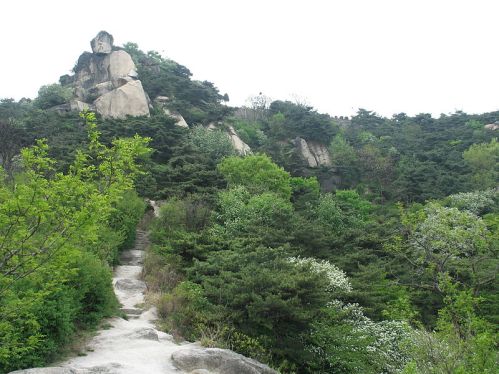
Inwangsan (photo by Gael Chardon)
Sometimes it takes another country to teach you lessons about your own. Five summers ago while I was teaching English for a busy month in Seoul, Korea, I encountered a local land spirit who showed me that this lovely country I was just beginning to discover was decidedly not my home.
It was about a week after I’d finally joined OBOD and requested the Bardic course. It was also my last weekend to explore Seoul and its environs before I flew back to the States to await that first of a series of welcome brown envelopes with the British postmarks of the OBOD course.
So on a foggy Sunday morning I made my way by train toward Inwangsan, a sacred mountain a handful of kilometers from my one-room apartment in Seoul, and then on foot into the mist. Outside Dingninmun Station and under the overcast sky, I managed to miss the tourist signs and markers , but the mountain loomed nearby, unmistakable, so I began my ascent off trail, figuring I’d intersect it higher up, near where a Buddhist and shamanic shrine coexist peacefully. Inwangsan is famous for its commanding views and granite cliffs. As for the view, I had little hope for on this gray day, but exposed granite slabs and outcroppings shone slick in the rain.
Forty-five minutes of climbing later, wet, muddy, and annoyed with myself, I paused to catch my breath. The fog had thickened, but the rising slope was still a reliable guide for the direction I wanted to go. I took a step, and –- how to describe it? –- up rose a wall of resistance in front of me. Something challenged me and barred my way from further ascent. At first I thought, stubborn and oblivious as I can be, that it was merely the tug of my own fatigue, but when I took another step it was clear this issued from something other than me. The hair on my arms stood up. Heart pounding, I apologized out loud, mumbled the few phrases of polite Korean I knew, turned around and slogged back down.
What was it? I rarely see anything inwardly in such situations, but impressions came this time as I made my way off the slopes. Something with multiple arms, big as a pickup truck, banded in stripes of dark and light, and determined to block me from advancing any further. I’ve not written about this till now, and just putting it into words makes the feel of it march again up and down my spine, vivid as if it happened this morning, a heavy ascent of wet earth, a tang of juniper and Asian pine and dead leaves. Yet I’d forgotten the mountain’s name, and the train station’s, too, and had to consult my journal from that summer. That as much as anything reminded me yet again (as if I need any further sign) of my “outlander” status there: I did not know the proper names for things.
/|\ /|\ /|\
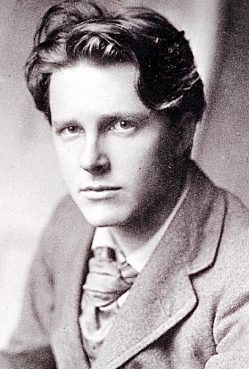
Rupert Brooke, 1887-1915
After British poet Rupert Brooke visited the Rocky Mountains some hundred years ago on a North American tour, he wrote: “There walk, as yet, no ghosts of lovers in Canadian lanes … it is possible, at a pinch, to do without gods. But one misses the dead” (Brooke, Letter XIII, “The Rockies”).
Brooke was young – it was just a few years before his untimely death at 27 – and he wrote with a young bard’s flip ignorance to cloak his discomfort with an unfamiliar country. For of course ghosts walk this continent, millennia of them. Brooke simply hadn’t yet listened closely enough. But new landscapes often strike us that way. A Chinese proverb I heard while working in The People’s Republic of China sums it up handily: shui tu bu fu – “earth and water aren’t comfortable.” We don’t yet know them, and neither do they know us. But stay in a place long enough, sweat and sleep there, plant and harvest, raise families and bury your dead, and the land begins to learn you, too, and to recognize you. And as you work out names for the shapes of water and earth you find in the neighborhood, and come to greet the stones and trees as friends, the words get shaped by mouths that eat and drink here, by lungs that take in the local air.
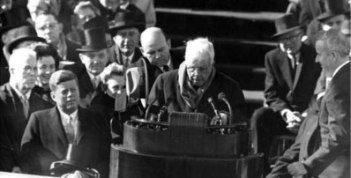
In the way of Bards, another who grappled with the same challenge comes to answer Brooke’s verses with words of his own. At 86, Robert Frost was asked to deliver a poem for President John F. Kennedy’s inauguration in January, 1961. The day dawned cold and bright, and with his failing vision and the sun in his eyes, Frost couldn’t read the words in front of him, so the old bard made do with memory instead, and recited another of his poems.
Frost at Kennedy’s inauguration
“The land was ours before we were the land’s,” he begins in “The Gift Outright” (Frost, 1975, p. 348). How often a bard finds a way through error and trial and awen. Frost continues, naming an experience common enough among many American Druids who may strive to honor a rich heritage originating east of the Atlantic, while also heeding new-old voices here on what some First Peoples still call Turtle Island:
But we were England’s, still colonials,
Possessing what we still were unpossessed by,
Possessed by what we now no more possessed.
Something we were withholding made us weak
Until we found out that it was ourselves …
Here in what homesick settlers called New England, older names still linger for things no one truly possesses. Within an hour from where I live you can find Mt. Monadnock, Mt. Ascutney, Wantastiquet Trail, Skatutakee and Nubanusit lakes. Anywhere you go on this continent, similar names and undercurrents whisper, and careful listening will repay any effort to attend to lore and myth and what the land wights may have to say. (The earth’s an old house: many lands have the same overlay of newer names on older ones.) Sometimes it takes long patience to regain their trust, if careless previous inhabitants squandered it. Sometimes it takes longer practice to stop withholding ourselves from our places, and to inhabit them fully.
Here in Vermont the Yankee accent and sensibility rise like springwater from long winters and sap from local trees boiled to syrup, pork from free-range pigs that graze the oak mast on Windmill Hill, which we can see from our living room window, and Okemo State Forest not so very distant. “Eating local” needn’t be mere marketing of another yuppie indulgence. It’s what we all did until just a couple of generations ago, growing it ourselves, letting the land feed our bellies and spirits. And it makes sense if you’re committed to “Druiding” (let’s make it a verb!) –- the taste and smell of home, and of a new place, too, can be powerful guides. The body leads the way by a kind of homing instinct.
Names, listening, tastes and smells. What of ritual and ceremony? Once my wife and I settled in Vermont, walking to learn my neighborhood became a go-to practice for me, with a three-mile loop of dirt roads my almost-daily ceremonial. When I honor the four quarters, I see the fish pond east of our house the former owners stocked with carp, and I remember water-of-air. The cold fronts each winter sweep down from Canada: air-of-earth. And with a hill named for a grove of hemlocks to our east beyond the pond that obscure the horizon, we never get much in the way of sunrises, but dramatic sunsets make up for it: fire-of-water. Online you can still track down Mike Nichols’ Wiccan classic “Re-thinking the Watchtowers: Thirteen Reasons Air Should Be in the North” (Nichols, 1989): it’s now a “sacred text” itself, though it started out as an observed deviation from traditional practice. Rules change with places, but ancient patterns abide.
Frost, Robert. (1975). The Poetry of Robert Frost: The Collected Poems, Complete and Unabridged. New York: Henry Holt and Co.
Nichols, Mike. (1989). “Re-thinking the Watchtowers or 13 Reasons Air Should Be in the North.” Internet Sacred Text Archive. Retrieved from http://www.sacred-texts.com/bos/bos089.htm.


 The Welsh proverb A gwir yn erbyn a byd — “the truth against the world” — hasn’t lost any of its force. It still offers a challenge, read one way; and a simple statement about the nature of things, read another. Or maybe they’re the same thing.
 In times like this, spiritual integrity can mean living with intention, living counter to the prevailing mood of pessimism and despair. But more importantly, counter to living without any intention at all. You know, the home-from-work, plop down in front of the TV or computer and insta-drug. Waiting to be entertained (is that so bad?), to be led, to be fed, to be used for another’s purposes because we have none of our own. Well, maybe it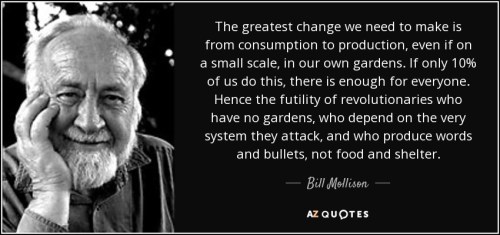
 And Hussey’s
  I cannot remember the paternal grandfather I was named for: he died 14 years before I was born. All I have of him are three yellowing photos and a handful of stories. But I imagine him when I honor my ancestors of blood and spirit, and he’s more alive to me as a result. A link, however tenuous, that I (and he, from his side) can strengthen at will.
 Over the last several cold damp nights and cool partly cloudy days here in New England, many of us who heat with wood have lit the first fires of autumn. (Some days building and feeding a fire is the best theology I can muster.)
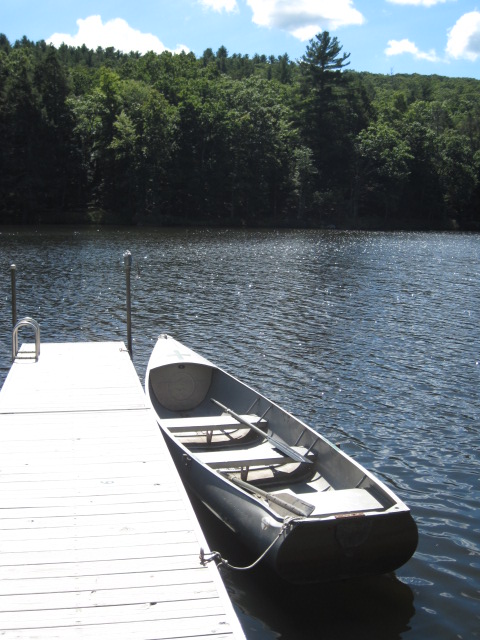




 For “light on the water,” as it turns out to my now-placated left brain, is indeed apt, a festival that celebrates a brief balance of light and dark in the quarter of the ritual year that belongs to the west and to water. “Light on the water” brings with it a twilit mood, a sunset reminder of the reality of life on earth, both dark and bright.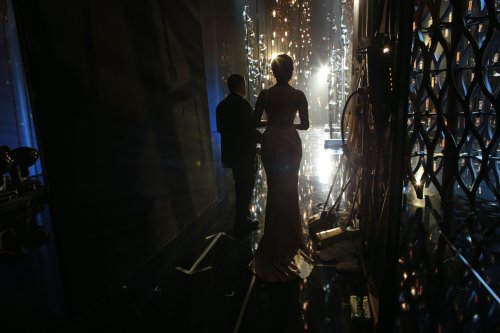


 A Druid Way


