The start of the year is a good time to look back and forward too, in as many ways as it fits to do so. If you’ve got a moment, think about what stands out for you among your hopes for this new year, and you strongest memories of the year past. What’s the link between them? Is there one? Here we are in the middle, between wish and memory. In his great and intellectually self-indulgent poem “The Waste Land,” Eliot said “April is the cruelest month, mixing memory and desire.” But April need not be cruel — we can make any month crueler, or kinder — and neither should January. Let’s take a sip of the mental smoothie of memory and desire that often passes for consciousness during most of our waking hours, and consider.
To recap from previous posts, if we’re looking for a workable and bug-free Religious Operating System, we can start with persistence, initiation and magic (working in intentional harmony with natural patterns). You’ll note that all of these are things we do — not things a deity, master or Other provides for us. While these latter sources of life energy, insight and spiritual momentum can matter a great deal to our growth and understanding, nothing replaces our own efforts. Contrary to popular understanding, no one else can provide salvation without effort on our part. We can “benefit” from a spiritual welfare program only if we use the shelter of the divine to build something of our own. Yes, a mother eats so she can feed the fetus growing within her, but only in preparation for it to become an independent being that can eat on its own. We may take refuge with another, but for the purpose of gaining or recovering our own spiritual stamina. If we’re merely looking for a handout and unwilling to do anything ourselves, we end up “running in our own debt,” Emerson termed it. We weaken, rather than grow stronger.
The recent SAT cheating scandal involving the Long Island students paying a particularly bright peer to take the tests for them is a case in point. We condemn such acts as dishonest on the societal and human level. Why do we imagine they’re any more ethical or viable on the spiritual level? Just as no other person can fall in love for us, undergo surgery in our place, eat for us, learn on our behalf, or do anything else for us that so intimately changes and affects us, so nobody else can do the necessary work we all end up doing whenever we’ve grown and changed. It takes effort, and it’s up to us. This usually comes both as a sobering realization and as a wonderfully liberating discovery. Our spirituality and growth are up to us, but that also means they’re in our hands, under our control, responsive to our initiative and effort and attention.
For a ROS to actually work, then, it needs to fit our own individual lives and circumstances. Jesus confronted this squarely when he observed, “The Sabbath was made for man, and not man for the Sabbath.” While we can overdo the jettisoning of old religious forms and habits, convinced they have nothing more to offer us, it can be a very good thing to haul out and burn the old stuff to make way for the new. What have we elevated to “god status” in our lives that, in spite of worship, offerings and adoration, is actually giving us little or nothing and holding us back from growing? For too long we have clutched old forms and outmoded beliefs and held them tightly to our hearts, convinced that forms can liberate us. But they have no more power than we give them. Belief is a ladder we construct. Reach the goal, and the ladder is merely extra weight to carry around. We don’t need it.
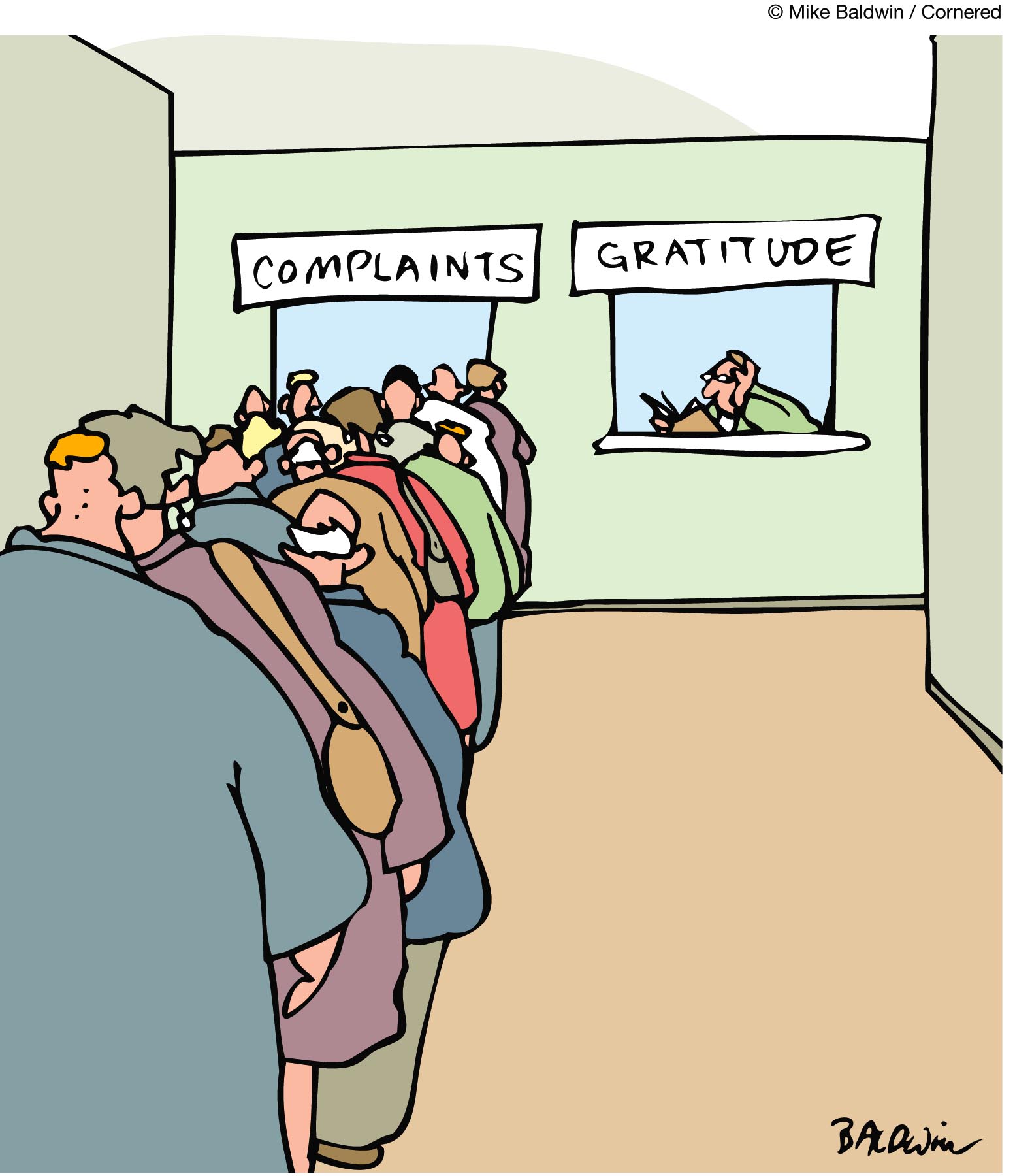
So you say I’m just supposed to up and cull out-of-date beliefs and dump them? Easy to say (or write), harder to do. One of the most useful items in our spiritual tool-kits is gratitude, the WD-40 of spiritual life. As a solvent, it can loosen hard attitudes, stubborn beliefs, closed hearts and dead growth. We may think of gratitude as an often wimpy sentiment — something softhearted — but I like to call it the grr-attitude. It’s an attitude with teeth, and helps us build a “spiritual firewall” against destructive energies.* Every life without exception, no matter how hard, has something in it to praise and be thankful for. Gratitude, along with persistence, can show us how to make do when every other avenue seems closed. It’s the great “life-unsticker.” It moves us out of spiritual ruts and ravines like nothing else. In fact, an entire life spent in gratitude and persistence, without any other “spiritual garnish,” could carry us remarkably far. It would be a very full life.
I can be grateful for habits and attitudes that have brought me to where I am, and I can often let them go more easily by thinking kindly of them, rather than hating them and beating myself up for being unable to move on from them. But the value of gratitude isn’t just anecdotal. The field of positive psychology is producing significant research findings. Here’s just one example, from Prof. Robert Emmons’ book Thanks! on Amazon: “[R]egular grateful thinking can increase happiness by as much as 25 percent, while keeping a gratitude journal for as little as three weeks results in better sleep and more energy.”*
Every aspect of our lives has spiritual lessons to teach. I even feel gratitude for my cancer, because it has brought me back into balance with myself, revealed friends to me, brought me more love than I could handle, and reminded me again to make the best use of my time here that I can. And that’s just a start. Gratitude is a choice of consciousness. It definitely belongs in any religious operating system.
*Emmons’ book Thanks! deserves reading — it’s in paperback, and you can get cheap used copies online (and no, I have no connection with the author! The title was on the list of books for the course I took this fall — one of my subsequent favorites).
The term “spiritual firewall” I’ve derived from the excerpt below. The book helped strengthen my growing understanding of gratitude as a stance or posture toward life that has palpable strength in it, a kind of spiritual toughness and healthy resiliency — with powerful consequences, too — rather than an exercise of mere empty sentiment.
Grateful people are mindful materialists. Deliberate appreciation can reduce the tendency to depreciate what one has, making it less likely that the person will go out and replace what they have with newer, shinier, faster, better alternatives. The ability that grateful people have to extract maximum satisfaction out of life extends to material possessions. In contrast, there is always some real or imagined pleasure that stands in the way of the happiness of the ungrateful person. Consumerism fuels ingratitude. Advertisers purposely invoke feelings of comparison and ingratitude by leading us to perceive that our lives are incomplete unless we buy what they are selling. Here’s a frightening statistic: by the age of twenty one, the average adult will have seen one million TV commercials. By playing on our desires and fears, these ads fabricate needs and cultivate ingratitude for what we have and who we are. Human relationships are hijacked. Consumer psychologists argue that advertising separates children from their parents and spouses from each other. Parents are portrayed as uncool and out of touch with their teenage children, who are encouraged to reject the older generation’s preferences and carve out their own identity around materialistic values. Gratitude for our spouses can have a difficult time surviving the constant parade of perfectly sculpted bodies exuding perpetual sexual desire. In a classic study conducted in the 1980s, researchers found that men who viewed photographs of physically attractive women or Playboy centerfolds subsequently found their current mates less physically attractive, became less satisfied with their current relationships, and expressed less commitment to their partners. Gratitude can serve as a firewall of protection against some of the effects of these insidious advertizing messages. When a person wants what they have, they are less susceptible to messages that encourage them to want what they don’t have or what others have (Emmons, 42-43).
Persistence, and its twin patience, may be our greatest magic. Sacred writings around the globe praise its powers and practitioners. So it’s hardly surprising, here in the too-often unmagical West, with its suspicion of the imagination, and its demand for the instantaneous, or at least the immediate, that we are impatient, restless, insecure, harried, stressed, whiny, dissatisfied and ungrateful. We bustle from one “experience” to the next, collecting them like beads on a necklace. The ubiquitous verb “have” leaves it mark in our speech, on our tongues: we “have” dinner, we “have” class or a good time, we even “have” another person sexually, and one of the worst sensations is “being had.” We do not know self-possession, so other things and people possess us instead.
The “slow food” movement, the pace appropriate for savoring, craftsmanship, care, reflection, meditation and rumination (slow digestion!) all run counter to the ethos of speed, promptness, acceleration that drive us to a rush to orgasm, speeding tickets, the rat race, stress-related illness, and so on. None of these problems or the observations about them are new, of course. But we remain half-hearted in our efforts or understanding of how to “pursue” their remedy. We chase salvation as much as anything else, as a thing to collect or gather or purchase so we can be about our “real” business, whatever we think that is. Spirituality gets marketed along with orange juice. For a sum, you can be whisked off to a more exotic locale than where you live your life, spend time with a retreat leader or guru or master or guide, and “have” (or “take”) a seminar or class or workshop.
Anyone who has adopted a spiritual practice and stuck with it has seen benefits. Like regular exercise, it grants a resilience and stamina I can acquire in no other way. I sit in contemplation and nothing much happens. A week or a month goes by, and my temper might have subtly improved. Fortunate coincidences increase. My dream life, or a chance conversation, or a newspaper article, nudges me toward choices and options I might not have otherwise considered. But usually these things arrive so naturally that unless I look for them and document them, I perceive no connection between spiritual practice and the increased smoothness of my life. From a slog, it becomes more of a glide. But the very smoothness of the transition makes it too subtle for my dulled perceptions at first. It arrives naturally, like the grass greening in the spring, or that gentle all-day snow that mantles everything.
I abandoned a particular daily practice after many years, for complicated reasons deserving a separate post, and I needed only to read the notebooks I kept from that earlier time to recall vividly what I had lost, if my own life wasn’t enough to show me. My internal climate faced its own El Nino. I was more often short with my wife, mildly depressed, more often sick with colds, less inspired to write, less likely to laugh, more tired and more critical of setbacks and annoyances. Set down in writing this way, the changes sound more dramatic — didn’t I notice them at the time? — but as a gradual shift, they were hardly noticeable at any one point. I still had my share of good days (though I didn’t seem to value them as much), and my life was tolerable and rewarding enough. “But I was making good money!” may be the excuse or apology or justification we make to ourselves, and for a time it was true enough of me. Then came the cancer, the near-breakdown, the stretch of several years where I seemed to move from doctor to doctor, test to test, treatment to treatment. If you or anyone you know has endured this, you get what I’m talking about. It’s distinctly unfun. And while I won’t say lack of practice caused this, it’s an accompanying factor, a “leading indicator,” a constituent factor. Doctors might very profitably begin their diagnoses with the question, “So how’s your spiritual practice?” Our spiritual pulse keeps time with our physical lives. They’re hardly separate things, after all. Why should they be?
In the story of Taliesin I mentioned in my last post, the boy Gwion, so far from the future Taliesin he will become, is set by the goddess Cerridwen to watch a cauldron as it cooks a magical broth meant to transform her son Afagddu, a mother’s gift to her child. A year and a day is the fairy-story time Gwion spends at it. A full cycle. The dailiness of effort and persistence. The “same-old,” much of the time. Gwion’s a servant. The cauldron sits there each morning. The fire beneath it smoulders. Feed the fire, stir the liquid. It cooks, and Gwion “cooks” along with it, the invisible energy of persistence accumulating as surely as the magical liquor boils down and grows in potency. Through the spring and summer, insects and sweat. Through autumn and winter, frost and chill and ice. The cauldron has not changed. Still at it? Yes. The broth slowly thickens as it bubbles and spatters.
One day a few drops (in some versions, three drops) fly out onto one of Gwion’s hands, burning. Instinctively he lifts the hand to his mouth, to lick and soothe it with his tongue. Immediately the magic “meant for another” is now his. He did, after all, put in the time. He sat there daily, through the seasons, tending the cauldron, stirring and keeping up the fire, swatting insects, breathing the smoke, batting sparks away, eyes reddened. Yes, the “accident” of the spattered drops was at least partly the result of “being at the right time in the right place.” It is “luck” as well as “grace,” both operative in his life. Part, too, was the simple animal instinct to lick a burn. And the greater portion was the effort, which catalyzed all the rest into a unified whole. Effort, timing, luck, chance, grace: the “package deal” of spirituality.
And the consequence? For Gwion, his growth has just begun. It is his initiation, his beginning. In his case it distinctly does NOT mean an easier path ahead for him. In fact, just the opposite — more on that in a coming post.
The Hopi of the American Southwest call their ritual ceremonial pipe natwanpi, “instrument of preparing.” The -pi suffix means a vehicle, a means, a tool. Tales like this story of Gwion can become anatwanpi for us, if we choose — part of our preparation and practice, a tool, a way forward.
“And some of the Pharisees from among the multitude said unto him, Master, rebuke thy disciples. And he answered and said unto them, I tell you that, if these should hold their peace, the stones would immediately cry out.” (Luke 19:39-40)
What shall we do till the stones start to speak,
or whom can we turn to and trust in these days?
Can we hear even echoes of truths that we seek,
catch mere flickers of fire to illumine our ways?
The stones broadcast secrets we now scarcely hear —
the earth bears true witness, though leaders stay mute,
to remind us of love that is stronger than fear.
Goal and path rise within us — there’s no other route.
The animals know much — in each neighboring eye
is the ghost of the knowledge hard-won from their days:
make the most of each moment, for this body will die —
tomorrow’s new compost, though it shouldn’t amaze
us when walls turn to doors: we walk through them to find
the doors of our hearts were more narrow by far.
Trust the paint-box you’re given, though your dear ones are blind,
though your culture berates you, fear sets up a bar.
We must watch as we journey, be mindful of stones
that mumble or shout, rousing sleepers to wake.
Learn to feel the right path in the set of our bones,
trust the deep self to know the next step to take.
Did it! Amazing experience, helped by the online Nanowrimo forum, with 200,000 other people doing the same thing all around the world. Dutch high-schoolers and Malaysian retirees and New Zealand farmers, Singapore lawyers and Hong Kong engineers. Everyone talking about it as they’re doing it. Egging each other on. Telling funny stories. Making and soliciting suggestions. Cries for help. Competitions. Excerpts for critiquing. How-to’s for people writing about medieval French history, chameleons, murder by deuterium, dragon mating, the proper warping and beaming of looms, the spices in chicken tikka, etc. Writing Buddies. The online support videos and posts from published authors. The sense of an immense online community engaged in huge set of magical creative hopeful acts against the naysayers and wannabes and critics, and our own doubts and inner censors and resistance and procrastination and sloth.
Word by word. And now, 50,260 words of the first draft of a fantasy novel. Or 106 pages in a Word document. A month of writing. Virtually no editing whatsover, beyond what spell-check does in true robot fashion.
Haven’t looked back at it. Not sure I want to. In any case I need to spend some time away from it. Catch up on this blog, on laundry, dishes.
Free at last! No, not free at all: finished with the first step. Let down a bit, to tell the truth. Adrenaline and all. Time to rest up, pull back from writing for a week, so the first symptoms of carpal tunnel subside (mostly my left arm).
Most productive day — over 5000 words. Had about five of those during the month. Nice to know I can do it. Wow. OK, onward. Get a fire built later (it’s sunny and in the 40s outside), shave, take a shower, write a letter, pay bills. Take a walk. Breathe.
Thank you, Powers of the Worlds, human and incorporeal. Wife, friends, the earth, the gods. And you, my readers, for all good thoughts. (It feels good to thank, to be grateful. An annual holiday for it isn’t often enough, of course. Daily.)
A singe grosbeak inspects our feeder, and as I look out through the living room picture window at the bird plumped against the cold, there’s a reflection in the glass of flames from the woodstove inside. In its orange vigor, my fire faces west, Druidically inappropriate, but very welcome on this grade A gray day.
In the northern U.S. that’s an image of this time of year: reflections, of heat inside, of life still proceeding outdoors and in, of the time of year itself.
The interval between Thanksgiving and the December holidays can be a delicious space, a “meanwhile” or middle-time for re-tooling and starting to close up shop on the current year. To feel that it’s often too busy, or merely filled with worsening weather forecasts, as though that is all it has to offer, is to miss something profoundly meditative about these days. What’s the opposite of miss? Attend, intercept, catch, be there. Whatever it is, that’s what I want to do.
There is as well in November and early December a late-autumnal melancholy, it’s true. The peak of Thanksgiving has passed, and some may see the next months as a pretty solid trudge through the valleys (in our boots, scarves and gloves, and hauling snow-shovels) until the climb to the next holiday.
So when I can take a look from this end of the year at a season at the other side of summer, I do. Off to that start of spring transience which mirrors something in us now as well. I followed a link from an article in today’s NY Times and there on the page was the sudden pure pleasure of “Sakura Park,” a poem by the late Rachel Wetzsteon (pronounced “wet-stone”). Take a visit to late spring, six months ago, or six months to come. The cherry trees (the sakura of the title) are in bloom …
Sakura Park
The park admits the wind,
the petals lift and scatter
like versions of myself I was on the verge
of becoming; and ten years on
and ten blocks down I still can’t tell
whether this dispersal resembles
a fist unclenching or waving goodbye.
But the petals scatter faster,
seeking the rose, the cigarette vendor,
and at least I’ve got by pumping heart
some rules of conduct: refuse to choose
between turning pages and turning heads
though the stubborn dine alone. Get over
“getting over”: dark clouds don’t fade
but drift with ever deeper colors.
Give up on rooted happiness
(the stolid trees on fire!) and sweet reprieve
(a poor park but my own) will follow.
There is still a chance the empty gazebo
will draw crowds from the greater world.
And meanwhile, meanwhile’s far from nothing:
the humming moment, the rustle of cherry trees.
Yes, that’s a poet for you — insisting on a connection between cherry petals and the growth of self, when all the cherry need do is be a self beautifully ready to attract bees, produce fruit and fulfill its cherry-tree-ness.
And yes, there’s a whiff of early middle-aged cynicism creeping in here (Wetzsteon died at 42), the dry rot that afflicts so many who tell themselves to be content with meanwhiles. “Give up on rooted happiness!” she urges. There is still green chance and raw luck and sweet grace in the world, but until they salvage something greater than what’s at hand, be content with meanwhiles, the poet advises, the “far from nothing” moments that hum with possibility even now. So it’s back to trees, where maybe we should have remained.
Too often we are literally “self-important.” We worry about the self like a barefoot child abandoned in a parking lot, or an opened can of tuna that will spoil unless we eat or cook or refrigerate it. The cherry tree sends out blossoms unworried about November. Not because November won’t come, but because it’s not November when it’s April. And when November comes, the tree will be a cherry in November, awaiting the next humming moment.
And yes, if I meditate among the swaying branches and crackling leaves this time of year (trying to fluff myself against the cold like an outsized bird, so I can sit or kneel a few minutes without shivering and breaking my focus), the “stolid tree on fire” matters more than it did before, and my own concerns matter less. Restoration that we seek, visit all who long for it. Find it in the silent witnesses of trees. We who listen for “a voice that will save us” forget what burns in front of us, the fire in the stove in the living room, this day passing with us into “later” and darkness and tomorrow, the trees wintering, summering and wintering again, the air itself, with its metallic crispness on the tongue and in the nose, the fire that burns in all things.
/|\ /|\ /|\
The 50,000-word deadline this Wednesday 11/30 at midnight looms before us “wrimos,” and I’m finally within range. Woo-hah! The Nanowrimo site obligingly lets participants grab icons of progress — anything to keep us writing. Much of what I’m drafting now is detail, filling in missing scenes, background, snatches of dialog with disembodied characters, pieces of Harhanu physiology and psychology — and I suppose, not surprisingly, a brand-new and potentially primary character — because of course what I expressly did not need at this point is a strong new presence telling me “when you are done, you are not done, for I have more” — to paraphrase Omar Khayyam in his Rubaiyat. He already has a name (Tehengin) which he obligingly repeated to me till I got it right. But, probably, I do need him — in some way which I’m sure he’ll inform me about. In detail.
So anyway, here I dance at 44212 words, taking a break to blog, before I return to dance some more. Wish me well in this home stretch.
As editor of a collection of essays, The Rebirth of Druidry, OBOD‘s Chosen Chief Philip Carr-Gomm attempts to characterize something of the appeal of the spirit of Druidry in human terms. I quote his article at length because in its effect it is all of a piece, and because it provides a suitable introduction to some things I want to say about the Goddess:
Druidry is the perfect lover. You fall in love with her so easily because she is so romantic. She whispers to you of the magic and mystery of the turning stars and seasons. She loves trees and Nature above all things, and you yearn for these too. She tells you stories of Gods and Goddesses, the Otherworld and fairies, dragons and giants. She promises secret lore — of sacred trees and animals, of herbs and plants. She points deep into the past, and ahead towards a future which is lived in harmony with the natural world. But just when you are convinced you will marry her, because she is so beautiful, so tantalizing, so romantic, she turns around and there she is, with rotten teeth and hideous face, cackling and shrieking at your naivety. And she disappears, leaving you with just her tattered cloak, made up of a few strands: some lines from the classical authors, whose accounts are probably inaccurate anyway, a few inferences drawn from linguistic and archaeological research, which could be wrong, with the rest of the cloth woven from material written from the eighteenth century onwards, replete with speculation, forgery and fantasy.
You feel a fool. You don’t tell your friends about your lover. You feel tricked and defrauded, and decide to follow something more authentic, more established, more substantial — like Buddhism, or Christianity, or Sufism, or Taoism — something serious. But then you go out walking. You follow the old trackways, you come to the old places. You see the chalk gods and stone circles. You pause and open yourself to the Land, and there She is again. But this time she is even more enchanting because you can see that she is not just a beautiful woman, full of romance and seduction, you can see that she is also a wise woman, who will provoke as well as seduce you, who will make you think as well as make you feel. And then you suddenly know why she has been the object of fascination for so many through the ages. She is the Muse, the Goddess behind Druidry, the bestower of Awen, of inspiration.
Obviously the imagery here from a male author conveys part of how a man may first encounter the “Goddess behind Druidry”; it may not appeal to women, who find their own powerful ways of connecting with Her. In mythic terms, however, this account very much reflects the changeability of the Goddess — what has inaccurately been called her fickleness, and which has caused many accustomed to meeting deity in a single, invariant form to confuse variety with unreliability or untrustworthiness. Westerners in particular have largely been cut off from experience with aspectual deity, which the Goddess so clearly manifests. Rather than manifesting a loving and compassionate presence, “[t]he deity may appear in wrathful or challenging forms, but these should not be considered hostile. She is the kernel of truth at the heart of everything, and if she appears in challenging forms to you, look more deeply, considering why this may be so,” suggests Caitlin Matthews in her slim but potent book, The Elements of the Goddess. “Many of those who venerate the Goddess are unhappy with her supposedly dark aspects because they associate ‘dark’ with ‘evil.’ In order to save her child about to do something dangerous or silly, a mother will get angry, shout or scream, but this doesn’t mean to say she loves her child any less.”
My first encounter with the Goddess came unbidden, unsought, when I was 25. (You need to know: I’m not especially sensitive or psychic. Friends who are say anyone who wants to reach me has to raise quite a ruckus to get my attention. If you’d asked me then I’d say — still would probably, even today — that half of what people experience in such situations is imagination. But now by “imagination” I mean something considerably larger and more potent than I did then. More about that later.) It was a frosty autumn day, and I was wandering the fields and scattered woods of a farm my father had recently bought in western New York, south of Rochester. I paused in a swampy grove of trees, with several fallen and decaying trunks to sit on. A mood or atmosphere of autumn pervaded the place, almost palpable. The air lay perfectly still. The musty-sweet smell of dried dead leaves filled the air, along with a tang of rot and manure from a nearby field, and a hint of woodsmoke. Over the hills from a distance came the faint roar of some town maintenance vehicle — they were always patching roads in the area. But distant sounds simply deepened the stillness by contrast. As this meditative silence spread and enveloped me, I became aware of a presence that filled the grove and towered over me, fifty, sixty feet tall. Immense. One face of the Goddess. Conscious encounter. Her.
She didn’t knock me on my ass, though that might have been useful too, given how dense I can be. But though I describe it here in mild enough terms, the experience was unforgettable, not for any one detail, but for its undeniable — and familiar — quality. This was someone I knew. Not someone or something alien, or to be feared, or a matter of belief, any more than I need to believe in the tree-trunk I sat on. It was like finding a limb which, when you found it, you knew had always been a part of you all along. You just hadn’t been aware of it. As if it had been asleep, but for its waking you finally twitched a muscle in it, and in feeling it respond you felt it.
So what’s the big deal, you say? “He met the Goddess, in some ways it was an anticlimax though also somehow memorable, he got over it, it was years ago. So?”
A year later I was in the throes of my first love affair (can anyone say “late bloomer”?), a tumultuous relationship in which I did get knocked on my ass. Among all the other things this Goddess encounter was, it was preparation, or warning. I needed greater emotional experience, insight, maturity. I was about to get it.
In between the divine and human realms is an archetypal one — a place, often, of dream and vision, and the idealized images of Others for men and women which “haunt our imagination and often make our love-lives incredibly tortuous until we realize that these daimons will never become physical realities. They are messengers between the divine realms and the human levels of our experience” (Matthews, 13). This was part of what I needed to learn firsthand. No book knowledge this time. It was an initiation of its own.
So this fall at OBOD’s East Coast Gathering, in a meditation involving an encounter with the Goddess in her guise as Cerridwen, I felt a surge of panic — again. “Cerridwen is bad. She tricked Gwion Bach in the old Welsh tale.” But it was old programming. Incomplete knowledge. Fear of that “fickleness” I mentioned earlier. “The old, outworn, dualistic concept of the Goddess as cruel and capricious must be viewed for what it is: a reflection of our shadow-side, a terrible polarization of social responsibility with which women have been burdened as a sex” (Matthews, 24). But now I had more tools to begin to deal with it. At Samhain I did specific work with the Goddess. I needed to. Is it any wonder I also spent 15 years working in a freshman girls dorm as a house parent? Training up close and personal. “The Goddess stands at the heart of life, death and further existence and she will assume the forms which are most appropriate in her dealings with our world” (Matthews, 24). Or as a teacher in the other path I follow related, when he talked about his own experiences with inner and outer realities, “They had to get me to stop bowing every time they appeared, so they could actually work with me and get some work out of me.”
Matthews continues, in ways particularly useful for a male bard like me. “Men experience the Goddess through their creative side. She makes manifest their ideas by animating their dormant creativity. There is a strong sense of ebb and flow about these energies which give men an experience of the cyclical nature of the feminine menstrual cycle. This kind of relationship is rarely recognized for what it is, yet all men can discover and welcome this experience. Although the effect of a Goddess upon a man is less immediately physical than in a woman, it is nonetheless potent” (15).
There is much misunderstanding of gender and sexuality, and what constitutes the self and its connection to the world, perhaps nowhere more so than in the West, with its addiction to pornography, its fear of homosexuality, its violence against women, and its frequent indifference to children. I’ll let Matthews have her last word here. “Every human being is a child of the Goddess … The way of the Goddess is one of natural law and natural wisdom … It is primarily the people of the West who are orphans of the Goddess. The social and political reasons for this desolation have been documented in many books … Both women and men need to find their Mother, relating to her and her creation in fresh and balanced ways, for every one of us needs to drink of her wisdom and realign ourselves with her natural laws.” This is not a matter of belief but of incarnation — our own — to live fully, gratefully and passionately in this world, until we leave it.
/|\ /|\ /|\
Nano update time. Is it any wonder, in light of this post, that I’m writing about a succubus?! And sympathetically — as a main character?! Must be some sort of assignment from the Goddess. Further training. God knows if it’s publishable. (Goddess may know, but if she does, she ain’t tellin’.) Reached 17,804 words: over 1/3 of the way there. Need to hit 20,000 today to be fully caught up, including today’s work. Should be able to do it. Major scene yesterday, in which Alza connected with the man she needs for her magical work, showed him her nature in a brief feed and reversal of energies to restore him, bypassing the mental level altogether, where the idea of a succubus would have completely flipped him, and left him with a medallion magically linked to her — ongoing physical contact to reinforce the dynamic. The resulting reactions when he deals mentally and emotionally with what he already knows will be interesting to capture, but the heavy lifting for that scene is done.
I’d been including more fire imagery in description and action, since Alza’s succubus nature seemed increasingly to resemble that of a fire demon. And then, as a break yesterday, doing some research on demons and succubi in other cultures, I happened on this quotation from the Qur’an: “And the jinn, We created aforetime from the smokeless flame of fire” (Al-Hijr, 15:27). And in an email yesterday from the university where I’m taking a seminar, advertising a weekend workshop for men: “FRIDAY, 11/11/11 – SUNDAY, 11/13/11 – ON THE EDGE OF FIRE: A MEN’S SPIRITUALITY RETREAT.” Right between the eyes — the kind of serendipity and synchronicity and happy accident one hopes for in writing. So I’m on some kind of track. I’m just still discovering what it is. And that’s much of the deep pleasure of this verbal marathon.
“We are many sets of eyes staring out at each other from the same living body” — Freeman House, Totem Salmon
We are many sets of eyes, staring out
at each other from the same living body.
We are ears listening to each other
across valleys of skin.
Heat of the other’s blood
warming the air we breathe,
air that filled the other’s lungs
not long before, and will again,
ruffling our hair, rippling this field
of frost-gray grass.
We touch earth that touches each other,
life-print curling at our fingertips and lips,
world (a piece of it) digesting in our bellies,
swept along in blood and spit,
spice of it in our marrow,
essential you in everything
I eat and love and do,
essential me in you.
/|\ /|\ /|\
So there’s a poem provoked (I say “provoked” rather than “inspired” because that’s the sensation — I encounter a piece of language not my own that becomes the grain around which oyster tries to form a pearl. It won’t let go until I respond, and try to shape the sensation into something in words.)
Nano update: I’m catching up at 13,527 words and counting, but still a little more behind than I’d like. We’ll see what 2 and 1/2 cups of coffee this morning helps me accomplish. I don’t usually drink it, since I’m hypersensitive to caffeine and it keeps me up most of the night following the day I drink it, but I was cold this morning, and the smell! … well, anyway, I’m caffeinated and writing.
Found an interesting passage in a medieval author yesterday, Walter de Mapis. (If you’re gonna procrastinate, I say, why not procrastinate tangentially? I researched historical refs to succubi.) So now I know something about rumors surrounding Pope Silvester. The pontiff flourished around the year 1000, and his legacy includes the story of a certain succubus, who was said to give him advice, and who was reputed to be his lover. Supposedly he repented on his deathbed. Traitor. I’m expecting my succubus main character Alza will have something to say about that. Who knows — maybe she was there. Maybe she was the succubus …
Just discovered she has a mantra or prayer or verbal talisman she recites frequently. Maria, one of her worshippers (from her “cult” phase), overheard her this morning talking quietly to herself, and asked about it. Here are the words Alza said (part of the charm is to speak about oneself in third person):
Alzakh ne utayal gashem muk dafa.
May Alzakh grow in this surrounding fire,
may Fire know her for its own,
may Fire fill her in all she does,
burning away what blocks her,
burning toward what is native to her,
what is or will become or has been Fire,
time the Fire that moves all things into being.
Always fun to get a piece of the original in Harhanu. You need to know: among my other odd hobbies is conlanging. So I hear bits of languages, like I imagine musicians and songwriters hear snatches of songs and musical phrases. Here are the italicized words phonetically, as I heard them from Alza’s mouth: ahl-zahkh NEH oo-tah-YAHL gah-SHEM mook dah-FAH. [Literally, Alza this surrounding fire-in grow-imperative.]
Alza’s name in Harhanu is actually Alzakh, with the kh the raspy sound in loch and Bach — a voiceless velar fricative, to be all linguistic-y and precise about it. Alza’s name got truncated over the years, to match what people thought they heard, or thought it should be. Much as men around Alza imagine the woman they want, which she can then use to seduce them. Most men are, frankly, pretty seducible, she learns. So that part’s easy.
You want Druidry? Find it here, or go bother somebody else. (Now maybe you have some idea why I don’t overdo the caffeine. It makes me all cranky-creative and snarky and stuff.)
In her blog, Alison Leigh Lily writes beautifully about the human body as a holy thing, an altar:
So, too, my body is the altar in the nemeton [sacred grove–ADW] of my soul — that small, solid piece of world that settles down like a stone into my awareness. And that awareness in turn is carved by the spiraling torrents of the sacred world, the sun that crafts the seasons out of mud and wind, the moon that pushes the sea to its extremes, the stars that draw the eye into the great distances that yawn open between us, the deer, the jay, the badger, the rustling oak and every being and body that dances through its longing, hunger, fear, curiosity and sleep. All these things turn about the sculpted edge of my nemeton, the sanctuary my soul has made of itself, the self that calls itself “I” and reaches out into the world to touch the chaos that has given birth to it. Sitting in the center of that nemeton is my body, all surface, the appearance of skin and hair and angles and soft curves of fat and loose muscle. Like a ladder that reaches into the dark. A spine, a wellspring, a single tree, a tongue of flame. My body is the altar around which my spirit gathers itself into stillness. Not a temple, but only a simple, useful table where I sit down to do my work.
And some of the work we are called to do is to recognize that altar. In the Bible I read, “I will go up into the altar of God” — introibo ad altare dei in Latin. I use it as a mantra, a chant, to be mindful of the altar as a place to ascend to. For it feels like we do actually rise up, into the body, out of thought, out of waking, out of the distractions and worries and daily obsessions, the small news that passes for important events that other people call “headlines,” but which are mostly just footnotes — out of the image and into the reality, into this body that is part of the world, not a thought or an idea or a remove from the thing itself, but the place where we experience a universe.
I strive to occupy this body, this world, as fully as I can, to be fully incarnate. Not to forsake this great, unheralded, impossibly large opportunity to know, to dare, to will and to be silent, to listen for the voices of the Others who move all around me, chickadee at the feeder, crows scavenging a dead squirrel on the road early this morning as my wife and I drove through the dark and the fog to her weaving apprenticeship.
And Tom, who introduced himself yesterday afternoon — a neighbor, out chopping wood. He paused from his work and called to my wife and me, walking slowly over to where we were unloading our car. “It’s something I can still do, and it needs doing,” he said to us, as he stood before us, dressed in blue sweat pants, a gray sweatshirt, a blue hoodie, pieces of leaves and bark plastered to this clothes. “I was just recovering from knee surgery when I had a stroke. And I was recovering from the stroke when I lost my job. But I can still chop wood, as long as I don’t have to bend my legs too much.” So I touch that friendliness, and something of the spirit in him, that brought him to our doorstep to chat in the fading afternoon light of a day in early November. Is any song more wonderful?
“Sanctuary my soul has made of itself,” Alison says — a poem, a song, a prayer for this life, this world.
“Prayer is about being hopeful,” says Sister Alice Martin. “It is not a phone call to God’s hotline. It’s not about waiting around for an answer you like, especially since sometimes the answer you’re going to get is NO!” And she continues, “If you are going to pray, then don’t worry. And if you are going to worry, then don’t bother praying. You can’t be doing both.” I know which one I want to choose, often as I can, prayer at this altar of my body.
“But ask the animals, and they will teach you; the birds of the air, and they will tell you; ask the plants of the earth, and they will teach you; and the fish of the sea will declare to you” — Job 12:7-8.
Mourning doves at the feeder this morning, blue jays squabbling on our standing-seam metal roof, shortly before dawn a fox leaping through the snow nearby, mice in the garage foraging on birdseed I spilled and haven’t yet swept up, a few geese lingering and looking forlorn as they forage in the dark water of a lake, made darker by contrast with the surrounding snows.
Visible kin, feathered and furred. Beneath the surface of the pond, a few salamanders who haven’t yet burrowed into the mud to winter there. Scaled kin.
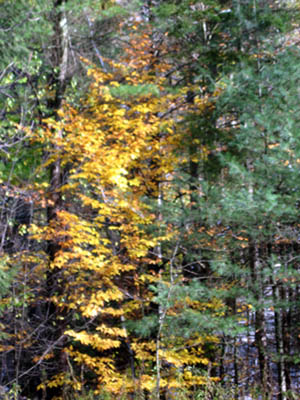
And golden till the end — leafy kin — a young maple in our back yard, shouldering its way up among larger pines.
What can I ask, and what will they teach, tell and declare?
Isn’t everything open and shut at the same time, the glory and the wretched side by side, the fox killing the hare, the wonder of sunrise, a birth and a death both?
But what of the between, where we all live, where it is often neither? The third way we pass over, because it constantly moves with us, never stopping to be wholly seen or felt, a shadow at our backs, a light in front of us, a suspicion of beauty and the marvelous: peering through the grime and fog of a dirty window, a commuter on the way to work, waving; a bare branch with exactly seven sparrows wing to wing, puffed against the cold; the surprise of light on water, perfect mirror; a child’s unflinching gaze. O my world, altar of how many things to see and know and suffer and enjoy and give up and welcome again, how can I do anything else than love you, in the end?
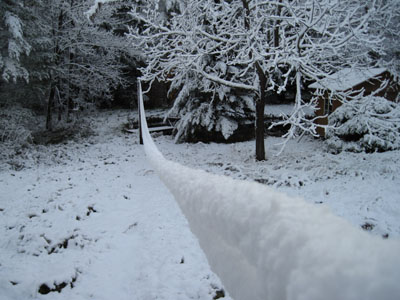
After a gentle, wet snow last night, the landscape is transformed.
The light before sunrise paints everything a lovely gray-blue, and in the stillness you can hear snow falling from branches as the temperature slowly rises. Minute by minute the scene changes, so I hurry to photograph this brief beauty.
Our clothesline has quadrupled in size with its snow sheathe.
Even as I hurry to capture these images, still in the shade of the hill to the east, the tree-line across the road receives the sun, and the yellow leaves still on the trees begin to show through under the snow.
A few hours later, with the temperature risen to the mid-30s, the trees stand mostly snow-free.
We’re a few days from the old Celtic harvest festival at summer’s end. For those of us the northeastern U.S., with the recent frosts and snow in the forecast, it feels like summer’s end as well. As a time of endings and beginnings — the new year begins as the old one ends — it is a time of introspection, intuition, dream and creativity. As an acknowledgment of change and completion, it can also include a remembrance of the dead.
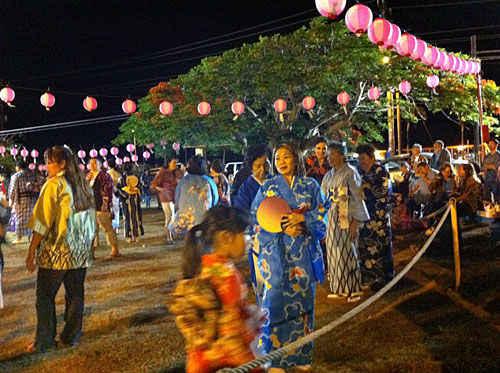
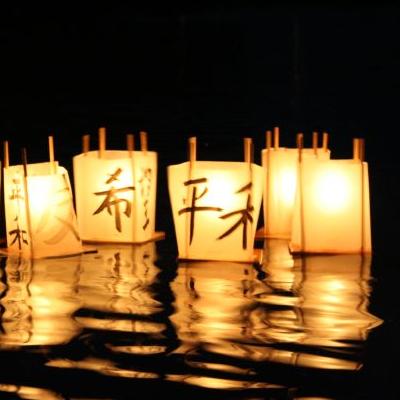
The holiday was adopted by the Church and transmuted to a three-day observance from Oct. 31 to Nov. 2. It begins the night before, on All Hallows Eve*, or Hallowed Evening (Halloween), continues with All Saints Day, and concludes on All Souls Day. In many other cultures there are similar observances, though not necessarily all on the same dates. Spanish speakers celebrate Dia de Los Muertos, and Christian Arabs observe Yom El Maouta, both meaning “Day of the Dead.” The Japanese observe O-Bon, remembering and honoring their ancestors. Held during July or August, depending on location and local tradition, the holiday feels to me (I lived in Japan for two years) like a cross between Halloween and the Fourth of July. Originating as a Buddhist observance, it also includes a dance — the bon-odori — to give thanks for the sacrifices of ancestors, fireworks, carnivals and a concluding Lantern festival, imaging the return of the souls of the dead. This Asian holiday captures the Druid spirit of Samhain for me: celebratory yet reverent, and family-oriented.
Druids and other Pagans have adopted the older Celtic name of Samhain or Samhuinn (pronounced approximately SAH-wen or SOW-en — the “mh” in Irish spelling indicates a sound like “w”) — as they have other Celtic names, since for them the holiday has association and symbols different from those current in the Church. The “sam-” is cognate with English “summer” — the word means simply “summer’s end.” (Christian anti-Pagan propaganda tracts like this one ignorantly and wrongly portray Halloween as “The Devil’s Night” and “Saman” as an evil “Lord of Death” — scroll down to the 15th frame. No evidence exists for a Celtic deity with that name and association. Besides, American commercialization of the day has obscured the invitation of its spiritual potential, though it remains still at hand. Somehow Americans also seem to have trouble achieving both “mirth and reverence,” as the “Charge of the Goddess” in the Wiccan tradition exhorts us.)
At the school where I’ve taught for a decade and a half, students themselves often took the initiative to celebrate this autumn holiday. Some two months into the school year, with exams looming and — for the seniors — college apps drawing more and more of their attention, they still found a supervising adult so they could get official permission and use school meeting areas, put up posters to invite everyone who wished to attend, and write their own rituals. I’ve saved several years’ worth of photocopied ceremonies in wildly varying degrees of elaboration, and I’ve attended both large and small gatherings, indoors and out. Some were largely excuses, it’s true, to dress up in capes and masks, light candles, scare and amuse each other, and then gorge on candy afterward. But others were moving commemorations of the season, an opportunity for acknowledgment from everyone who’d lost a relative or friend in the past year. The event helped acknowledge grief and cleanse the emotions through a group ritual of shouting and crying, burning messages in a cauldron, and closing with a group meditation. If the larger culture doesn’t make room for such things, subcultures often do.
The autumn equinox last month was the first time I celebrated that holiday as a Druid, and with fellow Druids, at the East Coast Gathering. In my part of the U.S., Druids are thin on the ground, though a couple of us are considering a small gathering. But whether or not in the end we manage to find time for a group celebration, I’ll also observe the day myself, this marker of moving in time and experiencing the fullness of human life.
/|\ /|\ /|\
*”All Hallows Eve” precedes the day dedicated to the hallows or saints (Old English halga) — All Saints Day.
On other blogs, I’ve also looked at practices and perspectives found in many places, Druidry among them, that are forming part of new-old ways of living on earth. The video below captures something of what I’ve found in Druidry. It’s got a nice flute solo and some good nature images. How were you planning to spend the next two and a half minutes, anyway?!
For those of us on a Druid path, Druidry comes to mean more than the pleasure most of us find outdoors under a sunny sky on a beautiful afternoon, because it has something to say to us all on dark days as well as bright ones. [For some of the ideas in the second paragraph, the quotation in the fourth, and some of the questions in the fifth and sixth, I’m indebted to an article in The Utne Reader by Larry Robinson, about the emerging field of ecopsychology.]
A range of voices — scientific, religious, societal, educational — have told us for a long time that we are individual, distinct objects in a world of other objects. We are our bodies, and our bodies are machines — sophisticated ones, but machines nonetheless — and the problems we experience are mechanical ones: we need tune-ups, adjustments, fixes. We are imperfect, weak, broken, sinful, damaged by our parents, our childhoods, heredity, our own human nature or the cruelties of other people who deny us what we need. But with the appropriate training, teaching, medication, treatment, therapy, alignment, adjustment, we can regain optimum functioning and get back “on track,” into the “grind,” the “swing of things,” the “race.”
If we look to most advertizing, we’re told that the solution to our unhappiness also lies in things. With the right food, clothes, phone, car, drink, partner or credit card or (carefully marketed) “experience,” we ‘ll find the fulfillment we’re seeking. The nagging malaise we feel will abate — some thing can fill it — and company X or service Y has just what we lack. It’s quite simple. We are things. Our problems also lie in things. The fix is a thing; find the thing, and get fixed.
But if we dull and drug the deeper lack by treating it with the surface stimulus of a “thing,” something else happens: “when we treat only the ‘presenting problem’ and fail to address deeper existential concerns, our silence on these issues communicates that we find them insignificant.” By refusing to let the real issue emerge, we shunt it off to the side, we disguise its potency and drive it deeper. Our “fix” just damages more, like a bad patch job when it gives way just tears a bigger hole. From such acts, whole cultures can decay. If the emperor has no clothes, and everyone follows imperial fashion instead of telling the truth, when winter comes, large numbers will get frostbitten. Such deeply embedded cultural deceptions can erupt into concrete, far-reaching physical consequences.
Thus the questions we’ve been given and told to answer are “What’s wrong with me?” and “What do I want or need?” “How can I get it?” and “Who can sell it or give it to me?” Druids acknowledge that we must breathe and eat and drink to sustain bodily life, but pose different questions for us to consider in place of the others above:
What’s my place in the world? Not socially or economically. We might also ask it this way: where am I–literally? What am I connected to? What sustains me each day? What do I have to be grateful for? What comes to me unasked, unsought? How does the world around me provide air and water and food? Who else is walking with me through the world? What is their place in the world? What sustains them?
I’m picking up on Steve Schwartzman’s recent comment here for a title to this post: “happy hunger.” We usually think of hunger as a “simple” biological drive, the body’s impulse towards food or sex or life. Yes, as sometimes conscious beings we can override our hungers, at least up to a point, for some other purpose. But to think of these or any hungers as “happy” I take as a prod in a good direction — a pointer, a reminder, a prompt that a shift in attention and consciousness is possible and has arrived full of benefit.
So what of other hungers? A hunger for connection, a hunger for the sacred, a hunger for contact with the natural world — all of them vital hungers which we struggle to answer and fill each day. And so many “unhappinesses” when we don’t meet these hungers — crimes and random behavior and restlessness and secondary hungers for stimulation — sugar, fat, salt, second-hand sex (porn), alcohol and drugs (to change awareness any way we can!), gossip, fits of temper, violence — these stem, I know at least in myself, from unfulfilled primary hungers, from attempts to shift consciousness out of the bland, boring, mundane, even unreal sensation of “just existing.” As if life, the most real or literally “thingly” thing we experience, could also be “unreal.”* (Which it also is. And that’s neither a good or bad thing, but part of the way the universe apparently works.)
Those of you familiar with psychologist Abraham Maslow’s hierarchy of needs know that, in his schema, these other hungers, and especially the hunger for the sacred, aren’t considered the “largest” or most “immediate” ones at all. They’re at the top of his hierarchy, most distant from Maslow’s naming of our “primary” needs for food and sex and safety. But I’d argue that in fact the need for the sacred is our primary hunger, and that all the rest fall in line behind it. The less we’re connected to the sacred, the more we’re just flesh machines. Fortunately we’re always connected to some degree — that’s what being alive is. The task is to blow the spark to fire, to nourish and feed that singular flame through and with all the others, so that eating and lovemaking and all the “daily-ness” of our lives, potentially everything, becomes sacrament, a door for the sacred to enter this instant, right here, and transform us. It’s what Christians call the abundant life, what Zen means by satori, and what we all experience in those transcendent moments that do not last because we also live through the (potential) sacrament of time, that sweeps us ever onward to the next, the latest, the new. A physical world can only manifest eternity as time. And our next task is to see time our ally, to make it and to know it as a sacrament as well. Not as endpoint — it can’t be that, in its ceaseless flow — but as ongoing opportunity for practice and reverence and worship.
So the “happy hunger” is the hunger that connects us, the hunger we recognize and welcome and honor. As a Druid I have a tool-kit to make room for the sacred, to invite and witness it around and within me and all whom I meet, to increase its presence in my consciousness, and then to bring more of it into my world and surroundings and atmosphere and aura and presence, so that others may encounter it, too, and access it in their own lives. We all have access points to many ways to do the same thing. The tools aren’t what’s lacking. It’s the courage and love and trust and responsibility to make use of them for our own good, for the good of the whole. This is my prayer and my goal for practice, my ritual and my path. May you strive and realize, delight and rejoice, as you discover and find your own.
/|\ /|\ /|\
*”real,” from Latin re-alis, “real, thingly,” from re-s, “thing, matter, affair.” Thus the “real” means simply whatever is a “thing,” and so the “unreal” is the realm where distinct “things” disappear, where there is a whole, a network, an interplay, an eco-system, and not a collection of separate things to be counted — the “real” is whatever we can count, or assign a number to. And so then of course we turn around and protest that we’re not just numbers to be counted, we’re not just statistics, or collateral damage, we “matter” (odd use of the “material” to point to the sacred!). Here is our recognition that the spark in us is sacred, that it knows more that “this.”
I am a whisper under the moon’s shadow, a song heard from the next room, a melody hummed under the breath;
I am the first bird to the feeder, the last star before dawn, the rain before the rainbow;
I am what I have forgotten so I can remember it again, a question at the altar, the answer of green leaves unfolding;
I am wherever the long dream draws its curtain, when I listen to the voices of ancestors, where the winds find their resting place;
I am why the swallow dips in flight, I am the luck of dice still tumbling, I am the interval when I can say these things.
/|\ /|\ /|\
Early Irish and Welsh poets such as Amergin and Taliesin composed related poems in the form of “I am” or “I have been” statements, with imagery drawn from nature, which I’ve imitated here. The Song of Amergin is one famous example which has survived in different versions.

 So you say I’m just supposed to up and cull out-of-date beliefs and dump them? Easy to say (or write), harder to do. One of the most useful items in our spiritual tool-kits is gratitude, the WD-40 of spiritual life. As a solvent, it can loosen hard attitudes, stubborn beliefs, closed hearts and dead growth. We may think of gratitude as an often wimpy sentiment — something softhearted — but I like to call it the grr-attitude. It’s an attitude with teeth, and helps us build a “spiritual firewall” against destructive energies.* Every life without exception, no matter how hard, has something in it to praise and be thankful for. Gratitude, along with persistence, can show us how to make do when every other avenue seems closed. It’s the great “life-unsticker.” It moves us out of spiritual ruts and ravines like nothing else. In fact, an entire life spent in gratitude and persistence, without any other “spiritual garnish,” could carry us remarkably far. It would be a very full life.











 A Druid Way