(Because when I pick up what I think is just one thing, a whole universe comes with it … Most days, that’s a good thing.)
You can of course find Proto-Celtic songs and their lyrics on Youtube. (What you do when you find them is another matter.) I say “of course” because if someone’s thought it, it already exists in some form, waiting for manifestation. A magical rule I keep forgetting.
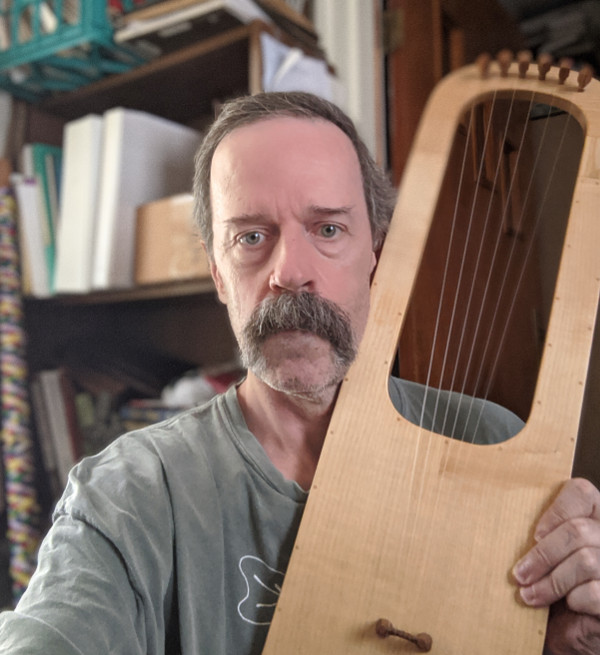
Sometimes we inherit an instrument, sometimes a longing, sometimes an echo of the words or the tune. / Me with a reconstructed Anglo-Saxon hearpa or lyre.
“The three pillars of achievement”, as the old Welsh triad goes: “a daring aim, frequent practice, and plenty of failures”. Can I “fail” in a search? Only if I “give up”. And that’s the past — it says nothing about what I may do in the future. “Work in Progress” is the only t-shirt I need …
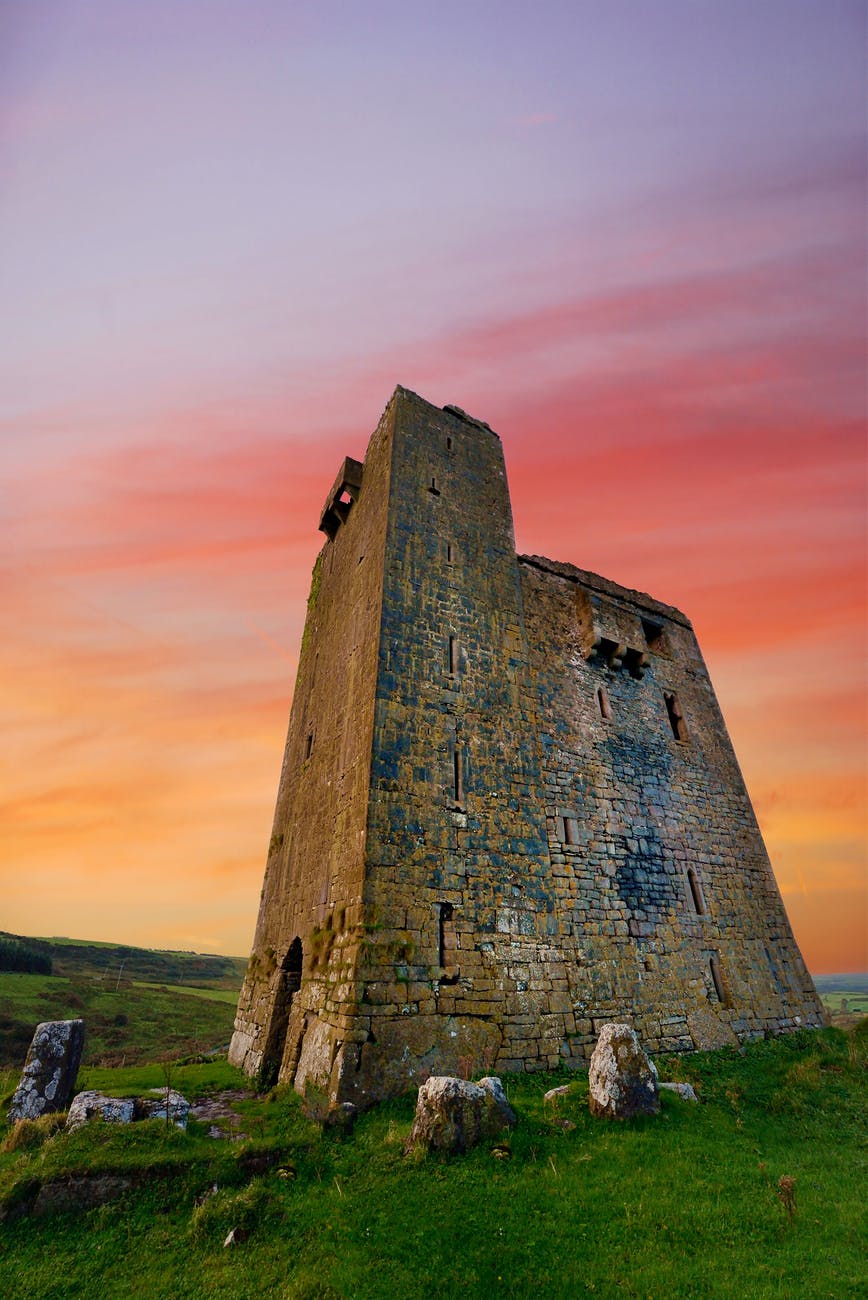
Tolkien’s metaphor of the tower — may it live forever! — fits here. It first appears in his seminal 1936 essay Beowulf: The Monsters and the Critics*, and he was one of the critics, so he should know. You can sense it already: he was gazing at something others simply did not see. Because of him, now we do. Anyone who works in a tradition (or wants to found one) confronts these challenges.
A man inherited a field in which was an accumulation of old stone, part of an older hall. Of the old stone some had already been used in building the house in which he actually lived, not far from the old house of his fathers. Of the rest he took some and built a tower. But his friends coming perceived at once (without troubling to climb the steps) that these stones had formerly belonged to a more ancient building. So they pushed the tower over, with no little labour, and in order to look for hidden carvings and inscriptions, or to discover whence the man’s distant forefathers had obtained their building material. Some suspecting a deposit of coal under the soil began to dig for it, and forgot even the stones. They all said: ‘This tower is most interesting.’ But they also said (after pushing it over): ‘What a muddle it is in!’ And even the man’s own descendants, who might have been expected to consider what he had been about, were heard to murmur: ‘He is such an odd fellow! Imagine using these old stones just to build a nonsensical tower! Why did not he restore the old house? he had no sense of proportion.’
But from the top of that tower the man had been able to look out upon the sea.
That’s the measure I want to use: does it let me “look out upon the sea”? On the face of it, that seems quite a modest goal, nothing like the “daring aim” that the triad describes. But in a world where some people seem intent only on pushing over towers, such an aim becomes strikingly subversive — even dangerous. Look out upon the waters for yourself, and you no longer need a “secondhand sea”. You’ve seen the waves yourself, heard the crash of surf on shore, felt the spray on your skin and the billows lapping at your bare toes, tasted its metallic salt.
About “restoring the old house”: sometimes that’s not possible. Sometimes what we’re restoring isn’t anything “old” at all. Or if it is: reviving a (nearly) extinct language is an enormous undertaking — a daring aim indeed. It can be done: Cornish, Hebrew, Manx — we have evidence before us. “Is the juice worth the squeeze”? Sometimes we won’t know till afterwards. Sometimes the deed itself is enough.
/|\ /|\ /|\
If I look at some of my own UPG, my unverified personal gnosis, like my experiences with Thecu Stormbringer, how does any of foregoing apply?
With Proto-Celtic we have considerable evidence from six Celtic languages. We have a science of historical linguistic reconstruction, tested on an increasingly widening sample of languages. We have a community, albeit small, interested in the results, whether they’re able to take part in the process or not.
The few words associated with Thecu that I’ve recovered — imagined — invented (can I always tell the difference? Can anyone?) are hardly enough to base an entire language on. Or are they? I have a friend who follows a different path, and who’s recovered? — received? — imagined? a language of several thousand words over the course of a few weeks. He uses it as a religious tongue, writes rituals in it, prays through it, writes about some of his most valued experiences with it. It continues to develop — or he keeps working at it, expanding and discovering it. For him it’s a living thing, part of his “tower”, to pick up Tolkien’s image again. The “sea he can look upon” exists in part because of that language. Validity? Authenticity? For him any answers lie in results. Such questions, he says, are theoretical beforehand, and irrelevant after. (In the process, their usually just distractions.)
Ireland — abandoned tower. Frans van Heerden / Pexels.com
“Of the old stone”, Tolkien counsels us, “some has already been used in building the houses in which we actually live, not far from the old houses of our fathers. Of the rest we can still take some and build towers …”
If we meet only silence in the face of our need, we can listen. If we listen with intention, knowing everything we bring to the moment, we may gain lyrics. From the deep I bring it, sings Taliesin. Words, after all, are one abode of the divine. And the melody? For the music, we have what awen and the gods open up for us. Where after all did our ancestors find their songs?
/|\ /|\ /|\
Sometimes we inherit an instrument, something the longing …
*Tolkien, J. R. R. The Monsters and the Critics and Other Essays. Harper-Collins, 2007.
Behind that particular recent search topic, among all the other searches that my blog utilities show are made on this site, lies a whole world of wonder.
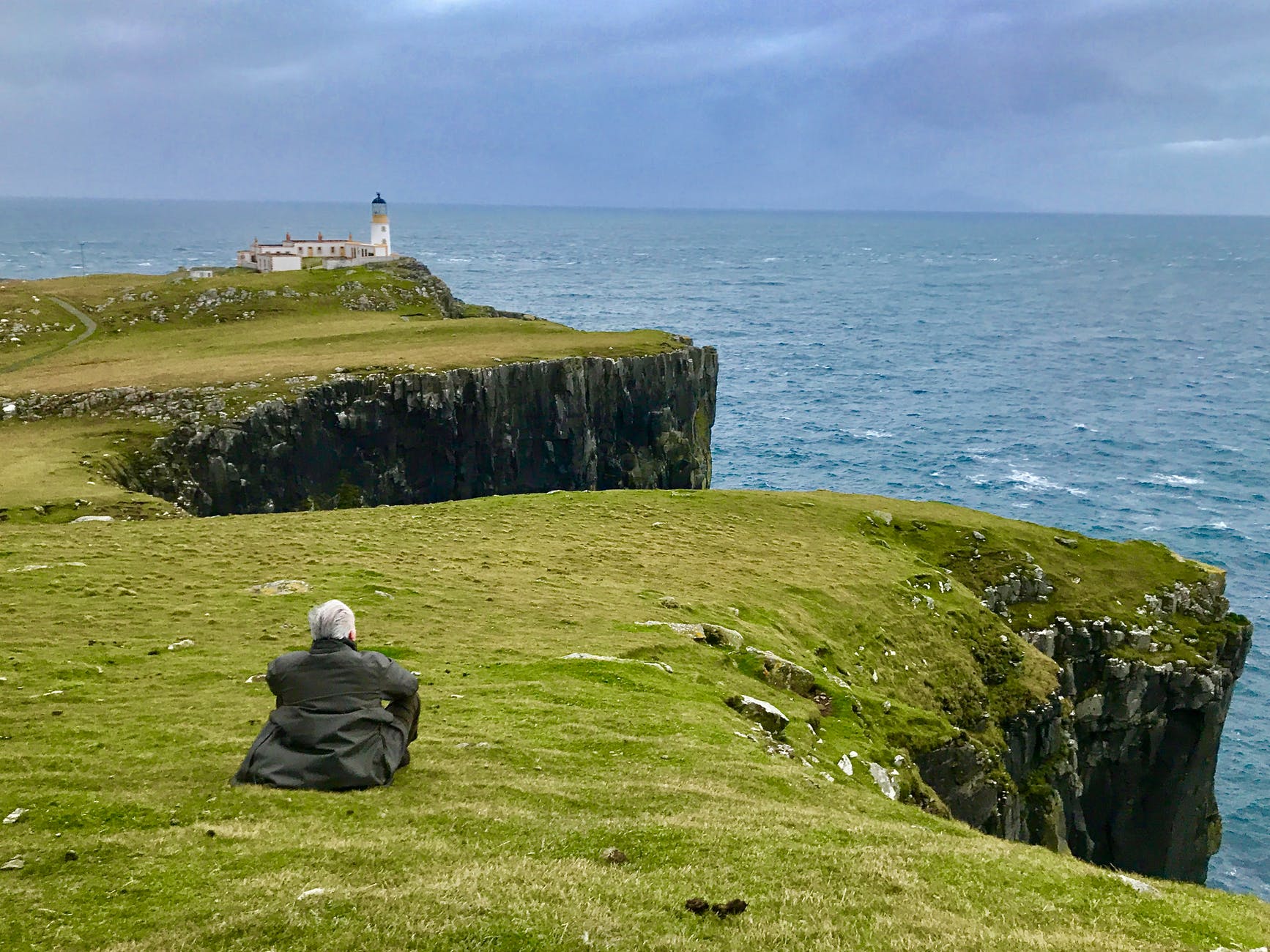
What’s the weather on your inner sea? / Photo by Lynda B. / Pexels.com
In spite of appearances — which I find myself saying a lot these days, appearances being the slippery things they are — we often have an intuitive sense of what we’re looking for. Would I recognize “Proto-Celtic song lyrics” if someone posted them online? What would they look like? What inner knowing would confirm them for me? And what melody or rhythm would I use to chant or sing them? Perhaps asking for and incubating a dream experience with them is one direction that could prove fruitful for the querent. I’ve add that to my daybook as a meditation theme for just before sleep.
Underlying these questions at least in part is a thirst for authenticity.
Wyoming — Devil’s Tower, but ‘Bear’s Tipi’ in Lakota/Todd Trapani/Pexels.com
For a useful parallel, I returned to a Youtube video I watched recently, on the native Lakota people of the north central U.S. “When I speak Lakota I feel connected”, says a young Lakota woman around the 1:10 mark. “I feel connected to all my relatives in the previous generations … There’s nothing to compare to the feeling of being Lakota, in Lakota country, speaking Lakota”.
Language and identity are core issues for many Lakota, as they are for many tribal peoples facing challenges to their existence. Do modern Druids feel that native speakers of Welsh or Irish or Scottish Gaelic or Manx or Breton or Cornish are somehow more authentic as Druids? How much of that feeling arises from the minority status and threats to survival that the Celtic languages also face, though on a different scale than those facing the Lakota? I have no answers here, but I have a lot of questions.
The same program “Rising Voices — Hótȟaŋiŋpi — Revitalizing the Lakota Language” includes a segment at around 6:10 where a Lakota TV interviewer announces the day’s program topic as “the Lakota language” and asks several young Lakota a series of questions: “Did anybody speak the language when you were growing up? How much of the language do you need to speak to be an Indian?”
Their answers range widely: “A lot. None. I don’t know. Lots and lots …”
The interviewer keeps probing: “What if you used to speak the language, but you forgot it?”
Confused looks. Nervous smiles. Different answers.
“OK”, the interviewer continues, “what if you don’t speak the language? Are you suddenly not an Indian?”
Again, bemused answers. “I guess. No. Maybe. My tribal card says I’m an Indian, so I guess … I don’t speak it …”
“OK”, says the interviewer, “how about if you speak the language, but you also shop at Walmart, and you drive a big American truck? Are you more or less of an Indian?”
“Depends on the kind of truck” says one person, with a smile. “[You’re] maybe more” [of an Indian], says another. “[Nervous laughter.] I don’t think you’re ‘more’ or ‘less’ … [In Lakota, with subtitles: ‘I love Walmart’] …”
The interviewer pushes on. “What if you’re white and you speak Lakota really well?”
OK, you get the idea.
Many of us are instinctively reaching for a vehicle or a means or an access-point that will help us achieve the sense of deep connection that the speakers of Lakota feel and expressed above. Insofar as this can mediated through language, then learning an ancestral language may help. Or if you’re of German descent, for example, but Irish calls to you, learning Irish may be a way to show respect to a tradition you value, and one you long to understand more fully, regardless of your bloodline or ancestry. (Besides, who knows who and what and whose you were in a previous lifetime?)
Druids on other continents, where other and non-European languages have long been spoken, confront similar issues. Fortunately, from what I’ve experienced on my own journey, the spiritual world senses, values and responds well to honesty, and searches our hearts and our intentions, not just the particular language we happen to be using. We needn’t wait for fluency in our chosen ritual or spiritual language before we can live a spiritual life. But we might consider how the act of learning a language with such associations and history is itself a ritual gesture with its own consequences. To say, write, and think certain words and not others has a power we can draw on for more than we imagine.
C. is a friend of mine with a doctorate in archaeology who’s worked with many North American tribal peoples as a trained consultant and is learning Ojibwe online from a Native teacher. The class includes both Ojibwe and non-Ojibwe students. For C. it’s a worthwhile use of his time in lockdown. Over the decades he has made friends among Ojibwe speakers, he appreciates the cultural insight, and it engages him because it’s about communication, something he’s spent much of his professional career doing. He’s testified as an expert in court cases, advocated for Native rights, worked on the repatriation of cultural objects and remains, and so on.
I’ve picked up the merest handful of Ojibwe words from him during our socially-distanced breakfasts that ended with Vermont’s recent stricter pandemic policies. So when he says something in Ojibwe and explains it — often a greeting or farewell — at least I can say gidash “you too”. I may say it wrong, it may not even mean exactly what I think from my brief acquaintance with it, or it may actually be used in different contexts than how I use it, but my intention remains, nonetheless: you matter. I learned this expression from him and I use it for that reason with him, for a small moment of human solidarity.
Spiritual solidarity spreads outward from there. What language do I use to make spiritual connections? Is my heart in it?
/|\ /|\ /|\
I value the teachings of Druidry, and appreciate the Celtic origins of many of them. But I also find myself drawn to Old English, a different “cultural stream”, though I don’t feel an equivalent draw or tug toward Anglo-Saxon Heathenry, or Asatru or anything similar. Here and there I’ve put pieces of OBOD ritual into Old English on this site, I teach Old English classes online, while I still work on a constructed form of a Celtic language, as I’ve also documented in past posts.
I wrote earlier in this post about “access-points” — portals or paths that give onto a realm where we can more easily connect to what we are seeking. While some spiritual teachings attempt this by holding out a specific sets of beliefs or a creed, Druidry and others suggest that a practice and a toolkit of techniques like an ancestral or cultural language may help in accomplishing this goal.
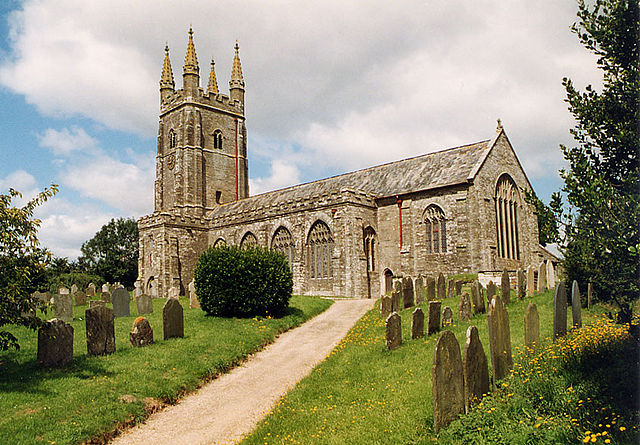
Thus, knowing that at least one branch of my family tree is rooted in Kingsbridge, England offers me one kind of access point, through a place and a people. Places can seem near-eternal, though anyone who’s lived to see strip malls, parking lots and new apartment buildings rise in a former pasture or woods knows how unreliable that sense can be. Still, when I encounter older versions of the town’s name in records — medieval Kyngysbrygge, Anglo-Saxon Cyningesbrycg — I know a connection to place, to where some of my ancestors are buried, though I may never set foot in it. And through the magic of the internet I even know what some of the landscape looks like, though I haven’t (yet) smelled the air or felt the earth beneath my feet.
Now that’s admittedly a tenuous and vague experience, compared to speaking an ancestral language. It can feel at times that people of European ancestry in this lifetime minimize or even disown their own ancestors, out of shame at colonialism, or simply because they’re “not interesting enough”.
Yet such experiences as tracing a family tree, and finally being able to name a place where one’s ancestors lived and died, can also be a portal, and I can use it to access much more. Names can take us far indeed. We know the power of being called by our name. Extending the principle of “as above, so below” to the same-plane version “as here, so there”, what do I imagine other beings and places experience when I know their names and use them with love and affection and a request for their wisdom and assistance? Calling a rock formation on your land Bear’s Tipi is qualitatively different from naming it Devil’s Tower, whatever language you use. If we don’t yet know that truth, it lies within our power to discover it.
In his most recent post, John Beckett writes of five of his mistakes as a Pagan. They’re instructive to reflect on, because most of us have made most of them in some form, regardless of our own unique journeys. (If I think any one of them doesn’t apply to me, I probably haven’t dug deeply enough.)
John names them like this: refusing to start at the beginning, trying to ignore the gods, waiting too long to start attending Pagan gatherings, not working more magic, and assuming other people share my vision. Or as I might paraphrase them to fit my circumstances, forgetting the foundations, ignoring spirit, resisting the gifts of community, renouncing my own power — and assuming other people share my vision.
Fortunately, “learning from my mistakes” is something we all are working on all the time. It’s one of the most magical things we can do, transforming a past mistake into a piece of wisdom for ourselves and for others. No mistakes, only ongoing projects.
We don’t have to “go anywhere” to contact the sacred.
“Everything that lives is holy”, William Blake declares. Fine, Billy, but how do I reconnect when I’m just not feeling it? In my better moments I may know it’s all holy, but I’m kinda down right now, dude, and I could use some help.
Druidry, after all, delights in “doing something” as a spiritual solution to many problems. Christianity may stereotypically insist “Ye must be born again!” as a prerequisite before anything else can happen, while Druidry as stereotypically suggests “Let’s go for a walk in the green world”.
What if neither of these is a viable option at the moment? Suicide hotlines get callers who’ve often tried every option they can lay hands on, and they’re still suicidal in part for that very reason: nothing’s working. And even those of us not in crisis at the moment can feel overwhelmed by events beyond our control.
If we step even one pace beyond the stereotypes, we find in counsel like “Be still and know that I am God” a place where Druidry and Christianity can draw closer. Something happens in stillness that all our elevator music and muzak and noise and ranting and partisanship try to overwhelm but cannot silence, because it is already silent. What is it?
In a post from Oct 2017 I wrote:
“The practice of sacramental spirituality can be pursued apart from the various pathologies of political religion”, notes John Michael Greer in his essay “The Gnostic Celtic Church“. In sacrament rather than creed lies one potent meeting-place for Druid and Christian.
What to do when one of our most human, instinctive and immediate responses — to touch each other in comfort with a hug, a hand on a shoulder — are actions dangerous to our health?
If the sacrament of touch is denied us, what other modes does spirit have?
The Sacrament of Hearing
“The Voice of the Beloved sustains us”. Whether it’s a telephone call to or from that particular person, or a special video, or piece of music, sound can carry us into spirit. The human capacity for memes and mantras and ear-worms is one we can use to our advantage. Set up what I actually want running through my inner worlds, and I’m halfway home.
And — paradox alert, because that’s much of human experience — in the sacrament of hearing, of listening, we may hear what is singing behind the silence …
Kaisenkaku Asamushi Onsen in Aomori prefecture, northern Japan / Wikipedia /
The Sacrament of Washing
Taking a bath or shower, and visualizing the gunk leaving our bodies down the drain and away can be a spiritual practice. Many traditions urge sacred bathing. (Besides, in lockdown we can let ourselves get pretty grody.)
A Hindu turns if possible to Mother Ganges, Catholics visit holy sites dedicated to manifestations of Mary, it’s a lovely Japanese custom to visit an onsen, and followers of Shinto and plenty of non-religious people as well find hot springs, saunas and mineral pools to be restorative.
The Sacrament of Blessing
Seven words make up a lovely blessing some of my friends use often: “Bless this day and those I serve”. If I live by myself, I’m one of the people I serve. Let’s remember to bless ourselves. We need it. Pets or other animals, and houseplants, may rely on me for food and shelter and affection, so I can add them to those I bless. Outward to friends, neighbors …
What else can I bless? Asking that question thoughtfully can open many doors.
The Sacrament of Prayer
Prayer has long been a potent sacrament in the lives of many. The words and sounds can help restore our connections to spirit, partly because they’ve done so in the past. Like a spiritual battery, they’ve accumulated a charge. We jump-start more often than we realize.
The words of the Druid’s Prayer, or of a song or poem not “officially recognized” as a prayer may turn out to be your prayer. Sometimes we need something even more compact — just a few words from a longer form, a sacred name, a whisper — or a shout. If you’re alone, that’s easier. Try it, and note the power of prayer at the top of our lungs.
One simple prayer available to everyone is simply breathing. We hear in the Gospel of John: “The wind blows wherever it wants. Just as you can hear the wind but can’t tell where it comes from or where it is going, so you can’t explain how people are born of the Spirit”. Experiencing the spirit in our own breathing is a doorway for some. It’s there — sacrament in the life action of our bodies.
You may see in several of the above sacraments how touch has managed to find its way to us. Hearing involves sound waves touching my ears, bathing makes me intimate with water, and so on.
The Sacrament of Cooking and Eating
Some of our most common acts are sacramental in potential, and we can activate them by according them the respect they’ve earned in our lives. Food and drink keep these bodies alive and moving. Preparing food has often been a holy activity, at least around our holy-days, if not every day. Combine eating with blessing, as many do, and I can heighten my awareness of spirit-in-substance. A blessing on the incarnate spirit which sustains us.
The Sacrament of the Image and Object
Photographs, statues, objects collected from a walk or a ritual or as gifts from another — all these things bear a power to tend us. They can evoke memory, their physical substance is imbued with all the times we’ve handled them before (touch seeks us out, once again!), and they have a power to shift our attention to specific places and times.
The Sacrament of Ritual
I talk a lot about ritual here, because we all do ritual constantly. Each of the sacraments above is a ritual, or has ritual elements in it. Part of the sacrament of ritual is to recognize how many things can become rituals — and more importantly, how much of their already-existent ritual power helps shape and influence and move our lives.
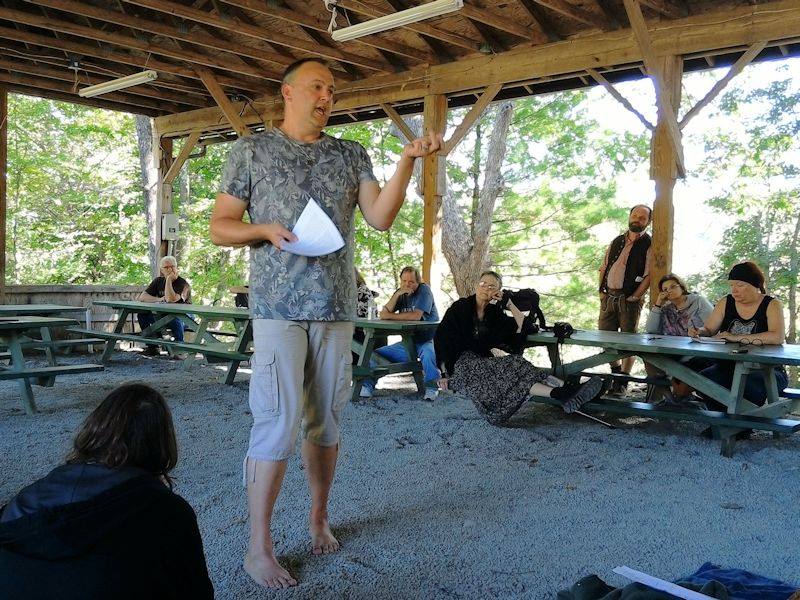
A barefoot Kris Hughes, recreating Iolo Morganwg’s simple summer solstice ritual on Primrose Hill in 1792, at East Coast Gathering 2015. Photo courtesy of Dana Wiyninger.
A friend of mine makes a ritual out of starting to write. He lights a candle, or some incense, and invites the muse of the moment to his writing project. A few other friends explore the meditative and sacramental power that wood-carving and weaving and knitting have, as well as enjoying their concrete manifestation, resulting in useful objects and garments.
May you find and feed your lives with sacraments that mean and matter to you.
A good metaphor gives you a form, a shape to attach stuff to. If you have a free mantle or shelf, you can arrange pictures and other beloved objects on it. On Halloween, out come the black cats and the carved pumpkins. With a Christmas tree, you’ve got a place for the decorations that live most of the year in a box, in a basement, closet, or attic. Here’s a menu — a useful metaphor for any spiritual tradition.
Sometimes we need to pass through a portal in order to see a new menu. Or sometimes just turn a page. What metaphor works for you? Which ones “become real”? Photo by Daria Shevtsova on Pexels.com.
Most traditions share at least one feature of their menus — they urge you to a daily practice. What shape that takes can be remarkably varied. But you generally know where you are with the daily menu. You’ve got your go-to’s. Like exercise, the morning or evening prayer or meditation or ritual or reading or other exercise or observance helps you keep in shape. Not only does each day tend to go better as a result of your improved spiritual and physical muscle-tone (you sleep better, you’re more flexible, you bounce back sooner), but you’re building a foundation for bigger things, too. You’ll be better able to handle the inevitable next set of changes.
That includes both challenges and blessings. Which is which can depend on my daily practice more than I anticipate. One thing becomes another, in the Mother, in the Mother, sing the Goddess-worshippers.
My wife and I do a short chant each morning to re-align and tune back in. (To what? you ask. Well, what do you want to connect to? There you go.) On those handful of days every month when we neglect it, we feel the lack. The reason doesn’t matter — the intrusion and bustle for a scheduled appointment, an unexpected phone call, a minor household emergency — something intervenes and calls us away from our routine. Both of us have our own individual practice, too — we just like to build couple energy as well. It’s something we’ve added to our lives, and now we can depend on what we call “positive inertia” to keep it up. Using our human habit-making tendencies to support a spiritual practice can be a winning strategy, especially if you tend toward laziness like I do.
The menu for my day is my regular practice, along with whatever longer-term project or planning I’m doing. A piece of that can be reading. It’s almost always writing, even if that’s just in the margins of my reading. Talking back to books, to other writers. Every few days, it includes posting here. (And thinking about and drafting posts, some of which will remain in draft form.) In cold weather, building a fire, which for me is both a practical and ritual act. In warm weather, hanging laundry on the line, which is likewise a form of concrete worship I’ve come to appreciate.
Sometimes the Specials are the “discoveries, insights and unexpecteds” that arrive in everyone’s day, if we give them even a little space to flower. A practice can help that to happen. The dream fragment, the chance comment, the meditation image or sensation or hunch, the phrase in my reading or in the day’s conversations gets into my journal, or not, depending. If it does, it’s one more help, one more gift. One and one and one and one and one do accumulate over time into a weight and a presence that have increasing value. And much of that value is how they talk to each other, echo and comment on and reinforce and confirm. Patterns, tendencies, directions, guidance, a path — a lifetime.
We encounter the Specials also in the larger events, like a full moon and a new moon every month, and every six weeks or so, one of the “Great Eight”, as I like to call them: the seasonal festivals of modern Pagan practice. They’re paired — the solstices and equinoxes that whole planet experiences, and the cross-quarter days of Celtic record, with their evocative names of Samhuin, Imbolc, Beltane and Lughnasadh — the four holidays of choice, you might say. Then all our individual and family birthdays and anniversaries, and the cultural holidays on the calendar of our nations.
These don’t come along every day, so their appearance pleasantly disrupts our routine in good ways. We human mysteries long for “something new” and “something familiar” in such varying and idiosyncratic proportions that no ritual calendar can wholly satisfy us. But let a friend message me with ideas for ritual, let a neighbour send a photo, let us hold a special Zoom with family far away or an online class or discussion or ritual, and the Special also takes shape. What’s on the menu? Ultimately, we are.
No, not Einstein’s famous equation: effect = mastery X cause2!
Our weird, worrisome and wondrous world is among many other things a laboratory for working out cause and effect. (In many ways, that’s what evolution is. Trial and error, with lots of discards. False starts, dead ends.)
“As above, so below” — just how far does it go? Can I ever really know?
Try out any current headline, fit it into the equation, and you see the same thing: lots of causing, little mastery, and voila! — a cascade of undesired effects from what initially might even have been a halfway-good idea. (We’ll discount our worst ideas here out of compassion for our own human shortsightedness.)
We introduce a natural predator to bring down the population of a creature we label a pest, and our solution becomes the new problem. [Wikipedia notes: “Harmonia axyridis (the harlequin ladybird) was introduced into North America from Asia in 1979 to control aphids, but it is now the most common species, outcompeting many of the native species” and is a pest itself in many areas.] We warm and cool ourselves with splendid new technologies, and end up overheating our world. We choose leaders trying out their own causes, and we become part of effects they set in motion that we did not anticipate.
If we work with the proportions that this version of the equation suggests, even a little bit of mastery goes a long way toward manifesting more of the effects we wish. A dash of cause and a truck-load of mastery looks like the way to go. Fewer broken dreams, broken bones, broken planets.
Because when I try changing the proportions — lots of cause, just a little mastery — the equation definitely shows how the effect will still be huge. It just won’t be what I wanted in the first place. Like almost any kitchen recipe, there’s some leeway once you know what you’re doing. You learn workable substitutions, you pick up subtle touches and turns and tricks, and in the process you learn a great deal of lore. (What does “season to taste” mean in this case? How much is a “dash” of cumin? How much longer should that turkey bake, since it’s bigger/smaller than last year’s bird, which took X hours? What does the dough feel like when it’s ready?)
Until then, though, I can’t exchange proportions of flour and salt “just because I want to” and expect anything other than disaster. Yes, freedom is my birthright; yes, I shape my universe and create my reality. So does every other being all around me. We’re all still learning, and our realities and universes keep banging into each other as we work through the lessons. (Often it looks like the trees and the bees already know valuable things we’re still figuring out, or are in serious danger of forgetting.)
What does mastery consist of in such situations, at least from a Druid perspective?
Much of Druidry, at least at the start, is a practice of learning how to harmonize with the many other causes all around us, human and non-human, before we barge in out of ignorance and arrogance and try to be causes ourselves. (In the old Greek myth, Prometheus stole fire from the gods and brought it to suffering mortals. In addition to cooking dinner, we’ve been burning ourselves and everything around us ever since. But is the point of the story that humans should give up fire?)
Part of it is simple math: the number of beings around me also launching causes into the cosmos far outnumbers me. Part of it is the very real possibility that over time some of these same beings may have learned things I don’t yet know, things I need to know before I set big causes in motion myself. And a third part, because threes are cool like that, is that as I learn about causes and effects from these other beings, I’ll also learn what I need for my own growing mastery.
A part of our practice is that as we learn about causes and effects from these other beings, we’ll also learn what we need for our own growing mastery.
“Doing Druidry” means we perform rituals, small or large, unintentional or highly planned, simply because we’re ritual beings. We strive to acknowledge and participate more consciously in the cycles of the seasons and our own lives. We meditate and pray, dream and imagine. We talk with trees, listening to their “slow gestures”, as U K LeGuin calls them. We study herbs, divination, the lives of birds and beast, bugs and branching things, out of amazement and empathy and neighbourliness, and simply because we find ourselves here alongside them, dying and living and experiencing what it’s like to walk around in these shapes of flesh. Occasionally a spirit or god flashes across or onto our path, and we try to find out what that means, too.
We’re called, in short, to pay attention.
Refusing to acknowledge cause and effect, yielding up our training for mastery, invites its own effects. Among the Wise in several traditions, it is said that the earth has rejected the initiation of cause and effect. In several of the older maps of the cosmos, the earth is the outermost realm. Within is the realm of emotion and imagination. And within that realm is the realm of cause and effect.
Now we “get” the physical world in many ways. We’ve become quite adept at working many of its laws of force, mass, acceleration and energy to achieve remarkable effects. And look at our cultures, with all our many images and arts and crafts, our music and stories.
We also get much of the second realm: we’ve learned how to evoke in other minds whole worlds of feeling and sensation and possibility. What we’ve just begun to do is work with the third realm, and choose whether the effects we can create should be created, and how to unravel tapestries we’ve woven that no longer serve us. We may say of the “next generation” of a thing that it’s both “new” and “improved”. While we do indeed get much of the “new”, we still struggle with the actually “improved”. Rapidly multiplying imbalances abound, and ripple outward all around us — unintended effects we often try to wish away, rather than owning. (We’re still calling many of them “side effects”, even when they’re fatal.)
One great beauty of Druidry is that it empowers people to find strategies and solutions from the bottom up. We’re directed to look to “what works”, which is an excellent rule of thumb. Druidry, you might say, is a way of domesticating a whole set of “rules of thumb” as a spiritual technology.
Cause and effect, which is our “classroom curriculum” for mastery, is also the thing that teaches us why we need mastery in the first place. And Druidry, which is after all a set of human understandings like anything else we may use to make our way through the curriculum, is one source of help with the challenges of mastery that lie before us.
/|\ /|\ /|\
Is all — or any — of this “true”? As many have said who’ve come before us, while we may never know if there “really are” gods and spirits, or magic (or a “curriculum”), the universe does often seem to behave as if they exist. I don’t know about you, but to me that’s well worth exploring for its own sake, far more interesting than spending time arguing whether or not it’s “true”. One test for truth is freedom; you know the old saying that “the truth shall make you free”. (Merely arguing about truth, without actually being free, doesn’t feel like freedom to me.) Part of my practice is acting as if I were free …
And “as if” seems right up there next to “cause and effect” as a important part of the curriculum.
The walnut, and particularly the black walnut (juglans nigra — Wikipedia link) growing in our back yard here in Vermont, isn’t included in the original oghamfews or ranks of European ritual trees and plants that Druids often work with. No surprise — the black walnut is native to North America, from where it’s been exported.
The name of the walnut itself, originally wealh hnutu “foreign nut” in Old English, supplies one hint as to why. Many Druids outside Celtic regions, where one particular set of native trees has acquired rich ritual significance, have explored sets of other trees and other attributions, sometimes coming to recognize the potential of their own local tree neighbours.
Native Americans, no slouches where natural wisdom is concerned, have their own tree lore that’s very worth delving into, and the same holds true for other regions of the globe. Trying out what actually works is a time-honoured Druid activity that can engage anyone, Druid or not, all our lives. Whether your tree neighbours are oaks and ashes, palms or olives, eucalyptus or baobab or deodar, getting to know them is often the truest part of ogham work.
One of “our” black walnuts in early October
I just finished shelling the first of two batches of nuts this morning. (The second batch arrived after a windy night of rain a few weeks ago, bringing down a second harvest from the nuts beyond our reach.) As anyone knows who’s worked with the fresh nuts, they’re messy to handle. The juices of the fleshy outer husks or drupes can stain the hands dark brown if you don’t wear gloves, and the maggots of a couple common insect pests often infest the drupe under the skin around the actual nut, without affecting the quality of nut itself.
You can find several helpful videos on Youtube about harvesting the nuts. Here’s one of the shorter and more straightforward ones that doesn’t suggest you need to buy unnecessary tools.
I choose to let the nuts sit a while before husking. They soon turn from the pale green and yellow in the video to a fairly uniform brown below. (The box lived in our breezeway for a few weeks.
The outer skins soften and the drupe may begin to decay. While husking is messier (juicier!), the skins often come off more readily.
Here are the husks from about 30 lbs. / 14 kg. of walnuts. You can readily see why the early North American settlers used the juice as a hair dye.
Several of the videos neglect to mention that you should take care where you discard the water from rinsing the husked nuts. The black walnut is allelopathic — as the Wikipedia entry notes, the tree “releases chemicals from its roots and other tissues that harm some other organisms and give the tree a competitive advantage”. For gardeners that means no garden plots within about 50 feet / 15 meters of the trunk. (With care, raised beds are exempt and can stand closer.) Blackberries and raspberries will do fine, but not much else. We learned the hard way our first year in the house, when a small plot of potatoes and corn near the walnuts amounted to nothing, yellowing within a month of germination.
Rinse the nuts a few times, then lay them out to dry and cure for several weeks. (Ours will season in the same room as our woodstove.)
Still wet from washing in our basement/utility bathroom.
Fresh or roasted, the nut meat is very flavorful. The oil is excellent in cooking, too, though we’ve never made it at home — the nuts disappear before that’s more than a passing thought.
Once dried, the nuts are admittedly hard to crack. A hammer is necessary, and even the dried nuts will still stain the fingers. There’s a reason they’re pricey in stores, and worth the effort to harvest them yourself when you can.
The two walnut trees on our small acreage are yet another reason to honour the former owner of our property, who planted so wisely. Though the USDA map above excludes New England from the tree’s range, our walnuts thrive in a natural dell in our back yard, sheltered by other trees, and watered by a small nearby stream. That personal and local association shapes part of my own walnut ogham: I too can grow and flourish outside my range, with care and attention to my surroundings and neighbours, and through the wise actions of those who came before me.
If you don’t already know Dana Driscoll’s excellent blog (Dana’s the Grand Archdruid of AODA, as well as a Druid graduate of OBOD), visit A Druid’s Garden for her wonderful post on the Black Walnut.
One of the main ogham qualities of the walnut lies in its “expelling” nature mentioned earlier because of the toxins in its roots and drupes, but many other “nutty” associations exist, which Dana mines and muses on in her blogpost.
Much of Druidry involves us in conversations. The teachings we’ve inherited point us towards potentially profound interactions with other living things in the world. Talking with trees is a perfectly normal activity for many Druids. And Druid or not, many of us know the deep connections we can experience with animals.
[Insert your favorite dog or cat or other pet picture here. You have one in your memory superior to anything I can supply.]
At the same time, we’re often occupied with exploring our inner worlds as well, engaging with everything that seems to shape our cosmos from inside out. Over 2000 years ago the old Roman-African playwright Terence wrote in one of his plays “I’m a person — nothing human is alien to me”, a line that since then has become famous on its own. With Druid sensibility, we may delete one word, change another, and simply say “I’m a Druid — nothing is alien to me”.
This doesn’t mean we love everything with a puppy love. Maybe dogs can — hence that expression — and genetic research points to genes that cause a genetic defect in people [Williams-Beuren Syndrome] but that make dogs hypersocial and capable of bonding with almost anything.
Now such affirmations (about Druids and puppies, too) are useful, because they can help keep us focused on what we’re doing, and why. We may find in them a definition of “doing Druidry”: enlarging our stock of wisdom and ability to live wisely and well in this marvelous and challenging world. With divinations either formal or gained through life experience, we ask ourselves, or get asked by our lives, two “big” questions: what’s my greatest talent or strength, and what’s my greatest weakness?
In some ways these aren’t “questions” in the usual sense. Much of our time in school rubs our faces in early answers to them. Of course, they’re mostly other people’s answers — teachers’ answers, and our families’ answers too. If they aren’t too disheartening or downright wrong — or sometimes if they are — we may take them and make them our own answers. “I’m good at X and not good at Y”. It’s even possible to live much of our lives without ever questioning those early assessments of “who we are”.
Druidry and Christianity have been talking for centuries. Study the Druid Revival, and it’s not an exaggeration to say that Christianity led to a rebirth of Druidry. For such things like strengths and weaknesses, a tradition like Christianity offers clear rules as a response, in particular its two great commandments. In the blogpost title above I call them “strategies”, because the word “commandment” often carries baggage with it. You can ignore or break a commandment, but a strategy is simply a strategy: you can try it out or not. Often, if you’re just easy with it, you may find it useful on a later spiral without any need for strain. You use it when it fits, and don’t worry about it when it doesn’t. Upaya, Buddhists call it — wise or skilful application of means. In shorthand Christian form, six words: love God and love your neighbor.
But what if you don’t believe in God, and you don’t know your neighbor?
It can be useful (“skilful means”, again) to recast such over-familiar things in new forms. Spirals, circling till we find a place to stand or sit. A Druidic version: cherish and value the living spirit that manifests in all things. And a visit to online Druid forums shows that most Druids do (if we can trust the sample size and generalize from it), in so many varying and fascinating ways. But what of the un-pretty and the less than appealing? I don’t have to “love” leeches and ticks, bacteria and viruses, but I can marvel at the ecological niche they manage to find and fill, the suppleness of their means of survival. The world abounds with life.
The corollary can be the harder strategy of the two, even in recast form: cherish the living spirit that manifests in other humans as much as you cherish it in yourself. Which becomes an amazing spiritual barometer, at least for me: my strength and my weakness revealed, linked, each circling the other like twin planets, like the yin and yang of a whole energy field.
How I treat others mirrors how I treat myself. John Donne, updated and Druidized: nobody’s an island, whole and complete, separate from other people. Each of us, peninsulas though we are, all jut out from a mainland into the ocean. If I think my “stuff”, bad and good, doesn’t feed into the common experience, I only have to recall how a colleague of mine liked to say, “Just try swimming in the non-peeing end of the swimming pool”.
One of the great gifts of Druidry is that it offers daily tasks and activities that are small enough they don’t feel overwhelming. I can sit under that tree. I can study this flower. I can read an old poem (or write a new one), practice a musical instrument, record my dreams, work with a divination system, garden, honor the spirit of the place I live, cook, paint, photograph, create beauty, and so on. Over time these crafts and disciplines and practices build into larger components of a spiritual life. Small spirals open naturally into larger ones, at their own pace. Love my cat or dog, and I’ve taken steps toward loving a difficult neighbor or family member. Love my cat or dog, and I may find things in myself I can release, live easier with, see differently, transmute. Love wisely, and I strengthen what was weak. And I can start to do this by sitting under a tree …
What are your questions and strategies? Naming them, getting them down in words, can be a gift you give yourself.
Visit a gathering of images of the human and planetary experience in places like the Photos of the Week in The Atlantic, and you soon discover the world is simply too large to swallow whole. We can’t “know it all”, or even “feel it all” in order make much of a sensible statement about it, but we can choose a part to cherish and honor and connect to, from which to view and understand the whole, precisely because everything is linked. It’s because things are linked that healing is possible. We might call that a form of Druid recognition, or humility before the awesomeness of the cosmos.










 A Druid Way

