In I Remember Nothing*, one of the last things screenwriter Nora Ephron wrote before her death in June 2012, the final short chapter is titled “What I Will Miss.” It’s simply a list, tinged with an anticipatory nostalgia that became clear in retrospect after her passing — and testimony to a life in which the most memorable things aren’t really things (unless you count people as mere objects — if you do, go away) so much as experiences. Here’s the entire list:
My kids
Nick [her husband of twenty years, Nicolas Pileggi]
Spring
Fall
Waffles
The concept of waffles
Bacon
A walk in the park
Shakespeare in the Park
The bed
Reading in bed
Fireworks
Laughs
The view out the window
Twinkle lights
Butter
Dinner at home just the two of us
Dinner with friends
Dinner with friends in cities where none of us lives
Paris
Next year in Istanbul Pride and Prejudice
The Christmas tree
Thanksgiving dinner
One for the table
The dogwood
Taking a bath
Coming over the bridge to Manhattan
Pie
The wonder and beauty of this list is that however different your list is, you get the love here. Yes, Ephron’s financial success means that among her items are Paris and Istanbul and more dining out than many of us can afford. But there’s no disagreeing about what should or shouldn’t be on Ephron’s list, because we each have our own list. Her list doesn’t negate mine. It celebrates her life while it leaves room for everyone else’s — it positively invites me, in fact, to celebrate mine, just by being a list, a tally, a memoir of pleasure.
Earth religion calls us to celebrate and cherish the things of this world because this is where and when we live. The brute acid irony of the present age, filled as it is with increasing numbers of people who say this life is the only one we get, is that it is also an age of the greatest ongoing and criminal destruction of the planet. If we will miss the things on our lists, and the quality of our fondness, if not the exact identity of our items, closely resembles that of everyone else alive now, it should make the same kind of deep visceral sense that a warm breeze on the skin or a cool drink in the throat does to help each other increase our fondness and spread the capacity for delight, and to preserve their sources, instead of denying joy to others while simultaneously pissing in the common well. If we were even one tenth the materialists we think we are, we’d worship the material, revere the physical, treating it lovingly and respectfully, rather than bitch-slapping it like an abusive spouse.
Now it’s true that if my wife and I indulged more often in even some of the things on our own lists, we’d be what her grandmother used to say of others with a sniff: “fat and happy.” And the sum of earth religion doesn’t mean merely to stuff ourselves silly with everything Dr. Oz says is bad for us, or vacuum up experiences like we’re snorting coke. But not enjoying the world is along the lines of holding your breath to get what you want. After you wake with a touch of headache, you may be no closer to getting what you want, and you’ll have missed out on pie, or butter, or bacon, or time spent with friends, or whatever your pleasure of the moment was, while you went ahead and had your tantrum. And you’ll have denied pleasure and joy to others, one of the cheapest and deepest forms of joy out there.
/|\ /|\ /|\
When I consider what if anything may survive my death (yes, even here the possessive creeps in, as though I own my death, one among the many other objects to bequeath to my heirs and assigns), it’s very likely that a love of these things won’t be among them. While I adore blueberries, and that love connects me to a weekend when I was five and I stayed with my grandmother who fed them to me while my parents attended the World’s Fair in New York City, it’s not an essential piece of me. Even my love of silence, which we might reasonably expect to run deeper, is in part a reaction to the noise of nearly two decades of working with adolescents in groups. So what IS essential?
A leap and a turn: stay with me. Much is made of finding one’s True Will in magic, the Hermetic equivalent of salvation or realization or enlightenment people seek elsewhere. As Frater Acher remarks in his introduction to Josephine McCarthy’s Magic of the North Gate, “Isn’t peeling away layer after layer of ego-driven wishes and desires to finally find and fulfill my True Will what drove mages for at least … well, at least since Crowley succeeded in establishing the highly ambiguous term “True Will” as the most successful fig leaf since the philosophy of hedonism to turn your life into a self-centered journey of narcissism?”** We can take a clue from Blake (as long-time readers know, one of my go-to figures among the Wise) who said “Eternity is in love with the productions of time.” This life matters. It’s not a rehearsal, though it is practice, in the sense that musicians and artists practice to keep growing and to continually refine their art. Infinity in the palms of our hands, eternity in our hours: we’ve all had a taste, a hint, the briefest glimpse, though it slips away again into yesterday and tomorrow. Here and now is where and when we always begin again.
In his poem “Love calls us to the things of this world,” Richard Wilbur echoes St. Augustine, who with Christian diffidence in his love of the physical, exclaims of his awareness of the divine, “I have learnt to love you late, Beauty at once so ancient and new! I have learnt to love you late! You were within me, and I was in the world outside myself. I searched for you outside myself and, disfigured as I was, I fell upon the lovely things of your creation. You were with me, but I was not with you. The beautiful things of this world kept me far from you and yet, if they had not been in you, they would have no being at all.” (Book X, paragraph 27), trans. R. S. Pine-Coffin. Augustine struggles to reconcile the paradox of the physical as both distraction and divine presence — incarnation. Here is Wilbur’s poem in response, in conversation, a fine coda for this entry:
*Ephron, Nora. I Remember Nothing: and Other Reflections. New York: Vintage Books, 2010, pp. 134-5.
**McCarthy, Josephine. Magic of the North Gate. Oxford, UK: Mandrake of Oxford, 2013, pp. 7-8.
Updated 5 October 2013; corrected works to productions in Blake quotation “Eternity is in love with the productions of time.” Same idea, faulty memory for exact wording.
Several other attendees have written fine accounts of this year’s OBOD East Coast Gathering — see Dana’s and John’s posts for two good examples, which are also introductions to their excellent blogs. Here’s mine (with a link to last year’s post, too).
/|\ /|\ /|\
Once I pull off the pavement onto the dirt road to Camp Netimus, I stop the car and get out. Apart from the soft metallic tinkling of the hot engine, there is only wind.
The first year I felt self-conscious about greeting the trees, but this year it comes effortlessly. How to convey the sense of subtle presence, of quiet welcome? Nothing I can “prove” or point to, nothing objective for any journalist who might opt to “cover” the weekend for a human-interest piece in a local paper, except a middle-aged man briefly motionless beside a tree. And yet. I stand with one palm flat against the gray trunk of this Netimus oak, and the sense of familiarity and welcome is palpable. How to explain this sense of return? Others at the Camp mention similar experiences over the course of the weekend. If this is delusion, and “only imagination” (two words that never should go together), it’s healthier than almost any other I can think of. The summer campers are gone, Alban Elfed — the fall equinox — is here, and Druids have returned to honor the spirits of place and the season. I know that a few hundred yards up the hill, I will see again the members of my Druid tribe, who have gathered from Texas and Michigan, Louisiana and Florida, New Hampshire and Georgia to celebrate, reunite, sing, dance, talk, learn, eat, drink, and revere the living green world.
Steps up to fire circle from Main Lodge — photo courtesy of Wanda GhostPeeker
Damh the Bard and Cerri Lee — photo courtesy of John Beckett
In spite of a pesky virus Damh picked up on his way across the pond, he regaled us with two sets around the evening bonfire the first day.
The perfect encounter, fitting for a bard: we know him first by his voice alone, which precedes him, rolling out from his albums, videos and podcasts. Check out his live performances on Youtube, and you get a sense, too, of his warm personality and delightful laugh. Now he is with us in person, a commanding presence, towering over us at 6’4” or 5”.
Susan Jones, OBOD Tutor Coordinator. Photo courtesy John Beckett
Susan Jones, the Tutor Coordinator for OBOD, also returned to the States this year to celebrate with us and lead a fine meditative workshop on the Hermit and Journeyman in Druidry. We need the Elders of our Tribe to help us steer on a “path with heart,” to give us a sense of who and what has gone before. We’re all in training to be Ancestors, after all. What will we contribute when our descendants invoke and welcome us around their bonfires and hearths?
/|\ /|\ /|\
The Cernunnos ritual Friday night proved powerful for many, the presence of the god palpable in the circle of the ceremony. John Beckett, priest of the god, led us in invoking him. The Lord of the Forests has remained on the periphery of my life thus far, a being I respect but have few dealings with. Yet in his grove I reconnected with an animal guide who made his presence known several other times during the weekend — that’s for another post. Two owls called intermittently throughout the rite.
This year was my third time attending the ECG, and the first for my wife. Over the last decade we’ve managed to pursue more deeply our individual paths and interests, while keeping each other apprised of what we’re learning and experiencing. I’d apparently talked up the Gathering enough that she opted this time to see “what I was up to” when I disappeared for several days in late September, to return smelling of woodsmoke and bursting with stories.
/|\ /|\ /|\
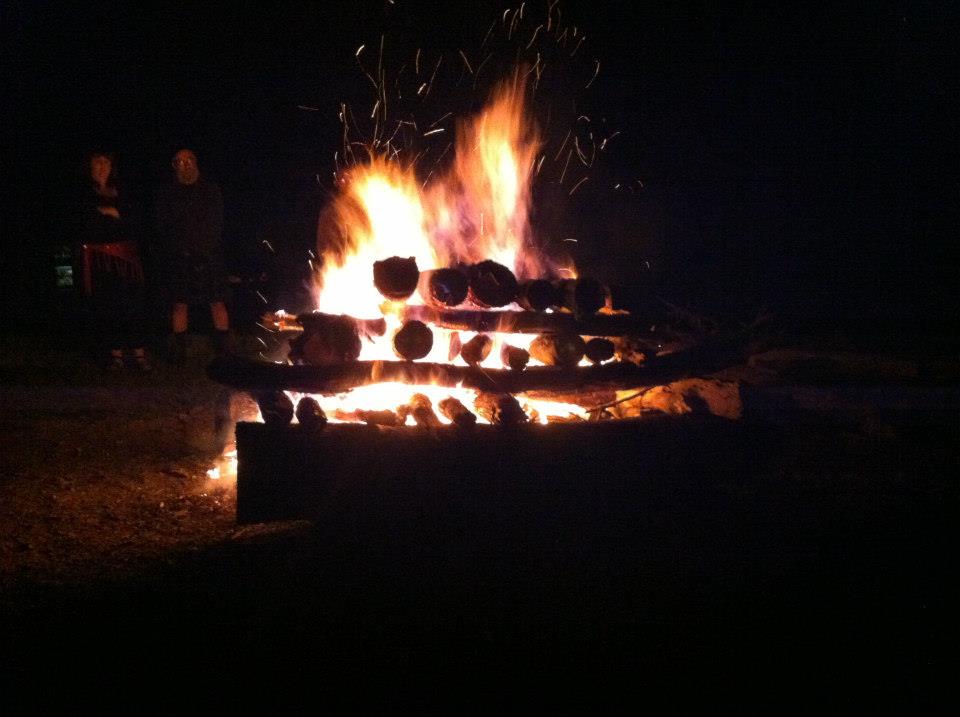
After weather forecasts early in the week that would have left most days of the Gathering in rain, the weather shifted. Both Thursday and Friday turned bright and sunny, with cool evenings perfect for what has become a tradition of bonfire, mead, talk, drumming, story and song late into the night.
Four Quarters, we honor you. Hawk of the East, Stag of the South, Salmon of the West, and Bear of the North, you came to be with us once again.
Directional Banner Carriers — photo courtesy John Beckett
With a title like that, you might expect shocking revelations, secret tips, insider advice, or something — anything — designed to titillate or distract a readership. Or perhaps I could offer some variation on “what people want” — if we try to deduce that incoherent impossibility from reports on Google’s most popular search terms.
Instead, I’ll start with the literal. Our west-facing driveway warms up during the day, and on late spring and early fall mornings like yesterday’s and today’s, when we open the overhead garage door, as often as not one or more garter snakes will have curled up on the concrete during the night to warm themselves on the residual heat. Each morning they’re sluggish and need to be coaxed with a toe from their stupor to move and so avoid getting run over by our car. Thus the “serpent under the door.”
But as with all other things (Druids like to claim), coincidences can be teachers, too. Take our power outage yesterday afternoon. I saw a flash of light, heard a popping sound, and our electricity died as I was starting to draft this post. Green Mountain Power arrived a couple of hours later and promptly fixed the problem. With an extensible pole, the line workman loosened something small and dark from the overhead transformer which plummeted to our lawn, and then he apparently reset a surge protector or trip device. Problem solved. When he came to the door to report success — I was watching all this from our living room window and stepped out to meet him — he said a bird had shorted out the line, tripping the transformer. The small dark object that had fallen was the burnt corpse of the unfortunate. Wholly unperturbed, our resident pair of mourning doves resumed their perches nearby on the power line soon after the GMP service truck departed.
Serpents and doves: be shrewd as the former, and gentle as the latter, counsels the Galilean master*. To put it more bluntly, avoid getting fried, or run over — each grisly fate available, significantly enough, through human agency. So it’s fitting that any shrewdness and gentleness I can wring from these two instances should issue from the same animal world.
As I write, goldfinches brighten our feeder, squabbling with the jays and an acrobatic chipmunk for seed. Today’s late morning humidity and temperature already climb toward midsummer highs, just a few days after night-time frost warnings in our area. The serpent under the door is my instinct, the bird on the power grid my arrogant ignorance. No, that’s not it. Something else, something other. Yes, the danger of allegory is its all-too-easiness, its tendency toward glib preachiness. A welcome Buddhist and pragmatic strain in some contemporary Druidry reminds me that sometimes a dead bird is just a bird, a sluggish serpent just a snake. It’s the “and yet” that rears up and insists on making bigger meanings from small ones that is a sometimes annoying blessing.
But why shouldn’t we squeeze every event and experience for all it might be worth? Equipped with overactive brains and growing out of a world we have tried to name and explicate, it’s a natural tendency, one literally native to us, crafted by nature, by natural selection and chance, by the divine at work with these, their alter ego, their personification, their image. Tolkien’s elves, the Quendi, named things and tried to wake them. In this they followed their nature: Quendi** means “those who speak with voices,” the verbal echoes of their name present in words like bequeath and loquacious, query and quest, inquisitive and require. Kweh, kwoh, kw-, kw- … Human deeds, human cries, human needs. The same world that wiggles and flutters in snakes and birds has shaped and turned itself to allow humans to name — and endanger — them. Because we can do something may not mean we should. So we look to our animal kin for direct lived insight into how to thrive in this world, their wordless gestures rich as words. In an early poem, Mary Oliver captures Druidic wisdom:
Sleeping in the Forest
I thought the earth remembered me,
she took me back so tenderly,
arranging her dark skirts, her pockets
full of lichens and seeds.
I slept as never before, a stone on the river bed,
nothing between me and the white fire of the stars
but my thoughts, and they floated light as moths
among the branches of the perfect trees.
All night I heard the small kingdoms
breathing around me, the insects,
and the birds who do their work in the darkness.
All night I rose and fell, as if in water,
grappling with a luminous doom. By morning
I had vanished at least a dozen times
into something better.
At first we might think it’s death she’s talking about, but as she says in other poems, it’s deeper and more significant than just that particular transition, that magnified human fear and obsession. Death, yes: but there are many more marvelous things in addition to that. We can imagine ourselves different, “better” — what that may mean. “The world offers itself to your imagination,/calls to you like the wild geese, harsh and exciting–/over and over announcing your place/in the family of things.” Gratitude to bird and beast; this, my offering.
Make a bridge of rain
the hour says, so sky and I do —
water and sight, slant
of light to dance on,
firm enough (sure as breath,
fine as the fleece of stars
you spun last night, sky)
we glide from hilltop to top,
this gray company and I.
Not looking we walk side by side.
Footfalls hush in the thrum of rain.
It’s only staring that puts us off
each choosing to doubt the other, as if
real is something to decide alone
not our song together. Mist sheer
as deep leaves clothes us all,
with waking only another dream,
this way we cross over.
Wadin Tohangu has been in my thoughts these past few days — at first just a tickle of awareness, an overlay to thought. Then stronger, a gesture on his part for me to pay attention, a longing on my part to offer that readiness.
In the past a listening heart usually opened the way for him. Give my opinions and distractions a rest, and always something more worthwhile would fill the space they occupied. A poem, an idea for a blog-post, a phone call I needed to make or take, a chance conversation with a homesick student no one else notices, a shaft of sunlight or spectacular cloud at the moment I look out the window. The attention that draws Wadin is simple but not easy. Especially not today. Why not? I ask myself. I’m out of practice, for one thing. I mull over the past few weeks. Money is tight, and old medical bills, though we bring the balance down each month, still require that monthly check. We’ve just managed to pay municipal property taxes, and now the Ides of April loom, tax day part two, on the 15th. (We have as little taken out of the paycheck as possible, on the theory that it’s easier to pay later on our terms, rather than to try getting a refund on the government’s. We’re still, you might say, optimizing the theory.) Add to that some education expenses for my wife, plumbing repairs after basement pipes froze … the list goes on, one version or another all too familiar to many of us.
But through it all, things to celebrate as well. Yes, there will be balance. Birds back, singing. A few passing on the way north, offering unfamiliar snatches of melody on their layover. Daffodils pushing up pale and uncertain, the first wasps and flies buzzing around rather forlornly, that indefinable slant of light and the scent of earth that signal spring, whatever the thermometer shows. Longer days. A sky that says forever is still here, starting right beyond my skin.
Wadin Tohangu is companion to my thoughts again. What will he say to me this time? What do I need to hear?
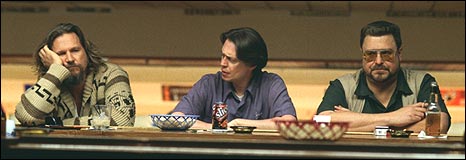
Sometimes I can contrive nothing better to say or do on this blog than simply pass along something I’ve been reading for its surprise or its insight — or at best, both at once. (Why begin with an image of Jake, Donny and Walt? Keep reading. Or call it a Druidic obsession with triads…)
Today’s shamelessly self-indulgent instance of such a something comes from a post on another blog, where I encountered the following passage from The Greek Commonwealth by British scholar, utopian and idealist Alfred Zimmern, first published 1911, and now available online. (It’s also been reprinted at least five times by Oxford, the latest edition I’ve found dating from 1977. Yes, I spent time tracking that info down. It’s better than grading the mountain of essays that sit on my desk and desktop. Call it rationalized procrastination.) In a chapter on poverty, noted the poster, Zimmern “tries to get the reader to imagine, in a poetic passage, the daily life of the Greeks in Classical times.”
Here, then, is Zimmern himself:
We think of the Greeks as pioneers of civilisation and unconsciously credit them with the material blessings and comforts in which we moderns have been taught, and are trying to teach Asiatics and Africans, to think that civilisation consists.
We must imagine houses without drains, beds without sheets or springs, rooms as cold, or as hot, as the open air, only draftier, meals that began and ended with pudding, and cities that could boast neither gentry nor millionaires. We must learn to tell the time without watches, to cross rivers without bridges, and seas without a compass, to fasten our clothes (or rather our two pieces of cloth) with two pins instead of rows of buttons, to wear our shoes or sandals without stockings, to warm ourselves over a pot of ashes, to judge open-air plays or lawsuits on a cold winter’s morning, to study poetry without books, geography without maps, and politics without newspapers. In a word we must learn how to be civilized without being comfortable. Or rather we must learn to enjoy the society of people for whom comfort meant something very different from motor-cars and armchairs, who, although or because they lived plainly and austerely and sat at the table of life without expecting any dessert, saw more of the use and beauty and goodness of the few things which were vouch-safed them – their minds, their bodies and Nature outside and around them.
Greek literature, like the Gospels, is a great protest against the modern view that the really important thing is to be comfortable…
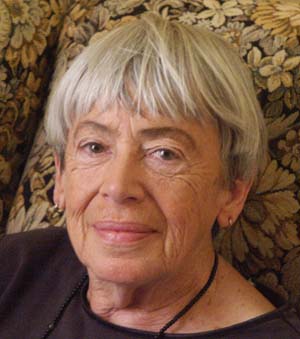
How many Druids would hold this up as an ideal as well, at least at first? But would — or could — we be as happy? Somehow I can imagine Jake Lebowski (from the Coen brothers’ ’98 film The Big Lebowski) would manage better in such conditions than I would. The Stoner might just beat out the Loner. “There are things more important than comfort”, says fantasy author Ursula LeGuin, “unless one is an old woman or a cat.” She’s now an old woman, as her image here shows; I confess that for some years, I’ve noticed a creeping feline-ness of (dis)inclination invade my once radical and rebellious bones …
I’m a fake Druid. So is everyone else who names Druidry as the path they walk. And I’ve come to love it.
In a guest essay on the ADF website, J. M. Greer notes,
The very last of the ancient Druids went extinct in the ninth century, and the surviving scraps of their teachings and lore are so fragmentary, diffuse, and contradictory that they don’t form anything like a workable system. All modern Druid groups—OBOD, ADF, and everyone else—were invented in the last three centuries by people who used some mix of scholarly writings, personal spiritual insight, speculation, and sheer fantasy as raw material for their concoctions.
Thus if “real Druidry” is defined as the sort that was practiced by Druids in Celtic countries before the arrival of Christianity, all modern Druids practice fake Druidry. That can’t be avoided, since “real Druidry” hasn’t existed anywhere for more than a millennium. What differentiates one modern Druid tradition from another is the particular kind of “fake Druidry” each practices.
Of course, Greer writes here as an outsider might see it, to try on a truth many still feel uncomfortable to admit. As Archdruid of AODA, he obviously doesn’t habitually dwell on his particular flavor of Druidry as “fake.” And when I practice my Druidry, it doesn’t feel like a “concoction” at all. It coheres, because like anything used — steps, coins, dishes, skin, planets — the edges get smoothed, a few chips and dents show up, and everything takes on that “lived-in” look, that patina that makes antiques look antique, that gives worry-stones their shine, and faces their habitual smile or frown lines. I make an offering at an altar, I join my Druid brothers and sisters at a festival, I sit for an hour in moonlight meditating, and whether a group of people 300 years ago rediscovered things most traditional peoples have long known doesn’t really concern me. Clearly, the moment itself offers me better things to do.
Greer continues:
The Druid community has on occasion been racked by squabbles between traditions, caused as often as not by simple misunderstandings that could have been quickly cleared up by people familiar with more than their own tradition. Since none of us have any right to claim possession of the One Genuine Real Live Druidry, a willingness to share the world with other Druid traditions, and to participate with them in celebrating the cycles of nature and the miracle of the living Earth, is a virtue that may well be worth cultivating by Druids of all kinds.
Ah, “One Genuine Real Live Druidry” — Ogreld, I’ll call it. My new tradition, founded right now as you’re reading this. Here we go … unlike every other practice and belief on the planet, Ogreld sprang into existence full-grown and perfect, without parents or kin. To get that essential temporal edge over other faiths and practices, Ogreld is the original “source faith” of humanity, practiced when people first became human. In fact, to top it off, it was Ogreld that madethem human. Now we’re cooking! … This is faking with a vengeance. “I’m faker than you are. Na-na-na-na-na!”
In the Egyptian afterlife, the human heart is weighed against the feather of Maat, who personifies truth and justice. The Wise among us understand that whether I acknowledge three elements of earth, water and air, or four elements of earth, air, fire and water, or a god whose elements are bread and wine, my rituals will still work in accordance with the reverence and love I bring to them, and the holy presences that empower them. Whether I have helped or hurt the earth and its inhabitants will matter a lot more than the color of my robes, the rank I’ve achieved, or the number of gods I pray to. The only real Druidry is a “path with heart,” a way of walking the earth that wisely honors all paths with heart. I’m busy faking that wisdom, practicing till I get it “righter” than before. Insofar as faking is doing something, it’s generally better than not doing anything at all. So yes, I’m a fake Druid. Have you met any other kind?!
Much of my learning before and during the Bardic grade of OBOD Druidry has been about listening. I’ve walked different landscapes here and abroad over the last couple decades, and almost always when there are negative energies, they seemed to issue from human presences that felt negative to me, or disrupted the native energy. The land itself is simply the land, with all its other lives and forces and history and presences. It may not always feel comfortable or easy or familiar, but it has an integrity that asks me to pay attention. And yes, I’ve done that with varying success. But the human is always an overlay, unless the place has been inhabited for a very long time, and the humans there learned to attend to and respect the place they lived. Which is sadly not often enough, though places exist here and there which are dearly loved and cherished, places in which the land spirits dance their joy.
California Druid Gwynt-Siarad tackles this directly in his blog entry, “The Curious Case of American Land Spirits.” I’ve taken the liberty of reposting the whole of his short entry here (Druids are always talking to beings they can’t see):
Recently I was involved in a discussion about land spirits. As the discussion progressed it touched on what I feel is a very important issue to us druids living in the Americas. That being, land spirits are more often then not, tied to the land and thus couldn’t come to us from Europe, and thus how do we treat with the spirits of this “new” land? The natives of this place have a long and good history of working with the land spirits here. Sadly, in most places, and certainly here on the west coast of the lower 48 the natives are almost completely gone. This is a very sad thing, but not the focus of this post. The question is, can those of us of European descent summon, honor, call, and treat with American land spirits? It was suggested that the spirits here are used to being summoned with certain type of ritual, that being those of the local natives. That the land spirits here have native names, and should only be addressed as such. ok…what if the name is not known, and can’t be learned? And what of the idea that they can only be summoned with native American style evocations? Where does this leave the modern druid? Even if I were able to learn, say the dances of the Umpqua Indians to summon the spirit of the Umpqua river, that would most likely be considered cultural appropriation and that’s just not P.C.
I have been tumbling these thoughts over in my head for several days now, and here is what I have come up with. First off, spirits are as individual in personality as people are. What might be ok with one spirit won’t be ok with another. How do we find out? I vote for good old fashioned trial and Error. Go out there and do what druids do in the way druids do it. If the spirit doesn’t like it, I am sure it will let you know, if you bother to listen. Let the spirits be our teacher. I think and feel with but a few exceptions so long as the spirits are approached with offerings, respect and love they are not going to be over critical if you said the right name, pronounced in the correct native dialect or be upset if you didn’t dance in the native way. Using a name the spirit is familiar with would be very helpful in treating with it, but not critical. So those druids that are inclined to work with such spirits, I say do your homework and get out there and get to know your spiritual neighbors!
No surprise that the spiritual world resembles this one — the spirits wish to be treated as individuals, because that’s what they are. What of spirits of a species which was transplanted to the New World by Europeans? Is it the “same” plant or animal? The best way to find out, as Gwynt-Siarad observes, is to start the conversation.
Compassion has no religion. Silence is not always indifference. O great, listening, witnessing world, you too have something to say, something you always are saying, without words. What comfort we can offer, miles and lives away from the families of the Sandy Hook school victims, and from other, newer sufferers since then, may consist of not filling the airwaves and spiritual spaces further, with our own shock or anger or sadness or dismay, or whatever other responses events may next provoke in us. Even if we do not know the families or victims or any of those touched by an event, we may send sympathy, because we are not stones. This is prayer, too. But every turn of the world changes us because we’re in it together. A great service is to love those who need love, and not merely to feel, to emote. We can do more than relive pain, especially another’s pain, or make it ours. Suffering needs no extra rehearsals, no practice. There’s always more than enough to go around.
We’re not stones, but we may raise them into a cairn, a act that by its solidity and palpable weight can lift suffering even a little, if it may, stone by stone. Let earth bear a portion of the weight. Allow this elemental power of Earth to transmute, to compost and transform, as it does all else that comes to it. The turning of the year again toward light in the middle of winter, the planet doing again what the planet does each year, can be solace too, earth re-establishing its balance. Soothing motion of the familiar, wordless touch with its animal comfort. Moon growing again towards fullness, light on the world in the middle of darkness.
But sometimes we hate comfort. Too often solace can reek of appeasement. We stiffen. One more easing is too many. Intolerable. Like words — already more than enough. With no ready target we seek out whatever will serve, anything to shut up the noise, the roar of raw nerves jangling. Anodyne. Oblivion, even, at least for a while.
Grief is too steady a companion. It knows us, it seems, deeper than a lover. OK, we get it. Pain too has something to say that will not be denied. We make a place for it, and it moves in, gets comfortable, settles down for too long. (How long is memory? Is recollection what we consist of? Do we relive, instead of living new? Does this become our only, instead of our also?)
When words do not do, I bring silence to the altar. When I cannot pray, then that is my prayer, just the act of moving toward the altar, a center, a focus.
/|\ /|\ /|\
The house has cooled overnight when I get up to write this. In between the last two paragraphs, I open the door of the woodstove to put in another two logs. In a turtleneck and sweats, I sit on the floor, feet toward the fire, with my laptop where its name says. Warmth, says the body, unrepentant in loving what it loves. Warmth too, radiating from the electrical current flowing through the machine I write with. So little, but a little. A start.
In our last conversation, Aithne had said nothing about needing my help. All this stuff about ancestors and bloodlines, and now I was wondering about that piece. Had she forgotten? But even if she did need me in any way, how could I really help? After several decades of living, I have a pretty clear sense of my talents and abilities. It wasn’t false modesty that told me both Rosmert and Aithne could certainly handle challenges and obstacles I couldn’t. Wasn’t that why they were teaching me, and not the other way around? There’s an innate order to things that we ignore at our own peril but that we can also learn to our advantage — that’s one of the foundations of my worldview. I guess when I thought about it that I saw helping others along the path is a form of payback, or maybe paying it forward. It’s a way to show gratitude, a way to keep the heart open. Gratitude feels good. Just do it.
So it was when all of this was still spinning through my brain that Aithne appeared again. It had been more than a few days since I’d tended to my Sacred Grove. The excuse doesn’t matter; it’s a poor one. But shortly after I returned, there she was. But she certainly was not dressed the same this time. Biker chick was all I could think: leather jacket, torn and faded jeans, bandanna, dark glasses, snake tattoo on her neck, even chains. Again she was gazing off into the distance, and when she turned toward me she took off the sunglasses and winked.
“You ready?” she asked.
“For what?” I replied. That was Aithne, I was beginning to understand. Small talk rated low among her priorities. And it was rubbing off.
“A ride,” she said. “I’ve got an ’86 Harley Sportster, 1100 cc’s. Want to try it out?”
And that was how, maybe an hour later, Aithne and I were roaring down a little-traveled country road that arrowed flat and straight toward the western horizon. After a series of lessons, practice runs, one spill and a bruised right knee, I felt reasonably confident handling the heavy machine. I wasn’t ready for a lot of traffic yet, but the basics were coming along nicely.
“We’ve got clear road,” she said. “Let’s open it up for a couple miles.”
The big bike still ran smooth when we topped 80 mph. I eased back on the throttle, listening to engine as it lost the high-pitched whine of speed. A few minutes later we were sitting on the side of the road, sipping Gatorade. Aithne was studying a ladybug on a blade of grass she held in both hands.
“You can help me, you know,” she said. “We need you healthy for the work, and for your part which only you can do. That’s your focus for now. Get healthy, and balanced.”
“I wanted to ask you about that. What can I do?”
“You can begin again.”
“Begin what?”
“You’ve completed another spiral. The next months may look familiar, but they aren’t the same thing that’s come before. Pay attention to what they can show you.”
“But what am I supposed to be looking for?” I asked.
Aithne paused and looked at me for a moment.
“You’re thinking about quitting your job after this academic year. You’re wondering how little you can live on if you do, how much food you can grow for yourself back in Vermont. Those aren’t bad things by any means, but your principal focus needs to go beyond that. Those aren’t ultimately pathways to the next two decades. You’re looking at surviving. I’m talking about thriving.”
“After the last couple of years, surviving looks pretty good to me.”
“And it is,” she said. “We had to work with your wife to get you to that surgeon in Baltimore. You weren’t listening when you most needed to. Fortunately, she was. So you survived the shift, you kept this body through the turn. You’re still here, and the ancestors aren’t finished with you in this life yet. You’re on commission. Did you know that?”
“Commission for … for what?” I stuttered. “Can I have some clarity just once about what I’m supposed to be doing?”
“You’re confusing clarity with looking back on a path you’ve already walked,” she said. “So often you can know by going. And for as long as you’re here, you’ll find that’s one of the things time’s for.”
And then I was back in my living room. The clock said 9:48 pm. It had been a long day, and I had much to think about.
Rosmert returned again today, but only briefly, and only, he explained, to introduce Aithne. At first I could not see her clearly, except to note she was only slightly shorter than Rosmert. Then it seemed the space around her sharpened somehow, or — I had the distinct feeling now — she was letting me see her. She wore the hood of her robe up, and it shadowed her face. Freckles dotted her nose, and a few tendrils of chestnut hair slipped from her hood. Then all I knew was her eagle gaze. Two green eyes of startling fierceness regarded me. She grabbed my half-extended hand, shook it vigorously, then promptly pointed out a problem.
“Greetings. You do realize you left the gateway open? Magically careless. Let’s close it immediately. I’ll show you how. But first, let me take a quick look around.”
From her brisk words and tone I could tell that today at least there was no such thing as Druid-business-as-usual. Or maybe this was usual, for her. As she studied the trees and stones, she began to describe one way to seal a grove more effectively against unwanted presences and energies.
Then I saw Rosmert winking at me just before he disappeared. He made a sweeping gesture that seemed to say “You’re in her hands now.” I laughed in spite of myself.
At the sound, Aithne turned from her survey of my grove and regarded me with a frown. “You have made a beginning, but you need practice at defense,” she said. “Now expel me from this space.”
When I hesitated, she exclaimed, “Do it! You did not invite me like you did Rosmert. I came at his bidding, not yours. So you can rid this grove of me quite easily. Do it. When you are quite satisfied I am gone, you may choose to invite me back, or not. But secure the gateway first, whatever you do.”
I centered myself in my grove and sang the Word of Protection. One instant, Aithne stood there, her head tilted to one side, listening. In the next, she vanished.
I walked the inside perimeter of the grove, singing. I walked it three times. I played with the thought of not inviting her back. At length, when I was satisfied with the wards and had formulated the triple seal, I called her by name, just once. A second later she appeared a few meters away.
“Better,” she said. “I tested the gateway several times before you called me. Much better.”
She turned slowly again to take in the trees. Over the past months it had been a fallow time for me while outer things made their demands, and I needed to do some inner work. The space certainly reflected this. It looked, quite frankly, unkempt and overgrown.
“But I did not come to critique your grove or your training,”she said, “or to sight-see. Whatever you might think.” She clapped her hands, and sat down on the same tree-stump Rosmert had occupied when he and I talked. “I need your help.”
Nonplussed, I stuttered, “Well, OK, with wh- … uh, how can I help?”
“It’s a matter of the Blood of Veen.”
“Who — or what — is Veen? Like it sounds? V-E-E-N?” I asked, spelling it. Goddess help me, I thought I could hear capital letters when she said Blood and Veen. It sounded, well, cheesy. Like hack sword-and-sorcery writing.
“It’s a town in the Netherlands. You have an ancestral connection to the region.”
Author, Episcopal priest and current professor Barbara Brown Taylor has written An Altar in the World, a splendid little book on simple, essential spiritual practices which anyone can begin right now. She writes from a refreshingly humble (close to the humus, the earth) Christian perspective, and a broad vision of spirituality pervades her words. Because of her insight and compassion, her awareness that we are whole beings — both spirits and bodies — because of the earthiness of her wisdom, and her refusal to set herself above any of her readers, she makes an excellent Druid of the Day. I hope I will always remember to apprentice myself gladly to whoever I can learn from. As the blurb on her website page for the book notes, “… no physical act is too earthbound to become a path to the divine.”
Taylor brings a worthy antidote to the bad thinking and fear-mongering so widespread today. Here’s a sample:
… it is wisdom we need to live together in this world. Wisdom is not gained by knowing what is right. Wisdom is gained by practicing what is right, and noticing what happens when that practice succeeds and when it fails. Wise people do not have to be certain what they believe before they act. They are free to act, trusting that the practice itself will teach them what they need to know … If you are not sure what to believe about your neighbor’s faith, then the best way to find out is to practice eating supper together. Reason can only work with the experience available to it. Wisdom atrophies if it is not walked on a regular basis.
Such wisdom is far more than information. To gain it, you need more than a brain. You need a body that gets hungry, feels pain, thrills to pleasure, craves rest. This is your physical pass into the accumulated insight of all who have preceded you on this earth. To gain wisdom, you need flesh and blood, because wisdom involves bodies–and not just human bodies, but bird bodies, tree bodies, water bodies and celestial bodies. According to the Talmud, every blade of grass has its own angel bending over it whispering, “Grow, grow.” How does one learn to see and hear such angels? (14)
/|\ /|\ /|\
Taylor, Barbara Brown. An Altar in the World. New York: Harper One, 2009.
Much of what we can do with initiation consists of bringing the inner experience outward, establishing it in consciousness, so that we can begin to live in and from the new awareness. That can often mean we find ourselves expressing it through light, sound, color, form, in painting, drawing, photography, dance, music, writing, embroidery, etc. — some way to bring that inside stuff into this realm of touch and smell and contact and physical sensation. The correlation doesn’t need to be, won’t be, exact. Doesn’t matter. It’s a bridge to somewhere over the rainbow, where the sidewalk ends, where the path disappears into a pool of still water. Pick(le) your metaphor.
Believing, as the (transformed) saying goes, is seeing. We see it through, we manifest it, because we’ve seen it before, maybe via an inner sense that doesn’t always feel like sight but may come as some other way of knowing. Do we need to be told “what to look for and when” as the cartoon suggests? Only if we’re focused on proof rather than transformation. Only if we’re trying to see somebody else’s vision. Ours, however, is ours — it doesn’t require tricks. (True, it may sneak up on us, or we may be the ones doing the sneaking.) Others may well “believe” it when they see it in our lives, when they have something they can contact that reassures them we’re still grounded here. Even if — or especially when— we’re not, anymore. Or not like we were, exclusively. We’re not freaks (at least usually not obvious ones). But the life that flows through us when we complete the circuit and connect to both poles comes across to everyone. Each person is charged at least a little, whenever any one of us is. The democracy of spirit. The changes come, and with a measure of luck and grace and good weather, we survive this life again, and enough of our loved ones are still with us to carry on.
If it’s a difficult initiation — unwanted or unsought — we may resist the awareness. The divorce, the scary diagnosis, the death of a friend, the chronic pain. But even if it’s the events and timing of the outward initiation that seem to be the launch-pad, the dividing line between our old and new selves, almost always, in my experience, sign-posts and markers of the inner preparation and change have shown up beforehand. We just may not recognize them till later, if at all. Scant consolation when your life falls apart all around. And even less welcome are the well-meaning Others in your life who may let slip that they “saw that one coming a mile away.” (But could we listen, could we hear the warning? Nope. Absolutely not. Don’t want to, don’t tell me, I don’t want to hear it!) Sometimes deafness is protection, the only shield we have at the moment. Compassion for ourselves, for others in that moment, and after.
One of the reasons I maintain this blog is the opportunity it gives me to test and measure some part of my inner worlds against this outer one. After all, this is the world I live in with a physical body, and if I want to use here what I’ve experienced elsewhere and inwardly, it needs to be adapted to the dynamics of this world. This physical life is one pole of the circuit that is our existence. The other pole lies in our inner worlds, but that’s no reason either to discount it or to grant it a superiority over everything else that it doesn’t deserve. Who has explored “everything life has to offer”? I’ve been around for several decades, and I still feel like a rank beginner, like I’m only just starting to do more than scratch the surface. And yet at the same time as doors open, a strange-familiar welcome lies on the other side, like I’m returning to something I’ve always known but haven’t yet walked. Now (first time? second time?) I’m setting foot there.
In the first branch of the Mabinogion, Pwyll prince of Dyfed encounters Arawn, Lord of the Otherworld, and the exchanges that develop between the two realms profit both of them. It’s a circuit both literal and figurative, as most things are: accessible to the metaphorical part of our minds, but also to our inner senses, if not our physical ones. And sometimes the division falls away and no longer separates the worlds. In the Western Tradition, Samhain or Hallowe’en celebrates just such a thinning of the veil. The Otherworld enters this one, or we journey there in dream or vision, and we become walkers in both worlds. Sometimes this world can then go transparent, and we see both worlds simultaneously, that old double vision that dissolves time and distance and the game of mortality. Then the veil falls again, easy concourse between the worlds slips away, and we resume to our regularly scheduled lives. Except not quite. We’ve changed.
As the old U.S. Emergency Broadcast System (now the EAS) used to say, more or less, “Had this been an actual emergency, you would have received instructions about what to do next,” except that instructions are already hard-wired in our hearts. Listen without listening, and all we get is static. The station has nothing more to say to us. No instructions. It seems like no one’s at the controls. No directions. If we can’t easily access them any longer, out of neglect or fear or ignorance, sometimes there’s a gap between learning about the “emergency” and “receiving instructions ” — a gap of hours, months, years, lives even. Where to go, what to do, how to go on, all become unknowable, impossible, lost to us. And so the ferment works in us, till we’re driven to find out, to quest for wisdom, to cry for vision. And what we ask for, we receive — eventually — as the Great Triad records: Ask and you will receive; seek and you will find; knock and it will open to you. Eventually. Patience, old teacher, maybe the earliest and longest lesson of all. Another face of that strange love that sometimes seems (dare we admit it?) built into things, that will not ever let us go.
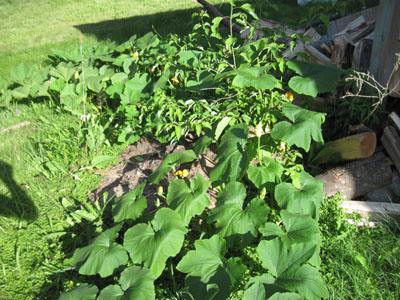
In early June my wife noticed a particularly vigorous shoot rising from an old compost pile beside our woodshed. The squash plant it eventually revealed itself to be has flourished joyfully, spreading in two directions, while the pitiful growths in one of our new raised beds refuse to be coaxed into thriving.
If life gives you lemons, you could make cleaning supplies, ant repellent, pickles, sore throat medicine, laundry whitener, stain remover, fruit preservative, copper cookware restorative, disinfectant — and if you insist, lemonade, too. The dead (cliche) comes to life when our attention lies elsewhere. Practice resurrection, and get used to it.
We hear a lot about growing where you’re planted, but what about everywhere else? The surprise that is our universe so often arrives with the unexpected, the new pattern, the shift, the change. Life does a one-off. It does what it is. (Isn’t that what you are, too — individual, unique, nothing else quite like you? The trouble comes when I or somebody else insists you should be like the rest of us. The universe never “conforms.” It’s simply itself. That’s our pattern too. We are where we come from.) We stand amazed at the burgeoning of vitality in places we doubted it could exist. If we have different plans, life may upset them. A young Christian couple I know, just married, decided they would leave conceiving a child “up to God.” A friend from their congregation remarked, with considerable glee, “They gave it to the Lord, and he gave it right back to them.” She got pregnant six weeks after the wedding.
In the mass of asphalt and concrete that is Route 91, like any superhighway, a few weeds have taken root on the meter-high divider between northbound and southbound lanes, a little way north of Hartford, Connecticut. They’re particularly visible because they happen to be growing just about at eye level as you drive by, and the highway department hasn’t yet set upon them with weedkiller. I give a silent cheer each time I pass, though I know my tax dollars support their eventual extinction. Still … Give them a few years and their roots will begin to split and break down the rigidity of man-made material into the beginnings of something more closely resembling soil. If there’s an “agenda” at work here, it isn’t always a “human” one, though humans are born into such a world, have grown and evolved within and through its shaping patterns, and have lived in it for millenia before they thought to try permanence on a scale the universe doesn’t really support.
Instead of worrying about “what the financial situation will support,” or what our many and often distinctly weird human institutions “demand,” why not ask what moves in harmony with the patterns of the universe? The main reason is we wouldn’t always like the answer. Sometimes we would. But we might find more balanced and sustainable ways of living that would approach “permanence,” which is just a weak version of natural equilibrium. Could we devise a “financial permaculture” that might not jolt us from crisis to crisis? Sure. Will we?
The Dao De Jing winks at us when it makes its observations:
Not exalting the gifted prevents quarreling.
Not collecting treasures prevents stealing.
Not seeing desirable things prevents
confusion of the heart.
The wise therefore rule by emptying hearts
and stuffing bellies, by weakening ambitions
And strengthening bones.
If men lack knowledge and desire, then clever
people will not try to interfere.
If nothing is done, then all will be well.
“Doing nothing” isn’t exactly what Daoism teaches; it’s more along the lines of “unforced action,” or “going with the flow”: wu-wei in Chinese. And can we expect people to succeed by weakening their ambitions? I don’t know; have we ever tried it? In all this there’s a wink and a smile, too. As if that wise voice is saying, “I don’t always mean this literally, of course, but you get the idea …” And who knows?! “Emptying hearts (in a good way) and stuffing bellies” might just pay off. Fill our stomachs, not our heads …
Or take this advice, surely perfect for our U.S. political season:
To talk little is natural.
High winds do not last all morning.
I’ll let Ursula Le Guin’s version of Chap. 27 have the final say here, a kind of diagnosis of how we’ve “gone astray,” that peculiar human thing we can do that the rest of the natural world doesn’t:
Good walkers leave no tracks.
Good talkers don’t stammer.
Good counters don’t use their fingers.
The best door is unlocked and unopened.
The best knot is not in a rope and can’t be untied.
So wise souls are good at caring for people,
never turning their back on anyone.
They’re good at looking after things,
never turning their back on anything.
There’s a light hidden here.
Good people teach people who aren’t good yet;
the less good are the makings of the good.
Anyone who doesn’t respect a teacher or cherish a student
may be clever, but has gone astray.
There’s deep mystery here.
/|\ /|\ /|\
There are many free versions of the Dao De Jing online; the site from which I drew these few excerpts provides several reasonably reputable versions to sample. Sustained meditation on the text (get a couple of versions and let them talk across to each other) can ease stress and open up many doorways and paths. It’s one of my most beloved Druid written resources. Wikipedia’s entry for Tao Te Ching captures some of its qualities: “The written style is laconic … and encourages varied, even contradictory interpretations. The ideas are singular; the style poetic. The rhetorical style combines two major strategies: short, declarative statements and intentional contradictions. The first of these strategies creates memorable phrases, while the second forces us to create our own reconciliations of the supposed contradictions.” If you recall, resolution of supposed contradictions, or finding the tertiary that resolves the binary of “either-or,” is a technique and strategy of wisdom taught in several Druid paths.
My wife has a designated daily mid-afternoon contemplation period at 2:00 pm. “I made a commitment,” she reminded me again this morning, when we were planning the day and I sweetly noted that her set time conflicted with other tasks that needed doing. While another time would probably serve her better (read “be less inconvenient for the people who live with her”!), I respected her response, because I know how precious an established positive habit is in transforming my own life.
One of the first discoveries almost anyone makes who sets out on a path of spiritual exploration is the apparent initial state of our individual inner worlds. If you make room for some down-time to relax and grab your recommended minimum daily requirement of silence and commune with yourself, you frequently get brought up short:
After an amazingly short time you will most likely feel bored. This teaches us one very useful thing. It gives us insight into the fact that if after ten minutes of being alone with ourselves we feel like that, it is no wonder that others should feel equally bored [with us]! (68)
These words* by Orthodox Christian monk, bishop, writer and spiritual director Anthony Bloom (1914-2003) strike home, for me at least. While boredom is a particularly American problem, it’s not unique to us. Others know it, but with our incessant desire for entertainment and stimulation, to be bored is the prime cause that drives us toward whatever is new. Even information about recent events we don’t yet know about, information which in a different world might actually be more useful to us, is called simply “news.” “What’s new?” we ask. Think about what really is “new.” Are you finding it at 6:00 pm nightly on your media source of choice?
Bloom continues his examination of boredom and the challenges of “inwardness” and stillness:
Why is this so? It is because we have so little to offer to our own selves as food for thought, for emotion and for life. If you watch your life carefully you will discover quite soon that we hardly ever live from within outwards; instead we respond to incitement, to excitement. In other words, we live by reflection, by reaction. Something happens and we respond, someone speaks and we answer. But when we are left without anything that stimulates us to think, speak or act, we realize that there is very little in us that will prompt us to action in any direction at all. This is really a very dramatic discovery. We are completely empty, we do not act from within ourselves but accept as our life a life which is actually fed in from outside; we are used to things happening which compel us to do other things. How seldom can we live simply by means of the depth and the richness we assume that there is within ourselves. (68)
Bloom doesn’t exaggerate about that emptiness in us, and yet of course there areindeed wonderful riches inside us all, just as we suspected. The difficulty I face in accessing them measures out for me how outward-directed I have become. How much I have to dig to regain one darkly shining edge of those inner worlds shows me where I have work cut out for me. (And that itself has become one of my spiritual exercises, rather than wasting time feeling guilty or making unlikely resolutions to do better. When you can’t do anything else, do laundry, or dishes. You’ll get something done that needs doing, ground yourself with a physical act, feel better about how you spent your minutes, and even carve out another space where you realize you can be both meditative and “productive” at the same time.)
As with so many things, balance is priceless. For everything else there may not necessarily be a spiritual MasterCard at hand, but you get the idea. As I’ve mentioned in previous posts (here and here, among others), the challenge of becoming cause in our lives, of living consciously and with intention, is a prime Druid discipline, as it is in almost every spiritual tradition in some form.
Bloom points out an opposite trap we can also fall into. Now that you’ve given yourself the delicious gift of downtime and reflection or meditation or contemplation, whatever you prefer to name it, “you will not be pulled out of it by the telephone, by a knock on the door, or by a sudden upsurge of energy that prompts you to do at once what you have left undone for the past ten years.” And you make another find, when “you discover that the world does not falter and that the whole world — if you can imagine it — can wait for five minutes while you are not busy with it. This is important, because we usually deceive ourselves, saying, ‘Well, I must do it: it is charity, it is duty, I cannot leave it undone.’ You can, because in moments of sheer laziness you will leave it undone for much longer than the five minutes you have chosen” (86-87).
Then at length the gifts of silence and inner discovery begin to open up. But the less I say about them here, the better. You already know what they are, from those rare precious moments when they already manifested to you. What is fleeting can eventually become an atmosphere that accompanies you and cloaks you. Such deep silence rings with a powerful intensity. If you’re fortunate, you’ve met someone who radiates this as a living presence. As the Bhagavad Gita says, “Even a little practice will free you …”
/|\ /|\ /|\
*Bloom, Anthony. Beginning to Pray. Ramsey, NJ: Paulist Press, 1970.

 In I Remember Nothing*, one of the last things screenwriter Nora Ephron wrote before her death in June 2012, the final short chapter is titled “What I Will Miss.” It’s simply a list, tinged with an anticipatory nostalgia that became clear in retrospect after her passing — and testimony to a life in which the most memorable things aren’t really things (unless you count people as mere objects — if you do, go away) so much as experiences. Here’s the entire list: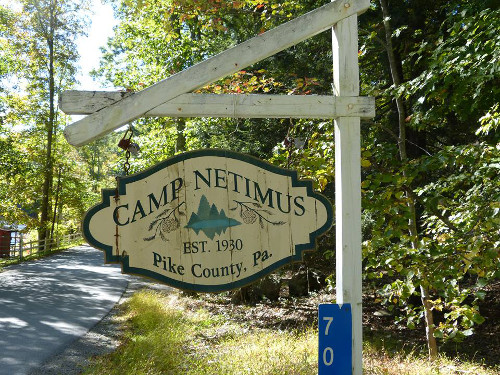









 A Druid Way