For those of you incubating your own enchantment of Brighid to coincide with the upcoming 19 days of the goddess, you have the moon to aid you. Waxing now, it reaches full at nearly the midpoint of the 19 days, on the 31st of January — a fine symmetry, whether you choose to align with it or not.
The Solar Question for today, the 20th of the month, in Caitlin Matthews’ Celtic Devotional (Gloucester, MA: Fair Winds Press, 2004) asks “What is the source of your spiritual guidance?” The Lunar Meditation* for the fourth day of the moon (counting the New Moon, Jan. 17, as day 1) is “the wonder of life”. If I’m facing a period of spiritual dryness, if I have no other ready guidance, “the wonder of life” is a fitting source. Watching and listening, I can find in something small as the sun sparkling on an icicle a subtly radiant doorway into the Enchantment of Brighid.
Because magic so often starts small, no more than a tickle, a spark, a whisper. Till it builds.
Keep refreshing “home” and your browser gives you different results, your Facebook feed changes, etc., my wife said the other day.
If I’m paying attention, an inner bell goes off for me at such moments, an aha! of illumination. Spiritual practice is my way of refreshing home, of choosing — or asking for — something else than what the apparent or obvious may be telling or showing me. Some animals and insects excel in mimicry as a defense, or to lure prey. So too the human world, with its heartfelt truths and its cons, its bullshit and its profound beauties, its “characters” and “originals” and its gold standard friends.
Refreshing home is a kind of alertness that many animals retain, honed senses not dulled by noise from talking self. Don’t get me wrong — human speech is indeed a gift. But like many powerful gifts, it’s double-edged. It’s true, peace to Walt Whitman, that animals “do not make me sick discussing their duty to God … Not one kneels to another, nor to his kind that lived thousands of years ago”*
So when I write, as in the previous post, about things like devotion to Brighid, and you’re feeling particularly agnostic about, maybe, absolutely everything, consider J M Greer’s observations about egregor(e)s, the energy of group consciousness that forms around any regular gathering and gives it a distinct character, and especially around magical groups that work intentionally with charging and exploring its potentials. Is Brighid an egregor? Does your local parent-teacher association or book club or university class differ from other groups in any way? Of course. But is Brighid “merely” an egregor?
Richard Dawkins and Sam Harris and other atheists miss a very large point here. I won’t spell it out — you already know it, or else you’re not interested in knowing it.
Greer says, writing about magical lodges:
… egregors capable of carrying the highest levels of power can only be built up on the basis of the living patterns of the realm of meaning, outside space and time. These patterns are what some religions call gods, and what others call aspects of God. They have a reality and a power that have nothing to do with the egregors built up around them, but they use the egregors the way people use clothing or the way actors in many traditional societies use masks. Skillful, intelligent, ethical, and dedicated work with these egregors, according to tradition, can bring lodge members into a state of participation with the primal living powers of existence itself — a state that is the goal of most religions, and as well as the highest summit of the art of magic (Greer, Inside a Magical Lodge, Llywellyn Books, 1998, pgs. 109-110).
It’s the part of those willing to work with and within a tradition not to stop at the level of belief in it, but to test and explore its possibilities. We’re worlds away from credal faith here. But you may, if you’re around a devotee of Brighid, especially this time of year, overhear or encounter a song or poem or prayer of dedication, service, and love.
Imbolc, the February 1st or 2nd holiday, part of the seasonal cycle of the “Great Eight” Pagan festivals, has long been associated with Brighid. Goddess, saint, patron of poets, smiths and healers, Brighid is a potent presence for many Druids. Christian Druids can honor her in either or both traditions, and her legends and symbols — effective points of access to her — are many.
Among the traditions that have gathered around her is the significance of the number 19 — whether part of the ancient awareness of the moon’s Metonic cycle, or the Christian tradition for determining Easter, curiously associated with the full moon, or the 19 nuns at Kildare connected with Saint Brighid. Or the practice of 19 days of magic focused on devotion to the goddess-saint, which this post examines. As a Druid-Christian link, the number and practices associated with Imbolc and Brighid can join the others I’ve talked about in other posts here as yet another means to transcend argument or debate, and find blessing.
Nineteen days with Imbolc in the center (on Feb. 1), the 10th day, begin January 23 and take us to February 10.
As this circle is cast, the enchantment of the apparent world fades … We stand together in the eye of the sun here and now …
So goes part of OBOD standard ritual. Why, you might be asking, if Druids say they wish to attune themselves to the natural world, do they practice ritual that sees the natural world as both enchanted and apparent?
Well, we still stand “in the eye of the sun”. Partly it’s “talking self” (see this and this post) that distracts us, that enchants us in the sense of holding us spellbound (and self-bound) rather than freeing us to grow. Circles concentrate energy and attention, contain them for the duration of the ritual, and can help charge us as instruments of the divine in order that we may “know, dare, will and keep silent”, as the old adage goes. So we circle alone and together to watch that particular enchantment fade, so that others can manifest more clearly. It’s a choice of enchantments. Do you like the current ones at work in the world? “She changes everything she touches, and everything she touches changes”. Sign me up!
Spending the interval from now till the beginning of the 19 days, a week from today, determining what service to offer, what magic to work, is time well spent.
I’ll be following up here with my experiences.
/|\ /|\ /|\
Image: Brighid. My preference is for deity images that aren’t sentimental or “airbrush pretty”. Contemporary artists often portray sexy gods and goddesses, which is fine, but as an image for meditation I’d rather not use soft porn.
Here’s an edited compilation of responses to a recent online question in a forum I follow, with wonderful suggestions for cleansing and purifying after work. I’ve removed all identifying personal information.
Q:
I have a challenging job and need to leave it behind, along with all the emotions and difficulties people around me have to deal with. What kinds of practices do you all do to cleanse and purify yourself after work?
A:
I find that something I can touch, smell, hear in a way that relaxes me and centers me is a comfort. Ritual object, drinking goblet, sacred stone, etc.
A quick “light shower” exercise — visualizing/feeling light pouring down on the top of your head and washing off the energies of the day. Combine it with a physical shower for fuller effect.
Or the “snowball” exercise — another visualization — balling up everything you don’t want/need, packing it tightly as you would a snowball, and then tossing it into a golden river to be washed away. Sometimes I do a more intense version of this, raking, shoveling the stuff and bulldozing it into the river. Doing a version physically with a piece of paper (“write the crap away”), stone, etc., and then burying/burning it, letting the elemental energies take it and transmute it. Or some combo of these — these are among my quicker go-to strategies.
I find the entrance to my home is an important transitional portal. I keep things around the door that mean something to me. These may include crystals, Medicine Wheels, fresh and dried herbs and plants or flowers. I get a visual and spiritual boost from these items when they greet me each day returning to my sanctuary (home).
One Native custom is to leave a basket outside your door where guests and yourself ‘dump’ any negative or burdensome thought into the basket before entering. (It’s considered rude to enter a Native’s home and start spilling your problems on them.) Hope this helps in some way.
I also have a small covered porch at my front door and I load it up with seasonal greenery, plants, statuary, crystals, sage, sweetgrass, cedar etc. — all the things that bring me peace.
There are a couple of areas I jokingly call “psychic car washes” on the drive home — mainly white pine groves — that I use to recenter myself. As I drive through, I imagine the energies of the trees enfolding me and pulling away any gunk collected during the day. Tunnels and places where there are high rock walls on either side of the road also work well for this.
I always intention where “it” goes when it leaves me — body of water or into Mother Earth as fertilizer — not leaving it for an empathic type to stumble upon it!
You could clap around your aura to break up any stagnant energy and loosen up anything you want to release. Then do a body shake to shake it off. You could do this before you step into the house or upon entering the front door after you take off your coat and boots.
Some wonderful ideas here! Reading through all this, I had the feeling it is also good to get into a give/take balance. How about after getting rid of the stuff you say a prayer / blessing over a water bottle and drink it? For recharging yourself as part of the rite.
I love the idea of water as healer/cleanser — I like to charge up water in the 3 nights of the full moon!
Set up a “coming home” shrine. Add stuff to it you find soothing, Feathers, seashells, beach rocks — stuff that speaks to you about relaxation. When you get home, light some joss, spend 3-4 minutes with it.
I have so many inspired ideas from this great sharing. Here’s a variation on the ancient Jewish custom. Put something meaningful to you on the door frame. Kiss it each time you enter or leave your home!
I picture a ball of white light at my sternum and expand it quickly to the edges of my field — clearing away and neutralizing the negative and the energy that is not mine. At the edges of my field it dissolves.
I also sweep across myself cutting and removing all that doesn’t serve me and isn’t mine.
After either of these I ask the universe to neutralize the energy and release it.
In a post from last August I pondered “the wisdom of the Galilean Master, who counseled prayer and fasting. And to make it a Druidic triad, we’ll add listening, because listening is another face it wears. Listening, prayer and fasting. LPF.”
front door view, 5 Jan 2018
And though it’s a Triad, each component works well by itself, if I’m not up for practicing all three as a package deal.
I have Druid friends who practice a regular weekly media fast — priceless counsel in these days of overloud and unhinged media assaulting our sensibilities. It’s not a fluke, or an indulgence. It’s simple self-preservation. No matter your affiliations and allegiances, it fits — it serves your highest good: the noise has gotten louder, more obnoxious, intrusive, demanding. How, I ask, is my spiritual armor holding up?
I find one version of LPF particularly useful if I’m about to fire off that tweet or Facebook post I could easily regret in five minutes or less. Or the quick retort to a co-worker or partner that has an unwonted, and unwanted, edge to it.
“Sit, sing, and wait”, to put it in words that practitioners of my other spiritual path commonly use. (The “sitting” is focus; I can “sit” while walking my favorite three-mile loop on a nearby dirt road. Sometimes sitting is doing just one thing. I build a fire. All I do is build a fire. No need for anything else. A fire meditation-in-action.)
Yes, go ahead and get down in words what I’m feeling. In itself that can be perfect response to anger, despair, whatever is dancing along my nerves and sinews. Print it out if it’s onscreen. Burn it. (Toss it in the woodstove.) Do the same if I’ve handwritten it in a journal or notebook. Let flames alchemize it back to the elements. Let it go even as it goes.
But then, says wise counsel, chant, sing, turn on your favorite CD or meditation track, restore your perspective through practicing joy. Yes, my friends remind me, you really do need to practice joy. Firegazing. Humming an octave higher or lower as I vacuum than the tune of the motor.
And in the ensuing re-calibration, re-balancing, re-equilibration that’s going on, wait. As with sitting, I can wait by turning down the inner and outer noise as I do something focused. Carry wood into garage, the night’s supply.
Welcome a chance for silence.
Sit, sing, and wait.
We know so little of silence that waiting without the muzak of all five senses firing, even for a brief interval, can seem oddly intimidating.
“You mean do nothing?!”
No — I mean wait. Let the dust settle. Let the moment clarify. A job of work in itself. Sometimes thirty seconds can be enough. Sometimes I need the full hour of that three-mile loop of dirt road, hills and trees. Sometimes a contemplation asks for sitting in a chair, unplugged, listening, alert, attentive to what is coming. Not the noise I carry with me. The song outside, the deeper song within.
My other spiritual path sets a high premium on a weekly fast as well, whether physical or mental. Both can be difficult, but wonderfully revealing of just where I expend energy.
Because what I think my priorities are, and how I actually spend the day’s energy and attention, will always show a gap. My practice for that day, whatever else I’ve got going on, is noticing and then closing the gap. (I’m cleaning the house. No, actually, I’m sitting in front of a screen most of the morning. Or I’m letting go the past. No, actually, I’m just rehearsing it instead.)
Even a little practice is “more than before”, my go-to mantra for progress. And just the effort to practice is in itself progress. To use bowling imagery, the skill to take down a single pin is just as great — just as useful and valuable — as the skill to make a strike.
More than before.
But fasting can also be ongoing, a powerful technique against the demand for our attention, one of the most valuable attributes we possess. “Where your treasure is, there will be your heart also” — so true. I need the reminder; everyone wants my attention. Advertisers and politicians depend on grabbing it and holding it long enough to get me to buy and vote. Rabble rousers just want the satisfaction of rousing my rabble — they want my attention any way they can get it, as psychic food. Getting and spending, I lay waste my powers. Wordsworth, old bard, you knew and wrote this 212 years ago.
Opt out, whisper the trees rustling outside my window. Druid, listen when the trees speak. Better than talking at them.
clearing the solar panels
A blessed thaw has come, after the bitter last two weeks. The eaves are dripping, and the sheathe of ice and snow on the solar panels finally loosened its grip enough I can roof-rake it off, and the panels can begin to receive the sun fully again.
Stamp off your snow, counsel Wise Ones in my morning meditation.
The caption of the photo below has a mini-spoiler — skip as needed.
Yoda has good counsel about books in “Last of the Jedi”
“I do not believe in God any more than I believe in Hamlet”, writes author, Buddhist and atheist Stephen Batchelor, “but this does not mean that either God or Hamlet has nothing of value to say” (Batchelor, Stephen. Living with the Devil. New York: Riverhead Books/Penguin, 2004). I gotta ask you: Doesn’t that deserve its own t-shirt?!
What are some of the things that God (or Hamlet) says to us? For the sake of foolishness or efficiency, let’s lump them together, prince and deity.
As late incarnations of the Fisher King, Hamlet, his father and his uncle all share a corruption also infecting their land itself: “something rotten in the state of Denmark”, indeed. Any sources of healing? A grail? There must be something.
Hmm. Fratricide, regicide, suicide — really no good options there. Hamlet at over 400 years old isn’t quite yet as immortal as a god, but it’s on its way, and even a god might well draw the line at three such wretched choices. There may be “special providence in the fall of a sparrow”, the prince reflects, recalling Scriptural assurances of a Divine Plan behind things, but you can tell when such lines have their own threads in our online fora, with people asking “What does it mean?” that the current beta version of the Divine Plan has sent all birds south for the winter of our play. No birds to save us here, no dove for any Ark, wren for inspiration, Eagle of the West to airlift us out of Mordor.
In a word, things suck. It’s gotten to the point where the Prince selfishly denies even his best friend Horatio the “felicity” or happiness of suicide: “Absent thee from felicity awhile/And in this harsh world draw thy breath in pain/To tell my story”. But, I ask Hamlet and God, are any of our stories worth that? Have things always sucked thismuch? Do we have any overarching story that can make sense of this world for us? (Three questions, Existential Triad #26.) In all its delicious suffering and gloom and razor wit, we could fairly call Hamlet (the play) a piece of Renaissance theater porn.
Is a spiritual search pornographic? Do we play out spiritual scripts to arouse ourselves in ways others (or we ourselves) deem destructive? (Is that a rhetorical question?!)
Horatio says, speaking of Hamlet — and speaking of all of us, too, because that’s what great cultural achievements do, after all — “he was likely, had he been put on/To have proved most royal”. Yes, along with the dead prince, we’re all “put on”, and all “likely”: life as a matter of the odds.
The “royal” part, though — we just can’t accept that yet, even in the face of stories trying their level best to show us, and teach us how. That identity — it implies too much, the gap yawning between what we are and what we could be, an open wound. So we reject it whenever possible, saving such inward knowing for our most unguarded moments with our favorite music, books, films, crafts, people, waking dreams. (Yes, these things rank nearly equal in my life.) Or “children’s movies” we watch with the kids, that may get it half-right, half of the time.
A 27 Dec. ’17 article (film spoiler alert!) in The Atlantic gets in on the Game. (We’re all playing.) Writing in “Why The Last Jedi Is More ‘Spiritual’ Than ‘Religious'”, Chaim Saiman begins:
For at least two generations, the Star Wars saga has served as a kind of secularized American religion. Throughout the series, the Force is a stand-in for a divine power that draws on a number of mystical traditions, representing the balance of good and evil, the promise of an ultimate unity, and the notion that those learned in its ways can tap into the infinite.
As Saiman scrutinizes the distinctly contemporary sensibility pervading “Last of the Jedi’s” attitude towards tradition, he concludes “… even a fictional secular religion will likely reflect the spiritual economy of its time”. Our tendency to value experiences over learning, or feeling over wisdom (not that these pairs equate) means we often hold traditions suspect without ever having immersed ourselves in them to learn them from the inside. So we often run from one workshop or neo-tradition or guru to another, collecting them like trophies or merit badges. Unlike Rey, we don’t come with a Force chip apparently pre-installed and active as a standard factory setting. (“Oh yes we do!”, say the stories.) Sci-fi porn?
If there’s a shift in the philosophical and religious tone in “Jedi” from the 1977 original Episode IV “A New Hope”, Saiman asserts, it’s that traditions have failed, and we’re thrown back on ourselves. Self-help porn?
So what, in turn, does that mean for our “spiritual economy”?
The great critic and author Harold Bloom told his students, referring to literary criticism, that interpretation is another form of more or less “creative misreading”.
Let’s extend Bloom’s insight where he never intended it, a popular form of magic in itself. How often we misread our lives and each other, the influences they bear on us, and our own motives and desires! Particularly well-done misreadings fill our theaters and earphones, climb our playlists and Top Tens, shaping the zeitgeist ever since zeits became geisty.
Bloom was famous for telling his students “There is no method except yourself” as far as criticism is concerned, and that too feels more widely applicable to our lives.
Or at least to mine. So here goes. Traditions exist, wisdom exists, we encounter them and decide out of all that we are what we will choose and value. In a pinch, we even creatively assign responsibility for our choices to any and everyone else, out of all sorts of motives, honing and refining our method.
Truth is never OSFA, “one size fits all”, though we recognize reflections everywhere, shards of what often feels like an original Mirror. Human traditions often grab hold of a single shard and — terrified they’ll lose even that one — erect it as the sole truth. Maybe this is our original and only idolatry.
So Hamlet instructs the actors for the play-within-the-play, stand-ins for all of us: “Hold the mirror up to nature (or, we might say, existence), to show … the very age and body of the time his form and pressure”. If there’s one thing true wisdom does, it’s to show us such forms and pressures. Not only the holes of a culture and civilization at any given moment, especially our own, but also the rebalancing factors and energies we can apply to survive and thrive in that civilization, and when it starts to falter, after.
In the end, the problem isn’t tradition or ritual, but dead tradition and rottingritual. The soup of spirituality needs the pot of form, or we go about a life or five with vague intentions that ultimately give us little and fail us at need. “I must create a system, or be enslaved by another man’s”, wrote William Blake.
Almost right.
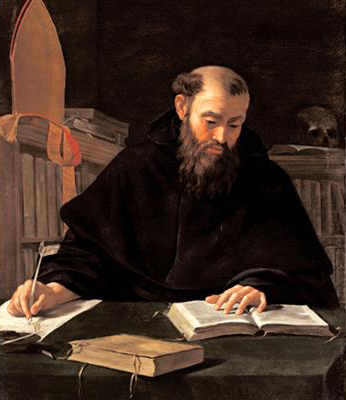
For once I’ll trust old Auggie, St. Augustine of Hippo (354-430), with the last words this time, with a few annotations. Words suitable to conclude this blog for 2017, and open the way for a new cycle in the new year.
So, then, my brothers, let us sing now, not [only] in order to enjoy a life of leisure, but in order to lighten our labors. You should sing as wayfarers do — sing, but continue your journey. Do not be lazy [unless you need to!], but sing to make your journey more enjoyable. Sing, but keep going.
[No, I’m not talking about the “open-source analytics data store designed for OLAP queries on timeseries data”. How the word Druid ever got patented and copyrighted, I’m not sure. Imagine trying to do the same with Christian or Hindu or Muslim!]
Recently the word “privilege” has accrued all manner of emotional loading with connotations of wokeness and political correctness, while one of its primary meanings — advantage — remains largely untouched. While I do see the seven points below as privileges, an accurate synonym is advantage, and so it’s this sense I want to examine here. Note also that I’m not claiming these advantages belong only to Druidry. But in my experience, Druids seem aware of them in uniquely Druid ways that contribute much to the experience of Druidry.
1–Druids (and Pagans generally) are so clearly a minority in the West that they enjoy a built-in remedy against arrogance. The misconceptions about Druidry and Paganism still rampant can, at their best, make a person laugh. Yes, there’ll always be individuals who try on an inflated self to see just how far such a blimp will carry them. The cosmos deflates most swollen and bloated things in its own good time. But for the rest of us, humility is a useful place to begin almost any human activity. Except maybe politics. Minority status points Druids naturally towards humility and humor.
2–Druids do community about as well as anyone. (Visit a Druid camp or Gathering and test this firsthand.) While acknowledging the valleys and caves and hermitages our solitaries occupy — many community folks are solitaries, and vice-versa — we get plenty of practice in loving others. Because in the end, that’s why we connect. The currents and energies of the cosmos also dwell in other people. Looking to power a rite or discover a richer truth or share the inspiration of awen? When we attempt these things, we draw on each other at least as much as on the sun, moon, stars and spirits. Living things make up much of “the power of the land within and without”, as the OBOD invocation puts it. Druid community is practice for love.
3–With the practice of Druidry comes a discovery of the need for discipline. No one checks up on us. If we want something to happen, we need to be open to it and also help set it in motion. Achievement takes work, a basic truth we seem in danger of ignoring in Western culture. Through making a choice for a particular practice of discipline, we gain increased self-respect. We’ve earned what we know. (If we haven’t, someone will probably point it out to us.) The opportunities Druidry offers to practice self-discipline also build self-respect.
4–Because of the diversity of training, experience, location and heritage among Druids, our practices help keep us open to surprise. Whether we meet in community or keep in touch through books and online, we’re always encountering new insights, ideas, perspectives and techniques. We’ll never know it all, and that’s part of the wonder of the path. We gather in circles, and they always open into spirals. The path doesn’t stay the same, and neither do we. Druid practice helps keep us open to surprise.
5–An experimental mindset powers much of our practice, as it does our gardening and beast-craft and spiritual exploration. “If it’s operational, it’s true” goes the old tag from the 60s, and it still has validity for most Druids. From this attention to reality comes a particular integrity in the Druid experience. Dogma still creeps in from time to time, but attention to what’s happening to the land, to what the spirits and guides are showing us, to what our studies reveal, and what our dreams and visions and hunches direct us to consider, mean that unlike religions that center on professions of faith, Druids are busy exploring to find out for themselves. Once you know, you no longer need to believe. Belief’s often a useful tool, but it’s just one among many. The experimental mindset that Druidry encourages promotes spiritual integrity.
6–Druid teaching, ritual and practice spark many Druids to explore their artistic and creative sides. Yes, Druidry is a spiritual path that specially honors and fosters creativity. Meet and talk with Druids and you’ll also discover how creative people are drawn to Druidry because they seek a path where imagination plays a primary role in spiritual experience, rather than a suspect behavior leading to heresy, diabolic influence and poor choices. Druidry knows passion and vision and creative exploration are spiritual gifts.
7–The Great Mystery that lies at the heart of the manifest and unmanifest is what powers Druidry. It sparks humans and other creatures, burns at the heart of planets and stars, and shines out of the cosmos whenever we pay reverent attention. The open-endedness of Druidry, its sense of a new horizon beyond the next hilltop, make it both welcoming, exciting and challenging. The heart of Druidry is both spiritual welcome and provocative challenge.
I don’t talk directly about the other path I follow, and that’s principally for my own benefit, so I can keep clear about where I am and what I’m doing at the moment. Obviously I can’t keep them separate, and there’s no reason to try. They feed each other constantly anyway, and often unexpectedly, too. Like when a teacher from the other path shows up as a Druid guide in a dream or meditation. Or an exercise originating in OBOD does nothing Druidy, but opens a door I thought was locked tight, or didn’t realize was a door in the first place, and shows me a new landscape I couldn’t even have imagined in my understanding of the other path. And that’s the short version of why I keep practicing both. Do the work, say both paths.
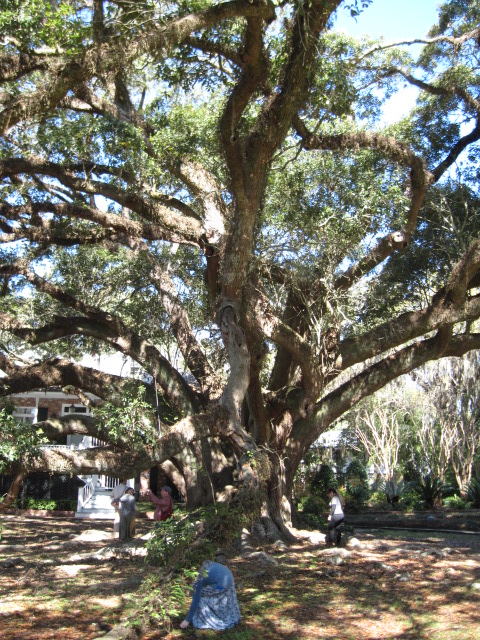
Louisiana Live Oak near Gulf Coast Gathering, 1200+ years old
One of the practices of the other path, nothing particularly unique or esoteric in itself, is writing a monthly letter to one’s teacher surveying the past 30 days, noting discoveries and setbacks, places for focus, requests for help, dreams, encounters, insights from reading and study, and so on. It doesn’t have to get (e)mailed (though that can be its own practice), because the value is in the doing. No surprise, we receive in direct measure as we give.
I talk often here about the value of a daily practice, whatever form it may take. Certainly weekly and monthly cycles grow and build on that daily rhythm, whatever it is. (Start small, and with what feels appropriate.) Lapse in my daily discipline, and I see the larger cycles become more challenging. They have to pick up my slack. The weekly fast, physical or mental, that can be so cleansing, simply has more to clear away, and that can make it harder to move through. If it’s physical, food calls with an imperative clamor you would not believe unless you’ve tried it. If mental, every weakness seems to arrive and bid for attention. Or they take turns. And sitting to begin that monthly letter, which you might think would welcome such experiences as ready-made material to incorporate, instead throws up formidable writer’s block. I am called to do the work. Otherwise I sit still, and stagnate. No fun there.
Along with the letter, of immense value is working with a personal word or mantra. Many know and use traditional words and phrases — OM, amen, nam myoho renge kyo, allah hu akbar, and so on. And these practices prove their own worth, in groups and alone. But the personal word is a spiritual key, and it can unlock many doors, simply because it is tuned to my present consciousness. It echoes where I am today. And that means that if my current word wears down, as they do over time, asking for a new one is part of the practice.
Watching and listening for the new word is an exercise in itself. Sometimes it will present itself in contemplation, as if dropped in place like a stone in a pond. It may be an existing English word, or a non-English syllable or two or three. I try it out, the vibration engages, and I’m off. Testing it is an important part of using it. If I feel a habit loosen, a mood lift, an energy or pulse that shifts things usefully, I know it’s working. Other times, it appears in a newspaper headline, or on a billboard, or in casual conversation. A small inward chime goes off, and I recognize it. Or it comes calling multiple times, till I catch on and at last wake up to its persistent knocking.
These are just two of what we might call foundational practices, the kinds of things that can sustain a spiritual life, that less commonly examined flooring for ritual and ceremony, the underpinnings of magic for whatever is the next in the round of seasonal festivals, in this case Yule or the Alban Arthan rite at winter solstice, now less than a month away. Take on a daily practice and it usually will come to consist of a set of such foundations and supports, mini-rites or prayers or practices, recitations or visualizations, exercises or devotions that may range from lighting incense to offerings made to the four directions, to presenting oneself as a ready servant to a patron god or goddess, to community service, volunteer work, and so on.
A living practice evolves and shifts over time. This is a good thing. For some years because of my cancer, I couldn’t prudently practice a physical fast, so the mental one taught me something of what it has to teach. And teaching adolescents in a boarding school, while it was a job, also allowed me chances to serve, to listen, rather than fill other heads with my chatter all the time.
Doing the work each of us is called to do readies us for working together. (Is it any wonder we face such division and partisanship in the U.S. these days? How many of us if we’re filled with anger and distrust and fear are doing the work?) A wise OBOD Druid recently remarked, “When we commune together in song and revelry, we become friends. When we rise together in ritual, we become allies. When we take time and heart to initiate members into the order together, we become family”. Slowly I’m seeing more and more how friends, allies, family all depend on each of us doing the work.
I’m getting closer, though, to a place where fewer boundaries exist between my two paths. It used to be that tempera paint, egg-based, stayed separate from oil painting, till someone with sufficient mastery thought to combine them. I can see such a point in what one might call the future, though if I can see it at all, the future in some sense has already arrived. I just have to catch up to what is inwardly waiting. Isn’t that the story of our lives, the ongoing possibility of manifesting what already dances across the River, on the other side of the moonlight?
But what about the moments when something outside of us, without our conscious intention or instigation (or with it), announces itself to us?
You know — those times when no circle or congregation, no rite or prayer has claimed us in our striving, and something reaches out to us of itself.
Dream, presence, deva, spirit, ghost, exaltation, angel, mystery, expansiveness, ecstasy, cosmic consciousness, god/God — a hundred names for what well may be a hundred different things. But each or all of them qualitatively different from you and me. The shiver, the awe, the freaking out, the reverence, the fear, the adoration, the Other. Or so virtually every description of these encounters suggests. And yet we’re intimately linked to them somehow, or we could never experience them in the first place.
What to do with this mass (and mess) of human experience? Religions often attempt to categorize, naming some portion as legitimate or amicable or “good”, and others as impostures, as frauds, as inimical or “bad”, and setting forth ways to grapple with it, to formalize human interactions with it.
On the other hand, with almost no consistent measure except the subjective available to it, science has for a long time typically dismissed the whole category as incoherent, though psychology and recent advances in neuroscience have begun to rehabilitate the subjective as a domain for serious study and insight. Or to put it another way, “The visible clings to the invisible”, say the Wise. WTF? says science.
So we devise rituals as one way to tame and investigate the subjective. Whether we go to wild places on a vacation or a quest to find ourselves, whether we spend too much to attend weekends and workshops on soul retrieval or finding our inner warrior, whether we rise and kneel in the pews, stand in Pagan circles, or renew our prescription to the current drug of choice, we try out options to scratch the itch of the Holy. Sometimes it’s merely a single mosquito bite. Sometimes it’s a whole-body rash.
Looked at one way, then, by pursuing a Druid-Christian approach we’re doubling our odds of successful encounter and engagement. Looked at another way, we’re muddying the waters, profaning the well, treading the old syncretistic path that usually ends not in transformative encounter but at best in a bland, safe vanilla spirituality void of those tradition-specific commitments that give each tradition its spiritual punch.
How to experience both living god/God and living earth? We wouldn’t have endlessly fracturing Christian denominations if “Jesus people” had a lock on things. Nor would we continually feel the need to hive off and fracture and splinter and regroup in virtually every other way as Druid and Pagan practitioners, either. Rather than seeing these things as weaknesses, we could celebrate them, always asking for integrity in ourselves first and foremost: what do we seek? What purpose does it serve? Who benefits?
Funny how the same questions never lose their applicability. Avoid personal integrity, and we squander our time demonizing opponents rather than incarnating the Holy in our words and deeds. Both difficult to access and continually present, the Holy is a paradox singularly appropriate for humans, who rarely make things easy for themselves.
Whether it’s solstice dawn or empty tomb, death or birth or other experience of transcendence, we seek communion, drink from a common cup, listen to and watch each other’s words and faces for signs of that contact, that connection. And when a strange-familiar wordless joy overtakes us, we try to put it into words for each other, as I do here, to pass it on.
Front entrance — my office, where I write this blog. Winter ’16.
May the Holy light your roof and bathe you in itself.
May the season offer you its generous portion
and open the door for gratitude.
May you turn to joy rather than despair
to nourish and sustain you in your trials and triumphs.
The blessings of your life to you,
rooted in each day’s grace and gift.
Here’s a triad I initially wrote about almost two years ago:
“Three reasons for supplicating the Mighty Ones: because it is a pleasure to you, because you wish to be a friend of the Wise, because your soul is immortal” — traditional.
Lovely reasons, all of them. Long-time readers of this blog know I like to take out truths and proverbs and see how they fit my experience. Not to either “prove” or “disprove” them, but to try them on for size, share something of the results, and possibly add to my spiritual toolkit.
Supplication as a source of pleasure: does this apply to my interactions with Thecu Stormbringer? [blogpost links 1, 2, 3]
My first response is “up to a point”. When my fear of change kicks in, it’s less pleasurable to learn more. But what have I learned?
When I last wrote, I’d received nine runes of change. But instead of trying them out, I stashed them in an envelope, because I was living them. That was manifesting as a move to an out-of-state teaching job that included housing. And then a return move back home within the month, when the job proved a “poor fit” — an often wry educationese euphemism that, in the words of Shakespeare’s Juliet, meant the whole scenario turned out to be “too rash, too unadvised, too sudden”.
And Thecu alerted me well in advance of the whole thing.
We often think — or I do, anyway — that if we could only know the future, we’d be armed against it, as if change were the enemy.
But to choose just one element of the whole experience that I’m writing to my Ovate tutor about, it was in the month before my wife and I made the change and packed up for a year out of state that I’d finally found a solid link to the land here in southern Vermont.
So leaving it hurt. And returning felt like a reprieve, or a fresh start. At the heart of it lay the increasingly clear perception that where we live has at last become our spiritual home.
More change coming. That’s this morning’s word to me from the goddess. To anyone alive today, change shouldn’t come as a surprise, though of course it still does.
I draw one rune from the envelope, even as I make a new place on my shelf-altar for Thecu.
(Surprised I hadn’t already? That’s the human inertia we all work with, which helps ballast us against small daily changes that shouldn’t upset us, and yet paradoxically weakens us when the big changes come along, because we’ve resisted incremental adjustments that would have made the transition much smoother.)
American children in schools across the nation “pledge allegiance to the flag” — an inanimate representation of the U.S. Is it so strange to extend reverence for an energy or consciousness reaching out to alert me of change and storms to come?
The rune I draw is the sixth of nine, last of the second set of three. For storms, angular energy, and wind sheer. For changes, side factors that contribute significantly, but which I overlook. For responses and initiatives, avoid a frontal resistance, and seek out angles and directions that can use the momentum and energy of change to shift to a better state and condition. Scuttle sideways, crab-like. Crab totem coming …
“When in doubt, divine”, says a journal entry from just about a year ago. A fragment, a contemplation seed, a gift, waiting for me to accept and receive it.
As I note at the end of a previous post about Thecu and change:
We can of course take an a-gnostic approach to all of the above as well: I sense changes coming (no surprise at all, given the state of the world!) and my imagination/subconscious is throwing up images, ideas, tools, hints to help me deal with them. Useful, wholly apart from the nature of their origin, because they’re intended to be empirical: their value lies in what they can do, what I can do with them. Who says the imagination or subconscious has no practical value? In some ways, that’s the ONLY thing it has.
And likewise, a reasonable response to a gift is gratitude for what’s been given.
/|\ /|\ /|\
Image: stormcloud — Pixabay “free for commercial use — no attribution required”.
Here we are, autumn of the year, gathering the harvest of what we have sown, both bitter and sweet. Hail to the West, place of the setting sun, of evening, of fullness and reflection and maturity.
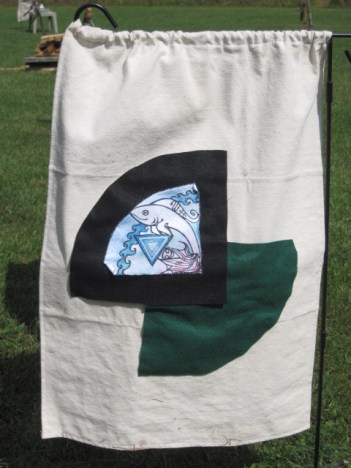
ECG ritual banner of the West. Design by Dana Driscoll.
West, traditional place of feeling and intuition, and in this cycle, the moon waxing toward fullness, too. I know: in the associations of many tables of correspondence, West is the waning moon. Why not attune to what will light the sky this evening, rather than a pattern that obviously doesn’t fit the moment? Tonight I’ll sit at my fire-circle for an evening contemplation, open as I can to what comes.
With the full moon can come illumination of what was previously hidden. We move in cycles, nourishing some causes and energies in the unconscious, till they move into awareness and we can assess whether they work to our advantage.
Larger cycles concern nations and planetary systems, whole species and immense and intricate patterns, while smaller ones shape our communities and individuals. Disasters and tragedies will keep coming, whether through deeply-rooted patterns in human psyches, or in natural cycles of change, disruption and rebalancing.
After a hurricane, rather than recriminations, it’s most useful to serve obvious need. Likewise after a human tragedy like a shooting. Let my sympathies rouse me to understand causes better, work for change, or open my compassion in concrete forms of aid. Otherwise, am I doing anything more than muddying the astral waters?
Emotional reaction has its place — we feel what we feel — but it can most lovingly be grounded in prayer, ritual and contemplation, and action, for my own good as well as for the good of others. Look to your own self first. the beginning point of all thought and action, counsel my inner guards and guides.
Here’s a first draft of a ritual meditation I’m still working on:
Earth in my hands, my gaze to the horizon,
I cast fear away, hate away, anger away.
clearing the bodies for health.
Water in my hands, my gaze to the wells of spirit
I wash in love, I bathe in compassion, I cleanse with caring,
clearing the springs of the heart.
Fire in my hands, my gaze to the flame of purification
I burn away limitation, I incinerate obstacles, I ignite useful anger,
clearing the will for further growth.
Air in my hands, my gaze to the way of wisdom
I conceive a change, I know a change, I understand a change,
clearing the mind for action.
I don’t say these things because they’re easy, but because they’ve proven themselves to me to be among the best responses over time, and the best ways to take a pro-active stance as well. They’re a practice, something I find worth doing in itself like any practice worth the name, and for healing needed so plainly and deeply.
“Everything is energy and that’s all there is to it. Match the frequency of the reality you want” – Einstein.
Gandhi in that oft-deployed admonition “Be the change you wish to see in the world” urges me to see the power of accepting responsibility for what I want, and helping it first manifest, however tentatively, within me. But Einstein gives me an inkling — no more! — of how. I don’t even care if it’s a case of “do as I say, not as I do”. I read crazy old Albert’s words and they ring true for me, call me to extend their resonance into action, into practice to see what they’re worth. Because how else can I know?
“Everything is energy …”
If you’ve read a number of my previous posts, you know by now it’s one of my ongoing obsessions to find out how others achieve what they do, and then, if I can possibly pull it off, to beg, adapt, borrow, or steal what I can from approaches, mindsets, techniques, strategies, work-arounds. (Oh, just give the old Druid a tool, already!)
Because belief, almost the sole technique on offer these days in the great monotheistic faiths, just ain’t enuf for me. (The spiritual riches of most traditions sadly lie ignored.) Or rather, it’s a powerful tool, but it needs material to work on, logic and motive as much as emotion.
We get another inkling of what matching frequencies can be like from human sexuality. The drive to mate and merge, instinctive in animals, can become more conscious in humans. (I say can. If you’ve approached such consciousness, you know the weight and force of that word can. How it slips away, how messed up and yet delighted we become in the presence of the “urge to merge”.)
A committed couple, the Judeo-Christian scriptures tell us, unites in a special way. Matthew (10:8) says, “… the two will become one flesh.So they are no longer two, but one …” If you’re reading this and you’ve known that particular blessing of unity, you get it. If even for a short interval, human sexual union gives us a direct experience of unity. It’s no surprise that we say we’re “in tune” with others, that we seek as well a wider “harmony”, that we long to be “in sync” — our languages mirror truth when they can, when we don’t muck about with them too much. (Ideologues and advertisers have much to answer for!)
So matching frequencies gets us “on the same wavelength”. We vibrate together, and with sympathetic vibrations each intensifies and reinforces the other. How to do this?
Mantra, sacred song, chant all aim for attunement. (All music aims to attune us to something. It just may or may not be a vibration in harmony with what I truly want. What does it help me manifest? What am I getting? What frequency have I matched? Where do I habitually vibrate?)
What is it about people and places that it just feels good to be around? What’s the quality that produces that comfort, that pleasure, that delight?
I want to tune myself in more consciously. That doesn’t mean I turn into some plastic saint, Druid or otherwise. It means in fact that if I want to express anger, I can do it consciously and responsibly, not passive-aggressively and unintentionally. I don’t need to summon into my life even more fallout from the random consequences of an already negative frequency buzzing in my head or heart. This, I know from hard experience and from looking almost everywhere at my fellow humans, is a core lesson.
I can take annoyance, irritation, and dump it through cranking a good headbanging song on speakers or headphones. Or do a ritual — ad hoc can be perfect — that lets me purge myself by dumping said negativity into an object I then bury in the earth. (Earth, take this from me. I transmute! says Earth.)
Or I do a quick visualization, one of my go-to’s, in fact: gathering my crap into a snowball and casting it into a river that sweeps it away and dissolves it. Gone. Even the turning of attention to such a visualization helps break an undesirable frequency, and guides me toward something that I initiate, not something thrown at me, dropped on me, spun within me. I become cause. Or at least, conscious effect.
Do these things, says my guide, and you open ways to fulfill your destinies. Because we all have more than one.
And if I remember to temper excitement at any new spiritual tool with useful clarity about the nature of the physical plane, and its inherent stability, I’ll learn to extend my practice to all planes, not just this one where change is — safely! — slow, most of the time.
Earth is a great laboratory for experimentation. Because then I won’t destroy every single new thing I mean to create, until I’ve learned my howthrough practice. And by then I’ll have seen how much more fluid the astral and other planes can be, how frequency-matching can be closer to instantaneous. How earth provides a useful counterweight to newbie mistakes and goofs. The ancestors, the gods, the spirits, the land — all help, all watch, all wait to be invited to the only adventure there is.
Part 2, in which I examine the time lag and solidity of Earth, coming soon.
9. How well does my spiritual interaction pass through the “Three Gates”?
This, I’ve slowly learned, is a great question to ask both before and after. In other words, any time.
As Matt Auryn notes in his original blogpost, “Rumi is credited with wisdom about three gates of speech. ‘Before you speak, let your words pass through three gates: At the first gate, ask yourself “Is is true?” At the second gate ask, “Is it necessary?” At the third gate ask, “Is it kind?”‘”
These gates, I’ve found over the years, work splendidly as a guide for my spoken interactions and for any other kind, too. They also form a powerful Triad for making decisions.
I need to include myself in the Triad: is my speech, action or decision also true, needful and kind — to me? What about my thoughts? And my feelings?
Often, whatever I’m testing with the Triad, I can get two out of three. Often it’s true and necessary. But it’s not kind. Return, return. Start over.
Standards tighten, I’m discovering. It’s not necessary anymore merely to “do no harm”. Someone — god, ancestor, higher self (same, different?) demands more. As elastic beings, staying where we are almost guarantees that the past stretching we’ve suffered through and learned from and grown into will weather down into slack. I can read the signs — tedium, stagnation and listlessness, if I don’t keep on stretching, letting myself be stretched, seeking out opportunities to stretch not just further, but wisely.
10. What’s my goal for interaction with Spirit? What is Spirit’s goal for me?
Important questions. Sometimes I know, or think I know, what’s needed at the moment. Sometimes it takes some digging to get to honesty with myself.
Other times the answer’s easy: no clue.
Usually that’s an excellent place for me to be. It means I need to listen first, before anything else. Instead of a ready cliche or a stock answer or something I dredge up from my own most recent spiritual slackness, I practice patience.
Sit, sing and wait, counsels one of the Wise. So I find different places and perspectives to sit in. The front entry of our house does duty for a small but useful office. Or a tree-stump from a powerline clearing that Green Mountain Power left beneath the row of hemlocks on our north property line. I sing a word, a name for spirit, a line from a song or poem, a spoken fragment from a dream. And I watch as this moment crystallizes into the next, and shapes of possibility begin to form. Often they scatter, birdlike, flying somewhere along the horizon, not where I’m gazing at all. I stand up and go about my day, and a whisker of insight, if I honor the handshake of spirit, comes.
11. How can I see and describe my understanding as a perspective?
Matt Auryn observes, “One of the best ways to keep your ego in check when discussing different methods and ideas is to claim them as your perspective and not as the dogmatic way to do things”.
So I try to remember to tell myself rather than believing X or Y that I suspect X or Y. Because whether it’s a ripple in the apparent world or a flash in the Otherworld, I almost always under-perceive it. I miss something, and often a lot. I kneel down to study a large footprint in our muddy backyard, never seeing the bear that made it lumbering away to forage among early blackberries. But knowing there’s alway more to perceive doesn’t discourage me. It makes it a game, even and especially when the stakes are high. Sometimes my best contemplations take wing when I begin by asking So what did I miss this time?
backyard black walnut coming into leaf
12. What hints and nudges has spirit sent to me already about fine-tuning my practice?
Every week or so, there’s a tonic that Spirit throws me down for and forces me to swig. “Take as indicated”, the label reads. And the fine print says:
“You’re a slow learner. That’s ample reason to practice humility. Everyone else is a slow learner, too. That’s an excellent reason to practice compassion.”
Funny how I haven’t yet overdosed on either of these.
13. What examples and teaching from the natural world greet and guide me today, right here and now?
A question I need never cease asking.
Yesterday and today, rain. The power out for about 90 minutes. The thermometer reads 46 F (8 C). I lit a fire about an hour ago. And as I set a match to the wadded newspaper and kindling, breathing the faint cold ash of the last fire, I knew Brighid was present, whether I’d invoked her this time or not.
Invocation, I heard/thought as the flame took hold, is my privilege. The gods welcome my service, but they move in the worlds just fine without me. And where there is privilege, and service, there is also wonder.
Every season is in season. Here on June 4, a private foretaste of winter. Not because the world is cruel, or because I’m cynical or confused, or because the nighttime temperatures here in the hills still refuse to budge from the mid-40s F (6 C), but because all possibilities are alive at every moment, even as time sorts them into sequences, into sets of before-and-after.
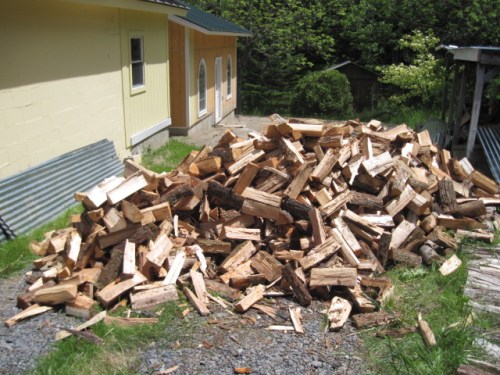
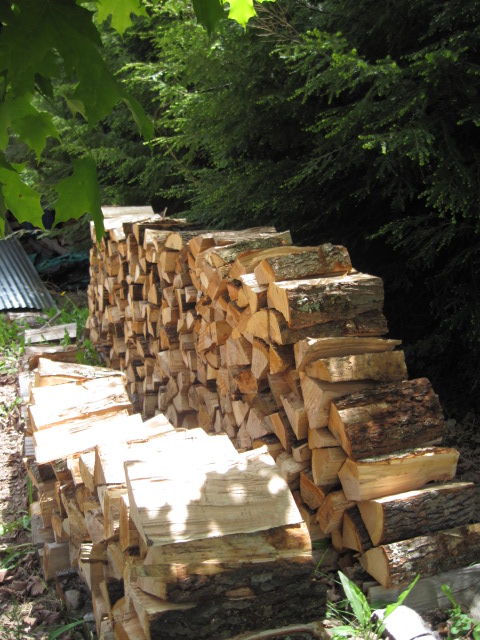
The first two cords of firewood arrived a couple days ago. I stack wood in June, and I’m reminded that I will lift these pieces again in December to carry in to the woodstove, my hands faintly scented with oak and maple and elm. This comes not as a rush of melancholy, but rather an intuition of a rhythm far larger than any one person or tribe or party. I sweat in the doing of it, and feel a familiar ache in the shoulders after I pause and straighten and stretch, another row done.
All around, we scrabble, dust ourselves off and parade our opinions, we joust and spar, not in our spare time, but in a time always spare of days. Meanwhile the great patterns we could apprentice ourselves to go largely unregarded, day following day, even as we wonder at what’s missing from our lives, and point fingers outward, away from where our lives point us.
At the close of World War 1 in 1919, two years shy of a century past, W. B. Yeats wrote these verses which too easily match today’s headlines:
Things fall apart; the centre cannot hold;
Mere anarchy is loosed upon the world,
The blood-dimmed tide is loosed, and everywhere
The ceremony of innocence is drowned;
The best lack all conviction, while the worst
Are full of passionate intensity.
Meanwhile what I need to know has always looked me in the face every minute of my life. It whispers in my ears, offering itself to my hearing. What I need to do comes to me in breathing, eating, working, sleeping and waking again, watching the worlds around me even as I take part in them and explore their textures with my skin. The moon waxes towards fullness, and birds sing all night long, making counterpoint with the peepers in the pond. The month warms towards the Solstice, and in a few weeks I will gather to celebrate it on a nearby hillside with half a score of others here in southern Vermont who also choose to honor the ancient rhythms.
With this blog I try to avoid “must” and “should”, “ought” and “have to”, except when I’m talking about myself and my own doings. Oh, I’m just as much a busybody as anyone. I have my opinions about what and how, who and when and why. But I also try out a path of wisdom laid down long ago and rein myself in, as much as I can, from dumping mere prejudices on you. And I submit that both of us breathe more easily as a result, and are the better for it. In their place, I strive to listen and reflect and marvel and shape into words what comes of that.
I see my woodpile and I lift, piece by piece, the life that is given to me, and order it as it lies within my power to do. And you, friend — blessedly, you do the same where you are.
“Ceremonies of innocence” have endured all these long millennia — will endure, as long as we practice them. And the Center? The Center has always held, making everything else possible — it’s the edges that fray, that have always frayed. We stitch up, and rip, as we go. So I turn toward that shining Center when I can, I invite you to consider the Center where you are, as it may look to you. And I write about it here.
For a related reflection about selfishness, continue on to the next paragraph. To jump to the next four points in this three-part series, scroll down to the break and the three awens /|\.
Selfishness. The behavior often gets a bad name, but I sometimes forget that survival is always a blend of self and other. In my marriage, my wife and I pursue both couple and individual goals. They needn’t conflict, though sometimes they rub up against each other in challenging ways. We negotiate and compromise. The marriage fails, or endures, on the basis of affection and communication. Self and other is what drew us together in the first place. Blending and balancing them is what sustains the partnership.
Change the scene. In a harsh environment, as human or animal, if I don’t eat so that my offspring can, I may starve, but they may survive. Biologically, this makes good sense — my genetic material gets passed along through them. Personally, of course, it may be disastrous, if I die. But the species benefits. My lines continues, with whatever genetic variants and strengths it may contribute to the whole. But if I don’t act “selfishly” enough to survive in the first place, I will never reproduce. The genetic possibilities I offer never benefit the species.
And this is just a simplistic biological sketch. My wife and I have no children. Biologically, simplistically, we “contribute nothing” to the species. Our species’ old judgments of childless couples stem from biology, and to an extent, they make very good sense. But wait …
What about spirituality? Some have labeled it a maladaptive behavior. From some perspectives it does look useless. For that matter, how do art, music, religion, philosophy, or other kinds of inward searches with variable outward results benefit either the species or the individual?
Humans have developed so that cooperation has begun to balance instinct as a means of both individual and species survival. We definitely haven’t mastered it yet — we’ve managed to kill the equivalent of the population of a large country of our own species (some 200 million) in just the last hundred years. Anger and fear, very ancient companions, still live with us. Each also has a survival benefit, up to a point.
But we’ve also managed to enrich both our individual and species experience immeasurably through beauty, wonder, awe, delight, pleasure, curiosity — you can extend this list yourself. These skills of consciousness make our species marvelously adaptive in unique ways we’re still only beginning to understand. To take just one ready example, ask yourself how often music has seen you through a rough period, or served as the capstone to a time of joy.
As a biological experiment, like all other species, it remains to be seen if we continue to adapt, or die out. But one rich component of our adaptive skill is self-consciousness and an ability to weigh courses of action. How well can cooperation serve us? How well can we manage both to honor instinct and also not let it usurp our chances and choices?
If you’re reading this blog, you presumably feel that spiritual inquiry and awe serve our species better than many other things we also do.
/|\ /|\ /|\
5. How am I looking for connection in ways that mesh with my practice?
If I use regular physical exercise, for example, as a time to renew, reconnect, and rebalance, I may gain in physical well-being, a priceless gift. But I may not pick up as readily on other spiritual cues and clues that come along and which I can access through other practices. Neither is “better” than the other, but they are choices and practices, each with distinct consequences and benefits.
To continue with the example, some forms of physical exercise allow for a meditative experience as a side benefit. Some don’t. The emptying and easing of worry, care, concern or obsessive thought that can result during vigorous exercise may be just the practice I need — a time away, a refuge on a par with prayer, meditation, silence, etc. On the other hand, if my body has sustained injury, or has survived for several decades, or for a host of other reasons, then other kinds of practice may be more suitable.
One point I’ve learned the hard way: I tend to overlook the gifts of one form of practice and lament that I miss out on other gifts that issue from practices I’m not trying. But I’ve learned that a spiritual practice almost never should be “either-or”. Most practices encourage tinkering and experimentation. If the path I’m on, the religion or spirituality or tradition that I follow, doesn’t urge me to play and explore and find delight, I need to seriously reconsider the path, or at least my approach and understanding of it. I may be serving it, probably mechanically or out of rote habit, but it’s not serving me.
6. How is my practice itself part of what’s inhibiting communication?
By definition, my practice is a choice I’ve made, a seed I’ve planted. All choices have consequences, and will germinate and grow and branch in unique ways. So it’s a given that my practice will inhibit some kinds of spiritual connection even as it sparks others. Rather than seeing this as a “bad” thing, though, I can see it as a measure of change and opportunity. Life is laboratory. Like a hermit crab, I may need to move on to a bigger shell. Tweak my practice, and new connections and communication become possible. I’ve dropped a few yoga asanas that now seem to strain more than they soothe, and I’ve added a daily 5-minute outdoor meditation leaning against the trunk of my favorite hemlock along our northern property line. New possibilities for connection open up I’m only beginning to discover.
hickory to our north, with new growth at the tips
7. What assumptions am I making?
Mind is really really good at assumptions. If instinct doesn’t always kick in, assumptions will. Again, this isn’t a bad thing, in itself. How else do I find a baseline for thought? I have to start somewhere. The large animal running toward me has attacked before. It’s likely to attack again. That food doesn’t agree with my digestion, so if I indulge, I’ll regret it. From good assumptions come “thrival” and survival. Poor assumptions lead to “complications”: death, stress, conflict, indigestion, anger, despair. We learn from “experience”, which is just another name for our set of assumptions constantly being tested, weeded out, replaced, refreshed and broadened. Cling too tightly to assumptions and, sure, they’ll lead to suffering. But hold on too weakly to good assumptions, and I overlook the usefulness of past experience as a guide to present choices.
So I start with assumptions. We all do. A “blank slate” means no basis for choice, judgment, taste, preference. The more I know my existing assumptions, the more I can play with them, rather than letting them play me. I can try out a new assumption like I would test-drive a car or a pair of shoes or a new series on Netflix, and see if I like it, see if it takes me somewhere I never imagined, if it builds and grows, or heals, teaches or delights.
8. To what degree is my understanding or misunderstand a matter of semantics?
To some degree — that I already know. Two evenings ago, a monthly study group I belong to spent some time talking about “broken” words and phrases, ones that just don’t communicate what we sense they might, or what others intend by them when they use them.
So we worked with renaming some of them. Instead of surrender, allowing. Instead of God, Spirit or the Way. And there’s the Bardic quest, in a nutshell: to dust off and recall old names, but also to refresh the imagination, to restore and recover and transmute energy. To commemorate, celebrate, innovate. Lots of “-ations”! To find and manifest and honor the elemental sacraments of spirit in fire, earth, water and air. To keep naming, to go on singing, what we need to hear.
We all know the experience of being called or offering the wrong name, the pleasure of someone (ourselves included!) remembering and using the right name. Confucius talked about cheng ming, the “rectification of names” to promote and ensure harmony. This, too, is practice.
“Call on me by my name”, say the gods and teachers of so many traditions. Paradoxically, most gods and teachers also possess and answer to many names. Then we get to play another game: Is Pallas Athena “the same” as Athena Parthenos? Is Coyote or the Trickster the “equivalent” of Hermes or Mercury or Loki?
“The name (ming) that can be named isn’t the real/lasting/eternal name”, the Tao Te Ching slyly reminds us in its second line (“Ming ke ming fei chang ming”.) Wider understanding of that little detail might have saved a few million lives.
Of course my understanding is partly mediated by semantics. Get over yourself, I hear. You’re a lot more than your mind. Use other tools, and your understanding gets mediated in other ways. The trick, I’m still learning, is to choose the tool, and not let the tool choose the understanding. Add a tool, add an understanding. We might ask, wresting to our own purposes the Samuel Jackon-fueled Capital One ad(vert)s, “What’s in your spiritual wallet?”






 For once I’ll trust old Auggie,





 A Druid Way