Archive for the ‘spiritual practice’ Tag
[Part 1 | Part 2 | Part 3 | Part 4 | Part 5 | Part 6| Part 7]
In this next series of seven posts, I’ll be following a classic Tarot interpretation of the Fool as the querent or seeker who journeys through the aspects and archetypes of the Major Arcana. And I’ll be writing from some perspectives I hope will be useful to Druid-Christian travelers along the Green Ways of Spirit, and will in turn inspire comments and insights from you that can enrich us all. Take this as rough draft — I’m working it out as I go.
[Note: The tarot images used here, from the original Rider-Waite Tarot, are now in the public domain in the U.S.]
FOOL or SEEKER
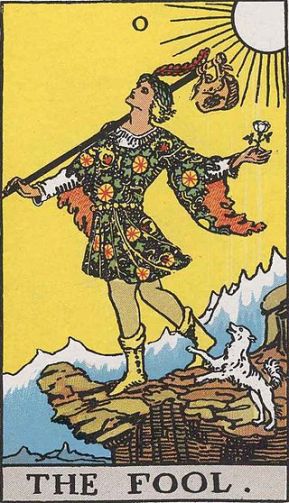 So important is the animal accompanying the Fool from the outset that almost every deck includes some creature accompanying the human figure of the Fool.
Whether we see this as our animal inheritance, part of our make-up as a physical being with age-old drives and instincts, or as a guide or companion distinct from us, the dog (or three birds in the Arthurian tarot) is with us from the beginning.
Why a fool? Nearly every significant tradition on the planet counsels us against arrogance or hubris, and in no place is this caution more needful than on our own spiritual journeys. “Let no one deceive himself. If any of you thinks he is wise in this age, he should become a fool, so that he may become wise” (1 Cor 4:10). The classic Zen master seeks to help a student recover that “original face, the one you had before you were born”.
Echoing this insight is the old Victorian Bard William Blake, a holy fool himself, who also said, “A fool sees not the same tree that a wise man sees”. Want an interesting exercise? Ask in meditation or dream to see the trees of the Fool.

Are they the trees of Paradise? The Medieval Legend of the Rood or Cross follows the main story line of the Biblical narrative with a tree or trees continually reappearing in different guises, first in Eden, then as a seed from that original tree buried with Adam’s body at Golgotha, to become — depending on the versions — part of Noah’s Ark, a bridge that the Queen of Sheba crosses, and eventually the Cross that Christ dies on.
(Where is the seed planted in me to disrupt all my false and narrow assumptions? What tree lifts its branches in my life, sending me places I’d never go on my own?)
And similarly, too, in Tolkien’s Silmarillion: there he recounts stories of how the Light from the original Holy Trees in Valinor is captured in the Silmaril gems, those greatest achievements of the Elven Feanor, whose name means “Spirit of Fire”, and follows their dramatic history through the volume. Trees, Light, Fire: we have them with us as we travel, even as we have the solace and guidance of an animal companion by our sides.
C. S. Lewis in his final novel, Till We Have Faces, draws on the Greek myth of Cupid and Psyche. The title echoes a line in the novel: “How can [the gods] meet us face to face till we have faces?” Lewis explained this to a correspondent, writing that a human “must be speaking with its own voice (not one of its borrowed voices), expressing its actual desires (not what it imagines that it desires), being for good or ill itself, not any mask”. In one way, then, the Great Work is to be me, the original self, wearing the face I had before I was born, “because no one comes to Spirit except through me”.
Ask an ancestor to show you an original face.
We might also see the sequence of cards coming after the Fool as masks that the Fool tries on along the journey, learning from each role or incarnation or experience, but never wholly defined by any of them. Or, alternatively, as initiations each soul must experience on its journey. (Looking for just four? Try the Elemental Sacraments that appear in the life of Jesus and offer themselves as well in slightly different guises to Druid and Pagan generally. And if you’re like me, you remember you may experience each one multiple times along you spiral path. I prime the pump occasionally and try one out myself, if it hasn’t come along recently on its own.)
MAGICIAN
 The Magician, numbered 1 in most decks, is a prime number, expressive of unity, the fullness of Awen, of Spirit before creative activity begins on the physical plane. The serpent that forms his belt recalls the admonition to be “wise as serpents and innocent as doves”.
As a lightning-rod for spirit, one hand raised to heaven or fire, one lowered to earth, garbed in fire and pure white, the lemniscate figure-8 of infinity above his head, he is a potent figure for many. And another mask.
In the Golden Tarot, the Magician is Christ, beast-Master, Lord of Animals, able to communicate with them in ways many humans have often lost and must work to regain. He knows as well the beast nature and the human nature, honoring and blessing them both. In our steps along the spiral, we sometimes cut ourselves off from what some have called our elder brothers and sisters.
Ask the spirit in all things to help you see how to participate in healing the breach.
In Hindu myth we enter the worlds with an adi karma, an initial nudge that lands us in physical bodies, and sets our feet on the spiral journey back home. “True voyage”, says U. K. LeGuin innocently, “is return”.
What is it about being human? The German poet Rilke exclaims in the first of his masterwork, the Duino Elegies:
Ah, who then can
we make use of? Not Angels: not men,
and the resourceful creatures see clearly
that we are not really at home
in the interpreted world.
Some versions render it our interpreted world. We’re the ones, after all, who filter experience through memory, intention, language, culture, emotion, training, expectation — a whole set of potent magical transformations animals only partially know, filters which immeasurably enrich our lives but also deeply complicate them. The Magician is master of transformations, able to ride successive changes but not be overwhelmed by them.
I enter each card in imagination and look around. What can I see, smell, hear, imagine, receive in hints and glimpses?
How can I find a home in this world? How can I be a refuge on the road for others here like me?
The HIGH PRIESTESS
 In the Matthews’ Arthurian Tarot, the figure is the Lady of the Lake. In both decks — the Rider-Waite pictured here, and in the Arthurian deck, in contrast to the Fire-red of the Magician, we see the Water-blue of the Priestess or Lady. Launched into the world of polarity, we encounter a different kind of initiation, and Initiator.
While there is great wisdom in the occult maxim of Dion Fortune that “All the gods are one god, and all the goddesses are one goddess, and there is one initiator”, it’s also true that many people have experienced the Powers of the Worlds as distinct beings, and until we have experience of them ourselves we may wisely keep silent about them. We already know from childhood onward that what’s true on the physical plane may not work on other planes, and vice versa. Try out the effortless flight of the astral dream world on earth, and gravity has a way of asserting its own reality regardless of our wishes or beliefs.
With a crescent “moon at her feet”, and also featured in her headdress, the High Priestess is in some ways an embodiment of Isis, and of Mary as well. She has her own balance, seated between the Pillars of Force of much classical magic practice, and positioned in front of a garden of fruit trees. With both the equal-armed cross on her breast and the title “tora(h)” or book of laws in her lap, she is a complex of many meanings, all worth exploring. “May your word to me be fulfilled”, goes one version of Mary’s words to the angelic message and messenger at the Annunciation. The fulfillment of the word “tora” may be as “rota” or wheel: the Fool’s journey or spiral continues.
But the feminine is not passive, as the stereotype often runs. Possibilities are endlessly sent to us by spirit, by the cosmos rippling its energies through every one of its creatures. We can refuse them. And we often do.
What law governs this moment? What is still spinning in my life? What annunciations come to me each day? What words have I accepted and allowed to fulfill themselves? What and who have I turned away from the door?
Poet and rocker Malcolm Guite writes in his poem “Annunciation”:
We see so little, stayed on surfaces,
We calculate the outsides of all things,
Preoccupied with our own purposes
We miss the shimmer of the angels’ wings,
They coruscate around us in their joy
A swirl of wheels and eyes and wings unfurled,
They guard the good we purpose to destroy …
We’re invited more often than we know to say yes to things that terrify us. We’ve imbibed our fears along with the advertisers’ marketing jingles that we know through repetition even if we despise the product. If repetition can accomplish so much, let me turn it to my purposes, rather than somebody else’s. As author Peter Beagle famously declares, “We are raised to honor all the wrong explorers and discoverers — thieves planting flags, murderers carrying crosses. Let us at last praise the colonizers of dreams”.
Or to turn to another great Bard, the late Leonard Cohen, who sings in “Anthem”, with great Druid counsel:
The birds, they sang
At the break of day
Start again, I heard them say.
Yeah, the wars
They will be fought again
The holy dove
She will be caught again
Bought and sold and bought again
The dove is never free.
Ring the bells that still can ring
Forget your perfect offering
There is a crack, a crack in everything
That’s how the light gets in.
No, the dove is never free, not till spiral’s end, but the Light keeps getting in. The dove keeps descending, bringing the blessings of spirit, keeps setting out from the Ark to find land after flood, keeps returning with a leaf in its beak, keeps on keeping on. (Male, female, polarity. Though it’s heresy in some quarters to say it, we’re all much more than a “gender” or “orientation”. A stereotype is a simply firm or fixed reference point in a world of changes, not something to attempt mistakenly to incarnate personally — impossible, anyway!)
How am I the High Priestess? How am I still the Magician? What has the Fool discovered so far of balance and polarity?
/|\ /|\ /|\
Each of us is a center from which good things ripple outwards to others. We matter more than we know, more than it can sometimes feel like we do. Any time spent in a true practice confirms this again and again.
/|\ /|\ /|\
Here’s a recent and unusual “comment” that ended up in the spam folder, even though it didn’t contain the typical hyperlinks that earn it instant spam status. (Track it to the originating URL, which I made sure not to include, and you land on a Russian-language small-equipment site. Go figure.) What caught my attention and rescued it from immediate deletion is its marketing build-up. Replace a few key phrases of this comment, and you could be talking about launching a physical exercise regimen, making prudent financial investments, improving your sex life, or learning a foreign language. It’s “Druidry” only in the very loosest sense. Here it is, punctuation unchanged:
Have you ever felt that you just don,t have the time to practise the Druidry that you want to? Wouldn‚t you like to be out in the woods meditating for hours, getting in tune with spirit and nature but the reality is a nine to five job in a town or city. You come home in the evening stressed and worn out and after you have spent some quality time with your partner, played with the kids and had some dinner, you just want to roll into bed. Then the whole sorry business starts again. I guess that like us you also thought of getting up half an hour early to have time for meditation or to greet the sun. You probably also have heard the alarm go off for that early start, reached out to turn it off and woken up exactly half an hour later at your normal getting up time. What if it didn‚t have to be like this? This is where Awen and the Art of Urban Druidry (with apologies to Robert M. Pirsig) comes in. Even in the most built up of cities there is life bursting out everywhere. The first stage on this path is to see it.
The comment treats spiritual practice as an addendum, something I can add to my diet like a supplement or vitamin, rather than where I live my life from. While “spirituality-as-supplement” is one perfectly valid way among others to begin, if a practice or spirituality doesn’t slowly and rightfully begin to pervade all I do, it’s not worth much — it’s not going to have the transformative effects I’m practicing it for in the first place. (More surprisingly, after such marketing language, the comment doesn’t follow through and offer its solution to the problem it identifies — “yours today for five easy payments of just $99/month!” And where’s the book? That title seems targeted for a quick spiritual pick-me-up.)
Very few Druids I know can regularly be found “out in the woods meditating for hours, getting in tune with spirit and nature”. This may occasionally happen at Gatherings — if we’re not seduced even then by the busy-ness of the Gathering schedule (here’s the wonderful but over-full, often double-booked, Feb 2019 Pantheacon schedule), or we forgo them altogether because if they’re any distance away, it takes fossil fuels to get there — or on long weekends, or vacations, or focused retreats.
A few solitaries may indeed carve out a daily block for deep meditation, by radically stripping away much else in their lives, sometimes including a partner. But it’s not a course specifically to recommend, or strive for, in the ordinary way of things. Plenty of Druids do little or no meditation — they’re fully engaged with other practices — you find the Druidry that works for you. Nor is some variety of meditation necessarily on the menu to set before newcomers. If I need to meditate for hours as my starting point, my chances of success, of sustaining such a rigorous practice, run from slim to none. (St. Paul counsels the Thessalonians to “pray without ceasing”, but that’s hardly a beginning practice for the new believer.) I gotta start where I am today, not from another place I have to go, just in order to begin.
The word “compromise” suffers these days — it’s practically equivalent in some circles to selling out, to treason, to soul-less complicity with the “Military-Industrial Complex” that president Eisenhower named over 50 years ago. Looking at all the many compromises every single one of us makes each day, I want to be mindful of my own first, before accusing anybody else. (Though you might not think so, to look at my comment on the opinion piece in the following paragraph!) I’ve taken the old song lyric as a matrix for vows and goals: “Let there be ____ on earth, and let it begin with me”. If Spirit can make headway with this 60-year old married Euro-American Druid-Eckist, using any part of my life as a center for change that might even deserve to ripple outward from there and influence others, then and only then do I have something to say to those others. If not, I’d best hold silence on such matters, listening to my trees when I can actually hear what they’re trying to tell me. Otherwise it’s all just another ego project that does little good for anybody.

looking west out our living room window
To get at this principle from the opposite direction, I’m now going to pick unfairly on a recent opinion piece in our local paper The Commons, titled “We have a choice: action or complicity“. (You can easily insert your own favorite divisive issue or polarizing problem or current controversy as the “choice”, without even reading the article). Such a self-righteous tone can feel really gratifying when we’re confident we’re perched on the “correct” side of the issue, and want to chastise all our weaker, conflicted, unprincipled neighbors who aren’t as woke and fired-up as we are about “Burning Issue-of-the-Day #327”. But attempts to ignite action through guilt, rather than offering a doable set of appealing steps that can start as soon as I set down the paper, haven’t exactly proven themselves as prime ways to effect change. And labeling the disengaged as “accessories after the fact”, as this opinion piece does those readers who sit out the controversy du jour and remain uninvolved in one particular struggle, probably will do little more than stir resentment at “damn liberals”. I’m a damn liberal myself in several ways, and even I grumble about damn liberals after reading the article.
In fact, most of us do have plenty of causes we’re committed to; it’s just that most of these causes are local, where we keep being admonished to act — they begin right here and now in our own lives: make rent, pay the mortgage, raise the kids, care for aging parents, save something for retirement, humor the crazy neighbor, pay off college tuition, care for our changing bodies, comfort a friend, invest time and passion into a love relationship, steady ourselves up for the next challenge, open ourselves to laughter and light wherever we can, and make of this world a home.
/|\ /|\ /|\
“What if it didn’t have to be like this?” asks the original comment.
Well, it doesn’t “have to be” like this, and it isn’t like this in the lives of Druids I know. Every one of them has found valid and authentic steps to begin to rein in consumption, live greener, hear the call of the awen, and honor the voices of the beings around them. From radically downsizing both living space and possessions, and “simplify-simplify-simplifying” (B in northern Vermont), to joining Native protests at the Dakota Access Pipeline, training with a Native teacher and working in a nursery (M in New Hampshire), to training and mentoring in permaculture and raising much of their own food (R in Pennsylvania), to super-insulating their house, driving an electric car, working full-time to grow low-cost public housing (W in southern Vermont), to living in cooperative housing, hand-crafting, and raising a child as a single parent (M in Massachusetts), Druids are living their Druidry woven in the fabric of what they do every day, not as an “add-on” squeezed into an already-full schedule.
So here I’ll repeat the words I opened with: Each of us, regardless of the labels slapped on to who we are or what we do, is a center from which good things already ripple outwards to others. We matter more than we know, more than it can sometimes feel like we do.
/|\ /|\ /|\
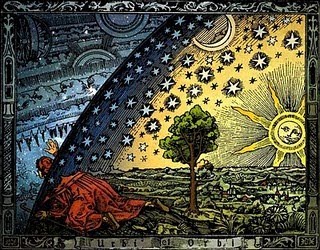 Denise comments:
Wonderful series; I hope you’ll continue. I’m another square peg – endlessly resisting all attempts to assimilate, no matter where I wander. Somehow, I keep finding myself coming back to Christianity but not “that” Christianity, I say to myself – not the rigidly human-focused, hierarchical, be-a-good-girl version of my childhood. No, not that one but the magical, connected, generously giving version that was part of my childhood too – the one that did not exclude anyone or anything… I recognize glimpses of it in your writing and think Yes! That’s it! That’s it! What exactly is it though? I don’t really know yet but it’s worth the journey to find out.
From this and other recent comments, we can begin to suss out the kind of practice, experience and reconnection many of us are seeking. I’ll be drawing from Denise’s comment above a number of signposts, because in it she hits on a series of crucial aspects of a spiritual quest, Druid or otherwise. And because I’m a Druid blogger, I’m choosing and focusing on Seven Signposts we can identify there. I’ll launch each signpost with an excerpt from the comment:
“another square peg — resisting all attempts to assimilate”
We’re social beings, even the most formidably anti-social and hermit-like among us, predisposed to find a niche when we’re with others of our kind, like other intelligent and social mammals. So not feeling at home in our world can be a sometimes painful indicator that a spiritual journey is under way. Something’s shaken loose and ejected us from easy comfort with our situations and our social circles. It matches an inner resistance to the conventional niches on offer in our lives, if they don’t nourish and feed us as they should, as they used to, but no longer can.

So we shy away from sham spiritual landing pads, not trusting the footing they offer us. “I yearn to find where and how I fit, but I’ll be damned if I have to sell out to do so”, we seem to keep whispering to ourselves. A certain integrity deep inside us, one we instinctively hear and trust, warns us off the varied boxes, chains, handcuffs and cages we see around us, even as we can see the comfort they appear to bring to others. That makes it doubly hard to explain why we won’t join them in an adjoining cell. “If it works for them …” But it keeps on not working for us.
And in turn, this sense of not fitting in can often lead to …
“wander(ing)”
“Not all who wander are lost”, Tolkien reminds us, writing of the royal-heir-in-waiting Aragorn, but also of course of each of us — heirs like many mythic figures of more than meets our physical eyes. Lineage, heritage, ancestral bequest — it’s there. Or in 90s speak, “Exiled much?”
But the arms of our immense spiral journey can circle so widely, so far over the horizon, that we may have little sense of anything like a spiral at all, only of our wandering, our meandering, generally off the kind of track so many others around us seem to be following. (Though that, too, can be an illusion, given how good we are at “keeping up appearances” for each other.) At times, those same others may envy what they see in us as freedom, while not seeing the cost we keep paying. And we may envy the stable, settled, found-my-niche folks who envy us in turn, and for the same reason: dissatisfaction with The Way Things Are Now.
“keep finding myself coming back”
So we still face one of several paradoxes we’ve gotten to know far too well. Paired somewhat oddly with the previous meander, our wandering in out-of-the-way spaces and places intermittently offers that delicious sense of return. We can also feel like we’re circling around an inner shrine or ideal, even as we’re often barely half-aware it’s there. And if I notice a movement of return, it can often slip past, like one more part of my larger wanderings, which may not be comforting. Am I making any headway at all, or just circling the same dead-end? Is this zeroing in on something valid, or endlessly backtracking to something I’ve already tried and rejected?
And what is it that we’re coming back to? Often we can identify it as …
“magical, connected, generous”
We know these qualities because — somehow, somewhere — we’ve stood in the heart of such worlds, lands that feel more like home than home, places of wonder, communion, and flow. Or maybe we can pinpoint exactly when we experienced such realms, when we entered and when we left. In either case, yearning for them has at times consumed us, or still burns in the background as a steady low flame, a kind of pilot light of the spirit, alight through years or decades or — we may have a sense — through lifetimes.
Here at the midpoint, the fourth out of seven signposts, we stand where we’re going, we’ve arrived again where we’ve never been before, and other paradoxical ways of attempting to get into words the sense of …
“recogniz(ing) glimpses”
The haunting, beguiling, infuriating sense of recognition stalks us, not letting go. It’s both in us and outside, out front and behind, a kind of spiritual transfusion, a re-kindling, the light of a star for us “in dark places, when all other lights go out”, as Galadriel says to Frodo in Fellowship of the Ring. These archetypal, primal spiritual presences stand behind the varied forms of religions and cultures, never wholly removed from us, however dim our sight at the moment. They endure because we do, reaching us in ways we can perceive and understand, connect with, honor and revere, work with, pass on, adapt to our circumstances — but ideally not make a dogma out of, despite our best efforts to nail them down, clasp them in our hands, own them outright, box and sell them, fight and die for them. (Maybe instead I could live for them?!)
“No one comes to Spirit except through me”, to cite a “difficult” text of just one tradition, need not be a claim to religious exclusivity and spiritual imperialism: it can be a simple statement of spiritual reality. “If I want to get closer, I need to find the original, authentic me within”. Or if I ignore this counsel, I’ll come round the long way, better supplied the next time I meet up with a moment of spiritual reconnection with the acuity to sort wheat from chaff, gold from dross. A few more notches on my belt, scars on my face, tools for my need.
“There are two paths you can go by”, sing Led Zeppelin. “In the long run, there’s still time to change the road you’re on”. Yup, I’m in it for the long run. And a multitude of paths: we’re each on trails of our own, criss-crossing others, at times walking the main track, at others turning aside at a fork, a fallen tree across the way, a washed-out bridge over a chasm, a fiery guardian brandishing a cruel-looking scimitar.
“what exactly is it?”
“I’ll know it when I see it”. “It takes one to know one”. The melody we carry in our hearts will burst forth in the right circumstances, harmonizing with the First Song, the awen echoing in all things, the Word, the Bani, the Shabda, the Kalaam-i-Haqq, the Hu, the Voice of the Silence, and a thousand other names. In one sense the spiral we’re on never ends — we circle, always closer. In another sense, we’re the endpoint, we’re the spiral itself, and the spiritual quest can feel like chasing our own tails till we’re dizzy with it.
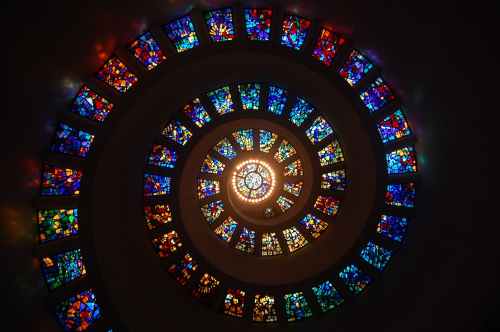
I take it as one measure of my place on the spiral whether my sense of “what exactly it is” happens to line up with others’ senses of it. If our sensibilities align, I know the gift of a way-station along my journey, and fellowship here. I may be able to work and grow with others, and find solace and companionship with them. If our senses don’t happen to line up just now, I walk solitary for a time. Familiar with both arms of the spiral, I try to honor where I am at the moment, and make the most of it. No judgment, no better-or-worse-than. Strive to honor the integrity of your own walk, counsel my guides and teachers.
“worth the journey”
In spite of everything, or because of it, we also carry an intimate sense that nothing else matters but this … whatever-it-is. Worth the journey, equal to and surpassing the pain, deserving our deepest dedication.
If, like me, you’ve “stepped away” on occasion, well, that too is a path, and will end up teaching more than the solitary person who walks it. We teach each other, most of all when no other teachers seem to paying attention to us, or we’re late to class, or we’ve lost the assignment, mislaid the text, dropped out, failed, skipped town, run off with a comely classmate to parts unknown. All our oldest tales tell of something similar. We’re in good company along the road.
/|\ /|\ /|\
We keep listening because we keep hearing hints. We keep looking because of what we’ve already seen. We walk across the darkened chamber because we have a sense of where at least some of the furniture looms, where a door behind this cabinet opens onto a realm of light.
The wisdom and practices of Christianity and Druidry together amplify each other, and for those who find resonance and insight in that happy confluence, a few more posts on the subject are in order.
And then it will be Spring Equinox — Autumn Down Under — and this old world will continue to knock in our bones and drum in our blood, while the spirit in us burns bright or dull, according to the myriad paths we traverse.
May Friend and Flame, Word and Melody light and cheer you as you go.
/|\ /|\ /|\
IMAGES: Pexels.com
You hear a lot about “top-down” and “bottom-up” initiatives. Start from the grass-roots. Or identify good leaders and let the growth come from their inspired guidance through hard times. But I’d claim that most of our best ventures build and grow from the center outwards. We’re all involved in this kind of initiative, and as a result we instinctively know what to do, even if we tell ourselves — or others have convinced us — otherwise. So the center is a good place to start.
Whether it’s an embryo, a crystal, a sapling, a story idea, a garden, a relationship, a ritual, a company or a nation, there’s a core, a center from which energy, ideas, blood all flow. This center — and this is an important key — also replicates itself everywhere, establishing new centers of activity and growth. Some — many — are within us. A tree sends out roots, plants send out runners, healing occurs and spreads from re-energized tissues and bones, and human nudges and hunches and gut feelings point us toward inner and outward changes. All living things seed themselves, passing on their dynamic potential to another generation, on multiple levels.
Druid attention to the ancestors, if it’s prudent, never seeks to excuse poor choices, bad parenting, or painful and difficult legacies passed down through generations. Each living thing is awash in a sea of tendencies that pair up with inherent directions and characteristics in its environment. I won’t ever have the body or metabolism of a long-distance runner, but that’s not really the issue: I can keep the body I do have as fit as possible, starting from the center of where I already live each day. The small daily changes I make are ones I’m more likely to stick with, even as the small changes my body makes as it ages prompt me, if I’m paying attention, to make adjustments for strength, endurance, energy and so on. Then when larger shifts and changes occur, I can better adapt to them. The same holds true for my inner bodies, emotion and thought and vision, memory and intuition.
Partly this comes out of practice with the small changes first, and partly out of stores and reserves put in place by going with the flow rather than fighting every single direction that living in a physical realm urges on us all. Electric cars coast downhill and save energy for the next climb. Hibernating species store up resources against the hard times. So, if I’m paying attention, can I, both physically and spiritually, prepare myself for each turn of the spiral. The “how” becomes part of my practice, if I let it, and the next challenge I face becomes my chance at re-calibration. Quite simply, is it working? Even to ask that question at all opens many doors.
Out of our sometimes violent human history and its consequent long conditioning, we may fall back on military metaphors, which don’t always yield the optimal mindset. You have to pick your battles, we say. No general wins on every front. More helpful is a range of metaphors, a rich gathering of stories to tell and learn from.

If it seems that spiritual laws swallow up individuality in statements about general tendencies, groups and patterns larger than one human life, it’s important to remember that it was humans who first noticed these principles, studied them, plumbed their potentials. And humans have always chosen either to disregard them or to work consciously with them. Intention is powerful. Animals largely follow an instinctive path. Humans have wider choices. Conscious and creative cooperation with the spiritual principles of existence is a powerful key to our individual human fulfillment. Through such means, we can manifest what has not yet been seen or experienced or even imagined, in forms of power and beauty and usefulness, for others as well as for ourselves.
As we become ancestors ourselves to our descendants of blood and spirit, passing along this “connective tissue” of life-giving thoughts and actions to succeeding generations, that’s one deep way to repay the gifts we’ve been given. It will then be their task to choose what works best for them, to honor and build on what they’ve received, and add their own stamp and color and flavor to the lives they live.
/|\ /|\ /|\
Image: Pexels.com.
[Don’t Go Away Just Yet, Grail] [Grail 1 | Grail 2 | Grail 3 | Grail 4 | Grail 5]
[Related: Arthur myghtern a ve hag a vyth — “Arthur king who was and will be”]
ONE
To recap: I rely on sacred sound, on awen, as my first and go-to practice. (Let’s call it East for now, since I need air to sing it.) Without the daily retuning it affords me, I find “all bets are off”. It clears the way, keeps me facing my own best interest more of the time, inspires me, keeps the creative stream flowing, helps me with compassion for others going their ways. In short, I like myself better when a sacred melody is my heartsong. Life flows more smoothly.
Some personal assembly is required for the “spiritual components” I’ve mentioned in this series. I can’t force a flower to open. What I do needs to flow from me gratefully, gracefully, as if I let myself out of a cage I didn’t know barred me from wider, richer experience. I may stand at the door a little dazed at first, but then the world outside the bars invites me. Spirituality offers a series of recipes. I don’t need to make and live on bread alone, or just green curries, but practice means I’ll improve on what I’ve started already. For what it’s worth, consider: “The fox knows many things, but the hedgehog knows one thing well”. (When you fully understand that, you can explain it to me!)
Or to paraphrase what I remind myself: The awen is already flowing in your life. Find out where!
If you want a poem version of the reminder, try Mary Oliver’s “Wild Geese”. Yup, awen coming thru: “your imagination calls to you like the wild geese, harsh and exciting, over and over announcing your place in the family of things”.
TWO
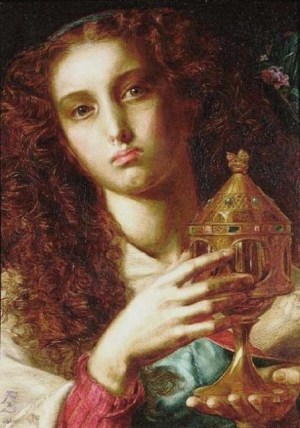
Elaine of Corbenic*, King Pelles’ daughter, bearing the Sancgraal/Frederick Sandys, 1861
The Elements, part of my “family of things”. Water, and West. Grail — Cauldron — Feminine Principle — Goddess — Virgin Mary — Yang and Yin together again. Octave, door, spiral key. Working with the Grail bears similarities to a form, like a kata in martial arts. Alone, it may not seem like much. As part of a path, a spiritual choreography, it opens out into unexpected country.
How I assemble, and what parts I choose, that becomes my practice.
I have a lovely blue-green vase given to me by a former student. It sits on a shelf, and needs dusting from time to time, especially after the winter season with ash from the woodstove. I also eat from a commonplace bowl that’s gotten chipped from wear, and lives part of its life submerged in soapy water along with all the other dishes I’m washing. Both are forms of the Grail. One sees daily use. The other looks pretty. Sometimes I feel a Grail in my heart, a divine space of possibility. The Grail is my heart, is everybody’s heart — our hearts together form the Grail.
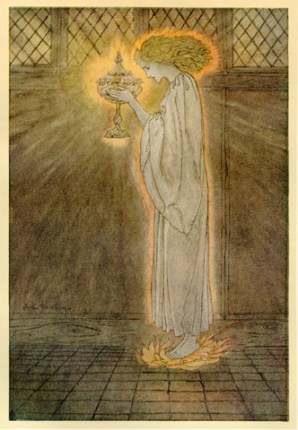
Another image of Elaine, by Arthur Rackham, 1917.
Seen from one side (the Grail has no sides), I’m on a Grail Quest. Seen from the other side, the Grail is the first thing I started out with, or that started out with me, as I tagged along childlike. It gave me away to the world (a way to all the worlds), knowing I’d always come back.
[*Elaine of Corbenic, the Grail Maiden of Arthurian legend, is the mother of Galahad with Lancelot.]
THREE
Earth, north. I sit gingerly at the keyboard, easing my back where I pulled a muscle yesterday on our icy driveway, carrying in an armful of firewood and nearly falling, catching myself with a wrench. Boar snorts at my shoulder, saying you know what to do. I reach to touch his bristles, reminding myself to relax, to shift, rock, ease the muscles from sitting too long in one posture. I stand up to look out the window at blue twilight on the snow, and stretch.
Grounding what I experience is key to bringing its use fully into my worlds. I practice this, writing, embodying shapes I’ve seen in vision, drawing (badly) the sword from yesterday. Though sword is east, it’s also undeniably a physical object — north, steel, mined from earth. Holding it, even in imagination, I ground the experience further. Holding a piece of metal or wood in my hand as a ritual equivalent, feeling its solidity and inertia, I ground further. Grail-in-all-things, goddess-in-all-things.
FOUR
Fire, south. Sun each day, moon each month, two great spirals for practice, a daily sun salutation, surya namaskar. A monthly moon meditation. Knight connects a version of this rhythm to polarity working with the Grail, too. Two ritual-contemplation questions arising in meditation today: “What is the sun of the moon? What is the moon of the sun?” I don’t need to understand everything before it becomes part of me. In fact, with much that I value deeply, like my wife, my marriage, understanding happens only after it has become part of me, and I of it, not before.
FIVE
First star tonight in the eastern sky tonight, Grail-star. Quintessence. Yes, earth my body, water my blood, air my breath, fire my spirit — so the old Pagan song instructs me. But spirit-greater-than-fire is here — spirit the essence of all four, and more, pouring inexhaustibly from the Grail across the cosmos.
With my forefinger I trace a pentagram in the twilight sky in the Seven Directions, another form I use: four quarters, zenith above, nadir below and center.
For the good of all beings, for the good of the whole, for the good of each one, may it be so.
/|\ /|\ /|\
IMAGES: Elaine by Sandys; Elaine by Rackham.
[Don’t Go Away Just Yet, Grail] [Grail 1 | Grail 2 | Grail 3 | Grail 4 | Grail 5]
[Related: Arthur myghtern a ve hag a vyth — “Arthur king who was and will be”]
And you might think after that last post, there’s nothing more I can add to the subject. I boxed myself in with a few home truths. You make your own path by walking it. Done. QED. End of story. Except …

One quality of a valid path is that it rewards the walking of it. It’s not valid merely because somebody else says so. The only authority worth recognizing is ultimately the truth we each sense within, in the doing of it. (Good parenting means in part supplying the rudiments of crap detection to our children. Pass along even the minimum we picked up over some decades of living, then, when the time is right, let them risk burning their own fingers, if they must, while we stand by with first aid.)
In some places this capacity for judgment used to be called critical thinking, and for past generations, inner resources. In many places we seem to have abandoned them. If we haven’t already refined that organ of good sense so that it serves us reasonably well, wherever and whatever it is, we can begin work right there. Life will, quite ruthlessly and uninvited, lend a firm hand.
As Ernest Hemingway once quipped, when asked what was needed, before anything else, to succeed at writing: “a built-in, shock-proof, crap detector”. One reason this tool matters so deeply, and in wider fields, is this: “At any given time, the chief source of bullshit with which you have to contend is yourself”. (This corollary to Hemingway comes from Neil Postman’s invaluable classic essay, “Bullshit and the Art of Crap Detection”, available online here.)
And Postman’s corollary also means knowing when to turn off the crap detector, consciously and intentionally, for purposes you choose. And the reason for this is significant:
“Each man’s crap-detector is embedded in his value system; if you want to teach the art of crap-detecting, you must help students become aware of their values”.
[Postman is talking to English teachers in this lecture/essay; he’s also talking before our current heightened sensitivity to pronouns, so cut him some slack if his wisdom outweighs his sexism for you.]
A pause here to regroup and reconnoiter:
- my single most useful tool is a crap-detector;
- its default target, when no others present themselves, is me;
- my use of a crap-detector is an art;
- and if I hope to learn how to use mine well, I need to know what matters deeply to me, because that’s where both my values and my crap live.
Where’s the Grail in all this, again? Bear with me. You’re here, if you’re following my promise in the first post in this series, to discover something about my way. Yours will, by the fact of your irreducible uniqueness, be different from mine, but also similar enough you may take away something useful.
Now you may already know all this — or think you do. In which case, write your own book, or run that weekend workshop, and tell us how it’s done (AKA how you do it). Apart from privileging your crap over mine, and separating me from some of my money in the process, I doubt you’ll be ahead in the end. I might be, if the experience helps me refine my crap detector.) The best things in life may, unlike your workshop, truly be free, but I work the hardest for them. But that way, oddly enough, I discover they’re splendidly my own, in a way yours can never be. They cost something far more valuable than money. They’re “free” in another sense because that’s what they make me. So: catch you on another rung of the spiral.
/|\ /|\ /|\

a Grail image
As a form, a container for energies and aspirations, the Grail earns my respect. (It passes my crap detector.) As an object for contemplation and visualization, together with regular practice of the cauldron sound I’ve described, I’ve begun to learn what matters to me, which is partly to say what works for me, what kindles me, what echoes in my bones, what seeks me out because it’s mine, and what I belong to in ways I’m still discovering. The Grail can be a passport to our native country. With it, I can go home again.
And as always, I try to heed the best bards. T. S. Eliot says in his “Four Quartets” (a vastly superior poem, in my arrogant opinion, to “The Waste Land” because I come away from it better equipped for joyful growth): “We shall not cease from exploration, and the end of all our exploring will be to arrive where we started and know the place for the first time”. Grail is perennially “first time” in its power to renew and heal, and in that way it’s a virgin experience. Spiritual renewal and rebirth bears this signature quality.
Paradoxes, like those in the preceding paragraph, are for me a sign and signal of approaching four-dimensional truth. As a Wise One once said, the opposite of a superficial truth is a falsehood. But the opposite of a profound truth is, often, another profound truth.
True poets and bards, they recognize this by instinct, and (at least in their better moments) never try to own it, only to announce the strange good news to us all through their words and songs. And we may catch ourselves shivering in recognition, another sign. This awe-tinged joy sparking in us, this inner alertness and attention and focus, is another quality the Grail can mediate, a quality I’ve learned to recognize with my crap-detector, which yields and bows. (Of course I can and should turn it back on — later — to assess what and where and, on occasion, what next.)
Up next — Grail 4: Elements, Tools, Guides.
/|\ /|\ /|\
IMAGES: Pexels.com.
Regarding public domain status of the Rider-Waite tarot: “In the United States, the deck fell into the public domain in 1966 (publication + 28 years + renewed 28 years), and thus has been available for use by American artists in numerous different media projects”.
[Don’t Go Away Just Yet, Grail] [Grail 1 | Grail 2 | Grail 3 | Grail 4 | Grail 5]
[Related: Arthur myghtern a ve hag a vyth — “Arthur king who was and will be”]
 Want a good overview of the awen in the life of another Druid? Don’t just take my word for it. Read Druid-in-two-traditions Dana Driscoll’s account here. [I’ve written about it, among other times, here and here.]
Looking for the lost melody of your life? For that sense of spiritual freedom you may have touched as a child? For the heart-song that so often eludes us in the busy-ness of 21st century living?
If there’s such a thing as a “container” for the awen, beyond the bodies of all things, it’s the Celtic Cauldron, proto-grail, womb, goddess symbol, under- and other-world vessel, humming on the edges of our awareness. To participate in its sound is to begin to manifest some of its properties. Put myself in sympathetic vibration with it, and I discover its powers of transformation. It accomplishes change through vibration — no surprise, when we know that every atom of the cosmos vibrates at its own particular frequency. That’s also part of why every major spiritual tradition on the planet includes chant, song, mantra, spoken prayer. The whole thing sings. When the bard Taliesin exclaims in one of his poems, “The awen I sing, from the deep I bring it”, he points us toward the pervasiveness of awen, its habitation in the heart of things, its flow through us, both lesser and greater, as we sing, and bring.
Dana observes, “One of the most simple things to do is to invoke Awen regularly as part of your practice.”
A tangent. An article from a few days ago somewhat ruefully acknowledges that there’s actually a specific day — January 17 — when Americans see many of their New Year’s resolutions fail. (Your own culture, if you’re not a Yank, may exhibit lesser or greater persistence.) Since we seem to addicted to bad news these days, feel free to indulge here in some delicious negative thinking, if you wish. But then read closer: “Contrary to widespread public opinion, a considerable proportion of New Year resolutions do succeed,” notes a psychology professor in the article. Even at the 6-month point, according to studies, some 40% of resolutions — and their “resolvers” — stick with it. While the data pool may well need refining, still, that’s an astonishing figure. Better than the best baseball average. While “two outta three ain’t bad”, as the Meatloaf song tells us, even “one outta three” is pretty damn good, in so many human endeavors. And if you’ve read this blog for a while, you know my strategy for success with resolutions. Start so small that it’s next to impossible not to begin. “Oh, anyone can find 30 seconds a day”.
And this holds true with so many practices, spiritual or otherwise. A habit is simply an expression of equilibrium. The resistance to change is the resistance of all set-points and stasis and inertial systems — their first “response”, if we think of them for a moment as conscious beings, is to absorb the new thing rather than change on account of it. It’s a survival mechanism, after all, evolved over eons, to prevent dangerous over-reactions and hyper-compensations to what are often only temporary blips in the environment. We can’t afford to be thrown off by “every little thing”.
Why would this apply to something like the awen, a pervading cosmic sound and vibration? It’s already flowing through us, at a sustaining level, keeping us alive, the heart beating, the electrical system of the body sparking along. But upset that equilibrium unwittingly, kick the carefully calibrated network of bodily systems, and you risk the same thing rash occultists and yogis do when they raise the kundalini unprepared, force their way onto the astral plane too abruptly, shift the body’s and psyche’s equilibria by force of will, and then face all the unexpected consequences — illness, accident, poor judgment, disharmony — all the attendant symptoms of dis-ease, of a complex equilibrium under abrupt, too-rapid or even violent change.
So I begin small, and gradual, and see how it goes, if it’s worthwhile, if it adds to and builds on my life — as I already live it. This latter point is keenly important, I find. And I encourage you to try the awen, or — if you’re drawn elsewhere — its kin in other traditions. (Maybe one living near you: Om, Hu [link to an mp3 sound file], etc.) Give it a year of serious practice, and I will personally guarantee positive change, or your karma back. Other practices have their established value, but sacred sound is special.
The “rewards” of such a practice are not always easy to “calculate”. (Revealing that we even use such language). But practice, as you’ll discover, opens many doors we didn’t even know were there. As OBOD Chosen Chief Philip Carr-Gomm notes,
Try opening to Awen not when it’s easy, but when it’s difficult: not when you can be still and nothing is disturbing you, but when there’s chaos around you, and life is far from easy. See if you can find Awen in those moments. It’s harder, much harder, but when you do, it’s like walking through a doorway in a grimy city street to discover a secret garden that has always been there – quiet and tranquil, an oasis of calm and beauty. One way to do this, is just to tell yourself gently “Stop!” Life can be so demanding, so entrancing, that it carries us away, and we get pulled off-centre. If we tell ourselves to stop for a moment, this gives us the opportunity to stop identifying with the drama around us, and to come back to a sense of ourselves, of the innate stillness within our being. And then, sometimes, we are rewarded with Awen at precisely this moment.
“The Holy Grail won’t go away” — and for very good reasons.
Next post: A Path, By Walking It.
/|\ /|\ /|\
At the close of my seventh year with this blog, I’m devoting a post to taking stock.
First, thank-yous to everyone — nearly 10,000 of you this past year — who keep coming back to read, to ruminate, and to comment. As I note on my About page, quoting Philip Carr-Gomm:
Just as the spiritual path can be characterised as the ongoing attempt to both remember yourself and forget yourself, so blogging can be seen as a challenge to both be more personal, more open, more sharing of the riches of a life and at the same time to take yourself less seriously, to let go of the concern about what other people might think about you, and to reveal rather than conceal your curiosity and amazement at the often crazy world you find yourself in.
As a spiritual practice, writing here keeps me turning over my experiences and perspectives — a good thing, I’ve found, for both consciousness and compost. This coming February 2019 I’ll join a panel of speakers with the rich topic of “Spiritual Lessons from Everyday Life”, and my time with this blog will definitely contribute. Human experiences have no “size” that I can determine, despite any labels we apply to them. Seemingly “small” ones deliver impacts that may not fully mature for years, while the splashier ones often fade quickly as dreams. You keep turning them over, turning them over, and good stuff emerges, which you know in retrospect mostly because it nourishes what will grow in the future. If I neglect this, soon all I have is a midden that smells, attracts pests, and I learn I’ve forfeited an opportunity for work that is real. Fortunately I can pick up the pitchfork and shovel at any moment and begin.
What other people bring to say, and how they respond to what I share here, seems to work much the same way. You learn it’s often not about you at all, whatever you thought. Each of us makes individual journeys so idiosyncratic and often difficult to get into words that what amazes me is we’re able to share anything at all. Or as I have occasion to exclaim to my wife, I’ve slowly learned that two things are simultaneously true, in the best traditions of paradox: that I’m nothing like other people, and that I’m exactly like other people — I’m an alien, or I’m your twin. This blog usually lands somewhere along that continuum.
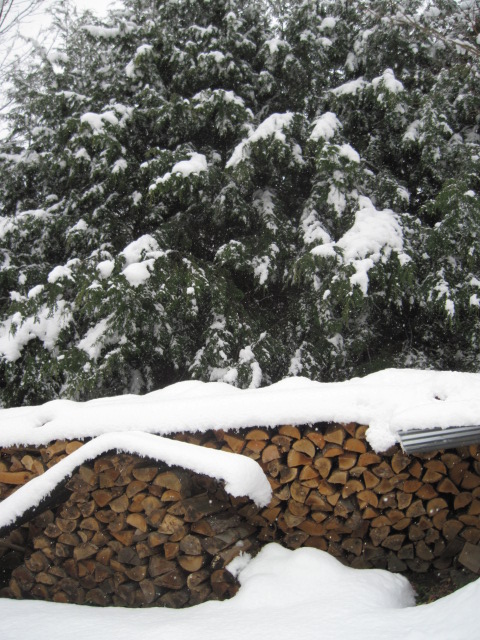
Three of the most popular posts this past year originate not from this year but from my 2017 “Druid and Christian Themes” series. This intersection of traditions still lights up for me, as it apparently does for a sizable proportion of readers. Otherwise, the only excuse I can offer for my choice of topics is also Thoreau’s: “I should not talk so much about myself if there were anybody else whom I knew as well.” But beyond Transcendentalist Yankee Smart-assery, he makes a subtler point: go deep enough inside yourself and you will find things to say that resonate for others at least some of the time. The odds of this happening are about the same as for baseball, so an average of .300 is respectable indeed.
Looking a little further at the Druid-Christian intersection I recall how Philip Carr-Gomm notes in his book Druid Mysteries:
Although Christianity ostensibly superseded Druidry, in reality it contributed to its survival, and ultimately to its revival after more than a millennium of obscurity. It did this in at least four ways: it continued to make use of certain old sacred sites, such as holy wells; it adopted the festivals and the associated folklore of the pagan calendar; it recorded the tales of the Bards, which encoded the oral teachings of the Druids; and it allowed some of the old gods to live in the memory of the people by co-opting them into the Church as saints (p. 31).
Since I find I’m citing Carr-Gomm a lot in this post, I’ll end with one more observation by him that I find still most topical today, the 30th of December 2018:
One of the most important tasks that face us today is one of reconciliation, whether that be between differing political or religious positions … the Christian community, far from taking fright at a perceived regression to a pagan past, can ally itself with [Druidry] which is complementary, and not antagonistic to Christian ideals and ethics …
St. Columba said “Christ is my Druid” and I believe that if we take Druidry to represent that ancient wisdom which lies deep within us, and that can connect us once again to the Earth and her wonders, we can understand how we can be Christian Druids, Buddhist Druids or Druids of whatever hue or depth is needed for us at our present stage of development.
May we each find and recognize “whatever hue or depth is needed for us at our present stage of development”. Blessings of the coming New Year to you all.
/|\ /|\ /|\
On ne voit bien qu’avec le cœur. L’essentiel est invisible pour les yeux.
“It’s only with the heart that you can see”, goes one rendering of these lines from St. Exupery’s classic The Little Prince. “Anything essential is invisible to the eyes”.
Still, you have to start somewhere. We all did, what with this being born thing, and with keeping the body together, in spite of maniacal drivers on the road, maniacal partisans in our politics, maniacal gremlins apparently in charge of both private and global destinies. Maybe the best reason for being a Druid is learning how to meet such magic with love, our oldest wizardry of all.
Without love in our lives, we die.
There’s a reason most of our popular songs talk about love. Good, bad, broken, ending, beginning, lost, found again. Sexual, Platonic, sentimental, confused, enduring, patriotic, familial, nostalgic. If it’s a Country song, there’s usually a pickup or whiskey or a gun in it. If it’s folk, there are often seven seas, or siblings, or signs, or at least a chorus everyone learns by the second go-round — the singer often demands we learn it. If it’s opera, there’s disguise and revelation, or an aria about, oh, I don’t know … buttons. But almost always it’s love that drives the story. Our story, after all.
The ways Druidry, like any worthy spiritual path, can lead us to contact love and bring more of it into our lives aren’t always made explicit, or even called “love” by name. But since too much of modern experience seems to focus on un-love between groups of people, and worst of all the un-love we direct towards ourselves, as the perennial experts in dark magic that we all are, it’s worth explicitly devoting a blogpost to this first invisible essential.
As with so many practices, I can only begin where I am. Remember, remember. Grow the love that already exists, and let it take up increasingly more space, till the extra spills over into other parts of my life, and then at length into other people’s lives, too. We all know people who are simply wonderful to be around. They give off love like sunlight. In their presence, there’s not just enough but plenty to spare. There’s a physics of love they’ve mastered, consciously or not: give it away so more can flow in. Like breathing, there’s a rhythm to it. It comes in, it goes out. Without this rhythm, we die. With it, we can inhabit our world and daily meet the possibility of loving someone and something in it better than we did yesterday. I start small because small things need love too. And because with love, there’s no such thing as size.
Romance gives us a glimpse of one kind of love in excess. Lovers often shimmer with it, their romantic love so strong you can feel it — even dense, non-psychic types like me pick up on it. There’s more than enough for them, so it spills over into the space around them, imparting to everything that giddy glamour we know if we’ve been there.
More mature love may not be quite so puppy-like, but that’s fine, too. We know people devoted to a craft or skill, or people who cook with love. They may not all be fabulous cooks, but you can taste the difference nonetheless. We know gardeners, pet-lovers, nature-lovers — the parade of lovers lengthens, with any luck, as you get older and tally up the encounters you’ve had with love of so many kinds. Druidry simply adds love of the green world to the pool of loves, and asks of us a practice to live more closely in harmony with this love and this world. Do what you do, and here are some tools to do it deeper and more powerfully and wondrously.
The particular form a practice takes, whether a daily walk (with or without dog), a morning or evening prayer, time feeling for a touchstone or seashell, piece of driftwood or stave picked up in a special place, that gem or animal fur or loved one’s cheek we caress, all let us bring some love into the physical world and ground it here, completing the circuit so more can flow in and out again.
Song, chant, ritual, poem, blessing, affirmation, or wordless love that kindles in the heart for this strange and marvelous planet, and all the other worlds we in-dwell: let our love come first in our hearts, guide, tool, weapon, defense against the dark, first and last resort, refuge, home, root, soul of every thing we cherish and hold dear. And more marvelous still, these things start to answer back, returning that love, building, if we only let it, the next step in our journeys, so that they may be joyful ones. And I wish this for you all.

First major snowfall, 16 November 2018. Color photo, garbed in November’s hues.
/|\ /|\ /|\
Loosening Holds
For me, four of the prime holds to loosen are don’t, can’t, shouldn’t and won’t. Each pretends to wisdom, when in fact it’s almost always mere legalism. And if it isn’t (a fifth hold?), a practice I try out will almost always begin to reveal it for what it is.
Let’s look at each hold in turn. Don’t presupposes tendency or present fact. “People don’t do X or Y”. Peer pressure being what it is, “majority rule” often enough shunts people away from even trying something different. Don’t try out Nanowrimo, the new job, the blind date, the salsa, the nudge to take a different route home.
Don’t as command can also, perversely, provoke instinctive rebellion, so that some people will do something simply because someone in authority forbids it — not from careful reflection, but reactively. This opens up a second meaning of don’t: pure prohibition. And our first encounter with this form as children has a sometimes dubious accompanying parental justification: “because I said so”. We can take at least one step forward and say what it is we actually do, rather than defining ourselves or anyone else by exclusion.
How to simplify a lifetime of teaching, if your nickname has become “The One Who Teaches”? Choose again, counsels the female messiah Aenea in Dan Simmons’ Hyperion Cantos.
Can’t opens up a whole set of assumptions that have been successfully challenged over time. Some have to do with the capacities of a subset of humanity, whether we select on the basis of gender or ethnicity or social class or some other criteria. Further, there are two kinds of can’t: permission of another person and our own personal abilities. We hear “You can’t do that!” often enough that we may carry its echo within us to the grave. “What demon possessed me that I behaved so well?” asks Thoreau of such times. Often that inner echo is enough to stop us from ever testing the second kind of can’t: are we in fact actually able to do it? Do we possess the will, grace, skill, energy and courage? The Nike campaign of “Just Do It” may not be the best single counsel, but taken with other helpings of wisdom at the meal of decision-time, it’s a plucky guide.
Shouldn’t may arise from the prudent counsel of another, but as a percentage of shouldn’ts that most of us hear, it rates pretty low. Much more common are the shouldn’t of fear, of concern for appearances (what will the neighbors/family/friends/coworkers think?), or of the speaker’s own incapacity, not mine. What does my dog think, when I run it by her? How about the friendly oak in the back yard, or the rowan guardian out front, that I’ve consulted in the past?
Won’t is a limit all its own. “It won’t work. You won’t succeed. Thing won’t turn out as you expect. You won’t like it once you get it”. Again, many of these are envy or fear of another’s success, or the habitual naysayer’s discouragement. A few won’ts may rise from loving concern, a desire to protect us, but they’re almost always better phrased as positives. “How about X? Have you thought about Y? Maybe Z would also work”.
Like other valid spiritual practices, Druid teachings generally offer positives in place of such holds on action, freedom, discovery and expression. Here are a Druidy set of seven I go to:
1) Ask for guidance. It can come in many forms: our animal neighbors, dreams, chance conversations in the checkout line, pets, flyers on a bulletin board, children, lines from books, a phrase on the evening news, and so on. Unless it’s a split-second decision, a choice usually benefits from at least a day’s reflection. Assemble your Wise Ones, consult them, and proceed from there.
2) Practice a form of divination to uncover factors you may not perceive are at work. A “divinatory attitude” increases options, and need never rule out my common sense. Tarot, impulse, hint, chance, ogham, runes, bibliomancy (opening a book of wisdom at random and focusing on what appears there) — there are many forms to try of openness to the cosmos.
3) Pray. Who and what you pray to and for, and how, and when, are up to you. Many resources exist to help open up this universal and age-old practice. If you’ve tried prayer, and had no success, maybe your target audience needs a switch. Ancestor, deity, ideal, energy — we open up when we pray. Turn the switch, open the valve, unlock the door, crank the window, twist off the lid. Breathe. Give thanks for a pulse.
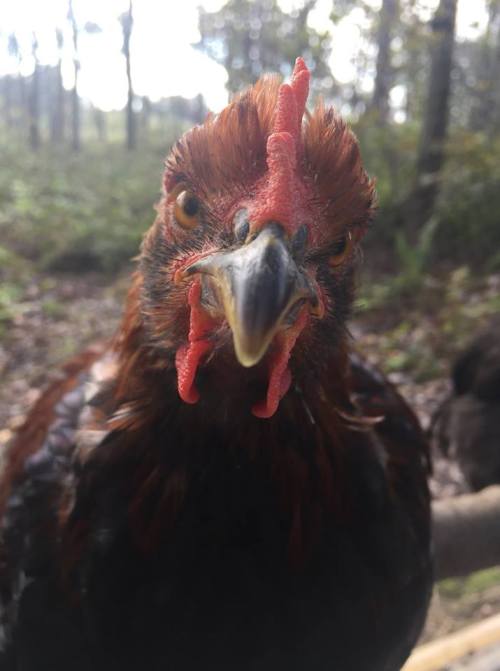
Pythagoras the rooster — what is he saying? Photo courtesy Dana Driscoll.
4) Consult tradition. While each of us breaks new ground by simply existing in ways and places and spaces no one else has, we also share immense common ground with others. The insights of the best of them have been preserved for our benefit, and it’s pure foolishness for me to overlook what they may have to say to me. They’re called classics for a reason. Pick your oracle. I light incense, a candle, toss a coin in a fountain, leave a larger tip in a restaurant, offer a piece of quartz to a favorite tree. Offerings, especially spontaneous ones, help open me up to listen, before and after. For me it’s part of cultivating an intention.
5) Follow intuition and guidance. When I write down my dreams and images and words from contemplations, even if I don’t always catch what’s coming through at the time, they prove their value as guides over time when I read them a day or week, month or year later.
6) Listen for creative nudges and work-arounds. We may admit later to factors in action that we turned away from at the time. Keep options in play. Everything in my heart and out my window has something to say, and that’s just one small corner of what’s available to me. I choose the red leaves on the blueberry bushes out the window as I write this, which remind me to bring in the garden hose before the next frost tonight.
7) Watch for signs. One good reason you and I exist — we’re individual responses to factors at play right now. We can hear and see things no one might notice or know of. Mentioning them from time to time to a trusted friend or partner is a useful reminder. They might have missed them. I have something to contribute to the conversation the world is always having with anybody listening.
“The awen I sing — from the deep I bring it” — Taliesin.
In Welsh, Yr Awen a Ganaf, Or Dwfn y Dygaf. Badly, uhr AH-wehn ah GAH-nahv, ohr DOO-vn uh DUH-gahv.
Chanting this quietly to myself — a practice all its own.
/|\ /|\ /|\
“What makes a Druid a Druid?”, asked a recent post to a Druid Facebook group I follow. The question, and the responses that followed, are both wonderfully instructive. I’ve distilled a large number of comments into thirteen ways of addressing the question. Below are the condensed originals, along with my indented comments.
1) A sickle, a white robe and a beard. What else?
This is one popular image, which we can trace to the Roman historian Pliny (link to short excerpt from his Natural History). Though it ignores the reality of female Druids in both the past and present, it does show that rather than a set of beliefs, Druidry suggests a set of tools that one uses in roles that Druids fulfill. In this case, harvesting the sacred mistletoe from the oak.
Ellen Evert Hopman likes to point out that white is really impractical — it shows dirt. Some of the oldest surviving Irish Druid materials talk about certain colours and patterns of cloth set aside for Druids — but not white. Wearing white stems partly from the influence of Pliny and partly from practices of the Druid Revival of the 1700s and onward.
2) A desire to seek knowledge regardless of belief or faith, a desire to keep that knowledge safe and a desire to share that knowledge with those able to understand it.
A good first draft of a Triad: “Three desires of the Druid: to seek knowledge, to preserve it, and to share it with others”. But many of us linger in desire without ever bringing it into manifestation. Desire alone won’t make a Druid.
3) Knowing when to put the kettle on.
Though it’s another piece of humour, timing of course matters deeply, and the “trick” of “catching the moment” reveals a great deal. Alertness to the hints the world is constantly giving us can guide our days. Likewise, obliviousness to such nudges and intuitions simply means our lives will be that much harder and less joyful. Nature so often is our first teacher.
The 21st century and most of its challenges reflect how often we’ve missed catching the moment and willfully ignored the many hints coming our way. Now we’re simply going to learn the hard way for the next few centuries. Neither Apocalypse nor Singularity, damnation or salvation: but a good deal more schooling in what we didn’t bother to learn the first few times round.
4) Initiation.
As a one-word answer, “initiation” points us in an important direction. But what we think it is, where and how we seek it, and what we do with it once we “have” it — those are places we can trip up.
As one commenter noted, “a Druid isn’t a ‘what’ – it’s not a thing to be initiated into. A Druid is what you are – you can be initiated into Druidry, but that doesn’t make you a Druid”.
Though, as another commenter observes, “self-initiation is a thing”, we are never alone: spirit, spirits, the ancestors, animal presences all participate in both “self” and group initiations.
In a larger sense, too, “initiation” happens to everyone. Life itself initiates us, through love, suffering, birth, death, the seasons. In that sense, we’re all “Druids in training”. Some opt to work with such energies more consciously and deliberately.

The Morrigan personifies the challenges that prove and test us all. Photo courtesy Wanda Flaherty.
5) Membership in an Order.
For many — and it can be a valuable step — what “makes a Druid” is membership in an Order. The path of the Solitary means doing preliminary training on one’s own, and the requisite patience and listening and discipline of the Solitary aren’t for everyone as a starting point. Solitary work can feel trackless at times — how do I know where to focus? How do I assess my efforts? An Order can lay out for us its set of answers to such questions. However, to do more than merely “belong” or “be a member” — to grow into Druidry — still requires that same patience and listening and discipline which the Solitary practices.
6) Doing the necessary work.
As a commenter says, “Whether as a solitary or as a member of an order, WORK is required. Otherwise, to call oneself a Druid is meaningless”.
7) Study, reverence, work in nature, and commitment.
For most Druids I know, one or more of these may flag at times. It’s unavoidable. Jobs, relationships, changing health and life circumstances all demand much of us. Returning again and again to pick up the work is what “makes a Druid”.
“Persistence …” says one of the Wise. “Is not this our greatest practice?”
8) Alternative answer: you have to be able to summon a unicorn or a dragon. You can also grow a tree that grows/attracts its own dryad.
Again, though a bit of humour, these answers point to Druidry as something people do rather than something they merely believe.
9) Living in honourable relationship with nature, the Gods and the tribe. (And the evidence that we’re doing this?) The ability to model and teach all of that.
10) There is a special badge you get that says “I’m a Druid” on it …
Ask a silly question …
If you’ve been at some Druid or Pagan events, you may on occasion have wondered whether it’s the bling that makes the Druid. Fortunately, no.
Theme for meditation: what says “I’m a Druid” to the non-human world around us?
11) Practice, experience, and listening.
Another good Triad to take into meditation. Each of the three informs and feeds the other two. What am I listening to? Is it nourishing the deepest part of me? If not … What have I learned from experience? How can that shape my practice? Does either practice or experience show me new things to listen for? What is teaching and guiding me today, right now? What is my next step?
12) 19 years of study … at least for the ancient Druids.
As others have pointed out, the dozen or more years of modern education most of us undertake account for a chunk of those 19 years, but by no means fulfill or equal all of them. A Druid who persists on the path finds in the end that those symbolic 19 years cover just the “introductory material” anyway …
13) You are a Druid when your community says you are — fulfilling the role.
This presents a paradox of sorts. It means I practice and work on fulfilling the role, though recognition may or may not come right away — or ever. But that’s not why I’m practicing. I’m not a Druid until I possess that inherent authority of experience that others recognize, yet I won’t possess that authority or experience unless I practice despite all lack of recognition. My indifference to such recognition as I practice is often a more sure way than any other to attain it.
One advantage of membership in an Order is that the community of members will come to recognize this authority. People will begin to turn to a wise and compassionate Bard, even though others who’ve completed the “higher” grades may also be present.
Another commenter reflects: “Because being a Druid is defined by function, it’s not something you can be in isolation. You can train as a teacher, and maybe even qualify. You can call yourself a teacher. But you are not in reality a teacher until you have taught someone, just as you are only a healer if you have healed someone. You are only a Druid if you carry out the role of a Druid”.
/|\ /|\ /|\
Here as promised in yesterday’s post is a statement of my personal philosophy, developed as a supporting document required as part of my application with a teacher placement agency. I don’t always state things in Druid terms here — this document was intended to address life and educational philosophy for secondary schools, after all. And if you’ve ever tried to get down on paper a statement of your philosophy — a very worthwhile spiritual practice, worth spending time on! — you’ll no doubt find yourself tweaking it, if you continue to live and grow and change.
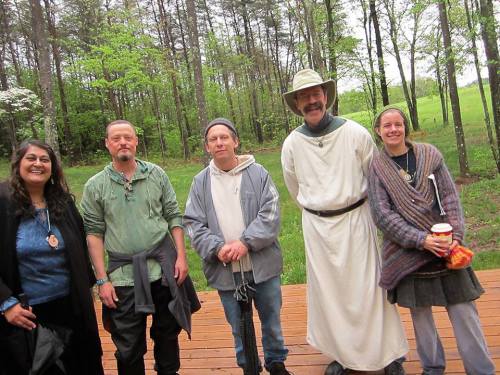
Five of us scouting a ritual site at MAGUS ’17. Photo courtesy Gail Nyoka
1) “The three pillars of achievement: a daring aim, frequent practice, and plenty of failures” – old Welsh triad. Very succinctly, try one more time than you fail. Helping students, colleagues and myself practice this principle boosts successes. Give me a worthwhile daring aim, and I’ll try that extra time.
2) “Think inside the box – it’s fresh territory again. Everybody else has left”. As long as I don’t overuse this, I can still get my wife to laugh at it. More to the point, it’s increasingly true. “Tried and true” techniques, practices, strategies and principles that don’t grow old with time or use really do still exist and merit our attention and implementation. (Often they’re just lying there in the box.)
3) Listen early and often. “Everybody’s talking at me/I don’t hear a word they’re sayin’” sings Harry Nilsson. Goes double for adolescents. Help being heard not be a novel experience for others.
4) “Time is but the stream I go a-fishing in. I drink at it; but while I drink, I see the sandy bottom and detect how shallow it is. Its thin current slides away, but eternity remains. I would drink deeper; fish fill the sky, whose bottom is pebbly with stars” – Thoreau, Walden. Among many other things, a mantra for calm and perspective. Ask me about my focus and I’ll be recalling center-points like this.
5) One and one and one and one and one and one and one and one and one and one are 10. Hint: the double-digit sum really doesn’t come out of nowhere. Even despite appearances. Or to steal from Neil Armstrong, it’s that next small step that makes a giant leap possible.
6) Upren masei kapotas ambei solna ir mitmu aljagotvei djuva. Literally, “Over our heads are both the sun and a most changeable sky” – Sovermian proverb (one of my constructed languages). Constants and variables aren’t equivalent, though we mistake one for the other constantly (and variably). And where does literature not illustrate this?!
7) Man déð swá hé bið þonne hé mót swá hé wile. Loosely, “folks do as they are when they can do what they want” – The Old English Durham Proverbs. Alternatively, both a justification for the rule of law, and for the positive consequences of accepting responsibility for oneself. Worth modeling.
8) “Is the juice worth the squeeze?” (AKA, good things can come from student film recommendations!) Pithy and fresh enough to stick in adolescent brains. Better than most “don’ts.”
9) If it’s avoidable, avoid it. If it’s celebratable, celebrate it. If it’s mnemonicizable, mnemonicize it. And if it has scales and fins, in which direction does it actually swim? (I’m a fan of mnemonics and other learning strategies.)
10) “All materials to build your home in this world or the inner cosmic worlds come from within, from the God center in your heart” – Paul Twitchell. Good for resetting the relative positions of responsibility, source, potential and manifestation. Frequently applicable in classrooms and curricula. “Ask me how!”
11) “… by now my desire and will were turned,/Like a balanced wheel rotated evenly,/By the Love that moves the sun and the other stars” – Dante, Paradiso. A life goal.
Now that I’ve chased away, as I usually manage to do every few weeks, a few incautious new readers who thought they’d follow my blog — until I said something indigestible to them — you and I remain to take stock. It’s part of my job description, in fact: blogger must intermittently provoke, offend or banish a portion of readership, if only to establish and maintain some semblance of integrity. That’s one route, anyway, to blogger bona fides.
Otherwise I’m just a spiritual politician, telling people mostly what they want to hear, scrambling for votes or likes. Please don’t merely “like” me. We’re not in primary school, right? Life isn’t, despite what the weak magic of social media enchants us to believe, a popularity contest. We’re not even in secondary school any longer. Read and ponder what I’ve said, and test it — not just with your opinions, but with your life. As I try to do, in spite of that annoying and near-universal tug toward hypocrisy.
So there really aren’t any rules? my inner teenager asks. The previous post was a feel-good piece. Love is all you need. All paths lead to the same destination. We’re all in this together.
And we are. Except.
Anyone who practices an art or craft knows that rules, especially rules-of-thumb gained over long experience, can be really useful. Gardening? Plant marigolds with tomatoes. Tuning your guitar? Start with your sixth string, the Youtube video instructs, held down on the fifth fret. Guidelines for what to do, how to tackle challenges and complexities. Received wisdom. Even, if I can use the word, a tradition. We rarely need to start from scratch.
When we’re young, we’re told to color inside the lines. What happens if you color outside the lines? Nothing. You’ve colored outside the lines. What you do is what you get. Maybe a well-meaning adult scolds you, or not. A little later, perhaps a reward or penalty. We know how early such patterns and personality traits get set. Some kids without prompting will color up to the lines so neatly an adult couldn’t better it. And they’ll get praise for neatness and attention and whatever other labels get put on noticing boundaries and respecting what they have to teach. Because they do have much to teach. Just not everything.
All right, teenaged self. What do you want rules for, anway? To push against, so you can declare yourself an original? To piss off a special adult, or adults in general? To run roughshod over, ’cause you’re such a rebel? Win the attention of possible partners, producers or profit-sharers? Welcome to inverse conformity: you’ve still let the rules define you. Can you make your own liveable set?
Robert Frost said writing free verse is like playing tennis without a net. He meant it disparagingly, but it’s actually just another game. Handball. Without a single thing labeled “net”, nearly every surface becomes playable. Players don’t stand opposite each other, but — often — side by side. The rules: changed, but still present. Because that’s what a game is. It’s hard to make “whatever” into a game very many folks want to play.
Yesterday John Beckett posted “Get Over Your Fear of Religion!” tackling the frequent superficiality of much contemporary spirituality. On at least one online forum I visit, his post predictably sent some into a tailspin. Beckett notes, “Some of this [the “spiritual but not religious” movement] is an understandable reaction against negative religion, but much is an avoidance of the work required to build any real spiritual or religious depth”. Some scolding is good for me.
Of course, our reaction against stifling religiosity also has ancient roots in human experience. It will never go away as long as we face complacency and laziness in our cultural institutions and practices. As a certain rabbi once observed a score of centuries ago, “The letter kills, but the spirit gives life”.
But beyond the pleasurable intoxication of a numinous moon or molten sunset or gold-drenched sunny afternoon, there’s more. “If you want a deep spiritual practice”, John continues, “that will help you handle life’s challenges, build deep and meaningful relationships, and change yourself and the world, you’re going to need religion”.
The first part sounds like what many people say they want. The last clause, though, tosses a dead mouse into the punch bowl.
Whatever else needs to happen as a consequence of mouse or punchbowl or tossing, reactions to the incident will reveal something to me in my own thinking and practice that I need to work on. Maybe you or I will take the bowl to the kitchen and bring out a fresh one. Maybe we’ll just cringe a little, and wait for somebody else to fix things. Maybe we’ll fish out the mouse, or shame the tosser, or ask for better punch-bowl covers, or mouse-traps. Or we’ll take to raising larger mice. Whatever our roles, the incident jolts us. Your outrage is yours. I do mine just fine, without help. But I don’t want to stop there, but start.
Over the decades, I’ve noticed life becomes custom-fitted to teach each of us what we need to learn. It gets to know us, scouts us right up to our weaknesses. I’m not always talking “fair” or “easy” or “blessed”, either. What I hold on to most tightly I’ll probably be compelled to relinquish. Rigid things tend to break. The gods prodding humans to grow. Or evolution fine-tuning a whole complex of eco-systems, sharpening the ability of each species to thrive by choosing the most adaptable individuals and going forward with them because — quite simply — they can change. A hundred thousand lemmings die, but one, slightly different, flourishes and becomes the progenitor of a new species. Ancestral lemming, I salute you.
If we’re changing, how could all the old rules possibly serve? Because rules can change, too, and most of the ones that trouble us and dog our heels are ones we’ve made for ourselves that haven’t changed with us. A few other parameters we encounter, like this pesky aging-and-mortality thing, and finite planetary resources, and cause and effect, we’re still learning to work with. It’s just that from time to time we confuse human rules with spiritual law. Confuse them so successfully we think they’re the same thing, until we find they’re not.
Imagine your ideal set of rules for how you’d play the game. Or laws, if you’re going for large-scale. Work to get down in writing at least three or four of them — you may uncover more — then try them out on your life, checking for fit, and then try them on the lives of a few other beings. Revise as needed.
Next post I’ll post mine.
/|\ /|\ /|\
“It’s a good thing to give thanks, whatever your tradition, or none. So we’ll have a moment of quiet. Simply listen, if you like, to the others near you, breathing”, says the pastor opening last night’s community dinner.
One of the joys of rural New England life is the Cabin Fever dinner tradition. These early spring events are a true “moveable feast” — held in churches, cafeterias, grange halls, schools — sometime in March or April, anywhere there’s a willing core of people dedicated to making community happen. Neighbors get called together from the more private hunkering down we all do each winter, watching wood-piles diminish, the inevitable March storms re-establish banks of snow that had been shrinking after the midwinter thaw, squinting at sky and trees, feeling the light linger a few minutes more at either end of day, scolded by the indomitable chickadees, uplifted at the distant honking of a flock of geese winging north again, at long last.

We’re crammed, atheist and Pagan, Christian and agnostic, Jew and animist, into the sanctuary of the local Congregational Church for the 13th spring in a row — a lunar year of springs. Tables and chairs from a local high school have been set up, filling the space to the stairwell. There are no pews. After the original church burned down years ago, our community vowed to rebuild a maximally flexible space, church and community center both.
Our local Cabin Fever dinner draws attendees from half a dozen nearby towns, in part because the pastor’s husband is a trained master chef who volunteers his skills for each year’s feast, but also because of the tradition of storytelling that proceeds throughout the dinner, as neighbors rise, take the microphone — there are over 200 of us here this evening, and for the first time the pastor had to turn away a few score later-comers — intermittently interrupt conversations, and regale us with stories of the quirks and humors of country living, encounters with moose and fisher cats, chimney fires, deaths and births, lost cows and sheep, found dogs and children.
The evening opens and ends with announcements, car lights left on, alerts that the bears have begun to emerge again from hibernation, hungry and ill-humored as always, that the Green Team meeting has been moved to Friday afternoons, that tryouts for the world music chorus will take place the following Saturday.
A few of us scurry to the basement kitchen after the announcement that packaged leftovers are available for an open donation. We leave with two cartons of roasted vegetables for the next day’s lunch.
Here is our prayer and our praise, our magic and our offering: we manage to come together again, we learn anew that it’s worth listening to each other for the sad-funny turns life takes us all on, that we can recognize in each other, for all the differences of temperament and history and desire, a common table, light and talk and laughter into a cold spring evening.
There’s been no preaching or teaching, only what we bring to each other out of our lives and stories, the best kind, lived last month, yesterday, in the parking lot before coming in.
With such things we do not solve or resolve, so much as we celebrate as we struggle. We sing as we go on.
/|\ /|\ /|\
Have you seen them? The ridiculous (to my mind, anyway) articles, often partial advertisements or product placements, that purport to instruct the reader. They arrive in a simple format, usually with the same clear lead: “You’re doing X wrong”.
(I strive to avoid yielding my attention, as much as possible, to things that can’t instruct me, however I may initially feel about them. So let’s see what we can gain here, for I would exploit all things that seek to manipulate me, and wring from them something both needful and utile. You know: just to turn them back on themselves, and fulfill my part in manifesting the ancient wisdom that says all thing work together for good for those that love. Because, to exploit another more recent piece of wisdom, “Everything will be all right in the end. If it’s not all right, it is not yet the end”*. We are, after all, actors in a 10 billion-year-old play. Just gotta get through this particular scene. Find your character’s mark, don’t bump into the furniture, deliver your lines with feeling. Ah, there now.)
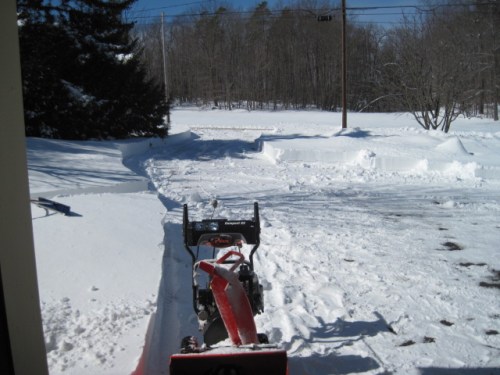
Public? private? Is there a difference, if both need clearing?
Now it may be Americans in particular who are susceptible to this form of social insecurity — wanting desperately to fit in, do the right thing (wear and drive and own and think the right things), be hip, be au courant, woke, and all the other necessary adjustments that our national Puritanism tells us are necessary for secular salvation. And so perhaps only Americans are doing our planetary Druidry wrong. Or not.
(Anyone outside the petri dish-circus-nuclear meltdown-barbecue that is America can spot a number of necessary adjustments Americans should be making for our own good and the good of the planet, but which we somehow inexplicably and wilfully ignore, but that’s another matter. We all have our own to-do lists.)
If there was money in it, somebody somewhere would be telling me I’m doing Druidry wrong.
And I am. Because all that means is I’m not doing me precisely like you’re doing you.
The tree-wisdom that is Druidry means living our lives on earth, in these earth-bodies, whatever else may be going on with us, whatever other realms we inhabit. All we can do is go with what we get — through the senses and training and experience, memory and genetics, personality and character, hints and clues and dreams, the nudges and examples of friends who wish us well, inner and outer gods and neighbors, animals and the blessed trees.
Quite a package. When we say we don’t know what to do, how to choose, what matters, how to go on, it’s not for lack of choices and possibilities, but from a super-abundance. And no clue, key or compass ready to hand.
So when I say I’m doing Druidry wrong, I mean by that what Thoreau says (pronouns expanded): “I desire that there may be as many different persons in the world as possible; but I would have each one be very careful to find out and pursue their own ways, and not their father’s or their mother’s or their neighbor’s instead”.
That is, I ignore or defy peer pressure (insofar as I can) where it really matters — not in the obvious outward ways of young people discovering for the first time what it means to have a self, choosing hair or makeup or clothing or other faddishness at odds with arbitrary norms that superficially reassure us all is well, that the walls are secure, that wakeful sentries guard the gates. Not outwardly but inwardly I wander and marvel, where as yet the Thought Police do not patrol. (Though cookies and bots, Google and Amazon are scratching at the windows.)

What cookies have I swallowed whole lately?
It’s because we do not trust each other to “be very careful to find out and pursue their own ways, and not their father’s or their mother’s or their neighbor’s instead” that we feel we must lay out tracks and paths for all, lest the heedless deeds of a few bring down the whole ramshackle scaffold that passes for civilization. And the few are never us but always Somebody Else. Until the trees finally reach me and teach me differently.
Ya gotta go wrong to go right.
“You gotta get in to get out”, Genesis sings in “The Carpet Crawlers”.
“The only way out is through”, says Robert Frost in “A Servant to Servants“.
 Ah, Outback Steakhouse, guru of the moment, with its tag “No rules, just right” — there’s a form of my own credo: that somehow, in the spiritual Outback we’re each exploring, I suspect there’s a path that’s right, apart from (other’s) rules, one for each of us. My evidence: we’re all walking our own paths anyway, in case you haven’t noticed.
Something of what all this can mean in turn I’ll be addressing in the next post.
/|\ /|\ /|\
*The Best Exotic Marigold Hotel, 2011.
Images: cookies picture by Kimberly Vardeman; Outback Steakhouse tagline.


 A Druid Way


