Archive for the ‘spiritual practice’ Tag
Druidry, writes Philip Carr-Gomm in his foreword to Nuinn’s (Ross Nichols) Book of Druidry,
is a way of working with the natural world, and is not a dogma or religion … Druidry honours, above all, the freedom of the individual to follow their own path through life, offering only guides and suggestions, schemes of understanding, methods of celebration and mythical ideas — which can be used or not as the practitioner sees fit (pg. 14).
You could just stop there, and run with that, because this post eventually descends into a rant. Or irascible prayer. OK, you were warned.

clover overtaking weeds — no mowing needed! (but woodchucks love it)
<begin rant>
The word “honours” matters in the quote above. Not “grants” or “permits” freedom. Druidry recognizes something that’s already there. Druidry says Pay attention, so you can recognize these things, too.
Freedom, guides, suggestions, schemes, methods, celebrations, myths. These are the “seven paths in freedom” I want to look at in this post. Don’t worry, it’s not really a numbered list. A different Song is playing. The Song matters more than any list.
Freedom, that much abused and misunderstood word, is an actual thing we can experience and live from, not merely a “concept” or an “idea”, though it’s these things, too. It’s not only “in my head”. Freedom, like any song, comes first, then we have thoughts about it. It’s a gift, just like our lives. A melody at the heart of things. And like our lives, we can end our own freedom in so many ways. Turn off the music. (At least temporarily, though the Spiral remains, all the way down into our DNA.) If you need to be reminded how, just read the headlines. It’s practically multiple-choice at this point. Fifty ways to leave your lover, sings Paul Simon. Shedding your skin, walking on the other side, is a really good option at this point. We do it every night in dream. How about while awake?
A free person gives freedom to those nearby. Freedom spreads, like air, fragrance, sound, waves. We all know others who take from us when we’re around them, just like we know people who give, who make space, and work not to impose their limitations on us. Sometimes we read of the “torch of freedom” — and though cynicism is a popular defensive shield these days, that’s a live metaphor for the sense of kindling and expansion we feel in the presence of a free person. May we meet — and be — such people!
Don’t want to, or can’t, join a Druid Order? You’re a Druid from the day you accept your freedom, and act from it. An Order’s just a form, a guide, a suggestion, to try or not.
If we act from freedom, we discover everything is a guide, a suggestion. The old challenge, Everything is permitted, provided you can accept responsibility for what you do, is a rich seed for meditation. How far can I go toward testing it?! Not Is it true? but How is it true? When is it true? In what ways is it true? These tests, and their results, work much more creatively and productively, at least for me, than a simple “yes/no” Is it true? Because I’ve found pretty much everything is both not true, and true, depending. So that question’s off the list, until I can come back to it on a higher spiral, when it may turn out useful once again, after I manage to learn a few more things. Consciousness makes all the difference: it’s the “depending”.
Druidry offers some things to try out. (Now I’m imagining that as my quick seven-word answer to anybody who asks “So what is Druidry?”!)
Ground a practice in the things of my world: air, water, fire, earth. Not just ritual, though that too. Expand my rituals. Thinking, this morning, while I wash two-days-dried dirty dishes in warm water: air/thought, water (obvious!), fire/heat of the water, of my blood, of the sunlight streaming through the kitchen window; earth of my bones and flesh, of the food scraps on the plates and pots and silverware, of the sink and walls and world all around.
Brother Lawrence wrote a wonderful classic, Practicing the Presence of God. You almost don’t need to read it, the title says so much. If you do read through, be patient with it and yourself — you’ll need to do some digging to excavate the gold, given the change of cultural understandings.
It’s a practice, not a one-time deal. You get better.
Listen to other beings. The white ants that come every summer to our kitchen have more to teach me than the last book I read, whatever it was. Practice asking good questions. I’ve spent at least four decades on that one, and no sign of stopping yet. You know — magic in, magic out. Or the opposite.
“My God is bigger”, said a Christian to an author friend of mine. “Maybe that’s because your need is bigger”, said the friend.
An infinite abyss separates any two moments in time, in eternity, says one of the Wise. I practice resting there, feeling the lightness of spirit, of creative fire, of the awen as it flows. I set my hand on a blank journal page, a computer screen blog post, and enter that abyss. If like me you flash on vertigo for a moment, know too how weightless is fire, always rising up, climbing the spirals we all walk. If a child falls in a dream, the Senoi people of Malaysia encourage the child to fall, and not wake up to escape the dream. “They taught the children to fall, knowing they wouldn’t be hurt, and to climb, to travel, or fly to unknown places, to unknown cultures, to learn new things. If they woke up instead, they would be advised not to escape from such dreams the next time they occurred”, write Stewart and Garfield in their 1972 book Creative Dreaming. Easier on everybody than the wrenching costs of the rising suicide rates in the U.S. and elsewhere.
Schemes of understanding, patterns, webs, networks, interconnections, links, circuits. Our “marvels of modern technology” work (when they work) by building with earth — metal, glass, rare earth elements. Technology grounds these sometimes abstract, intellectual facets of elemental Air and manifests them, re-alizes them, makes them what Latin calls res — things. Ground and center, counsels beginning practice, again and again and again. I always need to earth what’s goin’ down.
Heirs though we are of two thousand years of Christianized thinking, somehow we’re still more Gnostic than Christian, eager to flee this world, constantly forgetting the god at the heart of Christianity who incarnated, became flesh, manifested, took on a body, got as earthy as anybody can, and died that way too. Eucharist, literally thanksgiving — this is my body, this is my blood. The Things of Earth are holy, divine.
Pilgrim on earth, thy home is heaven. Stranger, thou art the guest of God(s).
And yes, William Carlos Williams, you turn out to be right on both counts: “It’s difficult to get the news from poems, but men die miserably every day for lack of what is found there”. You write about a fracking flower [short / long] and stake us through the heart. Bards, tell us how it is, how it can be. Now take out the comma. Bards tell us how it is, how it can be. I’m still practicing as I listen harder.
Or another take, if you like or need it: “Earth’s crammed with heaven” , says Elizabeth Barrett Browning. “And every common bush afire with God;/But only he who sees, takes off his shoes./The rest sit around and pluck blackberries,/And daub their natural faces unaware …” Another practice, taking off my shoes, and walking through the grass.
And that’s fine, too, says Druidry. The Spiral always waits. No one’s reached the end yet … There are always rest-points. We need ’em.
Methods, celebrations, myths. Five, six and seven, if you’re counting. J. M. Greer says one key is “embracing an experiential approach to religious questions, one that abandons rigid belief systems in favor of inner development and individual contact with the realms of nature and spirit”.
Everything’s political? Nope — everything’s spiritual. Or mythical, if you prefer. Politics wants the power and energy, but without bothering about the spirit that powers them. (Zeus tried all that out long ago, and look where it got him!) Things of this world? Sure! But just know where they come from. Get the order right. That’s why we keep screwing ourselves over with men (and it’s still mostly men) of power. Give the women a chance to mess things up, too!
They can’t give us what we really want. But we keep handing politicians our freedom anyway, as if they knew better what to do with it than we do. Reclaiming, Starhawk calls her Witchcraft tradition. Get it back! Don’t give it away again!
<end rant>
/|\ /|\ /|\

Fallen pine, cut into lengths: edging for more raised beds? Gateposts for my backyard grove?
Solstices.
Just as at the Winter Solstice we celebrate the shortest day and longest night, knowing that light will grow again, so at the Summer Solstice we celebrate the longest day and shortest night, knowing that daylight will now shorten. Here is a teaching of paradox: each peak, dark or light, contains the seeds of its own change. And as Taoist tradition teaches, “When Yang peaks, it shifts to Yin; when Yin peaks, it shifts to Yang.” — adapted from OBOD publications.
I begin again. A couple of deep breaths, to center myself. Then the awen, or another sacred word. Open the inner doorways.
Get out in the sun, advises the OBOD ritual booklet for Summer Solstice. Sit in a shadow. I love these two apparent contradictories, side by side! So perfect! Harvest your garlic. Sunburned, shaded, garlicked, I proceed.
Having neglected to grow either St. John’s Wort or Vervain for our Solstice rite next weekend, I’m on the lookout for them along the road, in fields nearby, or at a farmers’ market. We’re naming the local landscape and its creatures in our Solstice ritual script, listening between the words for their other names, ones they may not tell everyone. Indian Place Names of New England, in a hodgepodge of less-than-complete formatting for online viewing, gives one Native American name for our local Vermont region: Kawassentekwa “barren spot along the (Connecticut) River”! One more way to laugh, to stay humble, to see and work for possibility where, outwardly, things look bare.
Apparent world, crazy uncle at the door, we hug you and invite you in to join us at the Festival table. Meet the others here!
/|\ /|\ /|\
The heat is on — at least for a few days here in Southern VT, where temps yesterday and today reached 80 F / 27 C.
Do you feel it, that flaming toward summer solstice? If you’ve spent time outdoors, even at sunrise or sunset, you can sense the shift. The birds feel it, launching their first songs when the sun still lacks half an hour to cresting the horizon. Trees know it, their leaves finally fully unfurled and deeply green.
We’re two weeks out from the longest day — about the time I frequently sense a shift, turn my thoughts toward the next festival, and “listen harder”.
Just about year ago I posted 19 Ways to Celebrate Summer Solstice, and looking at it again, I see how many of the 19 Ways are for solitaries. Part of the appeal of Druidry is how any one of us can begin it, and deepen it, right where we are. We don’t need to find or start a group, though groups can provide fellowship and community, a hearth to cherish, a portable temple to support our practice, and also those chance conversations that can transform a ritual afternoon or evening, spark a friendship, mark a turning point, or open up a new direction for us to take. Yet most of the Ways could also fit group practice as well.
But I also want to yellow my nose with dandelion pollen as I sniff the flowers, stretch out full length in the grass, run my fingers over the bark as I listen to a favorite tree, anticipate the berries that will follow the delicate white flowers now on the berry vines, mark the slow dissolution of a fallen branch as the earth takes it back, ponder an anthill, study the mud-dauber wasp as it enlarges its nest. So many lives neighboring mine, why would I want to miss them? I have an appointment with the wild I will not miss.
The lore of the solstices is wisdom. Just as it reaches the heyday of its strength, the sun’s light yields, and the days once again start to shorten. And in the southern hemisphere, dark now rules over half of each day, but come winter solstice and the light will slowly begin to grow again.
From the traditions of OBOD, the Order I belong to, emerge older accounts of a three-part observance, a vigil till midnight (and for those willing, an all-night watch, interspersing periods of meditation with music, storytelling, etc.), a dawn ceremony to welcome the shortest day on Solstice itself, and a final noon rite several hours after that. Our local Vermont Druid group is hosting a full Solstice weekend, with a Friday evening mountain-top potluck, a sundown ritual Saturday evening, followed by night drumming, discussion and vigil, and a breakfast the next morning.
Harvesting and hauling firewood for the ritual a week ago, from the conservancy forest land where our “host for the Solstice” lives, we came on a large half-standing cherry, whose wood we cut and stacked, to await the bonfire.
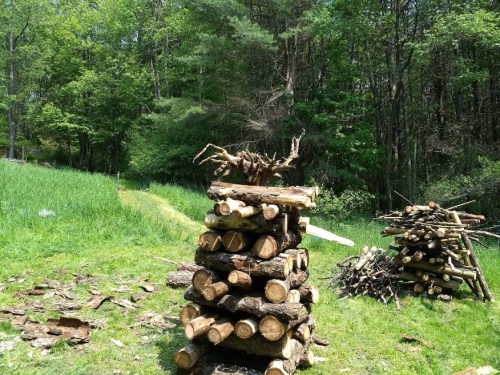
Cherry bonfire wood stacked. Photo courtesy Bruce W.
We can read rituals and myths, imagine them enacted, choose a portion which we will enact and dramatize, or maybe leave in half-symbolic form. The Oak King reaches his greatest power at Summer Solstice, and we crown him with a chaplet made of his own leaves. Yet it is the Holly King who rises, going forward, as the Oak weakens. We pass the oak-leaf crown to each other, and perhaps some of us hold in our thoughts the ancient proverb: nomine mutato, de te fabula narratur. Change the names, and it’s a story about you. A little shiver in the heat.
May your Solstice burn brightly!
/|\ /|\ /|\
[I first drafted this short post in early May, and I’m returning to it now, leaving its seasonal references untouched.]
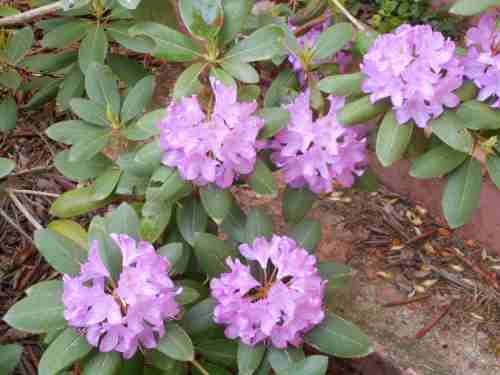
part of our two rhododendrons that survived the winter, now blooming in June
Penguin/Random House provides this excerpt from the late Mary Oliver‘s 2016 book, a collection of essays called Upstream.
“Attention is the beginning of devotion”, she writes, at the end of a section.
Druidry, like other true practices, is devotion, a measure of life away from distraction and toward attention. What do I mean by “measure”? A choice, a predilection, a heeding of instinct, or as Robert Frost puts it, a “stay against confusion”. After all, it’s we who do the measuring. (Or else we yield that privilege to others less worthy, less qualified to know what’s best for us. Until we do the difficult work of reclaiming.)
Truth, I find, sorts itself out marvelously well, once we start paying attention. Love itself is a kind of attention, a focus on what matters to us. I look into my partner of 31 years and discover a being new, mysterious — she’s becoming more of who she is. Both of us are graying and wrinkling, our kinship with trees ever more visible in the likenesses between bark and skin.
Attend, and we encounter. We meet other beings, landscapes, presences, the place we’re standing, feet pressed against the earth, the air we breathe, our own bodies, breathing and pumping blood, sweating under the early summer sun, or shivering slightly in this May air that only days ago frosted the grass and blackened the first brave flowers. Just beyond our skin, the cosmos. Looking only at the proportions of existence that are me and not me, you’d think attention might be in fact a wholly reasonable thing, though much modern life tells us no. So it is that the “apparent world” named in Druid ritual is what we’ve created — a sometimes-useful bridge that may not accommodate all the cars we wish to drive across it. At need, I remind myself, let that world fade away. Don’t worry — it’ll be there when I return.
There and back again, writes Tolkien. True voyage is return, writes U. K. LeGuin.
May you go there, and return — often.
/|\ /|\ /|\
For this post I’m returning to a thoughtful comment by Lorna Smithers from several years ago:
The division between what remains in the journal and what to communicate is a question I confront continuously as a Bard, for unlike with a path that focuses solely on personal transformation through magic, Bards are expected to share their inspiration.
I find that some experiences are OK to share immediately, others need time to gestate for the meanings to evolve and take on a clearer form, and a select few may always stay secret.
I see good craftmanship to be the key [to] sharing experiences. In contrast to the vomit of ‘compulsive confession’, well-wrought craft lifts the raw material into the realms of art, creating works that affirm the awe and wonder of the magical world.

I can’t simply mechanically transcribe from my journal (or my id — sometimes the same thing) onto the page or screen and expect comprehension, let alone value, or anything remotely approaching art. We’ve all heard about how social media has enervated meaningful communication, gutted nascent relationships, obliterated thoughtful engagement with alternative ideas and perspectives, and helped fuel partisanship, indifference, callousness and a host of our worst impulses. But we also know how much of value we’ve all found online that we might never have encountered anywhere else. There might even be a clue in all of that about where else to look for a solution, a response, a direction, a path to take through the digital (and other) wildernesses we traverse.
Craft, like any choice, applies to our spiritual journeys, too. From the baseline of a regular practice, I find I can achieve greater insight, connection, growth than without it. Craft is care, attention, devotion, dedication to a standard I’ve taken to heart because I understand its value. We used to apprentice ourselves to a master in order to learn not only the technical points — what woods to use, how to mix the paint, what companion plantings work best, how to splint a compound fracture, what to do about obsessive thoughts during meditation, what a recurrent dream can reveal — but also to absorb a set of attitudes and stances and inner disciplines: how to persist in the face of discouragement, failure, boredom, lack of patronage, incomprehension, inner silence in the face of years of effort, and other joy-annihilating experiences.
Cræft bið betera þonne æhta. A craft or skill is better than possessions, goes the Old English proverb. And further, Se cræft ðæs lareowdomes biþ cræft ealra cræfta. The craft of teaching is the craft of all crafts. If I manage to apprentice myself to a good teacher — bird, beast, tree, or even human — I learn not only the craft but the heart behind it. Craft begets craft.
And by a happy synonymy, OE cræft has the same additional meaning that its descendant does in Modern English of “boat, ship” — we’ve enlarged the reach of it with “spacecraft”.
Craft is the craft that will carry us across, to where we want to go.
/|\ /|\ /|\
Image: Pexels. com
That — according to the statistics WordPress freely offers to the obsessed among each of its subscribers — is today’s proportion of published posts to unpublished drafts sitting on this site that never made it to your eyes. Except the number is misleading. All of the published posts were drafts at one point. (Many feel like they still are.) It’s all draft till you die, said one of my writing instructors. So you can always revise. A poem (a life) is never finished, simply abandoned. Then mix in the perspective of this Druid who sees rebirth as part of the process, and death as simply the end of a chapter, a stanza, not the book, not the Song.

Original and image. Courtesy Pexels.com free images.
My chosen magic, I’ve discovered (What’s yours? Have you found it yet?), is to write myself into new spaces and truths. Yes, often an experience will boot me into new territory, but it’s reflecting on it, writing about it, trying on multiple understandings of it, that converts much raw experience into its subsequent effect on me — turns it into resource, compost, practice, training, the tenor and temper of my days.
How else to explain two people, same experience, very different outcomes? It’s what we do with what happens that matters. And what I “do” isn’t ever “done” — I’m what I’m doing, after all. (As you are you.) I keep adding, revising, re-imagining. Or I can, at any point along the way. The inexpressible freedom of this is something I keep encountering, flowering where I least expect it, hidden beyond the rise of the next hill, flickering through the screen of leaves in the woods around my house. An eye or ear or sometimes a whole face shows through the leaves, then disappears behind them again.
Gerard Manley Hopkins gets it, writes it:
As kingfishers catch fire, dragonflies draw flame;
As tumbled over rim in roundy wells
Stones ring; like each tucked string tells, each hung bell’s
Bow swung finds tongue to fling out broad its name;
Each mortal thing does one thing and the same:
Deals out that being indoors each one dwells;
Selves — goes itself; myself it speaks and spells,
Crying Whát I dó is me: for that I came.
Am I really listening? Do I hear it? Listen harder, says one of my teachers. Each mortal thing does one thing and the same. I read the poem aloud to myself again, not troubling over meaning, just attending to the sounds and echoes of the words.
Other counsel: Peace I leave with you, my peace I give unto you: not as the world gives, give I unto you. Let not your heart be troubled, neither let it be afraid, says the Galilean master. Peace, a different kind of giving, no need for trouble or fear: immense gifts. Gifts Druids often claim. Gifts bigger, for the world today at least, even than any kind of salvation “down the road” — bigger to our current time-fixated mindsets, anyway, because they’re gifts for here, now. We need them today!
So am I called to receive differently — not as the world receives — in order to recognize and accept the gift? (If the gift is different, then — so my thought runs — my receiving of it must be different, too.) It sure looks like it. And that could explain much of our current sense of estrangement from “how things should be” — the sense of wrongness abundant in personal and public spaces, the partisanship, the distrust and anger and fear. “The time is out of joint”, exclaims Hamlet. But we may or may not share his corresponding sense of duty towards the situation: “O cursed spite, that ever I was born to set it right!” (Not the whole show, Hamlet. Just your piece of it. Or at least start there.)
But how do I receive differently? As a Druid, I tell myself, I look to what I’m already doing. (Truth be told, as I’m still learning, we never start from scratch. There’s always a pilot light burning somewhere, at the heart of things. If I’ve lost sight of it, then that’s my practice: recovery.) I breathe, yes, but the air is also ready to come in and go out at the same time. Thus do many spiritual traditions counsel us to watch our breathing as one of the first and readiest and most powerful meditations or spiritual exercises. Do that attentively, regularly, and you’re halfway home.
Likewise my heart beats. (Through certain yogic practices, if you accept the evidence, it’s possible to achieve a level of physical mastery where you can stop and start the heart at will. Though for reasons that should be clear, I’m not spending my time learning that particular skill.) Can I receive the truth of how much of my life is a gift already, however I choose to honor or ignore it? Can I live the gift?
Let the fraction that is the title of this post remind me how much more I receive than I know or acknowledge. How else, indeed, is a life possible? So much flows through us to sustain us in every moment. Receive differently, tune into what’s going on this instant, then every subsequent instant.
OK, got it, I say to myself. But how to actualize this, to turn what is, after all, just a momentary perception into something useful and workable? Ah, there’s the need for a practice. Oh, we’ve attended the workshop, dived into the retreat, felt the flush of inspiration, had a mystic moment or two on our own, uninvited, or called by ritual, intoxication, chance, gift, an instant of vulnerability, openness. Useful, needful, helpful things. But to transform such a moment or interval into the richest soil where I can root and grow — that’s the work worthy of a life. And I know of no one who accomplishes that in any other way than by a spiritual practice.
That’s the magnum opus, the Great Work: to make of a life a gift in return. It is in giving that we receive, sings St. Francis.
Whitman sings in Song of Myself:
Stop this day and night with me …
You shall possess the good of the earth and sun, (there are millions
of suns left,)
You shall no longer take things at second or third hand, nor look
through the eyes of the dead, nor feed on the spectres in
books,
You shall not look through my eyes either, nor take things from me,
You shall listen to all sides and filter them from your self.
/|\ /|\ /|\
The page is never blank, though it looks that way each time I click “new post”. Always the track of beast flares across the path, the flight or song of bird ignites the sky. All beings burn with life. Any blankness I may encounter is specific terrain I’ve chosen somewhere, sometime. Now to learn just where I took that quirk in the path. I tremble as I ask, I’ve sown it, so let me own it.
If “I have it in me so much nearer home/To scare myself with my own desert places” as Frost says in “Desert Spaces”, I also carry within me other worlds upon worlds, mirroring all the ones around me. I stand at a mid-point, and so much flows through me, through us all. Do I even notice? (Do I want to?)
Seamus Heaney observes of these lines that
… whatever risk they run of making the speaker seem to congratulate himself too easily as an initiate of darkness, superior to the deluded common crowd … they still succeed convincingly … [an] undeniable emotional occurrence which the whole poem represents.
I call it an emotional occurrence, yet it is preeminently a rhythmic one, an animation via the ear of the whole nervous apparatus …
If I’m looking for awen, for spiritual energy and music and delight, for movement into the wider self that includes but never stops with the apparent world, then rhythm and melody will take me there — the drums of Beltane beating on my inner ear, the hum and whisper of birdsong and newly-minted leaves. (Doubt just becomes boring, no use.) Once out of my head and into such prayer and listening, the recovery of life-giving vision can proceed. Lock myself into my own concerns, though, and that’s where I’ll remain. Meanwhile the cosmos keeps saying enlarge, enlarge — “an animation via the ear of the whole nervous apparatus”. Let me sync with what’s playing all around me. Ah, there it is again, that Song in all things.
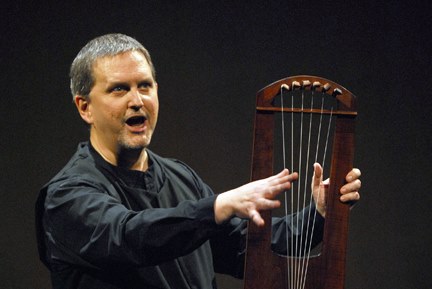
Bagby at play. Photo courtesy NY Classical Review.
Follow me, friend, as I take this tangent: tonight I’m leading the second of two local discussions of Beowulf, Tolkien, and Benjamin Bagby, who performs the first third of the Old English poem in the original language, accompanying himself on a reproduction harp. Bagby’s coming to perform in Vermont next month — the surface occasion for tonight’s discussion.
We’ll talk, among other things, about wyrd, that old word that still half-lives in modern English weird, lives more fully in the Weird Sisters of Macbeth, and most fully in its original sense of the pattern of things which is both destiny or fate, and also the stage for meaningful human choice and action. Beowulf falls to wyrd, but also survives because of it.
Anglo-Saxonist author Stephen Pollington puts it this way:
The analogy of a spider web is usefully employed in considering wyrd. Each section of the web is a discreet part of the whole, yet the tiniest ensnared insect will set the entire web vibrating. Whether the spider wins her dinner depends on how skillfully she has woven her web, how quickly she reacts, and the chances of the captured insect to struggle free. The web is wyrd, but what the actors do upon it will decide the outcome.
Wyrd, says the poem, oft nereð unfægne man þonne his ellen deah. Taking Pollington’s analogy to heart, I render this as “The Pattern often saves an undoomed man when his courage holds” (Beowulf line 572). And I repeat to myself the charm: What the actors do upon the Web will decide the outcome.
We’re all “initiates of darkness”, of fates and destinies set in motion and still unfolding, yes — but that doesn’t define us. It just leavens the crusty bread that we are. Without a taste of that Old Tree of the knowledge of good and evil, what after all could we manage to accomplish? The first breath of any opposition would blow us away like dandelion fluff, like breadcrumbs. (No inner resources, I can hear my grandmother sniff.) We didn’t start the fire, sings Billy Joel. It was always burning/Since the world’s been turning.
Part of the journey beyond Druidry 101, as on any path worthy of the name, is the discovery of the usefulness of opposition. In careful measure (wyrd measures out some, yes, but so do I, each day), it gives us something to push against, a resistance, like weights in the gym, the settings on the stairclimber, the hills that are part of my dog-walk. I find out where I am, in the face of it — it’s potent in dispelling my illusions. It’s part of our training for what a world of polarities means. Armed and tested with this hard-won wisdom, we’re ready for realms of light. A Druid can aspire to live, serve and create anywhere. (And until that day of fuller mastery, there’s today with its choices and challenges. The poor, says the Galilean master, you will always have with you. What is my poverty?)
Some days, of course, I long for a cosmos that’s easy, or even just easy-er. But, I notice, after some time there, I’m restless again, eager to jump back into the fray and play of a more demanding laboratory world, where just about everything is subject to change and experimentation. So what happens if I take this tangent?
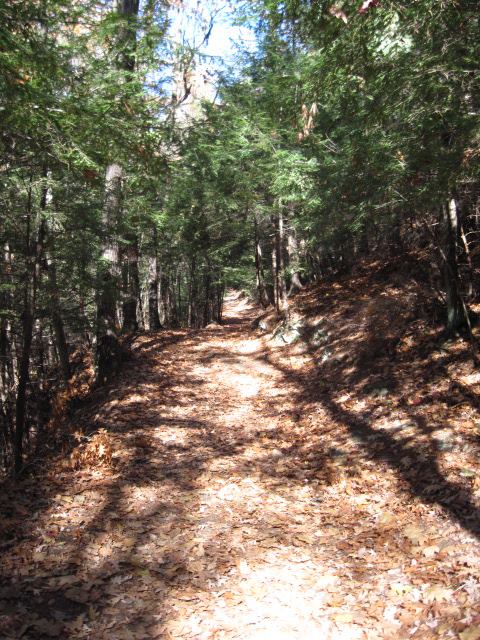
Mount Wantastiquet trail.
Meanwhile, I pray with the Leaf-Lords and Ladies around me:
Oak, shade my path. I welcome your wisdom.
Birch, green my way. I call on your courage.
Hemlock, heal my heart. I fast under your foliage.
Pine of all lands, I gather your gifts.
Tree companions all, I seek the shelter of your boughs.
/|\ /|\ /|\
Images: Bagby.
So you’ve made your way as a solitary practitioner, to the point where you know your land, the compass directions you salute, the spirits you greet and work with, the seasons, sun and moon, and the local weather-signs that signal storm or heat or simply change. You may well hold to an idiosyncratic practice that nevertheless works for you, drawn from dream, instinct, wide reading, the place you find yourself, discoveries that have proven to work, chance, ancestral memory, trial and error, divination, or direct instruction from a tree, guide, spirit, the land, another person.
If none of the foregoing sounds like you or your path — if you’re not a Druid, but Druid-friendly, or Druid-curious — nevertheless you can describe your path (and might benefit from putting such an overview into words, if only for yourself, as a record, a milestone, a signpost, a witness).
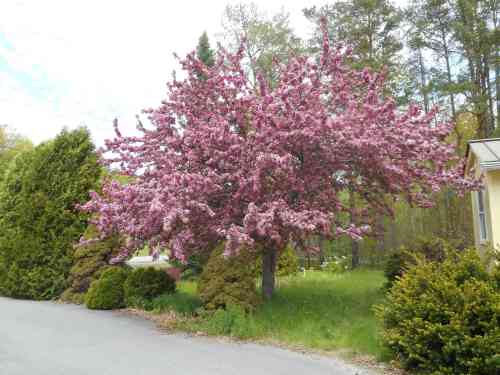
Spring, says Kipling in The Jungle Book … “the time of New Talk”
Or you’ve joined an order or grove or ritual group, you meet intermittently or regularly, you’ve settled on a basic ritual format that you spin variations on, you have your favorite festivals and ritual locations, and after a time you may start leading or writing your group’s rituals, or holding informal talks, or teaching divination, healing, permaculture, magic, and so on.
In either case, how many things can a Druid study or practice? Yes, you get the idea: the reach of it all widens far beyond the circle of the horizon.
In other words, you’re no longer a beginner at this stuff. You’re at least a “201-er” (following the numbering of university courses in many places, with 100-level classes signalling no prior knowledge or prerequisite coursework, and 200-level and above indicating intermediate and more advanced levels). You may not (ever) feel ready to write a book on what you know (though you could do so, nonetheless). You may never be approached by students eager to learn what you’ve painstakingly put together on your own (though that could happen, too). But you know enough, have learned enough, that when you act (or refrain from acting), things ripple from that choice, and you know it.
What’s next? Or what work lies ahead? And how do you figure that out?
The challenge of naming such next steps partly explains why there are so few non-beginner books and guides.
If you’ve stayed with any path long enough, and kept growing, you’ve learned how to begin taking those next steps, or — if they haven’t yet come into view — at least how to look and listen for them. You’ve also probably experienced “spiritual dryness” as well, those periods of inner drought where nothing’s kicking, and you just go through the motions like a wind-up toy. Patience is our greatest discipline and practice, says more than one spiritual teaching. Like trees and mountains, sometimes we need to weather for a while. And that can be the hardest work we do.
From the outside, even to close friends or family, it may look like we’re doing precisely nothing, when in fact we’re holding on and letting go all at once, questing for doors, gates, guides, signs, hints and clues, treading water, running in place, flexing all our limbs to stay as supple as possible, or — sometimes — dissolving into a complete funk and thinking we may just chuck it all. Heave a lifetime into the garbage bin and start fresh. Or abandon the whole project of having a project in the first place. Go fishing. Get and stay drunk, maybe for a few years. Have a midlife (or late-life) crisis. You’d run away, if it didn’t take so much energy. (Find a quiet corner and huddle there for a while, muttering to yourself. Yes, you’ve become one of those people now.)
201 is a point, or interval, where diverse spiritual traditions find considerable overlap, and the insights from one tradition can aid people in another. The most dogmatic and inflexible practitioners of any tradition usually haven’t wandered away from the home fires of their own hearths to the edges of the Forest, or into it. (You know what the capital letter stands for.) Or if they have, what they experienced there so terrified them that they fled and returned, hearts thumping wildly in their chests, determined to erect barriers, rules, ideologies, locks, guardians, gatekeepers to prevent others from enduring the same.
201 takes us into myth, archetype, confronting the self. 201, to borrow from Tolkien for a minute, drops us between the worlds of Man and Elf:
The real theme for me [in my fiction] is about something much more permanent and difficult; Death and Immortality: the mystery of the love of the world in the hearts of a race ‘doomed’ to leave and seemingly lose it [Men]; the anguish in the hearts of a race ‘doomed’ not to leave it [the Elves]. — Letters, no. 86.
To paraphrase and summarize a conversation between Elf and Man I can’t locate right now (probably from the Silmarillion, or from Athrabeth Finrod ah Andreth, the Discussion between the Elven King Finrod and the Mortal woman Andreth), “Which of us should therefore envy the other?”
Meanwhile, the Renewers of the cosmos, whoever they are, send us challenges to sweep us beyond such dichotomies. What does Life or Death have to do with the Song of Awen endlessly pouring forth through everything? To one stifling in spiritual dryness, the endless streaming of Awen all around can form part of the suffering that may accompany us during such periods. “Why is so much happening and flowing and flourishing all around me, while I sit here, a husk, waiting, endlessly, for something — anything?”
But write such things in a 201 book, and most readers would burn the damn thing, if they read it at all. Sometimes it can seem our patience and persistence have merely enlarged our capacity for suffering. And that’s really not what you want to share with anyone who casually inquires “So how’s it goin’?”!
Ubi sapientia invenitur? goes the old query. Where can wisdom be found?
If you know Kate Chopin’s “Story of an Hour” (and if you don’t, go read it right now — it’s very short, a matter of just a few minutes rather than an hour — so that the very next few phrases and sentences aren’t spoilers for you), you know that the main character, with a weakened heart, faces freedom and dies.
We’re called to live, instead.

New growth at the tips will be the most tender and sensitive, counsels the Green World.
Often the best cure is service. Not unwilling drudgery. But something worth doing. Find some way to give back, to unblock the flow of awen, of deep spirit, that has steadily been growing, pooling and accumulating, and now is a torment, because we can no longer give enough of it away, fast enough. (The cauldron is full to bursting. The weight of water in the reservoir builds and builds. Give more away, for the love of the sweet green earth!)
Instead of following a scripted plan for service (unless that appeals to you), ask for how you can serve. (Our talents can be used in ways we enjoy.) Then trust what comes, even as you test it step by step.
That, I’m still learning, turns out to be one of the bargains the universe, or the Gods, like best.
/|\ /|\ /|\
No, this isn’t the D&D you’re looking for. Or perhaps it is.
Last month, on the way home from our nephew’s Southern wedding, my wife and I met my two Pennsylvania cousins for breakfast. We hadn’t gotten together since their father, my uncle, passed on almost two years ago. In his mid-90s, he’d wanted a minimal funeral: “No reason to prolong your grief, or spend money doing so”, he’d said. The rite ended up so modest and unannounced only his daughters and grandkids attended. We were just hearing details now.
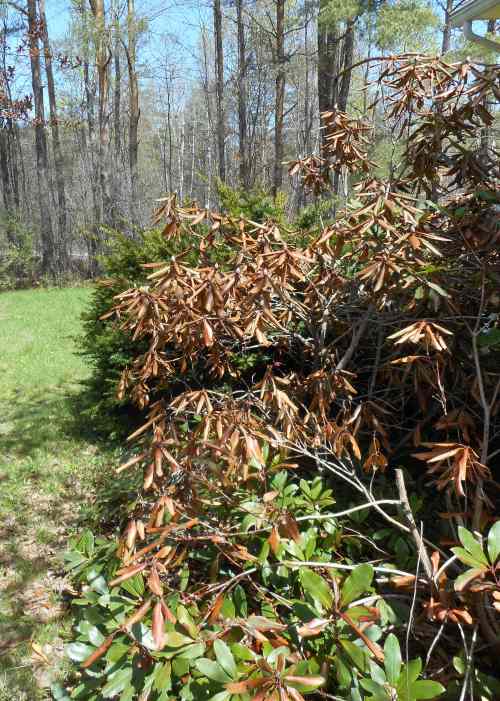
Our front-yard rhododendrons, with winter-kill on top, and the lower (snow-protected) green branches
Because of course funerals are very much for the living, too. And in spite of our callous and oblivious Western cultures so uncomfortable and unhelpful around death, we don’t “get over” grief after any fixed period of time. My younger cousin, I know, still carries hers around, like a tight knot in her chest, a cannonball of hurt.
“We’re not supposed to die!” she exclaimed at our breakfast, and I bit my tongue not to offer Druid things to her, knowing she still took a hard Evangelical Christian line about death: that it’s a punishment for sin, not a natural part of a cycle in worlds of time and space; that it’s a penalty for disobedience, not the consequence of wearing bodies that will, over time, wear out. Are autumn and winter unnatural?
Sometimes you just need to be heard in your grief, without judgment, without reply or attempts at comfort that, for you, ring false. No need to argue about death, for anyone’s sakes. I only hope she’ll find upcoming deaths, and her own, not a punishment but another step on our long journey.
Of course Druids no more “believe the same thing” than any other group of contrary, year-marked, and opinionated humans. One of my techniques, field-tested over my decades, if I can remember to turn to it — rather than bothering with belief, or non-belief — is to ask how is it true? When or where is it true, has it been true, will or can it be true again? These, to my mind, are larger, “better” questions, questions that still sidetrack me very helpfully, and fascinate me — much more than trying to lock down the moving target of “what a person can reasonably be expected to believe these days”. The answers, often spinning on to more questions, also fit poet Mary Oliver’s criteria: “so many questions more beautiful than answers”. Yup, says my inner Druid, trust the bards on this one, too.
Or as an artist friend said last night in Brandon VT, at her first major show of approximately 40 exquisite watercolors, quoting her mentor: the artist’s job (all our jobs, really) is to “deepen the mystery”, to pay attention.
As I’ve written elsewhere on this blog, I don’t so much believe in life after death as I suspect there’s life after death. It’s a hunch, an itch, a ripple up and down the spine, one way to make sense of too many experiences that otherwise don’t fit. This life is already so strange and unexpected, that to be here at all is no more or less unlikely than to continue after the change of death.
Another way to understand it: any “afterlife” has already begun. I just wasn’t paying attention. This is the afterlife of my previous life: what am I gonna do with it? Fried chicken and beer, operas and curry, sex and drugs, art and amazement, fasting and penance, profit and politics — each of us finds a set of pleasures and purposes to round out the strangeness of being here at all, along with any other projects we try our hands at.
Or, with a turn toward pop culture, with some Appropriation for Druid Purposes: “Ye best start believin’ in ghost stories, Miss Turner”, says Captain Barbossa in Pirates of the Carribean. “Ye’re in one!”
Alastair Reid writes in his poem “Curiosity“:
… that dying is what the living do,
that dying is what the loving do,
and that dead dogs are those who do not know
that dying is what, to live, each has to do.
And because you know I rely on our bards to heal and guide us, here’s Mary Oliver again, one of our master Bards, on grief, with a perfect Druid triad:
To live in this world
you must be able
to do three things:
to love what is mortal;
to hold it
against your bones knowing
your own life depends on it;
and, when the time comes to let it go,
to let it go.
Another chance for Bards to have the last word: a page of ten particularly apt poems on the immense range of our griefs and losses.
/|\ /|\ /|\
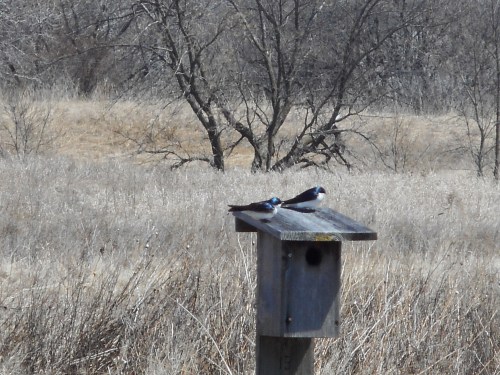
tree swallows sunning themselves — mid-April 2019
In a comment to John Beckett’s blogpost of March 28, Gordon Cooper covers several topics and throws out material very rich for reflection and experimentation.
Cooper first addresses the development of modern polytheism:
How can polytheists who honor non-Indo-European gods replicate the successes that Druidry has had?
I would suggest that the success OBOD has had and continues to have is rooted in some fairly simple and old fashioned tools — a correspondence course, mentors, and lots of engagement by the members. The first time I went to the OBOD Lughnasad gathering at the Vale of the White Horse, I was deeply impressed by the amount and quality of work I saw. One person learned ceramics, built a hand-painted and fired series of tiled walls on her properties with elemental dragon meditations she’d realized. Others had voluminous scrapbooks filled with meditations, plant studies, ritual walks, etc. Their other secret weapon is Philip. He’s an international treasure for all druids, at least in my experience.
The combination of well-thought-out instructional materials and mentors, together with a dedicated and generous leader, and the developing nature of most strands of Druidry as supportive and inspirational practices, have proven its value yet again. If the non-European gods have means of access to power in this realm, through their priests and their own natures as deities, can they inspire and help manifest similar supports for their devotees and adherents?
And yes, much of modern Druidry and Paganism in general finds a priceless resource in books. Cooper continues:
If a group chooses to start from Nuinn’s [Ross Nichols, founder of OBOD] druidry, as it seems to be articulated in “The Cosmic Shape” it is possible to arrive at a non-IE druidry by treating this as an embodied expression in ritual, artistic and land-based practices that manifests over time and space differently in each era and place. I strongly encourage reading the entirely of ‘Cosmic Shape” as one point of departure.
Cooper next tackles a particular source-text — Iolo Morganwg’s Barddas (link to complete text at Sacred Texts).
Moving to the Barddas as a possible base, regardless of how one considers the authenticity of Iolo’s writing, his notions around ritual, nature study and the sciences, poetry and justice are values that I think can be applied to many circumstances and cultures. Besides, anyone borrowing from an Egregore that includes Iolo, William Blake and a French Spy-cum-Mesmerist alchemist is likely to be in for an artistic and interesting ride.
All of us have experience with egregores of groups we’ve joined, been born into, or witnessed from outside as they variously manifested their energies. Political parties, churches, families, clubs, sports teams, other special-interest groups and so on are non-magical examples. Consciously-created and energized egregores deployed magically are potentially just “more so” — stronger, more durable, more capable of great (and also terrible) things. The principle at work is “the whole is greater than the sum of its parts”. Magic as an amplifier simply magnifies that whole.
Cooper then goes on to suggest provocatively, in a quick paragraph, one way to develop a valid Paganism or Druidry that grows organically from wherever we find ourselves, one that need not worry over cultural appropriation or validity:
I’m working on a very small group-focused practice that’s designed from the ground-up to be derived from the local biome and skills of the folks living there. It is being field tested in Bremerton [Washington state] now with the Delsarte Home Circle. It incorporates Ecopsychology, poetics, local kami, nature studies, personalized and group moving meditations and other meditation forms along with a customized ritual calendar derived from the specific region. It is appropriation-free and includes classical Spiritualist training. If interested, please contact me for details.
On the issue of Pagan or Druid chaplains, Cooper also speaks from (local) experience:
I’d say that Pagan chaplains in hospital systems are likely to find themselves in an ethical bind from time to time, as they’d be called on to engaged with YWYH on behalf of ill or dying patients in hospitals or elsewhere.
The VA Chaplains don’t serve or acknowledge the validity of druids and witches, at least at the Seattle VA. This isn’t going to happen with the current staff, and as I receive all of my medical services there, I am not inclined to fight an uphill and contentious battle.
Not all of us are called to fight outwardly — a misconception activists of all stripes are especially prone to. Following your own path is often powerful enough — the patient persistent effort of being a genuine self in a world of delusion and false directions is a forceful life stance, an essential kind of witness both to others and oneself, with consequences we often do not see. Not all music is scored as trumpet fanfare. Some of us are strings, oboes, flutes, drums, or the rests and silences between notes.
/|\ /|\ /|\
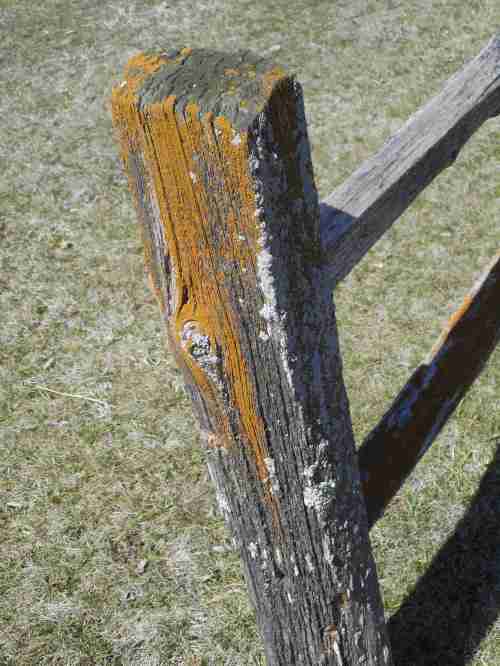
Go to the Bards, I tell myself yet again. The answers have lain there long. (You can tell I hang out with Bards new and old, even if I don’t always listen to them all that well — I use words like lain.)
Wordsworth, Old White Guy, still has something to tell us:
The world is too much with us; late and soon,
Getting and spending, we lay waste our powers;
Little we see in Nature that is ours;
We have given our hearts away.
Do we want some hints for living? Do we want some uplift, to know that positive change — and more important, joy — are still possible in this crazy world?
Bards offer a how-to for the spirit. These four lines yield some solid pointers.
Back away when you can, from the world, into the World. In the heart of even the most urban areas on the planet, green things still can find a way to thrive, sometimes with a little human help. A bee in the bathroom, a bug on the doorbell, a spider webbing the space between light-switch and corner cupboard — the living world keeps knocking. Find the green. Find the World. (Help the bug or bee outdoors again.)
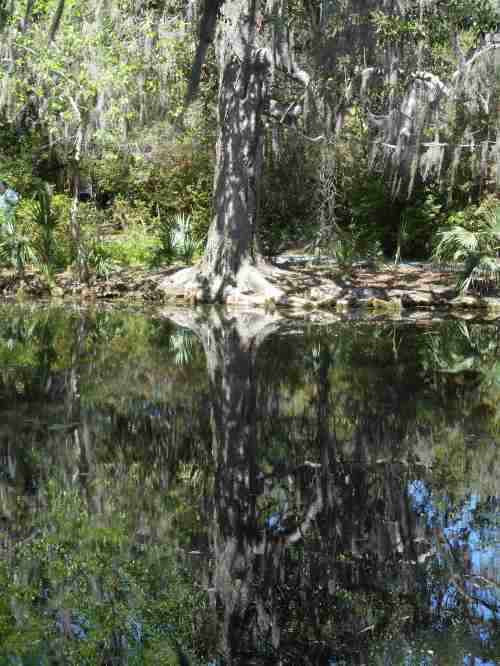
“Late and soon”? Unplug from time, from the apparent world we’ve built for ourselves, into contemplation. We know it’s good for us, and with images, mandalas, music, incense on hand, we can enliven our dips into our own inner pools of calm and wisdom each time with something different, if we crave variety, or with the same deepening familiar artistic companion to our sojourns. It may be a walk with the dog, a time spent folding laundry, a half-hour gazing at the reflection of a pond, working with paints, or clay, or fibers. I turn to a longtime friend, the oooooo at the heart of the ah — oo — en Awen, the HU of the Sufis, a holy name not contaminated with profanity or dulled by careless use. Sing the names holy to you.
Our “powers”? So many of us are facing our powerlessness. In some cases we’ve given what we have away — “laying waste” our own abilities to shape and choose, however meager they may feel and seem. Yet if we turn from buying and selling, things that can’t be bought will reappear for us: time spent with loved ones, time spent in nature, time spent on diving deeper into our own creative selves, uncramping some of our little-used faculties and skills and talents. Reclaim our powers, one at a time if necessary. (No waiting for the next election to give us back what is native to us. No one can hold them back from us, once we recognize them again.)
“Little we see in Nature that is ours”? Let go of possessing, I tell myself, and things will come to me of themselves. Sit still enough, and the birds will light on my head and shoulders like they did with St. Francis, like they continue to do today on those who spend time being still, loving the stillness that keeps opening into something larger and more beautiful. If I hog the road, of course I’ll see little else — I’m what’s in the way. But more and more beings become companions along the way, if I share the path.
If I look in the rear-view mirror of Time, I see the Ancestors waving.
How have I “given my heart away”? Excuse me, I whisper. I’m taking my heart back. I gave it and you didn’t value it. Let me bestow it where it will be cherished for what it is.
Bad news, you say of Wordsworth’s lines? Blaming the victim? No — showing the victim how to unvictim. Empowering the victim with what’s right here, turning off the victim switch others have flipped. No special monastery, ashram, growth center, workshop. These may serve their turn, but they are kindling, not Essential Fire. If I make it, I can unmake it. If I’ve shut it down, I can open it up again. If I’ve created my life, I can change my life.
It can be long work. But what else am I here for? Oh, so many things, many things, sing the birds. Everything, whispers the wind. Come find out, says the path into the greening woods.
/|\ /|\ /|\
[Part 1 | Part 2 | Part 3 | Part 4 | Part 5 | Part 6| Part 7]
I love these next three arcana — so over-the-top! People write and talk about fearing the appearance of the Tower, or the Devil, in a spread or reading. The Star not so much, though we still invest so much emotion in all three images. I ask myself: need I fear reality? What would that even mean?
The DEVIL
 Devil’s Tower, Devil’s Hole, Devil’s Triangle, the New Jersey Devils hockey team, Devil’s Food Cake (to be distinguished from Angel Food Cake), Devil’s Advocate, even DEVILS, the Deep Extragalactic VIsible Legacy Survey. Anyone looking for mixed messages? Should we even bother to try to untangle this complex of images and associations? We just keep piling more on more.
Untangle? Absolutely! Or not so much untangle as explore.
For me, one powerful key to the Devil is his connection with the Magician, a harmonic or further spiral, 17 (7×2) removed. The hand positions of the Devil mirror the Magician’s, the right in particular matching the Hebrew letter for sh, Jewish El Shaddai Almighty God, that resembles a “W” (= Hebrew letter shin ש), the handsign that accompanies the priestly blessing, made famous in an entirely different context by Leonard Nimoy as Spock in Star Trek, as a sign for “V” for his planet Vulcan.
 The Devil is the Magician is Us. It’s an image of the power humans have at their disposal, bend it as we will — and do. We can live long and prosper, or pervert the same power. As we all have, and no doubt will continue to do, on our long spiral journey.
Courtesy of a Judeo-Christian cultural surround and philosophical filter, citizens of European-based cultures may think of “evil” either as something non-existent (if God is “dead”, then so must the Devil be), or as a force from outside a normal, ordinary, essentially good universe. Time spent in the natural world can disabuse us of either notion: there are simply energy flows, some constructive, others contrary, and human choices often do much to amplify both kinds. (No surprise, I take it personally when I suffer, and I agitate for relief from my own particular suffering.) But both forces remain roughly balanced on the physical plane — hence a return to equilibrium in the flow of Tao that is one principal focus of Taoist practice.
We still tend to give “good” too little credit and “evil” too much, but that’s perhaps a further legacy of Puritanism and of dualistic thinking. Such over-simplification haunts American politics all too deeply, as intelligent foreign observers have long noted: Thus, on the American Left, we just don’t call it “evil” any more, but attach some other and often political label to it, as if it can be legislated away with the “right” people in office, if we can only vote out the backward, benighted, ignorant, toxic, patriarchal, gun-and-Jesus-loving, gay-bashing, hypocritical Deplorables that hold back all that is Good and True, and Progress will finally become the eternal norm. On the American Right, evil is alive and well, and successfully marketed in flavors both religious and secular, along with generous doses of paranoia, and typically describes things that snowflake Liberals, America-hating socialists, Pagan Greens, atheists, man-hating feminists, hidden-agenda homosexuals and baby-killing Darwinian believers support and advocate.
Both sides dearly love to loathe their Other. Do we all project much?!
The Christian sense that this is a “fallen” world in need of redemption compares to a Druidic sense that working with natural systems themselves can teach us how to sidestep a great deal of unnecessary grief in the first place, and wise observation and study can ease much of the unavoidable remnant that comes from living in a world subject to physical laws, time, change, aging, illness, death and rebirth. After all, it’s not humans alone, but animals, trees, mountains, our planet and the cosmos itself wear down and are renewed. “Everything She touches changes,” goes one Goddess-chant.
In the Arthurian deck, the card numbered 15 is the Green Knight. Aptly named, he is the force, as Dylan Thomas names it (links to whole poem),
that through the green fuse drives the flower
Drives my green age; that blasts the roots of trees
Is my destroyer.
And I am dumb to tell the crooked rose
My youth is bent by the same wintry fever.
The force that drives the water through the rocks
Drives my red blood; that dries the mouthing streams
Turns mine to wax.
And “answers” or elaborations to this come oftenest — you guessed it — from other bards:
To live at all is miracle enough.
The doom of nations is another thing.
Here in my hammering blood-pulse is my proof.
Let every painter paint and poet sing
And all the sons of music ply their trade;
Machines are weaker than a beetle’s wing.
Swung out of sunlight into cosmic shade,
Come what come may the imagination’s heart
Is constellation high and can’t be weighed.
Nor greed nor fear can tear our faith apart
When every heart-beat hammers out the proof
That life itself is miracle enough.
The Trappist monk and author Thomas Merton observed “Nothing has ever been said about God that hasn’t already been said better by the wind in the pine trees”. This is a “gospel in 20 words” that Druids and Christians could share.
“A church that doesn’t provoke any crises, a gospel that doesn’t unsettle, a word of God that doesn’t get under anyone’s skin, a word of God that doesn’t touch the real sin of the society in which it is being proclaimed — what gospel is that?” — St. Oscar Romero. How do we reconcile this healthy sense of activism with Druidry’s deep love and desire for peace? Are they actually opposed, or do they — can they — spring from the same source?
“Speaking truth to power” has never been more necessary — it’s the Magician’s power, in hands we always need to question and challenge.
Matthews’ notes in the Hallowquest handbook accompanying one edition of the deck that the Green Knight “represents the challenger whom all seekers meet on their quest. He answers questions and gives advice, but he also sets riddles and puzzles. Those who think that they know everything he leads astray and torments. His greatest desire is to be bested by a worthy opponent” (pg. 52).
The TOWER
 Towers everywhere: in the Christian West, from Babel onward. And before that, too: ziggurats and pyramids and the earliest “towers” of all — mountains. Connections with Mary Magdalene, “Mary of the Tower(s)”. For the U.S., the association with the destruction of the Twin Towers of Sept. 11, 2001. We say “Never Forget” about too many things, as though holding on to painful memory is sufficient tribute, a kind of vicarious participation. It isn’t enough, if I’m to continue the journey the Fool — I — started.
Like the frequent occurrence of Mercury in Retrograde, once you start paying attention, sometimes we just seem to be traveling through continuous “tower time”. Maybe it’s a good practice to uncouple from the Tower. Stop climbing it, sighting it in our viewfinders, walk away for a time.
But then, too, falling from a height is an old primate dream. How many of us have experienced falling dreams, or a sense of vertigo shortly before falling asleep, a sensation strong enough to startle us awake again?
Let ourselves fall, and what do we discover? All the way down, and our perspective might change.
We might see in the Tower a challenge to the ego, to the self we manufacture as an interface between ourselves and experience. In many ways the self is the Tower. Edgar Allen Poe in “The City in the Sea” writes “from a proud tower in the town/Death looks gigantically down”. (For further information, consult your amygdala [link 1 | link 2 | link 3].)
Is there much more to say about the Tower? Of course!
The STAR
 How many of us long for, or follow, a guiding star? Do we star in the drama of our own lives? Lucky star, rising star, star-crossed, shoot/aim for the stars — we know no lack of idioms. Has life starred certain experiences, talents, people, memories, etc. for our life-long obsession or dedication? A dis-aster is an ill-starred event. How much of our experience of imagination, emotion, vision and dream involves our starry or astral bodies?
As with the previous two arcana, this arcanum resonates in so many ways. Meditation on each of the arcana returns deepening insight, and the Star is no exception.
For Christians, associations with the Star of Bethlehem and the lore of the Magi reverberate strongly, while Revelation 12 depicts “a woman clothed with the sun, and the moon under her feet, and upon her head a crown of twelve stars”.
Tolkien plays on this ancient cultural resonance in The Lord of the Rings with Gandalf’s recitation of a piece of lore linking Numenor with Minas Tirith in Gondor:
Tall ships and tall kings
Three times three,
What brought they from the foundered land
Over the flowing sea?
Seven stars and seven stones
And one white tree. (The Two Towers, Bk. 3/chapt. 11; “The Palantir”).
Again we see in the Card a nude figure with limbs — conscious links or connections — in more than one element. The eight eight-pointed stars connect with the seven heavens of Medieval lore, with the eighth, the region of fixed stars, above them. As a doubling of the elemental four, the Star is a higher octave of activity. Seven cards from the Hermit, it links to the cultivation of solitude and (spiritual) perception.
You might assume that reaching such an exalted state is the end of the journey. After all, Dante ends each of his three Books of the Divine Comedy — a book abounding in numerical and astrological symbolism — with reference to the stars. And the 33rd and final canto of Paradiso, the last of the three, closes like this:
ma già volgeva il mio disio e ’l velle
sì come rota ch’igualmente è mossa,
l’amor che move il sole e l’altre stelle.
but already my desire and will were moved,
like a wheel which equally/smoothly is moved/turned
(by) the love that moves the sun and the other stars.
But four more arcana remain for us to consider.
/|\ /|\ /|\
IMAGE: live long and prosper;
[Part 1 | Part 2 | Part 3 | Part 4 | Part 5 | Part 6| Part 7]
I’m dancing with Tarot in this series, not aspiring to any profound system of interpretation, but skating with images across a frozen pond, juggling globes of fire, listening for the music the stars make overhead.
In this, as so often on this blog, I’m listening to bards here, rather than scholars. Recall Billy Collins’ wise “Introduction to Poetry” If you don’t know it, or haven’t read it recently, take a moment right now. Try it out, as I do frequently, as an antidote to too much right-brain-ness.
The HANGED MAN
 So what does the Hanged Man, card 12 of the Major Arcana, represent? Odin? Jesus? Both? Neither?
This kind of question, one that assumes that if you can ask it, there’s a reasonable, logical, unambiguous answer to it, reflects a confusion of planes, categories, realities, etc., that we all fall into from time to time.
“But what does it mean?” looks like an innocent query, even though it’s often anything but. Yet we keep on asking, tossing the grenade, just like we keep on believing (for a short time, anyway) anyone with enough authority to state categorically, emphatically, beyond-a-shadow-of-a-doubt, once-and-for-all-time, that X “means” Y. (If X “really” meant Y, they’d be the same thing, and we wouldn’t be asking the question. Or we could simply all become goddess-devotees, knowing that “one thing becomes another, in the Mother, in the Mother”, and that certain questions just have to be un-asked, if we’re to get any sleep at all.)
Something’s going on with this hanging dude, or dudette. He or she has a “fire in the head”, and looks at surprising ease all inverted there, suspended on a tau-cross, like some gnostic St. Peter, who asked to be crucified upside-down, so as not to aspire to equal honor with his Master. (Invert that sh*t, says the imp in me.)
Then, too, we have the figure 4 the legs make, about which much ink has been spilled. (Run with half a dozen interpretations as long as they last, and report back to your cerebellum at the conclusion.)
Certainly I’m a hanged one, as are you — we all are, at least at times. In Matthews’ Arthurian deck, the card is the Wounded King, the ruler of a wasteland in need of healing and restoration.
W. B. Yeats of Golden Dawn fame knew this — the Tarot features largely in the Golden Dawn ritual and symbolism — and Yeats gave himself the magical name Daemon est Deus Inversus, abbreviated DEDI (which not too incidentally is Latin for “I gave”). Demon is God upside-down. Or vice versa. For more than you want to know about the name and its significance, here’s just one of the links Google will offer you, should you opt to enter the phrase (and you should, as a form of spiritual roulette) in that innocent-seeming search box:
Iamblichus’s doctrine that the immortal soul becomes mortal is puzzling for Platonic scholars. According to Iamblichus, the embodied soul not only becomes mortal; as human, it also becomes “alienated” (allotriōthen) from divinity. Iamblichus maintains that the alienation and mortality of the soul are effected by daemons that channel the soul’s universal and immortal identity into a singular and mortal self. Yet, while daemons alienate the soul from divinity they also outline the path to recover it. Iamblichus maintains that daemons unfold the will of the Demiurge into material manifestation and thus reveal its divine signatures (sunthēmata) in nature. According to Iamblichus’s theurgical itinerary, the human soul—materialized, alienated, and mortal—must learn to embrace its alienated and mortal condition as a form of demiurgic activity. By ritually entering this demiurgy the soul transforms its alienation and mortality into theurgy. The embodied soul becomes an icon of divinity.
Why are both Jesus and Satan called the “morning star” in the Bible, and both referred to as serpents? For we have Jesus making the arresting observation: “As Moses lifted up the serpent in the wilderness, so must the Son of Man be lifted up” (John 3:14). Here’s one of our challenges, then, to run through a series of metaphors: to lift up the serpent, to raise the kundalini, to recover the divine in our deeds, thoughts and words, to become, in Iamblichus’s words, an icon of divinity. Or you can scratch any interpretative itch with an Orthodox reading, or canonical understanding, and miss a good 9/10 of what it might possibly say to you.
All this, for a person in red tights, hanging upside down …
Take the card into contemplation. Hang for a while, and see what you learn. Far better, as I keep saying, what you discover on your own, than what you merely read here, words from another. Pointers, merely; fingers toward the Equinox moon. Transform, transform …
What needs inversion in my life? How are my values or outlook upside down? What can I see differently from a radically different stance? Will I let myself relax into such a changed awareness, or immediately “set myself to rights”? If I were Odin or Jesus, would I “do things differently”? If so, how?
DEATH
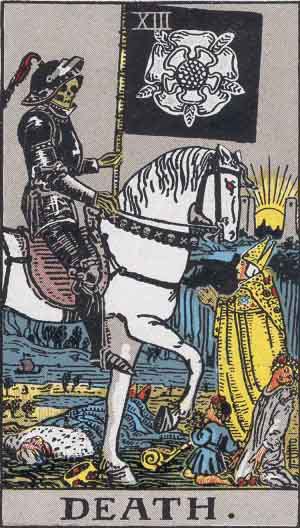 Like the Tower, Death and a few other cards manage to freak out a substantial number of people who work with the Tarot in its many guises.
“Death on a pale horse” comes riding straight outta scripture. (You can choose whether the background sun is rising or setting.) Figure out the banner Old Bony is carrying, and you might be on your way to insight. Death meditations are useful; there’s clear indication that at least some bardic initiations included them, and death-and-rebirth rituals help re-establish a healthier perspective than the ever-popular “life at all costs” obsession current in much of the West. Death, in spite of much bad advertising and spiritual teaching to the contrary, is not an “enemy” but a gateway, an arm of the spiral, a servant of life.
How apt that Death should have the number 13. (“Four” does similar duty in Japan and China, with the word for four a homonym for “death” or “death” [shi in Japanese, si in Mandarin Chinese]. Some Asian hotels go so far as to renumber their floors, avoiding the 4th altogether, just as we get all superstitious and tingly on Friday the 13th. “Friday the 4th” just doesn’t have the same feel at all.)
If you can put yourself into the landscape and know yourself as the Hanged Man, do the same with Death. And since there are other figures on the card, try out being the church official, pope or bishop, in front of Death’s horse.
In the Matthews’ Arthurian deck, this card is the Washer at the Ford, a harmonic of the Morrighan, the Goddess, the Dark Initiator.
What horse am I riding right now? What lies dead all around me? What am I killing by my insistence on my current identity? What needs to die in my life, so other things can be born?
TEMPERANCE
 “… in the very torrent, tempest, and (as I may say) whirlwind of passion, you must acquire and beget a temperance that may give it smoothness”, says Hamlet. The figure suggests elemental transformation. In the whirlwind of passion, can I also find smoothness, equilibrium, balance?
Two-thirds of the way through the journey, the Fool has learned something about moderation — not narrowly “abstinence from alcohol” (unless that’s the form your particular practice of moderation needs to take), but something much more valuable. The angelic figure bears the elemental symbol of fire on its breast, and pours liquid from chalice to chalice, while standing with one foot on earth and one in water: all four elements present and working.
A curious and provocative insight from R. J. Stewart’s The Well of Light:
Do not forget, ever, that you are already Elementals. There is not one, but several of them, most likely a large complex number, within yourself. Our bodies are made of Water, Earth, Fire, and Air.
Our consciousness and energies are Elemental; that is, the philosophical or metaphysical concept of the Four Elements as relative states of motion and energy, but not limited to the modern idea of elements as defined in chemistry and physics. So, to find Elementals, we need look no further than our own bodies and moods. And, I propose, we should pay much more attention to the way our bodies and emotions interact with places and with weather changes.
And a prayer or visualization Stewart uses in many of his books, that I find helpful:
In the name of the Star Father, The Earth Mother, The True Taker, The Great Giver, One Being of Light.
How have I transformed — in spite of myself? What needs tempering in my life? What elemental presences can I honor and bring forward as keys to directions my life might beneficially take? What is this Equinox saying to my earth, my air, my fire and my water?
/|\ /|\ /|\
[Part 1 | Part 2 | Part 3 | Part 4 | Part 5 | Part 6| Part 7]
If the holy terrain between Druid and Christian calls to you, better your way than one belonging to another person that doesn’t fit you where you walk on your particular arm of the Spiral Journey. A week’s worth of your own meditations surpasses anything I can write here. These themes are suggestions, prompts, points of departure. They’re mine, and they may not be yours. Their use is as sparks, kindling, tinder, fuel, provocation. Your particular path may grow out of resistance or contradiction. Thus are (spiritual) muscles strengthened.
If you’ve (mostly) survived your adolescence, held down a job, learned to deal with roommates, siblings, coworkers, parents, teachers, traffic cops, jerks, (holy) Fools, the DMV, followed a dream, fell in love, lost a bet, failed at something, succeeded at something else, and arrived here, it’s pretty likely you’ve accumulated enough insight to learn something useful when looking at cards intended to evoke insight from your experiences! We can also never fully know how our words on such subjects may be exactly what another needs to hear.
The HERMIT
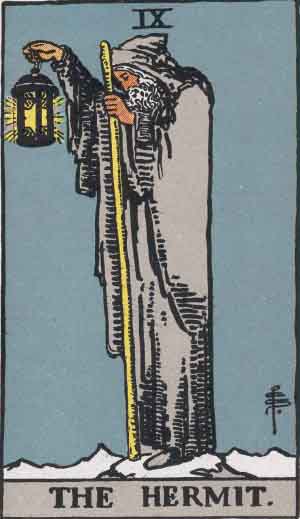 Hermits abound in world-wide lore and legend, running the gamut from hell-bound to holy. Depending on your temperament and the rebuffs that life generously doles out to all of us, you may find in the Hermit a kindred spirit, someone who chooses, as the French have it, reculer pour mieux sauter: “to draw back in order to make a better leap” back into the fray. Or eremitic withdrawal may become the theme for a lifetime, or a whole series of them. Plenty of secular examples come to mind as well, especially if you’re rich enough to build a life from your eccentricities, like billionaire Howard Hughes.
Modern examples include Thomas Merton, whose hermit tendencies can be summed up in the name of the monastic order he eventually joined: OCSO, the Order of Cistercians of Strict Observance, or Trappists. Not content with the already spartan nature of the Order, Merton withdrew further to a hermitage on the grounds of the monastery. His books and poems and increasing fame were one vital source of balance shaping his character into the wise monk, priest and author he slowly became.
J M Greer illustrates a Druid-focused model for practice just as potentially rigorous, especially for the solitary: the Gnostic Celtic Church. Greer highlights some of its distinctive features:
… the GCC does not train people for the standard American Protestant model of the clergy—a model that assigns to clergy the functions of providing weekly services to a congregation, “marrying and burying,” offering amateur counseling to parishioners, and pursuing political and social causes of one kind or another, and defines training for the ministry in terms of the same style of university education used by most other service professions.
This model evolved out of the distinctive social and theological requirements of American Protestant Christianity and has little relevance to other faiths, especially those that do not have the financial resources to support full-time ministers. It has nonetheless been adopted uncritically by a great many alternative religious traditions here in America. It was in response to the very poor fit between that model and the needs of a contemporary alternative religious movement that AODA [Ancient Order of Druids in America] chose to pursue an older model better suited to its own tradition and needs.
Instead of growing from a single and largely American Protestant model, the GCC focuses on what it calls the Rule of Awen, because
there is certainly a need for men and women who are willing to embrace a new monasticism centered on a personal rule: one in which the core principle of aligning the whole life with the spiritual dimensions of reality can express itself in forms relevant to the individual practitioner and the present age, in which a rich spiritual life supported by meaningful ceremonial and personal practice can readily coexist with whatever form of outward life is necessary or appropriate to each priest or priestess, and in which the practice of sacramental spirituality can be pursued apart from the various pathologies of political religion.
Greer always packs a lot in his sometimes academic prose: following Christ’s admonition, this means in short to “work out your own salvation with fear and trembling”. We say we want freedom, but how many of us trust our own inner guidance sufficiently to discern what is “necessary or appropriate”, and avoid the “pathologies of political religion”?
As always, the simplest and purest way contains with it the hard-earned wisdom of lifetimes. Greer lays out the central challenge we all face:
… find and follow your own Awen. Taken as seriously as it should be — for there is no greater challenge for any human being than that of seeking his or her purpose of existence, and then placing the fulfillment of that purpose above other concerns as a guide to action and life — this is as demanding a rule as the strictest of traditional monastic vows. Following it requires attention to the highest and deepest dimensions of the inner life, and a willingness to ignore all the pressures of the ego and the world when those come into conflict, as they will, with the ripening personal knowledge of the path that Awen reveals.
How many of us have even begun to recognize and creatively respond to all the myriad “pressures of the ego and the world”? (After all, this is much of what I’ve long been practicing in my own way, as recorded in this blog, and you have ample evidence here of the challenges one person has faced.)
The Matthews’ Arthurian deck depicts the Grail Hermit: “Neither Druid nor priest, as hermit he mediates the functions of both”.
Where is the “third element” in each of my life experiences? As neither pole of a binary, how does it serve both and thereby a greater whole?
The WHEEL of FORTUNE
 The Wheel or Spiral, the lungo drom or long road of yearning of the Romani, the Wheel of Becoming in Hinduism, “what goes around comes around” of folk wisdom, all point to the circular nature of life and the resonances that our actions establish.
Or as the Lakota holy man Black Elk puts it,
Everything the power of the world does is done in a circle. The sky is round and I have heard that the earth is round like a ball and so are all the stars. The wind, in its greatest power, whirls. Birds make their nests in circles, for theirs is the same religion as ours. The sun comes forth and goes down again in a circle. The moon does the same and both are round. Even the seasons form a great circle in their changing and always come back again to where they were.
The life of a man is a circle from childhood to childhood, and so it is in everything where power moves.
Worldwide, this circle or wheel is also quartered, divided into four fields or domains or regions. Yes, it’s impossible to square the circle , and the link will lead you into exquisite mathematical detail why this is so — but using this holy glyph or mandala as a teaching and learning device, as a tool in ritual, is another order of response to such an intersection of worlds. What is materially impossible is — often — spiritually essential. Or to put it another way, walking a spiritual path means squaring the circle every single day. (Or if you seek a spiritual practice based in mathematics, check out this origami link.)
For more insights that can lead to a unique personal practice with sacred geometry, and not incidentally provide further rich linkages between their profound influence in both Druidry and Christianity, check out Michael Schneider’s A Beginner’s Guide to Constructing the Universe: Mathematical Archetypes of Nature, Art, and Science.
JUSTICE
 In Matthews’ deck, the corresponding figure is Sovereignty: “our true self and the land are one”. The justice of this inner truth emerges in the great rebalancing that earth is currently experiencing, as the consequences of our past actions come home to us, and we begin to accept responsibility for them and to work off their effects. But we need not merely suffer them passively; we can work with them creatively for the purposes of transformation, which is what cause and effect are placed to afford to all who seek.
In the traditional deck, the figure is garbed and presented so that gender is not immediately clear. Latin justitia is a feminine noun, yet the figure of Justice as we have it here has a seated, balanced, imperial quality of the previous male figures in positions of traditional masculine power and authority.
As a further harmonic development of the Magician, Justice is a balanced expression of power: the upward right hand holds a sword, while the left grips a balance. The two pillars of manifestation again frame the seated figure, and a curtain conceals the region behind it.
What has been lost on the way to Justice? How is its expression still incomplete, indicating the need for further growth and unfoldment? What does rebalancing and attainment of a new equilibrium conceal or distract me from? What further currents of change and transformation remain that ask for my attention, and allow me to anticipate future expressions of Justice, of balance and recalibration and harmonizing?
The triple crown of Justice can be seen to reflect the magical current inherent in groups of three, and in the physical universe. The card commentary for this card in Matthews’ Arthurian deck includes this observation: “…the Goddess of Sovereignty gives three drinks from her cup, purveying the white milk of fostering, the red drink of lordship and the dark drink of forgetfulness. These she offers successively in her aspects as Foster-Mother, Consort and Renewer”.
“Mother, foster me to your service. Consort, empower us both through our union. Renewer, ease me as I strive to fulfill my vows to you”.
/|\ /|\ /|\
[Part 1 | Part 2 | Part 3 | Part 4 | Part 5 | Part 6| Part 7]

One of the vital perspectives that much modern Druidry can offer to Christian practice is an experimental approach. Rather than depending so heavily on creeds and affirmations of faith, we can approach statements in Christian and Jewish scripture as pointers toward practice, as statements of spiritual reality and awareness if certain prerequisites of practice, wisdom and experience are met, statements clothed in symbolism and perspectives than can sometimes translate to other terms and forms without diminution.
Here’s one such example: “Blessed is the one who comes in the name of the Lord” (Ps. 118:26). Whether as a statement of faith or a lyric in a praise-song, it often elicits a comforting familiarity. But why not take it for a spin? Because it offers at least three points for exploration, contemplation and practice, we could treat it as a Druid-Christian triad, and contemplation seed:
What does “blessed” mean?
What does it mean to “come in someone’s name”?
And what is the “name of the Lord”?
Coupled with this last question is a verse often directed at non-Christians, and prominent in mission-oriented publications and preaching: “At the name of Jesus every knee will bow” (Phil. 2:10). As a form of submission to a specific deity, a Christian islam, its initial meaning seems quite clear. All will acknowledge this particular form of deity, the Christian Son of God, in a future realization of his divine sovereignty. It’s a state yet to be fulfilled. Islam as an Arabic word for Muslims also conveys a sense of free will — it’s a voluntary submission. Of course, this is one form of understanding, and it need not be the only or even the most potent in effecting spiritual change.
Put these formulations in Druid terms and you might have recognition that the natural order has a discernible flow, a direction, an energy that humans resist and abuse only at an accumulating cost to themselves and to every other being around them. (Some have called this Lady Sovereignty. It’s possible also to see in this a version the Shekhinah, the presence of God.) Blessedness in these terms is fruitfulness, harmony, awareness, creativity — all arising from recognition of and concord with the underlying flow inherent in nature, and an ability to navigate life changes successfully. If we come in the name of spirit, or bring with us and our decisions and actions such blessedness or harmonious accord with the flow of nature, it’s often quite apparent to others. A yogi may do this while performing the Salutation to the Sun. Or the Druid sitting under a tree to rest against its trunk and watch the sunrise, may acknowledge the presence of something far greater than the human self in these things. A human on a “path with heart” already carries an awareness of spiritual presence of which he or she is an integral part of the whole.
It’s then that we recognize, at least in our better moments, the authority of those who act from love and wisdom, not from selfishness or shortsighted opportunism. And the sages among us, whether Druid or Christian, both or neither, may not always be those publishing the books and presenting at major Gatherings or Conferences. It may be the white-haired gardener praying in the neighboring pew, face aglow with reverence for the goddess in Mary, or Mary in the goddess, fingernails still darkened with the good earth under them. It may be the quiet young Christian woman calling the quarters at the next Equinox ritual, honoring the four archangels, or the four gospel evangelists, or the four creatures of Celtic or some other tradition, welcoming the presence of spirit in so many varied guises and forms permeating every quarter of the compass.
In the experience of spiritual abundance and presence, then, Christian and Druid may find another meeting-place.
/|\ /|\ /|\
The LOVERS
 The next Tarot image in our series is the Lovers. (The Matthews’ Arthurian image is of the White Hart, with the lovers Enid and Geraint in the foreground.) So much history and cultural change and commentary surrounds the myth or wisdom story of Adam and Eve that “It is difficult/to get the news from poems/”, as William Carlos Williams says in “Asphodel, That Greeny Flower”, “yet men die miserably every day/for lack/of what is found there”. The story may simply not “work” for many of us as it once did.
We can read the card in one way as depicting the non-physical spiritual force that expresses itself in female and male, in all living things, both green and fruiting, and flaming with energy, as in the fiery-leaved tree behind the male figure. To get caught by stereotypical associations, or to balk at “masculine” or “feminine” attributes, is to miss the polarities inherent in the natural world that allow for manifestation — multiple polarities we all carry within each of us. In one sense, then, nature has always been “gender-fluid”: we know of species that can change genders at need, or at different points in their life cycle.
What do I really love? Does that love build or tear down my life? How does love help me manifest? What polarities work through me with particular force or energy? What ones might I beneficially welcome and work with in my life? Where else can I love?
The CHARIOT
 The Chariot in the traditional deck (or Prydwen, Arthur’s ship of journeying in the Arthurian deck) closes out the first of the three rows of the Major Arcana (if we lay out the cards in 3 rows of 7, with the Fool or Seeker as the one who moves through each on the Journey). And again, in one traditional interpretation, this first row has to do with the maturing self, the personal, the exploration and development of capacities and potencies of the individual.
The notes for Prydwen from the Arthurian deck: “the Otherworldly journey which is undertaken by all seekers, so that the inner life becomes the basis for a sound outer life” (pg. 36).
One applicable Biblical verse here comes from Luke 6:45: “Good people bring good things out of the good stored up in their hearts, and evil people brings evil things out of the evil stored up in their hearts. For the mouth speaks what the heart is full of”. I don’t know about you, but this is a useful barometer for where my attention is. And with luck, you have a friend or partner who calls you on your crap. “What did you just say?!” That’s when I learn, if I don’t already know, that I’m (once again) out of balance and have some work to do.
What is happening in my inner worlds? What is my foundation? Where can I continue to work to shore up that foundation for both my inner and outer lives? What cycle has ended so that I can finally see and account for its shape and influence, and now return to polish what was rough-hewn? How is my storehouse? What am I harvesting from the old cycle as I begin a new one?
STRENGTH
 “The Sovereign Lord is my strength! He makes me as surefooted as a deer, able to tread upon the heights” (Habakkuk 3:19). Or to be gender-fluid about it: “I honor Lady Sovereignty who strengthens me here on this Land where the deer runs, showing me how to walk the heights with sure feet”.
On this new octave, the second row of 7, Strength shares the infinity symbol with the Magician. You could say she is the Magician — renewed, re-imagined.
Is this coercion or forcing of our elemental and instinctual selves by our “higher” selves? Is it conscious awareness of the vitality of both, thereby making it our own more fully and completely — a union, where formerly there were two? The Lady here has greens and flowers for a belt — she is not separate from nature. Is she shaping and directing that animal strength?
Perhaps we can see one theme run from the prophet’s words that open this section to Whitman’s words in “The Beasts” in his Song of Myself:
I think I could turn and live with animals, they are so placid
and self-contain’d.
I stand and look at them long and long.
They do not sweat and whine about their condition,
They do not lie awake in the dark and weep for their sins,
They do not make me sick discussing their duty to God,
Not one is dissatisfied, not one is demented with the mania of
owning things,
Not one kneels to another, nor to his kind that lived thousands
of years ago,
Not one is respectable or unhappy over the whole earth.
So they show their relations to me and I accept them,
They bring me tokens of myself, they evince them plainly in
their possession.
In some ways Whitman describes Paradise, a recognition of inner sovereignty that needs no one kneeling to another. The “self” that contains the beasts is the sovereignty of the Land, the Whole that cradles each individual in its arms, if we opt for the language of personification. Here it is animals leading the way in showing tokens of this “self”, already in their “possession”.
Is this what the Strength figure is trying to discover, or does achieve? Does Strength learn that strength unaided is insufficient — a realization that is the beginning of wisdom? It is our inner strength that issues forth in animals, too — our shared link, not one to dominate the other.
So I can do no better than end this post with words from U. K. LeGuin’s great Earthsea trilogy. Her magician or mage Ged learns from his own experience with beasts:
… in that wisdom Ged saw something akin to his own power, something that went as deep as wizardry. From that time forth he believed that the wise man is one who never sets himself apart from other living things, whether they have speech or not, and in later years he strove long to learn what can be learned, in silence, from the eyes of animals, the flight of birds, the great slow gestures of trees.
/|\ /|\ /|\
IMAGES: Pexels.com — winter pictures.
[Part 1 | Part 2 | Part 3 | Part 4 | Part 5 | Part 6| Part 7]
INTERLUDE
Druids have grappled with Christianity since it first arrived in Europe. While today we might take St. Augustine at his word (“that which is known as the Christian religion existed among the ancients, and never did not exist”*), exploring it in new and creative ways (tell me yours and I’ll tell you mine!), most people throughout Christian history have understood the assertion as narrowly as possible. That is, Christ started a new religion focused on belief in the divine power of his sacrificial death and resurrection, which saves the believer. Pairing this with a transformation in awareness, the convert takes on a new life in Christ.
For many, however, Jesus Christ, or least the religion that bears his name, is problematic at best. (To choose just one among myriad issues to explore, note that neither Druids nor non-Druids use the name Taliesin, for instance, as a “swear-word”!) Many non-Christians today have suffered from unloving and aggressive evangelism, family harassment, workplace tension, physical threats and social ostracism, whether they practice a non-Christian spirituality or simply remain “outside” the Christian church.
I’m addressing this series of posts, then, primarily to a vast “excluded middle” — neither the “born-again” believer nor the scarred (and possible tarred and feathered) “heretic”, but the people awake to the “magical and generous” possibilities all around us, because you’ve already experienced them, and they answer a deep hunger in you like nothing else can.
Or as Krista comments:
Dean, I’m always especially interested when you write on this particular topic. Having been raised in the Christian Faith, and having had no quarrel with the Christianity of my youth, my own Druid practice always has something of a Christian flavor to it even though I no longer consider myself a Christian. But I don’t consider myself Pagan either. Always was a bit of a square peg. So throughout my Druid journey I’ve become very comfortable blending and assimilating and it works quite well in my private practice. It’s a bit more challenging in community practice, but I’m working on it and I adapt when it’s called for. I think it would do the Druid community a world of good to acknowledge, and have more discussion about, different Druid perspectives rather than focusing almost exclusively on the Pagan perspective. Thanks for taking it on!
One less-than-flattering label for this is syncretism. But religions and spiritualities, just like most human cultures, thrive by cross-pollination, as careful study of them across time will bear out. Similarly, in our genetics we’re mongrels, hybrids, blends, mixes. (Our sometimes uncomfortable surprise at recent DNA test-results illustrates one aspect of this.) Our current sensitivity to “cultural appropriation” is our heightened awareness of the violence behind forcible mis-appropriations. Or as John Beckett puts it bluntly in his The Path of Paganism, “Always credit your sources, never pretend to be something you’re not, and steal from the best”. It’s the lack of credit, the pretense, and the poor selection that make up most of our problems with shoddy cultural (mis)appropriation. The “weekend guru” offering workshops, intensives and retreats, and cashing in on an inferior grab of unacknowledged and imperfectly-mastered practices from another culture currently perceived as somehow more “authentic” or “powerful”, gives all borrowing and mixing a bad name.
[Lest you take issue with the possibly glib tone of John’s “triad of appropriation” above, let’s hear him at greater length from a recent post:
Are you being respectful to the traditions and cultures you’re drawing from, or are you grabbing whatever looks shiny to you? Are you working with them as whole systems, or as mix and match entrees on a spiritual buffet? And as a polytheist, my biggest concern: are you treating the Gods as holy powers and as persons with whom we can form relationships, or as objects to be used where and how you see fit?]
/|\ /|\ /|\
Another under-explored overlap is Druid and Hindu practice | another link | a third link | which offers some very provocative insights into cultural similarity and preservation of ancient traditions over long periods of time, and at “opposite ends” of the Indo-European area of cultural and linguistic origins and influence. Everything from archetypal themes in stories, to names of gods, music and musical instruments, and spiritual practices, show common ground in the cultures of Celts and the peoples of the Indian subcontinent.
And so I write these posts partly in the spirit of “doing the Druid community a world of good to acknowledge, and have more discussion about, different Druid perspectives rather than focusing almost exclusively on the Pagan perspective”. And as always, I’m exploring my own practices and perspectives as I go — one of the chief benefits of blogging.
The EMPRESS
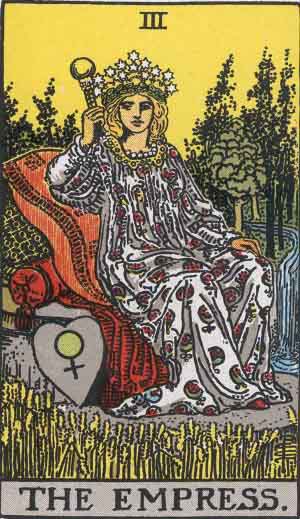 The Empress of the traditional deck, with her 12-star crown and sceptre, and the astronomical symbol of Venus next to her chair or throne, is another goddess figure. As an aspect or representation of the energies along the journey of the Fool or Seeker, she grounds us in the earth. The wheat growing at her feet, the waterfall to her left, the forest behind her, all place her “in the world” of both fruitfulness and change. Whether as Mother Earth, or Mary, or another goddess, or a living but impersonal archetype, or the fertile and fruitful energies within us, the Empress is a potent force and presence.
As Caitlin and John Matthews describe Guinevere in their version** of this card, as “the Empress of Logres (the Inner Britain), she creates the conditions for growth, establishing peace and contentment. She spins a thread of inner concord which is woven into the fabric of the land and its people. She imparts sensitivity to nature and harmonious awareness of all life” (The Arthurian Tarot. Thorsons, 1995, pg. 28).
What is the “thread of concord” between you and the land where you live? Only you can answer that: it can become a practice first to find out, and then to honor it in ways that you work out between you and the land. A grounding exercise of weaving or braiding a thread to carry with you as a reminder may help incarnate this awareness. Ritual can serve our need here, as in so many places.
What are the “conditions for growth” for whatever you wish to bring into your life? How can you begin to work them into your day to day work and awareness, so that they can manifest what you need? How can you serve others who are doing the same? Asking the questions can help the chance manifest, if I’m paying attention. If not, then next time around.
Archetypes, it should be said, aren’t something to “believe in”, and even less something to “worship” — though you certainly can if you choose to. (Let us know how it goes — you may discover something valuable to share.) Instead, and probably a better use of our energies and attention and time, they’re something to work with to see what they can help us do and understand about our lives.
The EMPEROR
 The Emperor in the traditional deck hews to traditional symbols and representations of patriarchal power: beard, crown, scepter, throne, armor, harsh and rather sterile landscape, rams’ horns adorning the throne’s arms and back. (It can be helpful for such reasons to consult other decks for different images and symbolism.) The fact that we’re experiencing the negative effects of imbalanced masculine energies in our lives simply tells us a piece of what needs healing and re-balancing. Scan most headlines and you realize many people haven’t a clue about how to begin to do this — itself a measure of how out of balance the energies have become for many. We’ve often jettisoned outmoded forms of spirituality, true — but neglected to replace them.
The Emperor’s number 4 is also represents the fullness of the human world, four-square in its founding on the four physical elements, before we shift our awareness to spiritual realities within and beyond them. The Pagan and Christian star alike points to the five-fold nature of all things, both physical and non-physical — a vital reminder of how the cosmos is constituted, which we overlook, and have overlooked, to our peril.
The spiritual, you might say, is what the physical *is* under its mask. Or to say it another way, the spiritual is always clear and apparent; it’s the physical that’s the mystery, the cloak, the concealer, the mist-filled branching off the path. We have simply forgotten to work our polarity magic, to walk a spiritual path of stewardship, to put it in Christian terms — we’ve thrown our planet out of balance over time, and now must spend at least as much time over the coming decades and centuries working to bring it back into balance and harmony.
The HIEROPHANT
 The figure in the traditional deck of the Hierophant, the “one who shows the holy”, may bring further associations of institutional authority and entrenched structures and imbalances.
Some decks re-order these first few cards, change their genders and assign them different symbolism, in an attempt to represent one or another version of a more balanced set of images. In the Matthews’ Arthurian deck the card depicts the bard Taliesin, the poet-as-way-shower-of-the-holy, especially of ways that stand outside formal structures and institutions. Today we find our bards and prophets among artists and performers, actors and politicians.
(Check out fansites and Facebook, Twitter and other social media, if you want to know how much the words and music and performances of artists matter to so many, if you don’t already have a deep appreciation for the power wielded by a multitude of visions and their visionaries. Again and again, people post how a performance or a lyric saved their lives, brought them down from suicide, changed their outlooks, gave them strength and courage and a vision to persevere through often impossible circumstances.)
Like the Hierophant, Taliesin is a guardian of tradition. We know all too well the dangers of distorted and abusive holders of traditional authority and power. Seemingly every other day, headlines trumpet the fall of another person — often a man — from a position of trust, authority and power. Such things have given tradition a bad name — except, again, in our modern reverence for everyone else’s traditions except our own. Traditional holders of wisdom, Native American or Tibetan or Mayan, still retain something of the original value that a tradition is meant to preserve.
For the other and often neglected face of tradition is that conserving function. We may conceive of tradition as “guarding from”, but more as “guarding for”. In his Elves, more than in any other expression in his fantasy works, Tolkien captures the sense both of preserving much wisdom and beauty through time, and of pervasive sadness at its seemingly inevitable loss. To cite just one example, even among the more hopeful, Gandalf addresses Aragorn in Book 6, Chapter 5 of The Lord of the Rings:
This is your realm, and the heart of the greater realm that shall be. The Third Age of the world is ended, and the new age is begun; and it is your task to order its beginning and to preserve what may be preserved. For though much has been saved, much must now pass away.
Our contemporary sense of loss and disorientation at our crumbling institutions, corrupt as some of them have become, is also an opportunity to reconnect with legitimate traditions, many preserved inwardly by their keepers, where we can recover them through vision, gratitude, ritual, and readiness and humility to ask for guidance. Taliesin, in the Matthews’ rendering, is one such preserver or conservator. He “sits in a firelit hall. He tells the story of his initiatory transformations to two children who sit at his feet listening intently. The golden links of tradition pass from his hands to theirs” (The Arthurian Tarot, pg. 30).
And our efforts in this quest (“lest any man should boast” as Christian scripture says [Ephes 2:9] of “works”, which by themselves can never be the only component of a quest) are part of our purification, our testing, a step along the path, not the sole key to growth. We are each one being in a cosmos of other beings, each with intentions and purposes, some which can align with ours. The hand of tradition, the wisdom of the Ancestors, the spiritual reality of the worlds, reaches out to grasp ours when we show we are ready.
/|\ /|\ /|\
*Augustine of Hippo. The Retractions, ed. Roy Joseph Deferrari, trans. Mary Inez Bogan. Vol. 60, The Fathers of the Church (Washington, DC: The Catholic University of America Press, 1968), 52. [Book 1, Chapter 12, article 3.]
**Here are the names of the cards in the Matthews’ Arthurian deck: (0) The Seeker, (1) Merlin, (2) Lady of the Lake, (3) Guinevere, (4) Arthur, (5) Taliesin, (6) The White Hart, (7) Prydwen, (8) Gawain, (9) The Grail Hermit, (10) The Round Table, (11) Sovereignty, (12) The Wounded King, (13) The Washer at the Ford, (14) The Cauldron, (15) The Green Knight, (16) The Spiral Tower, (17) The Star, (18) The Moon, (19) The Sun, (20) The Sleeping Lord, and (21) The Flowering of Logres.


 A Druid Way