I wrote up a version of the following for my journal, a practice in itself, and now for this post.
John Beckett’s helpful article “A Pagan Framework for Discernment” suggests a three-part approach for anyone doing the hard work of sifting experience and belief for their weight and significance and value. “Religious and spiritual ideas”, he observes, “are notoriously resistant to proof, as our atheist friends like to remind us. But if we wait on absolute proof, we’ll end up abandoning beliefs and practices that are meaningful and helpful to us.”
Divination is a useful practice at such a juncture, for several reasons. First, it acknowledges a need for help. I’m never alone, though too often I face challenges as if I am. [As that Christian triad (Matthew 7) has it, “Ask, and it shall be given you; seek, and ye shall find; knock, and it shall be opened unto you”. No, really!]
Second, divination gives me “something to do” that often relaxes the inner channels sufficiently that I’ll receive guidance “before” I actually do the divination. There’s little support or comprehension in our culture for anyone who talks about “voices in the head” — that kind of talk is one step toward getting you committed. So be careful who you talk to, I hear. Maybe if you started out committed, I hear, you’d know better how to respond to “voices in the head”. Rather than ignoring them, freaking, or heeding them unthinkingly, we’d assume there’s a wider range of options from which to choose.
Third, divination offers suggestions and potential wisdom apart from the usual gossipy, opinionated mechanical self that pretends to conscious awareness most days. Wisdom received often has a qualitative difference from what I’d usually say to myself.
“A belief is true if it works”, Beckett continues, “if it conforms to known facts, and if it’s helpful. But some factors have no bearing on truth even though we might wish they did.”
With such things in my thought as I consider how Thecu initiated communication a couple years ago, and then again recently, I ask for guidance on divination, figuring I’ll draw a card or three from a deck to assess possible directions. To my surprise I’m told to makean impromptu “deck” of nine folded pieces of paper. “Let each be a doorway”, I hear. That’s not quite right; there are no audible words. But the sensation is the same; the words are in my mind.
After I prepare the papers and document the moment with a photograph, almost before I can ask for the next step, I’m given nine words or names to write on them: hampu, lutec, nef, abal, tahilte, renha, lam, tseme, umun. Then, as smoothly as the sense of guidance arrived, it falls away, and I’m left with no further sense of direction. Upheld, then let down.
While the linguist in me putters in the background, turning over the names for a clue to their origin and meanings, I light a small candle and some incense, as much to forestall disappointment as anything else. The incense is homemade, from a workshop some years ago. It needs intermittent relighting, but that’s OK. I send out a silent “thanks and query” with each relighting. It feels right to do so.
Perhaps half an hour later, I receive further instruction, as I’m making some notes about a job lead: “The nine words are associated with the numbers 1 to 9. They are not numbers themselves, but they belong with them. Write the numbers on the cards you made in the order the words came.”
The following day I light candle and incense again, and add a spoken element. As I listen, I try pairing Thecu’s name with each of the nine words, in an impromptu chant, each pair repeated twice, with some playful riffs: “hampu Thecu, hampu Thecu, lutec Thecu, tec, tec Thecu, etc.” In one way, it’s nonsense, but all sound has a quality and an effect, so the practice is not a waste of time in any sense, unless I stupidly insist it is. I will practice this and listen again several more times to test it.
“We are wise”, Beckett closes, repeating his opening assertion,
to focus our attention on our actions rather than on our beliefs. But our actions generate experiences, and in our attempt to interpret and understand our experiences we form beliefs. Our experiences may be so strong or so frequent we are certain our beliefs about them must be right, but if we are honest with ourselves, we can never be completely sure they are right.
But we can ask ourselves if our beliefs work, if they conform to known facts, and if they help us lead better lives. If we can answer yes to these three questions, we can be confident that they are as right as they can be.
How do I pray to you, goddess of storms? Let this my prayer be a litany of questions.
How do I pray to you, goddess of storms?
Let this my prayer be a litany of questions.
How may I best honor you?
You gave me a glimpse, no more,
of landscape, cliffs lapped with green,
mist-hung and mournful,
with this foreign name to call you.
What is your service, what
may I do for you? Why
make yourself known to me?
Unlikely am I, no familiar of shrines,
a god’s service, formal prayer.
Then, too, I know so little of you.
Does naming you for others answer
your purposes? How do I answer you,
goddess of storms? Here are words,
intention, listening. Let this litany
of doubts and questions be first prayer.
/|\ /|\ /|\
In the single experience (see recent post) I had of her, Thecu was particular about the sound of her name: TEH-koo, spelt with a c, not a k. Something bleeding through here of eastern Europe: Thracian, Dacian, Illyrian, Macedonian Greek, Etruscan?
The linguist in me still turns over these very scant details. This is one of those shadowy regions of Europe, where we know so little, mostly echoes from the written histories of neighbors, along with a few hundred words, a handful of inscriptions.
So here’s the task I set myself in the previous post:
… I’ll take up ritual and its close alliance with emotion. Through rite and ritual, powered by where emotion can guide me, I can begin to (1) find out what I need to know (Air), (2) clear the way for the will to act (Fire), (3) empower my imagination (Water), and (4) help myself heal (Earth).
This morning, after fasting from coffee for three days, my wife and I dove back into our joint addiction. That meant, in addition to washing the carafe, cleaning the coffee mill of the remains of a brand that we found irritated our stomachs and left us with weird dreams. In spite of an organic label and a source we trusted, that particular brand goes on our NO list.
Yes, I’ll readily admit it: we’re coffee snobs. I say, if you have a habit, addict responsibly. Why pay a barista to do what we can do at home much more cheaply and satisfyingly.
Thus armed with our indulgence and our insufferably caffeinated arrogance, we perform the daily ritual. First, the banishing, or cleaning. Then the invoking, or grinding and brewing. Finally, the savoring, black or with milk or half-and-half. Or sometimes, if a new brand turns out especially bitter, a spoonful of maple syrup. This is also known as the sense of ritual well-performed. In other words, as with most cooking — and magic — season to taste. There are recipes to learn, and then there are local variations and individual adjustments. Both prove needful.
Coffee invites assessment and comparison. (My mistyped original read “incites”, which is also true.) So should ritual. We brew coffee almost daily, because we like it enough to find it worth the effort. Anticipation heightens the preparation, the performance. Not all batches are the same, and I can always fine-tune what I do. Feeling can guide me well, but not exclusively.
If it’s to have any benefit, ritual (or magic) needs similar practice, and the doing of it IS the ritual, IS the practice of magic. I should enjoy the experience enough that it’s worth the effort, the outlay of time, material, and energy.
Otherwise, why do it? Can I answer that question sensibly? (A lack of common sense has oft defeated many an evil overlord.) A more modest Druid like me has much to learn from the great and (ig)noble. Success, for evil or good, depends on feet planted on the good earth, first of magics. (After all, Yesod, “Foundation”, is a low, easily-reachable branch on the Tree of Life. It’s “a vehicle allowing movement from one thing or condition to another …” says Wikipedia. Or as Basics in Kabbalah puts it, “The foundation (yesod) of a building is its ‘grounding’, its union with the earth (malchut).” A measure and sounding of our time: you can find such formerly hidden knowledge simply by following an internet link. Do we dismiss such magical familiars because they have made our lives too easy?)
What will I write onto and into my skin? What will I invite deeper?
So back to the four elements, to the task enumerated at the start of this post. I learn (Air) which coffee to buy — and whether today is even a coffee day — apply the heat (Fire) to water (Water!) and ground the rite (coffee, Earth, pun included) at its conclusion — a pour of hot black nectar into our two waiting mugs. Any excess of thinking or willing gets balanced by this cauldron of feeling, of desire and pleasure and outcome. Hold the mugs in our hands, warmth and aroma as much a part of it all as taste on the tongue. Incidental effects, like the temporary sharpening of attention, the rise of blood pressure (I’m chronically low), the motivational effects to a sluggish intestinal tract, are all side benefits not to be disdained.
OK — I’ve taken the analogy further than it can bear, or perhaps not far enough. We tend to think of ritual and magic in abstract terms, when in fact they’re a series of concrete choices and actions and manifestations. Humans are magical transformers, with time and space our field of play. Whatever we manifest has its causes: as with the universe outside our skin, so with the universe inside. This isn’t just metaphysics but actual physics. If the definition of insanity is to expect different results from doing the same thing, then sanity can begin simply by trying something new.
And “old-new” might be a very good alternative name for our uni-verse, our “one-turning” which offers ritual as one of its keys and clues.
And what of healing? I wrote in March of this year, in the post “Healing From the Past“:
I add to my practice a henge-meditation. We needn’t bother ourselves to make any such claim as “Druids built Stonehenge” in order to make use of the spiritual dynamic it offers as a source of healing. Merlin sets the precedent: Stonehenge-as-symbol, in Geoffrey’s telling is older than its present home in southern England anyway. Not its origin but its power is what we need. Magic thrives when our intent makes the occasion a necessity: our focus is single and sharp not from force of will but from desire, emotion, need, want, hope, imagination, planning and preparation, ritual foundation, and love.
A final note: to make ritual “economical” in terms of any wear and tear on the practitioner, which means us, (1) start small, (2) keep records, (3) experiment to find what works and what doesn’t. As with coffee, check in frequently: how does it feel? Does the brew need tweaking? Make this aspect part of the process — though not its sole determinant. Ritual and magic, done skilfully, are among the most scientific as well as loving things we do.
Who knows when odd reading can lead to insight — and material for a blogpost?
Take, for instance, this delicious (to me, anyway) fragment:
“Emotions alert us to specific issues, and they do so without any subterfuge. If we are aware enough … our emotions will be able to contribute the energy we need to move into and out of any situation imaginable, because they contribute the specific energy and information we need to heal ourselves” (Karla McLaren. Emotional Genius: Discovering he Deepest Language of Soul. Laughing Tree Press, 2001).
This kind of statement makes me sit up and pay attention. Partly because any large claim switches on my crap detector, but also because I immediately want to try it out. You know, set up an experiment to test the claim.
In this case, like most of us, I’ve got a running start on just such a test. We can all name stories, movies, songs that grab us and move us. Even — if they reach deep enough, if we’re open and vulnerable to their magic — on the fifth, tenth or thirtieth read, viewing, hearing. Among your top contenders you may count a childhood favorite. The quality of these repeated experiences, at least for me, leaves no doubt: gods are alive, magic is afoot. Magic is alive, gods are afoot. (Leonard Cohen nails it again.)
In fact, so completely may the magic live for you that you guard it zealously and jealously. You watch who you choose to tell about it, because you’ve learned the hard way how another’s misunderstanding or mockery can sting, and even, if it’s carefully targeted, ruin a beloved experience for you.
The number and quality of claims McLaren makes are quite remarkable. Here they are again in list form. Emotions:
— alert us to specific issues.
— don’t lie or mislead — they offer no subterfuge.
— contribute the energy we need to move into and out of any situation imaginable.
— contribute the specific energy and information we need to heal ourselves.
Or, to put it elementally and alchemically, emotions identify what we need to know (Air), clear the way for the will to act (Fire), empower the imagination (Water), and help us heal (Earth).
McLaren also wisely includes a kicker, escape clause, out, safety switch: If we are aware enough … Of course. Isn’t that always the issue at the heart of things?
Stay with me here. (As the Rocky Horror narrator exclaims, “It’s just a jump to the left!”) Working with adolescents in a boarding school for sixteen years let me reflect on my own emotional growth or lack of it, even as I served as an adviser to hundred of students over the years. Because I advised freshman and senior girls, I frequently saw emotion more openly expressed than I might have with boys. How often I’d witness some variation of “I’m so upset/amazed/impressed/in love! Oh my god, I can’t believe X. I was A and now I’m B. I’m so upset/amazed/impressed/in love!”
The lesson here is emotion can be so strong that at first we have no distance from it, no perspective or comparison. We recycle it, loop with it, rehearse it. “All or nothing” is the adolescent’s stereotypical default setting, partly because so many experiences arefirsts and really don’t offer any basis for comparison: first love, first significant failure, first challenging success, first death of a close friend or family member, first major social embarrassment, first large moral choice, and so on. Emotions don’t lie, but when the tide sweeps in and then out again, how do you make your way through the wreckage to picking yourself up and drying out and moving forward?
With some progress towards maturity comes that invaluable ability to detach, step back, gain perspective on one’s own situation and experience. (We might say that IS maturity.) Only then can emotion alert us to specific issues. (If you look at the media and the world right now, we see repeated spikes of emotion with far too little detachment, reflection, proportion, perspective. Keep a person, a community or a nation in the first stage of emotion and they’ll never reach the second stage, let alone any of others. That way mature judgment dies.)
While cooler heads may lament the manipulation of whole groups by the technique of constantly lighting new fires, all while stoking the flames of old ones, there’s a useful lesson in the power of emotion. To lift a line from “Storybook Love”, the theme song to The Princess Bride, “it’s as real as the feelings I feel”.*
And it is. Emotion is real. The gifts of emotion, however, come in what we find after strong feeling. Feel the feeling, yes, I’ve learned. (Can’t do much if I’m repressing it. Genii still in a bottle, that trick.) Then work with it — from outside. Return whenever I need to fine-tune my understanding by checking in with the authenticity of the feeling. Just don’t invite it to take up residence and watch as it tracks in dirt and hangs its laundry over my windows.
Anger. Fear. Lust. Self-pity. Doubt. Feel any of these lately? These are among my top five most potent negative emotions. They’re also five of my teachers. I’ve learned more from anger and fear than I could tell you in any reasonable-sized book.
Awe. Curiosity. Amazement. Gratitude. Love. Another five, among the most potent positive emotions. Also fabulous teachers. Alchemized versions of the preceding negatives, shaped by the spiritual work we’re each called to do in our lives.
Emotion, our elemental Guide of the West, serves us best when we respect its proper domain. Its role is not to usurp our sovereignty by taking the throne.
In the next post I’ll take up ritual and its close alliance with emotion. Through rite and ritual, powered by where emotion can guide me, I can begin to (1) find out what I need to know (Air), (2) clear the way for the will to act (Fire), (3) empower my imagination (Water), and (4) help myself heal (Earth).
That is, I can begin to take McLaren at her word, and try out the claims she makes.
Listening for names. I spend a significant amount of time doing that, between my spiritual practice and my fiction. It’s a curious endeavor, hard to explain, but one a surprising number of people have experience with. What is it we’re hearing?!
Some two years ago in meditation I heard the name of a Storm Goddess, two syllables, beginning with the letter T. I don’t know about you, but the first time I encounter a deity, especially unsought, a being I don’t know, I can feel like I’ve just landed on an island no one’s visited before. No maps, no tourist description, no information to help the next person, because I’m the first one to arrive there. No other footprints on the beach. No electricity. When the sun goes down, I’m left only with this fire I choose to build, a new climate, night noises I don’t recognize, a night sky whose constellations have shifted, or wheel above me wholly new.
Subsequent listening brought me a little more information, a complete name I’m keeping back for now while I pursue additional ritual work and meditation. I do have a general location in eastern Europe where her worship originated. But not a lot more. I’m returning after this interval to pick up the thread, to think out loud here, to see if there’s more to discover. For me, writing about something often activates it in ways nothing else does, blowing hidden embers to flame. (A strong reason for keeping a journal, as I’ve learned. I confess I needed to track down the entry to recover her name. I only have it because I wrote it down.)
Black Sea and eastern Mediterranean
My title for this post isn’t meant to be serious — I have no sense of T “replacing” any other deity. She’s simply new to me, and as far as I can tell, her presence has left no written record. Barring a trip — beyond my resources at this point — to plant my feet on the ground and walk the region west of Black Sea where my meditation showed me her worship once flourished, I’m left with what I can discover from here. No report of divine possession resulting from touching a barrow rising through the mist and contacting ancestors or land spirits. No blaze of insight, no recognizable historical scene unfolding in inner vision. No Hollywood or Bollywood or CGI to dramatize a blogpost. No Industrial Light and Magic courtesy of the Otherworld.
That doesn’t hamstring my search, but it does direct it inward, fitting for a deity whose worship has apparently withdrawn to inner realms.
Why did she make herself known two years ago? That itself forms part of my search. It’s the nature of UPG, unverified personal gnosis, that I can’t yet rule out being played by a spirit. That’s no different than how a phishing advertisement or a fake news article snags a portion of its readers who part with money, belief, a sliver of common sense and integrity. What distinguishes my experience is the approach, if you want to call it that, of T. Reserved, as if testing me. No requests. A trickle of information, a flash image of green and rocky landscape. Enough to hang a meditation session on, enough to ask for a return on the investment of energy involved in making contact with an incarnate being, me, with lots of other demands on his attention and time. Enough to provoke this post.
Now part of the experience is that the writer in me immediately, inevitably jumps aboard and starts playing. Imagine! he says. You were her devotee in a past life and she’s contacting you to revive her worship! Decent premise for a story, right?! Or, or … it’s an inner warning of outer storms to come. Or this isn’t the goddess but a priestess of the goddess reaching out to you for a Dion-Fortuneque revivification of a spiritual energy whose time has now come again to wash over the earth. See what I mean? What to do with such a companion?!
Yes, my writer self is more than a bit of a quicksilver imp, a drama queen, a runaway dreamer who’d sooner spend an hour in reverie than getting words on paper or screen.
But for all that, he’s opened doors and given me words I don’t get any other way. He’s part of the package. I’m talking about all these things to give you a sense of my process. Yours, of course, is your own.
On Friday, Mystic River Grove, an OBOD group based in Massachusetts, celebrated a Summer Solstice ritual inspired by the Anglo-Saxon symbel or feast, and built around toasts, boasts and oaths. I couldn’t attend, but I want to reflect on these three components of celebration, apart from however Mystic River chose to celebrate beyond those three elements.
With a toast, boast and oath, you could certainly hold a fine solo rite. Toast your gods, land spirits, ancestors, teachers, living kin — whoever you’re called to honor. Then on to a boast, a celebration of excellence, a claim to honor for ourselves, for something we have achieved. Like gratitude, boasting’s a skill we neither teach or practice enough. My default boast is survival. I’m still here. But I can definitely claim more; this blog, my other writings, a good marriage, years of teaching young people, a circle of friends I admire and enjoy.
A solo rite still has witnesses: our own selves, hearing the words. Powers and beings of the world who attend because they were “in the neighborhood” so to speak, unless we explicitly ban them. And anyone we did invite to join us. But what’s the value of our community witnessing when we do these things? Why do these things publicly?
Toasts others make can remind us who we honor and who we might include next time. We learn of others’ gratitude. What I’m grateful for carries a story with it. It’s a window into a life, and speaking gratitude in a circle opens us to each other and our stories.
Boasts tell us something of the commitments and dedications of time and energy in others’ lives. If I’m proud of it, I’ve spent myself on it in some way, poured myself into it, and probably sacrificed in some way to accomplish it. Boasts also let us laugh — we can boast about silly things, or make fun of ourselves for how much even a small achievement may have cost us.
Oaths tell us what will matter in the coming days and months. What are others binding themselves to do? How does publicly announcing an intention, having others witness it, help energize us to accomplish it? An oath may include a spell of finding or binding, of opening the way, or shutting down obstacles, resistances, barriers, and so on. When I took part in Nanowrimo in past years, for instance, and wrote my 1600 words a day, announcing my progress online helped me keep going. You helped me persevere because you knew I’d set out to do it.
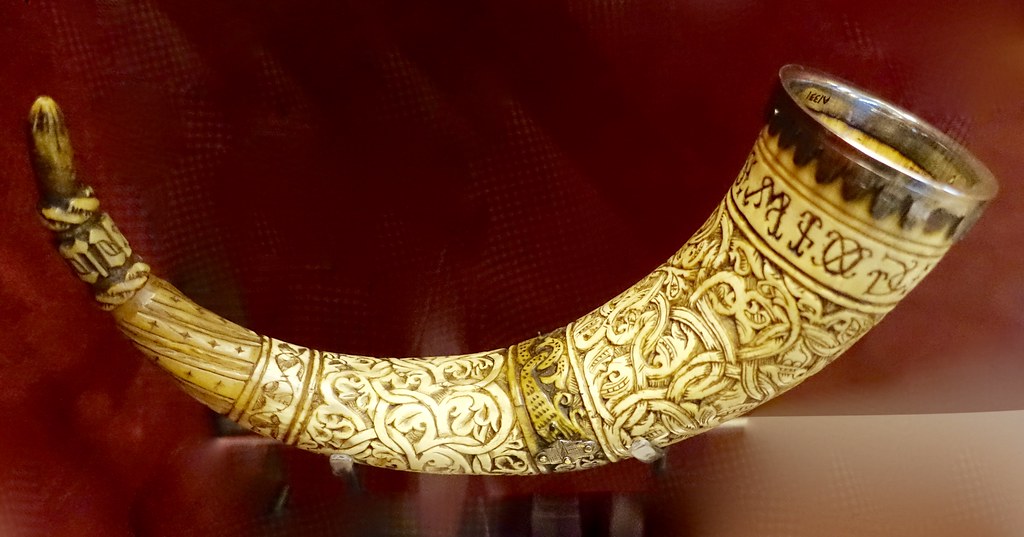
Depending on the size of the horn passed round the circle for each of the toasts, boasts and oaths, and the kind of drink you quaff each time, you may find your tongue loosened and the three acts easier to pull off!
Here the rhymer in me wants to add a fourth word, wrecking the lovely triad of toast, boast and oath, but creating in its place a new and balanced pair of rhymes: toast, boast, oath and growth. After all, a rite moves us to a new place and space, never the same as where we were before. As with yesterday and tomorrow, the difference from today may or may not seem like much, but just as the daylight lengthens and shortens each year, depending on which side of the solstice I’m on, so do the energies at play in my life. I can do things today not possible yesterday or tomorrow. And that’s worth a toast, a boast, an oath and the growth that comes with them.
Finally, if we’re going to be Anglo-Saxon about things, the Old English Maxims 1, lines 138-140, offer relevant insight here:
Keeping to the spirit I feel lies behind these proverbial expressions, and unpacking their compactness and concision*, I take this to mean, roughly, “Let your speech be words of good counsel to others, write runes of wisdom, sing as epically as you can, deserve praise, test and expand your judgment, while holding nothing back each day”.
/|\ /|\ /|\
*With even a little Old English, you can explore meanings and fashion your own translation with the help of the online Bosworth-Tollers Anglo-Saxon Dictionary here.
rǣd: accus. of se rǣd; advice, counsel, prudence, deliberation sceal, 3rd sg. of sculan: shall, ought, be obliged, must mon, Wessex dialect nominative of se man: one, person, human, mortal, man secgan: to say, speak, express rūne, accus. plural of sēo rūn: whisper (speech not intended to be overheard, confidence, counsel, consultation), mystery, secret, rune wrītan: to write, cut, draw, form letters (on wood, stone, parchment, etc.) lēoþ: accus. of þæt lēoþ; song, poem, ode, lay, verses gesingan: to sing lofes, gen. of þæt lof: praise, glory, hymn gearnian: to earn, merit dōm: accus. of se dōm; doom, judgment, judicial sentence, decree, ordinance, law areccan: to put forth, relate, recount, speak out, express, explain, interpret, translate dæges, gen. of se dæg: day, daytime onettan: to hasten, anticipate, be active or diligent
The June full moon, often aptly named the Strawberry Moon, actually reaches its fullest tomorrow (Friday) morning, but most North Americans will see it at its peak tonight.
wild strawberries, north yard — perfect reason not to mow
Tonight I’ll offer my full moon ritual for the health of the hemlocks that line the north border of our property, as well as other beings, “quando la luna è crescente” — while the moon’s still waxing. As the full moon nearest the summer solstice less than two weeks away, Strawberry Moon plays counterpoint to the shortest night and longest day of the year, and governs the first of the true summer months here in New England. I’ll be posting a follow-up in the next weeks.
“queen” hemlock, 50 ft. tall, visible from where I write
As Dana has so passionately documented on her Druid Garden site, including a powerful ogham/galdr healing ritual, the eastern hemlock battles against the hemlock woolly adelgid, widespread enough that it’s gained its own acronym — HWA. The adelgid, an aphid-like insect, is just one of several pests that afflict the trees, but one not native to North America and a factor in near-complete mortality in infested areas. As a commenter on Dana’s blog notes, natural biological agents offer the best and least toxic means of control and containment. The United States Dept of Agriculture site summarizes the situation well.
And if you ask why, Our true self and the land are one, says R. J. Stewart. As always, test and try it out for yourself. That ways lies deep conviction, replacing casual opinion with earth loved, spirit manifest, life full.
Now that I’ve reached the end of this series on some possible shared spaces between Druids and Christians, I’d like to pause and take stock.
How many of us have experienced anger, frustration or a kind of spiritual PTSD from our contacts with Christianity? How many have found one or more of these posts irritating or painful? Yet how many still feel drawn to something alive in Christianity or Christian practice?
From the wild stats this particular series has generated, I have to conclude it’s provoked a whole complex, difficult medley of thoughts and feelings. Consider, as I have, new readers from outside the circle of the most common visitors — North Americans and a few western Europeans, with the occasional Australian or New Zealander. This series, however, has drawn readers from Iraq, China, Turkey, India, Japan, Hungary, Singapore, Greece, Pakistan — and a readership from all of these nations showed up not just for single post but for most of this series.
And what should appear here as the 9th theme? Magic? Prayer? Initiation? Heresy — the right to choose — along with heterodox beliefs and practices? The Otherworld? Divine kingship? All promise rich materials as fitting ways to close. I’ll probably tackle at least a few of these in the coming weeks. If only because a series like this, like a devotional practice undertaken with love over time, almost always generates a momentum no finite thing can contain.
Or what about a shift of terminology? Would that help at all with any of these themes? If instead of “Baptisms of the Elements”, we called them “Elemental Sacraments”, would that easier name make a difference? Would it make it any easier to move beyond instinctive antipathies and past traumas?
Christian Druids and Druid Christians have already found ways to integrate their practice and ritual, celebrating spirit as it actually manifests, regardless of creeds. Some of the best links happen in community and fellowship. We experience something together beyond words, even as we struggle to embody it in language. But it’s that initial encounter, not the subsequent formulation in speech or writing, that constitutes the source of spiritual energy.
Praised be You, my Lord, through Brothers Wind and Air,
And fair and stormy, all weather’s moods,
by which You cherish all that You have made.
Praised be You my Lord through Sister Water,
So useful, humble, precious and pure.
Praised be You my Lord through Brother Fire,
through whom You light the night
and he is beautiful and playful and robust and strong.
Praised be You my Lord through our Sister,
Mother Earth
who sustains and governs us …
Here is insight and wisdom and reverence indeed, one that may find resonance for both Druids and Christians.
An “incarnational” Druidry, one that shares with Christians a deep gratitude for natural beauty and for the mystery of birds and beasts, for the holy gifts of choice and speech, thought and reason, for birth and dying and rebirth, and for the voice of the sacred in dream, vision, prayer and ritual, and for the transformational power that a spirit-filled person can manifest, whatever the tradition, will earn respect and a hearing in any quarter a Druid would want to find one.
Likewise, a humble Christianity, one which seeks first to model love of self and other, of spiritual freedom, of service and stewardship of the created world, of care for the body, and delight in our kinship with the natural world, one which reads with reverence the Book of Nature, will move and persuade and welcome Druids and other Pagans far more than any scriptural proofs or the tongue of condemnation, doctrine or preaching.
“Let our deeds and our shining faces be our testimony”.
anamnesis (Greek ἀνάμνησις; English an-am-NEE-sis) 1) the Platonic principle that people retain knowledge from past lives and that our present learning involves a recollection of that past knowledge. 2) the Christian principle of recalling the events of Christ’s sacrificial death in the words and actions of the liturgy, especially during Communion or the Eucharist*.
/|\ /|\ /|\
One way into the Greek word that may serve as a link between Druid and Christian practice is the English borrowed word amnesia, literally “forgetting”. An-amnesis is its opposite: “unforgetting, recall, recollection, remembrance, memorial action”. And I’m going on from there for a moment and, at least for the purposes of this post, forming the adjective anamnetic “having to do with ritual remembrance”.
Druidry and Christianity both acknowledge the importance of anamnesis. Anamnetic deeds depend for their effect on both ritual and memory — actions intended to evoke a sacred event or time. Perform the ritual and bring to mind the holy. Sacrifice is “making sacred”, and we only “know” the sacred because in some way we re-cognize it: we know it again. Anamnetic acts acknowledge that even the best memory fades, so they recharge it with symbolic words and deeds.
At the “hour of recall” in OBOD ritual, we’re reminded that the rite is both timeless and bound by time. Its effect comes in part through memory: “let memory hold what the eye and ear have gained”. We’re also reminded that the apparent world and the inner world may overlap, but they’re not the same. Ritual sets aside a space for the inner and the sacred, acknowledges it, increases the overlap, and then reverses all those actions in the farewell, in order to safely restore the participants to the profane, mundane, “real” world of everyday life. (Because trying to function here while still in ritual consciousness is dangerous. We’re “spacey” and attentive to other things, not traffic lights, the blender’s sharp blades, those three steps down, our co-worker’s question, the toddler who darts into the intersection just ahead.)
I take part in a ritual, and its effects follow in time and memory. Likewise in Christianity, depending on how the word “this” is understood, whether once during the annual Passover (the setting where he spoke the words), or at every meal, or something in between, Christ commands his followers to “do this … in remembrance of me” — in a word, to practice anamnesis. “Proclaim the Lord’s death till he come again”.
A sacred meal shared with others is among the best kinds of fellowship. It’s an anamnetic act common to many traditions and cultures as a sign of religious faith, because it also expresses friendly hospitality and generosity. These acts of giving and giving back are inherently sacred. We can choose to recognize this by ritualizing them, or by foregoing the opportunity they offer.
How much of human consciousness, after all, is memory? How do we sustain the transformative power of any event we choose to value, except through recalling it, naming it, celebrating it, re-enacting it in order to vivify it and make it real again in some way in the present? “What is remembered, lives”.
Thus we celebrate anniversaries, birthdays, historical events, and so on. We tell stories of the living and of the ancestors. We even make up fictions the rest of the time, in order to remind ourselves what life is like, in case we lose sight of its shape and nature. And when we enter the mythic realm, the question to ask is not “Is it true? Did it really happen?” but “What truth does it teach? What holy thing does it help us remember?” When we com-memorate something, we remember it together.
And what we value, we dramatize. Greek theater began as religious worship: “Until the Hellenistic period [roughly 320 to 30 BCE], all tragedies were unique pieces written in honour of Dionysus and played only once, so that today we primarily have the pieces that were still remembered well enough to have been repeated when the repetition of old tragedies became fashionable …” notes the Wikipedia entry on the theater of ancient Greece. Until later times, the theater was a sacred precinct. Weapons were banned, and actors were masked because their human identities, at least during the performance, was subsumed under the characters, often gods or heroes, whom they portrayed.
What might all this mean for possible Druid and Christian convergences? Ritual is grounded in theater, in a dramatic portrayal of the memorable. “Let us remember the holy” is one piece of common ground where both can stand. Accepting that no one “owns” the holy is another. Why this is should be obvious, though it’s sometimes ignored in claims of “my god(s) and your god(s)”. But sacred energy continually bursts free of limiting containers, and seeks new forms that refresh and rekindle and feed the spirit. if anything, it’s very much the other way around: the holy owns us. Sometimes it simply breaks through and claims us. You and I have no say in the matter. Other times, we may.
Old or new, liturgies can move us, but they are no substitute for direct contact with the sacred. We need no idolatry of rite placed above spiritual reality. The word’s not the thing it names. Much as I love words, I love the silences of the Great Mystery more. “Be still, and know …” counsels Psalm 46. Because there is that ability within us all that’s able to do this — to be still and come in contact with the holy. It’s our human birthright, and has nothing to do with belief.
Paradoxically (and what would many things amount to, without a touch of paradox?), old ways can come closer to Spirit than newer ones. “Stand at the crossroads and look; ask for the ancient paths, ask where the good way is, and walk in it, and you will find rest for your souls”.** The Hebrew prophet Jeremiah says these words, looking back at ways already old in his time. Pagan and Christian can find more to share than either may often imagine — in silence, in ritual, in remembrance.
/|\ /|\ /|\
*Like anamnesis, eucharist derives from Greek — in this case, from eucharistia “thanksgiving, gratitude”. Modern Greek still uses a related word (changed a little in pronunciation) to say “thank you”: ευχαριστώ [ehf-khah-ree-STOH]
**Jeremiah 6:16. The prophet gives these words to God to say.
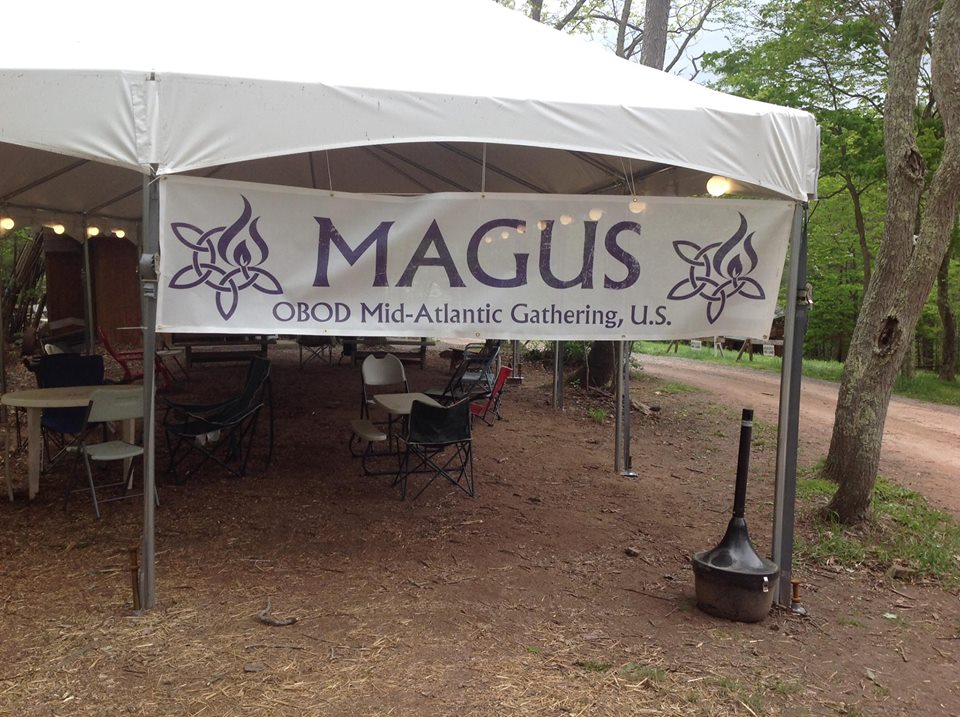
The first of what richly promises to be an annual event, the Mid-Atlantic Gathering U.S. (MAGUS) took place over this last weekend, Thursday to Sunday, at Four Quarters Sanctuary in Artemas, Pennsylvania.
photo courtesy Wanda Flaherty
The initial inward glimpse of the Gathering came to one of the organizers almost a decade ago. There’s yet another indication, if I need the reminder, of the possible time-gap between first seed and outward manifestation.
And our hosting venue, Four Quarters, an interfaith sanctuary launched in 1994, was the perfect place to hold a Beltane Gathering. As the Four Quarters home page observes, it’s
a membership-driven non-profit, a vibrant community of real people living real lives. And Four Quarters actually owns the Land, buildings and equipment that make our work possible, forever set aside from the vagaries of private ownership.
The lovely and wild 150 acres of the sanctuary lie in the Allegheny foothills in southern PA, just miles from the Maryland border. Home to a stone circle, labyrinth, retreat center with bunkhouse and dining pavilion, a brewery, a drum and dance circle, sweat lodge, a handful of permanent residents, and the clean-flowing Siding Creek defining part of its periphery, Four Quarters strives to
honor the many world traditions that reflect an Earth Based Spirituality, and we work to support those traditions and welcome their people. We do not teach “One Way” of belief. We do not have “The Answer”. We do have good questions.
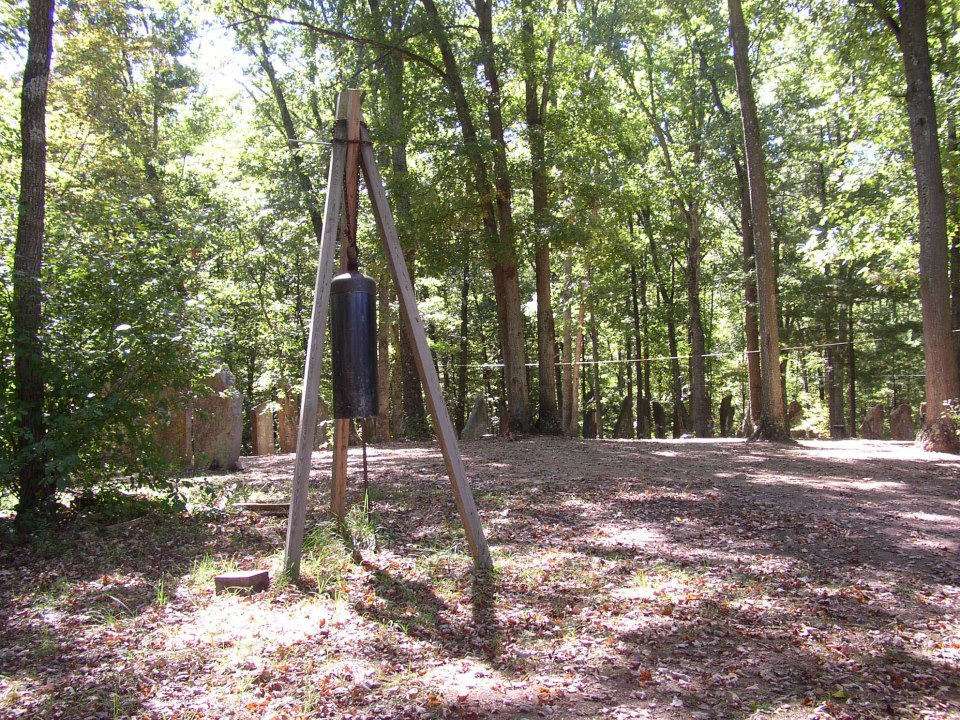
Here’s the Stone Circle seen from the north, a work in progress (with annual megalithic-style stone raisings open to anyone willing to join the rope-pulling and log-rolling stone lifting team). Note the nearly three-foot-long camp bell suspended from the tripod in the foreground — a deep voice audible throughout the property.
photo courtesy Wanda Flaherty
A wide-angle shot can’t capture the majesty of the stones or the power of the circle. Here’s a closer view of some of the lovely rough surfaces, mottled with rust in places, asking for touch and communion.
photo courtesy Wanda Flaherty
The first time I walked the circle Thursday evening, I sensed a quiet hum of presence. The next time I came more at ease, eager to touch and listen to the land and the inner voices. By the time I reached the eighth stone, sudden tears filled my eyes. The circle holds indisputable power.
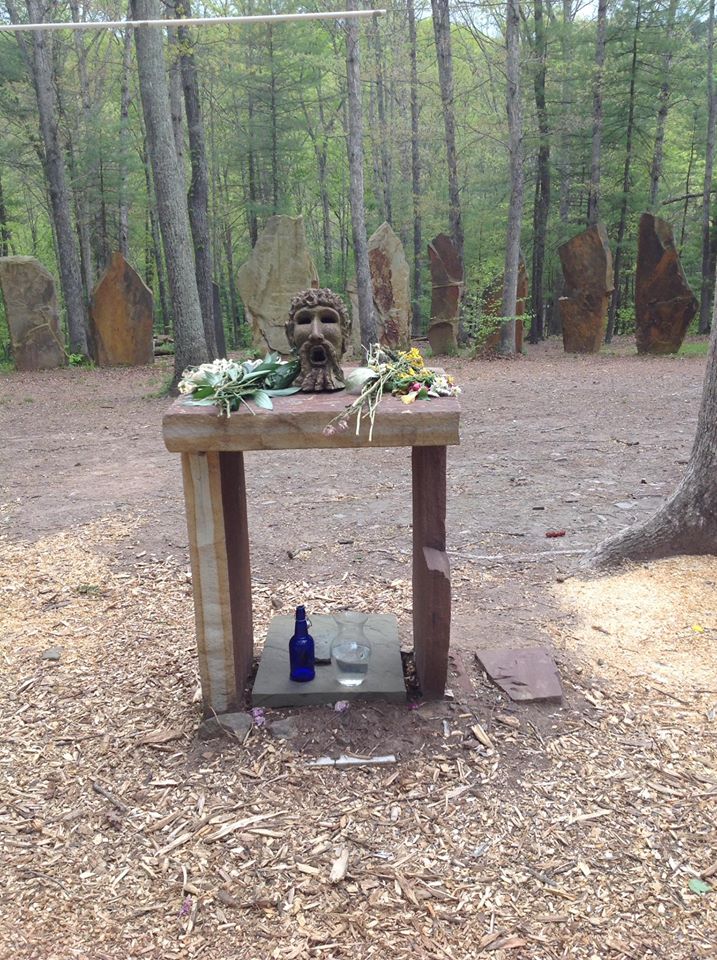
Here’s one of the altars near the center of the stone circle. The ancestors speak strongly here, if I give even half an ear.
photo courtesy Wanda Flaherty
How to convey the blend of the speaking land, the personal and the tribal at such Gatherings?! You come as someone new to Paganism, or to OBOD more specifically. Or you come knowing you’ll reunite with your people once more, across the miles. If we saw each other every day, we might begin to forget the human and spiritual wealth that surrounds us. In ritual, in conversations in the dining pavilion (below) or over coffee during breaks, we’re reminded that we’re never alone, no matter how solitary we may live the rest of the year. Inner connection exists over any distance.
dining pavilion — photo courtesy Wandy Flaherty
Typically when I reflect on a Gathering a few days after, one or two things stand out sharply. But when I started naming them over breakfast this morning, I ended with a list of a score of items — nearly the entire weekend as I experienced it, a blend not to be parcelled out in soundbites or highlights.
From the place, with its cool air crackling with oxygen from the vigorous trees, to the faces and energy of the Tribe and its rituals, formal and informal, to the songs of spiritual presence that all places offer, everything stands out in memory. Impossible to narrow down. This post is a small attempt to hint at that Everything — to urge you, if you want a taste of a particular kind of marvelous, to attend a Gathering if you can.
The way of the Solitary can indeed be a blessed one, but the Tribe also offers a great deal to reinvigorate even the most hermetic of Solitaries. A Gathering can paradoxically reaffirm the Solitary, because you meet other Solitaries. You witness the integrity of the individual path, as well as the gift of the Tribal way. Gatherings have changed me into an avid Tribe-seeker, at least a few times each year, so that when I retreat to my own smaller circle, the closing words of OBOD ritual echo true: “May our memories hold what the eye and ear have gained.”
/|\ /|\ /|\
“Kindling the Flame” was our Gathering theme. We apparently also needed the blessing of Water, in the form of steady rain from late Thursday afternoon through the night, and intermittently all Friday, to help remind us that all the elements gather, whenever any one of them is invoked. “Thus is balance preserved”.
Thursday included an opening orientation by our special guest OBOD Druid Renu Aldritch, a workshop I delivered on “Kindling Our Sacred Fires”, the opening ritual, and preparation for Bardic initiations the next morning.
After breakfast Friday, we initiated 12 Bards. Like many others, I’ve come to see how priceless it is to support initiations and attend whenever I can, regardless of whether I have an assigned “role”. The rite washes over us all, renews the experience each of us had during our own initiation, helps us rededicate, and allows us to greet the newly initiated within ritual space.
Always there are small hiccups and endearing glitches during a ritual. I think without them we’d have to make sure we added them. And we come to expect them: they humanize a dramatic moment, when someone with a major or minor role misplaces a prop or drops a ritual spoken line, topples the incense or bowl of water, mispronounces a magical name, and so on. We laugh, disarmed, and then the next part of the ritual can reach deeper, because we’ve opened up that much more. Each initiation is unique: tears, laughter, the presence of Spirit, the call of bird or beast to punctuate a word or silence.
Friday gave us Renu’s workshop, “Kindling the Spiritual Warrior”, a theme that bears ongoing attention. Dana’s workshop “Land Healing on the Inner and Outer Planes”, her ritual later that afternoon, “Ogam Tree Galdr in the Northern Tradition”, her generous personal readings using her own tree divination system, and her conversation fired many with renewed love and commitment to this path. That evening also brought initiation to three Ovates under moonlight and the background throb of drums from a drum workshop. We couldn’t have asked for a better ritual setting.
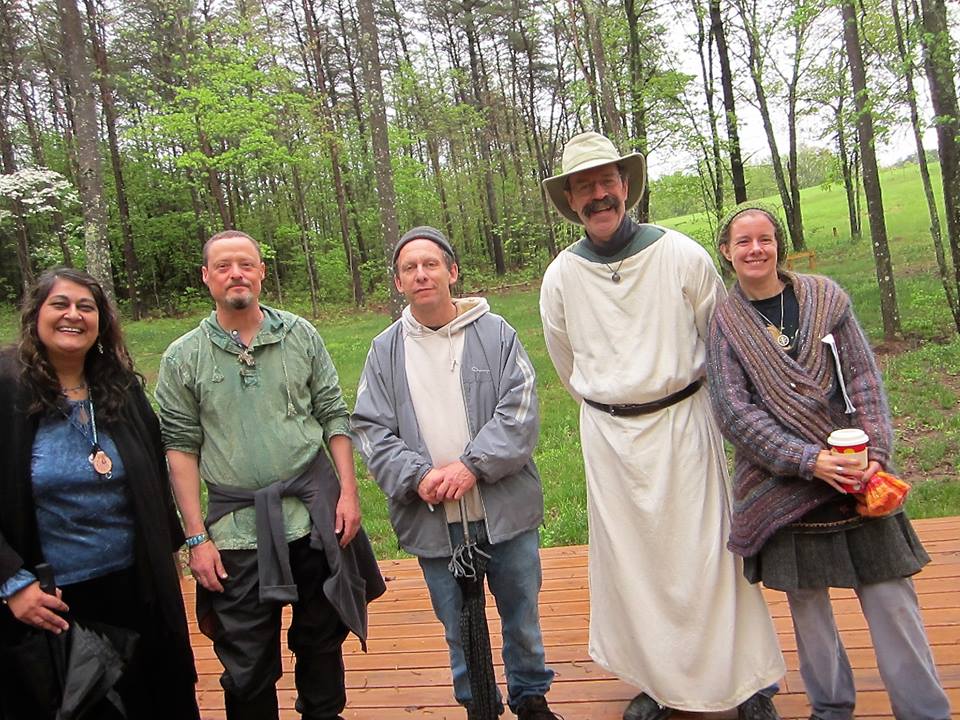
Downhill from the Labyrinth, prepping for the evening Ovate initiation in the open air: Renu, Dave, Ahote, me and Cat. (We opted later for a covered stage, in case the rain continued.)
photo courtesy Gail Nyoka
Saturday gave us Wanda’s workshop, “Awakening Your Beltane Sensuality” with its creative chance to heighten one sense by muting the others. Now that the rain had ceased, we could hold our main Beltane rite in the stone circle.
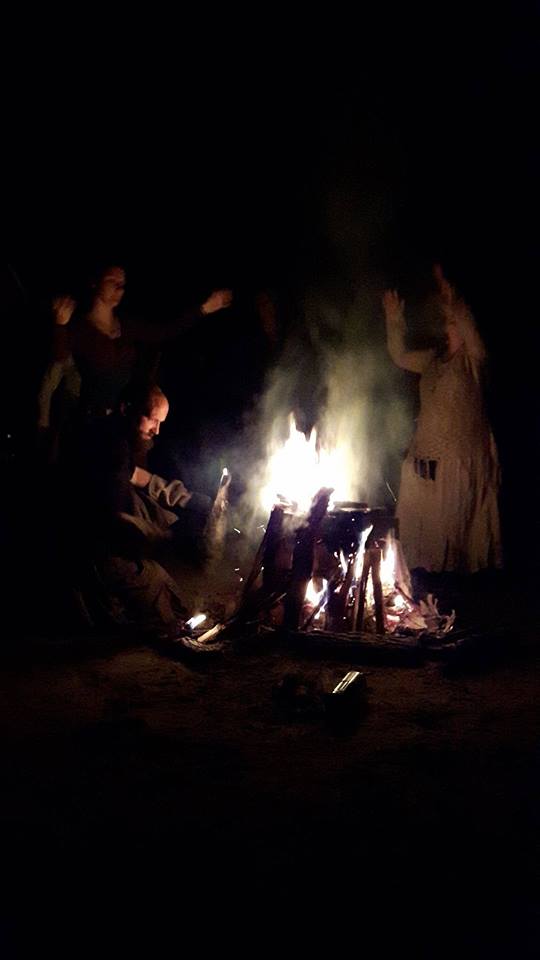
Here’s an evocative pic from Saturday night, the Fire Circle alight, a few dancers visible, along with Brom, our Fire Master, tending the flames.
photo courtesy Wendy Rose Scheers
By Saturday night I’d mostly finished my other ritual responsibilities, including providing a glitch for the main Beltane ritual where I had a speaking part — I dropped a line. “When that ritual pause goes on a little too long and you look around, you’re probably what’s missing”, as someone quipped over the weekend.
I was looking forward to enjoying the Fire Circle without performing for the eisteddfod, the Bardic arts portion of most OBOD festivals that welcomes the evening fires and the awen-inspiration of a Gathering and offers it back again in song and poetry and story.
But as Bards know from experience, the awen sometimes has other ideas. Fire gave me an opening line a few hours earlier during dinner. And it kept gathering more lines to it, right up to the evening Fire Circle. Verses kept changing and I didn’t have pen and paper handy, so I kept playing with lines and rhymes and their order. “Fire says improvise” came the first line. I’d invoked fire, after all, during my workshop, in several different ways. What did I expect?! Here’s the poem:
Fire says improvise —
no surprise,
when such orange wonder
seeks out skin and eyes.
Fire can burn all to black
but before,
that hot roar lifts me
to soar beyond
anything I thought to think I lack.
Most times I’m no fool —
how does this jewel
get to be so hot and cool?
Old rule, it says.
Burn madly, gladly,
or — if you must — sadly:
one way only among those other two.
For I will heat you from your crown
to your open-toed shoe.
The fire, friend,
the fire is in you.
Just get up and say it, came the nudge. Doesn’t have to be polished. I delivered the lines, gazing at the flames the whole time, then stumbled back fire-blind to my seat on one of the Fire Circle benches. The version here is close to what I remember saying, probably edited a little. Fire didn’t want an editor. Just flame, large or small. The other Bards obliged, and this eisteddfod was among the most varied and interesting I’ve known.
One of the oldest pieces of spiritual counsel in the Indo-European tradition is this: “Pray with a good fire”.
/|\ /|\ /|\
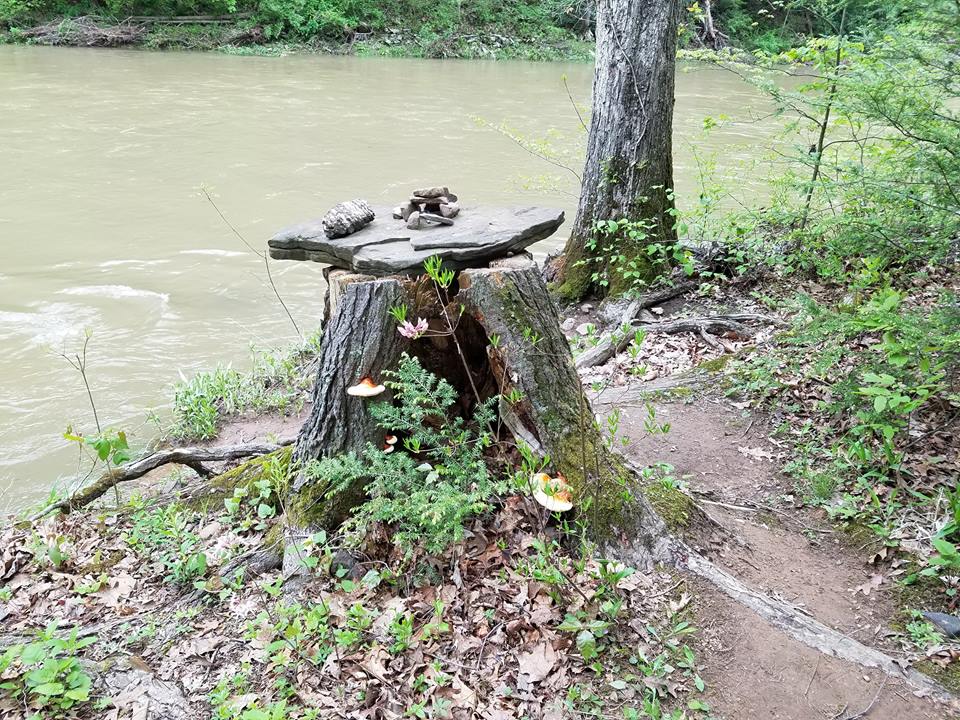
Below is an informal altar by Siding Creek, which curls around Four Quarters, another voice audible through much of the Sanctuary as a background whisper.
photo courtesy Renu Aldritch
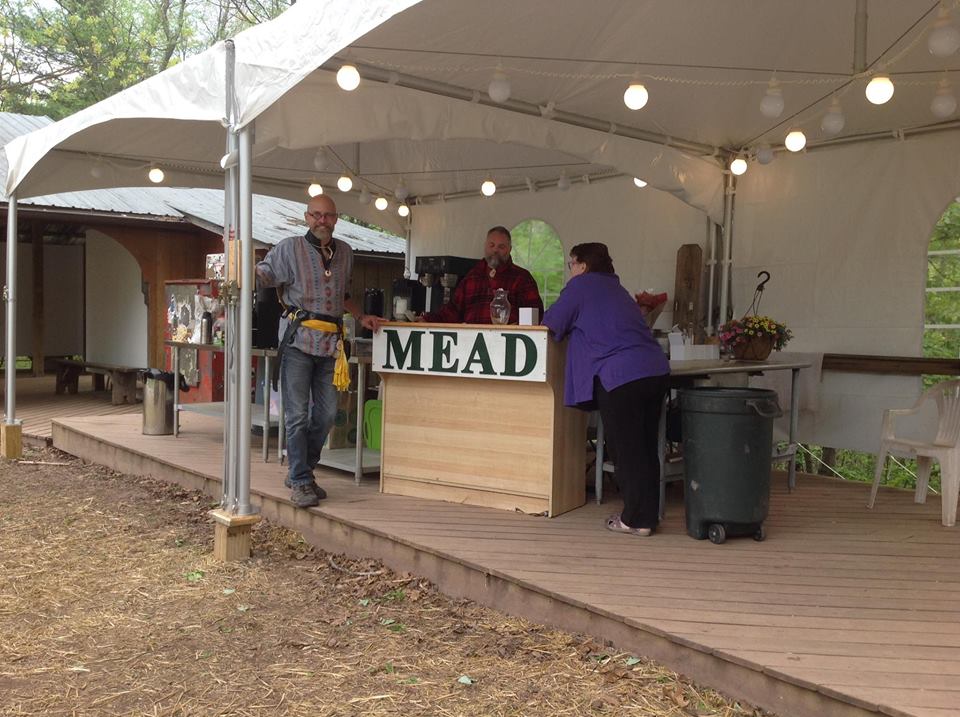
Four Quarters brews its own mead, a taste of the Land to take inside the body. Warmed by place, fire and fellowship, we return to our lives richer by each person who attended. Long live MAGUS!
photo courtesy Wanda Flaherty
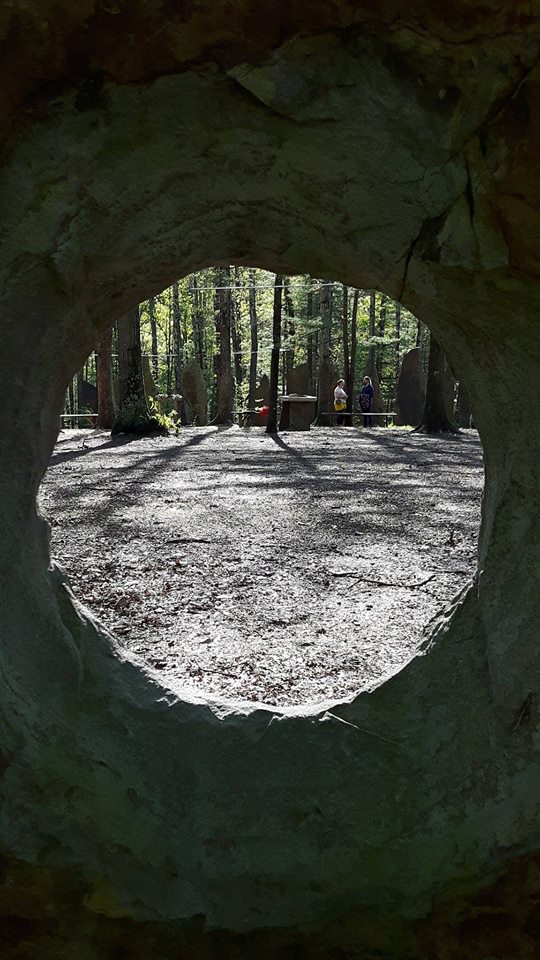
A final view of the Circle through the eye of the Mother Stone:
How do I keep the inward doors open? (How do I even begin to locate them and find their handles?) How do I pick up on subtle nudges? How do I hear the quiet inward speech of things — the “still small voice” as older versions of Christian scripture call it? We all get the big events — no need to go looking for them. They burst on the scene, kicking down the door a few times in a life, unmistakably loud and messy, whether good or bad, and usually a mix. But they break through, and everything shifts.
“Go out and stand on the mountain in the presence of the Lord, for the Lord is about to pass by.” Then a great and powerful wind tore the mountains apart and shattered the rocks before the Lord, but the Lord was not in the wind. After the wind there was an earthquake, but the Lord was not in the earthquake. After the earthquake came a fire, but the Lord was not in the fire. And after the fire came a gentle whisper. When Elijah heard it, he pulled his cloak over his face and went out and stood at the mouth of the cave. Then a voice said to him, “What are you doing here, Elijah?” (1 Kings 19:11-13).
With wind and earthquake and fire, how do we ever catch the whisper? And then, even if we manage to hear the “still small voice”, we may find that instead of resolution or insight or growth, we’re left with questions, like Elijah. Our own lives interrogate us. “What am I doing here? How did things end up like this?”
Most traditions urge a daily practice. As much of Christianity has become focused on belief rather than practice, it has lost much of what monastic practice has preserved. A site on Trappist monasticism notes:
The practice of lectio divina, (divine reading), is foundational to monastic life. So important is divine reading to the spiritual well-being of a monk that, traditionally, we devoted some of the best hours of the day to this practice. Lectio Divina is a discipline whose fruits are experienced over time. One needs to understand the practice and then commit to it with some regularity.
Practice matters. Not because it makes our lives “safe” or “easy”: no life is that I know of. If I think about it, most lives resemble the character throw in role-playing games (RPGs) like Dungeons and Dragons. You toss the game dice for talents, strengths and weaknesses. You may for instance roll a high intelligence, but your physical body is weak. You can’t rely on it. If you’re allowed to roll again, your strength, your vitality, may be high this time, but you’re none too bright. Or on the third throw, both intelligence and strength come up high, but your temper makes your life a train-wreck of impulse and blame.
A daily practice helps build spiritual stamina. It’s something like what our grandparents and great-grandparents used to call “inner resources”, though they may rarely have shown us how to develop ’em. (Merely “following the rules” doesn’t usually help.) But they knew enough to recognize people who had them. (In RPGs like Dungeons and Dragons, you can improve even weak qualities of your character over time, through experience. Funny thing!)
One of my teachers says that even if we could know the future, we’d have a hard time accepting just the good things to come in our lives. (That they might not always resemble “good things” from our present standpoint rarely occurs to us.) We build stamina over time, so that the big lifting is more manageable, and the daily lifting can become a small pleasure in itself.
A daily practice helps us hear that whisper, catch the still small voice. And that in turn can help us ride the worst of the big bad events, and make the most of the big good events (and little ones, too). And that can lead to all kinds of wonderful things. But the practice itself doesn’t deliver them. It catalyzes. It doesn’t guarantee.
One Druid I know makes it a point, whatever the weather, to visit a small outdoor shrine in his backyard each morning, before he heads off to work. He says a short prayer, or holds a meditation, makes an offering, etc. His practice builds over time, with things added or discarded. If, under pressure of a tight schedule or occasional family craziness, he misses his practice one morning, he feels the lack. But that in itself has deep value — it’s one way to recognize the value of a practice. It’s a good habit. The gods know we all cherish enough bad ones.
So working with the habit-forming tendencies we all have, we put them to work here and there. We start small. A daily practice can be a form of magic, of empowering ourselves to live more fully. Because really, what else is there? If we’re so sunk in difficulty that every day is a struggle just to survive, we’ve got nothing extra to share with anyone or anything. Our work is simply to endure. And sometimes that has to be enough. But beyond survival, one goal can be to spend our surplus as we choose, consciously, with intention. The goal is to find ways to get to a surplus in the first place, so we have something to spend, something to give back, to build on, to build up.
As Philip Carr-Gomm has written, “In a world sorely lacking in meaningful ritual, it can feel like a balm to the soul to engage in actions that are not obviously utilitarian, that are designed to help us enter into a deeper sense of engagement with life –- to give expression to our belief in a world of Spirit that infuses this physical world with energies that bring healing and inspiration.” If such ideas seem foreign or strange, that’s a measure of how far we’ve wandered from ways of living proven over millennia to help us make the most of our few decades here.
The Christian “Lord’s Prayer” is brief, and usefully so. Or if you’re a Catholic, the Rosary is comparably short. Most traditions offer short usable rites like prayers or visualizations. Along with similar prayers, OBOD Druids and others may practice a Light Body exercise.
Repetitions done mindfully can be remarkable in their effects over time, hard to describe until you try them out. Like any exercise, they build strength and stamina. We can propose to ourselves any number of fine practices, elaborate rituals, intense mystical exercises. But the small one we actually follow through on every day for a month will be the one that begins to convince us of its value, and of the value of a practice.
The key is to find what works, and what I can stick with. I keep a record. Did this for a week. Liked it. Kept it up for a year. Discarded it. Felt the lack. Picked it up again and added it back in to the mix a year later. Forgotten I’d made that experiment till I re-read my journal from that time.
Finding what works for me, ultimately, is a practice all its own, one of the most “practical practices” I can try.
/|\ /|\ /|\
I’ll close with a Youtube clip of “Pirililou”, which as its description states, is
an old Gaelic Chant sung at the Western ocean’s edge to the soul of the departed, in the first days after death, to assist the soul travelling from this world to the next ones. It is said to imitate the call of a shore bird … a bird dedicated to Bridhe and St Brigit, who assist the birth of souls in this world as well as the next.
As a meditation before sleep (that practice journey we all make nightly), this kind of meditation can lead to deep insight. Have we, after all, been fully born into this world, never mind any other one? Playing (singing, composing) a short devotional song that moves you deeply, and listening (performing) with intention, can make for the beginning of a profound practice.
There was the briefest mention of fire in the previous post, but much more about the other three elements. Why?
Deborah Lipp notes in her The Way of Four Spellbook (Llewellyn, 2006):
Fire has always been set apart from the other elements, because Fire alone has no natural home on the earth; Air has the sky, Water the sea, and Earth the land, but only Fire stands apart from geography. In nature, Fire is the outsider; it is out of control, and it conforms to no known rules (pg. 10).
Now Lipp’s observation both captures the nature of fire and also feeds our stereotypes about impulse, passion, strong feeling. How often we may long — or fear — to be out of control, fearless, spontaneous! Who hasn’t felt like an outsider at some point? Why would the Australian-inspired Outback Steakhouse restaurant chain opt for its advertising slogan “No rules. Just right”? Because there is indeed a rightness to fire — it can only flame up where there’s something to burn, after all. And most of us have been storing combustible material for a long time. How else to explain our explosions, outbursts, flares of temper? Even our language about these things draws on fire for metaphor.
Following the theme from the last post, we can speak of a fire baptism. You’re wholly in it when that happens. The full experience, nothing held back.
John the Baptist, Jesus’s precursor, explains to those asking, “I indeed baptize you in water … but he that cometh after me is mightier than I … he shall baptize you in the Holy Spirit and in fire”. We sense the power in fire, of all the elements closest in so many ways to Spirit. It can purify, transform, forge and anneal. Its extreme heat can also scorch, char, consume and destroy. Each element transforms its own way. “We didn’t start the fire”, sings Billy Joel. “It was always burning since the world’s been turning”. But he goes on: “We didn’t start the fire. No, we didn’t light it, but we tried to fight it”. And sometimes we even try to “fight fire with fire”. Yet we also long for fire to kindle cold hearts, to heat a flagging will, to spark the spirit deepest in us. We yearn to be fire.
“O! for a muse of fire”, cries Shakespeare’s Chorus in the first line of Henry V, “that would ascend the brightest heaven of invention”. We long to blaze, because we feel in fire something native and free. We are both it and other, too, as with all the elements. “Time is the substance from which I am made. Time is a river which carries me along, but I am the river; it is a tiger that devours me, but I am the tiger; it is a fire that consumes me, but I am the fire”, says Jose Luis Borges. The elements are natural sacraments, folds and garments for Spirit all around us. For fire, we light candles in so many traditions, for so many reasons, the flame cheering to the eye and heart.
I both am and am not fire. Self and other: the quest of our days, the distinction we cherish and also long to cast away. Pagan, Christian, Buddhist, Muslim, Jew, atheist, shaman, through all these experiences and intuitions we still ask ourselves, each other and the world: “What makes a good burn?”
/|\ /|\ /|\
Maybe the purest ritual Druids and Christians might share is one which seeks not to fill our ears with answers, but that gives us space and silence to listen to and ponder the questions. In some ways, the long, slow burn of Spirit in us is fire in its most potent form of all.
/|\ /|\ /|\
Beltane approaches, that festival of fire. The Edinburgh-based Beltane Fire Society celebrates 30 years this year of a dramatic festival of thousands, from 8:00 pm to 1:30 am. Here’s the “Drums of Beltane” subpage of the Society’s website. As the page notes,
Beltane may be known as a fire festival, but it may as well be considered to be a drum festival too. Drums are the beating heart of Beltane that create the rhythm of the festival, drive the procession forward, and soundtrack the changing seasons. They have been an integral part of Beltane since our tradition was first re-imagined on Calton Hill in 1988.
Looking for a fix of Beltane energy to get you launched? Here’s a video of the Drum Club which will be among the groups performing this year for the event. Just the first five minutes will give you a fine taste of Beltane fire in sound form. We can spark from anything, but sound and rhythm are powerful keys.
In this post you’ll find me wearing my hat of the linking, connecting and informing Druid, so salt to taste.
Iona Abbey
“My Druid is Christ,” wrote Saint Columba (521-597), among other things the founder of the abbey on Iona. Ask yourself what to make of such a remark from this early Irish missionary, working in what is now Scotland. You can even be Bardic about it, and shape your meditation into a triad of insights. Out of one of my meditations emerged a triad that begins: “Three things we serve, who love both flaming Star and branching Tree …”
/|\ /|\ /|\
And out of such echoes from a distant past comes the Romantic conception that Druidry and Christianity initially co-existed in amity. Evidence exists both to support and refute such a view. But whatever the reality of that period, which we may never know, we can certainly identify its spiritual gold and and continue to create with it in the present.
Although Christianity ostensibly superseded Druidry, in reality it contributed to its survival, and ultimately to its revival after more than a millennium of obscurity. It did this in at least four ways: it continued to make use of certain old sacred sites, such as holy wells; it adopted the festivals and the associated folklore of the pagan calendar; it recorded the tales of the Bards, which encoded the oral teachings of the Druids; and it allowed some of the old gods to live in the memory of the people by co-opting them into the Church as saints. That Christianity provided the vehicle for Druidry’s survival is ironic, since the Church quite clearly did not intend this to be the case (pg. 31).
As I poke around “ironic survival” further in this third (Part 1 | Part 2) reflection on Jesus and Druidry, I note one quite obvious thing many others have of course commented on. The Galilean master is at his most Druidic when he speaks with images of the natural cycle of things:
Truly, I tell you, unless a kernel of wheat falls to the ground and dies, it remains only a seed; but if it dies, it bears much fruit (John 12:24).
An extensive Druid-Christian liturgy could be written with just the nature images that pervade Christian and Jewish scripture. Already many such resources exist. The OBOD website provides “Resources for Exploring Christian Druidry“, which include music, ritual calendars, books, and links to organizations like Forest Church.
Life and death areironic, paradoxical. As integral gestures and movements of the cosmos, they’re also a “human thing”: we long for and fear the change that comes in death as in all such transformations. Initiation prefigures it, and life delivers it without fail. We all live and change, die and change. Druidry offers itself as a prime example of what it teaches, living, dying, changing and living again.
And Druidry, or at least Orders like OBOD, aren’t above borrowing and adapting rich language, Christian or not, attentive to the powers of Three. Nuinn (the Druid name of Ross Nichols, OBOD’s founder) writes:
Druidry is the Western form of an ancient universal philosophy, culture or religion, dating from the days of early man when the three were one (pg. 19).
This careful attention to triads and unities means that their presence in other traditions makes them attractive to Druid ceremony and ritual. Some OBOD rites include versions of the following Trinitarian as well as Druidic language:
May the blessing of the Uncreated One, of the Created Word and of the Spirit that is the Inspirer be always with us. May the world be filled with harmony and Light.
Rev. Alistair Bate, author of the OBOD website article “Reflections on Druidic Christology“, comments from a sensitivity to the contact points of the two traditions:
A more orthodox rendering of Chief Nuinn’s triadic formula might be “May the blessing of the Uncreated One, of the Creative Word and of the Spirit that is the Inspirer be always with us”. This, I believe, would not only be more truly in tune with the bardic experience, but would also resonate with the Om/Creation idea found in the Hindu tradition. As we envision Awen, the primordial sound, echoing out of the void, we connect with our own creative inspiration as part of that first creative Word, which is in Christian terms, at once Christ and his Spirit.
And with greater enthusiasm, perhaps, than comparative or historical theological accuracy, Bate concludes his article, summoning to his aid the words of probably the single most influential Christian thinker and writer:
In the 4th century St Augustine declared, “That which is called the Christian Religion existed among the Ancients, and never did not exist, from the beginning of the Human Race until Christ came in the flesh, at which time true religion, which already existed began to be called Christianity”. That the religion of our most ancient ancestors is in essence very similar to that of our more recent ancestors is the conviction that keeps some of us simultaneously both Druid and Christian.
/|\ /|\ /|\
A Footnote on Orders and Flavors of Druidry
Some readers, writes Philip Carr-Gomm in his foreword to Nuinn’s Book of Druidry,
might be pleased to learn of such a dialogue between Druidry and Christianity, particularly when it results in specific action being taken to initiate a new impulse within the Christian movement. Others might be disappointed, hoping Druidry was exclusively ‘pagan’. But Druidry is a way of working with the natural world, and is not a dogma or religion … Druidry honours, above all, the freedom of the individual to follow his own path through life, offering only guides and suggestions, schemes of understanding, methods of celebration and mythical ideas — which can be used or not as the practitioner sees fit (pg. 14).
It’s important to note that OBOD Druidry differs here from Druid Orders like ADF which are more explicitly religious. There are of course also members of OBOD who practice it as their religion. Carr-Gomm writes from the same universalist Druid strain that shows up repeatedly in OBOD and in its stance toward other traditions and religions. Visit the current ADF homepage and you read:
Ár nDraíocht Féin: A Druid Fellowship (ADF) is a Pagan church based on ancient Indo-European traditions expressed through public worship, study, and fellowship.
Explore further and you find specifics of ADF belief and activity that would exclude dual membership in ADF and a Christian church for all but the most liberal Christian. Among these are
the ADF Initiate Program, a course of training into the ways of magic, seership and trance for ADF, and with it a current of spiritual initiation
together with a cultivation of ancestral seership and contact, and an explicitly duotheistic ritual structure:
As a part of the work of growing our spiritual current the clergy of ADF have been exploring an otherworldly locale and inner Nemeton where we have been forming relationships with beings we call the ‘Ancient Wise’, those of the Sacred Dead who were poets, magicians and priests, and who would be willing to join with us to help us all walk the elder ways. This has been done through the good offices of the two deities who we honor in every sacrifice, the Warders of the Ways, the Earth Mother and the Keeper of Gates.
Compare this to the frequent shifting of language in the opening of OBOD’s “prayer which unites all Druids” but which ADF labels (accurately) a creation of the Druid Revival of the last 300 years, and thus from their perspective inauthentic. Listen closely at any OBOD gathering and you’ll hear these variations and others:
Grant, O Spirit(s)/God/Goddess/Holy Ones, thy protection …
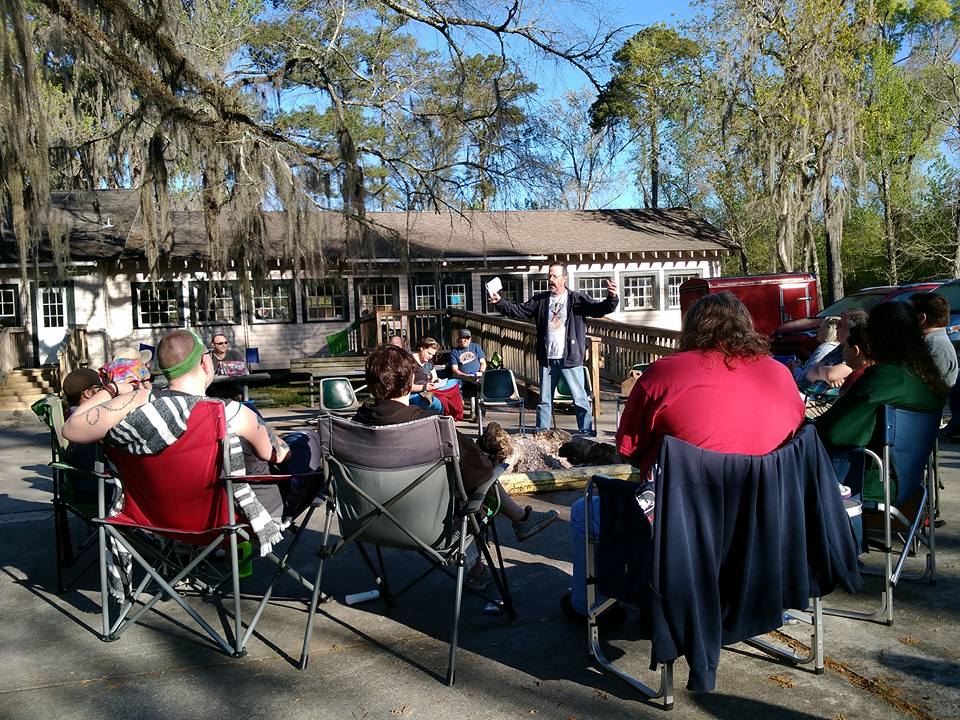
Highland Oak Nemeton, Fontainebleau State Park in Mandeville, LA, the magic of assembled Druids, and a sunny weekend of Gulf Coast weather in the 70s and 80s worked their cumulative spell on the 50 or so attendees of this year’s OBODGulf Coast Gathering. The spirits of the land witnessed Druids from OR, CT, VT, PA, FL, TX, LA, NE, VA, MI and other states make their way to the south-central U.S.
image courtesy Steve Cole
The workshops explored the Gathering theme “Opening The Seven Gifts” of Druidry. OBOD offers a lovely 2:30 video that presents the Seven Gifts more attractively than a bald recital could.
Our presenters kept the topics lively, sharing insights and fielding comments. Druidry needs no “outside experts” — the spiritual path generates its own.
Nonetheless, it’s always a draw to have a visiting speaker — and once again we welcomed the always-fabulous Kristoffer Hughes, one of Her Majesty’s Coroners, author, professional actor, OBOD Druid, and head of the Anglesey Druid Order in the U.K.
Kris spoke on “When the Last Leaf Falls: Death, an Awfully Big Adventure”, examining Western attitudes toward, and treatment of, the dead, and ways Druids can respond creatively and spiritually to the frequently dysfunctional nature of the Western “death industry” and its dehumanizing and ecologically destructive practices. He also urged us to bring each other in on, and discuss, our own plans for our deaths, disposal of remains, and the types of memorials we want.
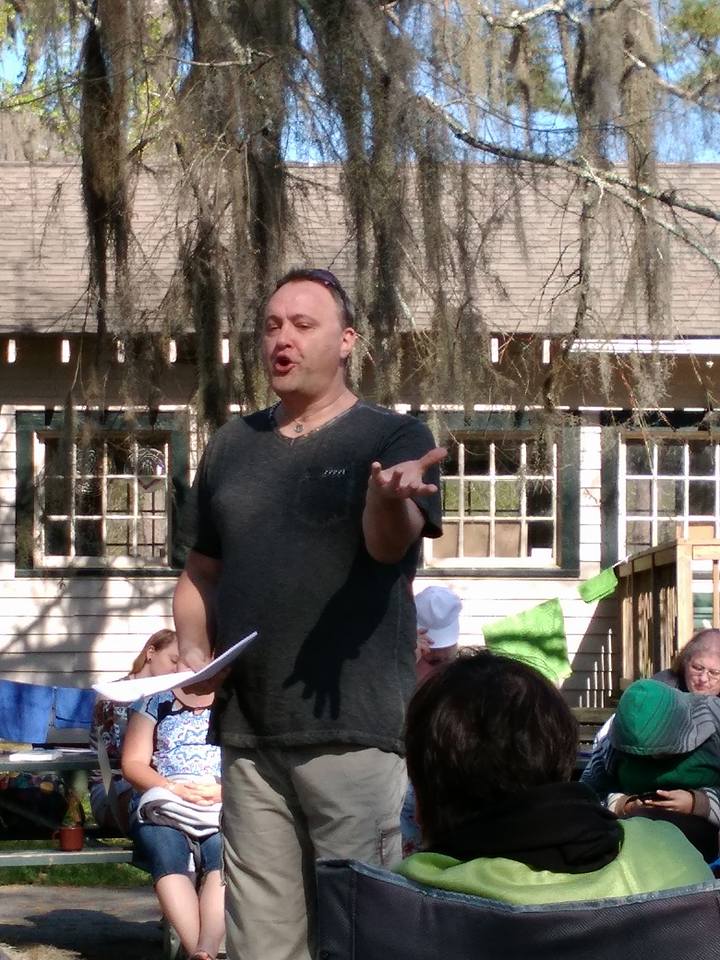
Kris during his talk — photo courtesy Kezia Vandilo
Dana dispelled stereotypes of magic during her evening talk around the fire our first night, the opening ritual fresh in our memories. The following morning Richard addressed the core of Druidry — getting back in touch with nature.
Richard and Dana
Lorraine helped many meet a new animal guide, Gabby drew us to consider healing, Jacob turned our thoughts to philosophy, and I explored the awen and the potentials for inspiration. Even if [below] my gesture at one point suggests a fish story — “the big one that got away”.
photo courtesy Kezia Vandilo
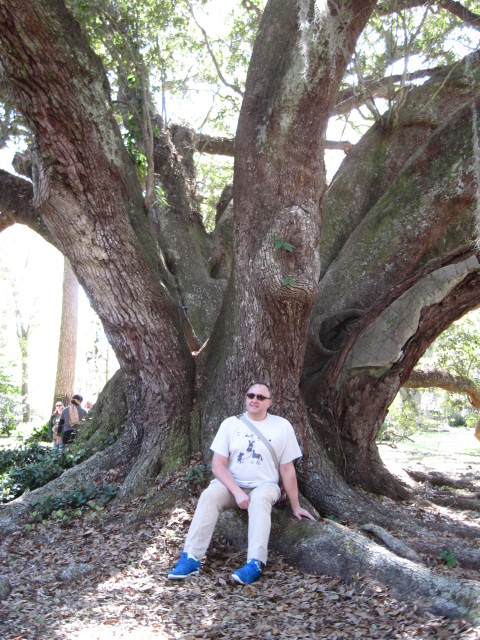
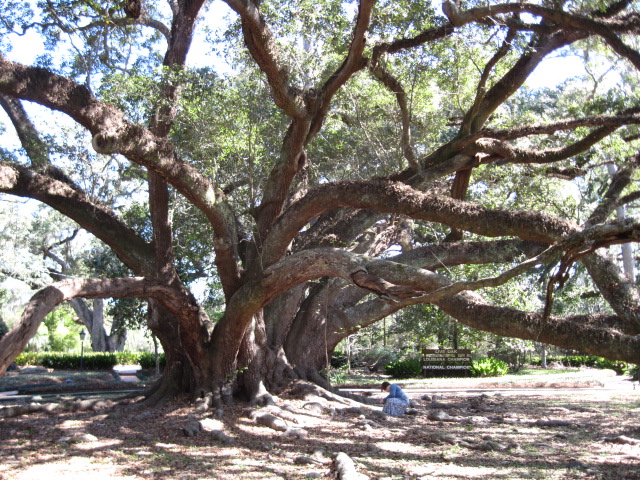
We initiated three Bards and five Ovates, held opening and closing rituals, along with the Seasonal Alban Eilir (Spring Equinox) ritual, went on nature walks, and visited the Seven Sisters Live Oak in nearby Mandeville, LA.
Below is our Welsh Druid guest communing with the tree, estimated to be over 1500 years old, and below that is a more distant shot to suggest something of its size.
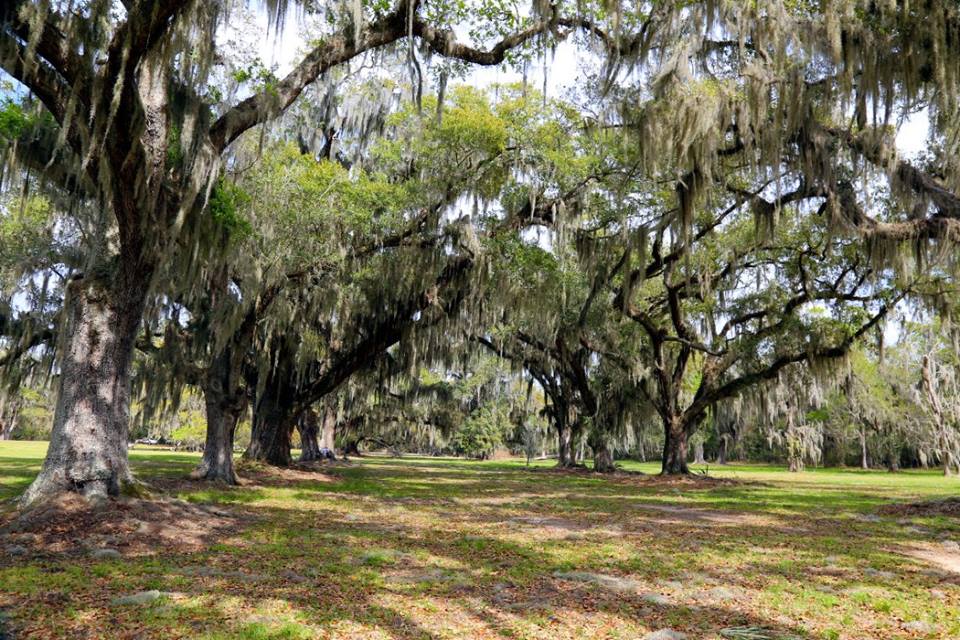
John Beckett captured an image of the atmospheric Spanish moss parasitic on so many trees south of the Mason-Dixon line.
photo courtesy John Beckett
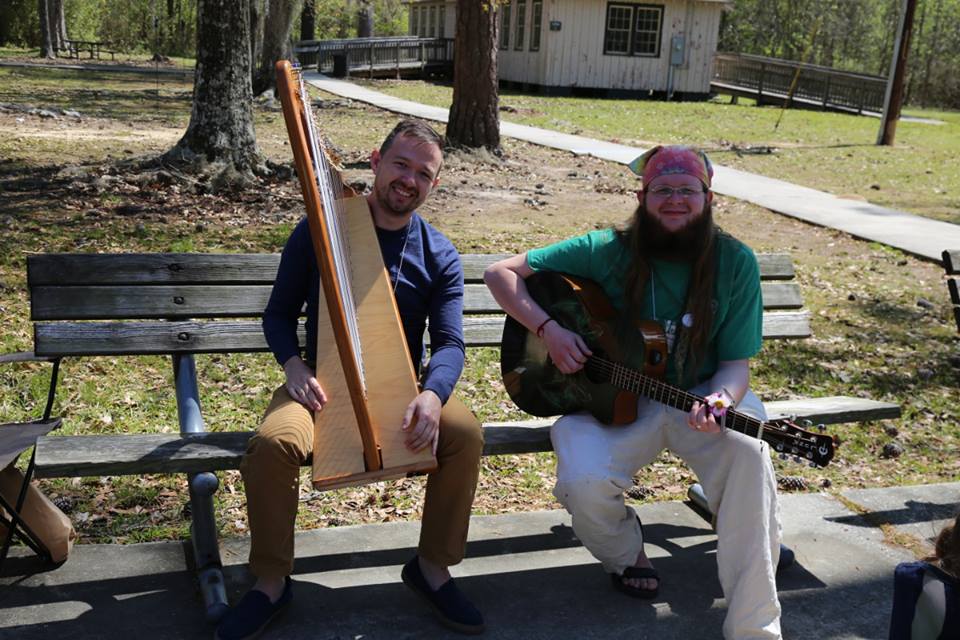
Storytellers and musicians, notably Jacob Pewitt and Brian Van Unen, made the slowly cooling evenings magical around the fire.
Jacob and Brian — photo courtesy John Beckett
What better way to leave behind the 18″ of snow in Vermont from the recent March nor’easter?!
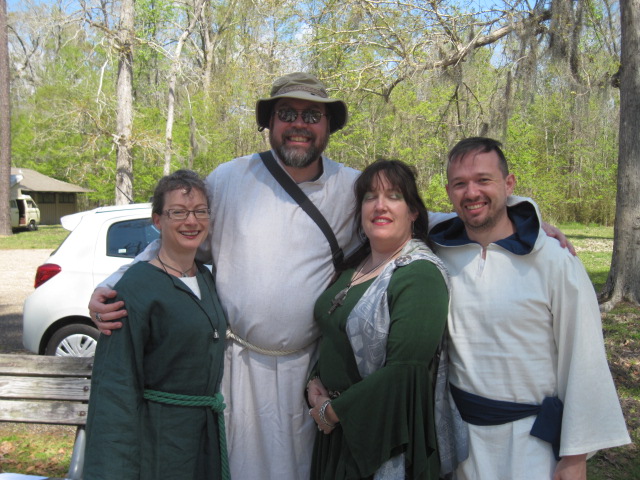
Always, always, it’s the faces, the reunions, the collapse of miles between us, and the conversations that make each Gathering so memorable.
Don’t know anyone before you arrive? You will before you leave!
Sovereignty, Lady of an inner realm which flows ceaselessly into this one, you birth, nourish and sustain us. May my deeds serve not my own will alone, but your larger shaping for the good of all. In my words here, in my deeds, thoughts, feelings and dreams, let that light and song and fire illumine where it can, whom it may.
If conditions here no longer allow for the manifold inner purposes and directions to manifest outwardly, physical life may well withdraw from one world, moving to another. Yet in spite of the uncertainty and dark despair that may arise in our hearts from time to time, this lovely, difficult, damaged world is far from exhausting its spiritual purposes.
As a sacred laboratory for experiences for many beings, and for spirit to inhabit all lives, possibilities and forms to know itself again, the world unfolds still, rich with potential. Both established forms yet with us and new ones coming into being offer choice, beauty, misery, destruction and growth. From the small to the great, from the inner to the outer, from seed and leaf to flower and fruit, through decay and transformation and renewal, it has ever been so.
True it is, that all realms touch, intermingle and answer each other. Events here send their ripples and taproots elsewhere for good and bad, and a shift there brings about a corresponding change here. The walls of the world echo. The great wonder is not that we have no influence on life, but that our influence often exceeds our knowledge. Day to day is not always the place to look for vision, though what we see elsewhere in vision and dream returns us here to labor anew.
Because that’s what makes a uni-verse, a one-turning. We are part of the work and movement of a marvelous many-faceted whole. It’s a measure of our priorities and the fading of the ancient heritage we have received and often abandoned in our pursuit of other things that many of us no longer know this in our bones, that we have to re-learn it through often bitter experience before we can begin again to make use of it to shape something better. But our cells know better, and our dis-ease may yet call us back to here and now, our suffering may still wake us to rebellion and questioning and discovery, our losses may perhaps stir us to compassion rather than endless lament and blame and surrender.
/|\ /|\ /|\
The seed of ritual, planted. The promise of spring, uttered. The shaping of hands to make each thing happen, foretold and prefigured at the birth of each woman and man into this world, from the great family ranged behind and all around us, that family of blood and friendship and teaching in the other worlds. Ancestors, hear us.
Slowly we apprehend what is essential and what is not, the long journey fashioned and felt and followed as we abide in multitudes of forms.
For us, the essential thing is that there is everywhere a conception of the end and the beginning of a temporal period, based on the observation of biocosmic rhythms and forming part of a larger system — the system of periodic purifications (cf. purges, fasting, confession of sins, etc.) and of periodic regeneration of life. This need for a periodic regeneration seems to us of considerable significance in itself. Yet the examples that we shall presently adduce will show us something even more important, namely, that a periodic regeneration of time presupposes, in more or less explicit form — and especially in the historical civilizations — a new Creation, that is, a repetition of the cosmogonic act. And this conception of a periodic creation, i.e., of the cyclical regeneration of time, poses the problem of the abolition of “history,” the problem which is our prime concern in this essay. — Mircea Eliade, Cosmos and History.
Lady, we gather in your grove, where your blessing yields all seasons at once. You abolish time in each moment, directing us forward and back, to ends and beginning, seed and leaf and fruit and fallow time. You regenerate us constantly, your dark and bright moons, this daily sun, stars overhead — who cannot see it?
Often, we cannot. Teach us again, three by three by three.
“The Goddess of Sovereignty gives three drinks from her cup, purveying the white milk of fostering, the red milk of lordship and the dark drink of forgetfulness. These she offers successively in her aspects as Foster-Mother, Consort and Renewer” — Caitlin and John Matthews, The Arthurian Tarot, pg. 43.
Clothed in rags, we walk the streets of the cities and wastelands, forests and plains and mountains of Time.
Although now long estranged,
Man is not lost nor wholly changed.
Dis-graced he may be, yet is not dethroned,
and keeps the rags of lordship once he owned … — J. R. R. Tolkien, “Mythopoeia”.
/|\ /|\ /|\
“If wishes were horses, beggars would ride,”
(some wishes are horses – watch out where they stride!)
but my words are wingéd – they fly to your side
to wish you a happy New Year ’17.
It’s not for myself that I say it – I mean
may you flourish and grow, whatever the weather:
as long as we’re in this, we’re in it together.

 After I prepare the papers and document the moment with a photograph, almost before I can ask for the next step, I’m given nine words or names to write on them: hampu, lutec, nef, abal, tahilte, renha, lam, tseme, umun. Then, as smoothly as the sense of guidance arrived, it falls away, and I’m left with no further sense of direction. Upheld, then let down.
 In the single experience (see recent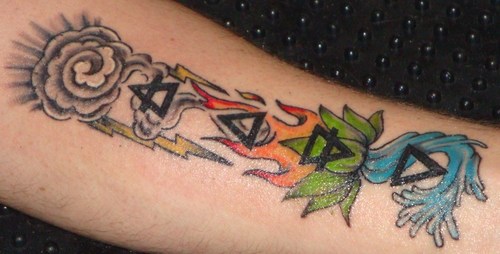

 Listening for names. I spend a significant amount of time doing that, between my spiritual practice and my fiction. It’s a curious endeavor, hard to explain, but one a surprising number of people have experience with. What is it we’re hearing?!
 With a toast, boast and oath, you could certainly hold a fine solo rite. Toast your gods, land spirits, ancestors, teachers, living kin — whoever you’re called to honor. Then on to a boast, a celebration of excellence, a claim to honor for ourselves, for something we have achieved. Like gratitude, boasting’s a skill we neither teach or practice enough. My default boast is survival. I’m still here. But I can definitely claim more; this blog, my other writings, a good marriage, years of teaching young people, a circle of friends I admire and enjoy.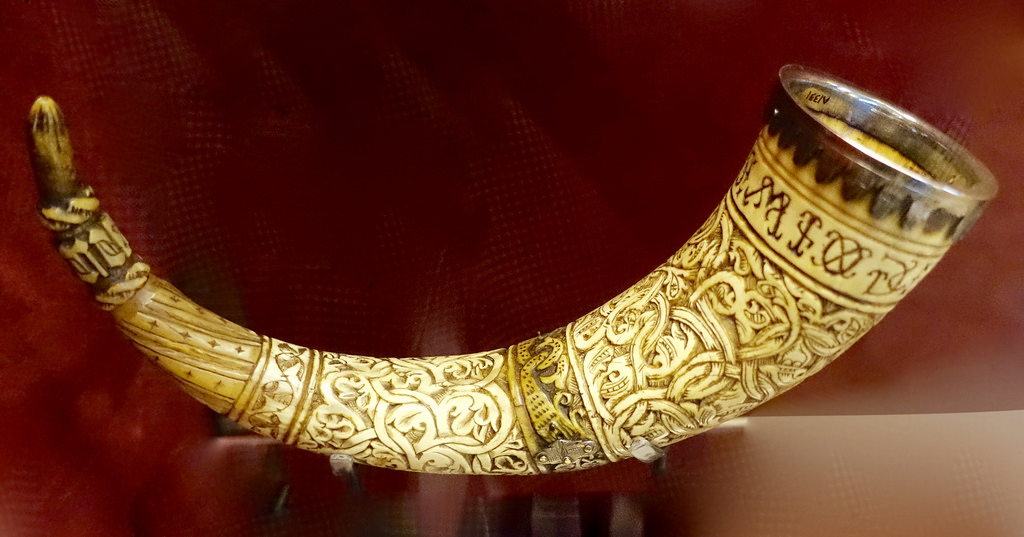
 Or what about a shift of terminology? Would that help at all with any of these themes? If instead of “Baptisms of the Elements”, we called them “Elemental Sacraments”, would that easier name make a difference? Would it make it any easier to move beyond instinctive antipathies and past traumas?





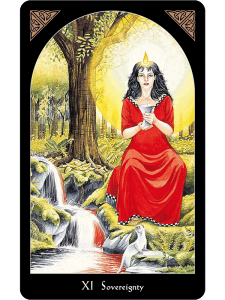 Sovereignty, Lady of an inner realm which flows ceaselessly into this one, you birth, nourish and sustain us. May my deeds serve not my own will alone, but your larger shaping for the good of all. In my words here, in my deeds, thoughts, feelings and dreams, let that light and song and fire illumine where it can, whom it may.


 A Druid Way