Archive for the ‘prayer’ Tag
Sometimes when I grow weary of one particular voice, my own, the one chattering in my head, I “talk old.” For me that means to use words from Proto-Indo-European, the reconstructed mother tongue of a hundred languages, ranging from Irish in the West to Hindi in the East. It means to play, to sing, to delight in the most lasting, the most insubstantial, intangible human artifacts we have.
Words like *deiwos “god (divine),” *ogni “fire (ignite),” *udor “water” are mantras for me, songs I sing to myself when no else is listening. (The * means the word is reconstructed. For me, the * means “Pay attention! Talking old is going on!”) Words no one speaks now, unless it’s some historical linguist, a professional muttering over a journal article she’s writing, or an amateur and word-mystic like me who gets lost in the shape and sound of “talking old.” Here are words our ancestors used, to talk to each other and to name their world. *kolnos, mountain … and I’m off, among moss and trees floating into view and disappearing again in the mist. *wlkwos, almost unpronounceable: the wolf, vilkas, ulf, vrka, lupa, lobo, those shapes of gray fur with fierce teeth that flash into view around a fire at night, only to vanish again, and then those unearthly howls echo from the hills and up and down our spines. We say unearthly — yet the only place we hear them is on earth. Home that is not home forever.
Individual words come fairly easily. There are whole dictionaries of Indo-European you can pore over, lists of cognates from a range of languages, the vowels and consonants shifting, the resemblances still striking, like at a family reunion where maybe a generation will skip, and then a nose or line of eyebrow or chin will reappear on a toddler asleep in the lap of her grandmother, and the kinship shows clear again. Blood will tell.
Sentences are harder, but still possible. The best we can do now often feels like speaking with a strong accent. We can get close enough we’d probably be understood here and there, across the six thousand years that separate the present from early Proto-Indo-European times, simple things the best, reaching the furthest across the miles and millennia. *Twom ognibyo wikyo, “I hallow you with fire,” and instantly I’m present at the rite, the flames dancing in our eyes, the smoke drifting and clearing. *Nomen bhero, “I carry a name,” I bear it, like a beloved cup that has passed down several generations, the edges softened, a few chips around the rim, the color or design worn in places.
Or maybe it’s been renewed, lovingly reworked so that its energy and substance will last a few more generations, the way we can still trace the meanings of so many names, handed on like heirlooms through a family. “That was your great-grandfather’s name, that was your aunt’s, you and your cousin both have the same middle name from your grandmother’s family.” *mater, *bhrater, *swesor, *pater, *sunu, *dhugater: mother, brother, sister, father, son, daughter — across thousands of years the family persists, its names still holding their old shapes and sounds, recognizable across a score of languages, the human links we share. *oinos, *dwou, *treyes, *kwetwores — one, two, three, four, and I count minutes, the pleasures of being alive, the four directions, the four seasons.
I “talk old” to the point that I’ve created several simplified forms of Indo-European as a constructed language or conlang, and used it to write simple prayers and poems. I “talk old” whenever English gets diluted by advertisers and politicians and careless speakers who squander its beauty and significance in talk that’s literally cheap, of little value. Poetry saves language because it always is trying to mean more, sometimes straining a language to its limits. Though paradoxically (signpost of how many truths!) the best poetry comes effortlessly, as if the universe speaks English, or Urdu, or Swahili, and everyone everywhere could understand the words, if they wanted to, if they just happened to be listening. Then “talking old” is simply speech, the human voice shaping experience, in love with possibility, the universe surprising us still, once again, always.
Compassion has no religion. Silence is not always indifference. O great, listening, witnessing world, you too have something to say, something you always are saying, without words. What comfort we can offer, miles and lives away from the families of the Sandy Hook school victims, and from other, newer sufferers since then, may consist of not filling the airwaves and spiritual spaces further, with our own shock or anger or sadness or dismay, or whatever other responses events may next provoke in us. Even if we do not know the families or victims or any of those touched by an event, we may send sympathy, because we are not stones. This is prayer, too. But every turn of the world changes us because we’re in it together. A great service is to love those who need love, and not merely to feel, to emote. We can do more than relive pain, especially another’s pain, or make it ours. Suffering needs no extra rehearsals, no practice. There’s always more than enough to go around.
We’re not stones, but we may raise them into a cairn, a act that by its solidity and palpable weight can lift suffering even a little, if it may, stone by stone. Let earth bear a portion of the weight. Allow this elemental power of Earth to transmute, to compost and transform, as it does all else that comes to it. The turning of the year again toward light in the middle of winter, the planet doing again what the planet does each year, can be solace too, earth re-establishing its balance. Soothing motion of the familiar, wordless touch with its animal comfort. Moon growing again towards fullness, light on the world in the middle of darkness.
But sometimes we hate comfort. Too often solace can reek of appeasement. We stiffen. One more easing is too many. Intolerable. Like words — already more than enough. With no ready target we seek out whatever will serve, anything to shut up the noise, the roar of raw nerves jangling. Anodyne. Oblivion, even, at least for a while.
Grief is too steady a companion. It knows us, it seems, deeper than a lover. OK, we get it. Pain too has something to say that will not be denied. We make a place for it, and it moves in, gets comfortable, settles down for too long. (How long is memory? Is recollection what we consist of? Do we relive, instead of living new? Does this become our only, instead of our also?)
When words do not do, I bring silence to the altar. When I cannot pray, then that is my prayer, just the act of moving toward the altar, a center, a focus.
/|\ /|\ /|\
The house has cooled overnight when I get up to write this. In between the last two paragraphs, I open the door of the woodstove to put in another two logs. In a turtleneck and sweats, I sit on the floor, feet toward the fire, with my laptop where its name says. Warmth, says the body, unrepentant in loving what it loves. Warmth too, radiating from the electrical current flowing through the machine I write with. So little, but a little. A start.
To “winter over” has always sounded encouraging to me. It may be a matter of full-on hibernation …

or merely that human sleep of cold weather that lingers through the darkness, drives us to seek out heavy, fat, rich foods in ancestral echo of our animal heritage, and longs to do nothing more strenuous than curl up and dream. There is animal “faith,” if you want to call it that, built into our bones and blood: the world will not turn away from us while we sleep, and we shall wake again to life.
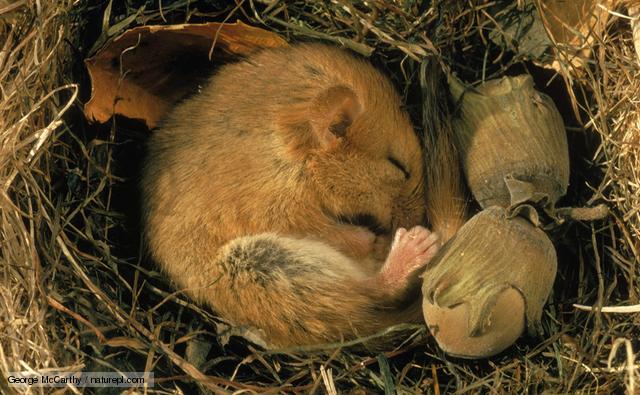
The dormouse in the picture has it about right: sleep with food half your size (hazelnuts, in this case), wake up, snack, pee, then back to sleep again. Drowsing comes much more easily now, especially after daylight savings time has shifted our days and brought evening creeping into the afternoons. With that extra jolt of possible light (this IS November, after all), mornings may be brighter and better, if you’re a morning person, but let 5:00 or 5:30 pm roll around and it feels like late evening already. Then today, with snowfall along the east coast as the winter storm makes its way along the same path Sandy took a short time ago, and you have hibernation mode with a vengeance.
May New York and New Jersey find their hazelnuts, their winter store of energy and life. A prayer to the South, where the people are cold in the dark, and my living breath upon it. A prayer to the west, where the frozen time has come, and my living breath upon it. A prayer to the north, warmer than many places closer to the equator: my living breath upon it. A prayer to the east, with winds cold and damp: my living breath upon it. Let all that breathes move its prayer with each inhalation and exhalation.
/|\ /|\ /|\
Image: dormouse.
Updated 8 Nov ’12
Sometimes you have experiences that just don’t fit. They’re orphans, and like orphans, too often they’re left to fend for themselves, so they end up on the street. Or else they’re stuck in a home by some well-meaning authority, where they may subsist uncomfortably for years in places where everyone else looks and acts and talks different. There may not be enough love to go around, either, and like Oliver in Dickens’ novel Oliver Twist, they’re reduced to pleading, “Please, sir, may I have some more?”
Monday night, before the hard freeze here (19 and windy) that threatened all the burgeoning flowers and trees, I offered up a prayer. I don’t usually pray in this way, but I found myself praying for all the wordless Rooted Ones busy putting out buds and leaves and new growth in response to the warm spell that caressed so much of the U.S. “I cry to the Powers,” I found myself saying. A little more love here, please. The great willow in our back yard has pale leafy fronds. The currants are budding. Crabgrass pushes up from dead mats of last year’s growth. The stems of bushes and the twigs of trees show reddish with sap. At the same time, I took stock in what I knew in some traditions about plant spirits, the personifications of energies that help individual species thrive.* Let the devas and plant guardians sort it out. Serve the larger balance — that sort of thing. Then the nudge to pray came, so I honored it. Everyone has a role to play. Then the goddess Skaði presented herself.
All this took place while I was driving down and then back home with my wife from an out-of-state trip to CT. Bookends to the day. We’d tried to be efficient with our driving and gas use, like the good Greenies that on occasion we actually are, and schedule several appointments for the same day. So we rose early, drove through welcome morning sun and glorious light to have a thermostat and brakes replaced on our car, get eye exams and prescriptions and glasses before a sale ended on April 1, drop off a gift at a friend’s house, and get to an admissions interview for a certificate program I’m interested in. (More about that as it progresses.)
We’d scheduled ourselves fairly loosely, but still the sequence of appointments mattered for times and distances to travel to the next stop. So when the car service that we’d been assured would take no more than two hours now promised to consume most of the day, we got a loaner car from the dealership, rescheduled and shuffled some of our meetings. Ah, modern life. Maybe it’s no more than imagination, but at such times recall of past lives makes horse-and-buggy days seem idyllic and stress-free by contrast. Back then we didn’t do so much because we simply couldn’t. Does being able to do more always mean we should?
So, Skaði.** Not to belabor you with too much detail: she’s a Scandinavian goddess of winter, hunting, mountains and skiing. A sort of northern Diana of the snows, an Artemis of the cold heights and crags. I’d run across her a few years ago, when I was doing some reading and meditation in Northern traditions. She loomed in my consciousness then, briefly. Frankly I found Bragi, the god of eloquence and poetry and patron of bards, much more to my taste. But there she was, for a short time.
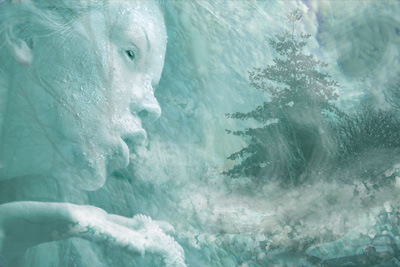 I flashed on an image of Skaði then, and she seemed — and still seems to me — quite literally cold, implacable, uninterested in humans, remote, austere, elegant in the way ice formations and mountain snows and the Himalayas are elegant — and utterly forbidding. Not someone even slightly interested in exchange, in human interaction. Now here she was. If you’ve been pursued by any of the Shining Folk, whether the Morrigan or Thor, Jesus or Apollo, you know that often enough they choose you rather than the other way around. So you make do. You pay no attention. Or you can’t help it and now you have a patron deity. Or something in between. If you’re a bloody fool, you blab about it too much, insisting, and the nice men in white coats fit you for one too. Or maybe you and Thorazine become best friends. It’s at times like this that I’m glad of the comparative anonymity of this blog. I can be that bloody fool, up to a point, and the people who need to will pass me off as just another wacko blogger. And then this post will recede behind the others, and only one or two people will happen on it in another month or two. The gods are out there, and they’re in our heads, too. Both/and. So we deal with it. And I can step back to my normal life. Or not. I’ll keep you posted.
So Skaði of the daunting demeanor wants something. I prayed to the Powers, almost in the Tolkien Valar = “Powers” sense — to anyone who was listening. Open door. Big mistake? I’m a Druid, but here’s the Northern Way inserting itself into my life. My call goes out, and Skaði picks up and we’re having this conversation in my head while I drive north on I-91 with my wife. I’ve gotten used to these kinds of things over time, as much as you can, which often isn’t so much. In a way I suppose it’s revenge — I used to laugh out loud at such accounts when I read them and shake my head at what were “obviously people’s mental projections.” Now I’ve got one saying if you want protection for your shrubbery (God help me, I’m also hearing the scene from Monty Python and the Holy Grail at this point. The Knights of Ni: “Bring me a shrubbery!”), then do something for me. What? I said. A blog post, first, then a website shrine. So here’s the blog post first. I’ll provide the shrine link when I’ve set it up.
/|\ /|\ /|\
*If you’re interested in an excellent account of this, check out The Findhorn Garden, originally published in 1976. This Scottish community, established on a barren piece of land, “inexplicably” flourished with the help of conscious cooperation with nature spirits. It’s documented in photographs and interviews. There are several books with similar titles and later dates, also published by Findhorn Community.
**The ð in her name is the “th” sound in with. I’m slowly realizing that part of my fussing over words, the urge to get it right, the annoyance at others who seem not to care about linguistic details, can be transformed to a gift. So for me part of honoring Skaði is getting her name right.
Image: Skaði. I can’t draw or paint to save my life, so when I came across this stunning representation, a shiver slalomed down my back. Skaði’s footsteps, I guess I should say. This is in the spirit of my experience of the goddess.
“Only what is virgin can be fertile.” OK, Gods, now that you’ve dropped this lovely little impossibility in my lap this morning, what am I supposed to do with it? Yeah, I get that I write about these things, but where do I begin? “Each time coming to the screen, the keyboard, can be an opportunity” — I know that, too. But it doesn’t make it easier. Why don’t you try it for a change? Stop being all god-dy and stuff and try it from down here. Then you’ll see what it’s like.
OK, done? Fit of pique over now?
I never had much use for prayer. Too often it seems to consist either of telling God or the Gods what to do and how to do it (if you’re arrogant) or begging them for scraps (if they’ve got you afraid of them, on your knees for the worst reasons). But prayer as struggle, as communication, as connecting any way you can with what matters most — that I comprehend. Make of this desire to link an intention. A daily one, then hourly. Let if fill, if if needs to, with everything in the way of desire, and hand that back to the universe. Don’t worry about Who is listening. Your job is to tune in to the conversation each time, to pick it up again. And the funny thing is that once you stop worrying about who is listening, everything seems to be listening (and talking). Then the listening rubs off on you as well. And you finally shut up.
That’s the second half, often, of the prayer. To listen. Once the cycle starts, once the pump gets primed, it’s easier. You just have to invite and welcome who you want to talk with. Forget that little detail, and there can be lots of other conversations on the line. The fears and dreams of the whole culture. Advertisers get in your head, through repetition. (That’s why it’s best to limit TV viewing, or dispense with it altogether, if you can. Talk about prayer out of control. They start praying you.) They’ve got their product jingle and it’s not going away. Sometimes all you’ve got in turn is a divine product jingle. It may be a song, a poem, a cry of the heart. The three Orthodox Christian hermits of the great Russian novelist Tolstoy have their simple prayer to God: “We are three. You are three. Have mercy on us!” Over time, it fills them, empowers them. They become nothing other than the prayer. They’ve arrived at communion.
/|\ /|\ /|\
Equi-nox. Equal night and day. The year hanging, if only briefly, in the balance of energies. Spring, a coil of energy, poised. The earth dark and heavy, waiting, listening. The change in everything, the swell of the heart, the light growing. Thaw. The last of the ice on our pond finally yields to the steady warmth of the past weeks, to the 70-degree heat of Tuesday. The next day, Wednesday, my wife sees salamanders bobbing at the surface. Walk closer, and they scatter and dive, rippling the water.
/|\ /|\ /|\
I once heard a Protestant clergywoman say to an ecumenical assembly, “We all know there was no Virgin Birth. Mary was just an unwed, pregnant teenager, and God told her it was okay. That’ s the message we need to give girls today, that God loves them, and forget all this nonsense about a Virgin birth.” … I sat in a room full of Christians and thought, My God, they’re still at it, still trying to leach every bit of mystery out of this religion, still substituting the most trite language imaginable …
The job of any preacher, it seems to me, is not to dismiss the Annunciation because it doesn’t appeal to modern prejudices, but to remind congregations of why it might still be an important story (72-73).
So Kathleen Norris writes in her book Amazing Grace: A Vocabulary of Faith. She goes on to quote the Trappist monk, poet and writer Thomas Merton, who
describes the identity he seeks in contemplative prayer as a point vierge [a virgin point] at the center of his being, “a point untouched by illusion, a point of pure truth … which belongs entirely to God, which is inaccessible to the fantasies of our own mind or the brutalities of our own will. This little point … of absolute poverty,” he wrote, “is the pure glory of God in us” (74-5).
So if I need to, I pull away the God-language of another tradition and listen carefully “why it might still be an important story.” Not “Is it true or not?” or “How can anybody believe that?” But instead, why or how it still has something to tell me. Another kind of listening, this time to stories, to myths, our greatest stories, for what they still hold for us.
One of the purest pieces of wisdom I’ve heard concerns truth and lies. There are no lies, in one sense, because we all are telling the truth of our lives every minute. It may be a different truth than we asked for, or than others are expecting, but it’s pouring out of us nonetheless. Ask someone for the truth, and if they “lie,” their truth is that they’re afraid. That knowledge, that insight, may well be more important than the “truth” you thought you were looking for. “Perfect love casteth out fear,” says the Galilean. So it’s an opportunity for me to practice love, and take down a little bit of the pervasive fear that seems to spill out of lives today.
Norris arrives at her key insight in the chapter:
But it is in adolescence that the fully formed adult self begins to emerge, and if a person has been fortunate, allowed to develop at his or her own pace, this self is a liberating force, and it is virgin. That is, it is one-in-itself, better able to cope with peer pressure, as it can more readily measure what is true to one’s self, and what would violate it. Even adolescent self-absorption recedes as one’s capacity for the mystery of hospitality grows: it is only as one is at home in oneself that one may be truly hospitable to others–welcoming, but not overbearing, affably pliant but not subject to crass manipulation. This difficult balance is maintained only as one remains [or returns to being] virgin, cognizant of oneself as valuable, unique, and undiminishable at core (75).
/|\ /|\ /|\
This isn’t where I planned to go. Not sure whether it’s better. But the test for me is the sense of discovery, of arrival at something I didn’t know, didn’t understand in quite this way, until I finished writing. Writing as prayer. But to say this is a “prayer blog” doesn’t convey what I try to do here, or at least not to me, and I suspect not to many readers. A Druid prayer comes closer, it doesn’t carry as much of the baggage as the word “prayer” may carry for some readers, and for me. “I’m praying for you,” friends said when I went into surgery three years ago. And I bit my tongue to keep from replying, “Just shut up and listen. That will help both us a lot more.” So another way of understanding my blog: this is me, trying to shut up and listen. I talk too much in the process, but maybe the most important part of each post is the silence after it’s finished, the empty space after the words end.
/|\ /|\ /|\
Norris, Kathleen. Amazing Grace: A Vocabulary of Faith. New York: Riverhead Books, 1998.



 A Druid Way