The final post in this series encompasses four cards — The Moon, the Sun, The Judgment and The World.
In spiritual traditions that focus on the inner journey and provide recognizable descriptions to note along the way, the Sun and Moon worlds can be markers of non-physical travel. Of course, we can understand the entire Major Arcana in similar terms — signposts of the journey of the Fool on the way to wisdom.
The MOON
While different creatures may appear on this card, The Moon itself suggests latency. This is a realm or stage of potential, of possibility not yet manifest in the physical world. On this traditional card, 15 yods (the Hebrew y: ) appear beneath the Moon — a source of perplexity and confusion on numerous Tarot forums.
While anyone exploring the Tarot discovers that a wealth of symbolism and figurative meaning flourishes around each card (yod begins Hebrew words like yad “hand” and Yahweh “God”), one simple explanation is that the full moon typically appears 14 to 15 days after the new moon each month.
If you’re like me, you may persist in thinking the full moon stands at the end of the lunar cycle rather than at its middle, so part of the meaning for me of the (full) Moon is precisely that cyclical flow of energies in the physical world. Completion of one cycle flows endlessly into the next. (You can also contemplate links to other cards which feature yods. In the Major Arcana, that includes the Tower.)
The Seeker arrives at Moon consciousness and benefits from its fullness, you could say, but this stage, like all the others, is a way-station and not a final destination.
What potentials lie in me that I may not recognize, but can manifest? What fullness or completion in my life indicates not a final arrival, or an opportunity to slip into passivity or lethargy, but a chance to initiate a new cycle? How can I take advantage of a crest in energy to launch this new venture, rather than waiting till the energy subsides, and change is harder to bring about?
The SUN
Unlike the Moon, the Sun features a human figure, naked and on horseback, with arms spread wide. Four sunflowers rise from what looks like a garden wall — the four elements under the light of the Sun. If we choose to call this mounted figure the Seeker or Fool, you might also choose to note that nothing is hidden — all is touched by the solar light, 11 straight sunbeams and 10 rippling ones for a total of 21, suggesting the final card of the Major Arcana, the World.
Arranging the cards in 3 rows of 7, with the Fool outside this structure as the Cosmic Traveler through its realms, the Sun is a harmonic of 12, the Hanged Man, and of 5, the Hierophant. Unlike the Moon, the Sun is indeed constant, unchanging, though mist or clouds may still interpose themselves and obscure its light. But this apparent stability and constancy is still not the end of the cycle, let alone any final arrival, but simply another stage. The illuminated human self relies on the power of its animal nature — is “naked to its influence” — yet does not need to “control” it; it holds no reins, nor requires any bit and bridle. The “horse knows the way to carry the sleigh” of the Chariot, which ends the first row of the work of the Self (and which incidentally is adorned with stars and moons). It also depicts the completion begun with the Hanged Man, whose inversion of values, or comfort with abandoning convention, has now borne fruit.
What discoveries am I “riding openly”? What does my “illumination” actually illuminate? What am I now strong enough or wise enough to invite wholeheartedly into my world or my consciousness?
JUDGEMENT
If the Sun reveals all things, or signifies attainment of a certain degree of illumination, we can see Judgement echoing the Christian end of time and the resolution of events launched at Creation. Figures rise from graves or caskets at the blast from the angelic trumpet.
The sound of the awen helps us cast off deadness, old forms and scripts of action and consciousness, and enter a new creative cycle. We may feel spent from our previous efforts, and even enter a kind of death, but what is enduring in us, what we are made out of, does not abandon its nature. It cannot die, but simply changes form, entering the earth, the Underworld, the Otherworld, to rise again, reappear, re-seed itself, take new forms and shapes.
We may presume, if we even believe in any kind of immortality, that our human personalities will endure. But I find it highly unlikely that my love of raspberries, my preference for wearing greens and blues, my stubborn preference for Birkenstocks over formal footwear, even when a workplace or ceremonial dress-code demands shoes, will persist into another incarnation. Add up such minutiae of a life and you do not capture what is best and most valuable in a person, however quirkily dear and familiar such things may turn out to be for those who remember them. A few such energies may have arisen from past-life choices and experiences, or prodded me further along the Spiral, and these, if pervasive enough, may leave traces that endure into another incarnation.
What of my own judgement? What discernment or powers of discrimination have I acquired? How have I (not) deployed them? What judgments of others do I allow myself to be subject to or to shape me or my experiences?
The WORLD
In the Christian worldview, Judgement is the precursor to Heaven or Hell. For the Tarot, though, neither of these follows. Instead, we encounter the World. Is it the same World as in the beginning, or the place where we Fools find ourselves?
In those famous Zen terms, before enlightenment, mountains are mountains and rivers are rivers. At enlightenment, mountains are no longer mountains and rivers are no longer rivers. Something has shifted, but in the end only each individual can truly say what it is. After enlightenment, though, it’s important to continue along the way, and not be stopped by a false sense that with illumination or attainment of a degree of wisdom, life somehow stops or should cease to be life; mountains are again mountains, and rivers are again rivers. We emerge, as the Tarot has been hinting to us repeatedly, on another arm of the Spiral.
We see in this traditional card the four figures of the Gospel authors or Evangelists of the New Testament, three animals (eagle, lion, ox) and a human. (Many days, that seems to me the most accurate characterization of the experience of being human!)
As I wrote in Part 1:
So important is the animal accompanying the Fool from the outset that almost every deck includes some creature accompanying the human figure of the Fool.
Whether we see this as our animal inheritance, part of our make-up as a physical being with age-old drives and instincts, or as a guide or companion distinct from us, the dog (or three birds in the Arthurian tarot) is with us from the beginning.
/|\ /|\ /|\
Where (I ask the wise beasts of my life) where would you like to go next on our journey?
If the holy terrain between Druid and Christian calls to you, better your way than one belonging to another person that doesn’t fit you where you walk on your particular arm of the Spiral Journey. A week’s worth of your own meditations surpasses anything I can write here. These themes are suggestions, prompts, points of departure. They’re mine, and they may not be yours. Their use is as sparks, kindling, tinder, fuel, provocation. Your particular path may grow out of resistance or contradiction. Thus are (spiritual) muscles strengthened.
If you’ve (mostly) survived your adolescence, held down a job, learned to deal with roommates, siblings, coworkers, parents, teachers, traffic cops, jerks, (holy) Fools, the DMV, followed a dream, fell in love, lost a bet, failed at something, succeeded at something else, and arrived here, it’s pretty likely you’ve accumulated enough insight to learn something useful when looking at cards intended to evoke insight from your experiences! We can also never fully know how our words on such subjects may be exactly what another needs to hear.
The HERMIT
Hermits abound in world-wide lore and legend, running the gamut from hell-bound to holy. Depending on your temperament and the rebuffs that life generously doles out to all of us, you may find in the Hermit a kindred spirit, someone who chooses, as the French have it, reculer pour mieux sauter: “to draw back in order to make a better leap” back into the fray. Or eremitic withdrawal may become the theme for a lifetime, or a whole series of them. Plenty of secular examples come to mind as well, especially if you’re rich enough to build a life from your eccentricities, like billionaire Howard Hughes.
Modern examples include Thomas Merton, whose hermit tendencies can be summed up in the name of the monastic order he eventually joined: OCSO, the Order of Cistercians of Strict Observance, or Trappists. Not content with the already spartan nature of the Order, Merton withdrew further to a hermitage on the grounds of the monastery. His books and poems and increasing fame were one vital source of balance shaping his character into the wise monk, priest and author he slowly became.
J M Greer illustrates a Druid-focused model for practice just as potentially rigorous, especially for the solitary: the Gnostic Celtic Church. Greer highlights some of its distinctive features:
… the GCC does not train people for the standard American Protestant model of the clergy—a model that assigns to clergy the functions of providing weekly services to a congregation, “marrying and burying,” offering amateur counseling to parishioners, and pursuing political and social causes of one kind or another, and defines training for the ministry in terms of the same style of university education used by most other service professions.
This model evolved out of the distinctive social and theological requirements of American Protestant Christianity and has little relevance to other faiths, especially those that do not have the financial resources to support full-time ministers. It has nonetheless been adopted uncritically by a great many alternative religious traditions here in America. It was in response to the very poor fit between that model and the needs of a contemporary alternative religious movement that AODA [Ancient Order of Druids in America] chose to pursue an older model better suited to its own tradition and needs.
Instead of growing from a single and largely American Protestant model, the GCC focuses on what it calls the Rule of Awen, because
there is certainly a need for men and women who are willing to embrace a new monasticism centered on a personal rule: one in which the core principle of aligning the whole life with the spiritual dimensions of reality can express itself in forms relevant to the individual practitioner and the present age, in which a rich spiritual life supported by meaningful ceremonial and personal practice can readily coexist with whatever form of outward life is necessary or appropriate to each priest or priestess, and in which the practice of sacramental spirituality can be pursued apart from the various pathologies of political religion.
Greer always packs a lot in his sometimes academic prose: following Christ’s admonition, this means in short to “work out your own salvation with fear and trembling”. We say we want freedom, but how many of us trust our own inner guidance sufficiently to discern what is “necessary or appropriate”, and avoid the “pathologies of political religion”?
As always, the simplest and purest way contains with it the hard-earned wisdom of lifetimes. Greer lays out the central challenge we all face:
… find and follow your own Awen. Taken as seriously as it should be — for there is no greater challenge for any human being than that of seeking his or her purpose of existence, and then placing the fulfillment of that purpose above other concerns as a guide to action and life — this is as demanding a rule as the strictest of traditional monastic vows. Following it requires attention to the highest and deepest dimensions of the inner life, and a willingness to ignore all the pressures of the ego and the world when those come into conflict, as they will, with the ripening personal knowledge of the path that Awen reveals.
How many of us have even begun to recognize and creatively respond to all the myriad “pressures of the ego and the world”? (After all, this is much of what I’ve long been practicing in my own way, as recorded in this blog, and you have ample evidence here of the challenges one person has faced.)
The Matthews’ Arthurian deck depicts the Grail Hermit: “Neither Druid nor priest, as hermit he mediates the functions of both”.
Where is the “third element” in each of my life experiences? As neither pole of a binary, how does it serve both and thereby a greater whole?
The WHEEL of FORTUNE
The Wheel or Spiral, the lungo drom or long road of yearning of the Romani, the Wheel of Becoming in Hinduism, “what goes around comes around” of folk wisdom, all point to the circular nature of life and the resonances that our actions establish.
Or as the Lakota holy man Black Elk puts it,
Everything the power of the world does is done in a circle. The sky is round and I have heard that the earth is round like a ball and so are all the stars. The wind, in its greatest power, whirls. Birds make their nests in circles, for theirs is the same religion as ours. The sun comes forth and goes down again in a circle. The moon does the same and both are round. Even the seasons form a great circle in their changing and always come back again to where they were.
The life of a man is a circle from childhood to childhood, and so it is in everything where power moves.
Worldwide, this circle or wheel is also quartered, divided into four fields or domains or regions. Yes, it’s impossible to square the circle , and the link will lead you into exquisite mathematical detail why this is so — but using this holy glyph or mandala as a teaching and learning device, as a tool in ritual, is another order of response to such an intersection of worlds. What is materially impossible is — often — spiritually essential. Or to put it another way, walking a spiritual path means squaring the circle every single day. (Or if you seek a spiritual practice based in mathematics, check out this origami link.)
For more insights that can lead to a unique personal practice with sacred geometry, and not incidentally provide further rich linkages between their profound influence in both Druidry and Christianity, check out Michael Schneider’s A Beginner’s Guide to Constructing the Universe: Mathematical Archetypes of Nature, Art, and Science.
JUSTICE
In Matthews’ deck, the corresponding figure is Sovereignty: “our true self and the land are one”. The justice of this inner truth emerges in the great rebalancing that earth is currently experiencing, as the consequences of our past actions come home to us, and we begin to accept responsibility for them and to work off their effects. But we need not merely suffer them passively; we can work with them creatively for the purposes of transformation, which is what cause and effect are placed to afford to all who seek.
In the traditional deck, the figure is garbed and presented so that gender is not immediately clear. Latin justitia is a feminine noun, yet the figure of Justice as we have it here has a seated, balanced, imperial quality of the previous male figures in positions of traditional masculine power and authority.
As a further harmonic development of the Magician, Justice is a balanced expression of power: the upward right hand holds a sword, while the left grips a balance. The two pillars of manifestation again frame the seated figure, and a curtain conceals the region behind it.
What has been lost on the way to Justice? How is its expression still incomplete, indicating the need for further growth and unfoldment? What does rebalancing and attainment of a new equilibrium conceal or distract me from? What further currents of change and transformation remain that ask for my attention, and allow me to anticipate future expressions of Justice, of balance and recalibration and harmonizing?
The triple crown of Justice can be seen to reflect the magical current inherent in groups of three, and in the physical universe. The card commentary for this card in Matthews’ Arthurian deck includes this observation: “…the Goddess of Sovereignty gives three drinks from her cup, purveying the white milk of fostering, the red drink of lordship and the dark drink of forgetfulness. These she offers successively in her aspects as Foster-Mother, Consort and Renewer”.
“Mother, foster me to your service. Consort, empower us both through our union. Renewer, ease me as I strive to fulfill my vows to you”.
One of the vital perspectives that much modern Druidry can offer to Christian practice is an experimental approach. Rather than depending so heavily on creeds and affirmations of faith, we can approach statements in Christian and Jewish scripture as pointers toward practice, as statements of spiritual reality and awareness if certain prerequisites of practice, wisdom and experience are met, statements clothed in symbolism and perspectives than can sometimes translate to other terms and forms without diminution.
Here’s one such example: “Blessed is the one who comes in the name of the Lord” (Ps. 118:26). Whether as a statement of faith or a lyric in a praise-song, it often elicits a comforting familiarity. But why not take it for a spin? Because it offers at least three points for exploration, contemplation and practice, we could treat it as a Druid-Christian triad, and contemplation seed:
What does “blessed” mean?
What does it mean to “come in someone’s name”?
And what is the “name of the Lord”?
Coupled with this last question is a verse often directed at non-Christians, and prominent in mission-oriented publications and preaching: “At the name of Jesus every knee will bow” (Phil. 2:10). As a form of submission to a specific deity, a Christian islam, its initial meaning seems quite clear. All will acknowledge this particular form of deity, the Christian Son of God, in a future realization of his divine sovereignty. It’s a state yet to be fulfilled. Islam as an Arabic word for Muslims also conveys a sense of free will — it’s a voluntary submission. Of course, this is one form of understanding, and it need not be the only or even the most potent in effecting spiritual change.
Put these formulations in Druid terms and you might have recognition that the natural order has a discernible flow, a direction, an energy that humans resist and abuse only at an accumulating cost to themselves and to every other being around them. (Some have called this Lady Sovereignty. It’s possible also to see in this a version the Shekhinah, the presence of God.) Blessedness in these terms is fruitfulness, harmony, awareness, creativity — all arising from recognition of and concord with the underlying flow inherent in nature, and an ability to navigate life changes successfully. If we come in the name of spirit, or bring with us and our decisions and actions such blessedness or harmonious accord with the flow of nature, it’s often quite apparent to others. A yogi may do this while performing the Salutation to the Sun. Or the Druid sitting under a tree to rest against its trunk and watch the sunrise, may acknowledge the presence of something far greater than the human self in these things. A human on a “path with heart” already carries an awareness of spiritual presence of which he or she is an integral part of the whole.
It’s then that we recognize, at least in our better moments, the authority of those who act from love and wisdom, not from selfishness or shortsighted opportunism. And the sages among us, whether Druid or Christian, both or neither, may not always be those publishing the books and presenting at major Gatherings or Conferences. It may be the white-haired gardener praying in the neighboring pew, face aglow with reverence for the goddess in Mary, or Mary in the goddess, fingernails still darkened with the good earth under them. It may be the quiet young Christian woman calling the quarters at the next Equinox ritual, honoring the four archangels, or the four gospel evangelists, or the four creatures of Celtic or some other tradition, welcoming the presence of spirit in so many varied guises and forms permeating every quarter of the compass.
In the experience of spiritual abundance and presence, then, Christian and Druid may find another meeting-place.
/|\ /|\ /|\
The LOVERS
The next Tarot image in our series is the Lovers. (The Matthews’ Arthurian image is of the White Hart, with the lovers Enid and Geraint in the foreground.) So much history and cultural change and commentary surrounds the myth or wisdom story of Adam and Eve that “It is difficult/to get the news from poems/”, as William Carlos Williams says in “Asphodel, That Greeny Flower”, “yet men die miserably every day/for lack/of what is found there”. The story may simply not “work” for many of us as it once did.
We can read the card in one way as depicting the non-physical spiritual force that expresses itself in female and male, in all living things, both green and fruiting, and flaming with energy, as in the fiery-leaved tree behind the male figure. To get caught by stereotypical associations, or to balk at “masculine” or “feminine” attributes, is to miss the polarities inherent in the natural world that allow for manifestation — multiple polarities we all carry within each of us. In one sense, then, nature has always been “gender-fluid”: we know of species that can change genders at need, or at different points in their life cycle.
What do I really love? Does that love build or tear down my life? How does love help me manifest? What polarities work through me with particular force or energy? What ones might I beneficially welcome and work with in my life? Where else can I love?
The CHARIOT
The Chariot in the traditional deck (or Prydwen, Arthur’s ship of journeying in the Arthurian deck) closes out the first of the three rows of the Major Arcana (if we lay out the cards in 3 rows of 7, with the Fool or Seeker as the one who moves through each on the Journey). And again, in one traditional interpretation, this first row has to do with the maturing self, the personal, the exploration and development of capacities and potencies of the individual.
The notes for Prydwen from the Arthurian deck: “the Otherworldly journey which is undertaken by all seekers, so that the inner life becomes the basis for a sound outer life” (pg. 36).
One applicable Biblical verse here comes from Luke 6:45: “Good people bring good things out of the good stored up in their hearts, and evil people brings evil things out of the evil stored up in their hearts. For the mouth speaks what the heart is full of”. I don’t know about you, but this is a useful barometer for where my attention is. And with luck, you have a friend or partner who calls you on your crap. “What did you just say?!” That’s when I learn, if I don’t already know, that I’m (once again) out of balance and have some work to do.
What is happening in my inner worlds? What is my foundation? Where can I continue to work to shore up that foundation for both my inner and outer lives? What cycle has ended so that I can finally see and account for its shape and influence, and now return to polish what was rough-hewn? How is my storehouse? What am I harvesting from the old cycle as I begin a new one?
STRENGTH
“The Sovereign Lord is my strength! He makes me as surefooted as a deer, able to tread upon the heights” (Habakkuk 3:19). Or to be gender-fluid about it: “I honor Lady Sovereignty who strengthens me here on this Land where the deer runs, showing me how to walk the heights with sure feet”.
On this new octave, the second row of 7, Strength shares the infinity symbol with the Magician. You could say she is the Magician — renewed, re-imagined.
Is this coercion or forcing of our elemental and instinctual selves by our “higher” selves? Is it conscious awareness of the vitality of both, thereby making it our own more fully and completely — a union, where formerly there were two? The Lady here has greens and flowers for a belt — she is not separate from nature. Is she shaping and directing that animal strength?
Perhaps we can see one theme run from the prophet’s words that open this section to Whitman’s words in “The Beasts” in his Song of Myself:
I think I could turn and live with animals, they are so placid
and self-contain’d.
I stand and look at them long and long.
They do not sweat and whine about their condition,
They do not lie awake in the dark and weep for their sins,
They do not make me sick discussing their duty to God,
Not one is dissatisfied, not one is demented with the mania of
owning things,
Not one kneels to another, nor to his kind that lived thousands
of years ago,
Not one is respectable or unhappy over the whole earth.
So they show their relations to me and I accept them,
They bring me tokens of myself, they evince them plainly in
their possession.
In some ways Whitman describes Paradise, a recognition of inner sovereignty that needs no one kneeling to another. The “self” that contains the beasts is the sovereignty of the Land, the Whole that cradles each individual in its arms, if we opt for the language of personification. Here it is animals leading the way in showing tokens of this “self”, already in their “possession”.
Is this what the Strength figure is trying to discover, or does achieve? Does Strength learn that strength unaided is insufficient — a realization that is the beginning of wisdom? It is our inner strength that issues forth in animals, too — our shared link, not one to dominate the other.
So I can do no better than end this post with words from U. K. LeGuin’s great Earthsea trilogy. Her magician or mage Ged learns from his own experience with beasts:
… in that wisdom Ged saw something akin to his own power, something that went as deep as wizardry. From that time forth he believed that the wise man is one who never sets himself apart from other living things, whether they have speech or not, and in later years he strove long to learn what can be learned, in silence, from the eyes of animals, the flight of birds, the great slow gestures of trees.
Druids have grappled with Christianity since it first arrived in Europe. While today we might take St. Augustine at his word (“that which is known as the Christian religion existed among the ancients, and never did not exist”*), exploring it in new and creative ways (tell me yours and I’ll tell you mine!), most people throughout Christian history have understood the assertion as narrowly as possible. That is, Christ started a new religion focused on belief in the divine power of his sacrificial death and resurrection, which saves the believer. Pairing this with a transformation in awareness, the convert takes on a new life in Christ.
For many, however, Jesus Christ, or least the religion that bears his name, is problematic at best. (To choose just one among myriad issues to explore, note that neither Druids nor non-Druids use the name Taliesin, for instance, as a “swear-word”!) Many non-Christians today have suffered from unloving and aggressive evangelism, family harassment, workplace tension, physical threats and social ostracism, whether they practice a non-Christian spirituality or simply remain “outside” the Christian church.
I’m addressing this series of posts, then, primarily to a vast “excluded middle” — neither the “born-again” believer nor the scarred (and possible tarred and feathered) “heretic”, but the people awake to the “magical and generous” possibilities all around us, because you’ve already experienced them, and they answer a deep hunger in you like nothing else can.
Or as Krista comments:
Dean, I’m always especially interested when you write on this particular topic. Having been raised in the Christian Faith, and having had no quarrel with the Christianity of my youth, my own Druid practice always has something of a Christian flavor to it even though I no longer consider myself a Christian. But I don’t consider myself Pagan either. Always was a bit of a square peg. So throughout my Druid journey I’ve become very comfortable blending and assimilating and it works quite well in my private practice. It’s a bit more challenging in community practice, but I’m working on it and I adapt when it’s called for. I think it would do the Druid community a world of good to acknowledge, and have more discussion about, different Druid perspectives rather than focusing almost exclusively on the Pagan perspective. Thanks for taking it on!
One less-than-flattering label for this is syncretism. But religions and spiritualities, just like most human cultures, thrive by cross-pollination, as careful study of them across time will bear out. Similarly, in our genetics we’re mongrels, hybrids, blends, mixes. (Our sometimes uncomfortable surprise at recent DNA test-results illustrates one aspect of this.) Our current sensitivity to “cultural appropriation” is our heightened awareness of the violence behind forcible mis-appropriations. Or as John Beckett puts it bluntly in his The Path of Paganism, “Always credit your sources, never pretend to be something you’re not, and steal from the best”. It’s the lack of credit, the pretense, and the poor selection that make up most of our problems with shoddy cultural (mis)appropriation. The “weekend guru” offering workshops, intensives and retreats, and cashing in on an inferior grab of unacknowledged and imperfectly-mastered practices from another culture currently perceived as somehow more “authentic” or “powerful”, gives all borrowing and mixing a bad name.
[Lest you take issue with the possibly glib tone of John’s “triad of appropriation” above, let’s hear him at greater length from a recent post:
Are you being respectful to the traditions and cultures you’re drawing from, or are you grabbing whatever looks shiny to you? Are you working with them as whole systems, or as mix and match entrees on a spiritual buffet? And as a polytheist, my biggest concern: are you treating the Gods as holy powers and as persons with whom we can form relationships, or as objects to be used where and how you see fit?]
/|\ /|\ /|\
Another under-explored overlap is Druid and Hindu practice | another link | a third link | which offers some very provocative insights into cultural similarity and preservation of ancient traditions over long periods of time, and at “opposite ends” of the Indo-European area of cultural and linguistic origins and influence. Everything from archetypal themes in stories, to names of gods, music and musical instruments, and spiritual practices, show common ground in the cultures of Celts and the peoples of the Indian subcontinent.
And so I write these posts partly in the spirit of “doing the Druid community a world of good to acknowledge, and have more discussion about, different Druid perspectives rather than focusing almost exclusively on the Pagan perspective”. And as always, I’m exploring my own practices and perspectives as I go — one of the chief benefits of blogging.
The EMPRESS
The Empress of the traditional deck, with her 12-star crown and sceptre, and the astronomical symbol of Venus next to her chair or throne, is another goddess figure. As an aspect or representation of the energies along the journey of the Fool or Seeker, she grounds us in the earth. The wheat growing at her feet, the waterfall to her left, the forest behind her, all place her “in the world” of both fruitfulness and change. Whether as Mother Earth, or Mary, or another goddess, or a living but impersonal archetype, or the fertile and fruitful energies within us, the Empress is a potent force and presence.
As Caitlin and John Matthews describe Guinevere in their version** of this card, as “the Empress of Logres (the Inner Britain), she creates the conditions for growth, establishing peace and contentment. She spins a thread of inner concord which is woven into the fabric of the land and its people. She imparts sensitivity to nature and harmonious awareness of all life” (The Arthurian Tarot. Thorsons, 1995, pg. 28).
What is the “thread of concord” between you and the land where you live? Only you can answer that: it can become a practice first to find out, and then to honor it in ways that you work out between you and the land. A grounding exercise of weaving or braiding a thread to carry with you as a reminder may help incarnate this awareness. Ritual can serve our need here, as in so many places.
What are the “conditions for growth” for whatever you wish to bring into your life? How can you begin to work them into your day to day work and awareness, so that they can manifest what you need? How can you serve others who are doing the same? Asking the questions can help the chance manifest, if I’m paying attention. If not, then next time around.
Archetypes, it should be said, aren’t something to “believe in”, and even less something to “worship” — though you certainly can if you choose to. (Let us know how it goes — you may discover something valuable to share.) Instead, and probably a better use of our energies and attention and time, they’re something to work with to see what they can help us do and understand about our lives.
The EMPEROR
The Emperor in the traditional deck hews to traditional symbols and representations of patriarchal power: beard, crown, scepter, throne, armor, harsh and rather sterile landscape, rams’ horns adorning the throne’s arms and back. (It can be helpful for such reasons to consult other decks for different images and symbolism.) The fact that we’re experiencing the negative effects of imbalanced masculine energies in our lives simply tells us a piece of what needs healing and re-balancing. Scan most headlines and you realize many people haven’t a clue about how to begin to do this — itself a measure of how out of balance the energies have become for many. We’ve often jettisoned outmoded forms of spirituality, true — but neglected to replace them.
The Emperor’s number 4 is also represents the fullness of the human world, four-square in its founding on the four physical elements, before we shift our awareness to spiritual realities within and beyond them. The Pagan and Christian star alike points to the five-fold nature of all things, both physical and non-physical — a vital reminder of how the cosmos is constituted, which we overlook, and have overlooked, to our peril.
The spiritual, you might say, is what the physical *is* under its mask. Or to say it another way, the spiritual is always clear and apparent; it’s the physical that’s the mystery, the cloak, the concealer, the mist-filled branching off the path. We have simply forgotten to work our polarity magic, to walk a spiritual path of stewardship, to put it in Christian terms — we’ve thrown our planet out of balance over time, and now must spend at least as much time over the coming decades and centuries working to bring it back into balance and harmony.
The HIEROPHANT
The figure in the traditional deck of the Hierophant, the “one who shows the holy”, may bring further associations of institutional authority and entrenched structures and imbalances.
Some decks re-order these first few cards, change their genders and assign them different symbolism, in an attempt to represent one or another version of a more balanced set of images. In the Matthews’ Arthurian deck the card depicts the bard Taliesin, the poet-as-way-shower-of-the-holy, especially of ways that stand outside formal structures and institutions. Today we find our bards and prophets among artists and performers, actors and politicians.
(Check out fansites and Facebook, Twitter and other social media, if you want to know how much the words and music and performances of artists matter to so many, if you don’t already have a deep appreciation for the power wielded by a multitude of visions and their visionaries. Again and again, people post how a performance or a lyric saved their lives, brought them down from suicide, changed their outlooks, gave them strength and courage and a vision to persevere through often impossible circumstances.)
Like the Hierophant, Taliesin is a guardian of tradition. We know all too well the dangers of distorted and abusive holders of traditional authority and power. Seemingly every other day, headlines trumpet the fall of another person — often a man — from a position of trust, authority and power. Such things have given tradition a bad name — except, again, in our modern reverence for everyone else’s traditions except our own. Traditional holders of wisdom, Native American or Tibetan or Mayan, still retain something of the original value that a tradition is meant to preserve.
For the other and often neglected face of tradition is that conserving function. We may conceive of tradition as “guarding from”, but more as “guarding for”. In his Elves, more than in any other expression in his fantasy works, Tolkien captures the sense both of preserving much wisdom and beauty through time, and of pervasive sadness at its seemingly inevitable loss. To cite just one example, even among the more hopeful, Gandalf addresses Aragorn in Book 6, Chapter 5 of The Lord of the Rings:
This is your realm, and the heart of the greater realm that shall be. The Third Age of the world is ended, and the new age is begun; and it is your task to order its beginning and to preserve what may be preserved. For though much has been saved, much must now pass away.
Our contemporary sense of loss and disorientation at our crumbling institutions, corrupt as some of them have become, is also an opportunity to reconnect with legitimate traditions, many preserved inwardly by their keepers, where we can recover them through vision, gratitude, ritual, and readiness and humility to ask for guidance. Taliesin, in the Matthews’ rendering, is one such preserver or conservator. He “sits in a firelit hall. He tells the story of his initiatory transformations to two children who sit at his feet listening intently. The golden links of tradition pass from his hands to theirs” (The Arthurian Tarot, pg. 30).
And our efforts in this quest (“lest any man should boast” as Christian scripture says [Ephes 2:9] of “works”, which by themselves can never be the only component of a quest) are part of our purification, our testing, a step along the path, not the sole key to growth. We are each one being in a cosmos of other beings, each with intentions and purposes, some which can align with ours. The hand of tradition, the wisdom of the Ancestors, the spiritual reality of the worlds, reaches out to grasp ours when we show we are ready.
/|\ /|\ /|\
*Augustine of Hippo. The Retractions, ed. Roy Joseph Deferrari, trans. Mary Inez Bogan. Vol. 60, The Fathers of the Church (Washington, DC: The Catholic University of America Press, 1968), 52. [Book 1, Chapter 12, article 3.]
**Here are the names of the cards in the Matthews’ Arthurian deck: (0) The Seeker, (1) Merlin, (2) Lady of the Lake, (3) Guinevere, (4) Arthur, (5) Taliesin, (6) The White Hart, (7) Prydwen, (8) Gawain, (9) The Grail Hermit, (10) The Round Table, (11) Sovereignty, (12) The Wounded King, (13) The Washer at the Ford, (14) The Cauldron, (15) The Green Knight, (16) The Spiral Tower, (17) The Star, (18) The Moon, (19) The Sun, (20) The Sleeping Lord, and (21) The Flowering of Logres.
Wonderful series; I hope you’ll continue. I’m another square peg – endlessly resisting all attempts to assimilate, no matter where I wander. Somehow, I keep finding myself coming back to Christianity but not “that” Christianity, I say to myself – not the rigidly human-focused, hierarchical, be-a-good-girl version of my childhood. No, not that one but the magical, connected, generously giving version that was part of my childhood too – the one that did not exclude anyone or anything… I recognize glimpses of it in your writing and think Yes! That’s it! That’s it! What exactly is it though? I don’t really know yet but it’s worth the journey to find out.
From this and other recent comments, we can begin to suss out the kind of practice, experience and reconnection many of us are seeking. I’ll be drawing from Denise’s comment above a number of signposts, because in it she hits on a series of crucial aspects of a spiritual quest, Druid or otherwise. And because I’m a Druid blogger, I’m choosing and focusing on Seven Signposts we can identify there. I’ll launch each signpost with an excerpt from the comment:
“another square peg — resisting all attempts to assimilate”
We’re social beings, even the most formidably anti-social and hermit-like among us, predisposed to find a niche when we’re with others of our kind, like other intelligent and social mammals. So not feeling at home in our world can be a sometimes painful indicator that a spiritual journey is under way. Something’s shaken loose and ejected us from easy comfort with our situations and our social circles. It matches an inner resistance to the conventional niches on offer in our lives, if they don’t nourish and feed us as they should, as they used to, but no longer can.
So we shy away from sham spiritual landing pads, not trusting the footing they offer us. “I yearn to find where and how I fit, but I’ll be damned if I have to sell out to do so”, we seem to keep whispering to ourselves. A certain integrity deep inside us, one we instinctively hear and trust, warns us off the varied boxes, chains, handcuffs and cages we see around us, even as we can see the comfort they appear to bring to others. That makes it doubly hard to explain why we won’t join them in an adjoining cell. “If it works for them …” But it keeps on not working for us.
And in turn, this sense of not fitting in can often lead to …
“wander(ing)”
“Not all who wander are lost”, Tolkien reminds us, writing of the royal-heir-in-waiting Aragorn, but also of course of each of us — heirs like many mythic figures of more than meets our physical eyes. Lineage, heritage, ancestral bequest — it’s there. Or in 90s speak, “Exiled much?”
But the arms of our immense spiral journey can circle so widely, so far over the horizon, that we may have little sense of anything like a spiral at all, only of our wandering, our meandering, generally off the kind of track so many others around us seem to be following. (Though that, too, can be an illusion, given how good we are at “keeping up appearances” for each other.) At times, those same others may envy what they see in us as freedom, while not seeing the cost we keep paying. And we may envy the stable, settled, found-my-niche folks who envy us in turn, and for the same reason: dissatisfaction with The Way Things Are Now.
“keep finding myself coming back”
So we still face one of several paradoxes we’ve gotten to know far too well. Paired somewhat oddly with the previous meander, our wandering in out-of-the-way spaces and places intermittently offers that delicious sense of return. We can also feel like we’re circling around an inner shrine or ideal, even as we’re often barely half-aware it’s there. And if I notice a movement of return, it can often slip past, like one more part of my larger wanderings, which may not be comforting. Am I making any headway at all, or just circling the same dead-end? Is this zeroing in on something valid, or endlessly backtracking to something I’ve already tried and rejected?
And what is it that we’re coming back to? Often we can identify it as …
“magical, connected, generous”
We know these qualities because — somehow, somewhere — we’ve stood in the heart of such worlds, lands that feel more like home than home, places of wonder, communion, and flow. Or maybe we can pinpoint exactly when we experienced such realms, when we entered and when we left. In either case, yearning for them has at times consumed us, or still burns in the background as a steady low flame, a kind of pilot light of the spirit, alight through years or decades or — we may have a sense — through lifetimes.
Here at the midpoint, the fourth out of seven signposts, we stand where we’re going, we’ve arrived again where we’ve never been before, and other paradoxical ways of attempting to get into words the sense of …
“recogniz(ing) glimpses”
The haunting, beguiling, infuriating sense of recognition stalks us, not letting go. It’s both in us and outside, out front and behind, a kind of spiritual transfusion, a re-kindling, the light of a star for us “in dark places, when all other lights go out”, as Galadriel says to Frodo in Fellowship of the Ring. These archetypal, primal spiritual presences stand behind the varied forms of religions and cultures, never wholly removed from us, however dim our sight at the moment. They endure because we do, reaching us in ways we can perceive and understand, connect with, honor and revere, work with, pass on, adapt to our circumstances — but ideally not make a dogma out of, despite our best efforts to nail them down, clasp them in our hands, own them outright, box and sell them, fight and die for them. (Maybe instead I could live for them?!)
“No one comes to Spirit except through me”, to cite a “difficult” text of just one tradition, need not be a claim to religious exclusivity and spiritual imperialism: it can be a simple statement of spiritual reality. “If I want to get closer, I need to find the original, authentic me within”. Or if I ignore this counsel, I’ll come round the long way, better supplied the next time I meet up with a moment of spiritual reconnection with the acuity to sort wheat from chaff, gold from dross. A few more notches on my belt, scars on my face, tools for my need.
“There are two paths you can go by”, sing Led Zeppelin. “In the long run, there’s still time to change the road you’re on”. Yup, I’m in it for the long run. And a multitude of paths: we’re each on trails of our own, criss-crossing others, at times walking the main track, at others turning aside at a fork, a fallen tree across the way, a washed-out bridge over a chasm, a fiery guardian brandishing a cruel-looking scimitar.
“what exactly is it?”
“I’ll know it when I see it”. “It takes one to know one”. The melody we carry in our hearts will burst forth in the right circumstances, harmonizing with the First Song, the awen echoing in all things, the Word, the Bani, the Shabda, the Kalaam-i-Haqq, the Hu, the Voice of the Silence, and a thousand other names. In one sense the spiral we’re on never ends — we circle, always closer. In another sense, we’re the endpoint, we’re the spiral itself, and the spiritual quest can feel like chasing our own tails till we’re dizzy with it.
I take it as one measure of my place on the spiral whether my sense of “what exactly it is” happens to line up with others’ senses of it. If our sensibilities align, I know the gift of a way-station along my journey, and fellowship here. I may be able to work and grow with others, and find solace and companionship with them. If our senses don’t happen to line up just now, I walk solitary for a time. Familiar with both arms of the spiral, I try to honor where I am at the moment, and make the most of it. No judgment, no better-or-worse-than. Strive to honor the integrity of your own walk, counsel my guides and teachers.
“worth the journey”
In spite of everything, or because of it, we also carry an intimate sense that nothing else matters but this … whatever-it-is. Worth the journey, equal to and surpassing the pain, deserving our deepest dedication.
If, like me, you’ve “stepped away” on occasion, well, that too is a path, and will end up teaching more than the solitary person who walks it. We teach each other, most of all when no other teachers seem to paying attention to us, or we’re late to class, or we’ve lost the assignment, mislaid the text, dropped out, failed, skipped town, run off with a comely classmate to parts unknown. All our oldest tales tell of something similar. We’re in good company along the road.
/|\ /|\ /|\
We keep listening because we keep hearing hints. We keep looking because of what we’ve already seen. We walk across the darkened chamber because we have a sense of where at least some of the furniture looms, where a door behind this cabinet opens onto a realm of light.
The wisdom and practices of Christianity and Druidry together amplify each other, and for those who find resonance and insight in that happy confluence, a few more posts on the subject are in order.
And then it will be Spring Equinox — Autumn Down Under — and this old world will continue to knock in our bones and drum in our blood, while the spirit in us burns bright or dull, according to the myriad paths we traverse.
May Friend and Flame, Word and Melody light and cheer you as you go.
A series of recent comments here has been helpful to me, even as I try to gauge how to approach these posts, and how far and where to take them.
I had breakfast with a Druid friend this morning, a short while before he’ll be off for an extended cross-country skiing trip, far from regular tourist routes, hiking in and out, and camping and staying in trail-side shelters. I value him in part because he’s a good listener, and as a consistent character trait, he seeks to find balance in his own reactions to his daily inner and outer life, even as he shares them with others. It makes for some priceless insights, if I shut up to catch them.
Such reflection is a gift, something to cherish and encourage in others. I try to listen here in the same spirit, when you comment in posts about what’s going on in your worlds and experiences. Often of course I don’t not know enough of your circumstances to comment usefully, but I keep listening partly for that very reason. Who knows the whole story, even of our own lives? (The late ABC commentator Paul Harvey called his popular broadcast The Rest of the Story. We keep paying attention, if we’re wise, because the story hasn’t ended yet by any means, and we’re all part of it, telling our piece as we live it. And if you suspect reincarnation is an accurate aspect of the story, its chapters can grow quite lengthy indeed.) Listening, patience, gratitude: a triad cutting across all traditions, proven countless times over and over in its profound power.
Krista writes:
Dean, I’m always especially interested when you write on this particular topic. Having been raised in the Christian Faith, and having had no quarrel with the Christianity of my youth, my own Druid practice always has something of a Christian flavor to it even though I no longer consider myself a Christian. But I don’t consider myself Pagan either. Always was a bit of a square peg. So throughout my Druid journey I’ve become very comfortable blending and assimilating and it works quite well in my private practice. It’s a bit more challenging in community practice, but I’m working on it and I adapt when it’s called for. I think it would do the Druid community a world of good to acknowledge, and have more discussion about, different Druid perspectives rather than focusing almost exclusively on the Pagan perspective. Thanks for taking it on!
How many of us hear even a part of our own experiences in what Krista shares here? Neither Christian or Pagan. It’s a perspective and an experience I suspect is more common than we recognize. “Square-pegged-ness” could probably define a number of us, and in fact much contemporary spiritual practice across traditions echoes this sense of having to find and tread our own paths. Because what price “purity” of belief or practice strictly within the confines of one tradition or school, church or community, if spiritually we’re suffocating or starving there? It can take a deal of work just to recognize such a priority, and honor such a spiritual imperative.
The influx of the divine that swirled and took shape in and around Christianity still has valid things to teach us, even as individual churches and whole communions and major denominations struggle to find their way. The existence today of over 20,000 Protestant denominations, to say nothing of other Christian traditions, testifies to the difficulty of satisfying the questing individual soul with system and conformity, doctrine and creed.
Group practice and community often mean more to many people than words of affirmation recited at a particular portion of the weekly service, though they may describe much of value, too. But the flame that burns at the heart of what is called Christianity does not appear to keep itself neatly smouldering within any bounds set by humans, any more than it does in other spiritualities. If it did, how much would it really be worth? Instead, it kindles and warms anyone who brushes up against it for any length of time. Inconveniently so, dynamically so, wonderfully and provocatively and endlessly “inspiritingly” so.
What other perspectives or flavors of Druidry do we often overlook, besides the Christian one(s)?
Until we can begin to answer that question adequately, I’m borrowing, for the space of a quotation anyway, some monotheistic but non-Christian flavor from Tolkien’s Silmarillion, hearing in it an echo of Druidic awen, and a further gift of the elemental fire that kindles us all:
Then the themes of Ilúvatar shall be played aright, and take Being in the moment of their utterance, for all shall then understand fully his intent in their part, and each shall know the comprehension of each, and Ilúvatar shall give to their thoughts the secret fire, being well pleased.
And disabledhikernh writes:
Thank you for this post. I am hard pressed to find other Druid Christians, so I have felt kind of isolated as such. Now I don’t 🙂
Isolation, that challenge to solitaries — and how many of us are solitary, even if we enjoy a local community of others, before and after we gather with them? The anvil of solitude can forge us spiritually in ways nothing else can, though the costs can be correspondingly high.
(One of my spiritual practices, for what it’s worth, found in other interesting places, too: If this experience is happening for me rather than only to me, what can I take from it? Where can I travel with it? What doors does it open, and not just close? What beauties glow behind the doors? What deities flare and bloom there? How far, I whisper to myself, half in fear, half in wonder, how far can I really go?)
Stevehas been sharing something of his journey in previous comments, and writes:
This series of posts is proving to be a thoughtful and thought provoking treatment of what is a “delicate” subject in many circles. When I first encountered some of your earlier posts on the intersection of druidry and christianity I admit to taking a very cautious approach, almost an attitude of “this is too good to be true”. With time to read and think about what you are saying it seems more likely that you are speaking from hard won, first hand experience. Thank you for doing this.
“Delicate” is apt. Steve’s caution here sounds at least as hard-won — and needful — as any experience of mine, and vice-versa. My caution in how definitively I assert something, how deep I dig, how far I push, what I ask that I can’t answer, is ongoing. Rather than encounter walls, or provoke readers unnecessarily with observations I can’t back up from experience, I want to explore respectfully — mostly so I miss as little as possible of value as I go.
One of the most startling overlaps or intersections of traditions for me happened during an initiation. I still don’t know altogether what it “means”, though it was over five years ago now. In a clear inner encounter, all the more unexpected because I hadn’t opened a Bible in many years, I saw how
out of his mouth came a sharp two-edged sword; and his face was like the sun shining in its strength (Revelation 1:20).
Rather than “meaning” anything at first, the experience shaped me within its own context, just like other profound experiences, whether of pain or joy, grief or wonder, which we analyze only later, and put labels on, as we “process” them, seeking to incorporate or reject them, expanding or contracting them to “fit” what we can accept at the time. At the time, this experience confirmed for me the energy and love behind the initiation, flagging it as powerfully memorable.
Milan’s bosco verticale — vertical forest, completed in 2018*.
(After a car accident over three decades ago now, I surveyed the overturned and totaled car I’d been driving, walked gingerly over a puddle of broken glass to retrieve my wallet, flung from the dash out the window by the impact, massaged a sore neck that was my only physical outcome of the event, and marveled in gratitude that no one had been hurt. Anything the accident “meant” came only later: Insurance claims. My sometimes-psychic brother, agitated all morning before my phone call home to explain what happened and ask to be picked up. The eventual replacement of the car. The job interview I was returning from, the mantra I’d been chanting, my mindset, the weather, the other driver, and so on.)
Part of the gift of the initiation experience is that I was largely able to let go of what it “meant” at first and focus on accepting its effects on my awareness. What it “meant” and “means” has continued to unfold, though not necessarily along “orthodox” lines. And that no doubt drives some of what I write here. Images and metaphors as divine “transparencies” or hierophanies, ways to connect to the limitless, ways it “shines through”, are part of our spiritual furniture, and part of my bias or individuality or inner architecture. They may or may not be yours, but you have yours.
I bless and consecrate you with water … with spirit, and with fire.
/|\ /|\ /|\
How often we’re put off by language — or drawn in and inspired, and for mostly the same reasons. The first piece of wise Druid counsel above comes, in fact, from Luke 5:16, describing what Jesus often did. Seems like a piece of uncommon good sense these days for anyone to practice, a sacred intention to add to our hours.
Another version* puts it like this: “Jesus often went away to other places to be alone so that he could pray”. Does that feel like anything most of us need to do regularly, to get off by ourselves so we can hear ourselves and our awen speak, and not merely listen to the strident echoes of the “24-hour news cycle”? Hear what life is constantly saying to the chakras and energy centers of our being**.
The second line above comes from Matthew 3:11-12, where John the Initiating Chief (Christians may know him as John the Baptist) names the powers he and Jesus invoke when blessing and hallowing others who seek out that particular ritual. Water, spirit, fire. What is baptism but blessing — literally, dipping in water and other holy substances or elements? A baptism in an initiation, and vice versa, symbolized by elements that have always been holy worldwide: water and fire, and spirit that animates them all. Call them elemental sacraments as I have, if that brings them into closer kinship and familiarity and comfort.
/|\ /|\ /|\
One of my teachers observed that just as we can choose to go through initiations organized and conducted by others, we can initiate intentions and directions in our own lives. An actual ritual can help to impress this on the mind and senses, reifying it, to use technical language — making it “thingly”, bringing it through “right down to the physical”.
So I find my own ways of slipping away into wilderness to pray, listen to the trees, sing the awen, and prepare.
And initiation? Many have long looked at the Biblical Book of Revelation as a guide to our inner spiritual architecture, with the seven churches it describes in detail as the varying focus and health of our seven inner energy centers, typified in various traditions as chakras or by other names, the spiritual eye among them, along with the halos on pictures of saints, the sacred heart, the gut instinct, and so on — yet another piece of the philosophia perennis, the Perennial Wisdom we cloak with our regional robes, names and forms, then “name and claim” as the Sole Truth of the cosmos (which we just so happen to be in exclusive possession of).
So you have a vision, and it’s natural to be told to get it down in words before it fades:
Write, therefore, what you have seen, what is now and what will take place later. The mystery of the seven stars that you saw in my right hand and of the seven golden candles is this: The seven stars are the messengers of the seven Gatherings, and the seven candles are the seven Gatherings. (Revelation 1:20).
Then you work to initiate your vision, with the Messengers (Instant or otherwise), and the Light sources you find at hand, LED, spiritual, human. A little paraphrase that I assert does no injustice to the original, and we’re on Druid territory. And why not vice versa? Rework a Druid ritual in Christian terms, and see what you may discover.
We can initiate or baptize our complete body, energies centers all working together, to (re)call it to its holy purpose as an Ancestor-in-the-Making, a Walker-between-the-Worlds, a Holy One. If the world around us, or some other world we’ve walked in lately, seems sacred or holy, or some other ideal summons us, we can “level ourselves up”, to use the language of gamers — shift energy and consciousness, so that we mirror and embody — incarnate — that holiness, rather than working against it.
So I choose the time of ritual with care, honoring the harmonics of the planets and stars, the tides of earth and our lives. Three days, or maybe seven, beforehand, I slip away to the wilderness and pray. As part of my ritual — perhaps the core of initiation, or perhaps other words come — I say, “I bless and consecrate you with water … with spirit, and with fire”.
And perhaps I close with some version of the blessings from recent posts, drinking what seems right to drink, making an offering from that drink to whoever it feels right to honor at the moment of the rite:
I now invoke the mystery of communion, that common unity that unites all beings throughout the worlds. All beings spring from the One; by One are they sustained, and in One do they find their rest. One the hidden glory rising through the realms of Abred; One the manifest glory rejoicing in the realms of Gwynfydd; One the unsearchable glory beyond all created being in Ceugant; and these three are resumed in One.
May the blessing of the Uncreated One, of the Creative Word and of the Spirit that is the Inspirer be with us always …
/|\ /|\ /|\
*Easy-to-Read Version, 2006, Bible League International.
**Whoever has ears, let them hear what the Spirit says to the churches (Rev. 2:29).
In the previous post I looked at the beginnings of a Druid-Christian ritual, letting the two traditions talk to each other through their images, rather than drawing on theology or metaphysics. (Druids and Pagans generally do have theologies — many of us just haven’t explored them in great depth or gotten them down in writing yet. Practice usually is more interesting, anyway.)
Name a purpose, and we can draft a Druid-Christian rite for it. Want a wedding, or a blessing, or an initiation? Both traditions have rich materials to draw on. Among other references and resources, Isaac Bonewits discusses ritual design at length in his book Neopagan Rites: A Guide to Creating Public Rituals that Work. Note Isaac’s focus on public: I use private Druid-Christian rituals that might not appeal to others, given our different histories and experiences with religions.
Shansui, the Chinese word for landscape: “mountains (and) water”
Already tired from too much thinking? Use the image above. Enter the scene. Walk that beach. Feel the warm, wet sand between your toes. Feel the wind play through your hair. Listen to the awen of the waves, calling. Salt air, seagulls.
Looking for a calendar, a whole set of practices and observances? The Pagan festival year lines up quite well with classical Christianity, for reasons that have been thoroughly (endlessly) explored and documented. Who knows how many Pagans sit in pews with Christian relatives at Yule and Easter, knowing other names, and sensing both kindred and at times estranged presences and energies?
For foundations for daily practice, one need look no further than the example of J M Greer’s The Gnostic Celtic Church, where Greer notes:
… personal religious experience is the goal that is set before each aspirant and the sole basis on which questions of a religious nature can be answered.
Greer also asserts as a piece of (Universalist) belief:
… that communion with spiritual realities is open to every being without exception, and that all beings — again, without exception — will eventually enter into harmony with the Divine.
What do I want and need? Do I even know? How can I find out?
The world’s spiritual traditions offer hundreds of variations on practices to answer just such questions. It’s good to check in from time to time, asking such things, living with the questions till they bud and leaf into answers, or into more beautiful questions.
As Mary Oliver sings, “So many questions more beautiful than answers …”
We change, and our practices need to keep up. Singing the awen, or other sacred word, is one tested and proven practice most traditions put forth for those seeking a new path, or a new branching along a path we know already. I sing till things clarify. Often for me this may take weeks, or months even … “Patience”, says one of the Wise. “Is not this our greatest practice?”
(But I just want to get to patience NOW …)
Smudge the whole cosmos, if necessary
Greer outlines practices for those interested in exploring a “Gnostic, Universalist, and Pelagian” Druidry. The ceremonies, rituals and meditations include the Hermitage of the Heart, the Sphere of Protection, the Calling of the Elements, the Sphere of Light, a Solitary Grove Ceremony (all but the first deriving from Druid AODA practice), and a Communion Ceremony that ritualizes the “Doctrine of the One”:
I now invoke the mystery of communion, that common unity that unites all beings throughout the worlds. All beings spring from the One; by One are they sustained, and in One do they find their rest. One the hidden glory rising through the realms of Abred; One the manifest glory rejoicing in the realms of Gwynfydd; One the unsearchable glory beyond all created being in Ceugant; and these three are resumed in One. (Extend your hands over the altar in blessing. Say …)
If you tried out Greer’s prayer above, who or what did you bless? If you didn’t, why not try it now? Say the words aloud …
Looking for a short form? Abred (AH-bred), Gwynfydd (GWEEN-veeth), Ceugant (KAY-gant).
/|\ /|\ /|\
I’ve looked before at these lovely Welsh names for the levels of being according to Celtic lore:
With the love of triads and threes that marks so much of Celtic art and story, it’s no surprise that the Celtic conception of our spiritual journeys should mirror this same triplicity. From the starting point of Annwn, the Celtic Otherworld, we move forth and back through three states of manifestation and consciousness, in a kind of dance that sees us revisiting old lessons until we’ve fully mastered the material, spiralling through different forms and perspectives.
Most of us hang out for a considerable time in this present world of Abred, this place of testing and proving. From here we proceed to Gwynfyd, a world of liberty and freedom beyond the pale shadows of these forces in our present world. Back and forth between Abred and Gwynfyd, with dips into Annwn here and there. And last comes Ceugant, an unbounded, infinite realm. By definition, no end point, but a new beginning. The horizon recedes.
/|\ /|\ /|\
And lest someone coming to the beginnings of Druid-Christian practice from the Christian side wonders how to begin with all of this stuff, consider this.
Nicholas Whitehead opens his curious book Patterns in Magical Christianity like this:
Christianity is a magical religion. This is not so controversial a statement as some might think. For all religious traditions are potentially magical by the simple fact that they embody or employ symbols, myths and rites that are mediatory, that intend or enable the translation of spiritual energies between levels of reality (pg. 13).
The author outlines a set of characteristics of such magical symbols, noting they
“are inherently appropriate”. He gives the example of a plant, with roots in earth, flower in the air, and “within its stem the life bearing sap rises and falls. Because of its intrinsic structure, the plant is a symbol for the ideal spiritual life … we live upon the earth, with our roots within the land. We are nurtured by the soil in which we live. Yet, without losing our connection to it, it is our destiny to rise above the land, to flower in the crowning glory of the light … Again note that we cannot make the plant into a symbol. It is simply is a magical symbol by virtue of its inherent structure and its role in the rhythmic life of the cosmos”.
“always participate in a greater reality”.
“enable the translation of energies between levels of reality”.
“are trans-rational”.
“are polyvalent”.
“tend to assemble in groups” (pg. 16).
Of course there’s a tremendous amount to unpack here — which is why it takes Whitehead a book to do so, along with a set of exercises he has developed in a workshop in order to put these precepts to the experimental test. Rather than debate them, which is a head trip I (mostly) don’t plan to take, they’re worth simply trying out, just as one would test the statement that water freezes at a certain temperature, rather than debating whether the claim is true. Of course adding salt, raising a wind over the surface, setting the container in a vacuum, and so on, all change the experimental parameters.
In the same way, my beliefs, intention, mindset when I experiment, past experiences, and spiritual awareness will all figure quite largely in any results I achieve. I’ve found I’m more interested in learning how certain things are valid or operational for me. That is, do they help me get somewhere worth reaching? Otherwise, an inner nudge or whisper usually alerts me: Move along — these aren’t the droids you’re looking for. Later I can play the thought and reason game for what it’s worth. Sometimes a lot, sometimes quite little.
/|\ /|\ /|\
IMAGES: Pexels.com
Greer, John Michael. The Gnostic Celtic Church: A Manual and Book of Liturgy. Everett, WA: Starseed Publications (Kindle)/Lorian Press (paper), 2013.
Whitehead, Nicholas. Patterns in Magical Christianity. Sunchalice Books, 1996. (More recent editions exist, though I haven’t yet been able to find one.)
Ritual, remarks British Druid and author Emma Restall Orr,
is the process of taking time out of the rush of life in order to remember what is sacred, that when we return to the road we do so with a soul once again open to inspiration and creativity. How we do it – and how long it takes – to be effective depends on how scattered by distraction and tangled in need we are. It can be as simple as pausing, breathing deeply, acknowledging the gift of life, the land beneath, the sky above. It can take weeks of preparation, days of fasting, hours of concentration, to fall into the moment of realization about how we can live awake and with honour, not just believing nature is sacred, but unconditionally treating her as such.
ritual bathing
Judging by the continuing readership for a group of posts here on Druidry and Christianity, the vital possibilities of such a concord live still for you as much as they do for me. They branch and grow, and rich fruit hangs from their boughs.
Our instincts aren’t wrong. The two traditions are twinned in ways we may never untangle, but we can explore what they can contribute to each other right now. One way to do that — certainly not the only way* — is through ritual.
Already we hold hints and fragments in our hands. In the Christian Bible, Luke relates the experiences of a rich man, the chief tax collector Zacchaeus. “And he was seeking to see who Jesus was, but on account of the crowd he could not, because he was small in stature. So he ran on ahead and climbed up into a sycamore tree to see him, for he was about to pass that way” (Lk. 19-3-4). Sometimes we need to shift perspective, to climb out of our lives to see them more clearly.
Later in the same chapter, (Lk. 19:37-40), the followers of Jesus are overcome with joy and are peacefully celebrating. But their exuberance apparently touches a nerve — it seems excessive and undignified to the Pharisees, among the Powers-That-Be of the day:
And some of the Pharisees in the crowd said to him [Jesus], “Teacher, rebuke your disciples.” He answered, “I tell you, if these were silent, the very stones would cry out.”
Have we not all felt such joy, that the stuffy, fearful, joyless ones around us want to rebuke us for our happiness?!
/|\ /|\ /|\
[The rite begins. Parts not yet assigned.]
Let the Great Gates open. For we hear voices crying in the wilderness … (1)
Climb your own sycamore! What will you ever see until you do?!
The stones are crying out at our silence (2).
If our houses of prayer and celebration have become dens for thieves, then it is meet and fitting that we repair to the green places of old (3).
For the Wise have counselled us, “Stand at the crossroads and look; ask for the ancient paths, ask where the good way is, and walk in it, and you will find rest for your souls” (4).
Our teachers are at hand: “Ask the beasts, and they will teach you; the birds of the heavens, and they will tell you, or the bushes of the earth, and they will teach you; and the fish of the sea will declare to you” (5).
Let our prayers rise like incense (6), born of earth, moistened in its making, lit by fire, wafting through air.
“They have dressed the wounds of our people with scant care, saying, ‘Peace, peace,’ when there is no peace at all” (7).
We will answer the call to peace, and serve. Let us give peace now to the quarters, and renew the Great Work again …
“May the blessing of the Uncreated One, of the Created Word and of the Spirit that is the Inspirer be always with us. May the world be filled with harmony and Light” (8).
/|\ /|\ /|\
Some readers, writes Philip Carr-Gomm in his foreword to Nuinn’s Book of Druidry,
might be pleased to learn of such a dialogue between Druidry and Christianity, particularly when it results in specific action being taken to initiate a new impulse within the Christian movement. Others might be disappointed, hoping Druidry was exclusively ‘pagan’. But Druidry is a way of working with the natural world, and is not a dogma or religion … Druidry honours, above all, the freedom of the individual to follow his own path through life, offering only guides and suggestions, schemes of understanding, methods of celebration and mythical ideas — which can be used or not as the practitioner sees fit (pg. 14).
Rev. Alistair Bate, author of the OBOD website article “Reflections on Druidic Christology“, comments from a sensitivity to the contact points of the two traditions:
A more orthodox rendering of Chief Nuinn’s triadic formula might be “May the blessing of the Uncreated One, of the Creative Word and of the Spirit that is the Inspirer be always with us”. This, I believe, would not only be more truly in tune with the bardic experience, but would also resonate with the Om/Creation idea found in the Hindu tradition. As we envision Awen, the primordial sound, echoing out of the void, we connect with our own creative inspiration as part of that first creative Word, which is in Christian terms, at once Christ and his Spirit.
And with greater enthusiasm, perhaps, than comparative or historical theological accuracy, Bate concludes his article, summoning to his aid the words of probably the single most influential Christian thinker and writer:
In the 4th century St Augustine declared, “That which is called the Christian Religion existed among the Ancients, and never did not exist, from the beginning of the Human Race until Christ came in the flesh, at which time true religion, which already existed began to be called Christianity”. That the religion of our most ancient ancestors is in essence very similar to that of our more recent ancestors is the conviction that keeps some of us simultaneously both Druid and Christian.
And as many others have long noted, the Galilean master is at his most Druidic when he speaks with images of the natural cycle of things:
Truly, I tell you, unless a kernel of wheat falls to the ground and dies, it remains only a seed; but if it dies, it bears much fruit (John 12:24).
An extensive Druid-Christian liturgy could be written with just the nature images that pervade Christian and Jewish scripture.
/|\ /|\ /|\
IMAGES: Pexels.com
*Other practices one could initiate, as Emma Orr notes above, might be “as simple as pausing, breathing deeply, acknowledging the gift of life, the land beneath, the sky above”. Or correspondingly complex, and “take weeks of preparation, days of fasting, hours of concentration, to fall into the moment of realization about how we can live awake and with honour …” We decide what it is we need, rather than any authority over us. And often the best decisions arise from experimentation, and from an openness to trying something new.
Devotees of Brighid, fans, and the simply “Brighid-curious” may enjoy John Beckett’s post “Solas Bhride: A Goddess Speaks Softly in Many Forms”, a reflection on his recent pilgrimage to Ireland.
/|\ /|\ /|\
In 2015, I posted the still-popular “Beltane and Touching the Sacred.” In it I said (updated for the current next Full Moon at the end of April 2018):
Here we are, about two weeks out from Beltane/May Day — or Samhuinn if you live Down Under in the Southern Hemisphere. And with a Full Moon on April 29 (0058 GMT April 30) there’s a excellent gathering of “earth events” to work with, if you choose. Thanks to the annual Edinburgh Fire Festival, we once again have Beltane-ish images of the fire energy of this ancient Festival marking the start of Summer.
You may find like I do that Festival energies of the “Great Eight”* kick in at about this range — half a month or so in advance. A nudge, a hint, a restlessness that eases, a tickle that subsides, or shifts toward knowing, with a glance at the calendar. Ah! Here we are again!
I’m off again in a few weeks for the 2nd Mid-Atlantic Gathering — MAGUS 2018, with the theme “Sacred Time, Sacred Space”. Looking for a fore-/after-taste? Here’s last year’s post.
/|\ /|\ /|\
Effective people, says Philip Carr-Gomm in his little book Lessons in Magic, “use both their cauldrons and their wands”.
Often a short quote like that is enough to launch me, set me off on reflection and contemplation and experimentation. (Echoing the near-endless spate of how-to books and guides to personal transformation, the idea of being “more effective” underlies the Protestant work ethic, its distortions in the American disdain for the poor as deserving their struggle, and much besides of bad and good.)
Put “effective” into the most crass terms: how to get what you want.
We often assume creativity — inspiration — comes first, and any manifestation second. But just as with so many things, it can be illuminating to examine assumptions as much for what they leave out as in. What can we learn, I ask, from both its truths and falsehoods?
The most famous creation story portrays both a creator and an “earth without form and void, and darkness … on the face of the deep”. Some translations suggest we can reasonably render the first few lines like this: “When God was creating the heavens and the earth, the earth was formless and empty, and darkness hovered over the waters”. In other words, creativity needs material to work on. And the material in this version of the story is already present. Creation in such a case is a forming and shaping of cosmic substance already in existence.
You could say the cauldron is the scene — the stage for creation, the setting. Without it, no workshop, no lab, no tubes of paint and brushes and palettes. No place for anything to “take place” — an idiom itself full of significance and teaching. Everything hovering, like the spirit of the god over the waters in the Genesis account, but no entry-point into manifestation. Waiting in creative tension, but with no results. Brooding on the nest, but no eggs to sit and warm and hatch.
And here’s the wand — or a compass in this case. Some kind of magical tool or instrument helps focus our creative energy.
French — ca. 1250
But Carr-Gomm rightly lists the cauldron first. Cauldron — Grail — womb of Mary in the Christian story — these precede creation. And they’re not passive, either, Mary is invited — not compelled — to nurture and carry the divine child. Her assent isn’t automatic, or pro-forma. Blessing our materials — inviting their participation — helps our creative process. Indeed, some kind of blessing is the key that makes creativity possible. We just often do it unconsciously. Ritual can help prod us to greater awareness. (As with all careless acts, ritual done badly can send us deeper asleep.)
For the Grail in the Arthurian mythos truly “has a mind of its own”. Though it may seem to be “just an object” — the goal of male knightly questing — it’s the Grail that chooses who ultimately satisfies its steep requirements, who may catch a glimpse, and when it will materialize and manifest.
The Wikipedia entry for “Holy Grail” notes that Chrétien de Troyes, the first to put the story in its Medieval form in the 1100s with Perceval as questing knight,
… refers to this object not as “The Grail” but as “a grail” (un graal), showing the word was used, in its earliest literary context, as a common noun. For Chrétien a grail was a wide, somewhat deep dish or bowl, interesting because it contained not a pike, salmon, or lamprey, as the audience may have expected for such a container, but a single Mass wafer which provided sustenance for the Fisher King’s crippled father. Perceval, who had been warned against talking too much, remains silent through all of this and wakes up the next morning alone. He later learns that if he had asked the appropriate questions about what he saw, he would have healed his maimed host, much to his honour.
So much of value here to note: the importance of a middle way between extremes, applicable to easily perceived tools in hand as well as more subtle tools like language. Don’t talk too much, but don’t shut up entirely..
With the slipperiness inherent in non-physical things and experiences, and the names we give to them, the san graal or “holy grail” becomes in Medieval French also the sang real “royal blood”, launching one of the oldest conspiracy theories still popular today concerning the possible existence of surviving lineal descendants of Jesus and Mary Magdalene. Add to this the World War II legends of a struggle between Hitler and “the forces of Light” for possession of the historical Grail and its immense powers, and you set the stage for the flowering of a new generation of Grail myths and legends. Archetypes continually regenerate; indeed, the Grail is among many other things an illustration of just such archetypal power.
And as we know from our own experiences with creativity, there are indeed many grails each time we manifest something — even if you prefer that they’re all subsidiary to a single magical One and Holy Grail. (Which in a certain sense they are.) Another question to ask, practice to experiment with: “What is the grail in this situation?”
Now this is all well and good, you say. Good fun, diverting, the stuff of fat best-sellers and million-dollar movie scripts and much silliness in pop culture and media. What of the wand? And what does any of this have to do with me?
Fear not. The wand gets at least its fair share of star billing before the end.
To take a turn through pop culture, why does Harry Potter take Hagrid’s advice and seek out Ollivander’s, apart from Hagrid’s plug that “there ain’t no place better”? Harry needs a wand. He survived the attack on him as an infant, with the scar as mute but vivid testimony of its potency.
But for any serious and conscious creative-magical work (all creativity is inherently magical), he’ll need a wand. It’s simply a matter of time before we ourselves come to the same conclusion.
“I wondered when I’d be seeing you, Mr. Potter!” says Ollivander.
And as with active Grail, the wand, we learn from Ollivander’s, and elsewhere, “chooses the wizard”. [Note how tall the interior of the shop is in the video clip — the airiness and “head-space” appropriate to a wand. And it’s at Ollivander’s words “I wonder” as he goes for the third wand that we hear again the hallmark and mysterious musical theme.]
And of course, with the tradition of clusters of three long associated with things magical, the third wand’s the charm.
Franz Bardon, no slouch when it comes to personal experience, magic and occult instruction, observes in his fine text Initiation into Hermetics that
Everything that can be found in the universe on a large scale is reflected in a human being on a small scale” (pg. 31) and “A true initiate will never force anyone who has not reached a certain level of maturity to accept his truth” (pg. 55).
Again, as with so many things, truth is better treated as experimental — to be tested through our own direct experience, rather than either swallowed credulously, or rejected out of hand — both falling short of the magical quality inherent in threes. Either-or too often simply misses the point we seek.
A wand extends and sharpens the creative ability — the inspiration and clarity of East, the dawn, air, what a bird sees when it flies, the overview, the big picture, the influx of Light from the sun. Its time is spring — the perfect tool in the hand of a gardener, whose version may take the form of trowel or spade.
Consult the recent and masterly exposition Wandlore and you’ll discover a major key:
The most basic hidden secret of magic is that the wizard must go within … inside the mind, and there, encountering Hermes, lord of communication, be led into the otherworlds.
As Carr-Gomm notes in The Druid Tradition, talking of Iolo Morgannwg, the brilliant creative mind behind much of the Druid Revival, but with important teaching more widely applicable and relevant to today’s headlines,
… when it comes to working with the esoteric, we are to large extent under the influence of Mercury, or Lugh, the god of communication between human and divine worlds … But Mercury is also the god of thieves and of deception — of stage magic, and the manipulation of illusion as well as of high magic — the manipulation of consciousness and the causal world. Those who have not clarified their relationship with Mercury fall prey to both aspects of his influence, and it is then hard for the academic [or anyone! — ADW] to understand how the same person can combine genuine material with the fraudulent, how they can channel both divinely inspired insights into Druidry and complete nonsense, how they can be upright and honest and engage in deception or delusion (pg. 27).
And rather than belabor the benefits of walking a spiritual path, and also to cover a truly immenseamount of ground, the end result, recorded in T. S. Eliot’s grand poem The Four Quartets, in the last line of the final section “Little Gidding“, is that “the fire [of wand and purified will] and the rose [of the Grail and the perception of spiritual unity] are one”.
/|\ /|\ /|\
Image: Christ with compass: “he set a compass upon the face of the depth” (Proverbs 8:27)
Carr-Gomm, Philip. Lessons in Magic. Lewes, East Sussex: Oak Tree Press, 2016.
Bardon, Franz. Initiation into Hermetics. Merkur Publishing, Inc., 2016.
MacLir, Alferian Gwydion. Wandlore: The Art of Crafting the Ultimate Magical Tool. Woodbury, MN: Llewellyn Books, 2011.
Carr-Gomm, Philip. The Druid Tradition. Rockport, MA: Element Books, Inc. 1991.
For an evocative single-page note of just some of the material behind Eliot’s poem, see here.
As a practitioner of what the following podcast calls “blended spirituality”, I was particularly interested in Tapestry’s recent conversation with Rev. Shawn Beck.
You can find the entire podcast (38′) here, along with some print excerpts of the interview.
As an OBOD Druid and an ordained priest in the Anglican Church in Canada, Beck faces a range of reactions when people learn of his practices.
“Well, that’s sorta neat, but actually you can’t do that” go some of the responses, both Christian and Pagan.
“In fact, I’ve been practicing it for a while, and I can”.
Our human liking for boundaries shows clearly here.
“What I find so interesting is that you’re not dabbling … you’re committed to both traditions”, says interviewer Mary Heinz.
One of the occasions for the interview is the publication of Beck’s book Christian Animism, which promptly goes onto my reading list.
Beck remarks, “I do identify myself as primarily Christian — heavily influenced and really spiritually transformed by Neo-Paganism”.
Asked how these two paths impact his daily practice, he notes that bringing in the feminine divine, and the value of nature as sacred, touches both his daily prayer life and public ritual.
“If I give a blessing, I may say … ‘one God, creator and mother of us all'”, says Beck. For him, the blending of paths augments language and practice, expanding them and their sensibilities.
“What do your superiors in the Anglican Church have to say to you when they weigh in?” queries Heinz.
Besides keeping his bishop apprised of his work and thought (and his blog*), Beck notes, “As a priest, I need to be sensitive to what’s actually going to be helpful to the people that I’m with”. Whether it’s skipping a Starhawk reference with those who might find it frightening, or — in the other direction — “gently giving permission to people to explore that part if it’s helpful …”, Beck uses discrimination and experience to guide his priestly work.
Though he doesn’t currently serve a parish, he is responsible for the training of other Anglican priests — such is the continued confidence his superiors repose in him.
Converted to Christianity in his teens, while also exploring Eastern religions through reading, Beck observes that many of his teen peers at the time belonged to a Fundamentalist church. Even then, he learned and practiced discretion. “And so if I wanted to talk about not just Jesus but also some of these other things that I was reading and exploring, I would always know that the emotional tension in that room or in that relationship would get sky-high”.
“How much of this journey can I share with others?” is therefore one guiding question for him, as for so many of us.
“Alive — magical — responsive”: this is some of the language Beck uses of his Pagan practice that catches the interest of the interviewer.
“For the last five years, I’ve been blessed to live on a lake, on a farm, off the grid”, Beck replies (11:45). “In Saskatchewan … No running water … I run and get the water … It’s a life embedded within nature”.
What does that permit him? “Part of it for me is being attentive to presences within nature”. As a Christian animist, he says, “the world is filled with a myriad of neighbors … So it’s about recognizing that that tree that I’ve been praying beside is alive and conscious and praying with me … It’s not just a vague sense of spirit, but that the universe is comprised of persons, and these persons are my neighbors”.
“Christians when they see a person addressing a non-human person in any way, they assume that it’s worship”, Beck says.
“I ask things of my human neighbors all the time, and they ask things of me all the time. And we don’t call that praying to each other. We just call it talking to each other”.
For a decade his family has been hosting talking circles. Among the directions of these sharing opportunities, people answer the question, “Where have you found Sophia in your life this past moon? Lady Wisdom — where has she been at work in your life?”
These are some of the highlights from the first half of the interview — I hope you find it worth listening to the whole.
/|\ /|\ /|\
*Beck’s most recent blogpost as of this writing is from March 9th: “A ChristoPagan view of magic and prayer”.
The Tree is a world-wide wisdom-glyph, a potent symbol of connection and energy and life. The Tree features significantly in Druidry, among its many other appearances, with one reasonable explanation of the meaning of the word druid linked to trees, to a derivation from two reconstructed Indo-European roots *deru/*doru/*dru-, with its cluster of related meanings — “tree, oak, rooted, sturdy, true” — and a second root *wid-, “know, see, perceive, wise” [see the American Heritage Dictionary of Indo-European Roots]. This names — and challenges — Druids to be “wise knowers”, “truth-seers”, “tree-sages” and so on.
So the list of “Seven Trees” in this post is a selection from a vast root-stock alive in a metaphorical and literal First Forest, whose roots reach everywhere. Nonetheless, throughout time humans have found such selections to be useful, because their specificity nourishes inner seeds of creativity and encourages them to germinate. We lift a bucket from the wisdom-well and drink from it, marveling as it answers a deep thirst in us. A sapling puts forth leaves in the human psyche, so that new cultures, discoveries and insights can emerge. Choose your tree(s).
1) The Tree of Dreaming
Dreams often link us in unexpected ways to much that we push out of waking consciousness. Desires, fears, hopes, inner truths we deny or secretly suspect, creativity, inspiration, wisdom and insight and encounters with non-physical beings, enemies and friends, guides, companions, challengers and initiators and teachers. Each night we climb a branch, and we may retain something or nothing on waking. The leaves of the Tree brush against us, we drink from its sap, its branches lead to new possibilities, and we stir and wake and dream again.
I drink each morning from the forest pool, imbibing the wisdom of my dreams. What offering do I make in return? Gifts of self, gifts from my worlds.
As a meditation practice, I can commend this for recall and for wonder. The trees are mirrored in the pool, and their leaves blanket the forest floor beneath my feet. I sit on a tree trunk, and eat from the fruits and nuts around me. Before I return, I give thanks. A favorite tree nearby helps this manifest and concretize in my life.
2) The Tree of Kindred
The image here is obvious: the family tree. Linked as we ultimately are to everyone else on the planet, descended from common ancestors, we are this season’s leaves on the Tree, budding, greening, fading, falling and re-emerging on branches immemorially old. But because it is difficult to do more than express a general love for all things, we can begin more fruitfully if we love this leaf and that twig, slowly expanding our circle as we live and encounter new beings and extend our connections. The individual is a powerful key. Which ancestors have particular resonance and teachings for you in this life?
3) The Tree of Transformation
Humans transform trees into useful objects of wood, wood is a workable substance, and we respond to the beauty of the grain and warmth of wood in our homes and other structures. A tree is a living thing, growing throughout its life, which in some species can be very long indeed. All trees have their seasons, of fruit and flower, youth and maturity. Many species connect with other nearby individuals, and botanists are beginning to discover the central importance of tree species and individuals in the ecology of forests and woodlands. Trees are human cradles and coffins, doorways and walls, and have come naturally to represent all the experiences and choices that face a person in life. Christ was a carpenter, and died on a wooden cross, or in the language of some Christians, “God died on a Tree” — the most incorporeal linked to one of the most physical of living beings. Trees are doorways to other worlds, thresholds (also made of wood) to change and growth. In the distinction between transient leaf and lasting tree we have an image of what immortality might mean, the leaf of one personality among thousands, and the deeper link to the World Tree.
Yggdrasil, one example of the World-Tree
4) The Tree of the Worlds
In many cultures, trees link worlds, three or five, seven or nine. (In Norse mythology the World-Tree Yggdrasil links the Nine Worlds of Niflheim, Muspelheim, Asgard, Midgard, Jotunheim, Vanaheim, Alfheim, Svartalfheim, and Helheim.) We live on Middle-Earth, between upper and lower — or many other — worlds.
Many other regions and cultures also express images of a World-Tree, including Siberia, China, many African tribes, the Aboriginal Americas, and so on. The Tree holds the worlds together, and also keeps them distinct, and as a perceptual image makes travel between them possible. As below, so above: once you know where you are, it becomes a lot easier to go somewhere else. Abandon cultural markers, and I forsake a ready cultural visa — ignoring the admonition of the popular credit card advertisement, I “leave home without it” and not surprisingly, I may run into all kinds of trouble at the borders.
5) The Tree of Wisdom
In the Garden of Eden, the serpent tempts Eve with fruit from the Tree of the Knowledge of Good and Evil. Unlike mere knowledge, wisdom transcends polarities, and is rarer and all the more valuable for that reason. We cannot stay ignorant, but we do pay a price on the road to wisdom, often through pain and suffering, individually and culturally. Because unlike so much knowledge (nowadays increasingly accessible to anyone with an internet connection), wisdom must be earned. In the Biblical story, the two trees of Knowledge and Life grow in the center of the Garden, twinned expressions or manifestations of inner realities.
6) The Tree of Life
The “brain-stuff” of the cerebellum is called arbor vitae, the “tree of life”, in anatomical terminology, because of its branching structure. Several tree species popular with landscapers share the name arbor vitae — they’re ever-greens, always green, and so appropriately named. The medieval arbor vitae, tree of life, was deployed in Christian theology, linking human and divine worlds, the World or Cosmic Tree with the tree(s) of Eden and the tree of the Cross. In the teachings of the Qabbalah, adopted by Western magical traditions, the Tree of Life is a map of creation.
As one of my students once remarked, “Eve’s mistake wasn’t one of eating but one of sequence, paying attention to the right order of things. Eat from the Tree of Life first, and then eat from the Tree of Knowledge”.
7) The Tree of Silence
As I mentioned above, there are many trees we could include in any list like this, the tree being such a powerful collection of understandings, physical beings, symbols, images, experiences, and cultural and spiritual markers and maps. Those on quests often find themselves needing silence, retreat, withdrawal, fasting from superficial human interaction in search of deeper, more meaningful connection.
Both religious and secular literature abounds with stories and images of the sage, wise woman or man, spending a period of time, or an entire life, in a wilderness, desert, or forest. And the young initiate, seeker of wisdom, or adventurer, often must traverse the wilderness, venture into the forest, only to discover she or he is never truly “out of the woods”. The lessons, growth and discovery always continue. But then the rest we seek, the repose and restoration, are so often found in silence. Over and around and in these silences rises a tree, in whose shade we rest, listening to its wisdom. In the rustling of its branches, which only helps the silence deepen, birds and bug and beasts peep out from time to time, kindred on our way.
/|\ /|\ /|\
Gratitude to you, my readers, for the 401 of you who follow this blog. Numbers both don’t matter at all and also matter deeply. Some of you visit briefly, and some stay longer. Knowing you’re reading and thinking about these things helps me keep writing. A blessing on you and your houses, you and your dear ones, you and your own walks each day and always.
Keep refreshing “home” and your browser gives you different results, your Facebook feed changes, etc., my wife said the other day.
If I’m paying attention, an inner bell goes off for me at such moments, an aha! of illumination. Spiritual practice is my way of refreshing home, of choosing — or asking for — something else than what the apparent or obvious may be telling or showing me. Some animals and insects excel in mimicry as a defense, or to lure prey. So too the human world, with its heartfelt truths and its cons, its bullshit and its profound beauties, its “characters” and “originals” and its gold standard friends.
Refreshing home is a kind of alertness that many animals retain, honed senses not dulled by noise from talking self. Don’t get me wrong — human speech is indeed a gift. But like many powerful gifts, it’s double-edged. It’s true, peace to Walt Whitman, that animals “do not make me sick discussing their duty to God … Not one kneels to another, nor to his kind that lived thousands of years ago”*
So when I write, as in the previous post, about things like devotion to Brighid, and you’re feeling particularly agnostic about, maybe, absolutely everything, consider J M Greer’s observations about egregor(e)s, the energy of group consciousness that forms around any regular gathering and gives it a distinct character, and especially around magical groups that work intentionally with charging and exploring its potentials. Is Brighid an egregor? Does your local parent-teacher association or book club or university class differ from other groups in any way? Of course. But is Brighid “merely” an egregor?
Richard Dawkins and Sam Harris and other atheists miss a very large point here. I won’t spell it out — you already know it, or else you’re not interested in knowing it.
Greer says, writing about magical lodges:
… egregors capable of carrying the highest levels of power can only be built up on the basis of the living patterns of the realm of meaning, outside space and time. These patterns are what some religions call gods, and what others call aspects of God. They have a reality and a power that have nothing to do with the egregors built up around them, but they use the egregors the way people use clothing or the way actors in many traditional societies use masks. Skillful, intelligent, ethical, and dedicated work with these egregors, according to tradition, can bring lodge members into a state of participation with the primal living powers of existence itself — a state that is the goal of most religions, and as well as the highest summit of the art of magic (Greer, Inside a Magical Lodge, Llywellyn Books, 1998, pgs. 109-110).
It’s the part of those willing to work with and within a tradition not to stop at the level of belief in it, but to test and explore its possibilities. We’re worlds away from credal faith here. But you may, if you’re around a devotee of Brighid, especially this time of year, overhear or encounter a song or poem or prayer of dedication, service, and love.
But what about the moments when something outside of us, without our conscious intention or instigation (or with it), announces itself to us?
You know — those times when no circle or congregation, no rite or prayer has claimed us in our striving, and something reaches out to us of itself.
Dream, presence, deva, spirit, ghost, exaltation, angel, mystery, expansiveness, ecstasy, cosmic consciousness, god/God — a hundred names for what well may be a hundred different things. But each or all of them qualitatively different from you and me. The shiver, the awe, the freaking out, the reverence, the fear, the adoration, the Other. Or so virtually every description of these encounters suggests. And yet we’re intimately linked to them somehow, or we could never experience them in the first place.
What to do with this mass (and mess) of human experience? Religions often attempt to categorize, naming some portion as legitimate or amicable or “good”, and others as impostures, as frauds, as inimical or “bad”, and setting forth ways to grapple with it, to formalize human interactions with it.
On the other hand, with almost no consistent measure except the subjective available to it, science has for a long time typically dismissed the whole category as incoherent, though psychology and recent advances in neuroscience have begun to rehabilitate the subjective as a domain for serious study and insight. Or to put it another way, “The visible clings to the invisible”, say the Wise. WTF? says science.
So we devise rituals as one way to tame and investigate the subjective. Whether we go to wild places on a vacation or a quest to find ourselves, whether we spend too much to attend weekends and workshops on soul retrieval or finding our inner warrior, whether we rise and kneel in the pews, stand in Pagan circles, or renew our prescription to the current drug of choice, we try out options to scratch the itch of the Holy. Sometimes it’s merely a single mosquito bite. Sometimes it’s a whole-body rash.
Looked at one way, then, by pursuing a Druid-Christian approach we’re doubling our odds of successful encounter and engagement. Looked at another way, we’re muddying the waters, profaning the well, treading the old syncretistic path that usually ends not in transformative encounter but at best in a bland, safe vanilla spirituality void of those tradition-specific commitments that give each tradition its spiritual punch.
How to experience both living god/God and living earth? We wouldn’t have endlessly fracturing Christian denominations if “Jesus people” had a lock on things. Nor would we continually feel the need to hive off and fracture and splinter and regroup in virtually every other way as Druid and Pagan practitioners, either. Rather than seeing these things as weaknesses, we could celebrate them, always asking for integrity in ourselves first and foremost: what do we seek? What purpose does it serve? Who benefits?
Funny how the same questions never lose their applicability. Avoid personal integrity, and we squander our time demonizing opponents rather than incarnating the Holy in our words and deeds. Both difficult to access and continually present, the Holy is a paradox singularly appropriate for humans, who rarely make things easy for themselves.
Whether it’s solstice dawn or empty tomb, death or birth or other experience of transcendence, we seek communion, drink from a common cup, listen to and watch each other’s words and faces for signs of that contact, that connection. And when a strange-familiar wordless joy overtakes us, we try to put it into words for each other, as I do here, to pass it on.
Front entrance — my office, where I write this blog. Winter ’16.
May the Holy light your roof and bathe you in itself.
May the season offer you its generous portion
and open the door for gratitude.
May you turn to joy rather than despair
to nourish and sustain you in your trials and triumphs.
The blessings of your life to you,
rooted in each day’s grace and gift.
“You can’t just draw a circle, step inside, and say it’s sacred. You just can’t!” said an acquaintance this last weekend.
In fact, you can.
“I can call spirits from the vasty deep”, says Glendower in Henry IV, Part 1 (Act III, sc. i).
“Why, so can I, or so can any man. But will they come when you do call for them?” responds Hotspur.
It’s a valid question.
We say “it’s sacred” the same way we say we love. It’s wishful thinking, or it’s meant to seduce, or it spills over from a heart already overflowing. Or a hundred other things. And we can usually tell the difference, being the fine-tuned crap detectors that millennia of gossip sessions rubbing shoulders with the neighbors have made us. If not, give it time. And as Zora Neale Hurston quipped (about love), “Everybody can do enough to satisfy themselves, though it may not impress the neighbors as being very much” (Dust Tracks on a Road, pg. 203). The same holds true for ritual.
Access to the sacred is the big-ticket item, and if you’re at all insecure about your own access, you’re more likely to try tearing down the competition.
But rather than argue from a position of dogma, if I really want to know rather than simply score cheap points, I need to join the circle numerous times, attend mass the same number of times and then — maybe — I might be able to compare notes. Adjust as needed to fit the two practices I’m intent on assessing. And most important of all, deserving of seeming to be tacked on at the end here, because I’m saving the best for last: I need to bring equivalent reverent attention and curiosity to each rite. Otherwise, why bother?
/|\ /|\ /|\
So we begin our rite together, Druid and Christian, Christian and Druid:
Now ask the beasts, and let them teach you,
and the birds of the heavens, and let them tell you.
Speak to the earth, and let it teach you,
and let the fish of the sea declare to you. [Job 12:7-8]
We call to the great bear in the starry heavens, power of the north …
We call to the hawk of dawn soaring in the clear pure air, power of the East …
We call to the great stag in the heat of the chase, power of the south…
We call to the salmon dwelling in the sacred pool, power of the west …
[OBOD ritual, adapted]
/|\ /|\ /|\
More than anyone else in recent decades, Isaac Bonewits looked at ways to improve liturgy. Yes, we can connect with spirit, with the holy, in any number of ways, and on our own. But when we do so publicly, communally, we usually do it in ritual. How can our rituals be good? And then, how can they be better?
Pacing is something that anyone familiar with the theater will tell you is absolutely crucial to the success of a performance … The only way to learn pacing is to experiment a lot with modular design and to rehearse the people in your group to find their skills and limits. A five-minute guided meditation may be too long for some groups, too short for others. Taking thirty seconds to bless each person in turn is fine if you only have a small group, but can be a disaster with a large one. A chant that naturally builds to a peak in three minutes should not be dragged out for ten. Many problems with pacing are solvable by artistic means, especially musical …
We may think one rite’s sacred and another isn’t, in other words, when what’s really going on is the holiness is leaking out of a rite through inattention to theater. It was, after all, a burning bush and not a burning blade of grass that God used to catch Moses’ attention.
For private rites, I ponder Jesus’s counsel:
When you pray, don’t be like the hypocrites. For they love to pray standing … on the street corners, so people can see them. Truly I tell you, they already have their reward. But when you pray, go into your inner room, shut your door, and pray …
Private circle, inner room: we set apart sacred space in order to perform a (second) sacred act, just as much as we perform a sacred act in order to set apart sacred space.

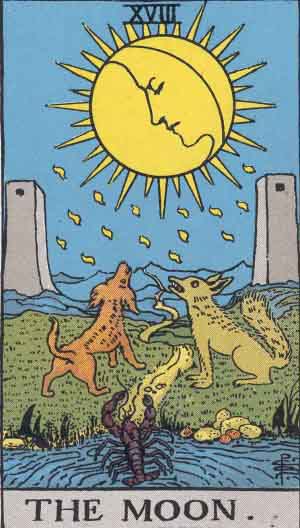 While different creatures may appear on this card, The Moon itself suggests latency. This is a realm or stage of potential, of possibility not yet manifest in the physical world. On this traditional card, 15 yods (the Hebrew y:
  ) appear beneath the Moon — a source of perplexity and confusion on numerous Tarot forums.
 Unlike the Moon, the Sun features a human figure, naked and on horseback, with arms spread wide. Four sunflowers rise from what looks like a garden wall — the four elements under the light of the Sun. If we choose to call this mounted figure the Seeker or Fool, you might also choose to note that nothing is hidden — all is touched by the solar light, 11 straight sunbeams and 10 rippling ones for a total of 21, suggesting the final card of the Major Arcana, the World.
 If the Sun reveals all things, or signifies attainment of a certain degree of illumination, we can see Judgement echoing the Christian end of time and the resolution of events launched at Creation. Figures rise from graves or caskets at the blast from the angelic trumpet.
 In the Christian worldview, Judgement is the precursor to Heaven or Hell. For the Tarot, though, neither of these follows. Instead, we encounter the World. Is it the same World as in the beginning, or the place where we Fools find ourselves?
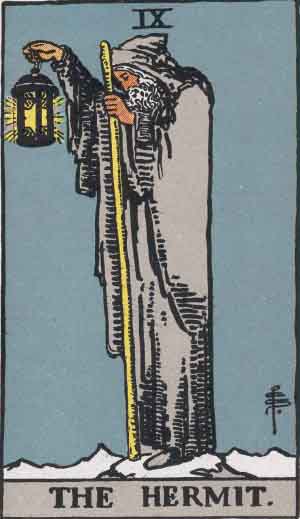 Hermits abound in world-wide lore and legend, running the gamut from hell-bound to holy. Depending on your temperament and the rebuffs that life generously doles out to all of us, you may find in the Hermit a kindred spirit, someone who chooses, as the French have it, reculer pour mieux sauter: “to draw back in order to make a better leap” back into the fray. Or eremitic withdrawal may become the theme for a lifetime, or a whole series of them. Plenty of secular examples come to mind as well, especially if you’re rich enough to build a life from your eccentricities, like billionaire Howard Hughes.
 The Wheel or Spiral, the lungo drom or long road of yearning of the Romani, the Wheel of Becoming in Hinduism, “what goes around comes around” of folk wisdom, all point to the circular nature of life and the resonances that our actions establish.
 In Matthews’ deck, the corresponding figure is Sovereignty: “our true self and the land are one”. The justice of this inner truth emerges in the great rebalancing that earth is currently experiencing, as the consequences of our past actions come home to us, and we begin to accept responsibility for them and to work off their effects. But we need not merely suffer them passively; we can work with them creatively for the purposes of transformation, which is what cause and effect are placed to afford to all who seek.
 The next Tarot image in our series is the Lovers. (The Matthews’ Arthurian image is of the White Hart, with the lovers
  The Chariot in the traditional deck (or Prydwen, Arthur’s ship of journeying in the Arthurian deck) closes out the first of the three rows of the Major Arcana (if we lay out the cards in 3 rows of 7, with the Fool or Seeker as the one who moves through each on the Journey). And again, in one traditional interpretation, this first row has to do with the maturing self, the personal, the exploration and development of capacities and potencies of the individual.
 “The Sovereign Lord is my strength! He makes me as surefooted as a deer, able to tread upon the heights” (Habakkuk 3:19). Or to be gender-fluid about it: “I honor Lady Sovereignty who strengthens me here on this Land where the deer runs, showing me how to walk the heights with sure feet”.
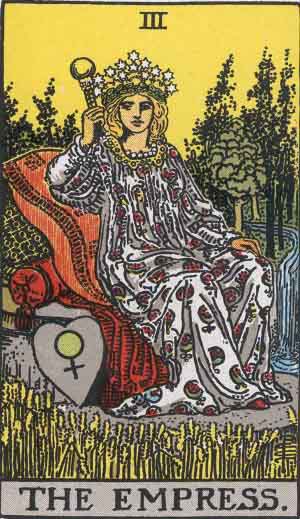 The Empress of the traditional deck, with her 12-star crown and sceptre, and the astronomical symbol of Venus next to her chair or throne, is another goddess figure. As an aspect or representation of the energies along the journey of the Fool or Seeker, she grounds us in the earth. The wheat growing at her feet, the waterfall to her left, the forest behind her, all place her “in the world” of both fruitfulness and change. Whether as Mother Earth, or Mary, or another goddess, or a living but impersonal archetype, or the fertile and fruitful energies within us, the Empress is a potent force and presence.
 The Emperor in the traditional deck hews to traditional symbols and representations of patriarchal power: beard, crown, scepter, throne, armor, harsh and rather sterile landscape, rams’ horns adorning the throne’s arms and back. (It can be helpful for such reasons to consult other decks for different images and symbolism.) The fact that we’re experiencing the negative effects of imbalanced masculine energies in our lives simply tells us a piece of what needs healing and re-balancing. Scan most headlines and you realize many people haven’t a clue about how to begin to do this — itself a measure of how out of balance the energies have become for many. We’ve often jettisoned outmoded forms of spirituality, true — but neglected to replace them.
 The figure in the traditional deck of the Hierophant, the “one who shows the holy”, may bring further associations of institutional authority and entrenched structures and imbalances.
 Denise





 “What I find so interesting is that you’re not dabbling … you’re committed to both traditions”, says interviewer Mary Heinz.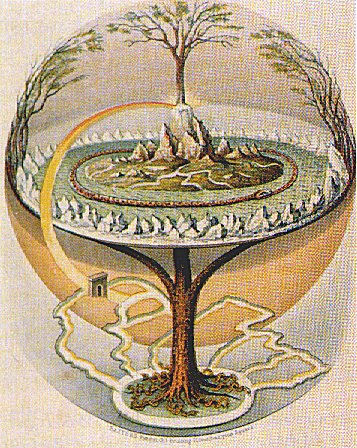
 As I mentioned above, there are many trees we could include in any list like this, the tree being such a powerful collection of understandings, physical beings, symbols, images, experiences, and cultural and spiritual markers and maps. Those on quests often find themselves needing silence, retreat, withdrawal, fasting from superficial human interaction in search of deeper, more meaningful connection.


 A Druid Way
