Archive for the ‘initiation’ Tag
Go to Part 1 | Part 2 | Part 3 | Part 4 | Part 5 | Part 6
 With energies flowing around us from so many end-of-year holidays and celebrations, it seemed fitting to think and write about initiation. It’s one more piece of a Religious Operating System (ROS), it’s an important key to Druidry and — most importantly — it’s something we all experience. For good reason, then, the subject cuts a large swath through spiritual, religious and magical thought and practice. As author Isaac Bashevis Singer opens his book The Chosen, “Beginnings are difficult times.” That’s one reason New Year’s resolutions often end up on the cutting room floor of the film version of our lives. (Some ways to keep them alive and well and not merely part of the special extended version of our lives that may not see wide release into the “real” world will be the subject of a post upcoming in the next few days.)
Some opportunities for initiation recur each year, and are built into our cultures. Right now the festival holidays of Hanukkah, Christmas, Diwali, Kwanzaa and so on are opportunities for annual initiation — if we let their celebrations reach into us and change us. As breaks from “profane” or ordinary time, holidays take us into altered if not sacred space, and then return us to our lives somehow — ideally, anyway — changed. Of course, specific religions and spiritual paths each offer their own initiations. For Christians, it’s baptism (and for Catholics and some other denominations, confirmation as well). A Jew passes through a bar or bat mitzvah, and so on.
But we needn’t look so far or so formally. First kiss, first love, first sexual experience, first drink (consider the particular sequence of these in your own life). Driver’s license, prom, graduation, military draft. Each transforms as a rite of passage. We “pass through” and come out on the other side, different, in ways others may or may not notice. We ourselves may not fully absorb the changes until much later.
 As with the kinds of freedom I considered in a previous post, there seem to be both “transitive” and “intransitive” initiations — initiations which enable or empower the initiate to do something — typically in the future — and initiations which recognize a standard or awareness already attained, and put a “seal of approval” on it. Of course these need not be separate. Both kinds can occur simultaneously. Initiation is a “beginning” (from Latin initio “start, beginning”) both a path or direction that another agency, power or person starts us on, and also something one does or experiences oneself.
Some big initiations are inclusive. Like annual holidays, we all experience them. Though we may not often think of it, death — our own, or that of a loved one, or of a public figure with symbolic power, like a John F. Kennedy or a Princess Diana — can be a powerful, transformative initiation. Through the grief and the inevitable breaks in familiar routine that come with the first shock, the family gatherings, the arrangements and the funeral itself, we’re brought to face loss, change, mortality, and endings and beginnings in ways. We may take on new, unfamiliar roles, like caretaker, mourner, survivor, with all the challenge and growth they can bring. The first death we encounter (apart from pets), given the usual number of years between generations, comes almost like clockwork sometime in our teens, with the passing of a grandparent. In the freshman dorm at the boarding school where I teach and serve as adviser, there are four or five deaths of grandparents each year, and all the myriad changes they carry with them for those involved. It’s a close study in family dynamics (and our capacity as advisers to provide support) to witness how kids and their families deal with it all.
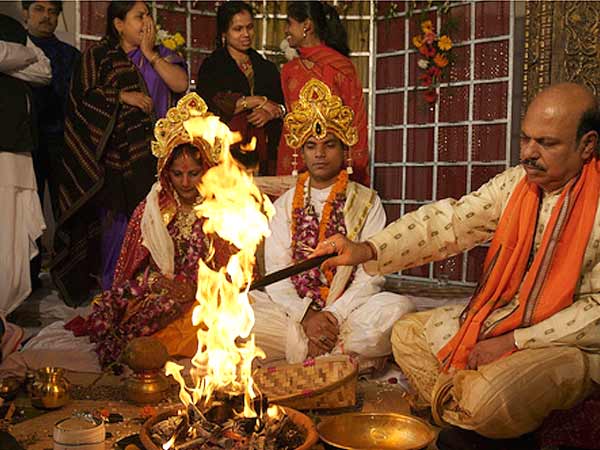
 Marriage often seems to occupy a sort of middle ground as far as these categories operate. On the one hand, no one is married in the eyes of either the law or a religious organization until they pass through the requisite ceremony. Yet we all know couples who are already “so married” that the ceremony confers nothing that they don’t already manifest in abundance. In this case, the initiation of marriage simply recognizes and formalizes a connection and a state of relationship that already exists and — if the ritual or ceremony still carries any power — blesses and charges the thing consecrated. My wife and I have two anniversaries, ten days apart, and each conveyed to us different energies. First was a spiritual ceremony by a cleric in our tradition, and second came the state ceremony, performed by a justice of the peace. Interesting, too, who we see as performing or undergoing the initiation. Ideally, to my mind, the one experiencing the initiation should play at least some part, if not an active role, in its enactment. For initiation takes place both outwardly, where it is often witnessed by the state if not also by family, and more importantly inwardly, on the subtle planes (which deserve their own post or series of posts).
“Where is wisdom to be found?” goes the old query. Initiation is one major source. Not all initiations “show” right away, or even ever. What we begin may never end. It can take a lifetime to sort out the effect of even “lesser” initiations, to say nothing of the big ones. Those “long” words, never and always, very much belong with initiations.
Go to Part 1 | Part 2 | Part 3 | Part 4 | Part 5 | Part 6
/|\ /|\ /|\
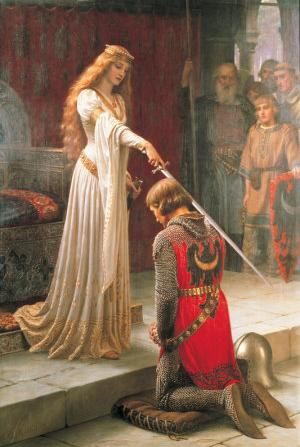
Image credits: Knighthood — “The Accolade” by Edmund Blair Leighton
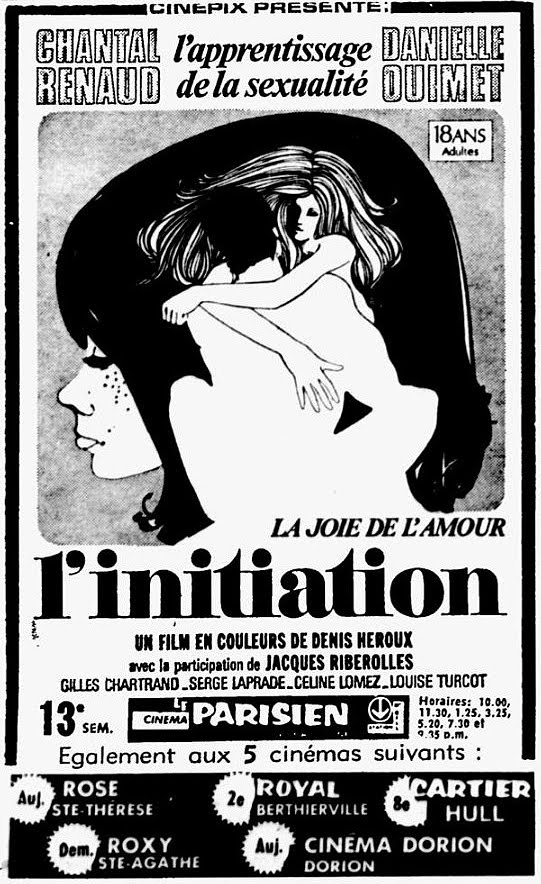
Sex and love
Oriya Indian wedding
Persistence, and its twin patience, may be our greatest magic. Sacred writings around the globe praise its powers and practitioners. So it’s hardly surprising, here in the too-often unmagical West, with its suspicion of the imagination, and its demand for the instantaneous, or at least the immediate, that we are impatient, restless, insecure, harried, stressed, whiny, dissatisfied and ungrateful. We bustle from one “experience” to the next, collecting them like beads on a necklace. The ubiquitous verb “have” leaves it mark in our speech, on our tongues: we “have” dinner, we “have” class or a good time, we even “have” another person sexually, and one of the worst sensations is “being had.” We do not know self-possession, so other things and people possess us instead.

The “slow food” movement, the pace appropriate for savoring, craftsmanship, care, reflection, meditation and rumination (slow digestion!) all run counter to the ethos of speed, promptness, acceleration that drive us to a rush to orgasm, speeding tickets, the rat race, stress-related illness, and so on. None of these problems or the observations about them are new, of course. But we remain half-hearted in our efforts or understanding of how to “pursue” their remedy. We chase salvation as much as anything else, as a thing to collect or gather or purchase so we can be about our “real” business, whatever we think that is. Spirituality gets marketed along with orange juice. For a sum, you can be whisked off to a more exotic locale than where you live your life, spend time with a retreat leader or guru or master or guide, and “have” (or “take”) a seminar or class or workshop.
Anyone who has adopted a spiritual practice and stuck with it has seen benefits. Like regular exercise, it grants a resilience and stamina I can acquire in no other way. I sit in contemplation and nothing much happens. A week or a month goes by, and my temper might have subtly improved. Fortunate coincidences increase. My dream life, or a chance conversation, or a newspaper article, nudges me toward choices and options I might not have otherwise considered. But usually these things arrive so naturally that unless I look for them and document them, I perceive no connection between spiritual practice and the increased smoothness of my life. From a slog, it becomes more of a glide. But the very smoothness of the transition makes it too subtle for my dulled perceptions at first. It arrives naturally, like the grass greening in the spring, or that gentle all-day snow that mantles everything.
I abandoned a particular daily practice after many years, for complicated reasons deserving a separate post, and I needed only to read the notebooks I kept from that earlier time to recall vividly what I had lost, if my own life wasn’t enough to show me. My internal climate faced its own El Nino. I was more often short with my wife, mildly depressed, more often sick with colds, less inspired to write, less likely to laugh, more tired and more critical of setbacks and annoyances. Set down in writing this way, the changes sound more dramatic — didn’t I notice them at the time? — but as a gradual shift, they were hardly noticeable at any one point. I still had my share of good days (though I didn’t seem to value them as much), and my life was tolerable and rewarding enough. “But I was making good money!” may be the excuse or apology or justification we make to ourselves, and for a time it was true enough of me. Then came the cancer, the near-breakdown, the stretch of several years where I seemed to move from doctor to doctor, test to test, treatment to treatment. If you or anyone you know has endured this, you get what I’m talking about. It’s distinctly unfun. And while I won’t say lack of practice caused this, it’s an accompanying factor, a “leading indicator,” a constituent factor. Doctors might very profitably begin their diagnoses with the question, “So how’s your spiritual practice?” Our spiritual pulse keeps time with our physical lives. They’re hardly separate things, after all. Why should they be?
In the story of Taliesin I mentioned in my last post, the boy Gwion, so far from the future Taliesin he will become, is set by the goddess Cerridwen to watch a cauldron as it cooks a magical broth meant to transform her son Afagddu, a mother’s gift to her child. A year and a day is the fairy-story time Gwion spends at it. A full cycle. The dailiness of effort and persistence. The “same-old,” much of the time. Gwion’s a servant. The cauldron sits there each morning. The fire beneath it smoulders. Feed the fire, stir the liquid. It cooks, and Gwion “cooks” along with it, the invisible energy of persistence accumulating as surely as the magical liquor boils down and grows in potency. Through the spring and summer, insects and sweat. Through autumn and winter, frost and chill and ice. The cauldron has not changed. Still at it? Yes. The broth slowly thickens as it bubbles and spatters.
 One day a few drops (in some versions, three drops) fly out onto one of Gwion’s hands, burning. Instinctively he lifts the hand to his mouth, to lick and soothe it with his tongue. Immediately the magic “meant for another” is now his. He did, after all, put in the time. He sat there daily, through the seasons, tending the cauldron, stirring and keeping up the fire, swatting insects, breathing the smoke, batting sparks away, eyes reddened. Yes, the “accident” of the spattered drops was at least partly the result of “being at the right time in the right place.” It is “luck” as well as “grace,” both operative in his life. Part, too, was the simple animal instinct to lick a burn. And the greater portion was the effort, which catalyzed all the rest into a unified whole. Effort, timing, luck, chance, grace: the “package deal” of spirituality.
And the consequence? For Gwion, his growth has just begun. It is his initiation, his beginning. In his case it distinctly does NOT mean an easier path ahead for him. In fact, just the opposite — more on that in a coming post.
 The Hopi of the American Southwest call their ritual ceremonial pipe natwanpi, “instrument of preparing.” The -pi suffix means a vehicle, a means, a tool. Tales like this story of Gwion can become a natwanpi for us, if we choose — part of our preparation and practice, a tool, a way forward.
/|\ /|\ /|\
Fast food
Transformation
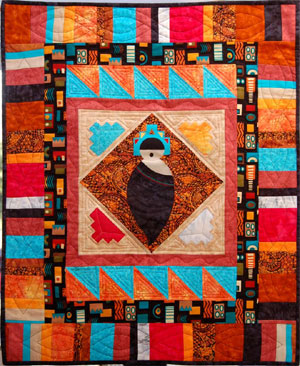
Hopi blanket
 Those inclined to criticize contemporary Druidry have made much about how the specific practices and beliefs of ancient Druids are forever lost to us simply because they left no written records, and because the references to Druids in the works of classical Greek and Roman authors are mostly based on secondhand accounts and sometimes markedly biased. Without such historical continuity, they claim, it is impossible to be a “real” Druid today, and thus all contemporary Druidry is a kind of whistling in the wind, at best a version of dress-up for adults. But what such writers and speakers often forget is the surviving body of legend, myth, teaching and wisdom in Celtic literature. Here is Druidry in compact and literary form, meant to be preserved as story, a link-up with the perennial wisdom that never dies.
To pick just one example, the stories from the Mabinogion, the Welsh collection of myth, legend and teaching have wonderful relevance and serve as a storehouse of much Druid teaching. Sustained meditation on these stories will reveal much of use and value to the aspirant after a Druidry that is authentic simply because it is grounded in knowledge and practice. As a pragmatist more than a reconstructionist, I’m much more interested in what works than in what may be historically accurate. The former leads one to inner discoveries. The latter is engaging as a worthwhile scholarly endeavor first, and only as a possible source of spiritual insight second. And that is as it should be. History is not spirituality, though it can inform it. But even if we can accurately deduce from an always incomplete archaeological record what a Bronze Age Druid may have done, it’s still not automatically fit and appropriate for a contemporary 21st century person to adopt. That’s a decision we must make apart from the reconstruction, which cannot guide us by itself. Stories, however, though formed in a particular culture, often reach toward universals far better than physical objects and actions.
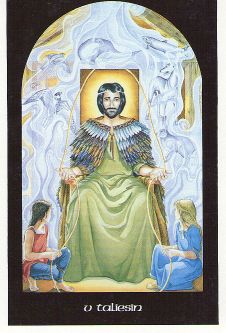
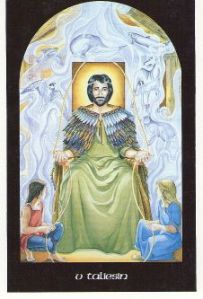 The story of Taliesin (this link is to a public domain text — more modern and well annotated versions are available) in the Mabinogion moves us into a world of myth and initiation. In the tale, the boy Gwion passes through ordeals and transformations, becoming at length the poet and sage Taliesin, whose name means “shining brow” — one who has a “fire in the head” and is alive with wisdom and poetic inspiration. As with figures from other traditions whose heads are encircled with halos, or shining with an otherworldly brightness, Taliesin belongs to the company of the “twice-born,” who have fulfilled their humanity by making the most of it. In my next post, I’ll talk about the first key in the story — persistence.
/|\ /|\ /|\
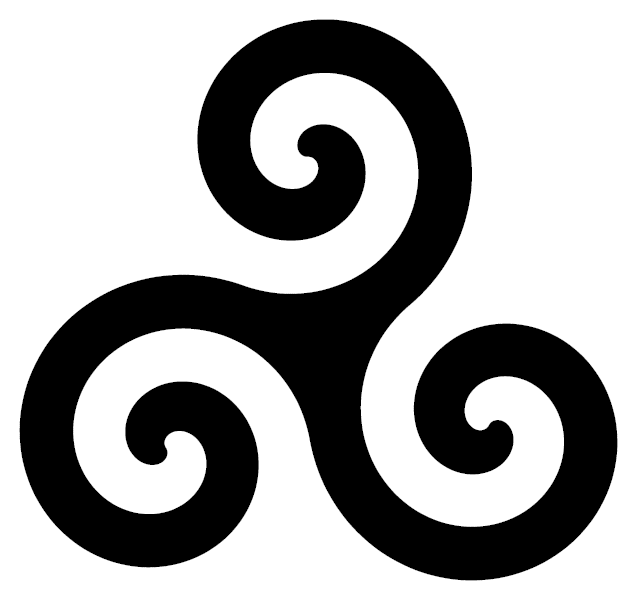
First image is a triskele or triskelion, a pan-European symbol associated with the Celts.
Second image is of Taliesin from Caitlin and John Matthews’ Arthurian Tarot.
/|\ /|\ /|\
Updated 9 September 2013

 With energies flowing around us from so many end-of-year holidays and celebrations, it seemed fitting to think and write about initiation. It’s one more piece of a Religious Operating System (ROS), it’s an important key to Druidry and — most importantly — it’s something we all experience. For good reason, then, the subject cuts a large swath through spiritual, religious and magical thought and practice. As author Isaac Bashevis Singer opens his book The Chosen, “Beginnings are difficult times.” That’s one reason New Year’s resolutions often end up on the cutting room floor of the film version of our lives. (Some ways to keep them alive and well and not merely part of the special extended version of our lives that may not see wide release into the “real” world will be the subject of a post upcoming in the next few days.)
 As with the kinds of freedom I considered in a previous post, there seem to be both “transitive” and “intransitive” initiations — initiations which enable or empower the initiate to do something — typically in the future — and initiations which recognize a standard or awareness already attained, and put a “seal of approval” on it. Of course these need not be separate. Both kinds can occur simultaneously. Initiation is a “beginning” (from Latin initio “start, beginning”) both a path or direction that another agency, power or person starts us on, and also something one does or experiences oneself.
 Marriage often seems to occupy a sort of middle ground as far as these categories operate. On the one hand, no one is married in the eyes of either the law or a religious organization until they pass through the requisite ceremony. Yet we all know couples who are already “so married” that the ceremony confers nothing that they don’t already manifest in abundance. In this case, the initiation of marriage simply recognizes and formalizes a connection and a state of relationship that already exists and — if the ritual or ceremony still carries any power — blesses and charges the thing consecrated. My wife and I have two anniversaries, ten days apart, and each conveyed to us different energies. First was a spiritual ceremony by a cleric in our tradition, and second came the state ceremony, performed by a justice of the peace. Interesting, too, who we see as performing or undergoing the initiation. Ideally, to my mind, the one experiencing the initiation should play at least some part, if not an active role, in its enactment. For initiation takes place both outwardly, where it is often witnessed by the state if not also by family, and more importantly inwardly, on the subtle planes (which deserve their own post or series of posts).



 A Druid Way