Imbolc, the February 1st or 2nd holiday, part of the seasonal cycle of the “Great Eight” Pagan festivals, has long been associated with Brighid. Goddess, saint, patron of poets, smiths and healers, Brighid is a potent presence for many Druids. Christian Druids can honor her in either or both traditions, and her legends and symbols — effective points of access to her — are many.
Among the traditions that have gathered around her is the significance of the number 19 — whether part of the ancient awareness of the moon’s Metonic cycle, or the Christian tradition for determining Easter, curiously associated with the full moon, or the 19 nuns at Kildare connected with Saint Brighid. Or the practice of 19 days of magic focused on devotion to the goddess-saint, which this post examines. As a Druid-Christian link, the number and practices associated with Imbolc and Brighid can join the others I’ve talked about in other posts here as yet another means to transcend argument or debate, and find blessing.
Nineteen days with Imbolc in the center (on Feb. 1), the 10th day, begin January 23 and take us to February 10.
As this circle is cast, the enchantment of the apparent world fades … We stand together in the eye of the sun here and now …
So goes part of OBOD standard ritual. Why, you might be asking, if Druids say they wish to attune themselves to the natural world, do they practice ritual that sees the natural world as both enchanted and apparent?
Well, we still stand “in the eye of the sun”. Partly it’s “talking self” (see this and this post) that distracts us, that enchants us in the sense of holding us spellbound (and self-bound) rather than freeing us to grow. Circles concentrate energy and attention, contain them for the duration of the ritual, and can help charge us as instruments of the divine in order that we may “know, dare, will and keep silent”, as the old adage goes. So we circle alone and together to watch that particular enchantment fade, so that others can manifest more clearly. It’s a choice of enchantments. Do you like the current ones at work in the world? “She changes everything she touches, and everything she touches changes”. Sign me up!
Spending the interval from now till the beginning of the 19 days, a week from today, determining what service to offer, what magic to work, is time well spent.
I’ll be following up here with my experiences.
/|\ /|\ /|\
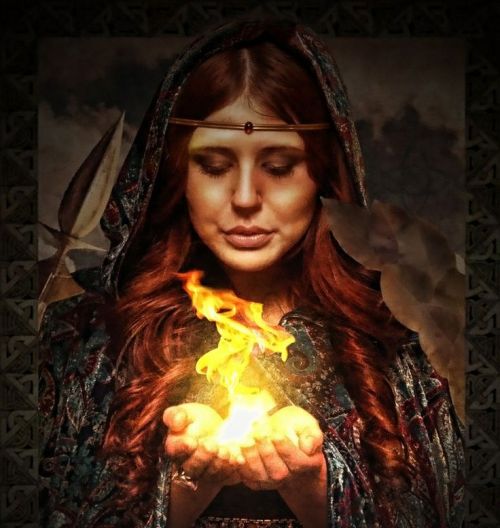
Image: Brighid. My preference is for deity images that aren’t sentimental or “airbrush pretty”. Contemporary artists often portray sexy gods and goddesses, which is fine, but as an image for meditation I’d rather not use soft porn.
The first stanza of Damh the Bard’s lovely song “Brighid” (below) places the goddess in the landscape of vision:
There’s a tree by the well in the wood,
That’s covered in garlands,
Clooties and ribbons that drift,
In the cool morning air.
That’s where I met an old woman,
Who came from a far land.
Holding a flame o’er the well,
And chanting a prayer.
Though here it’s the goddess who’s “chanting a prayer”, the bard has invoked her with song — his own prayer. And he’s gone to the “well in the wood” full of intention. Maybe not specifically to see the goddess, but knowing the tree and the well and the moment offer possibility waiting for human consciousness to activate. A gift of the gods, already given freely to us.
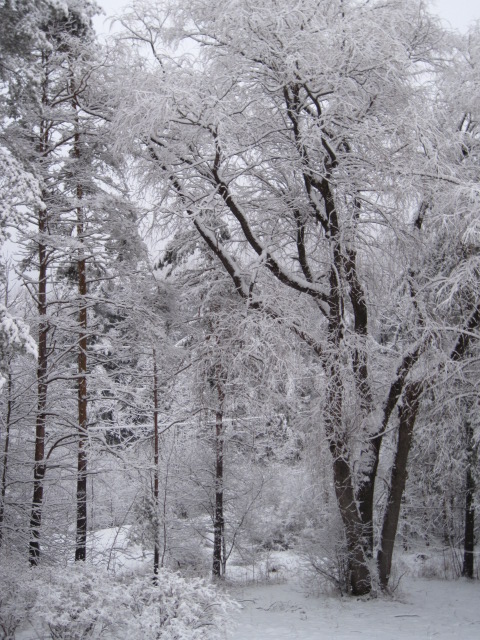
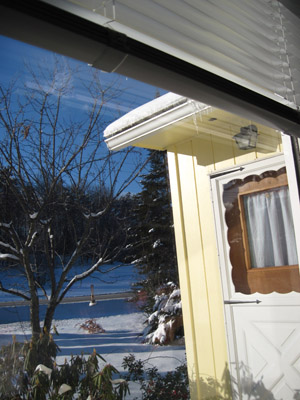
Here in Vermont a light snow falls as I write this, and I step away from the keyboard to take a picture.
By February here, snow itself can signal spring to come. You can feel the longer light, and moments of snowy beauty remind you that wonder is never far away. The sap will be running soon in the maples, the sugar shacks smoking all day and night as the sugarmen boil down the sweet juice to syrup. Green will burst forth, improbable as that seems right now in a world of cold whiteness. So Brighid comes from a “far land” that is also always near to attention, intention and devotion.
Here across the Pond from the Celtic homeland, some North American Pagans can feel removed from the “gods of Europe”, bewailing their distance. This place, we can feel, isn’t “Their” land. Yet anyone who’s encountered a spiritual presence knows that place is a convenience of the gods, not a requirement — a set of clothes, not the being who wears them.
Yes, it would be splendid, we imagine, to visit that “tree by the well in the wood”, simply by stepping out the back door to a landscape steeped in stories and legends of the goddess. Yet we also know what familiarity breeds. Or as an African proverb has it, “Those who live nearest the church arrive late”. The old saying that the gods like the offering of the salt of human sweat means effort is not wasted, devotion is repaid. Always, we have something we can offer them. And the gods give, but “not as the world gives”.
For you soon find that the gods are not merely passive reservoirs, to be drawn down whenever we happen to think of them and plug in for a re-charge, our rituals cannily crafted to work like the swipe of a credit card at a gas (petrol) pump. “Fill me up, Brighid!”
But wait, you say. Isn’t that just what we’re doing with ritual and song?
It’s really not a matter for argument, unless you need the exercise. Damh the Bard knows Brighid — you can hear it in the song. And out of love he’s traveled many times to the tree by the well in the wood. Brighid knows his name.
This, then, is one intention to cherish: may we serve them so that the gods know our names. Not to hold it up before others like a badge of pride, but as a spiritual resource to treasure and spend at worthy need. Or as Gandhi said, “If no one will walk with you, walk alone” knowing in truth you aren’t alone.
Ten years ago I didn’t honor Brighid. I didn’t “believe” in her, though I’d heard her name, thanks to all those who kept it alive in our world. Now I honor her, but I still don’t trouble myself about “belief”.
Instead, I take the hint and look. “I saw her reflection in the mirrored well”, Damh sings.
And I looked deep in her face,
The old woman gone, a maiden now knelt in her place,
And from my pocket I pulled a ribbon,
And in honour of her maidenhood,
I tied it there to the tree by the well in the wood.
The Hopi of the American Southwest call one of their ceremonial pipes natwanpi — literally, “instrument of preparation”. As words do, this one stuck with me ever since I read it, decades ago now. No wonder: we need markers for passage into sacred time, because otherwise it can burn and blow right past us. Or, to shift metaphors, if we don’t catch the sacred wave, we can’t surf in sacred time. We miss that tidal flow, then wonder why life can seem flat or dis-spirited.
With a beloved festival like Imbolc calling us, what better time to consider how we can attune to sacred times and sacred tides?
Shinto, that perennially popular topic here at A Druid Way, offers a mid-January festival called Bonden-sai which feels harmonious with Druid practice. Of course it has cultural flavors and overlays unique to Japan and Shinto, but its focus asks for and offers a kind of natwanpi. (Besides, a cold, gray, snowy northern January can use some color and liveliness.)
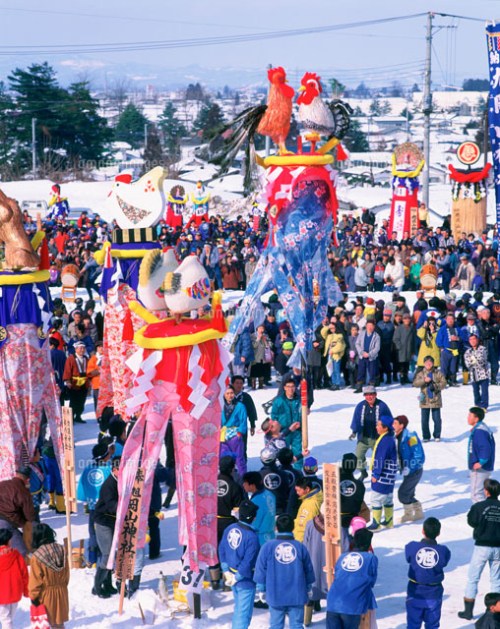
Bonden-sai, Akita Prefecture
The bonden for which the festival is named is called a “sacred wand”, though as you can see from the bonden in the picture above, “pillar” or “column” better suggests its appearance. (Let the chickens on some of the bonden above enlarge your sense of “sacred”!) A typical bonden, the Japanese National Tourist Organization (JNTO) helpfully informs us, measures
almost four meters in length … [and] serves as a marker for the gods descending to this world. In ancient times, bonden used to be made of paper or rice straw, but in recent years, they are often made by decorating a bamboo basket with colorful fabric. The bonden wands are carried by groups of children, townspeople, or even company employees. Each group entrusts the bonden with their prayers for an abundant harvest, good health for their families and success in business.
Bonden-sai is intimately associated with Akita Prefecture in Northwest Japan. Akita is also famed for its onsen (hot springs) and mountains, and Mount Taiheizan, the symbol of Akita City, is a major site for the festival. Bonden-sai there means a vigorous race up the mountain with your bonden to procure the blessings of the gods.
Shinto and Japanese culture, so long linked, have celebrated the sacred in so many things that the secular West allows to pass unremarked. Whether it’s drinking tea or sake, or bathing, or marking the calendar with a plethora of festivals, Japan models practices the West and particularly western Paganism learn from, build on and delight in.
Because when the gods are dead, the human heart also dies a little every day. You certainly don’t have to “believe” in them as any kind of prerequisite, any more than you have to believe in anything in particular to celebrate Halloween or Christmas or MLK Day. The gods themselves can serve as a kind of natwanpi, a means of preparation. Belief, like so much else, is a tool, a strategy, a technique for connecting to things other than ourselves. Use it skilfully, delicately, consciously, I’m learning, and it repays the respectful treatment.
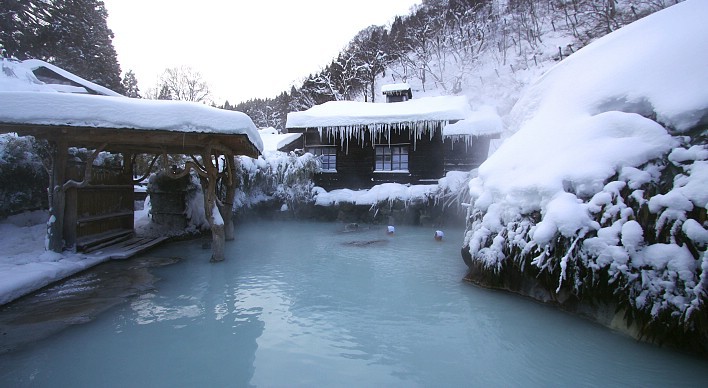
Nyuto Onsen (hot springs), Akita Prefecture
Ultimately it’s the impulse to celebrate that’s the flame to cherish. And if it chances on occasion to be gods that help it happen, as one of the forms the sacred can take, why exclude them out of hand, just because they’re gods?
As for me, I try to take advantage of any natwanpi that comes my way. And if I succeed and connect only 30% of the time, well, isn’t that a very respectable baseball batting average?!
“Ah, the seed has long lain there fallow, only at Imbolc do you at last feel it stirring beneath the snows.”
/|\ /|\ /|\
Marie-Louise von Franz
“One must start where there is still a flow of energy, even if it is just a thin flow, even if it seems silly” — Mary-Louise von Franz, Animus and Anima in Fairytales (Inner City Books, 2002).
Before and at and around Imbolc, the god Lugh draws me powerfully. Naturally, because time isn’t linear, and the workshop talk I’ve agreed to at Lughnasadh, a six-month conjunction with Imbolc and another fire festival, is now at work (was, before I agreed to it), by the god’s hand, or my own, or — more confusing and interesting — both at once. Snow on the ground, the land still in the grip of the Frost Giants (I like mixing myths, personally, at least by season), and here comes Lugh to prod me into action with his spear. Or if not action, exactly, some kind of attention.
The shape of the talk as it comes to me now in bits and starts will deal among other thiings with the matter of encountering a god, but also of any new course of action, of imagination, of inspiration. These wear different cloaks, but from what I can see, under them they’re the same, or at least siblings, equal parts trust and terror at times. Energy — which is what we are at heart, intelligent energy on the move.
So the seed, the nudge to change, to move, to grow — it comes and roots itself in us. And when the root-strength that cracks sidewalks and shoves boulders aside and generally plays havoc with human ideas of permanence and endurance finally gets to work, things move.
And often enough the seed then dies in the ground. What nourishes it? We stomp on it, uncomfortable thing, reminding us that something outside us wants to work its will with us, here, too. Right in the middle of streaming Netflix and election madness and ISIS and the woeful state of things and our own personal misery and joy, the particular flavor and color of crazy that the current year puts on each morning, mourning. Just because.
But let trickle reach seed and GERMINATION! Watch out! Funny, the vegetation god from the House of Bread (which is “Bethlehem” translated, as John Michael Greer obligingly reminds us) puts it this way in a Gospel, which really is supposed to be good news after all. Or as a Bard thinks of it, a song for the queens and kings we could be:
And he taught them many things by parables, and said unto them, Listen, a sower went out to sow: And it happened, as he sowed, some seed fell by the wayside, and the birds of the air came and devoured it. And some fell on stony ground, where not much earth was; and immediately the seed sprang up, because it had no depth of earth: But when the sun rose, it was scorched; and because it had no root, it withered away. And some fell among thorns, and the thorns grew up, and choked it, and it yielded no fruit. And other fell on good ground, and yielded fruit that sprang up and increased; and brought forth, some thirty, and some sixty, and some a hundredfold. And he said to them, Those who have ears to hear, let them hear.
/|\ /|\ /|\
We can play a part here in germination. (Says who? Well, I can argue about it, or I can try it out for myself. Which is more fun?) Where is my fertile ground? What god/dess is planting there? Where’s that trickle? Ah, there.
And so it begins. If I’ve learned anything to pass along, it’s the magic when seed and trickle meet. I can’t make seeds, but I can maintain a greenhouse for them. I can’t start the trickle, but I can pay attention when one comes — I’ve got ears to hear — and help it flow or block it. There. To work.
Much of our human anxiety clusters around an odd mental construct we call “tomorrow,” and sometimes those wacky futurists brought to us by odd institutes with funky acronyms and obscure sources of funding actually have something useful to contribute to earn their keep. Here’s Bruce Sterling on change (link to blog):
… as a futurist I just don’t do “positive” and “negative.” I actively avoid that kind of value judgment. Wishful thinking and fearful thinking gets in the way of an objective understanding of change-drivers. Change occurs from pent-up energies: it’s like asking if a battery’s voltage is “good” or “bad.” All potential change has positive or negative potential: otherwise it isn’t even “potential.”
“Change occurs from pent-up energies.” Without a reservoir of energy, it simply doesn’t happen. Any equilibrium — I’m extrapolating out loud here, to see what the implications look like — any apparent equilibrium or stasis, then, is a kind of wallpaper over pending change and a cloak for accumulating energies. In other words, things don’t change, until they do. Watch the surface and I won’t catch the building forces for change. Equilibrium, rather than a kind of reset to normal, an all-clear, all-systems-go signal, can be seen as a boiler, a reactor, a container for accumulating change-energies. If change is the norm, equilibrium is a pivot, a hinge. It’s not a place to live, but to visit, to stop by, to rest in. It’s the next foothold, the plateau wide enough for a pause, along the ascent.
“All potential change has positive or negative potential …” Both at the same time, in every case? If the energies behind changes are anything like water or electricity, they find the easiest channel to flow. A habit is the smoothest channel — it’s been widened, deepened and swept clean by repeated use, so energies for change often dissipate if they can flow along the channel of a habit. Block the habit, even once, when change is about to happen, and the flow will seek another channel — maybe even a new one, if other habits don’t swallow the energy.
[Personal observation here: the habit I referred to in the previous post has yielded for now to image and sound work, but as part of what I’m seeing as realignment, I’ve been catching myself indulging more in other repetitive/obsessive behaviors. Compensation? The energy will flow. An old computer game, for instance, suddenly seemed irresistibly interesting — I’d play a typical 10-minute session again and again, between other more productive tasks. The “path of least resistance” applies profoundly to working with habit and change. Eliminate one habit and energy will flow into the next easiest channel. A key I’m learning: make a change that’s easy for energy to fill. Howto do that is my practice.]
Can I avoid a value judgment, as Sterling claims he does? “Wishful thinking and fearful thinking gets in the way of an objective understanding of change-drivers.” Hmm. Often my wishes are negative: I want to escape/change/get away from/overcome X, and so X draws my attention, rather than the change I say I want to activate. Instead of spending energy on the change, I spend it on X. My attempt at change may actually be strengthening the habit.
Unlike the “get ___ quick/overnight/in just seven days!” promises of those with something to sell us, most permanent changes take longer to settle in. Everything I’ve learned from my habit can be used to build the energies of the changes I desire: visualization, sound, emotion, repetition. No doubt about it: change usually needs practice.
/|\ /|\ /|\
You might wonder what connection some of these recent posts have with Druidry. Good spiritual practice is good spiritual practice. Why else does “spiritual but not religious” resonate so deeply with so many? When religion gets in the way of spirituality, there’s a problem.
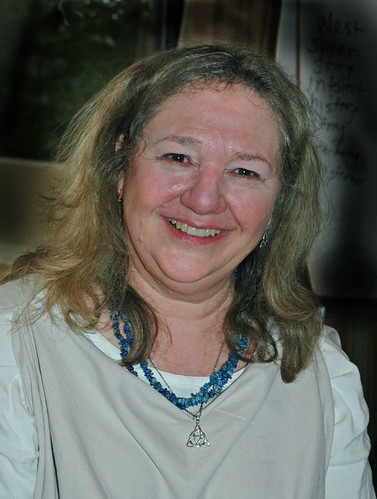
Ellen Hopman
Druid and author Ellen Evert Hopman offers this excerpt from her forthcoming book Legacy of the Druids.* Here is the voice of one of the many Druids she interviews. The attitude here, rather than the specifics, is what I cherish and practice in my own way. The fact that it assumes a Druidic form simply means you have yet another opportunity to translate good spiritual sense into your own particular tradition or idiosyncratic practice:
“The grandest moment of the year is on Imbolc, when I open up my door to the night and thank her for all that she has given, then pour milk across my threshold to the living world outside, inviting Her in, whoever She is, whatever deep and joyous mystery, whatever unplanned liberation she brings, even if it comes in the guise of loss and fear and death.
I believe in the abundance of life, through the most frightening and toilsome passages. I believe in the essential expansiveness of our souls, and these are encapsulated in Brigit, the patron of poetry, of healing, of smithcraft, the one who guides sailors through dark and turbulent seas, who sets the teats flowing and brings birth to the calves and lambs.
The world we inhabit is hidden in a tangle of veils – fear, rage, misunderstanding of who we are and how we are connected and how we can survive and flourish, human and nonhuman, wild and tame.
Facing our own tangles and emerging filled with that ability to give, to receive, to hope and love: that is how I see Her worship as functioning best. She is the beauty and She is the veils, and She is the freedom and unity I keep my eyes on when I struggle through.
Opening the door to Her on Imbolc, giving Her and Her world the nourishing gift of milk and inviting them more deeply into my heart – these are the most joyous religious acts I can ever commit.”
Mael Brigde
Vancouver, Canada
It’s a portion of Druid wisdom to master change in our lives — not to dominate life, which we can never do, but to sail with it onto that endless golden sea that, whenever I pay attention, is sparkling and surging around and within.
Earlier today my wife and I walked through the brilliant winter sunlight on the neighborhood loop that took us past snowfields already blue with late afternoon shadows.
Looking southeast around 3:30 pm
I’ve quoted the Philip Larkin poem “First Sight” before, but today it seemed perfect as a tribute to the goddess whose hearth (or in our case, woodstove) I worship at particularly intensely on these frigid midwinter days.
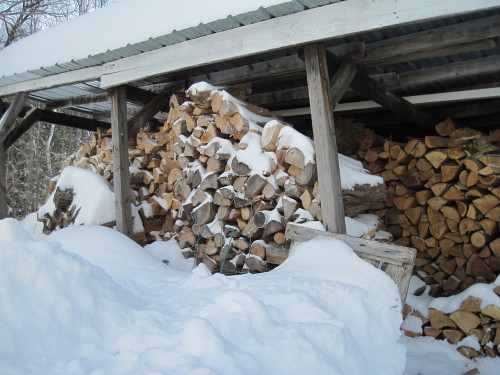
Imbolc as guide: more than half our wood remains.
Spring will come, and as goddess of fire and smithing, Brighid warms and heals and shapes us. Lack of any promising evidence for that change bothers her not at all.
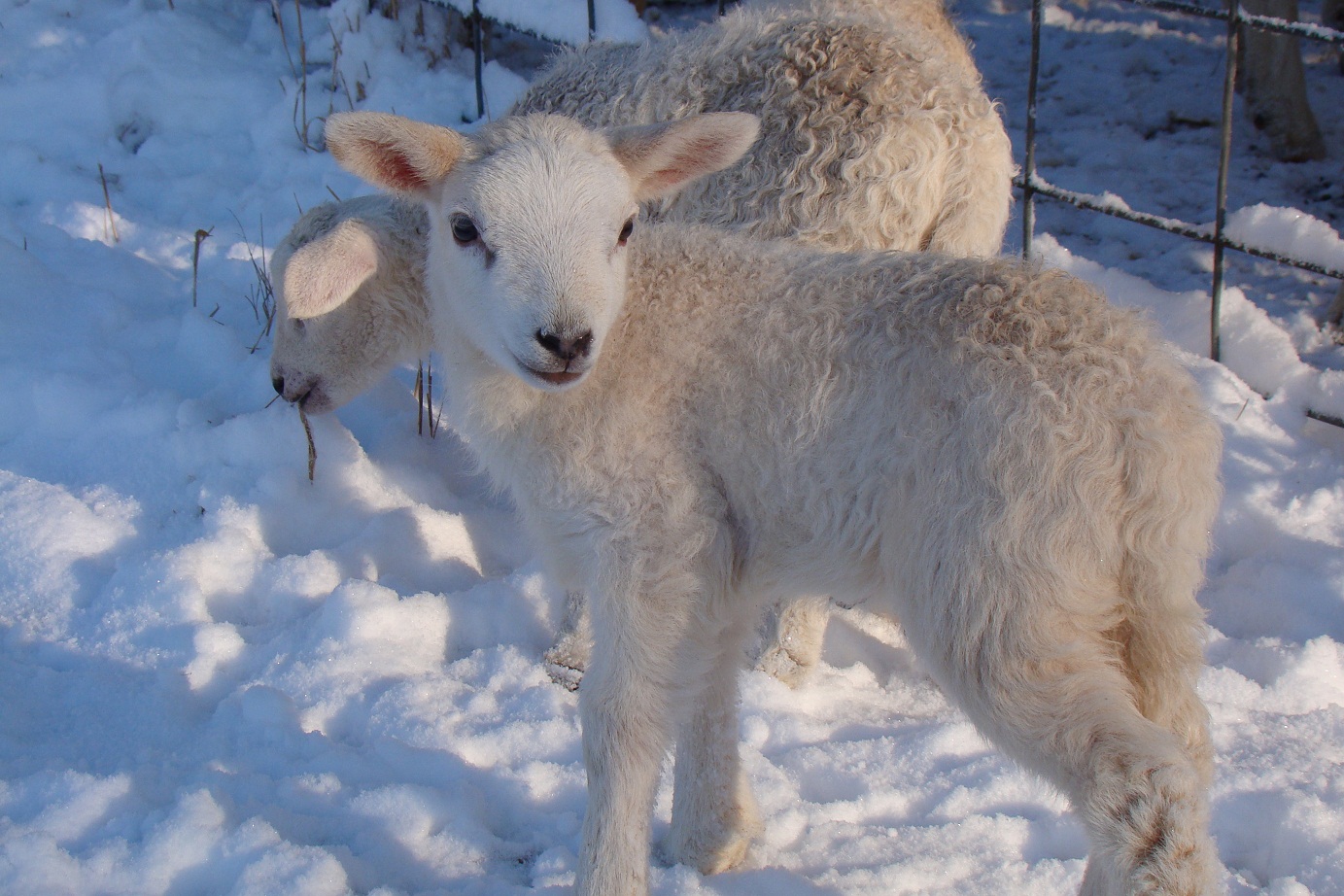
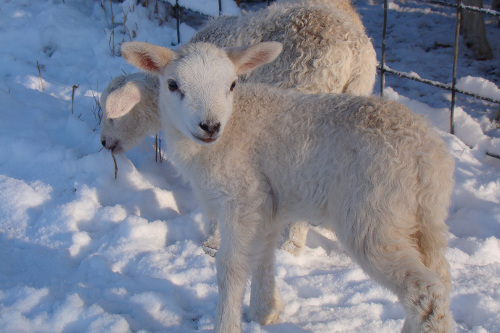
Larkin’s poem means more to us, because just four miles from our house a local farmer milks his herd of some 90 sheep and sells a variety of sweet, rich cheeses in a little shed halfway down the lane to his milk barn. Lambing season is usually later than February in the Northeast, for the simple reason that it’s too cold for the newborns in anything other than a heated shelter. Push the ewes to conceive too early in the fall, and you’ll end up with dead lambs. Larkin captures this time of change in a somewhat milder climate, but still snowy. Memory had me reciting his lines again to myself as we walked. I had to come back and locate the poem to fill in the gaps I couldn’t bring to mind:
Lambs that learn to walk in snow
When their bleating clouds the air
Meet a vast unwelcome, know
Nothing but a sunless glare.
Newly stumbling to and fro
All they find, outside the fold,
Is a wretched width of cold.
As they wait beside the ewe,
Her fleeces wetly caked, there lies
Hidden round them, waiting too,
Earth’s immeasureable surprise.
They could not grasp it if they knew,
What so soon will wake and grow
Utterly unlike the snow.
This always moves me — a transfomation we simply cannot see coming merely by looking around us. No evidence here, at least none we can make out. Even, sometimes, a “vast unwelcome.” Life in this world is catalyst. It never leaves us alone. What gifts of the gods and spirits and our own ancestors will wake and grow in us? Will we let ourselves be surprised? Brighid, may it always be so!
/|\ /|\ /|\
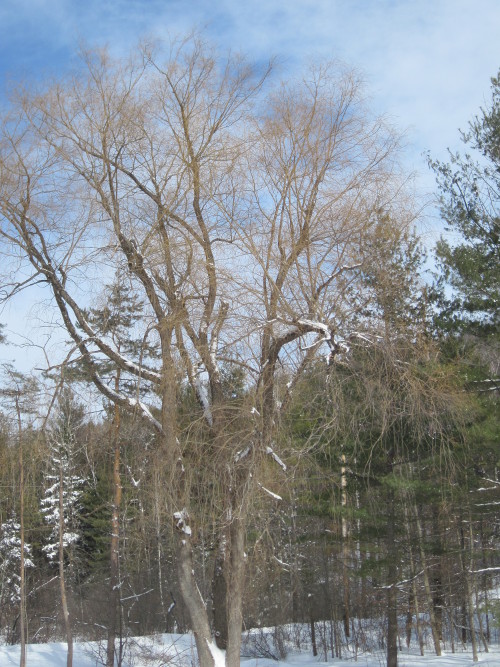
The rangy willow in our backyard has been feeling the sun these past several days. Even with its branches garbed in snow, you can make just make out in the crown of the tree the first faint reddish-green hint of spring in the depths of this February cold. Imbolc upon us. “They could not grasp it if they knew,/What so soon will wake and grow.” Memory of other Februaries wakes and hints at what will return, against the odds.
Backyard willow
With the triplet of Imbolc, Groundhog Day (in the U.S.), and a full moon tonight on Feb 3, it seemed right to celebrate today and tonight, the third day of the three. And this evening my wife and I enjoyed homemade potato soup rich with leeks and garlic and sour cream — we practiced the traditional Italian “mangiare in bianco” — literally, “to eat in white” in observance of the moon, without also “eating blandly or lightly,” as the expression can indicate, too.
The hill to our east, cresting perhaps four hundred yards above our roof, delays sunrise and moonrise both. Moonrise tonight “officially” hit Brattleboro VT at 5:09 pm. We wait for it longer here.
At first I thought the image below was a discard. A tree-trunk obscures one edge of the moon, and the horizon is hazy. But then I saw it perfectly captured our Imbolc experience. Slowly the sky cleared as the temperature continued to drop towards 0 (-18 C), as it has the last several nights. Hunger Moon* rose higher, and the moon-shadow of a pine in the backyard leaned out dark against the snow in the moonlight. I took another shot.
Moon around 6:45 pm, shortly after clearing our hilltop
Praise to Brighid and life and light, warmth human and divine in our veins, in the animals and plants around us! May our vision of the Whole become clear as the moon this night.
Moon around 8:00 pm
/|\ /|\ /|\
*Hunger Moon” is one of the Native American names for February — and never fails to make me shiver.
On first sight (or much later, depending on the particular script we’re following), the world can be a forbidding place. We all go through emotional and psychological winters at times. Nothing seems to provide warmth or comfort, so we hunker down and endure. And we can get so good at this kind of half-life that we mistake merely surviving for full-hearted thriving. Well-meaning friends or family who try to console us with various messages of hope or endurance (“This too shall pass”) can’t budge us from our heaviness.
The hidden changes implicit in the imminent shift of energy and consciousness which Druids symbolize and celebrate in Imbolc also find expression in the starkly beautiful lines of “First Sight” by British poet Philip Larkin.
First Sight
Lambs that learn to walk in snow
When their bleating clouds the air
Meet a vast unwelcome, know
Nothing but a sunless glare.
Newly stumbling to and fro
All they find, outside the fold,
Is a wretched width of cold.
As they wait beside the ewe,
Her fleeces wetly caked, there lies
Hidden round them, waiting too,
Earth’s immeasurable surprise.
They could not grasp it if they knew,
What so soon will wake and grow
Utterly unlike the snow.
For that is how at least some changes arrive — immeasurable, ungraspable, unlike anything that went before, so that we can’t even anticipate or recognize them ahead of time. Nothing of the past prepares us. The new comes on us “utterly unlike” the present. Only long memory serves to recognize them sometimes, and hail and welcome them — memory often consciously denied to us in one human lifetime, but accessible through dream and intuition and the “far memory” that we may call “past lives” or the “collective unconscious” or the “knower behind the thoughts” or “gut instinct.” This is memory as trees know it, the rings of years that grow into the wood, the cell memory we humans also carry with us, the salts of ancient oceans that pulse in the same proportions in our blood.
This is the promise of light renewed, that miracle we often cynically dismiss but deeply long for, the story we are always telling ourselves: maybe this time, maybe next week, one more year. This marriage, that job, this new chance, here, now, finally, at last.
It’s important to note that this event is not “supernatural” or “religious” in the commonly understood sense of “coming from outside our world” or depending on a deity. We don’t need to look that far, though we’re welcome to if we wish. It is earth’s immeasurable surprise, after all, issuing from this world, this land, dirt under our feet, air that surrounds us, sun on our skin. Put another way, the whole world is telling us “Pay attention!”
Another Irish name for Imbolc is Oimelc — “ewe’s milk.” In the agrarian societies all our ancestors came from, the pregnant ewes have been preparing for the lambs to come, their udders swelling with milk. There are signs of change and renewal all around us, but in our rush towards “anywhere but here,” we’ve often lost sight of and contact with the markers that would center and align us with the natural order of balance and harmony we crave.
In North America, the equivalent “secular” holiday is Groundhog’s Day, which one way or another says winter will in fact eventually end. Punxsutawney Phil emerges from the earth and his plump hibernation sleepiness to prophesy renewal, either seeing his shadow on a sunny day, or huddling under February clouds as secular augurs read the omens and declare them to the assembled faithful. (We don’t so much abandon ritual and religion as slip it past the censor of the modern and supposedly irreligious mind, clothing it in other guises less objectionable. If you doubt it, take a look at the grand mythologizing that surrounds Phil on sites like this one.)
My wife and I returned late yesterday afternoon to a cold house — we heat only with wood — back from an overnight to Boston where we visited my wife’s cousin Sue in the hospital. She’s due to go home soon after stem-cell replacement therapy and chemo for lymphoma. So far the treatment’s working, and her toughness and optimism are heartening.
Our indoor thermometer read 49 degrees, and as we shivered in the last afternoon light and I rekindled a fire in our woodstove, I caught myself glancing a couple of times at a calendar, the way you do after a trip, to reorient yourself to times and days. Late January. The last glimmer of sun over our front yard showed a typical Vermont winter scene — new snow, bare trees, and that deceptive bright calm that makes you believe you really don’t need to bundle yourself up and protect every extremity against single-digit New England winter days. A single step outside offers a brisk corrective to that particular illusion.
Yes, frostbite lurks for the unwary, but there’s a subtle shift nonetheless. Birds know it, plumped against the cold, heads cocked and alert for anyone else finding food, and so does the ivy drowsing beside my wife’s loom. It’s perked up recently, as if waking from its own vegetative hibernation.
Sue’s bright spirits, beyond her own brand of courage, are in keeping with the changing season. Imbolc approaches, the holiday also celebrated variously as Candlemas or St. Brigid’s Day on Feb. 1/2. The northeastern U.S. lies in the grip of winter, and yet the holiday looks forward to spring. The Irish word imbolc means “in the belly” — the fetal lambs growing and approaching the time of their birth into a larger world, full of darkness and light. Brigid draws devotees who keep shrines lit with light and fire. The Wikipedia entry nicely sums up her importance: “Saint Brigid is one of the few saints who stands on the boundary between pagan mythology, Druidism and Christian spirituality.”
Verses in her honor abound:
Fire in the forge that
shapes and tempers.
Fire of the hearth that
nourishes and heals.
Fire in the head that
incites and inspires.
You can feel the change with your eyes, on your skin, in your bones — a slightly different angle of light, longer days, a listening quality, if you go quiet enough to hear it. A reason to celebrate with light and flame.
There’s an old Japanese saying I encountered while living and working in Tokyo two decades ago that often comes to my mind this time of year. “What is the bravest of living things? The plum tree, because it puts forth its blossoms in the snow.” There’s a bravery in certitude, a trust that, as Genesis 8 declares, “As long as the earth endures, seedtime and harvest, cold and heat, summer and winter, day and night will never cease.”
There’s deep comfort in homely things — things of home — the soapstone stove, the hearth stones that accumulate wood-ash and need sweeping a few times a day, the armfuls of oak logs I bring to feed our fire.
Late this morning as I finish the final draft of this post, the stove still ticking and pinging softly as it heats and cools with each charge of wood, the wall thermometer finally reads 67. My wife reads in bed, the sky lowers gray, and a fine snow clouds the air as it descends.

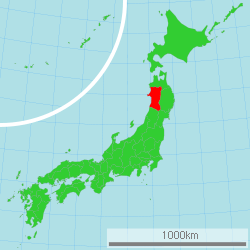 Bonden-sai is intimately associated with Akita Prefecture in Northwest Japan. Akita is also famed for its onsen (hot springs) and mountains, and Mount Taiheizan, the symbol of Akita City, is a major site for the festival. Bonden-sai there means a vigorous race up the mountain with your bonden to procure the blessings of the gods.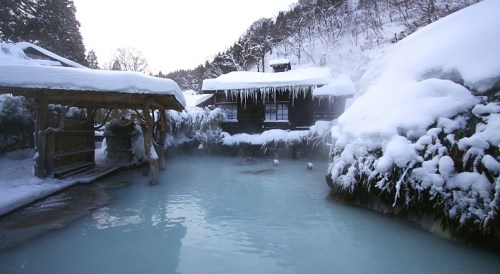

 Much of our human anxiety clusters around an odd mental construct we call “tomorrow,” and sometimes those wacky futurists brought to us by odd institutes with funky acronyms and obscure sources of funding actually have something useful to contribute to earn their keep. Here’s Bruce Sterling on change (
 “Change occurs from pent-up energies.” Without a reservoir of energy, it simply doesn’t happen. Any equilibrium — I’m extrapolating out loud here, to see what the implications look like — any apparent equilibrium or stasis, then, is a kind of wallpaper over pending change and a cloak for accumulating energies. In other words, things don’t change,
 It’s a portion of Druid wisdom to master change in our lives — not to dominate life, which we can never do, but to sail with it onto that endless golden sea that, whenever I pay attention, is sparkling and surging around and within.





 A Druid Way