Archive for the ‘earth spirituality’ Tag
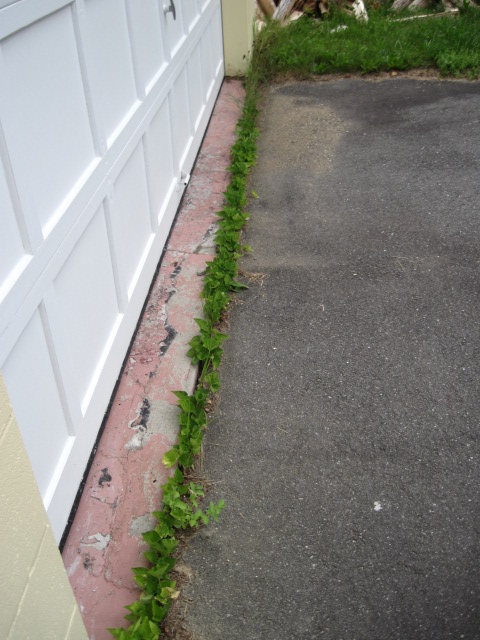
“Growing where you’re not planted”
I’m feeling ornery. Walk with me a little?
Of course people aren’t “equal,” whether “created,” “evolved,” “born lucky,” “favored by the Fae” or anything else. We demonstrate this by almost every action we take, whatever we may say we believe. Whether it’s elections, classrooms, job reviews, dating, playing fields, friendships, family dynamics — the list goes on — one person’s clearly not equal to another. We have criteria, hopes and fears, standards, priorities, memories, expectations, goals, feelings, and values that we almost always take into account.
Even where we might expect equality to matter most, such as in matters of law, where we confuse equality with fairness or justice, we often argue our cases with claims of unique circumstances, histories, medical conditions and so on. We seek exceptions, work-arounds, concessions — because we feel fairness or justice requires it. The particulars and specifics of our lives and experience, talents and quirks and character, all those hallmarks of individual identity, really do matter.
But if we’re not “equal,” as I’m claiming here, what we all are is valuable, unique, and irreplaceable. Most versions of equality, far from helpfully “leveling the playing field,” begin by erasing the individual differences that define our unique value. Equality allows us to be lumped together in easily stereotyped groups. We become interchangeable, a homogenized mass. People start to generalize — “all ___ are ___ ” and when we do, we forget or ignore the value of individual identities. To consider just ethnic or racial terms, whether I’m “just another privileged white male” or “just another poor brown minority,” you can more easily write me off. I have no face, no personality, no distinct identity beyond my equality with everybody else in the category, the label pasted squarely on our foreheads. My unique birth, life and death don’t budge such pre-judgments, which is all that prejudice is, as long as they’re invisible.
[You know the story of the starfish? It’s made the rounds, but it still teaches. The version I’ve heard goes something like this: After a storm, one person encounters another on a beach. Driftwood and debris dot the sand, along with sea life stranded by the storm above the reach of the regular high tide. The second person is gently rescuing starfish and setting them back in the water. “Why bother?” asks the first person. “There are so many others that will die. You can’t save them all. How can it matter?” The other person pauses for a moment, with another wriggling starfish in hand, then sets it in the water. “It matters to this starfish.”]
So what does all this have to do with living on this green earth and loving it? Gardeners, for one, know firsthand: one patch of earth ain’t equal to another. Every location enjoys unique qualities of sun, wind, exposure, soil health, moisture, shade, nearby vegetation, bacteria, earthworms, insects, birds, animals and humans. Likewise for the seedlings, saplings, plantings, harvests, compost heaps, helpful and harmful beasts, bugs and spirits — none are merely “equal.” Or listen to that world just next door; the Morrigan is not Cernunnos. Brighid isn’t Kali. Christianity and Druidry aren’t “equally valid” — a meaningless assertion because of “equal,” not because of “valid.” Each helps catalyze a different life experience of the world. Both are needed. That’s why they’re here. But what good would they do if they were somehow “equal”? And what would that even mean?
The cosmos sweeps along, manifesting both equilibrium, often through relatively stable groups, and change, which appears frequently through the impact of individuals. It’s true that whole swaths of seemingly identical beings get tossed on the scrap heap all the time. A wildfire incinerates a mature forest, a flood washes away topsoil or drowns a lowland habitat. Severe frost or enduring drought destroys a whole ecosystem. Molds, rusts, viruses, spores and plagues decimate or erase innumerable species. Many more seeds and fingerlings, tadpoles and nestlings die than manage to survive. But let a first sapling rise in a meadow, and birds perch there, dropping new seeds that will change everything in a few years. The slightly altered DNA or behavior or adaptation of one or two individuals grants them increased advantages in a changed environment, and over time their line flourishes when others flounder.
Nothing is “equal.” In a cosmos both in love with and wholly indifferent to individuals, that is how we live at all — the ongoing surprise of the individual. Our uniqueness is our glory — and so is everyone and everything else’s. How to serve both these truths — not “equally” but lovingly — that’s a challenge you and I imperfectly explore all our days.
[A version of this post was originally published in Druid Magazine. How do we orient ourselves, and what guides and markers can we use? The things I write about are part of my own “Druid compass” — you probably have a similar set yourself. The article gets a little purple in its prose, but if you’re a regular here, you’re used to reading past that.]
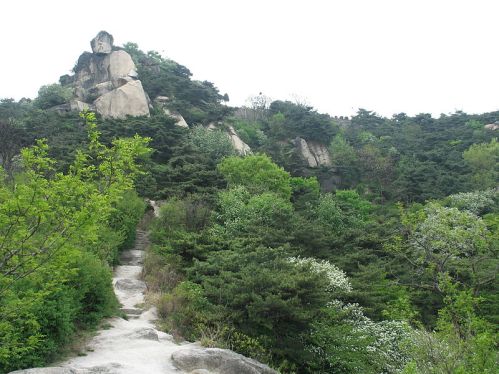
Inwangsan (photo by Gael Chardon)
Sometimes it takes another country to teach you lessons about your own. Five summers ago while I was teaching English for a busy month in Seoul, Korea, I encountered a local land spirit who showed me that this lovely country I was just beginning to discover was decidedly not my home.
It was about a week after I’d finally joined OBOD and requested the Bardic course. It was also my last weekend to explore Seoul and its environs before I flew back to the States to await that first of a series of welcome brown envelopes with the British postmarks of the OBOD course.
So on a foggy Sunday morning I made my way by train toward Inwangsan, a sacred mountain a handful of kilometers from my one-room apartment in Seoul, and then on foot into the mist. Outside Dingninmun Station and under the overcast sky, I managed to miss the tourist signs and markers , but the mountain loomed nearby, unmistakable, so I began my ascent off trail, figuring I’d intersect it higher up, near where a Buddhist and shamanic shrine coexist peacefully. Inwangsan is famous for its commanding views and granite cliffs. As for the view, I had little hope for on this gray day, but exposed granite slabs and outcroppings shone slick in the rain.
Forty-five minutes of climbing later, wet, muddy, and annoyed with myself, I paused to catch my breath. The fog had thickened, but the rising slope was still a reliable guide for the direction I wanted to go. I took a step, and –- how to describe it? –- up rose a wall of resistance in front of me. Something challenged me and barred my way from further ascent. At first I thought, stubborn and oblivious as I can be, that it was merely the tug of my own fatigue, but when I took another step it was clear this issued from something other than me. The hair on my arms stood up. Heart pounding, I apologized out loud, mumbled the few phrases of polite Korean I knew, turned around and slogged back down.
What was it? I rarely see anything inwardly in such situations, but impressions came this time as I made my way off the slopes. Something with multiple arms, big as a pickup truck, banded in stripes of dark and light, and determined to block me from advancing any further. I’ve not written about this till now, and just putting it into words makes the feel of it march again up and down my spine, vivid as if it happened this morning, a heavy ascent of wet earth, a tang of juniper and Asian pine and dead leaves. Yet I’d forgotten the mountain’s name, and the train station’s, too, and had to consult my journal from that summer. That as much as anything reminded me yet again (as if I need any further sign) of my “outlander” status there: I did not know the proper names for things.
/|\ /|\ /|\
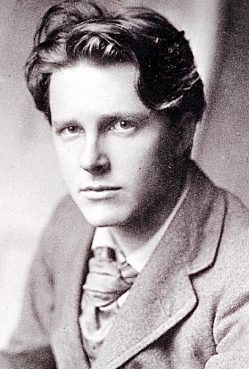
Rupert Brooke, 1887-1915
After British poet Rupert Brooke visited the Rocky Mountains some hundred years ago on a North American tour, he wrote: “There walk, as yet, no ghosts of lovers in Canadian lanes … it is possible, at a pinch, to do without gods. But one misses the dead” (Brooke, Letter XIII, “The Rockies”).
Brooke was young – it was just a few years before his untimely death at 27 – and he wrote with a young bard’s flip ignorance to cloak his discomfort with an unfamiliar country. For of course ghosts walk this continent, millennia of them. Brooke simply hadn’t yet listened closely enough. But new landscapes often strike us that way. A Chinese proverb I heard while working in The People’s Republic of China sums it up handily: shui tu bu fu – “earth and water aren’t comfortable.” We don’t yet know them, and neither do they know us. But stay in a place long enough, sweat and sleep there, plant and harvest, raise families and bury your dead, and the land begins to learn you, too, and to recognize you. And as you work out names for the shapes of water and earth you find in the neighborhood, and come to greet the stones and trees as friends, the words get shaped by mouths that eat and drink here, by lungs that take in the local air.
In the way of Bards, another who grappled with the same challenge comes to answer Brooke’s verses with words of his own. At 86, Robert Frost was asked to deliver a poem for President John F. Kennedy’s inauguration in January, 1961. The day dawned cold and bright, and with his failing vision and the sun in his eyes, Frost couldn’t read the words in front of him, so the old bard made do with memory instead, and recited another of his poems.
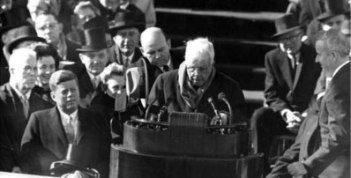
Frost at Kennedy’s inauguration
“The land was ours before we were the land’s,” he begins in “The Gift Outright” (Frost, 1975, p. 348). How often a bard finds a way through error and trial and awen. Frost continues, naming an experience common enough among many American Druids who may strive to honor a rich heritage originating east of the Atlantic, while also heeding new-old voices here on what some First Peoples still call Turtle Island:
But we were England’s, still colonials,
Possessing what we still were unpossessed by,
Possessed by what we now no more possessed.
Something we were withholding made us weak
Until we found out that it was ourselves …
Here in what homesick settlers called New England, older names still linger for things no one truly possesses. Within an hour from where I live you can find Mt. Monadnock, Mt. Ascutney, Wantastiquet Trail, Skatutakee and Nubanusit lakes. Anywhere you go on this continent, similar names and undercurrents whisper, and careful listening will repay any effort to attend to lore and myth and what the land wights may have to say. (The earth’s an old house: many lands have the same overlay of newer names on older ones.) Sometimes it takes long patience to regain their trust, if careless previous inhabitants squandered it. Sometimes it takes longer practice to stop withholding ourselves from our places, and to inhabit them fully.
Here in Vermont the Yankee accent and sensibility rise like springwater from long winters and sap from local trees boiled to syrup, pork from free-range pigs that graze the oak mast on Windmill Hill, which we can see from our living room window, and Okemo State Forest not so very distant. “Eating local” needn’t be mere marketing of another yuppie indulgence. It’s what we all did until just a couple of generations ago, growing it ourselves, letting the land feed our bellies and spirits. And it makes sense if you’re committed to “Druiding” (let’s make it a verb!) –- the taste and smell of home, and of a new place, too, can be powerful guides. The body leads the way by a kind of homing instinct.
Names, listening, tastes and smells. What of ritual and ceremony? Once my wife and I settled in Vermont, walking to learn my neighborhood became a go-to practice for me, with a three-mile loop of dirt roads my almost-daily ceremonial. When I honor the four quarters, I see the fish pond east of our house the former owners stocked with carp, and I remember water-of-air. The cold fronts each winter sweep down from Canada: air-of-earth. And with a hill named for a grove of hemlocks to our east beyond the pond that obscure the horizon, we never get much in the way of sunrises, but dramatic sunsets make up for it: fire-of-water. Online you can still track down Mike Nichols’ Wiccan classic “Re-thinking the Watchtowers: Thirteen Reasons Air Should Be in the North” (Nichols, 1989): it’s now a “sacred text” itself, though it started out as an observed deviation from traditional practice. Rules change with places, but ancient patterns abide.
/|\ /|\ /|\
Works Cited:
Brooke, Rupert. (2004). Letters from America. Project Gutenberg EBook #6445. Retrieved from http://www.gutenberg.org/files/6445/6445-h/6445-h.htm
Frost, Robert. (1975). The Poetry of Robert Frost: The Collected Poems, Complete and Unabridged. New York: Henry Holt and Co.
Nichols, Mike. (1989). “Re-thinking the Watchtowers or 13 Reasons Air Should Be in the North.” Internet Sacred Text Archive. Retrieved from http://www.sacred-texts.com/bos/bos089.htm.
IMAGES: Inwangsan by Gael Chardon; Rupert Brooke; Frost at JFK Inauguration.
The inspirational email from OBOD for this week reads:
And above all, watch with glittering eyes the whole world around you because the greatest secrets are always hidden in the most unlikely places. Those who don’t believe in magic will never find it. — Roald Dahl
OK Roald, what are you saying? I’ll walk some of the way with you because of your magic. After all, it’s almost part of the definition that creative people have felt it, and pass along a hint of it, even as it slips between their fingers. But wait — belief comes first, and then magic? Seeing is believing, we’ve been told; believing is seeing. But what’s a glittering eye? Well, it seems it’s a useful technique.
Sometimes the world demands it of us — it’s the only option if we want to see at all.
On our return car trip from a Chicago wedding last weekend, we first drove north to Michigan’s Upper Peninsula — the UP, home of the “Yoopers” accustomed to delightfully cool summers and long, snowy* winters, nestled among three of the Great Lakes, Superior, Michigan and Huron. (For readers living in other lands, that’s the north central U.S.)
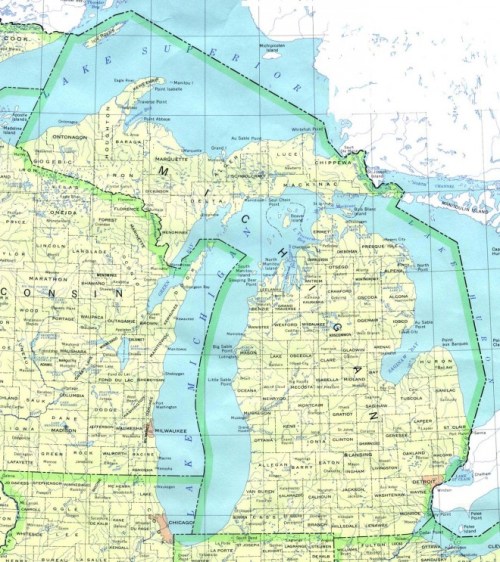
The UP is the area from Gogebic to Chippewa counties.
Here’s the morning sun on the water of Grand Island Harbor, Munising, on the south shore of Superior, where we stayed three nights ago.

The camera manages to capture what a normal human eye can’t look at directly. Only a “glittering eye” can see it — the sun demanded such an eye of anyone who wanted a look. Sometimes the whole world glitters and glimmers — too bright to look at any other way. At such moments it’s easier to admit even if only to oneself that gods must live in fire and shadow.
Or if you want some sort of equivalent in words, that impossible Bardic challenge, try this, courtesy of the 19th century poet Emily Dickinson:
Tell all the truth but tell it slant —
Success in Circuit lies
Too bright for our infirm Delight
The Truth’s superb surprise
As Lightning to the Children eased
With explanation kind
The Truth must dazzle gradually
Or every man be blind —
Oh Emily, we know some days how things do “dazzle us gradually” — the passing of time, each season’s gesture of beauty and change, the grace of a moment as it sashays or lumbers past us. Heartache, bittersweet — we can halfway name what it’s like to be alive. Whether or not we opt to honor these moments and seasons with ceremony or any kind of observance, the world’s ways tell their own truths, very far from headlines or gossip or what passes these days for “news.” The only really worthwhile news is always new, always the same, always old, too, and it begins just beyond our noses. An ancient story.
All it takes, sometimes, is a glittering eye, because the world glitters. Or sometimes an echoing ear, because the world also resounds and reverberates.
/|\ /|\ /|\
Image: Upper Peninsula.
For a recent (2013) low-key native’s and traveler’s reflection on the UP, go here.
*as much as 300 inches/7.5 meters, according to the article above.
Some things glow with it,
flame-keepers, hearths we return to
whenever the world dulls and grays,
whenever bodies earth themselves
too deeply, those mornings each of us
can count all two hundred and six bones
stacked here in our skeleton houses.
Some things touch and smolder,
some kindle, flare once, no more.
Others spark and ignite everything around them.
Fire says: be done with cataloging. I
will renew. In the end, leave everything
for a bright journey. Burn
slow and long.
 But what of activism? readers may rightly ask, especially after my last post.
One of the most evil perspectives — I use the word evil intentionally; a great peril of our times is that the force of the word has weakened to something almost laughable, even as the thing it names continues to spread, infect and damage our world in forms both subtle and painfully blatant, a truly demonic state of affairs — one of the most evil perspectives we cherish is that ecological awareness is somehow a luxury, or a liberal fantasy, just one option among other better and more profitable choices, or an idea whose time is past because it hasn’t produced “results.”
R. J. Stewart succinctly sums up the matter: our true selves and the land are one.
 Cause and effect really do still operate, however inconvenient we find them. But merely fighting polarized symptoms lines up more adversaries for us to attack, without ending the war.
For corporate greed like Nestle’s is just a symptom our modern world makes possible — other eras had and will have their own symptoms.
Yes, we can spend ourselves in noble battle, whatever our position, and if we push far enough, we can “prove” ourselves “right” — and bleed out in the process, kissing this incarnation goodbye. The particular forms that evil takes in this era conform to the lessons we need to learn at this stage of our consciousness.
In a sense, we create the lessons through our weaknesses and imbalances. How painful that continues to be for me to learn! So I want to uncover how to reduce such weakness, rather than spend a life lining up future adversaries that I create out of my ignorance and resistance to a set of lessons I refuse to learn. If indeed the world is a spiritual vessel that cannot be “improved” then what can be “done” with it? Do we even know yet? And how far are we willing to go to find out?
These questions seem to me far more vital than almost any others I’ve encountered. And I know that stance is luxury itself. I’ll admit right here: if I’m the one of those dying of thirst stemming from drought mixed with corporate greed, you who fight to put water back in my hands are my friends in ways a self-named Druid blogger sitting in hydrated Western comfort simply cannot be. So I readily accuse myself on that front, should you turn the focus that way.
But beyond mere easy outrage and less easy symptom-combat and triage, what can I learn and grow from and share? That seems more and more my dharma, the task I find keeps landing on my doorstep unsought.
I want to stare down the hardest questions, because I learn the most from them. But by this I don’t mean to set up tents and squat there in some new “Occupy Existence” movement. The existential is a starting point, not a garden to grow food in. I look at hard questions out of selfishness: I want the biggest bang for my buck out of this lifetime. No guarantees I get more than one (though available signs are promising). As John Beckett notes in a recent blogpost, who among us will lie on our deathbeds and lament most of all that we didn’t sign up for extended cable?!
/|\ /|\ /|\
Yesterday the second of three cords of firewood arrived. To get from this …
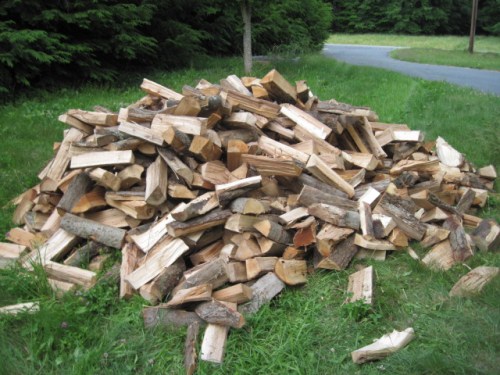
even to this modest beginning
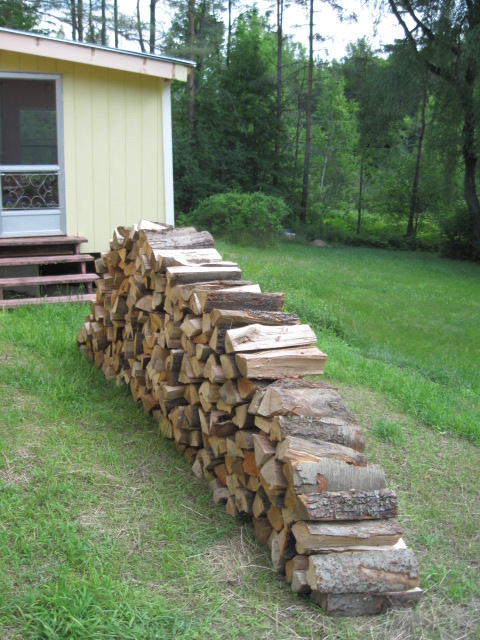
always seems a daunting task. But each year, piece by piece, we eventually get it done. Daily, daily, daily, a practice builds. When I find the right pace, the task itself becomes a kind of pleasure. if I listen, the task itself teaches me. I alternate which arm carries a bundle, and which arm steadies it. I feel each side getting a good workout. I stop when sunburn threatens or aching muscles bring me to the point of diminishing returns. The fatigue of needful effort feels good.
/|\ /|\ /|\
Images: Nestle water; Nestle chair.
— not just survival. That’s much of what I aim for with this blog. (You know almost as well as I do how I don’t always hit the target.)
Not tools for “social transformation” or “regime change” or advocating for somebody else’s large-scale fixes that may or may not ever reach me (or you) in anything like helpful ways. In U.S. terms, that means neither Trump nor Hillary will help more than they will hurt. (Only differently.) In U.K. terms, that means “to Brexit or not to Brexit” isn’t the question. Generally, that means binary choices often aren’t very useful ones.
Whoever “wins” won’t change what needs changing. (That ultimately lies with me. I win as I listen to what yearns to be heard most deeply.) Forces in motion that we launched decades ago, larger than politicians or parties or even empires, will see to changes. A wiser course, for me at least, is to work with forces that build, and learn to ride the ones that don’t, as skilfully as I can. Those aren’t up to a vote. They’re not democratic. If I want, I can put myself in agreement with their effects through anger or ignorance or blind acceptance. But I keep learning the hard way that none of those are profitable responses.
What’s the third — or at least a third — option? (There are always more than two options. If I don’t see them yet, right there is a place for me to work at listening and paying attention.)
Do the necessary work on myself and, as much as possible, avoid feeding energy to the rising political hysteria — of any flavor. “Chop wood, carry water” is a beginning. Yes, but also honor the trees as I do so. Bless the waters, waste less, thank more. In-form the heart, not out-form it. Love works better as a fountain, ever-flowing, than as a reservoir of “hold on to what you’ve got.” Turn down the volume on the shouting. Duck when necessary. Plant seeds for the long view. Share even modest harvests. Stay mindful of the Dao De Jing’s counsel: “Extremes do not last long.” And also: “This world is a spiritual vessel. It cannot be ‘improved.'” Or if you prefer, as humble recipes say, leaving it up to us in the end: flavor to taste.
So I keep bringing back my monkey-mind to focus here on what I can create and transform through awareness and co-operation, hoping to model in my limited way a version of what I see others I respect trying out in their lives and succeeding at.
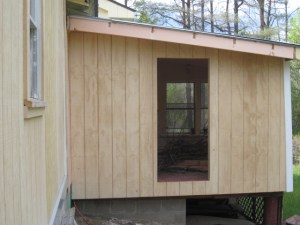
When building, start small.
Start small, because in the end that’s the only place anything starts anyway. But watch for when I touch infinities in those grains of sand I garden in. Revel in eternities that spring from my hours.
Have you ever reached a limit to joy? Not happiness which — often — is superficial, and — often — not worth pursuing: peace to that old Declaration we claim to fancy and which offers such pursuit as one leg of a Founding-Fathers triad that provoked a 240-year-old Exit of our own.
No, I mean joy, a stranger to many, it seems. What Tolkien’s hobbit Pippin could perceive, in the middle of all-out war, in the Maia Gandalf:
Pippin glanced in some wonder at the face now close beside his own, for the sound of that laugh had been gay and merry. Yet in the wizard’s face he saw at first only lines of care and sorrow; though as he looked more intently he perceived that under all there was a great joy: a fountain of mirth enough to set a kingdom laughing, were it to gush forth.*
True kingdoms to you.
/|\ /|\ /|\
Tolkien, J. R. R. The Return of the King, Chapter 1, “Minas Tirith.”
[ 1 | 2 | 3 | 4 | 5 | 6 | 7 | 8 | 9 | 10 | 11 | 12 | 13 | 14 | 15 | 16 | 17 | 18 | 19 | 20 | 21 | 22 | 23 | 24 | 25 | 26 | 27 | 28 | 29 | 30]
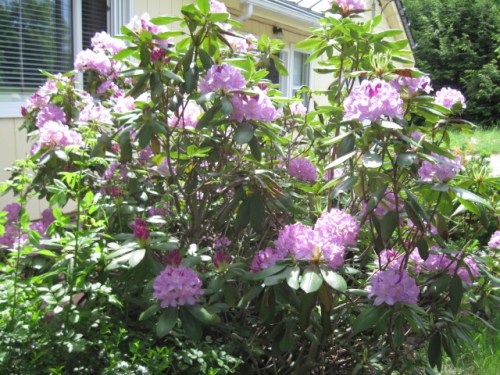
Rhododendron in bloom in our front yard, loud with bees
Since I laid out “Seven Shoulds” for Druids in the previous post, it’s only fair that I should account for how, and how well, I myself manage to do them. Here goes …
1–”Druids should have a practice.”
Ha! I laugh ruefully, because I follow two paths. Sometimes that seems double the challenge. Who needs it? I sometimes think.
But I find that if each day I can manage a practice from even one path, it “spills over” to the other path. They link — a topic for a whole book, I’m beginning to suspect.
I “get credit” on both paths, to put it crassly. Yes, practicing for “credit” means I’m pretty much scraping the bottom of the awen (inspiration) barrel, but sometimes ya gotta go with what you get. Not every day is Lucas Industrial Light and Magic. (If it was, I’d fry and blow away.)
Having a practice also means keeping the ball rolling, the flame burning, even and especially when you don’t feel like it. Then the gift comes, luck turns things around, chance plays things our way, and a god or two peers at me directly for a moment. Because of our efforts? Not always directly, like calculating a sum in math. The universe is more than a spreadsheet. But without the practice, it’s funny how whatever luck and chance and grace and gift I experience will begin to dwindle, dissipate and drain away.
The Galilean Teacher observed, “Those who have will be given more, and those who have little will lose the little they have.” At first encounter, this piece of gnomic wisdom sounded to me like some kind of nightmare economics. Punish the poor, reward the 1%, and all that. But when I look at it as an insight about gratitude — a practice all its own — it starts making a lot more sense. Unless we make room, there’s no space left in us for more. We have to give away to receive. It’s neither more blessed to receive or to give. Both are necessary for the cycle to operate at all.
If I blog or compose verse or do ritual, if I chant or contemplate or visualize, if I love one thing freely without reservation or thought of what’s in it for me, I’ve reached out to shake hands with Spirit. I find that “energy hand” is always held out to us, but unless I offer my half of the handshake and complete the circuit, nothing happens. “What’s the sound of one hand clapping?” goes the Zen koan. More often for me it’s “What’s the greeting of one hand offered?” Pure potential, till I do my part.
2–”Druids should be able to talk about Druidry.”
If inspiration fails, I fall back on John Michael Greer’s fine lines to prompt me into my own “elevator speech”: “Druidry means following a spiritual path rooted in the green Earth. It means embracing an experiential approach to religious questions, one that abandons rigid belief systems in favor of inner development and individual contact with the realms of nature and spirit” (1).
Of course, trot that out verbatim in reply to most casual inquiries, and you’ll probably shut people down rather than open up a conversation. I’m a book addict myself, but I don’t need to talk like one.
So here’s a more conversational version. “For me, Druidry means walking a spiritual path that’s based in the earth’s own rhythms. I try to take an experiential approach to questions big and small. That means I value inner growth and personal contact with nature and spirit.” I find something like that offers plenty of handles if anyone wants something to grab onto. It also has the Druidic virtue of consisting of three sentences.
3–”Druids should show their love of the earth.”
Sometimes this can be more far reaching than just what we ourselves do. Our choices reach more widely than that. Who we interact with also has consequences. We had a builder in recently to rescue our garage, which for every one of the eight years we’ve lived here has been sliding another half-inch down the slope of our back yard.
It took us a fair while to find him. Referrals and ads and word-of-mouth turned up people we eventually chose not to work with. But this fellow was different. Just one proof among several: his attention to reseeding the lawn and cleaning up construction waste after he’d completed the repairs helped us show our love of the earth through our choices of our interactions with others. We didn’t see or know this fully until after the fact, of course. But it was confirmation — the sign we needed. Some days it’s all we get to urge us to keep on keeping on.
I chose this example rather than any other because it was subtle in coming, though just as important as recycling or using less or any of the other things we try to do to “live lightly.” Druidry need not always “speak aloud” to have effects and consequences. Ripples spread outward, hit the far shore, and return. “What you do comes back to you.”
4–”Druids should keep learning.”
Many Druids made this a habit long ago. They have another book or five ready when they’re done with the current one. That’s me. It’s a competition, I’ve come to believe, who will win, my wife or me. She’s a weaver and has baskets and boxes of thread, heddles, wrenches, loom-parts, table-looms, tapestry manuals, and two car-sized looms, all striving for space with my shelves of language books, histories, Druidry and magic texts, boxes of novel and poem drafts, newspaper clippings, letters, and more.
But as J M Greer notes, “Druidry isn’t primarily an intellectual path.” Thank goodness! I’m saved from the limits of intellect, however well I’ve trained and domesticated it! Greer continues: “Its core is experiential and best reached through the practice of nature awareness, seasonal celebration, and meditation” (2).
Druids find themselves encountering people to learn from, the aging carpenter or herbalist or gardener who’d love for an apprentice willing to put in the hard work. So then we happen along and appreciate them and “apprentice for a moment” if not a decade. They’re often self-educated, regardless of what level of school they’ve completed. They seek out people to learn from, and recognize and honor the same impulse in others. Druidry, among all the other things it is, proves itself a wisdom path.
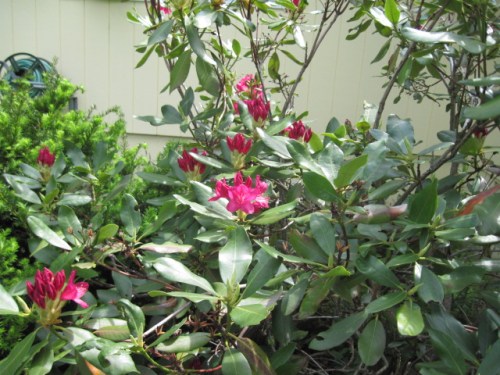
Companion rhododendron in rose, always blooming a week later
5–”Druids should respect their own needs.”
Oh! This is sometimes so large it’s like the air we breathe all our lives, easy to forget. Rather than scold ourselves for lapses, failings and limitations, celebrate what we have done. “More than before” is a goal I take as a mantra. Even two steps backwards gains me some insight, however painfully won, if I look and listen for it. And it gains me compassion for myself and others in our humanness– no small thing. As a Wise One once remarked, who would you rather have around you, someone right or someone loving?
Some six years out from cancer surgery and radiation treatment and I still don’t have the energy I once did. I’m also that much older. But I can rage against and mourn new physical limits, or I can find work-arounds for what I need to do, and set clearer priorities for what really matters, so as not to squander what I do have. Sure, it’s still a work in progress. But I find I can detect small-minded attitudes and deep-seated prejudices in myself more quickly, and do the daily work of limiting their influence and filling their space with more positive thoughts and actions. That’s a gain.
Ever danced your anger? All emotions are energy responses. But I don’t need to sit and stew in them. I can use them to propel myself to new places and spaces and states. It’s an older-person magic, perhaps, or maybe just one I’ve been a long time in realizing and appreciating and practicing.
6–”Druids should serve something greater than themselves.”
Looking back at the list I included — “a person, a spirit or god, a relationship, a practice, a community, a cause, an ideal, an institution, a way of life, a language” — I realize I’ve served all of ’em at some point. Some people stick with one their whole lives. It becomes their practice.
Right now, underemployed as I like to say, I’m more of a homebody than I’ve been, and consequently around the house more. If I find myself sparked to annoyance or anger at my wife for some petty thing, as can happen in the best of relationships, I try to remember to serve her, to serve the relationship. Again, can I use my anger, rather than just seethe? Can I remember to bless my anger, transform its energy and spend it to uncover an underlying issue? What’s the pattern I’ve been feeding? Do I want or need to keep feeding it? Serve myself in this way, in the deepest sense, and I serve others, and vice versa. No difference. To paraphrase, all things work together for good for those who love something that lifts them out of smallness and limitation.
7–”Druids should listen more than they talk — and we talk a lot!”
I’ve certainly demonstrated that here in this post, to say nothing of this whole blog.
Fortunately, one of my go-to practices is listening. Do I do it enough? Wrong question. “Some — any — is more than before.” Both paths I follow commend practices focused on sound as a steady daily method of re-tuning, so that Spirit can reach me through every barrier I may erect against it. Chanting awen, listening to music that opens me, finding literal in-spiration — ways to breathe in what is needed in the moment — letting the song roll through me and back out to others in quiet daily interactions — these are the practices I keep returning to. Listen for the music, whispers my life.
The Great Song keeps singing, blessedly, through my intermittent disregard and obliviousness, till I remember to listen again, and join in.
/|\ /|\ /|\
- Greer, John Michael. The Druidry Handbook, qtd. in Carr-Gomm, Philip. What Do Druids Believe? London: Granta Books, 2006, p. 34.
- Greer, The Druidry Handbook., p. 4.
[ 1 | 2 | 3 | 4 | 5 | 6 | 7 | 8 | 9 | 10 | 11 | 12 | 13 | 14 | 15 | 16 | 17 | 18 | 19 | 20 | 21 | 22 | 23 | 24 | 25 | 26 | 27 | 28 | 29 | 30]
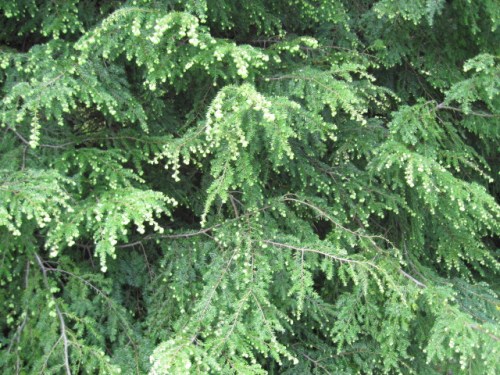
New growth on the tips of our south boundary pines
[Thirty Days of Druidry 28]
“Should” is such a polarizing word. I write it here as a reminder most of all to myself. “Who are you to tell us what to do?!” Well, what difference does that make? If my suggestions are good, follow them. If they’re not, don’t. In the end, “who I am” really doesn’t matter much, does it? I’m not putting it out there as a distraction, so why let it be one for you? A road sign on a road you’re not travelling doesn’t apply to you, does it?
Besides, if my suggestions are good, you’re probably already practicing them in your own way.
(The next post will account for how well I follow my own advice.)
OK, here goes:
1–Druids should have a practice. I’m not saying what that is or should be, only that we each need one. Finding one we can stick with and make our own can be a deal of work. But without a practice, we lose focus, we fail to hear the hints — from others, from the green world, from dreams, from study and learning, from the nudge that comes in the shower or taking out the trash — that help keep us in balance. Otherwise, how are we more than armchair or coffee-table druids?
2–Druids should be able to talk about Druidry. Not proselytize. Not necessarily give interviews, record podcasts or lead workshops, unless that’s our thing. But if someone asks, a door is opening, and we can have an “elevator speech” ready. You know, an account of what we do, and how it makes a difference in our lives. One or two sentences can be enough. Otherwise, if we can’t manage that much, why are we doing what we do?
3–Druids should show their love of the earth. How we each do that is part of our own unique practice. Like all things, we have our birth and our bloom, our fruit and our fallow time. Otherwise, how do our lives build and contribute to this world we say we love?
4–Druids should keep learning. Neither we nor the world stands still, and much is stirring in many fields of learning that can enrich our practice, our knowledge, our awareness and our ability to work with the energies of the world for good. Otherwise, how else do we honor what we have been given?
5–Druids should respect their own needs. Our existences are such complex systems, and it becomes very difficult to fulfill the potential of our lives if pain, anger, illness, injury, or weakness overtakes us. It can be equally difficult to do more than we’re already doing if we have lives we live fully, without adding more than enough and driving us to a tipping point of imbalance. We should seek to know ourselves well enough to respect our own boundaries and limits, while asking which ones deserve to be there as supports, corner posts, roof-beams and garden fences, and which ones we can wisely transcend and grow beyond. Otherwise, how can we respect the same needs in others?
6–Druids should serve something greater than themselves. It may be a person, a spirit or god, a relationship, a practice, a community, a cause, an ideal, an institution, a way of life, a language — the possibilities are great. Otherwise, how do we give back and complete our half of the cycle?
7–Druids should listen more than they talk — and we talk a lot! By listening, we can hear music others miss, find beauty that others pass by, celebrate wonders that many children know but adults are coaxed to forget. Otherwise, how can we add our voices to the Great Song that sings each dawn, noon and sunset?
There’s my list. Anything you would delete, change, substitute? What “shoulds” do you follow on your own path?
[ 1 | 2 | 3 | 4 | 5 | 6 | 7 | 8 | 9 | 10 | 11 | 12 | 13 | 14 | 15 | 16 | 17 | 18 | 19 | 20 | 21 | 22 | 23 | 24 | 25 | 26 | 27 | 28 | 29 | 30]
[Talach is the Druid name of a member of the Order of the Green Companions. Because of his support for this blog and its reaching 300 posts today, this guest post is an opportunity for him to share insight on an interesting situation presented to him. We have permission from the person identified below as M. to print this email exchange, with minimal editing to protect privacy.]
Dear Talach,
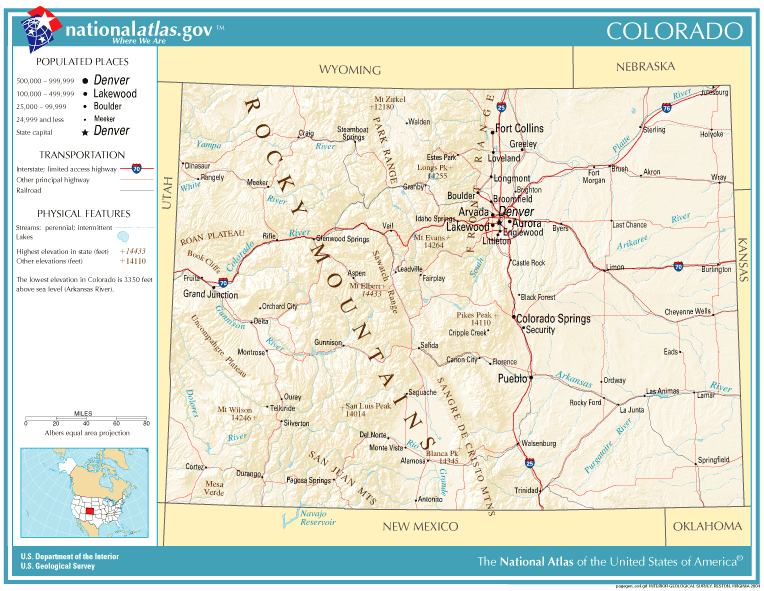
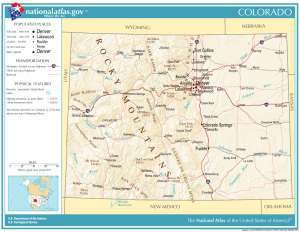 When you spoke after our Beltane ritual about ritual and non-ritual realities, I felt you might understand this problem I’m struggling with and maybe help. My partner and I are both Pagans, I’m a Druid and he’s pretty definitely a solitary Witch, so he doesn’t come to our gatherings. That’s fine. Recently we’ve been talking a lot and fighting a lot about the gods. He’s had some profound experiences with the Lord and Lady and as a result of their guidance he says he wants to make some BIG changes in our life together. Move out of state, off the grid, become self-sufficient, open our relationship, begin teaching and accepting students, etc. etc. There’s a group in Colorado he’s been talking with and he’s pretty focused on them. He met a couple members at a festival last summer.
I love this man, but and it’s a MAJOR but, I haven’t got any confirmation of this even after several months of divination and meditation and ritual. We’ve had some major blow-ups during this time. Part of our fighting comes because he says I don’t work with the gods because I don’t believe in them. He’s right about that last part. I don’t believe. All honor to Brighid and Lugh and the goddess at rituals and as forms of power to work with. But I’ve never experienced them as REAL outside of rituals. I want to hold on to this person and relationship if we can make it work. But my partner wants to make these changes NOW, at the latest definitely before midsummer. Where do we go from here?
M.
Dear M.,
Thanks for your note. You’re dealing several challenges here. Your partner wants changes you’re clearly not sure about. You’re facing a deadline. And part of the decision has been made to hinge on your awareness of the gods who speak to your partner about these changes but not to you.
What’s the most important issue here? It sounds like for you it’s your relationship. Is that true for your partner, too? What’s between you and the gods, or whether life is better somewhere else than where you are, are separate things to consider. You don’t say anything about jobs or housing or other assets, which are a big factor for you yourself, here and now, not just in Colorado or other place you or he may go, alone or with a partner.
So you can ask yourself a hard question, M., and if you do, be ready for the answer: is your relationship important enough for both of you to make it the center of any decision? This is separate from the gods or any deadline. If you and your partner can’t agree on that, you need to work through that, apart from Colorado or your openness to divine guidance. If you’re still both committed to each other and you both have some flexibility, could you try out the Colorado possibility for just a few months to see how it might fit you both?
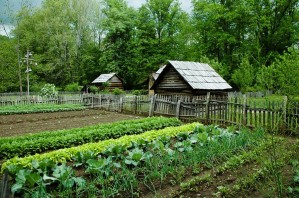 Of course you may not be able to just pick up and leave. Your partner is asking for many changes, not just one, and with a deadline. Why the rush? Why midsummer? If it’s just to get a big garden going, can you do that where you already are? Try becoming more self-sufficient now, apart from the Colorado decision. If neither of you have spent much time growing and preserving your own food, that’s also something to try out close to home first, if you can. That’s a big enough change by itself. Pots and window boxes can help you grow a fair bit even if you don’t have much or any garden space. I urge smaller steps if you can, to make any changes easier to look at and consider and work with one by one.
Blessings to you both, M.
Talach
/|\ /|\ /|\
IMAGES: Colorado map; gardening.
[ 1 | 2 | 3 | 4 | 5 | 6 | 7 | 8 | 9 | 10 | 11 | 12 | 13 | 14 | 15 | 16 | 17 | 18 | 19 | 20 | 21 | 22 | 23 | 24 | 25 | 26 | 27 | 28 | 29 | 30]
[Here are some previous posts on Beltane: a 4-part series, Touching the Sacred; and the Fires of May.]
Once again we’re about a week out from the holiday, close enough it tugs pleasantly at awareness. Here in Vermont, in the northeast U.S. where I live, the last few days in the 70s F/20s C confirm that winter’s gone, though nights below freezing are still a possibility. I remind myself from now till June that it snowed on my May birthday the year I was born. Weather, life: stick around long enough and you find anything’s possible.
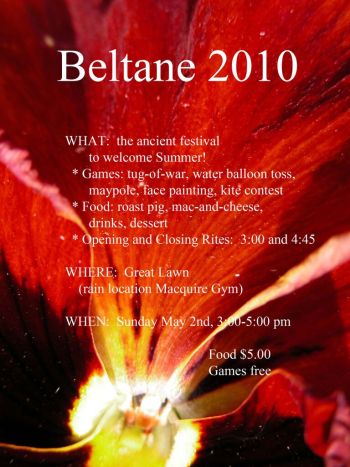 Outward from the merely personal to a group I practiced with the longest: students at the boarding school where I worked for 16 years. Our last and best effort was a truly elaborate Beltane. We devoted a lot of time to preparation, reserved a spot on the school’s Great Lawn (associated with the annual graduation picnic for the whole school community and parents), put up attractive color posters (see the image to the right), and even inspired our student president to spring for the cost of a whole roast pig.
Beyond our small group of eight, just three other people came.
We’d even begun forming a magic study group, devising our own sigil with input from each member, and generally carrying on in magically appropriate ways: sharing and describing our imaginative/astral visions until they took on a life of their own, balancing our elemental energies, ascertaining each member’s strengths and limits for later ritual work, and so on. To those who exclaim “What?! Are you insane?! Working magic with adolescents?! Nutter! Whackjob! Fool!” I reply only that we had multiple safeguards in place.
 To the left is one version of our sigil, drawn with magic marker on a student’s sketchpad, which I share here — “Guard the Mysteries! Constantly reveal them!” — for the benefit of those curious about the lineage and origins of such things.
Some readers may cluck their tongues knowingly and go on to detect “influences.” To which I say only: That’s fine. But these kids didn’t “know” anything about the Golden Dawn or Euro-alchemy or similar things. Spend time in ritual and you too will find that valid images continually reconstitute themselves in the imagination. If I had the sketches each of them made to include here, the connections pointed to a shared experience out of which they crafted the sigil. The Cross, the Cup, the infinity symbol, an upsilon, the axial symmetry — as far as we were concerned, we were onto an experience and a realm worth exploring. Our truth against the world’s.
As for the sparse attendance at Beltane: each group forms around and operates on its own harmonic. We ate well, sent leftovers home with everyone, and chalked up our rather large budget shortfall to the frequent mismatch between inner and outer worlds. Our next fundraiser only just recouped the outlay; balance restored.
/|\ /|\ /|\
Beltane, like the other “Great Eight” festivals* of contemporary Druidry and Paganism generally, draws on a swirl of energies as democratic and mongrel and vital as you could wish for. Find a circle to celebrate with, or if you prefer or are gifted with solitary practice, get outdoors, invite the season, contemplate on images and energies alive and at work in your awareness. Bring them into some physical form to ground and manifest them in your world. We all need reminders to help us through those “difficult” days with humor and grace and even, spirits friendly and stars favorable, with gratitude. What better than something that’s come into your world through you?
/|\ /|\ /|\
*The “Great Eight” festivals of the Wheel of the Year
October 31 – November 2: Hallowe’en, Samhain/Samhuinn, All Hallows Eve, All Saints Day, All Souls Day, Todos Santos, Day of the Dead, Dia de Muertos.
December 20-22: Yule, Winter Solstice, Alban Arthan.
February 1-2: Imbolc, Oimelc, St. Brigid’s Day, Groundhog Day, Candlemas.
March 20-22: Spring Equinox, Ostara, Alban Eilir.
May 1: May Day, Beltane, Bealtainne, Walpurgis Night.
June 20-22: Summer Solstice, Midsummer, St. John’s Day, Litha, Alban Hefin.
August 1: Lughnasad/Lunasa, Lammas(tide).
September 20-22: Autumn Equinox, Alban Elfed, Mabon.
[ 1 | 2 | 3 | 4 | 5 | 6 | 7 | 8 | 9 | 10 | 11 | 12 | 13 | 14 | 15 | 16 | 17 | 18 | 19 | 20 | 21 | 22 | 23 | 24 | 25 | 26 | 27 | 28 | 29 | 30]
[Some days, about all I can muster is a good gray awen.]
[Gray, grey. “If it’s good enough for Gandalf, then it’s good enough for me.”]
[Gra/ey magic(k). 1) a hair coloring product. 2a) Magic not performed for specifically beneficial purposes. 2b) (derogatory) Magic which avoids annoying ethical considerations. 2c) Magic practiced to confuse, mislead or perplex others. Roy Bowers’ version (link to article): “your opponent should never be allowed to confirm an opinion about you but should always remain undecided. This gives you a greater power over him, because the undecided is always the weaker.”]
/|\ /|\ /|\
“Light is the left hand of Darkness.”
Finally the Chief of the Urdd Awen Ddu rose and called for silence with a curious circular gesture. He was a slim, short man who nevertheless had a commanding presence. His simple black robe accentuated his dark eyes. Power spoke in his voice.
“Opposition strengthens us, like a good resistance training exercise. Contrary to the fears of our opponents, it’s not our intention to ‘cover all the lands in a second darkness.’ Our opponents grow stronger as well. But we have a secret they do not know.”
Almost no shadow
He paused to scan the room and gather eyes. “In the darkness we cast almost no shadow at all. With this energy freed, this psychic weight lifted, we may work our will with advantage. We read in the Hebrew scriptures how even God says, ‘I will give you the treasures of darkness and the hoards in secret places.’* And we have learned together how to recognize and gather these treasures that those who work in light never see, nor ever know. They cannot, not as long as they resist polarity, or think to vanquish one half of the universe.”
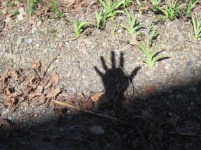 A good speaker weaves enchantment over an audience, and the Chief did so now. “Others may fear the Dark. But we have learned, my brothers and sisters, to know and respect its nature and its extent. Identifying with it, its reach becomes our own, and from the concealment darkness offers, we may extend our grasp to life in a way that light cannot. Anciently the Wise have declared, ‘Light is the left hand of Dark.’ Once prepared, as we have prepared ourselves, we can welcome it and grow from it — from the Dark.”
/|\ /|\ /|\
“Moreover it doth not yet appear that these arts are fables: for unless there were such indeed, and by them many wonderful and hurtful things done, there would not be such strict divine, and human laws made concerning them …” (Henry Cornelius Agrippa, Three Books of Occult Philosophy. First published 1531. This edition translated by James Freake, edited and annotated by Donald Tyson, Llewellyn Publications, St. Paul MN, 8th printing, 2005).
Of course, this and the previous two posts on the hypothetical Order of the Black Awen are hardly the last word to be said on the subject, nor infallibly workable truths about either the Dark or the Light such as the unwary might conclude, but they are nonetheless one entry, one doorway, one path in themselves.
/|\ /|\ /|\
*Isaiah 45:3.
[ 1 | 2 | 3 | 4 | 5 | 6 | 7 | 8 | 9 | 10 | 11 | 12 | 13 | 14 | 15 | 16 | 17 | 18 | 19 | 20 | 21 | 22 | 23 | 24 | 25 | 26 | 27 | 28 | 29 | 30]
“Now, my daughters and sons,” said the old woman, “because all things in this world dance with their opposites, and the Bright is the left hand of the Dark, it is meet that I, who am old and may not live to see the end of the next winter, should be the one who tells you of the Order of the Black Awen, Urdd Awen Ddu.”
She paused, and seeing her shiver I drew the blanket more closely around her. There was just a handful of us still gathered round the fire. Her words might have seemed overblown or contrived at any other time. But the fire and the evening and the mead had each done their work. We were ready to hear almost anything. The dew had descended a couple of hours ago, but the night chill only now was lapping at our skin. Dragon built up the fire again, and raked the coals together so the new logs would kindle sooner. The old woman smiled at us and continued.
“I give the Order its Welsh name, too, because it offers a valuable lesson. Taken apart from its meaning, the sound of it is lovely: oorth ah-wen thoo.* And so too its birth. All things carry in their breasts a spark of the Imperishable Flame at the heart of the world, the breath of the Formless. Anciently the Wise of the East knew this, and the Sage of the Way wrote in his book, ‘From the One comes Two; from the Two, Three; and from the Three the Ten Thousand Things.’ Without that balance, chaos follows. We might even welcome the appearance of the counterpart, the opposite, in a way, without doubting it will cost us dearly when we face it, as we eventually must. But it is the third of the Three that issue from the One which we will turn to for our way forward.”
She spoke now quite deliberately, not expecting questions as she had earlier, when a lot of good-natured banter enlivened the fire circle, and anyone who held forth and pontificated, never mind the subject, soon had to give it up and relearn if necessary the arts of true conversation, of actual give and take, rather than expecting a reverent silence from the rest of us. That earlier hour also saw the old woman depart for a nap after a brief appearance, so that she would be fresh for later. Which was now. And now we wanted her to hold forth, because she had something of considerable value to share with us, and because what she said was new to us. The singing and drinking carried us here, where we needed to listen. Night had shaped this place and space. So we were quite content mostly to listen and ponder her words.
Questions, however, bothered her not at all, and she sat at her ease when we occasionally asked them. Earlier she asked a good few of her own, though her hearing sometimes played tricks on her. Someone inquired where she had first encountered this Order, and this led to a sad but funny story that must keep for another time. Though she must have been in her late nineties and stooped, and the age-spotted skin of her hands slid loosely over her bones, her thought darted swift and sure, and her gaze out of eyes filmy with cataracts was nonetheless keen.
“Now this Order, dedicated as it is to things we must oppose who cherish the balance, comes into existence because we exist. Each thing calls forth its companion, its counterpart, and Dark is ever the companion and counterpart of Bright. It is a peculiar and perilous folly of these days to suppose we can all ‘just get along.’ We cannot. The world simmers always, and sometimes, as it must, it spills over into open conflict. When a Dark Order forms, the action of the Light has made some advance, yes, but it also stands in peril for that reason. The cause of the Light (or the Dark, for all that) is no mere cliche or child’s fantasy, and such a challenge from the Dark, one that claims and divides the awen, is one that we must answer.”
/|\ /|\ /|\
*the th of this respelling of the sound dd in Welsh urdd and ddu is voiced, as in English this, them, not as in thick, thin.
[ 1 | 2 | 3 | 4 | 5 | 6 | 7 | 8 | 9 | 10 | 11 | 12 | 13 | 14 | 15 | 16 | 17 | 18 | 19 | 20 | 21 | 22 | 23 | 24 | 25 | 26 | 27 | 28 | 29 | 30]
[Here’s the second half of a topic begun in the previous post.]
In the way the universe moves, as soon as I focus on health and healing, results come back from blood-work a few weeks past. The naturopath I consult phones me to share the data, and the numbers aren’t altogether positive. We agree to some diet, exercise and supplement changes, and a follow-up blood-draw in three months to see whether some of the more worrisome numbers are a blip or part of a concerning trend.
I mention this not to garner any sort of sympathy — I’ve been vague enough here I hope that’s clear — but to consider for a moment a couple of things. I use my life as material because I’m in it. I trust it’s part of our common experience, and countless experiences of feedback prove to me that, mostly, it is. (I reserve just a few quirks as my own indulgences.) From my perspective, we’re all in this life-lab together, here to try things out. I understand my own experience better than anyone else’s, and every writer can’t help but mine autobiography for material, however coy or deflective they may be about that fact when you ask.
So here goes. First, you may call it the merest coincidence that in post 14 in this series I examine health, and the next day medical tests come through, and I take it as part of a divination. The pending results were on my mind, you say, and naturally enough they emerged in a post. Nothing mysterious about it. Well, I don’t know about mystery. (That’s why they call it mystery.) But I’ve found that strikingly few things are “mere coincidence.” The dangers of over-reading such circumstances as “signs” or “spirit communications” or “meaningful data” pale in comparison to missing the opportunities for discovery, growth and change that such events offer. As an unreconstructed animist, I know that everything’s alive (especially rocks, and even more especially Vermont rocks!), everything’s affected and influenced by everything else, and everything talks constantly about it all. I like to join that conversation.
Second, I get to try out my spiritual toolkit, as soon as I remember I have one. (You shouldn’t be surprised at our capacity for ignoring resources already in our hands. We love sympathy, until it gets boring or annoying, and then we often swat it away. I loathe self-pity, and have been known to turn away well-intentioned compassion at every turn.)
I take hawk-guise and soar over the problem or challenge. Below, on the field of my life, personalities and forces and energies can stand out more clearly. As the seer of my own life, I can regroup quite literally. Who and what shall I pair or separate? What lies off the horizon that touches on this moment? What offers itself to me? Where I can I offer myself to others? If I want this clue, this cure, this healing, where I can be a part of such a cure and healing and solution for others? How can I take without giving? Yes, of course. But how I can give without taking? What circles and cycles wait for me to complete them, ones that only I can? Not because I am “special” or “gifted” or “unique,” but simply because I am. I exist, in this place, in this time. The stubbornness of the particular is a clue to meaning, as well as much else of value.
Yes, I’ll even concede that “every problem has a spiritual solution,” if we can also agree that “spiritual” may sometimes mean a warm bath, a glass of wine or mead, time and space for reflection. Sometimes it’s a bit longer than that. I turn and see it’s a whole life-project: part of the reason I seem to be here at all, one of a small set of Big Kahunas, a major theme for this incarnation. Druidry reminds me constantly that this physical world is a vital resource and a field for discovery. With all its pain and uncertainty and possibility and simple pleasure, it’s a toolkit all its own, one of astounding quality and diversity and energy. Herbs, totems, power objects, shrines, wise trees and beasts, spirits, fatigue, rest, hot and cold, the seasons, human physical contact and presence. I could devote (I feel I have devoted) many lives just to exploring these things, never mind the array of things on other levels of reality.
Salmon, Dragon, Bee, companions on the Way, I thank you for your wisdom, and through the transmutations of identity and experience, I offer some wisdom of my own.
[ 1 | 2 | 3 | 4 | 5 | 6 | 7 | 8 | 9 | 10 | 11 | 12 | 13 | 14 | 15 | 16 | 17 | 18 | 19 | 20 | 21 | 22 | 23 | 24 | 25 | 26 | 27 | 28 | 29 | 30]
“But wait! There’s more!” Whenever any cycle ends, it marks the beginning of another larger cycle that contains it. Time, it appears, curls back on itself, or rests inside its own loops and curves like an infinite series of Russian nesting dolls. If there’s indeed any end to cycles, no one’s seen it yet. Dragons may know, but they’re not telling. (Some suspect they may dip in and out of time at will. Dragon wisdom is well worth pursuing, but it can be a difficult teaching, this lore of fire and music at the heart of the world.)
The sweep of energies surrounding cyclical change can be confusing, and to anyone within the radius of a particular cycle, the opening of the next cycle may be obscured in the debris — physical, emotional, psychic, spiritual — of the closing one. Creation, including the destruction of the ends of the old cycle to clear the way for the new, is messy. Even the birth of the new in the midst of the old, not replacing but augmenting it, can be hard. The two things human dread most: change, and the same old thing.
Those of us outside the cycle may nod or smile knowingly, feeling even a little bit superior to it all, if the ends of the cycle don’t happen to lick our ankles or caress the napes of our necks. Ah, but then it’s our turn.
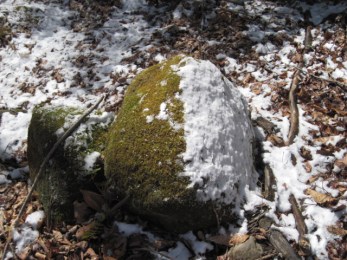
The Spring-in Winter of April ’16 in VT
The field of energies at work in the physical cosmos looks to be in rough equilibrium. That doesn’t mean stasis. Change still ripples and tears through from time to time. Yes, we face our storms and floods, earthquakes and volcanoes, and occasional meteors. And yes, they can be devastating and destructive. But overall — and life itself’s the best evidence here — the planet’s remarkably stable, and has been over very long periods of time. How else can a world be a home?
I find myself in a chair set down near a soundstage. The floodlights are off, though there’s a rather dim and diffuse glow coming from some back lighting, and there’s a bustle of stagehands as a scene change gets under way. Next to me a Druid sits at his ease in the director’s chair, sunglasses perched atop his head, flipflops dangling from his outstretched feet. In this short break in the filming he looks to be sleeping, but a moment later he opens his eyes and favors me with a wink. He leans toward me and whispers, “Avoid comparing the raw footage of your own life to other people’s highlight reels.”
[ 1 | 2 | 3 | 4 | 5 | 6 | 7 | 8 | 9 | 10 | 11 | 12 | 13 | 14 | 15 | 16 | 17 | 18 | 19 | 20 | 21 | 22 | 23 | 24 | 25 | 26 | 27 | 28 | 29 | 30]
Staring at the pecs and thighs of the gods,
stupid voyeur that I am, that immortal gloss
and sheen no tanning bed or airbrush skill can give,
or sampling on the sly from that moonshine still
where they refill their goblets, at last I think
I see them true, the outsized celebrities they’ve
always been for us: golden child, outcast, neurotic,
sex-addict, the pantheon’s drunk, slut, tyrant, monster —
the whole extended family a Jerry Springer dream finale.
But hear one speak with power, watch the mask slip,
face and form fade out to nothing like our own.
Now stone or star, volcano, cave, or lake, she or he
fires your heart or brands your brain, and you’ll
never live the same. The gods aren’t yours.
You’re theirs. Beyond wrong or right,
death, life or other toys to play with, you belong.


 A Druid Way