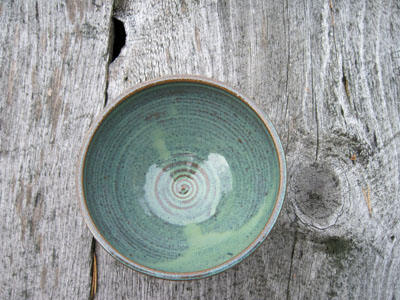
A spiral differs from a circle. There’s motion in it, and change. The track or trail of movement is itself motionless. (Well, comparatively: the boat’s wake dissolves in ripples, the jet trail fades, but some time after, at least; the jet’s long gone.) It records the journey. But journey in a spiral is not repetition. It’s recognition, re-encounter from a fresh perspective. History, planetary or personal, doesn’t repeat itself, but it does often spiral.
[Originally when I took the photo I was simply looking for a background that would contrast with the bowl. Only later after I’d uploaded the photo did I realize that the grain of the wood holds at least as much interest as the spiral design of the bowl. Talk about not seeing the obvious.]
You may remember the chorus in Joni Mitchell’s lovely song “The Circle Game”:
And the seasons they go round and round
and the painted ponies goes up and down
We’re captive on the carousel of time
We can’t return we can only look behind
from where we came
and go round and round and round
in the circle game.
Joni, it’s lovely, and it’s easy to be seduced by the beauty of your song, but you’re wrong. Or at least, you’re right only about one choice among many. It’s a game, and therefore we’re no more captive than any player is who agrees to the rules in order to play at all.
We can choose to play the game this way and be participants in time. That’s the only way to live in a material world anyway, from what I’ve seen: in time. Once we release the drive to “get ahead” or “win the race,” we can begin to jump through time, from moment to moment, recognizing “infinity in a grain of sand, and eternity in an hour,” as William Blake has it. Time is illusion, yes — but in the sense of play (Latin ludere, lusus, illusio = in+ lusio — “in the game”): a set of rules to make sense or pattern out of the flow of experience, which is e-lusive. We need “before” and “after” in order to begin (or return) to experience “now.” The moment of illusion, of play, then broadens and deepens.
“Time is the stream I go fishing in,” says Thoreau. I use this as a mantra when I get stressed about deadlines, minutes ticking, the illusion gaining hold in a way that’s no longer a game, no longer pleasant to be playing. There’s nothing wrong or cruel about time, once we let go the fear that comes with clinging to any particular moment — of resisting the play because life is supposedly such a serious thing. “Eternity is in love with the productions of time,” Blake says in another poem.
These “long lessons” are ones I keep learning. Most of us do — most of us are slow learners — earth’s a place for those with “special needs.”
To live any other way is to suffer needlessly — never my favorite thing to do, anyway — and to be trapped in regret and loss. We’ll all have a taste of these if we live long enough, as part of the balance that comes with fullness of life — why seek out more, and worse, elevate them to a kind of icon of authenticity? “I’m not human unless I make a fetish of my suffering,” some people seem to say. “I AM my suffering,” say others.
The Circle Game goes best when we treat it as a game, as a shape of experience. But it’s not the ONLY one. We hear of people being “lost in the past.” How about seeing what it’s like to lose yourself in the present? Nowhere is now here, to make a linguistic jest with wisdom at its core.
Robert Frost was on to it in “Birches.”
I’d like to get away from earth awhile
And then come to it and begin over.
May no fate willfully misunderstand me
And half grant what I wish and snatch me away
Not to return. Earth’s the right place for love:
I don’t know where it’s likely to go better.
If I don’t experience it on this curve of the spiral, it won’t be there for me the next time to “come to and begin over” in that “can-be-delightful” encounter of the “familiar-new” that often flavors our experiences. I cheat myself of so much joy, thinking there’s someplace “where it’s likely to go better.” Now, here, is when and where it’s at.
OK, indulge me in a fit of professional pique. Grr. And afterward, having carefully checked my counterpoints below, show me where I went wrong. Until then, my case stands against careless authors and bad linguistics.
I spent undergrad and grad years studying linguistics, both in class to get degrees, and on my own, to “follow the bent of my genius, which is a very crooked one,” as Thoreau says of himself.
So when any published authority who should know better does a bad job with linguistics, it provokes my ire and righteous indignation. Stings me to creative invective, expressed in various naturally-occurring and invented languages. If you’re a fan, think Firefly and Joss Whedon‘s creative use of “gorram” and Chinese for the characters when they need a good brisk curse to capture their feelings that won’t get censored by feckless Anglo censors. (So I slightly misused feckless. It’s such a great word, I’m automatically forgiven. Why isn’t there a feckful?!)
When it involves an attempt to set the record straight about Druids, we particularly need careful scholarship, along the lines of Ronald Hutton, whose consistently excellent and thoroughly researched books shrink Romantic inflation, while leaving the essential mystery. In fact, that could be a definition of mystery: what remains intact, even more vital, after the facts have been established. Mystery isn’t obscurity, but a depth beyond easy ratiocination. It transcends language, though intuition and imagination are both on to it. It’s home turf for them.
People believe all kinds of nonsense about language, and often on flimsy evidence — perhaps because in the West, most people know only one language, so the ways of them durn furriners will always be inscrutable — not a true mystery, but the consequence of mere ignorance.
A classic example I’ve cited before: “Samhain is the Celtic god of death.” It really isn’t, but people get seduced by the appearance of authority and mistake it for the real thing. This is reminiscent of Kipling’s Monkey People in The Jungle Book: “If we all say so, it must be true.” The linguistic falsehood is still reprehensible, but it’s understandable here in propaganda like the anti-Pagan tract in which this Samhain citation appears.
On to the source of my wrath.
A Brief History of the Druids by Peter Berresford Ellis is a necessary book, providing analyses of evidence for an understanding of Druidry that aren’t available in print elsewhere. He’s cited as “a foremost authority on the Celts,” is the author of half a dozen books on the Celts, and for the most part deserves this accolade and others.
But …
How is it, then, on page 96, that he can foolishly, carelessly assert that “the very word Teutonic is derived from the Celtic word for tribe, tuath in Irish”? This is simply wrong. “Teutonic” comes from Latin teutonicus, and refers to the Germanic tribes. The cognate word — the “sister word” in Germanic, because both Celtic and Germanic are daughter languages of Proto-Indo-European (PIE) — is thiudan-, related to King Theoden in Tolkien’s Lord of the Rings, and Deutsch, the German word for ‘German.’ However much Ellis would like the sound laws of PIE to reflect his desire for Celtic to be the mother tongue, they don’t and it’s not. Neither is Germanic, of course. However, Proto-Indo-European IS. And Ellis knows this, but lets his carelessness sway him into a baldly wrong, and worse, misleading assertion. The Celts indeed contributed much to Germanic culture, and that includes words as well as objects, but tuath isn’t one of them.
Here’s another example among others from this one book. On page 111, once again, Ellis wants Celtic to rule the roost. “When we turn back to Medb we find that her very name means ‘an intoxicating liquor’, [sic] and is the origin of the English mead.” And once again, the Irish medb and the English mead are cognate, or “born together,” from PIE *medhu. The English word doesn’t derive from the Irish. Both however do descend from the same parent — and that is PIE. [The * indicates a linguistic reconstruction.]
One instance of such false derivation in a scholarly work is possibly a “mistake” or oversight. Several instances become part of a consistent pattern of misuse of scholarship in the service of an agenda. It makes me question and doubt his other claims (not a bad thing, says my inner rebel; find out for yourself); and he gives just enough evidence to convince someone who doesn’t know enough about historical development of the Indo-European languages generally, and Celtic and English specifically, to challenge his assertions. It sounds right. But it isn’t. Boo — hiss!
Not the end of the world. But shoddy. Very shoddy. OK, enough ranting. <end rant>
Thank for indulging. Back to your regularly scheduled program.
/|\ /|\ /|\
Nano update: hit the 20,000 mark — in fact, passed it last night, with 20177 words. Somehow this feels more substantial in many ways than passing the 10K mark, which seemed such a milestone at the time — not merely twice as many words, but a kind of undeniable solidity or substance that can’t be denied or dismissed. Got some new (potential) characters, too, knocking to be let in. Will have to see whether this story needs an incubus to muddy the waters, or a preacher bent on saving Nick (Alza’s “chosen”), or a girlfriend (and second succubus?!) for Nick’s best friend Paul. Anyway, onward …
As editor of a collection of essays, The Rebirth of Druidry, OBOD‘s Chosen Chief Philip Carr-Gomm attempts to characterize something of the appeal of the spirit of Druidry in human terms. I quote his article at length because in its effect it is all of a piece, and because it provides a suitable introduction to some things I want to say about the Goddess:
Druidry is the perfect lover. You fall in love with her so easily because she is so romantic. She whispers to you of the magic and mystery of the turning stars and seasons. She loves trees and Nature above all things, and you yearn for these too. She tells you stories of Gods and Goddesses, the Otherworld and fairies, dragons and giants. She promises secret lore — of sacred trees and animals, of herbs and plants. She points deep into the past, and ahead towards a future which is lived in harmony with the natural world. But just when you are convinced you will marry her, because she is so beautiful, so tantalizing, so romantic, she turns around and there she is, with rotten teeth and hideous face, cackling and shrieking at your naivety. And she disappears, leaving you with just her tattered cloak, made up of a few strands: some lines from the classical authors, whose accounts are probably inaccurate anyway, a few inferences drawn from linguistic and archaeological research, which could be wrong, with the rest of the cloth woven from material written from the eighteenth century onwards, replete with speculation, forgery and fantasy.
You feel a fool. You don’t tell your friends about your lover. You feel tricked and defrauded, and decide to follow something more authentic, more established, more substantial — like Buddhism, or Christianity, or Sufism, or Taoism — something serious. But then you go out walking. You follow the old trackways, you come to the old places. You see the chalk gods and stone circles. You pause and open yourself to the Land, and there She is again. But this time she is even more enchanting because you can see that she is not just a beautiful woman, full of romance and seduction, you can see that she is also a wise woman, who will provoke as well as seduce you, who will make you think as well as make you feel. And then you suddenly know why she has been the object of fascination for so many through the ages. She is the Muse, the Goddess behind Druidry, the bestower of Awen, of inspiration.
Obviously the imagery here from a male author conveys part of how a man may first encounter the “Goddess behind Druidry”; it may not appeal to women, who find their own powerful ways of connecting with Her. In mythic terms, however, this account very much reflects the changeability of the Goddess — what has inaccurately been called her fickleness, and which has caused many accustomed to meeting deity in a single, invariant form to confuse variety with unreliability or untrustworthiness. Westerners in particular have largely been cut off from experience with aspectual deity, which the Goddess so clearly manifests. Rather than manifesting a loving and compassionate presence, “[t]he deity may appear in wrathful or challenging forms, but these should not be considered hostile. She is the kernel of truth at the heart of everything, and if she appears in challenging forms to you, look more deeply, considering why this may be so,” suggests Caitlin Matthews in her slim but potent book, The Elements of the Goddess. “Many of those who venerate the Goddess are unhappy with her supposedly dark aspects because they associate ‘dark’ with ‘evil.’ In order to save her child about to do something dangerous or silly, a mother will get angry, shout or scream, but this doesn’t mean to say she loves her child any less.”
My first encounter with the Goddess came unbidden, unsought, when I was 25. (You need to know: I’m not especially sensitive or psychic. Friends who are say anyone who wants to reach me has to raise quite a ruckus to get my attention. If you’d asked me then I’d say — still would probably, even today — that half of what people experience in such situations is imagination. But now by “imagination” I mean something considerably larger and more potent than I did then. More about that later.) It was a frosty autumn day, and I was wandering the fields and scattered woods of a farm my father had recently bought in western New York, south of Rochester. I paused in a swampy grove of trees, with several fallen and decaying trunks to sit on. A mood or atmosphere of autumn pervaded the place, almost palpable. The air lay perfectly still. The musty-sweet smell of dried dead leaves filled the air, along with a tang of rot and manure from a nearby field, and a hint of woodsmoke. Over the hills from a distance came the faint roar of some town maintenance vehicle — they were always patching roads in the area. But distant sounds simply deepened the stillness by contrast. As this meditative silence spread and enveloped me, I became aware of a presence that filled the grove and towered over me, fifty, sixty feet tall. Immense. One face of the Goddess. Conscious encounter. Her.
She didn’t knock me on my ass, though that might have been useful too, given how dense I can be. But though I describe it here in mild enough terms, the experience was unforgettable, not for any one detail, but for its undeniable — and familiar — quality. This was someone I knew. Not someone or something alien, or to be feared, or a matter of belief, any more than I need to believe in the tree-trunk I sat on. It was like finding a limb which, when you found it, you knew had always been a part of you all along. You just hadn’t been aware of it. As if it had been asleep, but for its waking you finally twitched a muscle in it, and in feeling it respond you felt it.
So what’s the big deal, you say? “He met the Goddess, in some ways it was an anticlimax though also somehow memorable, he got over it, it was years ago. So?”
A year later I was in the throes of my first love affair (can anyone say “late bloomer”?), a tumultuous relationship in which I did get knocked on my ass. Among all the other things this Goddess encounter was, it was preparation, or warning. I needed greater emotional experience, insight, maturity. I was about to get it.
In between the divine and human realms is an archetypal one — a place, often, of dream and vision, and the idealized images of Others for men and women which “haunt our imagination and often make our love-lives incredibly tortuous until we realize that these daimons will never become physical realities. They are messengers between the divine realms and the human levels of our experience” (Matthews, 13). This was part of what I needed to learn firsthand. No book knowledge this time. It was an initiation of its own.
So this fall at OBOD’s East Coast Gathering, in a meditation involving an encounter with the Goddess in her guise as Cerridwen, I felt a surge of panic — again. “Cerridwen is bad. She tricked Gwion Bach in the old Welsh tale.” But it was old programming. Incomplete knowledge. Fear of that “fickleness” I mentioned earlier. “The old, outworn, dualistic concept of the Goddess as cruel and capricious must be viewed for what it is: a reflection of our shadow-side, a terrible polarization of social responsibility with which women have been burdened as a sex” (Matthews, 24). But now I had more tools to begin to deal with it. At Samhain I did specific work with the Goddess. I needed to. Is it any wonder I also spent 15 years working in a freshman girls dorm as a house parent? Training up close and personal. “The Goddess stands at the heart of life, death and further existence and she will assume the forms which are most appropriate in her dealings with our world” (Matthews, 24). Or as a teacher in the other path I follow related, when he talked about his own experiences with inner and outer realities, “They had to get me to stop bowing every time they appeared, so they could actually work with me and get some work out of me.”
Matthews continues, in ways particularly useful for a male bard like me. “Men experience the Goddess through their creative side. She makes manifest their ideas by animating their dormant creativity. There is a strong sense of ebb and flow about these energies which give men an experience of the cyclical nature of the feminine menstrual cycle. This kind of relationship is rarely recognized for what it is, yet all men can discover and welcome this experience. Although the effect of a Goddess upon a man is less immediately physical than in a woman, it is nonetheless potent” (15).
There is much misunderstanding of gender and sexuality, and what constitutes the self and its connection to the world, perhaps nowhere more so than in the West, with its addiction to pornography, its fear of homosexuality, its violence against women, and its frequent indifference to children. I’ll let Matthews have her last word here. “Every human being is a child of the Goddess … The way of the Goddess is one of natural law and natural wisdom … It is primarily the people of the West who are orphans of the Goddess. The social and political reasons for this desolation have been documented in many books … Both women and men need to find their Mother, relating to her and her creation in fresh and balanced ways, for every one of us needs to drink of her wisdom and realign ourselves with her natural laws.” This is not a matter of belief but of incarnation — our own — to live fully, gratefully and passionately in this world, until we leave it.
/|\ /|\ /|\
Nano update time. Is it any wonder, in light of this post, that I’m writing about a succubus?! And sympathetically — as a main character?! Must be some sort of assignment from the Goddess. Further training. God knows if it’s publishable. (Goddess may know, but if she does, she ain’t tellin’.) Reached 17,804 words: over 1/3 of the way there. Need to hit 20,000 today to be fully caught up, including today’s work. Should be able to do it. Major scene yesterday, in which Alza connected with the man she needs for her magical work, showed him her nature in a brief feed and reversal of energies to restore him, bypassing the mental level altogether, where the idea of a succubus would have completely flipped him, and left him with a medallion magically linked to her — ongoing physical contact to reinforce the dynamic. The resulting reactions when he deals mentally and emotionally with what he already knows will be interesting to capture, but the heavy lifting for that scene is done.
I’d been including more fire imagery in description and action, since Alza’s succubus nature seemed increasingly to resemble that of a fire demon. And then, as a break yesterday, doing some research on demons and succubi in other cultures, I happened on this quotation from the Qur’an: “And the jinn, We created aforetime from the smokeless flame of fire” (Al-Hijr, 15:27). And in an email yesterday from the university where I’m taking a seminar, advertising a weekend workshop for men: “FRIDAY, 11/11/11 – SUNDAY, 11/13/11 – ON THE EDGE OF FIRE: A MEN’S SPIRITUALITY RETREAT.” Right between the eyes — the kind of serendipity and synchronicity and happy accident one hopes for in writing. So I’m on some kind of track. I’m just still discovering what it is. And that’s much of the deep pleasure of this verbal marathon.
“We are many sets of eyes staring out at each other from the same living body” — Freeman House, Totem Salmon
We are many sets of eyes, staring out
at each other from the same living body.
We are ears listening to each other
across valleys of skin.
Heat of the other’s blood
warming the air we breathe,
air that filled the other’s lungs
not long before, and will again,
ruffling our hair, rippling this field
of frost-gray grass.
We touch earth that touches each other,
life-print curling at our fingertips and lips,
world (a piece of it) digesting in our bellies,
swept along in blood and spit,
spice of it in our marrow,
essential you in everything
I eat and love and do,
essential me in you.
/|\ /|\ /|\
So there’s a poem provoked (I say “provoked” rather than “inspired” because that’s the sensation — I encounter a piece of language not my own that becomes the grain around which oyster tries to form a pearl. It won’t let go until I respond, and try to shape the sensation into something in words.)
Nano update: I’m catching up at 13,527 words and counting, but still a little more behind than I’d like. We’ll see what 2 and 1/2 cups of coffee this morning helps me accomplish. I don’t usually drink it, since I’m hypersensitive to caffeine and it keeps me up most of the night following the day I drink it, but I was cold this morning, and the smell! … well, anyway, I’m caffeinated and writing.
Found an interesting passage in a medieval author yesterday, Walter de Mapis. (If you’re gonna procrastinate, I say, why not procrastinate tangentially? I researched historical refs to succubi.) So now I know something about rumors surrounding Pope Silvester. The pontiff flourished around the year 1000, and his legacy includes the story of a certain succubus, who was said to give him advice, and who was reputed to be his lover. Supposedly he repented on his deathbed. Traitor. I’m expecting my succubus main character Alza will have something to say about that. Who knows — maybe she was there. Maybe she was the succubus …
Just discovered she has a mantra or prayer or verbal talisman she recites frequently. Maria, one of her worshippers (from her “cult” phase), overheard her this morning talking quietly to herself, and asked about it. Here are the words Alza said (part of the charm is to speak about oneself in third person):
Alzakh ne utayal gashem muk dafa.
May Alzakh grow in this surrounding fire,
may Fire know her for its own,
may Fire fill her in all she does,
burning away what blocks her,
burning toward what is native to her,
what is or will become or has been Fire,
time the Fire that moves all things into being.
Always fun to get a piece of the original in Harhanu. You need to know: among my other odd hobbies is conlanging. So I hear bits of languages, like I imagine musicians and songwriters hear snatches of songs and musical phrases. Here are the italicized words phonetically, as I heard them from Alza’s mouth: ahl-zahkh NEH oo-tah-YAHL gah-SHEM mook dah-FAH. [Literally, Alza this surrounding fire-in grow-imperative.]
Alza’s name in Harhanu is actually Alzakh, with the kh the raspy sound in loch and Bach — a voiceless velar fricative, to be all linguistic-y and precise about it. Alza’s name got truncated over the years, to match what people thought they heard, or thought it should be. Much as men around Alza imagine the woman they want, which she can then use to seduce them. Most men are, frankly, pretty seducible, she learns. So that part’s easy.
You want Druidry? Find it here, or go bother somebody else. (Now maybe you have some idea why I don’t overdo the caffeine. It makes me all cranky-creative and snarky and stuff.)
“Don’t get me wrong, I like your reality; it’s way more interesting than mine. It’s just that mine seems to be the one everyone else is in.” Courtesy of ivebecomemyparents.com
When I was in my teens, conversations with my mother about the future usually ended with her saying, “You have to live in the real world.” This usually amused me, and sometimes annoyed me. How little I knew at the time that her statement was loaded, that stuff was hanging off it and dripping into the reality overflow collection vat at the bottom of the psychic stairs.
1) She never once claimed that she lived in a real world. But I had to. Why was this? The question isn’t as naive as it sounds. And how could she tell I wasn’t already in the — or a — real world? “It takes one to know one,” as we used to say. What was the give-away, I wonder?
2) Where did the compulsion to live in a real world come from? Only from parents? “You have to live there.” Funny — if I hadn’t been living there, then I’d already disproved such a claim. I didn’t have to live there, which was clear because I’d been living someplace else. But she wanted me too. Probably “for my own good,” which is along the lines of “this hurts me more than it hurts you.” (To their credit, my parents never said that to me.)
3) What is a real world? How do you tell the difference between a real and an unreal world? Is there more than one world, as this statement implies? Sure seems like it. Then what’s the other world like? How did she know? And how did she decide or discover that this one is more real? Simple majority vote? “We live in this world, you — a single person — live in that one. We win.”
4) Is it a whole world? (Sometimes life seems like jumping from one to another of a subset of all possible worlds.) There could be and probably are worlds far better, worse, uglier, stranger and more comfortable than this one. Then again, maybe not.
It feels like we do live in several worlds, all of them real on their own terms. Like we shift worlds all day long, moving from one to another with such ease we forget, we don’t notice, we assume reality is unitive and discrete, rather than a series of interpenetrating planes and grades and places. Waking. Fully awake. Deeply focused. Spacing in front of a video. Lost in music. Making love. Eating. Daydreaming. Sleeping. Dreaming. Tell me those are all identical states of consciousness, identical worlds! I’ve had flying dreams, felt the wind rushing by around me. Last I looked, trying to fly in this world lands you six feet under, or heavily medicated.
Judy Cannato in her book Radical Amazement observes that it’s always time for transformation. To delay just makes the need for change more imperative and harder to ignore (though we’re pretty good at that). Our widespread sense of dis-ease and general “stuckness” and malaise and dis-spiritedness arise from discernible causes and have discernible solutions:
Our attitudes and behaviors are rooted in a way of thinking that is no longer reflective of the real. So much of the time we are stuck in the dualistic, hierarchical, either-or thinking that has created the very problems that threaten us. We are not mechanisms with separate parts, but interconnected holons that are mutually dependent. Yet far too often we cling to the individualism and dysfunctional systems that have “parented” us, molding obedient offspring carrying on the “family” tradition in a way that continues to devastate all life, others’ as well as our own. Shifting to a new paradigm takes commitment and hard work. It requires gut-wrenching honesty and the willingness to give up fear-filled control. We al know what a difficult undertaking this is, but we are capable of the challenge and perhaps more ready than we think. (14)
For me one key here is that this is inner work as much as anything else. I can start it, and I can start working on myself. In fact, that’s the only place any of us will find a lasting and satisfying solution. “Be the change you wish to see in the world” is not wishful thinking or unrealistic. It’s in the copy of Life: An Owner’s Manual that was tied to my umbilical cord when I dropped in, a little over five decades ago. Have you checked your copy recently?
/|\ /|\ /|\
Nanorimo update! Speaking of real and unreal: I’ve cleared 11,000 words — over one fifth of the way there! With 2800 words today, I’m catching up, but today’s goal is 13336, so I need to get another thousand down by day’s end to be in the ballpark and be able to catch up in another day or so. I now find myself writing some semi-detached scenes — backstory for my FMC — Nano-speak, I learned, for “female main character.”
Her name is Alza, and she’s a Harhanu — a succubus. Why a succubus? I’m finding out as I write, and I’ll let you know if I arrive at a definitive answer. Right now, though, it seems to have something to do with desire and empathy and our capacity for both deluding ourselves into disaster and enchanting ourselves into freedom and discovery. Oh, and she’s 947 years old. But she can be really hot when she chooses. Like when she’s hungry. Her most recent feed was from a German tourist named Konstant. He’s one of two humans who know her real nature. Their relationship is reciprocal. Sort of. Do I believe in succubi? I do when I’m writing Alza’s voice, when she’s draining a victim, when she searches like we all do for meaning and purpose. In some ways she’s the most human of my characters. Which may be a problem I’ll need to work on.
That number (of people who know her) is about to change. She’s made an entirely accidental (hah! so she thinks!) connection with a younger man (everyone is younger when you’re 947) named Nick who she’s discovering is crucial to her plans for living. And dying. Both of which she’s seriously considering. She’s also seduced a priest or two in her long life, and once allowed a cult to form around her. Now she’s more interested in laughing at Cosmo and Playboy and figuring out why one human should so dominate her thoughts when she’s used to doing the dominating. Or at least getting what she wants. Which is what men think they’re getting from her. OK, some of this is pretty self-indulgent. It’s also indicative of the space you get into when you’ve been writing all day!
So how does this connect with Druidry? Who knows?! I started writing on Nov. 1 with the small cluster of ideas that came to me, about three days before Nanowrimo began. You go with what you get. Years ago I started a historical novel set in Pre-Roman Etruria. But that’s not what came calling this time, saying “write me!” Hence, my current work.
Sunlit November trees.
A scarf of woodsmoke curls between the mountains.
Look long enough at beauty, someone says.
You’ll begin to see more things as they are.
/|\ /|\ /|\
So, Nano writing update: was out of town at a conference yesterday, and got no writing done. That means today’s a triple push: tomorrow I have a class, a car appointment, and a (late) Samhain celebration with a friend, so there’ll be less time to write. And catch up from yesterday, along with today’s 1667 words.
I’m grateful they keep coming. You know a story is launched — and this says nothing about its quality, only about whether it’s alive for the author, at least — when characters invade your dreams and begin telling you stuff about themselves. And while exercising this morning on our secondhand treadmill in our breezeway (45 degrees, but warmer than outside), I got another piece of plot. Rather, more a set of questions to ask (and answer), and a couple of flashes of image-ideas. By the end of today, I should be at least at the 10,000 word mark if I’m to stay on track.
My main character has retreated to her house in Santa Fe to take stock. (Why Santa Fe? I’ve no idea. Never been there. Would like to, yes. Have to do some research, to see how I might use the locale.) Now to avoid merely lengthy exposition and instead make things happen. I might be able to get away with some flashback, dramatize bits of the past that are now relevant. I keep picking up the stray question here and there that won’t let go, and it generates backstory — in some cases, gobs of backstory. But no stopping to worry about whether the story should begin somewhere else. That’s for a revision. Right now the point is to keep going, keep seeing new pieces I wouldn’t encounter any other way. In that way it’s like any creative process. The road rises to meet your feet as you keep walking.
Maybe you’ve had the dream version: you’re dreaming, you come to a cliff, you’re aware enough to say, “It’s a dream — I can jump and nothing will happen! Woo-hoo!” So you toss yourself in complete abandon, enjoying the thrill of that reckless plunge you would never take awake, but just as the cliff edge spins away above and behind you, you terrify yourself by asking: what if it’s NOT a dream?!
With luck, at this point, you don’t wake yourself up, heart pounding, breathing hard. Instead, you watch to see how you will land, and where, whether you will sprout wings and fly someplace else, etc. In other words, you’re hungry to know what will happen next?!Don’t let me wake up yet!
Just the promised update on my progress: I’m now at 4614 words, just four hundred shy of the total of 5000 for the third day. A tenth of the way toward the month’s goal.
Still writing — I’ve just begun a crucial scene. My two main characters finally meet, though they’ve been circling each other, and in one way or another aware of each other, for a few days of story time. A decent amount of backstory has gotten filled in, through interactions with other characters, so their meeting should matter. Always a good thing to ask when you’ve got characters doing anything: does it matter? It’s a version of that cruel and very necessary question: So what?!
Since the novel straddles the supernatural/erotic divide (at least right now — who knows where this draft will go next?), I’m hoping for a tense, revealing encounter. OK, enough procrastination. I do laundry during breaks when I’m writing. It always needs doing, so it doesn’t feel procrastinatory? procrastinational? procrastinative? — and it gets me up and stretching, going up and down stairs. And usually a new idea will arrive while I’m separating whites and colors, or measuring detergent. So, up to sort and measure and start, then back to work.
In her blog, Alison Leigh Lily writes beautifully about the human body as a holy thing, an altar:
So, too, my body is the altar in the nemeton [sacred grove–ADW] of my soul — that small, solid piece of world that settles down like a stone into my awareness. And that awareness in turn is carved by the spiraling torrents of the sacred world, the sun that crafts the seasons out of mud and wind, the moon that pushes the sea to its extremes, the stars that draw the eye into the great distances that yawn open between us, the deer, the jay, the badger, the rustling oak and every being and body that dances through its longing, hunger, fear, curiosity and sleep. All these things turn about the sculpted edge of my nemeton, the sanctuary my soul has made of itself, the self that calls itself “I” and reaches out into the world to touch the chaos that has given birth to it. Sitting in the center of that nemeton is my body, all surface, the appearance of skin and hair and angles and soft curves of fat and loose muscle. Like a ladder that reaches into the dark. A spine, a wellspring, a single tree, a tongue of flame. My body is the altar around which my spirit gathers itself into stillness. Not a temple, but only a simple, useful table where I sit down to do my work.
And some of the work we are called to do is to recognize that altar. In the Bible I read, “I will go up into the altar of God” — introibo ad altare dei in Latin. I use it as a mantra, a chant, to be mindful of the altar as a place to ascend to. For it feels like we do actually rise up, into the body, out of thought, out of waking, out of the distractions and worries and daily obsessions, the small news that passes for important events that other people call “headlines,” but which are mostly just footnotes — out of the image and into the reality, into this body that is part of the world, not a thought or an idea or a remove from the thing itself, but the place where we experience a universe.
I strive to occupy this body, this world, as fully as I can, to be fully incarnate. Not to forsake this great, unheralded, impossibly large opportunity to know, to dare, to will and to be silent, to listen for the voices of the Others who move all around me, chickadee at the feeder, crows scavenging a dead squirrel on the road early this morning as my wife and I drove through the dark and the fog to her weaving apprenticeship.
And Tom, who introduced himself yesterday afternoon — a neighbor, out chopping wood. He paused from his work and called to my wife and me, walking slowly over to where we were unloading our car. “It’s something I can still do, and it needs doing,” he said to us, as he stood before us, dressed in blue sweat pants, a gray sweatshirt, a blue hoodie, pieces of leaves and bark plastered to this clothes. “I was just recovering from knee surgery when I had a stroke. And I was recovering from the stroke when I lost my job. But I can still chop wood, as long as I don’t have to bend my legs too much.” So I touch that friendliness, and something of the spirit in him, that brought him to our doorstep to chat in the fading afternoon light of a day in early November. Is any song more wonderful?
“Sanctuary my soul has made of itself,” Alison says — a poem, a song, a prayer for this life, this world.
“Prayer is about being hopeful,” says Sister Alice Martin. “It is not a phone call to God’s hotline. It’s not about waiting around for an answer you like, especially since sometimes the answer you’re going to get is NO!” And she continues, “If you are going to pray, then don’t worry. And if you are going to worry, then don’t bother praying. You can’t be doing both.” I know which one I want to choose, often as I can, prayer at this altar of my body.
So once again I’ve signed up with National Novel Writing Month — Nanowrimo to the online community of the literarily hopeful and the creatively insane. The goal is 1667 words per day, enough that by month’s end, you have a first draft of 50,000 words. A decent goal, and a manageable one, provided you don’t spook yourself, or find excuses more enjoyable than writing. Last year, working full time, I wrote 10,000 words of a novel — a solid opening week. Then I lost it. Teaching draws on many of the same energies as writing, and I simply didn’t have the energy to do it all. Now, on leave and still healing, I find, a year and more out from follow-up radiation after cancer surgery two years ago this month, I’m back at it.
I’m posting this here to give myself added reason to finish this year: peer pressure! You’ll know just how I’m doing, because I’m letting you in on the mess and marvel of it all.
As I’ve learned repeatedly, whenever I write, I discover something worthwhile. So in one way it doesn’t matter if I “finish” because I’ll still have material to work with. Not an excuse for not meeting the Nanowrimo challenge, but a none too shabby side benefit of committing to, and following through on, getting words on the page.
The novel I’m working on is VERY “drafty” — beyond an unusual main character, I don’t have much more than a couple of plot ideas, not enough — yet — to hang an entire novel on. But I’m not worried. I have an opening scene completed this morning that already introduces two characters I hadn’t anticipated. And that gave me some stuff to hang a piece of plot on that came into view as a result of the scene. So, progress!
I’ll update you on my word count every time I post here, and let you know how it all turns out — maybe even post a couple of excerpts from time to time, as it takes shape. Right now I’m at 676 words. I need another thousand just to make the daily average. So far so good!
Now to make good on the inwardness and creativity released on Samhain. Suddenly, no surprise, I have several other things to write as well: birthday cards to my uncle and first cousin, a thank-you note and a full length letter to colleagues, incidental email, and a monthly initiate’s report for another path I follow.
Oh, and about the elephant of the title? Maybe it’s a symbol for writing. Or not. Just a title, perhaps. Or something about memory and size and sheer bulk. Or solidarity among writers. Or herd instinct. Whatever the case, since you’ve been patient, here are not one but several elephants for your pachyderm viewing pleasure:
“But ask the animals, and they will teach you; the birds of the air, and they will tell you; ask the plants of the earth, and they will teach you; and the fish of the sea will declare to you” — Job 12:7-8.
Mourning doves at the feeder this morning, blue jays squabbling on our standing-seam metal roof, shortly before dawn a fox leaping through the snow nearby, mice in the garage foraging on birdseed I spilled and haven’t yet swept up, a few geese lingering and looking forlorn as they forage in the dark water of a lake, made darker by contrast with the surrounding snows.
Visible kin, feathered and furred. Beneath the surface of the pond, a few salamanders who haven’t yet burrowed into the mud to winter there. Scaled kin.
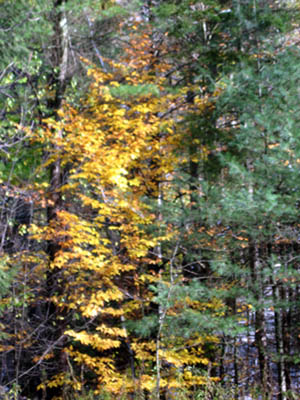
And golden till the end — leafy kin — a young maple in our back yard, shouldering its way up among larger pines.
What can I ask, and what will they teach, tell and declare?
Isn’t everything open and shut at the same time, the glory and the wretched side by side, the fox killing the hare, the wonder of sunrise, a birth and a death both?
But what of the between, where we all live, where it is often neither? The third way we pass over, because it constantly moves with us, never stopping to be wholly seen or felt, a shadow at our backs, a light in front of us, a suspicion of beauty and the marvelous: peering through the grime and fog of a dirty window, a commuter on the way to work, waving; a bare branch with exactly seven sparrows wing to wing, puffed against the cold; the surprise of light on water, perfect mirror; a child’s unflinching gaze. O my world, altar of how many things to see and know and suffer and enjoy and give up and welcome again, how can I do anything else than love you, in the end?
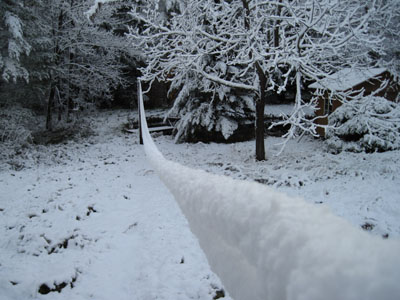
After a gentle, wet snow last night, the landscape is transformed.
The light before sunrise paints everything a lovely gray-blue, and in the stillness you can hear snow falling from branches as the temperature slowly rises. Minute by minute the scene changes, so I hurry to photograph this brief beauty.
Our clothesline has quadrupled in size with its snow sheathe.
Even as I hurry to capture these images, still in the shade of the hill to the east, the tree-line across the road receives the sun, and the yellow leaves still on the trees begin to show through under the snow.
A few hours later, with the temperature risen to the mid-30s, the trees stand mostly snow-free.
As we near Samhain (see previous post), I want to do some thinking out loud about sacrifice. And that includes moving randomly, and in less than smooth gestures, as thought moves (at least mine does), and leaving some avenues for later reflection. And input from readers, too.
Sacrifice literally means something that makes sacred or holy, though a sacrifice in contemporary usage has come to signify as well a loss or voluntary giving-up, in return for some advantage. Why should the holy link with a giving up? Something good, in exchange for something better. It carries with it associations of unpleasantness or suffering — the difficulty or pain involved in the giving up, even if the advantage is fully worthwhile.
But need the sacrifice always entail giving up? The making sacred of each moment may involve my giving up scattered attention, or a bad mood, but these are not usually things I’ll miss.
I go to my altar during a ceremony or ritual, and give in offering something I have purchased, grown or made — most recently, some home-made incense. It has “objective” value, as far as that can be measured, in dollars or in what dollars can purchase. But it has “subjective” value in terms of what it’s worth to me. I hope it may have value as well to whoever receives the sacrifice. Even more, if it costs me something essential to provide it, people often consider it a more “true” sacrifice. And if it’s a fair exchange, I’ll gain an equivalent for what I give. Well and good. Many sacrifices stop there. But what of sacrifice that gives all and expects nothing?
There is a joy in that kind of giving, if the sacrifice is voluntary. Much was made in ancient cultures of the “sacrifice that goes consenting.” A sacrificial animal delivered a bad omen if it resisted axe or blade, or shied away from the sacrificer. Human offerings, though apparently fairly rare, might have their senses dulled with drugs, so that the pain or apprehension — or defiance — did not taint or diminish the sacrifice. Does this reduce its value? Does the sacrifice still go “consenting”?
So far I’ve looked at this entirely from (my) human point of view. If I make an offering to a god or thought-form or some higher wavelength of consciousness (and these may or may not be the same thing), I change the situation by my actions, even if only in a small way. As a marker in memory, ritual breaks the flow of “profane” time with a division or irruption into consciousness of another kind of act. Actions done consciously, with intention, in formal words and gestures and attitudes of mind and body, are simply different from our daily-life consciousness. They feel different, and we remember them differently. They mark time as altars, chapels, shrines, temples, churches and sanctuaries mark space. Whether “holy” or not, they are different and distinctive for that reason. They don’t fit the pattern. In terms of consciousness, they are marked, while the “ordinary” is un-marked, the default mode of most of our experience.
But what of the view “from the other side”? Apart from whether gods exist, the universe tends towards an equilibrium, at least locally. Extremes don’t last, and we return to “normal.” Almost. The short span of “not normal,” of marked, of ritual time, of sacrificial consciousness, has left things changed, however small the change. Does a god perceive such human action and awareness? If so, how? And does what I’ve called ritual or sacrificial consciousness come across any differently to That Which Watches?
In crude terms, a sacrifice is a claim on another. Roman culture expressed this as do ut des: “I give, so that you may give.” I’ll scratch your back if you will later scratch mine. The initiative in this case comes from me: if I act, you are obliged in some sense to respond. There is trust here, a kind of faith in “how the universe works.” Many moderns might be utterly perplexed at this kind of thinking. All I can say is, don’t knock it till you’ve tried it.
In mainland Chinese culture, everyone is conscious of guanxi, the obligation or connection they have with others. In fact, one way of saying “you’re welcome” is mei guanxi — “no obligation or connection.” You don’t owe me; there’s no need to repay. On the flip side is the the incidence of one Chinese literally chasing another down the street with a gift the first person does not wish to accept. Take the gift and you acknowledge connection, obligation. If the sacrifice is accepted, you’ve built up some credit with Another, with the divine, with Otherworld energies. (Can we make a sacrifice without expecting anything, even if it’s just a sense of satisfaction or wholeness in the act of making the sacrifice?)
But the sense of sacrificial debt or obligation does not stop there. Again in Roman culture, the flip side, the necessary correspondence, is da ut dem: “You give, so that I may give (in the future).” Complete the cycle. Establish reciprocity, build the relationship. We depend on each other, gods on humans as much as humans on gods. Note that the goal isn’t to pay off the debt, or reach a new equilibrium, but to establish a connection through mutual commitment and generosity — to build a history together. In other words, to keep the exchanges going.
Eventually we may begin to see all our actions as ritual and as sacrifice. Whatever we sanctify comes into to our lives through reciprocity, because we are inevitably part of the whole, in relationship with the cosmos. “What you do comes back to you,” for the simple reason that you asked it to, by placing attention on it, by performing the ritual of desire and attention, and often, the dedication of resources, of the holy substance of the living world, to achieve or create or earn or win (or steal) whatever it was you thought you wanted.
But the act of desiring something, of investing energy and consciousness into it, changes us. We all know the old saying: be careful what you wish for, because you just might get it. When “it” comes, we’ve often moved on to other goals and desires, and no long wish for it, or even recognize it when it arrives. We’re on to the next thing, and the consequences of one of our old wishes or desires may no longer fit us where we are. We may even see it as a kind of obstacle, some piece of bad luck, a bump in the road, not knowing we asked for at some earlier point.
Here magic has its place, not as stage showmanship and illusion, not as Harry-Potter wand-waving, not as Hollywood “spfx” or special effects, but as a way of clarifying our desires and our consciousness, as well as reducing the occasions when we randomly or less than consciously send out desires for things we don’t actually want, or which won’t serve our best interests. Instead, we learn (how slowly and often painfully!) to act with intention, to change consciousness through ritual, discipline, focused psycho-drama, meditation, making ourselves the center of change, which then ripples outward from our own changed awareness into the wider world around us. All things flee from us, or come to us, in accordance with our state of awareness.
As a wise person said, “The only miracle is a changed consciousness.” That is the chief form of the plenitude that comes with true sacrifice — a test for its validity.
OK — now I’ve given myself lots of abstractions to test with specific concrete examples from daily life. Any comments or observations?
We’re a few days from the old Celtic harvest festival at summer’s end. For those of us the northeastern U.S., with the recent frosts and snow in the forecast, it feels like summer’s end as well. As a time of endings and beginnings — the new year begins as the old one ends — it is a time of introspection, intuition, dream and creativity. As an acknowledgment of change and completion, it can also include a remembrance of the dead.
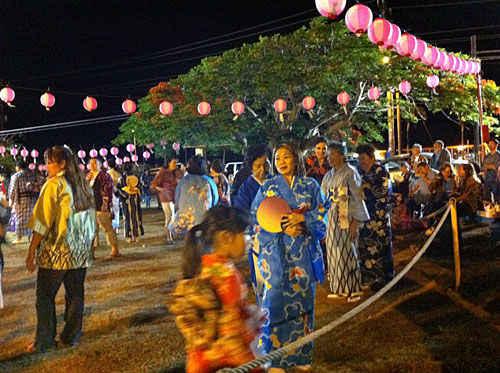
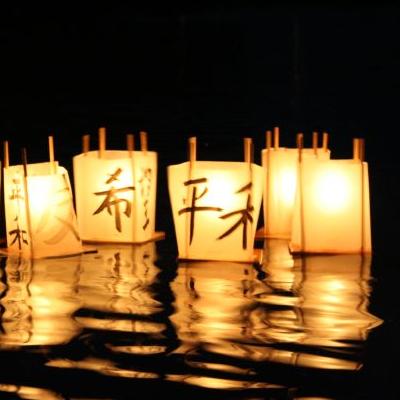
The holiday was adopted by the Church and transmuted to a three-day observance from Oct. 31 to Nov. 2. It begins the night before, on All Hallows Eve*, or Hallowed Evening (Halloween), continues with All Saints Day, and concludes on All Souls Day. In many other cultures there are similar observances, though not necessarily all on the same dates. Spanish speakers celebrate Dia de Los Muertos, and Christian Arabs observe Yom El Maouta, both meaning “Day of the Dead.” The Japanese observe O-Bon, remembering and honoring their ancestors. Held during July or August, depending on location and local tradition, the holiday feels to me (I lived in Japan for two years) like a cross between Halloween and the Fourth of July. Originating as a Buddhist observance, it also includes a dance — the bon-odori — to give thanks for the sacrifices of ancestors, fireworks, carnivals and a concluding Lantern festival, imaging the return of the souls of the dead. This Asian holiday captures the Druid spirit of Samhain for me: celebratory yet reverent, and family-oriented.
Druids and other Pagans have adopted the older Celtic name of Samhain or Samhuinn (pronounced approximately SAH-wen or SOW-en — the “mh” in Irish spelling indicates a sound like “w”) — as they have other Celtic names, since for them the holiday has association and symbols different from those current in the Church. The “sam-” is cognate with English “summer” — the word means simply “summer’s end.” (Christian anti-Pagan propaganda tracts like this one ignorantly and wrongly portray Halloween as “The Devil’s Night” and “Saman” as an evil “Lord of Death” — scroll down to the 15th frame. No evidence exists for a Celtic deity with that name and association. Besides, American commercialization of the day has obscured the invitation of its spiritual potential, though it remains still at hand. Somehow Americans also seem to have trouble achieving both “mirth and reverence,” as the “Charge of the Goddess” in the Wiccan tradition exhorts us.)
At the school where I’ve taught for a decade and a half, students themselves often took the initiative to celebrate this autumn holiday. Some two months into the school year, with exams looming and — for the seniors — college apps drawing more and more of their attention, they still found a supervising adult so they could get official permission and use school meeting areas, put up posters to invite everyone who wished to attend, and write their own rituals. I’ve saved several years’ worth of photocopied ceremonies in wildly varying degrees of elaboration, and I’ve attended both large and small gatherings, indoors and out. Some were largely excuses, it’s true, to dress up in capes and masks, light candles, scare and amuse each other, and then gorge on candy afterward. But others were moving commemorations of the season, an opportunity for acknowledgment from everyone who’d lost a relative or friend in the past year. The event helped acknowledge grief and cleanse the emotions through a group ritual of shouting and crying, burning messages in a cauldron, and closing with a group meditation. If the larger culture doesn’t make room for such things, subcultures often do.
The autumn equinox last month was the first time I celebrated that holiday as a Druid, and with fellow Druids, at the East Coast Gathering. In my part of the U.S., Druids are thin on the ground, though a couple of us are considering a small gathering. But whether or not in the end we manage to find time for a group celebration, I’ll also observe the day myself, this marker of moving in time and experiencing the fullness of human life.
/|\ /|\ /|\
*”All Hallows Eve” precedes the day dedicated to the hallows or saints (Old English halga) — All Saints Day.
On other blogs, I’ve also looked at practices and perspectives found in many places, Druidry among them, that are forming part of new-old ways of living on earth. The video below captures something of what I’ve found in Druidry. It’s got a nice flute solo and some good nature images. How were you planning to spend the next two and a half minutes, anyway?!
That presence in forest, grove or single tree is something kindred to me, so I walk under the branches, and touch the bark and speak with them, and listen. Their slow gestures move in the air above me. And the silence rings in my hearing. Druids and trees — that was something I understood right away. In childhood my closest friends were trees. What is it about them?
The German poet Rilke captures a piece of it in one of his Sonnets to Orpheus:
A tree ascended there. Oh pure transcendence!
Oh Orpheus sings! Oh tall tree in the ear!
And all things hushed. Yet even in that silence
a new beginning, beckoning, change appeared.
Creatures of stillness crowded from the bright
unbound forest, out of their lairs and nests;
and it was not from any dullness, not
from fear, that they were so quiet in themselves,
but from just listening. Bellow, roar, shriek
seemed small inside their hearts. And where there had been
at most a makeshift hut to receive the music,
a shelter nailed up out of their darkest longing,
with an entryway that shuddered in the wind —
you built a temple deep inside their hearing.
Trees get me to go “quiet in myself,” so that silence is not absence of speech, but a positive space that allows the stillness to unfold and open up and include the listener in it. From it rises the “tall tree in the ear.”
Orpheus, the “you” of the last line, is a musician, a listener who hears the space between notes. He knows sound and silence blend to make possible the third thing of music. Wisdom speech, as opposed to chat and gossip, possesses that same character, emerging out of the silence which makes it possible, and bearing the imprint of its quality.
Such communion is a powerful tool. The rough “shelters” we construct out of our animal longings point us toward knowing these things, toward recognizing and gathering in the temple we can find “inside our hearing.”









 A Druid Way


