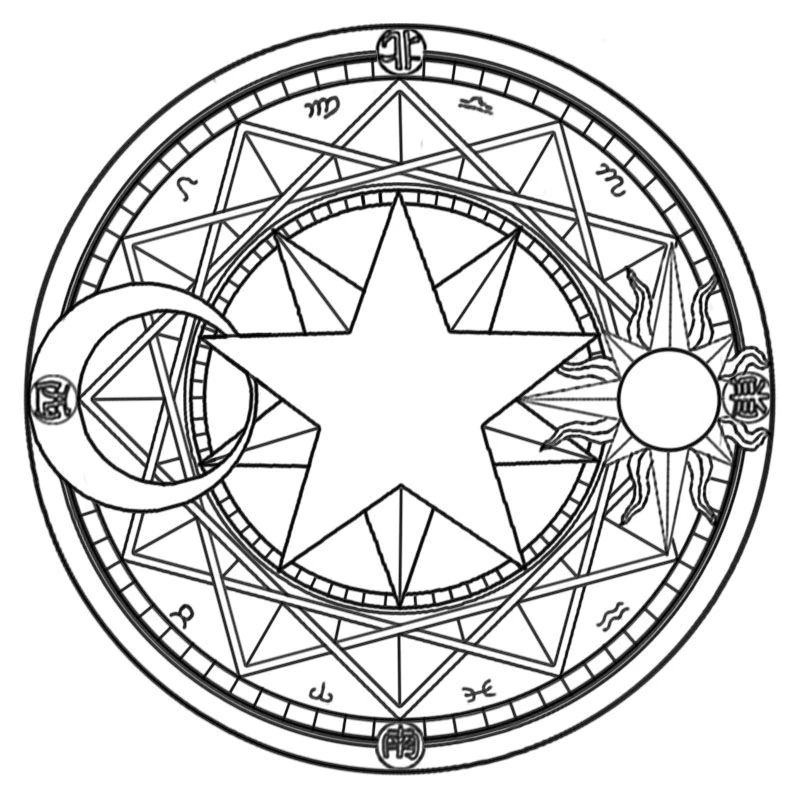
[Updated/edited 13 Feb. 2020 — located new ritual link!]
To properly and fully honor the deities of the day (including our love-tossed selves), we need look no further than a Chocolate Ritual. Here’s a link to one of its many versions.
Because when you cast your circle using a giant Tootsie Roll as your athame, you know you’re in the right place, with the right folks.
Truth’s subject to leakage at any time. Mostly, though, when that happens — when truth does manage, against the odds, to seep in — we strive vigorously to plug the hole any time more than a little discomfort spills out into our lives.
Praise then such discomforts, for what they can, even occasionally, reveal to us.
/|\ /|\ /|\
A burst of activity from Canadian viewers has been showing up on the page stats — one of a few places more wintry than here. A shout-out to Canadians trying to feel spring in February. It’s there — just under the snow, and behind the patience that, with this most recent bout of storms, is wearing thin for all but the most ardent lovers of winter.
/|\ /|\ /|\
“The world is a spiritual vessel. It cannot be improved,” says the Tao Te Ching, ch. 29. Of all the books based on wise and penetrating observation of the world and its dynamics, for me the “TTC” holds a singular position. So I’ve pondered this verse ever since I encountered it as a teen-ager.
To speak to this assertion (which, if you follow the above link, can be read many ways), and unpack and qualify it for myself and my readers, here are two of John Michael Greer’s responses to comments on his recent Feb. 1, 2017 blogpost “Perched on the Wheel of Time“:
The notion that one person can transform the world is very deeply rooted in our culture, and it’s not entirely untrue; like most damaging beliefs, it’s a half-truth. Each of us can change the world, but how we can change it is determined by our cultural and historical context — and of course it’s also true that in a world in which everyone can change the world, no one person gets to change everything! It can be a real struggle, though, to break through the binary between “you can change everything” and “no one can change anything,” and grasp the many ways in which we all, to use a New Age term, help co-create the future.
It can be a valuable Druid practice to break through binaries, finding at least a third position between two poles. And discovering and walking the line revealed by repeated blundering into a damaging belief/half-truth — there’s another name for life, for the modest wisdom a person can accrue over several decades. How much can I co-create? Where are my energies best spent in trying? Can I co-operate with even one other person around me — like a friend or partner, for starters — to maximize our co-creative acts?
And if this world can’t be “improved”? Well, certainly local conditions improve and deteriorate all the time, shaped in considerable part by the actions of individuals. Any overall equilibrium, though? I must ruefully admit that does seem to remain the same. But that’s not a reason to disengage. Greer expands on his perspective in a later comment on the same post, which I find persuasive as well:
…the Druid teachings I follow hold that this world, the world of human beings experiencing greed and hunger and a distinct lack of the brotherhood of man, is a necessary stage or mode of consciousness through which every soul must pass in due time. When we outgrow it, we move to a different stage or mode of consciousness, and the world stays the way it is so that it can provide the same experience to those who need it. Thus there’s only so much change you can make in the world — though there’s some, and making such changes are an important part of grappling with this mode of being. The changes that matter are those you make to yourself.
If a succinct statement of my bias is possible, Greer captures it in his last sentence here. “The changes that matter (most) to me are those I make to myself.”
First, because in the grand scheme of things I find change difficult. I’m assuming you do, too.
Second, because the changes I actually pull off, ones I make to myself, usually affect my immediate environment, where they’re more visible than they would be elsewhere. That means I get more feedback from them on what I’ve done, and whether it’s what I actually wanted. You know: life as laboratory.
Third, because I continue to learn the hard way that my understanding is often so imperfect in so many domains that I’d rather improve it and share what I’ve learned than botch my immediate environment out of ignorance or stupidity — and more likely, both. Humility is a really useful tool in my kit. Almost always I’ve ignored it at my peril.
And as for matters of scale, I’ve also met wise individuals in my life. Not many, but a few, human and non-human. But very, very few wise local governments, and even fewer wise nations. And that gives me guidance for where my energies are best spent — at least for me, in this cycle.
/|\ /|\ /|\
So when anyone — whether Jesus or Donald Trump — offers up a version of “I alone can save you”, I need a lot of proof and demonstration before I’m willing to divert my energies to them from working in my own life.
I think I could turn and live with animals, they are so placid and
    self-contain'd,
I stand and look at them long and long.
They do not sweat and whine about their condition,
They do not lie awake in the dark and weep for their sins,
They do not make me sick discussing their duty to God,
Not one is dissatisfied, not one is demented with the mania of
    owning things,
Not one kneels to another, nor to his kind that lived thousands of
    years ago,
Not one is respectable or unhappy over the whole earth.
/|\ /|\ /|\
It’s not what you look at that matters, it’s what you see. — Henry David Thoreau/OBOD’s weekly “Inspiration for Life”.
The first stanza of Damh the Bard’s lovely song “Brighid” (below) places the goddess in the landscape of vision:
There’s a tree by the well in the wood,
That’s covered in garlands,
Clooties and ribbons that drift,
In the cool morning air.
That’s where I met an old woman,
Who came from a far land.
Holding a flame o’er the well,
And chanting a prayer.
Though here it’s the goddess who’s “chanting a prayer”, the bard has invoked her with song — his own prayer. And he’s gone to the “well in the wood” full of intention. Maybe not specifically to see the goddess, but knowing the tree and the well and the moment offer possibility waiting for human consciousness to activate. A gift of the gods, already given freely to us.
Here in Vermont a light snow falls as I write this, and I step away from the keyboard to take a picture.
By February here, snow itself can signal spring to come. You can feel the longer light, and moments of snowy beauty remind you that wonder is never far away. The sap will be running soon in the maples, the sugar shacks smoking all day and night as the sugarmen boil down the sweet juice to syrup. Green will burst forth, improbable as that seems right now in a world of cold whiteness. So Brighid comes from a “far land” that is also always near to attention, intention and devotion.
Here across the Pond from the Celtic homeland, some North American Pagans can feel removed from the “gods of Europe”, bewailing their distance. This place, we can feel, isn’t “Their” land. Yet anyone who’s encountered a spiritual presence knows that place is a convenience of the gods, not a requirement — a set of clothes, not the being who wears them.
Yes, it would be splendid, we imagine, to visit that “tree by the well in the wood”, simply by stepping out the back door to a landscape steeped in stories and legends of the goddess. Yet we also know what familiarity breeds. Or as an African proverb has it, “Those who live nearest the church arrive late”. The old saying that the gods like the offering of the salt of human sweat means effort is not wasted, devotion is repaid. Always, we have something we can offer them. And the gods give, but “not as the world gives”.
For you soon find that the gods are not merely passive reservoirs, to be drawn down whenever we happen to think of them and plug in for a re-charge, our rituals cannily crafted to work like the swipe of a credit card at a gas (petrol) pump. “Fill me up, Brighid!”
But wait, you say. Isn’t that just what we’re doing with ritual and song?
It’s really not a matter for argument, unless you need the exercise. Damh the Bard knows Brighid — you can hear it in the song. And out of love he’s traveled many times to the tree by the well in the wood. Brighid knows his name.
This, then, is one intention to cherish: may we serve them so that the gods know our names. Not to hold it up before others like a badge of pride, but as a spiritual resource to treasure and spend at worthy need. Or as Gandhi said, “If no one will walk with you, walk alone” knowing in truth you aren’t alone.
Ten years ago I didn’t honor Brighid. I didn’t “believe” in her, though I’d heard her name, thanks to all those who kept it alive in our world. Now I honor her, but I still don’t trouble myself about “belief”.
Instead, I take the hint and look. “I saw her reflection in the mirrored well”, Damh sings.
And I looked deep in her face,
The old woman gone, a maiden now knelt in her place,
And from my pocket I pulled a ribbon,
And in honour of her maidenhood,
I tied it there to the tree by the well in the wood.
The Hopi of the American Southwest call one of their ceremonial pipes natwanpi — literally, “instrument of preparation”. As words do, this one stuck with me ever since I read it, decades ago now. No wonder: we need markers for passage into sacred time, because otherwise it can burn and blow right past us. Or, to shift metaphors, if we don’t catch the sacred wave, we can’t surf in sacred time. We miss that tidal flow, then wonder why life can seem flat or dis-spirited.
With a beloved festival like Imbolc calling us, what better time to consider how we can attune to sacred times and sacred tides?
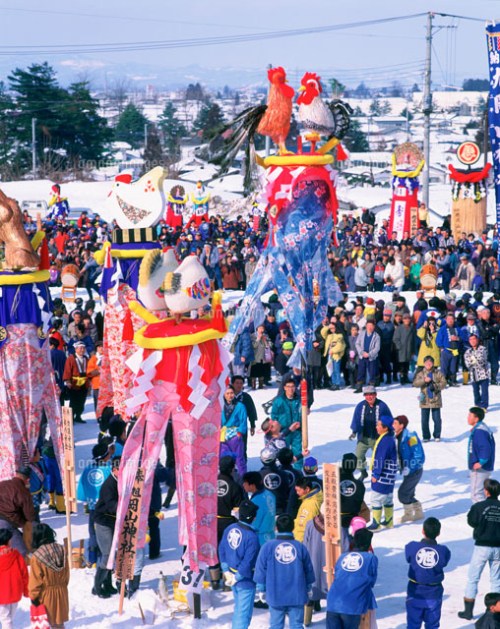
Shinto, that perennially popular topic here at A Druid Way, offers a mid-January festival called Bonden-sai which feels harmonious with Druid practice. Of course it has cultural flavors and overlays unique to Japan and Shinto, but its focus asks for and offers a kind of natwanpi. (Besides, a cold, gray, snowy northern January can use some color and liveliness.)
Bonden-sai, Akita Prefecture
The bonden for which the festival is named is called a “sacred wand”, though as you can see from the bonden in the picture above, “pillar” or “column” better suggests its appearance. (Let the chickens on some of the bonden above enlarge your sense of “sacred”!) A typical bonden, the Japanese National Tourist Organization (JNTO) helpfully informs us, measures
almost four meters in length … [and] serves as a marker for the gods descending to this world. In ancient times, bonden used to be made of paper or rice straw, but in recent years, they are often made by decorating a bamboo basket with colorful fabric. The bonden wands are carried by groups of children, townspeople, or even company employees. Each group entrusts the bonden with their prayers for an abundant harvest, good health for their families and success in business.
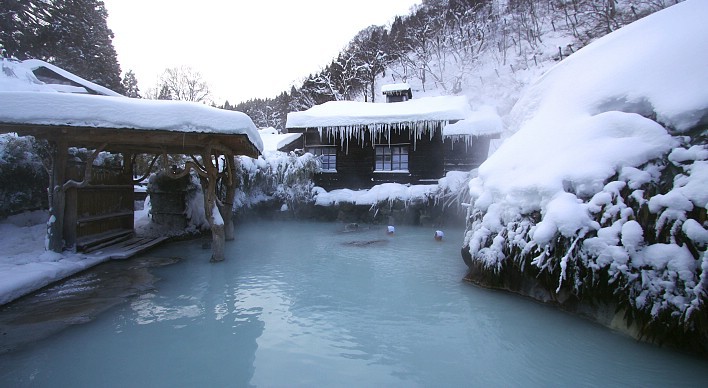
Bonden-sai is intimately associated with Akita Prefecture in Northwest Japan. Akita is also famed for its onsen (hot springs) and mountains, and Mount Taiheizan, the symbol of Akita City, is a major site for the festival. Bonden-sai there means a vigorous race up the mountain with your bonden to procure the blessings of the gods.
Shinto and Japanese culture, so long linked, have celebrated the sacred in so many things that the secular West allows to pass unremarked. Whether it’s drinking tea or sake, or bathing, or marking the calendar with a plethora of festivals, Japan models practices the West and particularly western Paganism learn from, build on and delight in.
Because when the gods are dead, the human heart also dies a little every day. You certainly don’t have to “believe” in them as any kind of prerequisite, any more than you have to believe in anything in particular to celebrate Halloween or Christmas or MLK Day. The gods themselves can serve as a kind of natwanpi, a means of preparation. Belief, like so much else, is a tool, a strategy, a technique for connecting to things other than ourselves. Use it skilfully, delicately, consciously, I’m learning, and it repays the respectful treatment.
Nyuto Onsen (hot springs), Akita Prefecture
Ultimately it’s the impulse to celebrate that’s the flame to cherish. And if it chances on occasion to be gods that help it happen, as one of the forms the sacred can take, why exclude them out of hand, just because they’re gods?
As for me, I try to take advantage of any natwanpi that comes my way. And if I succeed and connect only 30% of the time, well, isn’t that a very respectable baseball batting average?!
Sometimes ya gotta love acronyms. (No, not you specifically. People in general. Not that I’ve ever met a person-in-general. Only individuals, who annoyingly refuse to conform to abstractions. Thank the gods.)
Especially if you can find ways to play with acronyms as well as learn something useful from the ideas they compact into memorable form.
So first, let’s look at the A.S. part of the acronym in the title.
This post is inspired by an article in Scientific American from a little over a year ago Nov. 2015) titled “Perception Deception“. (Link to the author Michael Schermer’s blog — scroll down to November 2015 and the article.) In it, the author examines recent studies that point to our — and that includes all species — perceptions of reality as useful rather than necessarily accurate.
(Does it have to be either-or, the author plaintively asks at one point?)
In other words, it doesn’t matter how close to reality our perceptions are, as long as they give us advantages in survival and reproduction. Or, as the article puts it, they have Adaptive Significance. The sun doesn’t “rise” or “set”, to use a trivial example; instead, the earth rotates. But unless we’re attempting a spacecraft launch, we don’t need a more “accurate” understanding. Living as if the sun rises and sets grants us perfectly reasonable adaptive capacities.
We don’t need to go far at all to find larger and more weighty human examples. If your parents told you growing up not to talk with strangers and you put that precept into practice, it’s just possible you avoided some serious unpleasantness. There’s adaptive significance: you survived by escaping kidnapping, abuse, death, or recruitment into cult or gang or band groupie-dom.
But we know that most crimes statistically involve people who know us, so the ultimate adaptive significance of that parental instruction may turn out to be low. If that makes us into distrustful adults who find it difficult to open up to others, we may never connect with another person to reproduce and pass along our genes to a new generation. Low adaptive significance for the individual. But paradoxically high for the species: excessively fearful individuals self-select and remove their genes from the genetic melange of the human future. In other words, and among other things, heroes remain possible.
The premier example the studies cite is the Australian jewel beetle:
Females are large, shiny, brown and dimpled. So, too, are discarded beer bottles dubbed “stubbies,” and males with mount them until they die by heat, starvation or ants. The species was on the brink of extinction because its senses and brain were designed by natural selection not to perceive reality but to mate with anything big, brown, shiny and dimpled (Scientific American, Nov. 2015, pg. 75).
Now apart from providing wonderfully vivid and useful ammunition to cartoonists, misanthropists and meme-lovers about the relative intelligence of males and their sex drives, the example seems to me to undermine the point the researchers actually wished to make. Here is a perfect example of how perception needs to match reality quite faithfully, or it won’t confer that sought-after adaptive significance.
In other words, species also need to possess what the article terms Veridical Perception — the VP of the acronym — if they’re going to survive. Or as my mother repeatedly counselled the teenaged me, you have to live in (and perceive) the real world.
(She neglected to add: “Just not all the time”.)
It’s true that human culture can shelter from reality some highly inaccurate perceptions, and for long periods. To quote a whimsical example, Humpty Dumpty exclaims,”Why, I’ve believed as many as six impossible things before breakfast!” The mutual support we give each other, and human law, medicine, societal expectation and life experience, all help moderate and temper and refine our perceptions of reality to help minimize the damage inaccurate perceptions can cause. But wackadoos and wackadooism still persist. We can just generously think of them as genetic outliers. Experiments in adaptive significance, not veridical perception.
It is also an argument of the article that species with high adaptive significance consistently out-survive species endowed only with veridical perception.
Yet despite what current politics and media suggest, most humans live in approximately the same perceptive universe. Our differences loom large only in certain select domains. In spite of the noise these few domains are generating right now, the immediate adaptive significance of most of our behaviors remains high. (It’s flaws in their long-term adaptive significance that remain our great challenge.) Drive down the highway and — while a few accidents do indeed happen — the marvel is that most people see the universe in ways similar enough that we don’t take out all other drivers on the road in a single day of apocalyptic Hollywood bloodshed, simply because what you see as a red light I see as green. The relative absence of “carnage” — a loaded word in the U.S. right now — is an encouraging thought.
But side by side with adaptive significance, we might remember that evolution doesn’t “progress”. Where and how the arc of history may bend will apparently always be an experimental question, not an ideological statement.
A sparrow flying around today isn’t an “improved” or “more” evolved version of an ancestral theropod or archaeopteryx. The same is true of modern humans: we’re not any better suited to life in cities or at a desk in corporate America (or on the tundra or in the jungle) than our Cro-Magnon or Neanderthal forebears. We’re distinctly not “new and improved”. What we are is adapted, and adaptable.
It doesn’t have to be a choice: our behaviors more often possess adaptive significance when they also arise from veridical perception. We thrive when we “do the true”.
Veridical Perceptions with Adaptive Significance
And what about Druidry, just one of our many attempts at a veridical perception, at an accurate grip on reality? Does it also confer any adaptive significance? Is it just a Western 21st century middle-class indulgence? Does it offer an edge that can help us navigate tough times and steer us through these beginnings of a centuries-long post-industrial transition?
The next post will look at some possible responses to these questions.
This post is a tribute to the previous owner of the handful of acres and modest ranch house where my wife and I now live.
Elfriede* passed on at the age of 93. Just eight of us stood round her grave on a cold January day, each with a funny-sad story to tell about her. Elfriede’s short stature — a few inches under five feet — belied her remarkable toughness: “elf-strength”* indeed!
A survivor of a German concentration camp from which she escaped as a teenager, she made her way to England, where she met her husband Ed. The two of them eventually settled in New York City, and there they saved up to buy a Vermont property first as an escape from the city’s heat in summer, and then as a retirement house. They built and lived in the garage first, then constructed much of the rest of the house. Though it’s generally solid, it does offer its share of the quirks and kinks any owner-built house shows in abundance: odd wiring in places, uneven insulation, pipes stopping in the middle of one wall as if simply abandoned, and so on.
From the lavish plantings of flowers to the small fish pond downhill from the house to a variety of ornamentals bushes and shrubs, we have much to thank her for. But as I gather materials for a Beltane workshop this coming May, I send particular thanks to her for planting as many of the nine sacred woods as she did.
Which trees belong to the exclusive grouping varies by culture. (To the right is one Scottish version.) Already I’ve located five on the tally I’m using (Rowan, Birch, Willow, Oak and Holly), and I suspect I’ll eventually find all nine, and more.
My confidence stems from details I’ve already mentioned, and from moments like the following: Some eight years ago, on an overcast day that threatened rain, my wife and I arrived at what was then still Elfriede’s house for a second visit. We found she’d set a kitchen knife in the western yard, sharp edge toward the approaching weather front to split and shunt aside the oncoming storm.
Such European kitchen magic, along with Elfriede’s delight in all growing things, meant the modest property surely promised some rich botanical finds once we had the leisure to explore it properly. This “green vibe” definitely contributed to our ultimate decision to purchase the house. The land simply felt good.
So I raise a glass to her now, and I will again when I light the sacred fire on Beltane 2017.
*”Elfreda, Elfrida, Alfrida, Elfrieda, Elfriede, Elftrude, Elftraut is a female given name, derived from Ælfþryð (Aelfthryth) meaning “elf-strength”. The name fell out of fashion in the Middle Ages and was revived in the 19th century in both England and Germany.” — Wikipedia
[If the upshot of watching the video about Yury, the “Russian Hobbit” featured in yesterday’s post, has you most concerned about whether Petrushka, mentioned only in passing, is actually Yury’s rabbit, I’ve still achieved something. Something very small, but still something.]
/|\ /|\ /|\
ESCAPES and MODELS
This post examines some of the arguments, examples and ideas in a recent (Jan. 15, 2017) essay in The Atlantic with the unfortunate title “Seeking an Escape from Trump’s America.” I say “unfortunate”, because the problems the “escapees” face neither originate with Trump nor will they end with him. His name here is merely a red flag to a bull.
In the previous post, Yury aspires to, and achieves, a personal solution to his problem. For some, that may be enough. For others, community is a less selfish choice. It can also prove much more viable if you don’t have the means to drop out and move to Maine, as the previous post begins to suggest.
More importantly, the intentional communities the article investigates are not all “escapist” by any means. Rather than retreat, some attempt to engage the larger culture and model more viable and saner alternatives. Several got their start years and in some cases decades before Trump had entered the political fray. You could even call the title clickbait, because it does a disservice to the writer, who very probably didn’t choose it, and to the substance of the article, which grapples with some real and compelling concerns.
Twin Oaks, a community of some 100 members, celebrates its 50th anniversary this year. The community founded in 1967 can speak with particular authority — experience and evidence of its survival and “thrival” — about almost every issue facing intentional communities today. I believe the video below really is worth your next 16 minutes.
Now it may be that the video, or this post and some of the previous posts don’t speak to you. Perhaps you’re largely immune to the accumulating economic, political and cultural upheavals of our era. Possibly you’ve made your pile, your mortgage is paid, you have diversified investments, or other secure-enough sources of income. Along with those bulwarks against poverty and despair, you’re healthy enough to garden or handicraft your way through the next few decades until mortality relieves you of the challenges of this particular incarnation.
If so, please consider how you can help others. You don’t need to subscribe to false-Christian ideas of giving away all you own, unless you’re entering an intentional community, monastic or otherwise, for which this is the admission ticket. Why plunge yourself into poverty out of guilt or misguided perceptions that this will help someone else? Instead, use your position and privilege to accomplish something you choose to do for others.
ALTERNATIVES to “CONSUMPTION-HEAVINESS” and DESPAIR
One group has “given an official name to their search for an alternative to consumption-heavy American life: the Downstream Project, with the motto to ‘do unto those downstream as you would have those upstream do unto you.'”
That’s one measurable goal. Rather than trying to “change others”, live so that your life doesn’t make other lives harder. I know that’s certainly more than enough for me, some days. A negative goal troubles you? Think of the Hippocratic Oath: “Do no harm.”
Can we aim for something larger? Of course. “… instead of continuing in passive despair, as many Americans seem to do, the people in these communities decided to overhaul their lives.” What would a “life overhaul” look like for you? The beauty of the question is that the answer is wholly up to you, if you let it be. Why not your answer, rather than anyone else’s?
Many of the Druids I know give more than lip service to this ongoing question. Despair just gets boring after a while. And that’s one of the reasons I love them: they don’t merely go through the motions, but bring courage to their own lives, and find worthwhile challenges in engaging bigger questions than “Where will I vacation this year?” or “What’s on cable?”
If you still haven’t let go of “Trump?!”, consider this observation by one member of an intentional community the article considers: “When there’s a Democrat in power, social-justice-minded people go to sleep, because they feel validated by what they hear on NPR.”
We can even practice Trump-gratitudes: I thank Trump for waking me up, for kindling useful anger, for provoking self-examination, for puncturing my weak political stances, for making me doubt, for unsettling the false comforts of middle-class-dom, for X, Y, Z …
ALIENATION as a RESOURCE
So what can we do with these gratitudes once we affirm them? Feel just as alienated, if not more so?
Alienation is “othering”, and not all bad. (Trump himself is a delicious example of a Monty-Pythonesque “Now for something completely different”.) One thing becomes another anyway: it’s how the world works. Alienation? “The Living Energy Farm runs on a different philosophy of alienation: If they can prototype alternatives to modern life, they believe, they can eventually remake the world.”
Any real re-making happens at home:
In the summer, [members of one community] cook with a small solar dish and a rocket stove behind the kitchen; they’re building a bigger dish, taller than a grown man, nearby. They hooked up an exercise bike to a washing machine and rigged a pair of old tractors to run on wood gas rather than gasoline, although they aren’t quite functional. They built their own food-drying room off the kitchen, where they process vegetables grown on their 127 acres, and they graft fruit-tree branches onto wild stems.
‘We refer to it as neo-Amish, or Amish without the patriarchy,” another member says.
Some of what we see as solutions are inextricably bound up with the problem:
“The way we choose to live has far more impact in terms of our environment … than any particular technology,” [one community member says]. “If Americans bother to talk about the environment at all, it’s usually in terms of a technological perspective.”
We’re conditioned, after all, to expect technical fixes for most problems, when some of the best alternatives simply don’t originate in technology.
… mainstream environmentalism is too focused on incremental reform and modest lifestyle choices, like driving Priuses. “For us, the question is: How do I live comfortably with what renewable energy can do? … If you ask it that way, you can’t drive to D.C. and work in a cubicle,” he said. “But the environmental groups want to tell you that you can, because then you’ll send them donations.”
Ouch. But useful ouch, I hope. For Deanna, another community member,
“I envisioned being remote, being able to keep to ourselves, not being involved in whatever strife is going on in cities,” she said. She was glad to leave behind Boston and demonstrations like the ones that took place after Trump’s election; she’s also glad they now drink from a well, she said, because “it feels safer to be in a place where we have control over our water.” Hers is not a search for ideals, but for something tolerable—something better than what was available elsewhere.
If such retreats from what mass culture offers can provide something better, why not try them out? Another community named Cambia (“change”) isn’t just retreating.
To some extent, they’re trying to spread their knowledge and their project. They’re writing a wiki, nicknamed “commune in a box,” outlining legal and tax details for income-sharing communities—Cambia, it turns out, is both a commune and an LLC. They want people to be able to start new communities, tailored to their own needs; Cambia is not the model, they said, but a model.
Viable experimental models of alternatives are crucial at hinge points in the human experience. We certainly seem poised on one right now.
Another commentator concedes a signal challenge of making any change.” It takes a lot of cash to get off the grid,” he says. Putting it another way, you almost have to start rich to become poor.
… becoming untangled from capitalism also means becoming much more vulnerable. It’s tough to imagine a comprehensive way of replacing health insurance, not to mention programs like welfare, in a world without government.
“What we have now is an embryonic global civilization that’s totally ecologically, socially, and economically unsustainable. … There’s no escaping into your own little enclave.”
Once again, at the risk of sounding a theme many already know and others label a facile fiction, I’ll quote Tolkien’s Gandalf as he counsels Frodo: “The wide world is all about you: you can fence yourselves in, but you cannot forever fence it out.”
Some people use the term “lifestyle politics” to describe these communities—“the belief that if you live your values, then you will be able to make effective change, or at least express your political perspective,” [University of Washington professor of political science Karen] Litfin said. “I think that’s a good place to start, but if that’s where you end, you actually don’t have much impact at all.”
Meaningful change, I find, has to start with me, or it literally doesn’t mean anything, or not for long. It stays on the page (or the blogpost). I’m the center, just like everyone else is, where any transformation takes place.
An INVITATION to COMMENT
Reactions? How can we continue this conversation? (The most important arguments we have are with ourselves.)
Rather than emigrating to Canada or some other country when the candidate you don’t want wins anyway, consider a more radical change. Why not remain in your native land, but opt out of as many systems, expectations, structures, economies, etc. as possible that exist for others’ benefit but perhaps not yours?
Harder, you say? Less practical? I’m far less interested in the malcontent who talks of relocating to Canada and much more engaged by anyone who actually makes a change with less talk and more action.
Consider Yury …
What would it actually require to do what he’s done?
Of course, in the scant two plus minutes of the video, we don’t get anything like a clear picture of Yury’s resources and choices. We do get a romanticized picture of independence and self-reliance. What else has Yury opted to do without, in order to make his change?
Like Thoreau’s accounting of his expenses early on in Walden, let’s suss out a rough estimate of what a comparable transformation would require while remaining in the States. Readers who live in other countries know better than I how to translate expenses and possibilities to their own circumstances.
We learn Yury opted out of a professional life as a lawyer five years back. Presumably unlike many law students in the States, he doesn’t have massive loans to repay. Probably he was even able to save a modest amount in order to launch himself into his new life.
Sixty miles outside of Moscow, he’s obviously rural. How much land does he own? Does he raise most of his own food? How near is the nearest town? Can he walk to a general store or market for things he can’t grow? Solar panels on the roof power lights and a computer, but not much else. He apparently cooks and heats with wood. We’re told a generator tides him over for the few months each year when the sun isn’t enough.
How does he wash clothes? Is he still covered by a state health care system, or has he opted out of that too, living as most of humanity has until the last few generations? No car? Public transport nearby — even a bus — would definitely help.
I’m going to use Maine as a starting point, because land taxes are quite high in Vermont where I live. In New Hampshire, there’s no income tax, but various other taxes take a larger bite. Live in a scenic NH area with appealing vistas and you pay a “view tax”. Maine has fewer services, but someone like Yury isn’t looking for such things anyway.
So here’s my accounting:
1 — Property: .5 to 5 acres of land (I used Maine Listings): $3-10,000.
With careful shopping, the land may come with a well and/or septic in place. Composting toilets and rain collection systems can provide other options. A few miles from a town of a few thousand people will generally give you reasonable access to supplies, at least during the summer months, when hiking or biking with backpacks is relatively easy. A friendly neighbor you trade with — occasional transport to and from town in exchange for vegetables, firewood, yard work, etc. — can also make such an arrangement more doable.
Rental or leasing would allow for less expensive options for property and for the next item — taxes.
2 — Annual taxes: $100-1000
This depends of course on many variables — property size, township, distance from town, structures in place and added, etc. If you’re supporting yourself with any sort of service or product — eggs, firewood, craft items, seasonal labor — the figure rises.
3 — House/other structure(s): $1000-10,000+
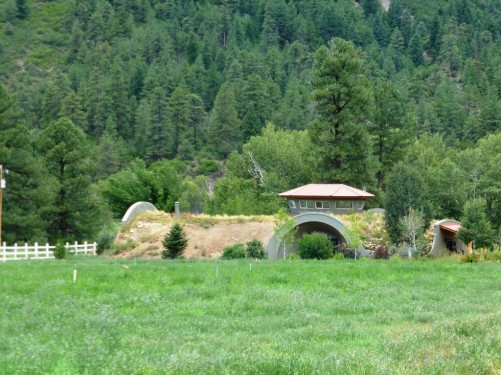
Yury’s underground house is straw, clay and wood, with some sort of insulating and waterproofing membrane. Building aboveground lets more light in, alleviates many waterproofing issues, but increases heating needs. Earth-berming is a powerful compromise — imagine a house with only south-facing windows — all other sides are bermed. A sod roof of a foot or more of earth is cheap and effective insulation.
Earthwood Building School run by Rob and Jaki Roy in West Chazy in northern New York has links and images to give you a range of ideas. (Rob, here’s some free advertising!) What you’re willing to do for yourself, and your minimum requirements, your “without-which-not” list, can shift the price quite dramatically up or down. Sweat equity also makes an immense difference here. Do you need perfect, or serviceable?
Add to this a chicken coop, wood storage, gardening equipment, perennial plantings as needed, etc.
4 — Annual living expenses: $2000-10,000+
Ivan McBeth, whom I’ve mentioned previously on this blog, lived with his wife Fearn for many years until his passing last year on about $8000 a year on their 40-acre property in northern Vermont. Much of his income derived from running Druidry workshops and building megalithic structures on site for clients.
Again, it might be possible to pare the lower end of that $2000 still further, especially with barter. Everyone has their necessities.
5 — “Future Fund”: ?
If you plan at all for the future, old age, emergencies, or a desire to change your life once again after a 1, 5 or 20 year experiment, a modest nest egg of any amount can help smooth the way.
/|\ /|\ /|\
Or you decide instead to relocate to another country. More expensive, very likely. Learning another language, living in a different climate, with different lifestyles, social norms, history, national trajectory and attitudes towards foreigners, and Americans in particular, will all play their part in your experience.
So does any of this whet your appetite, or discourage you?
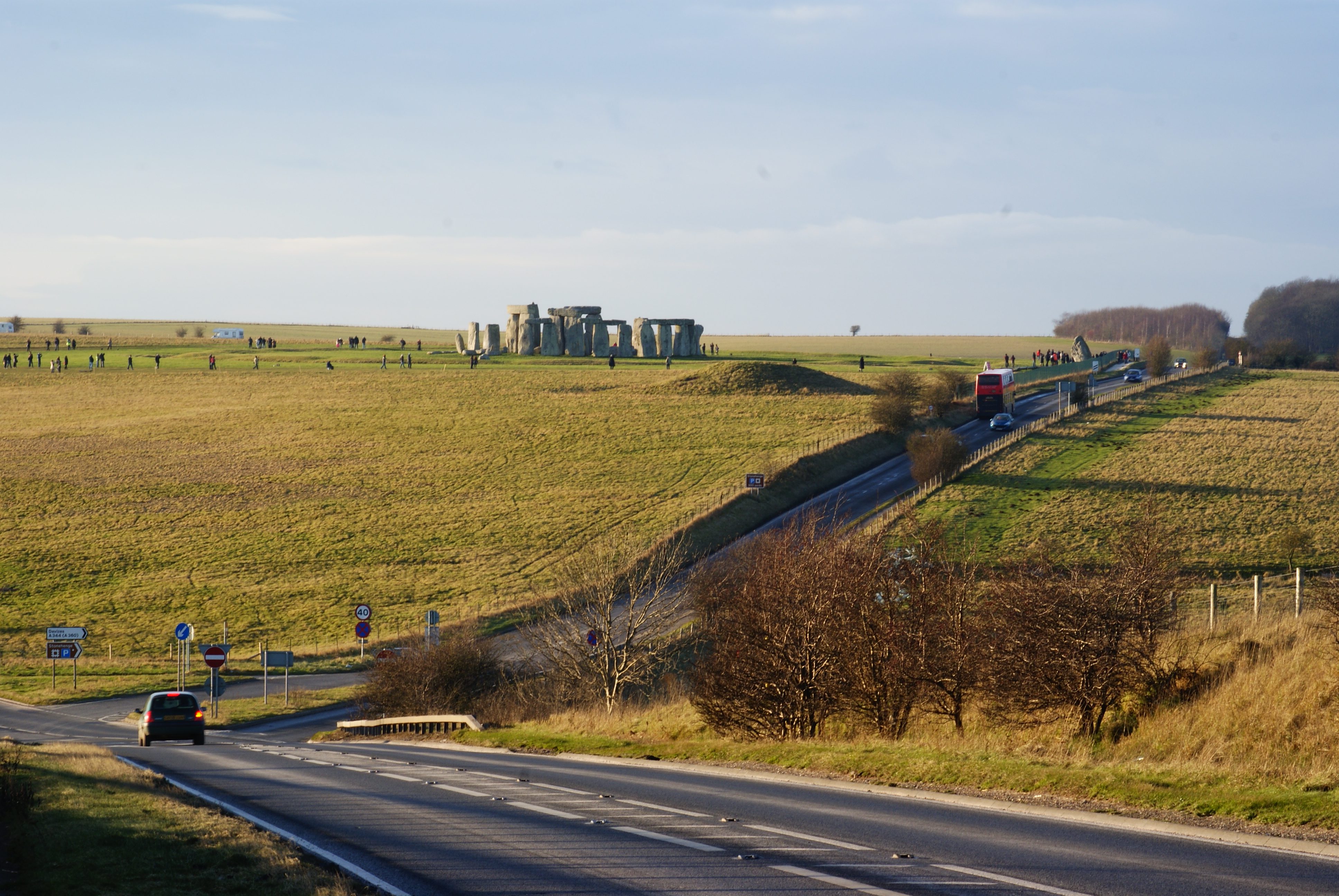
Like many celebrities, Stonehenge suffers from an excess of fame. The recent go-head for yet another long-debated construction project involving the site will, this time, move the noisy and heavily traveled A303 motorway underground into a nearly 2-mile long tunnel. It’s a 2.4-billion dollar attempt to restore the monument a step closer to its original solitude. You can read more about it in a short article in yesterday’s Guardian newspaper.
Want the condensed version? The return to comparative silence is undeniably welcome, though the prospect of digging upsets archeologists and many others, who know it will likely disturb the immense neolithic ceremonial complex that extends across the Salisbury plain, of which Stonehenge is simply the most visible and well-known part.
And for information on the excavation of nearby wooden rival of immense proportions just two miles from its more famous stone counterpart, The Independent has an article here.
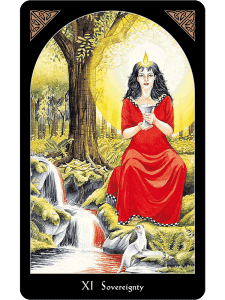
Sovereignty, Lady of an inner realm which flows ceaselessly into this one, you birth, nourish and sustain us. May my deeds serve not my own will alone, but your larger shaping for the good of all. In my words here, in my deeds, thoughts, feelings and dreams, let that light and song and fire illumine where it can, whom it may.
If conditions here no longer allow for the manifold inner purposes and directions to manifest outwardly, physical life may well withdraw from one world, moving to another. Yet in spite of the uncertainty and dark despair that may arise in our hearts from time to time, this lovely, difficult, damaged world is far from exhausting its spiritual purposes.
As a sacred laboratory for experiences for many beings, and for spirit to inhabit all lives, possibilities and forms to know itself again, the world unfolds still, rich with potential. Both established forms yet with us and new ones coming into being offer choice, beauty, misery, destruction and growth. From the small to the great, from the inner to the outer, from seed and leaf to flower and fruit, through decay and transformation and renewal, it has ever been so.
True it is, that all realms touch, intermingle and answer each other. Events here send their ripples and taproots elsewhere for good and bad, and a shift there brings about a corresponding change here. The walls of the world echo. The great wonder is not that we have no influence on life, but that our influence often exceeds our knowledge. Day to day is not always the place to look for vision, though what we see elsewhere in vision and dream returns us here to labor anew.
Because that’s what makes a uni-verse, a one-turning. We are part of the work and movement of a marvelous many-faceted whole. It’s a measure of our priorities and the fading of the ancient heritage we have received and often abandoned in our pursuit of other things that many of us no longer know this in our bones, that we have to re-learn it through often bitter experience before we can begin again to make use of it to shape something better. But our cells know better, and our dis-ease may yet call us back to here and now, our suffering may still wake us to rebellion and questioning and discovery, our losses may perhaps stir us to compassion rather than endless lament and blame and surrender.
/|\ /|\ /|\
The seed of ritual, planted. The promise of spring, uttered. The shaping of hands to make each thing happen, foretold and prefigured at the birth of each woman and man into this world, from the great family ranged behind and all around us, that family of blood and friendship and teaching in the other worlds. Ancestors, hear us.
Slowly we apprehend what is essential and what is not, the long journey fashioned and felt and followed as we abide in multitudes of forms.
For us, the essential thing is that there is everywhere a conception of the end and the beginning of a temporal period, based on the observation of biocosmic rhythms and forming part of a larger system — the system of periodic purifications (cf. purges, fasting, confession of sins, etc.) and of periodic regeneration of life. This need for a periodic regeneration seems to us of considerable significance in itself. Yet the examples that we shall presently adduce will show us something even more important, namely, that a periodic regeneration of time presupposes, in more or less explicit form — and especially in the historical civilizations — a new Creation, that is, a repetition of the cosmogonic act. And this conception of a periodic creation, i.e., of the cyclical regeneration of time, poses the problem of the abolition of “history,” the problem which is our prime concern in this essay. — Mircea Eliade, Cosmos and History.
Lady, we gather in your grove, where your blessing yields all seasons at once. You abolish time in each moment, directing us forward and back, to ends and beginning, seed and leaf and fruit and fallow time. You regenerate us constantly, your dark and bright moons, this daily sun, stars overhead — who cannot see it?
Often, we cannot. Teach us again, three by three by three.
“The Goddess of Sovereignty gives three drinks from her cup, purveying the white milk of fostering, the red milk of lordship and the dark drink of forgetfulness. These she offers successively in her aspects as Foster-Mother, Consort and Renewer” — Caitlin and John Matthews, The Arthurian Tarot, pg. 43.
Clothed in rags, we walk the streets of the cities and wastelands, forests and plains and mountains of Time.
Although now long estranged,
Man is not lost nor wholly changed.
Dis-graced he may be, yet is not dethroned,
and keeps the rags of lordship once he owned … — J. R. R. Tolkien, “Mythopoeia”.
/|\ /|\ /|\
“If wishes were horses, beggars would ride,”
(some wishes are horses – watch out where they stride!)
but my words are wingéd – they fly to your side
to wish you a happy New Year ’17.
It’s not for myself that I say it – I mean
may you flourish and grow, whatever the weather:
as long as we’re in this, we’re in it together.
Most of us discover sometime after high school, if not before, that popularity isn’t everything. Unless you successfully parlayed being Prom Queen into Grail Queen, or flipped that Unrelenting Jock Status into an emergent God of Marketing, in which case you don’t know what I mean.
Still, here’s what caught your eye if you visited A Druid Way in the last year. If you’ve recently joined my small but much appreciated regular readership, the list can provide a quick sampling of the year. Then, if you’re the sort who stays with us, you’ll make liberal use of the “search” box and track down what interests you most.
1–Autumn Equinox 2016: Proving as if proof were still needed that the colors, airs and changes of a northern autumn are rooted deep in the psyches of many.
[A Review of J M Greer’s The Gnostic Celtic Church]: At unofficial number 3, a post from nearly two years ago in January 2015 illustrates the continuing vitality of two streams of wisdom in the West, Gnostic and Celtic, as well as the considerable power of John Michael Greer to bring them together and provide rich material for both solitary and group practice.
3–Stone Wisdom: Seven images with captions from a 3-mile walk near my home.
4–Bringing It: Taliesin: “The awen I sing; from the deep I bring it.”
6–Thirty Days of Druidry—1: A series begun on the spring equinox, riding the vital and sometimes chaotic energies it brings.
[Shinto—Way of the Gods]: Another series, popular because Shinto offers an image of what nature spirituality looks like in a non-Western culture.
7–Druid Theology, Druid Practice: “an approximation of my own theology, always subject to change without notice, as any honest theology should be. Here are six things I believe.”
8–Pocket Druidry: Sometimes the best Druidry for the moment is pocket-sized. Literally, as well as metaphorically.
9–Review of The Broken Cauldron: “Lorna Smithers, a Lancashire awenydd, poet, blogger at Signposts in the Mist, and devotee of Gwyn ap Nudd, has mediated in her latest book a challenging prophetic vision of psychic and environmental shattering in the image of the Cauldron, that ancient and present manifestation of birth, wisdom and regeneration.”
10–Jedediah Purdy’s “New Nature”: In “The New Nature” (Boston Review, Jan 11, 2016), author Jedediah Purdy opens provocatively when he asserts that the current age “adds nature to the list of things we can no longer regard as natural.”
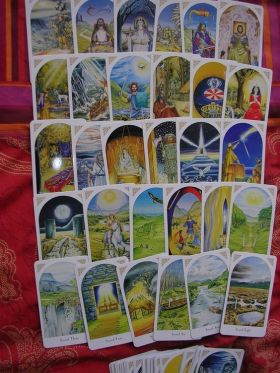
One of the meditations for this time of year between Yule and Imbolc that I’ve set for myself deploys Caitlin Matthews’ Arthurian Tarot, a tool I’ve mentioned before on this blog. You can find a chart of the dates and cards my meditation associates with them at the end of this post.
[As promised in the post before last, I’m also reporting with this post on how well my outer and inner worlds match up with the possibility of regenerating ancient tradition.]
Working through the Major Arcana in sequence from the beginning, and using The World/The Flowering of Logres as a pivot to return to The Fool/The Seeker, the Tarot serves as an energizing and revealing series of meditations for the exact number of days between the Winter Solstice and Imbolc/Brighid’s Day, if I observe it on February 1.
The Arthurian Tarot works well for this purpose, because such use places Arthur/The Emperor on December 25, and in at least some versions of the Arthurian Mythos, Arthur was born on Christmas — he’s the Christmas King.
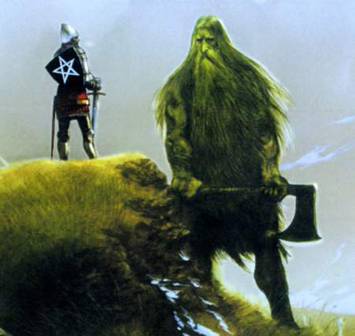
Thus, The Seeker sets forth on the Solstice, the day of greatest darkness — fitting for the beginning of the Journey, when almost everything seems shrouded, unknown. Though the Seeker stands on a precipice, he is not daunted, whatever the New Year brings — and in Arthur’s Court, it brings Gawain at least a deadly challenge in the form of the Green Knight. In this meditation series with the Arthurian Tarot, the Knight arrives on January 5 — fitting, since it’s the last of the Twelve Days of Christmas, and the holy feast of Theophany in the Eastern Orthodox calendar, when the divine appears to men.
With these encouraging correspondences emerging as I filled in my calendar, I felt I had sufficient personal justification to continue and to explore what this meditation series might have to offer. If you’ve worked with synchronicity at all, you know how sometimes signs can line up almost too easily. “One thing becomes another” in the realms of the Goddess, and we can lose ourselves in too-easy correspondences and mystic convergences, forgetting our initial purpose as we indulge in excessive woo-woo*. Or at least I can. Take heed, says inner guidance.
Continuing the series, the New Year begins with Sovereignty — a reminder that whatever the situation in the apparent world, we have the gift of being able to gaze into the other world(s) as well, using our divinely-bestowed power of double vision, and see where true power and authority lie, and acknowledge and revere the one(s) who wield(s) them.
The Wounded King immediately follows, with the Washer at the Ford and the Cauldron coming next — all three most potent symbols and archetypes.
Yesterday was Prydwen, the ship Arthur takes to raid the Otherworld and, in at least some traditions, win the Hallows of Britain, analogous to the Four Hallows of Ireland. As the Chariot, and a card laden with challenges in the past for me, Prydwen’s appearance told me I wasn’t up to tackle either the card or the meditation sequence. Bad food had left me achy in the joints, weak, and — most telling for me of toxins in my system — facing repetitive and panicked dreams and claustrophobia on waking. The Challenger stood armed and working in full force. Worth noting in my record of this day, even if I could not meet the call to close meditation and inner work the card indicated. Bed instead.
But I also know that, as is the way of spirals, I will face it again and again in the future, and my apparent “failure” yesterday is no loss at all. It has given me valuable insight, and helped me refocus energies that have previously been scattered. Now I can identify clearly a weakness that till then I had successfully managed to deny.
Another of the quests associated with Prydwen in the Arthurian deck is Arthur’s pursuit of the giant boar Twrch Trwyth, also associated with the Underworld and the Goddess, possessed of Otherworldly treasures between his ears, and — key to me — a form of my totemic animal, and sign of a way back to the lesson still available to me whenever I am ready to take it and my Boar dances his eagerness to accompany me.
Today, though, it’s Gawain.
In some senses the figure of Arthur’s nephew, the “most courteous knight”, represents for me an unmerited balance, strength and harmony. After all, I did not “pass” yesterday’s challenges of Prydwen and earn these qualities.
But as we all make this journey many times, we catch glimpses of each aspect as we proceed, arming and equipping us for the next spiral along the way. In the timeless realms, “after” can prepare us for “before.” Or to put it another way, success can bleed backward in time, if we are able to accept the gift. A vision of what is to come, of the future, and of what we already are, can sustain us through apparent disaster and despair by manifesting here what already exists on the inner planes.
More to come.
/|\ /|\ /|\
*woo-woo: again, a technical and precise term of art.
Dec 21: Seeker at the Solstice
Dec 22: Merlin
Dec 23: Lady of the Lake
Dec 24: Guinevere
Dec 25: Arthur – the “Christmas King”
Dec 26: Taliesin
Dec 27: The White Hart
Dec 28: Prydwen
Dec 29: Gawain
Dec 30: Grail Hermit
Dec 31: Round Table
Jan 1: Sovereignty
Jan 2: Wounded King
Jan 3: Washer at the Ford
Jan 4: Cauldron
Jan 5: Green Knight
Jan 6: Spiral Tower
Jan 7: Star
Jan 8: Moon
Jan 9: Sun
Jan 10: Sleeping Lord
Jan 11: Flowering of Logres
(Reversal and Return)
Jan 12: Sleeping Lord
Jan 13: Sun
Jan 14: Moon
Jan 15: Star
Jan 16: Tower
Jan 17: Knight
Jan 18: Cauldron
Jan 19: Washer at the Ford
Jan 20: Wounded King
Jan 21: Sovereignty
Jan 22: Round Table
Jan 23: Grail Hermit
Jan 24: Gawain
Jan 25: Prydwen
Jan 26: White Hart
Jan 27: Taliesin
Jan 28: Arthur
Jan 29: Guinevere
Jan 30: Lady of the Lake
Jan 31: Merlin
Feb 1: The Seeker at Imbolc
[Updated 2 June 2020: see my Romuva Update of May 2020.
14 Dec 2018: minor editing.
29 Dec 2016: two links added: a tribute to Trinkunas and a video of Kulgrinda, a music group he founded.]
One of the expressions of love of the earth relatively unknown in the U.S. is Romuva, Baltic Paganism. It is better known but similar to Druwi, another Baltic Pagan practice whose name itself shows its obvious connections with Druidry.
I first encountered this mostly Lithuanian pre-Christian religion about a decade ago, and I’ve followed news of it intermittently since then. Lithuania was one of the regions that held on to its ancient Pagan roots longer than most of Europe. Pagan observances still flourished into the 1400s. A series of crusades over several hundred years aimed at stamping out such lingering practices were largely successful, but even in the 1400s under Grand Duke Gediminas, Lithuania was still officially Pagan.
While much has undoubtedly been lost, Romuva imagery, song, symbol and practice were and still are intertwined with Catholic observance to a considerable degree, and folk memory and practice has preserved much material, particularly songs and dances. The roots of modern Romuva date from the Romantic period that sparked Lithuanian nationalism and an interest in indigenous culture, as it did for so many other regions of Europe.
Like many cultural phenomena of the last few hundred years, Romuva as it exists today owes a great deal to one person — in this case, ethnologist and krivis (Romuva priest) Jonas Trinkunas, who was born in 1939.
Jonas Trinkunas
Trinkunas, who passed almost three years ago in early 2014 (you can find a tribute at the Wild Hunt here), was a folklorist and university lecturer in Vilnius, Lithuania. He founded the “Society of Friends of India” (Lithuanian Indijos Bičulių Draugija), and the similarities of practice he saw in “the traditions of India were what pushed him to search for the roots of Lithuanian culture and its spiritual meaning”, notes the Wikipedia article on Trinkunas.
Hounded during the Soviet period when Lithuania lay under Kremlin authority, he was barred from academic life for 15 years, and only with Lithuanian independence could he resume that work. But in that interval he continued to travel his country and collect songs and lore that nourished his commitment to Romuva practice.
Once the Soviets were gone, the first festival observance he organized was Rasos — the summer solstice — the Lithuanian name literally means “morning dew”.
On the outskirts of Žemaičių Alkas, a Lithuanian resort area with a historical town center, carved wooden pillars mark the close intermingling of Pagan and Christian observance. Note the runes on the middle pillar.
The archaism of Lithuanian practice extends to language as well: to cite just one example from literally hundreds available, Lithuanian dieva “god” comes from Proto-Indo-European *deiwos, and is related to Latin deus, Germanic Tiw (English Tue’s Day, Tuesday), Sanskrit deva, etc.
For a taste of Romuva in action, here’s a 4:28 video of a Romuva handfasting, with several dainas (traditional songs) sung as accompaniment to the images. I suspect most Druids would feel right at home here.
Finally, a link to Kulgrinda, a traditional music group Trinkunas founded:
Years ago “in my other life”, while I was studying Old English, I found myself returning repeatedly to a dialog about 40 pages into our class text.
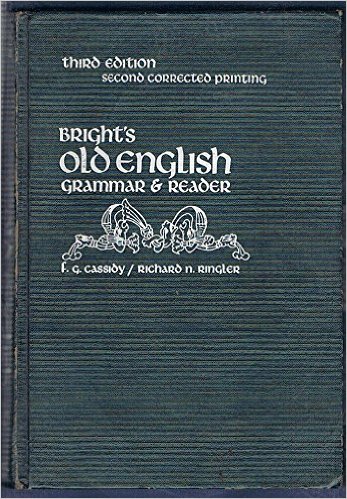
We were learning from Bright’s Old English Grammar and Reader, one of those standard hardcover textbooks you really can’t afford to buy new without a trust fund, the kind of book that generations of students dutifully underlined and annotated and highlighted and struggled through in one or another of its many editions and revisions. (My used copy has at least two previous owners, and the annotations and exclamation points to show for it.) Open to the copyright page and you see the first edition appeared in 1891, 125 years ago. The book itself is now part of a tradition.
Much of the text consists of tables of declensions and conjugations to memorize, alternating with Old English readings, both heavily footnoted. Fortunately, our teacher knew from experience that as long as you sought only to read, you could dispense with a good deal of that memorization. Learn a few core patterns and a high percentage of the time you could understand the grammar of the rest of what you read, recognizing a great deal by analogy and context.
But what about speaking? For “dead” languages — and what language is really dead if we still study it? — conversational examples are generally pretty thin on the ground. Language learning techniques have improved over the decades, especially for living languages. But many of those same strategies work just as well for tongues whose last speakers lived with horsecarts and cobblestones, hearthfires, oil lamps and emperors. So while you won’t necessarily be chatting right away (at least until you devise the needed vocabulary) about rap and drones and global warming, you can still access the living spirit of a language through conversation. So what amounted to a conversational fragment, really, still set my imagination turning.
Here’s that dialog in my translation, somewhat condensed. The tone of the original is just as heavy-handed and more than a little pedantic.
Teacher: Today we’re going to speak the language of the West Saxons. Are you ready? Tell me, students, what is that language?
Female Student: It’s the speech of our ancestors.
Teacher: That’s right. Our ancestors spoke it a thousand years ago.
Male Student: A thousand years ago? Those ancestors have been dead a thousand years? [Did he just wake up in class, halfway through the term?!]
Teacher: That’s right. Their bodies are dead.
Male Student: They don’t speak any longer. So then their language is just as dead as they are. What need is there for us to learn it?
You have to admit that this literal and clueless male student (in Old English, leorningcniht — in bad translation, “learning knight”) has a point. And if you’re thinking that Druidry, like any other human creation that once flourished and underwent a sea change over time, once faced a similar challenge, you’re not wrong. (History repeats itself to get our attention.)
If you’re wakeful enough this time of year, in spite of the tendency to drowsy half-hibernation that besets many of us in northern climes (or southern ones six months out from now), you may also be thinking that the problem is circular. I mean: As long as we see and treat something as dead, it has no life. We can always find someone or more than one asking plaintively, “What need is there for X?” But perceive it and use it as a living thing, and it revives in the doing. Our attention brings to it a very real and living fire.
That Old English dialog concludes in the next chapter:
Teacher: Well, young man, tell me now: everything that’s new, is it all good?
Male Student: No, sir. It’s not.
Teacher: And it’s also the same: not everything which is old is bad.
Male Student: Still, we can’t hear our ancestors.
Teacher: Miss, what do you say about this?
Female Student: I say that though we can’t hear their voices, nevertheless we can read their words.
Teacher: (Summarizes the deeds of the West Saxons). Now we are their heirs. If we don’t want to be foolish, let’s learn the speech of the West Saxons.
Now we are their heirs.
The ancient Hebrew people in exile in Babylon faced a similar problem: “How can we sing the Lord’s song in a strange land?” When the landmarks of your practice, whether cultural, geographical, psychic or some combination of all of these, are no longer present to support and sustain you along your path, the disorientation can be profound. What can you do?
“Still, we can’t hear our ancestors.” But it’s a choice to insist on being so literal.
One of the weaknesses of modern practice, observes R J Stewart in his magisterial Living Magical Arts,
“is the literary emphasis on superficial technique; the right words, the correct authority, the proper way to extinguish a candle; such details are given quite spurious weight without recourse to the traditions in which they may have originated. Much of this nonsense is cut through cleanly by a simple magical law: seek to understand the tradition, and the techniques will regenerate within your imagination” (pg. 69).
In the case of a living tradition, the solution is self-evident: study the tradition. But what about traditions that have no living point of contact?
I take comfort from Stewart here: seek to understand the tradition. The effort itself can help lead us to sacred sites and other contact points, links, resources, people, spirits (and in the case of “dead” languages, texts and practices and those first faltering attempts to spell out our life in a new tongue).
Our attention is a living and revivifying fire. “The techniques will regenerate within your imagination.”
A gift of Yule. (And since I’ve been doing Old English: Glæd Ġeol! Glad Yule!)
The next post will examine how well this works in practice — for me, anyway — the only person I can understand from the vantage point of inside knowledge.
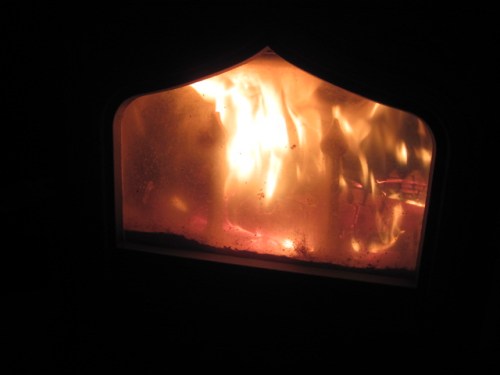
[Out our front window. Standing in place and turning 180 degrees, adjusting the camera for contrast, the window of our stove.]
The Atlantic online recently posted an article titled “Awesomeness is Everything” asserting that the experience of awe makes people kinder, tunes them in spiritually, and generally adjusts our overly-human world by clueing it in to larger ones all around it.
As vastness expands our worldview, it shrinks our ego. Awe makes spiritual and religious people feel a greater sense of oneness with others. And this oneness can make us nicer: Researchers found that inducing awe—say, by having people stand in a grove of tall trees—increased generosity, in part by stoking “feelings of a small self.” Awe also shapes our sense of time. One series of studies found that awe made time feel more plentiful, which increased life satisfaction, willingness to donate time to charity,and preferences for experiences over material products.
In winter, my physical world contracts significantly. True, a car could take me to other places, but unless I have the time and resources to drive south for most of a day, the climate will stay much the same. Ice and fire predominate, returning this human life more closely to proper proportions.

 [Updated/edited 13 Feb. 2020 — located new ritual link!]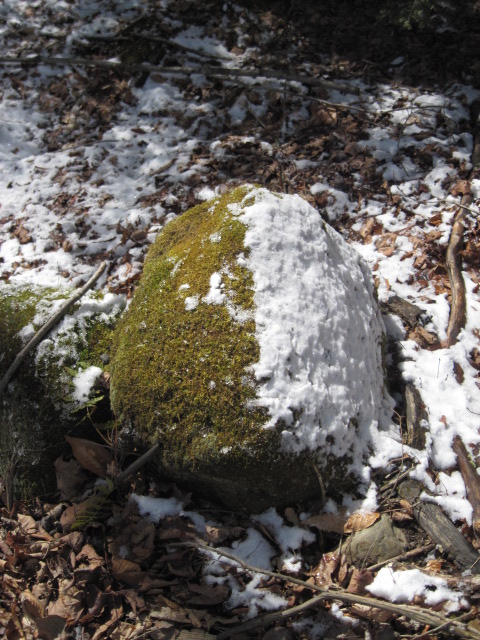
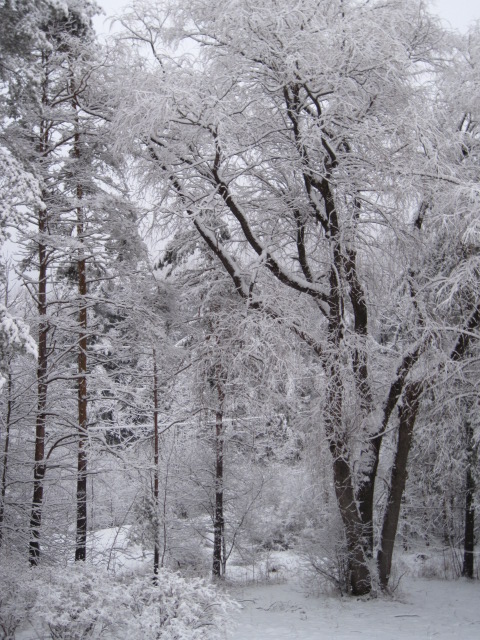
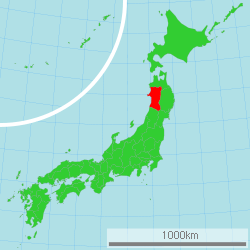 Bonden-sai is intimately associated with Akita Prefecture in Northwest Japan. Akita is also famed for its onsen (hot springs) and mountains, and Mount Taiheizan, the symbol of Akita City, is a major site for the festival. Bonden-sai there means a vigorous race up the mountain with your bonden to procure the blessings of the gods.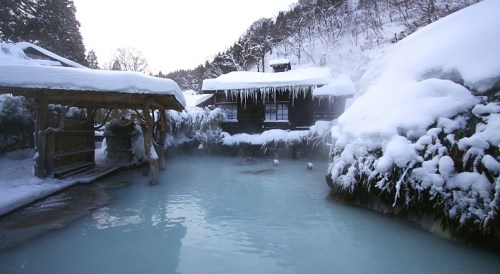
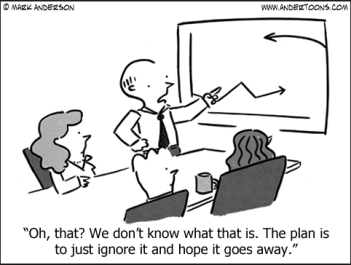 In other words, it doesn’t matter how close to reality our perceptions are, as long as they give us advantages in survival and reproduction. Or, as the article puts it, they have Adaptive Significance. The sun doesn’t “rise” or “set”, to use a trivial example; instead, the earth rotates. But unless we’re attempting a spacecraft launch, we don’t need a more “accurate” understanding. Living as if the sun rises and sets grants us perfectly reasonable adaptive capacities.
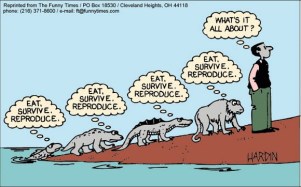 But side by side with adaptive significance, we might remember that evolution doesn’t “progress”. Where and how the arc of history may bend will apparently always be an experimental question, not an ideological statement.
 From the lavish plantings of flowers to the small fish pond downhill from the house to a variety of ornamentals bushes and shrubs, we have much to thank her for. But as I gather materials for a Beltane workshop this coming May, I send particular thanks to her for planting as many of the
 Or you decide instead to relocate to another country. More expensive, very likely. Learning another language, living in a different climate, with different lifestyles, social norms, history, national trajectory and attitudes towards foreigners, and Americans in particular, will all play their part in your experience.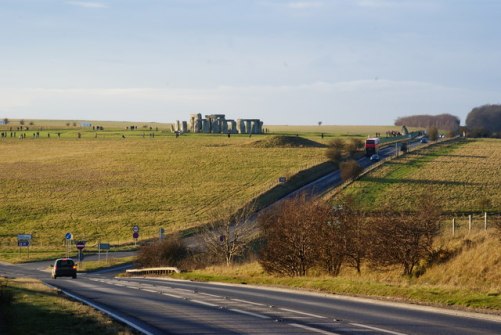
 Sovereignty, Lady of an inner realm which flows ceaselessly into this one, you birth, nourish and sustain us. May my deeds serve not my own will alone, but your larger shaping for the good of all. In my words here, in my deeds, thoughts, feelings and dreams, let that light and song and fire illumine where it can, whom it may.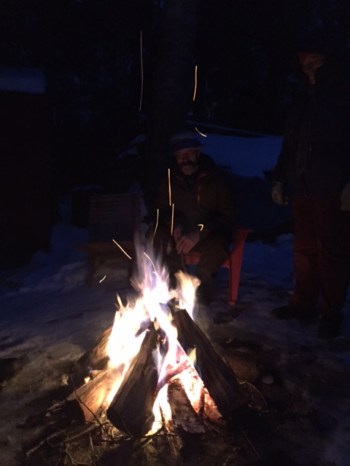
 One of the meditations for this time of year between Yule and Imbolc that I’ve set for myself deploys Caitlin Matthews’ Arthurian Tarot, a tool I’ve mentioned before on this blog. You can find a chart of the dates and cards my meditation associates with them at the end of this post.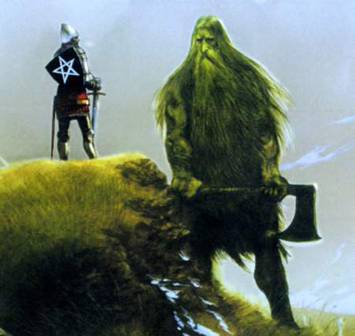
 [Updated 2 June 2020: see my

 One of the weaknesses of modern practice, observes R J Stewart in his magisterial Living Magical Arts,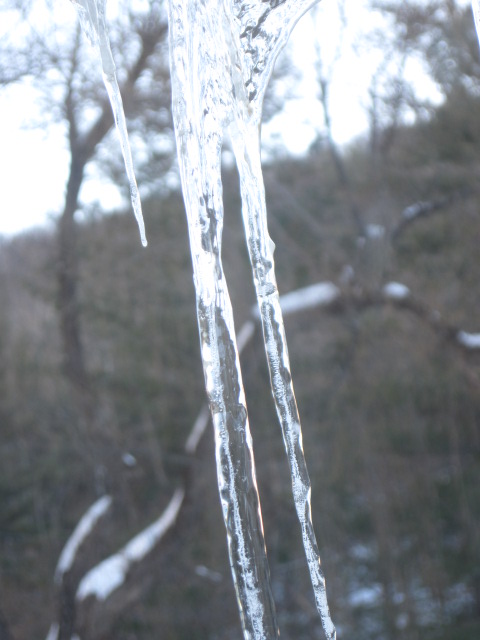


 A Druid Way