Archive for the ‘wood and water’ Category
 Author, Episcopal priest and current professor Barbara Brown Taylor has written An Altar in the World, a splendid little book on simple, essential spiritual practices which anyone can begin right now. She writes from a refreshingly humble (close to the humus, the earth) Christian perspective, and a broad vision of spirituality pervades her words. Because of her insight and compassion, her awareness that we are whole beings — both spirits and bodies — because of the earthiness of her wisdom, and her refusal to set herself above any of her readers, she makes an excellent Druid of the Day. I hope I will always remember to apprentice myself gladly to whoever I can learn from. As the blurb on her website page for the book notes, “… no physical act is too earthbound to become a path to the divine.”
Taylor brings a worthy antidote to the bad thinking and fear-mongering so widespread today. Here’s a sample:
… it is wisdom we need to live together in this world. Wisdom is not gained by knowing what is right. Wisdom is gained by practicing what is right, and noticing what happens when that practice succeeds and when it fails. Wise people do not have to be certain what they believe before they act. They are free to act, trusting that the practice itself will teach them what they need to know … If you are not sure what to believe about your neighbor’s faith, then the best way to find out is to practice eating supper together. Reason can only work with the experience available to it. Wisdom atrophies if it is not walked on a regular basis.
Such wisdom is far more than information. To gain it, you need more than a brain. You need a body that gets hungry, feels pain, thrills to pleasure, craves rest. This is your physical pass into the accumulated insight of all who have preceded you on this earth. To gain wisdom, you need flesh and blood, because wisdom involves bodies–and not just human bodies, but bird bodies, tree bodies, water bodies and celestial bodies. According to the Talmud, every blade of grass has its own angel bending over it whispering, “Grow, grow.” How does one learn to see and hear such angels? (14)
/|\ /|\ /|\
Taylor, Barbara Brown. An Altar in the World. New York: Harper One, 2009.
[Part 1 | Part 2 | Part 3 | Part 4 | Part 5 | Part 6 | Part 7 | Part 8 | Part 9]
Crying for vision, I step into the forest. Early twilight cloaks me, and mist cloaks everything else. A shiver stalks my spine. I feel something tread nearby with feet heavy as horses’ hooves, yet subtle and delicate as cloud. How it can be both I don’t know. Something breathes on my neck, though when I spin around I know nothing will show. Yet. I know I can freak myself out — I’ve done it lots of times. This is different. It is not fear, at least not fear as I know it. Instead it comes as joy and awe mixed, like the charge of touching the bark of a towering redwood a thousand years old, or the first glimpse of a landscape wholly remade by a night’s snow — beauty unlooked for, encounter with something awake and vital and ancient that I’m paying attention to at last.
How to explain it? Almost anyone listening would think I’m crazy, when all I can do is say “Look! Don’t you see them?!” as they dance and stalk and whirl themselves all around us both. And all the other person can do is shake his head at me, totally ignoring them as they gaze at him and size him up — perplexed, annoyed, amused, indifferent — depending on their natures. I shrug and turn back to them, watching, listening, enjoying and returning their welcome.
/|\ /|\ /|\
Updated 23 April 2015
When the phone call came, she was standing bent over the kitchen table, up to her elbows in pumpkin innards. A crop of volunteers had sprung up in a poorly-turned compost pile. She thanked Spirit for the gift, leaving wherever she harvested pumpkin a small bundle of dried thyme in exchange.
At the first ring, she looked down at her sticky hands, then out the window. A brief scatter of rain still sparkled on grass and leaves outside the kitchen window. Calls these days were almost always marketers. If it was Jack, she could call him back. They still needed to sort out a few things. But she would not rush the day, nor her mood, over answering the damn phone. She did pause at the third ring. Your worst arguments are with yourself, she remembered hearing. No, let the machine take it. She’d had it since high school, the black plastic housing cracked and duct-taped together. The sexless mechanical recording came on. She turned back to pale orange pulp and slimy seeds, slipped a couple into her mouth to chew, imagined them baked and salted. She waited, half expecting the caller to hang up.
The raspy voice on the machine straightened her back all by itself. Cassie, her father’s baritone said. And paused. Cigarette cough, the same. I want … I’d like to talk with you. She didn’t know how she felt. He’d kicked her out … eleven years ago, it was. They’d talked just twice since then. All that weekend’s worth of argument over a festival she’d been determined to attend. She couldn’t even remember its name.
No more of that Pagan crap in this house, he said, finally. I’m sick of it. You go and you don’t come back. They didn’t yell, at the end. Plenty beforehand. Fine with me, she said. She left about twenty minutes later. Didn’t even slam a door. And that was that. But you could have bottled the acid in the air and scoured steel with it.
I’m in Sacramento now. Oh, my number, it’s … She heard him stumble over it. I hope you’ll call back. Another long pause. As if he could hear her thinking, waiting. Not answering. Not wanting to. Cassie. The tug of her name again. Then a click and brief dial tone. She stared bleakly at the red digital 1 that appeared on the messages screen. How much of life was playback.
Outdoors the sky had darkened again, and her mood with it. She knew she needed to breathe and stand in the open air, to listen to something other than her own thoughts. Once outside, she knelt and rested her palms flat on the grass, to give her anger to the earth, not to carry it. Earth, take what I need no longer, teach through weakness what makes stronger. She breathed through the words, said them again, then a third time. She would call him back this evening. At nine, six o’clock his time. Sacramento. What was he doing there? Well, she could wait to find out.
She was Druid. When she needed to know things, a way would open. She was learning to trust it. Sometimes an opening way asked for patience, and that took work, still. Waiting rarely looked hard when others did it, but she’d done enough herself to know better. A song made it easier, and when she listened a certain way, now and again songs came, tinkling on the air, or roaring out of someplace she didn’t know she’d gone to till she returned with a start, the phone ringing, or her cat Halfpint curled in her lap and kneading one thigh with paws tipped with needle claws. Often the words came later, the melody already running ahead of her, in and around her attention till she got a version down on paper or on her music program.
She was Druid, she knew. It was a long time coming, that knowledge. Sometimes she’d resisted, convinced she was done with paths, and seeking and god-stuff, anything like that. But through it all the gifts kept arriving. Hard ones, and easy ones too. Often enough it meant whatever the land gave her at the moment. For proof, all she had to do was look at her house, filled with stones, bird bones, animal skulls, pressed flowers, carved branches, vervain and basil and mint, garlic and St. John’s Wort and other herbs she was learning as she went. After Jack left with his secretary, she got the little ramshackle two-bedroom house and the six acres of pasture they’d planned to farm, and slowly the once-empty rooms filled with links to the green world outside the door. Inside, too. Spiders in the corners, mice in the walls, squirrels skittering across the tin roof, crows caucusing in the back yard.
Jack. One of the hard gifts. He left, and for a while the emptiness threatened to eat her alive. A big hole she had to stop looking into. No bottom, but walls dark with bitterness. So she stayed busy volunteering and running the food pantry and substituting at the local elementary school, until one day a boy complained about the smell of incense that seemed to follow her wherever she went. “Witch” was the real reason, she heard from a sympathetic colleague. Parents complaining about “that teacher.” Though when the principal called her in “for a little chat,” what he said was they just couldn’t rely on her to be on time. All she knew then was that her morning ritual had just cost her one needed source of income. Hard gift.
A month of therapy, and “you’re stuck in a box labelled ‘wife,'” until she knew she could give herself better advice, and cheaper. When the box is the whole world, then I’m Druid in a box, she thought. And thinking inside the box is a great place to start. Hardly anybody else is in here. They’re all outside, because that’s where they’ve been told they should be. That’s where the clever ones are, the ones who want to be ahead of the curve. Mostly people do what they’re told. But almost always something held her back from doing what everybody else did, shoved her or kicked her sideways. A kind of resistance, a suspicion, a compass set in her belly and spinning her some other way. Ahead of the curve? It was more than enough to be the curve, bird’s wing in the air, crescent moon, arc of water coursing over a falls. The backyard junipers and oaks and one old willow bowing at the sky.
Then it was October, her birth month, and in spite of turning 30 in a few more days, her mood lightened. She could feel a shift coming, something new trying to find her, a little blind, and maybe needing help. She could help it. Listen, she reminded herself. It was one thing she’d finally gotten good at.
To be continued …
One of the challenges for contemporary Druids is to reconnect with the land where we live and find old and new paths of harmony to walk on it.
Back in CT for the coming year, we won’t need right away most of the firewood we’ve carefully stacked in VT, except to warm the house during the occasional weekend jaunt back north to check on pipes and windows, and stay over for a night or two.
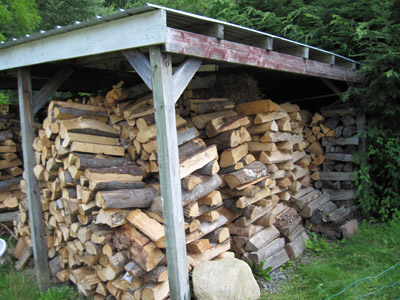 Seeing woodpiles, our own and others’, makes me realize how they’re among the treasures of the landscape, this long-inhabited place it’s our turn to live in and re-learn. Energy for the future. Trees cut locally (to limit the spread of arboreal pests) mean an opportunity for a new generation to leaf and grow. Once almost completely deforested in colonial times, both VT and NH are well-treed now. We get it, our green gold.
And we’ve held on as well, as much of the U.S. has, to the legacy of at least some of the old names and their stories: Ascutney, Memphremagog, Queechee, Maquam, Missisquoi, Sunapee, Ossipee, Winnipesaukee, Monadnock, Merrimack, Nubanusit, Contoocook … and my personal favorite, because my wife tells NH family stories about it, Skatutakee (pronounced skuh-TOO-tuh-kee). The names evoke for me a landscape of moose and bear, autumn fogs and spring mud, glacially fresh chill air and sky-blessed summer days, maple syrup and heirloom apples, blueberries and squash, small town greens and sheer church spires, seasonal tourist hordes and perfect frigid midwinter stillnesses. A marvelous locale to be all Druidy in.
But here in CT I’m drawn back into the local landscape too, the names of trees on campus, copper beech (fagus sylvatica) and charter oak and smaller ornamentals we just don’t see in VT. So I’ve resolved to “meet the locals,” and visit them in all four seasons, as we were reminded at the Gathering to do if we truly want to begin to know them well. My goal is to learn 25 new trees this year. (I’ll let you know how it goes in a future post.)
Digging for the future is putting down roots, knowing your place — not in the submissive way that the expression is used so often, but literally. How many of us have passed years of our lives and never known the trees who provide the oxygen we breathe, and shape the land we pass through and live in? I know it’s many times I’ve ignored them. But once the trees made themselves known to me, it seemed downright rude not to greet them every time I pass by, to cheer them on, if I’m walking to touch them, to cast my affection abroad, rather than hoard it tight in my heart. I dig for the future whenever I lay down a layer of my life that will become part of the contours of next year, or five years, ten years on. Excavation in reverse. Living fully now helps excavate what’s yet to come, brings it into view, lets it breathe and stretch and begin to grow towards its own good self. And trees? Trees were the first Druids.
/|\ /|\ /|\
Updated 26 Sept., 10:27 pm
After my father passed away in the winter of 2008, I wasn’t able to scatter his ashes the following spring as I’d planned. A cancer diagnosis laid me low soon after his final decline, and his childhood home in Niagara Falls in western NY state, as well as the farms he had owned and worked for decades, and where I grew up, were 450 miles from my wife’s and my home and jobs in CT. During my medical journey, we’d also bought a house in VT, and with follow-up radiation and a personal leave from our work, along with numerous loose ends to tie up, there’d simply been no good time. And the task and my intention, if not my father’s, deserved good time.
My dad had always been indifferent about the whole thing. Beyond asking to be cremated, he seemed to feel, perhaps from the many animal deaths and births that inevitably accrue in a lifetime of farming, that one more dead body was something to dispose of, but nothing worth much fuss. “Throw me on the manure spreader when you go out next, and toss me at the back of the cornfield,” he’d always say in his wry way, whenever I asked him one more time about his wishes. That was what we did with the occasional calf that died of pneumonia or scours. In six months, crows and time would eventually leave just whitening bones. But at the time of my dad’s death, we no longer owned the farm, and in any case, beyond a certain undeniable fitness to his request, a desire to make that one last gesture for the good of the land, as human fertilizer, there was the small matter of legality.)
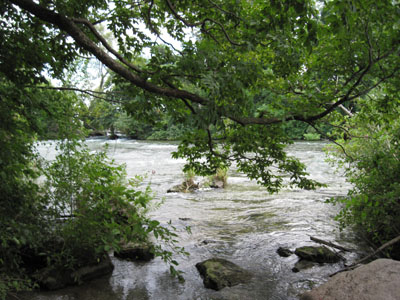
This summer a family reunion in Pittsburgh provided the opportunity to attend to this final matter. My wife and I drove there and back, and on the way out last Friday afternoon, after a slow cruise along Lakeshore Drive that hugs the south shore of Lake Ontario, we made our way to downtown Niagara Falls and then over the bridge onto Goat Island. So around 2:00 pm or so, you could have seen me squatting at the edge of the Niagara River, a few hundred yards above the Falls, on the second of the Three Sisters islands that cling to rocky outcrops in the rapids. The day was overcast but pleasant — typical of western NY, with its delightfully mellow lake-effect summers. Between my feet rested the heavy plastic bag of dad’s ashes, in the plain box the funeral home had provided.
I had nothing to say — no particular ceremony in mind. Words earlier, words around and after his death, words a week or so ago in a dream, but nothing now. This was for experiencing, not talking. Six years before, I’d returned my mother’s ashes to the Shellrock River in the small Iowa town of her childhood. That day, the easy meander of the river, the June sun on my back, the midday stillness, and the intermittent buzz of dragonflies skimming the water lent the moment a meditative calm. As my wife and two of my mother’s cousins watched, I slowly poured the powdery ashes into the river, and the water eddied and swirled as it bore them downstream. Watching the ash disperse downstream, I felt peace. Thus we can go home.
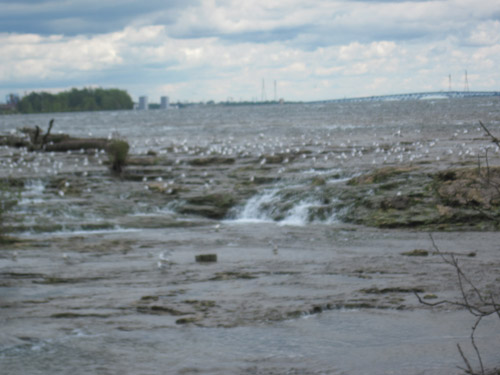
This day was different. A steady damp breeze rustled the leaves of the trees. On another treeless outcrop a short way upriver, the harsh voices of the flock of gulls were only intermittently inaudible over the tumble of water and the dull roar of the falls downriver.
I sat, heels in mud, watching the current on its endless course past and away. When I opened the bag of ashes, a sudden gust of wind caught some and dusted my left arm, which startled me, then made me smile. It was as if my father approved — that behind his gruffness, the elemental beauty of the spot, a family favorite, might matter after all. I brushed off my arm, and then poured the chalky ash into the spinning waters and watched it spread and then, eventually, the water cleared as it washed away.
/|\ /|\ /|\
[Part 1 | Part 2 | Part 3 | Part 4 | Part 5 | Part 6 | Part 7 | Part 8 | Part 9]
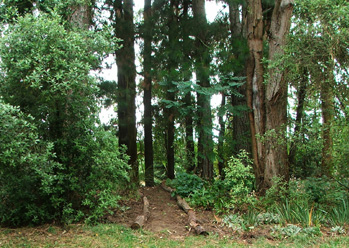
In the grove the Druid sits. In my grove, the one I’ve constructed in an inner world, via imaginal energies. With the tall slender trees of entrance standing on either side of the portal, a space between them wide enough for a single person to pass through. And he is welcome here, though I don’t remember inviting him. He is always welcome, a friend who will never presume.
Today he indulges me by wearing Druid robes — they make him familiar, with his dark brown skin, that homely, beautiful face I would know anywhere — and I relax into our conversation. I know him from somewhere else, too, someplace on the edge of awareness, a realm or time not quite pushing through to full consciousness. He does what he needs to in order to reach those under his guidance, and to put them at ease so that he can work with them. Awe or fear or worship is useless to him. Attention? That he can use.
His words issue from a place quiet and full of listening. I’ve come to trust him instinctively, the way wild animals do in the hands of those who love them with touch and gentleness, a welcome of care and compassion for a fellow being in the worlds. They know that touch, that presence, and their knowing has nothing of the talking human about it. It’s a language older than words.
He knows when to use words, too, and now he’s speaking about a past I’d forgotten. I remember it as he speaks, things I didn’t know I knew, things I have not needed to remember until now, because until now they would find no place in me to live, or have any value or significance. They would feel like they belonged to somebody else, foreign to me, alien, no more at home than a bird of the air caught in a small chamber, fluttering at the windows. What is it that stands between me and freedom, this transparent flat barrier I never knew was there, blocking me, hard as thought? But no, I have no wings, I’m not the bird. But for a moment, there …
The Druid turns to me, a look deep as evening in his gaze. “You are all you have ever been. Do you remember our first meeting, long ago?”
“It was a market,” I said. “And I remember. I was … I was drunk.”
“Sitting slumped against a wall. When I walked by, though, you spoke to me.”
“What was it I said? ‘Keep walking, don’t talk to me now. I don’t have anything left in this life for you.’ Something like that. I was embarrassed. I didn’t even know you.”
“Yet you gave me some fruit from your stand …
“Yes, I remember. A handful of marula.”
“Where were we?” he asked me softly.
“It was … West Africa. Africa was my home then.”
“Yes. What else do you remember?”
But somewhere in the distance a dog is barking. My focus falters, pulls me away from this place and back to my room in our Vermont house. The neighbor’s dog, Jim’s — barking as he always does, every afternoon, impatient for Jim to get home, release him from the chain and walk him, feed him, let him back into the house.
Damn, I think. It’s all gone, the vision’s gone.
But he’s still with me.
“Dogs bark on all the planes,” he’s saying. “They’ll bark, and then for a time they’ll be silent again. You can use them as a guide, or a distraction. Is there a dog barking near this grove?”
I listen. “No,” I say.
“Good. You’re back. Now, let’s continue …”
/|\ /|\ /|\
Image
Updated 23 April 2015
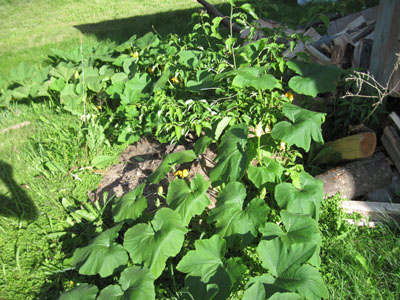 In early June my wife noticed a particularly vigorous shoot rising from an old compost pile beside our woodshed. The squash plant it eventually revealed itself to be has flourished joyfully, spreading in two directions, while the pitiful growths in one of our new raised beds refuse to be coaxed into thriving.
If life gives you lemons, you could make cleaning supplies, ant repellent, pickles, sore throat medicine, laundry whitener, stain remover, fruit preservative, copper cookware restorative, disinfectant — and if you insist, lemonade, too. The dead (cliche) comes to life when our attention lies elsewhere. Practice resurrection, and get used to it.
We hear a lot about growing where you’re planted, but what about everywhere else? The surprise that is our universe so often arrives with the unexpected, the new pattern, the shift, the change. Life does a one-off. It does what it is. (Isn’t that what you are, too — individual, unique, nothing else quite like you? The trouble comes when I or somebody else insists you should be like the rest of us. The universe never “conforms.” It’s simply itself. That’s our pattern too. We are where we come from.) We stand amazed at the burgeoning of vitality in places we doubted it could exist. If we have different plans, life may upset them. A young Christian couple I know, just married, decided they would leave conceiving a child “up to God.” A friend from their congregation remarked, with considerable glee, “They gave it to the Lord, and he gave it right back to them.” She got pregnant six weeks after the wedding.
In the mass of asphalt and concrete that is Route 91, like any superhighway, a few weeds have taken root on the meter-high divider between northbound and southbound lanes, a little way north of Hartford, Connecticut. They’re particularly visible because they happen to be growing just about at eye level as you drive by, and the highway department hasn’t yet set upon them with weedkiller. I give a silent cheer each time I pass, though I know my tax dollars support their eventual extinction. Still … Give them a few years and their roots will begin to split and break down the rigidity of man-made material into the beginnings of something more closely resembling soil. If there’s an “agenda” at work here, it isn’t always a “human” one, though humans are born into such a world, have grown and evolved within and through its shaping patterns, and have lived in it for millenia before they thought to try permanence on a scale the universe doesn’t really support.
Instead of worrying about “what the financial situation will support,” or what our many and often distinctly weird human institutions “demand,” why not ask what moves in harmony with the patterns of the universe? The main reason is we wouldn’t always like the answer. Sometimes we would. But we might find more balanced and sustainable ways of living that would approach “permanence,” which is just a weak version of natural equilibrium. Could we devise a “financial permaculture” that might not jolt us from crisis to crisis? Sure. Will we?
The Dao De Jing winks at us when it makes its observations:
Not exalting the gifted prevents quarreling.
Not collecting treasures prevents stealing.
Not seeing desirable things prevents
confusion of the heart.
The wise therefore rule by emptying hearts
and stuffing bellies, by weakening ambitions
And strengthening bones.
If men lack knowledge and desire, then clever
people will not try to interfere.
If nothing is done, then all will be well.
(Gia-Fu Fen translation)
“Doing nothing” isn’t exactly what Daoism teaches; it’s more along the lines of “unforced action,” or “going with the flow”: wu-wei in Chinese. And can we expect people to succeed by weakening their ambitions? I don’t know; have we ever tried it? In all this there’s a wink and a smile, too. As if that wise voice is saying, “I don’t always mean this literally, of course, but you get the idea …” And who knows?! “Emptying hearts (in a good way) and stuffing bellies” might just pay off. Fill our stomachs, not our heads …
Or take this advice, surely perfect for our U.S. political season:
To talk little is natural.
High winds do not last all morning.
I’ll let Ursula Le Guin’s version of Chap. 27 have the final say here, a kind of diagnosis of how we’ve “gone astray,” that peculiar human thing we can do that the rest of the natural world doesn’t:
Good walkers leave no tracks.
Good talkers don’t stammer.
Good counters don’t use their fingers.
The best door is unlocked and unopened.
The best knot is not in a rope and can’t be untied.
So wise souls are good at caring for people,
never turning their back on anyone.
They’re good at looking after things,
never turning their back on anything.
There’s a light hidden here.
Good people teach people who aren’t good yet;
the less good are the makings of the good.
Anyone who doesn’t respect a teacher or cherish a student
may be clever, but has gone astray.
There’s deep mystery here.
/|\ /|\ /|\
There are many free versions of the Dao De Jing online; the site from which I drew these few excerpts provides several reasonably reputable versions to sample. Sustained meditation on the text (get a couple of versions and let them talk across to each other) can ease stress and open up many doorways and paths. It’s one of my most beloved Druid written resources. Wikipedia’s entry for Tao Te Ching captures some of its qualities: “The written style is laconic … and encourages varied, even contradictory interpretations. The ideas are singular; the style poetic. The rhetorical style combines two major strategies: short, declarative statements and intentional contradictions. The first of these strategies creates memorable phrases, while the second forces us to create our own reconciliations of the supposed contradictions.” If you recall, resolution of supposed contradictions, or finding the tertiary that resolves the binary of “either-or,” is a technique and strategy of wisdom taught in several Druid paths.
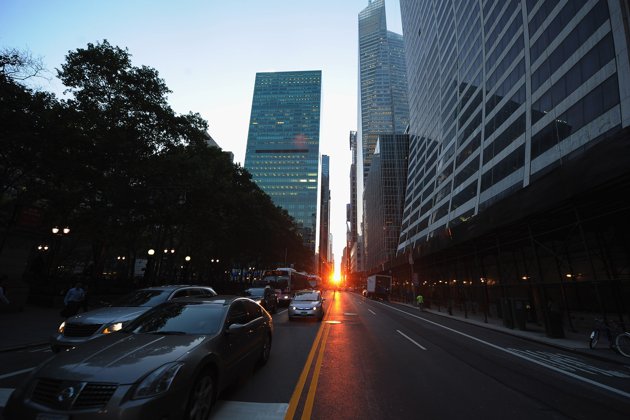
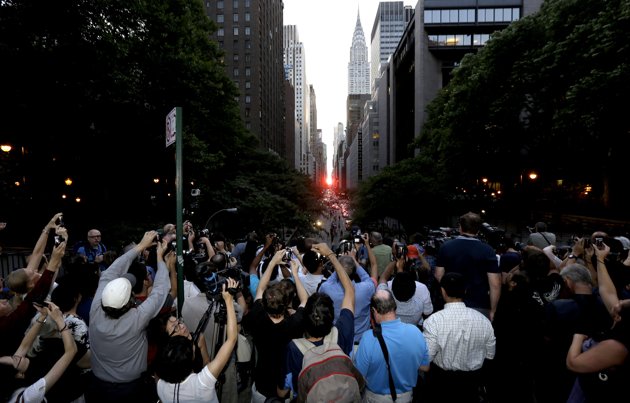
Our green world and ready contact with its natural rhythms can sometimes feel remote in urban settings. Because so many people live in one of the “mega-metro” areas on the planet, their appreciation of the natural world may often burn more brightly than it does for the small-towner who has lived all her life surrounded by cows and trees. With Tokyo, Seoul, Mexico City, New York and Mumbai heading the list at over 20 million souls each (counting their greater metro areas), it’s good to celebrate the green world particularly when it makes itself known among the girders and concrete. The first entry in my “Druid of the Day” series, just started, was a nod in that direction. Manhattanhenge is another one, and much larger:
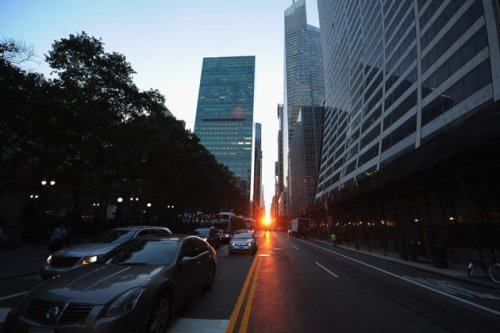
If you follow Yahoo, you probably caught it. The caption for yesterday’s image reads “The sun sets during ‘Manhattanhenge’ on July 12, 2011 in New York City. The Manhattan Solstice is a semiannual occurrence in which the setting sun aligns west-east with the street grid of the city.” There’s a short sequence of similar images worth visiting.
We need such rhythms — to calibrate our biological clocks, to remind us how the world nourishes and sustains us, and how we need to remember it in our daily decisions — not out of piety for the Earth Mother (though nothing’s wrong with that, of course) but for the very real reason that this world is home. Whenever we can truly celebrate, our hearts open. And in a time when so much “news” doesn’t help us live better, stopping to enjoy the sun looking down the city streets is a good thing.

/|\ /|\ /|\
For those interested in astronomical details and explanations, Wikipedia’s entry for Manhattanhenge helps. The event occurs twice a year, in May and July, on either side of the planetary solstice, as the sun makes its (apparent) journey north and then south again after the solstice.
New York Times columnist Dana Jennings wins the first “Druid of the Day” award particularly for this portion of his column in yesterday’s (7/10/12) Times:
Scenes From the Meadowlandscape
Monet had his haystacks, Degas had his dancers, and I have the New Jersey Meadowlands from the window of my Midtown Direct train as I travel to and from Manhattan.
But what, it’s fair to ask, does squinting out at the Meadowlands each day have to do with art, with culture? Well, as a novelist and memoirist for more than 20 years, I like to think that if I stare hard enough — even from a speeding train — I can freeze and inhabit the suddenly roomy moment. Through the frame that is my train window I’m able to discern and delight in any number of hangable still lifes.
And the Meadowlands never disappoints, no matter what exhibition is up.
Its shifting weave of light, color and texture hone and enchant the eye. The sure and subtle muscle of the Hackensack River is sometimes just a blue mirror, but when riled and roiled by wind and rain it becomes home to slate-gray runes. The scruff, scrub and brush are prickly and persistent, just like certain denizens of New Jersey. And the brontosaurus bridges, their concrete stumps thumped into the swamp, idly look down on it all.
For his focus, intentionality and the requisite quietness to see, and then — just as important — turn the results of that seeing into a window, an access point for others who read his column to do the same “noticing” in their own lives, Jennings earns my commendation as “Druid of the Day.” This seemed like a good series to launch, to help remind myself as well as my readers of ways we can be more attentive to beauty around us, particularly unexpected instances — free, a gift if we only notice them — and receive their transformative power.
City or country, it doesn’t matter: we can be witnesses of natural power and beauty, and learn what they may have to teach us, anywhere — including Manhattan, and from the window of the Midtown Direct train. These are no less — or more — “Druidic” than any other spots on the planet.
Know others who deserve recognition as “D of the D”? Please send them along to me and I’ll write them up and include an acknowledgement to you in the citation. Thanks in advance.
/|\ /|\ /|\
 Normally I steer clear of posts that border on the political, because they accomplish little except to harden opinions and positions, and sharpen arguments, without leading to a solution. But I make an exception in this post, for reasons I hope will become clear.
Especially in difficult times like these, we rely for perspective and direction on the supposed Wise Ones of our world, so it behooves them to be more cautious and informed in their public statements than this article by Tim Worstall in the U.K.’s Telegraph of May 16, 2012. The article byline for the author identifies him as “Senior Fellow at the Adam Smith Institute in London, and one of the global experts on the metal scandium, one of the rare earths,” so you’d think he’d exercise more care in an international forum like this newspaper. Here are his opening words, remarkable for their flippancy, misrepresentation and ignorance:
Apparently something terrible happens when we get to peak oil. I’ve never really quite understood the argument myself, but when we’ve used half of all the oil then civilisation collapses or something. I’m not sure why this should happen: we don’t start starving when there’s only half a loaf of bread left. But I am assured that something awful does happen.
That oil fields do get pumped out is obviously true – and also that you can have a good guess at when the ones we’re currently pumping will run out. The part I don’t get is the catastrophe. Some people seem to think that “peak oil” is when we can’t actually pump out a higher amount: that if we’ve got 70 million barrels a day, then that’s the most we can ever have, 70 million a day. Which is also called a disaster. Apparently this means that demand will move ahead of supply, which is simple sheer ignorance of the price system. There is no such thing as “supply” or “demand”. There is only either of them at a price. So, if there really is a limit on how fast we can pump the stuff up, the price will rise.
Worstall’s observations illustrate a confusion of realms, a common-enough misperception, and one we all make from time to time. In the case of a recognized expert, though, we expect greater wisdom and sense — he simply isn’t thinking things through. If you’re talking about the human economy of making brooms, say, or copies of DVDs of The Avengers, or oranges, or purebred Siamese cats, well and good. Then Worstall is right, and supply and demand will play out pretty much as he claims. Price is indeed the hinge between them. Even in extreme cases of demand, say for parts to an antique car that went out of production decades ago, you can probably find a craftsperson who will forge and finish them for you. Because they’re one-offs, they’ll cost you plenty. But if you want the parts badly enough, and you have the necessary cash or other acceptable medium of exchange, someone will oblige and supply your demand. That’s Econ. 101. It’s how modern economies are supposed to work. We get it.
But turn to the natural economy of the physical environment and a different picture emerges. The human and natural economies are NOT the same, and it’s dangerous to assume they are. In the natural economy, many materials aren’t renewable, and they’re simply not subject to supply and demand. A finite quantity exists, and when we use it up, there’s no more to be had, at any price.
Yes, we can grow more trees for wood, plant more fruits and vegetables for food. Many metals and other materials can be recycled, and so on. At least we’ve made a start on re-using and re-purposing. But oil and natural gas, to name just two resources, exist in finite qualities. Use more and we’ll run out sooner. Use less and they’ll last longer. Until we have replacements or other viable sources of energy, it’s only common sense to conserve and sip, rather than guzzle. It’s not like running out of milk and going down to the nearest convenience store, or ultimately putting another 10,000 cows into milk production. It’s rather as if I’m running out of air, trapped in a house-fire, or dragged underwater by a sinking ship. My demand for air may become extreme, but if the supply runs out, I eventually die. Life itself is finite, and no one has escaped its ending. No extensions for love or money. Demand for more hours or days has never obligated the universe to provide them, and no promise of payment or bribe suffices to keep our hearts beating a second longer. They stop.
In the case of oil and gas, unknown supplies no doubt still exist. Hydrofracking may prove helpful to buy us a little more time — or not. It may well go the way of ethanol, which for a while looked like the next sure thing. Yes, there’s petro-energy to be had, but if it costs more to produce than it’s worth, a different side of supply and demand switches on. For the geeks among us, that’s EROEI — energy returned on energy invested. We may have enough oil for 50 more years, or 75, or 100 or 200, but we will run out. At that point, demand won’t budge the simple physical fact of an exhausted resource. At too high a price, it’s not worth it to anyone to extract a few more gallons or cubic meters. As in the Monty Python parrot sketch, it’s kaput, used up, done, extinct, no more.
Unlike many peak-oil doomsayers, I’m willing to concede that down the road we may well devise a marvelous technological solution to our mammoth energy needs. But until we do, it’s deeply stupid to continue using more each year, rather than less, now that production has recently peaked, even as peak oil historians predicted it would, six decades ago. How high must the price of a barrel of oil rise, and how much must the economies and households and peoples of the world suffer, until that’s clear?
But good things will emerge from this crisis, too. They may not be what we want, but as the Stones (almost) said, “we just might find we get what we need” in the moment. And there’s material for future posts.
/|\ /|\ /|\
Image: buffalo shortage
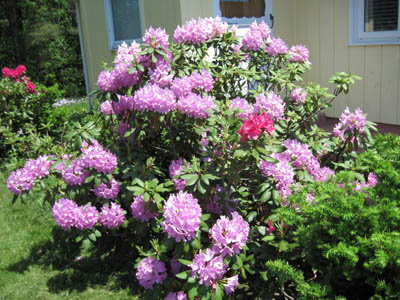 Here are Yin and Yang, our two rhododendrons — a single red flower grows on the pink bush in the foreground, with a branch of the red bush showing in the background. Plant envy? Unfortunately the red bush doesn’t have a single pink flower, or the image would be complete. In a month they’ll be back to their usually ungainly woody scraggly selves, with no hint of the glory they present each May. Is the aftermath the only time we appreciate what we had — when it’s finally gone?
The aftermath is the consequences, the results, the outcome. But we never hear of a “foremath,” whatever it is that stands before the event, the “math” — literally the “mowing” in Old English.
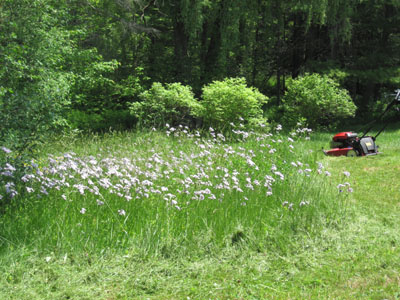 Most of our yard is the typical rural patch of grass, which given half a chance will turn to sumac, crabgrass, chicory, dandelions and even slender saplings inside six months. In the few years that we’ve owned the house, we’ve let whole quadrants go uncut for a season. Sometimes it’s from pure practical laziness — we’ve no one to impress, after all, and no condo association to yelp at us — and it saves gas and time, until we get around to putting in more of the permanent plantings that won’t require cutting. Until then, we’re getting the lay of the land, seeing how soil and drainage and sun all work together (our three blueberry bushes, visible in the background in the second photo, thrive on the edge of our septic leachfield), and which local species lay claim first when we give them a chance to grow and spread. The moles that love our damp soil also tunnel madly when we leave off mowing for the summer. We think of it as natural aeration for the earth.
The northwest corner, shown here, shaded by the house itself for part of the day, yields wild strawberries if we mow carefully, first exposing the low-lying plants to sun, and then waiting while the berries ripen. Patches of wildflowers emerge — common weeds, if you’re indifferent to the gift of color that comes unlabored-for. I like to hold off till they go to seed, helping to ensure they’ll come back another year, and making peace with the spirits of plant species that — if you can believe the Findhorn experience and the lore of many traditional cultures — we all live with and persistently ignore to our own loss.
This year we’ve “reclaimed” most of the lawn for grass, as we expand the cultivated portion with raised beds and berry patches. But I remind myself that we haven’t left any of it “undeveloped” — the unconscious arrogance of the word, applied to land and whole countries, suggests nature has no intention or capacity of its own for doing just fine without us. Who hasn’t seen an old driveway or parking lot reverting to green? Roots break up the asphalt remarkably fast, and every crack harbors a few shoots of green that enlarge the botanical beach-head for their fellows. Tarmac and concrete, macadam and bitumen are not native species.
And what would any of us do, after all, without such natural events like the routine infection of our guts by millions of beneficial bacteria to help with digestion? A glance at the entry for gut flora at Wikipedia reveals remarkable things:
Gut flora consist of microorganisms that live in the digestive tracts of animals and is the largest reservoir of human flora. In this context, gut is synonymous with intestinal, and flora with microbiota and microflora.
The human body, consisting of about 10 trillion cells, carries about ten times as many microorganisms in the intestines. The metabolic activities performed by these bacteria resemble those of an organ, leading some to liken gut bacteria to a “forgotten” organ. It is estimated that these gut flora have around 100 times as many genes in aggregate as there are in the human genome.
Bacteria make up most of the flora in the colon and up to 60% of the dry mass of feces. Somewhere between 300 and 1000 different species live in the gut, with most estimates at about 500. However, it is probable that 99% of the bacteria come from about 30 or 40 species. Fungi and protozoa also make up a part of the gut flora, but little is known about their activities.
Research suggests that the relationship between gut flora and humans is not merely commensal (a non-harmful coexistence), but rather a mutualistic relationship. Though people can survive without gut flora, the microorganisms perform a host of useful functions, such as fermenting unused energy substrates, training the immune system, preventing growth of harmful, pathogenic bacteria, regulating the development of the gut, producing vitamins for the host (biotin and vitamin K), and producing hormones to direct the host to store fats.
Such marvels typically set off echoes in me, and because much of my training and predilection is linguistic in nature, the echoes often run to poems. A moment’s work with that marvelous magician’s familiar Google brings me the lines of “Blind” by Harry Kemp:
The Spring blew trumpets of color;
Her Green sang in my brain–
I hear a blind man groping
“Tap-tap” with his cane;
I pitied him in his blindness;
But can I boast, “I see”?
Perhaps there walks a spirit
Close by, who pities me–
A spirit who hears me tapping
The five-sensed cane of mind
Amid such unsensed glories
That I am worse than blind.
Isn’t this all a piece of both the worst and the best in us? We can be fatally short-sighted and blind, but we can also imagine our own blindness, see our own finitude — and move beyond it to a previously unimagined larger world.
Sometimes you have experiences that just don’t fit. They’re orphans, and like orphans, too often they’re left to fend for themselves, so they end up on the street. Or else they’re stuck in a home by some well-meaning authority, where they may subsist uncomfortably for years in places where everyone else looks and acts and talks different. There may not be enough love to go around, either, and like Oliver in Dickens’ novel Oliver Twist, they’re reduced to pleading, “Please, sir, may I have some more?”
Monday night, before the hard freeze here (19 and windy) that threatened all the burgeoning flowers and trees, I offered up a prayer. I don’t usually pray in this way, but I found myself praying for all the wordless Rooted Ones busy putting out buds and leaves and new growth in response to the warm spell that caressed so much of the U.S. “I cry to the Powers,” I found myself saying. A little more love here, please. The great willow in our back yard has pale leafy fronds. The currants are budding. Crabgrass pushes up from dead mats of last year’s growth. The stems of bushes and the twigs of trees show reddish with sap. At the same time, I took stock in what I knew in some traditions about plant spirits, the personifications of energies that help individual species thrive.* Let the devas and plant guardians sort it out. Serve the larger balance — that sort of thing. Then the nudge to pray came, so I honored it. Everyone has a role to play. Then the goddess Skaði presented herself.
All this took place while I was driving down and then back home with my wife from an out-of-state trip to CT. Bookends to the day. We’d tried to be efficient with our driving and gas use, like the good Greenies that on occasion we actually are, and schedule several appointments for the same day. So we rose early, drove through welcome morning sun and glorious light to have a thermostat and brakes replaced on our car, get eye exams and prescriptions and glasses before a sale ended on April 1, drop off a gift at a friend’s house, and get to an admissions interview for a certificate program I’m interested in. (More about that as it progresses.)
We’d scheduled ourselves fairly loosely, but still the sequence of appointments mattered for times and distances to travel to the next stop. So when the car service that we’d been assured would take no more than two hours now promised to consume most of the day, we got a loaner car from the dealership, rescheduled and shuffled some of our meetings. Ah, modern life. Maybe it’s no more than imagination, but at such times recall of past lives makes horse-and-buggy days seem idyllic and stress-free by contrast. Back then we didn’t do so much because we simply couldn’t. Does being able to do more always mean we should?
So, Skaði.** Not to belabor you with too much detail: she’s a Scandinavian goddess of winter, hunting, mountains and skiing. A sort of northern Diana of the snows, an Artemis of the cold heights and crags. I’d run across her a few years ago, when I was doing some reading and meditation in Northern traditions. She loomed in my consciousness then, briefly. Frankly I found Bragi, the god of eloquence and poetry and patron of bards, much more to my taste. But there she was, for a short time.
 I flashed on an image of Skaði then, and she seemed — and still seems to me — quite literally cold, implacable, uninterested in humans, remote, austere, elegant in the way ice formations and mountain snows and the Himalayas are elegant — and utterly forbidding. Not someone even slightly interested in exchange, in human interaction. Now here she was. If you’ve been pursued by any of the Shining Folk, whether the Morrigan or Thor, Jesus or Apollo, you know that often enough they choose you rather than the other way around. So you make do. You pay no attention. Or you can’t help it and now you have a patron deity. Or something in between. If you’re a bloody fool, you blab about it too much, insisting, and the nice men in white coats fit you for one too. Or maybe you and Thorazine become best friends. It’s at times like this that I’m glad of the comparative anonymity of this blog. I can be that bloody fool, up to a point, and the people who need to will pass me off as just another wacko blogger. And then this post will recede behind the others, and only one or two people will happen on it in another month or two. The gods are out there, and they’re in our heads, too. Both/and. So we deal with it. And I can step back to my normal life. Or not. I’ll keep you posted.
So Skaði of the daunting demeanor wants something. I prayed to the Powers, almost in the Tolkien Valar = “Powers” sense — to anyone who was listening. Open door. Big mistake? I’m a Druid, but here’s the Northern Way inserting itself into my life. My call goes out, and Skaði picks up and we’re having this conversation in my head while I drive north on I-91 with my wife. I’ve gotten used to these kinds of things over time, as much as you can, which often isn’t so much. In a way I suppose it’s revenge — I used to laugh out loud at such accounts when I read them and shake my head at what were “obviously people’s mental projections.” Now I’ve got one saying if you want protection for your shrubbery (God help me, I’m also hearing the scene from Monty Python and the Holy Grail at this point. The Knights of Ni: “Bring me a shrubbery!”), then do something for me. What? I said. A blog post, first, then a website shrine. So here’s the blog post first. I’ll provide the shrine link when I’ve set it up.
/|\ /|\ /|\
*If you’re interested in an excellent account of this, check out The Findhorn Garden, originally published in 1976. This Scottish community, established on a barren piece of land, “inexplicably” flourished with the help of conscious cooperation with nature spirits. It’s documented in photographs and interviews. There are several books with similar titles and later dates, also published by Findhorn Community.
**The ð in her name is the “th” sound in with. I’m slowly realizing that part of my fussing over words, the urge to get it right, the annoyance at others who seem not to care about linguistic details, can be transformed to a gift. So for me part of honoring Skaði is getting her name right.
Image: Skaði. I can’t draw or paint to save my life, so when I came across this stunning representation, a shiver slalomed down my back. Skaði’s footsteps, I guess I should say. This is in the spirit of my experience of the goddess.
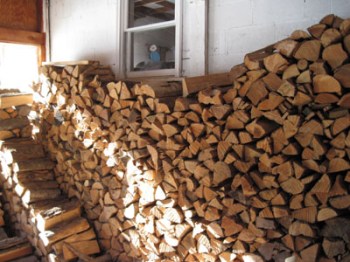 There’s elemental comfort in contemplating the woodpile in our back lean-to (and a second one outdoors) — a reassurance that reaches to the bone. Wood is our primary source of heat, and we spend about $600 a year to heat our small ranch house. Some rooms have electric baseboard which we use only minimally, when we’re away for more than a few days in winter, to save pipes from freezing. Taking a break from splitting, I stand and count days and logs, logs and days. And I give thanks to the waiting trees around our property.
Yes, it’s labor-intensive to feed a stove and keep it drawing well. If you’ve maintained a fire, you know these things, of course — I’m hardly telling you anything new. But for us the payback of wood is true solace: even when the power goes out, and no matter the windchill, we stay warm. Each log is captured sunlight, and if you’ve spent any time in wood heat, you know its delightful penetrating quality, much like sunbathing. (This winter has been mild so far for southern VT — our heaviest single snowfall clocked in at under a foot, and the thermometer dove and hovered just below zero Fahrenheit for only a couple of days last month. Today on our hilltop the mercury hit the mid-40s — briefly.)
Especially at night during a winter outage, with flames or embers our only source of illumination beyond candlelight or short bursts of flashlight, a moment’s reverie can transport us back 10,000 years to a Neolithic cave and the flicker of firelight on stone walls. You sit close to each other for added warmth, and fire-watching feels both utterly ancient and distinctly human. Then the hearth resumes its old and honored place as center of life and civilization. (Brigid, saint and goddess, patron of Candlemas and Imbolc just past, is lady of the hearth-fire.) Without heat on a bitter night, we’re each reduced to King Lear’s “thing itself … unaccommodated man … a poor, bare, forked animal.” At such times, more even than water, heat’s the immediate necessity.
When we first visited the house with a realtor on a bright, cold January day some years back, I remember thinking how much work wood heat would be. But we’ve only needed to start a fire about half a dozen times since late October, when the stove began burning steadily. Since then, the coals are almost always still hot enough in the morning to re-ignite whole logs without kindling. My wife or I wake up most nights now, in the small hours, almost taking turns without consciously planning it, to stoke the fire just once, and return to bed. And we can cook on the stove. Yes, it takes longer, but if the power’s out, time suddenly returns in abundance.
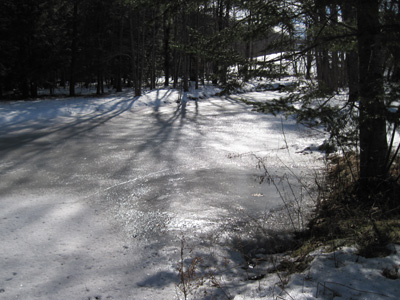
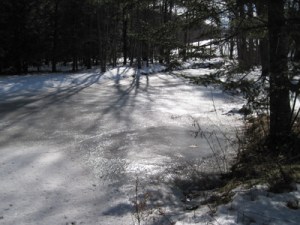 As for water, beyond our well, we have a small pond at the bottom of our yard. Again, when we first saw the property, all I thought was “mosquito breeding ground,” but I’ve come to see its multiple advantages. No, the water’s not potable (though the minnows, salamanders and frogs don’t seem to mind), but we can boil it if need be. It also serves for irrigation in a drought. Come spring, we’ll be fitting a hand pump to our well-head for water during extended power outages. (I stare at the pond now, this pale February light reducing the scene to white, gray, black, wondering how thick the ice is, how much chipping with an axe to reach the frigid liquid water.)
I record all these details in part because my wife and I spent half an hour yesterday watching clips of the new National Geographic series Doomsday Preppers, premiering next Tues., Feb. 7. While the featured families and individuals carry their preparations to extremes most of us would not, it’s perfectly sensible to maintain a store of several days’ food and drinking water in case of power outages or local natural disasters. Dried, canned and easy-to-prep foods if you have no means of cooking, rice and flour, beans and pasta if you do.
The harshness of local events in the past several months, like the drought in Texas, the severe tornadoes in the Midwest, and hurricane Irene in the Northeast, have persuaded people in ways nothing else could to consider such preparations. If heat isn’t under your control and you live in a temperate (read “cold”) zone, it’s wise to have a fall-back plan. Ditto for cooling, if your home otherwise bakes in the summer. You don’t have to expect “the end of the world as we know it” to use (as my grandmother liked to say) — “the good sense God gave gravel.”
While much is made of Americans’ dependence on electricity and foreign oil, most of us learn pretty quickly, if we have to, how to make do with wind, water, wood and fire. If you grew up in a small town, attended a summer camp, went hiking or just stayed up overnight outside a house, you have a preliminary sense of your abilities and tolerances in the natural world. It’s useful to know these, and build on them. That old sense of self-reliance that’s part of the story we tell ourselves about the “American character” is a good place to begin. And for you readers from other parts of the world, consider the equivalents in your cultures. Make it a game, especially if you have young kids. Think through your options in emergencies and disasters, and if they feel too constraining, work to expand them. We live in such varied circumstances, so no one solution will work for everybody. And that’s as it should be.
Come September, my wife and I will be back in CT, in school housing, with different contingency plans to consider.
A weekend’s reflection and planning will pay off down the road, even if they simply get you through the next minor “inconvenience” more smoothly. As the inconvenience increases, so will the payoff. Live long enough and you know from personal experience that John Lennon spoke true: life is what happens when you’re making other plans.
/|\ /|\ /|\

 Author, Episcopal priest and current professor Barbara Brown Taylor has written An Altar in the World, a splendid little book on simple, essential spiritual practices which anyone can begin right now. She writes from a refreshingly humble (close to the humus, the earth) Christian perspective, and a broad vision of spirituality pervades her words. Because of her insight and compassion, her awareness that we are whole beings — both spirits and bodies — because of the earthiness of her wisdom, and her refusal to set herself above any of her readers, she makes an excellent Druid of the Day. I hope I will always remember to apprentice myself gladly to whoever I can learn from. As the blurb on her website page for the book notes, “… no physical act is too earthbound to become a path to the divine.”




 A Druid Way
