Archive for the ‘spirituality’ Category
I am a whisper under the moon’s shadow, a song heard from the next room, a melody hummed under the breath;
I am the first bird to the feeder, the last star before dawn, the rain before the rainbow;
I am what I have forgotten so I can remember it again, a question at the altar, the answer of green leaves unfolding;
I am wherever the long dream draws its curtain, when I listen to the voices of ancestors, where the winds find their resting place;
I am why the swallow dips in flight, I am the luck of dice still tumbling, I am the interval when I can say these things.
/|\ /|\ /|\
Early Irish and Welsh poets such as Amergin and Taliesin composed related poems in the form of “I am” or “I have been” statements, with imagery drawn from nature, which I’ve imitated here. The Song of Amergin is one famous example which has survived in different versions.
Between legs of my flight back early this morning from my cousin’s wedding, I stood in an airport shuttle at Washington/Dulles, watching for a long minute as the sun edged into view in a glory of red and orange. Then the shuttle turned as it headed towards the main terminal, and I couldn’t see the horizon anymore.
I glanced around at my fellow passengers. Every single one of them was looking down, intent on a cell phone or iPad or some other device. Had they all missed beauty? Then finally I heard one couple directly ahead of me say something about the colors along the skyline. How often have I missed what’s just beyond my vision at the moment, but accessible with just a slight shift of attention — off myself and onto things in the larger circles of the world?

How easy we overlook what’s freely given to us! Would we attend to it, value it more, if we had to pay a small fee each time we wanted to witness a sunrise or a rainbow or a storm?!
It’s true that we often treat what we buy with more respect than what comes to us gratis. It’s also true that by “owning” something we feel we have a right to do with it whatever we wish because it’s “ours.” Nature as entertainment, as a product for consumption. “My” holly bush, “my” yard. Imagine nature a signatory even to one of our decrees concerning it.
Meanwhile, the holly spreads its sharp leaves, unconcerned. Red berries flash into vision, and wind sifts between leaf and fruit.
We’re often disposed toward or away from future experiences by previous ones, and for the bookish and private child I was while growing up, books provided me some of those experiences. One favorite that I still re-read from time to time is the fantasy classic, LeGuin’s A Wizard of Earthsea. And one of my favorite passages is a piece of wisdom that is pure Druidry in its nature-focus. When the main character Ged has spent his power in a desperate attempt at healing a child, and afterward lies comatose, his pet otak, a weasel-like creature, gently licks him:
“It was only the dumb instinctive wisdom of the beast who licks his hurt companion to comfort him, and yet in that wisdom Ged saw something akin to his own power, something that went as deep as wizardry. From that time forth he believed that the wise man is one who never sets himself apart from other living things, whether they have speech or not, and in later years he strove long to learn what can be earned, in silence, from the eyes of animals, the flight of birds, the great slow gestures of trees.”
This is some of the same instinctive wisdom, an inkling or hunch or suspicion about where wisdom may be found. It is bodily wisdom, as least at first, the same kind of wisdom or knowing that helped save lives on Sept. 11, when some people obeyed an impulse to do something different that morning, take a different mode of transportation, or vary the route to work, call in sick, stop for a bite to eat before arriving at work, and so on. We’ve all heard the stories.
If this is instinct, Druidry has no wish to domesticate it, but to extend it, to work in concert with it, to find out its wisdom and humbly listen to it.
I set myself to listen when I can. I’ve long been uncomfortable around bees, wasps and hornets. I got stung badly more than once as a child. But this summer, hanging out laundry, I took myself in hand, and learned to watch them and listen to them and talk quietly to them instead. Below the clothesline of our house, several bees busily gathered pollen from a clump of goldenrod growing there (we let a part of our backyard grow wild every year). I acknowledged them and admired their steady labor and music, never hurrying, but also never pausing. Talking to them did make me feel better. In turn, the bees did not bother me, though they knew I was there. The hum of their wings was steady and assured. A few investigated the damp towels I was pinning up, and several flew around me as they left. We worked in harmony at our respective tasks. By establishing a vibration of peace, we could each do what the moment required.
One of the options for the OBOD course I’m taking is to receive the course materials either as written text, or on CD (or both). I opted for the CD version, and the experience of hearing the various narrating voices, the sound-scape rather than sight-scape (each lesson on the CD includes a musical transition between sections), and the absence of a text to refer to, all contribute to a remarkable different sense of learning from what I’m used to as a reader. While I’m also taking an evening course at a seminary, and though that class is, like many, heavily discussion based, there’s a written syllabus (also online), we generally refer to one or more of the ten assigned class texts, and somehow the greater class experience still feels book-based, even though 95% of the in-class work is informal lecture and discussion.
In sum, the CDs have much of the effect of radio — sound builds different experience than vision. Though the West is at present heavily biased in favor of sight over hearing, there is a primacy to sound that vision cannot touch. In the beginning, we’re told, was the Word, the creative sound. Interestingly, the Hindu tradition also begins with sound — Vac or Vak, the original Word. Hearing wisdom makes it more visceral and immediate.
“Believe one who knows: you will find more in woods than in books. Trees and stones will teach you that which you can never learn from masters” — Bernard of Clairvaux (1090-1153)
Whether we believe Bernard or not, his claim is eminently testable. After testing it for yourself, belief is rather beside the point. So what is it that trees and stones teach, and how does it differ from what we can learn from “masters”? Some of this natural wisdom is difficult to put into words, not out of some obscurantist pseudo-mysticism, but because it is a kind of somatic knowledge — a knowledge the body gains from doing as opposed to what the mind gains from thinking and conceptualizing. How do we know how to ride a bicycle? Once the body acquires the experience, it doesn’t forget — even if the actual knowledge is not something we can usefully put into a set of memorizable “instructions.” That won’t help. Your body has to learn how to ride and learn it by muscle memory, and no amount of intellectual learning will bring us closer to such knowledge. Only experience will do.

The bookish culture of medieval and early modern Europe referred to the “Book of Nature” as a source of great wisdom, alongside holy scripture. For Druids, nature is scripture. While there is plenty of book learning a Druid can acquire, the beginning and ending of Druidry lies in experience of the natural world. If there are things I “can never learn from masters,” nevertheless a good master will turn me loose to experience them for myself. However much I look out my front picture window at the wind bending the ash and the red maple, and the sun shining on them, I know little compared to what I learn feeling the wind on my face and the sun on my skin. A sense of natural presences — of what have been called spirits, devas, elementals — is also something you can’t gain by thinking, any more than you can meet a new person by thinking about people you already know. But time outdoors can deliver this new knowledge to you, if you’re patient and alert, and place this knowledge beyond intellectual argument, because it is at least partly somatic knowledge. The body simply knows. I found this out myself last week, astonished at the number of presences on the small piece of land where our house sits. The back yard teemed with beings. I didn’t have to “believe” in them, anymore than you have to believe in people picnicking near you in a park. The decision at hand for me was whether or not to greet them. They were so perfectly who and where they should be that for me it seemed discourteous not to.
Druids seem to be enjoying a superficial popularity these days. Games like the world-wide phenomenon of World of Warcraft, a massively multi-player game, typically make up the first several listings on most search engines if you type in “druid.” These druids are of course characters or roles that players adopt and then develop or “level up” through prolonged experience of the game, in ways both like and very unlike daily life. Here’s an excerpt from the World of Warcraft Wiki: “Druids are keepers of the world who walk the path of nature, following the wisdom of the Ancients and Cenarius, healing and nurturing the world. To a druid, nature is a delicate balance of actions, in which even the smallest imbalance can create storming turmoil from peaceful skies. Druids draw their power from this wild energy, using it to change their shapes and command the forces of nature.”

[Image Source]
The French comic series Asterix, better known in Europe than in the U.S., features the druid Getafix (his name, like those of many of the other characters in different translations, is either a pun or play on words):
In the world of fiction a casual reader can also encounter some engaging and reasonably accurate stories that attempt to portray Druids in a balanced way. Fantasy and historical novelist Morgan Llywelyn has written several fine novels, one of her best being the eponymous Druids. Set in Celtic Gaul (more or less modern France), the story takes place during the growing conflict between Julius Caesar and the Celtic tribes he is “pacifying.”

The tale is narrated by Ainvar, a young apprentice druid of the Carnutes, a historical Celtic tribe whose homeland was in central Gaul, south-west of the modern capital of Paris. Ainvar is a “soul friend” (Gaelic anam cara) of Vercingetorix (82-46 BCE), chief of the neighboring Arverni tribe and another historical figure who stood against the incursion of the Romans under Caesar by attempting to unify the fiercely independent Celtic tribes against the Roman general’s encroaching legions. He is even mentioned in Caesar’s military memoir The Gallic Wars and in a few other ancient sources.
Throughout Llywelyn’s book, several other Druidic practices and beliefs emerge in ways natural to character and story, notably a sense of the sacredness of the land, the interconnectedness of all things, the value of ritual and blessing to imprint events in consciousness and experience, and the balance and pattern of the world, of which humans are a part, and which we ignore at our peril.
[Amazon books]
Contemporary British druids in ritual garb (Wikipedia image):

and a time to every purpose under the heaven, says Ecclesiastes. Nowadays people say in partial and often unconscious echo, “Everything happens for a reason.” It’s a loaded statement. In the natural world we can find pattern and order, and much of the appeal of Druidry lies in acknowledging and celebrating such patterns. The physical world reflects an order that does not depend on human effort, a pattern which recurs and circles and balances itself: dark with light, death with life, decline with renewal.
These are comforting notions, but what of violent crimes, natural disasters, horrific diseases? Then the words turn glib and facile, if not downright cruel. Tell a burn victim, a family made homeless by a tornado, the target of sexual assault that there’s a reason or purpose behind their suffering. The statements are much less cheery or supportable in such instances.
But the statements assert even more this. A “reason” suggests the “purpose” of the original quotation, an intention and even an intelligence behind it all, perhaps “out there” in the world, perhaps “in here” in human perception and the urge to make sense of experience. Is the universe malevolent? Does it intend us ill? Or, as many suspect, is it in fact not conscious at all, and wholly indifferent to human presence?
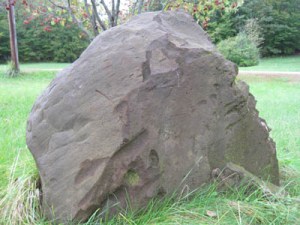
[My wife and I found this half-ton boulder two years ago when we dug up a new garden area. It now sits upright in our front lawn, more or less aligned north-south, and it’s starting to acquire a patina of lichen. Unsought. Beautiful.]
My experience with Druidry thus far has pointed me toward a perspective that comes through experience rather than principally through argument or rational process. These questions matter most prior to experience.
It can, for instance, be pleasant to lie in the sun. Actually lying in the sun delivers this realization after the fact. The warmth feels good, and the body responds to the heat and light. But beyond that, the relaxation may bring a discovery about something completely unrelated to sunbathing — a problem or difficulty I’m having. Likewise, the practice of Druidry can put a Druid in the position of discovering and knowing things unsought, without feeling the need to take a position on them either for or against. You simply know.
Of course we can seek out experiences expressly to test the validity of a belief or opinion for ourselves — that is, after all, good scientific method — but the after-the-fact quality of unsought insight allows one to absorb the experience in a less-conditioned way, without expectations or already-formed conclusions. Experience is primary, and all our explanations follow. Otherwise, we’re merely echoing others’ opinions about their experiences. Once you’ve experienced it yourself, any opinions about it start to matter a lot less.
That’s one reason that Druids I’ve met are tolerant of often divergent beliefs — they know that experience can dissolve doubts and contradictions and disagreements and leave us on the far side of mental processes and constructs, where a new landscape has opened up, and the former questions don’t matter so much any more. Or they’ve been transformed. Or new questions have arisen that are much more challenging and engaging. The world itself has changed for us.
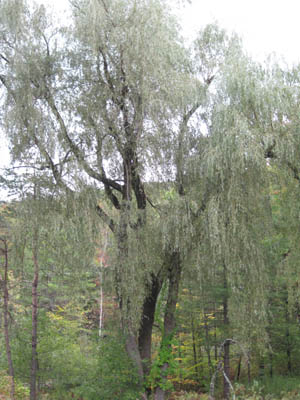 Here’s one of my favorite trees, a tall willow behind our house, on a rather cloudy day yesterday. The tree suffered winter storm damage a few years ago — an almost horizontal branch cracked, broke and fell into the snow — but it’s beautiful still.

And here’s the road up the hill behind the willow. The end curves away out of sight (at least until the leaves drop). A metaphor for the paths we’re all on? Sure. And it’s also — and first — a road. I’ll update the pictures as the changes come.




 A Druid Way