Archive for the ‘spiritual tools’ Category
[Part 1 | Part 2 | Part 3 | Part 4 | Part 5 | Part 6 | Part 7 | Part 8 | Part 9]
Wadin Tohangu has been in my thoughts these past few days — at first just a tickle of awareness, an overlay to thought. Then stronger, a gesture on his part for me to pay attention, a longing on my part to offer that readiness.
In the past a listening heart usually opened the way for him. Give my opinions and distractions a rest, and always something more worthwhile would fill the space they occupied. A poem, an idea for a blog-post, a phone call I needed to make or take, a chance conversation with a homesick student no one else notices, a shaft of sunlight or spectacular cloud at the moment I look out the window. The attention that draws Wadin is simple but not easy. Especially not today. Why not? I ask myself. I’m out of practice, for one thing. I mull over the past few weeks. Money is tight, and old medical bills, though we bring the balance down each month, still require that monthly check. We’ve just managed to pay municipal property taxes, and now the Ides of April loom, tax day part two, on the 15th. (We have as little taken out of the paycheck as possible, on the theory that it’s easier to pay later on our terms, rather than to try getting a refund on the government’s. We’re still, you might say, optimizing the theory.) Add to that some education expenses for my wife, plumbing repairs after basement pipes froze … the list goes on, one version or another all too familiar to many of us.
But through it all, things to celebrate as well. Yes, there will be balance. Birds back, singing. A few passing on the way north, offering unfamiliar snatches of melody on their layover. Daffodils pushing up pale and uncertain, the first wasps and flies buzzing around rather forlornly, that indefinable slant of light and the scent of earth that signal spring, whatever the thermometer shows. Longer days. A sky that says forever is still here, starting right beyond my skin.
Wadin Tohangu is companion to my thoughts again. What will he say to me this time? What do I need to hear?
/|\ /|\ /|\
Updated 23 April 2015
The title for this post comes from an entry by fellow Druid John Beckett on his blog Under the Ancient Oaks, which is well worth frequenting. John closes with these beautiful words: “What I cannot know by fact, I believe by love.”
So here’s my riff on it, a prayer-song and a poem and a question. I know the hawk flies overhead; I believe he is kin to me because we arise from the same world, share the same earth, water and air, and will return to them. I know my heart still beats as I write this; I believe I will have more opportunities to love before it finally stops. I know the touch of my beloved; I believe what love has taught me outweighs college degrees and years in school. I know the gifts of time and silence; I believe I can make use of them not only for my own benefit but to give back to life. I know the sun shines behind this afternoon of cloud; I believe the shade to be necessary as the sun. I know gratitude is a choice; I believe it is one of the most powerful choices I can make. I know the snow covers part of a world once green; I believe it will turn green again for many millenia yet, the cycles continuing. I know the spider I rescued from the bathtub yesterday counts for little against the hundred of bugs I have killed at other times; I believe life cannot be valued in numbers alone. I know many things hard to believe; I believe some things I may never know. And I am content that this should be so.
/|\ /|\ /|\

What follows are brief notes from a short talk I recently gave on magic.
Dion Fortune’s definition of magic: “the art and science of causing change in consciousness in accordance with will.”
“… most of us, most of the time, are content to use the imaginations of others to define the world around us, however poorly these may fit our own experiences and needs; most of us, most of the time, spend our lives reacting to feelings, whims and biological cravings rather than acting on the basis of conscious choice; most of us, most of the time, remember things so poorly that entire industries have come into existence to make up for the failures and inaccuracies of memory” (J. M. Greer, Circles of Power, 52).
We can, however, choose to imagine – & remember – ourselves differently. When we do so with focused attention, changes happen, both subjectively & objectively.
/|\ /|\ /|\
Magic stems from an experiential fact, an experimental goal, & an endlessly adaptable technique.
The fact is that each day we all experience many differing states of consciousness, moving from deep sleep to REM sleep to dream to waking, to daydream, to focused awareness & back again. We make these transitions naturally & usually effortlessly. They serve different purposes, & what we cannot do in one state, we can often do easily in another. The flying dream is not the focus on making a hole in one, nor is it the light trance of daydream, nor the careful math calculation.
The goal of magic is transformation – to enter focused states of awareness at will & through them to achieve insight & change.
The technique is the training & work of the imagination. This work typically involves the use of ritual, meditation, chant, visualization, concentration, props, images & group dynamics to catalyze transformations in awareness.
/|\ /|\ /|\
Magic is also “a set of methods for arranging awareness according to patterns.”
We live our lives according to patterns. Some patterns are limiting & may be unmasked as restrictive. Other patterns can help bring about transformation. “[T]he purpose of magical arts is to enable changes within the individual by which he or she may apprehend further methods [of magic & transformation] inwardly.”
“… [O]ur imagination is our powerhouse … certain images tap into the deeper levels of imaginative force within us; when these are combined with archetypal patterns they may have a permanent transformative effect.”
– R. J. Stewart, Living Magical Arts
/|\ /|\ /|\
Image source: sunset.
[Part 1 | Part 2 | Part 3 | Part 4 | Part 5 | Part 6 | Part 7 | Part 8 | Part 9]
To see a World in a Grain of Sand
And a Heaven in a Wild Flower
Hold Infinity in the palm of your hand
And Eternity in an hour.
—William Blake, “Auguries of Innocence”
That kind of seeing and holding requires a special focus, a clear attention, I think, as I hurry to lunch, distinctly UN-focused, a dozen thoughts jangling, after two very different conversations with students during conference period. My freshman advisee Walt has asked about the intricacies of some scheduling for sophomore year, while Ann, a junior and a former student, has come to talk about polishing a remarkable piece of journal writing from her freshman year for possible publication.
At the dining hall table where I often sit, Mr. Madden, Mr. Ritter and Mr. Delahunt are chuckling about an old piece of school gossip concerning the previous administration. Ms. Valenti joins us, and the conversation soon shifts to the deer that appear early almost every morning in the yards of the faculty residences on the campus periphery, where Ms. Valenti and Mr. Madden live in senior faculty houses. Ms. Valenti describes the ten- or eleven-point buck she saw standing motionless in her driveway earlier in the week. Mr. Delahunt mentions that he’s learned a small herd of deer beds down each night in a wooded gully between the new science building and the peripheral faculty housing. I cheer silently for these animal lives thriving, often just beyond our knowledge, in this apparently suburban part of the world.
At first I think all of this is mere distraction, but Blake reminds me yet again there’s a whole world here, eternity and infinity too, if I only see and touch them. We all gobble our food, and I hurry back to my first afternoon class with my seniors. So many grains of sand: underfoot, on the stairwell carpets of the English building, in my second-floor office when I reach down to pick up a fallen paperclip from the floor. Each one a world, if I had time to see it. Next year I will have time, because this is my last here. Voluntary poverty, or insanity, or more than a little of both.
Class goes fast with my fifth period Brit Lit seniors. Many of them read from the satires they’ve written in imitation of Jonathan Swift’s “A Modest Proposal.” We don’t work on Blake, but here is eternity, too. For a few moments we’re all paying attention, laughing at a satire of college admissions, or the sleep deprivation so many students face, not thinking about anyone or anything else — about the test next period, the sick friend, the college rejection letter, deadlines, schedules, midterm tomorrow, the weather, or whether a visionary dead white male Romantic poet may or may not have anything useful to say to us.
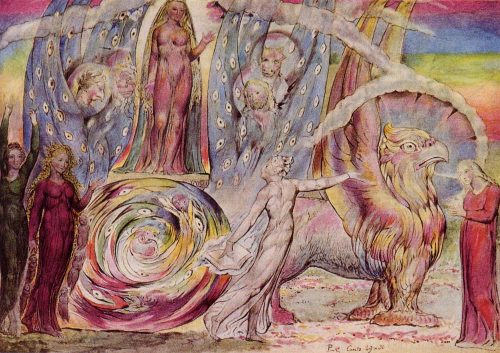
Mr. Blake, we survived the 2012 fake apocalypse, I feel like crowing. His ghost seems to nod, looking out the window at the light fog that huddles over the nearest quad. Maybe that’s the best we can do, right now, our version of eternity: bad apocalypse.
Unwilling to share their satires, the sixth period seniors struggle with Blake. We work through a couple of the easier poems, and soon I can tell it’s “drag” time. I drag them through a few more, trying to open up the sometimes seeming-simplistic usually-complex lines. Blake’s ghost sighs heavily. An uphill climb for everyone, even though I’m working harder than usual to exhume the poet from two centuries of cultural and historic static that seems to buzz between the words on the page and the lives of my students. I give them a creative writing exercise, and one soft-spoken girl produces a lovely poem inspired by the lines at the top of this post. Her lines offer almost all sensory detail, a lovely lyric, with none of the teen angst that normally trails after much adolescent poetry like a homeless dog. I give thanks for such things.
Blake, old sage, tyger-burner, Jerusalem-singer, painter and poet of the 19th century as strange and full of possibility as our 21st … what else do you have to tell me? I listen as I write, content for a moment to hear the voice of silence in and around the clicks and taps of the keyboard. “Hear the voice of the Bard, who past, present and future sees …” With the view out my window circumscribed to the present only, I can tell I have my work cut out for me. Blake’s ghost nods encouragingly. Time to begin again.
/|\ /|\ /|\
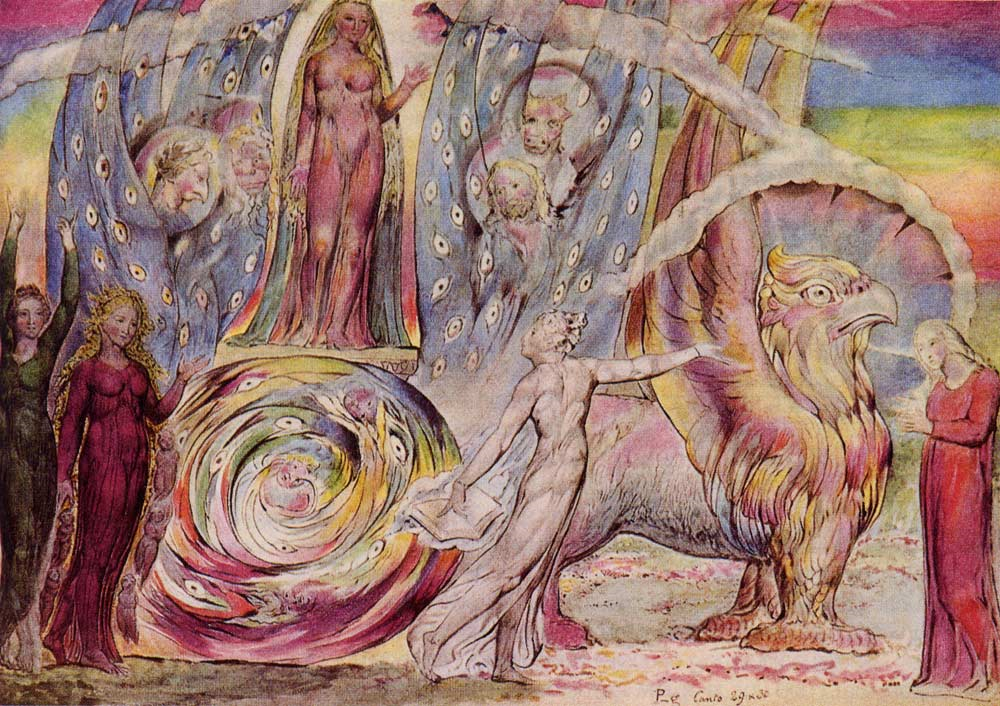
image: “Beatrice addresses Dante”; William Blake
Updated 23 April 2015

Much of my learning before and during the Bardic grade of OBOD Druidry has been about listening. I’ve walked different landscapes here and abroad over the last couple decades, and almost always when there are negative energies, they seemed to issue from human presences that felt negative to me, or disrupted the native energy. The land itself is simply the land, with all its other lives and forces and history and presences. It may not always feel comfortable or easy or familiar, but it has an integrity that asks me to pay attention. And yes, I’ve done that with varying success. But the human is always an overlay, unless the place has been inhabited for a very long time, and the humans there learned to attend to and respect the place they lived. Which is sadly not often enough, though places exist here and there which are dearly loved and cherished, places in which the land spirits dance their joy.
California Druid Gwynt-Siarad tackles this directly in his blog entry, “The Curious Case of American Land Spirits.” I’ve taken the liberty of reposting the whole of his short entry here (Druids are always talking to beings they can’t see):
Recently I was involved in a discussion about land spirits. As the discussion progressed it touched on what I feel is a very important issue to us druids living in the Americas. That being, land spirits are more often then not, tied to the land and thus couldn’t come to us from Europe, and thus how do we treat with the spirits of this “new” land? The natives of this place have a long and good history of working with the land spirits here. Sadly, in most places, and certainly here on the west coast of the lower 48 the natives are almost completely gone. This is a very sad thing, but not the focus of this post. The question is, can those of us of European descent summon, honor, call, and treat with American land spirits? It was suggested that the spirits here are used to being summoned with certain type of ritual, that being those of the local natives. That the land spirits here have native names, and should only be addressed as such. ok…what if the name is not known, and can’t be learned? And what of the idea that they can only be summoned with native American style evocations? Where does this leave the modern druid? Even if I were able to learn, say the dances of the Umpqua Indians to summon the spirit of the Umpqua river, that would most likely be considered cultural appropriation and that’s just not P.C.
I have been tumbling these thoughts over in my head for several days now, and here is what I have come up with. First off, spirits are as individual in personality as people are. What might be ok with one spirit won’t be ok with another. How do we find out? I vote for good old fashioned trial and Error. Go out there and do what druids do in the way druids do it. If the spirit doesn’t like it, I am sure it will let you know, if you bother to listen. Let the spirits be our teacher. I think and feel with but a few exceptions so long as the spirits are approached with offerings, respect and love they are not going to be over critical if you said the right name, pronounced in the correct native dialect or be upset if you didn’t dance in the native way. Using a name the spirit is familiar with would be very helpful in treating with it, but not critical. So those druids that are inclined to work with such spirits, I say do your homework and get out there and get to know your spiritual neighbors!
No surprise that the spiritual world resembles this one — the spirits wish to be treated as individuals, because that’s what they are. What of spirits of a species which was transplanted to the New World by Europeans? Is it the “same” plant or animal? The best way to find out, as Gwynt-Siarad observes, is to start the conversation.
/|\ /|\ /|\
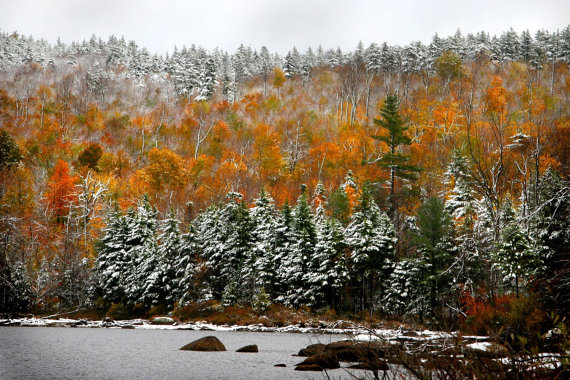
image credit: http://www.etsy.com/listing/59674255/fall-autumn-photography-new-england
(Check out their gorgeous prints.)
Henry David Thoreau wrote in his manifesto, Walden, that he wished to follow “the bent of my genius, which is a very crooked one, every moment.” Let’s suspend belief about the “every moment” part for now. Most of us slack off; we’re not up to full time bent-ness. But I suspect every genius is “bent” by the time it emerges, after the intense discoveries and trials of childhood and adolescence. It is, after all, a time when we each face a personal apocalypse which — apart from recent 2012 apocalypse kerfluffle (a profoundly scientific and precise term), itself only the most recent instance of a few millenia’s worth of end-times hysterias* — is at root not a disaster per se, but an unveiling, a revealing.
That’s why the Biblical apocalypsis, a Greek word, gets translated “Revelations.”** A revelation needn’t be a disaster. We may seek from many sources for revelation or insight into our lives and situations. But as far as adolescence goes, whether it’s some profound additional shock, or the more routine experience of our physical bodies running mad with hormones, hair, smells, urges and general mayhem, it can be a real humdinger of a decade.
Among other things, we begin to come to terms with the full measure of shadow and light we each carry around with us, a personal atmosphere with its own storms and sun, its seasons of gloom and glory. As Hamlet exclaims to Ophelia (Act 3, scene 1): “I am myself indifferent honest; but yet I could accuse me of such things that it were better my mother had not borne me: I am very proud, revengeful, ambitious, with more offences at my beck than I have thoughts to put them in, imagination to give them shape, or time to act them in. What should such fellows as I do crawling between earth and heaven? We are arrant knaves, all; believe none of us.”
Quite a catalog of self-condemnation. But on our “crawl between earth and heaven,” we can choose to do more than indulge in self-loathing. It’s not a competitive sport, after all. No prizes for “arrant-ness,” to use Shakespeare’s word. This being human is a mixed bag, a potluck. We work out our own answers to the question of what to do crawling between earth and heaven. It’s an apt description: we truly are suspended at times, halfway to both realms, too rarely at home in either.
And so, rather than New Year’s resolutions, I prefer to look at themes and nudges. If I take my own advice, courtesy of Yoda, and tell myself “do or do not, there is no try,” then “small moves” becomes the game. Nudge a little here, prod a little there. Few life trajectories change overnight. If yours does, then all bets are off. You’re probably in full-on apocalypse mode right now — and that’s apocalypse in the 2012 “all-hell-about-to-break-loose” sense. It’s time to rewrite the manual, reboot, do over. But the rest of the time, the smallest change can eventually lead to big consequences. Lower expectations. Make it almost impossible for yourself not to follow through.
Now you’re not trying to change; you’re playing with change — which has a very different feel. If you want to commit to half an hour of exercise a day, for instance, make it five minutes instead. Psych yourself out or in, your choice. Small moves. Make it foolishly easy, like using a credit card. It’s just a piece of plastic, just a small thing you’re doing. A game really. I’ve been surprised how I can make changes, as long as I make them small enough, rather than big enough. Seduce yourself into change so small you can’t resist, like those bite-sized pieces of your current favorite snack addiction. “Nobody can eat just one.” And so on.
We think too much of ourselves. I’ll think less, on alternate days, to see how it feels. This is real trying — not an attempt that focuses on probable failure, but the testing, the probing, the experimenting, as in “trying the cookie dough,” or “trying a kiss on the first date,” or “trying on a new set of clothes.” There’s self-forgetfulness available in the fascination of the game-like quality life takes on when we cease to take ourselves quite so seriously. Instead, we may come to revere some other thing than the self. Because one of her insights is apropos of what I’m getting at, I’ll close here with Barbara Brown Taylor, from her 2009 book An Altar in the World:
According to the classical philosopher Paul Woodruff, reverence is the virtue that keeps people from trying to act like gods. ‘To forget that you are only human,’ he says, ‘to think you can act like a god — that is the opposite of reverence.’ While most of us live in a culture that reveres money, reveres power, reveres education and religion, Woodruff argues that true reverence cannot be for anything that human beings can make or manage by ourselves.
By definition, he says, reverence is the recognition of something greater than the self–something that is beyond human creation or control, that transcends full human understanding. God certainly meets those criteria, but so do birth, death, sex, nature, justice, and wisdom. A Native American elder I know says that he begins teaching people reverence by steering them over to the nearest tree.
‘Do you know that you didn’t make this tree?’ he asks them. If they say yes, then he knows that they are on their way (20).
So maybe I’ve seduced you into trying or tasting your life and its possibilities instead of getting hung over changing it. May you find yourself on your way, may you celebrate what you discover there, may you delight in reverence.***
/|\ /|\ /|\
*See John Michael Greer’s Apocalypse Not (Viva Editions, 2011) for an amusing take on our enduring fetish for cataclysm and disaster. You’d think that after Katrina, the Gulf oil spill, the Japanese tsunami and nuclear disaster, hurricane Sandy, and the yearly shootings we endure, we’d be fed up with real actually-documentable apocalypses. But no …
**The name of the Greek sea-nymph Kalypso means “Concealer.” Undo or take off the concealment and you have apo-kalypse, unconcealing: revelation.
***Once my attention is off myself, I find that change often happens with less wear and tear. Reverence can seduce us into other ways of being that don’t involve the stressors we were “trying to change.” We may not even notice until later. I get so busy watching the moon rise I forget what I was angry about. Anger fades. Moon takes it. Reverence, o gift of gods I may not know or worship, I thank you nonetheless …
Updated 2 Jan 13
Compassion has no religion. Silence is not always indifference. O great, listening, witnessing world, you too have something to say, something you always are saying, without words. What comfort we can offer, miles and lives away from the families of the Sandy Hook school victims, and from other, newer sufferers since then, may consist of not filling the airwaves and spiritual spaces further, with our own shock or anger or sadness or dismay, or whatever other responses events may next provoke in us. Even if we do not know the families or victims or any of those touched by an event, we may send sympathy, because we are not stones. This is prayer, too. But every turn of the world changes us because we’re in it together. A great service is to love those who need love, and not merely to feel, to emote. We can do more than relive pain, especially another’s pain, or make it ours. Suffering needs no extra rehearsals, no practice. There’s always more than enough to go around.
We’re not stones, but we may raise them into a cairn, a act that by its solidity and palpable weight can lift suffering even a little, if it may, stone by stone. Let earth bear a portion of the weight. Allow this elemental power of Earth to transmute, to compost and transform, as it does all else that comes to it. The turning of the year again toward light in the middle of winter, the planet doing again what the planet does each year, can be solace too, earth re-establishing its balance. Soothing motion of the familiar, wordless touch with its animal comfort. Moon growing again towards fullness, light on the world in the middle of darkness.
But sometimes we hate comfort. Too often solace can reek of appeasement. We stiffen. One more easing is too many. Intolerable. Like words — already more than enough. With no ready target we seek out whatever will serve, anything to shut up the noise, the roar of raw nerves jangling. Anodyne. Oblivion, even, at least for a while.
Grief is too steady a companion. It knows us, it seems, deeper than a lover. OK, we get it. Pain too has something to say that will not be denied. We make a place for it, and it moves in, gets comfortable, settles down for too long. (How long is memory? Is recollection what we consist of? Do we relive, instead of living new? Does this become our only, instead of our also?)
When words do not do, I bring silence to the altar. When I cannot pray, then that is my prayer, just the act of moving toward the altar, a center, a focus.
/|\ /|\ /|\
The house has cooled overnight when I get up to write this. In between the last two paragraphs, I open the door of the woodstove to put in another two logs. In a turtleneck and sweats, I sit on the floor, feet toward the fire, with my laptop where its name says. Warmth, says the body, unrepentant in loving what it loves. Warmth too, radiating from the electrical current flowing through the machine I write with. So little, but a little. A start.
“there is an altar to a different god,” wrote the Portuguese poet Fernando Pessoa (1888-1935). Perhaps that’s some explanation for the often mercurial quality of being this strange thing we call the self, ourselves. We can’t easily know who we are for the simple reason that (often, at least) we aren’t just one thing — we consist of multiple selves. We’re not individuals so much as hives of all our pasts buzzing around together. Whether you subscribe to the reality of past lives or see it as a possibly useful metaphor, we’re the sum of all we’ve ever been, and that’s a lot of being. And with past lives (or the often active impulses to make alternate lives for ourselves within this one through the dangerous but tempting choices we face) we’ve known ourselves as thieves and priests, saints and villains, women and men, victims and aggressors, ordinary and extraordinary. When we’ve finally done it all, we’re ready to graduate, as a fully-experienced self, a composite unified after much struggle and suffering and delight. All of us, then, are still in school, the school of self-making.
Doesn’t it just feel like that, some days at least?! Even only as a metaphor, it can offer potent insight. The Great Work or magnum opus of magic, seen from such a perspective, is nothing more or less than to integrate this cluster of selves, bang and drag and cajole all the fragments into some kind of coherence, and make of the whole a new thing fit for service, because that’s what we’re best at, once we’ve assembled ourselves into a truly workable self: to give back to life, to serve an ideal larger than our own momentary whims and wishes, and in the giving, to find — paradoxically — our best and deepest fulfillment. “He who loses himself will find it gain,” said a Wise One with a recent birthday we may have noticed. We all learn the hard way, for the most part, because it’s the most profound learning. Certainly it sticks in a way that most book learning alone does not.
/|\ /|\ /|\
[Part 1 | Part 2 | Part 3 | Part 4 | Part 5 | Part 6 | Part 7 | Part 8 | Part 9]
In our last conversation, Aithne had said nothing about needing my help. All this stuff about ancestors and bloodlines, and now I was wondering about that piece. Had she forgotten? But even if she did need me in any way, how could I really help? After several decades of living, I have a pretty clear sense of my talents and abilities. It wasn’t false modesty that told me both Rosmert and Aithne could certainly handle challenges and obstacles I couldn’t. Wasn’t that why they were teaching me, and not the other way around? There’s an innate order to things that we ignore at our own peril but that we can also learn to our advantage — that’s one of the foundations of my worldview. I guess when I thought about it that I saw helping others along the path is a form of payback, or maybe paying it forward. It’s a way to show gratitude, a way to keep the heart open. Gratitude feels good. Just do it.
So it was when all of this was still spinning through my brain that Aithne appeared again. It had been more than a few days since I’d tended to my Sacred Grove. The excuse doesn’t matter; it’s a poor one. But shortly after I returned, there she was. But she certainly was not dressed the same this time. Biker chick was all I could think: leather jacket, torn and faded jeans, bandanna, dark glasses, snake tattoo on her neck, even chains. Again she was gazing off into the distance, and when she turned toward me she took off the sunglasses and winked.
“You ready?” she asked.
“For what?” I replied. That was Aithne, I was beginning to understand. Small talk rated low among her priorities. And it was rubbing off.
“A ride,” she said. “I’ve got an ’86 Harley Sportster, 1100 cc’s. Want to try it out?”
And that was how, maybe an hour later, Aithne and I were roaring down a little-traveled country road that arrowed flat and straight toward the western horizon. After a series of lessons, practice runs, one spill and a bruised right knee, I felt reasonably confident handling the heavy machine. I wasn’t ready for a lot of traffic yet, but the basics were coming along nicely.
“We’ve got clear road,” she said. “Let’s open it up for a couple miles.”
The big bike still ran smooth when we topped 80 mph. I eased back on the throttle, listening to engine as it lost the high-pitched whine of speed. A few minutes later we were sitting on the side of the road, sipping Gatorade. Aithne was studying a ladybug on a blade of grass she held in both hands.
“You can help me, you know,” she said. “We need you healthy for the work, and for your part which only you can do. That’s your focus for now. Get healthy, and balanced.”
“I wanted to ask you about that. What can I do?”
“You can begin again.”
“Begin what?”
“You’ve completed another spiral. The next months may look familiar, but they aren’t the same thing that’s come before. Pay attention to what they can show you.”
“But what am I supposed to be looking for?” I asked.
Aithne paused and looked at me for a moment.
“You’re thinking about quitting your job after this academic year. You’re wondering how little you can live on if you do, how much food you can grow for yourself back in Vermont. Those aren’t bad things by any means, but your principal focus needs to go beyond that. Those aren’t ultimately pathways to the next two decades. You’re looking at surviving. I’m talking about thriving.”
“After the last couple of years, surviving looks pretty good to me.”
“And it is,” she said. “We had to work with your wife to get you to that surgeon in Baltimore. You weren’t listening when you most needed to. Fortunately, she was. So you survived the shift, you kept this body through the turn. You’re still here, and the ancestors aren’t finished with you in this life yet. You’re on commission. Did you know that?”
“Commission for … for what?” I stuttered. “Can I have some clarity just once about what I’m supposed to be doing?”
“You’re confusing clarity with looking back on a path you’ve already walked,” she said. “So often you can know by going. And for as long as you’re here, you’ll find that’s one of the things time’s for.”
And then I was back in my living room. The clock said 9:48 pm. It had been a long day, and I had much to think about.
/|\ /|\ /|\
Updated 23 April 2015
[Part 1 | Part 2 | Part 3 | Part 4 | Part 5 | Part 6 | Part 7 | Part 8 | Part 9]
“The Blood of Veen is a key to new insights for you,” said Aithne. “Your ancestors reach you through the body — your body. You carry them with you wherever you go, in your cell memory, your DNA, your genetic coding, and the energy signatures scientists are just on the edges of discovering, which are part of the bonds that link the physical body to the other worlds.”
“So how does the Blood of Veen connect with me personally?”
“If you visit a place where your ancestors lived, you may have a dream or vision that teaches you something you need to know.” Aithne stood gazing a little above my left shoulder, or head, as if she was watching something move there. “Veen is in the province of Brabant.” She paused, apparently studying empty air. “And some of your mother’s ancestors came from that region,” she added. Aithne’s knowledge startled me. One of my mother’s aunts had traced much of the family line back to medieval France and Belgium. Some of her ancestors came from Brabant, including a noble named Joscelyn de Louvain, when Brabant was a Duchy. (Don’t get the wrong idea here. I have my full share of black sheep in the family, too!) And Louvain is a city in Brabant — its capital, in fact.
“But I can’t just pick up and visit Brabant or anywhere else in the world at the drop of a hat! Most people don’t have the time or money to track down their ancestors in other countries or take some sort of reincarnation tour.”
“You don’t need to,” said Aithne, ignoring my flash of irritation. “Pictures can help. And there are online forums where you can ask questions and find out detailed information about almost anything you want to know. Let your curiosity work for you. After all, how much time do you waste online as it is?!” Her sudden smile was teasing. “Make the first move, and the ancestors will respond. You’ll have a dream, find a book, ‘happen’ to meet someone, make a connection. They will guide you.”
Somehow it surprised me that Aithne knew these things. While I’ve come to expect my inner experiences to bring me general insights and hints and nudges on occasion, whenever I receive specific information it still surprises me. A few years ago in a dream I got the name of a small British town in Devon where some of my father’s family originated. I’d never heard of it before, and it no longer exists today. For that reason I know that no one in my family had ever mentioned it. But there are archaeological records and mentions of the town in chronicles and censuses of the period showing that it once did exist.
That was the outer confirmation of an inner experience. Such validation doesn’t always come, but when it does, I feel a shiver of awe and wonder. These things are real. The worlds link however briefly, and lives change as a result. I know this, I’ve experienced it before enough time to silence any doubt, but my inner doubter doesn’t care. He’s achieved pro status by this point, and just goes about pointing out sly new possibilities of self-deception. I guess my ancestors have to be pretty patient with me to get through at all. I often think they must find other descendants more worth their time. Then I remember they’re working outside of time — at least outside of my time. They can afford a little patience with the stubborn and half-deaf ones like me.
Aithne seemed to be following my thought. She was nodding slightly, and then she said, “Sometimes the act of inquiring leads you to new people and experiences that are beneficial for everyone involved. You know this,” she said.
“I’ll return one more time,” she said. “We have a few more things to discuss.”
/|\ /|\ /|\
Updated 23 April 2015
[Part 1 | Part 2 | Part 3 | Part 4 | Part 5 | Part 6 | Part 7 | Part 8 | Part 9]
Rosmert returned again today, but only briefly, and only, he explained, to introduce Aithne. At first I could not see her clearly, except to note she was only slightly shorter than Rosmert. Then it seemed the space around her sharpened somehow, or — I had the distinct feeling now — she was letting me see her. She wore the hood of her robe up, and it shadowed her face. Freckles dotted her nose, and a few tendrils of chestnut hair slipped from her hood. Then all I knew was her eagle gaze. Two green eyes of startling fierceness regarded me. She grabbed my half-extended hand, shook it vigorously, then promptly pointed out a problem.
“Greetings. You do realize you left the gateway open? Magically careless. Let’s close it immediately. I’ll show you how. But first, let me take a quick look around.”
From her brisk words and tone I could tell that today at least there was no such thing as Druid-business-as-usual. Or maybe this was usual, for her. As she studied the trees and stones, she began to describe one way to seal a grove more effectively against unwanted presences and energies.
Then I saw Rosmert winking at me just before he disappeared. He made a sweeping gesture that seemed to say “You’re in her hands now.” I laughed in spite of myself.
At the sound, Aithne turned from her survey of my grove and regarded me with a frown. “You have made a beginning, but you need practice at defense,” she said. “Now expel me from this space.”
When I hesitated, she exclaimed, “Do it! You did not invite me like you did Rosmert. I came at his bidding, not yours. So you can rid this grove of me quite easily. Do it. When you are quite satisfied I am gone, you may choose to invite me back, or not. But secure the gateway first, whatever you do.”
I centered myself in my grove and sang the Word of Protection. One instant, Aithne stood there, her head tilted to one side, listening. In the next, she vanished.
I walked the inside perimeter of the grove, singing. I walked it three times. I played with the thought of not inviting her back. At length, when I was satisfied with the wards and had formulated the triple seal, I called her by name, just once. A second later she appeared a few meters away.
“Better,” she said. “I tested the gateway several times before you called me. Much better.”
She turned slowly again to take in the trees. Over the past months it had been a fallow time for me while outer things made their demands, and I needed to do some inner work. The space certainly reflected this. It looked, quite frankly, unkempt and overgrown.
“But I did not come to critique your grove or your training,”she said, “or to sight-see. Whatever you might think.” She clapped her hands, and sat down on the same tree-stump Rosmert had occupied when he and I talked. “I need your help.”
Nonplussed, I stuttered, “Well, OK, with wh- … uh, how can I help?”
“It’s a matter of the Blood of Veen.”
“Who — or what — is Veen? Like it sounds? V-E-E-N?” I asked, spelling it. Goddess help me, I thought I could hear capital letters when she said Blood and Veen. It sounded, well, cheesy. Like hack sword-and-sorcery writing.
“It’s a town in the Netherlands. You have an ancestral connection to the region.”
/|\ /|\ /|\
Updated 23 April 2015
OK, be forewarned … this runs long. If you’re more in the mood for bon-bons than for jerky, come back later. This ended up pretty chewy. It’s also provisional, a lot more tentative than it sounds. Now I’ve told you, so don’t get cranky with me later. Here goes …
/|\ /|\ /|\
In her poem “Circe’s Power,” Louise Glück speaks in the voice of the sorceress who transforms the crew of Odysseus into swine when they arrive on her island. Even the great war-leader and trickster Odysseus himself would have fallen under her spell, but for a charm the god Hermes gives him. (“Some people have all the luck,” “the gods favor them,” etc.) So it’s dueling magics at work, divine and mortal enchantments competing for supremacy. (Sort of feels like life at times. Like we’re adrift in a hurricane, or trying to build a house on a battlefield.) Circe speaks to Odysseus, to all of us, in a kind of explanation of life seen from the vantage point of magic. Or not.
I never turned anyone into a pig.
Some people are pigs; I make them
look like pigs.
I’m sick of your world
that lets the outside disguise the inside.
Your men weren’t bad men;
undisciplined life
did that to them. As pigs,
under the care of
me and my ladies, they
sweetened right up.
Then I reversed the spell,
showing you my goodness
as well as my power. I saw
we could be happy here,
as men and women are
when their needs are simple. In the same breath,
I foresaw your departure,
your men with my help braving
the crying and pounding sea. You think
a few tears upset me? My friend,
every sorceress is
a pragmatist at heart; nobody sees essence who can’t
face limitation. If I wanted only to hold you
I could hold you prisoner.
Oddly, this poem always cheers me up, with what I take to be its hard realism. That may sound funny, since part of the time Circe’s talking about magic, and she has a cynic’s view of much of life. Or maybe a minimalist’s. How do those two things go together?! But it’s a magic we’re born into, the nature of a world in which the outside does indeed often “disguise the inside.” Here, almost everything wears a mask. Even truth hides as illusion, and illusion as truth. The god of this world, we’re told in the Christian Bible, has the face and name of Liar. We learn this soon enough, discovering quite young the great power of lying. It’s a magic of its own, up to a point — a beguiling enchantment. Some of us never recover. It’s lies all the way. But there are other worlds, and other magics as potent, if not more so. If Circe is “sick of this world,” what can she tell us of others?
Another way of looking at it can come to us in an Emily Dickinson poem. (What is it with these poets, anyway?! Liars, magicians, many of them. Enchant us into the real.) “Tell all the truth, but tell it slant,” says the Amherst visionary, and we’re off to the nature of truth seen in a world of illusion: paradox. (Maybe truth needs a mask, to exist here at all.) “The only way out is through,” insists Frost in yet another poem, but in spite of our longing for the Old Straight Path, it’s fallen away from us, and the world is now “bent,” as in the Tolkien mythos. We can’t get out so easily.
“Success in circuit lies,” Dickinson goes on to say. In other words, “you can’t get there from here”: the directions are all scrambled, even the best of them. You travel in a cosmic roundabout and end up somewhere else, not just on a road less traveled, but one apparently never traveled before, until you set foot on it. Who can help you as you journey there? No one? Anyone? One paradox is that you’re walking the same path everyone else is, too. Everyone’s having an experience of being on their own. What we share is what keeps us separate. Paradox much? Useful at all?
“Too bright for our infirm Delight/The Truth’s superb surprise,” says Dickinson. OK, so what the hell does that mean? Well, Circe knows, or seems to. If every sorceress is indeed a “pragmatist at heart”, then she and all the others who deal in truths and illusions may have something useful to tell us in the end. Certainly our encounters with truth can have a surprising quality of sudden opening and revelation. Whether the surprise is “superb” depends in part on you. But what are we to make of her next assertion? “Nobody sees essence who can’t face limitation.” The two negatives “spin your head right round.” Is it still true if we remove them? “Everyone sees essence who can face limitation.”
This is without doubt a world of limits, of hard edges, of boundaries we run into all the time, however much we try to ignore them. Inconvenient truths aren’t the same as illusions. (We just wish they were.) Some of the edges cut, some leave scars. We get away with very little, in the end. Most of our illusions get stripped away, in this world of illusions. What’s left? Emily, Louise, mother-wit, “the sense God gave gravel,” somebody (anybody!), help us out here!!
“As Lightning to the Children eased/With explanation kind/The Truth must dazzle gradually/Or every man be blind –” Emily concludes. (Maybe the dash says it all.) Is there any “kindness” in this world of disguises? Well, if some truth really is, or can be, as potent as the words here suggest, then one kindness is precisely the illusion we complain about. It’s protection, insulation, a hot-pad between us and the Real, to keep it from scorching our skin, burning our vision. Mortal eyes cannot behold the infinite. “No one can see the face of God, and live,” Moses is told. Things get scaled down in this world. The hot turns lukewarm, tepid. You want scalding? You were warned.
So what might we take away as a provisional set of guidelines to test and try out, and maybe use, if and when they fit?
1. Know your worlds.
This ain’t the only one. Don’t mix ’em, or expect one to work like any of the others. “When in Rome, do as the Romans do,” and all that. This world in particular revels in concealment. Spring lies in the lap of winter, and unlikely as it seems, green and warmth will return to this world gone gray and white and cold. Neither winter nor spring is the whole truth, but each is true in its season. Time works out truth in a world built of time and space. “Dazzle gradually,” so you can surprise and startle and reveal intensely … in the end.
2. Essence and limitation are linked.
“Nobody sees essence who can’t face limitation.” If we want the truth we seek, and desperately need, and deep-down know already (a particularly maddening truth we reject whenever we can), we find it here in this world, in limits and seeming dead-ends and walls and obstacles and finales. Death’s a big one. These are our teachers still, till we’re able to move beyond them. Really? That’s the best you can do for us? Well, got any other world handy? Yes? Then you know what I mean. You don’t need this. No? Then you’re right where you need to be. Understand that I’m not speaking from any privileged or superior place. I know what you know, and vice versa. Deal. You’ll notice that I’m here in this right beside you. As my wife and I remind each other whenever necessary, those too good for this world are adorning another.
3. Truth ain’t so much obscure or impossible or unavailable or “an empty category,” but it IS often different than we think or want it to be.
We manifest it as we discover it. We know it when we see it, like pornography or good taste. Just don’t ask for someone else’s version to guide you, or you’re back to square one. (As a clue, OK. As absolute authority over your life? Don’t even think about it!)
4. In the end, it’s all Square One.
5. And that’s a good thing.
6. To quote The Best Exotic Marigold Hotel, “Everything will be all right in the end. If it’s not all right, then it’s not yet the end.” Patience is one of the primal and most subtle of magics.
7. Your version of “all right” will keep changing.
If it hasn’t changed recently, check your brain for clogs. You may have missed an important message the universe has been trying to tell you.
8. Everything wants to make a gift of itself to you.
The distance between your current reality and that truth is the measure of the Great Work ahead. This one’s taken me for a couple of l o n g walks indeed. Everything. Gift. If I resist it, it comes back in an ugly or terrifying or destructive “un-gift” form. There are hard gifts. Each life ends with one. Still a gift.
9. Ah, the triple three of nine, a piece of Druid perfection.
The ultimate four-letter word is love. “A love for all existences,” goes the Druid Prayer. Get there, and life begins in earnest. We’ve all been there, briefly. Time to make it longer than brief. “Reverse the spell to see the goodness and the power,” to reword Circe only a little. Still working on these.
To “winter over” has always sounded encouraging to me. It may be a matter of full-on hibernation …

or merely that human sleep of cold weather that lingers through the darkness, drives us to seek out heavy, fat, rich foods in ancestral echo of our animal heritage, and longs to do nothing more strenuous than curl up and dream. There is animal “faith,” if you want to call it that, built into our bones and blood: the world will not turn away from us while we sleep, and we shall wake again to life.
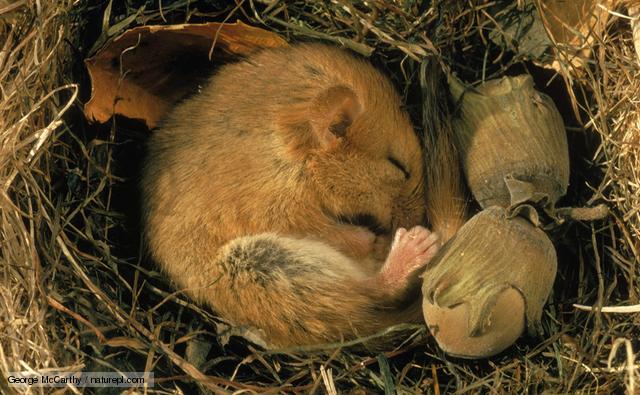
The dormouse in the picture has it about right: sleep with food half your size (hazelnuts, in this case), wake up, snack, pee, then back to sleep again. Drowsing comes much more easily now, especially after daylight savings time has shifted our days and brought evening creeping into the afternoons. With that extra jolt of possible light (this IS November, after all), mornings may be brighter and better, if you’re a morning person, but let 5:00 or 5:30 pm roll around and it feels like late evening already. Then today, with snowfall along the east coast as the winter storm makes its way along the same path Sandy took a short time ago, and you have hibernation mode with a vengeance.
May New York and New Jersey find their hazelnuts, their winter store of energy and life. A prayer to the South, where the people are cold in the dark, and my living breath upon it. A prayer to the west, where the frozen time has come, and my living breath upon it. A prayer to the north, warmer than many places closer to the equator: my living breath upon it. A prayer to the east, with winds cold and damp: my living breath upon it. Let all that breathes move its prayer with each inhalation and exhalation.
/|\ /|\ /|\
Image: dormouse.
Updated 8 Nov ’12
[Part 1 | Part 2 | Part 3 | Part 4 | Part 5 | Part 6 | Part 7 | Part 8 | Part 9]
Crying for vision, I step into the forest. Early twilight cloaks me, and mist cloaks everything else. A shiver stalks my spine. I feel something tread nearby with feet heavy as horses’ hooves, yet subtle and delicate as cloud. How it can be both I don’t know. Something breathes on my neck, though when I spin around I know nothing will show. Yet. I know I can freak myself out — I’ve done it lots of times. This is different. It is not fear, at least not fear as I know it. Instead it comes as joy and awe mixed, like the charge of touching the bark of a towering redwood a thousand years old, or the first glimpse of a landscape wholly remade by a night’s snow — beauty unlooked for, encounter with something awake and vital and ancient that I’m paying attention to at last.
How to explain it? Almost anyone listening would think I’m crazy, when all I can do is say “Look! Don’t you see them?!” as they dance and stalk and whirl themselves all around us both. And all the other person can do is shake his head at me, totally ignoring them as they gaze at him and size him up — perplexed, annoyed, amused, indifferent — depending on their natures. I shrug and turn back to them, watching, listening, enjoying and returning their welcome.
/|\ /|\ /|\
Updated 23 April 2015
When the phone call came, she was standing bent over the kitchen table, up to her elbows in pumpkin innards. A crop of volunteers had sprung up in a poorly-turned compost pile. She thanked Spirit for the gift, leaving wherever she harvested pumpkin a small bundle of dried thyme in exchange.
At the first ring, she looked down at her sticky hands, then out the window. A brief scatter of rain still sparkled on grass and leaves outside the kitchen window. Calls these days were almost always marketers. If it was Jack, she could call him back. They still needed to sort out a few things. But she would not rush the day, nor her mood, over answering the damn phone. She did pause at the third ring. Your worst arguments are with yourself, she remembered hearing. No, let the machine take it. She’d had it since high school, the black plastic housing cracked and duct-taped together. The sexless mechanical recording came on. She turned back to pale orange pulp and slimy seeds, slipped a couple into her mouth to chew, imagined them baked and salted. She waited, half expecting the caller to hang up.
The raspy voice on the machine straightened her back all by itself. Cassie, her father’s baritone said. And paused. Cigarette cough, the same. I want … I’d like to talk with you. She didn’t know how she felt. He’d kicked her out … eleven years ago, it was. They’d talked just twice since then. All that weekend’s worth of argument over a festival she’d been determined to attend. She couldn’t even remember its name.
No more of that Pagan crap in this house, he said, finally. I’m sick of it. You go and you don’t come back. They didn’t yell, at the end. Plenty beforehand. Fine with me, she said. She left about twenty minutes later. Didn’t even slam a door. And that was that. But you could have bottled the acid in the air and scoured steel with it.
I’m in Sacramento now. Oh, my number, it’s … She heard him stumble over it. I hope you’ll call back. Another long pause. As if he could hear her thinking, waiting. Not answering. Not wanting to. Cassie. The tug of her name again. Then a click and brief dial tone. She stared bleakly at the red digital 1 that appeared on the messages screen. How much of life was playback.
Outdoors the sky had darkened again, and her mood with it. She knew she needed to breathe and stand in the open air, to listen to something other than her own thoughts. Once outside, she knelt and rested her palms flat on the grass, to give her anger to the earth, not to carry it. Earth, take what I need no longer, teach through weakness what makes stronger. She breathed through the words, said them again, then a third time. She would call him back this evening. At nine, six o’clock his time. Sacramento. What was he doing there? Well, she could wait to find out.




 A Druid Way