The title comes from a casual workshop comment on the awen with Welsh Druid Kristoffer Hughes at East Coast Gathering a couple years ago. As we take our first steps in this fabulously crazy year of 2020, it’s a superlatively appropriate question to ask.
“May your bridge be a star, and your star a bridge” — Winston-Salem, NC. April ’19
Or to take it for a spin, account for your life in your own way, on your own terms, and you may well see a change — especially if you respond to some of its challenges with mu— that great Zen keyword which in at least some traditions means “un-ask the question”.
Let’s consider for a moment the joys of those being our options: a touch of insanity, or unsurpassed excellence. Make these specifically Druidmadness and marvelousness, and you just might be onto something. Especially if you mix them …
The counsel of a bard — Gerard Manley Hopkins, that blessed fool of Victorian England, writes in “As Kingfishers Catch Fire” (you know you’re near bardic territory with such titles):
Each mortal thing does one thing and the same:
Deals out that being indoors each one dwells;
Selves — goes itself; myself it speaks and spells,
Crying Whát I dó is me: for that I came.
What I do is me … the greatest spell any of us will ever work. Each thing in the universe is dear for its individuality, its singularness. Irreplaceable you.
Now to turn this potent enchantment to a purpose, rather than watch it subside into itself like a melted-down candle. How many of us are quite literally mis-spelled? That is to say, there are definite spells or enchantments in play, but they do not work wholly or even partly for our benefit. The spell is working counter to our purposes. (How many of the knights in Arthurian myth quest nobly for the Grail, and never catch even a glimpse of it? Or to quote author Feenie Ziner, who writes about her son’s quest in the wilderness for a truer vision than 70s America offered him, on any great moral journey, the devil is always a stowaway. We take the mis-spelling right along with us, we yield to almost any spiritual enchantment that comes along, especially if it’s cleverly packaged, and we give it space in our rucksacks and backpacks, a place on our storage shelves.)
So often we can hear other bards answering. They’re in endless conversation with each other, when they’re not sitting stunned after a visit from gods, or mead has simultaneously fired and rewired their inward sight, or a spell of solitude eventually returns them hungry for the magic of simple, daily things — a crackling fire, the wet nose or soft fur of a pet, the comfort of a friend’s presence when nobody needs to say anything at all. And sometimes they talk most when they find themselves right in the middle of these simple things. Because in the end, where else is there?
As the late author, mystic and former priest John O’Donohue puts it in Eternal Echoes*,
Each one of us is alone in the world. It takes great courage to meet the full force of your aloneness. Most of the activity in society is subconsciously designed to quell the voice crying in the wilderness within you. The mystic Thomas a Kempis said that when you go out into the world, you return having lost some of yourself. Until you learn to inhabit your aloneness, the lonely distraction and noise of society will seduce you into false belonging, with which you will only become empty and weary. When you face your aloneness, something begins to happen. Gradually, the sense of bleakness changes into a sense of true belonging. This is a slow and open-ended transition but it is utterly vital in order to come into rhythm with your own individuality. In a sense this is the endless task of finding your true home within your life. It is not narcissistic, for as soon as you rest in the house of your own heart, doors and windows begin to open outwards to the world. No longer on the run from your aloneness, your connections with others become real and creative. You no longer need to covertly scrape affirmation from others or from projects outside yourself. This is slow work; it takes years to bring your mind home.
The work of both Druid and Christian — as it is the work of anyone walking a “path with heart” — is to turn from the “seductions of false belonging”. Christians may call this “the world”, and offer strategies for dealing with it that are specific to their tradition. Such guidelines can be most helpful if, as my teacher likes to say, they’re truly a line to my guide, and not an obstacle to testing and knowing for myself.
More often than not, Druidry simply presents its particular practices and perspectives on living in harmony with nature, trusting that anyone who follows them deeply enough will discover much the same thing. Rather than do’s and don’t’s, it suggests try this out for yourself and see. (Imagine a more directive Druidry, a more experiential Christianity. What could happen?!)
One thing I admire about O’Donohue, and seek in other writers and teachers and traditions, and try to model myself if I can, is never to present a problem or criticize a behavior without also offering at least some strategies for negotiating it. Show me a how— and preferably more than one. A palette of choices.
Here O’Donohue spotlights one of the challenges the human world offers us — the seduction of false belonging, whether spiritual, political, romantic, economic, etc. — and identifies an answering response or strategy of finding our true home, of resting in the house of our own heart, of bringing the mind home.
Now these poetic expressions are lovely and metaphorical — at least until we begin to experience them for ourselves, and find out what they can mean for us. Every human life offers opportunities to do so, though one of the “seductions of false belonging” urges us to discount them, to treat them as idle fantasies, as pipe-dreams, to replace our instincts with advertising slogans. Cynicism about spiritual opportunities abounds, because like so much else, hucksters have sought to monetize them, to profit off our naivete and first attempts to build that true home, to rest in the heart-house. Nothing drives us from such homes like mockery and shame.
Mis-spell me, spell me wrong, and I’ll look everywhere but in a song to tell me what I need to know, where I want to go. Home is the poem I keep writing with my life.
As I’ve mentioned in previous posts, one of my daily go-to practices involves singing the awen, what I’ve also called the “cauldron sound” in Druid terms. Others know it as the hu, the original voice that sings in everything. Hindus call it om, and Christians term it the Word of God, the “amen, the faithful and true witness”. You encounter mention of it in many different traditions around the planet, because it appears to have an objective reality (and that’s something to explore, rather than accept — or reject — dogmatically).
Here’s a short video of Philip Carr-Gomm and Eimear Burke leading a chant of the Irish equivalent imbas: One key is to experiment — find the song, the word, the home that fits. And hermit-crab-like, move when it no longer can house you, or shelter your spirit.
And one Druidic extension of these practices can be to search out and experiment with sounds and voices specific to our individual heart-homes and houses. Our spirit animals can be helpful in this pursuit, alerting us to inward places to visit, and situations to avoid, or plunge into. Or as the Galilean master noted, “In my father’s house are many dwelling-places”.
/|\ /|\ /|\
*O’Donohue, John. Eternal Echoes: Celtic Reflections on Our Yearning to Belong. HarperPerennial, (reprint of 1999 original), 2000.
The source of my omen for Day 12 is you, my readers. In your continued re-reading of my April 2017 post on the Grail Cross (and your silence in response to my requests for feedback!), I find a useful omen for our days ahead: we need both Grail and Cross energies. In the absence of your reasons, I can only supply my own, and that is as it should be.
The Grail Cross is a union of symbols, a conjunction of two traditions, yes — but both celebrating and indicating things much larger than human tradition: the divine not just accessible in nature, right here where we live, here in the flesh, but the same thing, on a different arm of the spiral. If I’m not feeling it, and knowing it, that’s something I can change. How you and I change it will shape much of our experience in this new year. Not politicians, not employers, not partners or celebrities — give away my power to them and they can’t — even with the most loving of intentions — give me what I need, what the world needs. Rightly understood and calibrated, these two needs are one, even as Grail and Cross are a union. Immanent and transcendent, if you need or want those words.
In the Tarot reading in the previous post, the cards for “recent past” and “possible outcome” are both Cups, or Grails. The moon is the Self or significator. Do I really need clearer pointers?
Well, maybe I do. I don’t know about you, but I can be notoriously thick, and slow to understand even when signs, spirits, gods and the weather all point in the same direction. So I look for the final omen of these Omen Days, number 13, on January 6.
sauna photo courtesy BW.
My friend B invites me to share his recently-constructed sauna on Twelfth Night (or Thirteenth Night, in terms of the omens I’ve been taking for this series). We thaw and warm and relax in the cedar space, alternating with brief stands in the evening snow outside, watching the moon that’s full today, feeling our sweat dry, returning when the wind bites cold on our heated bodies.
sauna photo courtesy BW
In this dim, round, warm, womb-like space, we sit and sweat and talk. B has added a few things not shown in this second picture: a tomten stone at the foot of the stove, in honor of the local land spirits, a thermometer near the top of the round interior, a small venting hole and cover to help regulate the temperatures. For most of our hour in and intermittently outside the sauna, the temps hover around 200-210 F / 93-99 C — blissful, exquisite heat, in which the body yields, sweats, unknots, and finally reacquaints itself with what the Finns call löyly — the sauna steam as a celebration of all the elements together, working in concert: fire in the stove, earth in the rocks above it, water ladled from a sauna bucket onto the rocks for the final steam bath, and the steamy air that rises from them. (B is meditatively carving a sauna ladle from cherry wood he found as windfall on his land.)
Three days into the new year, and the omen for Day 10 (3 January) is a Tarot reading I did on the 1st, but put aside for other tasks. But it’s been in my attention to return to it and take another look as I post it here. Third time, or third day in this case, is the charm.
The question I posed for the reading is this: What needs our attention in the coming year?
(In light of everything in play just past the start of this new year, this innocent-seeming question already feels more than over-loaded!) But how much of our task is focus, attention to what matters, without which we scatter and “lay waste our powers”. We can see much of the past decade as a painfully clear illustration of just such a scattering. But also, a gathering and centering in response, as we belatedly come, however imperfectly, to attention.
1. Significator or Self: Moon
2. Cross or cover: 2 of Cups
3. Basis: 7 of Pentacles
4. Recent past: Ace of Cups
5. Possible Outcome: 9 of Cups
6. Near Future: 10 of Pentacles
7. Self: 10 of Wands
8. Environment: Empress
9. Hopes and Fears: Queen of Pentacles
10. Outcome: 6 of Wands
Rather than attempting a point-by-point explication now, I’ll look for an overview I’ll return to and expand on through the coming months, refining and revising my understanding.
For now, then, the Moon:
The true task of the third line [of the Tarot major arcana] is not revelation but bringing that inner ecstasy back to consciousness. The Star [the card preceding Moon] contained no road back. It shows us dwelling in the glories of darkness transformed into light. To use that light, we must pass through distortion and fear.
The Star experience lies beyond words or even form, though it implies forms emerging with the streams of water. In the moon we see this process happening, as visions, myths and images. The Moon is the card of the imagination as it moulds the energy of the Star into shapes that the consciousness can apprehend. — Pollack, Seventy-eight Degrees of Wisdom, pg. 125.
How to “use that light” and “pass through distortion and fear” seems a fitting take on a principal challenge of 2020, and a concise answer to my question for the reading: “What needs our attention in the coming year?” I’ll take up the other cards in coming posts as explications of possible ways to go about this double task.
“Let moon meet answering fire”
DAY 11
For Omen Day 11 (4 January), a late-arriving Christmas card featuring the Star in the East. Sometimes we seek the omen, sometimes it seeks us. They meet in a handshake, an embrace, yin and yang of incarnate experience, with us the conduits, the lightning rods, and the capacitors of what we are pleased to call “our” lives.
Could we but see the whole, these mutual seekings comprise its two halves, yin and yang, which themselves contain the characters for sun and moon. In the character simplification that mainland China pursues, yin 阴 and yang 阳 clearly display their respective elements of 月 moon and 日 sun.
Several Druid orders draw on this ancient understanding and make it a formal part of their training, instructing students to pursue the Sun path and the Moon path, with the third component, the Earth path, the synthesis energized by the interaction of the first two. And in the intermingling of Threes and Fours, those ancient symbols and numerical powers that color much of modern Druidry, we could name four paths: earth, moon, sun and stars. It’s no accident that’s where Dante’s Divine Comedy ends: l’amor che move il sole e l’altre stelle — “the love which moves the sun and the other stars”.
Yesterday, too, the blogpage here on Magic received five views, so the omen feels confirmed — the “messy creativity” of five-star magic.
Christmas … What’s born in us? A magical birth, the Child of Light, image of the being always being born in us as we grow and love, die and are reborn in each moment, so a post on magic, a riff on another’s post from a couple of months ago, comes together here.
The Five Counsels of Magical Living
Use what’s on hand.
The hand — four fingers of the elements, a “fifth” of spirit: the five-pointed star of magic, symbol and potency of spiritual traditions Pagan and Christian both. Always a festival celebrating something both new in the world, and always present — divinity incarnate that we can touch and see and hear. (If this world is not a holy place flush with divinity, what world is?)
For balance, I gather the four elements, ask the blessing of the fifth that is always pouring forth unasked. (The asking helps me focus.) Earth my body, water my blood, yes. Words of the old chant. But earth also in each thing, solid and durable, whether difficult or easy, manifesting itself clearly to the senses, saying I am here. Water in the blood, and in snow, rain, clouds, sky, emotion and imagination, intuition and dream, possibility flowing all around me, saying I am here. Slightly less palpable, but only slightly.
Air my breath, and also the breathing of all things on and around us, wind on my face, speech and thought hastening past, wings across the skin, a hint of vista, and distances covered in a moment by thought fast as any falcon. Air saying I am here.
And fire …
Hallow your space-time.
What is the time? We’re always checking the clock, “reading the time”, parceling out our minutes and hours. But how do we hallow it, make it holy, sacred? Do I know? Where can I find out? It doesn’t happen by itself, except insofar as being here is a holy act on its own. Necessary, beautifully necessary: but not sufficient. We get a “minimum daily requirement” of the sacred, enough to keep us breathing, our hearts beating, and the planet spinning, not enough — without our own efforts — to achieve what we’re here to achieve. Don’t know what this is? Few do, completely. Run it “to earth” as the old hunting metaphor has it — such seeking is part of achieving. It is holy, the space-time of our lives that we and the gods together weave and clothe ourselves with.
Make me ever sky-clad to spirit, so I can know its nearness …
Focus (on) magic that’s already happening.
What’s already happening? Do I know? (Not from headlines, which rarely tell us what’s really happening, only its consequences. We look at mere symptoms and try to divine their causes, rather than starting with causes and working things out from there.)
Kindle a fire from “dead” trees and living flame bursts forth. Draw a breath and this body lives to move us through experience till it kindles, too, with spiritual energy. The awen is always singing. Am I listening? Where do I hear it? How can I listen more? From the deep we all bring it … How and where are we shaping it? In Annwfn, Abred, Gwynfyd, Ceugant? Where will my actions manifest? How can I improve my choosing?
Magic mirrors where my mind is, mortal and immortal merging …
Put words to it.
Name it, whisper my days. The magical journal, the blog, the diary, the impulse to record, to trace the path we’ve taken this far, is a spiritual one, whatever else may lie behind it. A good half of our naming becomes the next charm, the new spell, the in-cantation, where we sing ourselves into the Ancient Song of existence that is always arriving out of silence.
Name it and “hame” it — manifest it. The “hame”, Old English hama, is a covering, the “natural shape” of things, but also — magically — its astral form. In The Lord of the Rings, Gandalf gains the epithet Greyhame or “gray mantle” for the cloak he wears. But even as it cloaks or covers him, manifesting him so that others can perceive him, it also conceals his inner nature as one of the Maiar. He is a “spirit of fire” no less than Feanor.
Words make up the golden thread that links earth and the other worlds. Sound, shape, thought, figures carved in stone or wood, printed in ink, fashioned of electrons on a screen.
Let words hame me, let me hame my words, till I can draw the magic deeper into time and space and assist it to take form. Let the Word become flesh. Resist it, and it will take form anyway, but often a nightmarish one, out of the distortions our creative use of our power to block also makes of it. We see monuments of our mis-making all around us in this present world, to temper our future makings, if we choose to learn.
Aim for and with the hame to tame it, reclaim it, see it in others, the same It.
Renew how you ground.
Unbalanced, we fumble through our hours and lives. Ungrounded, we electrocute ourselves with stress, anger, fear, dis-ease. Without a steadying spiritual practice, how can we stay earthed? We all already have a practice — it’s time to explore it more deeply, draw on it, shift it where it needs shifting, reinforce it where it needs reinforcement, grow it and cherish it.
/|\ /|\ /|\
Pollack, Rachel. Seventy-eight Degrees of Wisdom. Element Books, 1997. (This is an omnibus edition of what were formerly published as two separate volumes.)
Looking for tips on making a radical change in 2020? Here are some actually good ideas from The Guardian, in an article titled “Everyone thought I was mad — how to make a life-changing decision and stick to it” — not the usual “New Year’s Resolutions” clickbait. The 10 strategies it offers are, of course, all (un)common sense, that birthright so many of us abandon under the onslaught of dark-magic* advertising, politics, social media, bad education, lack of imaginative reading, etc. — the soul-less enterprise that infiltrates much of what we call life, but is really a bad substitute, sold and re-sold to us, when the Real Thing is always and forever free.
Yes, Others really do want to exploit our wills for their benefit — one of the good things coming out of our times is how transparently clear that’s finally become to many. And that need not lead us to despair, but can tell us how powerful we really are, or can be, unless and until we listen to numerous forms of bad counsel that run against our own better judgment. Yield too much, and it can take us lifetimes to regain and restore what we gave up. Or you may be a “just-this-one-life-that’s-it” kind of person, but you still see how far too many of us relinquish our sovereignty and holy self-hood to others who deserve it not at all.
Smartest radical change I ever made? Walking away from a teaching job at a private boarding school that included not only a high salary (for a school-teacher), but also health insurance and housing and utilities, but that was also quite literally making me sick (cancer diagnosis in 2009). At one point I was homeless and jobless, too — but alive.
Second smartest change? Marrying my wife, though at the time I was unemployed and broke, and had just returned from an overseas teaching job in Changsha, Hunan Province, China that paid me $250 U.S. per month. The strategies in the article are wise ones — take it from someone who’s made some radical changes in his life, and never regretted those he made (only those he didn’t!).
Third smartest change? Taking that China job I just referred to, though it paid so little. Because it opened doors to all the subsequent jobs I ever had, though I didn’t foresee that at the time. And the perspective of being a foreigner, going deep into another culture as speaking even some of the language can help you do, as well as seeing my country from a distance, from the outside, and as a foreigner myself for a short while after I returned — I can set no price on the profound value of those experiences.
/|\ /|\ /|\
The junco’s for Omen Day 7. Tuesday, on my way to drop off a draft of our labyrinth paper to my hospice client, I spotted a flock of juncos foraging near my car as I exited the community where my client lives. Juncos were such frequent wintertime companions in my childhood in upstate New York that I was pained but not surprised to read how their range has shrunk over 50% in the interim. Below’s an image of the dark-eyed subspecies I saw, clearly featured against the snow. Or as Linnaeus described it in his 18th-century classification, F[ringilla] nigra, ventre albo — “A black finch with white belly”.
What we take for granted is often the most vulnerable, or least permanent: whether it’s democracy, life, health, friendships or a bird, they can all prove equal in their fragility. We forget we are a part of this world, not apart from it. What we do matters, helping to shape the whole we all live in and through.
dark-eyed junco — junco hyemalis
Omen Day 8 didn’t even ask me to leave the house: the sourdough starter we revived for yesterday’s New Year’s Day breakfast of waffles. We’d refrigerated it for several days, and the night before, it was time to revive and feed it, ready it for another meal.
It’s natural to find the cute and furry things amenable to a nice, safe middle-class Druidry. But the prickly, grotesque, dangerous, or simply odd and invisible ones? Not so much. All praise, then, to the lactobacillus that gives all things sourdough their tangy character, and thrives together with us in our bodies all our lives, strengthening, healing and rebalancing so many of our essential biological systems! Three hurrahs for such mutualism!
Let me find ways, o Spirit of 2020, to be more surprised, and less fearful, more grateful, and less suspicious.
/|\ /|\ /|\
One of the traditional practices for the Omen Days is to go outdoors, close your eyes, spin yourself around, and take the omen from the first thing you see when you re-open your eyes. But of course there are many ways to read the cosmos. I’ve done it with dreams, with the “obvious/non-obvious” thing immediately underfoot, and so on. For me the deeper point of taking an omen is to pay attention, to actually attend to what I may have overlooked, to begin to explore the richness of the supposedly ordinary and everyday. If I’ve expanded where I look, noticed more of the daily amazement of living that offers itself to all of us, I count that omen a successful one.
Omen Day 9, looking for your sign, I finally see it.
Going out to the woodpile, I participate in its manifestation, by being alive, in this place, here, now. A log, the heartwood brown and rough. Nothing “special”, perhaps, but beauty, given freely. That counts in my book as “special”. I bring it indoors, the condensation damp on my hands, and set it on a side table to photograph. In the picture it looks like the lampshade’s growing out of the wood — fittingly enough: firewood, a source of heat and light.
/|\ /|\ /|\
Another bard offering words — William Stafford’s “The Dream Of Now”. This isn’t an expansive poem of the summer solstice, exulting in long days and heat and passion, but a poem about that core toughness in us, that sees us through winter along with all the other things fluffing out feathers and fur against the cold, or sleeping deep in the Earth till she warms again.
When you wake to the dream of now
from night and its other dream,
you carry day out of the dark
like a flame.
When spring comes north and flowers
unfold from earth and its even sleep,
you lift summer on with your breath
lest it be lost ever so deep.
Your life you live by the light you find
and follow it on as well as you can,
carrying through darkness wherever you go
your one little fire that will start again.
*dark-magic: magic that doesn’t let our own light in; magic practiced against our own better interests, something we almost always participate in, because our consent is required, until we notice and begin to wake up again. Always weaker than light-magic, though its power comes from convincing us otherwise by whatever means available: deceit, obscurity, false promises, appeals to our weaknesses (cleverly scouted out in advance) … Another reason to learn and practice magic: absolutely everyone and everything else all around us already practices it.
Two nights ago, I turned to look at the clock on my nightstand, the pale phosphorescent numbers showing almost 2:00 am. Then I heard my wife moving in the hall outside the bedroom.
What is it? I asked.
The stars woke me up, she said.
A little shiver, of awe and pleasure both, at those words. And yes, with a few steps across the kitchen toward our boots, and quiet laughter as we stumbled out the front door to look, the clear night sky above us flamed with stars. So many cities now glow with light pollution at night that you can no longer look up and see the stars. How helpful the present darkness, for seeing the splendor of the light.
(Here for my daily augury I take up a typo from an earlier draft of this post — I’d quoted Aleister Crowley’s famous line from his Book of the Law (1), but with one additional letter at the end: “Every man and woman is a start”. I laughed a good while over that one. Yes, I’m a beginning, a work in progress, raw materials like all of us are. So just keep going, says Spirit.)
/|\ /|\ /|\
Year-end storms brush much of the U.S. this week. The northeast is seeing sleet and ice, rain and snow for a couple of days, leaving roads treacherous. Some New Hampshire friends have taken to heart the Icelandic tradition of Jólabókaflóð — literally, “Yule-book-flood”, and have provided themselves with ample reading material for whatever the weather brings.
outside our front door this morning
“Wind and ice are the only deciders of symmetry”, writes upstate New York poet Linda Allardt (2). “Survival makes do for grace”. Some winter days, especially in a northern climate, you can feel the truth of that right down into your bones.
The Galilean Master tried to teach “spiritual meteorology” to his followers: “When it is evening, you say, ‘It will be fair weather, for the sky is red.’ And in the morning, ‘There will be a storm today, for the sky is red and threatening.’ Do you know how to discern the appearance of the sky, but cannot discern the signs of the times?” (3). I religiously check “the weather” each morning, but too often ignore my “spiritual climate”, which includes our physical one. The analogy hits home: weather is to climate, as mood is to spiritual climate. The former changes day by day, while the latter’s a long-term trend.
[For what I’ve come to understand, over a decade of study, is a fairly accurate projection of our climate future, take a look at articles like this one in The Guardian: “The Climate Crisis in 2050: What Happens if Cities Act but Nations Don’t” . Rather than pure depressing statistics, it reflects and extrapolates from the present reality, as the subheading names it, that “It is cities, not national governments, that are most aggressively fighting the climate crisis”. And if you’re still too optimistic, this second article can really help cure that.
I don’t know about you, but for me clear vision is preferable to hysteria and paranoia any day. This one possible future may indeed be grim, but there’s room for human hands and hearts to shape its form and direction, and avert its worst features, as we’re beginning to do, albeit in fits and starts. And as a strong believer in reincarnation, I suspect I’ll likely be back again in the middle of it, dealing with it as best I can, along with a good number of others alive today. From this perspective, it’s good to start equipping myself now with the spiritual tools I’ll need to work with then.]
So there you have it. I’ve written a post that has Jesus, Aleister Crowley, and climate change in it, and it sorta kinda maybe even coheres.
Groundhog, whistle-pig, moonack (derived from a Native American name), or French Canadian siffleux (“whistler”) — as I take more firewood from the stack, I’ve found our backyard woodchuck has again taken shelter for the winter in a burrow between our woodpile rows. It makes good animal sense: until I started taking the wood away for fires, the burrow mouth was protected, and tin sheets still partially shield both wood and burrow from snow and rain.
woodchuck — marmota monax — Wikipedia
The woodchuck enjoys a regional claim-to-fame in the U.S. as “Punxsatawney Phil” and indeed has a brief cameo in the ’93 Bill Murray/Andie MacDowell comedy, Groundhog Day.
(We can detect in the February 2 Groundhog Day — no surprise — echoes of older celebrations like Imbolc. The harsher winters in North America merely postpone the coming of spring that the European holiday anticipates, until late March at the earliest, at least in New England. Animal divination!! The groundhog’s “prediction” of early spring or more winter depends, after all, on sunlight: if it’s sunny and he sees his shadow — only his “priests” know for sure — that means, paradoxically, six more weeks of winter.)
When our next-door neighbor dug a new in-ground septic tank over a year ago, things reached a tipping point that made “his” marmota monax leave home in search of a better life. The journey didn’t demand much — no long treks for the plucky immigrant who would ultimately set down roots in a strange new land. Instead, just a quick run under the property line fence, and voila! Our handy clover patch no doubt also played a savory role — we saw him — them? — off and on this past summer in the thick of it, grazing quite contentedly, bees humming all around in the clover flowers.
Last winter I discovered him burrowed in under the first row of the woodpile. By the time spring came, and I’d cleared away the logs and knew he was out, I drove a log firmly into the mouth of the burrow. (I absolutely refuse to use the smoke bombs that poison both animal and soil. Have-a-heart traps may be the next option.) Sure enough, un-dissuaded, he dug a new hole in June, this time right along the east-facing foundation of our house. When I stuffed a log into the mouth of that hole, he dug around it. I added another log. Then when I didn’t see him for a while, I thought my harassment campaign had paid off, and maybe he’d finally crossed the road, where there’s some prime woodchuck real estate that could be his for the taking. A neighboring farmer mows the open, level 5-acre meadow bordered by woods just once a summer, and otherwise it lies fallow, undisturbed.
Hard to see, but dirt between the log rows comes from the enlarged burrow
But there’s the roof of his winter burrow, with its mouth one row deeper into the woodpile. Part of me rejoices at his resilience, even as I plan anew how to see him off, once warmer weather arrives. All this, of course, while another part of me ponders whether this is indeed the unsubtle arrival of a new animal guide, upping hiscampaign to grab the attention of this torpid and obtuse human.
In the guise of a woodchuck, a delightful link exists between Frost and Thoreau, those two quintessential New England bards. A wry Colby Quarterly article, “Two Woodchucks, or Frost and Thoreau and the Art of the Burrow” , exhibits good Druidic sensibility in exploring that link. Regardless of whether the article author actually follows through on his own insights, they remain for readers. To make a cellar for his cabin at Walden Pond, Thoreau enlarged a woodchuck’s burrow, trusting the beast had dug deep enough, beneath the frost line. Here the “Two Woodchucks” author cites Thoreau’s sense of the need to dig down both literally and metaphorically to find out the truth of things:
In order to find this reality, we must first “settle ourselves,” establish a sense of place, a living connection with the landscape. Then we must “work and wedge our feet downward,” in woodchuck fashion, “through the mud and slush of opinion, and prejudice, and tradition, and delusion, and appearance, that alluvion [alluvium] which covers the globe”.
I read as I draft this post that the woodchuck can nearly double its weight as it gorges each autumn to store up fat for hibernation. The average burrow, with between two and eight mouths, requires the removal of 500 lbs / 225 kilos of dirt. Sure enough, it often digs a separate winter burrow, much deeper than its summer quarters. Though at need the woodchuck can climb trees to escape predators, and typically retreats to its burrow rather than fight, when cornered, the sturdy beast has claws and sharp incisors to defend itself. Their range spans from Georgia to Minnesota and New England, north as far as Newfoundland, and west across the Canadian plains into Alaska. Study almost any creature, and you begin to see its adaptations to its specific life-path emerging as something quite remarkable.
Boar, pillbug, woodchuck — the teachings of animal encounters to guide this Druid, if he only listens, through his days.
No need this morning to look far for what first strikes the eye: fog outside, and a window-screen in the foreground. As with our own human consciousness, what’s up front and in our faces draws the camera’s auto-focus to the screen, in spite of one shot (in a series of attempts) where I thought I’d finally gotten the camera to focus on distance. Probably could have, too, if I knew my camera better. When the human eye focuses on distance, the screen blurs and fades. Right there is a whole chapter of spiritual practice, attention and mechanical behaviors. Where’s my focus? What am I looking at? I decided the indoors version with the foregrounded window screen should stay — it was still offering something to think about further.
Fog-weaving, and awareness. With temps well above freezing, and enough snow to melt and turn to low-hanging mist, it was a perfect day to drive in and out of banks of fog as the elevation changes in our Vermont hills. Often it’s easy to slip into altered states of consciousness, walking a fogged-in landscape. Driving through one, it’s much less safe to try!
About a year and a half back, I wrote about fogweaving with Lugh while climbing our local Mt. Ascutney:
Fog-weaving at such times needs so little effort. The climb quickens the breath, and the cool air is lush with oxygen. Without the chatter of any human companion as a distraction, and with the fog collapsing the field of vision to just a few dozen yards in any direction, your attention narrows in on step after deliberate step. Light trance comes on like cloud itself. Without thought you can slip through to the “realm next door” between one step and the next, and you may sense the god dreaming on the peak. And rather than needing human action or imagination to weave or conjure vision, the fog itself curtains or reveals what is already there.
Awareness is a tricky thing: we move each day into and out of so many different kinds of awareness that we often don’t notice they’re best for different purposes — they’re most definitely not interchangeable. Or as I try to explain this phenomenon in the page on Magic:
… each day we all experience many differing states of consciousness, moving from deep sleep to REM sleep to dream to waking, to daydream, to focused awareness and back again. We make these transitions naturally and usually effortlessly — so effortlessly we usually do not notice or comment on them. But they serve different purposes: what we cannot do in one state, we can often do easily in another. The flying dream is not the focus on making a hole in one, nor is it the light trance of daydream, nor the careful math calculation. And further, what we ordinarily do quite mechanically and often without awareness, we can learn to do consciously.
With the tickle of a dream the previous night to set the tone, I woke with another dream in my head early this morning: I have a son who’s seeking me out.
(In the category of “too much info” but helpful context: it’s even possible such a child exists. My graduate school girlfriend turned down my marriage proposal, warned me she’d never tell me even if it turned out she was pregnant, and on that note I opted to leave the U.S. and the whole intolerable situation in the fall of 1987 to teach in China. We haven’t been in contact since. So — to cut short any further confessions — I woke this morning wondering, yet again, what the dream could be saying.)
Looking up close, I see screen. Focusing on the distance, I see fog. Where’s my focus?What am I looking at?
A dream this morning. I haven’t been sleeping well for the past several days, but with that wakefulness, it’s been easier to catch and record dreams before they fade into the next sleep cycle of the night. In the dream I’m trying to cross a stream flowing through a forest, but it takes me a bit until I find stepping stones, and even then, the first one’s half-submerged. The stream’s neither wide nor deep, but for some reason in the dream I don’t want to get my feet wet. The water runs very clear, and I know in the dream there’s something — what it is I can’t tell — something unusual about the forest.
Then this morning as I’m going out to fetch wood for the two fires, house and studio, I need to start: hornet’s nest on the eaves of the woodshed. I wasn’t thinking about this Omen Days practice until almost the moment I looked up, and then there it was. A nest of gray paper, empty now, but mostly intact, a season’s work to build a growing house that entomologists say the hornets almost never return to for the following year. In the photo everything’s shades of gray, though it’s a color shot: even the evergreen in the background comes across in black and white, rather than green.
Now it’s certainly easy enough to argue yourself out of as well as into a divination. There’s a kind of trust involved, that the universe really does talk to us, and not just through such crabbed and sometimes tortuous means as a divination can be, or as we can make it with all our second-guessing — the cosmos talking constantly, ceaselessly — wind in the trees, birds, beasts, clouds, our own skins, those touch-points where we seem to end and Everything Else begins, though we intermingle like high school students at a formal dance, awkwardly sometimes, though sometimes with heat in our blood. “How can we tell the dancer from the dance?”
Crossing a stream, leaving a house: like most signs and symbols, they mean best when they “mean personal”. You could, I suppose, go look them up in a symbol dictionary, the kind that sells for a couple of bucks in the checkout line at the grocery, or a pricier version summoned from deep in the bowels of Amazon. But why would I want somebody else’s take on what is, after all, mylife? I’m not mocking the impulse, only reining it in. Live a few decades, and your own hand-made symbol dictionary is better, for you, than anyone’s.
Like any good mount, a dream-interpretation horse, or a symbol-horse, needs a sensible rider, or what use is riding at all? I might as well walk. I can, it’s true, just let the animal-self roam free, and there are excellent times and places for that, too. (Take your animal guide for a run, if you haven’t done so recently. Mine’s sure eager for it.) But right now the journey asks the best of both of us, and so I ride my symbol-horse, and my horse carries me. Leaving a house can signify death, but just as important, transformation, and growth: the hermit-crab outgrowing the old shell and moving into a newer one — vulnerable during the change, true, but doing what it does, what it needs to do to live at all. And where is it, specifically, that I don’t want to “get my feet wet”? That’s sure kindling for another dream, another divination, a prayer, especially when I don’t usually pray.
Finding stepping-stones to cross a stream: earlier in the day yesterday, I’d done a tarot divination as a way to gain insight into a character for a novel I’m working on. The significator was the Wheel of Fortune — apt for the antagonist, who’s experimenting outright on his life — as we all are. And for such symbols and signs and communications — since I mentioned Dickens in the previous post, then I’ll invite him, since it looks like he’s along for the ride anyway — we can ask Scrooge’s question in A Christmas Carol: “Are these the shadows of the things that Will be, or are they shadows of the things that May be only?”
As with most divinations, if we think we’re asking a question of the future, then we get what we understand to be the future’s answer, which may be useful or not, or hard to read, or no answer at all. Scrooge has met with “ghosts” or spirits of Past, Present and Future, and not one of this Temporal Triad is the sole determining factor. Scrooge himself is. In his experience, the future gives no “answers”, but shows the shadows of things that are even now taking shape. These, in turn, interact with all the Ancestors have left us, and set in our hands for an inheritance.
/|\ /|\ /|\
This picture from a couple of days ago, looking out across the stone in our yard, reveals ice-sparkle I couldn’t see without the zoom that focuses this image. To the naked eye it’s a general glow. But this is hawk’s view, more sharp-eyed than I am unaided, without the help of lenses and devices — our human-craft. A different kind of divination, like the signs and symbols available when we look with a microscope, or telescope, or listen with a telephone, or stand in ritual and attend to those without skin on who just might have something to say to those of us wearing it for the moment. Look differently, and see anew. Every sense whispers “Try this”.
Earlier today my co-admin Steve on the Druid and Christianity Facebook group posted this link to one of Caitlin Matthews’ blogposts from several years back about “Omen Days” — the southern Celtic (Wales and Brittany) tradition of using the Twelve Days of Christmas for divination. As an intercalary period, one literally “between the calendar(s)”, from Christmas to Twelfth Night or Epiphany on January 6, the days have long been considered “time out of time”, and therefore especially apt for such practices. Like the holy space of a ritual, set aside from ordinary time, the Twelve Days are — or can be — magical.
In some versions of the divination, each day aligns with one month of the year: December 26th with January, December 27th with February, and so on, offering a particular flavor to the practice.
Looking, too, for a link between solar and lunar calendars, it seemed fitting to me to make it 13 days, starting on Christmas Day, rather than just 12 by starting the day-count after, on the 26th. But there is a new moon on the 26th this year, and that can play into any decision.
And when we consider that this period after the solstice is a liminal one, open as at Samhain to the Ancestors and the spiritual realm, it’s worth reflecting on Dickens’ choice to set his “sacred holiday ghost story” of A Christmas Carol during this interval, with its Druidic as well as Christian series of three spirits, and we can enjoy as well such a context for other stories, like those of the Wild Hunt, active in the winter and so around Yule, and the Medieval “Day of Misrule”, the inversion of “normal” order, on Twelfth Night itself.
In the same post, Matthews mentions dvoverie, a Russian word meaning dvo “two” ver–ie “faiths” — or holding “two beliefs”, a word to describe the persistence of an old worldview after the arrival of a new one. (The Russian ver– is cognate with our Latin-derived verity — “truth”. Two truths for one.)
For a while this cultural expression was thought to characterize or be unique to Russia, especially prevalent among folk practices. Think of our ongoing custom of treating the sun as if it rises and sets each day, in spite of astronomical awareness that it’s the earth that moves, not the sun. Though this source go so far as to call dvoverie “an academic myth”, as if dismissing something as a “myth” makes it untrue, rather than simply ahistorical, I’d argue we’re all quite “dvoverian”, and in more ways than we might imagine.
In some Christian circles, it’s true, the lament persists that certain symbols, practices and beliefs are “Pagan”, “not Biblical”, etc. Pagans sometimes return the favor. (Personally, I find such “purity tests” too often lead to sub-optimal results, just like they do for many women today in only slightly different circumstances, and for often similar reasons.) I’d prefer to ask those symbols, practices and beliefs: “Are you worthwhile? Do you grant insight, increase our understanding, grow our capacity for gratitude and love?”
(And lest we too quickly conclude that divination is never a Christian practice, we have only to look at the Apostles drawing lots in order to identify Matthias as a replacement for Judas Iscariot in the Book of Acts, or at ancient practices in Israel. St. Thomas Aquinas among many others exercised himself on the topic in his Summa Theologica.)
Let’s make Omen Days a “dvoverian” experiment.
/|\ /|\ /|\
My divination today follows the practice of asking my question outdoors, then spinning around eyes closed, opening them to the first thing seen, or asking the question indoors and then going outdoors to observe whatever offers itself. In either case, the sign or omen is what first comes to the attention.
“What can these divinations teach me?”
For me it was jet-trail and birdsong — the seen and the heard at the same time. I looked up to see the jet-trail, and then I became aware of the song. The trail had no sound, the song no visible bird. A useful reminder that a single sense rarely provides all the evidence, or any kind of “complete picture” (note the bias toward the visual in such expressions!).
If you live in an urban area near an airport, of course, this may prove no omen at all for you. (That’s why omens are not universal signs, in spite of our best attempts to codify the cosmos.) But in southern Vermont, a plane of any size passing over is unusual. Except for June or July, when the nearest airbase sometimes makes training runs for days at a time over Vermont (and usually seems to halt each time the complaints reach a certain threshold), a flyover merits attention.
The birdsong belonged to a song sparrow, a very common bird, a cheery voice for our northern winters. No, it wasn’t a Raven, or some other bird with mythic weight and portent to weigh down an omen till it crumbles under its own gravity. If I want to push it even a little, I might recall the Gospel verse: “Are not two sparrows sold for a penny? Yet not one of them will fall to the ground outside your Father’s care”.
Here’s a Youtube video of a song sparrow in our neighboring state of New York:
The worlds of human (jet) and animal (bird) need not be opposed, and aren’t at heart separate worlds at all, in spite of our unwise attempts to uphold such a false division. The Song all around and within us keeps rising, in spite of our jet-trails, in spite of our restlessness to be somewhere else other than where we are. We hear it. How can we heed it more fully?
2020: jet-trail and birdsong — a divination of our times.
Much of what I write here is inward-facing. Writing’s a core component of my spiritual practice. For me it’s a vital means of discovery, of turning over an experience or perspective until — often enough to keep me going — it falls into place, takes on a new aspect once it gets put in words, gains a solidity or heft that lets me examine it more clearly, or links up with daily events, the weather, the experience of wearing skin, conversations, dreams, things Others are communicating as they go about their varied lives. Words through these short days and long nights, words that at least sometimes prove useful to you as well, a solstice gift.
to the west, across the road from our living room window
Tonight my wife and I included among our celebrations of Solstice one event we’ve attended for several years running. A local church hosts ‘Into the Silence’, inviting a duo called Coracle to play Celtic-themed music and recorded natural soundscapes like whale-calls, birdsong, coyotes, or — like tonight — “owls with sleet falling”. The music alternates with periods of silence. There’s no introduction or closing, no announcements, in fact no human voices at all, beyond a few whispers, and some creaks from the wooden pews, velcro fasteners and zippers opening as participants settle in. The only illumination comes from a score of candles on the altar that a congregant lights at the beginning, and from a solitary Christmas tree trimmed with tiny white bulbs. In some ways it’s ideal “Druid Church”. The possibility of spiritual encounter feels larger without words.
/|\ /|\ /|\
Now that my wife has finally recovered from a bout of food poisoning, she’s back in her weaving studio. This morning when I went out to start a fire there, the thermometer on the wall read 29 F / -2 C. Considering the last few nights have been below 0 F / -18 C, that’s heartening. It also turned out to be a sunny day, which helped the stove to get indoor temps up to a more comfortable range, so she could work for some hours on her warp.
The pleasure of kindling a fire in the house each day all winter, with a second one in the studio some days, sweeping ash, chopping wood, never diminishes for me. Yes, some mornings like this one, I’m shivering as I begin it, and sometimes the wood takes a while longer than usual to lift the stoves into the most efficient zone where they can burn hot and clean, but the work itself answers the effort. (If you only let her, Brighid blesses it.) As Thoreau quips in Walden,
Every man looks at his wood-pile with a kind of affection. I love to have mine before my window, and the more chips the better to remind me of my pleasing work. I had an old axe which nobody claimed, with which by spells in winter days, on the sunny side of the house, I played about the stumps which I had got out of my bean-field. As my driver prophesied when I was plowing, they warmed me twice—once while I was splitting them, and again when they were on the fire, so that no fuel could give out more heat.
Warmth, a direct connection between labor and result, recovery from illness, sunlight, outside air and snow both cold and dry enough that the coverlet of white powders off when I bang each log against the pile. Pleasures of solstice — gifts, all of them. And when we returned an hour ago from the solstice celebration of music and silence, a sky dotted with the distant fires of stars.
If we change just one of F. Scott Fitzgerald’s words (“longest”) in The Great Gatsby, he has Daisy Buchanan, that quintessential summer person, exclaim, “Do you always watch for the shortest day of the year and then miss it? I always watch for the shortest day of the year and then miss it”. (Those of you in the southern hemisphere can take your Gatsby solstice straight up, summery, and un-revised.)
Because the “Great Eight” festivals of the calendar are worth remembering, let’s not “miss it”, but watch and celebrate the shortest day.
A day the whole planet shapes is one of the gifts of solstice.
Older festivals, and revived ones, acknowledge the otherworldly aspect of the season. The central European tradition of Krampus as the alter ego and companion of St. Nicholas balances the season with a parade of gruesome and frightening figures.
Likewise, the Welsh custom of wassailing with Mari Lwyd, the “Grey Mare”, is equal parts festive and otherworldly. Here’s one of the traditional Welsh songs, “Mari Lwyd”, by Carreg Lafar:
The first lines announce the wassailers:
Here we come
Dear friends
To ask permission to sing …
And here’s a very impromptu and lively short clip of outdoor singers and answering singers indoors:
We can say that such human responses to the seasonal change are another gift of the solstice.
The third gift is the monuments that cultures and civilizations have built worldwide to mark and commemorate the seasons — especially the solstices and equinoxes. Standing stone complexes like Stonehenge, menhirs, passage tombs like Newgrange, earthworks like Serpent Mound, and so on all celebrate and commemorate a planetary event many have long recognized as significant.
Here’s a 2013 video of the creation and lighting of a labyrinth made from 2500 tea-lights at the Holy Cross Church in Frankfurt am Main, Germany:
I’ve found there’s so often a link between “finding something to write about” and paying attention to whatever might be my spiritual “work of the day”. Start with one, and the other follows you like a stray, till you take it home and make it a member of your household.
These things circle back on themselves, or more accurately — like so much else — they spiral. They’re not exactly the same each time they reappear, because we’re not the same. No point in a lesson about something I’ve mastered, when there’s so much else a dream could tackle. (Yes, I’m a big believer that our dreams are intelligent and insightful, in spite of our best efforts to ignore them — maybe because we try to ignore them.)
I had a recurring dream throughout my 20s of being back in high school. This kind of thing — a dream-revisiting of a supposedly finished part of our lives — isn’t uncommon. (The worlds interweave much more than we often understand.) Even in the dreams, I often felt blocked, frustrated, sometimes knowing I’d already graduated, but was back because of unfinished business. Sometimes I recognized other people in the dreams, sometimes not.
I kept asking for clarity and resolution, and eventually I did “go back to high school”: I taught in one for a decade and a half. The dreams stopped shortly before the job offer came through: I finally graduated in one dream, years older than my dream classmates. Even in the dream I felt a vast sense of relief.
I’ve come to see that the past wasn’t the only thing I had to deal with. The dreams were offering preparation for the future, too. But it took re-reading of my dream journals from that period to make these connections, the shifting patterns of dozens of high school dreams, to understand part at least of what was happening.
The title of this post, “Winning the Dream”, is partly to point out (to myself, as much as anybody) how badly “winning” fits either our dreaming or waking selves. We dream the same way we live, not to beat off all competitors (though up to a point anyone can pursue this interesting but ultimately exhausting set of life choices), but because we’re here, and this is what we do. To live, to dream, with the awen thrumming in your blood is an amazing, daunting, humbling, unmissable thing.
/|\ /|\ /|\
Sometimes, the best transition is no transition at all. One minute you’re asleep, the next you’re awake. My dream, and my life, both leave it to me to figure out.
I suspect — one of my favorite words (rather than “believe”) — that awen is the link here — awen and genius. To work with these two (the same thing?) is to be what the Welsh call an awenydd (ah-WEHN-eeth) — one in touch with spirit: “Spirit energy in flow is the essence of life”, as Emma Restall Orr puts it in Living Druidry (Piatkus Books, 2004).
/|\ /|\ /|\
Genius. Funny word, much changed from its early sense compared to how we commonly use it these days.
Here’s a sample of the older usage, from Dickens’ A Christmas Carol. Scrooge is walking home in the evening shortly before Christmas:
The yard was so dark that even Scrooge, who knew its every stone, was fain to grope with his hands. The fog and frost so hung about the black old gateway of the house, that it seemed as if the Genius of the Weather sat in mournful meditation on the threshold.
In such older usage we hear something of the Latin origin of the word — genius as “spirit”, as in genius loci, or “spirit of place”. Places, families, individuals each had their associated genius or spirit. (Nowadays we might be more likely to say “atmosphere”, or “vibe”.) From there the meaning of genius grew to include a person connected to an especially impressive spirit — one way others could explain a person of exceptional talents, gifts, virtuosity, or unusual ability. Genius came to mean “great talent”: She’s a genius in the lab. And now it’s also an adjective, common in memes and advertising: Try this genius solution to all your storage challenges!
But if you and I and everybody else enjoys an associated genius, we might be wise to check in first with the genius each of us has, rather than chasing after ones that aren’t native to us. (In fact, as I look at my life, I could well characterize most of its events as a study in either chasing non-native genius, or checking in with native genius.)
Different traditions give the genius a frequently confusing range of names — guardian angels, daemons, jinn, and so on. Some of the more polarized traditions may label the spirits of other traditions as unequivocably evil, though they often viewed their own entities as a much more mixed bag. Acceptable former gods become saints, and vice-versa, while others get tarred with the label devils. (A god or goddess survives if they can ride such changes over centuries and millennia, and work creatively with openings when they arrive.)
/|\ /|\ /|\
Yesterday morning the hospice client I work with (scroll down to section 4 at the link, if you’re interested) was talking again about labyrinths as spiritual tools, and remarked, “You can only access the wisdom of place if you know the place you’re in”. Everything we experience is real, you might say, putting it another way. We just need to determine which world it’s real in. It doesn’t fit here? Change the this-here to other-here and it just might snap into place, complete the puzzle, fill in the mozaic, carry the melody to its close.
Know the place, know the person, and you know a great deal about the genius, or governing spirit.
In many ways, then, “winning the dream” means know the genius of whatever you’re doing, where you’re at, what you’re into.
Five questions for sussing out genius:
1) What spirit is driving it? Is it something familiar, something I’ve worked with before? Or something new? A song came through last fall, and I don’t do songs. But maybe that’s the point: it’s time to start singing. A new way spirit is striving to get through, to express what it is, what I am. Or I’m thrown in with people I normally wouldn’t talk with, because we don’t seem to have anything in common. Well, you’re both breathing, right? You share 95% of what’s happened ever since you both started with that in-breath, out-breath thing you’re both doing. The rest, as they say, is mere details.
I stopped off this last Monday for a one-time hospice volunteer respite-visit for the family of a neighborhood 92-year old. They had medical appointments themselves, and volunteers give them precious time away, knowing someone is staying with the family member.
His hearing is still pretty good, though his eyesight means he himself can’t read any more. But nine decades means you’ve seen a good deal. I read a little to him, and we talked. What you “read” at 92 is different than at 20 — but no less valid. As the body wears down, you’re already prepping for the transition, the next rung of the spiral. You can see it in his eyes, sharp and bright as any bird’s. He’s still taking it all in, alert to the surprise of the ordinary, as much as anything else: the taste of his lunch, the warmth of the nearby woodstove (they set his bed just a few feet away), the fall of clumps of snow melting from the roof as the temperature climbed well above freezing — to be here at all, to wear this body, even with its aches and pains, defeats and deficits. Sitting and talking with him, it feels like he’s mastered the skill of being present.
2. What apparent opposites are in play? Spirit so often manifests this way. Polarities set the stage, define the players of the game, map out a particular curve on the spiral, mediate energies at work in the situation. Identify with one or the other, and I may lose sight of the overall dynamic, where it’s actually going, and define myself solely by opposition or resistance. Which may well be the point, or it may completely miss it, depending … But do I know? Have I seen what’s in play, at play, what the drama is today?
3. What’s the flow? Polarities may set the charge moving, but it’s our presence that mediates spirit, that determines what flows toward and away from us. Taoism is a wise study of this particular aspect of being alive, and has much to teach about riding the currents, sailing where we need to go, surfing the waves of the cosmos as they manifest in the weather, the Others in our lives, the kiss of a dog’s nose, the aroma of cooking, the punch of cold air when I open the door to December.
4. What’s the form? The flow arrives into forms and beings, walls and doorways, shaped by awen and wyrd and choice and momentum. Form is a becoming, rather than anything like an endpoint. In worlds of time and space, form is “re-forming” constantly, whether on a slow scale of millennia, like a mountain, or much more rapidly, as in the stages of the life of a mayfly. Do I recognize the forms with and around me, and what energies are arriving through them? Have I included myself as one of those forms? (Exempt myself and I miss a good half of whatever’s going on, what it’s saying to me.)
5. What’s the alignment? What things are being adjusted, modified, “edited”, re-formed, and then opened up again to Spirit? (The cycle begins again, the spiral reforms on a different harmonic.) Where and how — and when? — can I join in, do my part, make a play, run with it?
Beckett, John. Paganism in Depth: A Polytheist Approach. Woodbury, MN: Llewellyn Publications, 2019.
If you’re “new-ish” to Druidry, Paganism, etc., and you’re looking for a pocket definition of what all this stuff is, what it entails, what at heart it’s doing on the scene, here’s another Pagan and Druid writer, J. M. Greer, with a definition that works for many:
Above all else, Druidry means following a spiritual path rooted in the green Earth … It means embracing an experiential approach to religious questions, one that abandons rigid belief systems in favor of inner development and individual contact with the realms of nature and spirit (Druidry – A Green Way of Wisdom).
/|\ /|\ /|\
Like his first book, The Path of Paganism: An Experience-Based Guide to Modern Pagan Practice (Llewellyn, 2017), this second book by John Beckett delivers on its title. I’m repeating here my preface to that review:
John is a fellow OBOD Druid. We’ve met at several OBOD Gatherings, and I’ve gratefully used and credited his excellent photos in several previous posts here. We’ve talked on occasion, but I don’t know him well, except as a reader of his excellent blog. I participated in his moving Cernunnos rite at East Coast Gathering several years ago.
Usually I only review books I feel I can discuss insightfully and enthusiastically: The Path of Paganism certainly qualifies. I’m adding this personal note as brief background and for completeness.
John’s Dedication page to this new book makes subtle and far-reaching points:
For those who serve their gods and communities when it’s easy and when it’s hard, who take their Paganism ever deeper even when there’s no map, and who trust their own senses when encountering things that some say cannot be: you are building something sacred and beautiful. This book is dedicated to you.
I don’t “do Druidry” primarily as a polytheist — in spite of what you might conclude, at least on the basis of my previous post about Thecu, and intermittent posts over time about Brighid, whom I listen to most closely, as triple goddess of healing, smithcraft and poetry. But I find much of value in this book, just as I did in John’s previous one. As John remarks about the “big tent” of Paganism, there’s room for a wide range of belief, because it’s practice that binds us together, and a well of common experiences.
“dragon-stone”, Mt. Ascutney, August ’19
Go deeper, “where there are no maps”, and you learn even more deeply to trust what’s true — that is, what bears out that initial quality in your subsequent lived experience. Inner guidance proves valid, insights bear fruit, spiritual help clears the way to good things. There’s “troth” there — all those lovely older English words are clearly linked (and likely sprung from the same root as Druid, the initial d- regularly softened to t- in Germanic languages like English*) — something we can trust, solid as a tree, because of its inherent truth, so that we can form abiding relationships — multiple troths (as in betrothed) — with other beings and places where it manifests. These things quite literally “come true” — they arrive with a particular quality or atmosphere we learn to greet with joy, and to cherish, out of previous experiences with them.
As John perceptively notes:
Our mainstream culture talks about “having faith” that everything will work out OK even if we have no reason to expect it will. Pagans aren’t big on that kind of faith … There is a very utilitarian ethic to spiritual practice: do the work and you get the benefits. Don’t do the work and you won’t. Oftentimes the gods are gracious and give us things we have not earned. Their generosity is a virtue we would do well to emulate. But some things cannot be given, only obtained through sustained effort. No one could give me the experience of running a marathon or the wisdom I gained in doing it. I cannot command the presence of the gods in my life, but without years of devotional practice I would rarely hear them, much less understand what they’re telling me. Whether you want to be a marathon runner or a magician, a concert pianist or a priest, there is a high cost to being the best you can be. The down payment is due in advance and the ongoing payments never end. I’ve found them to be the best investments I’ve ever made (pgs. 206-207).
These comments come late in John’s book. If they showed up in the first paragraph, they might well bewilder or scare off many readers, and perhaps rightly so. His Introduction puts the book’s sections in helpful context. Here I’ll cite one in particular:
The Interlude of this book is titled “I like It Here — Why Do I Have To Leave?” Sometimes we find a certain level of skill and commitment and think we’ve found where we need to be for the rest of our lives. But in a year or two or ten, we start hearing a call to move on again. This section explores what that call looks, sounds, and feels like, why we might want to leave a place where we’re comfortable, and how we can begin the journey (pg. 4).
Finding our own pace, and place, is a lifetime’s quest that no one else can do for us (in spite of holy hucksters and Gucci gurus to the contrary). Nor does John claim “his” Paganism is for everyone. He writes, as he makes clear, as an “Ancestral, Devotional, Ecstatic, Oracular, Magical, Public, Pagan Polytheist” — and after he explains each adjective, he observes:
This is the religion I practice. Your journey will likely take you somewhere different — perhaps somewhat different, perhaps very different. But the methods and practices presented in this book will help you find your way regardless of the direction you take and what your deep Paganism does or doesn’t include (pg. 6).
What strikes me as a practitioner of two different spiritual paths is how much and how well the guidance in this book applies to any path. Of course its explicit polytheist and Pagan assumptions will not serve everyone, but the sections on examining our foundational assumptions, on regular spiritual practice, devotion, study, inclusion, ecstasy, communication with deity, community building, the risks and costs of deep dedication all bear the marks of thoroughly lived spirituality that anyone who has done similar work can attest to and recommend to others. The counsel can seem at times deceptively simple, because 99% of any glitter, hype and buzz has been scoured away by the inward work required.
And not everyone needs to do such work:
In the hyper-individualistic twenty-first century … everyone expects a church to cater to them. And many churches do … They’re struggling to “remain relevant” and they’re desperate to attract members no matter what it takes. My Facebook feed includes some Christians searching for “what meets my needs” and other Christians complaining about entertainment replacing worship. Given these two cultural forces, it’s no surprise many people in our wider society (from which Paganism and polytheism largely draw their members) don’t know what to make of religions that 1) don’t claim to be for everyone, and 2) don’t attempt to cater to everyone …
So what are you going to do when you go looking for a group to practice with and a community to be a part of? You don’t want to change your identity to satisfy them, and they aren’t going to change their identity to satisfy you. Is there really no room for you in any religion? That can’t be right, or we wouldn’t have covens and orders and churches and such. You can’t get 100 percent of what you want in a group or a tradition. But you can probably get 70 percent, or 80 or maybe even 98 (pgs. 65-67).
John then discusses his involvement with several distinct traditions and organizations, including ADF, Unitarian Universalists, and OBOD, concluding:
There is room for me in all these organizations even though none are an exact match with my own beliefs and practices — that is, with my own religious identity … When I’m in one of their services or rituals I respect their boundaries and priorities and participate with them. When I hear UUs speak of “God” in monotheistic or even non-theistic language, I remember that in this context, the singular “God” is not what’s most important. What’s most important is a group of people coming together to form an open, caring, active religious community (pg. 68).
I’ll end with another excerpt from John’s most recent blogpost (link above), because in it he focuses specifically on polytheist practice and experience relevant to this review and how we might read his book:
A calling from a God doesn’t make you special and it certainly doesn’t give you any authority over others. Mainly it gives you more work to do. A fully-formed religion has room for both dedicated religious specialists and for those who simply want to honor the Gods and live ordinary lives.
/|\ /|\ /|\
*initial d- softened to t- in Germanic languages like English: this is a regular historic sound change in the Germanic languages (but not their “cousins” — see below) as they evolved from Proto-Indo-European. The same change regularly shows up elsewhere, for example:
Latin decem “ten”, Greek deka, Sanskrit dasa, Welsh deg, English ten;
Latin ducere “lead”, English tug (and Old English here–toga “army leader”);
Latin deus “God, god”, Sanskrit dyaus, Old English Tiw (as in Tue’s day);
Latin duo “two”; Sanskrit dva(u), Greek duo, Welsh dau, English two;
Latin dens, dentis “tooth”; Sanskrit dan, dantah, Greek odon, odontos, Welsh dant, English tooth.
I’ve written before about Thecu [ 1 (1 Jul ’17) | 2 (10 July ’17)| 3 (11 July ’17)| 4 (18 Feb. ’18)| 5 (2 Aug. ’18) | 6 (16 Aug. ’18)], sometimes rather obliquely, recording the few details I’ve learned about this goddess. I had to look up the dates of the posts — three in close succession from two and half years ago, then three more, six months apart, over a year ago. After that, noting that my first experience with Thecu dates from 2015, it was easy to conclude that divine time just doesn’t flow like mortal human time.
Early this morning a little more material came through. Always a light sleeper, I tend to wake between 1:00 and 3:00 am most nights, often for just a short time. A few pages of a book usually send me back asleep till dawn.
This time, though, I was doing the writing I was reading:
Thecu Storm-bringer, Storm-rider, Storm-seeker … I needed to listen to her name — these three variations come through.
Thecu-yel “house of Thecu” — is this a temple or shrine? Brief visual impression of a stone vault in a high place, open to the sky.
offering of a cup of plain water
metal sheet incised with a nine-rayed star and the runes she previously showed me
I am her mov— a “house-beam” of Thecu-yel (???)
Here then are some things she’s apparently asking me to do: provide an offering cup or bowl, and prepare a small metal sheet with a nine-rayed star, each ray ending in one of the runes I’ve written about receiving previously. A few glimpses of cultural practice, some more words, names of things. No sense of urgency, and no promise on my part to see these things done. We’re in early stages yet, deity and human feeling out the terrain between us.
/|\ /|\ /|\
Creativity and gods? you may be thinking. Well, I’m right there with you. We can forget that every relationship is a creation, a set of gestures and responses on both sides, doing and saying this, not bothering with that. Phoning or texting or meeting at least once a week, or every few months, in that charming/ dimly-lit/ busy/ quiet little coffee-shop/ corner pub/ boulevard deli/ open-air market. Or standing in each other’s kitchens after ritual, plate of potluck balanced precariously in one hand as we wave with the other, underscoring a point we’re making.
One of the messy, creative parts is discernment. True, at this point anyway, it’s pretty clear Thecu’s not drumming up followers. Nor am I the sort who’d join them in carrying banners into the streets to announce her advent, transcribing her holy books, doing the talk-show circuit to proclaim her most recent dramatic revelation, and so on.
I am curious about the words and names that came through, even as I wonder how much of that is my conlanging self at play. As with Paganism generally, what matters more — at least to Thecu, apparently — than any belief I may have about all this is my response to it. I’ll either do or not do what she’s shown me.
Of course I could write all this off as over-active imagination. (How many doors of possibility do we not walk through, with just that excuse dangling around our necks?) Or — with only slightly less transparency of process, along with a great deal more ego — I could declare myself her duly appointed priest-on-the-spot, and launch the book-and-workshop thing, inflated with my own stuff to make up for the sharply-limited amount of material the goddess herself has provided up to now. Padding for the sacred …
Instead, my curiosity fired as she probably knew it would be, I’ll do what Thecu has intimated, and we’ll both take it from there.
To close, I’m re-posting the prayer below from the 2nd link above:
How do I pray to you, goddess of storms?
Let this my prayer be a litany of questions.
How may I best honor you?
You gave me a glimpse, no more,
of landscape, cliffs lapped with green,
mist-hung and mournful,
with this foreign name to call you.
What is your service, what
may I do for you? Why
make yourself known to me?
Unlikely am I, no familiar of shrines,
a god’s service, formal prayer.
Then, too, I know so little of you.
Does naming you for others answer
your purposes? How do I answer you,
goddess of storms? Here are words,
intention, listening. Let this litany
of doubts and questions be first prayer.
Today my adjectives arrive in a four-pack, all waiting, ready as a title. Actually, they sojourned toward me last night, but I was too tired to do more than note them and carry them into sleep. (What more to say with them?)
Not a bad way for a writer to compost.
Let’s start with holy, north, and earth. Each of us has a holy place — a home, city, spiritual retreat, dream, relationship, cause, purpose, goal — a place where we can store our treasures and sacred objects, a place that grounds us. (And if you don’t have one right now, you’re probably on quest to find one, among all the other things you’re doing.)
What’s your Jerusalem, your Mecca, your Well of Brighid? What’s your north star, your soul’s home, your rest and your dreaming?
Each of us is a holy place, a sacred discovery we may have great trouble with, not seeing spirit looking out of eyes looking into our own.
Spinning, spinning. On to the east and late sunrise, courtesy of these long nights before the Winter Solstice. Wise, the east, realm of thought, of reflection. The hard-earned wisdom of every life, things we’ve learned, things we’ve always known, things we’re still discovering. It was among ferns that I first learned about eternity, sings Robert Bly, because deep-down, the echo, the rhyme, is just as important as the meaning. Ah, bards!
Obscene, the south? Work with me a moment. It’s the fire that gets us into trouble, as often as not. The untamed in us will have its way, in spite of our better judgment. “If I repent of anything”, Thoreau quips in Walden, “it is very likely to be my good behavior. What demon possessed me that I behaved so well?” (Can we also ask, what angel directed me, that I behaved so badly?)
Fire will have our way with us, in spite of other wills, all clamoring for us to do theirbidding. Depending on how repressed (or connected) you are, obscene can be your modus operandi — when the going gets tough, you get bawdy. As if the universe finally is playing your song — backwards. Trickster emerges from his burrow, from her mountain pass — one glance and you see you’re twins. You wear each other’s skin. Chaos — because fighting fire with fire. In our native element …
And West — joyous, the playfulness of water cascading, the tide unceasing, the crash of the surf calling us. Where will water float me to, this time? Pilot for my boat, old friend, let’s weigh anchor and be off again! River, stream, blood in my veins, in these earliest rhythms I know it again, eternal journey. I emerge out of it, I merge back into it.
It asks nothing, it asks my all: “Labour is blossoming or dancing”, sings W B Yeats, “where
The body is not bruised to pleasure soul,
Nor beauty born out of its own despair,
Nor blear-eyed wisdom out of midnight oil.
O chestnut tree, great rooted blossomer,
Are you the leaf, the blossom or the bole?
O body swayed to music, O brightening glance,
How can we know the dancer from the dance?
Dancer, dance — holy, wise, obscene and joyous.
/|\ /|\ /|\
I spin a quarter turn to the right, then start the cycle again. Holy is now the east, from where the day’s first light blesses us all. Wise is the south, that animal fire un-quenched in us, kindling life, kindling each other. Obscene is now the west: how wet and juicy everything is! — being born, eating, bleeding, loving, sweating, dying. We swim through lives. And joyous is the earth: to be here at all, snow and sun, leaf and love and loss, every place it’s happening, solid, rooted, here.
(Turn another quarter turn to start, then — when you’ve finished, another. How do the Four line up this time? Two meditations for you, to continue two more quarter turns, to look and listen, to explore.)

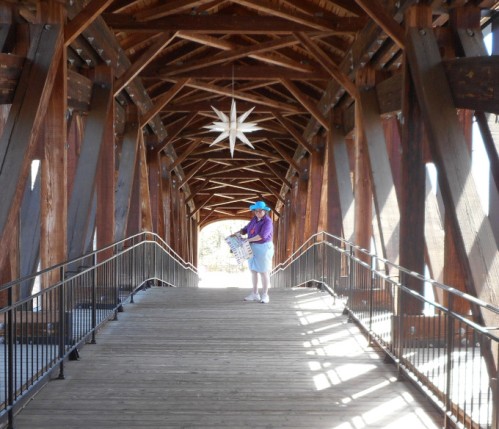
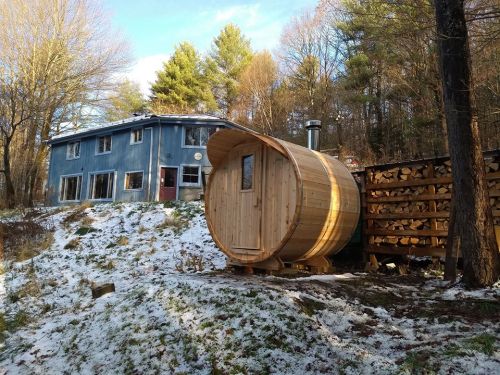

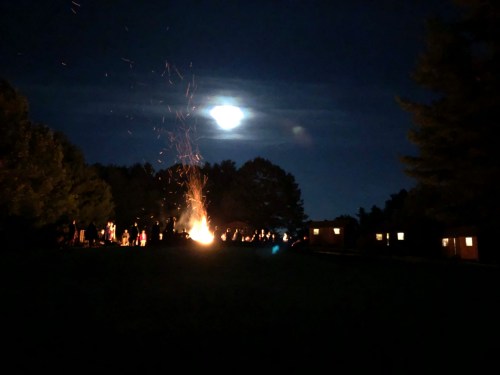
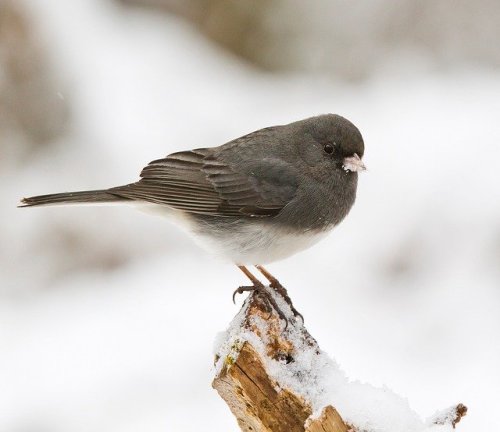
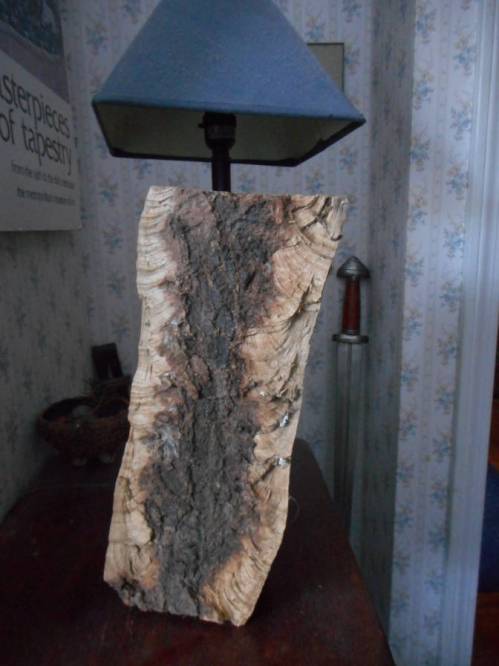


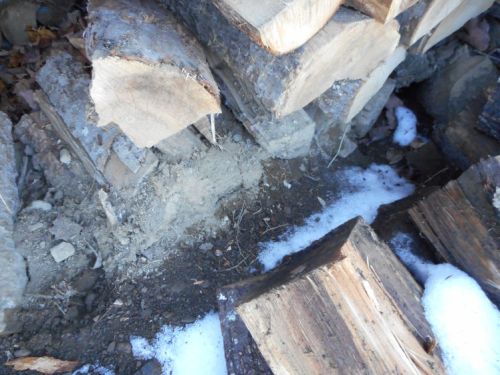

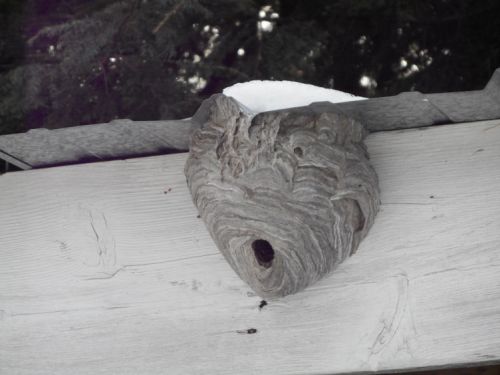
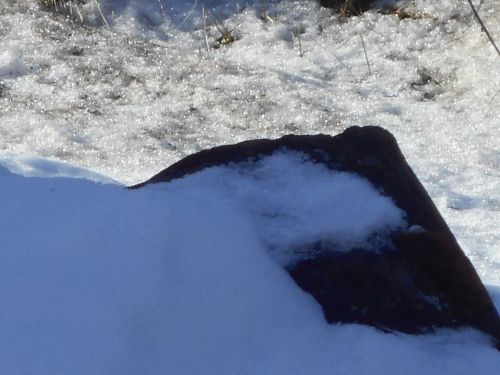


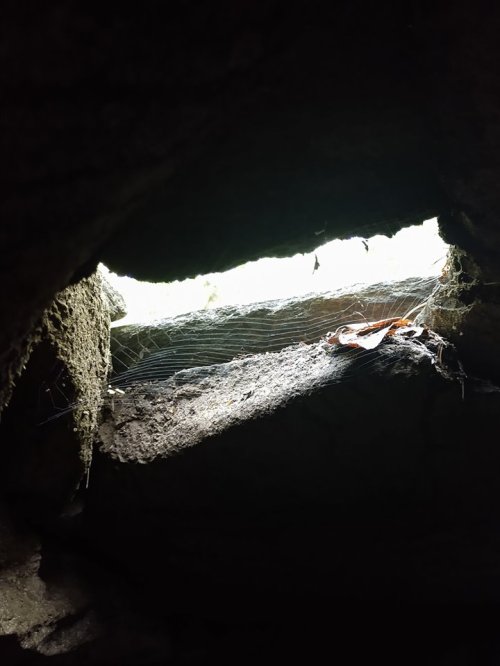


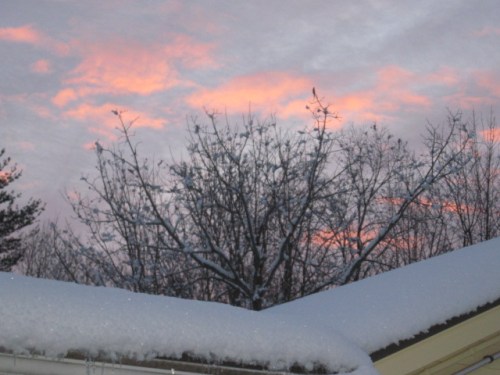
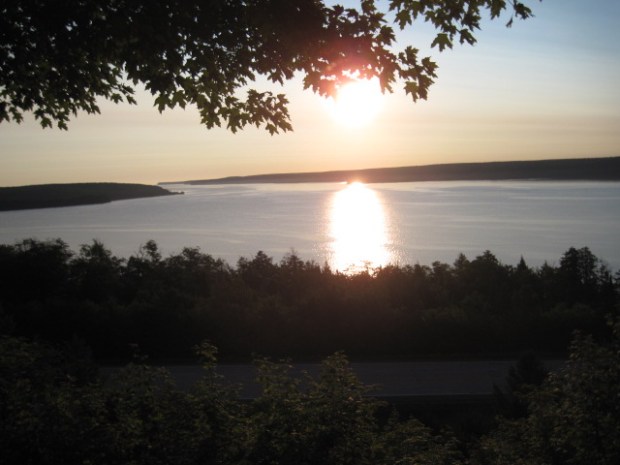
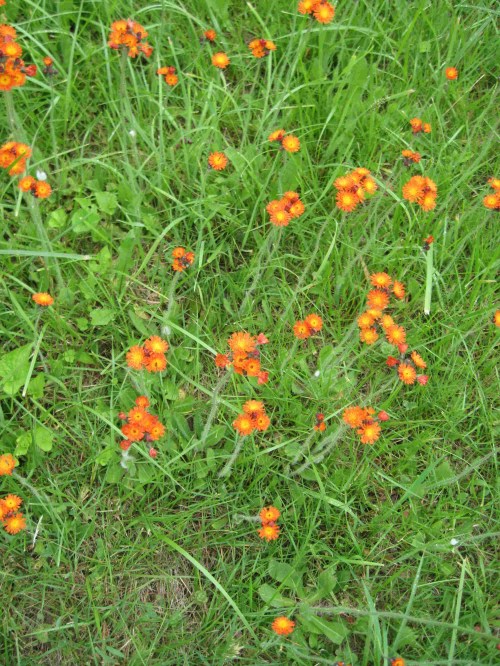


 A Druid Way