Today’s “Druid of the Day” also happens to be a Druid full-time: presenting Cat Treadwell, a British Druid who lives in Derbyshire, UK. (That’s “Darbyshire” for us Yanks who might actually trust English spelling, along with “clerk” and “Berkeley” as they’re pronounced in the mother country.) Cat’s out about her Druidry, her blog The Catbox is worth reading, she’s just published a book based on her experiences, and there’s a fine interview of her at the Wiccan Pagan Times. So if you’re inclined, there’s some reading for you. I won’t spoil it by discussing it here.
Most of all I honor Cat because she exemplifies the spirit in the villanelle by Theodore Roethke, “The Waking”:
The Waking
I wake to sleep, and take my waking slow.
I feel my fate in what I cannot fear.
I learn by going where I have to go.
We think by feeling. What is there to know?
I hear my being dance from ear to ear.
I wake to sleep, and take my waking slow.
Of those so close beside me, which are you?
God bless the Ground! I shall walk softly there,
And learn by going where I have to go.
Light takes the Tree; but who can tell us how?
The lowly worm climbs up a winding stair;
I wake to sleep, and take my waking slow.
Great Nature has another thing to do
To you and me, so take the lively air,
And, lovely, learn by going where to go.
This shaking keeps me steady. I should know.
What falls away is always. And is near.
I wake to sleep, and take my waking slow.
I learn by going where I have to go.
“Great Nature” always has other things to do, and doesn’t hold back but simply does them. And for three of them right now — you, me, and Cat Treadwell — I’m grateful, and offer this short post in thanksgiving.
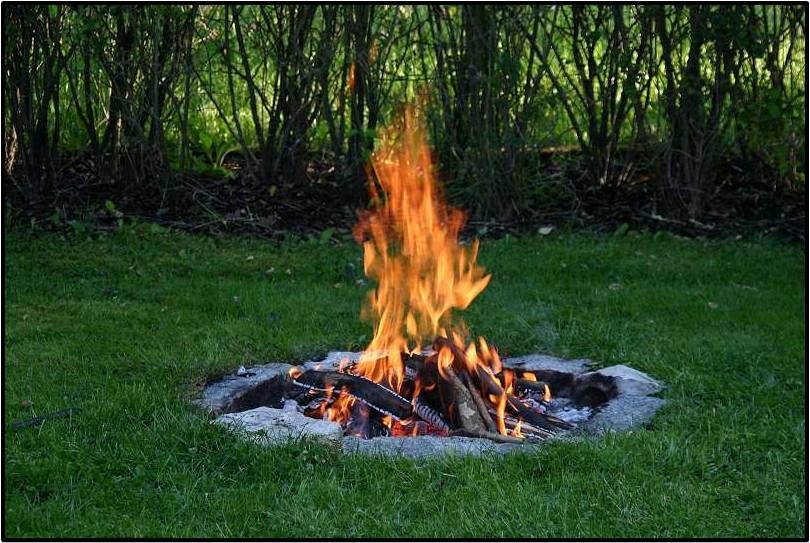
The day was fading into twilight, and I could feel the dew settle around us like a third party at this meeting. “What is your name, master?” I asked him. In a grassy spot near us I made a firepit, seeing and touching the rough gray stones, feeling their weight to make it real. Then I gathered a bundle of sticks and lit a fire, because now there was an evening chill in the air.
“I’ve been given many names. Some of them I even like,” he said in a wry tone, smiling at me.
Suddenly I knew his name. “Wadin Tohangu,” I said. “That’s an African name?”
He nodded.
“You’re an African Druid? Is there even such a thing?!”
He chuckled at my surprise. “I travel a lot. And you’re as much a Druid as I am.”
This wasn’t exactly the answer I expected. And I wondered what he meant.
“Yes, you may call me Wadin Tohangu. Call on me when you need help,” he said, “or if you wish to talk, as we are doing today.” He spoke English clearly and very well, but the way he said his name, with the slightest accent, set off echoes in my head. A familiar name. I knew it somehow. How?
“It’s a name you can use,” he said, as if in reply to my thoughts. He put his hands out toward the heat of the fire. “It’s as magical as you are.”
“Some days I don’t feel very magical,” I said, and paused. Time always seemed to pass differently in the grove, both slowly, and faster than I expected.
“That’s one key, of course. How you choose to feel,” Wadin answered. “Which things are your choices and which are simply given to you would be helpful to contemplate. We confuse those two quite often. And which to be grateful for, we misunderstand even more!”
“How much can we be grateful for?” I asked.
“That’s a question to answer by experimenting,” he replied. The pile of burning twigs and small branches shifted, settling. “Gratitude is another key.”
“Choices and gratitude,” I said, half to myself.
The dog started barking again somewhere in the distance. I swallowed a flash of annoyance. This was important — I wanted to hear everything Wadin was saying.
“Yes,” he said. “And a third point is attention, as we’ve seen.”
I looked at him.
“For you that dog is a most useful guide,” he said, laughing at my expression. “Why not find out his name, too?”
The darkening sky behind him showed several stars. He stood up. “Each moment offers what we need, both for itself, and for moving on to the next one. How else can time pass?” As I watched the firelight flicker on his face, he said, “Remember these things.”
I looked around at the grove one more time, and when I turned back, Wadin was gone. I stood up. Then I moved to touch the altar and said goodbye to the trees. The fire had died down to glowing embers. I stirred them with a stick, pushing them into the sand of the pit.
The dog was still barking. So I followed the sound back to my room, where it was coming in through a screened open window. I heard a car door slam at Jim’s place, and voices. Then everything was still again, except for crickets chirping in the dark. I turned on a light, and sat there quietly for few minutes, thinking about the experience, and writing it down in my journal.
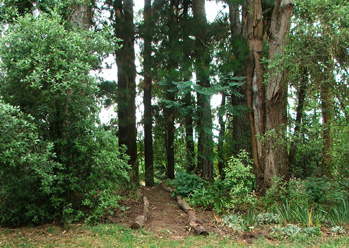
In the grove the Druid sits. In my grove, the one I’ve constructed in an inner world, via imaginal energies. With the tall slender trees of entrance standing on either side of the portal, a space between them wide enough for a single person to pass through. And he is welcome here, though I don’t remember inviting him. He is always welcome, a friend who will never presume.
Today he indulges me by wearing Druid robes — they make him familiar, with his dark brown skin, that homely, beautiful face I would know anywhere — and I relax into our conversation. I know him from somewhere else, too, someplace on the edge of awareness, a realm or time not quite pushing through to full consciousness. He does what he needs to in order to reach those under his guidance, and to put them at ease so that he can work with them. Awe or fear or worship is useless to him. Attention? That he can use.
His words issue from a place quiet and full of listening. I’ve come to trust him instinctively, the way wild animals do in the hands of those who love them with touch and gentleness, a welcome of care and compassion for a fellow being in the worlds. They know that touch, that presence, and their knowing has nothing of the talking human about it. It’s a language older than words.
He knows when to use words, too, and now he’s speaking about a past I’d forgotten. I remember it as he speaks, things I didn’t know I knew, things I have not needed to remember until now, because until now they would find no place in me to live, or have any value or significance. They would feel like they belonged to somebody else, foreign to me, alien, no more at home than a bird of the air caught in a small chamber, fluttering at the windows. What is it that stands between me and freedom, this transparent flat barrier I never knew was there, blocking me, hard as thought? But no, I have no wings, I’m not the bird. But for a moment, there …
The Druid turns to me, a look deep as evening in his gaze. “You are all you have ever been. Do you remember our first meeting, long ago?”
“It was a market,” I said. “And I remember. I was … I was drunk.”
“Sitting slumped against a wall. When I walked by, though, you spoke to me.”
“What was it I said? ‘Keep walking, don’t talk to me now. I don’t have anything left in this life for you.’ Something like that. I was embarrassed. I didn’t even know you.”
“Yet you gave me some fruit from your stand …
“Yes, I remember. A handful of marula.”
“Where were we?” he asked me softly.
“It was … West Africa. Africa was my home then.”
“Yes. What else do you remember?”
But somewhere in the distance a dog is barking. My focus falters, pulls me away from this place and back to my room in our Vermont house. The neighbor’s dog, Jim’s — barking as he always does, every afternoon, impatient for Jim to get home, release him from the chain and walk him, feed him, let him back into the house.
Damn, I think. It’s all gone, the vision’s gone.
But he’s still with me.
“Dogs bark on all the planes,” he’s saying. “They’ll bark, and then for a time they’ll be silent again. You can use them as a guide, or a distraction. Is there a dog barking near this grove?”
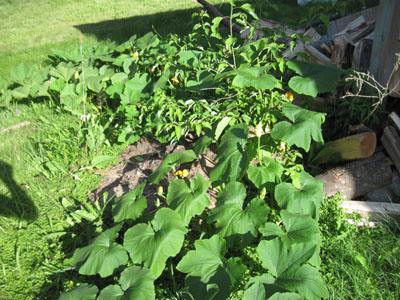
In early June my wife noticed a particularly vigorous shoot rising from an old compost pile beside our woodshed. The squash plant it eventually revealed itself to be has flourished joyfully, spreading in two directions, while the pitiful growths in one of our new raised beds refuse to be coaxed into thriving.
If life gives you lemons, you could make cleaning supplies, ant repellent, pickles, sore throat medicine, laundry whitener, stain remover, fruit preservative, copper cookware restorative, disinfectant — and if you insist, lemonade, too. The dead (cliche) comes to life when our attention lies elsewhere. Practice resurrection, and get used to it.
We hear a lot about growing where you’re planted, but what about everywhere else? The surprise that is our universe so often arrives with the unexpected, the new pattern, the shift, the change. Life does a one-off. It does what it is. (Isn’t that what you are, too — individual, unique, nothing else quite like you? The trouble comes when I or somebody else insists you should be like the rest of us. The universe never “conforms.” It’s simply itself. That’s our pattern too. We are where we come from.) We stand amazed at the burgeoning of vitality in places we doubted it could exist. If we have different plans, life may upset them. A young Christian couple I know, just married, decided they would leave conceiving a child “up to God.” A friend from their congregation remarked, with considerable glee, “They gave it to the Lord, and he gave it right back to them.” She got pregnant six weeks after the wedding.
In the mass of asphalt and concrete that is Route 91, like any superhighway, a few weeds have taken root on the meter-high divider between northbound and southbound lanes, a little way north of Hartford, Connecticut. They’re particularly visible because they happen to be growing just about at eye level as you drive by, and the highway department hasn’t yet set upon them with weedkiller. I give a silent cheer each time I pass, though I know my tax dollars support their eventual extinction. Still … Give them a few years and their roots will begin to split and break down the rigidity of man-made material into the beginnings of something more closely resembling soil. If there’s an “agenda” at work here, it isn’t always a “human” one, though humans are born into such a world, have grown and evolved within and through its shaping patterns, and have lived in it for millenia before they thought to try permanence on a scale the universe doesn’t really support.
Instead of worrying about “what the financial situation will support,” or what our many and often distinctly weird human institutions “demand,” why not ask what moves in harmony with the patterns of the universe? The main reason is we wouldn’t always like the answer. Sometimes we would. But we might find more balanced and sustainable ways of living that would approach “permanence,” which is just a weak version of natural equilibrium. Could we devise a “financial permaculture” that might not jolt us from crisis to crisis? Sure. Will we?
The Dao De Jing winks at us when it makes its observations:
Not exalting the gifted prevents quarreling.
Not collecting treasures prevents stealing.
Not seeing desirable things prevents
confusion of the heart.
The wise therefore rule by emptying hearts
and stuffing bellies, by weakening ambitions
And strengthening bones.
If men lack knowledge and desire, then clever
people will not try to interfere.
If nothing is done, then all will be well.
“Doing nothing” isn’t exactly what Daoism teaches; it’s more along the lines of “unforced action,” or “going with the flow”: wu-wei in Chinese. And can we expect people to succeed by weakening their ambitions? I don’t know; have we ever tried it? In all this there’s a wink and a smile, too. As if that wise voice is saying, “I don’t always mean this literally, of course, but you get the idea …” And who knows?! “Emptying hearts (in a good way) and stuffing bellies” might just pay off. Fill our stomachs, not our heads …
Or take this advice, surely perfect for our U.S. political season:
To talk little is natural.
High winds do not last all morning.
I’ll let Ursula Le Guin’s version of Chap. 27 have the final say here, a kind of diagnosis of how we’ve “gone astray,” that peculiar human thing we can do that the rest of the natural world doesn’t:
Good walkers leave no tracks.
Good talkers don’t stammer.
Good counters don’t use their fingers.
The best door is unlocked and unopened.
The best knot is not in a rope and can’t be untied.
So wise souls are good at caring for people,
never turning their back on anyone.
They’re good at looking after things,
never turning their back on anything.
There’s a light hidden here.
Good people teach people who aren’t good yet;
the less good are the makings of the good.
Anyone who doesn’t respect a teacher or cherish a student
may be clever, but has gone astray.
There’s deep mystery here.
/|\ /|\ /|\
There are many free versions of the Dao De Jing online; the site from which I drew these few excerpts provides several reasonably reputable versions to sample. Sustained meditation on the text (get a couple of versions and let them talk across to each other) can ease stress and open up many doorways and paths. It’s one of my most beloved Druid written resources. Wikipedia’s entry for Tao Te Ching captures some of its qualities: “The written style is laconic … and encourages varied, even contradictory interpretations. The ideas are singular; the style poetic. The rhetorical style combines two major strategies: short, declarative statements and intentional contradictions. The first of these strategies creates memorable phrases, while the second forces us to create our own reconciliations of the supposed contradictions.” If you recall, resolution of supposed contradictions, or finding the tertiary that resolves the binary of “either-or,” is a technique and strategy of wisdom taught in several Druid paths.
My wife has a designated daily mid-afternoon contemplation period at 2:00 pm. “I made a commitment,” she reminded me again this morning, when we were planning the day and I sweetly noted that her set time conflicted with other tasks that needed doing. While another time would probably serve her better (read “be less inconvenient for the people who live with her”!), I respected her response, because I know how precious an established positive habit is in transforming my own life.
One of the first discoveries almost anyone makes who sets out on a path of spiritual exploration is the apparent initial state of our individual inner worlds. If you make room for some down-time to relax and grab your recommended minimum daily requirement of silence and commune with yourself, you frequently get brought up short:
After an amazingly short time you will most likely feel bored. This teaches us one very useful thing. It gives us insight into the fact that if after ten minutes of being alone with ourselves we feel like that, it is no wonder that others should feel equally bored [with us]! (68)
These words* by Orthodox Christian monk, bishop, writer and spiritual director Anthony Bloom (1914-2003) strike home, for me at least. While boredom is a particularly American problem, it’s not unique to us. Others know it, but with our incessant desire for entertainment and stimulation, to be bored is the prime cause that drives us toward whatever is new. Even information about recent events we don’t yet know about, information which in a different world might actually be more useful to us, is called simply “news.” “What’s new?” we ask. Think about what really is “new.” Are you finding it at 6:00 pm nightly on your media source of choice?
Bloom continues his examination of boredom and the challenges of “inwardness” and stillness:
Why is this so? It is because we have so little to offer to our own selves as food for thought, for emotion and for life. If you watch your life carefully you will discover quite soon that we hardly ever live from within outwards; instead we respond to incitement, to excitement. In other words, we live by reflection, by reaction. Something happens and we respond, someone speaks and we answer. But when we are left without anything that stimulates us to think, speak or act, we realize that there is very little in us that will prompt us to action in any direction at all. This is really a very dramatic discovery. We are completely empty, we do not act from within ourselves but accept as our life a life which is actually fed in from outside; we are used to things happening which compel us to do other things. How seldom can we live simply by means of the depth and the richness we assume that there is within ourselves. (68)
Bloom doesn’t exaggerate about that emptiness in us, and yet of course there areindeed wonderful riches inside us all, just as we suspected. The difficulty I face in accessing them measures out for me how outward-directed I have become. How much I have to dig to regain one darkly shining edge of those inner worlds shows me where I have work cut out for me. (And that itself has become one of my spiritual exercises, rather than wasting time feeling guilty or making unlikely resolutions to do better. When you can’t do anything else, do laundry, or dishes. You’ll get something done that needs doing, ground yourself with a physical act, feel better about how you spent your minutes, and even carve out another space where you realize you can be both meditative and “productive” at the same time.)
As with so many things, balance is priceless. For everything else there may not necessarily be a spiritual MasterCard at hand, but you get the idea. As I’ve mentioned in previous posts (here and here, among others), the challenge of becoming cause in our lives, of living consciously and with intention, is a prime Druid discipline, as it is in almost every spiritual tradition in some form.
Bloom points out an opposite trap we can also fall into. Now that you’ve given yourself the delicious gift of downtime and reflection or meditation or contemplation, whatever you prefer to name it, “you will not be pulled out of it by the telephone, by a knock on the door, or by a sudden upsurge of energy that prompts you to do at once what you have left undone for the past ten years.” And you make another find, when “you discover that the world does not falter and that the whole world — if you can imagine it — can wait for five minutes while you are not busy with it. This is important, because we usually deceive ourselves, saying, ‘Well, I must do it: it is charity, it is duty, I cannot leave it undone.’ You can, because in moments of sheer laziness you will leave it undone for much longer than the five minutes you have chosen” (86-87).
Then at length the gifts of silence and inner discovery begin to open up. But the less I say about them here, the better. You already know what they are, from those rare precious moments when they already manifested to you. What is fleeting can eventually become an atmosphere that accompanies you and cloaks you. Such deep silence rings with a powerful intensity. If you’re fortunate, you’ve met someone who radiates this as a living presence. As the Bhagavad Gita says, “Even a little practice will free you …”
/|\ /|\ /|\
*Bloom, Anthony. Beginning to Pray. Ramsey, NJ: Paulist Press, 1970.
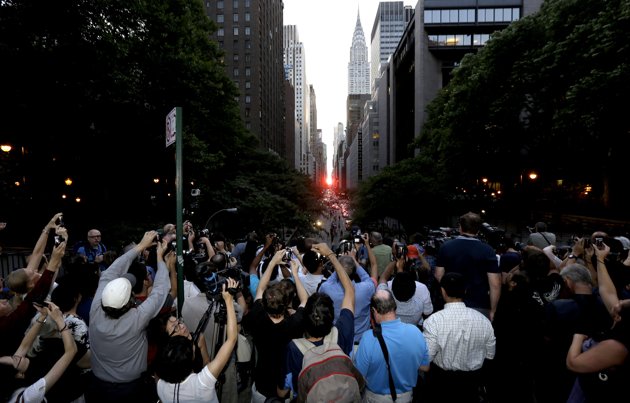
Our green world and ready contact with its natural rhythms can sometimes feel remote in urban settings. Because so many people live in one of the “mega-metro” areas on the planet, their appreciation of the natural world may often burn more brightly than it does for the small-towner who has lived all her life surrounded by cows and trees. With Tokyo, Seoul, Mexico City, New York and Mumbai heading the list at over 20 million souls each (counting their greater metro areas), it’s good to celebrate the green world particularly when it makes itself known among the girders and concrete. The first entry in my “Druid of the Day” series, just started, was a nod in that direction. Manhattanhenge is another one, and much larger:
If you follow Yahoo, you probably caught it. The caption for yesterday’s image reads “The sun sets during ‘Manhattanhenge’ on July 12, 2011 in New York City. The Manhattan Solstice is a semiannual occurrence in which the setting sun aligns west-east with the street grid of the city.” There’s a short sequence of similar images worth visiting.
We need such rhythms — to calibrate our biological clocks, to remind us how the world nourishes and sustains us, and how we need to remember it in our daily decisions — not out of piety for the Earth Mother (though nothing’s wrong with that, of course) but for the very real reason that this world is home. Whenever we can truly celebrate, our hearts open. And in a time when so much “news” doesn’t help us live better, stopping to enjoy the sun looking down the city streets is a good thing.
/|\ /|\ /|\
For those interested in astronomical details and explanations, Wikipedia’s entry for Manhattanhenge helps. The event occurs twice a year, in May and July, on either side of the planetary solstice, as the sun makes its (apparent) journey north and then south again after the solstice.
New York Times columnist Dana Jennings wins the first “Druid of the Day” award particularly for this portion of his column in yesterday’s (7/10/12) Times:
Scenes From the Meadowlandscape
Monet had his haystacks, Degas had his dancers, and I have the New Jersey Meadowlands from the window of my Midtown Direct train as I travel to and from Manhattan.
But what, it’s fair to ask, does squinting out at the Meadowlands each day have to do with art, with culture? Well, as a novelist and memoirist for more than 20 years, I like to think that if I stare hard enough — even from a speeding train — I can freeze and inhabit the suddenly roomy moment. Through the frame that is my train window I’m able to discern and delight in any number of hangable still lifes.
And the Meadowlands never disappoints, no matter what exhibition is up.
Its shifting weave of light, color and texture hone and enchant the eye. The sure and subtle muscle of the Hackensack River is sometimes just a blue mirror, but when riled and roiled by wind and rain it becomes home to slate-gray runes. The scruff, scrub and brush are prickly and persistent, just like certain denizens of New Jersey. And the brontosaurus bridges, their concrete stumps thumped into the swamp, idly look down on it all.
For his focus, intentionality and the requisite quietness to see, and then — just as important — turn the results of that seeing into a window, an access point for others who read his column to do the same “noticing” in their own lives, Jennings earns my commendation as “Druid of the Day.” This seemed like a good series to launch, to help remind myself as well as my readers of ways we can be more attentive to beauty around us, particularly unexpected instances — free, a gift if we only notice them — and receive their transformative power.
City or country, it doesn’t matter: we can be witnesses of natural power and beauty, and learn what they may have to teach us, anywhere — including Manhattan, and from the window of the Midtown Direct train. These are no less — or more — “Druidic” than any other spots on the planet.
Know others who deserve recognition as “D of the D”? Please send them along to me and I’ll write them up and include an acknowledgement to you in the citation. Thanks in advance.
So here we are at the last installment of this seven-parter. Indigestion and too much caffeine. No, not the series, though you may be thinking or feeling that, too. Looking back over earlier ones I realize each post has gotten more random than the preceding one. Not sure if I’ve done Greer a favor, writing about his seven keys — keys belonging to all of us — but doing it in such a way that they’re more “notes for a revolution” than anything like a review. You can’t just dump a bunch of principles by themselves on people and expect them to see how they fit, exactly. Which is what I’ve sorta done anyway. Inoculation by reading.
Like I said, they’re more notes for a revolution, so that when it comes, you’ll recognize the advance guard and maybe the sound of the explosions and know you’ve seen and heard something like this before, and maybe deal with it better or more inventively than your brother or neighbor out here panhandling and prospecting with the rest of us. “Look what I found! It’s a … well, I don’t have a name for it, but it might be useful at the weekly swap-and-steal.” Heaven consists of the spare parts of creation that didn’t get used elsewhere. We’re destined to mine the scrap heaps for the gold everyone’s tossed there by mistake.
Here goes with the last Law. (Of course it’s never the last law. There’s always another one, like yet another stray that won’t leave, moping around for scraps. Throw it a bone, or a filet. Watch what it does with it.)
“Everything that exists comes into being by a process of evolution. That process starts with adaptation to changing conditions and ends with the establishment of a steady state of balance with its surroundings, following a threefold rhythm of challenge, response and reintegration. Evolution is gradual rather than sudden, and it works by increasing diversity and accumulating possibilities, rather than following a predetermined line of development.”*
A shiver of awe and delight coursed through me when I first read this one. Maybe nobody knows where humanity is headed — it’s not something mapped out beforehand. “The wind blows where it wishes and you hear the sound of it, but do not know where it comes from and where it is going; so is everyone who is born of the Spirit,” says the Beloved Disciple in the eighth verse of his third chapter. (What, you didn’t know portions of the Bible are a Druid stealth device? Look twice before crossing.)
Sure, our DNA has something to say about it, and so do the causes we’re always setting in motion. These will shape our experience and our future. But they’re ourcauses. We can change. And we want to “accumulate possibilities” because these mean freedom. The dead-end singleness of conformity and bland homogeneity leave us hankering for the quaint, the queer, the mysterious, the odd, the doesn’t-fit, the original, the new, the surprising, the fresh. After all, we left Eden (some versions have us kicked out, but the result’s the same) and we’ve been on quest ever since. But “pave paradise and put up a parking lot”? Not what we really want, is it?
In “To Holderin,” the German poet Rilke writes to a compatriot:
Lingering, even among what’s most intimate,
is not our option. From fulfilled images
the spirit abruptly plunges towards ones to be filled:
there are no lakes until eternity. Here falling
is our best. From the mastered emotion we fall over
into the half-sensed, onward and onward …
We suspect so much more of reality than we let on. Or than it does. It’s not safe to do so, but it’s right, in the best senses of the word. Who ever wanted what is merely safe, when fuller life offers itself to us? Well, some people do, and often enough they get what they desire, and before long beg to be freed of it. Poetry means “making” in Greek, and we all make, we’re all makers, poets of our lives. Song is our native tongue, or could be. It’s that melody playing just beyond hearing that we’re always trying to capture, to get back to. That crashing sound? That’s just another person banging around the music room in the dark, trying to pound out a melody.
While we’re listening to Germans, here’s Martin Heidegger: “To be a poet in a destitute time means to attend, singing, to the trace of the fugitive gods. This is why the poet in the time of the world’s night utters the holy.” Cool, just so long as we know the holy really isn’t safe at all. No place to hide. Here’s Rilke again:
Here is the time for the sayable, here is its homeland.
Speak and bear witness. More than ever
the Things that we might experience are vanishing, for
what crowds them out and replaces them is an imageless act.
An act under a shell, which easily cracks open as soon as
the business inside outgrows it and seeks new limits.
Between the hammers our heart
endures, just as the tongue does
between the teeth and, despite that,
still is able to praise …
Sometimes you get the sense from Rilke, like from other madmen and seers, that you’ve always known what he means, that in fact you’ve done what he’s saying, even though you may not be able to say it yourself. But he manages to. We leave saying to the poets as if they’re somebody, but not us, who forgets you aren’t supposed to say these things, or that nobody expected you couldsay them. But you say them anyway. And get inconveniently booted to the curb by your neighbors, who take over “for your own good,” and after you comes flying what you thought was your life.
So you pick yourself up, brush off the worst of the dust, and keep going, without a life if you have to. Not as if nothing has happened, but as if everythinghas, and it keeps on happening. Who else do things happen to, but us? We’re mistaken if we think that disconcerting little factoid that reaches the news but which happens in “some other part of the world” — outer Don’t-bug-me, central I-don’t-care-yo! — isn’t our concern. Next week I’ll find refugees from there in my basement, peering up at me. My new psychic friends, walking my dreams, if I don’t see them actually fishing through my garbage, desperate for food or love or those pieces of my life I decided weren’t worth my time.
Oh, Druids are a little bit crazy, more so on certain days of the week than others, and most of all under certain phases of the moon. We’d cry if we weren’t laughing so hard, and sometime it sounds much the same. But the spirit lightens a little, and we see the outlines of a Friend where before was only a little mannikin of sadness or despair. We keep doing this for each other just often enough to go on, suspecting ourselves of the worse motives, and probably right to do so. But there’s a fire over the horizon, and singing, and the party’s going on without us. It’s the same fire in our heads.
Shapes move and stumble around the fire, vaguely familiar, so that after joining them it seems we know them, we left them years ago, but this is a reunion where we see everyone’s suffered and grown, though some have become knotty and twisted, like old trees. But there’s a few among us brave enough to hug them anyway, and bring them into the Dance. And so we dance, all night, the last stars twinkling when we finally stumble home to bed and a delicious, bone-weary sleep. And later, who knows what waking?
/|\ /|\ /|\
*Greer, John Michael. Mystery Teachings from the Living Earth. Weiser, 2012.
“Everything in existence exists and functions on one of several planes of being or is composed of things from more than one plane acting together as a whole system. These planes are discrete, not continuous, and the passage of influence from one plane to another can take place only under conditions defined by the relationship of the planes involved.”*
One “map” of the planes I’ve found useful also features in many other spiritual teachings (mystical Christianity, Neo-Platonism, and some forms of Hinduism among them), including one I’ve followed for over thirty years, and identifies the physical universe as just one of several other planes. Besides the physical plane which we experience with our physical bodies, we experience the astral (see the third paragraph of Earth Mysteries — 4 of 7) or emotional plane (also sometimes called the etheric plane), the causal plane of memory, and the mental plane of thought. These last two also sometimes have different names — not surprising, considering they can seem more removed from immediate physical sensation and experience — and thus, understanding. Yet we exist in and experience these planes all the time.
Who’s doing the experiencing here? According to this way of perceiving things, that’s the real you, soul or spirit who wears these other bodies like clothes appropriate to different seasons and climates. So if we say “my soul,” who is talking? The experiencer or consciousness is soul, using the mind to think, the causal body to remember, the astral body to feel and imagine, and the physical body to experience physical reality.
While we can’t directly experience the astral world with our physical bodies, given the close proximity of the two planes, we certainly can feel the effects of strong emotions with our physical bodies and the “atmospheres” of places likewise charged with feeling. We’ve all walked into a room where there’s just been an argument, where religious observance has been performed over a sustained period of time, etc. We may pick up the vibe of such places — vibrating at a characteristic frequency, physics tells us, is what everything is doing already anyway — and if we’re inattentive we may internalize it, harmonize with it, and then not understand why we ourselves may feel tired, energized, angry, calm, etc. after spending some time there.
But our astral body is fully capable of experiencing the astral plane, and doing neat things like flying, changing form, and generally responding rapidly to thought, as it does in dreams. (Our physical bodies also respond to thought, but being of a slower vibrational rate, they more often take years or decades to show the effect. You’ve heard the expression “to worry yourself sick,” and that’s one of the more negative uses of focused and intense emotion — a kind of magic turned against ourselves.) The astral is the plane of imagination, where we may see things in “the mind’s eye,” or with “rose-colored glasses,” if we’re particularly optimistic, because pink or rose is one of the dominant colors there, just as green is characteristic (though by no means ubiquitous) in the physical world with its plants and chlorophyll.
The astral plane, according to many traditions, is where most of us transfer our consciousness after the death of our physical bodies. It is certainly possible to open our astral awareness (often without much control, which can make it dangerous without proper guides) with alcohol or drugs. Safer techniques include drumming and trance work, dance (like certain Dervish orders do, for instance), chant, mantra, ritual, physical exhaustion, daydreaming, meditation, creative visualization, and so on.
The causal plane of memory, like the astral plane, has its own rules and qualities, as does the mental plane. We say “that rings a bell” when we’re reminded of something, and each plane has characteristic sounds associated with it as well as colors. When we focus attention on these other planes while physically awake, we tend to tune out the physical world and its body, and are “lost in thought,” or “in another world.” In these and other instances, our languages preserve fragments of ancient wisdom our modern world tends to ignore, though we often intuitively know something of its truth in spite of the habitual skepticism of our current age.
Our contemporary default position of disbelief is no better than the habitual credulity of previous ages, when people believed all sorts of things which, while they may have been true of some other plane, weren’t usually true of this one. And in our turn toward the currently widespread religion of science, we’ve adopted its characteristic blind spots just as wholeheartedly. Ask scientists why the universe exists, for instance, and you can usually reduce them to speechlessness. It’s simply not a question science is equipped to answer.
The ability to manifest consciously the realities of one plane in another — and since we’re focused heavily on the physical world, for the sake of this discussion that usually means bringing something into physical form — is a supremely human accomplishment. Yes, animals are wired with instinct to reproduce their own kind, and in the case of birds and mammals, care for their young, but in addition to such instinctive drives, humans create cultures, with their languages, arts, crafts, technologies, rules, perspectives, and ways of living in the world.
In each of these posts on the seven Laws, I’ve barely scratched the surface. Each Law deserves repeated meditation, and in his book Greer makes several suggestions for experiencing the creative force of each Law and some of its far-reaching implications. Alone, the Laws can seem rather abstract, hard to apply to daily concerns and problems, too generalized to match the specifics of our individual situations. This itself is a powerful realization: to bring things into manifestation, we need the individual, the distinct and unique set of qualities, experiences, memories, talents, perspectives and strengths, in order to achieve what makes and keeps us human.
If it seems that the Laws swallow up individuality in statements about general tendencies, groups and patterns larger than one human life, it’s important to remember that it was humans who first noticed these principles, and humans can choose either to disregard them or to work consciously with them. Conscious and creative cooperation with the spiritual principles of existence is the fulfillment of humanity. Through such means, we can manifest what has not yet been seen or experienced or even imagined, in forms of power and beauty and usefulness, for others as well as for ourselves. That’s one way to repay the gifts we’ve been given.
/|\ /|\ /|\
*Greer, John Michael. Mystery Teachings from the Living Earth. Weiser, 2012.
“Everything that exists is the effect of causes at work in the whole system of which each thing is a part, and everything becomes, in turn, the cause of effects elsewhere in the whole system. In these workings of cause and effect, there must always be a similarity of kind between an effect and at least one of its causes, just as there must be a similarity of scale between an effect and the sum total of its causes.”*
Under the guise of karma, this principle is superficially familiar to more people, perhaps, than the other six laws. Though not exactly what some people have in mind when they wish you “good karma,” as if it were the same thing as luck. Where does luck fit in a world system of cause and effect? Worth considering. A Wise One once remarked that it’s not always possible to be the cause in every situation — to initiate, to be the active force, to get things moving — but that if we must be effect, at least we can strive to be conscious effect. Recognize the cause, and respond consciously, rather than be manipulated by it unconsciously. Because who knows? — it may not have your best interests at heart.
That’s not to say that a cause is necessarily actively malevolent or is seeking you out to destroy you and unmake you. But it may simply be a cause you or someone else set in motion at random, unconsciously, unintentionally. If you’re its unconscious effect, it’s suddenly detour time. Willing to go for a ride with a strange cause, one that beckons to you, flashing those stunning looks, that oh so beguiling smile? Have fun! Just don’t expect things to be the same when you get back. Whenever that turns out to be …
You can be spontaneous and conscious too. But be the cause. Otherwise, what’s consciousness for? I find that a fascinating, troubling question.
So many beings get along fine without the human excess of self-consciousness, that strange echo-chamber or feedback loop that tells us our thoughts, our feelings, our thoughts about our feelings, and our feelings about the thoughts we’re having about our feelings. How often we long for pure experience, without that inner narrator who insists on supplying second thoughts, doubts, fears, insecurities, grubby little (or big) desires, and so on. It’s like a bad voice-over in a film, a jangling mess that some spiritual traditions remedy with meditation to calm the “monkey of the mind,” so we can get at whatever of value may lie underneath the noise of consciousness.
OK, that’s human consciousness, and specifically self-consciousness, at its least attractive. But what of consciousness itself? It’s not all bad. In fact, it seems to confer some evolutionary advantages. A conscious being can make choices, react with more than instinct — maybe even live through challenging situations where instinct isn’t enough. If you’ve observed animals, you can sometimes catch reflection and thinking. Dogs and cats give evidence of it. Both birds and mammals can learn and adapt, maximizing their ability to survive, and to pass on their genetic material to their offspring. But is there more than evolutionary advantage to the species? How about to the individual?
In more conscious creatures, play and possibly even pleasure are gifts that consciousness also seems to confer. Otters play for hours, and birds — if you’re convinced by people like David Rothenberg — sing not only to defend their territory, attract mates and warn off rivals, but also to express joy. Is that too human? Are we anthropomorphizing?
And creativity … to me that’s the greatest gift of consciousness. We’re problem solvers. We love smooth sailing for sure, long for it deeply in the trough of trouble, but we’re often at our best when challenged, when pushed to grow. Even our attempts at avoiding growth are frequently clever, creative, inspired. We procrastinate, rationalize, justify, repress, suppress, distract ourselves, get addicted to something too small for the love we’re driven to express, and our suffering is outrageous, ridiculous, painful, outsized, exaggerated — often because we’ve made it just that way in our struggles to escape what we know we must do eventually.
And here’s the kicker: even — and maybe especially — our avoidance just makes us stronger for when we finally do face down the problem or issue or challenge. We’ve tried everything else, all the other options, and they’ve failed in some way. So we bring to that eventually unavoidable moment of growth a head of anger and frustration, true, but also a chunk of wisdom and strength that we got precisely because we’ve resisted for so long. That momentum, that power and wisdom with a glow of a little anger and a dash of curiosity under the fear — this very mixed package of preparation — may not always get us through the challenge. It still may not be enough this time around. Now we’re still effect, but we’re on the way to becoming cause.
The failure to meet the challenge this time, to pass the test, signals to us what we still need to do to be ready next time. And the heightened emotion clinging to the lesson, the issue, and the events and people around it, flags it for us. Never again will we completely be able to avoid it, to shove it entirely back into the shadows, and let ourselves slide into unconsciousness. A tail sticking out of the box, or paw scratching at the door, or fur on the carpet, will be evidence of this animal self, our helper, our “trouble double,” that we’ve tried to hide. We willbe cause, even if we can’t yet pull it off. Something in us knows this. Our growth will seem to pursue us on its own — because we’ve made it ours by being cause even to a limited degree, and cause must, inevitably, unavoidably, have its effect.
All this time, we’ve not been idle; we’ve also been building up strength for our next attempt: by more avoiding, maybe (if we’re really good at that), but also by a slowly growing awareness that growth is what we’re destined for, that we can actually work toward it, even if our own lives have to drag us there kicking and biting and howling the whole way, functioning as some of the causes we ourselves have set in motion. There’s more strength building in us, and if there’s a cost, then we’ll pay. (Another cause, another effect.) We’re slow learners, because sometimes that’s the only way the lesson sinks in deep enough that we really get it good, get it down pat, and run with it. One way or another …
And so the causes we absolutely needed to set in motion will become just the effects we need to experience down the road. But because we grow as a result, the effects which were “everything we ever wanted” at the time will eventually come to box us in, because we’ve grown, and so they’re no longer enough for us. Then they start to strand us, and constrict and blind and infuriate us, until we arise from them stronger and are again able to set new causes in motion. Open-ended growth. Our ideas of perfection often seem to involve stasis: at some point we imagine we’ll “arrive” and not need to grow anymore. Heavenly choirs and streets of gold, no telemarketers or spam or mosquitos or flu, and sitting around all day in Paradise Lounge, plucking at harps and sipping (virgin) daiquiris and margaritas. Likewise our perspective on setbacks often doesn’t take in enough time to see the causes and effects playing out. Sometimes we can’t see them all, if they span multiple lives. Or parallel ones, if you’re not prone to reincarnate like I am.
But back to perfection as stasis: from what I’ve seen, that misses how the system works. “Everything becomes, in turn, the cause of effects elsewhere in the whole system.” No final perfection — that’s just another trap or sidestep. Which is fine, if you’d like that experience: then it’s no trap or sidestep so much as interesting or even productive diversion. (Having your cake iseating it too, after all. Otherwise it just sits there.) We don’t arrive at long last at any unchanging endpoint. That’s not perfection. We’re travelers. We may get rest stops, but the growth is endless. “Eden bears those footprints leading out …”
/|\ /|\ /|\
*Greer, John Michael. Mystery Teachings from the Living Earth. Weiser, 2012.
“Everything that exists is subject to limits arising from its own nature, the nature of the whole system of which it is a part, and the nature of existence itself. These limits are as necessary as they are inescapable, and they provide the foundation for all the beauty and power each existing thing is capable of manifesting.”*
Though it’s not good New Age gospel to admit it, we’re faced with limits and boundaries all the time, and more to the point, that’s a good thing, for the reason Greer points out, and for others. Limits are the counterweight, the resistance for our training, the sparring partner to keep us in fighting trim. Rules change on other planes of existence, but to manifest power and beauty here, limits are absolutely essential. They’re the valve that allows us to build up pressure in the boiler, the enclosure that intensifies the heat of the fire, the focus for the laser — or the conscious, persistent human intention that manifests a goal.
Physical limits allow us to give shape to things, and to have a reasonable expectation they’ll stay in that shape, usefully, predictably. These rules don’t apply in the same way elsewhere. All of us have had experience on, and of, at least one other plane, the astral, where most dreams occur. You know how fluid and changeable the forms and shapes are there. The dog chasing you morphs into a car you’re riding in with the person who bullied you in high school. You look closely and that person’s hands aren’t holding the steering wheel any longer, but clutching a bouquet of flowers instead, two of which turn into ropes that winch you so tight you can’t breathe. You struggle, wake up gasping, and — thank God! — you’re in your bed. It’s the same bed as last night, last week, last month, the bed which someone made years ago, and it stays put, reassuringly solid and unchanging beneath you, obeying the laws of this physical world. You slowly come back from the feeling-sensation of your dream on the astral plane, welcoming the heaviness of your physical body around you, touching a few of the things here, pillows and sheets, your partner, a pet curled against your thigh or your face, the nightstand or wall beside your bed. Familiar, stubbornly solid objects and beings, responding to gravity and inertia. Yes, things mostly stay put here, in this world. Though we all have stories about the car keys …
The image at the top comes from a site with its own take on freedom and limits. What I find interesting is the image of flight presented as one of limitless freedom. Yet flight depends on air, resistance, lift, momentum, wing span and area, an appropriate center of gravity, and so on. Not everything stays aloft after you fling it into the air, and flight in a vacuum like in space follows different rules than flight in an atmosphere. It can seem paradoxical that freedom increases the better we understand and work within limits.
/|\ /|\ /|\
*Greer, John Michael. Mystery Teachings from the Living Earth. Weiser, 2012.
Since my wife and I are too cheap to spend money on cable, we get most of our programming through the internet. Vermont sometimes gets tagged in people’s minds as one of the hinterlands of the U.S., though in fact it’s scheduled to have ultra high-speed internet by 2013, billed as “fastest in the nation,” and VTel (Vermont Telephone) installers are actually ahead of schedule in some areas.
One result of our cable-free existence and frequent obliviousness to whatever is “trending now” is that we often discover programs toward the end of their initial run, or well after they’ve already gone to syndication or archive status. Hulu is one of our friends, so if you’ve already watched the Canadian series “Being Erica” and you’ve moved on to newer fare, this post may not be for you. It may be a case of BTDT (been there, done that). So my electronic alter ego here with his Druidry and opinions and evident desire to pry where it’s sometimes uncomfortable (but interesting!) to pry isn’t offended if you log off and go do your laundry, or at least surf onward toward something more engaging.
==PILOT EPISODE SPOILER ALERT==
If you’re still here, the show’s pilot episode does a good job of making the series premise clear. 32-year old Erica feels she’s over-educated (a Master’s degree) and under-fulfilled (single, and with a low-level telemarketing job). The pilot brings her to a low point — she wakes up in a hospital bed after an allergic reaction, and receives a brief visit from a Dr. Tom, who leaves her with a business card that reads “the only therapy you’ll ever need.” As Erica and the audience simultaneously discover, he’s able to send his patients back through time to deal with events in their pasts that they regret. Not to “fix” them in some facile way, but to learn more fully what they have yet to teach.
Vancouver Actor Erin Karpluk, who plays Erica, reveals a wonderful vulnerability and resilience, and she develops a daughter-father chemistry with Dr. Tom, played by veteran Michael Riley. There’s also a “Canadian” flavor to the series, by which I mean something mostly vaguely felt, but nevertheless detectable at certain moments: many episodes are less politically correct, more real, better scripted and more risk-taking than the typical formulaic and “safer” equivalent might end up being in the States. There’s been abortive planning to make both U.K. and U.S. versions.
So you know I just have to make a connection about now. Ah, and here it is, right on schedule. In my experience, the past is not some fixed thing, written into concrete forever, like one false step into a bog that draws you down and suffocates you. Instead, it depends for its whole existence on you, in your present, here and now, in these circumstances and with this awareness, to understand and explore it. Change your understanding of the past, and your past itself can change in almost any sense you care to claim. Not whatthe “facts” are, which is almost always the least important thing*, after all (peace to all those police procedural shows and their fans!), but howthey matter and still shape you today. Just as history gets revised through time, as we gain new understandings and perspectives, so too do our own experiences, choices and destinies appear new or different to us as we change. That bully in grade school turns out to have helped us develop a thicker skin, or empathy — or an unacknowledged contempt for “trailer trash,” or a keen taste for revenge that dogs our heels to this day. Pick your blessing or poison.
The future is what is fixed, the track we’re still following, and reconfirming right now with our current habits, choices and focus — fixed, and set in stone — untilwe “change” our pasts by knowing and owning them more fully. Seen from this perspective, “fate” is undigested, rejected past that’s come back to haunt you. Healing comes not from literally changing “what happened” — possible only through repression or selective recall — but from squeezing out of each experience every last drop of wisdom and growth we can get from it. Yes: easier said than done. Much easier, often.
But if we find our pasts too painful to deal with, we’ll not only carry them around with us anyway, regardless, but miss out on their lessons as well. As therapist Rollo May said, “Either way, it hurts.” The point is not avoidance of pain, but growth. My past comes at me whispering (or shouting, depending), “Dosomething with your pain, Dude.” Revisiting and re-imaging the past may sound all New-Agey and Hallmarky, but if it’s one way among many to heal, why mock it or discount it, unless you love your pain more than anything else you have? “Yes, it may be pain, but it’s mine, my darling, my precious. Go dredge your own.” Gollum much?!
This present moment is the pivot, the hinge, the point of transformation, if I’m evergoing to act on those New Year’s resolutions that now seem so distant. How many of them have I achieved? (In a December post, I confess to not making any, at least not big ones, partly for this reason.) Baby steps. What’s the smallestchange I can make? That’s often the best starting point, because unlike the large resolution, I really can do the small stuff, and stick with it. And then build on it. Treat it all as experiment. Document it — write it down. (Oscar Wilde says one should keep a journal so that one always has something sensational to read.) My life as lab for change. Talk about a show.
Part of the appeal of “Erica,” of course, is watching somebody else go through this. Yet this isn’t merely a voyeuristic thrill so much as it is a provocation to reflect. A significant part of the interest of the series for me is that even Erica’s therapist Dr. Tom, while often truly guru-wise with her issues, isn’t God, or some perfected being. (We often really can see and understand others’ problems more clearly than our own. The challenge is not to abuse this insight, but make the most of it in the best way for our own specific circumstances.) He still has his struggles too — deep ones, as we come to discover, ones that come play a role in Erica’s therapy, to the dismay and growth of both of them.
And my response was “How right!” A perfect being would be a bit of a pain, and might have forgotten (or never known) what it’s like, this human gig. Jesus is never more useful and accessible than when he suffers humanly: when his friend Lazarus dies and he weeps, when he gets angry and physical at the money-changers for profaning the Temple, when the fig tree has no fruit because it’s not the season, and Jesus curses it anyway, when his friends ditch him to save themselves. This human thing, he gets it.
Incidentally, I’ve never understood the Christian obsession with sin. We’re all guilty and imperfect. Check. We’ve messed up. Check. But the point is that our pasts are our teachers. They help us grow. Our “sin” is what tempers and forges and perfects us in the end. Yes, it’s a long end. We’re all slow learners, those “special ed” kids, every one of us. A sequence of lives to learn and experience and grow and love in makes sense for this reason alone. For God or any Cosmic Cop to damn us to hell for “sin” cuts off the whole reason we’re here, from this perspective. It’s like flunking everyone out of first grade because we haven’t mastered algebra yet. We’re not ready. Give us time. Life’s tough enough to break every heart, several times if necessary — and to remake it bigger. OK, here endeth the lesson.
==Final Season Spoiler Alert==
Except not quite. The fourth and final season — Hulu doesn’t carry it — of “Being Erica” comes out this month on DVD, and Amazon.ca just sent email confirmation that it’s shipped. My wife and I are looking forward to watching Erica become a therapist: “Dr. Erica” in her own right. Isn’t that part of our journey, too? Out of our experience we grow, and then we can help others along the way, specifically because of who we are, and what we’ve learned. Our imperfection and individuality are our great gifts, which we grow into ever more fully. That’s an eternity to look for, if you’re in the market for one.
/|\ /|\ /|\
*Even facts prove slippery, as any attorney, judge and gathering of eyewitnesses knows. But sometimes it’s precisely a fact that makes all the difference. Then it’s usually a fact that confirms or disproves a perspective, and so it throws us back to the centrality of perspectives and understandings once again.
Readers of this blog know I frequently quote John Michael Greer. As a writer, blogger, and leader of another Druid order, he challenges me to dig deeper into my own order and understanding of Druidry, and examine its teachings more critically, as well as ponder the implications of his cultural criticism. While his popular blog The Archdruid Report deals primarily with the consequences of Peak Oil, and offers productive strategies for thriving in the coming hard century or more of scarcity and turmoil, as we transition to a post-industrial age, most of his other writing centers on his spiritual journey until now.
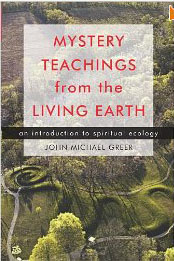
As a case in point, his most recent book, Mystery Teachings from the Living Earth (Weiser, 2012), is a reimagining of The Kybalion*, published anonymously in 1912. Greer asserts as his book’s underlying principle that “The laws of nature are the laws of spirit; this is one of the great secrets of the Mysteries.” He reworks the seven principles of the earlier book into insightful observations about spiritual ecology, framed as spiritual law. Here’s the first one, the Law of Wholeness:
“Everything that exists is part of a whole system and depends on the health of the whole system for its own existence. It thrives only if the whole system thrives, and it cannot harm the whole system without harming itself.”
The American myth of rugged individualism and self-reliance, part of the cultural story we Yanks have told ourselves over the decades, has served its purpose, and possibly run its course: it may be more of an obstacle now, in an era when we need cooperation and interdependence more than we need stoic endurance. We’re interconnected, and what I do affects you. One of my teaching colleagues always used to laugh at the idea of non-smoking sections in restaurants. “It’s like imagining there’s a non-peeing end of the swimming pool,” he’d exclaim. “A feel-good label doesn’t make it so.” I cannot harm myself without harming the whole system. But anyone buying wholesale into the myth of individualism doesn’t want to hear that.
Rather than seeing the divine as standing outside nature, here’s a way of perceiving the universe as a single immense feedback loop. Suddenly the Golden Rule isn’t just a good moral guide, but also blindingly obvious common sense. What you do comes back to you. What goes around comes around — not because “God punishes me,” or because of “karma” or “sin” or anything other than what goes in, comes out. Computer programmers know it as GIGO: garbage in, garbage out. Maybe it’s time for LILO: love in, love out. As long as we see the world as a collection of separate, discrete individuals rather than an interconnected series of networks, we’ll kill, abuse, pollute, steal, etc. And likewise, as long as we believe that we should be free to do something that “doesn’t hurt anyone else,” we live in illusion. Everything that each of us does matters to all the rest of us. We’re interconnected, linked up to each other in astonishing ways that we’re only beginning to discover.
At first this seems to dump all the guilt for why things suck squarely on our shoulders, and a lot of people today are sick of guilt. Rightly so: it doesn’t accomplish anything except to poison the heart and to distract us from moving forward. It’s only useful if it goads us into constructive action and that’s rarer than it should be. But guilt isn’t the same thing as responsibility. Accepting responsibility is the death of victimhood. If I begin to see that everything I do has an effect, a consequence, then my life matters in a way it may never have seemed to matter before.
To put it another way and quote a Wise One, “If nothing we do matters, then the only thing that matters is what we do.” In the midst of nihilism and cynicism and hopelessness, each word, thought, deed and feeling carries weight, shapes the universe for good or bad, and leaves a trail, a wake, a ripple, that will flow outward from my life now and also after I am gone. I matter, and so do you, simply by virtue of being alive and here in this place, now. To not choose to act, or to act foolishly and blindly is to waste a priceless opportunity to contribute to the commonwealth, the res publica, the Republic, this shared world of ours.
Who among us can deny that even small acts of kindness or cruelty committed by others have an effect on us out of all proportion to their apparent scale? Can we then imagine for a moment that our own acts don’t set in motion a similar set of ripples? We don’t have to be “big” to matter. Love has no size. Any is much. Blessed be this life, gift to others and ourselves, chance to act, to love, to participate in the Web, to leave ripples at our passing, to vibrate the strands with our existence and choices, to play on life and pluck its melody, note by note.
/|\ /|\ /|\
Image of Mystery Teachings: Amazon.com
You can read the Kybalion online and download a PDF of it.
One of the great gifts of Druidry is that when I feel like crap, and inclined to self-pity, Druid teaching reminds me it’s really not all about me. Not to say that I don’t matter, but that so many other things also do, and so I can gladly get lost in the immensity of worlds of other beings, and often enough regain perspective just from watching till the ego subsides again to some reasonable scale. Feel like crap? OK, then really feellike crap, docrap, be crap as only you can, then get it out of your system, the way you do with crap. Excrete! Crap isn’t forever. Even (or especially) recycled, it turns into something else, becomes nourishment and sustenance for beauty and glory and life. Give away your crap, gift that it can be, and let earth transmute it to feed something hungry precisely for what you can’t use, don’t want, can’t wait to get rid of. This is the gift of Earth, the alchemy this element offers. Blessed, fearful change.
Right now the neighbor’s dog, chained for an hour’s air to the railing on the front steps next door, is barking himself hoarse at something no doubt beyond his reach, but in between volleys, through the open living room window, I can also hear goldfinches calling near our niger-seed feeder. I look up to see five of them clustered on and around the tube of seed swaying from a tree-branch. It’s one of their favorite seeds, and my wife finally found a way to rig a feeder that keeps off our resident chipmunk family while still drawing birds.
Further in the distance, our neighbor up the hill has paused his Harley, which thrums and rumbles as it sits at the bottom of the hill drive on the far side of our yard. He’s doing his ritual last-minute check of gauges and gear before he heads out for an evening run. After he leaves, beyond that, the sound of a lawn mower fades in and out. And in the gaps of silence, wind in the trees. The true silence of dawn and late evening can feel like a cat curled up on itself, listening for its own purring. Then the downy woodpecker assaults the corrugated tin roof of our woodshed in quest of grubs. It sounds like gunfire, beak on metal, still startles us, though we’ve heard it maybe a dozen times over the last few months. Sometimes I think he does it for the pure rousing hell of it. I would.
I’ve just finished a one-week intensive at Hartford Seminary, Understanding and Engaging Religious Diversity. The class ran six day-long sessions broken only by buffet meals on-site that simply continued the discussions in a slightly different mode. Remarkable group. This last Friday morning, our final meeting, one of our classmates exclaimed seriously and humorously at the same time, “Damn you, people, you just keep changing me!” In the greenhouse of close proximity, intense engagement and curiosity, we managed to go very deep. How far are we willing to go in encounter and challenge to what we think we know and believe? What, as our instructor asked us, really is our core conviction, which — if we yielded to another’s truth, or gave ours up — would leave us different people? Can we touch that and walk away unchanged? What happens if we try to come as near as possible to that boundary? What was almost equally fascinating was where people were going right after the class ended. Some to another summer workshop, two to different destinies in India, some to new chaplaincy assignments, a couple of us on to more summer classes elsewhere, a few back to work, and I to days of recovering from a nasty bout of bronchitis, time to process it all, and to write this post. Time, the pause that earth can give. Sickness and healing, its punctuation.
Muslims, a Jain, Buddhists, Pagans, Christians, several of us of multiple faiths in one person, Jew-and-Hindu, a Buddhist-Wiccan-Sikh, and so on. And the simple and lovely ritual we spoke to each other, going round in a circle that closed out our time together: “Thank you for the blessing that you bring; thank you for the blessing that you are.” Vortex that has sanctified.
Druid teaching, both historically and in contemporary versions, has often been expressed in triads — groups of three objects, perceptions or principles that share a link or common quality that brings them together. An example (with “check” meaning “stop” or “restrain”): “There are three things not easy to check: a cataract in full spate, an arrow from a bow, and a rash tongue.” Some of the best preserved are in Welsh, and have been collected in the Trioedd Ynys Prydein (The Triads of the Island of Britain*, pronounced roughly tree-oyth un-iss pruh-dine). The form makes them easier to remember, and memorization and mastery of triads were very likely part of Druidic training. Composing new ones offers a kind of pleasure similar to writing haiku — capturing an insight in condensed form. (One of my favorite haiku, since I’m on the subject:
Don’t worry, spiders —
I keep house
casually.
— Kobayashi Issa**, 1763-1827/translated by Robert Hass)
A great and often unrecognized triad appears in the Bible in Matthew 7:7 (an appropriately mystical-sounding number!). The 2008 edition of the New International Version renders it like this: “Keep asking, and it will be given to you. Keep searching, and you will find. Keep knocking, and the door will be opened for you.”
Apart from the obvious exhortation to persevere, there is much of value here. Are all three actions parallel or equivalent? To my mind they differ in important ways. Asking is a verbal and intellectual act. It involves thought and language. Searching, or seeking, may often be emotional — a longing for something missing, a lack or gap sensed in the soul. Knocking is concrete, physical: a hand strikes a door. All three may be necessary to locate and uncover what we desire. None of the three is raised above the other two in importance. All of them matter; all of them may be required.
And what are we to make of this exhortation to keep trying? Many cite scripture as if belief itself were sufficient, when verses like this one make it clear that’s not always true. Spiritual achievement, like every other kind, demands effort. Little is handed to us without diligence on our part.
And though the three modes of investigation or inquiry aren’t apparently ranked, it’s long seemed to me that asking is lowest. If you’ve got nothing else, try a simple petition. It calls to mind a child asking for a treat or permission, or a beggar on a street-corner. The other two modes require more of us — actual labor, either of a quest, or of knocking on a door (and who knows how long it took to find?).
It’s possible to see the three as a progression, too — a guide to action. First, ask in order to find out where to start, at least, if you lack other guidance. With that hint, begin the quest, seeking and searching until you start “getting warm.” Once you actually locate what you’re looking for — the finding after the seeking — it’s time to knock, to try out the quest physically, get the body involved in manifesting the result of the search. Without this vital third component of the quest, the “find” may never actually make it into life where we live it every day.
Sometimes the knocking is initiated “from the other side” In Revelations, the Galilean master says, “I stand at the door and knock.” Here the key seems to be to pay attention and to open when you hear a response to all your seeking and searching. The universe isn’t deaf, though it answers in its own time, not ours. The Wise have said that the door of soul opens inward. No point in shoving up against it, or pushing and then waiting for it to give, if it doesn’t swing that way …
/|\ /|\ /|\
*The standard edition of the Welsh triads for several decades is the one shown in the illustration by Rachel Bromwitch, now in its 3rd edition. The earliest Welsh triads appearing in writing date from the 13th century.
**Issa (a pen name which means “cup of tea”) composed more than 20,000 haiku. You can read many of them conveniently gathered here.











 A Druid Way