OBOD’s weekly email “Inspiration for Life” offers good advice here, but frequently my question after reading is this: how exactly do I go about practicing any insight it contains? And of course part of any answer sends me back to digging through what I’ve learned. It prods me to open my spiritual toolkit once again.
Here’s a recent weekly prompt, as I think of it, for a possible focus I might take up during the week:
Don’t feel bad about feeling bad. Don’t be frightened of feeling afraid. Don’t be angry about getting angry. There is no need to give up when we are feeling depressed. Nor should we be dismayed at the grief which often accompanies the outgrowing of anything which needs outgrowing. We can be glad that our soul is speaking to us and pushing us onwards. We frequently need to persevere with a period of inner turmoil before the dust can settle and be swept out the door. — Donna Goddard
/|\ /|\ /|\
First comes an experience, and then any emotional response to it we may have. Sometimes there isn’t one, though often one comes, just not right away. My wife and I moved out of state for a promising new job, quit within a month, and moved back to Vermont in mid-September. In various ways I’ve been dealing with more fallout from that over the past thirty days than I did in late September, when the event happened, or shortly after we returned.
These delays frequently catch us off guard because of the time gap between initial event and response. Then we react to our reactions, without looking at the cause. Sometimes our secondary reaction takes up our attention and energy far more than the original experience or emotion. So we fill too many waking — and dreaming! — hours grappling with the effects of effects, rather than being cause in our own lives. And if like me you’ve truly mastered this peculiarly modern and dysfunctional art, you now feel guilty for a second, third or even fourth-level reaction: your response to your response at emotions stirred by the initial experience. How craftily we perform these perverse and twisted magics against ourselves!
Fortunately, the same skill we use in tying ourselves in knots can serve to aid us in climbing free. It needs only our fire to turn it to our purposes.
So I summon my magic, starting with the Law of Reversed Effort. Rather than resisting the guilt, inertia and listlessness, I realize they’ve become so heavy they start to drop off me, pulled by their own weight and gravity. They puddle in a mess around my feet. Stepping away, I begin to rise, calling for help if I wish from teacher, friend, familiar or other beneficent spiritual presence as I ascend.
As I rise, I pass through clouds, and then suddenly I’m above them. Here the sun shines with an intense brightness I can feel warming my skin. I continue to ascend, the earth growing smaller and smaller beneath me. It’s now a blue-green ball of coolness beneath me, the solar system around me. Then that too recedes. The whole galaxy swims around me, then clusters of galaxies, shining strands of stars and families of stars. Piercing the sphere of the cosmos like a soap bubble, I rise yet further, into another and larger universe. I slow and pause, absorbing the sense of light and freedom and expansiveness.
When I am ready, I descend back the way I came, through galaxies, back to the solar system, back to earth, and down into my body again. When I feel my physical form sitting on the chair, I savor the sense of lightness and ease, and give thanks. Then I open my eyes, savoring the gift, and record the experience.
/|\ /|\ /|\
In this world rich with experience, it’s fine that I am not always the cause. But it’s immensely helpful, in such an interconnected world, to remember that things don’t happen tome, as if I’m a stone, but for me, because I’m an integral part of the web. It’s feedback for what we’re all doing. Just this shift in awareness can begin to free me to find useful insights, spiritual tools, and paths forward, right in the middle of circumstances that otherwise may feel like dead-ends. Because choosing to be the effect of thoughts about experiences will return me to remarkably useless perceptions, like “That’s just your imagination!” which of course is perfectly true, but not, however, in the sense that this accusation comes.
Imagination is spiritual sight. It’s never just one thing. In fact, it constantly, unfailingly, eternally (internally!), tries to show us multiple, innumerable other ways to see, to perceive, to understand, to celebrate, to create. It shows us ourselves, and everyone and everything else, as we can be. Not in a Disney, fluff-bunny or Hallmark sense, but in the truer sense of potential buried and awaiting all the transformations that human consciousness is designed to achieve and manifest. Here, where it’s needed most. In the middle of the sturm and drang, the drama, the doom, the headlines, the media chatter. Yes, right in the middle of it all, a birth, a growth, a flowering.
Imagination at work is nudging the roll of the cosmic dice, when the Dungeon Master sets us to establishing who and what we will be in this iteration of the Great Game. Because we know we’re the dice, the throw that sets them rolling, the twinkle in the eye of the Master, and the numbers that come up which we then agree to play with, as well as the Players themselves.
/|\ /|\ /|\
Or if that package of metaphors doesn’t work for you, fire is always burning. Honor it. We decide what to use it to ignite, warm, inspire.
Air is always breathing and flowing around us. Respect it. We decide what to breathe on, and endow with careful attention, thought, planning, symbolism, imagery.
Water is always pooling and rippling. We decide what needs nourishing at the roots, where the true dream lives, what we deeply feel, and how our hearts guide us along the paths we instinctively know already. Acknowledge it.
Lastly and most kindly, earth is ready beneath us, supporting us, stage for manifesting all we make of our lives from this moment forward. Love it.
/|\ /|\ /|\
Peering out the windows of this train at strange new territory passing by, talking with curiously-attired strangers in the car, supping with voices and images of beasts and birds in my ears, dozing off with conversations still echoing. You know, the life of a writer obsessed for a time with characters and story.
At 27,201 words, I’m somewhat under my target word-count for Nanowrimo. The lovely impossible experience of any sustained period of writing means the simultaneous tyranny of daily word-sprints and counts and updates and bemoaning the calendar and days passing, along with a complete, blissful disregard for all these things, as I bathe in a refreshing pool under gentle sunlight, that has appeared in the middle of my story, a moment of solitude surrounded by moss and mists and a distant valley calling me to explore.
But what about the moments when something outside of us, without our conscious intention or instigation (or with it), announces itself to us?
You know — those times when no circle or congregation, no rite or prayer has claimed us in our striving, and something reaches out to us of itself.
Dream, presence, deva, spirit, ghost, exaltation, angel, mystery, expansiveness, ecstasy, cosmic consciousness, god/God — a hundred names for what well may be a hundred different things. But each or all of them qualitatively different from you and me. The shiver, the awe, the freaking out, the reverence, the fear, the adoration, the Other. Or so virtually every description of these encounters suggests. And yet we’re intimately linked to them somehow, or we could never experience them in the first place.
What to do with this mass (and mess) of human experience? Religions often attempt to categorize, naming some portion as legitimate or amicable or “good”, and others as impostures, as frauds, as inimical or “bad”, and setting forth ways to grapple with it, to formalize human interactions with it.
On the other hand, with almost no consistent measure except the subjective available to it, science has for a long time typically dismissed the whole category as incoherent, though psychology and recent advances in neuroscience have begun to rehabilitate the subjective as a domain for serious study and insight. Or to put it another way, “The visible clings to the invisible”, say the Wise. WTF? says science.
So we devise rituals as one way to tame and investigate the subjective. Whether we go to wild places on a vacation or a quest to find ourselves, whether we spend too much to attend weekends and workshops on soul retrieval or finding our inner warrior, whether we rise and kneel in the pews, stand in Pagan circles, or renew our prescription to the current drug of choice, we try out options to scratch the itch of the Holy. Sometimes it’s merely a single mosquito bite. Sometimes it’s a whole-body rash.
Looked at one way, then, by pursuing a Druid-Christian approach we’re doubling our odds of successful encounter and engagement. Looked at another way, we’re muddying the waters, profaning the well, treading the old syncretistic path that usually ends not in transformative encounter but at best in a bland, safe vanilla spirituality void of those tradition-specific commitments that give each tradition its spiritual punch.
How to experience both living god/God and living earth? We wouldn’t have endlessly fracturing Christian denominations if “Jesus people” had a lock on things. Nor would we continually feel the need to hive off and fracture and splinter and regroup in virtually every other way as Druid and Pagan practitioners, either. Rather than seeing these things as weaknesses, we could celebrate them, always asking for integrity in ourselves first and foremost: what do we seek? What purpose does it serve? Who benefits?
Funny how the same questions never lose their applicability. Avoid personal integrity, and we squander our time demonizing opponents rather than incarnating the Holy in our words and deeds. Both difficult to access and continually present, the Holy is a paradox singularly appropriate for humans, who rarely make things easy for themselves.
Whether it’s solstice dawn or empty tomb, death or birth or other experience of transcendence, we seek communion, drink from a common cup, listen to and watch each other’s words and faces for signs of that contact, that connection. And when a strange-familiar wordless joy overtakes us, we try to put it into words for each other, as I do here, to pass it on.
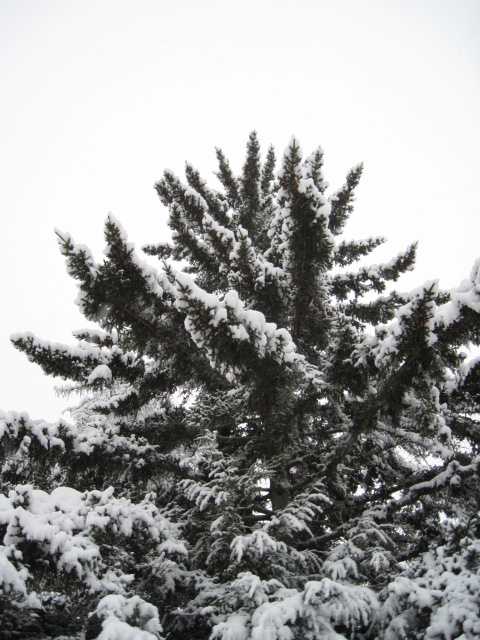
Front entrance — my office, where I write this blog. Winter ’16.
May the Holy light your roof and bathe you in itself.
May the season offer you its generous portion
and open the door for gratitude.
May you turn to joy rather than despair
to nourish and sustain you in your trials and triumphs.
The blessings of your life to you,
rooted in each day’s grace and gift.
“You can’t just draw a circle, step inside, and say it’s sacred. You just can’t!” said an acquaintance this last weekend.
In fact, you can.
“I can call spirits from the vasty deep”, says Glendower in Henry IV, Part 1 (Act III, sc. i).
“Why, so can I, or so can any man. But will they come when you do call for them?” responds Hotspur.
It’s a valid question.
We say “it’s sacred” the same way we say we love. It’s wishful thinking, or it’s meant to seduce, or it spills over from a heart already overflowing. Or a hundred other things. And we can usually tell the difference, being the fine-tuned crap detectors that millennia of gossip sessions rubbing shoulders with the neighbors have made us. If not, give it time. And as Zora Neale Hurston quipped (about love), “Everybody can do enough to satisfy themselves, though it may not impress the neighbors as being very much” (Dust Tracks on a Road, pg. 203). The same holds true for ritual.
Access to the sacred is the big-ticket item, and if you’re at all insecure about your own access, you’re more likely to try tearing down the competition.
But rather than argue from a position of dogma, if I really want to know rather than simply score cheap points, I need to join the circle numerous times, attend mass the same number of times and then — maybe — I might be able to compare notes. Adjust as needed to fit the two practices I’m intent on assessing. And most important of all, deserving of seeming to be tacked on at the end here, because I’m saving the best for last: I need to bring equivalent reverent attention and curiosity to each rite. Otherwise, why bother?
/|\ /|\ /|\
So we begin our rite together, Druid and Christian, Christian and Druid:
Now ask the beasts, and let them teach you,
and the birds of the heavens, and let them tell you.
Speak to the earth, and let it teach you,
and let the fish of the sea declare to you. [Job 12:7-8]
We call to the great bear in the starry heavens, power of the north …
We call to the hawk of dawn soaring in the clear pure air, power of the East …
We call to the great stag in the heat of the chase, power of the south…
We call to the salmon dwelling in the sacred pool, power of the west …
[OBOD ritual, adapted]
/|\ /|\ /|\
More than anyone else in recent decades, Isaac Bonewits looked at ways to improve liturgy. Yes, we can connect with spirit, with the holy, in any number of ways, and on our own. But when we do so publicly, communally, we usually do it in ritual. How can our rituals be good? And then, how can they be better?
Pacing is something that anyone familiar with the theater will tell you is absolutely crucial to the success of a performance … The only way to learn pacing is to experiment a lot with modular design and to rehearse the people in your group to find their skills and limits. A five-minute guided meditation may be too long for some groups, too short for others. Taking thirty seconds to bless each person in turn is fine if you only have a small group, but can be a disaster with a large one. A chant that naturally builds to a peak in three minutes should not be dragged out for ten. Many problems with pacing are solvable by artistic means, especially musical …
We may think one rite’s sacred and another isn’t, in other words, when what’s really going on is the holiness is leaking out of a rite through inattention to theater. It was, after all, a burning bush and not a burning blade of grass that God used to catch Moses’ attention.
For private rites, I ponder Jesus’s counsel:
When you pray, don’t be like the hypocrites. For they love to pray standing … on the street corners, so people can see them. Truly I tell you, they already have their reward. But when you pray, go into your inner room, shut your door, and pray …
Private circle, inner room: we set apart sacred space in order to perform a (second) sacred act, just as much as we perform a sacred act in order to set apart sacred space.
In a 2013 post I wrote that when I remember the ancestors,
I make my very own Samhain-on-the-spot, the veil between the worlds thins, and I converse with the dead, with the Otherworld, with the generations stored in my DNA and blood and bone. Perhaps you could call it racism in the best sense of the word — a celebration of all who have gone before me and who, by living, have delivered me to this moment of my own life, as I write these words. It doesn’t last, but it also endures forever.
Samhuinn is remembering and honoring connection. One reason it looms so large in Pagan practice is simply that the essence of ritual is connection, and successful ritual means good relationships. On social media like Facebook, we think that we decide if we’re “in a relationship” or not. Westerners in particular like to imagine we’re free, among many other things free to choose. But many of our relationships that matter most aren’t matters of choice. Our existence itself, as a part of this universe of beings, is the first and greatest example. So the biggest “relationship” question often isn’t whether but how: how will I maintain good relationships — with myself, with other beings, with the planet?
In language many Pagans would find congenial, Catholic priest and eco-theologian Thomas Berry writes* (in The Great Work):
…we will recover our sense of wonder and our sense of the sacred only if we appreciate the universe beyond ourselves as a revelatory experience of that numinous presence whence all things came into being. Indeed, the universe is the primary sacred reality. We become sacred by our participation in this more sublime dimension of the world about us.
“Religious naturalist” Loyal Rue makes an immense and related claim,** deserving (as I try to approach such things) neither acceptance or rejection at first, but simple meditation and reflection:
The most profound insight in the history of humankind is that we should seek to live in accord with reality. Indeed, living in harmony with reality may be accepted as a formal definition of wisdom. If we live at odds with reality (foolishly), we will be doomed, but if we live in proper relationship with reality (wisely), we shall be saved. Humans everywhere, and at all times, have had at least a tacit understanding of this fundamental principle.
And we see a movement among some Christians towards a center that Druids and other Pagans also strive towards. Michael Dowd, former fundamentalist and author of Thank God for Evolution!, writes:
I am an unabashed evidential mystic—a sacred realist, a Christian naturalist. Reality is my God and evidence is my scripture. Big History is my creation story and ecology is my theology. Integrity is my salvation and doing whatever I can to foster a just and healthy future for the full community of life is my mission.
In Arthurian tradition, the Lady of the Lake gives Arthur his sword, affirming his right to kingship, and she receives it back again when, mortally injured after the battle of Camlann, he is borne away to Avalon to be healed.
We can see the Lady as a exemplar of Sovereignty, right relationship to the cosmos. As a representative of the inward reality that lies behind our outward world, she initiates and instructs the king — metaphorically, the archetypal “royal line” in all of us. Demonstrating again and again through her actions that leader and land are one, she shows that psychic wholeness and healing can never be isolated or merely individual. We are communal beings. Hermits and recluses often report dreams filled with people, a compensation for their outward communal “drought”. The famous Grail question points to this same reality: “Who(m) does the Grail serve?” Not just the one who finds it or achieves it! The cheap and shallow English labels “winner” and “loser” simply do not apply.
If we connect with our ancestors in the largest sense of the word, with our physical forebears and also with anyone who has helped us to reach who we presently are and may become, we may begin to see that even in spite of what may be our best efforts to live only for ourselves, we still end up contributing to the entire cosmos. Whether that contribution makes us worthy ancestors to those who will come after us is another matter, and our individual and communal charge.
/|\ /|\ /|\
Interlude — a different preview of Edinburgh’s annual and marvelous Beltane Fire Society Samhuinn celebration. Samhuinn can provide us with a mirror to see ourselves as ancestors (don’t we all “see through a glass darkly”?).
Right relationship — the first ritual goal I will strive to keep in mind as I finish drafting my personal Samhain rite.
This evening my wife and I will gather with another couple a few miles away. We’ve shared several of the “Great Eight” festivals before, sometimes with a formal ritual, at others with that most ancient ritual of all, friendship, food and fire. One partner of the couple often faces a difficult time at Samhain, due to her psychic awareness and to past bad experiences with the day. So for us sometimes the kindest ritual is not to celebrate Samhuinn in any formal sense at all, but simply to be present and grounded ourselves, and to help be grounding for her.
A fire can help burn away negative energy, and making a practice of imaginally gathering and tossing into the fire any negative energy, to be consumed and returned to its elements for the cosmos to rebuild into healthy and balanced forms, is appropriate work. Doing it physically and unobtrusively can also be part of maintaining the fire.
A blessed Samhuinn to you all.
/|\ /|\ /|\
*Berry, Thomas. “The Wild and the Sacred,” in The Great Work. New York: Harmony/Bell Tower, 1999, pg. 49.
**Rue, Loyal. Religion Is Not About God. Piscataway, NJ: Rutgers University Press, 2005, pg. 135.
What would you teach a young person asking to apprentice with you for the wisdom, skills and insights you’ve gained in your life? And how would you go about teaching these things?
The season itself encourages me to be mindful of such things. With its focus on harvest, completion, the Ancestors, and with my own middle age upon me, it’s natural to take stock and ponder what’s most worthwhile out of all the experiences and insights a human accumulates over several decades.
Before going any further, why not take a few minutes and write down your responses to those questions in the first paragraph above?
/|\ /|\ /|\
What follows is one half of a possible conversation with the other person.
“Thank you for asking. You honor me by bringing these questions to me. In turn, I’ll start by asking you what you’ve learned so far. We build on what we already have discovered, so this is a good starting point. Let’s go for a walk — you choose the direction.”
“One way to begin to answer these things for yourself is to look at times in life when you are happy, or totally engrossed in whatever you are doing. What were you doing, and what did the experience feel like? No need to hurry toward an answer. We can talk again in a few days. Time for a cup of tea or coffee, right?”
“What would go on your ‘favorites’ list? You know — favorite colors, places, animals, people, activities, etc. These things can be a source of comfort, encouragement and energy when you need to recharge or rebalance. Turning to them consciously and gratefully and making them a regular part of your life can assist you greatly. And they can be keys to explore further, and develop as part of your personal toolkit for living. For instance, carving out space and time to practice them, and making a physical space where they are represented, can make a surprising difference in our experience of each day.”
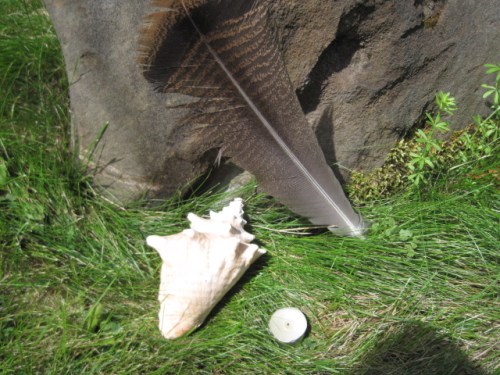
“For some people, these can become doorways to a profession or career. For others, they become rituals and practices to restore and rebalance. For still other people, they can become spiritual symbols and subjects for meditation and insight. Here on my table altar is a hawk feather I found while my wife and I were looking at property here in Vermont. It was a teaching symbol that continues to remind me to pay attention to small signs. Because way beyond random probability, they can often turn out to be big signs.”
“What kinds of things are you good at? If you don’t know or aren’t sure, start asking and paying attention. Everyone has certain latent strengths, talents and abilities. It may be that others have already helped you find some of them, or have encouraged you if you’ve started showing or practicing them, but you can find them on your own as well. They may not always be things that others value right away, but you probably practice them anyway. In fact, some of the things we can be shy about are often things we deeply value and don’t want to expose to others’ opinions or judgments, so we keep them hidden. In spite of what Western culture tells us, there are such things as good secrets. Respect your own sense of when to open up about them, and when to keep them private. Or if I’m listening to the wisdom of plants and trees, build my root system first, then flower second.”
“If you’re wondering about what we’ve been talking about so far, or if you’re thinking they don’t seem very spiritual things, you’re partly right. We often undervalue such things, or think they don’t matter, or overlook them when we’re considering ‘matters of real significance’. Yet all these things make up part of the value of each individual. Each of us has importance, and each of us has core purposes we can discover and fulfill.”
“One powerful way to grow and learn is to serve. You hear a lot about service, and about ‘selfless service’. But I’ve found that the most balanced service is one that we may enter knowing we’ll benefit along with others, but not worrying about that either way. We serve because it’s another way to be grateful for what we’ve received. But we also serve because the universe makes us curious, and service takes us places we can reach in no other way. It connects us to people and places and other beings who we can help and who can help us. Service builds relationships. It’s a form of love. Though it may sound very strange to say it, loving another person can be a form of service. That includes loving ourselves. If we think about the numbers of unhappy people in the world today, loving ourselves is truly a vital and desperately needed form of service.”
“Finding something larger than myself and connecting to it is the only lasting source of happiness and fulfillment I’ve found. We long to feel deeply that our lives matter, and that kind of connection brings meaning and purpose and a deep sense of rightness. We may connect to a craft or art or skill, and we may connect to another person or organization or movement. During my life, I’ve moved around a bit among these at various times. Some people find one way to connect and spend their entire lives with that single way. But like everything else, there’s no single ideal way for everyone, but simply the way that works best for you right now. This isn’t something to believe, though you can if you want to, but it is something to test and try out and determine its validity for yourself.”
“Extending these insights into the practice of a craft, an art, a religion or spiritual path, an organization or cause or profession, are each natural developments of the initial urge and instinct to serve and to express our talents and abilities. A god or gods may help us focus our service, or become the center of what we do. But our service may not take that particular form. Our judgments about others’ choices will always be incomplete. To know our own purposes and priorities is the task of a whole life. We can honor others’ choices and give them the freedom to choose just as they give us that same freedom. There’s a deep test: does my practice afford others the freedom to choose? And does their practice offer me that same freedom?”
“In this world of time and space and change, there is a spiritual adage whose insight I’ve learned the hard way, repeatedly throughout my life. And it’s this: each day’s rhythm means we must re-win our spiritual freedom for that day. It’s an ongoing practice, not a single achievement. In fact, it’s the substance of our service.”
“Winter doesn’t mean Summer has failed”, says one of my teachers. It’s not a competition, though sometimes our seasonal myths and stories can make it seem like winter and summer take turns through time in “winning” and “losing” and grudgingly parcelling out the year between them. (It’s more a tussle between lovers.)
North, early morning, October
And if the world follows its cycles of manifestation, so do humans who live and grow and die and are born here. After all, we’re one of the things the universe does. That mountain ash is as well, and this solitary bee sunning itself on the east wall of our house this October morning, and taking flight in a sudden thrum of wings as I walk past, lugging the laundry.
I’m stingy enough (if you’re kind you can call it thrifty) that I pause under the clothesline a moment, savoring the October calm and light. Sorting through clothespins for the large ones, I calculate how much I’m paying myself per hour to air-and-sun-dry the laundry, rather than spend money for electricity to do the job.
Either it’s the clothesline in good weather, or the drying rack indoors, with a fire in the stove. Labor-intensive, but easy on the wallet. The day’s weather forecast, rather than traffic and distance to the laundromat and spare quarters on hand, is my guide. As a builder-acquaintance of mine likes to say, you have to earn so damn much just to save so damn little. If I can remove one more homely task from that cycle, it’s a victory. In the process, I recover simple pleasures like the scent of laundry the sun has loved all day long.
Could we find a guide as useful for whenever we plunge into any particular cycle of manifestation? After all, I don’t want to pour more energy into working the ground, if the time for planting is already here. Or plant, if it’s harvest-time and a frost looks imminent. More and more I’m starting to see where to focus. Which signals from the universe deserve my attention? What guides me to alertness about these cycles and my part in them, and what distracts and diverts and wastes my energy?
Ah, you know the feeling as well as I do. How did it happen last week that I squandered what looked like a crest of inspiration and passion, a peak where I knew I could do what I longed to do, and managed to throw myself into the depths of a trough instead? Was it noise rather than wisdom that tugged on my attention from the outside, and drew me aside from my goal? Some samples — the voices we all hear, that seduce us from our best interests: “You should W. Or X is so terrible that you must Y. Or you can’t Z”, and so on, and on. I wake up enough from time to time to ask myself, “Since when have strangers known better than my own inner guidance what’s in my best interests?!”
So I have a map for manifestation. Is that enough? Can I locate more guidance?
Well, how about my reasons, my motive, my intention? Whom does the Grail serve? one such teaching asks us. Druid koan, a question the universe is always asking. Who benefits? If we serve only the self, we’re cutting off half the flow that’s possible for us. As distributors, as channels, as manifesters of awen-inspiration and life and energy, we can always open to a greater flow. Isn’t that our deepest desire, to feel life pass through us on its way to a worthy purpose? To have participated fully in the marvel of existence? I don’t know about you, but that’s the richest and most thrilling experience I know.
What do I need in order to work with the entire cycle?
It’s for the good of the whole. That doesn’t mean cutting myself out of the cycle of manifestation, out of some misguided understanding that I must sacrifice my own happiness or well-being to realize what I desire. I’m also part of the cycle, which is incomplete without me. I am one of the means by which the universe achieves manifestation. Rather than the tired, old (and often untrue) “A chain is only as strong as its weakest link”, how about “Each of us is part of the Spiral, and also reflects the magical whole in our uniqueness and creativity”?
Altar of the South, ECG ’17
And because we can peer across and around and occasionally beyond Time, and get glimpses of the Pattern or the Web, we can work from a larger vision of any goal, from full participation in the cycle. Do our best, and then release it, trusting the intelligence of the universe, as it manifests in our teachers and guides, in bird and beast, beech and bug, and the shapes and fortunes of our own lives, to help us tweak and revision and adapt as manifestation cycles through.
This post on creating a usable Celtic ritual language continues a number of previous posts on the subject.
Why do such a thing — create a new Celtic ritual language, rather than master an existing Celtic tongue, when all of them struggle to survive and need all the support they can get? Better yet, why not instead devote the same energy and time to creating rituals, songs, poems, prayers in the language of everyone who will take part? In a word, why be obscure?
Because language is — or can be — magical. Because sometimes we need the power of audible speech that means something only to us. Because a ritual language, a holy tongue, carries its own potency, apart from matters of practicality. Because a dedicated language, like anything else, accrues value and energy and strength precisely because it’s been set apart, treated with care and esteem, as a thing worthy of respect. Because if you go to the trouble of creating a ritual language, I assert that you honor the gods just as much as you do by learning an existing one. Because there’s a world of difference between theft and inspired imitation.* Because a vow, a dream, a burst of awen guided you to do so.
Here’s the prayer that opened the post linked to above:
For the gift of speech already, I thank you.
For the gift of a Celtic tongue I will make,
let my request be also my gift to you in return:
the sound of awen in another tongue, kindred
to those you once heard from ancestors
of spirit. Wisdom in words, wrought for ready use.
May your inspiration guide heart and hand,
mind and mouth, spirit and speech.
/|\ /|\ /|\
So in the face of loud and rude reasons not to, you follow the urging to create a ritual language anyway. The Celtic world tugs at you, your practice draws on Celtic imagery, myth and folklore, and you opt for a Celtic language over a (re)constructed tongue native to the land where you live. (The possibilities of a Native American conlang deserve a separate post.)
Resources abound for such a project. After all, we have six surviving Celtic languages — Breton, Cornish, Irish, Manx, Scottish Gaelic and Welsh. We have reconstructed Proto-Celtic, we’ve got inscriptions in other extinct Celtic languages, and we have a couple of centuries of linguistic analysis that helps to clarify grammar, word derivations, pronunciation, etc. Beyond that are several Celtic conlangs of varying degrees of realism and fidelity to the historical Celtic languages (like Arvorec, Brithenig, Caledonag, Galathach, Proto-Brittonic, etc.).
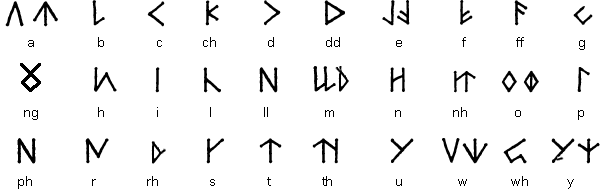
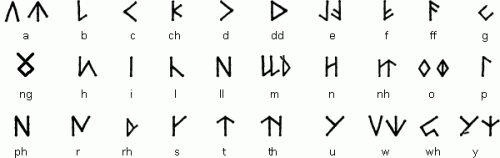
In addition to language proper, we’ve got scripts, too, like Ogham and the Coelbren alphabet. An embarrassment of riches, truly.
Coelbren alphabet
/|\ /|\ /|\
So where to begin?
I’m partial to P-Celtic, or Brythonic (Breton-Cornish-Welsh), so that’s my starting point, rather than Q-Celtic or Goidelic (Irish-Manx-Scots Gaelic). But take your pick. It’s your flavor of awen, after all.
We can assemble a basic word-list of a few hundred items pretty quickly. In an hour, you’ll have enough for simple phrases even as you continue to tinker. For help, Omniglot has gathered some useful comparative lists to launch you, and so has this Wikipedia comparative table. (Mostly it’s the vowels that may need tweaking, but that can wait until later.) So we’ll start here with a small sample:
den: man [dehn]
dor: door [dohr]
gwreg: woman [roughly goo-REG]
plant: child [plahnt]
ti: house [tee]
ci: dog [kee]
mab: son [mahb]
tir: land [teer]
mam: mother [mahm]
mor: large [mohr]
neweth: new [NEH-weth]
bihan: small [BEE-hahn]
drug: bad [droog]
gweled: see [GWEH-led]
bod: be [bohd]
Every word above has clear cognates (“relatives”) in Welsh, Breton and Cornish, so we’re on very solid ground so far. Aim for a consistent pronunciation, write it down so you remember, devise a simple key as in the brackets above, and you’re on the way.
We know Brythonic, like Goidelic, had a definite article, for which we’ll choose an. So we can say “the man, the woman”, etc.: an den, an gwreg.
(We can address how we might want to handle those infamous Celtic sound changes later. To give just one a quick example, feminine nouns historically change their initial sound after the definite article, so we might include a rule that gives us gwreg, an wreg; mam, an vam, etc.)
We know that Celtic adjectives typically follow the noun they modify, as in the Romance languages:
an tir mor: the large land
ti neweth: new house
mab bihan: small son
ci drug: bad dog
We know that Brythonic, like the Celtic languages generally, makes phrases equivalent to English “the door of the house, the child of the land” by juxtaposing the words: dor an ti, mab an tir. (Again, we can work out any sound changes later.)
In addition, we know that Celtic often favors a verb-first sentence order (a simplification, but a useful starting point), as if in English we said “Sees the man the dog” instead of “The man sees the dog.”
So we can construct simple sentences:
Bod an gwreg an tir. The woman is the land.
Gweled an mab an ti mor. The son sees the large house.
Now this should serve to show the beginnings of what’s possible without earning a graduate degree in Celtic Studies. If you’re creating solely for yourself, you can follow the promptings of your guides, ancestors and awen. A dream, a book, a contemplation or a museum visit may inspire a particular project: a prayer, a chant or song, a rhyme or invocation, a simple story.
If you’re creating for or with a group, other factors may arise. How complex do you need the grammar? What kinds of things do you want or need to say? How regular and intuitive should the pronunciation be? Are others working directly with you in expanding the vocabulary, or are they asking you as their tribal bard for original and translated rituals and prayers in the language?
For instance, Celtic has an invariable relative pronoun, given here as “a”, which lets us make sentences like this:
Bod hi an gwreg a gweled an tir neweth. She is the woman who sees the new land.
Your choices as you create, after awen, the gods and common sense each have their say, operate in a cauldron that balances flexibility, regularity, variety and ease of use. Like any recipe, season to taste.
*A note on cultural appropriation — as John Beckett suggests in his The Path of Paganism, “always credit your sources, never pretend to be something you’re not, and steal from the best”. To put it another way, all cultures borrow from each other, or die.
Feeling from the West, and from the South the fire of intention set on slow burn. Now on to thought, consciousness, intellectual discrimination — the original sense of the word, that priceless ability to make distinctions, not our unfortunate modern meaning-shift of imposing them hurtfully on our brothers and sisters. Properly-made distinctions distinguish between stupid and wise uses. Distinctions by themselves are inert, lifeless. They need human consciousness to animate and manifest them.
ECG directional banner for East and the Hawk of Dawn. Design by Dana Driscoll.
But often, feeling is first, before thought, before reflection. We feel and then think about it, even as we experience and then reflect on what happened. e e cummings captures it perfectly in his love-poem of that name:
since feeling is first
who pays any attention
to the syntax of things
will never wholly kiss you;
wholly to be a fool
while Spring is in the world
my blood approves
and kisses are a better fate
than wisdom
lady i swear by all flowers. Don’t cry
—the best gesture of my brain is less than
your eyelids’ flutter which says
we are for each other: then
laugh, leaning back in my arms
for life’s not a paragraph
and death i think is no parenthesis
So much here, in the “syntax of things”, the pattern and web that bards sing of. Here the Bardic impulse lives: thought in the service of feeling, shaping in words what comes first in emotion. So we continue to turn counterclockwise to work our spell, from feeling to intention and now to perception, clarity, naming what first was wordless. My spellchecker flags my initial typo “worldless” — true as well, because without thought is no distinct world, for feeling floods everything, without the distinctions of thought.
We flow liquidly from feeling to feeling, not bothered by the categories and parameters and boundaries of thought. But feeling, if it’s to lead to anything other than the next feeling, needs the mold and shaping power of thought to give it direction and focus. Thoughtless feeling blunders and bumps into things, knocks over both bad and good, never noticing the wreckage. But wise thought charged with feeling bears a rare potency.
How marvelous that thought is also magically linked to spring, to beginnings and formative activity! The freshness of new thought, the airiness of clean perception is indeed Springtime. And the cosmos invites us to say, as cummings poem announces, “we are for each other”. Because as another Bard reminds us, “no man is an island, entire of itself”. (What do they teach in schools nowadays? We’ve long had that wisdom laid out before us that we need to navigate difficult times. True Bards have always been out in front, pointing and singing us to our heart’s deep desire.) We are kin, family, relatives. The Lakota know it, calling the cosmos mitakuye oyasin, “all my relatives”, winged and footless and four- and two-footed.
It’s in the Western world in particular that we’ve carried individualism too far and made a cult of it, set up altars and applied ourselves to worship. Friendships and families, strained. Human connection breaking. The Me generations are reaping the harvest of being cut off from the cosmos. Sever the link to the worlds, cut the original umbilicus that was never meant to break, and we’re just “stupid bags of skin”, to quote yet another philosopher. Beings who live, and die, alone. Sad, and wholly avoidable.
Thus to thought, to link us up, to relink us, Latin religare, from which comes the noun religio, a relinking. The multitude of shapes and forms that religion can take testifies to mental creativity. Almost anything shaped with love can help to relink us to what we need to truly live. Lose the love, though, and any form empties out pretty fast. It can’t serve its purpose without feeling, any more than it can without thought. Without the heart, religion dies. Without the head, it’s brain-dead at birth.
Of course, if we leave religion in the hands of thieves and scoundrels, we’ll get the same result we do when we leave governance in similar hands. But that’s on us. Religion well-practiced can relink us to what nourishes and feeds us. When (not if) it’s not doing that, it’s always time to wrest the reins from the hands of the incompetent and the malicious. Little wonder we’re in a spiritual-but-not-religious age. But the spirit needs a container, a form, a shape, to embody it in a world of bodies, forms and shapes. A formless spirituality may work for spirits, but we have bodies while we’re here, and an embodied spirituality will almost always serve us better.
So I light my fire, I meditate with an image, I write and draw and dance and do ritual to embody what I want to celebrate and remember and welcome into my life and the lives of those I practice with.
And I write about some of that here.
/|\ /|\ /|\
As this blog approaches its 6th anniversary and 50,000 hits, I again want to thank all of you who visit and read. Site statistics tell me more of you stay than leave, which in turn tells me I’m talking about things that matter enough to you that you come back, and wrestle with some of the same issues, and attempt to make of your lives something worthy of the gift of life we’ve been given.
Like so many truths, the title for this post is both a truism and a guide.
Want to perceive something? Set it in high contrast to something — often, anything — else. Human consciousness, biologists tell us, is built to detect patterns and contrasts. Among other things, consciousness is a sophisticated survival mechanism. What stands out from the background may be friend, food or foe. That’s one good reason why we won’t be color-blind any time soon, any more than we typically ignore hair or eye color, gender or height or clothing. These are all vital signals that convey information too useful to ignore.
Fire, full moon, night, autumn — as my wife said, after we’d sat for an hour talking and fire-gazing, “It’s very grounding.”
Why not “ground and center” with fire? Oh, I know the reasons: earth helps neutralize imbalances, reconnects us to our physicality when we may be lost in thought or feeling, and so on. Earth’s a great insulator. It helps deaden psychic forces, just like eating meat does after intense ritual or magic or a nightmare. Ground and center, that basic of Pagan practice, one that renews itself as we walk our paths.
But sometimes if I’m too grounded, neutralized and banked and bermed, I need fire. The centering’s still crucial — focus is part of our struggle in this age of so many distractions. In this case, it’s “spark and center”. (With water or air, then, it can be “bathe and center”, or “breathe and center”.)
Kindle me to action, don’t drug me to inertia. In our age of rampant anti-depressants and opioids, you might say we need new prescriptions if we’re to flourish and thrive as the gods invite us to do.
And by “kindle” I don’t mean “prod me to outrage”. That’s a “flash in the pan”. I’m going for a slow burn, the kind that makes good stews and soups, that’s perfect for barbecue so tender the meat falls off the bone, and the ashes keep warm for hours after the flames have died down.
That’s also the kind of kindling that keeps me warm through winter. In this counterspell to our times, I turn us counterclockwise, from West in the last post to South and Fire. As we edge toward Winter in the northern hemisphere, I evoke Summer in us. After all, my preparations of food preservation and stacking firewood and insulating and covering and closing all aim to shelter the sacred fire within.
It takes sacred fire to understand sacred fire, so I lit one last night. Like any dedicated practice, and like all good ritual, action and prayer embody each other.
In these times, the sacred shines all the more brightly by contrast.
Here we are, autumn of the year, gathering the harvest of what we have sown, both bitter and sweet. Hail to the West, place of the setting sun, of evening, of fullness and reflection and maturity.
ECG ritual banner of the West. Design by Dana Driscoll.
West, traditional place of feeling and intuition, and in this cycle, the moon waxing toward fullness, too. I know: in the associations of many tables of correspondence, West is the waning moon. Why not attune to what will light the sky this evening, rather than a pattern that obviously doesn’t fit the moment? Tonight I’ll sit at my fire-circle for an evening contemplation, open as I can to what comes.
With the full moon can come illumination of what was previously hidden. We move in cycles, nourishing some causes and energies in the unconscious, till they move into awareness and we can assess whether they work to our advantage.
Larger cycles concern nations and planetary systems, whole species and immense and intricate patterns, while smaller ones shape our communities and individuals. Disasters and tragedies will keep coming, whether through deeply-rooted patterns in human psyches, or in natural cycles of change, disruption and rebalancing.
After a hurricane, rather than recriminations, it’s most useful to serve obvious need. Likewise after a human tragedy like a shooting. Let my sympathies rouse me to understand causes better, work for change, or open my compassion in concrete forms of aid. Otherwise, am I doing anything more than muddying the astral waters?
Emotional reaction has its place — we feel what we feel — but it can most lovingly be grounded in prayer, ritual and contemplation, and action, for my own good as well as for the good of others. Look to your own self first. the beginning point of all thought and action, counsel my inner guards and guides.
Here’s a first draft of a ritual meditation I’m still working on:
Earth in my hands, my gaze to the horizon,
I cast fear away, hate away, anger away.
clearing the bodies for health.
Water in my hands, my gaze to the wells of spirit
I wash in love, I bathe in compassion, I cleanse with caring,
clearing the springs of the heart.
Fire in my hands, my gaze to the flame of purification
I burn away limitation, I incinerate obstacles, I ignite useful anger,
clearing the will for further growth.
Air in my hands, my gaze to the way of wisdom
I conceive a change, I know a change, I understand a change,
clearing the mind for action.
I don’t say these things because they’re easy, but because they’ve proven themselves to me to be among the best responses over time, and the best ways to take a pro-active stance as well. They’re a practice, something I find worth doing in itself like any practice worth the name, and for healing needed so plainly and deeply.
Here’s the second half of the set of values I began looking at in Part 1.
Let go and move on.
Set goals.
Care for self and others.
For a nation that claims to be forward-thinking and looking, we’re accumulating an impressive ability to lick old wounds and live in the past. “Times were better when” can afflict the best of us. But even if it’s true, I live now, not then, and I need to begin with what I have today. I’m older (any “wiser” part is an independent variable).
If I’m listening to here, safe in my home cosmos, and honest with Deep Self, I already have a foundation to build on (“here”, “safe” and “honest” are the first three values from Part 1), one that lets me proceed to the next three steps. (Hint to self, or Self: they’re not necessarily steps in a sequence. Repeat-practice any as needed. Each also offers me an extended theme for meditation.)
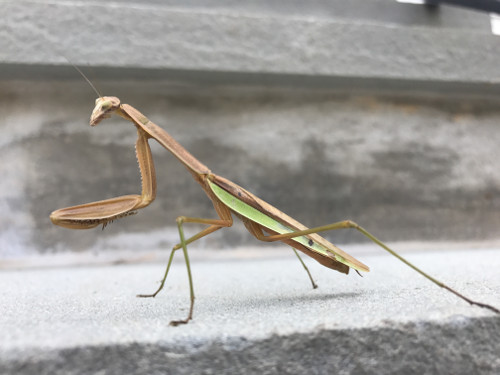
Mantis, 4 Sept. ’17. Photo courtesy Jodi Klue.
Mantis, you landed on nearby steps to interrupt a casual conversation a few weeks past, so this time I invite an image of you here to do the same. You become a prayer I can pray often. Let me see interruption as spiritual opportunity, the green world and all the persons in it as companions and allies and teachers, not adversaries. If you offer difficult gifts, I will not just refuse them outright.
You are my divination and message-bearer. (Yes, “sometimes a bird is just a bird” — until awareness greets it like a friend, with understanding that makes good sense of experience. Nothing has the “final word”. The Spiral opens onward, even as it offers rest and respite. Keep questing.)
Plainly you’re turning with the year, the vibrant green of early adulthood now muted, brown as leaves that carpet the yard and driveway. Hunter, are you weary? What have you seen with those complex many-faceted eyes? The power of awen: the empathy to enter other lives and know them, to sing their energies and possibilities, to feel slender legs beneath me, two powerful ones raised and ready to clutch. To sing and die and rise again, to thread the labyrinth of time.
Ah, shape-shifting is a mighty way to “let go and move on”! We do it each night in dreams, a practice I can extend to waking hours. Who can I become to know this world better? What links of sympathy connect me to all life? How does this moment offer doorways into what the cosmos needs next? How can I serve? Out of self and into Self and into other selves. Brother fox and sister hawk, I hear you breathing, your lungs contract and fill in my own chest.
Sometimes I can serve by setting a goal. Let me take the last two practices together: I set a goal to take care of myself so I can take care of others. After all, I can only serve if I CAN serve. How often I misunderstand self-sacrifice! If I can only perform the sacrifice once, chances are I’m limiting myself.
O wisdom-guide, you whisper, Often the best sacrifices are ones you can keep doing. The point isn’t burnout. Make it sacred, sacri-fice it, so you can make it sacred again.
Those of us who attended the recent East Coast Gathering are resuming our “mundane” lives. How to integrate the vision and energy of a Gathering, or any time of intense spiritual uplift, back into daily living is a perennial challenge.
But slowly I am coming to see that I need to “get spiritual” just so I can begin to see that the “mundane” is also absolutely overflowing with spiritual energy. We need to re-charge, yes: so we can flow again. Or to put it another way, my ability to tune in to a seemingly “ordinary” interaction in line at the supermarket, or pumping gas, or climbing the steps at work can transform the apparently mundane into a spiritual connection. The “apparently mundane” in all its flatness and dullness is our workshop, laboratory, spiritual opportunity. Empty canvas. It’s easy to perceive and ride the spiritual currents during events like ECG. Then I get to practice during “everyday life”. I am transformer, I am catalyst, I am pathway in and of myself. It can always begin again with each of us.
East Coast Gathering’s host camp. Photo courtesy Krista Carter-Smith.
Once again the Tribe — as many as could attend — converged on a hilltop in northeastern Pennsylvania near the autumn equinox for the 2017 OBOD East Coast Gathering. Some travelers contended with the after-effects of Hurricane Irma, others with more personal challenges. If you can make the effort, you experience the reward.
This year featured a Croning Ritual honoring nine women who requested this rite of passage, and a coming of age ritual for a young member. As Druid (and other Pagan) groups mature, similar opportunities will continue to arise to commemorate and honor such capstone events of our lives.
/|\ /|\ /|\
The spirits of the Land know us and often have a message for those among us who can hear them. And this weekend in particular we were urged simply to listen — more on that later.
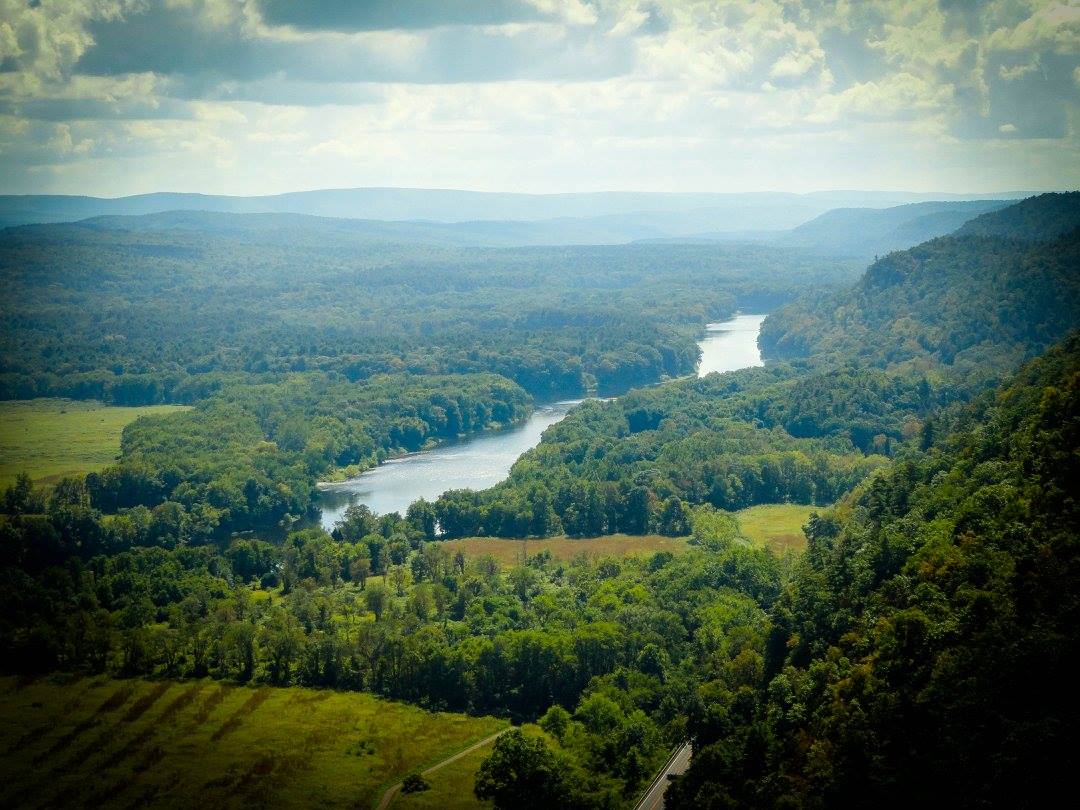
The Land near ECG. Photo courtesy Gerfalc Hun.
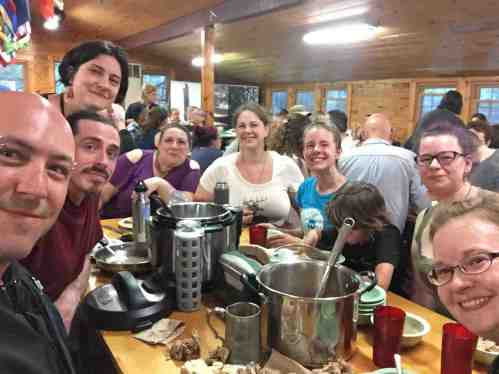
The overriding theme this year, twinned with our official theme “Discovering Awen: The Bardic Arts”, was clearly gratitude. Our delight poured forth on the several Facebook pages we frequent. Again and again, attendees wrote of their thanks to others for simply coming. With their presence and conversation, workshops and smiles, they reminded us of the beauty, fellowship and vitality of our chosen path.
Members of Mystic River Grove. Photo courtesy Dana Driscoll.
This year marked my seventh Gathering in the PA hills. ECG opened its gates in 2010 and has subsequently given birth to the Gulf Coast Gathering and, last year, to MAGUS as well, the Mid-Atlantic Gathering (my review here).
Once again the event sold out quickly, and once again part of the draw, besides reconnecting with friends, was our special guest, this year the Chosen Chief of OBOD, Philip Carr-Gomm.
Philip and his wife Stephanie had been in the States longer this time. They’d just come off the previous weekend of giving workshops with the Green Mountain Druid Order in north central Vermont.
OBOD Chosen Chief Philip Carr-Gomm with attendees. Photo credit Elysia Cook
/|\ /|\ /|\
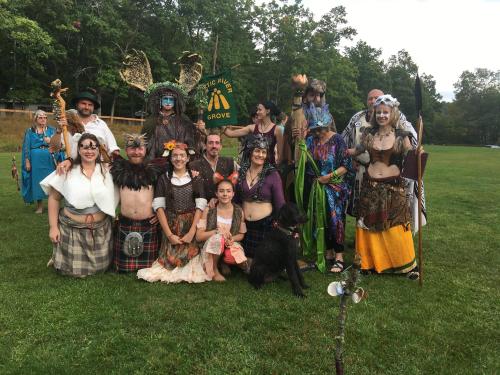
Partly to honor the Chief, the Opening Ritual received special attention. Mystic River Grove, with members across New England, prepared thoroughly.
Mystic River Grove prepares for Opening Ritual. Photo courtesy Gerfalc Hun.
Because of a new job, Saturday was the only day I could attend, so I made the most of it, rising early and driving to camp to arrive at breakfast.
Saturday included the main Equinox ritual, as well as a lunchtime talk by Philip, Ovate initiations, and as always the bonfires to draw the Tribe together after nightfall. I missed the Opening Ritual, ably led by Mystic River Grove, the oldest OBOD group in the States. The pictures hint at how marvelous it was.
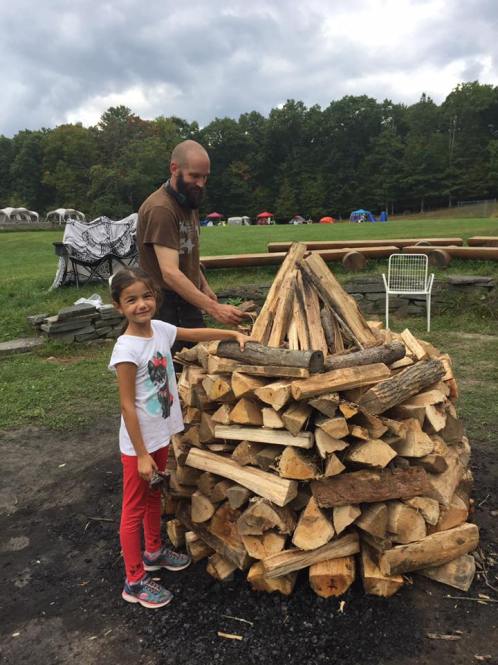
Brom putting the final touches on another masterpiece, with Alkandra helping. Photo courtesy Nadia Chauvet-Thanasoulas.
Interior of a camp cabin — home for the Gathering. Photo courtesy Jo Ami.
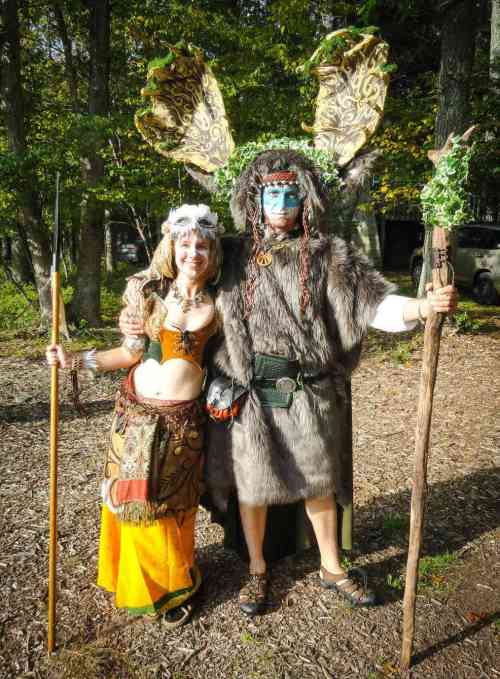
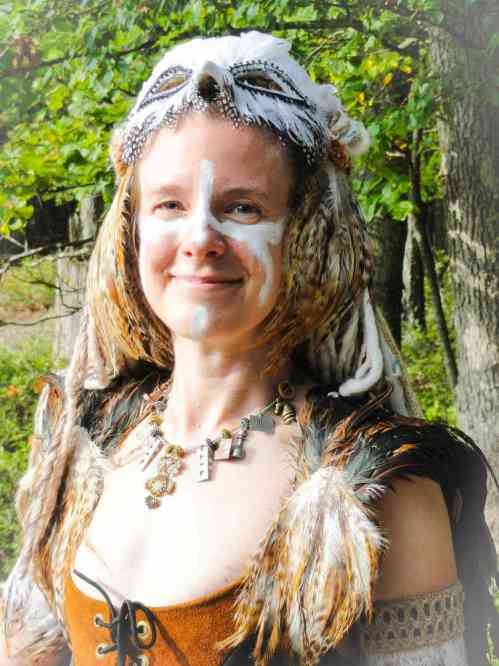
Cat and Gerfalc of Mystic River Grove in ritual garb as Owl and Moose. Photo courtesy Gerfalc Hun.
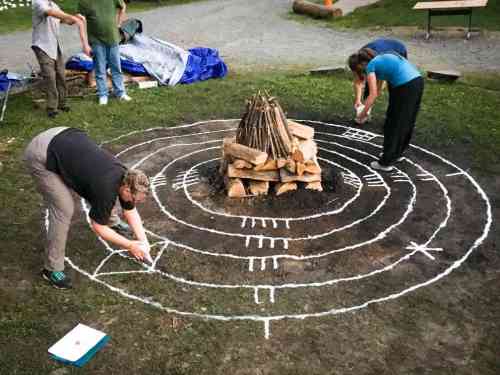
Loam introduced us to the Indian practice of rangolee or kolam, a form of ritual painting with rice flour. Below you can see the rangolee ogham (a splendid merger of Hindu and Druid traditions!) taking shape in the fire circle.
Loam and a friend laying rangolee, ritual painting with rice flour, around the firewood. Photo courtesy Gerfalc Hun.
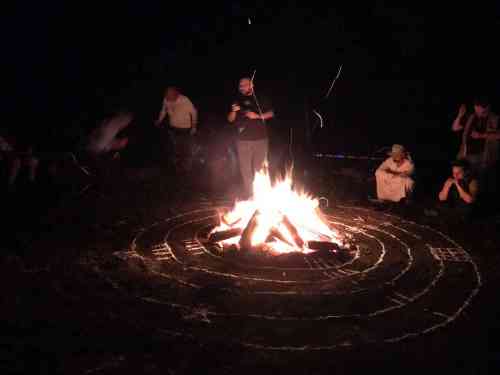
The unusual warmth of the weekend spurred me to stay robed from the afternoon ritual all the way through until the evening Ovate initiations. (Thank-you’s again to my wife for choosing a very breathable fabric when she fashioned my robe!) I’m sitting and gazing into the fire below. The rangolee remain vivid in firelight.
After the Saturday evening Ovate initiations. Photo courtesy Steve Cole.
Cat spearheaded the ritual planning and mask-making for Mystic River Grove’s Opening Ritual. Here she is as Owl. Photo courtesy Gerfalc Hun.
Sarah F. as Salmon for Mystic River Grove’s Opening Ritual; she also served as Grove Mother during initiations. Her long-running astrology blog always has something to teach. Photo courtesy Gerfalc Hun.
“Again the Labyrinth” — Cat gathers a team to set up the scores of electric tea lights in paper bags, switching them on and later off each night. Photo courtesy Steve Cole.
Late Saturday — last night of the Gathering, people linger
“May the harmony of our circle be complete” go the words of standard OBOD ritual. If we’re growing at all as Druids, we keep getting reminded just how large our circle is.
Those who attend the Camp before and after us each year all contribute their energies, and not everything meshes automatically. But in particular, Druids can imagine themselves more in tune than others, and this in turn can lead to an arrogant obliviousness to what the Land is actually saying, and to a disrespect of the expressed wishes of the non-human inhabitants. As guests, the messages ran, we can do better.
As a result of the experience of past years and this year in particular, by both organizers and some attendees, and messages received from the land spirits of the Camp, next year’s Gathering will reflect a change in approach and perspective. These changes will appear on the ECG website. Listen, respect, celebrate. Old lessons, perennially new.
Here’s to the spiral of 2018!
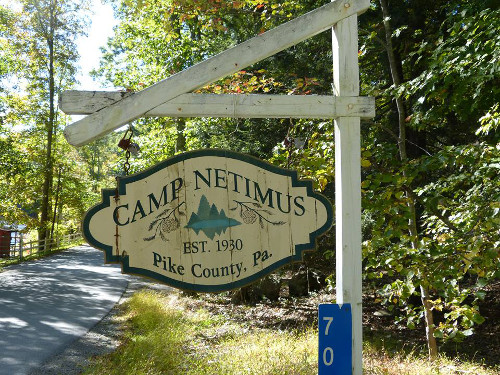
Trees of Camp Netimus. Photo courtesy Elysia Cook.
Melas commented thoughtfully on the previous post, and I’d like to reflect on his words here. In trying to explore the questions he raises, ultimately I end up pushing hard against my own doubts and understandings and probable prejudices. By this I mean I’m mostly arguing with myself, not Melas. So here goes …
First, Melas’s initial observation:
The poem, though short, is moving, especially upon a reflection, as you have provided. Without considering the poet’s evident meaning or original intention, I’d venture upon a somewhat different interpretation than yours, that is, one based on my traditional views. Let us at least agree that ancestry bears some degree of importance in any tradition of polytheism; the difficult questions are, how much, and what if one is of mixed ethnic ancestry?
I’ll add to Melas’s two “difficult questions” here and make them four: Does ancestry in fact matter, how much, what if one is of mixed ancestry, and does polytheism affect the issue one way or another? (One or many gods, or none, we all have the same energies to work with. Or do we live in wholly different universes simply because we group and name and work with these energies differently?) To continue a theme from the previous post, if we consider a person of Greek descent whose ancestors for at least ten or more generations were most likely Orthodox Christians, is practicing Hellenismos, reconstructed Greek polytheism, a comfortable or straightforward way to find harmony with these most recent ancestors, to enlist their aid, or to maintain their tradition? Or consider the opposite: is the Orthodox Christian angering all those ancestors who preceded Christianity? Is it merely a numbers game?
When I welcome ancestors — the occasionally monotheist, sometimes pantheist, intermittently polytheist being that I am — I invite those sympathetic to me, one of their descendants, today. (Who else, after all, would want to come? Think of those family events you’ve tried to escape!) In this sense, ancestry is indeed everything. I’m here because of them, and with them rest both my gratitude and reverence. But I face choices and challenges both similar to and different from ones they faced. I have ancestors who were Christians, Pagans, atheists, agnostics, animists, polytheists and shamans. How do we sort out such identifications and allegiances?
Do the last thirty generations of so of Christian ancestors of varying degrees of devotion and wisdom trump hundreds of generations and more of pre-Christian ancestors? Will the polytheists among them fight the monotheists in the Otherworld, or at my ritual circle? Does more recent ancestry matter more than the more ancient strains? OBOD’s standard ritual includes a declaration of peace, without which no work can proceed. Those who work the rituals can attest to the power of that declaration, and to the tenor and energy of the rites that follow. What we do, and who we welcome, matter here and now. A feast is ultimately for those who actually attend (though even to be invited is pleasing, too). To paraphrase Jesus, many are called, but fewer are fed.
King’s poem in the previous post acknowledges his
people
back to the beginning of
life,
In the witness of the gods
and the ungods
Back to the beginning: bug and bird, beast and beech tree. I suspect, one of the words I prefer to use in place of believe, because it captures both my doubt and my intuition, that such matters as commitments and practices from one life may recede when we drop the body of that life. We work on what we need to learn. If we truly do experience all things as we move through each circle of existence and awareness, as some Druids teach, then so do our ancestors along their journeys. Some things we give up, even as we take on others. (Some will follow us through many lives.) Whether this time around I was baptized into the “right” church, or offered the traditional gifts to welcome my spirit guide on my vision quest, may matter little compared to our enduring work along the Spiral of all beings to learn and grow in strength and love. And from what I’ve seen, we’re all slow learners. The Spiral is large and long.
Melas comments:
To the first [how much does ancestry matter?], I would say as much as possible, since a connection by blood is an inner force and connection (literally and figuratively) that can’t be replaced easily or dispensed with as unessential. I am not wholly Greek in ancestry, but my ancestors are partly from neighboring nations, and therefore choosing for me is easier than someone half-Greek and half-Chinese. In such a case, it would be best to take a side, I mean join one tradition without scorning the other, since large distance is inconvenient and causes confusion in the mind and heart.
When the choosing is clear, the choice can align the chooser quite effectively within a tradition that can be a solace and a guide, a source of strength and identity. Today many are still born with such a clear ancestral heritage. In such a case, it may indeed “be best to take a side, I mean join one tradition without scorning the other”. Perhaps Americans feel more keenly the “confusion in the mind and heart” that Melas talks about, with our often mixed ancestries. Confusion may result, whether the distance is physical, cultural, linguistic, genetic, spiritual, psychological, etc.
But should I then be a Christian, because everyone in my immediate family was, and because though I’m deliciously mongrel in many ways, most of my more recent Swiss German, English, Welsh, French, and Scottish ancestors were Christian as well? (I have transcripts of letters from one ancestor eight generations back, admonishing her children to strengthen their faith in trying times.) Should I be Catholic, or Protestant, or provoke ire on all sides and practice a blend of Christianity and Druidry?
Candomble ritual, Brazil
And I call to mind people known to me personally, who don’t count among their keys to identity a genetic match in this particular life to a particular tradition that nonetheless calls deeply to them. Is there no place for an Asian or African in an often Euro-centric tradition like Druidry? Most traditions of Druidry I know welcome all who come with good will and an open heart, regardless of DNA. And that feels right to me, and to many others. Does that weaken the tradition, or strengthen it? Or indeed not affect it either way?
What are we to make of those whose inner experiences orient them toward traditions outside their apparent genetic heritage? What of the Euro-American adopted into a Native American tribe? The person of mixed ancestry who practices two or more traditions, a syncretism that seems more the rule than the exception, if we look at human history? Many homes in America find ways to honor a colorful braid of ancestral strands, Latino and Jewish and Thai, Catholic and Native American and Nigerian, etc. Haitians practice Vodoun, and Candomble and Santeria flourish in many places in the Americas — syncretistic forms all of them.
Santeria initiate
What of other new traditions, and restored ones, among people who already have a clear cultural and genetic identity? Native Americans have established the Native American Church, a distinctive set of beliefs and practices blending Christianity and shamanism, with sacramental use of peyote. As a Wise One once quipped, “There is little nature likes so much as to destroy old forms and then create new ones like them”. Do the ancestors of Native tribes ignore their descendants because of this innovation? I suspect — that word, again — that the ancestors either haven’t figured out yet, or worry about it a great deal less than we do.
Melas closes:
This point of the essential connection between ancestors and polytheism is too often overlooked nowadays, and I think it is dangerous. If we don’t stick firmly and mainly to a certain tradition and people (again, without scorning others), we expose ourselves to the uneasiness (sometimes misery) of uncertainty, and further we render traditions unlasting, empty and jumbled by removing distinctions from them.
Does the distinctiveness of a tradition depend on ancestry, or on honoring the ancestors? I see these as different things. I may know next to nothing of my ancestry, or through misinformation and deliberate ancestral deception I may believe things that are inaccurate, but the existence of my ancestors is still indisputable. And what of ancestors of spirit, those who have taught and trained and nourished me though we have no kinship by blood? They matter equally to me and to many others. Are such calls outside our blood the calls of those ancestors?
In the end, I’d argue that the distinctiveness or value of a tradition is simply this: does it meet the needs of those who practice it? Does it nourish the heart and spirit? Does it answer our innermost cry? If it does, it thrives and flourishes: wethrive and flourish in it. If it doesn’t, then like all things in this world, it changes or dies. It may be distinct, but dead. We contain, but also surpass, all that we do. That’s time-bound, however wonderful it is. And we live in more than one world at once, acting in each. But each of us is also still a seed, a potential, waiting in the earth, even as along time’s spiral we fruit and die, sprout again and blossom. The world shows us that much every year.
Irish poet Dennis King opens his poem “Altú” “Grace” like this: “I láthair mo mhuintire …” “In the presence of my people …”, finding reason in human existence itself for thanks. So often we need gratitude most when we feel it least. But on to the poem:
In the presence of my
people
back to the beginning of
life,
In the witness of the gods
and the ungods,
In homage to the
immense
generosity of the universe,
I give thanks
before my portion.
I’m going to do the English teacher thing you and I both have learned to detest: take a perfectly good piece of writing and analyze its parts. My goal, however, is not some obscure symbol-hunt or post-Modern Deconstructionist manipulation, but the pursuit of wisdom. What can this poem teach me?
First, King acknowledges witnesses. I live in the presence of my people, whether I belong to an extended family of the living, by blood or choice, or to the default tribe each of us can claim, one among a host of ancestors. All we do and are takes place in their presence. We don’t need to summon, invoke, or invite them, though it’s a courtesy in ritual, and it serves to remind us we’re companioned always.
Look in the mirror and you see the ancestors in eyes, nose, hair, line of jaw and length of limb. Consider what goes deeper than skin, and you can find them in your temper, your tastes, native tongue, social class and assorted beliefs and prejudices. Yes, you’ve added your own variations on these themes, and many of these you can shift to some degree through chance and choice and effort.
Send off for the increasingly popular DNA check, and you may find, depending on the accuracy of the particular test, that your tribe includes ancestors from unexpected places, that you can claim roots in many lands — that you even have something like a choice of tribes, if you’re looking to trade labels or identities.
Hellenic ritual
If the genetic test runs true that my father’s cousin ran a few years ago, I have some Greek ancestors, though family trees I’ve received and researched back ten generations or more on both sides offer no hint to explain an “8% Hellenic background”. But what does thatmean, anyway? Wanderers, all of us, with ancestors as human, amorous, deceitful and restless as any of our relatives alive today. If because of all this I opt to worship Zeus, Athena, Hermes or Dionysos, they may or may not deign to notice. It’s an option for me, of course, and there are Reconstructionist Hellenists today who are reviving the old ways, Olympian style. But is that my call, or calling?
“Back to the beginning of life”, King continues. Whoever played a part in launching this whole enterprise of living, “gods or ungods” or lightning zapping the primordial chemical stew of a young Earth, we’re here and thinking (and drinking) about these things. And so these possible witnesses deserve acknowledgement, too. Why?! Because whether or not they exist, to remember and honor them even for a moment does me good. It enlarges my sympathies, and sets my life in a field much larger than what my social security number and bank PIN code and town tax ID and physical address suggest I am. We’re more, I hope we keep remembering, than the boxes we check on the endless forms we fill out. No single identity can define me, so why insist on just one? Pagan, white, childless, married, cancer survivor, writer, heterosexual, teacher, male: any one of these, and many more, could be a life-project to explore. Does one contradict or deny another? Does a census or a faction or political party or church begin to define me? Yes, you say?
Who are the true “authorities” in my life? Ancestors of scores of millennia, or a few political office-holders of the current arrangement, fulfilling one piece of their own lives by holding up one political system among how many possibilities? “I am large”, says Walt Whitman. “I contain multitudes”. (Easy to say, Walt, if no one insists on you being small, single, unitary, one thing only. Box checked, census complete, status once-and-for-always. But how large a claim about me, this thing I was born into, am I willing to assert?)
To exist at all is gift. “In homage to the immense generosity of the universe”: what would my life look like if I lived it daily in such homage? Can I begin to imagine it? Could I begin today, in small ways that could build over time?
“I give thanks before my portion”. Physically before: there it is, on plates and in bowls and cups. And temporally: before I take any of it into my body, I thank. Not after. Gratitude, how many doors can you open?
My portion: each of us has a part, a piece, a portion. If you’re a Christian, and you take Communion, the bread and wine or grape juice represent, or become, the inexhaustible blood and body of God. We eat and drink god-stuff, ungod-stuff. Our portion is endlessly refilling, and replenishing. To find and know and cherish my true portion: another project worthy of a life, of living.
One of the great pleasures of the “Great Eight” seasonal festivals on the Wheel of the Year, if you have a group to celebrate with, is the unique combination of private and community rites that can mark each season. They can merge and nourish and colour each other in subtle and provocative ways.
I’ve written here about my own recent private rite consecrating a new fire circle. Earlier today I hosted a small group rite of Lunasa.
Card drawn before the rite from the Arthurian Tarot: the Grail Hermit. Caitlin and John Matthews’ deck provides rich material for meditation. A partial interpretation: while group ritual is important, personal communion with the Source and its many guises is crucial to balance. I don’t need to “go anywhere” to find the Grail or the inner hermitage, but I do need to make an effort to allow them to manifest in the busy-ness of my life. I note too that some things can only be discovered and mastered alone. A group can become a distraction if its main contribution is more busy-ness and not useful centering and grounding in practice. That’s a message that’s still deeply applicable to me and my practice.
The hanging over the door of the Hermit’s hut is purple, with a golden image of the Grail on it. The royal road of true spirituality calls us to claim our spiritual identity as heirs to an inner kingdom. As with all above-below and within-without paradoxes, the apparent poverty, obscurity and simplicity of the Hermit contrast and foreshadow the spiritual wealth within. One clue: the fire burning in the clearing.
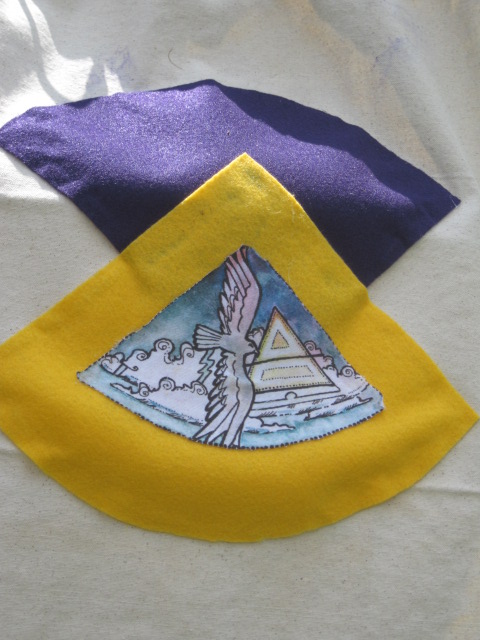
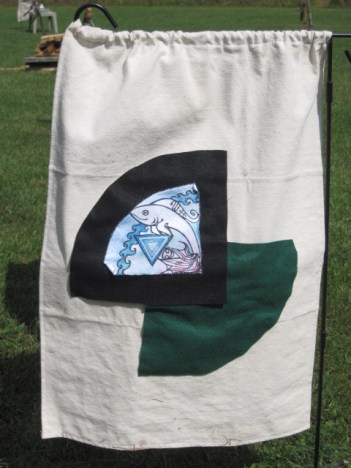
For the group rite we made space in our weaving room with looms and fibers for backdrops. Appropriate for the Weaver at the Loom, Shaper of All!
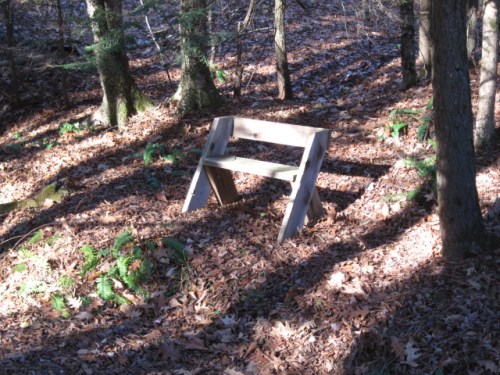
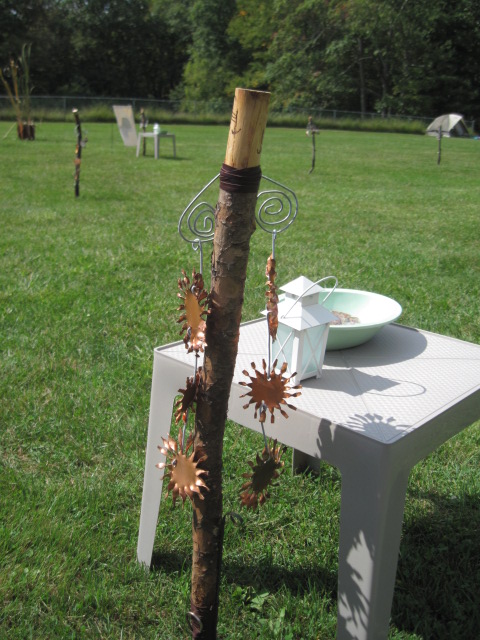
Here on the altar the firsfruits: blueberries, candles, a sheaf of grasses, corn meal and ritual objects sheltered from the weekend of rain.
Halfway through the rite, the thunder receded, the rain stopped and the sun emerged.
Hail Lugh, hail Earth Mother. In the words of the ritual — her words — “I will nurture you … I will comfort you … I will bless you through all the days of your lives”.
Thanks to BW for composing and leading our ritual, and to those who celebrated with us.
/|\ /|\ /|\
Matthews, John and Caitlin. Illustrated by Miranda Grey. The Arthurian Tarot. Aquarian Press, 1991; 25th anniversary edition, Connections 2015.



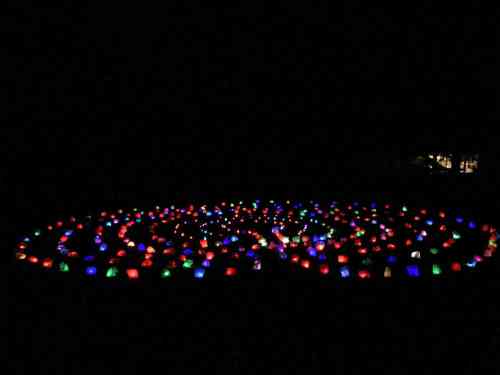
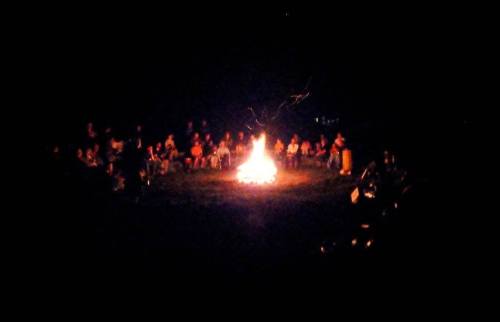
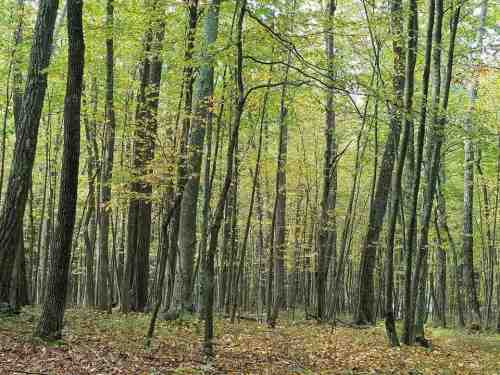
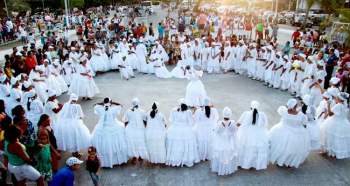

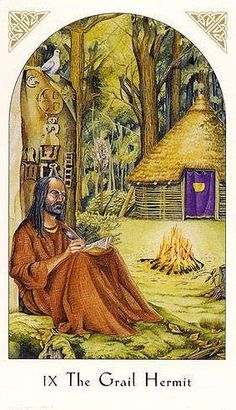 Card drawn before the rite from the Arthurian Tarot: the Grail Hermit. Caitlin and John Matthews’ deck provides rich material for meditation. A partial interpretation: while group ritual is important, personal communion with the Source and its many guises is crucial to balance. I don’t need to “go anywhere” to find the Grail or the inner hermitage, but I do need to make an effort to allow them to manifest in the busy-ness of my life. I note too that some things can only be discovered and mastered alone. A group can become a distraction if its main contribution is more busy-ness and not useful centering and grounding in practice. That’s a message that’s still deeply applicable to me and my practice.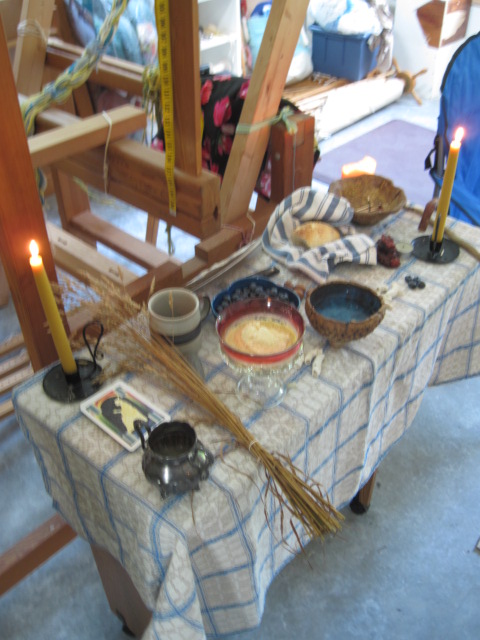


 A Druid Way