Hail, Goddess. I will go with what I know,
with what you show: you give me
nine runes, nine paths of storm;
you tell me their wisdom lies in riding changes,
walking the storm-paths. So I ask how
I may serve in return for your gift.
Speak how, instead of squaring the circle,
to try circling the square. Not to share
exact shapes [of the runes], but their greater principle
you may share. [For] they form a sequence:
linear as you received them, but also
a circle or spiral. Four by three, and three by four:
ending and beginning lie side-by-side,
or — you will understand it —
directly above and below each other,
[on] different rounds of the spiral.
The Runes of Thecu combine straight lines
and circular shapes — lines of force
and vortices or whorls [of energy in motion].
How to ride changes?
Practice [with the runes] to find out.
And I will guide you.
How to transcribe what you receive in such instances? Well, the obvious answer is this: you do the best you can. And you ask, usually more than once, for clarification.
Let me puncture any mystery here: the words I attribute above to Thecu came during three intervals. The first and second, along with runes, over the past week, in two separate periods of meditation. The first led to the insight that Thecu was offering guidance on how to walk “nine paths of storm”, and a preliminary sense of what that might mean. The first five runes also came then, drafts scribbled on scrap paper, as I tried to get their shapes to match the different flows of energy my inner experience felt like it conveyed. The same thing a second time, two days later.
Then this morning: I already knew I was going to write about this, and I’d made a draft, along with the admonition I’d received not to share except in general terms the insight of the runes. So in about five minutes the above lines came, as I attempted to pull together fragmentary notes about the runes and render the impression of those meditation sessions into something more like continuous speech.
Are they “the words of the goddess”? Sure. Also, no and yes. In keeping with the deep wisdom of unverified personal gnosis (UPG), they’re meant to be tested and tried out, to see how their truths work for me. One key to practice, and it can be disconcerting, is to shift from “UPG mode” to “critical thinking mode”. I get this stuff in ways similar to how I get pieces of poems and stories. And it’s the same kind of thing: then you have to figure out what to do with them. Sometimes the message, image, metaphor is clear. Other times, it needs shaping or untangling. And to keep honest about proportions of these things has indisputable value, but not — it needs to said as well — spiritual primacy. The impulse-message-insight-inspiration needs to get recorded before, like such things do, it flows away like cloud.
And I share this experience for what it’s worth to others who may encounter similar impressions, nudges, doubts and insights. What to make of such things? For me, it’s to see how and where they might fit in living my life, and whether their usefulness, if any, merits passing along anything about them to others. So I serve notice here most of all to myself. Any value to this experience will emerge, or not, in and over time. And I will try to report that here.
We can of course take an a-gnostic approach to all of the above as well: I sense changes coming (no surprise at all, given the state of the world!) and my imagination/subconscious is throwing up images, ideas, tools, hints to help me deal with them. Useful, wholly apart from the nature of their origin, because they’re intended to be empirical: their value lies in what they can do, what I can do with them. Who says the imagination or subconscious has no practical value? In some ways, that’s the ONLY thing it has.
Site statistics for the last post drew readers from surprisingly varied lands: Vietnam, South Africa, Argentina, Ukraine and Latvia among them. I highlight these simply because their national languages aren’t English (with the exception of S. Africa). Not only are readers there interested in Druidry, but they’re seeking out English-language media that talk about it.
“Show us applied Druidry and we’ll pay attention”, you’re saying.
Here’s a follow-up, an excerpt from my “post-mortem” journal entry after the ritual. Because “feels” don’t really tell the whole story, as you’ll see. How I think a ritual progressed, and the whole picture with every factor included, can be two different things.
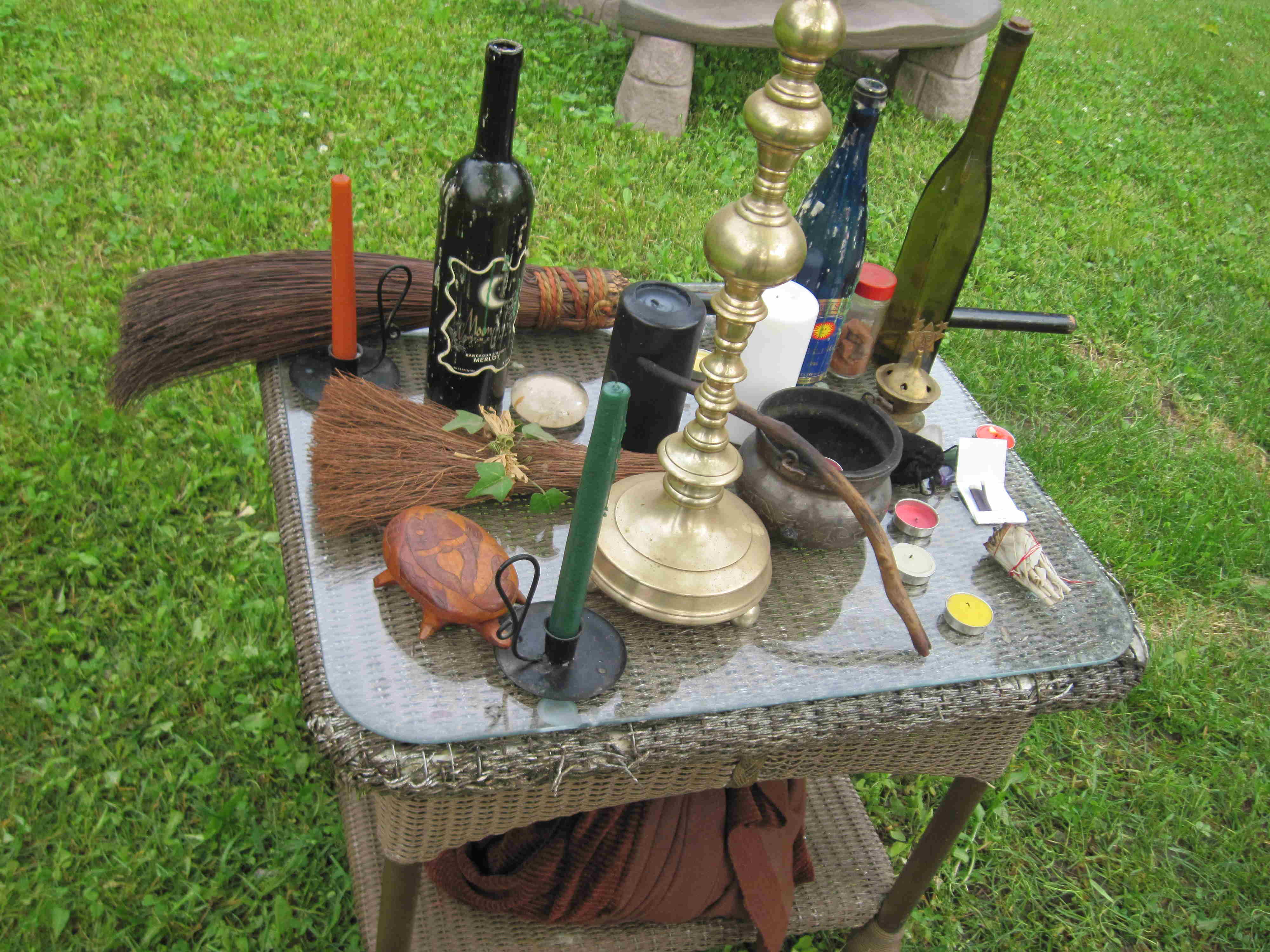
First off is the ritual set. You know: state of mind, weather, time of day, preparation. Alert. Noticing many animal presences, especially ants, flies, aphids, grasshoppers. Slightly edgy, the way I often feel when stuff’s going on I know I don’t otherwise notice. (Material for later meditation there.) Weather sunny and clear, 73 F (23 C). Approximately 2:00 pm. Preparation minimalist, with a few objects I was led to choose in meditation earlier that day. (Barely visible, behind and below the cup to the left/north sits a black Cherokee owl cup, containing objects from my first OBOD initiation, along with a symbol of the wild boar, one of my animal guides. (Yes, in one sense this wasn’t “minimalist” at all; I’d pulled out all the stops for this rite.)
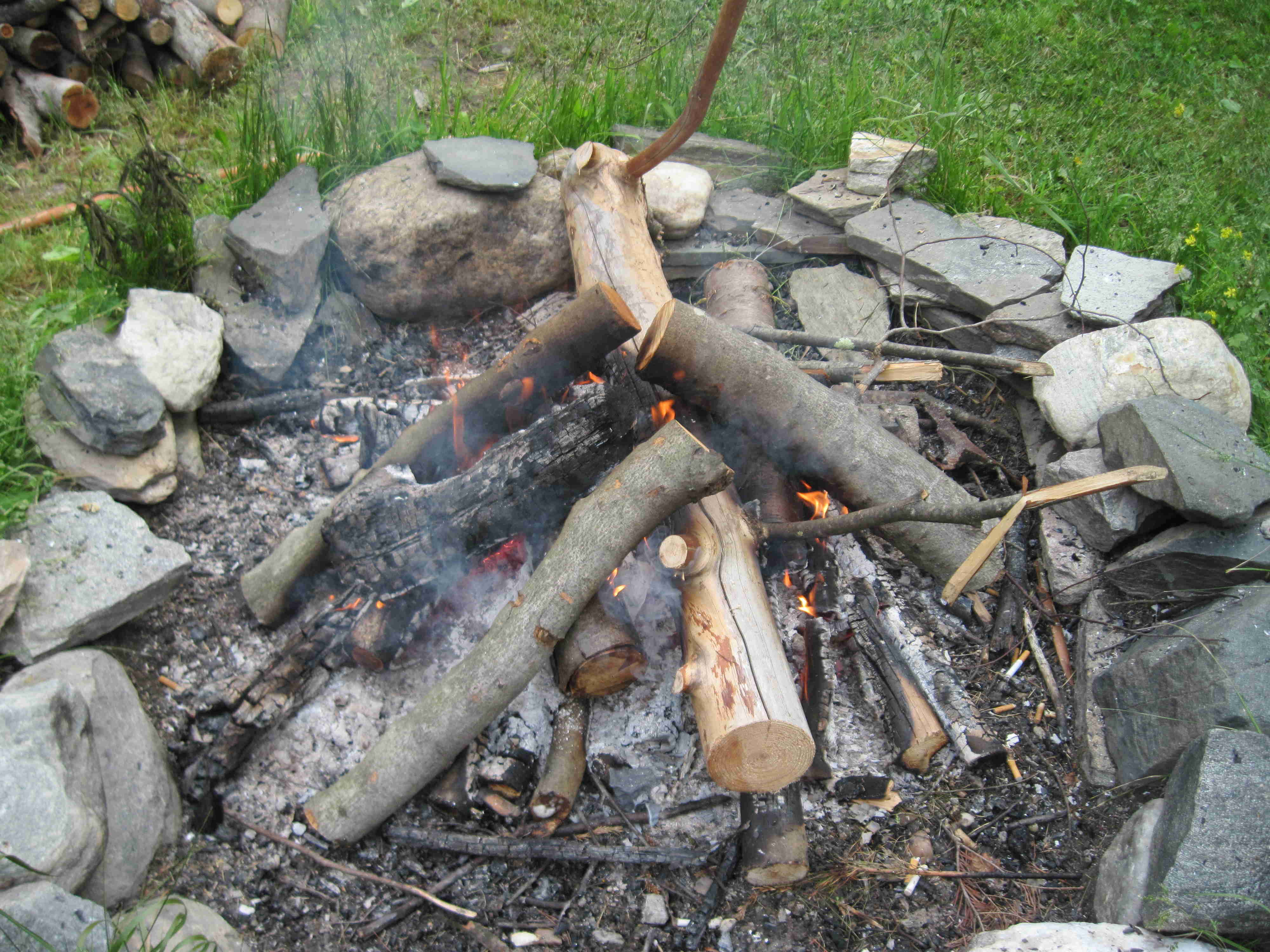
Below is an image with the fire lit, a little more than halfway through the rite. I began with a standard OBOD ritual opening: “By the power of star and stone, by the power of the land within and without …”
In the picture I’m facing East. Directly in front of me is the blue bowl of water for West. To the right, South, the dragon candle-holder, with a green candle.
“Green for South?” I hear the purists gasp. Yup. Why? As one of my friends might say (and spell) it, that’s the color of “the green fyre” of nature. I’d been nudged to use green at our Midsummer ritual. More than the sun, how the Land flourishes under the sun at the solstice says “summer” to me. Your climate and tools differ? Excellent! We’re both learning to listen to what’s in our faces and under our feet and in our hearts.
On the far side of the circle in the East is a deer-bone whistle from Serpent Mound. Its high pitch matched the cry of birds overhead, the wind in the trees. Finally, to the left and North is my Ovate anchor stone and one of several offerings, a cup of milk and a slice of bread (already offered by the time of this picture), white for the northern snow, for Lugh Lord of Light, and for Thecu Stormbringer*, for fertility and harvest both, how we are all nourished from the time we are born, “the fat of the land”. What is it that fire burns, after all?
Dry wood lay ready, kindling and newspaper, too. I’d just said these words “I ask your aid in consecrating this fire circle and the greater circle, that has its center here, its circumference everywhere.”
Out with the book of matches. One after another. Nothing. The fire wouldn’t light.
So back into the house for wooden matches. “Disaster! Bad omens abound! No fire means no passion, no energy for your work. AND you broke your ritual circle!”
Well, no. Remember the part above about the “greater circle”? I was still in it. I pondered the nudge to include this line as I wrote it earlier in the day. And if such “ritual breakage” distresses you in your own rites, you know what to do: cut yourself a ritual doorway, The circle won’t blow away during the few minutes you’re gone.
Sometimes a break in the ritual points to a specific focus for the ritualist to attend to. I took the need to get better matches as a ritual message: when I tend any fire — energy — passion — heat — will — decision — I need to pay particular attention to beginnings, to my tools, to an extra step that might be necessary to assist with manifestation. Fire spoke: any ritual worth its salt links self-as-home together with the ritual action. Fire comes from within as much as from without. Much more useful and to the point than irrational fear of bad ritual mojo.
“I kindle this fire in honor of all the elements, earth and form and north the altar, air and breath and east the means, water and cauldron and west the capacity.”
At length, after a meditation I’m still reflecting on, the closing, again adapted from OBOD ritual: “As the outer fire dies down, may it remain a pure flame within. This circle is closed in the apparent world. May its inspiration continue within us all, a gift”.
/|\ /|\ /|\
*In the next post, an update on my work with Thecu of the Nine Paths of Storm.
“The hours of folly are measured by the clock, but of wisdom no clock can measure” — William Blake, “The Proverbs of Hell”.
/|\ /|\ /|\
“Where do you get your ideas from?” Every writer’s been asked this question, and every writer morosely ponders it anew, when inspiration flags and the blank page or screen stares back. When the awen is flowing, writing’s a pleasure. When it’s not (or as my guide might say, “It’s flowing differently”), often the real work begins: to listen, to bless the fallow times. To let go. Or as one of my teachers puts it, “Sit, sing, and wait”. No — not a prescription for doing nothing, but rather a particular kind of blessing. To bless ourselves is often the hardest work of all. It asks less than we’re willing to do, because doing isn’t the issue. At least not the kind of doing I usually do.
Often I get ideas from you, my readers. I look at the site statistics and find an old post from a year or two past is getting traction again. Why that topic? Why the interest now? I re-read it and listen for what might be speaking. What are you looking for? What’s shaking in your lives right now? Often, too, human memory being what it is, I don’t remember the post well (or at all), and so I can come upon it with something like fresh perception. Your interest helps me look and listen. And if it’s happening with you, it’s almost a sure thing it’s happening with me, too.
In the previous post, I wrote of honoring the mundane, respecting this world and its rhythms and changes. I go out later today to a new fire circle in my backyard to ask that it be consecrated. I initially wrote “to consecrate it”, and that could well be accurate, if I took on the sole responsibility of hallowing it. But even then, other energies and presences are involved. Because do I ever act alone? More and more, I’m learning at least my own answer to that question.
I ask for consecration, as well as performing it myself, in order to hear something of what goes on around and through me. As a capacitor and transformer of spirit, I find listening almost always clues me in that there’s more going on than I suspected. This is a suspicious universe, and I mean that in the best sense of the word. There’s so much to imagine might be happening, and imagination will pull back the curtain, open the window. I suspectthe sacred all around and within me.
And then? Often, because vision’s my default sense, I expect, or suspect, I’ll seesomething. Instead, an air blows through the open space that carries me with it. Or a bird calls, or one of the sugar ants that have invaded our house this summer crawls across my arm. I start, and grumble at a meditation interrupted, until slowly it occurs to me this is a message. I’m part of a host of others, of selves, and we spiral together. Consecrate a circle or grove, and every square centimeter is stuffed with beings. Even counting only those with skins on.
In a post from a few years back that’s been drawing readers, I wrote,
So we return and begin (again) with the things of earth, these sacred objects and substances. As sacraments, earth, air, fire and water can show us the holy, the numinous. Their daily embodiments in food and drink, precious metals and gems and sex, pleasure and learning and science, music and literature and theater, sports and war and craft, are our earliest teachers. They are part of the democracy of incarnate living, the access points to the divine that all of us meet and know in our own ways.
Not bad, but I’d add: “their daily embodiments” in embodiments. In all the Others that journey with me. These are the ones I’ll invite to join me as I open my inner grove, and as I light the first fire in the new fire circle later today.
/|\ /|\ /|\
While digging up our yard for a new foundation last fall, our contractor unearthed a lot of stones. We asked him to pile them on the edge of the excavated area, suspecting we’d find places for them eventually, and wanting them nearby and handy, rather than neatly dropped along our property line — and further away to carry. Puzzled, he agreed. When his crew returned two months ago to reseed the area with grass, they added to the pile as they raked and smoothed the dirt. We could hear them talking and see them shaking their heads as they threw more onto the pile in what looked to them like the middle of our back yard.
And now some serve for a fire circle, and others — the two or three large ones above — may work for seats or altar stones, if we can manage to shift them and set them firmly in place. To give you an idea of size, the large one to the right weighs a few hundred pounds (150 kilos or more).
Holy Ones I know, you grasp
the thread of my life. Sometimes
I feel your fingers drawing
me tight against the soundboard.
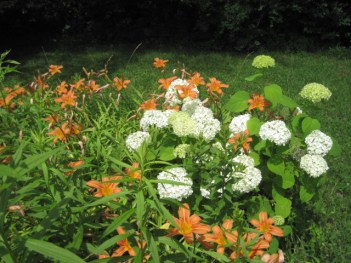
lilies & hydrangeas, NW lawn
Can I sing for all of us, or does the song come for me alone? We don’t always want another to sing for us any more, though it was once a chief pleasure at the gatherings of a people. Once we knew the songs, sought to renew them when they flagged in us, when we lost the tunes from time to time. Pick them up again, friends. Then tell, tell the Tribe.
First stanzas. They can arrive in an echo, a line or two, teasing me to follow. Sometimes the whole thing turns out in an hour of listening and trial. Sometimes I fold the first words away for the next look, when maybe a day has turned and tuned me closer to where the words will go best this time. Always and never the same as last time.
Wake from a dream of speaking to those who don’t wear bodies like this, my wife rousing from a kindred dream, my parents (gone this past decade and more) in a house we have built and furnished together with them.
Sometimes I’m left ahead, not behind. It’s things that need to catch up to where I am, things that will turn round a few more turns before I understand. Then they’ll rush on ahead again.
/|\ /|\ /|\
“Lady of the Land, open the door,
Lord of the Forest, come you in”
Here in New England, you can hear the Land singing a version of this Lunasa greeting. In the distance, a lawn mower, a chainsaw. And just outside my door, for almost the last hour now, swallows sing and chatter practically in my ears. They’ve commandeered for their nest the space on top of the outdoor light above the front steps, less than a meter from where I write, the front entry-way I made into a womb-like office.
A coming weekend program of workshops and talks on the other path I take, titled “How to Survive Spiritually in Our Times”.
It’s an excellent topic to explore, and I invite you, before you read any further, to look aside from the screen you’re on, grab pen and paper (or open a doc on your desktop) and write down some of the strategies you’ve learned. How have you survived spiritually so far? And what have you learned the hard way, perhaps the deepest and wisest and most valuable among your resources?
Did you stop to make at least a few notes? Did you include questions among your strategies?
Taking at least a few minutes for this is worth doing. (You can still do it, right now …)
I list among my own strategies getting my experience(s) down in writing, keeping a record. Both this blog and a bedside notebook help me place the downs and ups and make sense of why? and what next? My computer desktop fills with notes I date obsessively, and gather roughly once a month into another kind of journal. That one often I revisit perhaps just once or twice a year — as valuable as the others for patterns and themes I’d otherwise miss. A hoard of unattached dream fragments, poem notes, quotations, lines from my reading, a song lyric that’s dogged my heels and probably is asking for attention, long-term and refreshed to-do lists, scraps of conlangs, orphaned things that I’ve learned will find their homes and families if only I take them in and find them clothes and beds.
And what is spiritual survival, anyway? We get physical survival, we learn both fast and slow, throughout our lives, what we need to sustain ourselves, what we need to live. Fast, because if we miss those first lessons, we never live long enough for any others. Stay out of traffic. Respect hot and electrified things. Don’t take into your body absolutely everything (substance, person, idea, spirit) that presents itself.
Not long after these — learning them a little more slowly, but not much — come later lessons. Just as you don’t take into your body everything on offer, take into your heart even less. Give, instead. (Loving others as self-defense!) Cherish good measures. Learn which lines it’s truly wise not to cross. Learn which other lines actually are, in fact negotiable, despite what others tell you. (Study which lines keep moving.)
Learn whose approval and disapproval truly matters. Learn to wield your own approval and disapproval. Sell yourself not short but long. Label idols carefully. Review regularly. Love, four-letter word and practice, not just in spite of anyone or anything that comes at you, but as the idiom goes, “for good”.
Is anything not spiritual survival? How I’m spending today continues to manifest whatever spiritual truths I’m learning.
/|\ /|\ /|\
“You”, said Apollo to the German poet Rilke, “must revise your life”.
Holy Ones we know, you grasp
the threads of our lives. Sometimes
we feel your fingers glide, drawing
us tight against the soundboard.
You pluck from us those first notes
of song. They rise, we rise, and …
A lot of talk these days about truth or reality and fakeness, almost as if our era was the only one ever so burdened, so challenged, so troubled by discerning the difference. So I cheer when I find a key to help me along the way, one I can hold up to the light and turn in my hands and consider, one I can offer to you and see whether it serves your need, too.
Es ist alles wahr wodurch du besser wirst, runs a German proverb Thoreau quotes in his journal entry for October, 1837 — “Everything is true through which we become better.”
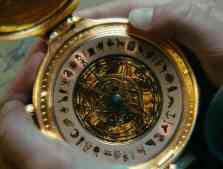
I love this as a test for truth. No abstraction here, but rather a laboratory prompt, a calibration on our internal alethiometers, to use the example of Philip Pullman’s delicate device for measuring truth.
In the first volume of the fantasy trilogy His Dark Materials, Pullman describes the alethiometer like this:
It was very like a clock, or a compass, for there were hands pointing to places around the dial, but instead of the hours or the points of the compass there were several little pictures, each of them painted with the finest and slenderest sable brush (Northern Lights, 1995).
(Do you have your own alethiometer already? You do? Is it in good working order? Or are you looking for one?)
And that in turn should tell me something. As much as it is anything else, truth is an image, a whole set of images, that I carry around. From childhood onward, from experience, from stories, movies and the examples of others, from my culture and the era I was born and grew up in, I gather up and walk with a museum of images. Does what I see and experience right now match those pictures? If not, can it be true? How can it be true?
Everything is true through which we become better. Should I walk around asking, “Have you become better yet?” Well, no: unless I start first with myself. You know this is my principal strategy for avoiding insufferable arrogance, spiritual myopia and self-righteousness. Turn the edge on myself first, before urging the blade on others. A better question is “How did you do it? And can I generalize a principle, extract a technique from your answer, so that I can pull it off, too?”
What am I doing, what have I done, and has it helped? Have I become better? If so, can I do more of it? How Druidic! Rather than an eternal and external standard to which I must somehow conform but which is native, apparently, to nobody, instead I practice one dependent on my life and my experience. Yet we can recognize a shared quality in both our experiences, even though they’re different. What can that tell us? What are we perceiving? Part of an answer seems to lie in the relationship between honoring my own experience even as I honor another’s.
To give a specific example, echinacea consistently upsets my system, but my wife finds it a wonderful aid. My truth doesn’t trump hers, but neither does hers negate mine. One principle does for both: if it helps, if through it I become better, it’s true for me. As with freedom, so with truth: yours ends where mine begins, and vice versa. Force either on me and they cease being what they are, but become their own opposites. (We still endlessly practice this negative magic on ourselves and each other.)
I do ritual alone, or with others, and stand together in a circle with the Visible and the Invisible to welcome the sacred. My wife and I work at our marriage, and it has its good and better years, like anything planted and cultivated, watered and weeded. I fell out of touch with a college friend, and we’ve drifted apart. I remember others regularly, and our relationship still holds true.
I find truth in the quality of such relationships. Improving a relationship is one way I become better.
Oh, uniformity or conformity has its place. Build a house and you want dimensions as close as you can measure and cut them. We also speak of angles, materials and directions as true. True north. We’re dismayed, or gratified, when potentials and promises come true. In a ritual it’s helpful if we work together. The chant grows stronger when we say or sing the words in unison, like any chorus. Unity can be … fun.
Alan Watts (1915-1973)
The principle remains, whatever the design of the structure you build, house or ritual, song or life. As Alan Watts quipped decades ago — I can’t locate the source offhand — most creatures on the planet are endless variations on a single design: tubes with various attachments. (We’re improvisations, like jazz, like the unrepeatable concert version your favorite band performs of its signature song.) What wonderful diversity elaborating and playing with that unitary principle!
But what’s diversity for? I remember my first years at the school where I taught, serving as international student adviser. “Students from 38 countries!” the school brochures and website crowed at the time. “OK,” I said at one faculty meeting, feeling out the parameters of my new position. “We’ve got diversity. Now what do we do with it?” I genuinely wanted to know. No one answered. But I wasn’t being rhetorical. Was “having” diversity enough? Was that the goal, now achieved, box checked, on to the next item on some larger list? Was the school, were we, with our vaunted diversity, somehow now better? If so, how?! Could we measure it? Could we be or do something, anything, better as a result?
“I desire”, says Thoreau in Walden,
that there may be as many different persons in the world as possible; but I would have each one be very careful to find out and pursue his own way, and not his father’s or his mother’s or his neighbor’s instead.
If we respect ourselves in all our quirky uniqueness and individuality, how can we not respect everything else? Your difference affirms mine. The world and all its creatures, the Chinese wan wu, “Ten Thousand Things”, announce this principle every moment. How can we not glory in such diversity?!
Apparently, to judge by what’s happening in so many places, we often can’t. Is it because we don’t trust our own uniqueness? Do we fear ourselves as distinct and free beings, and therefore fear everyone else who is also a unique self, different from us?
Does your difference help me become better? No, it must be said, not if I run from it in fear, or if I feel I must attack you to protect myself, or deny you any way to live your difference, so that it leaves mine alone. Shortsightedly, I could even claim your difference makes me worse, not better, because I don’t like it, or because you remind me of my own freedom and uniqueness. Because all difference urges me to the responsibility to live from that knowledge. No, I don’t want to become better. Save me from any such transformations! I want to be, not become.
I find truth in the quality of relationship. I want to connect to others who help me become, just as I want to help them become more of who they are.
Selfishly, I readily admit, they’re more fun to be around when they’re becoming than when they’re locked in fear and desperately trying to remain who they are. And paradoxically, they become more of who they are when they keep changing and growing. And so, they tell me, do I.
Yes, the Great Self of the Cosmos first says Be! But then its continues, saying Become! I want to hear those Words and live them. Because what else is there? Serving something larger than the self, another paradox here, fulfills the self. All the many species around me live and flourish and die and return because they and I are what the cosmos does.
And ritual, song, art, creativity in solving problems, joy, relationships with other unique beings, are all ways to express and take part in and complete that doing.
Yes, to be national for a moment, the motto on our U.S. currency proclaims E pluribus unum — “Out of many, one”. When you start with states that are nearly independent nations, unity can hold great allure.
In other contexts, too, of course, we seek that uni-verse, that “one-turning”, of one-ness. But if we seek a more whole truth, a “single turning” through which we might become better, we also recognize and acknowledge and begin to live from its other half, too — its complement, which we’ve often overlooked: Ex uno plures — “Out of One, many”. As the old song goes, echo of a cosmic melody, you can’t have one without the other.
I wrote up a version of the following for my journal, a practice in itself, and now for this post.
John Beckett’s helpful article “A Pagan Framework for Discernment” suggests a three-part approach for anyone doing the hard work of sifting experience and belief for their weight and significance and value. “Religious and spiritual ideas”, he observes, “are notoriously resistant to proof, as our atheist friends like to remind us. But if we wait on absolute proof, we’ll end up abandoning beliefs and practices that are meaningful and helpful to us.”
Divination is a useful practice at such a juncture, for several reasons. First, it acknowledges a need for help. I’m never alone, though too often I face challenges as if I am. [As that Christian triad (Matthew 7) has it, “Ask, and it shall be given you; seek, and ye shall find; knock, and it shall be opened unto you”. No, really!]
Second, divination gives me “something to do” that often relaxes the inner channels sufficiently that I’ll receive guidance “before” I actually do the divination. There’s little support or comprehension in our culture for anyone who talks about “voices in the head” — that kind of talk is one step toward getting you committed. So be careful who you talk to, I hear. Maybe if you started out committed, I hear, you’d know better how to respond to “voices in the head”. Rather than ignoring them, freaking, or heeding them unthinkingly, we’d assume there’s a wider range of options from which to choose.
Third, divination offers suggestions and potential wisdom apart from the usual gossipy, opinionated mechanical self that pretends to conscious awareness most days. Wisdom received often has a qualitative difference from what I’d usually say to myself.
“A belief is true if it works”, Beckett continues, “if it conforms to known facts, and if it’s helpful. But some factors have no bearing on truth even though we might wish they did.”
With such things in my thought as I consider how Thecu initiated communication a couple years ago, and then again recently, I ask for guidance on divination, figuring I’ll draw a card or three from a deck to assess possible directions. To my surprise I’m told to makean impromptu “deck” of nine folded pieces of paper. “Let each be a doorway”, I hear. That’s not quite right; there are no audible words. But the sensation is the same; the words are in my mind.
After I prepare the papers and document the moment with a photograph, almost before I can ask for the next step, I’m given nine words or names to write on them: hampu, lutec, nef, abal, tahilte, renha, lam, tseme, umun. Then, as smoothly as the sense of guidance arrived, it falls away, and I’m left with no further sense of direction. Upheld, then let down.
While the linguist in me putters in the background, turning over the names for a clue to their origin and meanings, I light a small candle and some incense, as much to forestall disappointment as anything else. The incense is homemade, from a workshop some years ago. It needs intermittent relighting, but that’s OK. I send out a silent “thanks and query” with each relighting. It feels right to do so.
Perhaps half an hour later, I receive further instruction, as I’m making some notes about a job lead: “The nine words are associated with the numbers 1 to 9. They are not numbers themselves, but they belong with them. Write the numbers on the cards you made in the order the words came.”
The following day I light candle and incense again, and add a spoken element. As I listen, I try pairing Thecu’s name with each of the nine words, in an impromptu chant, each pair repeated twice, with some playful riffs: “hampu Thecu, hampu Thecu, lutec Thecu, tec, tec Thecu, etc.” In one way, it’s nonsense, but all sound has a quality and an effect, so the practice is not a waste of time in any sense, unless I stupidly insist it is. I will practice this and listen again several more times to test it.
“We are wise”, Beckett closes, repeating his opening assertion,
to focus our attention on our actions rather than on our beliefs. But our actions generate experiences, and in our attempt to interpret and understand our experiences we form beliefs. Our experiences may be so strong or so frequent we are certain our beliefs about them must be right, but if we are honest with ourselves, we can never be completely sure they are right.
But we can ask ourselves if our beliefs work, if they conform to known facts, and if they help us lead better lives. If we can answer yes to these three questions, we can be confident that they are as right as they can be.
How do I pray to you, goddess of storms? Let this my prayer be a litany of questions.
How do I pray to you, goddess of storms?
Let this my prayer be a litany of questions.
How may I best honor you?
You gave me a glimpse, no more,
of landscape, cliffs lapped with green,
mist-hung and mournful,
with this foreign name to call you.
What is your service, what
may I do for you? Why
make yourself known to me?
Unlikely am I, no familiar of shrines,
a god’s service, formal prayer.
Then, too, I know so little of you.
Does naming you for others answer
your purposes? How do I answer you,
goddess of storms? Here are words,
intention, listening. Let this litany
of doubts and questions be first prayer.
/|\ /|\ /|\
In the single experience (see recent post) I had of her, Thecu was particular about the sound of her name: TEH-koo, spelt with a c, not a k. Something bleeding through here of eastern Europe: Thracian, Dacian, Illyrian, Macedonian Greek, Etruscan?
The linguist in me still turns over these very scant details. This is one of those shadowy regions of Europe, where we know so little, mostly echoes from the written histories of neighbors, along with a few hundred words, a handful of inscriptions.
So here’s the task I set myself in the previous post:
… I’ll take up ritual and its close alliance with emotion. Through rite and ritual, powered by where emotion can guide me, I can begin to (1) find out what I need to know (Air), (2) clear the way for the will to act (Fire), (3) empower my imagination (Water), and (4) help myself heal (Earth).
This morning, after fasting from coffee for three days, my wife and I dove back into our joint addiction. That meant, in addition to washing the carafe, cleaning the coffee mill of the remains of a brand that we found irritated our stomachs and left us with weird dreams. In spite of an organic label and a source we trusted, that particular brand goes on our NO list.
Yes, I’ll readily admit it: we’re coffee snobs. I say, if you have a habit, addict responsibly. Why pay a barista to do what we can do at home much more cheaply and satisfyingly.
Thus armed with our indulgence and our insufferably caffeinated arrogance, we perform the daily ritual. First, the banishing, or cleaning. Then the invoking, or grinding and brewing. Finally, the savoring, black or with milk or half-and-half. Or sometimes, if a new brand turns out especially bitter, a spoonful of maple syrup. This is also known as the sense of ritual well-performed. In other words, as with most cooking — and magic — season to taste. There are recipes to learn, and then there are local variations and individual adjustments. Both prove needful.
Coffee invites assessment and comparison. (My mistyped original read “incites”, which is also true.) So should ritual. We brew coffee almost daily, because we like it enough to find it worth the effort. Anticipation heightens the preparation, the performance. Not all batches are the same, and I can always fine-tune what I do. Feeling can guide me well, but not exclusively.
If it’s to have any benefit, ritual (or magic) needs similar practice, and the doing of it IS the ritual, IS the practice of magic. I should enjoy the experience enough that it’s worth the effort, the outlay of time, material, and energy.
Otherwise, why do it? Can I answer that question sensibly? (A lack of common sense has oft defeated many an evil overlord.) A more modest Druid like me has much to learn from the great and (ig)noble. Success, for evil or good, depends on feet planted on the good earth, first of magics. (After all, Yesod, “Foundation”, is a low, easily-reachable branch on the Tree of Life. It’s “a vehicle allowing movement from one thing or condition to another …” says Wikipedia. Or as Basics in Kabbalah puts it, “The foundation (yesod) of a building is its ‘grounding’, its union with the earth (malchut).” A measure and sounding of our time: you can find such formerly hidden knowledge simply by following an internet link. Do we dismiss such magical familiars because they have made our lives too easy?)
What will I write onto and into my skin? What will I invite deeper?
So back to the four elements, to the task enumerated at the start of this post. I learn (Air) which coffee to buy — and whether today is even a coffee day — apply the heat (Fire) to water (Water!) and ground the rite (coffee, Earth, pun included) at its conclusion — a pour of hot black nectar into our two waiting mugs. Any excess of thinking or willing gets balanced by this cauldron of feeling, of desire and pleasure and outcome. Hold the mugs in our hands, warmth and aroma as much a part of it all as taste on the tongue. Incidental effects, like the temporary sharpening of attention, the rise of blood pressure (I’m chronically low), the motivational effects to a sluggish intestinal tract, are all side benefits not to be disdained.
OK — I’ve taken the analogy further than it can bear, or perhaps not far enough. We tend to think of ritual and magic in abstract terms, when in fact they’re a series of concrete choices and actions and manifestations. Humans are magical transformers, with time and space our field of play. Whatever we manifest has its causes: as with the universe outside our skin, so with the universe inside. This isn’t just metaphysics but actual physics. If the definition of insanity is to expect different results from doing the same thing, then sanity can begin simply by trying something new.
And “old-new” might be a very good alternative name for our uni-verse, our “one-turning” which offers ritual as one of its keys and clues.
And what of healing? I wrote in March of this year, in the post “Healing From the Past“:
I add to my practice a henge-meditation. We needn’t bother ourselves to make any such claim as “Druids built Stonehenge” in order to make use of the spiritual dynamic it offers as a source of healing. Merlin sets the precedent: Stonehenge-as-symbol, in Geoffrey’s telling is older than its present home in southern England anyway. Not its origin but its power is what we need. Magic thrives when our intent makes the occasion a necessity: our focus is single and sharp not from force of will but from desire, emotion, need, want, hope, imagination, planning and preparation, ritual foundation, and love.
A final note: to make ritual “economical” in terms of any wear and tear on the practitioner, which means us, (1) start small, (2) keep records, (3) experiment to find what works and what doesn’t. As with coffee, check in frequently: how does it feel? Does the brew need tweaking? Make this aspect part of the process — though not its sole determinant. Ritual and magic, done skilfully, are among the most scientific as well as loving things we do.
Who knows when odd reading can lead to insight — and material for a blogpost?
Take, for instance, this delicious (to me, anyway) fragment:
“Emotions alert us to specific issues, and they do so without any subterfuge. If we are aware enough … our emotions will be able to contribute the energy we need to move into and out of any situation imaginable, because they contribute the specific energy and information we need to heal ourselves” (Karla McLaren. Emotional Genius: Discovering he Deepest Language of Soul. Laughing Tree Press, 2001).
This kind of statement makes me sit up and pay attention. Partly because any large claim switches on my crap detector, but also because I immediately want to try it out. You know, set up an experiment to test the claim.
In this case, like most of us, I’ve got a running start on just such a test. We can all name stories, movies, songs that grab us and move us. Even — if they reach deep enough, if we’re open and vulnerable to their magic — on the fifth, tenth or thirtieth read, viewing, hearing. Among your top contenders you may count a childhood favorite. The quality of these repeated experiences, at least for me, leaves no doubt: gods are alive, magic is afoot. Magic is alive, gods are afoot. (Leonard Cohen nails it again.)
In fact, so completely may the magic live for you that you guard it zealously and jealously. You watch who you choose to tell about it, because you’ve learned the hard way how another’s misunderstanding or mockery can sting, and even, if it’s carefully targeted, ruin a beloved experience for you.
The number and quality of claims McLaren makes are quite remarkable. Here they are again in list form. Emotions:
— alert us to specific issues.
— don’t lie or mislead — they offer no subterfuge.
— contribute the energy we need to move into and out of any situation imaginable.
— contribute the specific energy and information we need to heal ourselves.
Or, to put it elementally and alchemically, emotions identify what we need to know (Air), clear the way for the will to act (Fire), empower the imagination (Water), and help us heal (Earth).
McLaren also wisely includes a kicker, escape clause, out, safety switch: If we are aware enough … Of course. Isn’t that always the issue at the heart of things?
Stay with me here. (As the Rocky Horror narrator exclaims, “It’s just a jump to the left!”) Working with adolescents in a boarding school for sixteen years let me reflect on my own emotional growth or lack of it, even as I served as an adviser to hundred of students over the years. Because I advised freshman and senior girls, I frequently saw emotion more openly expressed than I might have with boys. How often I’d witness some variation of “I’m so upset/amazed/impressed/in love! Oh my god, I can’t believe X. I was A and now I’m B. I’m so upset/amazed/impressed/in love!”
The lesson here is emotion can be so strong that at first we have no distance from it, no perspective or comparison. We recycle it, loop with it, rehearse it. “All or nothing” is the adolescent’s stereotypical default setting, partly because so many experiences arefirsts and really don’t offer any basis for comparison: first love, first significant failure, first challenging success, first death of a close friend or family member, first major social embarrassment, first large moral choice, and so on. Emotions don’t lie, but when the tide sweeps in and then out again, how do you make your way through the wreckage to picking yourself up and drying out and moving forward?
With some progress towards maturity comes that invaluable ability to detach, step back, gain perspective on one’s own situation and experience. (We might say that IS maturity.) Only then can emotion alert us to specific issues. (If you look at the media and the world right now, we see repeated spikes of emotion with far too little detachment, reflection, proportion, perspective. Keep a person, a community or a nation in the first stage of emotion and they’ll never reach the second stage, let alone any of others. That way mature judgment dies.)
While cooler heads may lament the manipulation of whole groups by the technique of constantly lighting new fires, all while stoking the flames of old ones, there’s a useful lesson in the power of emotion. To lift a line from “Storybook Love”, the theme song to The Princess Bride, “it’s as real as the feelings I feel”.*
And it is. Emotion is real. The gifts of emotion, however, come in what we find after strong feeling. Feel the feeling, yes, I’ve learned. (Can’t do much if I’m repressing it. Genii still in a bottle, that trick.) Then work with it — from outside. Return whenever I need to fine-tune my understanding by checking in with the authenticity of the feeling. Just don’t invite it to take up residence and watch as it tracks in dirt and hangs its laundry over my windows.
Anger. Fear. Lust. Self-pity. Doubt. Feel any of these lately? These are among my top five most potent negative emotions. They’re also five of my teachers. I’ve learned more from anger and fear than I could tell you in any reasonable-sized book.
Awe. Curiosity. Amazement. Gratitude. Love. Another five, among the most potent positive emotions. Also fabulous teachers. Alchemized versions of the preceding negatives, shaped by the spiritual work we’re each called to do in our lives.
Emotion, our elemental Guide of the West, serves us best when we respect its proper domain. Its role is not to usurp our sovereignty by taking the throne.
In the next post I’ll take up ritual and its close alliance with emotion. Through rite and ritual, powered by where emotion can guide me, I can begin to (1) find out what I need to know (Air), (2) clear the way for the will to act (Fire), (3) empower my imagination (Water), and (4) help myself heal (Earth).
That is, I can begin to take McLaren at her word, and try out the claims she makes.
Listening for names. I spend a significant amount of time doing that, between my spiritual practice and my fiction. It’s a curious endeavor, hard to explain, but one a surprising number of people have experience with. What is it we’re hearing?!
Some two years ago in meditation I heard the name of a Storm Goddess, two syllables, beginning with the letter T. I don’t know about you, but the first time I encounter a deity, especially unsought, a being I don’t know, I can feel like I’ve just landed on an island no one’s visited before. No maps, no tourist description, no information to help the next person, because I’m the first one to arrive there. No other footprints on the beach. No electricity. When the sun goes down, I’m left only with this fire I choose to build, a new climate, night noises I don’t recognize, a night sky whose constellations have shifted, or wheel above me wholly new.
Subsequent listening brought me a little more information, a complete name I’m keeping back for now while I pursue additional ritual work and meditation. I do have a general location in eastern Europe where her worship originated. But not a lot more. I’m returning after this interval to pick up the thread, to think out loud here, to see if there’s more to discover. For me, writing about something often activates it in ways nothing else does, blowing hidden embers to flame. (A strong reason for keeping a journal, as I’ve learned. I confess I needed to track down the entry to recover her name. I only have it because I wrote it down.)
Black Sea and eastern Mediterranean
My title for this post isn’t meant to be serious — I have no sense of T “replacing” any other deity. She’s simply new to me, and as far as I can tell, her presence has left no written record. Barring a trip — beyond my resources at this point — to plant my feet on the ground and walk the region west of Black Sea where my meditation showed me her worship once flourished, I’m left with what I can discover from here. No report of divine possession resulting from touching a barrow rising through the mist and contacting ancestors or land spirits. No blaze of insight, no recognizable historical scene unfolding in inner vision. No Hollywood or Bollywood or CGI to dramatize a blogpost. No Industrial Light and Magic courtesy of the Otherworld.
That doesn’t hamstring my search, but it does direct it inward, fitting for a deity whose worship has apparently withdrawn to inner realms.
Why did she make herself known two years ago? That itself forms part of my search. It’s the nature of UPG, unverified personal gnosis, that I can’t yet rule out being played by a spirit. That’s no different than how a phishing advertisement or a fake news article snags a portion of its readers who part with money, belief, a sliver of common sense and integrity. What distinguishes my experience is the approach, if you want to call it that, of T. Reserved, as if testing me. No requests. A trickle of information, a flash image of green and rocky landscape. Enough to hang a meditation session on, enough to ask for a return on the investment of energy involved in making contact with an incarnate being, me, with lots of other demands on his attention and time. Enough to provoke this post.
Now part of the experience is that the writer in me immediately, inevitably jumps aboard and starts playing. Imagine! he says. You were her devotee in a past life and she’s contacting you to revive her worship! Decent premise for a story, right?! Or, or … it’s an inner warning of outer storms to come. Or this isn’t the goddess but a priestess of the goddess reaching out to you for a Dion-Fortuneque revivification of a spiritual energy whose time has now come again to wash over the earth. See what I mean? What to do with such a companion?!
Yes, my writer self is more than a bit of a quicksilver imp, a drama queen, a runaway dreamer who’d sooner spend an hour in reverie than getting words on paper or screen.
But for all that, he’s opened doors and given me words I don’t get any other way. He’s part of the package. I’m talking about all these things to give you a sense of my process. Yours, of course, is your own.
On Friday, Mystic River Grove, an OBOD group based in Massachusetts, celebrated a Summer Solstice ritual inspired by the Anglo-Saxon symbel or feast, and built around toasts, boasts and oaths. I couldn’t attend, but I want to reflect on these three components of celebration, apart from however Mystic River chose to celebrate beyond those three elements.
With a toast, boast and oath, you could certainly hold a fine solo rite. Toast your gods, land spirits, ancestors, teachers, living kin — whoever you’re called to honor. Then on to a boast, a celebration of excellence, a claim to honor for ourselves, for something we have achieved. Like gratitude, boasting’s a skill we neither teach or practice enough. My default boast is survival. I’m still here. But I can definitely claim more; this blog, my other writings, a good marriage, years of teaching young people, a circle of friends I admire and enjoy.
A solo rite still has witnesses: our own selves, hearing the words. Powers and beings of the world who attend because they were “in the neighborhood” so to speak, unless we explicitly ban them. And anyone we did invite to join us. But what’s the value of our community witnessing when we do these things? Why do these things publicly?
Toasts others make can remind us who we honor and who we might include next time. We learn of others’ gratitude. What I’m grateful for carries a story with it. It’s a window into a life, and speaking gratitude in a circle opens us to each other and our stories.
Boasts tell us something of the commitments and dedications of time and energy in others’ lives. If I’m proud of it, I’ve spent myself on it in some way, poured myself into it, and probably sacrificed in some way to accomplish it. Boasts also let us laugh — we can boast about silly things, or make fun of ourselves for how much even a small achievement may have cost us.
Oaths tell us what will matter in the coming days and months. What are others binding themselves to do? How does publicly announcing an intention, having others witness it, help energize us to accomplish it? An oath may include a spell of finding or binding, of opening the way, or shutting down obstacles, resistances, barriers, and so on. When I took part in Nanowrimo in past years, for instance, and wrote my 1600 words a day, announcing my progress online helped me keep going. You helped me persevere because you knew I’d set out to do it.
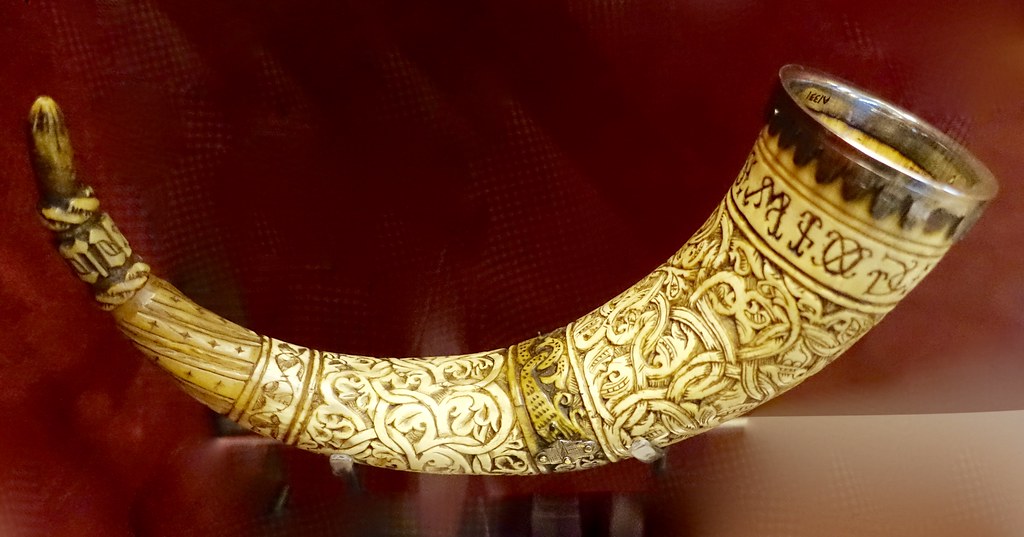
Depending on the size of the horn passed round the circle for each of the toasts, boasts and oaths, and the kind of drink you quaff each time, you may find your tongue loosened and the three acts easier to pull off!
Here the rhymer in me wants to add a fourth word, wrecking the lovely triad of toast, boast and oath, but creating in its place a new and balanced pair of rhymes: toast, boast, oath and growth. After all, a rite moves us to a new place and space, never the same as where we were before. As with yesterday and tomorrow, the difference from today may or may not seem like much, but just as the daylight lengthens and shortens each year, depending on which side of the solstice I’m on, so do the energies at play in my life. I can do things today not possible yesterday or tomorrow. And that’s worth a toast, a boast, an oath and the growth that comes with them.
Finally, if we’re going to be Anglo-Saxon about things, the Old English Maxims 1, lines 138-140, offer relevant insight here:
Keeping to the spirit I feel lies behind these proverbial expressions, and unpacking their compactness and concision*, I take this to mean, roughly, “Let your speech be words of good counsel to others, write runes of wisdom, sing as epically as you can, deserve praise, test and expand your judgment, while holding nothing back each day”.
/|\ /|\ /|\
*With even a little Old English, you can explore meanings and fashion your own translation with the help of the online Bosworth-Tollers Anglo-Saxon Dictionary here.
rǣd: accus. of se rǣd; advice, counsel, prudence, deliberation sceal, 3rd sg. of sculan: shall, ought, be obliged, must mon, Wessex dialect nominative of se man: one, person, human, mortal, man secgan: to say, speak, express rūne, accus. plural of sēo rūn: whisper (speech not intended to be overheard, confidence, counsel, consultation), mystery, secret, rune wrītan: to write, cut, draw, form letters (on wood, stone, parchment, etc.) lēoþ: accus. of þæt lēoþ; song, poem, ode, lay, verses gesingan: to sing lofes, gen. of þæt lof: praise, glory, hymn gearnian: to earn, merit dōm: accus. of se dōm; doom, judgment, judicial sentence, decree, ordinance, law areccan: to put forth, relate, recount, speak out, express, explain, interpret, translate dæges, gen. of se dæg: day, daytime onettan: to hasten, anticipate, be active or diligent
Yesterday our local group celebrated an early Solstice. The forecast rain held off — Blessing of the Sun! — and at the very end of the rite as we uncast the circle, a couple of birds landed in the branches of the tree above the altar, just a few feet overhead. As many of you have also witnessed, the natural world acknowledges the energies of ritual respectfully performed.
Several members of our group are Wiccans — note the brooms to sweep away negative energy as needed. They’re not only working tools but useful working symbols as well. By that I mean a symbol to carry into meditation and deploy in visualization, as well as a physical object. Catch myself in less-than-desirable states of consciousness? Out comes the “inner broom”. My particularly stubborn inner trash gets swept into heaps, dumped in a bucket and cast into an inner river which dissolves it and washes it away, reintegrating it into the cosmos. (Repeat as needed.)
So often we look half-aware for something to replace negativity, and lacking a viable replacement we can get sucked back into it, because its tug draws the emotions. Symbols stand ready to our need, charged with their own emotional electricity. When I find it may not be enough merely to purify, whether with prayer, salt, incense, ritual or some combo of them, a symbol can help rally inner resources. Some unwanted stuff has a way of creeping back in, and the situation may call for an ongoing cleanse. Broom, en garde!
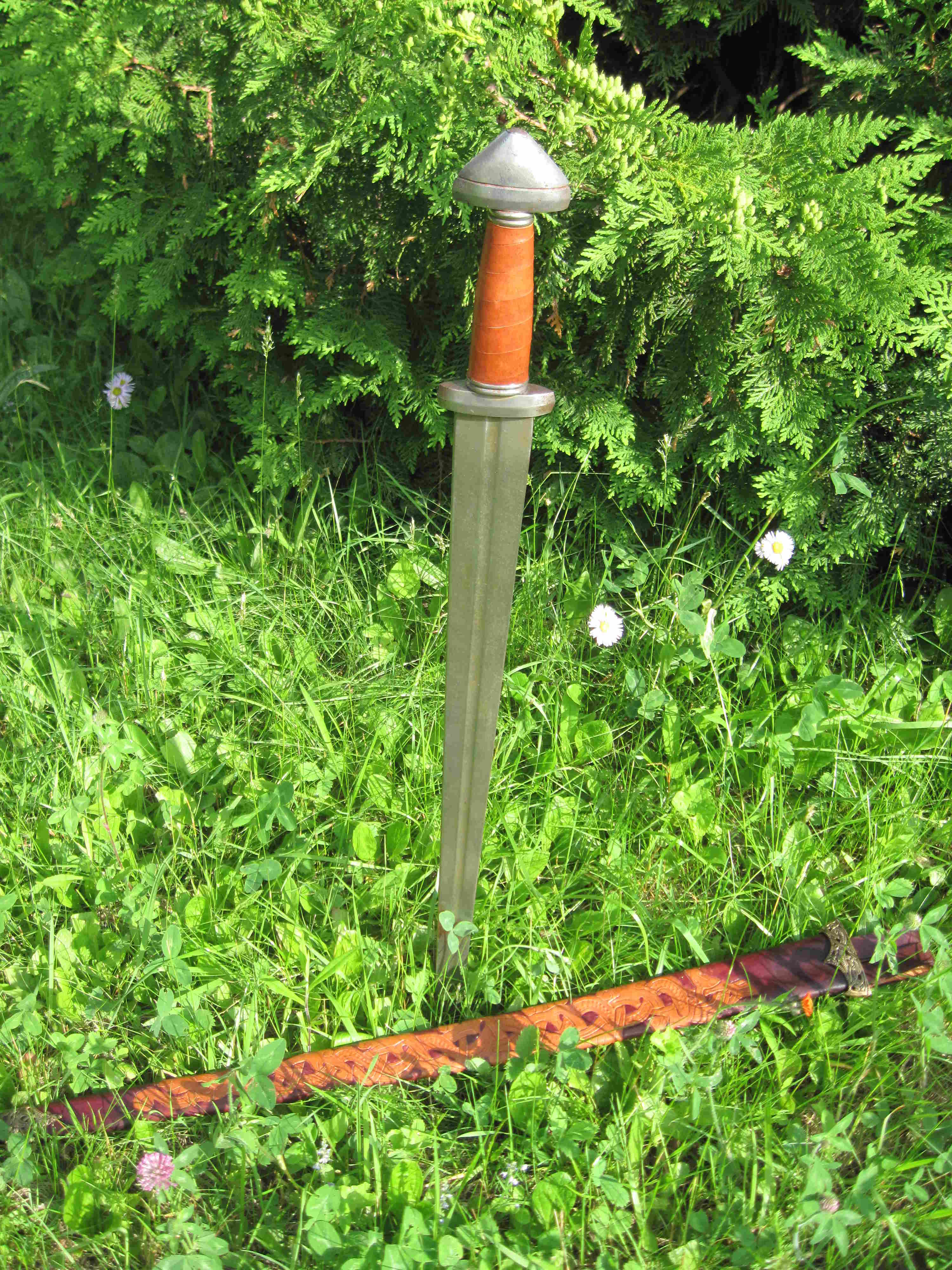
If it makes you feel better, because you “grasp” or “understand” such things, to call them “psychological”, by all means do so. What matters more to me, though, at least in the moment, is whether they work. One member couldn’t join us yesterday who played a specific role in the rite-as-written, so after a quick exchange of PMs with the ritual writer, I stepped in, among other things to cast the circle. This gave me a splendid excuse to de-rust a sword for the purpose and, not-so-incidentally, help me confront why I love and seek out ritual, but shy from consecrating objects I already possess as ritual aids. I’ve touched on this in previous posts [among others, here].
Fire comes to our ritual and bodily need (why separate them, after all?), its heat, light and hue all central to the season and a ritual working: nearby fire-pit shedding warmth on our skin, or candles flickering on the altar. But the sword is a fine tool of power, a weapon, a strong and ancient symbol, forged in flame and often enough incorporating a cross where hilt meets blade. So it gathers up a whole complex of symbolic vectors of energy.
The replica sword I cleaned up yesterday morning before the ritual is an older design than the more familiar Medieval ones with the exaggerated hilt. Its edges are very dull — no risk to anyone of injury — so it’s also ideal to transport. If by chance the police should stop me for any reason, it’s much easier to explain a stage sword than one like my other sword, much rustier, but with a wicked edge still. Seeing how well the white vinegar cleaned off the rust from the smaller sword, though, I’ll be tackling that more extensive cleaning job tomorrow.
I mention all this at some length because the curious resistance I felt at bringing a ritual tool along to the ritual told me something curious is afoot. Two swords (a promising name for a novel, or magical order!) put me in mind of the two ancient Indo-European words for elemental fire, *ogni the active, and *pur the static. Is there something at play in my conception of ritual, or my ritual purposes, that I’m missing or blocking? The smaller, less impressive (and very dull-edged) blade has the fancy scabbard. The other, larger and deadly weapon has a simple leather sheath, all practicality, but no tooled design. Surface and deeper meaning, keenness and showiness, purpose and pretension? I’m still listening.
After uncasting the circle yesterday, I drove the point of the blade into the soft earth by the altar, saying, “The circle open, but unbroken”, or some variation on those words.
And the ritual circle in my mind, open and unbroken, interrogates me still. If I gain any insight, I’ll pick this up again in a subsequent post.
/|\ /|\ /|\
“Where can I celebrate the Solstice?” You can find some version of this question online. Best, I’d answer, is your own celebration. Yes, there are plenty of group events around the world, but the shortest night of the year offers you your pick of how to observe the festival. An all-night party (a lively Scandinavian tradition) or a vigil (some Druid traditions) are two popular options. Or some unique combination of the two.
I plan to stay up Tuesday evening for a “second Solstice” and greet the Sun Wednesday morning, June 21st, on what will be the longest day in the eastern U.S. Where I live, daylight on the 21st is 15 hours and 21 minutes long, making the night just a little over 8 and a half hours.
The “third Solstice” is Friday 23 June, whether I attend a group celebration just outside of Boston (a drive of 3 hours in Friday evening traffic) or do a ritual solo at home.
The June full moon, often aptly named the Strawberry Moon, actually reaches its fullest tomorrow (Friday) morning, but most North Americans will see it at its peak tonight.
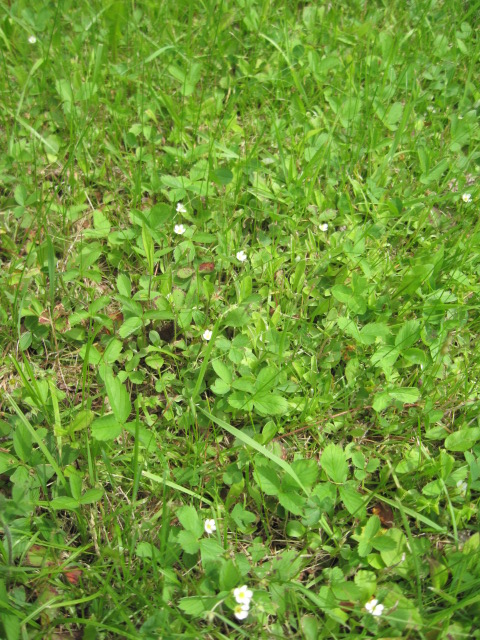
wild strawberries, north yard — perfect reason not to mow
Tonight I’ll offer my full moon ritual for the health of the hemlocks that line the north border of our property, as well as other beings, “quando la luna è crescente” — while the moon’s still waxing. As the full moon nearest the summer solstice less than two weeks away, Strawberry Moon plays counterpoint to the shortest night and longest day of the year, and governs the first of the true summer months here in New England. I’ll be posting a follow-up in the next weeks.
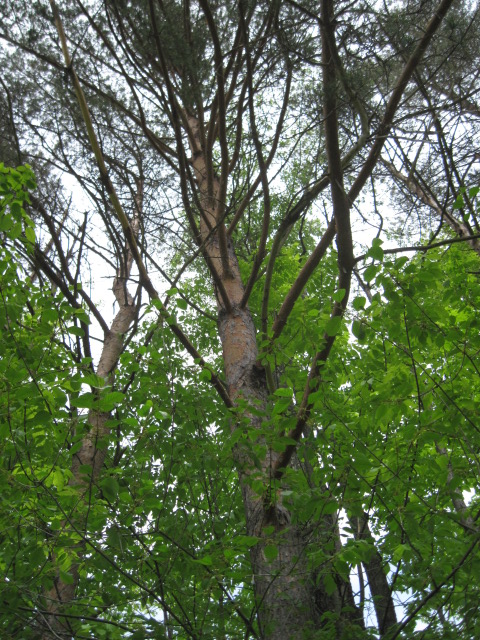
“queen” hemlock, 50 ft. tall, visible from where I write
As Dana has so passionately documented on her Druid Garden site, including a powerful ogham/galdr healing ritual, the eastern hemlock battles against the hemlock woolly adelgid, widespread enough that it’s gained its own acronym — HWA. The adelgid, an aphid-like insect, is just one of several pests that afflict the trees, but one not native to North America and a factor in near-complete mortality in infested areas. As a commenter on Dana’s blog notes, natural biological agents offer the best and least toxic means of control and containment. The United States Dept of Agriculture site summarizes the situation well.
And if you ask why, Our true self and the land are one, says R. J. Stewart. As always, test and try it out for yourself. That ways lies deep conviction, replacing casual opinion with earth loved, spirit manifest, life full.
Now that I’ve reached the end of this series on some possible shared spaces between Druids and Christians, I’d like to pause and take stock.
How many of us have experienced anger, frustration or a kind of spiritual PTSD from our contacts with Christianity? How many have found one or more of these posts irritating or painful? Yet how many still feel drawn to something alive in Christianity or Christian practice?
From the wild stats this particular series has generated, I have to conclude it’s provoked a whole complex, difficult medley of thoughts and feelings. Consider, as I have, new readers from outside the circle of the most common visitors — North Americans and a few western Europeans, with the occasional Australian or New Zealander. This series, however, has drawn readers from Iraq, China, Turkey, India, Japan, Hungary, Singapore, Greece, Pakistan — and a readership from all of these nations showed up not just for single post but for most of this series.
And what should appear here as the 9th theme? Magic? Prayer? Initiation? Heresy — the right to choose — along with heterodox beliefs and practices? The Otherworld? Divine kingship? All promise rich materials as fitting ways to close. I’ll probably tackle at least a few of these in the coming weeks. If only because a series like this, like a devotional practice undertaken with love over time, almost always generates a momentum no finite thing can contain.
Or what about a shift of terminology? Would that help at all with any of these themes? If instead of “Baptisms of the Elements”, we called them “Elemental Sacraments”, would that easier name make a difference? Would it make it any easier to move beyond instinctive antipathies and past traumas?
Christian Druids and Druid Christians have already found ways to integrate their practice and ritual, celebrating spirit as it actually manifests, regardless of creeds. Some of the best links happen in community and fellowship. We experience something together beyond words, even as we struggle to embody it in language. But it’s that initial encounter, not the subsequent formulation in speech or writing, that constitutes the source of spiritual energy.
Praised be You, my Lord, through Brothers Wind and Air,
And fair and stormy, all weather’s moods,
by which You cherish all that You have made.
Praised be You my Lord through Sister Water,
So useful, humble, precious and pure.
Praised be You my Lord through Brother Fire,
through whom You light the night
and he is beautiful and playful and robust and strong.
Praised be You my Lord through our Sister,
Mother Earth
who sustains and governs us …
Here is insight and wisdom and reverence indeed, one that may find resonance for both Druids and Christians.
An “incarnational” Druidry, one that shares with Christians a deep gratitude for natural beauty and for the mystery of birds and beasts, for the holy gifts of choice and speech, thought and reason, for birth and dying and rebirth, and for the voice of the sacred in dream, vision, prayer and ritual, and for the transformational power that a spirit-filled person can manifest, whatever the tradition, will earn respect and a hearing in any quarter a Druid would want to find one.
Likewise, a humble Christianity, one which seeks first to model love of self and other, of spiritual freedom, of service and stewardship of the created world, of care for the body, and delight in our kinship with the natural world, one which reads with reverence the Book of Nature, will move and persuade and welcome Druids and other Pagans far more than any scriptural proofs or the tongue of condemnation, doctrine or preaching.
“Let our deeds and our shining faces be our testimony”.
anamnesis (Greek ἀνάμνησις; English an-am-NEE-sis) 1) the Platonic principle that people retain knowledge from past lives and that our present learning involves a recollection of that past knowledge. 2) the Christian principle of recalling the events of Christ’s sacrificial death in the words and actions of the liturgy, especially during Communion or the Eucharist*.
/|\ /|\ /|\
One way into the Greek word that may serve as a link between Druid and Christian practice is the English borrowed word amnesia, literally “forgetting”. An-amnesis is its opposite: “unforgetting, recall, recollection, remembrance, memorial action”. And I’m going on from there for a moment and, at least for the purposes of this post, forming the adjective anamnetic “having to do with ritual remembrance”.
Druidry and Christianity both acknowledge the importance of anamnesis. Anamnetic deeds depend for their effect on both ritual and memory — actions intended to evoke a sacred event or time. Perform the ritual and bring to mind the holy. Sacrifice is “making sacred”, and we only “know” the sacred because in some way we re-cognize it: we know it again. Anamnetic acts acknowledge that even the best memory fades, so they recharge it with symbolic words and deeds.
At the “hour of recall” in OBOD ritual, we’re reminded that the rite is both timeless and bound by time. Its effect comes in part through memory: “let memory hold what the eye and ear have gained”. We’re also reminded that the apparent world and the inner world may overlap, but they’re not the same. Ritual sets aside a space for the inner and the sacred, acknowledges it, increases the overlap, and then reverses all those actions in the farewell, in order to safely restore the participants to the profane, mundane, “real” world of everyday life. (Because trying to function here while still in ritual consciousness is dangerous. We’re “spacey” and attentive to other things, not traffic lights, the blender’s sharp blades, those three steps down, our co-worker’s question, the toddler who darts into the intersection just ahead.)
I take part in a ritual, and its effects follow in time and memory. Likewise in Christianity, depending on how the word “this” is understood, whether once during the annual Passover (the setting where he spoke the words), or at every meal, or something in between, Christ commands his followers to “do this … in remembrance of me” — in a word, to practice anamnesis. “Proclaim the Lord’s death till he come again”.
A sacred meal shared with others is among the best kinds of fellowship. It’s an anamnetic act common to many traditions and cultures as a sign of religious faith, because it also expresses friendly hospitality and generosity. These acts of giving and giving back are inherently sacred. We can choose to recognize this by ritualizing them, or by foregoing the opportunity they offer.
How much of human consciousness, after all, is memory? How do we sustain the transformative power of any event we choose to value, except through recalling it, naming it, celebrating it, re-enacting it in order to vivify it and make it real again in some way in the present? “What is remembered, lives”.
Thus we celebrate anniversaries, birthdays, historical events, and so on. We tell stories of the living and of the ancestors. We even make up fictions the rest of the time, in order to remind ourselves what life is like, in case we lose sight of its shape and nature. And when we enter the mythic realm, the question to ask is not “Is it true? Did it really happen?” but “What truth does it teach? What holy thing does it help us remember?” When we com-memorate something, we remember it together.
And what we value, we dramatize. Greek theater began as religious worship: “Until the Hellenistic period [roughly 320 to 30 BCE], all tragedies were unique pieces written in honour of Dionysus and played only once, so that today we primarily have the pieces that were still remembered well enough to have been repeated when the repetition of old tragedies became fashionable …” notes the Wikipedia entry on the theater of ancient Greece. Until later times, the theater was a sacred precinct. Weapons were banned, and actors were masked because their human identities, at least during the performance, was subsumed under the characters, often gods or heroes, whom they portrayed.
What might all this mean for possible Druid and Christian convergences? Ritual is grounded in theater, in a dramatic portrayal of the memorable. “Let us remember the holy” is one piece of common ground where both can stand. Accepting that no one “owns” the holy is another. Why this is should be obvious, though it’s sometimes ignored in claims of “my god(s) and your god(s)”. But sacred energy continually bursts free of limiting containers, and seeks new forms that refresh and rekindle and feed the spirit. if anything, it’s very much the other way around: the holy owns us. Sometimes it simply breaks through and claims us. You and I have no say in the matter. Other times, we may.
Old or new, liturgies can move us, but they are no substitute for direct contact with the sacred. We need no idolatry of rite placed above spiritual reality. The word’s not the thing it names. Much as I love words, I love the silences of the Great Mystery more. “Be still, and know …” counsels Psalm 46. Because there is that ability within us all that’s able to do this — to be still and come in contact with the holy. It’s our human birthright, and has nothing to do with belief.
Paradoxically (and what would many things amount to, without a touch of paradox?), old ways can come closer to Spirit than newer ones. “Stand at the crossroads and look; ask for the ancient paths, ask where the good way is, and walk in it, and you will find rest for your souls”.** The Hebrew prophet Jeremiah says these words, looking back at ways already old in his time. Pagan and Christian can find more to share than either may often imagine — in silence, in ritual, in remembrance.
/|\ /|\ /|\
*Like anamnesis, eucharist derives from Greek — in this case, from eucharistia “thanksgiving, gratitude”. Modern Greek still uses a related word (changed a little in pronunciation) to say “thank you”: ευχαριστώ [ehf-khah-ree-STOH]
**Jeremiah 6:16. The prophet gives these words to God to say.


 “So how did the ritual go?”


 A lot of talk these days about truth or reality and fakeness, almost as if our era was the only one ever so burdened, so challenged, so troubled by discerning the difference. So I cheer when I find a key to help me along the way, one I can hold up to the light and turn in my hands and consider, one I can offer to you and see whether it serves your need, too.
 In the first volume of the fantasy trilogy His Dark Materials, Pullman describes the alethiometer like this:
 Yes, to be national for a moment, the motto on our U.S. currency proclaims E pluribus unum — “Out of many, one”. When you start with states that are nearly independent nations, unity can hold great allure.
 After I prepare the papers and document the moment with a photograph, almost before I can ask for the next step, I’m given nine words or names to write on them: hampu, lutec, nef, abal, tahilte, renha, lam, tseme, umun. Then, as smoothly as the sense of guidance arrived, it falls away, and I’m left with no further sense of direction. Upheld, then let down.
 In the single experience (see recent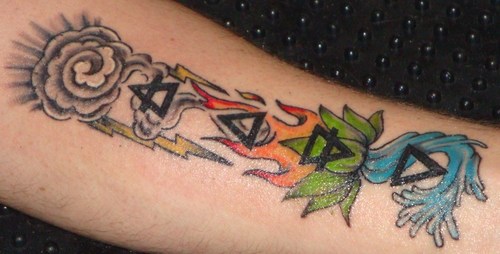

 Listening for names. I spend a significant amount of time doing that, between my spiritual practice and my fiction. It’s a curious endeavor, hard to explain, but one a surprising number of people have experience with. What is it we’re hearing?!
 With a toast, boast and oath, you could certainly hold a fine solo rite. Toast your gods, land spirits, ancestors, teachers, living kin — whoever you’re called to honor. Then on to a boast, a celebration of excellence, a claim to honor for ourselves, for something we have achieved. Like gratitude, boasting’s a skill we neither teach or practice enough. My default boast is survival. I’m still here. But I can definitely claim more; this blog, my other writings, a good marriage, years of teaching young people, a circle of friends I admire and enjoy.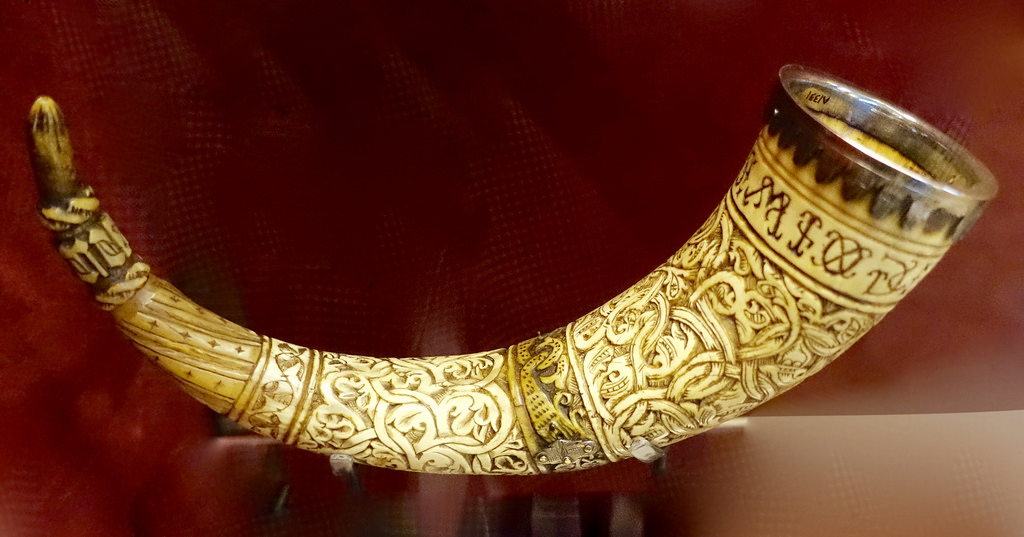
 Or what about a shift of terminology? Would that help at all with any of these themes? If instead of “Baptisms of the Elements”, we called them “Elemental Sacraments”, would that easier name make a difference? Would it make it any easier to move beyond instinctive antipathies and past traumas?


 A Druid Way