So you still want not just a few phrases but a complete language dedicated to your rituals?! And you’re crazy enough not just to thinkabout this but to actually plan to pull it off! In spite of all the alternatives I mentioned in the previous post, like simply using a small number of individual words or phrases as ritual triggers, you’re still determined to acquire the complete ritual language package. You want to be able to composenew rites in this language, not just insert a few fixed phrases here and there in your rituals. And wrth gwrs (oorth goors) of course, your circle, grove, grotto, temple, fane, gathering or group is with entirely with you — 100%. Or they will be, once you browbeat or bribe or trick them to try it out, once they’re enchanted and seduced by the undeniable power and majesty and beauty of your fully-equipped ritual tafod (TAH-vohd) tongue. You know in your heart of hearts that soon enough they’ll be saying diolch (DEE-olkh) “thanks” to you for bringing them into the light (or the luminous darkness).
The First Candidate
Here’s the first ritual language candidate for your consideration, Welsh, along with some of the stronger arguments in its favor:
*It’s one of the six living Celtic languages, so you’ve got the authenticity thing covered. No one can accuse you of wimping out on that point.
*Hey, you already can say a couple of things in it, like wrth gwrs (oorth goors) “of course” and tafod (TAH-vohd) “tongue” and diolch (DEE-olkh) “thanks.”
*It’s from the “easier” side of the Celtic family: Welsh, along with Cornish and Breton (the P-Celtic branch), are considered easier to learn and speak (for English speakers) than Irish, Scots Gaelic, or Manx (the Q-Celtic branch) for a number of reasons: pronunciation, grammar, and spelling.
*The writing system uses a version of the Roman alphabet. True, because of the spelling of Welsh words like wrth gwrs and tafod and diolch, some have unkindly called written Welsh “alphabet vomit,” but Welsh offers a much better match between sound and symbol than does, say, English. Different doesn’t have to mean worse, and it can sometimes even mean better. Think about such oft-cited English examples like the pronunciation of -ough in through, rough, though, cough, and bough. You’ll be glad to know there’s extremely little of that in Welsh.
*It has a solid and well-documented literary history — the Mabinogion, that medieval collection of marvelous tales, is one of its chief glories — one which several modern Druid orders have used as a set of Druid teaching texts. Here for your delectation is the first line (in medieval Welsh) of Branwen, Daughter of Llyr:
Bendigeiduran uab Llyr, a oed urenhin coronawc ar yr ynys hon, ac ardyrchawc o goron Lundein.
“Bendigeidfran son of Llyr was the crowned king of this island, and exalted with the crown of London.”
[Bendigeidfran is pronounced roughly “ben-dee-GUIDE-vrahn”]
*There are numerous helpful learning aids available, including online materials like the Big Welsh Challenge. That means there’s plenty of assistance for students of the language, in large part because enough Welsh people themselves want to learn Welsh.
*Welsh is arguably doing as good a job at surviving the onslaught of English as any of the other Celtic languages. In other words, it’s not going away any time soon.
*Welsh makes a distinctive auditory impact on listeners — check out the short video below to hear several Welsh speakers:
Other Options — Proto-Indo-European
Or maybe Welsh still seems too much to tackle. (Did you catch the last word of the video — diolch [DEE-olkh] “thanks”?) You still want your own language, but something different. It doesn’t need to be a living language. In fact, a more private one might even serve better. You understand that ritual secrecy isn’t meant to exclude anyone but rather to focus and contain energies, like the Cauldron of the Goddess brewing those three drops of inspirational awen. Yes, there are still other options.
For instance, you could investigate Proto-Indo-European (PIE) — the Big Kahuna itself, the “Grandmother Tongue” of the speakers of all the hundred or so Indo-European languages alive today, spoken by more than 2 billion people. I’ve mentioned Ceisiwr Serith in a previous blog, whose fine book Deep Ancestors: Practicing the Religion of the Proto-Indo-Europeans offers much material for reflection, adaption and use. Serith writes and practices from an ADF perspective, emphasizing historical scholarship. You can also check out his website for more information and challenge.
Dictionaries and grammars of PIE are available online and through sellers like Amazon. With some hours of initial study and effort, you can begin to create short sentences like this one: yagnobi ognibi tum wikyo (YAHG-noh-bee OHG-nee-bee toom week-YOH) “I hallow you with sacred fire.” Using such resources I’ve fashioned these and other words and phrases for ritual. While scholars and amateur Indo-Europeanists can and will quibble quite endlessly* about “correct” or well-founded pronunciation and grammar, you’ll be exploring a ritual essence you can incorporate into your rites to enrich and empower them. Isn’t that the point?
(*It’s significant — and highly relevant for our purposes — that there’s much stronger consensus on PIE vocabularythan on grammar, details of pronunciation, or wider issues of culture, religious practice, original homeland, and so on. That’s as it should be: we intuitively understand that it’s in the names of things that we reach closest to the heart of any language, especially ritual language.)
The Celtic Conlang
Or you could go the Celtic conlang route, selecting from the pool of shared vocabulary that Welsh, Cornish and Breton (or Irish, Scots Gaelic and Manx) have in common, and build your language piece by piece. Books like D. B Gregor’s Celtic: A Comparative Study (Oleander Press, 1980) devote several chapters to — you guessed it — detailed comparisons of the six Celtic languages. If you have some skill with languages (and you do, or you wouldn’t be considering this route, would you?), you can adapt and regularize to your heart’s content. To give you some idea, with a couple of dictionaries and the running start of sites like Omniglot’s Celtic Connections page, you can devise your own language with as much Celtic flavor as you wish.
Three Existing and Well-developed Celtic Conlangs
There are other conlang options too, like Deiniol Jones’ detailed Arvorec, Andrew Smith’s Brithenig and Alex Middleton’s Kaledonag. All three of these are sufficiently elaborated that you could create ritual materials in them. And you’ve got living conlangers that you can consult — or hire — for help.
Commission Your Own Unique Language
If you or your grove have some cash on hand, there’s yet another option, if you want to commission a conlanger to make you a unique never-before-seen-or-spoken ritual conlang. As I mentioned in the previous post, you can call on the Language Creation Society for help. Here’s the relevant LCS page for requesting a conlanger to create a language to your specs. Note the following minimum costs, as of today, 3/26/14: “We require a minimum of $150 for a language sketch, $300 for a full language, and $300 for an orthography.” (Each term is explained further on the page.) The commissioning person or group gets to set a wide range of criteria — worth investigating if this option appeals to you. Self-disclosure: Yes, I’m a member of the LCS, because they’re the best such group around. Like the ADF motto says, “Why not excellence?”
(Almost) Last, Best, and Deepest …
It shouldn’t come (almost) last, but here it is. If you’d like a deeper ritual challenge, ask your spirits, guides or gods for help. I’ve gotten valuable material this way, including large portions of blog posts (see here and here for examples), and I’m certainly far from unique. Others have also received names, prayers, rituals and other spiritual material from contemplation, trance, and ritual itself. If the God/desses want you to use a special or dedicated language in your rites, they’ll help. Just ask. What is inspiration, after all?!
Another illustration may help. Several years ago, over the space of about six or seven weeks, an acquaintance of mine named Chris received an entire ritual conlang — several thousand words, names, grammatical ideas, and — how else to say it? — cultural practices, like gestures, ritual apparel, symbols, etc. — through a series of visions and inner communications. We talked about his method, his process. He’d record as much as he could recall from a given experience or vision, then ask for guidance in recovering whatever he’d missed or forgotten, trying out names and phrases, for example, to see if they were acceptable in prayers and rituals, if they sounded right to the gods and to his own growing sense of “fit,” based on what he’d been given so far. For instance, the name Nezu came through, an inner guide he could call on. Testing the name, modifying it from the initial version he’d received, until it “worked” and felt right, mattered to him, and the name grew in impact because he took the time (hours and hours!) and made the effort. In short, he sacrificed for what he desired; he hallowed his own efforts through his dedication and attention and love, and the gods hallowed them for him in turn. Rarely is it just one or the other, after all.
Now Chris was interested in conlangs and had some experience learning, or learning about, several different languages. He knows some Elvish, Klingon and Na’vi, and he’s studied several different human languages in varying degrees of depth. Such a background doesn’t hurt, of course. The gods work with what we give them. If you’re a musician, you may get inspiration for songs. If you’re a visual artist, you may get images, and so on. Nurture and encourage the ritual skills and human talents of the people in your group, and you’ll be surprised at what they can achieve.
So you’ve got it down — your ritual books (unless you and your grove are really devoted, and all of you memorizeyour rites) are meant to make using the language as easy as possible, both for members and any visitors who drop in for your Evocation, Consecration, Tranformation, Prognostication, etc. Just hold off on the big-screen Powerpoint version until you become a Mega-grove, along the lines of the Protestant Mall-Churches.
A Note on Compiling Ritual Booklets
You know you can get your grove members to pronounce almost anything unusual reasonably well, just like Catholics have been doing with pronunciation guides like the following example from Pray It in Latin (pg. 3) by Louis Pizzuti. (My apologies if you have bad Church memories.) If you haven’t been paying attention, I’ve given short examples of this strategy earlier in this blog with wrth gwrs and tafod and diolch. Now you’ll remember these three, right? You’ve seen them three times, that magic number of manifestation and long-term memory.
OK, now see how well you manage learning to pronounce some Ecclesiastical Latin:
HAIL MARY
Hail, Mary, full of grace, the Lord is with you. Blessed are you among women, and blessed is the fruit of your womb, Jesus. Holy Mary, Mother of God, pray for us sinners, now and at the hour of our death. Amen.
Ave Maria, gratia plena, Dominus tecum,
AH-vay Maria GRAHT-see-ah PLAY-nah DOH-mee-noos TAY-koom
Hail Mary filled with-grace Lord with-you
benedicta tu in mulieribus,
bay-nay-DEEK-tah too een moo-lee-AY-ree-boos
blessed you among women
et benedictus fructus ventris tui, Jesus.
ayt bay-nay-DEEK-toos FROOK-toos VAYN-trees TOO-ee YAY-soos.
and blessed fruit womb yours Jesus
Sancta Maria Mater Dei
SAHNK-tah Maria MAH-tayr DAY-ee
Holy Mary Mother of-God
ora pro nobis peccatoribus
OHR-ah proh NOH-bees payk-ah-TOH-ree-boos
pray for us sinners
nunc et in hora mortis nostrae. Amen
noonk ayt een HOR-ah MOHR-tees NOHS-tray AH-mayn
now and in hour of-death of-ours. Amen.
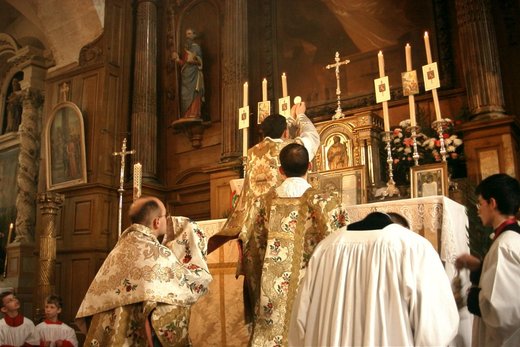
Many spiritual and religious traditions feature a special language used for ritual purposes. The most visible example in the West is Latin. The Latin Mass remains popular, and though the mid-1960s reforms of Vatican II allowed the use of local vernacular languages for worship, they never prohibited Latin. For some Catholics, the use of vernacular reduced the mystery, the beauty and ultimately, in some sense, the sacredness of the rites. If you visit an Orthodox Christian or Jewish service, you may encounter other languages. Within an hour’s drive of my house in southern Vermont, you can encounter Greek, Hebrew, Russian, Arabic and Tibetan used in prayer and ritual.
Language as Sacrament
The heightened language characteristic of ritual, such as prayer and chant, can be a powerful shaper of consciousness. The 5-minute VedicSanskrit video below can begin to approximate for one watching it a worship experience of sound and image and sensory engagement that transcends mere linguistic meaning. The rhythmic chanting, the ritual fire, the sacrificial gathering, the flowers and other sacred offerings, the memory of past rituals, the complex network of many kinds of meaning all join to form a potentially powerful ritual experience. What the ritual “means” is only partly mediated by the significance of the words. Language used in ritual in such ways transcends verbal meaning and becomes Word — sacrament as language, language as sacrament — a way of manifesting, expressing, reaching, participating in the holy.
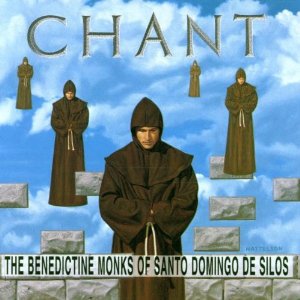
And depending on your age and attention at the time, you may recall the renewed popularity of Gregorian chant starting two decades ago in 1994, starting with the simply-titled Chant, a collection by a group of Benedictines.
Issues with Ritual Language
One great challenge is to keep ritual and worship accessible. Does the experience of mystery and holiness need, or benefit from, the aid of a special ritual language? Do mystery and holiness deserve such language as one sign of respect we can offer? Should we expect to learn a new language, or special form of our own language, as part of our dedication and worship? Is hearing and being sacramentally influenced by the language enough, even if we don’t “understand” it? These aren’t always easy questions to answer.
“The King’s English”
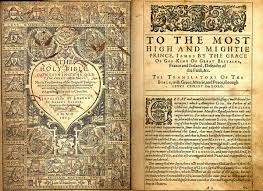
For English-speaking Christians and for educated speakers of English in general, the King James Bible* continues to exert remarkable influence more than 400 years after its publication in 1611. What is now the early modern English grammar and vocabulary of Elizabethan England, in the minds of many, contribute to the “majesty of the language,” setting it apart from daily speech in powerful and useful ways. Think of the Lord’s Prayer, with its “thy” and “thine” and “lead us not”: the rhythms of liturgical — in this case, older — English are part of modern Christian worship for many, though more recent translations have also made their way into common use. A surprising number of people make decisions on which religious community to join on the basis of what language(s) are, or aren’t, used in worship.
Druid and Pagan Practice
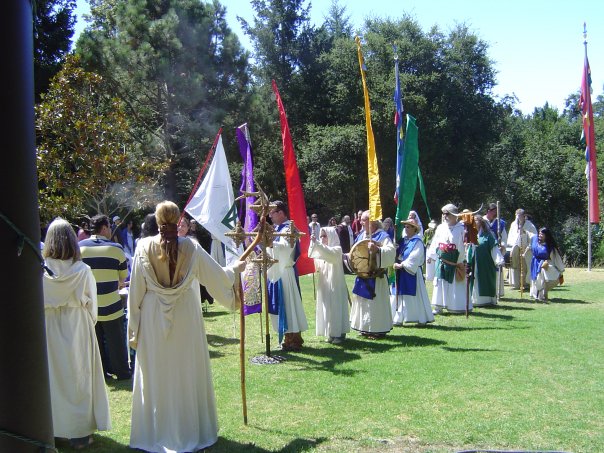
When it comes to Druid practice (and Pagan practice more generally), attitudes toward special language, like attitudes towards much else, vary considerably. Some find anything that excludes full participation in ritual to be an unnecessary obstacle to be avoided. Of course, the same argument can be made for almost any aspect of Druid practice, or spiritual practice in general. Does the form of any rite inevitably exclude, if it doesn’t speak to all potential participants? If I consider my individual practice, it thrives in part because of improvisation, personal preference and spontaneity. It’s tailor-made for me, open to inspiration at the moment, though still shaped by group experience and the forms of OBOD ritual I have both studied and participated in. Is that exclusionary?
Ritual Primers
Unless they’re Catholic or particularly “high”-church Anglican/Episcopalian, many Westerners, including aspiring Druids, are often unacquainted with ritual. What is it? Why do it? How should or can you do it? What options are there? ADF offers some helpful guidance about ritual more generally in their Druid Ritual Primer page. The observations there are well worth reflecting on, if only to clarify your own sensibility and ideas. To sum up the first part all too quickly: Anyone can worship without clergy. That said, clergy often are the ones who show up! In a world of time and space, ritual has basic limits, like size and start time. Ignore them and the ritual fails, at least for you. Change, even or especially in ritual, is good and healthy. However, “With all this change everyone must still be on the same sheet of music.” As with so much else, what you get from ritual depends on what you give. And finally, people can and will make mistakes. In other words, there’s no “perfect” ritual — or perfect ritualists, either.
(Re)Inventing Ritual Wheels
Let me cite another specific example for illustration, to get at some of these issues in a slightly different way. In the recent Druidcast 82 interview, host Damh the Bard interviews OBOD’s Chosen Chief, Philip Carr-Gomm, who notes that some OBOD-trained Druids seem compelled to write their own liturgies rather than use OBOD rites and language. While he notes that “hiving off” from an existing group is natural and healthy, he asks why we shouldn’t retain beautiful language where it already exists. He also observes that Druidry appeals to many because it coincides with a widespread human tendency in this present period to seek out simplicity. This quest for simplicity has ritual consequences, one of which is that such Druidry can also help to heal the Pagan and Non-Pagan divide by not excluding the Christian Druid or Buddhist Druid, who can join rituals and rub shoulders with their “hard polytheist” and atheist brothers and sisters. (Yes, more exclusionary forms of Druidry do exist, as they do in any human endeavor, but thankfully they aren’t the mainstream.)
About this attitude towards what in other posts I’ve termed OGRELD, a belief in “One Genuine Real Live Druidry,” Carr-Gomm notes, “The idea that you can’t mix practices from different sources or traditions comes from an erroneous idea of purity.” Yes, we should be mindful of cultural appropriation. Of course, as he continues, “Every path is a mixture already … To quote Ronald Hutton, mention purity and ‘you can hear the sound of jackboots and smell the disinfectant.'” An obsession with that elusive One Genuine Real Live Whatever often misses present possibilities for some mythical, fundamentalist Other-time Neverland and Perfect Practice Pleasing to The Powers-That-Be. That said, “there arecertain combinations that don’t work.” But these are better found out in practice than prescribed (or proscribed) up front, out of dogma rather than experience. In Druidry there’s a “recognition that there is an essence that we share,” which includes a common core of practices and values.
As a result, to give another instance, Carr-Gomm says, “If you take Druidry and Wicca, some people love to combine them and find they fit rather well together,” resulting in practices like Druidcraft. After all, boxes are for things, not people. Damh the Bard concurs at that point in the interview, asserting that, “To say you can’t [mix or combine elements] is a fake boundary.”
Yet facing this openness and Universalist tendency in much modern Druidry is the challenge of particularity. When I practice Druidry, it’s myexperience last week, yesterday and tomorrow of the smell of sage smoke, the taste of mead, wine or apple juice, the sounds of drums, song, chant, the feel of wind or sun or rain on my face, the presence of others or Others, Spirit, awen, the god(s) in the rite. The Druid order ADF, after all, is named Ár nDraíocht Féin — the three initials often rendered in English as “A Druid Fellowship” but literally meaning “Our Own Druidry” in Gaelic.
A Human Undersong
Where to go from here? Carr-Gomm notes what Henry David Thoreau called an “undersong” inside all of us, underlying experience. “We sense intuitively that there’s this undersong,” says Carr-Gomm. “It’s your song, inside you. The Order and the course and the trainings [of groups like OBOD] — it’s all about helping you to find that song. It’s universal.” As humans we usually strive to increase such access-points to the universal whenever historical, political and cultural conditions are favorable, as they have been for the last several decades in the West.
Paradoxes of Particularity
Yet the point remains that each of us finds such access in the particulars of our experience. (Christians call it the “scandal of particularity”; in their case, the difficulty of their doctrine that one being, Jesus, is the sole saviour for all people — the single manifestation of the divine available to us.**) And the use of heightened ritual language can be one of those “particulars,” a doorway that can also admittedly exclude, an especially powerful access point, because even ordinary language mediates so much human reality. We quite literally say who and what we are. The stroke victim who cannot speak or speaks only with difficulty, the aphasic, the abused and isolated child who never acquires language beyond rudimentary words or gestures, the foreigner who never learns the local tongue — all demonstrate the degree to which the presence or absence of language enfolds us in or excludes us from human community and culture. And that includes spirituality, where — side by side with art and music — we are at our most human in every sense.
In the second post in this series, I’ll shift modes, moving from the context I’ve begun to outline here, and look at some specific candidates for a DRL — a Druidic Ritual Language.
*Go here for a higher-resolution image of the title page of the first King James Bible pictured above.
**In a 2012 post, Patheos blogger Tim Suttle quotes Franciscan friar and Father Richard Rohr at length on the force of particularity in a Christian context. If Christian imagery and language still work for you at all, you may find his words useful and inspiring. Wonder is at the heart of it. Here Rohr talks about Christmas, incarnation and access to the divine in Christian terms, but pointing to an encounter with the holy — the transforming experience behind why people seek out the holy in the first place:
A human woman is the mother of God, and God is the son of a human mother!
Do we have any idea what this sentence means, or what it might imply? Is it really true? If it is, then we are living in an entirely different universe than we imagine, or even can imagine. If the major division between Creator and creature can be overcome, then all others can be overcome too. To paraphrase Oswald Chambers “this is a truth that dumbly struggles in us for utterance!” It is too much to be true and too good to be true. So we can only resort to metaphors, images, poets, music, and artists of every stripe.
I have long felt that Christmas is a feast which is largely celebrating humanity’s unconscious desire and goal. Its meaning is too much for the rational mind to process, so God graciously puts this Big Truth on a small stage so that we can wrap our mind and heart around it over time. No philosopher would dare to imagine “the materialization of God,” so we are just presented with a very human image of a poor woman and her husband with a newly born child. (I am told that the Madonna is by far the most painted image in Western civilization. It heals all mothers and all children of mothers, if we can only look deeply and softly.)
Pope Benedict, who addressed 250 artists in the Sistine Chapel before Michelangelo’s half-naked and often grotesque images, said quite brilliantly, “An essential function of genuine beauty is that it gives humanity a healthy shock!” And then he went on to quote Simone Weil who said that “Beauty is the experimental proof that incarnation is in fact possible.” Today is our beautiful feast of a possible and even probable Incarnation!
If there is one moment of beauty, then beauty can indeed exist on this earth. If there is one true moment of full Incarnation, then why not Incarnation everywhere? The beauty of this day is enough healthy shock for a lifetime, which leaves us all dumbly struggling for utterance.
Daily you call me to pray — not the prayer of asking, of importunity, but the prayer of communion, of celebrating blood flowing through veins, of life moving in lungs and belly. In the cool of dawn this morning I slip outdoors for air plush with oxygen, newly breathed out from the green lungs of the trees. I gaze on the mist-shrouded pines and maples and scrub oaks, hear the neighbor’s rooster break into the sheared metal cry that is his morning’s call. The other birds are already about, the jay chicks now big as their parents, and noisier, in their cries to be fed. A fox bitch slinks back into the woods, cat-footed and deft as she threads her way through tall grass and brambles. Dampness clings to my skin. Life-prayer, what the birds and wind and water and morning light are saying.
I say “you” call me to pray: there’s a presence I address, though it’s not a person. I could call it the echo of listening, the ambit of my attention, some kind of answer or reverberation to the pressure of a human walking the land and caressing the world with hominid consciousness that wants to talk, to name, to engage, to encounter as a person, to bring down to size a world that resolutely will not yield to whim, or whimsy. But that’s not quite it, either. “You” is the best I can do, to honor and salute the world I encounter, particularly when it glows or sparkles or hums or burns. Others have called it god or gods, Spirit or numina. We know a little better, in some places at least, how names can trip us up. But names can be good talk. It is awen, too: that Welsh word for “inspiration” that is also the presence of Spirit.
/|\ /|\ /|\
Wadin Tohangu comes unbidden, unless it’s a prayer to the universe which alerts him as well that I’m actually paying attention again. Fallow time has “done it,” though merely “going fallow” as I mentioned in the previous entry doesn’t cause a change to happen, but it often accompanies it. Something about the will is involved. Sometimes the greatest magic is to set aside the will and be open to change. I don’t like surrender because I can’t claim credit when the change comes. I want it to be under my control. Stereotypically to surrender is a male difficulty and a female strength, but there are plenty of strong-willed women who find surrender difficult, and weak-willed men who need to work on self-assertion. So that’s not it altogether either.
“Are you finished talking to yourself about this?” Wadin asks, his mouth crinkled in a smile. I realize he has been sitting there for some time now as I swam and splashed in my thoughts. I smile back, unable to respond right away — or rather, my mind spins over a thousand responses, none of them particularly graceful or useful or true. But I do know I’m glad he has come. That’s something I hold onto in gratitude, and the whirling of thought slows enough that I can say it.
“It’s good to see you.”
His smile widens — he seems perfectly at ease in the moment, as if he came expressly to do nothing else than sit and listen to me think. Not in an obtrusive way, not eavesdropping, but simply how he is, awake to what goes on around him.
“You’re struggling,” he says, “with how to talk about the will, and that’s also been a focus for you for some time.”
“That’s definitely true,” I answer. “I guess inner and outer worlds do line up from time to time.”
“What happens when they do?” he asks.
“I’m freed up to write about it, for one thing,” I say. “I get unstuck.”
“The stuckness often comes from pushing with the will,” he says. He leans forward a little, resting his elbows on his knees. “It’s a common confusion to think that will involves strain.”
“Sometimes we push through, and we can accomplish a lot. And athletes push against fatigue all the time,” I say.
He nods. “That’s true for the physical body, of course. Muscular effort moves objects.” He pauses before continuing.
“We feel pain and can push through it with the will. Sometimes that means we ‘win.’ And of course sometimes that means we end up with a sprain or torn ligament or some other injury, too.”
He gazes at me. “So what causes the difference?” he asks.
“I’d say, listening to the body. Not fighting it, but working with it.”
“Good,” he says. “Certainly listening can spare you injury or tension or strain.” He runs a sandaled toe over a design on the carpet, and I realize we’re sitting in my living room. I write “sitting in my living room,” and look up from the keyboard, and of course there’s “no one there.”
“Come back to our conversation,” he says, reaching to prod me with a forefinger. “There’s more to talk about.” He looks at me with interest. “What did that feel like just now, when you returned from ‘no one there’ to our meeting?”
“I could feel an energy shift,” say. “I got interested again. And I wanted to keep going.”
“All of these are important,” he says. “The shift is something you ‘do,’ but it’s not a strain or a push of what we normally call the ‘will.’ And your interest and curiosity also matter. They draw you in, rather than you pushing against resistance.”
I say nothing, waiting for him to continue.
“Imagination is effortless. You can ‘try to imagine,’ of course. Or you can simply imagine. This is the difference between will or imagination, and strain, which is what most people mean by ‘will’ or ‘willpower.'”
“What about people who say they ‘can’t’ imagine?” I ask.
“They’re usually telling the truth. Fear blocks them, or their straining against their habit or desire keeps them from accomplishing what they ‘try’ to do. That’s what they’re imagining instead. Imagination runs ahead of ‘will’ in that sense. It’s already ‘there,’ at work in the ‘future,’ long before ‘will’ arrives. While ‘will’ is still waking up, imagination has already constructed a palace or dungeon for you to inhabit, according to your focus. Not everyone imagines in pictures, of course. For many it’s often feeling instead. We already feel a certain way about something, and that ‘colors our experience,’ as we say.”
“But where’s the element of choice in that?” I ask. “It sounds like will or imagination is just a reaction to circumstances, rather than a conscious decision to focus on what we choose. Isn’t that the will? What we choose, rather than what we simply let happen?”
“Discipline of the imagination is the key to life,” he says, looking at me steadily. “What you attend to, what you look at or focus on, and how you look at it, determine your experience to a great extent. That’s the actual ‘will,’ not the strain to do something against our intention.”
“Would you explain that?” I say.
“Remember your own experience a short time ago,” he answers. “As you looked where I was sitting, you ‘realized’ that I ‘wasn’t there.’ Then your attention shifted, and our conversation continued. I’m ‘here,’ though I’m not ‘here.’ Which do you focus on, my presence or my absence?”
“You mean both are true?” I say.
“Yes. Though ‘true’ is a distracting word. You activate one or the other with your attention. That’s will, or intention.”
“But what about human suffering?” I say. “We don’t choose to suffer or experience hardship or disasters or …”
He was smiling at me again. “The challenge is that our habitual attention gives lasting reality to our imagination. ‘As a man thinketh in his heart, so is he,”* goes one way of expressing it. ‘What you do comes back to you.'”
“But what about people born into horrendous circumstances? You can’t say they imagined them into being!” I could hear the hint of outrage creeping into my voice. “The circumstances happened to them. They certainly didn’t choose them. Who would choose pain and suffering?”
“That’s an important question,” he says. “Do you know anyone who keeps making ‘bad choices,’ as they are called? And keeps getting painful results? That’s a fairly severe example of such choices at work. Of course we often face the accumulated consequences of long imagining. Lifetimes of imagination can solidify into exceptionally firm and unyielding circumstances. In such cases, an hour or day or even a year of change and effort may bring only surface alteration. Deeper transformation can take longer.”
“Aren’t we blaming the victim in such cases?” I say.
“You see, there is no blame here. We are talking about growth. You may know the story of the Galilean master who is questioned about the man born blind. “Who sinned?” his followers asked him. ‘The man himself, or his parents — what caused him to be born blind?’ And the Master answers them and says, ‘Neither one. All this happened so that the work of God might be shown in his life.’** A circumstance can be destiny, and we can lament limitation, or it can be opportunity, and we can move and build from there. It depends on which direction you look. One way to understand it is that a disciplined imagination is one that is ready to accomplish the ‘work of God.’ Imagination is a powerful tool of Spirit.”
“But where does it all start?” I say.
“Often the fledgling falls from the nest and learns to fly the ‘hard way,'” he says. then pauses at my expression.
“But gravity is not ‘evil,” he continues, “though it may hurt, if the chick tumbles onto a branch or onto the ground. But when the eagle has mastered using gravity to move through the air, it can soar.”
“Is that the price we pay?” I say.
“You hoped it would be painless, I see,” he says, smiling again. “Pain does get the attention in a way nothing else can. Maybe that’s why it’s still useful as a spiritual tool.”
“Pain as a tool? I’ll have to think about that some more.”
“You think a lot. Everything can be a tool,” he says. “You just need to decide how to use it, rather than getting stopped by it.”
/|\ /|\ /|\
The first post in this series looks at kinds of knowledge. The second shows how wanting to know leads to discoveries about our real selves. The third looks at daring and how it is a kind of freedom.
Compassion has no religion. Silence is not always indifference. O great, listening, witnessing world, you too have something to say, something you always are saying, without words. What comfort we can offer, miles and lives away from the families of the Sandy Hook school victims, and from other, newer sufferers since then, may consist of not filling the airwaves and spiritual spaces further, with our own shock or anger or sadness or dismay, or whatever other responses events may next provoke in us. Even if we do not know the families or victims or any of those touched by an event, we may send sympathy, because we are not stones. This is prayer, too. But every turn of the world changes us because we’re in it together. A great service is to love those who need love, and not merely to feel, to emote. We can do more than relive pain, especially another’s pain, or make it ours. Suffering needs no extra rehearsals, no practice. There’s always more than enough to go around.
We’re not stones, but we may raise them into a cairn, a act that by its solidity and palpable weight can lift suffering even a little, if it may, stone by stone. Let earth bear a portion of the weight. Allow this elemental power of Earth to transmute, to compost and transform, as it does all else that comes to it. The turning of the year again toward light in the middle of winter, the planet doing again what the planet does each year, can be solace too, earth re-establishing its balance. Soothing motion of the familiar, wordless touch with its animal comfort. Moon growing again towards fullness, light on the world in the middle of darkness.
But sometimes we hate comfort. Too often solace can reek of appeasement. We stiffen. One more easing is too many. Intolerable. Like words — already more than enough. With no ready target we seek out whatever will serve, anything to shut up the noise, the roar of raw nerves jangling. Anodyne. Oblivion, even, at least for a while.
Grief is too steady a companion. It knows us, it seems, deeper than a lover. OK, we get it. Pain too has something to say that will not be denied. We make a place for it, and it moves in, gets comfortable, settles down for too long. (How long is memory? Is recollection what we consist of? Do we relive, instead of living new? Does this become our only, instead of our also?)
When words do not do, I bring silence to the altar. When I cannot pray, then that is my prayer, just the act of moving toward the altar, a center, a focus.
/|\ /|\ /|\
The house has cooled overnight when I get up to write this. In between the last two paragraphs, I open the door of the woodstove to put in another two logs. In a turtleneck and sweats, I sit on the floor, feet toward the fire, with my laptop where its name says. Warmth, says the body, unrepentant in loving what it loves. Warmth too, radiating from the electrical current flowing through the machine I write with. So little, but a little. A start.
The Equinox is upon us. Still the Druid Prayer of the Revival echoes from last weekend at the East Coast Gathering:
Grant, O God/dess, thy protection,
And in protection, strength,
And in strength, understanding,
And in understanding, knowledge,
And in knowledge, the knowledge of justice,
And in the knowledge of justice, the love of it,
And in that love, the love of all existences,
And in the love of all existences, the love of God/dess and all goodness.
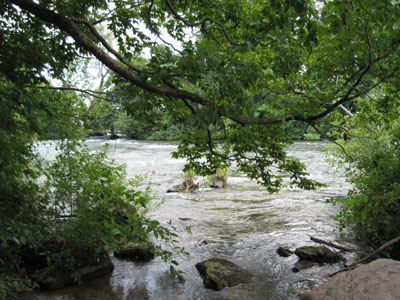
The lake in the picture (photo credit Sara Corry) is at the base of Camp Netimus, where the East Coast Gathering assembled for its third year this last weekend. In the presence of such moments, it’s easier to perceive that the physical world is one face of the holy, or as Jung expressed it, “Spirit is the living body seen from within, and the body the outer manifestation of the living spirit—the two being really one” (253). Humans respond to beauty and to such transparent intervals as this, often in spite of what they may consciously believe or claim about reality. We cannot help but be moved because we are part of what we witness. We may witness a score of hierophanies, visions of the divine, each day. Whatever our beliefs, these openings to the sacred nourish and help sustain us.
The rebalancing we hope to accomplish depends on our state of consciousness, on our ability to accept a gift given. And so in a workshop last weekend, “The Once and Future Druid: Working with the Cauldron of Rebirth,” we repeatedly turned to another seed-passage, this time from Neville’s The Power of Awareness: “The ideal you hope to achieve is always ready for an incarnation, but unless you yourself offer it human parentage, it is incapable of birth.” I carried that with me for several days, marveling at its ability to focus the attention. Whenever I found myself falling into old patterns of thought, I return to its simple truth. The power of such meditations and seed-exercises reaches beyond their apparent simplicity or even simplisticness.
In one sense we are consciously meme-planting, even if it’s on a personal level. Why not plant our own, rather than be subject to others’ constructs, which may not suit us? Yes, these seed-thoughts and heart-songs may remain lifeless if we do not ignite them with our attention and desire. But properly sustained, like a campfire (sorry … the camp images stick with me!), fed and banked and tended, it can pour out a healing and transformative warmth all out of scale to its visible size.
/|\ /|\ /|\
Jung, Carl. Modern Man in Search of a Soul. London: Routledge and Kegan Paul/Ark Paperbacks, 1984.
After my father passed away in the winter of 2008, I wasn’t able to scatter his ashes the following spring as I’d planned. A cancer diagnosis laid me low soon after his final decline, and his childhood home in Niagara Falls in western NY state, as well as the farms he had owned and worked for decades, and where I grew up, were 450 miles from my wife’s and my home and jobs in CT. During my medical journey, we’d also bought a house in VT, and with follow-up radiation and a personal leave from our work, along with numerous loose ends to tie up, there’d simply been no good time. And the task and my intention, if not my father’s, deserved good time.
My dad had always been indifferent about the whole thing. Beyond asking to be cremated, he seemed to feel, perhaps from the many animal deaths and births that inevitably accrue in a lifetime of farming, that one more dead body was something to dispose of, but nothing worth much fuss. “Throw me on the manure spreader when you go out next, and toss me at the back of the cornfield,” he’d always say in his wry way, whenever I asked him one more time about his wishes. That was what we did with the occasional calf that died of pneumonia or scours. In six months, crows and time would eventually leave just whitening bones. But at the time of my dad’s death, we no longer owned the farm, and in any case, beyond a certain undeniable fitness to his request, a desire to make that one last gesture for the good of the land, as human fertilizer, there was the small matter of legality.)
This summer a family reunion in Pittsburgh provided the opportunity to attend to this final matter. My wife and I drove there and back, and on the way out last Friday afternoon, after a slow cruise along Lakeshore Drive that hugs the south shore of Lake Ontario, we made our way to downtown Niagara Falls and then over the bridge onto Goat Island. So around 2:00 pm or so, you could have seen me squatting at the edge of the Niagara River, a few hundred yards above the Falls, on the second of the Three Sisters islands that cling to rocky outcrops in the rapids. The day was overcast but pleasant — typical of western NY, with its delightfully mellow lake-effect summers. Between my feet rested the heavy plastic bag of dad’s ashes, in the plain box the funeral home had provided.
I had nothing to say — no particular ceremony in mind. Words earlier, words around and after his death, words a week or so ago in a dream, but nothing now. This was for experiencing, not talking. Six years before, I’d returned my mother’s ashes to the Shellrock River in the small Iowa town of her childhood. That day, the easy meander of the river, the June sun on my back, the midday stillness, and the intermittent buzz of dragonflies skimming the water lent the moment a meditative calm. As my wife and two of my mother’s cousins watched, I slowly poured the powdery ashes into the river, and the water eddied and swirled as it bore them downstream. Watching the ash disperse downstream, I felt peace. Thus we can go home.
This day was different. A steady damp breeze rustled the leaves of the trees. On another treeless outcrop a short way upriver, the harsh voices of the flock of gulls were only intermittently inaudible over the tumble of water and the dull roar of the falls downriver.
I sat, heels in mud, watching the current on its endless course past and away. When I opened the bag of ashes, a sudden gust of wind caught some and dusted my left arm, which startled me, then made me smile. It was as if my father approved — that behind his gruffness, the elemental beauty of the spot, a family favorite, might matter after all. I brushed off my arm, and then poured the chalky ash into the spinning waters and watched it spread and then, eventually, the water cleared as it washed away.
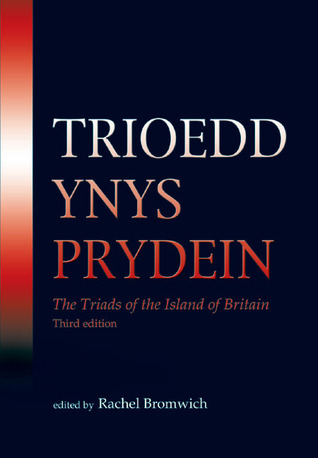
Druid teaching, both historically and in contemporary versions, has often been expressed in triads — groups of three objects, perceptions or principles that share a link or common quality that brings them together. An example (with “check” meaning “stop” or “restrain”): “There are three things not easy to check: a cataract in full spate, an arrow from a bow, and a rash tongue.” Some of the best preserved are in Welsh, and have been collected in the Trioedd Ynys Prydein (The Triads of the Island of Britain*, pronounced roughly tree-oyth un-iss pruh-dine). The form makes them easier to remember, and memorization and mastery of triads were very likely part of Druidic training. Composing new ones offers a kind of pleasure similar to writing haiku — capturing an insight in condensed form. (One of my favorite haiku, since I’m on the subject:
Don’t worry, spiders —
I keep house
casually.
— Kobayashi Issa**, 1763-1827/translated by Robert Hass)
A great and often unrecognized triad appears in the Bible in Matthew 7:7 (an appropriately mystical-sounding number!). The 2008 edition of the New International Version renders it like this: “Keep asking, and it will be given to you. Keep searching, and you will find. Keep knocking, and the door will be opened for you.”
Apart from the obvious exhortation to persevere, there is much of value here. Are all three actions parallel or equivalent? To my mind they differ in important ways. Asking is a verbal and intellectual act. It involves thought and language. Searching, or seeking, may often be emotional — a longing for something missing, a lack or gap sensed in the soul. Knocking is concrete, physical: a hand strikes a door. All three may be necessary to locate and uncover what we desire. None of the three is raised above the other two in importance. All of them matter; all of them may be required.
And what are we to make of this exhortation to keep trying? Many cite scripture as if belief itself were sufficient, when verses like this one make it clear that’s not always true. Spiritual achievement, like every other kind, demands effort. Little is handed to us without diligence on our part.
And though the three modes of investigation or inquiry aren’t apparently ranked, it’s long seemed to me that asking is lowest. If you’ve got nothing else, try a simple petition. It calls to mind a child asking for a treat or permission, or a beggar on a street-corner. The other two modes require more of us — actual labor, either of a quest, or of knocking on a door (and who knows how long it took to find?).
It’s possible to see the three as a progression, too — a guide to action. First, ask in order to find out where to start, at least, if you lack other guidance. With that hint, begin the quest, seeking and searching until you start “getting warm.” Once you actually locate what you’re looking for — the finding after the seeking — it’s time to knock, to try out the quest physically, get the body involved in manifesting the result of the search. Without this vital third component of the quest, the “find” may never actually make it into life where we live it every day.
Sometimes the knocking is initiated “from the other side” In Revelations, the Galilean master says, “I stand at the door and knock.” Here the key seems to be to pay attention and to open when you hear a response to all your seeking and searching. The universe isn’t deaf, though it answers in its own time, not ours. The Wise have said that the door of soul opens inward. No point in shoving up against it, or pushing and then waiting for it to give, if it doesn’t swing that way …
/|\ /|\ /|\
*The standard edition of the Welsh triads for several decades is the one shown in the illustration by Rachel Bromwitch, now in its 3rd edition. The earliest Welsh triads appearing in writing date from the 13th century.
**Issa (a pen name which means “cup of tea”) composed more than 20,000 haiku. You can read many of them conveniently gathered here.
Sometimes you have experiences that just don’t fit. They’re orphans, and like orphans, too often they’re left to fend for themselves, so they end up on the street. Or else they’re stuck in a home by some well-meaning authority, where they may subsist uncomfortably for years in places where everyone else looks and acts and talks different. There may not be enough love to go around, either, and like Oliver in Dickens’ novel Oliver Twist, they’re reduced to pleading, “Please, sir, may I have some more?”
Monday night, before the hard freeze here (19 and windy) that threatened all the burgeoning flowers and trees, I offered up a prayer. I don’t usually pray in this way, but I found myself praying for all the wordless Rooted Ones busy putting out buds and leaves and new growth in response to the warm spell that caressed so much of the U.S. “I cry to the Powers,” I found myself saying. A little more love here, please. The great willow in our back yard has pale leafy fronds. The currants are budding. Crabgrass pushes up from dead mats of last year’s growth. The stems of bushes and the twigs of trees show reddish with sap. At the same time, I took stock in what I knew in some traditions about plant spirits, the personifications of energies that help individual species thrive.* Let the devas and plant guardians sort it out. Serve the larger balance — that sort of thing. Then the nudge to pray came, so I honored it. Everyone has a role to play. Then the goddess Skaði presented herself.
All this took place while I was driving down and then back home with my wife from an out-of-state trip to CT. Bookends to the day. We’d tried to be efficient with our driving and gas use, like the good Greenies that on occasion we actually are, and schedule several appointments for the same day. So we rose early, drove through welcome morning sun and glorious light to have a thermostat and brakes replaced on our car, get eye exams and prescriptions and glasses before a sale ended on April 1, drop off a gift at a friend’s house, and get to an admissions interview for a certificate program I’m interested in. (More about that as it progresses.)
We’d scheduled ourselves fairly loosely, but still the sequence of appointments mattered for times and distances to travel to the next stop. So when the car service that we’d been assured would take no more than two hours now promised to consume most of the day, we got a loaner car from the dealership, rescheduled and shuffled some of our meetings. Ah, modern life. Maybe it’s no more than imagination, but at such times recall of past lives makes horse-and-buggy days seem idyllic and stress-free by contrast. Back then we didn’t do so much because we simply couldn’t. Does being able to do more always mean we should?
So, Skaði.** Not to belabor you with too much detail: she’s a Scandinavian goddess of winter, hunting, mountains and skiing. A sort of northern Diana of the snows, an Artemis of the cold heights and crags. I’d run across her a few years ago, when I was doing some reading and meditation in Northern traditions. She loomed in my consciousness then, briefly. Frankly I found Bragi, the god of eloquence and poetry and patron of bards, much more to my taste. But there she was, for a short time.
I flashed on an image of Skaði then, and she seemed — and still seems to me — quite literally cold, implacable, uninterested in humans, remote, austere, elegant in the way ice formations and mountain snows and the Himalayas are elegant — and utterly forbidding. Not someone even slightly interested in exchange, in human interaction. Now here she was. If you’ve been pursued by any of the Shining Folk, whether the Morrigan or Thor, Jesus or Apollo, you know that often enough they choose you rather than the other way around. So you make do. You pay no attention. Or you can’t help it and now you have a patron deity. Or something in between. If you’re a bloody fool, you blab about it too much, insisting, and the nice men in white coats fit you for one too. Or maybe you and Thorazine become best friends. It’s at times like this that I’m glad of the comparative anonymity of this blog. I can be that bloody fool, up to a point, and the people who need to will pass me off as just another wacko blogger. And then this post will recede behind the others, and only one or two people will happen on it in another month or two. The gods are out there, and they’re in our heads, too. Both/and. So we deal with it. And I can step back to my normal life. Or not. I’ll keep you posted.
So Skaði of the daunting demeanor wants something. I prayed to the Powers, almost in the Tolkien Valar = “Powers” sense — to anyone who was listening. Open door. Big mistake? I’m a Druid, but here’s the Northern Way inserting itself into my life. My call goes out, and Skaði picks up and we’re having this conversation in my head while I drive north on I-91 with my wife. I’ve gotten used to these kinds of things over time, as much as you can, which often isn’t so much. In a way I suppose it’s revenge — I used to laugh out loud at such accounts when I read them and shake my head at what were “obviously people’s mental projections.” Now I’ve got one saying if you want protection for your shrubbery (God help me, I’m also hearing the scene from Monty Python and the Holy Grail at this point. The Knights of Ni: “Bring me a shrubbery!”), then do something for me. What? I said. A blog post, first, then a website shrine. So here’s the blog post first. I’ll provide the shrine link when I’ve set it up.
/|\ /|\ /|\
*If you’re interested in an excellent account of this, check out The Findhorn Garden, originally published in 1976. This Scottish community, established on a barren piece of land, “inexplicably” flourished with the help of conscious cooperation with nature spirits. It’s documented in photographs and interviews. There are several books with similar titles and later dates, also published by Findhorn Community.
**The ð in her name is the “th” sound in with. I’m slowly realizing that part of my fussing over words, the urge to get it right, the annoyance at others who seem not to care about linguistic details, can be transformed to a gift. So for me part of honoring Skaði is getting her name right.
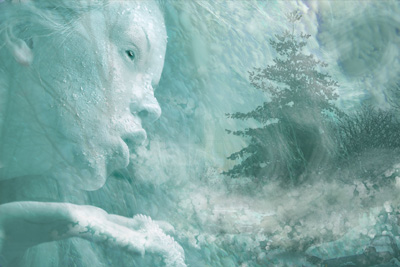
Image: Skaði. I can’t draw or paint to save my life, so when I came across this stunning representation, a shiver slalomed down my back. Skaði’s footsteps, I guess I should say. This is in the spirit of my experience of the goddess.
“Only what is virgin can be fertile.” OK, Gods, now that you’ve dropped this lovely little impossibility in my lap this morning, what am I supposed to do with it? Yeah, I get that I write about these things, but where do I begin? “Each time coming to the screen, the keyboard, can be an opportunity” — I know that, too. But it doesn’t make it easier. Why don’t youtry it for a change? Stop being all god-dy and stuff and try it from down here. Then you’ll see what it’s like.
OK, done? Fit of pique over now?
I never had much use for prayer. Too often it seems to consist either of telling God or the Gods what to do and how to do it (if you’re arrogant) or begging them for scraps (if they’ve got you afraid of them, on your knees for the worst reasons). But prayer as struggle, as communication, as connecting any way you can with what matters most — that I comprehend. Make of this desire to link an intention. A daily one, then hourly. Let if fill, if if needs to, with everything in the way of desire, and hand that back to the universe. Don’t worry about Who is listening. Your job is to tune in to the conversation each time, to pick it up again. And the funny thing is that once you stop worrying about who is listening, everything seems to be listening (and talking). Then the listening rubs off on you as well. And you finally shut up.
That’s the second half, often, of the prayer. To listen. Once the cycle starts, once the pump gets primed, it’s easier. You just have to invite and welcome who you want to talk with. Forget that little detail, and there can be lots of other conversations on the line. The fears and dreams of the whole culture. Advertisers get in your head, through repetition. (That’s why it’s best to limit TV viewing, or dispense with it altogether, if you can. Talk about prayer out of control. They start praying you.) They’ve got their product jingle and it’s not going away. Sometimes all you’ve got in turn is a divine product jingle. It may be a song, a poem, a cry of the heart. The three Orthodox Christian hermits of the great Russian novelist Tolstoy have their simple prayer to God: “We are three. You are three. Have mercy on us!” Over time, it fills them, empowers them. They become nothing other than the prayer. They’ve arrived at communion.
/|\ /|\ /|\
Equi-nox. Equal night and day. The year hanging, if only briefly, in the balance of energies. Spring, a coil of energy, poised. The earth dark and heavy, waiting, listening. The change in everything, the swell of the heart, the light growing. Thaw. The last of the ice on our pond finally yields to the steady warmth of the past weeks, to the 70-degree heat of Tuesday. The next day, Wednesday, my wife sees salamanders bobbing at the surface. Walk closer, and they scatter and dive, rippling the water.
/|\ /|\ /|\
I once heard a Protestant clergywoman say to an ecumenical assembly, “We all know there was no Virgin Birth. Mary was just an unwed, pregnant teenager, and God told her it was okay. That’ s the message we need to give girls today, that God loves them, and forget all this nonsense about a Virgin birth.” … I sat in a room full of Christians and thought, My God, they’re still at it, still trying to leach every bit of mystery out of this religion, still substituting the most trite language imaginable …
The job of any preacher, it seems to me, is not to dismiss the Annunciation because it doesn’t appeal to modern prejudices, but to remind congregations of why it might still be an important story (72-73).
So Kathleen Norris writes in her book Amazing Grace: A Vocabulary of Faith. She goes on to quote the Trappist monk, poet and writer Thomas Merton, who
describes the identity he seeks in contemplative prayer as a point vierge [a virgin point] at the center of his being, “a point untouched by illusion, a point of pure truth … which belongs entirely to God, which is inaccessible to the fantasies of our own mind or the brutalities of our own will. This little point … of absolute poverty,” he wrote, “is the pure glory of God in us” (74-5).
So if I need to, I pull away the God-language of another tradition and listen carefully “why it might still be an important story.” Not “Is it true or not?” or “How can anybody believe that?” But instead, why or how it still has something to tell me. Another kind of listening, this time to stories, to myths, our greatest stories, for what they still hold for us.
One of the purest pieces of wisdom I’ve heard concerns truth and lies. There are no lies, in one sense, because we all are telling the truth of our lives every minute. It may be a different truth than we asked for, or than others are expecting, but it’s pouring out of us nonetheless. Ask someone for the truth, and if they “lie,” their truth is that they’re afraid. That knowledge, that insight, may well be more important than the “truth” you thought you were looking for. “Perfect love casteth out fear,” says the Galilean. So it’s an opportunity for me to practice love, and take down a little bit of the pervasive fear that seems to spill out of lives today.
Norris arrives at her key insight in the chapter:
But it is in adolescence that the fully formed adult self begins to emerge, and if a person has been fortunate, allowed to develop at his or her own pace, this self is a liberating force, and it is virgin. That is, it is one-in-itself, better able to cope with peer pressure, as it can more readily measure what is true to one’s self, and what would violate it. Even adolescent self-absorption recedes as one’s capacity for the mystery of hospitality grows: it is only as one is at home in oneself that one may be truly hospitable to others–welcoming, but not overbearing, affably pliant but not subject to crass manipulation. This difficult balance is maintained only as one remains [or returns to being] virgin, cognizant of oneself as valuable, unique, and undiminishable at core (75).
/|\ /|\ /|\
This isn’t where I planned to go. Not sure whether it’s better. But the test for me is the sense of discovery, of arrival at something I didn’t know, didn’t understand in quite this way, until I finished writing. Writing as prayer. But to say this is a “prayer blog” doesn’t convey what I try to do here, or at least not to me, and I suspect not to many readers. A Druid prayer comes closer, it doesn’t carry as much of the baggage as the word “prayer” may carry for some readers, and for me. “I’m praying for you,” friends said when I went into surgery three years ago. And I bit my tongue to keep from replying, “Just shut up and listen. That will help both us a lot more.” So another way of understanding my blog: this is me, trying to shut up and listen. I talk too much in the process, but maybe the most important part of each post is the silence after it’s finished, the empty space after the words end.
/|\ /|\ /|\
Norris, Kathleen. Amazing Grace: A Vocabulary of Faith. New York: Riverhead Books, 1998.








 A Druid Way


