Archive for the ‘poetry’ Category
A spiral differs from a circle. There’s motion in it, and change. The track or trail of movement is itself motionless. (Well, comparatively: the boat’s wake dissolves in ripples, the jet trail fades, but some time after, at least; the jet’s long gone.) It records the journey. But journey in a spiral is not repetition. It’s recognition, re-encounter from a fresh perspective. History, planetary or personal, doesn’t repeat itself, but it does often spiral.
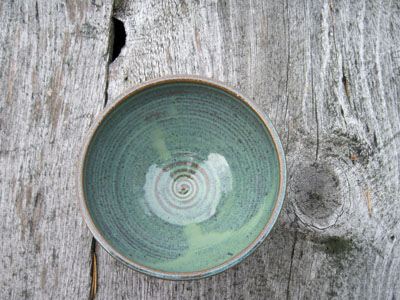
[Originally when I took the photo I was simply looking for a background that would contrast with the bowl. Only later after I’d uploaded the photo did I realize that the grain of the wood holds at least as much interest as the spiral design of the bowl. Talk about not seeing the obvious.]
You may remember the chorus in Joni Mitchell’s lovely song “The Circle Game”:
And the seasons they go round and round
and the painted ponies goes up and down
We’re captive on the carousel of time
We can’t return we can only look behind
from where we came
and go round and round and round
in the circle game.
Joni, it’s lovely, and it’s easy to be seduced by the beauty of your song, but you’re wrong. Or at least, you’re right only about one choice among many. It’s a game, and therefore we’re no more captive than any player is who agrees to the rules in order to play at all.
We can choose to play the game this way and be participants in time. That’s the only way to live in a material world anyway, from what I’ve seen: in time. Once we release the drive to “get ahead” or “win the race,” we can begin to jump through time, from moment to moment, recognizing “infinity in a grain of sand, and eternity in an hour,” as William Blake has it. Time is illusion, yes — but in the sense of play (Latin ludere, lusus, illusio = in+ lusio — “in the game”): a set of rules to make sense or pattern out of the flow of experience, which is e-lusive. We need “before” and “after” in order to begin (or return) to experience “now.” The moment of illusion, of play, then broadens and deepens.
“Time is the stream I go fishing in,” says Thoreau. I use this as a mantra when I get stressed about deadlines, minutes ticking, the illusion gaining hold in a way that’s no longer a game, no longer pleasant to be playing. There’s nothing wrong or cruel about time, once we let go the fear that comes with clinging to any particular moment — of resisting the play because life is supposedly such a serious thing. “Eternity is in love with the productions of time,” Blake says in another poem.
These “long lessons” are ones I keep learning. Most of us do — most of us are slow learners — earth’s a place for those with “special needs.”
To live any other way is to suffer needlessly — never my favorite thing to do, anyway — and to be trapped in regret and loss. We’ll all have a taste of these if we live long enough, as part of the balance that comes with fullness of life — why seek out more, and worse, elevate them to a kind of icon of authenticity? “I’m not human unless I make a fetish of my suffering,” some people seem to say. “I AM my suffering,” say others.
The Circle Game goes best when we treat it as a game, as a shape of experience. But it’s not the ONLY one. We hear of people being “lost in the past.” How about seeing what it’s like to lose yourself in the present? Nowhere is now here, to make a linguistic jest with wisdom at its core.
Robert Frost was on to it in “Birches.”
I’d like to get away from earth awhile
And then come to it and begin over.
May no fate willfully misunderstand me
And half grant what I wish and snatch me away
Not to return. Earth’s the right place for love:
I don’t know where it’s likely to go better.
If I don’t experience it on this curve of the spiral, it won’t be there for me the next time to “come to and begin over” in that “can-be-delightful” encounter of the “familiar-new” that often flavors our experiences. I cheat myself of so much joy, thinking there’s someplace “where it’s likely to go better.” Now, here, is when and where it’s at.
“We are many sets of eyes staring out at each other from the same living body” — Freeman House, Totem Salmon
We are many sets of eyes, staring out
at each other from the same living body.
We are ears listening to each other
across valleys of skin.
Heat of the other’s blood
warming the air we breathe,
air that filled the other’s lungs
not long before, and will again,
ruffling our hair, rippling this field
of frost-gray grass.
We touch earth that touches each other,
life-print curling at our fingertips and lips,
world (a piece of it) digesting in our bellies,
swept along in blood and spit,
spice of it in our marrow,
essential you in everything
I eat and love and do,
essential me in you.
/|\ /|\ /|\
So there’s a poem provoked (I say “provoked” rather than “inspired” because that’s the sensation — I encounter a piece of language not my own that becomes the grain around which oyster tries to form a pearl. It won’t let go until I respond, and try to shape the sensation into something in words.)
 Nano update: I’m catching up at 13,527 words and counting, but still a little more behind than I’d like. We’ll see what 2 and 1/2 cups of coffee this morning helps me accomplish. I don’t usually drink it, since I’m hypersensitive to caffeine and it keeps me up most of the night following the day I drink it, but I was cold this morning, and the smell! … well, anyway, I’m caffeinated and writing.
Found an interesting passage in a medieval author yesterday, Walter de Mapis. (If you’re gonna procrastinate, I say, why not procrastinate tangentially? I researched historical refs to succubi.) So now I know something about rumors surrounding Pope Silvester. The pontiff flourished around the year 1000, and his legacy includes the story of a certain succubus, who was said to give him advice, and who was reputed to be his lover. Supposedly he repented on his deathbed. Traitor. I’m expecting my succubus main character Alza will have something to say about that. Who knows — maybe she was there. Maybe she was the succubus …
Just discovered she has a mantra or prayer or verbal talisman she recites frequently. Maria, one of her worshippers (from her “cult” phase), overheard her this morning talking quietly to herself, and asked about it. Here are the words Alza said (part of the charm is to speak about oneself in third person):
Alzakh ne utayal gashem muk dafa.
May Alzakh grow in this surrounding fire,
may Fire know her for its own,
may Fire fill her in all she does,
burning away what blocks her,
burning toward what is native to her,
what is or will become or has been Fire,
time the Fire that moves all things into being.
Always fun to get a piece of the original in Harhanu. You need to know: among my other odd hobbies is conlanging. So I hear bits of languages, like I imagine musicians and songwriters hear snatches of songs and musical phrases. Here are the italicized words phonetically, as I heard them from Alza’s mouth: ahl-zahkh NEH oo-tah-YAHL gah-SHEM mook dah-FAH. [Literally, Alza this surrounding fire-in grow-imperative.]
Alza’s name in Harhanu is actually Alzakh, with the kh the raspy sound in loch and Bach — a voiceless velar fricative, to be all linguistic-y and precise about it. Alza’s name got truncated over the years, to match what people thought they heard, or thought it should be. Much as men around Alza imagine the woman they want, which she can then use to seduce them. Most men are, frankly, pretty seducible, she learns. So that part’s easy.
You want Druidry? Find it here, or go bother somebody else. (Now maybe you have some idea why I don’t overdo the caffeine. It makes me all cranky-creative and snarky and stuff.)
Sunlit November trees.
A scarf of woodsmoke curls between the mountains.
Look long enough at beauty, someone says.
You’ll begin to see more things as they are.
/|\ /|\ /|\
 So, Nano writing update: was out of town at a conference yesterday, and got no writing done. That means today’s a triple push: tomorrow I have a class, a car appointment, and a (late) Samhain celebration with a friend, so there’ll be less time to write. And catch up from yesterday, along with today’s 1667 words.
I’m grateful they keep coming. You know a story is launched — and this says nothing about its quality, only about whether it’s alive for the author, at least — when characters invade your dreams and begin telling you stuff about themselves. And while exercising this morning on our secondhand treadmill in our breezeway (45 degrees, but warmer than outside), I got another piece of plot. Rather, more a set of questions to ask (and answer), and a couple of flashes of image-ideas. By the end of today, I should be at least at the 10,000 word mark if I’m to stay on track.
My main character has retreated to her house in Santa Fe to take stock. (Why Santa Fe? I’ve no idea. Never been there. Would like to, yes. Have to do some research, to see how I might use the locale.) Now to avoid merely lengthy exposition and instead make things happen. I might be able to get away with some flashback, dramatize bits of the past that are now relevant. I keep picking up the stray question here and there that won’t let go, and it generates backstory — in some cases, gobs of backstory. But no stopping to worry about whether the story should begin somewhere else. That’s for a revision. Right now the point is to keep going, keep seeing new pieces I wouldn’t encounter any other way. In that way it’s like any creative process. The road rises to meet your feet as you keep walking.
Maybe you’ve had the dream version: you’re dreaming, you come to a cliff, you’re aware enough to say, “It’s a dream — I can jump and nothing will happen! Woo-hoo!” So you toss yourself in complete abandon, enjoying the thrill of that reckless plunge you would never take awake, but just as the cliff edge spins away above and behind you, you terrify yourself by asking: what if it’s NOT a dream?!
With luck, at this point, you don’t wake yourself up, heart pounding, breathing hard. Instead, you watch to see how you will land, and where, whether you will sprout wings and fly someplace else, etc. In other words, you’re hungry to know what will happen next?! Don’t let me wake up yet!
Curiosity’s one of the best tools I know.
In her blog, Alison Leigh Lily writes beautifully about the human body as a holy thing, an altar:
So, too, my body is the altar in the nemeton [sacred grove–ADW] of my soul — that small, solid piece of world that settles down like a stone into my awareness. And that awareness in turn is carved by the spiraling torrents of the sacred world, the sun that crafts the seasons out of mud and wind, the moon that pushes the sea to its extremes, the stars that draw the eye into the great distances that yawn open between us, the deer, the jay, the badger, the rustling oak and every being and body that dances through its longing, hunger, fear, curiosity and sleep. All these things turn about the sculpted edge of my nemeton, the sanctuary my soul has made of itself, the self that calls itself “I” and reaches out into the world to touch the chaos that has given birth to it. Sitting in the center of that nemeton is my body, all surface, the appearance of skin and hair and angles and soft curves of fat and loose muscle. Like a ladder that reaches into the dark. A spine, a wellspring, a single tree, a tongue of flame. My body is the altar around which my spirit gathers itself into stillness. Not a temple, but only a simple, useful table where I sit down to do my work.
And some of the work we are called to do is to recognize that altar. In the Bible I read, “I will go up into the altar of God” — introibo ad altare dei in Latin. I use it as a mantra, a chant, to be mindful of the altar as a place to ascend to. For it feels like we do actually rise up, into the body, out of thought, out of waking, out of the distractions and worries and daily obsessions, the small news that passes for important events that other people call “headlines,” but which are mostly just footnotes — out of the image and into the reality, into this body that is part of the world, not a thought or an idea or a remove from the thing itself, but the place where we experience a universe.
I strive to occupy this body, this world, as fully as I can, to be fully incarnate. Not to forsake this great, unheralded, impossibly large opportunity to know, to dare, to will and to be silent, to listen for the voices of the Others who move all around me, chickadee at the feeder, crows scavenging a dead squirrel on the road early this morning as my wife and I drove through the dark and the fog to her weaving apprenticeship.
And Tom, who introduced himself yesterday afternoon — a neighbor, out chopping wood. He paused from his work and called to my wife and me, walking slowly over to where we were unloading our car. “It’s something I can still do, and it needs doing,” he said to us, as he stood before us, dressed in blue sweat pants, a gray sweatshirt, a blue hoodie, pieces of leaves and bark plastered to this clothes. “I was just recovering from knee surgery when I had a stroke. And I was recovering from the stroke when I lost my job. But I can still chop wood, as long as I don’t have to bend my legs too much.” So I touch that friendliness, and something of the spirit in him, that brought him to our doorstep to chat in the fading afternoon light of a day in early November. Is any song more wonderful?
“Sanctuary my soul has made of itself,” Alison says — a poem, a song, a prayer for this life, this world.
“Prayer is about being hopeful,” says Sister Alice Martin. “It is not a phone call to God’s hotline. It’s not about waiting around for an answer you like, especially since sometimes the answer you’re going to get is NO!” And she continues, “If you are going to pray, then don’t worry. And if you are going to worry, then don’t bother praying. You can’t be doing both.” I know which one I want to choose, often as I can, prayer at this altar of my body.
That presence in forest, grove or single tree is something kindred to me, so I walk under the branches, and touch the bark and speak with them, and listen. Their slow gestures move in the air above me. And the silence rings in my hearing. Druids and trees — that was something I understood right away. In childhood my closest friends were trees. What is it about them?
The German poet Rilke captures a piece of it in one of his Sonnets to Orpheus:
A tree ascended there. Oh pure transcendence!
Oh Orpheus sings! Oh tall tree in the ear!
And all things hushed. Yet even in that silence
a new beginning, beckoning, change appeared.
Creatures of stillness crowded from the bright
unbound forest, out of their lairs and nests;
and it was not from any dullness, not
from fear, that they were so quiet in themselves,
but from just listening. Bellow, roar, shriek
seemed small inside their hearts. And where there had been
at most a makeshift hut to receive the music,
a shelter nailed up out of their darkest longing,
with an entryway that shuddered in the wind —
you built a temple deep inside their hearing.
Trees get me to go “quiet in myself,” so that silence is not absence of speech, but a positive space that allows the stillness to unfold and open up and include the listener in it. From it rises the “tall tree in the ear.”
Orpheus, the “you” of the last line, is a musician, a listener who hears the space between notes. He knows sound and silence blend to make possible the third thing of music. Wisdom speech, as opposed to chat and gossip, possesses that same character, emerging out of the silence which makes it possible, and bearing the imprint of its quality.
Such communion is a powerful tool. The rough “shelters” we construct out of our animal longings point us toward knowing these things, toward recognizing and gathering in the temple we can find “inside our hearing.”
I am a whisper under the moon’s shadow, a song heard from the next room, a melody hummed under the breath;
I am the first bird to the feeder, the last star before dawn, the rain before the rainbow;
I am what I have forgotten so I can remember it again, a question at the altar, the answer of green leaves unfolding;
I am wherever the long dream draws its curtain, when I listen to the voices of ancestors, where the winds find their resting place;
I am why the swallow dips in flight, I am the luck of dice still tumbling, I am the interval when I can say these things.
/|\ /|\ /|\
Early Irish and Welsh poets such as Amergin and Taliesin composed related poems in the form of “I am” or “I have been” statements, with imagery drawn from nature, which I’ve imitated here. The Song of Amergin is one famous example which has survived in different versions.


 A Druid Way