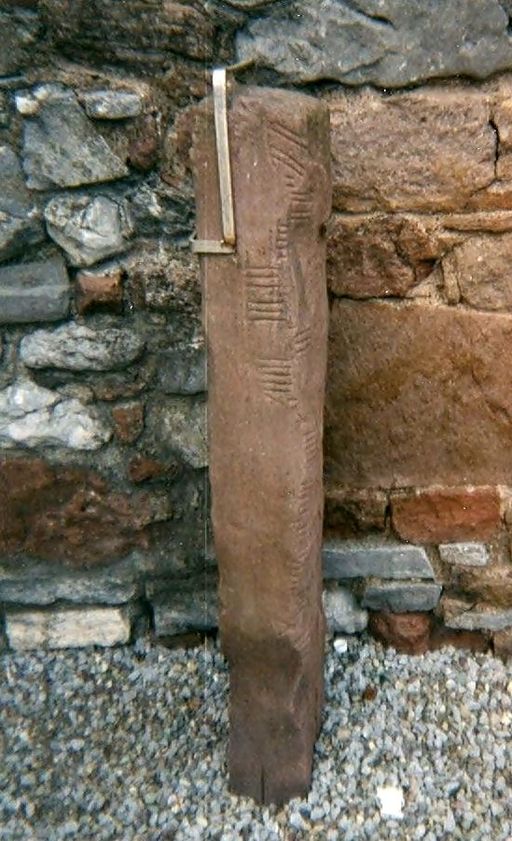
The ogham alphabet, which some contemporary Druids and Pagans use in divination, served writers of early Irish for about half a millennium, starting in the 400s. The writing system consists of mostly straight lines, well-adapted for incising letters on wood and stone, which keep saying “we don’t do curves”.
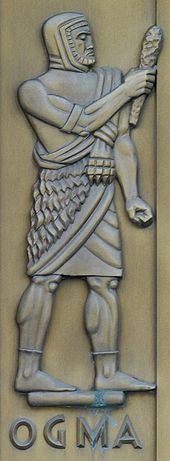
You can read scholarly speculation about ogham’s origins here on Wikipedia and elsewhere. Accounts in the later medieval Lebor Gabala Erenn (“The Book of the Taking of Ireland”) and the Ogam Tracts variously attribute its origins to the god Ogma/Ogmios and to wise Celtic ancestors.
Among other modern writers, Robert Graves (1895-1985) launched the ogham into the modern world in his book, The White Goddess. Did he know what he was doing? Well, it’s subtitled A Historical Grammar of Poetic Myth. Depending on your point of view, that’s utterly contradictory, or an image of our common human reality. Things rarely have a single “cause” but instead are part of a web or network of beings and energies, each aspect or person or deity contributing its portion.
Whatever you make of its origins, as a proven divination system the ogham can open doors to insight.
But as a friend of mine recently discovered, it has some practical disadvantages in non-magical use. For one thing, it has no letter to represent p, in part because Irish had no need for a letter to represent this sound, which disappeared over the course of its development. Historical linguistics offers examples: Proto-Indo-European *pater “father” became early Irish *athir; PIE *pisk– “fish” became (modern) Irish iasc, and so on. (With Christianity, Irish came to adopt the Latin alphabet, convenient for all the words beginning with p that it eventually borrowed from Latin.)
I find in these things some helpful reminders. Sometimes what works — works well, works wonderfully — on one level of reality may not fit well or at all on another level. Deploying the gift of a magical alphabet like ogham, I might discover something profound about my purpose in this life, but not be able to write the word “purpose” using that same alphabet.
Though a p is a possible sound, you might say, I may not need it in particular — there are other sounds, a whole spectrum. (Arabic, for instance, doesn’t have a p either, and gets along fine. From the perspective of many other languages, how can English speakers possibly have a language without the “raspy throat sound” in Bach or Ḥanukkah? [That’s a velar or pharygneal fricative, if you want to show off.] English used to have that sound — the evidence lies in all those archaic spellings with -gh- like “night, light, sought, though, bright, laugh” etc. And the way languages keep changing, we could one day have that sound back again.)
I fall into a ready trap if I expect the cosmos to line up obediently according to my partial understanding of it. (Don’t ask me how many times I’ve had to re-learn that lesson. And by the looks of things, I’m not yet done, either.) When I asked Ogma for help with a constructed Celtic language, I attempted to align with an energy connected to language and words. The results reflect both the blessing the god was willing to offer, and also my human effort. Centuries from now, if someone attempts to “explain the origins” of “my” language, could they even come close to the muddy, messy reality of human interest, a spiritual door opening, a gift of inspiration, some experience with Celtic languages, time dedicated to manifestation, and who knows what else in the mix? I may want my magic pure and my life comprehensible, but they refuse to cooperate.
of spirit. Wisdom in words, wrought for ready use.
May your inspiration guide heart and hand,
mind and mouth, spirit and speech.
/|\ /|\ /|\
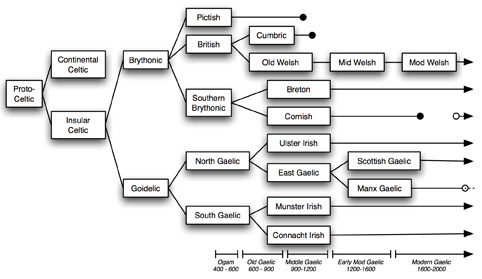
The six living insular Celtic languages — Welsh, Breton, Cornish*, Manx*, Irish and Gaelic — have survived (*or been revived) against often harsh and long odds. I won’t go into the historical challenges that the Celtic tongues share with most minority languages. And I’m not even considering any of the extinct continental Celtic tongues like Gaulish, Galatian or Lepontic.
Suffice it to say that not one of the six living Celtic tongues is secure enough that its advocates can relax into anything resembling the ease of speakers of a world language like English. So why not learn one of these endangered languages (or revive Galatian)? After all, with such knowledge comes the ability to experience a living Celtic culture from the inside, as well as gain access in the original languages to texts that nourish Druid practice and thought. One more speaker is one more voice against linguistic and cultural extinction. In the title and first section above I invoke Brighid/Bríd and Ogma/Oghma, to give the ancient and modern Irish forms of their names. With the experiences of many contemporary and ancient polytheists in mind, I can say with some confidence that the gods honor those who go to the trouble to learn the old languages and speak to them using even a little of the ancestral tongues.
Or if not one of the living Celtic tongues, then how about one of the Celtic conlangs that already exist? Arvorec, Kaledonag, Galathach and others wait in the wings, in varying states of development. They could provide a ready foundation to build on — a foundation already laid.
Why not use one of them? In part out of respect for their makers, who may not want their creations associated with Druidry. Arvorec, to focus on just one for a moment, is already part of the conlang community of Ill Bethisad, and has its own con-culture (and even con-religion — An Graveth, a cousin to Druidry). In part — a significant part for me — as a Bardic offering to the gods invoked here: gods esteem the taste of human sweat. Salt flavors the sacrifice. And for the very human reason that when we invest time and energy in something, we often value it more, and can draw on dedication, creative momentum, pride, inspiration, desire and love to see it through. If a Celtic language is not my mother tongue, then let it be a foster-mother. Let this tongue be one I have helped craft from the shapes and sounds and world we receive as a heritage.
/|\ /|\ /|\
Like the Romance, Slavic, Germanic and Indo-Iranian language families, the members of the Celtic family show considerable similarities among themselves in vocabulary, grammar, and so on. Centuries of work on the greater Indo-European family have already been done, insights and advances continue, and many resources exist for the Celtic conlanger and Bard-linguist to draw on. Proto-Celtic, the mother tongue of the Celtic languages, is also being reconstructed.
One early question to answer in birthing a Celtic conlang is Q or P. No, that’s not some password you have to know in order to gain admission to the Secret Circle of All Druidry (SCOAD), or a riddle posed by the Planetary High Holy Archdruid. P- and Q-Celtic are shorthand for a linguistic division that usefully divides the six living Celtic tongues into two groups of three, based on their treatment of the Indo-European *kw- in words like *kwetwores “four,” Proto Celtic *kwetwar-, with Irish ceathair, Gaelic ceithir, Manx kaire for the Q-side, and Breton pevar, Cornish pesvar and Welsh pedwar for the P-side. Of course, being next-door neighbors as well as cousins, the six languages also borrowed from each other through their centuries together, which delightfully muddies the waters of linguistic post-gnostication (“knowing after the fact,” like pro-gnostication, only not). Flip a coin, go with your gut, follow your own esthetic, pray, do a divination, or some idiosyncratic combo all your own.
I’m going with P.
What else do we know about the Celtic Six as an initial orientation for a language maker? Quite a lot, actually. Here’s just a small sample: all six have a definite article (English “the”), but only one has an indefinite article (English “a, an”). Most have Verb-Subject-Object (VSO “Ate I breakfast”) as a common if not the dominant word order (English is SVO). All count with an old vigesimal system by twenties, as in French, where “eighty” is quatre-vingt “four twenties,” “ninety” is quatre-vingt dix “four twenties (and) ten,” and so on.
And the consonant mutations: no mutations and — sorry! — it’s just not Celtic! Sorta like a sundae without whipped cream, or a kielbasa slathered in coleslaw and mustard without the bun. In brief, depending on the preceding word, the initial consonant of a Celtic word changes in predictable ways. Here’s an example from Welsh:
Ei means “his.” It causes lenition of the consonant of a following word. Cath means “cat,” but when lenited after ei, the form is ei gath “his cat.
Ei also means “her” (and provides an example of how mutations can help distinguish words): ei “her” aspirates the consonant of a following word. Ei chath means “her cat.”
Eu means “their”: it doesn’t cause a mutation: eu cath is “their cat.”
It gets tricky because while the insular Celtic languages do all have mutations, their mutations behave differently from language to language. Here is Welsh again, now contrasted with Irish:
Welsh | Irish | English gloss
cath | cath | “cat”
ei gath | a chath | “his cat”
ei chath | a cath | “her cat”
eu cath | a gcath | “their cat” (Incidentally, not a typo: Irish gc- — like bp- and dt- — is pronounced g but also shows it is derived from an original c. Cool. Or ridiculous. Depending.)
/|\ /|\ /|\
May we remember you and your gifts, Bríd and Oghma: apt words, the praise of good things, and wisdom dark and bright.
Brighid of the mantles, Brighid of the hearth fire,
Brighid of the twining hair, Brighid of the auguries,
Brighid of the fair face, Brighid of the calmness,
Brighid of the strong hands, Brighid of the kine.
Brighid, friend of women, Brighid, fire of magic,
Brighid, foster mother, Brighid, woman of wisdom,
Brighid, daughter of Danu, Brighid, the triple flame.
Each day and each night I call the descent of Brighid.
That the power of healing be within us,
That the power of poetry be within us,
That the power of shaping be within us,
In earth, and sky, and among all kindreds.
Kindle your flame in our heads, hearts and loins,
Make us your cup, your harp, your forge,
That we may heal, inspire and transform,
All in your honor, Brighid, font of blessing.
Brighid above us,
Brighid below us,
Brighid in the very air about us,
Brighid in our truest heart!

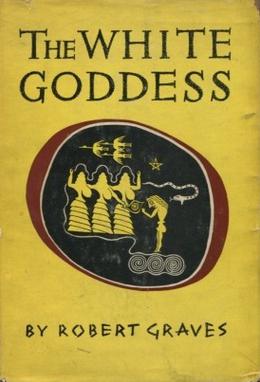 Among other modern writers, Robert Graves (1895-1985) launched the ogham into the modern world in his book, The White Goddess. Did he know what he was doing? Well, it’s subtitled A Historical Grammar of Poetic Myth. Depending on your point of view, that’s utterly contradictory, or an image of our common human reality. Things rarely have a single “cause” but instead are part of a web or network of beings and energies, each aspect or person or deity contributing its portion.


 A Druid Way


