Once again we’re about a week out from the holiday, close enough it tugs pleasantly at awareness. Here in Vermont, in the northeast U.S. where I live, the last few days in the 70s F/20s C confirm that winter’s gone, though nights below freezing are still a possibility. I remind myself from now till June that it snowed on my May birthday the year I was born. Weather, life: stick around long enough and you find anything’s possible.
Outward from the merely personal to a group I practiced with the longest: students at the boarding school where I worked for 16 years. Our last and best effort was a truly elaborate Beltane. We devoted a lot of time to preparation, reserved a spot on the school’s Great Lawn (associated with the annual graduation picnic for the whole school community and parents), put up attractive color posters (see the image to the right), and even inspired our student president to spring for the cost of a whole roast pig.
Beyond our small group of eight, just three other people came.
We’d even begun forming a magic study group, devising our own sigil with input from each member, and generally carrying on in magically appropriate ways: sharing and describing our imaginative/astral visions until they took on a life of their own, balancing our elemental energies, ascertaining each member’s strengths and limits for later ritual work, and so on. To those who exclaim “What?! Are you insane?! Working magic with adolescents?! Nutter! Whackjob! Fool!” I reply only that we had multiple safeguards in place.
To the left is one version of our sigil, drawn with magic marker on a student’s sketchpad, which I share here — “Guard the Mysteries! Constantly reveal them!” — for the benefit of those curious about the lineage and origins of such things.
Some readers may cluck their tongues knowingly and go on to detect “influences.” To which I say only: That’s fine. But these kids didn’t “know” anything about the Golden Dawn or Euro-alchemy or similar things. Spend time in ritual and you too will find that valid images continually reconstitute themselves in the imagination. If I had the sketches each of them made to include here, the connections pointed to a shared experience out of which they crafted the sigil. The Cross, the Cup, the infinity symbol, an upsilon, the axial symmetry — as far as we were concerned, we were onto an experience and a realm worth exploring. Our truth against the world’s.
As for the sparse attendance at Beltane: each group forms around and operates on its own harmonic. We ate well, sent leftovers home with everyone, and chalked up our rather large budget shortfall to the frequent mismatch between inner and outer worlds. Our next fundraiser only just recouped the outlay; balance restored.
/|\ /|\ /|\
Beltane, like the other “Great Eight” festivals* of contemporary Druidry and Paganism generally, draws on a swirl of energies as democratic and mongrel and vital as you could wish for. Find a circle to celebrate with, or if you prefer or are gifted with solitary practice, get outdoors, invite the season, contemplate on images and energies alive and at work in your awareness. Bring them into some physical form to ground and manifest them in your world. We all need reminders to help us through those “difficult” days with humor and grace and even, spirits friendly and stars favorable, with gratitude. What better than something that’s come into your world through you?
/|\ /|\ /|\
*The “Great Eight” festivals of the Wheel of the Year
October 31 – November 2: Hallowe’en, Samhain/Samhuinn, All Hallows Eve, All Saints Day, All Souls Day, Todos Santos, Day of the Dead, Dia de Muertos.
December 20-22: Yule, Winter Solstice, Alban Arthan.
February 1-2: Imbolc, Oimelc, St. Brigid’s Day, Groundhog Day, Candlemas.
March 20-22: Spring Equinox, Ostara, Alban Eilir.
May 1: May Day, Beltane, Bealtainne, Walpurgis Night.
June 20-22: Summer Solstice, Midsummer, St. John’s Day, Litha, Alban Hefin.
August 1: Lughnasad/Lunasa, Lammas(tide).
September 20-22: Autumn Equinox, Alban Elfed, Mabon.
[Some days, about all I can muster is a good gray awen.]
[Gray, grey. “If it’s good enough for Gandalf, then it’s good enough for me.”]
[Gra/ey magic(k). 1) a hair coloring product. 2a) Magic not performed for specifically beneficial purposes. 2b) (derogatory) Magic which avoids annoying ethical considerations. 2c) Magic practiced to confuse, mislead or perplex others. Roy Bowers’ version (link to article): “your opponent should never be allowed to confirm an opinion about you but should always remain undecided. This gives you a greater power over him, because the undecided is always the weaker.”]
/|\ /|\ /|\
“Light is the left hand of Darkness.”
Finally the Chief of the Urdd Awen Ddu rose and called for silence with a curious circular gesture. He was a slim, short man who nevertheless had a commanding presence. His simple black robe accentuated his dark eyes. Power spoke in his voice.
“Opposition strengthens us, like a good resistance training exercise. Contrary to the fears of our opponents, it’s not our intention to ‘cover all the lands in a second darkness.’ Our opponents grow stronger as well. But we have a secret they do not know.”
Almost no shadow
He paused to scan the room and gather eyes. “In the darkness we cast almost no shadow at all. With this energy freed, this psychic weight lifted, we may work our will with advantage. We read in the Hebrew scriptures how even God says, ‘I will give you the treasures of darkness and the hoards in secret places.’* And we have learned together how to recognize and gather these treasures that those who work in light never see, nor ever know. They cannot, not as long as they resist polarity, or think to vanquish one half of the universe.”
A good speaker weaves enchantment over an audience, and the Chief did so now. “Others may fear the Dark. But we have learned, my brothers and sisters, to know and respect its nature and its extent. Identifying with it, its reach becomes our own, and from the concealment darkness offers, we may extend our grasp to life in a way that light cannot. Anciently the Wise have declared, ‘Light is the left hand of Dark.’ Once prepared, as we have prepared ourselves, we can welcome it and grow from it — from the Dark.”
/|\ /|\ /|\
“Moreover it doth not yet appear that these arts are fables: for unless there were such indeed, and by them many wonderful and hurtful things done, there would not be such strict divine, and human laws made concerning them …” (Henry Cornelius Agrippa, Three Books of Occult Philosophy. First published 1531. This edition translated by James Freake, edited and annotated by Donald Tyson, Llewellyn Publications, St. Paul MN, 8th printing, 2005).
Of course, this and the previous two posts on the hypothetical Order of the Black Awen are hardly the last word to be said on the subject, nor infallibly workable truths about either the Dark or the Light such as the unwary might conclude, but they are nonetheless one entry, one doorway, one path in themselves.
“Ah, the seed has long lain there fallow, only at Imbolc do you at last feel it stirring beneath the snows.”
/|\ /|\ /|\
Marie-Louise von Franz
“One must start where there is still a flow of energy, even if it is just a thin flow, even if it seems silly” — Mary-Louise von Franz, Animus and Anima in Fairytales (Inner City Books, 2002).
Before and at and around Imbolc, the god Lugh draws me powerfully. Naturally, because time isn’t linear, and the workshop talk I’ve agreed to at Lughnasadh, a six-month conjunction with Imbolc and another fire festival, is now at work (was, before I agreed to it), by the god’s hand, or my own, or — more confusing and interesting — both at once. Snow on the ground, the land still in the grip of the Frost Giants (I like mixing myths, personally, at least by season), and here comes Lugh to prod me into action with his spear. Or if not action, exactly, some kind of attention.
The shape of the talk as it comes to me now in bits and starts will deal among other thiings with the matter of encountering a god, but also of any new course of action, of imagination, of inspiration. These wear different cloaks, but from what I can see, under them they’re the same, or at least siblings, equal parts trust and terror at times. Energy — which is what we are at heart, intelligent energy on the move.
So the seed, the nudge to change, to move, to grow — it comes and roots itself in us. And when the root-strength that cracks sidewalks and shoves boulders aside and generally plays havoc with human ideas of permanence and endurance finally gets to work, things move.
And often enough the seed then dies in the ground. What nourishes it? We stomp on it, uncomfortable thing, reminding us that something outside us wants to work its will with us, here, too. Right in the middle of streaming Netflix and election madness and ISIS and the woeful state of things and our own personal misery and joy, the particular flavor and color of crazy that the current year puts on each morning, mourning. Just because.
But let trickle reach seed and GERMINATION! Watch out! Funny, the vegetation god from the House of Bread (which is “Bethlehem” translated, as John Michael Greer obligingly reminds us) puts it this way in a Gospel, which really is supposed to be good news after all. Or as a Bard thinks of it, a song for the queens and kings we could be:
And he taught them many things by parables, and said unto them, Listen, a sower went out to sow: And it happened, as he sowed, some seed fell by the wayside, and the birds of the air came and devoured it. And some fell on stony ground, where not much earth was; and immediately the seed sprang up, because it had no depth of earth: But when the sun rose, it was scorched; and because it had no root, it withered away. And some fell among thorns, and the thorns grew up, and choked it, and it yielded no fruit. And other fell on good ground, and yielded fruit that sprang up and increased; and brought forth, some thirty, and some sixty, and some a hundredfold. And he said to them, Those who have ears to hear, let them hear.
/|\ /|\ /|\
We can play a part here in germination. (Says who? Well, I can argue about it, or I can try it out for myself. Which is more fun?) Where is my fertile ground? What god/dess is planting there? Where’s that trickle? Ah, there.
And so it begins. If I’ve learned anything to pass along, it’s the magic when seed and trickle meet. I can’t make seeds, but I can maintain a greenhouse for them. I can’t start the trickle, but I can pay attention when one comes — I’ve got ears to hear — and help it flow or block it. There. To work.
With a dramatic title like that, this post really has to deliver! But all I mean by it are the usually small ways we destroy, unmake, sabotage, undermine and discourage … ourselves.
Successful psychic attacks by others are remarkably rare. Those we work against ourselves are all too common. I can’t. I shouldn’t. I don’t. I won’t. And of course, let’s not discount the low-level psychic garbage of much contemporary media, with its insistence that it knows better than we do what the truth is about the world, its prospects, our futures in it, the roots of our safety and happiness, and so on. You can almost feel “know, dare, will, be silent” seeping out of you and spinning down the drain. “If it bleeds, it leads” may sell advertising space and draw viewers and readers, but it’s less than optimal energy to nourish ourselves with, to try to live on.
One of Best Buy’s holiday logos
The solution isn’t merely to surround ourselves with a silver shield, though that’s often a good starting visualization. Whatever comes at you that you don’t want or need reflects off and away. Such a technique works well in traffic, in public places with a stew of emotions, like airports, bus stations — and any Black Friday shopping you’re daredevil enough to attempt. You can read the mindset already in place with advertising from sources like Best Buy and AARP that proclaim “Win the Holidays.” Can we make this season any more stressful?! Yes, but we don’t have to. This too is a choice we make.
And the desire I’ve witnessed in myself and many others from time to time, to retreat, withdraw, barricade the gates, is all too hobbit-like in its naivete. “The wide world is all about you,” Gandalf reminds Frodo. “You can fence yourselves in, but you cannot for ever fence it out.” The Survivalist mentality is understandable, but wrong-headed. What to do?
elemental laundry magic — water, earth, air, fire
Sometimes the best magic there is to practice a simple shift of attention. Instead of someone else controlling what I will think and image and focus on, I can choose, if I wish. We all surrender this power of choice much too often, and daily. Does any advertizer, for instance, really have my best interests at heart?! But love purifies the market of the heart.
One of the most soothing of day-to-day tasks for me is laundry, especially when I can hang it outdoors and it comes in later, dry and sun-spiced — for free.
Laundry?, you say, more than a little outraged, perhaps. Consider the sly admonition of the Tao Te Ching, chap. 8:
The highest good is like water. Water gives life to the ten thousand things and does not strive. It flows in places men reject and so is like the Tao. In dwelling, be close to the land. In meditation, go deep in the heart. In dealing with others, be gentle and kind. In speech, be true. In ruling, be just. In business, be competent. In action, watch the timing. No fight: No blame.
We reject what can be most helpful, because it is simple. It doesn’t appeal to our vanity, to our sense that our problems must be large and important, because we are, so we may dismiss it.
Some of these recent sunny November days have seen our backyard with laundry magic at work, bowing in a cool breeze. But even the drying racks near the woodstove work their own charm. Elemental powers, I have summoned you, and you have served me well. I thank you for your gifts of earth, water, air and fire. Both the laundry basket and my heart come away lighter, cleaner. Hail, and farewell.
Such daily magic has more power than we suspect. I smile even as I write about this, and you may too, scoffing at my innocence or simple-mindedness. But in fact simplicity can be another most potent magic. The clear, simple task, with its attainable objective, is one key to using energy well. Breaking down more complex challenges into simpler tasks is good practice, as any successful efficiency expert, organizational consultant, psychologist, trainer, businessperson, housekeeper — and magician — knows.
When we reclaim such small spaces for ourselves, we witness small successes. Of such small successes and satisfactions is a good day built, and then a week, a month, a life. I don’t need to “win” any holiday. The spaces for love and celebration are always open for us, gifts we can then give to ourselves and each other, possibilities to reclaim in the small but cumulative and thereby powerful ways that magic usually works. To end on a final Tolkienian note and paraphrase Gildor Inglorion’s words to Frodo, “Joy (like courage) is found in unlikely places.”
An excursus on tradition, culture and purpose follows. If you’re not interested and you just want to pick up the story of Gawain and his deadly appointment where the last post left off, scroll down to the first break below marked by the triple awen /|\.
You’re still here? Part of my intent in this series of posts about Arthur and Gawain is to begin examining a native source of wisdom that’s not wholly Celtic in origin. The story of Taliesin from the Welsh tradition has been fruitfully mined by many modern Druid orders. But we can also seek more widely and find fertile sources of insight, wisdom and technique within other English language traditions, demonstrating how much of our lore, Arthurian and other, truly is a marvelous mix of multi-cultural magic. And this holds true with many cultural and linguistic traditions — what we need are explorers to locate and bring these half-forgotten treasures back to wider awareness. The sense of restlessness, rootlessness and apathy that beleaguers many people today has both real causes and real solutions.
In other words, as vital and growing traditions like Wicca and Druidry already have demonstrated, we don’t need to focus our spiritual journey only on Shamballa, or join an ashram in India, or sit under a Bo tree in meditation in a quest for wisdom and enlightenment beyond the physical and financial means of most people outside those traditions. These are all fine and worthy resources — but closer ones have also always stood lurking shadow-like on the edge of our vision.
Of course, it’s not a case of either-or, but both-and. The cultural garb that wisdom occupies, and the training any one culture gives in moving within that specific garb, properly belong to that culture. Wearing that cultural garb, to continue the metaphor, when I’m not entitled to it by participation in that culture, is indeed a kind of impostership. That’s cultural (mis)appropriation.
Tlingit totem and community house
But the wisdom which the cultural garb clothes is the common inheritance of all of humanity. I can’t rightly erect a Tlingit totem in my living room or front yard, to cite a single example, and claim to be a Tlingit shaman empowered to pass on Tlingit cultural forms to cash-flush weekenders looking for a quick psychological pick-me-up in a workshop — or even a serious course of study. But shamanism itself is a worldwide phenomenon with common features across cultures, and it can be learned without raiding anyone’s cultural heritage.
And so stories like Sir Gawain and the Green Knight offer immediate hints of ways that Druidic and Christian themes, images, precepts and practices may be fruitfully explored and adapted to modern life without injury to or theft from either tradition. Even questions like “But can you be both Christian and Druid?” are found to dissolve in actual practice, when each way illuminates the other. It’s typically those on the outside of a practice who ask that question, after all. We’d rather justify our opinions to others than genuinely test their validity for ourselves.
It betrays an unseemly and groundless fear of a universe permeated with the divine, if we shy from investigating any of its corners and crannies. Certainly such fears have no place in modern Paganism, nor should they find any home in Christianity either. For the latter tradition, to put the matter in explicit Christian and Biblical language, such fears betray a painful lack of faith in an all-powerful God who declared his original creation “good,” whose Son incarnates out of love of that creation in order to redeem all things, and whose divine will is sovereign.
The fact that whole traditions like Christianity have become toxic for many people is actually a most helpful guide when we come to look at Celtic Christianity, and particularly at movements like the Gnostic Celtic Church, which gently points out that the practice of sacramental nature spirituality “can be pursued apart from the various pathologies of political religion” (article at GCC link above) and serve all life, not just an in-group.
Beyond such immediate hints, then, deeper study, practice and contemplation of stories like Sir Gawain and the Green Knight reveal a wealth of images, lessons, techniques and perspectives useful not just to “those on a spiritual path” but to anyone alive today.
All right — back to our regularly scheduled program.
/|\ /|\ /|\
Over the next three days at Bertilak’s Castle, Dec. 29th, 30th and 31st, Gawain faces a perfect triad of temptation, reward and opportunity. It’s just hard for him (and us) to tell which is which. On each of the three days Bertilak returns from the hunt, he has different game to offer his guest, and though his wife plays the same game of flirtation with Gawain while her lord is away, she skilfully ratchets up the sexual tension each time. She speaks:
And right here you lie. And we are left all alone,
with my husband and his huntsman away in the hills
and the servants snoring and my maids asleep
and the door to this bedroom barred with a bolt.
She should know — she’s the one who barred it behind her!
I have in my house an honored guest
so I’ll take my time; I’ll be talking to him for a while.
You’re free to have my all,
do with me what you will.
I’ll come just as you call
and swear to serve your will.
(Armitage translation, pg. 103)
The Middle English of those last four lines is even more explicit: ” Ye ar(e) welcum to my cors (body)”!
The delicate challenge of the situation, as the original audience to this poem knew well, is one founded in the Medieval traditions of Courtly Love: if Gawain is to uphold his reputation and preserve both his own honor and the Lady’s, he must do what she asks, while at the same time not giving in to the temptation she clearly offers him.
Toward the end, before they negotiate things to just a kiss, she even scolds him: you can’t be the famous Gawain, she exclaims, or you would have acted long before now and taken what I offered.
Well, then, he replies, “I schal kysse at your comaundement … so pleade it no more.” Thus he succeeds this first time in walking a very fine line. His good name and the Lady’s still secure, he bounds up from bed, dresses and dashes off to Mass.
Immediately the scene shifts to the hunt, with explicit details over some 40 lines of the gutting, butchering and feeding of the innards to the dogs, with the dressed carcass at length hauled back to the Castle. The first day the hunters bring back deer — a haul of venison the biggest Gawain’s “seen in seven years.” And in exchange he gives Bertilak a kiss — all he’s had from the Lady. They renew their pact.
Day Two moves things along, with the hunt in pursuit of a boar this time, and the same graphic description of flaying the carcass and butchering it. “Back at the Castle” in Gawain’s chamber, the lovely Lady makes it clear to Gawain that he should take from her what he wants and what she’s already offered, and if he’s rebuffed, why then he’s certainly got the youthful strength to take by force.
But that’s not the custom in my land, replies Gawain, nor the practice for “each gift that is geven not with good wylle.” The Lady chides him again: For somebody so famous, lord, can it be you’re truly ignorant of love, or don’t know how to take full advantage of a lady who’s shown she’s interested?
But at last they bargain things down to two kisses this time, and so once again Gawain barely escapes with reputation and honor intact.
That evening, on Bertilak’s return, Gawain delivers the two kisses according to their pact, which they again renew. He resists all teasing inquiries about the how’s and who’s of the kisses.
The Lady, meanwhile, is still so intent on Gawain, “so loving … with stolen glances and secret smiles,/ that it muddled his mind and sent him half mad …” (Armitage, pg. 131). Somehow he keeps his composure — it’s a near thing — and does not turn from her rudely for his own self-preservation, but courteously engages her all evening.
Edmund Leighton’s God Speed!
Bertilak for his part delights in his guest’s honor — so far. Gawain begs to leave early the next morning to be sure of arriving on time, but Bertilak will hear none of it. He declares to his guest: You’ll reach the Chapel well before dawn in the light of the first day of the New Year, so don’t concern yourself with that. “For I have fraysted [tested] you twice, and faythful I fynd thee. Now ‘third time throw best,’ think in the morn./ Make we merry while we may!” and they drink and at length agree to fulfill their original pact through the third day. If you’re thinking at this point that Bertilak has a pretty good idea what goes on at home while he’s out on his winter hunts — well, you’re not wrong!
It’s Day Three, the third hunt takes Bertilak and company off on the trail of a fox, and we know from prior experience with threes and with past stories that this third time will be the true test.
And so it is. The Lady certainly pulls out all the stops. The next morning she arrives at Gawain’s chamber scantily clothed, her shoulders and back both bare, the cut of her shimmering robe scarcely covering her breasts, clusters of tiny gems sparkling in the tresses of her hair. As before, she bars the door from inside, and in Gawain “a passionate heat takes hold in his heart” (Armitage, pg. 137). The Lady lowers herself onto him and kisses him, and when he doesn’t take things further, berates him for not loving her now that things have gone so far between them. “Telle me that now trwely,” she insists: there must be somebody else. Another lady, perhaps?
No! says Gawain. No one!
“That is a worde,” answers the Lady, “that worst is of alle.” You reject me for no other reason than myself. But surely then you have some gift, some token to give me, to ease the ache of memory when I recall you and our meeting?
Alas, Gawain replies, on this journey I brought nothing to such an unknown land that would serve. The best I could do would be one of my gloves.
Well, says the lovely Lady, “though I have naught of yours, yet shall you have of mine.”
First she offers a ring, which he refuses. And then a green silk girdle, which he treats likewise — until she reveals something of its worth:
“And now he sends back my silk,” the lady responded,
“so simple in itself, or so it appears,
so little and unlikely, worth nothing, or less.”
But if he only knew its value: “the body which keeps it
buckled robustly around him,
will be safe against those who seek to strike him
against any trickery in the world.
Gawain finally relents at that, hoping, we understand, to up his chances at surviving the axe-blow tomorrow. Then tell my lord nothing, the Lady entreats him. Gawain consents to this as well, and
His thanks are heartfelt then.
No sooner can he say
how much it matters, when
three kisses come his way.
(Armitage, pgs. 144-5)
Bertilak returns, receives from Gawain the three kisses (and nothing else), and laments he has only a stinking fox-hide to offer in return. They feast and drink again, the lord celebrates Gawain’s perfect gift of three kisses, agrees to offer him a guide to the Chapel in the morning, and they part to their bed-chambers.
The Medieval poet closes this third of four “fitts” or sections of his poem like this:
If Gawain sleeps soundly or not, I can’t say.
For he had muche in the morn to mind, if he would, in thought.
Let him lie there stille,
he has near what he sought;
If you will a while be stylle,
I schall telle you how they wrought.
In the previous post, in the tradition of cliff-hangers everywhere, we left Gawain in Camelot, no doubt in a daze. He’s just accepted and accomplished the first half of the challenge of the beheading game from the Green Knight.
The unseely green holiday visitor to the fabled court of Arthur has, in turn, taken Gawain’s best blow and withstood it. He both lost his head and retrieved it, apparently none the worse for wear. Clearly he’s magical, or divine (when did those two split, to our great loss?), though the poet makes no mention of this. No need, when the deed speaks for itself.
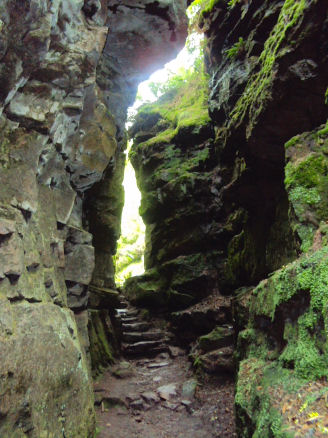
“Lud’s Church,” Staffordshire, UK — one possible candidate for the “Green Chapel”
And in a year and a day — an interval both long enough and one that will spin by all too quickly — Gawain must present himself at the Green Chapel, somewhere vaguely to the north of Camelot, to fulfill the second half of the challenge game. This time it’s his neck that goes under the axe. “Come, or be called coward forever!” The Green Knight’s words still ring in his memory.
And the devil of it all is that Gawain’s clearly asked for this. Nobody else he can blame. He rose from among the gathered court to seize both challenge and axe from the hands of his uncle the king. Clearly both men thought the challenge would end then and there, with the foolish visitor’s head bouncing across the floor. But you never know for sure when magic will intervene, nor how it will shape what comes next.
So the Medieval poet’s got the “death” part of the title already in play. We all know we’ll die, somehow, someday. As for sex, so far we can find plenty in the lively and erotic holiday atmosphere of the court, lords and ladies celebrating together in a two-week-long revel, food and drink in abundance. A Christian holiday, indeed, but not one that excludes the secular delights of feasting and dancing, flirtation and dalliance. For Gawain, there’s added pleasure in his seat of honor beside the lovely Guinevere, Queen and chivalric ideal.
But wait, as the poet might have said, there’s more and better to come.
/|\ /|\ /|\
A brief magical interlude here. Alert to what we can learn from the “wisdome of olde bookes,” we can consider a portion of what this story may have to teach us. From one point of view, Arthur has set up magical intentions and chosen the moment. After all, the time is right for them, with all the swirl of energies around the winter solstice and new year.
The king, the male half of the royal spiritual self, will not eat until all are served, opening his heart with generosity and fellow-feeling. All parts of our own kingdoms benefit from this. And he likewise won’t eat till either a marvel manifests or — another kind of marvel — some challenge or “game” presents itself. It’s surprising what we may chance to discover and experience, when we choose to look with such preparation. And the Queen? She is a chess-piece in the larger game, but also the most powerful figure, once the pawns and knights move out of her way.
/|\ /|\ /|\
A year and a day lasts long enough to permit some really magnificent bouts of denial and procrastination. As a period of magical testing, it can sort the committed from the undisciplined, the patient from the reckless.
At Michaelmas, late September, the poet tells us that the moon itself signals to Gawain that his appointment draws near. Yet a month later, on All Saints, the Christian Samhain, Gawain lingers still at the court, reluctant to depart. Finally, after more feasting, and loads of unsolicited advice from other knights at court, Gawain presents himself to Arthur and asks for permission to go: “Now, liege lord of my lyfe, leave I you ask.”
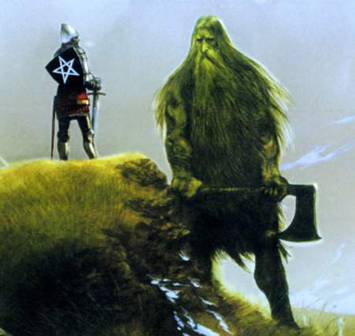
Here in a modern conception, the Green Knight is clearly a giant. Note Gawain’s shield adorned with pentacle/pentagram.
And the poet moves on to describe Gawain’s apparel and weaponry in splendid detail, focusing for some 30 lines on a careful exposition of the meaning of the pentangle on Gawain’s shield, though he concedes it “must tarry him in his telling.”
This passage alone, in a poem plainly dating from the 1400s, should at least temper the silly hubbub that arises every year around Halloween from certain quarters about Satanists and their evil pentagrams or pentacles. But of course, it won’t.
Here, centuries before Anton LaVey with his Church of Satan was even a twinkle in his ancestors’ eyes, the pentagram is clearly a Christian symbol. Thus, among other things, the five points of this “pure pentaungel” signify here “the fyve woundes that Cryst caught on the cross, as the Creed telles.” As a holy symbol of power, it’s been around for much longer than Christianity, of course, and will be long after Christianity is a legend and other faiths overtake it. And it will continue to acquire and shed secondary associations that may help or hinder any seeker from recognizing the pentagram as nothing less, and nothing more, than a symbol of spiritual reality beyond human opinion and (mis)perception.
Off Gawain goes on his faithful steed Gringolet, through the land of Logres — a Welsh word for England, and famous over centuries in legend and stories both old and more recent, such as C. S. Lewis’s Narnia and Susan Cooper’s Over Sea, Under Stone.
After some eight weeks of winter travel north — no modern M5 and M6 motorways for him to gallop along — Gawain arrives, weary and weather-stained, by chance as it seems on Christmas Eve, at a noble castle whose inhabitants welcome him warmly.
Three persons hold his particular regard — the castle’s lord Bertilak, an obvious focus, but also two noble women, one ancient, who notably sits at the table in the seat of highest honor, and the young and lovely lady of the lord — so fair in “her face, her flesh, her complexion, her quality, her bearing, her body, more glorious than Guinevere, or so Gawain thought” (Armitage translation, pg. 85).
After Mass they “feast and dance” for three days, and on the 27th of December, St. John’s Day, other guests depart, and Gawain, explaining his purpose to Bertilak in detail, announces he must also set out on the final leg of his journey to find the mysterious Green Chapel, and fulfill his pledge with the strange knight.
But there’s no need, exclaims the lord, laughing. “Ye schal be in your bed at thyne ease” till “the first of the yere.” As for the “grene chapayle … it is not two miles hence.”
Now let’s attend to the time till then, Bertilak continues. You promised to obey my will here, and you may linger in bed till morning Mass, then pass the day with my lovely wife, while I’m off hunting away from the castle. But let’s agree to a game of exchange. Whatever I win while I’m out, I’ll give you on my return, and just so, you must give me whatever you receive.
Agreed! says Gawain, always — we’re beginning to understand — up for a game or challenge, however much he may come to regret it later.
And so they each raise a glass together to drink on it to seal their pact.
Now at his ease after weary weeks of travel, Gawain has already taken much comfort in the lovely lady, enjoying her conversation, and sitting head to head sharing confidences. It’s innocent up to this point. Courtly love shows here at its best — no “foulness,” the poem emphasizes, attaches itself either to their words or manner. Reputations and honor have held them both to clear boundaries. But they do grow increasingly intimate and relaxed under the influence of youth, proximity, holiday revels, and the easy hand with which Bertilak holds his realm.
From the original manuscript: the Lady and Gawain
Bertilak leaves with the hunt early next morning, and Gawain, still abed, hears “a lyttel din at his door.” So he “heaves up his hed out of the clothes. A corner of the curtain he caught up a lyttel, and waits warily thitherward what it be might. It was the lady, loveliest to beholde, that drew the door after her dernly [secretly] and stille.” Less innocent now … and definitely more interesting!
The story will continue in Part Three.
/|\ /|\ /|\
Images: the Sir Gawain manuscript, formally named MS Cotton Nero A X, located at the British Museum; Lud’s Church, Gradbach, Staffordshire, UK — one of the possible sites of the poem’s “Green Chapel”; Gawain, shield and Knight; The Lady and Gawain, from MS Cotton Nero A X
*For the curious, the first line of the mauscript in the top image above reads: “Sithen [since] the s(i)ege and the assau(l)t was sesed [ceased] at Troye …” The anonymous poet opens by giving his poem a Classical backstory.
Armitage, Simon. Sir Gawain and the Green Knight. New York: W. W. Norton and Company, 2007.
Like their kindred words in the other Celtic tongues, the syllables* of this Cornish saying still echo, telling of the “Once and Future King.” They assert a living archetype of a king born in fulfillment of prophecy, a ruler recognized and granted kingship by the Lady of the Lake, a leader who struggles, fights and dies for his people. The king is the land.
Arthur from the Matthews’ deck
Nyns yu marow Arthur myghtern. “He is not dead, king Arthur,” the story continues, but sleeps, and will wake at his country’s direst need, and return. The king is the land.
Arthurian tarot decks like John and Caitlin Matthews’ Hallowquest, Anna-Marie Ferguson’s Legend and Stephanie and Philip Carr-Gomm’s Druidcraft packs often depict the archetypal king as card 4, the Emperor. This is Arthur as anointed ruler, secure in his kingship, enthroned, crowned and robed in power.
But surely what moves us more is not merely this static image, forceful though it can be. The young Arthur, ignorant of his destiny, is also the seeker, the Fool, the first card in the deck, a numerical 0. In Ferguson’s Legend deck he is Percivale, the callow and naive youth. With both Guinevere (Welsh Gwenhwyfar, “White Shadow”) and his own sister Morgan (with several other variants of her name) he is one half of the Lovers. And at least in the Matthews’ conception, he is the Wounded King, and also the Sleeping Lord.
The progression, as in most tarot decks, is the journey of the self toward fulfillment, wisdom, self-awareness.
As a tool for Druidic meditation and ritual, the Arthurian mythos offers rich and profound material. Map our lives onto such a mythic pattern, and we can animate energies to manifest the next step on our spiritual journey. At every point we spiral. We can look at all the steps, all the places on the curves and whorls of the spiral, as potentials for us — right now. Not later. Not after we do or learn or master or win X. Now. The king who will be, but sleeps, is a potential which can guide the questing boy who will be — and who also already has been — king. What might the king say to his younger self? What gift might our older selves pass to us right now, insight or wisdom or counsel we need as we grapple with problems, as it can often feel, in the dark?
So many traditions around our planet speak in their own ways of time and space as illusions. This need not mean they are not real, but rather that we need not accept our agreement with an illusion as the last and defining word about our lives. They don’t have to be the only reality. By playing a game with time, we can slip into past or future through memory and daydream, to the point of no longer “being here” but “someplace else” instead. And we’ve all experienced this.
For we do this effortlessly, ever since childhood, a natural talent, a birthright, a skill we keep all our lives, unless it’s been largely chased away and beaten out of us by our culture, teachers, parents, our own self-limitation, habits of thought, and so on. “Head in the clouds, dreamer, impractical, unfocused”: words so many of us may have seen in school reports, job assessments, personal evaluations. Or maybe we suffer from the opposite pole, and more and more of the lightness and joy has been leached from our days through routine, day to day cares, deadlines and installments and bills and mortgages and the nightmarish hope of someday “catching up” or “getting ahead” or “arriving.” Always, it can seem, one pole or the other. But polarized things gather power. That’s why an illusion can grab and hold us. But that’s also why change and growth and exploration are also — always — possibilities. Poles hold the energy for entrapment, but also for transformation.
The Sleeping Lord (form outlined in the hillside under the hawk)
These images and this millennium-old mythos provide a wealth of meditation seeds, portals to discovery, and material for ritual that Arthurian orders of ritual and magic explore, but which are also perfect for solitary work, too.
Arthur myghtern a ve hag a vyth can be a contemplation seed (it’s one of mine), a cue to open the imagination to possibility. (I use it as a tool, a charm, a spell, a mantra of magical power. Pair it with an image, an object, an intention — intention being the flame which, I find, lights everything up.)
And if I’m willing to step across one more boundary, ritually priming myself with a “For behold: now am I ____ !” I can explore all the characters in the Arthurian realm. Taliesin-like, I can be the Green Knight, invulnerable to mortal blows, and Morgan and Merlin, Nimue and Mordred, too. What does it feel like to die as you kill your uncle-father (Shakespeare’s Hamlet knows!) in fulfillment of a prophecy from a time before your birth? What does it mean to lie asleep, waiting to fulfill a royal destiny? What part of me sleeps right now, that I can rouse if I choose? Or like Ygraine, Arthur’s mother, to carry an unborn child in my belly, a king, gestating and brooding and nourishing new and royal life from within? Or what can I see as Merlin in his cave or tower, looking up and down time itself, living backward as in T. H White’s version of the Arthurian boyhood story, The Sword in The Stone?
Then to close the rite, the meditation: “And now have I returned.” A simple formula, but helpful, to ground the meditation, to signal a shift of reality. (Return is as important as departure.) Open your eyes, and record what you experienced. In this way, over days and weeks, you build an increasingly persuasive document that can help loosen the hold of the illusion of this time, this place. Each time I sit to meditate, the pages telling of my previous journeys in front of me, the grip of illusion eases. For these two things, time and space, can be potential gifts, or they can remain prison walls. They’re a choice, if I choose them, rather than a given, if I merely accept them.
The Seeker from Matthews’ deck. Before us all lies the Rainbow Path.
Figures as diverse as Henry Ford and physicist John Wheeler get credit for versions of the saying “Time is what keeps everything from happening at once.” It’s a way of ordering experience, making it intelligible to human consciousness. And so is space, which — to follow through on the whimsically powerful definition and construct its corollary — “keeps everything from happening here.”
Starting small, with the trick, if you will, of imaginative magic, will begin to unfasten the iron clasps around consciousness. It’s just one way, of course. Traditions in and outside of a whole range of religions and spiritual paths offer many tools and strategies for accomplishing this change, if we wish it. But these particular images and this story have spoken for a thousand years to many people, and the Arthurian drama that can be a mirror and key to our mortal and spiritual lives shows little sign of a diminishment of its power to move and inspire — and transform. Sleeper, whispers a whole nation of people inside each of us that we have been and are being today and will be someday, a multitude of selves. Sleeper, awaken to your crown and to your destiny.
/|\ /|\ /|\
Images: Matthews’ Arthur, card 4; Matthews Sleeping Lord; Matthews’ Seeker (Fool in other decks) with three choughs (a raven-like bird) overhead.
*Note on pronunciation: The -gh- of the Cornish word myghtern “king” is essentially the same sound as in German “Bach” and close to English “h” in “aha!”: mikh-tayrn comes reasonably close for ritual purposes: AHR-thoor MIKH-tayrn ah VEH hahg ah VEETH.
I cherish my Druid family, but like all our families, they can sometimes drive me crazy. Very often I cringe when I see their online appeals for assistance with jobs, health, relationships — the usual sources of our suffering and joy. Don’t misunderstand: I want to help. But that impulse immediately finds itself in combat with a question: do I really know what even I myself need in a given situation? Not what I want, but what I need? And if I don’t, is it any kindness to send energy to a situation that does not serve a friend’s best interests?
Such appeals typically elicit a round of quick replies from well-meaning friends and readers. A ritual performed, a prayer said, a visualization completed. Done, done, done, read the comments in response.
What to pray for? The obvious, the thing the other person is requesting, seems dogged with problems. Divination can help, of course, and dreams, or the kind of conversation with friends when a word or phrase lights up with brighter meaning. Then there’s an omen or coincidence, a gift of chance, the natural world revealing a clue, or that sudden intuition while I’m doing something truly mystical like … the laundry. You know — the human ways the gods speak to us. And I think How rarely I know what’s best. Not false modesty here, but fact. Often I ask for clarity and wisdom, rarely for a specific outcome. Because prayers do get answered. I’ve prayed myself squarely into disaster more than once. Be careful what you wish for.
So when I encountered the following passage recently, near the end of The Last of the Wine, one of Mary Renault‘s splendid evocations of ancient Greece, it jumped out at me. In its intent it resembles how I try to pray for others in difficulty. Also it’s more eloquent than I can usually manage to be.
Here a friend of the main character Alexias is speaking, near the tail end of the suffering that much of Greece experienced during the three brutal decades of the Peloponnesian War:
We have entreated many things of the gods, Alexias. Sometimes they gave and sometimes they saw it otherwise. So today I petitioned them as Sokrates once taught us: ‘All-knowing Zeus, give me what is best for me. Avert evil from me, though it be the thing I prayed for; and give the good which from ignorance I do not ask’ (Mary Renault. The Last of the Wine. Pantheon Books, 1964, pg. 344).
/|\ /|\ /|\
In addition to prayer, we have other tools in our kit, of course. Magic, like prayer, is much misunderstood, practiced in all sorts of ways reckless and marvelous, and deserves careful study, like any art.
I’ve mentioned British author and magician Josephine McCarthy before, and she has down-to-earth and useful insight here, too:
The simple vision or ritual often gets cast to one side in search of something more powerful and interesting, and such action is a dead end that pulls the prospective magician off the tracks. Some of the simplest rituals are the most powerful once the magician has learned the deeper frequency of the ritual and can interact with it. For me the most powerful ritual of all is the lighting of the candle. It opens all worlds, all times and gives me access to focused power that is unfiltered. (Josephine McCarthy. Magical Knowledge Book 1: Foundations – The Lone Practitioner. Mandrake, 2012, pgs. 51-52).
What? you say. (I can hear the growing outrage in your voice.) Light a candle and just like that, problem solved? No.
One of the keys in McCarthy’s words is deeper frequency. Disciplined practice reveals such insight and will yield results possible in no other way. Thus the question for the Druid is less “What do you believe?” and more “What do you do?” Belief matters, praxis matters more. In the doing, the dedicated practice, we access that deeper frequency, the solution we can put into effect.
All well and good, you say. But what about right now, when I’m hurting?
Friend, I hear and pray the best prayer I can make out of my practice. I promise to keep on practicing. Any one of us can be the channel for Spirit to manifest in this moment — including you. In the meantime, a meal, a listening ear, a hug, a back-rub, a good night’s sleep, are some of the best immediate magics we have. Love has found you yet again.
Will Self’s June ’14 article in The Guardian (“Has English Heritage Ruined Stonehenge?“) has recently been (re)making the rounds on Facebook groups I frequent, and the author’s lively reportage offers generous “blog-bites” to quote (starting with that title), so it’s ready grist for the mill of A Druid Way.
In fact, if you just jump straight to his article, read it and — in the way of our Net-lives, surf on to the Next Interesting Thing (a NIT to pick, if there ever was one) — if you neglect to return here, I’ll not only not be hurt but will rest content that I’ve served one of my purposes.
“Selfies with Trilithons”: Will Self visits Stonehenge. Image Mike Pitts, The Guardian.com
I admit to a fondness for titles that use questions.They successfully play on our inherent OCD, setting themselves up like an itch begging to be scratched. They’re Zen koans for the non-Zen types among us. You read them to find out the answer, or at least what the author thinks is the answer, and so you relieve the itch, even if the particular scratch the article provides ultimately irritates you further.
New, worse itch? No problem. The latest diet, scandal, must-see series, sex technique, disaster or investment opportunity all await you, just a click away, and many will use questions to draw you in. The “Top 10” list relies on a similar strategy: human experience boiled down to a concentrate. Just add water! Maybe at best our lives are indeed “selfies with trilithons” and everything else slips downhill from there. Or so a great part of the Western world’s surface culture would have you believe.
The article byline asks, “The summer solstice, King Arthur, the Holy Grail … Stonehenge is supposed to be a site of myths and mystery. But with timed tickets and a £27m visitor centre, does it herald a rampant commercialisation of our heritage?”
You’re being wholly reasonable if you guess Self’s answer is “yes.”
English Heritage earns decidedly mixed reviews here. It’s the U.K. organization that oversees such sites as Stonehenge, and for Self it serves a very mixed role as an institution whose “very raison d’etre consists in preventing the childish public from chipping away at stuff they don’t understand much – beyond the bare fact that it’s very old – so they can cart off a free souvenir, rather than shelling out for a Stonehenge snow globe in the superbly appointed new gift shop.”
“Stonehenge snow globe” works fine as an alternative title for this post.
Self’s wit attacks a range of easy targets besides English Heritage. It’s little surprise Druidry comes in for a smackdown, too. “As inventions of bogus deep-time traditions go, British druidism has to be one of the most enduringly successful.” Except that unlike Stonehenge, all modern forms of Druidry that expect to be taken seriously assert precisely the opposite. They’re comparatively new on the scene, and they dispense with bogusness. They’re no older than the Druid revival of the past few centuries because that’s their real origin story — and this revival coincides point-for-point with rediscovering and wondering about and valuing things like Stonehenge and Avebury and Newgrange. You know — those Neolithic things that have always lurked in the neighborhood and have been with us for a very long time. We just never paid them much attention.
Until we did.
[Even Reconstructionist Pagan groups — who point with some justifiable pride at archaeological and other scholarly evidence to back up their practices and who sometimes sniff disdainfully at groups like OBOD, which draw on both legend and myth and on Druid Revival writings — benefit in the end from the scientific investigations ultimately launched by those same enthusiasms and, yes, those initial misconceptions of the Revival.]
We like our monuments and religions old, though we want our gossip and news “live, local and late-breaking” and our technology to be version X.X + 1 — whatever’s one higher than last week’s version (unless it’s Windows). “Selfie with a trilithon” pretty much sums it up.
But if modern Druids are the philosophical and spiritual equivalent of “the childish public … chipping away at stuff they don’t understand much – beyond the bare fact that it’s very old,” then what is it that we “cart off” from it? A reflected glory from old things? A fine wild-goose-chase for the ego? The illusion of connection with something larger and more lasting? (“All this and more for twelve easy payments of just $39/month! Our representatives are standing by for your call now!”)
These are the surface manifestations of vital and unquenchable hungers that have wakened in large numbers of people, however much a passel of hucksters manages to package and market empty and pricey facsimiles of them. Self does concede that “in important ways the [P]agans and the archaeologists retain a common cause: both groups, after all, venerate the monument, even if it’s in radically different ways.”
Self also contrasts Stonehenge at present with ancient sites:
Midhowe broch
… in the Orkney islands, where I lived over the winter of 1993-4 – I’ve returned many times since – Neolithic remains can seem more significant than the contemporary built environment. A couple of miles from the house I stayed in on the island of Rousay, there’s the ruin of an iron age broch, or fortified dwelling, and beyond this there’s a Neolithic chamber tomb, Midhowe, that’s dated to the third millennium BCE. Midhowe is a large and complex structure, although by no means as obviously important as Stonehenge. It was fully excavated in the 1930s and 40s by Walter Grant (of the distilling family) who owned the Trumland estate on Rousay, which included this site and several other important tombs. Since the roof of Midhowe has long since gone, Grant covered up the exposed stonework with hangar-like structure, but the curious thing is that this doesn’t detract at all from its powerful and brooding atmosphere.
During my times in Orkney I’ve visited a great many of the Neolithic sites. I’ve sat in tombs, laid in them, dreamed in them, and tried to grasp the sort of mindset – whether individual or collective – that’s implied by buildings that took shape over thousands of years, and were built by people with life-spans far shorter than our own. I have felt the wonder – felt it most of all, because at Midhowe there is hardly any of the furniture and signage associated with the modern tourist attraction: no ticket office, no custodian, and only discreet information boards. Apart from in high season, you can visit Midhowe and most of the other great Orkney sites with the confident expectation that you’ll see scarcely another human being.
If, as Self notes, “archaeologists seem fairly convinced that implicit in the Stonehenge’s design is some form of ancestor worship; for us there can be no doubt: we revere the idea of their reverence, we are engaged in a degraded form of meta‑ancestor worship,” then we can also see, in our longing to (re)connect, a “degraded” form of magic. “I don’t want anything to do with magic,” we often say, as we unwittingly absorb endless hours of advertising and political language which constantly attempt to manipulate our desires and emotions with crude magical techniques. We let ourselves be “magicked” but refuse to learn how to practice any “defense against the Dark Arts” — or learn how to do magic well and for our benefit rather than someone else’s.
“No magic — that’s for kids,” we say, as our lives propel us willy-nilly along a path of magical initiation tailor-made for us out of the circumstances of our lives, our likes and dislikes, and our choices. Fate, or freedom? Yes! “When you come to a fork in the road, take it,” as Yogi Berra is reputed to have said.
“I don’t believe in magic,” we say, all the while daydreaming and planning, imagining and remembering — magical techniques in embryo, every one of them. Christian, atheist, Muslim, Pagan, SBNR, or “those who just don’t roll that way” — we all make our ways through these mortal lives which are also lives of manifestation and transformation, the essence of magic.
Author and practicing magician Josephine McCarthy, whose book “Magic of the North Gate” I reviewed here, notes that people react variously to the relative powerlessness that life in Western culture urges onto so many. But often a (paradoxically) powerful personal experience, an abrupt break with the past or the every-day world, sets some of them on a journey. In the first book of her Magical Knowledge series, McCarthy observes:
When a person chooses not to play a part in that circus, they look elsewhere. Some people begin … in search of their own power, some begin in search of knowledge, and some approach that path from a sense of deep instinct.
The beginning of the path … is very much about personal development, be it spiritual, intellectual or self-determination … This is the first rung of the ladder and has many dead ends woven into it … designed to trap and teach them a lesson that is needful for their development … The ‘dead ends’ … are often related to our relationship to power, glamour and ego. We all go through it in one form or another and most climb out of it with a very red face, ready to move on, lesson well learned. There is nothing wrong in making mistakes and doing silly things, it is all part of the learning process. The first rung teaches us about ourselves, our weaknesses and strengths, our true desires and fears, and the real extent of our ability to be honest with ourselves. Remember the words over the door to the temple: Man, know thyself.* The threshold of the temple must be crossed with the intention to be willing to look in the mirror with an open mind and see what is really there. (McCarthy, Magical Knowledge: Book 1, pgs. 30-31)
In the end you cannot study “men,” as C. S. Lewis once observed. “You can only get to know them, which is quite a different thing.” And current trends notwithstanding, we very much need each other’s compassion along the way, given the difficulties and joys of life. That’s an act of High Magic. Given how we all will face death, it’s fair to say we also deserve that compassion from each other. And death? Death is one more potential magical initiation.
*Translation of the sign over the Temple of Apollo in Delphi, Greece that read “gnothi seauton.” [Gno- related to English know, Latin cognitio, Greek gnosis. Seauton related to English and Greek auto- meaning “self.”]
McCarthy, Josephine. (2013). Magical Knowledge: Book 1 — Foundations. Oxford: Mandrake of Oxford.
During the year and a day of your training, you’ve studied, practiced, visualized, rehearsed, memorized, subjected yourself to physical and psychological tests and disciplines and — perhaps in spite of your own better judgment of your readiness — you’ve finally been chosen as a candidate for initiation.
The day of the ceremony arrives. You may be dressed in a particular ritual way, or you may have bathed and simply be wearing new clothes. Perhaps a single jewel or ring you now wear gives you something you find yourself toying with as you wait. Probably you’ve been given specific instructions to help prepare you and assist you in entering the desired state of consciousness. Or the absence of such instructions has the same effect.
You’re nervous, too, and the other members of the group who are participating in your initiation don’t do anything to dispel that nervousness. In fact, they may be sympathetic and kind to you, and their very kindness will only increase the mystery. What am I getting myself into? you ask yourself. This and other questions are good ones to ask — though they may have no answers.
In many occult and magical orders, potential new initiates face a challenge when they enter the ritual space where their initiation will take place. “What do you seek?” goes one variant of the verbal part of the challenge. Depending on what you’ve been taught or are expecting, the rumors you’ve heard, or the nature of the particular group you’re with, the question can catch you off guard. It’s meant to.
In an intro to an online magical training document by Dolores Ashcroft-Nowicki, J. H. Brennan relates his own experiences, and doubtless those of many other people, here (see pg. 4) . He comments wryly that, not surprisingly, whywe seek is often a bigger determining factor in our experience than what.
We all do things for the best possible motives, of course; and nowhere more so than in the esoteric arts. It is relatively easy to discover that the only really acceptable excuse for magical study is embodied in the statement I desire to know in order to serve. That was the answer I was prompted to give to the ritual question during my own initiation. I dutifully gave it; and it was a lie.
What actually attracted me to magic was not service but power.
“I desire to know in order to serve” has its motivations all lined up for inspection. It’s a “good doggy” answer. It’s noble-sounding, and as the “really only acceptable excuse,” it’s comforting to give it and feel good about having such an answer to give. Because in this logical and scientific age of ours, don’t you need an excuse for something as wacky and bizarre as the study of magick — especially spelt with a -k — that doesn’t make you sound like a raving loony?!
So let’s reverse it. “I desire to serve in order to know.”
One of my teachers said this yesterday. It rang true to me because he demonstrates service in what he does, in how he listens to the people he meets, and in how he stills his own agendas and instead of what he thinks, he strives to hear what’s needed. He does these things with humility. And just as important, he models this for others, not as something he turns on to impress others and then drops once he’s “offstage,” but as something he’s continually practicing until it accompanies him, his words and his actions like a fragrance. And that makes you want to do the same.
A few months ago I encountered a goddess in contemplation. I heard her name, an epithet — Stormbringer — and a little more. The only way I can find out more about her is to serve her. Slowly I gain a clearer vision of who she is and why she is manifesting to me, now.
I can enlarge my understanding of service. I serve when I grow — a larger vision spreads its fermentation through human consciousness, because my actions emerge from what I hold in my heart and thoughts.
We serve when, rather than getting bogged down in irritation, anger and fear, we assume a playful approach to problems. Then the lightness of spiritual insight and creativity can lead us to solutions we might not have found on our own. And our playfulness, when it’s respectful of others, can help lighten their loads, too, and smile, if possible, or laugh. We serve in small things, done without thought for anything except the doing, and the doing well.
(OK. Got it. Dang — give you a soapbox and you just don’t let up, do you?)
I serve when I open myself to receive love from others , and find I must “enlarge my spirit to receive the gift,” as Ursula LeGuin describes it in her fantasy A Wizard of Earthsea.
I serve when I ask to understand the causes underlying an issue or problem in my life, not just to remove the problem so I can get on with my agenda. (Often enough, my agenda isthe problem. The apparent problem is a gift, to show me something I need to learn. Otherwise it wouldn’t keep coming back again. And again. Funny how much easier it is to see in other people’s lives.)
Difficult gift, what do you have to teach me? Can I enlarge my heart for you, too? Right now, when you come knocking again, when it’s really not convenient at all? Can I let my impatience dissolve and make my listening a gift to you?
We serve when we recognize ourselves in others, when we recognize others in ourselves, and see the Great Mystery, as the Lakota Sioux call it, the Wakan Tanka, in the eyes of those we meet every day.
We serve when we practice gratitude. A powerful practice I’ve proved to myself: keeping a gratitude journal, with daily entries. Just reading it over can jump start me out of depression and back into engaging my life. Gratitude grows and spreads to others its divine infection.
And so, in serving, what do I know that I didn’t before? Has knowing become less important, and service more?
It’s the end of the year, and like you may be, I’m taking a look back. If A Druid Way inspires or helps or informs others, I’m grateful. My intent is to be a witness to the journey – quite as quirky as yours is, I imagine – opinionated, cranky, full of starts and stops, false steps and helpful insights, along with the odd cul-de-sac, or three, where the unexpected rots, or blooms. That’s where I want to keep my focus.
That’s said, if others opt to read what you write (and why else do people blog, rather than keep a private journal?), you’re no longer talking only to yourself. Obsessing about how to increase your page views isn’t normally conducive to the flowering of intuition and creativity. But knowing what others find interesting can serve as a guide for future topics that may still have some juice in them.
Here, then, counting down to number 1, are the ten most popular posts since I started this blog over three years ago in October 2011.
10. Voices of Modern Druidry. “Druidry is a lively and growing phenomenon, so the following list is by its nature incomplete … Included in the roster of people below are references and links to several of the most visible and influential Druid organizations active today.”
9. DRL – A Druid Ritual Language, Part 1. “Many spiritual and religious traditions feature a special language used for ritual purposes … The heightened language characteristic of ritual, such as prayer and chant, can be a powerful shaper of consciousness.”
8. The Fires of May, Green Dragons and Talking Peas. “Ah, Fifth Month, you’ve arrived. In addition to providing striking images like this one, the May holiday of Beltane on or around May 1st is one of the four great fire festivals of the Celtic world and of revival Paganism. Along with Imbolc, Lunasa and Samhain, Beltane endures in many guises.”
7. Opening the Gates: A Review of McCarthy’s Magic of the North Gate. McCarthy’s book is “characteristically humble, wise, unexpectedly funny, and profound – qualities too often lacking in books on magic. Add to these its emphasis on being of service to the land, and it is altogether a valuable resource.”
6. The Four Powers – Know, Dare, Will, Keep Silent – Part One. “‘All I know is a door into the dark,’ says Seamus Heaney in the first line of his poem “The Forge.” In some way that’s where we all begin. At three, four, five years old, some things come into our world already bright, illuminated, shining, on fire even. The day is aflame with sun, the golden hours pass until nightfall, and then come darkness and sleep and dreaming. We wander through our early days, learning this world, so familiar-strange all at once. We grow inwardly too, discovering trust, betrayal, lying, love, fear, the pleasure of imagination, the difference between visible and invisible worlds. Which ones do people talk about, admit to themselves? Which ones do people around us ignore, or tell us don’t matter?”
5. East Coast Gathering 2012. A good Gathering or Festival “offers a chance for Druids to walk among friends, attend workshops, and” — in our case — “(re)connect with a beloved landscape in northeastern Pennsylvania.”
4. A Portable Altar, a Handful of Stones. “An altar is an important element of very many spiritualities around the world. It gives a structure to space, and orients the practitioner, the worshiper, the participant (and any observers) to objects, symbols and energies. It’s a spiritual signpost, a landmark for identifying and entering sacred space. It accomplishes this without words, simply by existing.”
3. About Initiation. “With energies flowing around us from so many end-of-year holidays and celebrations, it seemed fitting to think and write about initiation. It’s one more piece of a Religious Operating System (ROS), it’s an important key to Druidry and — most importantly — it’s something we all experience. For good reason, then, the subject cuts a large swath through spiritual, religious and magical thought and practice. As author Isaac Bashevis Singer opens his book The Chosen, ‘Beginnings are difficult times.’ That’s one reason New Year’s resolutions often end up on the cutting room floor of the film version of our lives. (Some ways to keep them alive and well and not merely part of the special extended version of our lives that may not see wide release into the “real” world will be the subject of a post upcoming in the next few days.)”
2. Shinto—Way of the Gods. “Almost two decades ago now, in the early 1990s, my wife and I lived for a year in Hikone, a medium-sized city in central Japan, about an hour’s train ride north of Kyoto. The city’s most visible claim to fame is Hikone Castle, a 380-year-old wooden fortress that dominates the downtown skyline. But the most enduring memory I took from Japan and have never forgotten is the profound impression of its many Shinto shrines — roughly 80,000 of them, according to various sources — that dot the landscape and invite the casual visitor as well as the reverent worshiper.”
1. Fake Druidry and OGRELD. “I’m a fake Druid. So is everyone else who names Druidry as the path they walk. And I’ve come to love it.”
Thank you, everyone, for reading and following, for your comments, for over 21,000 page views and 500 likes, and for the encouragement these give me to keep exploring. (Early) Happy New Year to you all!
Our bodies already know the Goddess – this is our oldest magic.
I relied on this insight in planning for the workshop at this year’s East Coast Gathering, whose theme was “Connecting with the Goddess.”
/|\ /|\ /|\
Goals and plans I had for the workshop:
The heart of the workshop is a hands-on look at various ways to make a physical book/scroll/altar object that explores/invites/incorporates ritual, ogham/runes, art, prayer, poems, questions, magic and daydreaming into a concrete “link” to the Goddess as we experience Her — or desire to experience Her. Think “book” as “portable paginated/folding/roll-up ongoing altar-in-process.” I’ll talk about inspiration, nudges, hints and ways to listen, inviting and hoping for participant sharing and input! The seed for the workshop comes out of the fact that I’m a prime example of somebody who doesn’t have a consistent Goddess practice (though She’s seeing to it that’s shifting, too), but when She wants my attention, She gets it, like with this book, and workshop.
It’s probably a good thing we don’t always hear how ambitious we sound. Young or old, you eventually learn to deal with the inevitable gap between vision and manifestation. If you’ve managed to hold on to any of that original and wonderful idealism of youth, you also realize that the gap isn’t a reason to despair, or to dispensewith vision, but rather a sign of just how important vision is.
The physical world, so important for manifestation, by its nature tends to lag behind the swiftness with which vision can appear. But that lag is precisely part of this world’s immense value: its inertia and density allow for greater permanency and resistance to change, so that we can experience the results of vision over time — and fine-tune it if we choose. Unlike in dream, where the subtle stuff of vision or imagination can wisp away so quickly, physical manifestation tries to linger.
/|\ /|\ /|\
The Goddess is generous. Or alternatively, if you prefer the cynical version, I belong to the OCD Order of Druids. Creativity, as the saying goes, is messy. I over-planned for the workshop, ending up with far more material than any mortal could begin to do justice to in a mere hour, and this post is my penance, or confession. Or further indulgence. And maybe — in the way it often arrives when we’re not paying attention, even in spite of ourselves — a spark of awen.
/|\ /|\ /|\
“Creating A Goddess Book,” with focus on “book” in order to free it from the psychological shrine many Druids, and Pagans generally, tend to put books in. Instead of paper, a book of leather, or metal, or cloth — individual sheets, or a single longer scroll. A nudge to try out the qualities of other substances than paper, than the admittedly inviting blank books on sale in chain bookstores, or even Ye Friendlie Lokal Paygan Shoppe.
Each workshop participant received a packet to practice with, consisting of a rectangle (approx. 3″ x 4″) of vegetable-cured leather and a similar-sized rectangle of .019″ aluminum, wrapped in a larger swath of canvas cut from a shop drop-cloth from Home Depot. A wood- and leather-burning tool, a few screwdrivers, some markers of various kinds, a few words about inspiration and the importance of working to manifest things on the physical plane as one powerful way to connect with the Goddess. Suggestions for inscribing/writing/ incising a short prayer, vow, magical name, etc. Reference tables of Ogham and runes for those who wanted to inscribe words with some privacy, as a personal meditation. I pointed out that you could cut all three materials with kitchen scissors. Besides the wood-burner, no fancy tools required. Then I shut up and let participants have at the materials. Done!
Hex Nottingham’s leather and metal “pages” — photo courtesy Hex Nottingham
Except for the next flash of inspiration in the planning process, which would not let go: a “Nine-Fold Star of the Goddess” you can try out here at one of several websites that illustrate the steps.
/|\ /|\ /|\
A sampling, with some commentary and additions, from the workshop handout:
“Spirit must express itself in the world of matter or it accomplishes nothing. Insights of meditation and ceremony gain their full power and meaning when reflected in the details of everyday life.” — J. M. Greer, The Druidry Handbook, p. 138.
This world, here, is the realm of mystery. Spirit is simple — it’s this world that’s so surprising and complex in its changes and ripples, its folds and spirals and timings. Make something, I tell myself, labor with the body, and then I can often approach the Goddess more easily, dirt under my fingernails, sweat on my face. She likesbodies. I’m the one who keeps forgetting this, not her.
“Work with a Goddess long enough and you learn to hear Her call. You learn to pick her voice out above the noise of contemporary society, above the words of teachers and friends, and even above your own thoughts and feelings. Sometimes what you hear is not what you expect.” — John Beckett, “A Rite of Sacrifice,” Mar. 4, 2014.
“Shaper, you have made and shaped me. Honor and serenity are yours. I am your garment, you the indwelling spirit. Work with me in everything I do, that all may know you. Energizer, quicken me. Measurer, clear my path. Protector, guard me safely. Initiator, take my hand. Challenger, transform me. Savior, be my help. Weaver, make my pattern bright. Preserver, heal me. Empowerer, make me wise.” — adapted from Caitlin Matthews, Elements of the Goddess, p. 118.
Rilke’s fragment, a whole meditation in itself, or a daily morning prayer.
Oh, I who long to grow,
I look outside myself, and the tree
inside me grows.
— Rainer Maria Rilke
And Larkin’s poem “Water”:
Water
If I were called in
To construct a religion
I should make use of water.
Going to church
Would entail a fording
To dry, different clothes;
My liturgy would employ
Images of sousing,
A furious devout drench,
And I should raise in the east
A glass of water
Where any-angled light
Would congregate endlessly.
— Philip Larkin
After delighting in this poem, make an exercise of it. Choose one of the elements. It can be water, as in the poem, or one of the others. Finish the sentence: “If I were called in to construct a _____, I should make use of [element].” Keep going: a series of statements, a meditation on the one you just wrote, a free association. Whatever gets you putting words down. You can try this over several days with all the elements, or at a different pace, if you’re working with the elements on your own.
The ECG schedule this year put the Goddess Book workshop immediately after Thursday’s Opening Ritual, so people arrived still bubbling from the ceremonial jump-start for the weekend.
“In every world, in every form, in every way, I am near you, I uphold you, I comfort you, I guide you, I deliver you from each limitation until my freedom is yours. Your body is my chalice, your heart my echo, your form my shadow, your pulse my footstep, your breath my passing.” — from my own Goddess book.
/|\ /|\ /|\
1. Once you hold the Star of the Goddess in your hand, write the names of the four elements and Spirit, one near each of the points. Complete this step before reading further.
2. Which elements sit on either side of Spirit? Contemplate on their positions there. Are they elements that help support your spiritual life? Are they especially active? Are these the elements that need extra attention and balance?
3. Consider a section in your Goddess book for vows: experiment with them, not as harsh, unyielding obligations, but as tools for studying resolve, testing experience, practicing manifestation of your intent, and so on. They need not be “public” – write them in ogham, runes, etc. Start small and easily achievable.
/|\ /|\ /|\
Dedicating a Goddess Book: Blood, sweat, tears, spit, etc. can mark our books with our earthiness: a commitment to be honest with the Goddess about our path, its ups and downs, to remember her presence with us, and to acknowledge what we need, what we doubt, what we’re willing to work for – whatever feels right to include. Make a ritual of it. Do it quietly, simply, without fanfare, with silence making its own ritual. Or call out all the stops, bells and whistles. Then dance, feast and celebrate.
/|\ /|\ /|\
Allow a Goddess book — it could be a single sheet or “page” specifically intended for this purpose — to return slowly to the elements on an outdoor altar. Or bury it in the Mother’s good earth. Thus is the vow fulfilled that the Mother takes into Herself, as She will take all things back in time, and return them again.
“All things are holy to you. This book like all things lies among the faces you show to me; may I learn from you daily, drink deep from your well, and body you forth as your child.” — from my Goddess book.
/|\ /|\ /|\
A small ritual. Take a few deep breaths. Sing the awen, or other name or word that grounds and focuses you. Holding your cupped hands in front of you, say: “I make this altar for the Goddess, a space where she may act in my life.”
Holding the Star, or your journal, or other ritual object meaningful to you, or nothing else at all, ask yourself: What specific space or doorway exists in my life for the Goddess to manifest or to act in? Pay attention to hints, images and answers as they come.
/|\ /|\ /|\
And again: Our bodies already know the Goddess – this is our oldest magic.
I’ll be covering a fair bit of ground in this post, and supplying a larger than usual number of links (distractions?), since so many of you, my readers, come from such diverse perspectives and experiences. Thus it is that while some of what I say here will be sure to irritate, confuse or bore some of you, there’s a very fair chance the same sections won’t be the same irritants for everybody. And with a liberal helping of what goes under the names of luck, awen, grace, and chance, some of it might actually be useful to you.
So what do you make of this video?!
Ritual and Ritual Language are Pan-human
One of my points in including the “Biker Blessing” — whatever you think of Pope Francis, the pontiff sure has his own style — is simply to illustrate two important points we keep forgetting: all humans participate in and perform rituals, and they’re both utterly common and rather strange, when you actually begin to examine them more closely.
To give just one common example, if you intend to get hitched in a church, you’re not yet married until right after the presiding clergy says some equivalent of the words “I now pronounce you man and wife.” So what do those words do?! (For the nerds among us, this has been called the performative aspect of language, according to the theory of speech acts in a book with the fine title of How to Do Things with Words by Brit J. L. Austin.)
It’s because the West in particular often lacks (read “threw the baby out with the bathwater over the last century”) meaningful ritual that ritual has come to preoccupy many Druids and Pagans generally. But it bears repeating that ritual isn’t merely a Druid or even a Pagan concern: ritual and ritual languages cover the planet.
Here’s a remarkably respectful video from a 3-minute 2010 BBC broadcast. (Title includes “OBOD” but no mention is made of it in the video itself, so don’t worry — I’m not proselytizing — really!):
“Ceremonies of Innocence”
Another common example. Depending on how you were raised, your parents taught you to say “thank you” and “excuse me.” In the process they likely also taught you that the forms themselves matter, as much as or often more than your heartfelt gratitude or apology. The discipline of saying the words themselves – often — was enough. (If you’re feeling cynical, you could argue that this is one of our first formal lessons in hypocrisy.) We may rail justifiably against “empty language,” but that’s not the fault of ritual. The emptiness of much empty talk issues from a lack of conviction or perspective behind it. As Yeats said in his poem “The Second Coming,” “The blood-dimmed tide is loosed, and everywhere/The ceremony of innocence is drowned;/The best lack all conviction, while the worst/Are full of passionate intensity.” So we get loudness and passion as the daily menu on far too many of our media of choice, while stillness and reflection flee for the hills. But (to mix metaphors) that’s where these two inexhaustible caves of treasures lie waiting. We can, if we desire to, recover the “ceremonies of innocence.”
A Side-note on Definitions
You may have noticed that I carefully sidestepped the issue of what “ritual” is and what a “language” is. If you want more information on these fascinating and often controversial topics than the quick-and-dirty Wikipedia links can give, and you don’t have a good town library handy, just search “magical use of ritual language” on Google Scholar. Earlier today (3/24/14) it returned 168,000 results. So even if upwards of 90% of these prove to be some combination of junk or dead links, you’ll find remarkable studies, academic and amateur and much in between. Enough in fact to launch you into a lifetime of fruitful reading and study on just this one topic, should you wish. (See the end of this post for a detailed excerpt of the Wikipedia entry for “magical language.”
All or Nothing
Of course, using ritual language doesn’t have to be an “all or nothing” proposition. A few words and phrases can often be sufficient to signal important parts of a ritual, or to heighten the charge of ritual atmosphere. Any decent magical training curriculum will show you this. Like all conscious acts, those performed with intention carry power. (Anyone reading this knows, for instance, the difference between a casually tossed-off “I love you” and the same words said with full attention and feeling. If you don’t, don’t come back here until you do. That part of your life obviously deserves more atttention than this blog.)
As an example of this “ritual sprinkle” approach, here’s an excerpt of the ritual use of Welsh from the “Grand Sword” page of the Gorsedd of the Bards (Museum of Wales online):
One of the Gorsedd’s oldest rites is the ceremony of partly unsheathing the Grand Sword. The Archdruid asks the following questions and the audience replies ‘Heddwch’ (Peace) three times:
‘Y Gwir yn erbyn y Byd, A oes Heddwch? (The Truth against the World, Is there Peace?) Calon wrth Galon, A oes Heddwch? (Heart to Heart, Is there Peace?) Gwaedd uwch Adwaedd, A oes Heddwch? (Shout above responding Shout, Is there Peace?)’
Carrying a sword was one of the rites in Iolo Morganwg’s first Gorsedd in 1792. As a pacifist Iolo wanted to emphasise that the Bards met in peace and when a naked sword was placed on the Logan Stone they proceeded to sheath it as a symbol of peace in Gorsedd.
Bardic chair inscription: “the truth against the world”
With no more than this much Welsh in a ritual, or even just Y gwir yn erbyn y Byd [approximately “uh GWEER uhn EHR-been uh BEED”] “the Truth against the World,” you can clearly set apart the language of your rite from ordinary language, and help evoke the heightened state of consciousness characteristic of much (not all) successful ritual.
Benefits of Ritual Language
If you want the John F. Kennedy version – “what ritual language can do for you” – here’s a start.
An FAQ of the Latin Liturgy Association site lists several “important benefits of using Latin” as a “sacral” language, including its close association with worship, as with the Arabic of the Qur’an, the Sanskrit of Hinduism and the Hebrew of Judaism. It also “helps us overcome limitations of time and place” and “participate in the universal reality of the Catholic Church, linking us with the generations” who preceded us. As the language of a sacred musical tradition, it also gives access to the plainsong and chant of the Church.
So Why Use a Distinct Ritual Language?
Huston Smith
OK, you get that ritual and ritual language are powerful and widespread. But why not keep it to your own native tongue and skip the difficulty of learning another language besides? Who has the time for studying and mastering a dedicated language? Isn’t a dedicated practice more important? Aren’t ritual and worship and devotion in [insert your language here] better than none at all? This cry of the heart has a strong appeal. Its human roots are ancient. Huston Smith in his The World’s Religions (p. 34) cites a Hindu prayer, noting, “Even village priests will frequently open their temple ceremonies with the following beloved invocation:
O Lord, forgive three sins that are due to my human limitations:
Thou art everywhere, but I worship you here;
Thou art without form, but I worship you in these forms;
Thou needest no praise, yet I offer you these prayers and salutations,
Lord, forgive three sins that are due to my human limitations.
Surely this is justification, if indeed we need any? You may have seen this prayer incorporated into rituals as part of the reach toward the divine – I have. Of all human failings, surely what language we use in our quest must rank low on the scale of such things?
M. Isadora Forrest notes in her book Isis Magic, “Isis of the Ten Thousand Names provided Her ancient worshippers with a broad range of Divine aspects, functions and affinities” (pg. 8). So if we can approach spirit or divine realm using our own names for it, what’s the need for a separate ritual language? Can’t we reach and communicate with the Goddess [substitute your own preferred name here] using what is, after all, our “mother tongue,” the speech that is most intimate to us? Isn’t this language therefore among the most valid of tools we can use, if we wish to contact and plunge into the Otherworld, the divine realm? It reaches and extends from the heart.
Well, just like you generally appreciate home-baked over store-bought, deities show preferences. Among them are offerings, names and languages. That doesn’t mean that English or whatever your native language is won’t “work” as you lay the roses, pour the mead, light the cedar incense, offer the myrrh or dragonsblood or cinnamon, but it does mean that a more immediate connection is one benefit and advantage of using a ritual language. In part it’s a matter of dedication and devotion. Our efforts please the divine; as someone said – I’m quoting badly here – “the gods enjoy the taste of human sweat in their offerings.”
A tradition can have profound impact on our spiritual paths. Forrest observes (again, insert your preferred designation for “Goddess” and “Isis” as needed):
By examining the evidence this tradition has left us, modern devotees of the Goddess can be connected with and find inspiration in the ancient worship … We can discover the traditional ways Isis was worshipped and learn how her worshippers thought, talked and taught about her. In the stories they told, the religious purposes they agreed upon … we can follow the path of a very ancient religious tradition that can connnect us to our spiritual ancestors. By using the symbols they used and found meaningful– and by finding our own meaning in them – we are empowered by tradition. It can guide us, inpsire us, explain things to us. It provides potent archetypal symbols, sanctified by centuries of use, energized by the meaning invested in them. The devotion of thousands upon thousands of Isis worshippers before us can provide a path we can walk and a context for our own relationship
with the divine. Thus, “tradition can be an extremely valuable tool of connection with the Divine; yet it need not constrain us. Human religious history is a history of change” (9).
Ritual Language and Two Kinds of “Users”
The use of a special ritual language concerns two groups of ritualists in different ways. For writers or composers of rituals and liturgies, the language must be “composable in.” That is, it shouldn’t be so difficult to use that the creation of new rituals and liturgies is so challenging only a few can pull it off. This means that those who know the language can use it creatively. Need a new handfasting ritual, or a rite to plant potatoes? No problem! This also means that the first group can make the ritual accessible to the second and much larger group, the users or participants in rituals and liturgies. This latter groups includes not only the “usual suspects,” the regular participants in rituals, but also any visitors (assuming your rituals with a ritual language are open to them), and readers of any media like your group’s website that explains or presents rituals to a wider audience.
Which Ritual Language?
There are currently some 6000 human languages on the planet, though the number is decreasing dramatically. However, Celtic-inspired Druids need not sort through them; under a dozen ready and suitable options present themselves. (If you want to focus on Asatru and other similar northwestern European Heathen traditions, replace Celtic with Germanic tongues. Likewise, substitute some Slavic options, if you’re into Baltic Heathenism like Romuva, or Hellenismos if you’re a Greek Pagan.etc.).
Welsh, Irish Gaelic, Scots Gaelic, Breton, Cornish, Manx. Throw in Proto-Celtic if you wish. All but the latter have communities of speakers, grammars and dictionaries and various learning resources. (Proto-Celtic lets you try out an ancestral speech in a form that’s still being reconstructed as we speak. Enough exists to compose in it – barely. See the next section for more possibilities.) Admittedly you’re most likely to encounter the modern forms of these, but dive into the modern form, and you can begin to make use of preserved older forms in manuscripts, chronicles, epics and legends, rich with symbolism and myth for rituals, prayers, chants, song lyrics, etc. as yet unborn, unwritten, unchanted, unsung.
Conlangs, Arise!
Game of Thrones
Another option lies in the adaptation of a Celtic language to your purposes. Ritual language is already heightened, altered, shifted. Well, a conlang or constructed language may fit your needs. (For a detailed look at some possibilities, visit Mark Rosenfelder’s online Language Construction Kit.) Conlangers have been modifying adapting, regularizing, extending and creating out of whole cloth an astonishing range of languages. A significant number of them exist in forms complete enough to use for ritual. And you can actually commission a language from the Language Creation Society. You too can do just as the producers of Game of Thrones have done with Dothraki, whose creator David Peterson has created other languages. Visit his website for a sampling.
Perplexed by the contradiction between authentic or historical and concocted or created ex nihilo? You’ve arrived at the classic a priori versus a posteriori nexus – a lively point of debate in the conlang community.
J M Greer
Ends and Beginnings
Had enough? Need a break? Or want to sample the sounds of some 30 European languages? Below is a Youtube clip featuring Celtic, Romance, Germanic and Slavic languages, along with Greek, Albanian and Hungarian to round out the linguistic variety of Europe (see the note below for a complete list of languages and approximate times). You may have visceral reactions to accents, pitches, sounds. I urge you to make note of them. See if you can get down in words what it is that appeals or doesn’t appeal to you in the sounds and overall sprachgefühl, a wonderful German word that literally means “speech-feeling” — the character of a language. This can be helpful as you consider the sound of any ritual language you might want to use. It may also prove useful if you’re wondering what languages you might want to study in the future (if you’re following the language learning advice of John Michael Greer in his talk “A Magical Education”). And there’s a chance it may spark a dream of a past life when you may have spoken a form of one of these languages yourself.
Here’s the 32-language video:
A Next Step
In DRL — A Druid Ritual Language — Part 3, I’ll look specifically at Welsh and then at a couple of conlangs as candidates for ritual languages.
From the Wikipedia entry for “Magical Language“, accessed 3/23/14, which I cite below for its interest:
The performance of magic almost always involves the use of language. Whether spoken out loud or unspoken, words are frequently used to access or guide magical power. In “The Magical Power of Words” (1968) S. J. Tambiah argues that the connection between language and magic is due to a belief in the inherent ability of words to influence the universe. Bronisław Malinowski … suggests that this belief is an extension of man’s basic use of language to describe his surroundings, in which “the knowledge of the right words, appropriate phrases and the more highly developed forms of speech, gives man a power over and above his own limited field of personal action.”Magical speech is therefore a ritual act and is of equal or even greater importance to the performance of magic than non-verbal acts.
Not all speech is considered magical. Only certain words and phrases or words spoken in a specific context are considered to have magical power. Magical language … is distinct from scientific language because it is emotive and it converts words into symbols for emotions; whereas in scientific language words are tied to specific meanings and refer to an objective external reality. Magical language is therefore particularly adept at constructing metaphors that establish symbols and link magical rituals to the world.
Malinowski argues that “the language of magic is sacred, set and used for an entirely different purpose to that of ordinary life.” The two forms of language are differentiated through word choice, grammar, style, or by the use of specific phrases or forms: spells, songs, blessings, or chants, for example. Sacred modes of language often employ archaic words and forms in an attempt to invoke the purity or “truth” of a religious or a cultural “golden age”. The use of Hebrew in Judaism is an example.
Another potential source of the power of words is their secrecy and exclusivity. Much sacred language is differentiated enough from common language that it is incomprehensible to the majority of the population and it can only be used and interpreted by specialized practitioners (magicians, priests, shamans, even mullahs). In this respect, Tambiah argues that magical languages violate the primary function of language: communication. Yet adherents of magic are still able to use and to value the magical function of words by believing in the inherent power of the words themselves and in the meaning that they must provide for those who do understand them. This leads Tambiah to conclude that “the remarkable disjunction between sacred and profane language which exists as a general fact is not necessarily linked to the need to embody sacred words in an exclusive language.”
Video roster of languages and times; “FSI + a number” refers to the U.S. Foreign Service Institute ranking of difficulty for an English speaker, 1 being easier, and higher numbers being comparatively more difficult/requiring more hours of study:
(Special thanks to Amethyst, where a version of this review first appeared in the November issue.)
Magic of the North Gate is an intriguing book for those like me who have studied McCarthy’s previous works and might have expected another in the same vein. An inviting departure from her involvement in more temple-oriented magic, this book reflects a change of lifestyle as well for its author. A teacher, ritual magician and Hermeticist, McCarthy now resides in Dartmoor National Park in the southwest of the U.K. Think of a Golden Dawn mage taking up residence in Yellowstone or Yosemite. The book remains characteristically humble, wise, unexpectedly funny, and profound – qualities too often lacking in books on magic. Add to these its emphasis on being of service to the land, and it is altogether a valuable resource.
Throughout the book’s nine chapters, McCarthy recounts her rich experiences over the years of working with land spirits and nature magic. A resident for a time in the western U.S., she passes along many helpful observations in her stories and suggestions applicable both for the typically more settled inner and outer terrain of the United Kingdom, and the wilder landscapes of North America. To put it another way, her book often prompts a reader to meditate, reflect and then adapt her many ideas to the reader’s own landscape, circumstances, abilities and experience. No mere recipe book, this.
Nevertheless, along the way you discover that you’ve gained valuable insights on how to approach gardening and building outdoor shrines, advice on honoring the fairies and welcoming local deities, or strategies to deal with approaching storms and “death alleys” on infamous stretches of highways. She discusses ways of honoring old bones you may unearth, effecting a “deity transfer” to a statue, and interacting with Native American peoples, sanctuaries and spirits who will respect your heritage and ancestors if you own them outright, in keeping with how you respect theirs. The eighth chapter, “The Dead, the Living and the Living Dead,” offers much material for exploration and contemplation. As McCarthy observes, “A major skill to learn in life that has major bearing on the death of a magician is discipline of controlling wants and needs … it is a major tool” in making the transition through death (230).
The final chapter, “Weaving Power into Form,” likewise provides ample material to explore in one’s own practice. McCarthy’s Hermeticist training and experience re-emerge, particularly in her emphases and terminology in later chapters, to good effect, since she has contextualized what she says there by establishing a foundation in preceding chapters for her particular flavor of earth magic. Her insights into ways of working with the energies of the temples of the directions and elements are also helpful.
McCarthy’s writing style is both conversational and reflective. Her book reads in part like a journal and follows its own organic and occasionally circular order, though her nine chapters do deliver what their titles promise. Often, though not always, the points she makes are less a “how-to” – though she offers much advice clearly grounded in experience – than a “what-happens-when.” To give just a few for-instances across the chapters, here are some excerpts:
“Magic in its depth creates boundaries of energetic opposition and tension. This is part and parcel of how power works – it also protects the integrity of the inner worlds as well as beefing up the magician … It can also act as an idiot filter …” (17-18).
“If I had known about [the impact on the physical body] beforehand, I would still have explored, but would have looked after my body better and would have made a point of reaching for inner contacts to help teach me about how to handle my body through this work. Hence this part of the chapter” (39).
“Land spirits don’t do ‘sorry’; if you break a promise then the deal is off” (130).
“You may notice that your home or building does not appear upon the land, which is normal if it is a modern building. Buildings, unless they are consecrated spaces or temples, tend to take hundreds of years to fully appear in the inner landscape of the land” (133).
I will return to this book to re-consider and annotate the portions I’ve highlighted and queried in a different way than I will her other books, The Work of the Hierophant, and the Magical Knowledge trilogy (Foundations, The Initiate, and Adepts). The latter texts help fill in gaps in my more intellectual understanding of kinds of work I will very likely not pursue in this life, though there, too, McCarthy’s earned wisdom transfers to other kinds of practice. But Magic of the North Gate is a more immediate companion and touchstone for what I am exploring already, in my own way, on my handful of acres on the New England hilltop where I live and anywhere else I set foot.
/|\ /|\ /|\
McCarthy, Josephine. Magic of the North Gate. Oxford: Mandrake of Oxford, 2013.
In this post I enthuse about an early and continuing inspiration in my practice, and inevitably drag in other more idiosyncratic but hopefully still relevant associations along the way. So first, the “old magician” of the title. Scottish-born R. J. Stewart (b. 1949), a composer and author, is among the handful of contemporary practicing magicians whose work has done much to clear away accumulated Medieval and Victorian superstition and obscurity from magic. Why, for instance, should I intone or vibrate a particular name during a ritual, unless I know what it is and what it’s meant to accomplish?
Inspired by Celtic tradition and the teachings of his mentor Ronald Heaver (1900-1980), Stewart has developed practices designed to heal both magician and environment, among other reasons Druids may be interested in him. (His website deserves a visit if you want to learn more about him and his magic.) Along the way, with his Inner Convocations and Inner Traditions practices, he’s also helped to articulate a comprehensible theory of how magic works and can be effectively practiced, reflected in workshops, audio projects, and books like Living Magical Arts (hereafter LMA). That book was my first deep introduction to magic more than two decades ago, and I sit with my dog-eared copy in front of me now.
I value LMA in part because in it Stewart states basic truths succinctly and clearly — truths I find I need to come back to again and again. His work derives from personal experience. That means that unlike too many texts on “magic,” it is no pastiche of the work of others, or a mere catalog of magical correspondences that do little by themselves to advance actual magical practice. On the page, correspondences may look nice (or scary, depending on your own personal fear factor) and decorative for the armchair magician — and who isn’t one of those, with all the books on magic you could read and leave lying around to impress or intimidate guests?! But anyone half-way into a serious first-year study of magic can (re)create from experience their own list of equally effective correspondences. That doesn’t render them somehow invalid or useless, but shows that they’re dependent variables rather than constants. I wanted the constants, “unrealist” that I can sometimes be.
The fact that magical traditions worldwide share much common ground in things like tables of correspondences, while annoyingly refusing to agree on some presumed “basics,” like which direction is associated with which element, should of course give us a clue about what “matters,” what’s convention, and what the difference is. (For more on this, see Mike Nichols’ wonderful “13 Reasons Why Air Should Be North,” now promoted to the status of a “Sacred Text” at ISTA, the Internet Sacred Text Archive, which if you don’t know, you should know, if only to “waste” large amounts of time exploring.)
In LMA, Stewart offers overviews, rationales, and a coherent and profound magical philosophy for what he presents. As he defines it, “magic is a set of methods for arranging awareness according to patterns.” Worked with consciously, these patterns can help catalyze a transformation: “the purpose of magical arts is to enable changes within the individual by which he or she may apprehend further methods [of magic and transformation] inwardly.” This transformation can come about because “magic attempts to relate human consciousness to divine consciousness through patterns inherent in each.”
One reason for the magical dimension of human reality is simply that, as biologists have been discovering, we’re pattern-seekers and pattern-makers in profound ways. That’s how we make sense of the world, the “one great bloomin’ buzzin’ confusion” of things*. Find the pattern — or impose one, if nothing helpfully steps forward as a clue to whatever’s going on in front of our noses. Note that this predilection towards pattern-making is neither “good” or “bad” by itself — though it makes sense to assume, as at least a provisional view of reality, that if pattern-recognition is so successful as a survival strategy across so many species, it may actually have something to say about what “reality” is like, or how it comes across to consciousnesses still evolving to “grok” it.
For we share this “blueprint of consciousness” with other mammals, which is why I suspect we were ever able to domesticate animals like dogs, cats, sheep, geese, ducks, chickens, cows, horses, and pigs that have contributed so hugely to human civilization. They’ve served us as sources of food, clothing, transportation, power for machines, defense, pest control, and companionship. (Growing up, I remember a picture my dad displayed prominently in our house of five cows, each one representing a different breed of dairy cattle, with the caption “Foster Mothers of the Human Race.” We kept a herd of the familiar black and white Holsteins, the most common breed in the U.S., the breed most people think of when they think “cow,” but the other four breeds were still important enough to our farm family that as a child I also knew Brown Swiss, Jersey, Ayrshire and Guernsey cattle on sight.) If domestication isn’t a marvelous and far-reaching act of magic, what is?
So pattern-making is a “keeper” in our toolkit of magical strategies and techniques. I sense the shades of my born-again and otherwise Christian ancestors flinching and cringing and flagellating themselves. But magic is not a religion, and is certainly not anti-religion, but rather “a coherent set of traditions regarding human potential.” Or it’s becoming one, in the hands of competent modern magicians like Stewart. And he goes on to assert that the god and goddess images of religion are imaginative images “engineered to a high standard of performance.” What that means is that magicians, without ever denying the power or value of such images, work through and beyond them because they want to experience and work with the reality which lies behind images and which energizes them.
Stewart’s style both in LMA and later books is educated and not a breezy, colloquial one. If you’re hearing worship in my words, try again. I don’t expect everyone will (or should) agree with Stewart. I don’t always. But his common-sense, grounded, characteristically practical outlook is refreshing and unusual when you look at the sometimes careless, unscholarly, irresponsible and misleading books on the market which promise a lot and don’t deliver. Use your reason and intelligence fully, as Stewart would urge, because they’re tools too. He remarks late in the book, “if the intellect can be turned to prove to itself that conditioned life patterns are false, it becomes a useful tool towards liberation.” No quick fixes here (I’m usually suspicious of books which promise those anyway), but a path worthy of prolonged dedication.
/|\ /|\ /|\
Stewart, R. J. Living Magical Arts. Blandford Press, U.K. 1987.
*attributed to author and psychologist William James (1842-1910)

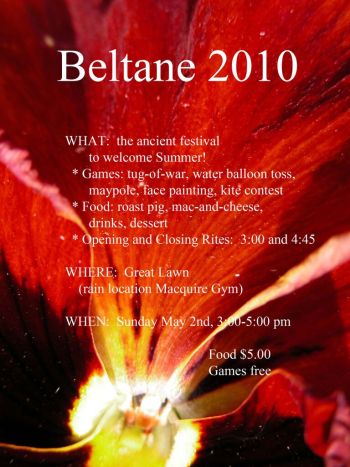 Outward from the merely personal to a group I practiced with the longest: students at the boarding school where I worked for 16 years. Our last and best effort was a truly elaborate Beltane. We devoted a lot of time to preparation, reserved a spot on the school’s Great Lawn (associated with the annual graduation picnic for the whole school community and parents), put up attractive color posters (see the image to the right), and even inspired our student president to spring for the cost of a whole roast pig.
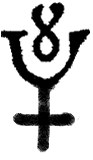 To the left is one version of our sigil, drawn with magic marker on a student’s sketchpad, which I share here — “Guard the Mysteries! Constantly reveal them!” — for the benefit of those curious about the lineage and origins of such things.
 A good speaker weaves enchantment over an audience, and the Chief did so now. “Others may fear the Dark. But we have learned, my brothers and sisters, to know and respect its nature and its extent. Identifying with it, its reach becomes our own, and from the concealment darkness offers, we may extend our grasp to life in a way that light cannot. Anciently the Wise have declared, ‘Light is the left hand of Dark.’ Once prepared, as we have prepared ourselves, we can welcome it and grow from it — from the Dark.”


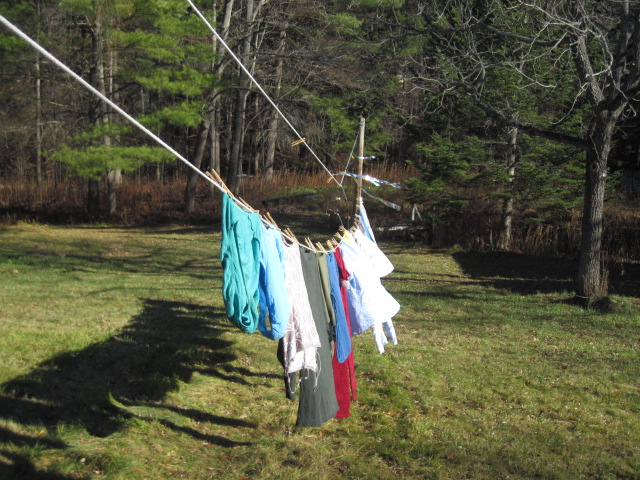


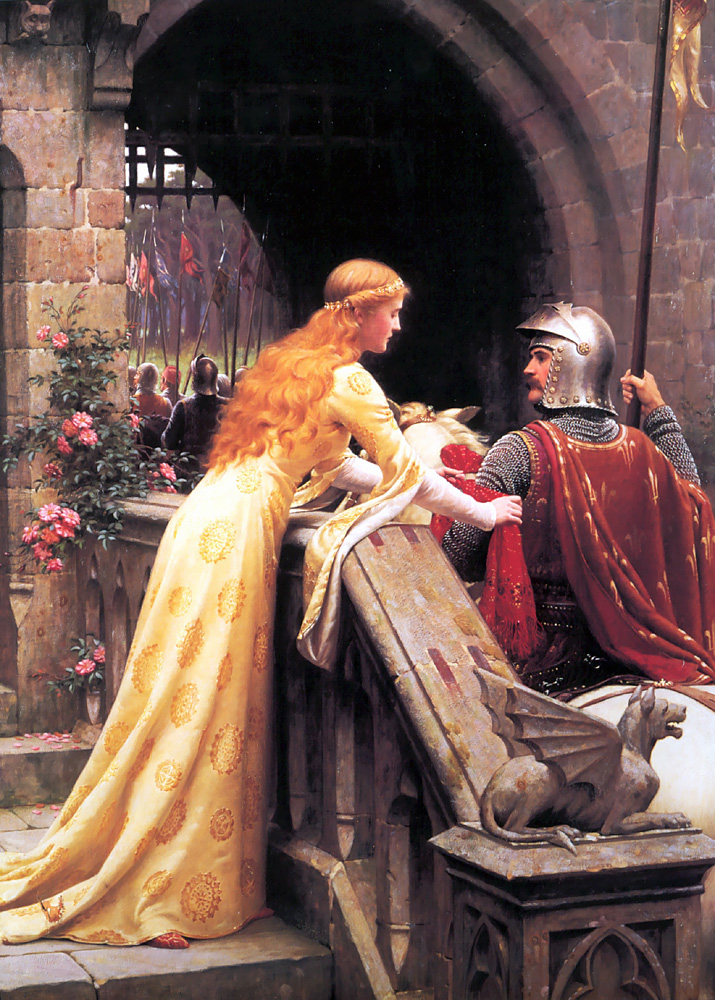


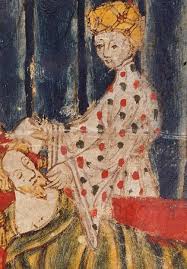
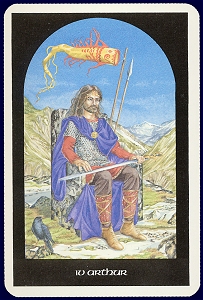
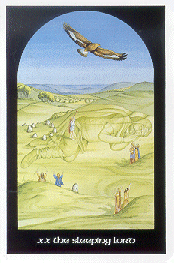
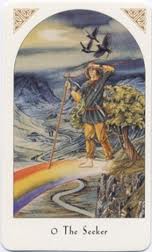
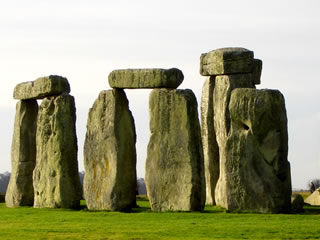
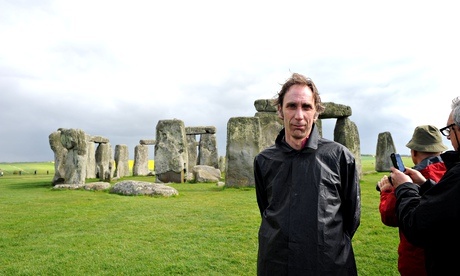
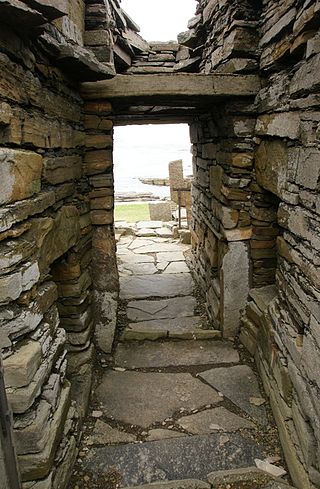




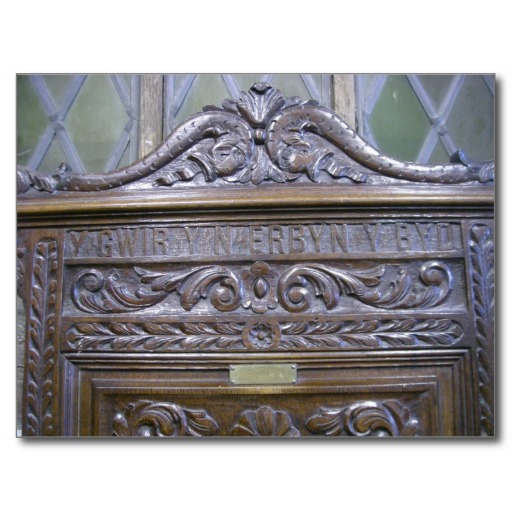


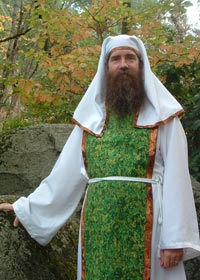



 A Druid Way