Archive for the ‘East Coast Gathering’ Category
[A version of this post appeared in my column in the online Druid magazine Amethyst. My thanks to the editors for providing their well-edited forum for OBOD’s East Coast Gathering (ECG) community.]
I offer this post on the chance it may prove useful if you’re grappling with some aspect of animal guides, power animals, personal totems — the usages and terminologies haven’t settled down yet.
Last September, as I sat engrossed in the ECG 2013 workshop on Animal Guides, I simply had to laugh at myself. It had become clear to me over the weekend that sometimes your animal guide pursues you, rather than the other way around. In my case I’ve learned that gods, spirits, and guides often have to shout and do handstands to get me to notice at all. I’m just grateful they think it’s worth Their while.
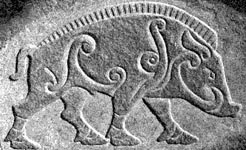 With Boar, my obliviousness ran deeper than usual, and lasted much longer. Maybe (I say, trying to excuse myself in any way I can find) it’s only because I’ve looked at my obtuseness more closely than usual. Maybe following two paths has scrambled the inner circuits. Maybe my inner discipline needs work (whose doesn’t?!). Laughter may be appropriate – and fitting for Boar, who can be a bit of a trickster anyway. As long as laughing isn’t all you do, I hear inwardly. Clues pile up. Here are some I’ve managed to account for so far.
My father, a city boy who grew up in Niagara Falls, NY, became a full-time dairy farmer a few years before I was born. For some reason he could judge pigs well, recognize the outstanding animal, pick out the prize pig. In fact he won several judging competitions when I was still a baby. But the ability perplexed him. He’d mention it from time to time, amused. (Now I ask myself, is Pig or Boar some kind of family or ancestral totem? One more quest to add to my list of quests.)
I was born in the year of the Boar, according to the Eastern 12-year calendar. OK, I thought. Interesting piece of trivia. Entertainment, really. Chinese restaurant lore. Fortune cookie material. My nominally Christian family never paid any attention to such things. And in my adolescent arrogance and ignorance, I considered myself professionally immune to astrology, which I was sure was for wackadoos. It didn’t help that it was part of the national conversation at the time. If you’re old enough to remember the Reagan presidency and the First Lady’s Nancy Reagan’s admitted fascination with astrology, you know what I’m talking about.
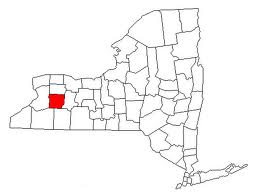 When I was in my early teens, and walking the Wyoming County fairgrounds in late August, a show pig at our local county fair lunged at me as I passed – a serious, front-legs-over-the-top-of-the-pen, get-to-you-if-I-could attempt. I was passing by a good ten feet away, one person in a crowd of visitors to the week-long fair in our agricultural county. What set the pig off? Something I was wearing? A scent of sweat or lunch or shampoo? Pitch or timbre of my voice? I never did find out. But I’ll note that I was fascinated around this time by the Greek myth of the Calydonian Boar Hunt, and the relationship between Meleager and Atalanta, a fleet-footed huntress sent by the goddess Artemis, who had also sent the boar. Why? To punish the king of Calydon for his neglect of the rites due to the gods. (You have to understand: goddesses feature in another of my lists of embarrassing interactions with the universe. Sometimes when I get it down on paper it’s just downright embarrassing. But, I can hope, maybe my embarrassment will be useful to others.)
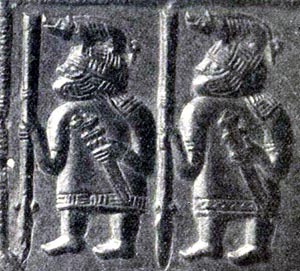
 I reflect, too, on my long* fascination with Old English, Anglo-Saxon society, and the war (and boar) themes in poems like Beowulf. To the left you can see the stylized (and outsized) boars on the warriors’ helms.
To cite just two instances from one poem, at one point the poet equates the warriors directly to the boar and to its symbolic importance as a fighter: “The armies clashed — boar struck boar” (lines 1327-8). And some hundred lines later, Beowulf’s own helmet is described in detail: “A smith crafted it, set boar-images around it, so that ever after no sword or war-axe could bite it” (1452-1454).
 Fast forward a decade and I’m teaching English in Japan in Musashino, a western suburb of Tokyo. One weekend my wife and I were visiting Asakusa Jinja, a large Shinto shrine in downtown Tokyo. As I was poring over trinkets for a cheap souvenir, a servant of the shrine insisted that I take a small carved wooden boar token. It didn’t appeal to me at the time – I thought some of the other images were more artistic renderings. But I made a small offering and went home with the image.
The Wild Boar serves as the mascot at a private high school where I taught for almost two decades. Every day classes were in session, I entered the campus dining hall passing beneath a stuffed head of a wild boar mounted over the entrance. The animal had been shot decades ago by one of the first headmasters of the school, an avid hunter.
About a dozen years ago, my wife and I took a vacation to Italy and the Tuscan hill country, where not once but twice I ate wild boar, and was sick both times. You’d think at some point it might have dawned on me that I shouldn’t eat my animal guide.
 In fact, a few years ago an alum donated to the school a replica of Il Porcellino, a famous boar figure from Florence, Italy by the Renaissance sculptor Pietro Tacca. I now walked past Boar twice a day, outdoors and in. I can’t claim the universe rearranged itself for my benefit (or embarrassment), but the effect was the same.
Why such resistance on my part? I still don’t know entirely. But Boar appeared in a vision during the East Coast Gathering drumming session with Thomas Deerheart and Maya Minwah, and gave me some very specific health advice for a longstanding issue I’m dealing with. Ever since then I’ve been drawn to touch Boar, run my hands over his coarse fur, feel the ridge along his back.
 The Druid Animal Oracle entry for Torc, the Boar, notes: “… he is a representative of the Goddess—his skin can heal you” (Philip and Stephanie Carr-Gomm, The Druid Animal Oracle, Fireside/Simon and Schuster, 1994, p. 39). It’s important to note I finally read the Oracle only after I wrote a second draft of this column (yet another resistance – I’ve had the volume on my shelves for over a year).
We say “my guide” or “my power animal,” but I’m finding that for me at least it’s the other way around. I belong to them. Whatever I think I’m looking for, it’s been looking for me even longer. The hunter is hunted. They track me down till I’m cornered and I have to listen, till I can’t ignore them any longer.
Recently Magpie has caught my attention again. I’m trying to listen better this time to whatever this new guide wants to communicate. What with running with Boar, and flying with Magpie, at least I’ve got the opportunity for plenty of inner exercise.
/|\ /|\ /|\
As I look over these notes, several points stand out. (I’ll put them in first person and speak only for myself, not to presume too much about who you are, or what your experience may be.) First, to my mind, is the desire (I don’t know how else to put it) of the Other — Spirit or spirits, guides, deities, totems — to connect with me. Second I must concede my own obliviousness. I ask for help, or a “sign,” but even when it lies down in front of me and trips me up, I STILL manage to ignore it.
Next is the likelihood that once I start looking, the coincidences begin stacking up until it’s clear there’s more than coincidence going on. Common themes emerge. The animal I seek is also seeking me — in dreams, “accidents,” images, unaccountable emotional reactions to seemingly “unimportant” things– in all the different ways it can reach me, in case one or more channels of communcation are blocked (usually on my end).
Animal images in poems also cry and echo for the nerd-Bard that I am. We repress the animal guides in and around us, so that like other repressed things, they eventually spring, animal-like, into our psyches elsewhere, in sometimes strange and nightmarish images, in art, dream, eventually, even, in national obsessions and pathologies. If they pool and accumulate enough cultural energy, they manifest in personal and societal outward circumstances, in political and cultural movements, in wars and other conflicts. Think of W. B. Yeats’ apocalyptic poem “The Second Coming,” which famously ends “what rough beast, its hour come round at last,/Slouches towards Bethlehem to be born?”
Or consider Philip Levine’s “Animals are Passing from Our Lives” in the voice of a pig approaching its slaughter. Apocalyptic and angry poems like these, like most art, aren’t “about” only one thing. Run them to earth and they keep meaning something more. We use animals (animals use us) to communicate what we sometimes cannot say directly. Among all the other things they do, animals help us express that deep love, that bitter grief, anger and darkness, comfort and healing, that simply may not be able to manifest in any other way.
/|\ /|\ /|\
Images: boar; boar-helmed warriors; Asakusa Jinja; Il Porcellino; Druid Animal Oracle.
*Like many English majors, I studied Old English as an undergrad and grad student. Like some others, my interests in things Tolkien and Old English stimulate and nourish each other. Since then I’ve kept up my amateur’s interest by attending conferences, writing and presenting papers, shoring up my grasp of the language in discussions and translations on online forums, and in rendering portions of OE poems and prose into modern English, as with the lines above. I say “amateur,” because with the exception of occasionally teaching the poem in translation to high schoolers, I pursue my interest out of personal obsession rather than professional necessity.
[Part 1]
 In the Celtic worldview (and also for anyone in the Northern Hemisphere it’s abundantly clear), we’ve entered the “dark” half of the year. “Dark” drags in its wake many associations, many millennia old in primate consciousness, of fear, death, danger — all things we instinctively flee, unless we pause to examine cultural conditioning to see why this should be so. If you’re still moved to flee after such a pause, at least you’ll be running with eyes open. Watch out for the lemmings up ahead.
And here is another lesson about Orders and freedoms. The planet we live on follows its own rhythms, regardless of our druthers, and as natives here, willy-nilly we move with the earth under our feet. Earthquake, hurricane, flood, volcano; spring, summer, fall, winter. We’re tenants, not landlords. As much as we try to banish winter cold and darkness, they abide just inches beyond our noses as we peer out our triple-glazed windows. And that’s fitting, of course. Among all its other wonders, the planet grew this wonderful fore-brain of ours that makes childbearing a challenge when it’s time to pass a large skull through a small birth canal, but that same large brain helps us live in temperate and even arctic climates, as well as virtually everywhere else there’s legroom. A balance between order and freedom, limit and innovation, change and stasis. We’re a part and apart, at the same time, courtesy of a species the planet’s still experimenting with, and probably always will be, till we die out or evolve, some of our descendants, into something else.
OK, you say. Got it. Had it before I came here. Heard the lecture, took the tour. Tell me something I don’t know. And these are precisely the challenges to throw at all our ways of thinking, not just the privileged few that happen to irritate us because the horrid Others say them. First assignment, due on your next day of reckoning, at your local time, or whenever is most inconvenient. All our assumptions need a stir on the compost heap. Political affiliations, marriages, jobs, habits, hobbies, what’s vulgar or profane (Miley Cyrus? Death camps? CEO incomes? Ignorance? Missed chances to use petroleum to prepare for a world without it? Endless lolcats? Taupe and mauve and puce?). The once-over should include everything — especially whatever’s a wholly-owned subsidiary of your left hemisphere. What don’t we know? Got a hunch about that. Isn’t our ignorance one more miserable discomfort, to join the ignoble quartet above — death, dark, fear, danger? We don’t look because it’s hard. It asks us to start over. Not to reinvent ourselves, but to return to what we threw away because it seemed old, to pick it up, and see it again for the first time as utterly, endlessly new. One thing becomes another, in the Mother, in the Mother. Look it up, or consult the nearest young thing growing. The Goddess makes all things new.
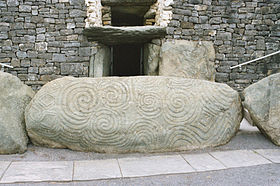
No Order can “teach” us such “wild wisdom.” All it can do is point the way back to our bones, blood and sinew that always held it, gift that doesn’t turn away from us merely because we turned from it. Change, cycle, spiral. We see it celebrated, repeated (doing what it’s being) in Celtic art. We can feel it in the flow of Tai Chi, the circular movements of dance and swimming, the serve and volley and return of tennis, sex, night and day, birth and death. What goes around comes around. What you do comes back to you. Is this not a great gift, that we see the results of our actions? Nothing is lost, and all is stored like seed in the earth, and returned at the next springing forth. Only a short-sighted people would fear the fallow time, forgetting the blossom time after. Only blind people would act as if this is all there is. “This” by definition is never all there is. Reconnecting with the natural world “lengthens” the sight. Vistas re-established. Perspectives re-balanced. Cure at hand for too much left hemisphere, too little humility. When was the last time we praised a world leader for that trait? And why is that? OK, call me Groucho.
At the recent East Coast Gathering, Damh the Bard told a version of the fine story of the Hare and the Moon. The Moon had a choice piece of wisdom to impart to the people of earth, and asked the Hare to carry the message. “Tell them this: you are all going to die,” said the Moon, and like a shot the Hare was off, bearing the Moon’s message to the people of earth in great leaps and bounds. Of course, Moon had been showing the lesson each month, passing through darkness to fullness, waning and waxing, shrinking and growing, endlessly, patiently teaching. But the people had forgotten, and when they received Hare’s partial message, they wailed bitterly at their wretched fate. “We’re all going to die!” But the Hare, impetuous fellow that he was, had not stayed to hear the second half of the message, which was delayed in reaching the Earth: “… and you all will be reborn.” For Hare’s over-haste and obliviousness, when he returned, the Moon split his lip, and to this day the harelip is a reminder to hold in the heart the whole message, to find wholeness in the many pairings that a true cycle treats as “One Thing, moving” — a Uni-verse.
 So what are Druids to do who feel Orders may not be for them, or at least not right now? The whole world beckons. If, as Robert Frost says in “Carpe Diem,” which must by all signs be the true religion of America*, “The present / Is too much for the senses, / Too crowding, too confusing— / Too present to imagine,” a few years later, his splendid poem “Directive” urges: “Drink.” This too can be religion, can be spirituality, can be a saving and healing practice that does not split the two, if you will have it: “Drink, and be whole again beyond confusion.”
/|\ /|\ /|\
*Carpe Diem: (Latin) literally, “seize the day”; Nike’s Just Do It; YOLO — you only live once; “in heaven there is no beer; that’s why we drink it here.”
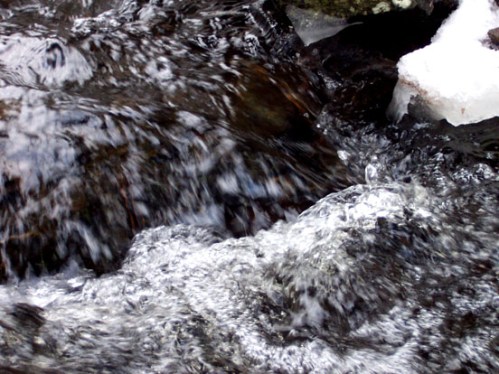
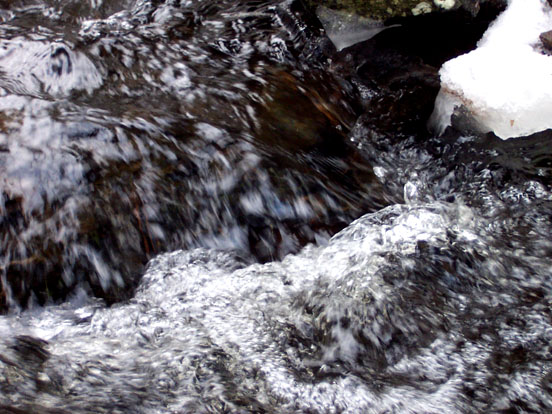
Images: spiral at Newgrange, Ireland; winter brook.
Updated 6 Nov. 2013
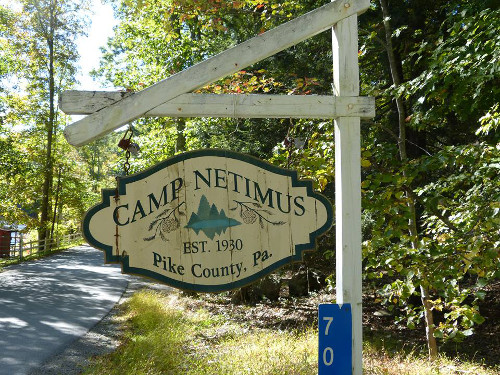
Camp Netimus sign — photo courtesy Krista Carter
Several other attendees have written fine accounts of this year’s OBOD East Coast Gathering — see Dana’s and John’s posts for two good examples, which are also introductions to their excellent blogs. Here’s mine (with a link to last year’s post, too).
/|\ /|\ /|\
Once I pull off the pavement onto the dirt road to Camp Netimus, I stop the car and get out. Apart from the soft metallic tinkling of the hot engine, there is only wind.
The first year I felt self-conscious about greeting the trees, but this year it comes effortlessly. How to convey the sense of subtle presence, of quiet welcome? Nothing I can “prove” or point to, nothing objective for any journalist who might opt to “cover” the weekend for a human-interest piece in a local paper, except a middle-aged man briefly motionless beside a tree. And yet. I stand with one palm flat against the gray trunk of this Netimus oak, and the sense of familiarity and welcome is palpable. How to explain this sense of return? Others at the Camp mention similar experiences over the course of the weekend. If this is delusion, and “only imagination” (two words that never should go together), it’s healthier than almost any other I can think of. The summer campers are gone, Alban Elfed — the fall equinox — is here, and Druids have returned to honor the spirits of place and the season. I know that a few hundred yards up the hill, I will see again the members of my Druid tribe, who have gathered from Texas and Michigan, Louisiana and Florida, New Hampshire and Georgia to celebrate, reunite, sing, dance, talk, learn, eat, drink, and revere the living green world.

Steps up to fire circle from Main Lodge — photo courtesy of Wanda GhostPeeker
Our three OBOD guests this year from the U.K. are musician and OBOD Pendragon Damh (Dave) the Bard, his wife, artist and workshop facilitator Cerri Lee, and OBOD Tutor Supervisor Susan Jones.

Damh the Bard and Cerri Lee — photo courtesy of John Beckett
In spite of a pesky virus Damh picked up on his way across the pond, he regaled us with two sets around the evening bonfire the first day.
The perfect encounter, fitting for a bard: we know him first by his voice alone, which precedes him, rolling out from his albums, videos and podcasts. Check out his live performances on Youtube, and you get a sense, too, of his warm personality and delightful laugh. Now he is with us in person, a commanding presence, towering over us at 6’4” or 5”.

Susan Jones, OBOD Tutor Coordinator. Photo courtesy John Beckett
Susan Jones, the Tutor Coordinator for OBOD, also returned to the States this year to celebrate with us and lead a fine meditative workshop on the Hermit and Journeyman in Druidry. We need the Elders of our Tribe to help us steer on a “path with heart,” to give us a sense of who and what has gone before. We’re all in training to be Ancestors, after all. What will we contribute when our descendants invoke and welcome us around their bonfires and hearths?
/|\ /|\ /|\
The Cernunnos ritual Friday night proved powerful for many, the presence of the god palpable in the circle of the ceremony. John Beckett, priest of the god, led us in invoking him. The Lord of the Forests has remained on the periphery of my life thus far, a being I respect but have few dealings with. Yet in his grove I reconnected with an animal guide who made his presence known several other times during the weekend — that’s for another post. Two owls called intermittently throughout the rite.
This year was my third time attending the ECG, and the first for my wife. Over the last decade we’ve managed to pursue more deeply our individual paths and interests, while keeping each other apprised of what we’re learning and experiencing. I’d apparently talked up the Gathering enough that she opted this time to see “what I was up to” when I disappeared for several days in late September, to return smelling of woodsmoke and bursting with stories.
/|\ /|\ /|\
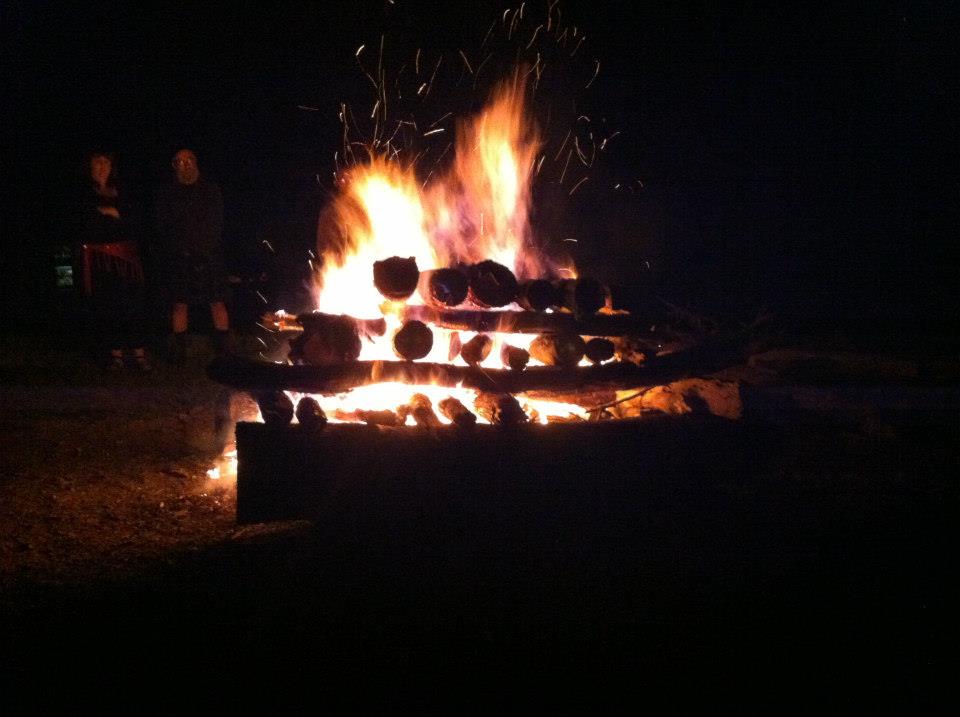
After weather forecasts early in the week that would have left most days of the Gathering in rain, the weather shifted. Both Thursday and Friday turned bright and sunny, with cool evenings perfect for what has become a tradition of bonfire, mead, talk, drumming, story and song late into the night.

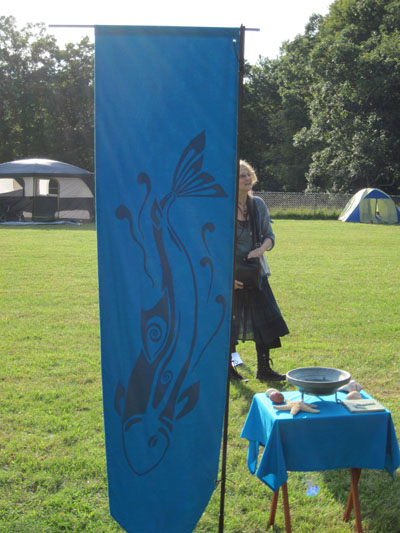
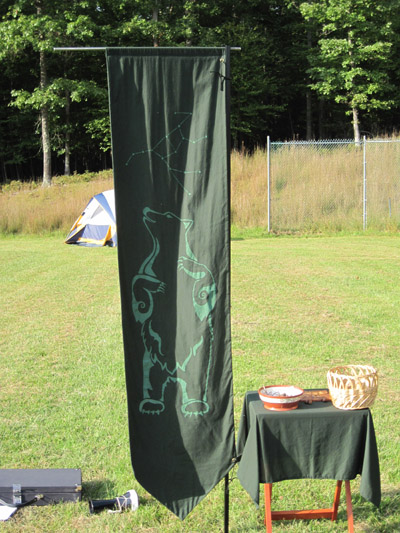
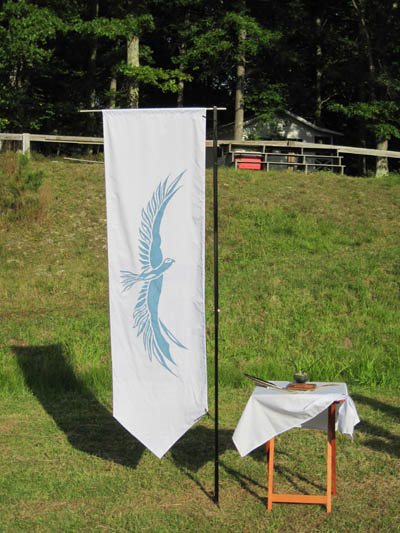
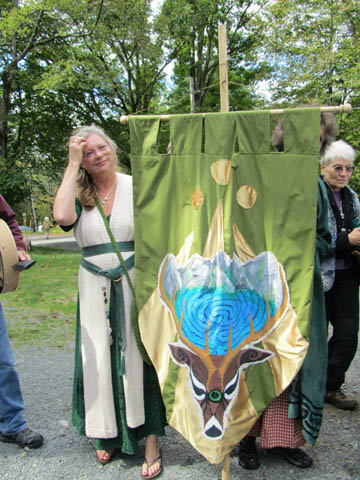
Four Quarters, we honor you. Hawk of the East, Stag of the South, Salmon of the West, and Bear of the North, you came to be with us once again.
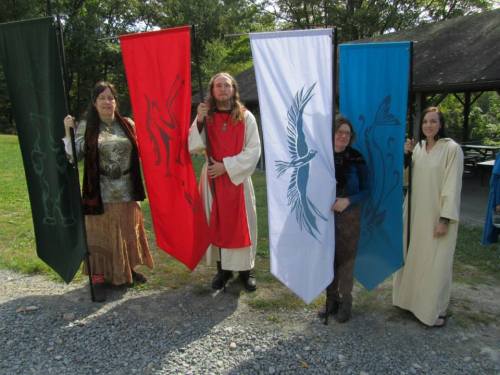
Directional Banner Carriers — photo courtesy John Beckett

The Equinox is upon us. Still the Druid Prayer of the Revival echoes from last weekend at the East Coast Gathering:
Grant, O God/dess, thy protection,
And in protection, strength,
And in strength, understanding,
And in understanding, knowledge,
And in knowledge, the knowledge of justice,
And in the knowledge of justice, the love of it,
And in that love, the love of all existences,
And in the love of all existences, the love of God/dess and all goodness.
The lake in the picture (photo credit Sara Corry) is at the base of Camp Netimus, where the East Coast Gathering assembled for its third year this last weekend. In the presence of such moments, it’s easier to perceive that the physical world is one face of the holy, or as Jung expressed it, “Spirit is the living body seen from within, and the body the outer manifestation of the living spirit—the two being really one” (253). Humans respond to beauty and to such transparent intervals as this, often in spite of what they may consciously believe or claim about reality. We cannot help but be moved because we are part of what we witness. We may witness a score of hierophanies, visions of the divine, each day. Whatever our beliefs, these openings to the sacred nourish and help sustain us.
The rebalancing we hope to accomplish depends on our state of consciousness, on our ability to accept a gift given. And so in a workshop last weekend, “The Once and Future Druid: Working with the Cauldron of Rebirth,” we repeatedly turned to another seed-passage, this time from Neville’s The Power of Awareness: “The ideal you hope to achieve is always ready for an incarnation, but unless you yourself offer it human parentage, it is incapable of birth.” I carried that with me for several days, marveling at its ability to focus the attention. Whenever I found myself falling into old patterns of thought, I return to its simple truth. The power of such meditations and seed-exercises reaches beyond their apparent simplicity or even simplisticness.
In one sense we are consciously meme-planting, even if it’s on a personal level. Why not plant our own, rather than be subject to others’ constructs, which may not suit us? Yes, these seed-thoughts and heart-songs may remain lifeless if we do not ignite them with our attention and desire. But properly sustained, like a campfire (sorry … the camp images stick with me!), fed and banked and tended, it can pour out a healing and transformative warmth all out of scale to its visible size.
/|\ /|\ /|\
Jung, Carl. Modern Man in Search of a Soul. London: Routledge and Kegan Paul/Ark Paperbacks, 1984.
Updated 9/28/12

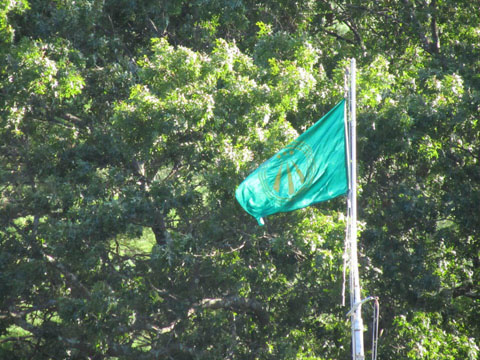
The OBOD East Coast Gathering offers a chance for Druids to walk among friends, attend workshops, and (re)connect with a beloved landscape in northeastern Pennsylvania. Here’s the OBOD banner, the color easy to see, the three-rayed Awen symbol of the Order a little harder to make out. (Photo by John Beckett)

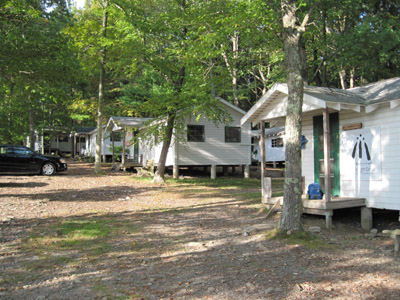
 The camp which hosts the Gathering offers both tent areas and basic cabins.
With more people attending this year than last, the ample space helped.
The area is splendid for large group rituals as well.
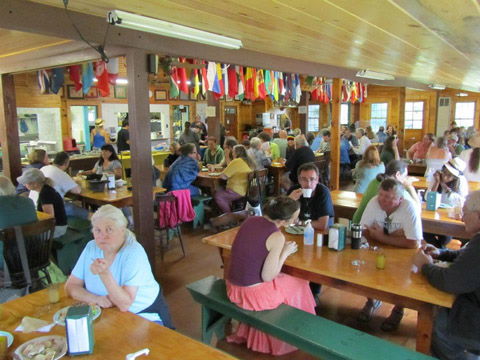
The rainstorm over the weekend brought with it cooler weather, which just made us all the more grateful for hot drinks and the varied meals our staff of Druid volunteers cooked for us.

(Dining room photo by John Beckett)
I didn’t arrive in time for the opening ritual. But the Closing was held on the same grounds, with the same altars. Here are shots of the two entry cairns seen looking south, along with the four directional altars and their banners: Stag of the South, Salmon of the West, Bear of the North and Hawk of the East.
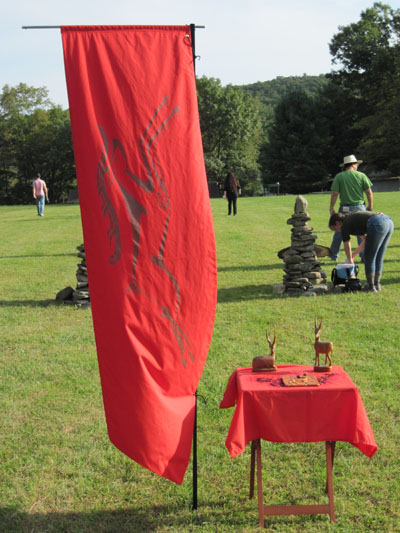

One of the added pleasures this year was the attendance of more Druids from different orders, including ADF. Here are members of Cedar Light Grove assembled around their grove banner (photo by John Beckett).

OBOD groves brought banners too.

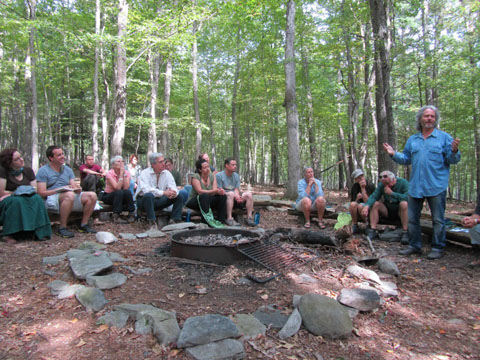
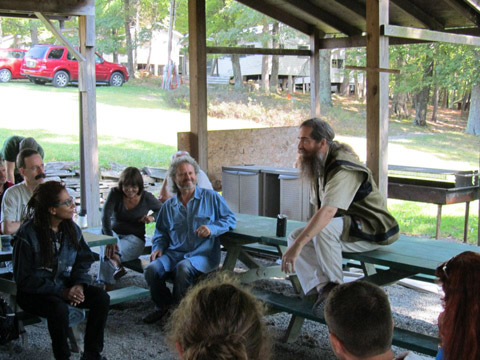
And this year, the third Gathering and my second, yet another draw was the chance to meet and learn from both OBOD’s Chosen Chief Philip Carr-Gomm, and AODA’s Archdruid John Michael Greer.
The first photo is of Philip giving a talk in Storyteller’s Grove a little north of camp.
The second shows John Michael during one of his morning talks in the Pavilion.
In the third, both join for a conversation and Q&A. (3 photos by John Beckett)

And of course no Druid gathering would feel complete without the ceremonial garb that makes the rituals visually distinctive and memorable.
Here are JM Greer and John Beckett:

Topping off each day were the evening fire-circles and drumming, music and song and ample home-brewed mead, cyser and sack from our resident firekeeper and brewer, Derek. Then came the Hour of Recall, truly. The Closing ritual, goodbye hugs, departures, promises to keep in touch, to plan events, to meet again. Another remarkable East Coast Gathering comes to an end, with opened hearts and subtle changes to take away and live through for the coming year. Till 2013!
/|\ /|\ /|\

 With Boar, my obliviousness ran deeper than usual, and lasted much longer. Maybe (I say, trying to excuse myself in any way I can find) it’s only because I’ve looked at my obtuseness more closely than usual. Maybe following two paths has scrambled the inner circuits. Maybe my inner discipline needs work (whose doesn’t?!). Laughter may be appropriate – and fitting for Boar, who can be a bit of a trickster anyway. As long as laughing isn’t all you do, I hear inwardly. Clues pile up. Here are some I’ve managed to account for so far.
 When I was in my early teens, and walking the Wyoming County fairgrounds in late August, a show pig at our local county fair lunged at me as I passed – a serious, front-legs-over-the-top-of-the-pen, get-to-you-if-I-could attempt. I was passing by a good ten feet away, one person in a crowd of visitors to the week-long fair in our agricultural county. What set the pig off? Something I was wearing? A scent of sweat or lunch or shampoo? Pitch or timbre of my voice? I never did find out. But I’ll note that I was fascinated around this time by the Greek myth of the Calydonian Boar Hunt, and the relationship between Meleager and Atalanta, a fleet-footed huntress sent by the goddess Artemis, who had also sent the boar. Why? To punish the king of Calydon for his neglect of the rites due to the gods. (You have to understand: goddesses feature in another of my lists of embarrassing interactions with the universe. Sometimes when I get it down on paper it’s just downright embarrassing. But, I can hope, maybe my embarrassment will be useful to others.)
 I reflect, too, on my long* fascination with Old English, Anglo-Saxon society, and the war (and boar) themes in poems like Beowulf. To the left you can see the stylized (and outsized) boars on the warriors’ helms.
 Fast forward a decade and I’m teaching English in Japan in Musashino, a western suburb of Tokyo. One weekend my wife and I were visiting Asakusa Jinja, a large Shinto shrine in downtown Tokyo. As I was poring over trinkets for a cheap souvenir, a servant of the shrine insisted that I take a small carved wooden boar token. It didn’t appeal to me at the time – I thought some of the other images were more artistic renderings. But I made a small offering and went home with the image.
 In fact, a few years ago an alum donated to the school a replica of Il Porcellino, a famous boar figure from Florence, Italy by the Renaissance sculptor Pietro Tacca. I now walked past Boar twice a day, outdoors and in. I can’t claim the universe rearranged itself for my benefit (or embarrassment), but the effect was the same.
 The Druid Animal Oracle entry for Torc, the Boar, notes: “… he is a representative of the Goddess—his skin can heal you” (Philip and Stephanie Carr-Gomm, The Druid Animal Oracle, Fireside/Simon and Schuster, 1994, p. 39). It’s important to note I finally read the Oracle only after I wrote a second draft of this column (yet another resistance – I’ve had the volume on my shelves for over a year).










 A Druid Way