Archive for the ‘earth spirituality’ Category
No, this isn’t the D&D you’re looking for. Or perhaps it is.
Last month, on the way home from our nephew’s Southern wedding, my wife and I met my two Pennsylvania cousins for breakfast. We hadn’t gotten together since their father, my uncle, passed on almost two years ago. In his mid-90s, he’d wanted a minimal funeral: “No reason to prolong your grief, or spend money doing so”, he’d said. The rite ended up so modest and unannounced only his daughters and grandkids attended. We were just hearing details now.
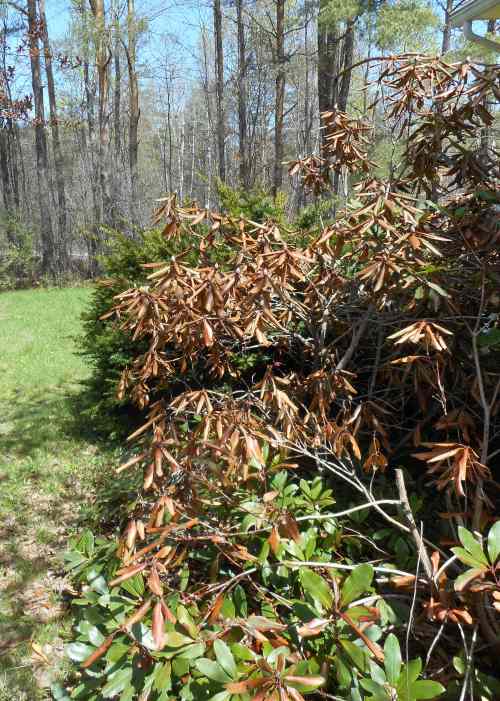
Our front-yard rhododendrons, with winter-kill on top, and the lower (snow-protected) green branches
Because of course funerals are very much for the living, too. And in spite of our callous and oblivious Western cultures so uncomfortable and unhelpful around death, we don’t “get over” grief after any fixed period of time. My younger cousin, I know, still carries hers around, like a tight knot in her chest, a cannonball of hurt.
“We’re not supposed to die!” she exclaimed at our breakfast, and I bit my tongue not to offer Druid things to her, knowing she still took a hard Evangelical Christian line about death: that it’s a punishment for sin, not a natural part of a cycle in worlds of time and space; that it’s a penalty for disobedience, not the consequence of wearing bodies that will, over time, wear out. Are autumn and winter unnatural?
Sometimes you just need to be heard in your grief, without judgment, without reply or attempts at comfort that, for you, ring false. No need to argue about death, for anyone’s sakes. I only hope she’ll find upcoming deaths, and her own, not a punishment but another step on our long journey.
Of course Druids no more “believe the same thing” than any other group of contrary, year-marked, and opinionated humans. One of my techniques, field-tested over my decades, if I can remember to turn to it — rather than bothering with belief, or non-belief — is to ask how is it true? When or where is it true, has it been true, will or can it be true again? These, to my mind, are larger, “better” questions, questions that still sidetrack me very helpfully, and fascinate me — much more than trying to lock down the moving target of “what a person can reasonably be expected to believe these days”. The answers, often spinning on to more questions, also fit poet Mary Oliver’s criteria: “so many questions more beautiful than answers”. Yup, says my inner Druid, trust the bards on this one, too.
Or as an artist friend said last night in Brandon VT, at her first major show of approximately 40 exquisite watercolors, quoting her mentor: the artist’s job (all our jobs, really) is to “deepen the mystery”, to pay attention.
As I’ve written elsewhere on this blog, I don’t so much believe in life after death as I suspect there’s life after death. It’s a hunch, an itch, a ripple up and down the spine, one way to make sense of too many experiences that otherwise don’t fit. This life is already so strange and unexpected, that to be here at all is no more or less unlikely than to continue after the change of death.
Another way to understand it: any “afterlife” has already begun. I just wasn’t paying attention. This is the afterlife of my previous life: what am I gonna do with it? Fried chicken and beer, operas and curry, sex and drugs, art and amazement, fasting and penance, profit and politics — each of us finds a set of pleasures and purposes to round out the strangeness of being here at all, along with any other projects we try our hands at.
Or, with a turn toward pop culture, with some Appropriation for Druid Purposes: “Ye best start believin’ in ghost stories, Miss Turner”, says Captain Barbossa in Pirates of the Carribean. “Ye’re in one!”
Alastair Reid writes in his poem “Curiosity“:
… that dying is what the living do,
that dying is what the loving do,
and that dead dogs are those who do not know
that dying is what, to live, each has to do.
And because you know I rely on our bards to heal and guide us, here’s Mary Oliver again, one of our master Bards, on grief, with a perfect Druid triad:
To live in this world
you must be able
to do three things:
to love what is mortal;
to hold it
against your bones knowing
your own life depends on it;
and, when the time comes to let it go,
to let it go.
Another chance for Bards to have the last word: a page of ten particularly apt poems on the immense range of our griefs and losses.
/|\ /|\ /|\
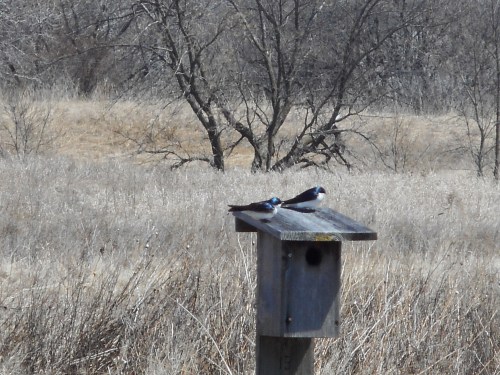
tree swallows sunning themselves — mid-April 2019
In a comment to John Beckett’s blogpost of March 28, Gordon Cooper covers several topics and throws out material very rich for reflection and experimentation.
Cooper first addresses the development of modern polytheism:
How can polytheists who honor non-Indo-European gods replicate the successes that Druidry has had?
I would suggest that the success OBOD has had and continues to have is rooted in some fairly simple and old fashioned tools — a correspondence course, mentors, and lots of engagement by the members. The first time I went to the OBOD Lughnasad gathering at the Vale of the White Horse, I was deeply impressed by the amount and quality of work I saw. One person learned ceramics, built a hand-painted and fired series of tiled walls on her properties with elemental dragon meditations she’d realized. Others had voluminous scrapbooks filled with meditations, plant studies, ritual walks, etc. Their other secret weapon is Philip. He’s an international treasure for all druids, at least in my experience.
The combination of well-thought-out instructional materials and mentors, together with a dedicated and generous leader, and the developing nature of most strands of Druidry as supportive and inspirational practices, have proven its value yet again. If the non-European gods have means of access to power in this realm, through their priests and their own natures as deities, can they inspire and help manifest similar supports for their devotees and adherents?
And yes, much of modern Druidry and Paganism in general finds a priceless resource in books. Cooper continues:
If a group chooses to start from Nuinn’s [Ross Nichols, founder of OBOD] druidry, as it seems to be articulated in “The Cosmic Shape” it is possible to arrive at a non-IE druidry by treating this as an embodied expression in ritual, artistic and land-based practices that manifests over time and space differently in each era and place. I strongly encourage reading the entirely of ‘Cosmic Shape” as one point of departure.
Cooper next tackles a particular source-text — Iolo Morganwg’s Barddas (link to complete text at Sacred Texts).
Moving to the Barddas as a possible base, regardless of how one considers the authenticity of Iolo’s writing, his notions around ritual, nature study and the sciences, poetry and justice are values that I think can be applied to many circumstances and cultures. Besides, anyone borrowing from an Egregore that includes Iolo, William Blake and a French Spy-cum-Mesmerist alchemist is likely to be in for an artistic and interesting ride.
All of us have experience with egregores of groups we’ve joined, been born into, or witnessed from outside as they variously manifested their energies. Political parties, churches, families, clubs, sports teams, other special-interest groups and so on are non-magical examples. Consciously-created and energized egregores deployed magically are potentially just “more so” — stronger, more durable, more capable of great (and also terrible) things. The principle at work is “the whole is greater than the sum of its parts”. Magic as an amplifier simply magnifies that whole.
Cooper then goes on to suggest provocatively, in a quick paragraph, one way to develop a valid Paganism or Druidry that grows organically from wherever we find ourselves, one that need not worry over cultural appropriation or validity:
I’m working on a very small group-focused practice that’s designed from the ground-up to be derived from the local biome and skills of the folks living there. It is being field tested in Bremerton [Washington state] now with the Delsarte Home Circle. It incorporates Ecopsychology, poetics, local kami, nature studies, personalized and group moving meditations and other meditation forms along with a customized ritual calendar derived from the specific region. It is appropriation-free and includes classical Spiritualist training. If interested, please contact me for details.
On the issue of Pagan or Druid chaplains, Cooper also speaks from (local) experience:
I’d say that Pagan chaplains in hospital systems are likely to find themselves in an ethical bind from time to time, as they’d be called on to engaged with YWYH on behalf of ill or dying patients in hospitals or elsewhere.
The VA Chaplains don’t serve or acknowledge the validity of druids and witches, at least at the Seattle VA. This isn’t going to happen with the current staff, and as I receive all of my medical services there, I am not inclined to fight an uphill and contentious battle.
Not all of us are called to fight outwardly — a misconception activists of all stripes are especially prone to. Following your own path is often powerful enough — the patient persistent effort of being a genuine self in a world of delusion and false directions is a forceful life stance, an essential kind of witness both to others and oneself, with consequences we often do not see. Not all music is scored as trumpet fanfare. Some of us are strings, oboes, flutes, drums, or the rests and silences between notes.
/|\ /|\ /|\

photo courtesy Srinivas Ananda
Here’s a set of lively images from just a couple days ago of Edinburgh’s Beltane Fire Society’s 2019 celebration. Twice a year, at Beltane and Samhain, the Society stages an event featuring fire, drumming and dancers drawing upwards of 10,000 spectators.
Past posts on this blog may help provide inspiration for your own observances and practice.
• Two recent posts on Beltane 2019 — my own local Druid group’s ritual and a reflection on Beltane north and Samhain south.
• What is it with fire and Beltane? Well, the name Beltane itself, according to some etymologies, means the “Fires of Bel”.
• In my “30 Days of Druidry” series, I take up Beltane again — the ancient Celtic fire festivals of Beltane and Samhain still live in many forms today. A local example — a group of Morris dancers (article, pix and short amateur video) braved a chilly May 1st morning yesterday on nearby Putney Mountain, VT, to “bring in the May”.
• In 2015 I wrote this series of posts on “touching the sacred” — something we can often do most easily through fire and fire festivals. No surprise that cultures around the world have for millennia recognized fire as a sacred metaphor and vehicle. Let me take you there, says fire (and also Led Zeppelin’s vocalist Robert Plant, especially in “Kashmir”. Lack direct access to transformative fire? A shaman like Plant can help!).
• “The Fires of May, Green Dragons and Talking Peas” assembles the words of bards and a set of images to suggest to ear and eye what it is we seek and thrive from when we find it.
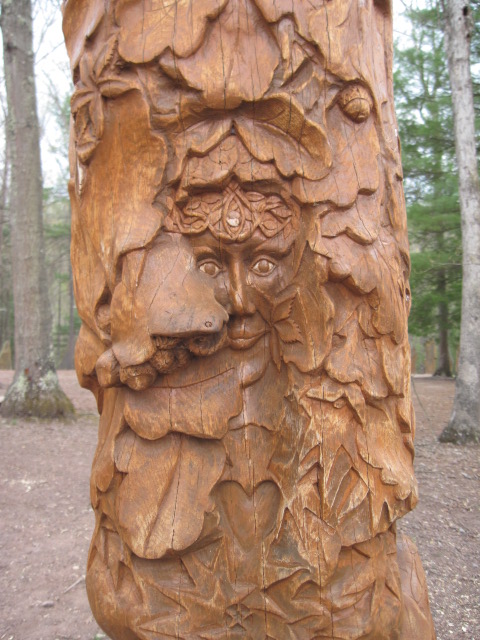
wooden totem at Four Quarters Sanctuary, PA
• Want to experience a taste of a larger Beltane Gathering? Here are posts from 2018 and 2017 on the first two years of the Mid-Atlantic Gathering.
/|\ /|\ /|\
Beltane yesterday, with our Vermont OBOD Seed Group, the Well of Segais, was a windy, sunny welcome to spring in the north half of the state. With many dirt roads washing out after all the recent heavy rains, members scrambled to reach hardtop roads, scouted for accessible ritual locations, and found this marvelous, recently-constructed stone circle in a municipal park overlooking Route 2.

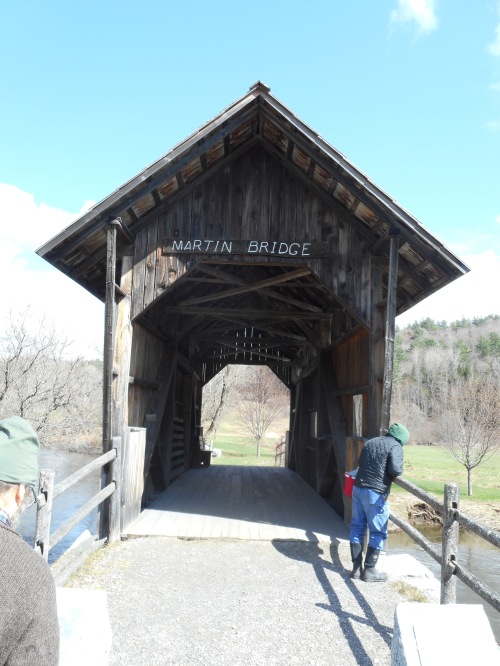
A short walk over this preserved covered bridge, and across a boggy meadow, took us up a hill to the circle.
Between the initial location-scouting and our arrival yesterday, someone had found and placed a striking large quartz rock on the central stone. With some careful shifting on our part, it settled into place upright, serving as a stable windbreak. With five of us, we had just enough members to fill the ritual roles — and to reach out hands to form a ritual circle around the central stone!

Just as Imbolc for Vermonters often marks the start of “sugaring” — maple syrup season (or at least a midwinter thaw) — so Beltane celebrates the first leaves appearing on the trees, the first brave daffodils often pushing through the last of the snow, and the onset of “mud-” and then “stick-” season, two short but memorable intervals sandwiched between the long Vermont winter and the often wet spring.

Calendula –Wikipedia Creative Commons
A group member brought calendula seeds as a ritual gift for all to plant. An “all-arounder”, the calendula is a member of the marigold family, bringing color, medicine, edible blooms, dye, tea, and other uses. Technically an annual, the plant can reseed itself and become effectively a perennial, if you don’t deadhead the flowers and if you allow it to mature into its seed-bearing form.
Looking to welcome the moon along with Beltane? Wait till May 4, and you can work with the New Moon, as Mystic River Grove in Massachusetts will do this year.
“Within me the powers of Sun and Moon. With my right hand (or wand) I father the Child, with my left (or chalice) I mother it. Within me lives the alchemy of this union. Let the magical child of my creative nature blossom and thrive in the inner and outer worlds” (adapted from OBOD ritual).
Beltane blessings to all!
/|\ /|\ /|\
Go to the Bards, I tell myself yet again. The answers have lain there long. (You can tell I hang out with Bards new and old, even if I don’t always listen to them all that well — I use words like lain.)
Wordsworth, Old White Guy, still has something to tell us:
The world is too much with us; late and soon,
Getting and spending, we lay waste our powers;
Little we see in Nature that is ours;
We have given our hearts away.
Do we want some hints for living? Do we want some uplift, to know that positive change — and more important, joy — are still possible in this crazy world?
Bards offer a how-to for the spirit. These four lines yield some solid pointers.
Back away when you can, from the world, into the World. In the heart of even the most urban areas on the planet, green things still can find a way to thrive, sometimes with a little human help. A bee in the bathroom, a bug on the doorbell, a spider webbing the space between light-switch and corner cupboard — the living world keeps knocking. Find the green. Find the World. (Help the bug or bee outdoors again.)
“Late and soon”? Unplug from time, from the apparent world we’ve built for ourselves, into contemplation. We know it’s good for us, and with images, mandalas, music, incense on hand, we can enliven our dips into our own inner pools of calm and wisdom each time with something different, if we crave variety, or with the same deepening familiar artistic companion to our sojourns. It may be a walk with the dog, a time spent folding laundry, a half-hour gazing at the reflection of a pond, working with paints, or clay, or fibers. I turn to a longtime friend, the oooooo at the heart of the ah — oo — en Awen, the HU of the Sufis, a holy name not contaminated with profanity or dulled by careless use. Sing the names holy to you.
Our “powers”? So many of us are facing our powerlessness. In some cases we’ve given what we have away — “laying waste” our own abilities to shape and choose, however meager they may feel and seem. Yet if we turn from buying and selling, things that can’t be bought will reappear for us: time spent with loved ones, time spent in nature, time spent on diving deeper into our own creative selves, uncramping some of our little-used faculties and skills and talents. Reclaim our powers, one at a time if necessary. (No waiting for the next election to give us back what is native to us. No one can hold them back from us, once we recognize them again.)
“Little we see in Nature that is ours”? Let go of possessing, I tell myself, and things will come to me of themselves. Sit still enough, and the birds will light on my head and shoulders like they did with St. Francis, like they continue to do today on those who spend time being still, loving the stillness that keeps opening into something larger and more beautiful. If I hog the road, of course I’ll see little else — I’m what’s in the way. But more and more beings become companions along the way, if I share the path.
If I look in the rear-view mirror of Time, I see the Ancestors waving.
How have I “given my heart away”? Excuse me, I whisper. I’m taking my heart back. I gave it and you didn’t value it. Let me bestow it where it will be cherished for what it is.
Bad news, you say of Wordsworth’s lines? Blaming the victim? No — showing the victim how to unvictim. Empowering the victim with what’s right here, turning off the victim switch others have flipped. No special monastery, ashram, growth center, workshop. These may serve their turn, but they are kindling, not Essential Fire. If I make it, I can unmake it. If I’ve shut it down, I can open it up again. If I’ve created my life, I can change my life.
It can be long work. But what else am I here for? Oh, so many things, many things, sing the birds. Everything, whispers the wind. Come find out, says the path into the greening woods.
/|\ /|\ /|\
[Part 1 | Part 2 | Part 3 | Part 4 | Part 5 | Part 6| Part 7]
If the holy terrain between Druid and Christian calls to you, better your way than one belonging to another person that doesn’t fit you where you walk on your particular arm of the Spiral Journey. A week’s worth of your own meditations surpasses anything I can write here. These themes are suggestions, prompts, points of departure. They’re mine, and they may not be yours. Their use is as sparks, kindling, tinder, fuel, provocation. Your particular path may grow out of resistance or contradiction. Thus are (spiritual) muscles strengthened.
If you’ve (mostly) survived your adolescence, held down a job, learned to deal with roommates, siblings, coworkers, parents, teachers, traffic cops, jerks, (holy) Fools, the DMV, followed a dream, fell in love, lost a bet, failed at something, succeeded at something else, and arrived here, it’s pretty likely you’ve accumulated enough insight to learn something useful when looking at cards intended to evoke insight from your experiences! We can also never fully know how our words on such subjects may be exactly what another needs to hear.
The HERMIT
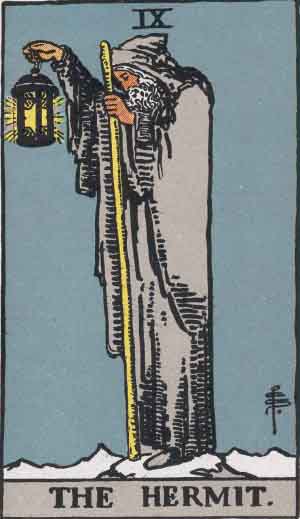 Hermits abound in world-wide lore and legend, running the gamut from hell-bound to holy. Depending on your temperament and the rebuffs that life generously doles out to all of us, you may find in the Hermit a kindred spirit, someone who chooses, as the French have it, reculer pour mieux sauter: “to draw back in order to make a better leap” back into the fray. Or eremitic withdrawal may become the theme for a lifetime, or a whole series of them. Plenty of secular examples come to mind as well, especially if you’re rich enough to build a life from your eccentricities, like billionaire Howard Hughes.
Modern examples include Thomas Merton, whose hermit tendencies can be summed up in the name of the monastic order he eventually joined: OCSO, the Order of Cistercians of Strict Observance, or Trappists. Not content with the already spartan nature of the Order, Merton withdrew further to a hermitage on the grounds of the monastery. His books and poems and increasing fame were one vital source of balance shaping his character into the wise monk, priest and author he slowly became.
J M Greer illustrates a Druid-focused model for practice just as potentially rigorous, especially for the solitary: the Gnostic Celtic Church. Greer highlights some of its distinctive features:
… the GCC does not train people for the standard American Protestant model of the clergy—a model that assigns to clergy the functions of providing weekly services to a congregation, “marrying and burying,” offering amateur counseling to parishioners, and pursuing political and social causes of one kind or another, and defines training for the ministry in terms of the same style of university education used by most other service professions.
This model evolved out of the distinctive social and theological requirements of American Protestant Christianity and has little relevance to other faiths, especially those that do not have the financial resources to support full-time ministers. It has nonetheless been adopted uncritically by a great many alternative religious traditions here in America. It was in response to the very poor fit between that model and the needs of a contemporary alternative religious movement that AODA [Ancient Order of Druids in America] chose to pursue an older model better suited to its own tradition and needs.
Instead of growing from a single and largely American Protestant model, the GCC focuses on what it calls the Rule of Awen, because
there is certainly a need for men and women who are willing to embrace a new monasticism centered on a personal rule: one in which the core principle of aligning the whole life with the spiritual dimensions of reality can express itself in forms relevant to the individual practitioner and the present age, in which a rich spiritual life supported by meaningful ceremonial and personal practice can readily coexist with whatever form of outward life is necessary or appropriate to each priest or priestess, and in which the practice of sacramental spirituality can be pursued apart from the various pathologies of political religion.
Greer always packs a lot in his sometimes academic prose: following Christ’s admonition, this means in short to “work out your own salvation with fear and trembling”. We say we want freedom, but how many of us trust our own inner guidance sufficiently to discern what is “necessary or appropriate”, and avoid the “pathologies of political religion”?
As always, the simplest and purest way contains with it the hard-earned wisdom of lifetimes. Greer lays out the central challenge we all face:
… find and follow your own Awen. Taken as seriously as it should be — for there is no greater challenge for any human being than that of seeking his or her purpose of existence, and then placing the fulfillment of that purpose above other concerns as a guide to action and life — this is as demanding a rule as the strictest of traditional monastic vows. Following it requires attention to the highest and deepest dimensions of the inner life, and a willingness to ignore all the pressures of the ego and the world when those come into conflict, as they will, with the ripening personal knowledge of the path that Awen reveals.
How many of us have even begun to recognize and creatively respond to all the myriad “pressures of the ego and the world”? (After all, this is much of what I’ve long been practicing in my own way, as recorded in this blog, and you have ample evidence here of the challenges one person has faced.)
The Matthews’ Arthurian deck depicts the Grail Hermit: “Neither Druid nor priest, as hermit he mediates the functions of both”.
Where is the “third element” in each of my life experiences? As neither pole of a binary, how does it serve both and thereby a greater whole?
The WHEEL of FORTUNE
 The Wheel or Spiral, the lungo drom or long road of yearning of the Romani, the Wheel of Becoming in Hinduism, “what goes around comes around” of folk wisdom, all point to the circular nature of life and the resonances that our actions establish.
Or as the Lakota holy man Black Elk puts it,
Everything the power of the world does is done in a circle. The sky is round and I have heard that the earth is round like a ball and so are all the stars. The wind, in its greatest power, whirls. Birds make their nests in circles, for theirs is the same religion as ours. The sun comes forth and goes down again in a circle. The moon does the same and both are round. Even the seasons form a great circle in their changing and always come back again to where they were.
The life of a man is a circle from childhood to childhood, and so it is in everything where power moves.
Worldwide, this circle or wheel is also quartered, divided into four fields or domains or regions. Yes, it’s impossible to square the circle , and the link will lead you into exquisite mathematical detail why this is so — but using this holy glyph or mandala as a teaching and learning device, as a tool in ritual, is another order of response to such an intersection of worlds. What is materially impossible is — often — spiritually essential. Or to put it another way, walking a spiritual path means squaring the circle every single day. (Or if you seek a spiritual practice based in mathematics, check out this origami link.)
For more insights that can lead to a unique personal practice with sacred geometry, and not incidentally provide further rich linkages between their profound influence in both Druidry and Christianity, check out Michael Schneider’s A Beginner’s Guide to Constructing the Universe: Mathematical Archetypes of Nature, Art, and Science.
JUSTICE
 In Matthews’ deck, the corresponding figure is Sovereignty: “our true self and the land are one”. The justice of this inner truth emerges in the great rebalancing that earth is currently experiencing, as the consequences of our past actions come home to us, and we begin to accept responsibility for them and to work off their effects. But we need not merely suffer them passively; we can work with them creatively for the purposes of transformation, which is what cause and effect are placed to afford to all who seek.
In the traditional deck, the figure is garbed and presented so that gender is not immediately clear. Latin justitia is a feminine noun, yet the figure of Justice as we have it here has a seated, balanced, imperial quality of the previous male figures in positions of traditional masculine power and authority.
As a further harmonic development of the Magician, Justice is a balanced expression of power: the upward right hand holds a sword, while the left grips a balance. The two pillars of manifestation again frame the seated figure, and a curtain conceals the region behind it.
What has been lost on the way to Justice? How is its expression still incomplete, indicating the need for further growth and unfoldment? What does rebalancing and attainment of a new equilibrium conceal or distract me from? What further currents of change and transformation remain that ask for my attention, and allow me to anticipate future expressions of Justice, of balance and recalibration and harmonizing?
The triple crown of Justice can be seen to reflect the magical current inherent in groups of three, and in the physical universe. The card commentary for this card in Matthews’ Arthurian deck includes this observation: “…the Goddess of Sovereignty gives three drinks from her cup, purveying the white milk of fostering, the red drink of lordship and the dark drink of forgetfulness. These she offers successively in her aspects as Foster-Mother, Consort and Renewer”.
“Mother, foster me to your service. Consort, empower us both through our union. Renewer, ease me as I strive to fulfill my vows to you”.
/|\ /|\ /|\
Each of us is a center from which good things ripple outwards to others. We matter more than we know, more than it can sometimes feel like we do. Any time spent in a true practice confirms this again and again.
/|\ /|\ /|\
Here’s a recent and unusual “comment” that ended up in the spam folder, even though it didn’t contain the typical hyperlinks that earn it instant spam status. (Track it to the originating URL, which I made sure not to include, and you land on a Russian-language small-equipment site. Go figure.) What caught my attention and rescued it from immediate deletion is its marketing build-up. Replace a few key phrases of this comment, and you could be talking about launching a physical exercise regimen, making prudent financial investments, improving your sex life, or learning a foreign language. It’s “Druidry” only in the very loosest sense. Here it is, punctuation unchanged:
Have you ever felt that you just don,t have the time to practise the Druidry that you want to? Wouldn‚t you like to be out in the woods meditating for hours, getting in tune with spirit and nature but the reality is a nine to five job in a town or city. You come home in the evening stressed and worn out and after you have spent some quality time with your partner, played with the kids and had some dinner, you just want to roll into bed. Then the whole sorry business starts again. I guess that like us you also thought of getting up half an hour early to have time for meditation or to greet the sun. You probably also have heard the alarm go off for that early start, reached out to turn it off and woken up exactly half an hour later at your normal getting up time. What if it didn‚t have to be like this? This is where Awen and the Art of Urban Druidry (with apologies to Robert M. Pirsig) comes in. Even in the most built up of cities there is life bursting out everywhere. The first stage on this path is to see it.
The comment treats spiritual practice as an addendum, something I can add to my diet like a supplement or vitamin, rather than where I live my life from. While “spirituality-as-supplement” is one perfectly valid way among others to begin, if a practice or spirituality doesn’t slowly and rightfully begin to pervade all I do, it’s not worth much — it’s not going to have the transformative effects I’m practicing it for in the first place. (More surprisingly, after such marketing language, the comment doesn’t follow through and offer its solution to the problem it identifies — “yours today for five easy payments of just $99/month!” And where’s the book? That title seems targeted for a quick spiritual pick-me-up.)
Very few Druids I know can regularly be found “out in the woods meditating for hours, getting in tune with spirit and nature”. This may occasionally happen at Gatherings — if we’re not seduced even then by the busy-ness of the Gathering schedule (here’s the wonderful but over-full, often double-booked, Feb 2019 Pantheacon schedule), or we forgo them altogether because if they’re any distance away, it takes fossil fuels to get there — or on long weekends, or vacations, or focused retreats.
A few solitaries may indeed carve out a daily block for deep meditation, by radically stripping away much else in their lives, sometimes including a partner. But it’s not a course specifically to recommend, or strive for, in the ordinary way of things. Plenty of Druids do little or no meditation — they’re fully engaged with other practices — you find the Druidry that works for you. Nor is some variety of meditation necessarily on the menu to set before newcomers. If I need to meditate for hours as my starting point, my chances of success, of sustaining such a rigorous practice, run from slim to none. (St. Paul counsels the Thessalonians to “pray without ceasing”, but that’s hardly a beginning practice for the new believer.) I gotta start where I am today, not from another place I have to go, just in order to begin.
The word “compromise” suffers these days — it’s practically equivalent in some circles to selling out, to treason, to soul-less complicity with the “Military-Industrial Complex” that president Eisenhower named over 50 years ago. Looking at all the many compromises every single one of us makes each day, I want to be mindful of my own first, before accusing anybody else. (Though you might not think so, to look at my comment on the opinion piece in the following paragraph!) I’ve taken the old song lyric as a matrix for vows and goals: “Let there be ____ on earth, and let it begin with me”. If Spirit can make headway with this 60-year old married Euro-American Druid-Eckist, using any part of my life as a center for change that might even deserve to ripple outward from there and influence others, then and only then do I have something to say to those others. If not, I’d best hold silence on such matters, listening to my trees when I can actually hear what they’re trying to tell me. Otherwise it’s all just another ego project that does little good for anybody.

looking west out our living room window
To get at this principle from the opposite direction, I’m now going to pick unfairly on a recent opinion piece in our local paper The Commons, titled “We have a choice: action or complicity“. (You can easily insert your own favorite divisive issue or polarizing problem or current controversy as the “choice”, without even reading the article). Such a self-righteous tone can feel really gratifying when we’re confident we’re perched on the “correct” side of the issue, and want to chastise all our weaker, conflicted, unprincipled neighbors who aren’t as woke and fired-up as we are about “Burning Issue-of-the-Day #327”. But attempts to ignite action through guilt, rather than offering a doable set of appealing steps that can start as soon as I set down the paper, haven’t exactly proven themselves as prime ways to effect change. And labeling the disengaged as “accessories after the fact”, as this opinion piece does those readers who sit out the controversy du jour and remain uninvolved in one particular struggle, probably will do little more than stir resentment at “damn liberals”. I’m a damn liberal myself in several ways, and even I grumble about damn liberals after reading the article.
In fact, most of us do have plenty of causes we’re committed to; it’s just that most of these causes are local, where we keep being admonished to act — they begin right here and now in our own lives: make rent, pay the mortgage, raise the kids, care for aging parents, save something for retirement, humor the crazy neighbor, pay off college tuition, care for our changing bodies, comfort a friend, invest time and passion into a love relationship, steady ourselves up for the next challenge, open ourselves to laughter and light wherever we can, and make of this world a home.
/|\ /|\ /|\
“What if it didn’t have to be like this?” asks the original comment.
Well, it doesn’t “have to be” like this, and it isn’t like this in the lives of Druids I know. Every one of them has found valid and authentic steps to begin to rein in consumption, live greener, hear the call of the awen, and honor the voices of the beings around them. From radically downsizing both living space and possessions, and “simplify-simplify-simplifying” (B in northern Vermont), to joining Native protests at the Dakota Access Pipeline, training with a Native teacher and working in a nursery (M in New Hampshire), to training and mentoring in permaculture and raising much of their own food (R in Pennsylvania), to super-insulating their house, driving an electric car, working full-time to grow low-cost public housing (W in southern Vermont), to living in cooperative housing, hand-crafting, and raising a child as a single parent (M in Massachusetts), Druids are living their Druidry woven in the fabric of what they do every day, not as an “add-on” squeezed into an already-full schedule.
So here I’ll repeat the words I opened with: Each of us, regardless of the labels slapped on to who we are or what we do, is a center from which good things already ripple outwards to others. We matter more than we know, more than it can sometimes feel like we do.
/|\ /|\ /|\
Slip away to the wilderness and pray.
I bless and consecrate you with water … with spirit, and with fire.
/|\ /|\ /|\
How often we’re put off by language — or drawn in and inspired, and for mostly the same reasons. The first piece of wise Druid counsel above comes, in fact, from Luke 5:16, describing what Jesus often did. Seems like a piece of uncommon good sense these days for anyone to practice, a sacred intention to add to our hours.
Another version* puts it like this: “Jesus often went away to other places to be alone so that he could pray”. Does that feel like anything most of us need to do regularly, to get off by ourselves so we can hear ourselves and our awen speak, and not merely listen to the strident echoes of the “24-hour news cycle”? Hear what life is constantly saying to the chakras and energy centers of our being**.
The second line above comes from Matthew 3:11-12, where John the Initiating Chief (Christians may know him as John the Baptist) names the powers he and Jesus invoke when blessing and hallowing others who seek out that particular ritual. Water, spirit, fire. What is baptism but blessing — literally, dipping in water and other holy substances or elements? A baptism in an initiation, and vice versa, symbolized by elements that have always been holy worldwide: water and fire, and spirit that animates them all. Call them elemental sacraments as I have, if that brings them into closer kinship and familiarity and comfort.
/|\ /|\ /|\
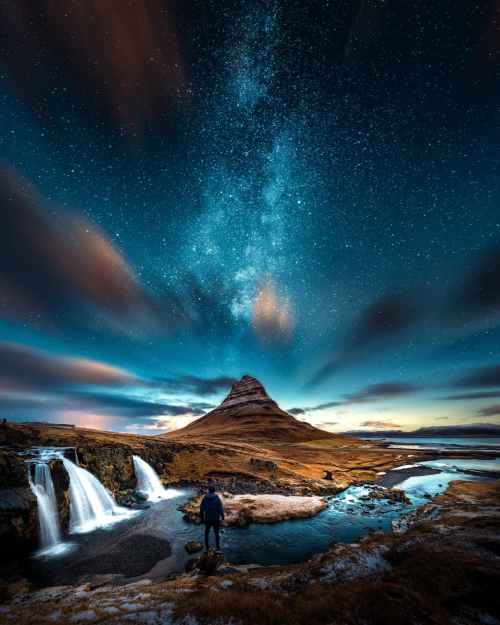
One of my teachers observed that just as we can choose to go through initiations organized and conducted by others, we can initiate intentions and directions in our own lives. An actual ritual can help to impress this on the mind and senses, reifying it, to use technical language — making it “thingly”, bringing it through “right down to the physical”.
So I find my own ways of slipping away into wilderness to pray, listen to the trees, sing the awen, and prepare.
And initiation? Many have long looked at the Biblical Book of Revelation as a guide to our inner spiritual architecture, with the seven churches it describes in detail as the varying focus and health of our seven inner energy centers, typified in various traditions as chakras or by other names, the spiritual eye among them, along with the halos on pictures of saints, the sacred heart, the gut instinct, and so on — yet another piece of the philosophia perennis, the Perennial Wisdom we cloak with our regional robes, names and forms, then “name and claim” as the Sole Truth of the cosmos (which we just so happen to be in exclusive possession of).
So you have a vision, and it’s natural to be told to get it down in words before it fades:
Write, therefore, what you have seen, what is now and what will take place later. The mystery of the seven stars that you saw in my right hand and of the seven golden candles is this: The seven stars are the messengers of the seven Gatherings, and the seven candles are the seven Gatherings. (Revelation 1:20).
Then you work to initiate your vision, with the Messengers (Instant or otherwise), and the Light sources you find at hand, LED, spiritual, human. A little paraphrase that I assert does no injustice to the original, and we’re on Druid territory. And why not vice versa? Rework a Druid ritual in Christian terms, and see what you may discover.
We can initiate or baptize our complete body, energies centers all working together, to (re)call it to its holy purpose as an Ancestor-in-the-Making, a Walker-between-the-Worlds, a Holy One. If the world around us, or some other world we’ve walked in lately, seems sacred or holy, or some other ideal summons us, we can “level ourselves up”, to use the language of gamers — shift energy and consciousness, so that we mirror and embody — incarnate — that holiness, rather than working against it.
So I choose the time of ritual with care, honoring the harmonics of the planets and stars, the tides of earth and our lives. Three days, or maybe seven, beforehand, I slip away to the wilderness and pray. As part of my ritual — perhaps the core of initiation, or perhaps other words come — I say, “I bless and consecrate you with water … with spirit, and with fire”.
And perhaps I close with some version of the blessings from recent posts, drinking what seems right to drink, making an offering from that drink to whoever it feels right to honor at the moment of the rite:
I now invoke the mystery of communion, that common unity that unites all beings throughout the worlds. All beings spring from the One; by One are they sustained, and in One do they find their rest. One the hidden glory rising through the realms of Abred; One the manifest glory rejoicing in the realms of Gwynfydd; One the unsearchable glory beyond all created being in Ceugant; and these three are resumed in One.
May the blessing of the Uncreated One, of the Creative Word and of the Spirit that is the Inspirer be with us always …
/|\ /|\ /|\
*Easy-to-Read Version, 2006, Bible League International.
**Whoever has ears, let them hear what the Spirit says to the churches (Rev. 2:29).
In the previous post I looked at the beginnings of a Druid-Christian ritual, letting the two traditions talk to each other through their images, rather than drawing on theology or metaphysics. (Druids and Pagans generally do have theologies — many of us just haven’t explored them in great depth or gotten them down in writing yet. Practice usually is more interesting, anyway.)
Name a purpose, and we can draft a Druid-Christian rite for it. Want a wedding, or a blessing, or an initiation? Both traditions have rich materials to draw on. Among other references and resources, Isaac Bonewits discusses ritual design at length in his book Neopagan Rites: A Guide to Creating Public Rituals that Work. Note Isaac’s focus on public: I use private Druid-Christian rituals that might not appeal to others, given our different histories and experiences with religions.

Shansui, the Chinese word for landscape: “mountains (and) water”
Already tired from too much thinking? Use the image above. Enter the scene. Walk that beach. Feel the warm, wet sand between your toes. Feel the wind play through your hair. Listen to the awen of the waves, calling. Salt air, seagulls.
Looking for a calendar, a whole set of practices and observances? The Pagan festival year lines up quite well with classical Christianity, for reasons that have been thoroughly (endlessly) explored and documented. Who knows how many Pagans sit in pews with Christian relatives at Yule and Easter, knowing other names, and sensing both kindred and at times estranged presences and energies?
For foundations for daily practice, one need look no further than the example of J M Greer’s The Gnostic Celtic Church, where Greer notes:
… personal religious experience is the goal that is set before each aspirant and the sole basis on which questions of a religious nature can be answered.
Greer also asserts as a piece of (Universalist) belief:
… that communion with spiritual realities is open to every being without exception, and that all beings — again, without exception — will eventually enter into harmony with the Divine.
What do I want and need? Do I even know? How can I find out?
The world’s spiritual traditions offer hundreds of variations on practices to answer just such questions. It’s good to check in from time to time, asking such things, living with the questions till they bud and leaf into answers, or into more beautiful questions.
As Mary Oliver sings, “So many questions more beautiful than answers …”
We change, and our practices need to keep up. Singing the awen, or other sacred word, is one tested and proven practice most traditions put forth for those seeking a new path, or a new branching along a path we know already. I sing till things clarify. Often for me this may take weeks, or months even … “Patience”, says one of the Wise. “Is not this our greatest practice?”
(But I just want to get to patience NOW …)
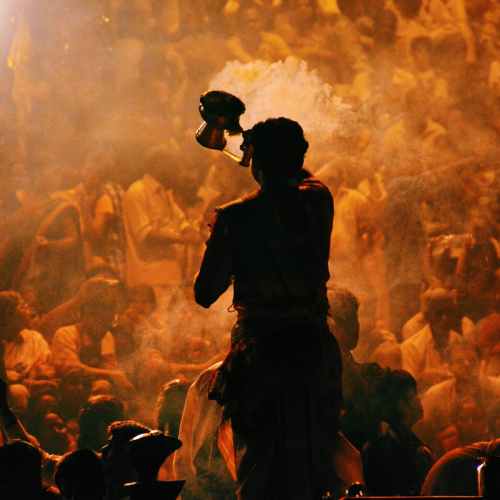
Smudge the whole cosmos, if necessary
Greer outlines practices for those interested in exploring a “Gnostic, Universalist, and Pelagian” Druidry. The ceremonies, rituals and meditations include the Hermitage of the Heart, the Sphere of Protection, the Calling of the Elements, the Sphere of Light, a Solitary Grove Ceremony (all but the first deriving from Druid AODA practice), and a Communion Ceremony that ritualizes the “Doctrine of the One”:
I now invoke the mystery of communion, that common unity that unites all beings throughout the worlds. All beings spring from the One; by One are they sustained, and in One do they find their rest. One the hidden glory rising through the realms of Abred; One the manifest glory rejoicing in the realms of Gwynfydd; One the unsearchable glory beyond all created being in Ceugant; and these three are resumed in One. (Extend your hands over the altar in blessing. Say …)
If you tried out Greer’s prayer above, who or what did you bless? If you didn’t, why not try it now? Say the words aloud …
Looking for a short form? Abred (AH-bred), Gwynfydd (GWEEN-veeth), Ceugant (KAY-gant).
/|\ /|\ /|\
I’ve looked before at these lovely Welsh names for the levels of being according to Celtic lore:
With the love of triads and threes that marks so much of Celtic art and story, it’s no surprise that the Celtic conception of our spiritual journeys should mirror this same triplicity. From the starting point of Annwn, the Celtic Otherworld, we move forth and back through three states of manifestation and consciousness, in a kind of dance that sees us revisiting old lessons until we’ve fully mastered the material, spiralling through different forms and perspectives.
Most of us hang out for a considerable time in this present world of Abred, this place of testing and proving. From here we proceed to Gwynfyd, a world of liberty and freedom beyond the pale shadows of these forces in our present world. Back and forth between Abred and Gwynfyd, with dips into Annwn here and there. And last comes Ceugant, an unbounded, infinite realm. By definition, no end point, but a new beginning. The horizon recedes.
/|\ /|\ /|\
And lest someone coming to the beginnings of Druid-Christian practice from the Christian side wonders how to begin with all of this stuff, consider this.
Nicholas Whitehead opens his curious book Patterns in Magical Christianity like this:
Christianity is a magical religion. This is not so controversial a statement as some might think. For all religious traditions are potentially magical by the simple fact that they embody or employ symbols, myths and rites that are mediatory, that intend or enable the translation of spiritual energies between levels of reality (pg. 13).
The author outlines a set of characteristics of such magical symbols, noting they
- “are inherently appropriate”. He gives the example of a plant, with roots in earth, flower in the air, and “within its stem the life bearing sap rises and falls. Because of its intrinsic structure, the plant is a symbol for the ideal spiritual life … we live upon the earth, with our roots within the land. We are nurtured by the soil in which we live. Yet, without losing our connection to it, it is our destiny to rise above the land, to flower in the crowning glory of the light … Again note that we cannot make the plant into a symbol. It is simply is a magical symbol by virtue of its inherent structure and its role in the rhythmic life of the cosmos”.
- “always participate in a greater reality”.
- “enable the translation of energies between levels of reality”.
- “are trans-rational”.
- “are polyvalent”.
- “tend to assemble in groups” (pg. 16).
Of course there’s a tremendous amount to unpack here — which is why it takes Whitehead a book to do so, along with a set of exercises he has developed in a workshop in order to put these precepts to the experimental test. Rather than debate them, which is a head trip I (mostly) don’t plan to take, they’re worth simply trying out, just as one would test the statement that water freezes at a certain temperature, rather than debating whether the claim is true. Of course adding salt, raising a wind over the surface, setting the container in a vacuum, and so on, all change the experimental parameters.
In the same way, my beliefs, intention, mindset when I experiment, past experiences, and spiritual awareness will all figure quite largely in any results I achieve. I’ve found I’m more interested in learning how certain things are valid or operational for me. That is, do they help me get somewhere worth reaching? Otherwise, an inner nudge or whisper usually alerts me: Move along — these aren’t the droids you’re looking for. Later I can play the thought and reason game for what it’s worth. Sometimes a lot, sometimes quite little.
/|\ /|\ /|\
IMAGES: Pexels.com
Greer, John Michael. The Gnostic Celtic Church: A Manual and Book of Liturgy. Everett, WA: Starseed Publications (Kindle)/Lorian Press (paper), 2013.
Whitehead, Nicholas. Patterns in Magical Christianity. Sunchalice Books, 1996. (More recent editions exist, though I haven’t yet been able to find one.)
Ritual, remarks British Druid and author Emma Restall Orr,
is the process of taking time out of the rush of life in order to remember what is sacred, that when we return to the road we do so with a soul once again open to inspiration and creativity. How we do it – and how long it takes – to be effective depends on how scattered by distraction and tangled in need we are. It can be as simple as pausing, breathing deeply, acknowledging the gift of life, the land beneath, the sky above. It can take weeks of preparation, days of fasting, hours of concentration, to fall into the moment of realization about how we can live awake and with honour, not just believing nature is sacred, but unconditionally treating her as such.

ritual bathing
Judging by the continuing readership for a group of posts here on Druidry and Christianity, the vital possibilities of such a concord live still for you as much as they do for me. They branch and grow, and rich fruit hangs from their boughs.
Our instincts aren’t wrong. The two traditions are twinned in ways we may never untangle, but we can explore what they can contribute to each other right now. One way to do that — certainly not the only way* — is through ritual.
Already we hold hints and fragments in our hands. In the Christian Bible, Luke relates the experiences of a rich man, the chief tax collector Zacchaeus. “And he was seeking to see who Jesus was, but on account of the crowd he could not, because he was small in stature. So he ran on ahead and climbed up into a sycamore tree to see him, for he was about to pass that way” (Lk. 19-3-4). Sometimes we need to shift perspective, to climb out of our lives to see them more clearly.
Later in the same chapter, (Lk. 19:37-40), the followers of Jesus are overcome with joy and are peacefully celebrating. But their exuberance apparently touches a nerve — it seems excessive and undignified to the Pharisees, among the Powers-That-Be of the day:
And some of the Pharisees in the crowd said to him [Jesus], “Teacher, rebuke your disciples.” He answered, “I tell you, if these were silent, the very stones would cry out.”
Have we not all felt such joy, that the stuffy, fearful, joyless ones around us want to rebuke us for our happiness?!
/|\ /|\ /|\

[The rite begins. Parts not yet assigned.]
Let the Great Gates open. For we hear voices crying in the wilderness … (1)
Climb your own sycamore! What will you ever see until you do?!
The stones are crying out at our silence (2).
If our houses of prayer and celebration have become dens for thieves, then it is meet and fitting that we repair to the green places of old (3).
For the Wise have counselled us, “Stand at the crossroads and look; ask for the ancient paths, ask where the good way is, and walk in it, and you will find rest for your souls” (4).
Our teachers are at hand: “Ask the beasts, and they will teach you; the birds of the heavens, and they will tell you, or the bushes of the earth, and they will teach you; and the fish of the sea will declare to you” (5).
Let our prayers rise like incense (6), born of earth, moistened in its making, lit by fire, wafting through air.
“They have dressed the wounds of our people with scant care, saying, ‘Peace, peace,’ when there is no peace at all” (7).
We will answer the call to peace, and serve. Let us give peace now to the quarters, and renew the Great Work again …
“May the blessing of the Uncreated One, of the Created Word and of the Spirit that is the Inspirer be always with us. May the world be filled with harmony and Light” (8).
/|\ /|\ /|\
Some readers, writes Philip Carr-Gomm in his foreword to Nuinn’s Book of Druidry,
might be pleased to learn of such a dialogue between Druidry and Christianity, particularly when it results in specific action being taken to initiate a new impulse within the Christian movement. Others might be disappointed, hoping Druidry was exclusively ‘pagan’. But Druidry is a way of working with the natural world, and is not a dogma or religion … Druidry honours, above all, the freedom of the individual to follow his own path through life, offering only guides and suggestions, schemes of understanding, methods of celebration and mythical ideas — which can be used or not as the practitioner sees fit (pg. 14).
Rev. Alistair Bate, author of the OBOD website article “Reflections on Druidic Christology“, comments from a sensitivity to the contact points of the two traditions:
A more orthodox rendering of Chief Nuinn’s triadic formula might be “May the blessing of the Uncreated One, of the Creative Word and of the Spirit that is the Inspirer be always with us”. This, I believe, would not only be more truly in tune with the bardic experience, but would also resonate with the Om/Creation idea found in the Hindu tradition. As we envision Awen, the primordial sound, echoing out of the void, we connect with our own creative inspiration as part of that first creative Word, which is in Christian terms, at once Christ and his Spirit.
And with greater enthusiasm, perhaps, than comparative or historical theological accuracy, Bate concludes his article, summoning to his aid the words of probably the single most influential Christian thinker and writer:
In the 4th century St Augustine declared, “That which is called the Christian Religion existed among the Ancients, and never did not exist, from the beginning of the Human Race until Christ came in the flesh, at which time true religion, which already existed began to be called Christianity”. That the religion of our most ancient ancestors is in essence very similar to that of our more recent ancestors is the conviction that keeps some of us simultaneously both Druid and Christian.
And as many others have long noted, the Galilean master is at his most Druidic when he speaks with images of the natural cycle of things:
Truly, I tell you, unless a kernel of wheat falls to the ground and dies, it remains only a seed; but if it dies, it bears much fruit (John 12:24).
An extensive Druid-Christian liturgy could be written with just the nature images that pervade Christian and Jewish scripture.
/|\ /|\ /|\
IMAGES: Pexels.com
*Other practices one could initiate, as Emma Orr notes above, might be “as simple as pausing, breathing deeply, acknowledging the gift of life, the land beneath, the sky above”. Or correspondingly complex, and “take weeks of preparation, days of fasting, hours of concentration, to fall into the moment of realization about how we can live awake and with honour …” We decide what it is we need, rather than any authority over us. And often the best decisions arise from experimentation, and from an openness to trying something new.
1. Matt 3:3, Mark 1:3, Luke 3:4, John 1:23.
2. Luke 19:40.
3. Mark 11:17.
4. Jeremiah 6:16.
5. Job 12:8.
6. Psalm 141:2.
7. Jeremiah 8:11.
8. Closing of OBOD ritual.
John Beckett (6 January 2019) writes:
A ritual is a series of interrelated actions designed to accomplish a spiritual goal. It may be a celebration, but it’s more than a party. It may honor certain spiritual persons, but it’s more than singing praises. It may work magic, but it’s more than a spell.
Couple this succinct overview of ritual with OBOD founder Ross Nichols’ “Ritual is poetry in the world of acts” and you’ve got a fair bit to go on, if you want to do some rummaging about in ritual spaces and energies.

Ross Nichols leading a procession of the Cornish Gorseth in the 1970s. Wikipedia Creative commons.
For starters, form matters. What makes a lively seasonal festival ritual more than a party? After all, some parties also have a form. If it’s a birthday, maybe there’s a welcome period for everyone to assemble, settle in and get something to drink. Then food — a buffet or even a formal sit-down meal — followed by presents, and then games, or dancing, or some other group activity. Or maybe the whole evening is food, mingling and music, with presents dropped off on a designated table. There may be formal start and ending times, or apart from one announced activity — often, the food — there’s no set beginning or close. “Show up when you can”. Still, people often know what “birthday party” typically means. There’s some kind of loose format in most people’s expectations, unless the invitation says otherwise.
If a ritual has assigned roles, it can begin when all the participants have assembled. Beckett talks about how ritual ideally doesn’t have an “audience”. While it’s a performance, no one should be so detached as to be merely a spectator. At our most recent Vermont OBOD seed group celebration of Winter Solstice, we held a ritual “post-mortem” discussion as some dishes for our potluck dinner were warming in the oven. With just enough members attending that foggy evening to carry out the ritual-as-written, it’s true each of us “had a part”. But more importantly, as one member observed afterward, it’s what we do with and for other participants during the ritual that makes the difference. “I support them”, she said. While one person is assigned to speak the words that “call North”, for instance, everyone else can do so, too. Add your intention. Feel the direction. Visualize, sense it on your skin. Imagine the participant serving as North to be garbed appropriately for the direction, crowned and armed with symbols of earth. In fact, if we expect North or any of the other directions to manifest and be a palpable presence, just such group energy and support are essential. Otherwise, what are we doing calling the directions?
I’ve queried the opening words of the standard OBOD ritual format before, in previous posts. “By the power of star and stone, by the power of the land within and without, by all that is fair and free, welcome to this Rite of …” Lovely, but what IS “the power of star and stone”? And if I don’t know, then how do I know I want to call on it, invoke it, welcome the assembled group with and by it? Is it the same as “the power of the land within and without”? Do either of these have anything to add to our rite?
Or let’s say I chose to forego seeking and supplying a merely intellectual equation: “power of land = X”. I let the words move me wherever and however they’re meant to, trusting the ritual and relying on our group’s reverent and “heart-ful” performing of it to answer such questions in due time, if at all. Let the intention and the energy of the assembled members carry me over any rough spots, and all will be well. OK, but then how do I support the herald who proclaims these opening words, if I don’t know what I’m supposed to be doing? If we all imagine different things on hearing the words, we generate a diffuse generic energy (or nothing much at all) that may not come anywhere near to what the “power of star and stone” could do, if we knew what we were about.
Mean clearly, and you can carry people with you.
O Romeo, Romeo, wherefore art thou Romeo?
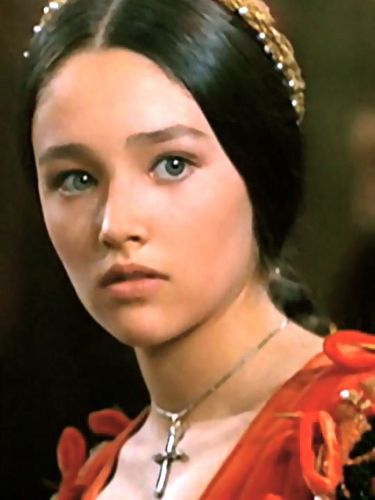
Olivia Hussey as Juliet in Franco Zeffirelli’s 1968 film version of the play.
Listen to an informed performance of Romeo and Juliet and when Juliet says these words, it’s the third “Romeo” that she stresses: “O, why do you have to be Romeo? Any other name would be fine. But no: you turn out to belong to my family’s enemies!” If you don’t know what you’re saying, you can’t mean what you need to mean. The words won’t mean what they could. Understand what Juliet says, and her next lines make perfect sense:
Deny thy father and refuse thy name
Or if thou wilt not, be but sworn my love,
And I’ll no longer be a Capulet.
‘Tis but thy name that is my enemy …

Dionysus in ’69. Photo by Brett Brookshire.
Because drama is a component of ritual, films and plays have something to teach us about owning the words and actions of ritual in deep and creative ways. Ancient Greek drama was sacred to Dionysus. In Athens, no weapons were allowed in the theater precinct during the Dionysia Festival of tragedies and comedies. The ritual of theater was an act of worship, a sacred thing dedicated to the god.
Serious about addressing ritual glitches, the crew of MAGUS ’17 asked participants to memorize their parts. Come ready to speak with intention, since you won’t need a piece of paper in front of you. Improvise, once you know the energy of the traditional words. Call North, and let us hear and feel North. I was North, a small but important part. I did call North, with original words and images I’d been composing orally — I felt their power myself — then flubbed a short line North says a page or two later that I couldn’t remember and couldn’t for the life of me find, for an ungodly amount of time, as I pawed through the printed ritual in my hand. Ritual flow broken, I finally found my place and shamefacedly read off my line.
Fortunately, Druids are forgiving folks. It both did and didn’t matter. Ritual isn’t made or marred by a single person. Smiles and laughter heal many a weak line reading, dropped candle, overenthusiastic blessing with water. It took time before I could laugh, because I was so annoyed at myself — all the more reason I needed to.
Contrast this with my Ovate self-initiation: my wife away for the weekend, all lights in the house extinguished except for a single small candle. I sit on the floor in a dim and flickering circle of light, words of the open and closing ritual at hand, but foremost in my awareness a dedication I speak as the words come to me, along with a palpable sense of witnesses around me as I proceed. The ritual pacing my pace, the words my words, the experience my own and that of those who, I sense, share it with me. Powerful, personal, memorable, unscripted at its peak, and especially potent for that reason.
The two poles of ritual? Both valid, necessary — and each distinct.
/|\ /|\ /|\
Images: Ross Nichols; Juliet; Dionysus in 69.
At the close of my seventh year with this blog, I’m devoting a post to taking stock.
First, thank-yous to everyone — nearly 10,000 of you this past year — who keep coming back to read, to ruminate, and to comment. As I note on my About page, quoting Philip Carr-Gomm:
Just as the spiritual path can be characterised as the ongoing attempt to both remember yourself and forget yourself, so blogging can be seen as a challenge to both be more personal, more open, more sharing of the riches of a life and at the same time to take yourself less seriously, to let go of the concern about what other people might think about you, and to reveal rather than conceal your curiosity and amazement at the often crazy world you find yourself in.
As a spiritual practice, writing here keeps me turning over my experiences and perspectives — a good thing, I’ve found, for both consciousness and compost. This coming February 2019 I’ll join a panel of speakers with the rich topic of “Spiritual Lessons from Everyday Life”, and my time with this blog will definitely contribute. Human experiences have no “size” that I can determine, despite any labels we apply to them. Seemingly “small” ones deliver impacts that may not fully mature for years, while the splashier ones often fade quickly as dreams. You keep turning them over, turning them over, and good stuff emerges, which you know in retrospect mostly because it nourishes what will grow in the future. If I neglect this, soon all I have is a midden that smells, attracts pests, and I learn I’ve forfeited an opportunity for work that is real. Fortunately I can pick up the pitchfork and shovel at any moment and begin.
What other people bring to say, and how they respond to what I share here, seems to work much the same way. You learn it’s often not about you at all, whatever you thought. Each of us makes individual journeys so idiosyncratic and often difficult to get into words that what amazes me is we’re able to share anything at all. Or as I have occasion to exclaim to my wife, I’ve slowly learned that two things are simultaneously true, in the best traditions of paradox: that I’m nothing like other people, and that I’m exactly like other people — I’m an alien, or I’m your twin. This blog usually lands somewhere along that continuum.
Three of the most popular posts this past year originate not from this year but from my 2017 “Druid and Christian Themes” series. This intersection of traditions still lights up for me, as it apparently does for a sizable proportion of readers. Otherwise, the only excuse I can offer for my choice of topics is also Thoreau’s: “I should not talk so much about myself if there were anybody else whom I knew as well.” But beyond Transcendentalist Yankee Smart-assery, he makes a subtler point: go deep enough inside yourself and you will find things to say that resonate for others at least some of the time. The odds of this happening are about the same as for baseball, so an average of .300 is respectable indeed.
Looking a little further at the Druid-Christian intersection I recall how Philip Carr-Gomm notes in his book Druid Mysteries:
Although Christianity ostensibly superseded Druidry, in reality it contributed to its survival, and ultimately to its revival after more than a millennium of obscurity. It did this in at least four ways: it continued to make use of certain old sacred sites, such as holy wells; it adopted the festivals and the associated folklore of the pagan calendar; it recorded the tales of the Bards, which encoded the oral teachings of the Druids; and it allowed some of the old gods to live in the memory of the people by co-opting them into the Church as saints (p. 31).
Since I find I’m citing Carr-Gomm a lot in this post, I’ll end with one more observation by him that I find still most topical today, the 30th of December 2018:
One of the most important tasks that face us today is one of reconciliation, whether that be between differing political or religious positions … the Christian community, far from taking fright at a perceived regression to a pagan past, can ally itself with [Druidry] which is complementary, and not antagonistic to Christian ideals and ethics …
St. Columba said “Christ is my Druid” and I believe that if we take Druidry to represent that ancient wisdom which lies deep within us, and that can connect us once again to the Earth and her wonders, we can understand how we can be Christian Druids, Buddhist Druids or Druids of whatever hue or depth is needed for us at our present stage of development.
May we each find and recognize “whatever hue or depth is needed for us at our present stage of development”. Blessings of the coming New Year to you all.
/|\ /|\ /|\
[Part One | Part Two]
In a recent comment, Steve writes:
A broader definition of magic sounds interesting, especially when compared with some of the ideas about it I have encountered over the years.
Do you have a working definition you could share or is this something you have developed in your blog?
I do have a working definition of magic, and I’ve also written about it in various forms fairly frequently, though not always under that label. But it’s good to regularly take out opinions and understandings, dust them off, rattle them, note what shakes free, scrape off the rust, and buff and polish the rest. So with the spur that Steve’s comment provides, that’s what I’ll do in this post.
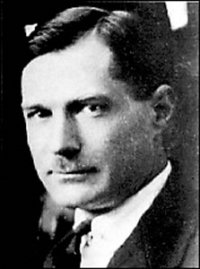
Yevgeny Zamyatin / Wikipedia / public domain
Our definitions come, mostly, after experiences. Before that, we don’t have much to attach them to, and if anyone who’s reading this is anything like me, your definitions at that point may not match things that you later DO experience. So then we get mired in the mismatch, rather than referring back to the original experience. Or — even better than looking backward — experiencing more, other, wilder. So I open up once again a page where I can re-read irascible old revolutionary Yevgeny Zamyatin (1884-1937), whose essay “On Literature, Revolution, Entropy, and Other Matters” reminds me: “Dealing with answered questions is the privilege of brains constructed like a cow’s stomach, which, as we know, is built to digest cud”.
“Privilege”? Tired of a too-steady diet of cud, I aim to forage more widely.
So I’ll begin by asserting we all practice magic, and work outward from there, using this as a core assumption and seeing how it holds up. We do much of our magic half-consciously, so that we often don’t perceive the patterns, causes and effects of what we set in motion as clearly as we might. After all, like most of us, I insist on who I am: in my case, straight, white, male, employed, married, healthy, intelligent, rational. But when even one of these breaks down, as every one of them has for at least some of us over a lifetime, my world trembles violently, even if it doesn’t collapse outright, and I scurry and latch on to explanations for what’s going on.
Isn’t such an interval about the least likely time for any of us to notice the patterns, causes and effects of what we’ve set in motion? And even if and when we do, we tend to account for them only with naturalistic explanations (Pagans may add supernatural but not necessarily more accurate ones), including blaming other people, fatigue, stress, illness, the government, conspiracies, the Man, our reptilian overlords, a loveless marriage, plain bad luck, and so on, forgetting how much even of our conscious experience at the very moment of our explaining has been programmed by education, habit, expectation, culture, practice, a “reasonable explanation”, and a simple, overriding human desire not … to … be … weird.

But … magic?!
At the heart of this often-inaccurate accounting is a precept that disturbs and offends Westerners in particular, taught as we are that we are free and independent beings, with wills and choices subject to our conscious attention. We are not so free after all, but if we can’t even examine this assertion in the first place, what are we to do? If we all practice magic, as I claim, we all need to, because as musician and mage R. J. Stewart observes:
With each phase of culture in history, the locks upon our consciousness have changed their form or expression, but in essence remain the same. Certain locks are contrived from willed patterns of suppression, control, propaganda, sexual stereotyping, religious dogma; these combine with and reinforce the old familiar locks restraining individual awareness; laziness, greed, self-interest, and, most pernicious of all, willful ignorance. This last negative quality is the most difficult of all to transform into a positive; if we truly will ourselves to be ignorant, and most of us do in ways ranging from the most trivial to the most appallingly irresponsible and culpable, then the transformation comes only through bitter experience. It may seem to be hardship imposed from without, almost at random, but magical tradition suggests that it flows from our own deepest levels of energy, which, denied valid expression by the locks upon our consciousness, find an outlet through exterior cause and effect (Stewart, Living Magical Arts, pg. 20-21).
“[D]enied valid expression by the locks upon our consciousness”: we might think such a “locked-up” person simply needs re-education, or better training, maybe positive reinforcement, a decent opportunity. (I note here that it’s almost always some other person who’s the problem, or needs the help — never me. After all, I’m awake and in charge of my life.) This is also where we get much of the American program of self-improvement, “pulling ourselves up by our own bootstraps”, as it used to be called. Those who can afford it try therapy, or weekend retreats and workshops. Those who can’t may rely on pharmaceuticals or liquor or increasingly available weed. As the evidence mounts, as the growing dysfunction, suffering, addiction, unhappiness and all-around misery attest, something’s not working.
So why magic, of all things? Surely any number of other options would be preferable to something so half-baked, superstitious, irrational, etc., etc. — the list of slanders, some of them justified by pernicious snake-oil salesmen, is long.
J. M. Greer, ecologist, blogger, conservationist and mage, puts it this way:
[t]he tools of magic are useful because most of the factors that shape human awareness are not immediately accessible to the conscious mind; they operate at levels below the one where our ordinary thinking, feeling, and willing take place. The mystery schools have long taught that consciousness has a surface and a depth. The surface is accessible to each of us, but the depth is not. To cause lasting changes in consciousness that can have magical effects on one’s own life and that of others, the depth must be reached, and to reach down past the surface, ordinary thinking and willing are not enough (J. M. Greer, Mystery Teachings from the Living Earth, Weiser Books, 2012, pg. 88).
To put it another way, in what is not a particularly poetic magical Druid triad: Magic stems from an experiential fact, an experimental goal, and an endlessly adaptable technique.
The fact is that each day we all experience many differing states of consciousness, moving from deep sleep to REM sleep to dream to waking, to daydream, to focused awareness and back again. We make these transitions naturally and usually effortlessly. They serve different purposes, and what we cannot do in one state, we can often do easily in another. The flying dream is not the focus on making a hole in one, nor is it the light trance of daydream, nor the careful math calculation. What we do mechanically and often without awareness, we can learn to do consciously.
The goal of magic is transformation – to enter focused states of awareness at will and through them to achieve insight and change. Often, for me anyway, this is nothing more mysterious than moving out of a negative, depressed or angry headspace at will into a more free, imaginative one, where I can problem-solve much more effectively, and also be much more pleasant to be around. Or so my wife tells me.
“The major premise of magic,” says R. J. Stewart, “is that there are many worlds, and that the transformations which occur within the magician enable him or her to gain access to these worlds” (R. J. Stewart, Living Magical Arts, pg. 7).
The technique — a cluster, really, of practices and techniques — is the training and work of the imagination. This work typically involves the use of one or more of the following: ritual, meditation, chant, visualization, concentration, props, images and group dynamics to catalyze transformations in awareness. “… [O]ur imagination is our powerhouse …” says Stewart. “… certain images tap into the deeper levels of imaginative force within us; when these are combined with archetypal patterns they may have a permanent transformative effect”.
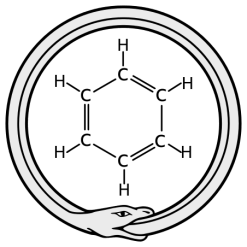 Even mundanely, golfers visualize a hole in one, carpenters see the finished design long before it emerges from the blueprint, chemists rely as much on inspiration as any artist for discoveries like that of August Kekule, who dreamt of the structure of the benzene ring via the archetypical image of a snake swallowing its tail.
Furnish the imagination with the food it needs, and it can be a powerful tool and guide. Abandon it to others who do not know us, nor have our best interests at heart, and we cast away our birthright.
PART TWO — Applications — coming soon.
/|\ /|\ /|\
Finding out about how we ourselves “do Druidry” — or other path we’re on — is a key step that all of us, it seems, keep taking. From that personal connection and insight, renewed over time and through our own experiences, comes a growing confidence in our own strengths and uniqueness that others can’t easily shake. It’s no longer just faith, but communion. It’s bone-knowledge, gut-wisdom, skin-sense. We know things, in that lovely old expression, by heart.
The more our practice, whatever it is, rests as much in doing as in believing, the more we draw strength from it in ways that can feel surprisingly like physical exercise. Our bodies learn to know our practice as well as our brains. Oak or rowan or beech become friends — our community has grown through knowing individuals, no longer just abstractions in a listing of trees in an ogham-book. The welcome of oak differs from the subtler touch that rowan extends. And these two differ from maple or hemlock. And so on through all the other furry, winged and finned kindred we encounter in the land where we find ourselves.
The work of any Order worth my energy and dedication will contain material that speaks clearly to me and seems just right. There will also be exercises and insights that I can adapt, and still others that are right to set aside for a time until they align with what I’m doing and needing to do. One of the signal advantages of an Order is its span: many hands and hearts have sifted material I might never encounter on my own, and wiser heads than mine have added insights, caveats and encouragements that I might otherwise miss. The work of an Order is more compact, in valuable ways, than the work of a Solitary. It’s denser, richer in certain ways, brewed and spiced, aged and tempered, refined and mellowed, sharpened and lit.
It also vibrates on a harmonic that reaches others attuned to it. Doing the rituals, passing through the initiations, studying and reflecting on and trying out the coursework, meeting others doing the same things, all bring me into a greater circle I discover I need, no matter how solitary I am — and need to be — most of the time. The choice, as it so often does, arises from the richness of both-and, not either-or. I find that I come not to a fork in the path, but the path itself opening out, for a time, into a meadow. Beyond is vista: mountains, maybe, or valleys shining with silver rivers, towns bright with banners and laughter. Quests beckon, mysteries abound. It’s no surprise that a medieval landscape features in so many modern dreams and deeds, with both real danger and jewelled possibility a heartbeat or horse-ride away. Just over the next hill, or back at the castle, down a corridor we never knew was there.
In the West we pursue ever more isolated and internal lives, busy too often with busy-ness itself, all the while crying out for the gifts of community we simultaneously keep turning away from: connection, fellowship, camaraderie, friendship, shared interests and inspirations, shared suffering and joy. Well-founded community sees that spark of individuality restored to a healthy place, one that does not render me less able to connect, but more; one that honors my need to withdraw at times, even as I also need to open to others; one that sweeps me out of indifference toward engagement with the struggles of others anywhere, who turn out to be surprisingly like me after all. We be of one blood, ye and I.

first fire, a few days ago
Along with Groucho Marx, many of us may have grumbled some version of I don’t want to belong to any club that will accept people like me as members. And knowing ourselves as we do, maybe we’re right to say that. On our off days, we’re off on ourselves as much as anyone else. Hamlet’s our doppelganger, midwife to angst and depression and self-accusation: I am very proud, revengeful, ambitious, with more offences at my beck than I have thoughts to put them in, imagination to give them shape, or time to act them in. What should such fellows as I do, crawling between earth and heaven?
Somehow “joining an Order” just doesn’t seem like any kind of sane response to that question, but more like the absolute last thing I would choose. Isn’t there a twilit bar or pub nearby where I can hide and drown my sorrows?
And certainly Orders aren’t any kind of cure-all or panacea. As human institutions, they’re potentially beset with all the human foibles we know so well in ourselves. Personalities clash, dreams backfire and scorch, visions implode, egos lunge and stab. We peer around at the wreckage, bandage the worst of our wounds, and vow: never again.
But Orders can also launch us toward the heights that we know or dream of, or — if we’re particularly cynical right now — doubt are possible at all: they focus and help to nourish the deepest hungers in us, beyond food or sex. In the connections they aid us in making, we touch on something that lifts us out of ourselves, we’re part of that never-ending story our best dreamers keep singing about to us, and painting, and weaving, and nudging us to explore.
/|\ /|\ /|\
I’ve mentioned before on this blog that I practice two distinct spiritual paths. One of the teachings on the other path concerns waking dreams. “A waking dream is something that happens in the outer, everyday life that has spiritual significance”, writes one of my guides on that path. And the crucial point, for me, is that I can perceive that significance. Or miss it. Or call it coincidence, or something else.
In her post “The Reality of Omens“, Druid Life blogger and author Nimue Brown writes,
When looking for omens in the world around us, it is necessary to consider how reality works in the first place. One of the things I have rejected outright is that other autonomous beings could show up in my life as messages from spirit – because the idea that a hare, a sparrowhawk, or some other attention grabbing thing could have its day messed about purely to try and give me a sign, is profoundly uncomfortable to me. I have something of an animist outlook, and I do not think the universe is *that* into me.
Brown’s caveat rings true — we can safely pare the human ego down, without fear it will crumble and disappear. Unlike the average toddler, most adults handle reasonably well the discovery that they’re not actually the center of universe.

But as a fellow semi-animist, I’d not separate “spirit” from what you and I and other things are doing every day. “Spirit” isn’t a thing that stands apart from what it inhabits — it’s not a bearded Jehovah lounging in the heavens, lording it over the rest of the cosmos, twitching the puppet-strings to get his way with us. Spirit permeates things — it’s what peeks out when you look in the eyes of a dog or bird or bug, or into the heart of a flower. It’s what gives waves their curl, or cumulus clouds their cotton-like billow, or your jogging neighbor the will to keep at her four-mile routine, in spite of December sleet. Spirit makes things thing-ly — how else can I detect its presence? Ever seen it hanging out all by itself? Pay attention and I can notice now more, now less. But never apart from the things it’s been doing all along, like you and me and the grass growing tall in the back lawn where I haven’t mowed it at all this year.
The skies cloud over, the temperature drops and a wind kicks up. Is it an “omen”? No — but these things do carry meaning to anyone paying attention. It’s probably going to rain soon. That particular kind of omen we call a “no-brainer” (though humans still manage daily to ignore even obvious omens). As part of the universe where a local storm is brewing, I can pick up on other things spirit is doing, or I can ignore them. The universe “isn’t that into me”, but it is in fact *in* me, and in you too, and we’re both in it.
So I prefer to see “omens” and “signs” as friends visiting. Spirit is simply flowing. One of its flows is you, another is me, a third is the car pulling into the driveway with S. at the wheel, “just stopping by” on her way home after shopping. If I gain insight or wisdom or a nudge to do something, or a burst of gratitude from that visit, then I’m paying attention in some way, and I’m being me, with my own unique responses to what spirit’s always doing all around and in me.
Rather than worrying overmuch about whether it was a sign or an omen or simply another wave in the ocean of spirit manifesting everywhere and everything, why not measure its effects? Is my life deeper, richer? Are the lives of others made richer and deeper? Is that enough, without checking the box labeled “omen” or “not omen”?
But what of the autonomy Brown names as part of her animist understanding of the uni-verse, the “one-turning”?
The idea that “other autonomous beings could show up in my life as messages from spirit – because the idea that a hare, a sparrowhawk, or some other attention grabbing thing could have its day messed about purely to try and give me a sign, is profoundly uncomfortable to me”, she notes.
But she and the many other beings in her life can be and are many things at once. And so are you and I. Like spirit in us and all around, I am many things at once. I am not “purely” anything, but delightfully mongrel. I’m an incarnate human, and also a Vermonter, a husband, a blogger, an aging white male, a person alive in the 21st century, an American, the son of two parents who both lost fathers while still in their single-digit years. I am a manifestation of spirit, a homeowner, a Druid, a teacher, a conlanger, a portal of Mystery, and so on. (Maybe the problem isn’t labels by themselves, but that we never use nearly enough of them. Scatter them like seed. Each is — not a limit — a possibility.) Each of these features opens access points for spirit to reach other beings, while leaving me with the same freedom as other “autonomous beings”. Spirit does “overlap” and “interconnection” really well.
My individuality and freedom are what spirit uses to connect with all other free and individual things. Spirit as the whole, the universe, seems to “love” individuals — that’s why there are many of us, rather than just two or three. Spirit as “one thing” interconnects and links all things, all these other “one things”.
So when a crow flies overhead while I’m checking the squashes in the garden, the crow is a crow and a friend visiting and a reminder, if I’m listening, of animal intelligence and and and. Its appearance and my awareness meet, for whatever comes from that meeting. Omen, sign, friend visiting, reminder of crow wisdom to fly over things before I decide to land on them, spirit guide — because spirit is always sparking the beings it pervades — to eat, fight, flee, love, mate, birth young, flower, fruit, grow old, die, return, become, become.
And the crow also discovers and learns something. Here’s a human that does not aim a gun at me as I fly over. Here is a water supply, a pond I can drink from. Here are trees to roost in, good cawing branches to talk to the rest of the flock, food sources to peck at in the scraps and compostables that get put out almost daily. And a hundred other crow things I don’t know about, without shapeshifting to Crow, or crow to me.
Brown goes on to make a key observation about our attention:
I can however read something into my behaviour at this point. I was in the right place at the right time, and I think that tells me something about my relationship with the flow. I take exciting nature encounters as good omens not because I think nature is bringing me a special message, but because it means I was in just the right place, at exactly the right time, looking the right way and paying attention. That in turn means I am in tune, and would seem to bode well for anything else I’m doing.
I simply take “encounter” as “message”. Humans are meaning-makers — it’s what we do. Any omen is an amen, an awen, a chance, a doorway. Will I walk through it? Or will I see how spirit walks through it — to me and to everyone and everything else? And as these things happen, can I catch the Song that is always singing, just at the borders of hearing?
/|\ /|\ /|\
Article in today’s New York Times: “What does it mean to be human?” touches on some of these matters.


 A Druid Way
