One reason the Old Ways still call to us is that they’re replete with earth-wisdom and heart-truth. For dogma, read experience. For doctrine, read rule-of-thumb. Our favorite childhood stories, our fairy-stories, legends, myths and tall-tales all seem to take place in such a cosmos, where the smallest actions spin out their consequences, where magic flourishes, and where hopes and dreams come true. Samhain wisdom.
It’s a revealing expression, come true. This world of change and manifestation is constantly arriving, shaped as much by our misunderstandings and mistakes as by our grasp on truth, all tangled up in the physics of a cosmos that’s often far weirder than we imagine. Samhain cosmos.
Often we’ve jettisoned belief in a single truth-with-a-capital-T, but in the process we’ve also often forgotten that cause and effect still play out in our lives, and not all of our personal truths are equally viable. (That’s how and why we keep learning and growing, after all. We test our understandings against our lives. I don’t know about you, but I’d not want to jump back to 14-year-old me and my beliefs, doubts and fears of that time.) Samhain truths.
In place of our traditional and healthily provisional/experimental perception of what spirit is and how it works, we’ve turned to all manner of beliefs and disbeliefs, forgetting that spring keeps coming every year, that the power that underlies and sustains things still pulses through them regardless of our human awareness or obliviousness. Rather than bothering so much with belief, it might help us to find out where and when and how things are true, under what circumstances they can be true, and so on. Less church, more laboratory. Samhain practice.
Even words like wisdom and truth and evil have fallen out of fashion, because we think we don’t believe in them any more, until they bite us where it hurts. (Well, wisdom still manages to stick around in a few places — especially if it comes from somewhere exotic, and can be bottled and marketed as hidden or never-before-revealed or traditional.) Sometimes we even notice that most of the “new and improved spirituality” on offer is our traditional wisdom with a hip contemporary makeover. Samhain fashion.
But catch the spirit of Samhain and I get plugged back into a cosmos alive under my skin and in my blood and flaming in the autumn leaves. Get out in the cooling air and I smell the old earth-year. I watch the moon swell to fullness this time coinciding with the last day of October. Samhain reminds us we are alive in time and space, here and now, but also that the world turns, whether we will or no. The chorus of the old goddess chant deserves meditation: “Hoof and horn, hoof and horn/Those who die shall be reborn./Corn and grain, corn and grain/Those who fall shall rise again”. Where and when and how is this true, under what circumstances can it be true …? Samhain questions.
And what of Samhain music? It’s in our blood, a human heritage. Wisdom makes a song we all know by heart. We hear echoes all the time — a fragment of a melody that arrests us in the middle of whatever we’re doing when we hear it. A phrase in a speech or book or conversation that makes us sit up straighter, or slip into reverie. All the things we tend to discount in our humanness, things we rarely talk about. Samhain stuff.
Earth of Samhain, bone and boulder. Air of Samhain, breath and breeze. Fire of Samhain, ______ . Water of Samhain, ______ . What draws us to fill in those blanks we might call the gravity of Samhain, the tug of the time on us. Things have a particular shape, fit into a certain space and no other. Aptness. Identity. Fire of Samhain, heart and hearth. Water of Samhain, blood and brook.
Turn those phrases toward however they work best for you. Then do it. (For counsel on what your particular it is, consult the season of Samhain, your left ventricle, your right hemisphere, you animal guides, and the blessed time you spend outdoors under trees, listening.)
/|\ /|\ /|\
The Beltane Fire Society will hold a digital Samhuinn this year, with live events posted to Facebook and Youtube.
What offerings do I bring to the shrine of sleep these days?
In some ways we resist the dark on a national level. In most of North America and much of Europe, the season of time changes is upon us, where we turn back our clocks one hour to bring more daylight to our mornings. But much of the rest of the world doesn’t do this, and some regions even within the time-changing nations don’t change either.
Mystic River Grove ritual
Samhain, like Beltane, is a time when “the veil thins” — when the distinctions and barriers between levels of reality are less sharply defined, and it’s often easier to move back and forth between realities. Many of us have had dream experiences that open us to such possibilities. (Whether and how we choose to respond to these opened doors and gates and windows is another matter.)
Twice a year, potential experiences of a larger cosmos unroll into our awareness, unasked. (The rest of the time we may need to make more effort.) The mingled fear and curiosity we often hold for such enlargements tell us much about the social controls at work in our lives. While some explore lucid dreaming, yoga nidra and similar practices, for many of us the twice-yearly opportunities of vivid and insightful dreams, if we invite them, offer plenty to work with. Anyone who has kept a dream journal, and worked with recurring dreams, dream sequences, symbols, guides and ancestors, knows the value of dreamwork. As with so many practices, what you reap mirrors what you sow.
Animal companions can often walk with us to help us with comfort and reassurance, if we’re exploring other worlds. A familiar object — a photograph, seashell, feather or stone, handled before sleep over several nights, can travel with us into the dream, appearing within our dreams to remind us of our intent and our desire, and help shape the dream experience. Some people find that gazing at their hands, as a reminder of our capacity to effect change, to accomplish tasks, to shape our lives, can be another dream tool.
Personalized affirmations, repeated verbally, written in a journal, kept in the attention during the daylight hours, can also help incubate a dream. Here are a couple of examples:
At the shrine of sleep I dedicate my intent to ___, this object/animal companion to ___, my hands to ___ . Change whatever needs changing for your personal circumstances.
As this candle comes alight, so I seek a dream tonight, a holy gift of deep insight. Meditate with the candle, then extinguish it, knowing you carry the light of your intent into sleep for blessing during this time of Samhain.
Likewise, many have found the dream chalice practice an effective one:
Dedicate a goblet, glass or other cup as your dream chalice, placing it on your nightstand or otherwise near your bed before you sleep. Each morning when you awake, drink from the chalice, knowing you are drinking in the wisdom of your dreams. Keep a record of your impression, thoughts, feelings, memories, and images that occur to you over the next three (or seven) days.
Unlike that high school or college or professional exam or road test or other ego-destroying experience of assessment, your first or hundredth ritual needn’t achieve a certain score before you “pass”.
If you bought candy to distribute, you’ve performed a small ritual. If you have decorations you’re thinking about putting up (or you already have them up), you’ve performed a ritual. If you plan to sit quietly and reflect on the season, you’re doing ritual.
As John Beckett remarks on his blog, it’s the Samhain season, not just a single day.
I invite you to join me in celebrating Nine Days of Samhain. I’ll be posting every day for the nine days starting Friday the 23nd through the 31st with contemplations, any insights, ritual gestures, and whatever else comes through, so if you’re looking for meditative company in the days leading up to Great Hallows, check in as it pleases you:
First Day, Friday the 23rd: Tide of Winter
Second Day, Saturday the 24th: Shrine of Sleep
Third Day, Sunday the 25th: Unchanging Wisdom
Fourth Day, Monday the 26th: Dedicated Waking
Fifth Day, Tuesday the 27th: Thresholds, Doorways
Sixth Day, Wednesday the 28th: Grandmothers, Grandfathers
Seventh Day, Thursday the 29th: Gates of Welcome
Eighth Day, Friday the 30th: Cauldron of Memory
Ninth Day, Saturday the 31st: Deepest Refreshment
Note: the themes and seeds for the Nine Days loosely derive from Caitlin Matthews’ Celtic Devotional.
Now we have two out-sized figures — the Nazca Cat and the Uffington Horse — to use when we call the Quarters/welcome the Directions/invoke the Watchtowers/hail the Archangels/commune with the Guardians.
But wait! What is it I’m invoking, or at least imagining here?
We have marked the images of animals on our landscapes, both physical and psychic — marked them visually, emotionally, energetically. It feels like part of the same impulse that leads us to put pictures of friends and family on our walls and mantles and desks. Image evokes presence, welcomes the energies of the imaged being (or place). We go where our attention takes us, so it’s prudent to be conscious about what we allow into our attention — a potentially profound practice over time, over an entire life. Image, icon, logo, meme, visualization — we use this human ability in so many and such varied ways, for our enervation and also for our betterment.
It can be a practice to meditate with these images, to inquire what they can teach us, what we should be attending to, how to regard them, what energies they mediate into the landscape where they are located, and into our consciousness when we think of them, recall them, bring them to mind, see them with the mind’s eye. Those of us who feel “I can’t visualize” may in fact be profound visualizers, since visualization is as much about feeling and sensing as it is about “seeing.”
When we plan a trip, go to the grocery store, think about dinner, bring up a memory, the associated images can pass by the screen of our inward attention so quickly we think we’re not seeing them, when in fact they may merely be passing faster than thought can separate them. We’ve done this since we arrived in this life, so it’s little wonder the images we practice are fast. Often we “flesh out” or incarnate an anticipated event by just such an inner run of images. We may not necessarily “see them” in a “daily life” way, but a part of us notes whatever is missing from the sequence, and that’s what we add to the grocery list, or remind ourselves to attend to after we return home.
Some practice with this can be revealing, if we start from the assumption that visualization isn’t our “problem”, but rather a skill we’ve already perfected, one we do so automatically we no longer notice it, like walking without falling over like when we were toddlers, any more than we notice our cerebellums telling our hearts to beat, or our stomachs to digest. Bringing these semi-voluntary and involuntary actions under conscious control is a different matter — some branches of yoga teach this — but we all visualize constantly, and usually faster than thought.
As above, so below — yes. But as within, so without, also. Our inner and outer worlds can start to work together rather than fighting each other, with loving practice to what our attention is doing, and where we’re placing it, and how we feel about what we’re attending to.
Attitude and attention — two of the greatest powers we have.
Log in to WordPress, check your site, and with luck you read a notice that announces “Nothing in your spam queue”.
Imagine: even spam has been lining up to see you! You’re not as small and insignificant as you thought!
Spam — the stuff that clamors for my attention whether it deserves it or not. First cousin to Fake, Faux, etc. Cut down actual trees, put models of ’em in a Tree Museum*.
A whole Spam world? Sign me up! Take the Blue Pill …
The subtitle of this post could well be: What’s So Bad about the Apparent World, Anyway?
Finding hollow spaces to celebrate richness. Mt. Ascutney State Park, Vermont.
The “Apparent World”, you’ll recall from previous posts, and as OBOD ritual reminds us, is this one, this world of apparently firm surfaces that consist of little more than the orbital shells of electrons surrounding atoms — nothing “substantial” at all. Spam. This world of matter, energy, space, time, friends, relatives, partners, pets, car, house, job, neighbors, Current Political Crisis #437, aliens, the solar system, all the galaxies beyond it — apparent. Yes, all these things really do “appear”, which is what apparent means. What else, after all, would anybody expect them to do?
“As the Apparent World fades …” says the ritual. Well, maybe I like this Apparent World. After all, I’ve spent 2-3-4-5-6-7 decades acclimating to it, acquiring skills to deal with it, maybe even occasionally thriving in it. I’m invested in it, even if those annoying Others have paved paradise and put up a parking lot*. Yes, I know I have to leave it all too soon. How could I forget that? Reminders all around me every day, even in the best of times, as if I’d forget otherwise! Sometimes ya gotta deny the end just to notice and enjoy everything that comes before it. Smell the flowers, they tell us. Hey, sometimes denial is one of the best and most adaptive survival strategies of all!!! “Some of the happiest people I know …” and so on.
Because just when I think it’s (only) apparent, it shifts on me and becomes fabulously, dangerously, pulse-quickeningly real.
“But wait. There’s more!” Paradoxically, many of the same people reminding us about The End also keep telling us there’s so much beyond it. Huh. What? How’s that work?!
Thoreau has something to say about that. Love him or hate him, he’s on the money often enough to deserve our clear attention:
Time is but a stream I go a-fishing in. I drink at it; but while I drink I see the sandy bottom and detect how shallow it is. Its thin current slides away, but eternity remains. I would drink deeper; fish in the sky, whose bottom is pebbly with stars. I cannot count one.
“Counting one” can be a ritual. Maybe the ritual I’ve been longing to do, but for any number of reasons I haven’t yet done. Yes, fishing’s also a grand ritual, as any devotee knows. So is drinking, too. And seeing the sandy bottom, detecting its shallowness. Noticing eternity. Daydreaming of fish in the sky, pebbles like whole planets and stars. Longing to drink deeper.
Our Apparent World, for all its richness, is paper-thin, and with eternity banging at the door and peering in through the windows, and always beginning right now, why deprive myself of that glorious abundance, especially when I don’t have to? In another paradox, it turns out that the true Masters of self-denial, the rabid ascetics and flagellants [warning — link to rites of self-crucifixion in the Philippines!] are those who restrict themselves to the Apparent World, never bothering to drink and detect and long and notice and count. But only a few of us are really cut out for the Apparent World, though almost everything’s set up for their convenience. Most of the rest of us run around vainly trying to arrange “something more”. I’m speaking to the latter group. Because if you’re content with apparent, why do anything different? You’ve got what you need, and I don’t need to photobomb your perfect selfie. Delete this blog from your feed immediately. Otherwise, I’m your spam.
/|\ /|\ /|\
A post appeared this morning on an OBOD Facebook page from a new bard uncertain about where she could find in the published course rituals any kind of entry point for herself. The rituals she’d encountered so far felt too grand, too dramatic. She wasn’t sure where or how she fit, or how they fit her. She also noted she was a Solitary, with no group nearby to experience that form of ritual with.
Who else is solitary and may have something to teach me? Do I know?
One of the replies to her post took an interesting tack. Yes, ritual can exist to impress others, the commenter noted, taking them to places they might not go on their own. The dramatic gesture, the theatrical staging, often matter more in such cases where people can beneficially be surprised out of skepticism or ironic detachment or a long-established cool by an honest-to-god encounter with a god, or a spirit, or themselves, or another world, or even this one. But ritual can also be for ourselves, and take any size or shape we wish.
We all do ritual every day, all day long, anyway. Why not make these moments work more beautifully and magically for us, rather than spamming our attention with thoughts, opinions, images, emotions, possibilities and so forth that just don’t fit us and who we are and where we want to go?
/|\ /|\ /|\
*with thanks to Joni Mitchell and her “Big Yellow Taxi”.
What might moving beyond “Paganism 101” or “Druidry 101” look like?
(The number refers to one common identification system at colleges and universities for introductory courses. Higher levels — with their prerequisites of knowledge, experience and ability — come with higher numbers.)
Part of the difficulty stems from our diversity. The Druid and Pagan circle is an apt metaphor. We stand together facing a small piece of turf, both literal and figurative. That’s our common ground. Our group, our grove, our gathering of friends shares a common goal. We’ve come together to celebrate the harvest or a particular phase of the moon, or hold a handfasting or croning or saging. We’ve got “Purposes”. Turn outward from the group circle, though, and start walking, and we grow farther and farther apart.
That’s not a bad thing in itself.
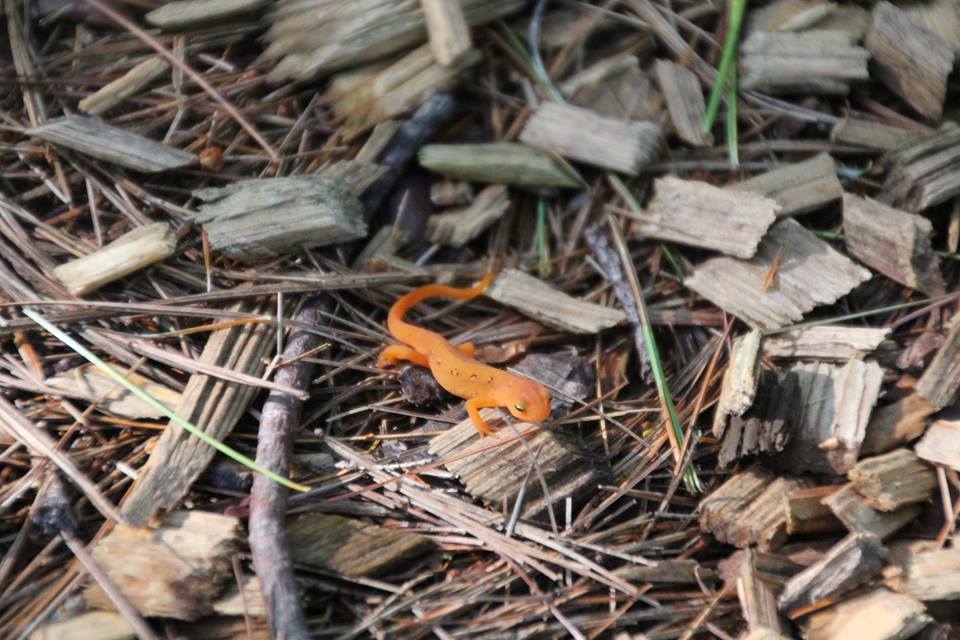
eastern newt / eft in pine woods
Jason Mankey also gets at some of the issues of the “beyond” factor in his post “The Trouble with 101 Books“. Partly it’s a consequence of living in a world of time and space — things keep changing, and so do we.
For Druid bloggers and polytheists like John Beckett, moving beyond 101 means deepening your relationships to the deities you connected to, among other things.
For an herbalist or gardener, it may mean developing your craft by studying nutrition and alternative healing, perhaps offering your skills professionally. It may mean getting a certificate in permaculture, or developing a hardier species to thrive where you live, challenging your ability to grow a larger percentage of your own food, teaching others, and so on.
For some of the members of the Druidry and Christianity Facebook group, the challenge is to find ways of being Christian that honor their spiritual discernment, while also acknowledging the powerful call of spiritual realities and opportunities of the natural world which are often ignored or considered actively suspect in the eyes of mainline churches and congregations and pastors.
Painters, sculptors, musicians work to sharpen their skills and develop their individual styles, and with enough talent coupled with a knack for marketing may even generate some income from their abilities. Some, but usually not enough to quit the day job.
If you don’t recognize yourself and your own experiences in this small handful of descriptions, you understand intimately how far you’ve walked from your own circle or community, just as much as if one of these descriptors more or less captures where you are right now and what you’re doing. Praise for the keepers and participants of circles, for the communal centers they offer!
For a mystic and walker of boundaries, it can mean exploring realms others don’t visit very often, including states of consciousness, ritual approaches, and a growing personal vocabulary to talk about such experiences, along with attempts to find parallels in other traditions and in the work that centuries of Bards in so many cultures have gifted us with. If a Bard somewhere seems to know about what I’m experiencing, I take that as a helpful guide to the terrain I’m walking. But if readers aren’t familiar with that particular association or reference, or if it doesn’t resonate for them, it may not help clarify what I’m talking about very much.
Often the work is so idiosyncratic and personal that it’s hard to share. Or when we do, others don’t quite know what to make of it. I found I learn best when I ask questions. As a ready way to minimize spiritual deception, especially self-deception, I find it unsurpassed. But long ago I also learned that the kinds of questions that interest me most often make other people prickly and defensive, or cause them to look at me strangely, or throw things, or turn away and find somebody else to talk to. So to avoid ostracism and rebuffs and a generalized loathing of my presence, I mostly turn my questions on myself and on my experiences and understandings of the world.
It’s true that such preoccupations can lead to a markedly reclusive lifestyle, so I bless my guides and mentors for nudging me into a career in education and teaching, thereby avoiding even greater eccentricity. If twenty-five years of teaching at the secondary and university level has shown me anything, it’s demonstrated that students like to ask questions of their own on occasion, rather than always answering other peoples’. The same holds true for groups and structures. Young adults are always forming their own groups, with structures that make sense to them, rather than answering to or serving the needs of adult administrators trying to justify their salaries.
When I write about my preoccupations here, I realize I’m writing first for myself, and only secondarily for others, because otherwise I wouldn’t know what to say. Your Druidry 201 and or Paganism 450 Honors will not always overlap with mine. That’s as it should be. Thoreau addresses this phenomenon in the first chapter of Walden with characteristic dry humor:
In most books, the I, or first person, is omitted; in this it will be retained; that, in respect to egotism, is the main difference. We commonly do not remember that it is, after all, always the first person that is speaking. I should not talk so much about myself if there were anybody else whom I knew as well. Unfortunately, I am confined to this theme by the narrowness of my experience.
/|\ /|\ /|\
Thank you to all my readers for helping this blog reach 100,000 page views. While I write first for myself, I wouldn’t have kept going without knowing you were also reading and thinking about these things.
Unknowingly, we also shut most of the gates to Otherworlds ourselves. Hence religion — literally, “re-linking”. Both bad and good news here, for the keys (hidden, discovered, at the end of the quest — pick your legend) are in our hands.
As children all of us spent at least some time peering from the gates of an Otherworld into this one. That’s almost a definition of childhood. Imagination came so readily then that we thought nothing of it — it was our native tongue, our common language. We thought nothing of it because our journeys back and forth between the worlds felt completely natural, for the simple reason that they are. How many of us have heard children endlessly repeating a word or phrase, self-enchanting, practicing one form of word-magic to launch themselves into another world, another state of consciousness? Or the youngster who asks for an adult to read the same bedtime story over and over again, never tiring of it, making it part of the before-sleep ritual, that transition to another world, another state of consciousness? Or watching the same children’s movie day after day, delighting in the ritual of sequence, of beginnings and endings, of transport out of one state of awareness and into others? Or childhood games, with their frequent patterns of losing and finding, of repetition and transformation together. Anyone can be “it” — until the next round. (For whatever “it” may be this time, consult your right hemisphere.)
Almost effortlessly we arrive into this life, knowing firsthand, instinctively, how to make such journeys, only slowly letting go of that precious knowledge as we acclimate to this world.
With enough practice and experience here in this life, we’re able to mock up difficulties and obstacles of all kinds for ourselves in the opposite direction. In fact, we get r e a l l y good at it — when I have time, when I’m not so stressed, later, next weekend, when I finally get a break from work, when the kids are asleep, after the virus retreats, when I’m not so strapped for cash — never perceiving that it’s exactly such priorities which too often shut us off from the very wonder, healing and rebalancing we long for and so desperately need. Rather than slipping in and out of worlds with ease, we root ourselves deeply in just one, then struggle to connect to any others. Rather than tapping into sources and fountains of rejuvenation that would make this life easier, less stressful, more magical, we resolutely “put away childish things”, then wonder why we feel empty and unfulfilled. If we want a clear demonstration of elemental earth out of balance, we can look at its grip on us, holding us back from mingling with the other elements and with spirit. Hence the needful work with elemental ritual.
Through ritual we can let this “apparent world” fade, as OBOD rites describe it. And one strategy for doing that, given our busy lives, is to slip into such ritual spaces and places in the middle of whatever else we’re doing. This practice in itself mimics the between-the-worlds quality we seek, so it models what it induces. Make the intervals and practices small enough we can’t not enter them. They can also become components of the larger rituals we practice.
We don’t need robes, candles, incense, banners, deity and elemental figurines, gongs, bells, swords, wands, altars. True, things like these can help, but they’re not necessary. Sometimes a single short prayer-chant, practiced once an hour through the day, or on some other schedule (every 15 minutes, or each time you get up from your chair, or at each break, etc.), can begin to open doors.
With each breath I take I walk between the worlds.
The previous post offered a somewhat longer prayer: I invoke the three gifts of Mon …
And the usually brief triads are another short piece of poetry and singing, of verbal magic to enchant ourselves into other worlds.
Or if you’re more kinesthetic, and words don’t do it for you, a ritual gesture or kind of movement, or for other sensory orientations, sound, color, smell, and so forth. The previous post offered the infinity symbol as gesture or sign, a way of signaling the openness that always walks with us, the ability to slip in and out of other worlds in an instant, and then return. Drawing it might help. (Doodling is one way many of us enter daydream, another world, and to shift consciousness, etc.)
/|\ /|\ /|\
In another few days this blog will hit 100,000 views — one indication that in the nearly nine years of its existence it’s continued to serve those who read and return to ponder the kinds of things I write about here. The international readership it’s acquired heartens me as well — it’s not speaking merely to a North-American base.
I do a lot of re-reading (“if it was worth reading once, it deserves at least a second go”), and right now I’ve returned to Richard Adams’ Shardik, his 1974 novel about “the power of God in a bear”. Adams, though better known for Watership Down, felt that in Shardik he had written his best work.
Some flavours and expressions of Druidry devote attention to the shape-shifting that can open doors, to the more shamanic aspects of our past and our potential, to the animal-human links that can help restore us to balance and fuller experience of humanity. Books can often point us in such directions.
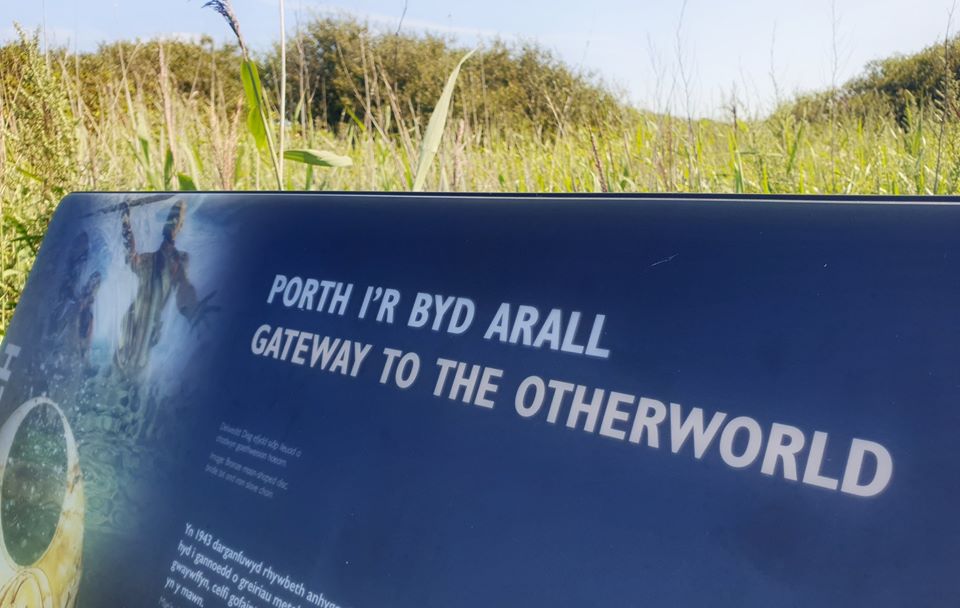
So reads a sign at Llyn Cerrig Bach, a small lake on the Welsh isle of Anglesey or Môn.
photo courtesy Kristoffer Hughes
Porth “door, gate”, related to portal; i “to”; (y)r “the” byd “world”; arall “other, another”.
(Incidentally, one of the best online Welsh dictionaries is maintained by the Prifysgol Cymru/University of Wales.)
How to find and pass through such a gate?
In addition to the photo above, Welsh Druid chief and author Kristoffer Hughes [Facebook link / Voices of Modern Druidry entry] offers this bilingual triad on his Facebook page:
Dyma dri o roddion Môn,
Traed y Derwyddon ar y Tir,
Cylch tragwyddol y Môr,
Coleuni diderfyn yr Awyr.
The three gifts of Môn,
The feet of the Druids upon the Land,
The eternal circle of the Sea,
The Sky’s unbounded illumination.
Here are the Three Elements of Earth, Sea and Sky — Tir, Môr and Awyr. The Welsh names work very well all by themselves as a chant and prayer: tir [teer], môr [mohr] and awyr [ah-weer].
/|\ /|\ /|\
In 1942, a hoard of some 150 objects was discovered near the end of the lake, apparently deposited there as votive offerings. Among them is this splendid bronze plaque, now held in the National Museum of Wales in Cardiff:
How do we find and pass through portals to the Otherworld?
I invoke the Three Gifts of Môn,
and seek entrance to an Otherworld,
to where it is right and fitting for me to journey.
Feet of Druids, guide my steps.
True return I seek, for I have been there before,
not merely in dream and vision, and in desire,
but fully, born out of it into this life,
in the eternal circle of the Sea,
returning to it after time and times have ended here.
In this air I make the sacred sign
[with the forefinger of your dominant hand,
draw an infinity symbol in the air].
By the power of Earth, Sea and Sky,
assist me to make the journey anew,
and recall what I discover there,
so that I may share it after
for the good of the whole.
Recording the experience, whatever comes, is a valuable tool for making any subsequent journeys, and as a landmark of our practice. By making a record, I learn how I journey, which may be very different from the path others take. It may be that I recall with different senses active. Some see, but others hear, or touch, or return with no distinct impressions until they lift a musical instrument, or write a poem, or paint or draw. The more different kinds of outlets we provide in our lives and practice, the more the Otherworld can touch us here, and we can locate and recognize and draw on its inspiration.
/|\ /|\ /|\
For more information, and images of other signposts like the “Gate to the Otherworld” mapping the region, visit “Anglesey Visualizations installed” at Monumental UK.
For an 8-minute Youtube interview with Kristoffer Hughes about the history of Druids in Wales, and their shamanic background, go here.
I wrote a few years back about toasts, boasts and oaths as part of a Lúnasa ritual at Mystic River Grove in Massachusetts, and I’m revisiting the topic here, because it’s a rich one to explore further. Anyone interested in Lugh, his Welsh counterpart Lleu Llaw Gyffes, and associations with Lunasa need only Google for more info than any ritualist could use in 50 rituals. Use the search box on this site for my other posts on the subject.
This triad of ritual actions is especially fitting now, because Lugh is the god whose nasadh “assembly” gives us the name of our current seasonal festival Lughnasadh, or Lúnasa in reformed Irish spelling. Lugh is described as samildánach — “equally skilled in many arts” — certainly reason enough for boasts, toasts and oaths as components of Lunasa ritual. Emulate the god and celebrate the pluses in our lives. His festival includes games of skill, a kind of Celtic Olympics.
Without much squeezing or distortion, we can also see each action as associated with a specific time: past, present and future.
Boasting generally looks to the past, to something already accomplished. “I’ve done it before (and so I’ll do it again)”. We could even see the modern job resume as a kind of contemporary and restrained boast — it highlights our relevant employment history, our training and experience. Likewise, a good job interview is a delicate balance between touting our accomplishments and demonstrating our self-awareness, an understanding of our weaknesses — cleverly transformed, of course, into opportunities for growth in the service of our next employer.
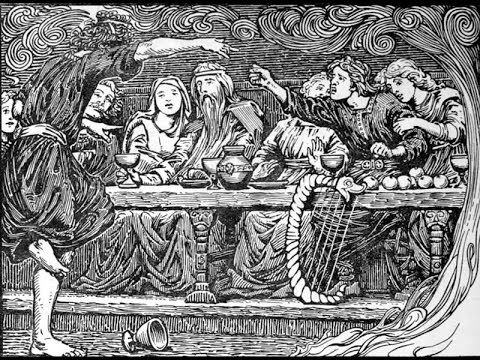
The Flyting of Loki
A boast naturally seeks recognition and praise, or acknowledgement at the very least. (A suspicion of pride and an awareness of its dangers pervade the Judeo-Christian moral heritage of the West, so a Pagan restoration of justified pride is long overdue. The point, after all, is to do something praiseworthy, something that fully deserves boasting about.) As a result, it can also be an occasion that calls for responses from others that tease the boaster, as much as for compliments on an achievement done well. A roast, another rhyming theme that fits well here, is an invitation for just such teasing and carefully-tuned mockery. Through it we test the self-confidence of the boaster, their ability to “take it”, and check their anger, and sometimes to respond in kind. African-American playing the dozens and the Norse, Celtic and Anglo-Saxon flyting each ritualize an exchange of insults. The Norse Lokasenna, sometimes called the Flyting of Loki, is just one historical and literary example. In one form or another, the “rap battle” has long been alive and well.
Toasts are often expressions of gratitude or celebration for something that’s happening now in the present. We salute and celebrate another, whether person or object, event or location. In some way it’s a form of blessing. We toast a newly-married couple, we christen and launch a boat, we hold a ribbon-cutting ceremony for a completed factory or auditorium or museum. As with boasts, toasts often ask for toasts in response, and some cultures formalize such exchanges. Further highlighting the link between boasts and toasts, it’s often considered “good form” to lightly tease a person or couple we’re toasting, as a way of showing affection.
Oaths usually look toward the future, to something we intend to achieve. As a promise or vow, an oath can be an acknowledgement of a debt we’ve garnered in the past, but oriented towards a general time to come. Or it can be more like a promissory note, specifying terms of repayment, the conditions for fulfillment, etc. In the oral cultures where they mostly originate, oaths are a matter of public memory. We make them publicly so that others witness them. A sense of a commitment made with others’ knowledge often helps the oath-maker to fulfill the oath. It’s a way to utilize any shame, any fear of loss of face if we fail, to motivate us, just like we imagine the praise if we succeed, the enhanced reputation and public standing.
This triad of ritual behaviors can feel somewhat contrived in the West, because each is a ritual action less common today than in the past. As an opportunity to revive ceremonial forms and a chance to explore a triad of potent group ritual gestures, boasts, toasts and oaths deserve to be incorporated in our rites and celebrations.
/|\ /|\ /|\
These ritual acts are also chances for growth. Part of the cultural change we’ve undergone in the West over the past several centuries has been a shift toward internalizing these three rites. Rather than boasting publicly, we read books on motivation and struggle to deal with self-esteem issues. We take workshops on resume-building and interview skills and networking. We internalize our weaknesses and strengths, though we now hand over to social media an increasing share of our once-private lives, in a curious reversion to the older cultural patterns of turning towards a community for much of our identity.
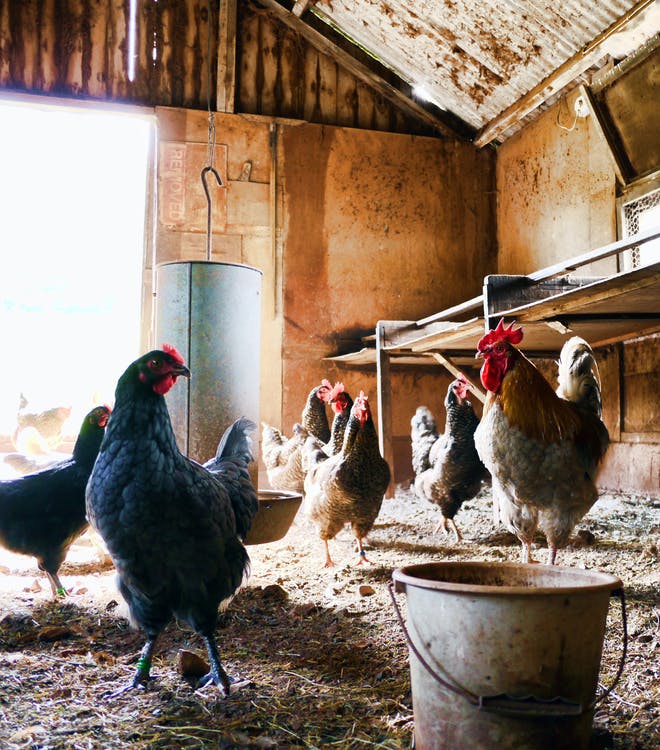
The pecking order of birds, the ranking among herd animals, a usually stylized aggression to establish social position, can shade into bullying among humans, a specific form of cruelty. Animals generally stop once one of them establishes dominance over the other. We see animal rituals in the submissive gestures of wolves, stags, chimps, etc. who yield to a stronger opponent. A human bully doesn’t stop, and equivalent gestures of submission may simply encourage greater cruelty. The point of bullying is not merely to establish dominance, which is the goal of most alphas, both female and male, but to cause pain.
Specifically Druidic responses to bullying are often rooted in community. We look for our values to nature and to what we have in common, and a response to a bully is often a communal one. Isolation, banning, shunning, communal expressions of disgust and repulsion, all can have their effect in awakening shame and regret, or at the minimum ending the behavior and any opportunities for it to continue.
Just as important, however, are opportunities for clearing one’s name, for redemption, for forgiveness, for reparations and restoration. Ritual has a place in this as well. The fear and anger that often underlie bullying behavior can be dis-empowered. Elemental re-balancing can play its part — earth can eat the heaviness and sense of blockage and obstruction that comes from wrong-doing acknowledged. Water can cleanse and purify, air can lift and lighten, and fire can purge and burn away.
is the one you’re actually practicing, as opposed to any ideal in your head. Or least so it looks from where I’m walking through the woods, or sitting at the kitchen table.
From new Druids on one of the OBOD Facebook sites introducing themselves, asking questions, sharing their sense of discovery on this new journey, to battle-scarred Christians on the Druidry and Christianity site, recounting their journeys out of toxic groups and towards a Jesus who’s always been praying in the forest, as well as blessing the tidal basins along the seashore and listening in the desert sands, or standing there in the next room, gazing at the statue of his brother Lugh, or his sister Brighid, we’re walking any number of possible and imagined paths to see what the next steps reveal.
Can we map out some of the characteristics of what “true Druidry” might look like?
incense / Pexels.com
ONE
For a start, we can lay claim to the sense of the Hippocratic oath (NIH website). Though the oath doesn’t include the explicit words “First, do no harm” that are often attributed to it, the sense behind those words is clearly present. One of the signal advantages to walking a solitary path is that no dysfunctional group will muck up your journey. Add to that the reassurances in the study materials of responsible Orders to do what feels right, and simply to set aside any exercises or materials that don’t. Most people connect with a group, if at all, through a friend or acquaintance, and that’s as good a way as most. Likewise, the practice of Druidry should be the practice of non-harming.
Of course, Druidry like any other valid path can be an instrument to help unstick us if we’re stuck. It tends to do this gently, pointing us toward sources of balance and healing. More vigorous and rigorous forms and practices are also available. As we come into healthier balance, we often are drawn to find ways to lighten any undesirable impact of our words, actions, thoughts and feelings. Just as taking up the study of Druidry should do no harm to us, our practice of Druidry should do no harm to Others.
TWO
Good teaching supplies options to students: you can find ways to adapt the course of instruction to your interests, circumstances, and so on. A water-loving tree mentioned in your reading, for instance, may not grow anywhere near you in your home climate, a dry one unlike the British isles, but another tree in your yard or town piques your interest and attention, and can teach you much. Your local tree becomes your teacher for the month (and beyond) as much as your formal written study materials. Knowing this, authors of good materials generally point you toward such teachers, who constitute a central part of earth spirituality. “The Land is your greatest teacher”.
A Druid proverb here might be “Do not overlook teachers you may not expect, or who don’t match your preconceived notions of what a teacher should look like. For these include some of the best teachers you will meet”. Or more succinctly: “Expect the best teachers, whatever forms they may take”.
THREE
Many people recount experiences of synchronicity in their study: the lesson on animal guides arrives when you’ve encountered or been dreaming of an animal, perhaps the animal mentioned in the lesson. A book reaches your hand that opens up a topic you’ve just been thinking about. A conversation with a friend touches on an issue you’ve been struggling with, and that brings its own comfort. Any focus maintained over time tends to provoke such experiences. Are we simply more alert to things already present in our lives? Does our study “cause” them to arrive when we need them? Is the green world listening in some sense to our spoken and unspoken wishes and thoughts? Pondering such questions is also part of Druidry, and helps to shape our response to the synchronicities.
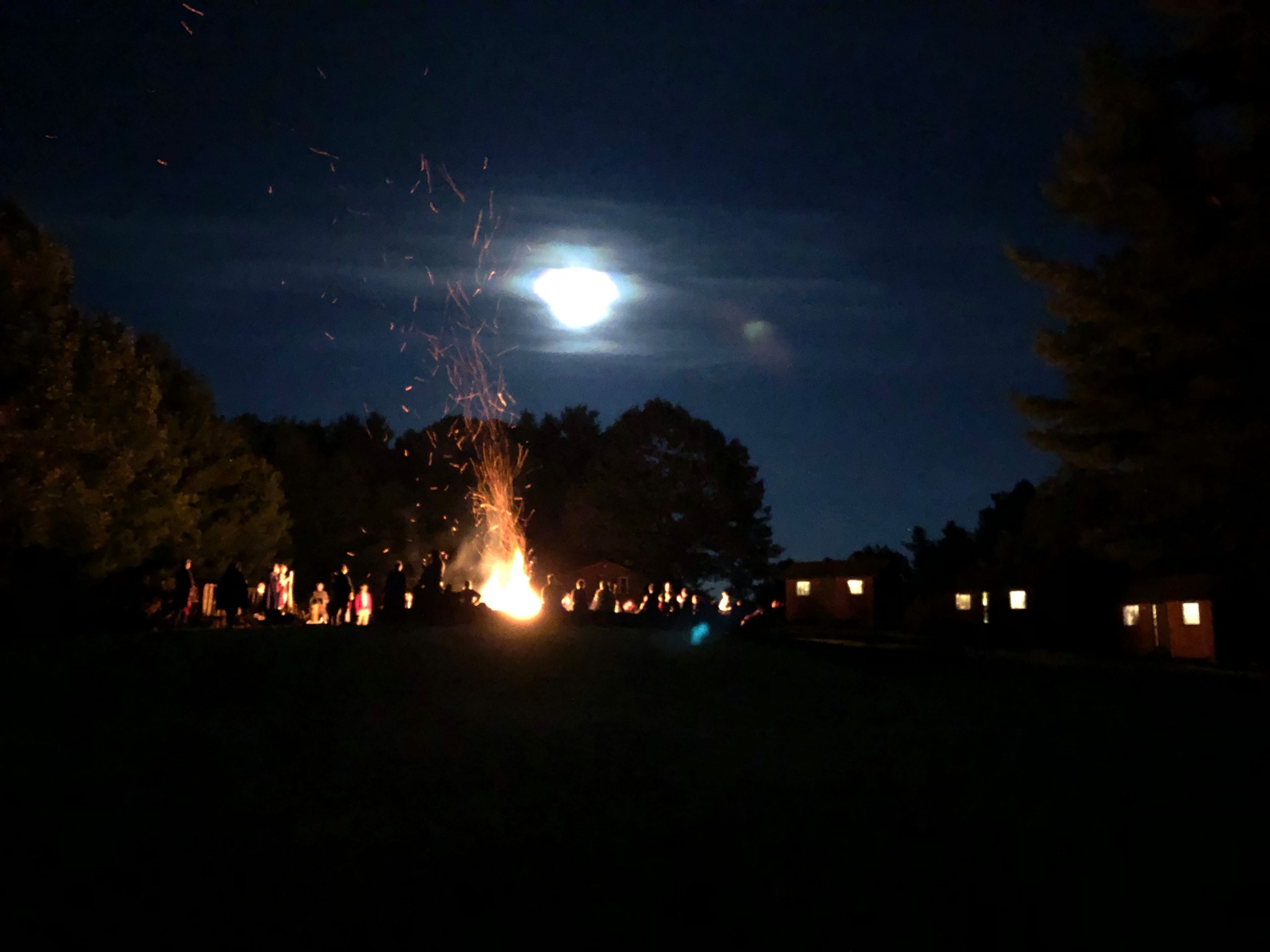
“It takes night to see fire best”. Full moon at BAM gathering, Sept. 2019.
FOUR
Ritual observances as the tides and seasons change, something as simple as a blessing over a harvest, or a libation to the full or new moon in recognition of its beauty and mystery as a door to spirit, deepen our experience of living in time, and also afford us glimpses of timelessness. “The apparent world fades”, says OBOD ritual. (Don’t worry, whisper the flowers on the altar. It hasn’t gone away. It’ll still be there when you return.)
Ritual both intensifies our awareness of the “ordinary” and opens us to the non-ordinary. Often ordinary and non-ordinary share qualities, or merge and blend and shift in ways we hadn’t noticed before. (Are they the “same”? Both no and yes seem true or accurate answers. Compare Tolkien’s proverb: “Go not to the Elves for counsel, for they will say both no and yes” — The Fellowship of the Ring.)
At Lunasa or Imbolc, Brighid may have something to say to Lugh, and vice-versa, and via ritual we find we can listen in to their conversation. Or we turn our words, gestures and ritual elements to one of them and it seems that the other answers. As the Wise have reminded us, just because Brighid or Lugh may not exist, that doesn’t mean they have nothing valuable to say to us. Such categories of things get re-arranged. We start to realize how large and multi-form and marvelous the cosmos can be — a blessing of freedom and possibility in itself.
FIVE
“Guard the mysteries! Constantly reveal them!” wrote Beat poet Lew Welch some 51 years ago now, in 1969, in his poem “Theology”. In one sense, that’s what the experience of doing Druidry feels like. The really profound things can’t be conveyed to other people anyway, but only experienced. Any mystery we “guard” is also something we’re trying to reveal to anybody interested, through our rituals and actions, our stories and our own practices, our urging to others to practice for themselves so they can have the experiences, too.
The act of revealing often takes the form of a kind of guarding. With both mirth and reverence, as Doreen Valiente puts it in her Charge of the Goddess, we approach the sacred at the heart of the world, in ourselves and in other things. We model this as best we can because of our own repeated experiences.
Our approach is a participation and honoring; our participation is an approach. The guarding itself is an invitation — apart from initiations, our Circles are typically open to respectful visitors, and we do what we do “in the eye of the sun” unless the event runs into evening hours, as feels right for Samhain.
SIX
Curiosity seems a common trait many Druids share. Almost always there’s something that sparks their interest. Often it’s an avocation, something done as an amateur in the original sense of the word — out of love. There are many remarkably accomplished and educated people among Druids I know. They take up new studies and practices, pursue training through more formal diploma-ed and certificate programs, as well as less formally, through reading, apprenticing, experimenting, returning to and building on a hobby, study, or passion of their youth or acquiring a new one.
“So many things worth knowing” could serve as a motto for many. Like Gandalf, they often enjoy digging, learning things in the process not yet generally known or accepted. “Among the Wise I am the only one that goes in for hobbit-lore”, remarks Gandalf in The Fellowship of the Ring. The wizard’s specialty proves to be “an obscure branch of knowledge, but full of surprises. Soft as butter as they can be, and yet sometimes as tough as old tree-roots. I think it likely that some would resist the Rings far longer than most of the Wise would believe”.
SEVEN
Transformation and spiraling seem to characterize living teachings. We change, the teachings themselves seem to morph and change and shift, what we thought we were and knew transforms, and we spiral to see the same old things in new ways, encountering higher harmonics of the no longer “same old thing”, so that our experience and wisdom deepen as a result. Another common proverb expresses this well: One thing becomes another in the Mother …
We hear about computer software and hardware, and the humorously-named wetware, that pink and sloshy stuff inside our skulls.
I propose the term spirit-ware for all the applications that run without physical forms. Just as you don’t need to believe in Apple or Linux or Google or Microsoft to use their applications and other products, you can get along fine without belief in spiritware and yet still try it out. In fact, we all do that every day. Belief is just one technique among many.
Walpole-Westminster Bridge over the CT River, Bridgehunter.com/Library of Congress
Experience of the four elements can often provide a bridge for those seeking to understand both lowercase and uppercase spirit/Spirit. Ritual can help us focus in on how North feels different from East, bringing it home with earth and air as ritual experiences, and also with the enlarged awareness of presence that ritual can facilitate.
Or to give a local geographical and political example, does anyone believe that “Vermont” and “New Hampshire” are anything more than very powerful symbols and metaphors that we agree on for the sake of convenience? (When I cross the bridge at Westminster, VT and drive east to Walpole, NH, what’s much more “real” than any change of state boundaries, to me anyway, is my encounter with the Connecticut River that defines most of the eastern Vermont border and western New Hampshire border.)
Go back a few hundred years and pieces of what are now two New England states belonged to Canada, France, New York, and so on. Go back a few more centuries, and the whole region is Wabanahkik, the Dawn Land of the Abenaki people. “So which is it?” Any answer depends on time and place.
/|\ /|\ /|\
Over on the Druidry and Christianity Facebook site, a member posted a question about “false gods” in connection with those who worship Brighid and similar figures. How do we know what they are?
Waxing moon, two evenings ago
For better and worse, I tend towards a pragmatic approach towards Others, especially Others without their skins on.
I understand that such an approach may not work for everyone, particularly for those who’ve committed to a specific creed and worldview. The longer I live, though, the less I believe I know what “false god” even means any more. Yes, I know how such expressions get used, but often that seems like finger-pointing and competitiveness between different religious factions. There are so many kinds of beings, some with skin and some without. And from what I’ve seen, they’re a real mix of good, bad and in-between, so that my criterion tends to be Jesus’s wise standard: “by their fruits you shall know (i.e., distinguish) them”. Which is how I also tend to discriminate between a good and a bad used-car salesperson, plumber, restaurant, potential life-partner, etc.
I also don’t think I really “worship” anyone or anything. Some people do — it’s an important part of their spiritual and religious life. But what I do know is that some beings earn my respect and attention, and others don’t. I find I’m more interested in relationships than worship, and as with any worthwhile relationship, I need to listen, be available to do what’s needful, pay attention, show my gratitude, go with the flow, and live my commitment in my actions.
And I find that demands more from me than most of my beliefs do, which my life keeps revising on me anyway, often when I least expect it.
/|\ /|\ /|\
The early Church made a distinction between three kinds of reverence/worship: the Greek terms doulia, hyperdoulia, and latria, or reverence, great reverence and worship (https://en.wikipedia.org/wiki/Latria). Latria is for God alone, while saints may receive lesser devotion. Well and good.
But I don’t know how to apply such labels realistically to what I do each day, no matter what it may look like on paper. If a dear friend helps me out when I’m down, spends time with me, listens, checks in to follow up on me, takes me out to dinner, etc., the ways I’d show my deep gratitude in response, at least to someone watching from the outside, would probably look an awful lot like latria, or worship/sacrifice. Yet I’m not “worshiping” my friend (or at least not any more than I worship any close friends) when I give a gift in return, or write them a poem or song in gratitude.
sunset two nights ago, from our front yard
Is writing and singing a love song to someone else a form of worship, or simply expressing love? Does it have to be one or the other? We can attempt to define and prescribe which actions fall in which category, but the person’s intent seems far more important to me, and that’s often where doctrine has least to say, since its purpose, often, is to direct behavior, something visible and measurable, so that we may begin to achieve a glimpse of the result of holy intentions and actions. It can be an indirect way to catalyze a spiritual practice, but for some it’s a useful one.
One of the loveliest modern songs of devotion to Brighid is by Damh the Bard. It’s a favorite of mine and of many. Listening to it, I’m not concerned with doctrine but with the love he expresses: https://www.youtube.com/watch?v=vMxeYEhUxYw
Granted, Damh isn’t a Christian Druid. The distinction between human and god matters less in both song and the experience of many Pagans. You’ll note if you listen that Brighid is both “old woman” and “goddess”. (Maybe if we let go that distinction our care and treatment of the elderly might improve.)
One commenter at Druidry and Christianity observed:
But when it comes to pagan gods (let’s assume for the moment that there was a goddess Bridget and a Saint Bridget and that it’s possible not to conflate the two), I think it’s not so much a question of what constitutes “worship,” as it is a question of who/what pagan gods actually are. Are they spiritually beings set up against God? Are they under God? Are they unaligned? Is it even possible to have an unaligned spirit?
There are different kinds of answers to such questions, and which ones satisfy anyone asking the questions seem to depend in turn on the intention, expectation, experience, belief and individuality of those asking. Ultimately, one goes with what accords with one’s inmost sense of truth. No one else can supply that, but only influence how much we trust it.
Prayer may supply an answer individually, though we’ve always seen different and sometimes diametrically opposite answers to apparently the “same” prayer. In response to prayer guidance, some join one church that others condemn — also as a response to guidance received in prayer.
The experience of God’s sovereignty for others means that Biblical verses like Romans 8:28 “And we know that all things work together for good to them that love God, to them who are the called according to his purpose” are sufficient answer. God’s creation is good, and his Word is fulfilled.
Medieval European angelology suggests a whole range of spiritual beings — evil, unaligned and good. Much Christian magic of that time involves cooperation with the good ones against the evil ones. Or sometimes evoking and extorting from the more dubious ones as much occult knowledge as you can, before banishing them back to their respective realms. You just had to make sure your magic circle was as secure as possible, so you wouldn’t get eaten. (For a contemporary fantasy take on various ways you can get eaten, among many other things, see Leigh Bardugo’s Ninth House, set among Yale University’s secret societies, featuring an anti-heroine named Alex, who’s able to see spirits — much to her dismay.)
Divination can help as well, though from a Christian perspective it can be just as suspect as the subject of potentially evil or non-aligned spiritual beings themselves.
Ultimately, I find, it seems to come down to a paraphrase of C. S. Lewis’s observation: “You can’t really study people [or gods]; you can only get to know them, which is quite a different thing …”
Many variations on the following theme exist. Socrates receives credit for it, among other thinkers. Sometimes it’s called the “Three-Way Filter”. So no, it’s not originality I’m claiming, but utility. As a simple but profound guide in these challenging times, this triad answers a deep and pervasive need. It asks us three questions, in a form so compact we can’t help but use it if we wish:
Is it true? Is it kind? Is it necessary?
Twitter would mostly dry up, if we followed this Triad. Social media as a whole would shrink to a more appropriate and sane size, and not co-opt reason and good sense. My wife and I attribute our durable marriage to both of us practicing this Triad with each other. Because where else do we live our lives most deeply except with our loved ones? If it works there, our way of life, it might even work elsewhere.
Imagine how our patterns of consumption and our interactions with others would approach something more conscious and intentional. Politics as we know it would change radically. And the shaming of others that we indulge in for not meeting standards we ourselves also fall short of would also shrink. (And again: if I can practice this with my partner whom I love, I gain skill for practicing it with others whom I may not love as much.)
Why?
Because often enough I can say “yes” to two of the three criteria. And though the song lyrics tell us “two outta three ain’t bad”, aiming for all three remains the goal. “Why not excellence?” asks ADF, one of the major Druid orders today. Why shouldn’t we aspire?!
When we push against this apparent world, and see it begin to pixelate, a new path can open for us …
It’s interesting to me that, of the three criteria, “kind” is most often the criterion that catches me. I don’t normally think of myself as a particularly heartless or cruel person, yet “kind” is often my sticking point. We reach to claim the moral high ground with “true” and “necessary”, but I end up where it’s kindness that’s lacking.
Try imagining this Triad as a political platform, I say to myself, whatever my place on the political spectrum. And if I can’t, what does that say about my politics, or about my hopes for any kind of justice?
Or as “the only morality I need”, how does it stand up? It’s remarkable how thoroughly the Triad reaches into choices, values, treatment of others — a whole range of ethical issues.
Now let’s couple this Triad with the famous Christian Triad of Jesus: I am the Way, the Truth and the Life. You can derive a whole series of useful meditations on the various pairings of the Three of Jesus with this other Three. And not just the obvious linkages, either — for instance, “Is it necessary?” is a truth we often toss aside, because in our self-indulgent age we feel justified simply if we want something. Voila — no further criteria needed! Likewise with freedom, at least in 21st-century America: if anything constrains me, it must violate my rights. Never mind that it’s good for the whole. Never mind that a whole range of behaviors are denied me, that laws constrain me and would have constrained me during most major civilizations we have knowledge of, because much of “what I want” may not be good for others. (We each have our lists.)
But is any of this Druidic? asks my pesky inner Druid. Well, consider the Instructions of King Cormac, and let me know how well this Triad of Truth, Kindness and Necessity lines up with the counsels of the King.
/|\ /|\ /|\
Which brings us to death, which can seem a very un-Druidic subject.
First ethics, then mortality. Wow, you really know how to market yourself to your readers, and offer upbeat blogposts.
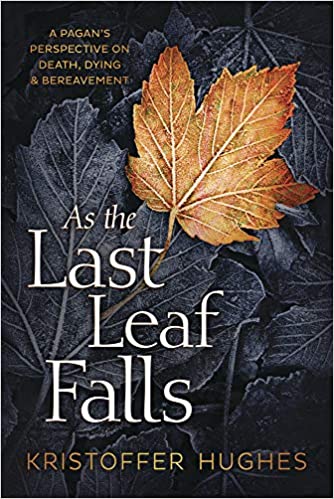
So it’s fitting that one of the most irrepressibly cheerful Druids I know should speak about death, and from daily, intimate, firsthand knowledge. Here’s Welsh Druid Kristoffer Hughes speaking on the subject on the occasion of the re-issue of his meditation on mortality, under the new title As the Last Leaf Falls. As someone who deals professionally with dead bodies and the bereaved every day, as a mortuary worker (in the States we’d say morgue), he knows the death industry firsthand.
“You can tell an awful lot about a society just by the manner they deal with the dead”, notes Kristoffer. He traces much of our contemporary Western outlook, practice and ritual to Queen Victoria, who dressed in mourning for 40 years.
Dip in at any point in this half-hour talk and you’ll gain something of value. “The medicalization of death and grief profoundly impacts all of us in the West”, Hughes says, around the 8:00-mark. “Death always brings in the big questions and the Spirit — but that is not the domain of medicine … We’ve created institutions of death whereby the indignities of death can occur without offending the sensibilities of the living. And I see that every day quite viscerally …”
At the 9:00-point, he notes “A basic anxiety runs through humanity … we are all going to die. And that sound quite depressing, doesn’t it? I might need a mouthful of gin just to offset that. But please don’t judge me. I’ve been in a morgue since quarter past 7:00 this morning”.
“Life … a terminal sexually-transmitted infection …”
“There’s no fundamental universally-correct truth that will alleviate everyone’s anxiety …”
“We need meaning … significance … transcendence … When there’s no meaning, we find people under their desks sucking on Valium the size of their heads …”
“We’re told to conform to other people’s meaning … and that can be a frightfully difficult task”.
“So often when people shine too brightly, [other] people might want them to dim their light. And I say to you never dim your light. Ever. Shine. ‘Cause that’s the purpose you are here. Your eyes are windows through which the universe experiences itself. How can you not shine? If anybody tells you to dim your lights, tell ’em to buy a pair of shades …”
Later (around 16:25) he cites Taliesin: “Know what you are when you are sleeping. Are you a body or a spirit or an occult radiance?” Sleep, he says, the “little death” we each experience every night, is a prime key to insight and awareness about what death actually is.
Re the Covid-19 virus, he says, we lack meaningful rituals to cope that we used to have. “Ritual has fractured”, says Hughes. And the emotional relocation that is grief is far more difficult to navigate. So we need new rituals to help us travel the emotional relocation of grief, of honoring the living and the life of those who’ve left.
A mundane laundry triad: It needs doing, you do it regularly, and you see the benefit in practical terms: clean clothes.
elemental laundry: water, earth, air, fire …
While people have individual laundry rituals — you must fold clothes a certain way, or you can only wash certain items together, or you sort into whites and colors, while somebody else sorts by fabrics, or gentle versus regular machine cycle, or you use specific detergents on specific categories — laundry everywhere needs washing. It’s a deeply human activity.
I talk so much about spiritual practice for several reasons. Those who do it know its profound value, while those who don’t tend more often than not to busy our political landscape and to make headlines of various less-than-positive kinds. By “less-than-positive”, please note, I don’t mean less-than-comfortable. A spiritual practice worth doing should in fact unsettle us if we’re stuck — and that’s a good thing. If I’m entrenched in a rut, I need to be plucked from it, and a good spiritual practice is a rut-plucker.
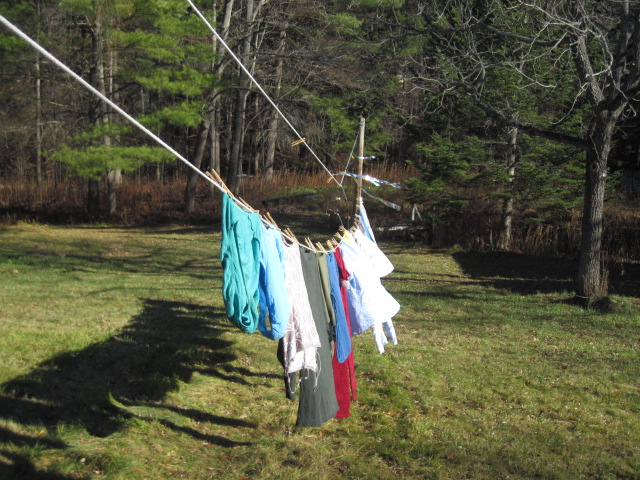
Do laundry long enough and you begin to discover its seasons and rituals, its smaller and larger gestures. During warm weather, hanging clothes outdoors may be an option (as a rural and stingy Yankee, I get to save several hundred dollars each year drying clothes on a line from early April through late October, and gathering in wonderfully sun-breathed clothes besides. Ah, blessed sweat equity). You may wash more in cold weather because you wear more in cold weather. You may also begin at length to practice economies — better (and less) detergent, or scent-free choices, or more efficient machines, or certain days where doing the laundry just makes better sense. You may struggle against housing ordinances which prohibit clotheslines, or you may frequent laundromats or public laundries with their own rules and practices.
Travel or visit others (before these wry, random and ructious covidious times, and hopefully afterwards, too!) and you face different laundry adventures, washing items in a sink, or in your friends’ or sisters’ machines, or in a hotel laundry room. Leave the ritual you know and you discover how much of a habit it has become. Pack a suitcase, and you’re drawing on accumulated clean laundry to see you at least partway through the journey. A good practice grants you just such a reserve you can draw on.
Some practices will shrink or shred or discolor some of your laundry. Note that nothing in such a practice is “wrong” by itself: only the combining of actions and objects that don’t work well together causes the problem. How far I can extrapolate from that lesson is itself a useful meditation.
Water, air, earth … gifted already. Add the fire of my intention. / Photo by ArtHouse Studio on Pexels.com
And I ponder how the goal of laundry isn’t clean clothes by themselves, exactly. It’s more a person well-clothed in fresh apparel. We want to wear the clean clothes, not merely gaze at them in a pile. I can shower twice a day, but if I have to put on dirty clothes again after a shower, I’m working at cross-purposes with myself. Another reflection for meditation, for the place of a practice.
/|\ /|\ /|\
At a certain point, laundry can become a spiritual practice, an apparent reversal of the title of this post. But not really: a sound spiritual practice nourishes our capacity to make a practice out of more and more of our lives. If I’ve been doing a practice for a while, and I can detect how it has enlarged me in good ways, that’s a valuable indicator, a signpost along the way that we often do not learn in schools, or from those who by rights should be conveying to us the keys and secrets to making the most of our decades here in this strange and marvelous world. But I will not fault them: it may well be that they in their turn did not ever learn it themselves. If I’ve caught even a glimpse of that possibility, I’m blessed indeed. A ritual of compassion for the ancestors: share with them this gift, let them sense something of its resonance for me, let it flow backward and forward in time.
If we’re fortunate, we can number among our family or friends or teachers someone who makes a spiritual practice out of daily life. Their company is a gift and a pleasure, because whatever they do, they do with love. Children may experience this around a grandparent or other mentor. What we do in the presence of the loving spiritual practitioner matters far less than the doing of it in that presence. The quality of that presence outflows. It’s like a fragrance or vibration we take with us. Begin with something small that you do often, said my teacher one time. If it’s tying your shoelaces, tie them with love. When you’ve made that a practice, then slowly expand it to other things.
It’s good to take out our beliefs from time to time and lay ’em side by side with our practice. Good, because a disconnect between them is like dirt in an engine — friction wears things down. I can deal with it only if I know about it. We see it most readily in our relationships, but somehow look past it in our own psyches. We grow closer to another person, or we drift further apart, and we can often trace the causes and turning points, but we discern it less easily in other dimensions of our existence. At least in my own experience, such “grit in the works” burns energy, grows stress, sparks illness, ignites irritability, and seeds confusion over goals. So it’s good to pay attention and apply remedies.
Our inner worlds are sometimes less “in our faces”. Photo by Luis Quintero / Pexels.com
I say, for instance, that I want to improve dream recall, and I seem to believe it, yet I ignore my pre-sleep routine. Rather than affirmations, dream review, and care for my late-night reading choices, I read for pure entertainment, falling asleep with glasses on and my finger in a book. Many things lie outside my ability to manage and improve, so why not focus on those I can? Then, paradoxically, the number of things I can manage and improve often enlarges, because I’m not wasting energy on internal conflict.
Back in 2016 I outlined my principal beliefs as I could perceive them then, partly in response to a comment from a reader talking about his sense of the need for a Druid theology:
My correspondent acknowledges he’s a solitary, and such a path can indeed be lonely at times. Alone, I may confront myself more directly and disconcertingly. Alone, I face truths that can be uncomfortable, inconvenient — and profoundly useful to discovery, creativity and growth. Groups can conceal and divert us from the necessary work of the self.
If the tools of Druidry are worth anything, they’re up for the task of helping us grow, both in groups and alone. We find ourselves in a universe of ceaseless growth and change, so it makes sense that both our beliefs and practices should mirror this larger world we inhabit, if they’re to be of any use and value. Daily meditation, time outdoors in nature, ritual observance, ongoing study, and creative expression make up the lives of many Druids who find value in these practices.
Where’s my attention? (Mt. Ascutney, VT, looking southwest)
The “more perfect union” of the title (from the Preamble of the U.S. Constitution) doesn’t automatically mean that practice must conform to belief (or belief to practice, either), but simply that we attend to the harmony between them. That harmony means they can balance and inform and influence each other.
So here are those beliefs, with today’s notations, observations, etc. following after, indented.
/|\ I believe that to be alive is a chance, if I take it, to be part of something vastly larger than my own body, emotions, and thoughts (or if I’ve learned any empathy, the bodies, emotions and thoughts of people I care about). These things have their place, but they are not all.
Not only is it a chance, but my life experiences seem to push and prod me toward that awareness of a “something larger”. Most of my suffering, if I’m honest, also seems to issue from resisting that direction of growth. If compassion — literally, “feeling or suffering with” — doesn’t enlarge in me, I pay for it with a sense of futility, waste, depression, impatience, boredom. But how I might become part of the “something vastly larger” is as varied as each of us is. My practice is for discovering the “how” and embodying it.
/|\ I believe this because when I pay attention to the plants and animals, air, sky, water and the whole wordless living environment in and around me, I am lifted out of the small circle of my personal concerns and into a deeper kinship I want to celebrate. I discover this sense of connection and relationship is itself celebration. Because of these experiences, I believe further that if I focus only on my own body, emotions, and thoughts, I’ve missed most of my life and its possibilities. Ecstasy is ec-stasis, “standing outside.” Ecstatic experiences lift us out of the narrowness of the life that advertisers tell us should be our sole focus and into a world of beauty and harmony and wisdom.
Joy doesn’t get talked about much, but it’s at least as infectious as any virus. We’ve all known and experienced those moments of joy and “outlift”. Again, how I “lift out of the small circle of my personal concerns and into a deeper kinship” is my practice. If my practice isn’t currently helping me achieve that, that’s worth attending to, and changing.
“Stilling the pool of nwyfre is the task of the art of breathing” — J M Greer, The Druidry Handbook.
/|\ I believe likewise that the physicality of this world is something to learn deeply from. The most physical experiences we know, eating and hurting, being ill and making love, dying and being born, all root us in our bodies and focus our attention on now. They take us to wordless places where we know beyond language. Even to witness these things can be a great teacher.
I’ve written before about both the possibilities and limitations of language, out of personal experience and professional training. The “wordless places” we reach and explore don’t necessarily come to us by worry over names and words. Tearing down a Confederate monument, to use a current example, or renaming an airport to drop an association with a politically incorrect person, may apply a dollop of relief to pain, but it won’t address the underlying cause of that pain, which arose, and still arises, from a refusal to do the inner work required.
/|\ I believe in other worlds than this one because, like all of us, I’ve been in them, in dream, reverie, imagination and memory, to name only a few altered states. I believe that our ability to live and love and die and return to many worlds is what keeps us sane, and that the truly insane are those who insist this world is the only one, that imagination is dangerous, metaphor is diabolical, dream is delusion, memory is mistaken, and love? — love, they tell us, is merely a matter of chemical responses.
As inhabitants of multiple worlds, we often neglect the claims they make on us, and also forfeit the advantages they confer if we would only attend to those claims. This world is just one among many. Such statements seem either self-evident to people, or completely obscure. I find there’s almost never much middle ground.
/|\ I believe that humans, like all things, are souls and have bodies, not the other way around — that the whole universe is animate, that all things vibrate and pulse with energy, as science is just beginning to discover, and that we are (or can be) at home everywhere because we are a part of all that is.
“Being at home everywhere” is a kind of vairagya, or not putting all my eggs in a basket that isn’t designed for them. It’s a remarkable and deep practice I’ve been exploring for decades, in various forms, and have only begun to understand.
St. Paul talks about something similar, as far as I can tell, in a challenging passage in Philippians 4:11: “Not that I speak in respect of want: for I have learned, in whatsoever state I am, therewith to be content”. It’s definitely not indifference, or obliviousness to others’ suffering, but something much more profound. In fact it seems to enable me to help more, not less, when I get myself out of the way of what the other person or situation needs. One small example: rather than imposing what I think my hospice client needs, some of my greatest service lies in listening to him. And sometimes that’s very hard, when I want to “fix things”.
/|\ I believe these things because human consciousness, like the human body, is marvelously equipped for living in this universe, because of all its amazing capacities that we can see working themselves out for bad and good in headlines and history. In art and music and literature, in the deceptions and clarities, cruelties and compassions we practice on ourselves and each other, we test and try out our power.
The sense we have from time to time of being both natives and foreigners in our own lives reflects our varying capacity to work with this human consciousness, recognizing its limitations and also its great virtues for growth and discovery. And Druidry provides tools for working with it, and also discovering other kinds of consciousness, each with its own particular strengths. Why limit myself to just one?!
With just a few changes, you can readily adapt my recent Beltane Solitary rite for the Solstices tomorrow, winter or summer.
Earth below me and in my bones, Sky above me and in my breath, Seas around me and in my blood, by the Power of these holy Three, I proclaim this to be sacred time and space …
A Solitary has the advantage of spontaneity. With the skeleton framework of a ritual as a guide, you’re free to improvise, to slow or quicken your pacing, to substitute words, drop or expand a section to fit the moment’s need. Just like with poetry and song-writing, you need just enough structure as a form to create with, and enough freedom not to feel boxed in. You find wings of a definite shape and size — they’re real, after all — and with them you can fly.
As with ritual, so with ritual politics: unlike the blood-curdling threats accompanying initiations in days not so long ago, the wiser rituals (and their ritual-writers) remind the initiate that no bindings are laid upon you, and should ever you, your guides or spirit wisdom counsel you to depart (or change the ritual, or strike out on your own path), do so with blessings. Anything else smacks of power-over.
/|\ /|\ /|\
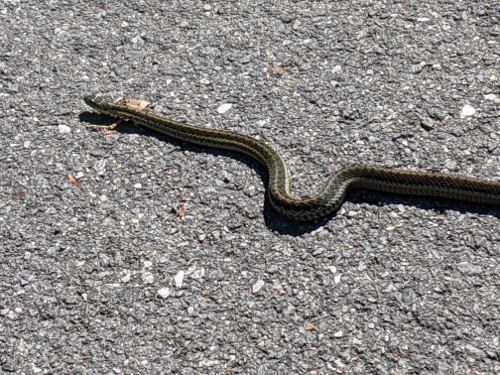
The June Solstice here in central New England means our local snakes are finally active both day and night. Although we’ve seen the more aggressive cottonmouth in the area, it’s the common and docile garter snakes (thamnophis sirtalis) that usually hunt our lawns for bugs and frogs and the occasional mole, which have come to sun themselves on our driveway each morning. This supple fellow from yesterday was about 18 in/46 cm.
The Carr-Gomms write in their Druid Animal Oracle:
Although some legendary dragons are strongly linked with only one of the four elements, many of them happily partake of the characteristics of all the elements: sleeping in water holes, curling their bodies around hills by day, and flying through the air or breathing flames whenever they wish. Quintessentially alchemical, they speak of the energies and powers that exist both within our own selves and within the landscape around us (pg. 135).
A good reminder for the Solstices — the alchemy for transformation is always on hand, in encounters possible everywhere. After all, earth, sea and sky are all in me, too. We be of one kindred, o serpent.
And so when Jesus says wherever two or three are gathered in my name, there am I also, can you feel it? Spirit with us, around and inside us. May we gather in that awareness, wherever we are, by twos and threes, bird and beast, ancestor and neighbor.
/|\ /|\ /|\
Greetings to visitors from Brazil, whose numbers are up today! Muito obrigado!



 Or if you’re more kinesthetic, and words don’t do it for you, a ritual gesture or kind of movement, or for other sensory orientations, sound, color, smell, and so forth. The previous post offered the infinity symbol as gesture or sign, a way of signaling the openness that always walks with us, the ability to slip in and out of other worlds in an instant, and then return. Drawing it might help. (Doodling is one way many of us enter daydream, another world, and to shift consciousness, etc.)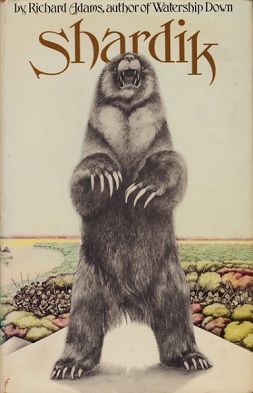

 The pecking order of birds, the ranking among herd animals, a usually stylized aggression to establish social position, can shade into bullying among humans, a specific form of cruelty. Animals generally stop once one of them establishes dominance over the other. We see animal rituals in the submissive gestures of wolves, stags, chimps, etc. who yield to a stronger opponent. A human bully doesn’t stop, and equivalent gestures of submission may simply encourage greater cruelty. The point of bullying is not merely to establish dominance, which is the goal of most alphas, both female and male, but to cause pain.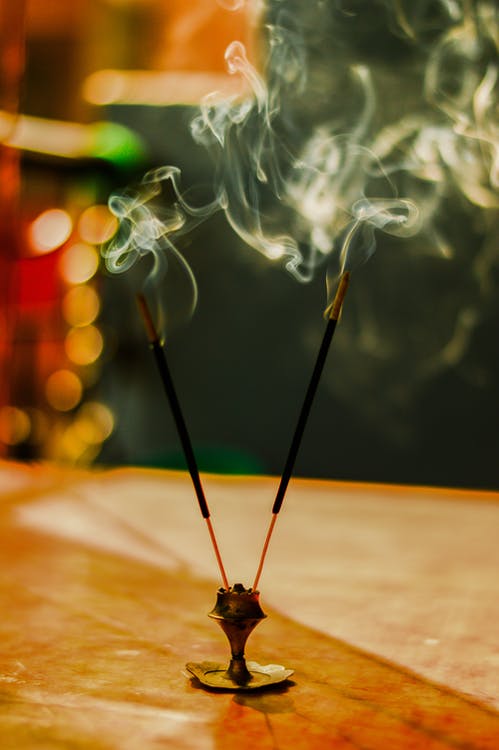








 A Druid Way


