I wrote up a version of the following for my journal, a practice in itself, and now for this post.
John Beckett’s helpful article “A Pagan Framework for Discernment” suggests a three-part approach for anyone doing the hard work of sifting experience and belief for their weight and significance and value. “Religious and spiritual ideas”, he observes, “are notoriously resistant to proof, as our atheist friends like to remind us. But if we wait on absolute proof, we’ll end up abandoning beliefs and practices that are meaningful and helpful to us.”
Divination is a useful practice at such a juncture, for several reasons. First, it acknowledges a need for help. I’m never alone, though too often I face challenges as if I am. [As that Christian triad (Matthew 7) has it, “Ask, and it shall be given you; seek, and ye shall find; knock, and it shall be opened unto you”. No, really!]
Second, divination gives me “something to do” that often relaxes the inner channels sufficiently that I’ll receive guidance “before” I actually do the divination. There’s little support or comprehension in our culture for anyone who talks about “voices in the head” — that kind of talk is one step toward getting you committed. So be careful who you talk to, I hear. Maybe if you started out committed, I hear, you’d know better how to respond to “voices in the head”. Rather than ignoring them, freaking, or heeding them unthinkingly, we’d assume there’s a wider range of options from which to choose.
Third, divination offers suggestions and potential wisdom apart from the usual gossipy, opinionated mechanical self that pretends to conscious awareness most days. Wisdom received often has a qualitative difference from what I’d usually say to myself.
“A belief is true if it works”, Beckett continues, “if it conforms to known facts, and if it’s helpful. But some factors have no bearing on truth even though we might wish they did.”
With such things in my thought as I consider how Thecu initiated communication a couple years ago, and then again recently, I ask for guidance on divination, figuring I’ll draw a card or three from a deck to assess possible directions. To my surprise I’m told to makean impromptu “deck” of nine folded pieces of paper. “Let each be a doorway”, I hear. That’s not quite right; there are no audible words. But the sensation is the same; the words are in my mind.
After I prepare the papers and document the moment with a photograph, almost before I can ask for the next step, I’m given nine words or names to write on them: hampu, lutec, nef, abal, tahilte, renha, lam, tseme, umun. Then, as smoothly as the sense of guidance arrived, it falls away, and I’m left with no further sense of direction. Upheld, then let down.
While the linguist in me putters in the background, turning over the names for a clue to their origin and meanings, I light a small candle and some incense, as much to forestall disappointment as anything else. The incense is homemade, from a workshop some years ago. It needs intermittent relighting, but that’s OK. I send out a silent “thanks and query” with each relighting. It feels right to do so.
Perhaps half an hour later, I receive further instruction, as I’m making some notes about a job lead: “The nine words are associated with the numbers 1 to 9. They are not numbers themselves, but they belong with them. Write the numbers on the cards you made in the order the words came.”
The following day I light candle and incense again, and add a spoken element. As I listen, I try pairing Thecu’s name with each of the nine words, in an impromptu chant, each pair repeated twice, with some playful riffs: “hampu Thecu, hampu Thecu, lutec Thecu, tec, tec Thecu, etc.” In one way, it’s nonsense, but all sound has a quality and an effect, so the practice is not a waste of time in any sense, unless I stupidly insist it is. I will practice this and listen again several more times to test it.
“We are wise”, Beckett closes, repeating his opening assertion,
to focus our attention on our actions rather than on our beliefs. But our actions generate experiences, and in our attempt to interpret and understand our experiences we form beliefs. Our experiences may be so strong or so frequent we are certain our beliefs about them must be right, but if we are honest with ourselves, we can never be completely sure they are right.
But we can ask ourselves if our beliefs work, if they conform to known facts, and if they help us lead better lives. If we can answer yes to these three questions, we can be confident that they are as right as they can be.
How do I pray to you, goddess of storms? Let this my prayer be a litany of questions.
How do I pray to you, goddess of storms?
Let this my prayer be a litany of questions.
How may I best honor you?
You gave me a glimpse, no more,
of landscape, cliffs lapped with green,
mist-hung and mournful,
with this foreign name to call you.
What is your service, what
may I do for you? Why
make yourself known to me?
Unlikely am I, no familiar of shrines,
a god’s service, formal prayer.
Then, too, I know so little of you.
Does naming you for others answer
your purposes? How do I answer you,
goddess of storms? Here are words,
intention, listening. Let this litany
of doubts and questions be first prayer.
/|\ /|\ /|\
In the single experience (see recent post) I had of her, Thecu was particular about the sound of her name: TEH-koo, spelt with a c, not a k. Something bleeding through here of eastern Europe: Thracian, Dacian, Illyrian, Macedonian Greek, Etruscan?
The linguist in me still turns over these very scant details. This is one of those shadowy regions of Europe, where we know so little, mostly echoes from the written histories of neighbors, along with a few hundred words, a handful of inscriptions.
Who knows when odd reading can lead to insight — and material for a blogpost?
Take, for instance, this delicious (to me, anyway) fragment:
“Emotions alert us to specific issues, and they do so without any subterfuge. If we are aware enough … our emotions will be able to contribute the energy we need to move into and out of any situation imaginable, because they contribute the specific energy and information we need to heal ourselves” (Karla McLaren. Emotional Genius: Discovering he Deepest Language of Soul. Laughing Tree Press, 2001).
This kind of statement makes me sit up and pay attention. Partly because any large claim switches on my crap detector, but also because I immediately want to try it out. You know, set up an experiment to test the claim.
In this case, like most of us, I’ve got a running start on just such a test. We can all name stories, movies, songs that grab us and move us. Even — if they reach deep enough, if we’re open and vulnerable to their magic — on the fifth, tenth or thirtieth read, viewing, hearing. Among your top contenders you may count a childhood favorite. The quality of these repeated experiences, at least for me, leaves no doubt: gods are alive, magic is afoot. Magic is alive, gods are afoot. (Leonard Cohen nails it again.)
In fact, so completely may the magic live for you that you guard it zealously and jealously. You watch who you choose to tell about it, because you’ve learned the hard way how another’s misunderstanding or mockery can sting, and even, if it’s carefully targeted, ruin a beloved experience for you.
The number and quality of claims McLaren makes are quite remarkable. Here they are again in list form. Emotions:
— alert us to specific issues.
— don’t lie or mislead — they offer no subterfuge.
— contribute the energy we need to move into and out of any situation imaginable.
— contribute the specific energy and information we need to heal ourselves.
Or, to put it elementally and alchemically, emotions identify what we need to know (Air), clear the way for the will to act (Fire), empower the imagination (Water), and help us heal (Earth).
McLaren also wisely includes a kicker, escape clause, out, safety switch: If we are aware enough … Of course. Isn’t that always the issue at the heart of things?
Stay with me here. (As the Rocky Horror narrator exclaims, “It’s just a jump to the left!”) Working with adolescents in a boarding school for sixteen years let me reflect on my own emotional growth or lack of it, even as I served as an adviser to hundred of students over the years. Because I advised freshman and senior girls, I frequently saw emotion more openly expressed than I might have with boys. How often I’d witness some variation of “I’m so upset/amazed/impressed/in love! Oh my god, I can’t believe X. I was A and now I’m B. I’m so upset/amazed/impressed/in love!”
The lesson here is emotion can be so strong that at first we have no distance from it, no perspective or comparison. We recycle it, loop with it, rehearse it. “All or nothing” is the adolescent’s stereotypical default setting, partly because so many experiences arefirsts and really don’t offer any basis for comparison: first love, first significant failure, first challenging success, first death of a close friend or family member, first major social embarrassment, first large moral choice, and so on. Emotions don’t lie, but when the tide sweeps in and then out again, how do you make your way through the wreckage to picking yourself up and drying out and moving forward?
With some progress towards maturity comes that invaluable ability to detach, step back, gain perspective on one’s own situation and experience. (We might say that IS maturity.) Only then can emotion alert us to specific issues. (If you look at the media and the world right now, we see repeated spikes of emotion with far too little detachment, reflection, proportion, perspective. Keep a person, a community or a nation in the first stage of emotion and they’ll never reach the second stage, let alone any of others. That way mature judgment dies.)
While cooler heads may lament the manipulation of whole groups by the technique of constantly lighting new fires, all while stoking the flames of old ones, there’s a useful lesson in the power of emotion. To lift a line from “Storybook Love”, the theme song to The Princess Bride, “it’s as real as the feelings I feel”.*
And it is. Emotion is real. The gifts of emotion, however, come in what we find after strong feeling. Feel the feeling, yes, I’ve learned. (Can’t do much if I’m repressing it. Genii still in a bottle, that trick.) Then work with it — from outside. Return whenever I need to fine-tune my understanding by checking in with the authenticity of the feeling. Just don’t invite it to take up residence and watch as it tracks in dirt and hangs its laundry over my windows.
Anger. Fear. Lust. Self-pity. Doubt. Feel any of these lately? These are among my top five most potent negative emotions. They’re also five of my teachers. I’ve learned more from anger and fear than I could tell you in any reasonable-sized book.
Awe. Curiosity. Amazement. Gratitude. Love. Another five, among the most potent positive emotions. Also fabulous teachers. Alchemized versions of the preceding negatives, shaped by the spiritual work we’re each called to do in our lives.
Emotion, our elemental Guide of the West, serves us best when we respect its proper domain. Its role is not to usurp our sovereignty by taking the throne.
In the next post I’ll take up ritual and its close alliance with emotion. Through rite and ritual, powered by where emotion can guide me, I can begin to (1) find out what I need to know (Air), (2) clear the way for the will to act (Fire), (3) empower my imagination (Water), and (4) help myself heal (Earth).
That is, I can begin to take McLaren at her word, and try out the claims she makes.
Listening for names. I spend a significant amount of time doing that, between my spiritual practice and my fiction. It’s a curious endeavor, hard to explain, but one a surprising number of people have experience with. What is it we’re hearing?!
Some two years ago in meditation I heard the name of a Storm Goddess, two syllables, beginning with the letter T. I don’t know about you, but the first time I encounter a deity, especially unsought, a being I don’t know, I can feel like I’ve just landed on an island no one’s visited before. No maps, no tourist description, no information to help the next person, because I’m the first one to arrive there. No other footprints on the beach. No electricity. When the sun goes down, I’m left only with this fire I choose to build, a new climate, night noises I don’t recognize, a night sky whose constellations have shifted, or wheel above me wholly new.
Subsequent listening brought me a little more information, a complete name I’m keeping back for now while I pursue additional ritual work and meditation. I do have a general location in eastern Europe where her worship originated. But not a lot more. I’m returning after this interval to pick up the thread, to think out loud here, to see if there’s more to discover. For me, writing about something often activates it in ways nothing else does, blowing hidden embers to flame. (A strong reason for keeping a journal, as I’ve learned. I confess I needed to track down the entry to recover her name. I only have it because I wrote it down.)
Black Sea and eastern Mediterranean
My title for this post isn’t meant to be serious — I have no sense of T “replacing” any other deity. She’s simply new to me, and as far as I can tell, her presence has left no written record. Barring a trip — beyond my resources at this point — to plant my feet on the ground and walk the region west of Black Sea where my meditation showed me her worship once flourished, I’m left with what I can discover from here. No report of divine possession resulting from touching a barrow rising through the mist and contacting ancestors or land spirits. No blaze of insight, no recognizable historical scene unfolding in inner vision. No Hollywood or Bollywood or CGI to dramatize a blogpost. No Industrial Light and Magic courtesy of the Otherworld.
That doesn’t hamstring my search, but it does direct it inward, fitting for a deity whose worship has apparently withdrawn to inner realms.
Why did she make herself known two years ago? That itself forms part of my search. It’s the nature of UPG, unverified personal gnosis, that I can’t yet rule out being played by a spirit. That’s no different than how a phishing advertisement or a fake news article snags a portion of its readers who part with money, belief, a sliver of common sense and integrity. What distinguishes my experience is the approach, if you want to call it that, of T. Reserved, as if testing me. No requests. A trickle of information, a flash image of green and rocky landscape. Enough to hang a meditation session on, enough to ask for a return on the investment of energy involved in making contact with an incarnate being, me, with lots of other demands on his attention and time. Enough to provoke this post.
Now part of the experience is that the writer in me immediately, inevitably jumps aboard and starts playing. Imagine! he says. You were her devotee in a past life and she’s contacting you to revive her worship! Decent premise for a story, right?! Or, or … it’s an inner warning of outer storms to come. Or this isn’t the goddess but a priestess of the goddess reaching out to you for a Dion-Fortuneque revivification of a spiritual energy whose time has now come again to wash over the earth. See what I mean? What to do with such a companion?!
Yes, my writer self is more than a bit of a quicksilver imp, a drama queen, a runaway dreamer who’d sooner spend an hour in reverie than getting words on paper or screen.
But for all that, he’s opened doors and given me words I don’t get any other way. He’s part of the package. I’m talking about all these things to give you a sense of my process. Yours, of course, is your own.
The June full moon, often aptly named the Strawberry Moon, actually reaches its fullest tomorrow (Friday) morning, but most North Americans will see it at its peak tonight.
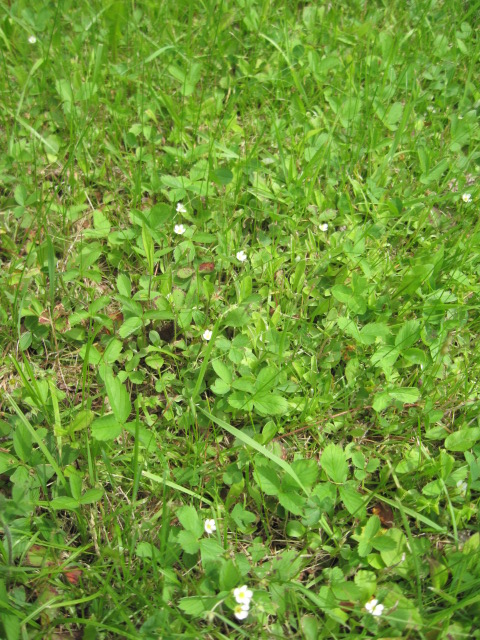
wild strawberries, north yard — perfect reason not to mow
Tonight I’ll offer my full moon ritual for the health of the hemlocks that line the north border of our property, as well as other beings, “quando la luna è crescente” — while the moon’s still waxing. As the full moon nearest the summer solstice less than two weeks away, Strawberry Moon plays counterpoint to the shortest night and longest day of the year, and governs the first of the true summer months here in New England. I’ll be posting a follow-up in the next weeks.
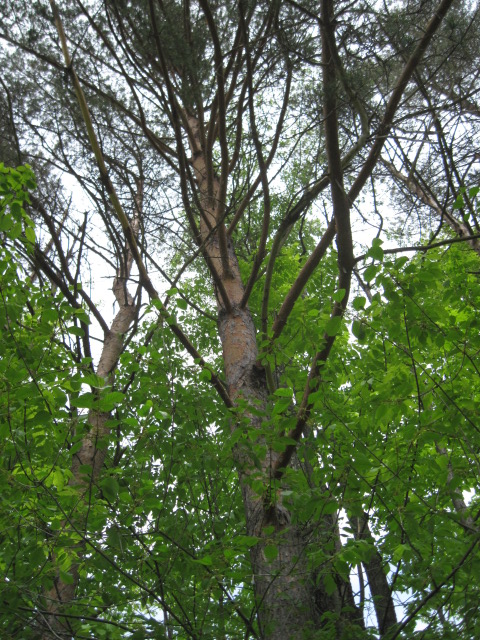
“queen” hemlock, 50 ft. tall, visible from where I write
As Dana has so passionately documented on her Druid Garden site, including a powerful ogham/galdr healing ritual, the eastern hemlock battles against the hemlock woolly adelgid, widespread enough that it’s gained its own acronym — HWA. The adelgid, an aphid-like insect, is just one of several pests that afflict the trees, but one not native to North America and a factor in near-complete mortality in infested areas. As a commenter on Dana’s blog notes, natural biological agents offer the best and least toxic means of control and containment. The United States Dept of Agriculture site summarizes the situation well.
And if you ask why, Our true self and the land are one, says R. J. Stewart. As always, test and try it out for yourself. That ways lies deep conviction, replacing casual opinion with earth loved, spirit manifest, life full.
9. How well does my spiritual interaction pass through the “Three Gates”?
This, I’ve slowly learned, is a great question to ask both before and after. In other words, any time.
As Matt Auryn notes in his original blogpost, “Rumi is credited with wisdom about three gates of speech. ‘Before you speak, let your words pass through three gates: At the first gate, ask yourself “Is is true?” At the second gate ask, “Is it necessary?” At the third gate ask, “Is it kind?”‘”
These gates, I’ve found over the years, work splendidly as a guide for my spoken interactions and for any other kind, too. They also form a powerful Triad for making decisions.
I need to include myself in the Triad: is my speech, action or decision also true, needful and kind — to me? What about my thoughts? And my feelings?
Often, whatever I’m testing with the Triad, I can get two out of three. Often it’s true and necessary. But it’s not kind. Return, return. Start over.
Standards tighten, I’m discovering. It’s not necessary anymore merely to “do no harm”. Someone — god, ancestor, higher self (same, different?) demands more. As elastic beings, staying where we are almost guarantees that the past stretching we’ve suffered through and learned from and grown into will weather down into slack. I can read the signs — tedium, stagnation and listlessness, if I don’t keep on stretching, letting myself be stretched, seeking out opportunities to stretch not just further, but wisely.
10. What’s my goal for interaction with Spirit? What is Spirit’s goal for me?
Important questions. Sometimes I know, or think I know, what’s needed at the moment. Sometimes it takes some digging to get to honesty with myself.
Other times the answer’s easy: no clue.
Usually that’s an excellent place for me to be. It means I need to listen first, before anything else. Instead of a ready cliche or a stock answer or something I dredge up from my own most recent spiritual slackness, I practice patience.
Sit, sing and wait, counsels one of the Wise. So I find different places and perspectives to sit in. The front entry of our house does duty for a small but useful office. Or a tree-stump from a powerline clearing that Green Mountain Power left beneath the row of hemlocks on our north property line. I sing a word, a name for spirit, a line from a song or poem, a spoken fragment from a dream. And I watch as this moment crystallizes into the next, and shapes of possibility begin to form. Often they scatter, birdlike, flying somewhere along the horizon, not where I’m gazing at all. I stand up and go about my day, and a whisker of insight, if I honor the handshake of spirit, comes.
11. How can I see and describe my understanding as a perspective?
Matt Auryn observes, “One of the best ways to keep your ego in check when discussing different methods and ideas is to claim them as your perspective and not as the dogmatic way to do things”.
So I try to remember to tell myself rather than believing X or Y that I suspect X or Y. Because whether it’s a ripple in the apparent world or a flash in the Otherworld, I almost always under-perceive it. I miss something, and often a lot. I kneel down to study a large footprint in our muddy backyard, never seeing the bear that made it lumbering away to forage among early blackberries. But knowing there’s alway more to perceive doesn’t discourage me. It makes it a game, even and especially when the stakes are high. Sometimes my best contemplations take wing when I begin by asking So what did I miss this time?
backyard black walnut coming into leaf
12. What hints and nudges has spirit sent to me already about fine-tuning my practice?
Every week or so, there’s a tonic that Spirit throws me down for and forces me to swig. “Take as indicated”, the label reads. And the fine print says:
“You’re a slow learner. That’s ample reason to practice humility. Everyone else is a slow learner, too. That’s an excellent reason to practice compassion.”
Funny how I haven’t yet overdosed on either of these.
13. What examples and teaching from the natural world greet and guide me today, right here and now?
A question I need never cease asking.
Yesterday and today, rain. The power out for about 90 minutes. The thermometer reads 46 F (8 C). I lit a fire about an hour ago. And as I set a match to the wadded newspaper and kindling, breathing the faint cold ash of the last fire, I knew Brighid was present, whether I’d invoked her this time or not.
Invocation, I heard/thought as the flame took hold, is my privilege. The gods welcome my service, but they move in the worlds just fine without me. And where there is privilege, and service, there is also wonder.
Happy Beltane! Go here for an enthusiastic if skewed view of the holiday, and here for The Edinburgh Reporter‘s take on this year’s celebration in Scotland’s capital tomorrow evening. As the Chair of the Beltane Fire Society says in the article:
Beltane is an event that cannot be described, it has to be felt, and that’s what makes it so special. We really want to reach out and welcome in the wider community this year, so come and share the beginnings of Summer with us.
Thornborough Henges, Yorkshire, England — site of modern Beltane festivals
If you’ve been following this series on some of the shared imaginal territory between Druidry and Christianity, and you find your hopes both raised and disappointed, this preamble is for you. Of all the themes, festival and holidays are probably the most self-explanatory. Instead of worrying too much about what I’m writing here, go find a good Beltane celebration. You’ll know more afterwards than anything I cover here.
But if you’re kind enough to have stayed and you’re still reading, let’s take a look at the nature of this theme. Now I have something of a handle on the weaknesses in my own understanding and writing ability. Let’s lay that aside for a moment. You and I both bring to this discussion — as we do to everything else — our personal histories of living in societies where Christianity still dominates the scene. After all, for centuries it’s ruled the roost. It’s been the default setting: our laws, values, art, music, vocabulary and ways of thinking all still draw so deeply from Christianity that we can suppose only naively that if we’ve “left the church” we’re “free” of it, and shaped no more by its perspectives and doctrines and worldview. [Yes, you may belong to the growing minority who grew up in a non-Christian household. Still, it’s pretty likely you celebrate Christmas in some way, and get some kind of Easter vacation without even asking.]
We assume, that is, if we no longer subscribe to a handful of Christian doctrines for spiritual guidance and practice, that we’re somehow “post-Christian”. You hear that everywhere. Yet we can acknowledge how much Classical civilization continues to mold the West — we never imagine we’re “post-Roman” or “post-Greek”. To offer the most trivial example, one of our generic insults is “Go to hell!” — a distinctly Christian destination, one that’s unlike to freeze over any time soon. (We can check back in after another 500 years — maybe by then a more clearly post-Christian West will have taken shape. One of the best ways to test this is to live for a time in a non-Christian part of the world. Much of Asia will do, but so will the Middle East, Africa, and parts of South America. Get back to me after that, if you take issue with what I claim about persistent Christian influence in the West. I had to live outside the U.S. for three years to see something of this.)
In a word, we’ve all got baggage. Nothing surprising in that. But if by chance we still long to salvage something from Christian practice that moves us still — if we refuse to throw out an imaginal and spiritual baby, however troubling its family tree, along with an often foul historic bathwater — and we’re walking a non-Christian path, the many links and themes like these past few posts have explored can call to us quite strongly. Parts of the Mass may move you, or you love the lights and cheer of Christmas, or the palm fronds and joy of Easter, or the quiet of candlelight services where words don’t fill your head and your heart has space to expand into the richness of silence.
We can use that fact of emotional and spiritual connection, use it for insight and growth and exploration.
How? Bear with me. I’m suggesting a few ways in what follows.
One of the delights of following a couple of blogs mining the same spiritual or religious vein is the interconnections they can weave over time. Obvious reasons for such common ground are shared experiences, comparable reading lists, current events, and so on. But sometimes you just end up in shared spaces, looking around and talking about what you’re experiencing, as if it’s in the air and water. (Which it is.)
I reviewed John Beckett’s new book in the last post, and John launches the interconnection this time, in his recent April 25th post “Why I Had To Make a Clean Break With Christianity“. If you follow his blog, you know that John has grappled with the lingering after-effects of membership in a fundamentalist church, and its mind-warping power on his worldview. He revisits that experience occasionally for hard-won, balanced insights anyone can use.
If you’re uncertain about the possibility of an rapprochement between Druidry or Paganism and Christianity, in other words, John’s got something to say you may find well worth your while.
There have always been, he notes, Christian groups with a wide range of practices:
Christianity was never a wholly new thing in any of its forms. It has mythical roots in Judaism, intellectual roots in Greek philosophy, and folklore roots in every land in which it was established. Some pagan beliefs and practices survived, but they were Christianized. They had to be –- in medieval and early modern Europe it was impossible to be anything other than a Christian (or possibly a Jew, in some places, at some times, for a while…).
These survivals and continuations include magic –- a lot of magic.
As a Pagan and Druid, John knows magic because he practices it, and from that practice he knows from the inside how pervasive magical practice actually is. If you’re human, in other words, you’ve both done magic yourself and had others practice it on you. The less conscious, and therefore weaker, the more random in its effects. But most Westerners have confronted one extremely common form of debased magic in advertising — the manipulation of emotion, desire, image, sound and verbal conjuring for a specific purpose: to sell you stuff. And though most of the more radical Protestant denominations have worked assiduously to purge their churches from any perceived taint of Catholic magic, it manages to creep back in unseen.
Magic doesn’t care what you believe – magic cares what you do. Work this magic properly and you’ll get results.
But I can’t do this magic. I had to make a clean break with Christianity and I can’t go back, not even to work magic with the aid of powerful spirits.
Wait, you’re saying. The title and theme of this post is Festivals and Holidays. What’s thatgot to do with magic, anyway? You’re always going on about magic. Enough already!
Well, “ritual is poetry in the world of acts“, wrote OBOD founder Ross Nichols. And poetry works with image and emotion. You see where this is going? Poetry is magical art, verbal magic. And rituals and festivals, if they’re potent and memorable, are stuffed with poetry and theater. There’s a reason that a wedding at a justice of the peace can be much less satisfying than a church or temple wedding, regardless of what you believe. (Because what you do is another matter.)
We long for ritual, even as we’ve managed to banish a bunch of it from our lives. So we pour it into wedding planners and other secular makeshifts that can deplete our bank accounts without delivering the goods. (“But do you really feel married to this man?” my mother-in-law asked my wife after our non-church wedding. Note: we had two weddings, secular and spiritual to cover all the bases. Neither one “churched”.)
So. Most of the “Great Eight” holidays of the Pagan Wheel of the Year have their Christian counterparts. We needn’t rehash old arguments about who “stole” whose holiday. If Druids, and Pagans generally, would like to find common ground with Christians, shared celebrations of holy days are one place to look.
Interestingly, of all the Eight, Beltane has perhaps the weakest Christian link. Yes, May 1st is the feast day of two apostles, James and Philip, in the Catholic church. In northern and central Europe Walpurgisnacht on April 30th, the eve of the festival of the eighth-century saint Walpurga, on May 1, came to be associated with witches. Beltane on the other hand was almost exclusively a Celtic holiday until it was claimed by neo-Pagans in the middle of the last century. Six months out from the start of winter at Samhain (“summer’s end”, the Celtic sam– cognate with the sum– of English “summer”), Beltane also fits the rhythms of the year-long cycle of seasonal celebrations, heralding the beginning of summer, of energy and fertility and well-being.
Whatever you do, wherever you are, try to find a way to celebrate the season.
There was the briefest mention of fire in the previous post, but much more about the other three elements. Why?
Deborah Lipp notes in her The Way of Four Spellbook (Llewellyn, 2006):
Fire has always been set apart from the other elements, because Fire alone has no natural home on the earth; Air has the sky, Water the sea, and Earth the land, but only Fire stands apart from geography. In nature, Fire is the outsider; it is out of control, and it conforms to no known rules (pg. 10).
Now Lipp’s observation both captures the nature of fire and also feeds our stereotypes about impulse, passion, strong feeling. How often we may long — or fear — to be out of control, fearless, spontaneous! Who hasn’t felt like an outsider at some point? Why would the Australian-inspired Outback Steakhouse restaurant chain opt for its advertising slogan “No rules. Just right”? Because there is indeed a rightness to fire — it can only flame up where there’s something to burn, after all. And most of us have been storing combustible material for a long time. How else to explain our explosions, outbursts, flares of temper? Even our language about these things draws on fire for metaphor.
Following the theme from the last post, we can speak of a fire baptism. You’re wholly in it when that happens. The full experience, nothing held back.
John the Baptist, Jesus’s precursor, explains to those asking, “I indeed baptize you in water … but he that cometh after me is mightier than I … he shall baptize you in the Holy Spirit and in fire”. We sense the power in fire, of all the elements closest in so many ways to Spirit. It can purify, transform, forge and anneal. Its extreme heat can also scorch, char, consume and destroy. Each element transforms its own way. “We didn’t start the fire”, sings Billy Joel. “It was always burning since the world’s been turning”. But he goes on: “We didn’t start the fire. No, we didn’t light it, but we tried to fight it”. And sometimes we even try to “fight fire with fire”. Yet we also long for fire to kindle cold hearts, to heat a flagging will, to spark the spirit deepest in us. We yearn to be fire.
“O! for a muse of fire”, cries Shakespeare’s Chorus in the first line of Henry V, “that would ascend the brightest heaven of invention”. We long to blaze, because we feel in fire something native and free. We are both it and other, too, as with all the elements. “Time is the substance from which I am made. Time is a river which carries me along, but I am the river; it is a tiger that devours me, but I am the tiger; it is a fire that consumes me, but I am the fire”, says Jose Luis Borges. The elements are natural sacraments, folds and garments for Spirit all around us. For fire, we light candles in so many traditions, for so many reasons, the flame cheering to the eye and heart.
I both am and am not fire. Self and other: the quest of our days, the distinction we cherish and also long to cast away. Pagan, Christian, Buddhist, Muslim, Jew, atheist, shaman, through all these experiences and intuitions we still ask ourselves, each other and the world: “What makes a good burn?”
/|\ /|\ /|\
Maybe the purest ritual Druids and Christians might share is one which seeks not to fill our ears with answers, but that gives us space and silence to listen to and ponder the questions. In some ways, the long, slow burn of Spirit in us is fire in its most potent form of all.
/|\ /|\ /|\
Beltane approaches, that festival of fire. The Edinburgh-based Beltane Fire Society celebrates 30 years this year of a dramatic festival of thousands, from 8:00 pm to 1:30 am. Here’s the “Drums of Beltane” subpage of the Society’s website. As the page notes,
Beltane may be known as a fire festival, but it may as well be considered to be a drum festival too. Drums are the beating heart of Beltane that create the rhythm of the festival, drive the procession forward, and soundtrack the changing seasons. They have been an integral part of Beltane since our tradition was first re-imagined on Calton Hill in 1988.
Looking for a fix of Beltane energy to get you launched? Here’s a video of the Drum Club which will be among the groups performing this year for the event. Just the first five minutes will give you a fine taste of Beltane fire in sound form. We can spark from anything, but sound and rhythm are powerful keys.
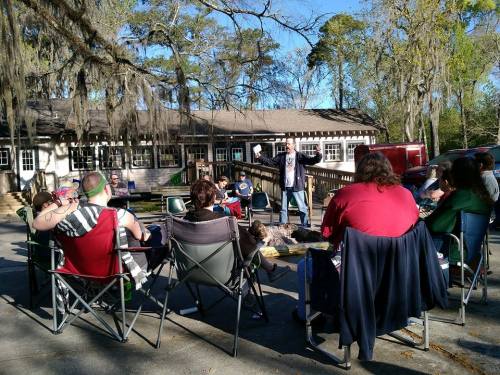
Highland Oak Nemeton, Fontainebleau State Park in Mandeville, LA, the magic of assembled Druids, and a sunny weekend of Gulf Coast weather in the 70s and 80s worked their cumulative spell on the 50 or so attendees of this year’s OBODGulf Coast Gathering. The spirits of the land witnessed Druids from OR, CT, VT, PA, FL, TX, LA, NE, VA, MI and other states make their way to the south-central U.S.
image courtesy Steve Cole
The workshops explored the Gathering theme “Opening The Seven Gifts” of Druidry. OBOD offers a lovely 2:30 video that presents the Seven Gifts more attractively than a bald recital could.
Our presenters kept the topics lively, sharing insights and fielding comments. Druidry needs no “outside experts” — the spiritual path generates its own.
Nonetheless, it’s always a draw to have a visiting speaker — and once again we welcomed the always-fabulous Kristoffer Hughes, one of Her Majesty’s Coroners, author, professional actor, OBOD Druid, and head of the Anglesey Druid Order in the U.K.
Kris spoke on “When the Last Leaf Falls: Death, an Awfully Big Adventure”, examining Western attitudes toward, and treatment of, the dead, and ways Druids can respond creatively and spiritually to the frequently dysfunctional nature of the Western “death industry” and its dehumanizing and ecologically destructive practices. He also urged us to bring each other in on, and discuss, our own plans for our deaths, disposal of remains, and the types of memorials we want.
Kris during his talk — photo courtesy Kezia Vandilo
Dana dispelled stereotypes of magic during her evening talk around the fire our first night, the opening ritual fresh in our memories. The following morning Richard addressed the core of Druidry — getting back in touch with nature.
Richard and Dana
Lorraine helped many meet a new animal guide, Gabby drew us to consider healing, Jacob turned our thoughts to philosophy, and I explored the awen and the potentials for inspiration. Even if [below] my gesture at one point suggests a fish story — “the big one that got away”.
photo courtesy Kezia Vandilo
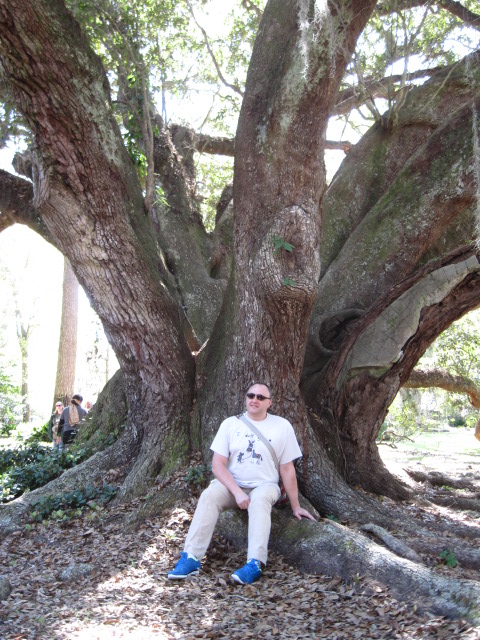
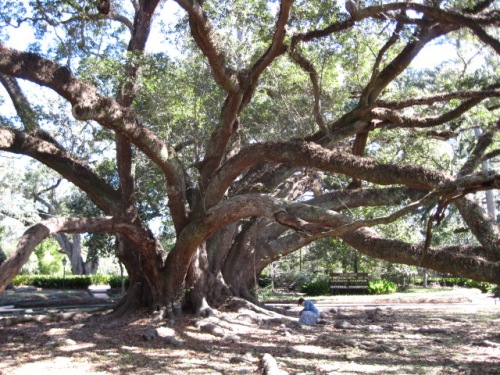
We initiated three Bards and five Ovates, held opening and closing rituals, along with the Seasonal Alban Eilir (Spring Equinox) ritual, went on nature walks, and visited the Seven Sisters Live Oak in nearby Mandeville, LA.
Below is our Welsh Druid guest communing with the tree, estimated to be over 1500 years old, and below that is a more distant shot to suggest something of its size.
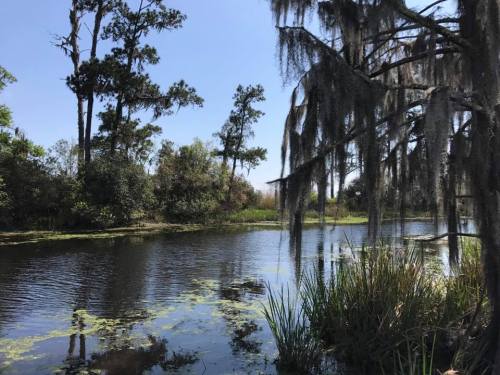
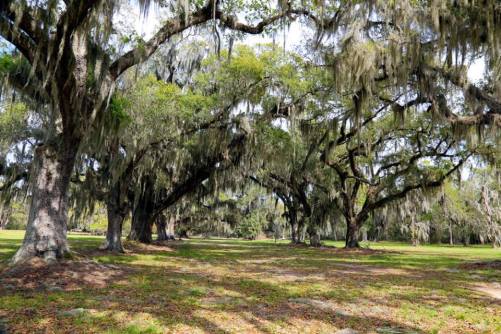
John Beckett captured an image of the atmospheric Spanish moss parasitic on so many trees south of the Mason-Dixon line.
photo courtesy John Beckett
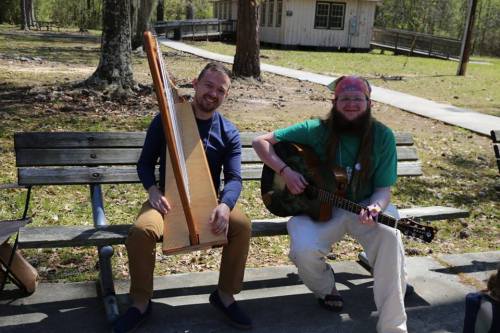
Storytellers and musicians, notably Jacob Pewitt and Brian Van Unen, made the slowly cooling evenings magical around the fire.
Jacob and Brian — photo courtesy John Beckett
What better way to leave behind the 18″ of snow in Vermont from the recent March nor’easter?!
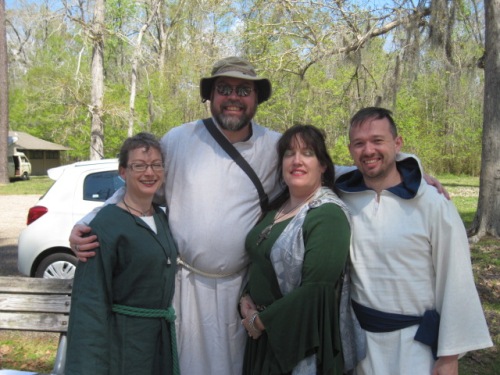
Always, always, it’s the faces, the reunions, the collapse of miles between us, and the conversations that make each Gathering so memorable.
Don’t know anyone before you arrive? You will before you leave!
All right — I’ll admit the title-as-opaque-acronym is at least a little clickbaity. (I do like the “dig” in the middle of it — it fits one of the themes for this post.)
But more importantly, this is the question I find my life keeps asking, in ways both small and large. What next?
Large: like many cancer survivors, I monitor numbers from regular blood tests. The slow rise I’ve seen over the past 5 years in undesirable antigens means I can’t grow complacent. “Leave nothing on the table,” counsels an elder I know who’s grappling with dementia. A life lived within limits isn’t a disaster: from everything I’ve seen, it’s the only way life happens. Nobody “does it all”. (The young adult novel I’ve got one-third finished won’t get completed on its own. It’s up, and down, to me.)
Small: a Meetup group I’ve been nurturing patiently is finally large enough to gather for an Equinox/Ostara potluck. A member’s offered her home, and we’ve got several people committed to bringing a dish to pass. One more chance to practice savoring the shoots and leaves of new growth that spring makes its specialty.
In-between: unable to afford to buy a bigger house (we opted 9 years ago for small), or encouraged by any leads to move out of state for jobs, my wife and I focused on asking how to flourish where we are. She eventually found part-time work, and we built an addition to give us breathing room. I’m getting good writing ideas faster than I can get them on paper or screen.
How to survive, yes, of course. But how to thrive, the deeper quest.
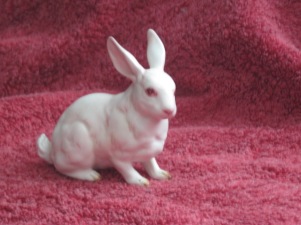
Sometimes the big picture isn’t what I need, though I thought it was. Sometimes, instead, it’s just the next step, it’s the phone call I remembered to make this afternoon, it’s the contemplation or ritual tomorrow morning. It’s the short walk that reveals sudden green beneath melting snow. It’s the porcelain hare my aunt gave me 50 years ago.
I think “half a century” and don’t know what I feel. Then I think “half a century” again, and I say to myself, “I’m still here, still wondering what comes next”. I take the delicate figure down from the shelf and blow from its pink and white ears the dust from a season of wood stove ash. The picture’s not quite in focus, but my camera doesn’t do closeups any better. A piece of wisdom: it doesn’t have to be perfect.
And I open for the 100th time the demanding draft of a workshop I’ll be giving at Gulf Coast Gathering on “30 Days and Ways to Tap the Awen”.
Well, I remind myself, you asked for them. The inward sap bucket fills, after a winter’s dry season. Now the trick of a moment (a life): to open my heart wide enough to receive.
The first stanza of Damh the Bard’s lovely song “Brighid” (below) places the goddess in the landscape of vision:
There’s a tree by the well in the wood,
That’s covered in garlands,
Clooties and ribbons that drift,
In the cool morning air.
That’s where I met an old woman,
Who came from a far land.
Holding a flame o’er the well,
And chanting a prayer.
Though here it’s the goddess who’s “chanting a prayer”, the bard has invoked her with song — his own prayer. And he’s gone to the “well in the wood” full of intention. Maybe not specifically to see the goddess, but knowing the tree and the well and the moment offer possibility waiting for human consciousness to activate. A gift of the gods, already given freely to us.
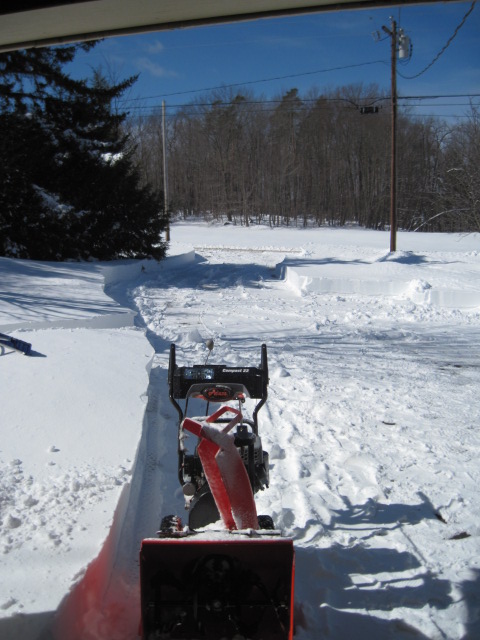
Here in Vermont a light snow falls as I write this, and I step away from the keyboard to take a picture.
By February here, snow itself can signal spring to come. You can feel the longer light, and moments of snowy beauty remind you that wonder is never far away. The sap will be running soon in the maples, the sugar shacks smoking all day and night as the sugarmen boil down the sweet juice to syrup. Green will burst forth, improbable as that seems right now in a world of cold whiteness. So Brighid comes from a “far land” that is also always near to attention, intention and devotion.
Here across the Pond from the Celtic homeland, some North American Pagans can feel removed from the “gods of Europe”, bewailing their distance. This place, we can feel, isn’t “Their” land. Yet anyone who’s encountered a spiritual presence knows that place is a convenience of the gods, not a requirement — a set of clothes, not the being who wears them.
Yes, it would be splendid, we imagine, to visit that “tree by the well in the wood”, simply by stepping out the back door to a landscape steeped in stories and legends of the goddess. Yet we also know what familiarity breeds. Or as an African proverb has it, “Those who live nearest the church arrive late”. The old saying that the gods like the offering of the salt of human sweat means effort is not wasted, devotion is repaid. Always, we have something we can offer them. And the gods give, but “not as the world gives”.
For you soon find that the gods are not merely passive reservoirs, to be drawn down whenever we happen to think of them and plug in for a re-charge, our rituals cannily crafted to work like the swipe of a credit card at a gas (petrol) pump. “Fill me up, Brighid!”
But wait, you say. Isn’t that just what we’re doing with ritual and song?
It’s really not a matter for argument, unless you need the exercise. Damh the Bard knows Brighid — you can hear it in the song. And out of love he’s traveled many times to the tree by the well in the wood. Brighid knows his name.
This, then, is one intention to cherish: may we serve them so that the gods know our names. Not to hold it up before others like a badge of pride, but as a spiritual resource to treasure and spend at worthy need. Or as Gandhi said, “If no one will walk with you, walk alone” knowing in truth you aren’t alone.
Ten years ago I didn’t honor Brighid. I didn’t “believe” in her, though I’d heard her name, thanks to all those who kept it alive in our world. Now I honor her, but I still don’t trouble myself about “belief”.
Instead, I take the hint and look. “I saw her reflection in the mirrored well”, Damh sings.
And I looked deep in her face,
The old woman gone, a maiden now knelt in her place,
And from my pocket I pulled a ribbon,
And in honour of her maidenhood,
I tied it there to the tree by the well in the wood.
[If the upshot of watching the video about Yury, the “Russian Hobbit” featured in yesterday’s post, has you most concerned about whether Petrushka, mentioned only in passing, is actually Yury’s rabbit, I’ve still achieved something. Something very small, but still something.]
/|\ /|\ /|\
ESCAPES and MODELS
This post examines some of the arguments, examples and ideas in a recent (Jan. 15, 2017) essay in The Atlantic with the unfortunate title “Seeking an Escape from Trump’s America.” I say “unfortunate”, because the problems the “escapees” face neither originate with Trump nor will they end with him. His name here is merely a red flag to a bull.
In the previous post, Yury aspires to, and achieves, a personal solution to his problem. For some, that may be enough. For others, community is a less selfish choice. It can also prove much more viable if you don’t have the means to drop out and move to Maine, as the previous post begins to suggest.
More importantly, the intentional communities the article investigates are not all “escapist” by any means. Rather than retreat, some attempt to engage the larger culture and model more viable and saner alternatives. Several got their start years and in some cases decades before Trump had entered the political fray. You could even call the title clickbait, because it does a disservice to the writer, who very probably didn’t choose it, and to the substance of the article, which grapples with some real and compelling concerns.
Twin Oaks, a community of some 100 members, celebrates its 50th anniversary this year. The community founded in 1967 can speak with particular authority — experience and evidence of its survival and “thrival” — about almost every issue facing intentional communities today. I believe the video below really is worth your next 16 minutes.
Now it may be that the video, or this post and some of the previous posts don’t speak to you. Perhaps you’re largely immune to the accumulating economic, political and cultural upheavals of our era. Possibly you’ve made your pile, your mortgage is paid, you have diversified investments, or other secure-enough sources of income. Along with those bulwarks against poverty and despair, you’re healthy enough to garden or handicraft your way through the next few decades until mortality relieves you of the challenges of this particular incarnation.
If so, please consider how you can help others. You don’t need to subscribe to false-Christian ideas of giving away all you own, unless you’re entering an intentional community, monastic or otherwise, for which this is the admission ticket. Why plunge yourself into poverty out of guilt or misguided perceptions that this will help someone else? Instead, use your position and privilege to accomplish something you choose to do for others.
ALTERNATIVES to “CONSUMPTION-HEAVINESS” and DESPAIR
One group has “given an official name to their search for an alternative to consumption-heavy American life: the Downstream Project, with the motto to ‘do unto those downstream as you would have those upstream do unto you.'”
That’s one measurable goal. Rather than trying to “change others”, live so that your life doesn’t make other lives harder. I know that’s certainly more than enough for me, some days. A negative goal troubles you? Think of the Hippocratic Oath: “Do no harm.”
Can we aim for something larger? Of course. “… instead of continuing in passive despair, as many Americans seem to do, the people in these communities decided to overhaul their lives.” What would a “life overhaul” look like for you? The beauty of the question is that the answer is wholly up to you, if you let it be. Why not your answer, rather than anyone else’s?
Many of the Druids I know give more than lip service to this ongoing question. Despair just gets boring after a while. And that’s one of the reasons I love them: they don’t merely go through the motions, but bring courage to their own lives, and find worthwhile challenges in engaging bigger questions than “Where will I vacation this year?” or “What’s on cable?”
If you still haven’t let go of “Trump?!”, consider this observation by one member of an intentional community the article considers: “When there’s a Democrat in power, social-justice-minded people go to sleep, because they feel validated by what they hear on NPR.”
We can even practice Trump-gratitudes: I thank Trump for waking me up, for kindling useful anger, for provoking self-examination, for puncturing my weak political stances, for making me doubt, for unsettling the false comforts of middle-class-dom, for X, Y, Z …
ALIENATION as a RESOURCE
So what can we do with these gratitudes once we affirm them? Feel just as alienated, if not more so?
Alienation is “othering”, and not all bad. (Trump himself is a delicious example of a Monty-Pythonesque “Now for something completely different”.) One thing becomes another anyway: it’s how the world works. Alienation? “The Living Energy Farm runs on a different philosophy of alienation: If they can prototype alternatives to modern life, they believe, they can eventually remake the world.”
Any real re-making happens at home:
In the summer, [members of one community] cook with a small solar dish and a rocket stove behind the kitchen; they’re building a bigger dish, taller than a grown man, nearby. They hooked up an exercise bike to a washing machine and rigged a pair of old tractors to run on wood gas rather than gasoline, although they aren’t quite functional. They built their own food-drying room off the kitchen, where they process vegetables grown on their 127 acres, and they graft fruit-tree branches onto wild stems.
‘We refer to it as neo-Amish, or Amish without the patriarchy,” another member says.
Some of what we see as solutions are inextricably bound up with the problem:
“The way we choose to live has far more impact in terms of our environment … than any particular technology,” [one community member says]. “If Americans bother to talk about the environment at all, it’s usually in terms of a technological perspective.”
We’re conditioned, after all, to expect technical fixes for most problems, when some of the best alternatives simply don’t originate in technology.
… mainstream environmentalism is too focused on incremental reform and modest lifestyle choices, like driving Priuses. “For us, the question is: How do I live comfortably with what renewable energy can do? … If you ask it that way, you can’t drive to D.C. and work in a cubicle,” he said. “But the environmental groups want to tell you that you can, because then you’ll send them donations.”
Ouch. But useful ouch, I hope. For Deanna, another community member,
“I envisioned being remote, being able to keep to ourselves, not being involved in whatever strife is going on in cities,” she said. She was glad to leave behind Boston and demonstrations like the ones that took place after Trump’s election; she’s also glad they now drink from a well, she said, because “it feels safer to be in a place where we have control over our water.” Hers is not a search for ideals, but for something tolerable—something better than what was available elsewhere.
If such retreats from what mass culture offers can provide something better, why not try them out? Another community named Cambia (“change”) isn’t just retreating.
To some extent, they’re trying to spread their knowledge and their project. They’re writing a wiki, nicknamed “commune in a box,” outlining legal and tax details for income-sharing communities—Cambia, it turns out, is both a commune and an LLC. They want people to be able to start new communities, tailored to their own needs; Cambia is not the model, they said, but a model.
Viable experimental models of alternatives are crucial at hinge points in the human experience. We certainly seem poised on one right now.
Another commentator concedes a signal challenge of making any change.” It takes a lot of cash to get off the grid,” he says. Putting it another way, you almost have to start rich to become poor.
… becoming untangled from capitalism also means becoming much more vulnerable. It’s tough to imagine a comprehensive way of replacing health insurance, not to mention programs like welfare, in a world without government.
“What we have now is an embryonic global civilization that’s totally ecologically, socially, and economically unsustainable. … There’s no escaping into your own little enclave.”
Once again, at the risk of sounding a theme many already know and others label a facile fiction, I’ll quote Tolkien’s Gandalf as he counsels Frodo: “The wide world is all about you: you can fence yourselves in, but you cannot forever fence it out.”
Some people use the term “lifestyle politics” to describe these communities—“the belief that if you live your values, then you will be able to make effective change, or at least express your political perspective,” [University of Washington professor of political science Karen] Litfin said. “I think that’s a good place to start, but if that’s where you end, you actually don’t have much impact at all.”
Meaningful change, I find, has to start with me, or it literally doesn’t mean anything, or not for long. It stays on the page (or the blogpost). I’m the center, just like everyone else is, where any transformation takes place.
An INVITATION to COMMENT
Reactions? How can we continue this conversation? (The most important arguments we have are with ourselves.)
[Updated 2 June 2020: see my Romuva Update of May 2020.
14 Dec 2018: minor editing.
29 Dec 2016: two links added: a tribute to Trinkunas and a video of Kulgrinda, a music group he founded.]
One of the expressions of love of the earth relatively unknown in the U.S. is Romuva, Baltic Paganism. It is better known but similar to Druwi, another Baltic Pagan practice whose name itself shows its obvious connections with Druidry.
I first encountered this mostly Lithuanian pre-Christian religion about a decade ago, and I’ve followed news of it intermittently since then. Lithuania was one of the regions that held on to its ancient Pagan roots longer than most of Europe. Pagan observances still flourished into the 1400s. A series of crusades over several hundred years aimed at stamping out such lingering practices were largely successful, but even in the 1400s under Grand Duke Gediminas, Lithuania was still officially Pagan.
While much has undoubtedly been lost, Romuva imagery, song, symbol and practice were and still are intertwined with Catholic observance to a considerable degree, and folk memory and practice has preserved much material, particularly songs and dances. The roots of modern Romuva date from the Romantic period that sparked Lithuanian nationalism and an interest in indigenous culture, as it did for so many other regions of Europe.
Like many cultural phenomena of the last few hundred years, Romuva as it exists today owes a great deal to one person — in this case, ethnologist and krivis (Romuva priest) Jonas Trinkunas, who was born in 1939.
Jonas Trinkunas
Trinkunas, who passed almost three years ago in early 2014 (you can find a tribute at the Wild Hunt here), was a folklorist and university lecturer in Vilnius, Lithuania. He founded the “Society of Friends of India” (Lithuanian Indijos Bičulių Draugija), and the similarities of practice he saw in “the traditions of India were what pushed him to search for the roots of Lithuanian culture and its spiritual meaning”, notes the Wikipedia article on Trinkunas.
Hounded during the Soviet period when Lithuania lay under Kremlin authority, he was barred from academic life for 15 years, and only with Lithuanian independence could he resume that work. But in that interval he continued to travel his country and collect songs and lore that nourished his commitment to Romuva practice.
Once the Soviets were gone, the first festival observance he organized was Rasos — the summer solstice — the Lithuanian name literally means “morning dew”.
On the outskirts of Žemaičių Alkas, a Lithuanian resort area with a historical town center, carved wooden pillars mark the close intermingling of Pagan and Christian observance. Note the runes on the middle pillar.
The archaism of Lithuanian practice extends to language as well: to cite just one example from literally hundreds available, Lithuanian dieva “god” comes from Proto-Indo-European *deiwos, and is related to Latin deus, Germanic Tiw (English Tue’s Day, Tuesday), Sanskrit deva, etc.
For a taste of Romuva in action, here’s a 4:28 video of a Romuva handfasting, with several dainas (traditional songs) sung as accompaniment to the images. I suspect most Druids would feel right at home here.
Finally, a link to Kulgrinda, a traditional music group Trinkunas founded:
From the OBOD “Inspiration for Life” for 26 October: “Our greatest responsibility is to become good ancestors” — Jonas Salk (1914-1995). Search for information on Salk and you’ll find, beyond his discovery of the life-saving polio vaccine, that the original quotation has “be” for “become,” but “become” fits. It gives us room to grow into the role.
Growth? I don’t know about you, but most days I need all the help I can get. We can be as literal as you like. My father had a mild case of polio in the 1930s when he was a young man, and it stunted the growth of his legs. He would have been as tall as I am at 6’2″. When we sat, we were the same height, but standing, he was six inches shorter than me. He made up for reduced stature by work and persistence (if you’re uncharitable you might have called it cussed stubbornness). Sometimes we can feel like we’re cast against type in our own lives. What now?
If I approach the day, the season, this life, as roles, I can often feel my way into possibility. We’ve all slipped in backstage. From there we tried out for this role — like almost all the others we’re offered — just by being born. Set aside for a moment the question of whether any of us asked to be here. If we do indeed get recycled from one part of this universe into another, perhaps our own ancestors called us, and our parents made bodies for us and brought us back to the longest-running show of them all. Have kids, and we’re doing the same for them. No kids this time around? You won’t escape that easy.
Live in this world more than a handful of years and you’ll meet others you instantly warm up or cool off to. Mere chance? Unlikely. Instead, one big noisy, contentious family reunion. You never liked Great-Uncle Louis, only now (s)he’s your one-year old niece Lucy who just spit up on your new silk shirt.
Or that annoying nephew Luke who always manages to bring back your car with a few more dings and scratches whenever he borrows it. You’d say no but you still owe his mother a few grand from that tight period some years back.
After all, karma’s one of the most efficient ways of polishing rough edges. Get back what you give out. Until you decide to play it differently. A different take. An original interpretation. A dramatic break-through. A sensitive and well-rounded performance that elicits sympathy for a potentially unlovable character.
What roles will I play in this ancestor ritual that is my life? Can I live large enough that I qualify as a “good ancestor”? Do my choices make the future lighter, wiser, more loving? (The signs tell me I’ll get to find out in person. Back in a century or three to check in and live my own consequence.)
Some days I get a foretaste. I wake, sliding slowly out of bed feeling I’m already halfway to ancestor status. You know, when your body’s now the best barometer for tomorrow morning’s weather. Low pressure and my lower back aches. Rain coming and my shoulder throbs. At such times it’s slender consolation that half a millennium hence my thighbone may decorate some family altar, or that my brother’s great-great-great-times-10 granddaughters will drink toasts from my lovingly preserved skull.
No, Salk probably meant something more. While not all of us will fall fighting to defend our land for our descendants, in every age too many of us do.
But just as many of our battles are inward, and many outwardly calm or seemingly easy faces conceal, it may be, most grievous private wars. It’s fitting, then — humbling, sobering and just — that we may well return to see what becomes of our own deeds.
For me there’s no better perspective. I find myself asked to forgive less than glorious forebears. “Judge not, lest you be judged” can cut painfully close. Knowing my own struggles and weaknesses, I’ll toast them with a generous measure of compassion — not because they may “deserve” it, but because they need it, and so do I — even as I honor the great among them, this weekend on Samhain.
“Some people don’t understand when I say these are the things I believe.”
So Damh the Bard sings in his lovely song “The Hills They Are Hollow.” But his song begins, “As I walk upon this green land, this land that I love …”
For me, that’s where Druidry starts, not in belief, but in love and experience of the natural world and the land we live on.
Belief may or may not come later, when doors that will not open to intellect alone open to love. And if you feel the land is sacred, then quite naturally you feel like singing about it: “Let’s sing of the mystery of Sacred Land …”
Recently a visitor to this blog pm’d me to comment on what he perceives as the need for a Druid theology. It’s easy enough to feel that way, surrounded as most Pagans and Druids are by a larger culture still shaped by a religion where creeds matter much more than they do in Druidry.
My correspondent acknowledges he’s a solitary, and such a path can indeed be lonely at times. Alone, I may confront myself more directly and disconcertingly. Alone, I face truths that can be uncomfortable, inconvenient — and profoundly useful to discovery, creativity and growth. Groups can conceal and divert us from the necessary work of the self.
Yet one of the benefits of experiencing group practice is the reminder of the energies we all encounter and work with (or ignore). Yes, we can experience them all in solitary practice, sometimes more personally, vitally and intensely than in a group. Alone, I can move at my own pace, honor and learn from and serve the beings who speak to me, focus on what is meaningful and what lives within and around me.
But attend a Druid group event and you’ll find one of the hallmarks of Druidry is a wide diversity of belief arising out of that practice and experience. Such belief is almost always secondary — important certainly, coloring experience and shaping behavior, influencing interactions with others, nourishing opinions, and clarifying decisions about future practice. Standing together in a circle with your Tribe, belief matters much less. No one asks for a recital of your beliefs as part of any ticket of admission, or denies you because you don’t “believe in” the Morrigan, or you believe that the universe is a berry carried in the mouth of a trout swimming in a much larger ocean. After all, there are days I don’t believe in myself.
We face the altar, feel the sun and wind on our faces, acknowledge the always-turning year, hear the ritual words, and encounter through all our senses the reality of a marvelous cosmos alive with presences, forces and powers anyone can experience.
Walt Whitman says in his Leaves of Grass,
Stop this day and night with me and you shall possess the origin of all poems,
You shall possess the good of the earth and sun, (there are millions of suns left,)
You shall no longer take things at second or third hand, nor look through the eyes of the dead, nor feed on the spectres in books,
You shall not look through my eyes either, nor take things from me,
You shall listen to all sides and filter them from your self.
Polytheists, animists, atheists, duotheists, monotheists, henotheists, eclectics, chaos magicians consciously selecting beliefs appropriate to their goals at the time — in the face of such variety, what can a Druidic theology say about belief in deity, the core of most credal religions — which Druidry clearly isn’t? What would such a theology achieve that Druidry doesn’t already have?
Yes, in the OBOD Alban Elfed ritual, we say the ritual words and recite the Druid’s prayer “which unites all Druids.” But from everything I’ve seen, the unity isn’t one of belief but of willingness to try out ritual for what it is and can be, to honor the sacred moment, and to hear the awen singing in its many forms. “Grant, O Spirit/Goddess/God/Holy Ones, your protection …”
“Why do we use the same ritual each year?” ask some of the regular attendees at the East Coast Gathering. Well, we do and we don’t. One common and shared autumn ritual during a weekend filled with name ceremonies, grade initiations, peace rituals, workshops, songs and the ritual of eating together with new and familiar people isn’t too much to ask.
Because it’s a ground form, a common experience for everyone, nothing too daunting for a first-time attendee, whether OBOD member or visitor, familiar to the experienced ritualist who can fine-tune the ritual pacing, catch the moment when a squadron of hawks soars above the Gathering, or a cloud of dragonflies visits the circle, or owls hoot in the woods. The wind lifts from the east at exactly the moment East is invoked, and everyone can share the connection.
My correspondent says, “Until we have a theology, I fear druidism will not be taken seriously by those outside of our thought … I do believe our fantasy perceptions need crushing and only a theological work can place [our Druidry] alongside other faiths on a level of reality.”
But is reality in fact one thing? Is an insistence on one reality — always somebody else’s, I notice, never mine — what we need now, or have ever needed? Do “the Fae dance on Midsummer’s Eve”? Perhaps we need more, not fewer, “fantasy perceptions” in a world where a large portion of people routinely cannot see the stars at night because of light pollution, where a Guardiancolumnist notes that our language mirrors our declining ability to notice and name the natural world:
The same summer I was on Lewis, a new edition of the Oxford Junior Dictionary published. A sharp-eyed reader noticed that there had been a culling of words concerning nature. Under pressure, Oxford University Press revealed a list of the entries it no longer felt to be relevant to a modern-day childhood. The deletions included acorn, adder, ash, beech, bluebell, buttercup, catkin, conker, cowslip, cygnet, dandelion, fern, hazel, heather, heron, ivy, kingfisher, lark, mistletoe, nectar, newt, otter, pasture and willow. The words taking their places in the new edition included attachment, block-graph, blog, broadband, bullet-point, celebrity, chatroom, committee, cut-and-paste, MP3 player and voice-mail. As I had been entranced by the language preserved in the prose-poem of the “Peat Glossary”, so I was dismayed by the language that had fallen (been pushed) from the dictionary. For blackberry, read Blackberry.
“One of the most striking characteristics of Druidism,” writes Philip Carr-Gomm, “is the degree to which it is free of dogma and any fixed set of beliefs or practices” (What Do Druids Believe? Granta Publications, 2006, pg. 25). “It honours the uniqueness of each individual’s spiritual needs. In this way it manages to offer a spiritual path and a way of being in the world that avoids many of the problems of intolerance and sectarianism that the established religions have encountered.”
And so I submit that it’s always good to know what you believe, as a way of doing what Carr-Gomm describes: honoring the unique form of your spirituality. Get it down in writing for yourself, grapple with it — and keep it on hand so you can revise it as your life takes you in unseen and unforeseeable directions. But never suppose it can serve you as a club to beat others “for not doing it my way” unless you want others to beat you with theirs.
Why let a belief-reaction, a secondary response to the primacy of experience, dominate my consciousness? No, thanks. Beliefs change. Any religion which rests on a credal foundation will always be rocked by a world that shifts beneath it, by words that will forever need updating as understanding changes, by a nagging sense that reality stubbornly persists in not conforming to belief. Rather than blaming Satan or some evil Other, Druidry looks at the world and strives to learn from it. Imperfectly, humbly, joyfully.
Are there beliefs that most Druids share? Sure. But more interesting to me are my own experiences and the conclusions I draw from them. Below I offer part of a previous post from some eight months ago as an approximation of my own theology, always subject to change without notice, as any honest theology should be. Here are six things I believe:
/|\ I believe that to be alive is a chance, if I take it, to be part of something vastly larger than my own body, emotions, and thoughts (or if I’ve learned any empathy, the bodies, emotions and thoughts of people I care about). These things have their place, but they are not all.
/|\ I believe this because when I pay attention to the plants and animals, air, sky, water and the whole wordless living environment in and around me, I am lifted out of the small circle of my personal concerns and into a deeper kinship I want to celebrate. I discover this sense of connection and relationship is itself celebration. Because of these experiences, I believe further that if I focus only on my own body, emotions, and thoughts, I’ve missed most of my life and its possibilities. Ecstasy is ec-stasis, “standing outside.” Ecstatic experiences lift us out of the narrowness of the life that advertisers tell us should be our sole focus and into a world of beauty and harmony and wisdom.
/|\ I believe likewise that the physicality of this world is something to learn deeply from. The most physical experiences we know, eating and hurting, being ill and making love, dying and being born, all root us in our bodies and focus our attention on now. They take us to wordless places where we know beyond language. Even to witness these things can be a great teacher.
/|\ I believe in other worlds than this one because, like all of us, I’ve been in them, in dream, reverie, imagination and memory, to name only a few altered states. I believe that our ability to live and love and die and return to many worlds is what keeps us sane, and that the truly insane are those who insist this world is the only one, that imagination is dangerous, metaphor is diabolical, dream is delusion, memory is mistaken, and love? — love, they tell us, is merely a matter of chemical responses.
/|\ I believe that humans, like all things, are souls and have bodies, not the other way around — that the whole universe is animate, that all things vibrate and pulse with energy, as science is just beginning to discover, and that we are (or can be) at home everywhere because we are a part of all that is.
/|\ I believe these things because human consciousness, like the human body, is marvelously equipped for living in this universe, because of all its amazing capacities that we can see working themselves out for bad and good in headlines and history. In art and music and literature, in the deceptions and clarities, cruelties and compassions we practice on ourselves and each other, we test and try out our power.

 After I prepare the papers and document the moment with a photograph, almost before I can ask for the next step, I’m given nine words or names to write on them: hampu, lutec, nef, abal, tahilte, renha, lam, tseme, umun. Then, as smoothly as the sense of guidance arrived, it falls away, and I’m left with no further sense of direction. Upheld, then let down.
 In the single experience (see recent
 Listening for names. I spend a significant amount of time doing that, between my spiritual practice and my fiction. It’s a curious endeavor, hard to explain, but one a surprising number of people have experience with. What is it we’re hearing?!



 Sometimes the big picture isn’t what I need, though I thought it was. Sometimes, instead, it’s just the next step, it’s the phone call I remembered to make this afternoon, it’s the contemplation or ritual tomorrow morning. It’s the short walk that reveals sudden green beneath melting snow. It’s the porcelain hare my aunt gave me 50 years ago.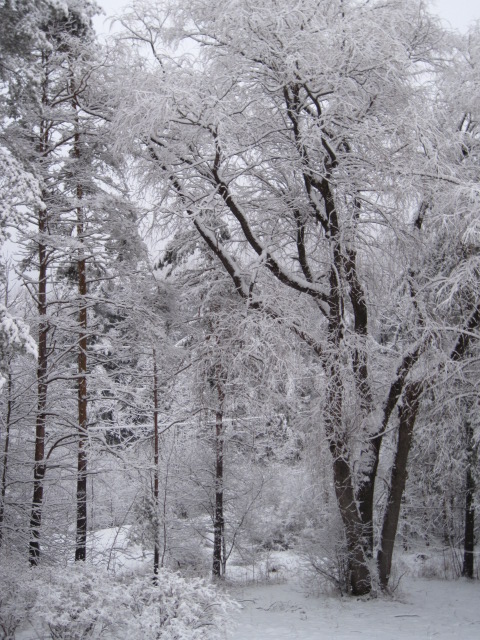
 [Updated 2 June 2020: see my


 A Druid Way