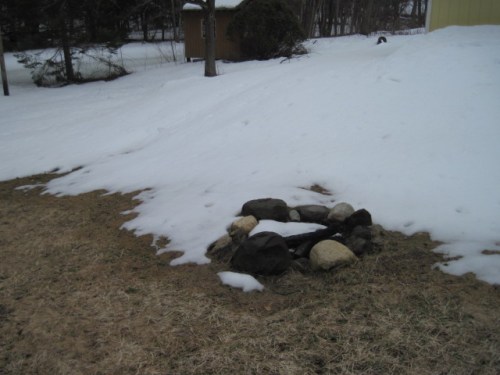
On an overcast, mild and rainy day, the stones of our backyard firepit emerge at last from the retreating snow. No thing exists “entire of itself” or for itself only. It also touches things around it, making and meaning for them a whole range of significances. For the moles in the lower yard, warming weather soaks the earth with snowmelt, and that means flooded burrows. For the deer who’ve survived the New England winter, fresh browse as the grass greens again under the strengthening sun, with the tender shoots of new growth burgeoning everywhere. For the returning birds, nesting material, the first bugs, and surfacing worms.
One of the core teachings explains that the macrocosm (literally ‘the great universe,’ the universe around us) and the microcosm (the ‘little universe,’ the universe within us) are mirror images of each other.
Thus, we can look to the world of nature around us for help in understanding our own nature, recognizing that if a theory about the nature of the universe proves to be a mistake when tested against the world around us, it will also prove to be a mistake when applied to the world within us (Greer, J. M. Mystery Teachings from the Living Earth, pg. 15).
Inner turmoil, strange dreams I can recall only fragments of on waking, a sense of being reminded of — and held to — a standard I agreed to long ago. A sense of being on the cusp of some ordination, relied on for a spiritual responsibility. “Ready or not, here I come”, says Spirit.
“Every human being is already a priest”, says John Plummer in his book Living Mysteries,
in a very primal sense. We stand between earth and sky, like pillars in an ever-moving temple. We find ourselves within and among other humans and many other orders of being (stones, plants, animals, elementals, angels, etc.) with energies flowing back and forth, consciously and not … Our outer personalities mediate the sacred presence at the core of our being, more or less well. We are all points in an extraordinarily complex web, through which divine power moves. That power … is much greater than us, and not particularly concerned about whether we understand how it is working, at any given moment (pg. 13).
Whether baptized or called by the spirits, pursued and confronted by an animal guardian, taught in dreams, initiated through suffering or illness or other trauma into a spiritual quest, roused by the shakti of a guru or the accumulated potency of intensive meditation, ignited by our own unanswered questions and a divine discontent, or turned off all spirituality by its many fakes and shams into a formidable and rationalistic atheism, we are called.
Plummer continues:
… we cannot turn our back on it. If we try, it will come knocking louder and louder, until we re-open the door. We have to feed it from our own substance, letting it grow through us, and then hand it forward to those who come after us, whoever they may be. To fail to transmit what we have received is to dam a stream until it becomes a stagnant pond, rather than free-flowing, clear water (pg. 15).
And so we come to this weekend, both April Fools’ Day and Easter, that lovely Pagan celebration — after all, it does take place on the first day of the Sun, after the first full moon, after the Spring Equinox — a true Pagan Triad of Light.
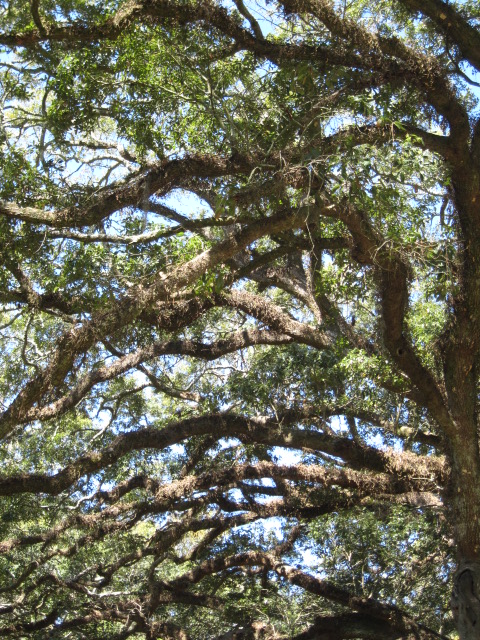
Gulf Coast Gathering ’17, Live Oak canopy
Water and Light, and the holy Trees as witnesses.
/|\ /|\ /|\
Greer, J. M. (2012). Mystery Teachings from the Living Earth: An Introduction to Spiritual Ecology. Weiser Books.
Plummer, John. (2006). Living Mysteries: a Practice Handbook for the Independent Priest. Berkeley, CA: Apocryphile Press.
“It’s a good thing to give thanks, whatever your tradition, or none. So we’ll have a moment of quiet. Simply listen, if you like, to the others near you, breathing”, says the pastor opening last night’s community dinner.
One of the joys of rural New England life is the Cabin Fever dinner tradition. These early spring events are a true “moveable feast” — held in churches, cafeterias, grange halls, schools — sometime in March or April, anywhere there’s a willing core of people dedicated to making community happen. Neighbors get called together from the more private hunkering down we all do each winter, watching wood-piles diminish, the inevitable March storms re-establish banks of snow that had been shrinking after the midwinter thaw, squinting at sky and trees, feeling the light linger a few minutes more at either end of day, scolded by the indomitable chickadees, uplifted at the distant honking of a flock of geese winging north again, at long last.
We’re crammed, atheist and Pagan, Christian and agnostic, Jew and animist, into the sanctuary of the local Congregational Church for the 13th spring in a row — a lunar year of springs. Tables and chairs from a local high school have been set up, filling the space to the stairwell. There are no pews. After the original church burned down years ago, our community vowed to rebuild a maximally flexible space, church and community center both.
Our local Cabin Fever dinner draws attendees from half a dozen nearby towns, in part because the pastor’s husband is a trained master chef who volunteers his skills for each year’s feast, but also because of the tradition of storytelling that proceeds throughout the dinner, as neighbors rise, take the microphone — there are over 200 of us here this evening, and for the first time the pastor had to turn away a few score later-comers — intermittently interrupt conversations, and regale us with stories of the quirks and humors of country living, encounters with moose and fisher cats, chimney fires, deaths and births, lost cows and sheep, found dogs and children.
The evening opens and ends with announcements, car lights left on, alerts that the bears have begun to emerge again from hibernation, hungry and ill-humored as always, that the Green Team meeting has been moved to Friday afternoons, that tryouts for the world music chorus will take place the following Saturday.
A few of us scurry to the basement kitchen after the announcement that packaged leftovers are available for an open donation. We leave with two cartons of roasted vegetables for the next day’s lunch.
Here is our prayer and our praise, our magic and our offering: we manage to come together again, we learn anew that it’s worth listening to each other for the sad-funny turns life takes us all on, that we can recognize in each other, for all the differences of temperament and history and desire, a common table, light and talk and laughter into a cold spring evening.
There’s been no preaching or teaching, only what we bring to each other out of our lives and stories, the best kind, lived last month, yesterday, in the parking lot before coming in.
With such things we do not solve or resolve, so much as we celebrate as we struggle. We sing as we go on.
One of the Enchantments of Brighid is openness to possibility. The goddess specializes in healing, poetry and smithcraft — skills of change, transformation and receptivity to powerful energies to fuel those changes and transformations. We seek inspiration and know sometimes it runs at high tide and sometimes low. As this month draws to a close, we have a moon waxing to full, an aid from the planets and the elements to kindle enchantments, transformations, shifts in awareness.
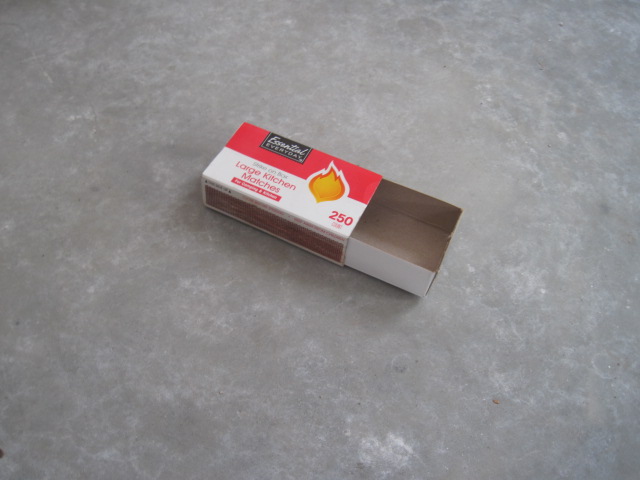
A day ago we finished a box of wooden matches. The box holds 250, and since we use them only for lighting our stove, that means we go through just part of a box every year. Emptying a box doesn’t happen that often, so it’s noticeable.
I like the imagery of the “empty” box. Though combustible itself, its main purpose is to contain matches and provide a strike surface. An old box has a worn strike surface, and one might be tempted to toss the whole thing in the fire. But I’m keeping it for these 19 days of Brighid, and it occurs to me now that it deserves a place on my altar. The sacredness of the everyday? Well, where else can the holy mystery abide in the worlds of matter, energy, space and time. As a friend likes to say, a mest (or messed) world can be a good and powerful stage for life and joy to happen.
Not to stretch things too far — how far is that, anyway? — I am a box, and so are you. Our spaces can hold all manner of things, and it’s our intention that determines what those might be. Insubstantial in itself, the box is nevertheless a potential locus for fire and mystery, or scores of other things. We take from the box a mood or a match, strike it and lay it to paper and kindling. We don’t create the fire, but without the box, the match, the intention and the movement to bring fire and kindling together, we don’t get flames.
To me the empty box is a “found” spiritual tool (my favorite kind), one I can work with physically and also in the imagination from where magic pours forth. Kitchen magic, or woodstove magic, if you will. What belongs inside it? What are some of the matches I wish to light? Where do I find them? (Where have I found them in the past? What new sources of them open up each day?)
/|\ /|\ /|\
On a small piece of paper I write a prayer to Brighid, and I fold and close it in the box.
We could subtitle this post “Druidry — the Ironic Survival”. Philip Carr-Gomm notes in his book Druid Mysteries:
Although Christianity ostensibly superseded Druidry, in reality it contributed to its survival, and ultimately to its revival after more than a millennium of obscurity. It did this in at least four ways: it continued to make use of certain old sacred sites, such as holy wells; it adopted the festivals and the associated folklore of the pagan calendar; it recorded the tales of the Bards, which encoded the oral teachings of the Druids; and it allowed some of the old gods to live in the memory of the people by co-opting them into the Church as saints. That Christianity provided the vehicle for Druidry’s survival is ironic, since the Church quite clearly did not intend this to be the case (p. 31).
Sacred sites, festivals and folklore, tales of the Bards, and the old gods: there you have the substance not only of Druidry but also of Druid and Christian linkages and considerable common ground.
Do we need all four to practice Druidry, or to honor Brighid?
Yes. We already have all four, to a degree that allows us to build on what we have, if we choose. While guided tours to sacred sites continue to make money for their organizers, we can gain access inwardly, through dedicated practice.
How?
On the day before the 19 Days of Brighid, we have many points of access, if we’re willing to explore them with attention, creativity and love.
1) Kildare is Cill Dara, “Church or Cell of the Oak”. Find an oak tree or leaf. “As above, so below. As within, so without”. Can you proceed from there? If you’ve been reading this blog, or have a practice of your own, you have an inkling or a clear idea of what you might do next. Here then is a first door to the Enchantment of Brighid.
Now for 18 more.
2) For a guided meditation, many songs exist. One I’ve posted about previously is Damh the Bard’s song “Brighid” . Enact the song, as your circumstances permit. Read through the lyrics first, or just listen through. Then do what comes to you to make the song come alive. What will you offer at the Well? If you have a bowl of water and a candle or tealight, enact the first appearance of the goddess. Say the prayer of the song’s chorus, or your own.
3) Using the help of the video in the previous post for making a Brighid’s cross, make the creation of your own cross — from reeds, strips of paper, fabric, etc. — an offering, a gift, an act of mindfulness, a devotion to Brighid.
4) Troubled by doubt? Blocked into inaction by hesitation, fear, or talking self telling you not to be ridiculous? Note the lines in Damh’s song: “But in her prison, she heard the spell the people were chanting: Three days of Summer, and snowdrops are flowering again”. The people — that’s you and me — help free her from prison. We imprison the divine, but we have the power to liberate it again in our lives. What chant comes to you? Listen for it as you go about your day, reading the headlines, listening to conversations, songs on the radio, and so on. Meditate, and write down what comes. This is a prayer the people are chanting.
5) Dance a dance you make up that has 19 steps. A circle, a square, some other shape or just steps as they come to you. Swing your arms, raise them, keep them at your sides, or clasped in prayer. Drum on a tabletop, a pot, a cup, bang two spoons together. Or step in silence. On the 19th step, say or whisper aloud or inwardly the name of the goddess. Dance when nobody’s watching. Except you and the goddess.
6) Brighid is goddess of fire. Light a flame and say “The fire is still burning. Nineteen priestesses tend the Eternal Flame. Oh but of you, my Lady, we are still learning”.
7) Educate yourself about Brighid. Here’s an easy “for-instance” — a short video (5 mins.) featuring Mary Meighan, who offers several clues to a practice.
Brighid’s Well
8) Volunteer at a homeless shelter, dedicating the service to Brighid, an offering, a way of helping to keep the human fire kindled in others. We think of such things around the big Christian holidays of Christmas and Thanksgiving and tend to drop them from memory at other times. I’ve just sent off an email to one of our local shelters, 8 miles away, requesting info on volunteering.
9) Dedicate a practice meaningful to you for each of the next 19 full moons. Ask for insight and resolution — in exact proportion to how well you keep your practice. Ready? Set … Go!
10) Following bpott’s comment on a recent post, “[P]lay (with serious thought) with enchantment”. What does enchantment look like to you? When have you experienced moments of enchantment? How did they manifest? What was going on when they did manifest? What can you do to welcome them again?
11) Again following another recent comment by bpott, take your practice outdoors, however briefly. Especially needful in the Northeastern US, because we get serious cases of cabin fever. (Our area organizes “Cabin Fever Dinners” to bring people out of hunker-down mode and into celebration over a communal meal. One of the more popular ones in our area draws 75-100 people and is held in a local church. Yes, plenty of non-church people attend. It doesn’t hurt that the menu and kitchen are overseen by the pastor’s husband, who’s a gourmet chef. It’s very much a Brighid experience, at least for me. Generosity, kindling the fire in others.) Enjoy the thaw that’s come to the region. And wherever you are, breathe outdoor air. Let the sun shine on your skin.
12) What can you kindle and smith, inspire and heal, in yourself and others? What wells and forges exist in your life? How can you use and serve them? What wells and forges have you possibly overlooked or taken for granted? Again, how can you serve and use them?
13) Set a dream intention each night for prophetic, healing or creative dreams. Record each morning what comes. If you think nothing came, write what you imagine coming. Read it that night before you go to sleep.
14) Choose a bowl of water or goblet, etc. as your Well of Brighid. Ask for the blessing of Brighid upon it. Drink from it each morning after sleep.
15) You visit the Fire Temple on the inner planes. What do you experience there? Write down what comes. Who greets you? What gets ignited? What gets burnt away? What kind of flame are you given to return with to your life?
16) Find a poem that inspires you. (Or write one.) Make the reading and saying aloud of the poem a practice for the 19 days. Make of your love for the poem an offering.
17) Practice intense devotion for a particular manifestation of the divine in the form of a god or goddess that draws you. In a post “Loop of Brighid: The Mysticism of Devotion“, Christopher Scott Thompson says,
Rather than talking in a hypothetical way about what the mystical experience actually is, I’m going to talk about how to get there yourself through your own relationship with the gods and goddesses you personally serve. This is not an attempt to import something like bhakti from Hinduism into modern western paganism, because devotional practice to specific deities is already naturally developing within the pagan revival. However, I will be using the concept of bhakti as an analogy for the most intense and mystical forms of modern devotional paganism, such as the mood expressed in this poem [included just above this extract in the original post].
For those of you incubating your own enchantment of Brighid to coincide with the upcoming 19 days of the goddess, you have the moon to aid you. Waxing now, it reaches full at nearly the midpoint of the 19 days, on the 31st of January — a fine symmetry, whether you choose to align with it or not.
The Solar Question for today, the 20th of the month, in Caitlin Matthews’ Celtic Devotional (Gloucester, MA: Fair Winds Press, 2004) asks “What is the source of your spiritual guidance?” The Lunar Meditation* for the fourth day of the moon (counting the New Moon, Jan. 17, as day 1) is “the wonder of life”. If I’m facing a period of spiritual dryness, if I have no other ready guidance, “the wonder of life” is a fitting source. Watching and listening, I can find in something small as the sun sparkling on an icicle a subtly radiant doorway into the Enchantment of Brighid.
Because magic so often starts small, no more than a tickle, a spark, a whisper. Till it builds.
Imbolc, the February 1st or 2nd holiday, part of the seasonal cycle of the “Great Eight” Pagan festivals, has long been associated with Brighid. Goddess, saint, patron of poets, smiths and healers, Brighid is a potent presence for many Druids. Christian Druids can honor her in either or both traditions, and her legends and symbols — effective points of access to her — are many.
Among the traditions that have gathered around her is the significance of the number 19 — whether part of the ancient awareness of the moon’s Metonic cycle, or the Christian tradition for determining Easter, curiously associated with the full moon, or the 19 nuns at Kildare connected with Saint Brighid. Or the practice of 19 days of magic focused on devotion to the goddess-saint, which this post examines. As a Druid-Christian link, the number and practices associated with Imbolc and Brighid can join the others I’ve talked about in other posts here as yet another means to transcend argument or debate, and find blessing.
Nineteen days with Imbolc in the center (on Feb. 1), the 10th day, begin January 23 and take us to February 10.
As this circle is cast, the enchantment of the apparent world fades … We stand together in the eye of the sun here and now …
So goes part of OBOD standard ritual. Why, you might be asking, if Druids say they wish to attune themselves to the natural world, do they practice ritual that sees the natural world as both enchanted and apparent?
Well, we still stand “in the eye of the sun”. Partly it’s “talking self” (see this and this post) that distracts us, that enchants us in the sense of holding us spellbound (and self-bound) rather than freeing us to grow. Circles concentrate energy and attention, contain them for the duration of the ritual, and can help charge us as instruments of the divine in order that we may “know, dare, will and keep silent”, as the old adage goes. So we circle alone and together to watch that particular enchantment fade, so that others can manifest more clearly. It’s a choice of enchantments. Do you like the current ones at work in the world? “She changes everything she touches, and everything she touches changes”. Sign me up!
Spending the interval from now till the beginning of the 19 days, a week from today, determining what service to offer, what magic to work, is time well spent.
I’ll be following up here with my experiences.
/|\ /|\ /|\
Image: Brighid. My preference is for deity images that aren’t sentimental or “airbrush pretty”. Contemporary artists often portray sexy gods and goddesses, which is fine, but as an image for meditation I’d rather not use soft porn.
Here’s an edited compilation of responses to a recent online question in a forum I follow, with wonderful suggestions for cleansing and purifying after work. I’ve removed all identifying personal information.
Q:
I have a challenging job and need to leave it behind, along with all the emotions and difficulties people around me have to deal with. What kinds of practices do you all do to cleanse and purify yourself after work?
A:
I find that something I can touch, smell, hear in a way that relaxes me and centers me is a comfort. Ritual object, drinking goblet, sacred stone, etc.
A quick “light shower” exercise — visualizing/feeling light pouring down on the top of your head and washing off the energies of the day. Combine it with a physical shower for fuller effect.
Or the “snowball” exercise — another visualization — balling up everything you don’t want/need, packing it tightly as you would a snowball, and then tossing it into a golden river to be washed away. Sometimes I do a more intense version of this, raking, shoveling the stuff and bulldozing it into the river. Doing a version physically with a piece of paper (“write the crap away”), stone, etc., and then burying/burning it, letting the elemental energies take it and transmute it. Or some combo of these — these are among my quicker go-to strategies.
I find the entrance to my home is an important transitional portal. I keep things around the door that mean something to me. These may include crystals, Medicine Wheels, fresh and dried herbs and plants or flowers. I get a visual and spiritual boost from these items when they greet me each day returning to my sanctuary (home).
One Native custom is to leave a basket outside your door where guests and yourself ‘dump’ any negative or burdensome thought into the basket before entering. (It’s considered rude to enter a Native’s home and start spilling your problems on them.) Hope this helps in some way.
I also have a small covered porch at my front door and I load it up with seasonal greenery, plants, statuary, crystals, sage, sweetgrass, cedar etc. — all the things that bring me peace.
There are a couple of areas I jokingly call “psychic car washes” on the drive home — mainly white pine groves — that I use to recenter myself. As I drive through, I imagine the energies of the trees enfolding me and pulling away any gunk collected during the day. Tunnels and places where there are high rock walls on either side of the road also work well for this.
I always intention where “it” goes when it leaves me — body of water or into Mother Earth as fertilizer — not leaving it for an empathic type to stumble upon it!
You could clap around your aura to break up any stagnant energy and loosen up anything you want to release. Then do a body shake to shake it off. You could do this before you step into the house or upon entering the front door after you take off your coat and boots.
Some wonderful ideas here! Reading through all this, I had the feeling it is also good to get into a give/take balance. How about after getting rid of the stuff you say a prayer / blessing over a water bottle and drink it? For recharging yourself as part of the rite.
I love the idea of water as healer/cleanser — I like to charge up water in the 3 nights of the full moon!
Set up a “coming home” shrine. Add stuff to it you find soothing, Feathers, seashells, beach rocks — stuff that speaks to you about relaxation. When you get home, light some joss, spend 3-4 minutes with it.
I have so many inspired ideas from this great sharing. Here’s a variation on the ancient Jewish custom. Put something meaningful to you on the door frame. Kiss it each time you enter or leave your home!
I picture a ball of white light at my sternum and expand it quickly to the edges of my field — clearing away and neutralizing the negative and the energy that is not mine. At the edges of my field it dissolves.
I also sweep across myself cutting and removing all that doesn’t serve me and isn’t mine.
After either of these I ask the universe to neutralize the energy and release it.
On a Druidry Facebook group I’m a member of, the question arises a few times each year: what makes Druidry distinctive? In other words, if you’re looking over your options, “Why this and not that?”
Sustained contact with the green world is first practice, never abandoned, never out of date.
In a comment on the last post here, bpott said she was told in meditation to “practice devotionals to the gods outdoors. Lighting a candle to Brighid and sitting with her, or pouring water in a bowl for the moon to infuse its energy and listening to Manannan are such devotionals. There is indeed much to be gained through these spiritual practices”.
But this isn’t something for you to take anyone’s word for. It’s not that kind of observation. Words are meant guide us to own experience and back out again, to reflect so we can experience deeper.
Or as J M Greer puts it,
Druidry means following a spiritual path rooted in the green Earth. It means embracing an experiential approach to religious questions, one that abandons rigid belief systems in favor of inner development and individual contact with the realms of nature and spirit.
We regularly need reminders like these, because Talking Self sidetracks us.
“Talking Self” — you know, that chatty, sometimes neurotic self we use to read and post on Facebook, grumble at headlines we don’t like, and cheer for ones we do. It can often persuade us that it is all of who we are, because its medium is language and the thoughts and feelings language kindles in us. Name it, says Talking Self, trying to keep everything in its domain of names and words. (The Dao De Jing quietly reminds us “the nameless is the origin of heaven and earth”.)
Druidry says take yourself out of talking self and into Self — the being linked in its sinew and blood, bone and spirit, to all that is — rivers and streams, woods and meadows, valleys and hills, tundra and deserts, bird and beech, beast and bass and bug.
When you come back, you can turn Talking Self toward song or ritual, if you like — give it something to do that it does well — but in the service of something higher than reactive gossip and self-importance and anxiety.
And “going outdoors” doesn’t have to entail a frigid January plunge through a hole in the ice at the local lake. It may be as simple as smelling an evergreen twig you picked up yesterday on a walk, and now you hold it as you meditate, on the change of seasons, the incense of a living thing on your fingers and in your nose. Crafting a banner or a poem for the next time your Grove meets — at Imbolc in February. Baking and taking a gift to an elderly neighbor or the local soup kitchen. Grooming your dog or cat.
All these things re-engage the body and give Talking Self a break. Poor thing, it needs one. These practices help restore our connections. They gift us with balance. For these reasons they are, in a curious word more often associated with another tradition, incarnational. They literally put us into our bodies, even as they give Spirit shapes and forms we can experience.
Many forms of Spirit, many bodies to experience them: earth body and dream body and thought body and memory body. And others we haven’t begun to explore.
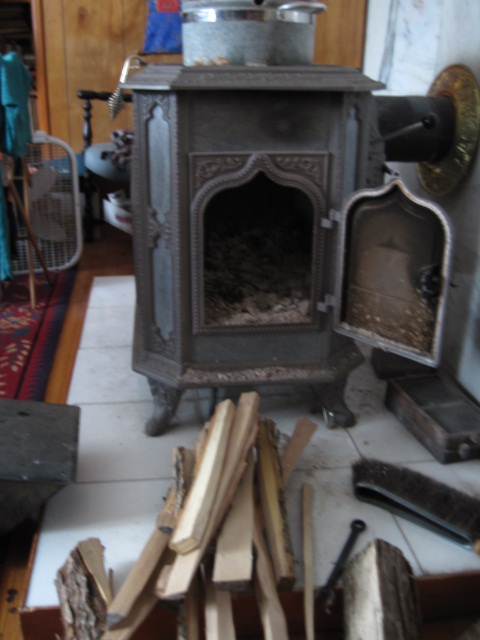
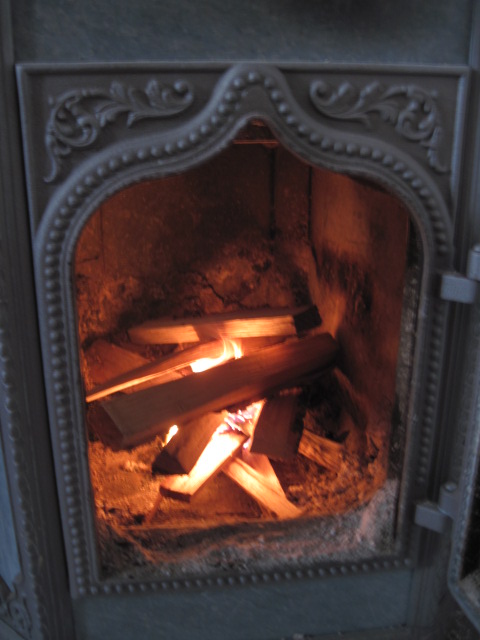
I lay the makings of a fire in our woodstove, crumpled newspaper and punky dry strips of willow from a fallen branch two years ago, and thin strips of a log split and split and split again. Wood’s our primary heat-source — we’re far too stingy to waste money on our electric backup, except in direst emergencies, and then the power may have gone out anyway. I can pause a moment before setting the match to the kindling and honor Brighid. The makings of a devotional. Not “believe in Her”, not “profess my faith She exists”, but honor Her. Often something quite different.
As someone once quipped, more important than me believing in Brighid is Brighid believing in me. What god would care to waste attention on a human who isn’t ever here? But if I’m here and as I honor Her I sense She’s here, what’s left to believe? It’s the honoring that’s important. The connection.
The Druid experience continually “abandons rigid belief systems in favor of inner development and individual contact with the realms of nature and spirit”. Continually, because my rigidity will creep back in, and fire and touch can warm and soften and free me from inflexible habits and open me to change and love.
I met Brighid most intimately through the task of firing up the woodstove when we settled in Vermont in 2008. Fire became a daily reality each winter (and much of spring and autumn, too). The wonder of fire and the opportunity of honor to Brighid needn’t be separate from the gathering of kindling and the match. Our winter-fires may not be the reverential fire of Kildare — though they can be. Every morning.
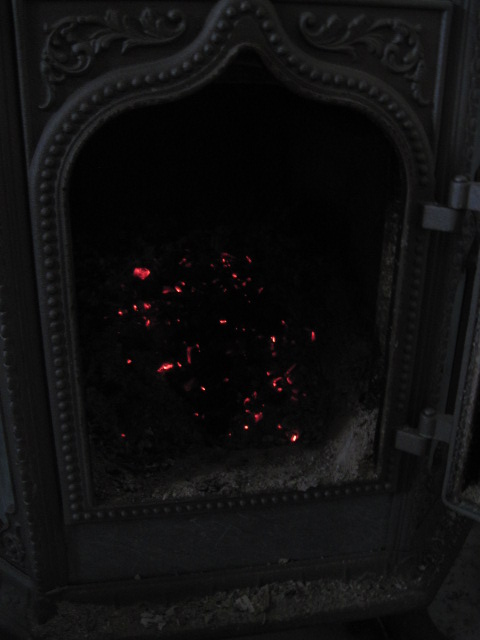
Today I’ll take out the ash to the compost pile, the midden, lovely old word. I let the freshly-removed ash sit out in the hod for a week, so I’m not dumping a pile of embers outdoors on a windy day. Old ash out, new ash to the hod, new fire to the stove ,whose walls are still warm to the touch. I set the kindling, whisper a sometimes wordless prayer to the goddess, and watch as flames grow and spread.
taking out the ash
new fire
My devotional has to take a particular, concrete form if it’s to exist at all for the body and senses to engage. Spiritual-but-not-religious knows this, instinctively keeps seeking but then abandoning forms, because it distrusts forms even as it senses their value. But it’s the dead form and the opinions-and-then-dogmas of Talking Self that are the obstacle to spiritual connection, not form itself.
Oh, Lord [goes one prayer] forgive three sins that are due to my human limitations.
Thou art Everywhere, but I worship thee here:
Thou art without form, but I worship thee in these forms;
Thou needest no praise, yet I offer thee these prayers and salutations.
Lord, forgive three sins that are due to my human limitations.
Except they’re not limitations at all: the way to do them in time and space is with temporal and spatial forms. I find little limitation in building a fire and honoring Brighid too. My devotional is a matter of intention, of choice. When I’m on another plane, I adopt its forms. (In dreams I fly, with dream-power my earth body doesn’t have.) But now, here (no need to apologize for limitations*), these forms.
Without a form, no transformation, whisper the Wise.
/|\ /|\ /|\
*The words “limit” and “limitations” are dirty words, far more obscene these days than any other. Obsessed with freedom, we miss what limits are and signify for us.
A shape is a limitation. Personally, I like shapes and forms. If I had no particular shape or form, I wouldn’t be “free” — I’d be monstrous, “de-formed”.
J M Greer notes in his Mystery Teachings from the Living Earth. 2012, pgs. 42-53:
A field mouse, for example, has teeth and a digestive system that are fine-tuned to get nutrients from seeds and other concentrated plant foods, and so that is what field mice eat. They do not eat crickets, even though crickets are very nourishing; they leave crickets to the garter snakes. They do not eat herbs, even though herbs are very abundant; they leave herbs to the rabbits. They limit themselves to one kind of food, and as a result their bodies and their behavior are exquisitely shaped to get and use that kind of food. Rather than jacks-of-all-trades, they are masters of one.
… the elegant lines of the blade [of grass] have evolved to make the most economical use of limited energy and resources, for example, and the curve at which it bends measures the limit of the blade’s strength in the presence of the wind. Remove the limits from the grass, and its beauty goes away. The same thing is true of all beauty, in nature as a whole and in the subset of nature we call human life: beauty is born when a flow of nature encounters firm limits, and the more perfect its acceptance of those limits, the greater the beauty will be.
… The same thing is true of all power, in nature as a whole and in that subset of nature we call human life: power is born when a flow of energy encounters firm limits, and the more narrow the outlet left open by those limits, the greater the power will be.
In a fit of New Year’s house-cleaning, I spent part of yesterday going through photos and papers my mother left to me. She passed sixteen years ago, but only now am I finally getting around to culling photo albums and memorabilia. Unlabeled pictures of ancestors I don’t recognize I’m discarding. (The clearest of them I’ll scan and post to ancestry.com — someone may perceive a link to their own story.) Together the images I’m discarding will make for a personal springtime ritual of memory, which feels now like it should be annual: to the unknown ancestors.
a known ancestor — my great-great-grandmother Ann
Among my mother’s effects was a sealed envelope, with a notation in fading Victorian script: “Worth County Eagle of Feb. 10, 1881”. Worth County is rural northern Iowa, where my mother was born and grew up.
The paper is just one quarter its usual size, and the Feb. 10th issue opens with an apology, explaining that the recent three-day blizzard has delayed their paper shipment, and so the present issue is small, a single sheet, folded in half to make four pages.
The railroads are all blockaded. Possibly the BCR & N [railroad] may get trains to Albert Lea [nearby in Minnesota] by Saturday night, if they have no bad luck. The Minneapolis & St. Louis [line] is in very bad shape. Six engines are dead at Hartland and the road is full of snow. They cannot clear the road this week.
But the most poignant column of the issue, appearing on the third page, is more personal:
Last Friday afternoon, Joe Fleming, of Kensett, came to Northwood, on horseback, for a coffin, for the only child of Chas. Christenson. It was late on his arrival, and he did not think it expedient to venture out again, so near dark, and remained over night. Our readers all know what a day Saturday was, and it was unsafe for one to be out on the road, so Joe waited until Sunday morning. By then it was impossible for him to get his horse out of the barn, on account of the deep snow. But he made up his mind that the trip must be made, and so had the coffin fastened securely to his back and started on foot, during that severe snow storm. He arrived at home safely.
What we do simply to survive is worthy of story. Let’s not diminish the lives we lead today. One-hundred thirty-seven years ago a child died, a human grief, and that death sparked the human determination that became this particular story. What is remembered lives. But we chose what we remember. Storms occasion such stories, markers of our lives. Everyone has one or more to tell.
May you be warm and safe and cherish your stories, however hard-won. By living them you’ve earned them. Such memories number among things that need to be born.
The caption of the photo below has a mini-spoiler — skip as needed.
Yoda has good counsel about books in “Last of the Jedi”
“I do not believe in God any more than I believe in Hamlet”, writes author, Buddhist and atheist Stephen Batchelor, “but this does not mean that either God or Hamlet has nothing of value to say” (Batchelor, Stephen. Living with the Devil. New York: Riverhead Books/Penguin, 2004). I gotta ask you: Doesn’t that deserve its own t-shirt?!
What are some of the things that God (or Hamlet) says to us? For the sake of foolishness or efficiency, let’s lump them together, prince and deity.
As late incarnations of the Fisher King, Hamlet, his father and his uncle all share a corruption also infecting their land itself: “something rotten in the state of Denmark”, indeed. Any sources of healing? A grail? There must be something.
Hmm. Fratricide, regicide, suicide — really no good options there. Hamlet at over 400 years old isn’t quite yet as immortal as a god, but it’s on its way, and even a god might well draw the line at three such wretched choices. There may be “special providence in the fall of a sparrow”, the prince reflects, recalling Scriptural assurances of a Divine Plan behind things, but you can tell when such lines have their own threads in our online fora, with people asking “What does it mean?” that the current beta version of the Divine Plan has sent all birds south for the winter of our play. No birds to save us here, no dove for any Ark, wren for inspiration, Eagle of the West to airlift us out of Mordor.
In a word, things suck. It’s gotten to the point where the Prince selfishly denies even his best friend Horatio the “felicity” or happiness of suicide: “Absent thee from felicity awhile/And in this harsh world draw thy breath in pain/To tell my story”. But, I ask Hamlet and God, are any of our stories worth that? Have things always sucked thismuch? Do we have any overarching story that can make sense of this world for us? (Three questions, Existential Triad #26.) In all its delicious suffering and gloom and razor wit, we could fairly call Hamlet (the play) a piece of Renaissance theater porn.
Is a spiritual search pornographic? Do we play out spiritual scripts to arouse ourselves in ways others (or we ourselves) deem destructive? (Is that a rhetorical question?!)
Horatio says, speaking of Hamlet — and speaking of all of us, too, because that’s what great cultural achievements do, after all — “he was likely, had he been put on/To have proved most royal”. Yes, along with the dead prince, we’re all “put on”, and all “likely”: life as a matter of the odds.
The “royal” part, though — we just can’t accept that yet, even in the face of stories trying their level best to show us, and teach us how. That identity — it implies too much, the gap yawning between what we are and what we could be, an open wound. So we reject it whenever possible, saving such inward knowing for our most unguarded moments with our favorite music, books, films, crafts, people, waking dreams. (Yes, these things rank nearly equal in my life.) Or “children’s movies” we watch with the kids, that may get it half-right, half of the time.
A 27 Dec. ’17 article (film spoiler alert!) in The Atlantic gets in on the Game. (We’re all playing.) Writing in “Why The Last Jedi Is More ‘Spiritual’ Than ‘Religious'”, Chaim Saiman begins:
For at least two generations, the Star Wars saga has served as a kind of secularized American religion. Throughout the series, the Force is a stand-in for a divine power that draws on a number of mystical traditions, representing the balance of good and evil, the promise of an ultimate unity, and the notion that those learned in its ways can tap into the infinite.
As Saiman scrutinizes the distinctly contemporary sensibility pervading “Last of the Jedi’s” attitude towards tradition, he concludes “… even a fictional secular religion will likely reflect the spiritual economy of its time”. Our tendency to value experiences over learning, or feeling over wisdom (not that these pairs equate) means we often hold traditions suspect without ever having immersed ourselves in them to learn them from the inside. So we often run from one workshop or neo-tradition or guru to another, collecting them like trophies or merit badges. Unlike Rey, we don’t come with a Force chip apparently pre-installed and active as a standard factory setting. (“Oh yes we do!”, say the stories.) Sci-fi porn?
If there’s a shift in the philosophical and religious tone in “Jedi” from the 1977 original Episode IV “A New Hope”, Saiman asserts, it’s that traditions have failed, and we’re thrown back on ourselves. Self-help porn?
So what, in turn, does that mean for our “spiritual economy”?
The great critic and author Harold Bloom told his students, referring to literary criticism, that interpretation is another form of more or less “creative misreading”.
Let’s extend Bloom’s insight where he never intended it, a popular form of magic in itself. How often we misread our lives and each other, the influences they bear on us, and our own motives and desires! Particularly well-done misreadings fill our theaters and earphones, climb our playlists and Top Tens, shaping the zeitgeist ever since zeits became geisty.
Bloom was famous for telling his students “There is no method except yourself” as far as criticism is concerned, and that too feels more widely applicable to our lives.
Or at least to mine. So here goes. Traditions exist, wisdom exists, we encounter them and decide out of all that we are what we will choose and value. In a pinch, we even creatively assign responsibility for our choices to any and everyone else, out of all sorts of motives, honing and refining our method.
Truth is never OSFA, “one size fits all”, though we recognize reflections everywhere, shards of what often feels like an original Mirror. Human traditions often grab hold of a single shard and — terrified they’ll lose even that one — erect it as the sole truth. Maybe this is our original and only idolatry.
So Hamlet instructs the actors for the play-within-the-play, stand-ins for all of us: “Hold the mirror up to nature (or, we might say, existence), to show … the very age and body of the time his form and pressure”. If there’s one thing true wisdom does, it’s to show us such forms and pressures. Not only the holes of a culture and civilization at any given moment, especially our own, but also the rebalancing factors and energies we can apply to survive and thrive in that civilization, and when it starts to falter, after.
In the end, the problem isn’t tradition or ritual, but dead tradition and rottingritual. The soup of spirituality needs the pot of form, or we go about a life or five with vague intentions that ultimately give us little and fail us at need. “I must create a system, or be enslaved by another man’s”, wrote William Blake.
Almost right.
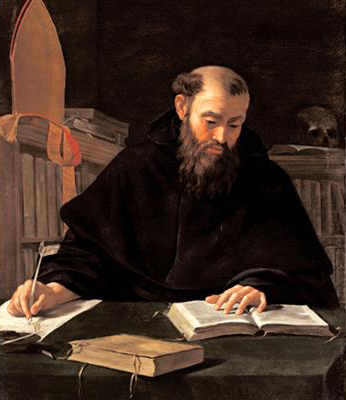
For once I’ll trust old Auggie, St. Augustine of Hippo (354-430), with the last words this time, with a few annotations. Words suitable to conclude this blog for 2017, and open the way for a new cycle in the new year.
So, then, my brothers, let us sing now, not [only] in order to enjoy a life of leisure, but in order to lighten our labors. You should sing as wayfarers do — sing, but continue your journey. Do not be lazy [unless you need to!], but sing to make your journey more enjoyable. Sing, but keep going.
If you join rituals of many of the contemporary Druid orders, you’ll encounter the Druid Prayer frequently. (In OBOD rituals it’s simply standard practice.) Some Reconstructionist Druid groups may eschew it because it originates during the “Druid Revival” period beginning in the 1600s, rather than from what we can recover of historical Druidry, but for all that, the claim often used to introduce it, that it “unites all Druids”, is more than wishful thinking. Or it could be.
back yard, facing east
Also called the Gorsedd Prayer (Welsh Gweddi’r Orsedd), it’s long been part of the Welsh National Eisteddfod as well. The “inspired literary scalliwag” Iolo Morganwg composed it, and you can find several versions of it, including the Welsh originals, here. It’s survived because of its power:
Grant, O God (or Goddess/Spirit/etc.), Thy protection;
And in protection, strength;
And in strength, understanding;
And in understanding, knowledge;
And in knowledge, the knowledge of justice;
And in the knowledge of justice, the love of it;
And in that love, the love of all existences;
And in the love of all existences,
the love of God (or Goddess/Spirit/etc.) and all goodness.
As a prayer of pure petition, it has value. The prayer makes no mention of reciprocity — the petitioner doesn’t promise to do anything in return for these very large gifts. In short, stripped of the politeness of the first word “grant”, the prayer says “Give.”
But if the Granter gives, the effects of the gift do provide a kind of return. If we’re protected, strengthened, granted understanding, knowledge, love of justice, of all existences and of God, you could argue that large transformative effects will doubtless follow, and constitute their own return. We certainly won’t be the same, act the same, or — most likely — pray the same. If we can’t get there any other way, sincere and heartfelt petition can do the trick.
As with so many elements of our group practice, we too rarely talk about them; first we’re busy preparing and then doingthem, and feasting and socializing after. The sense of having “held up our end” can be palpable after ritual: the atmosphere tingles with a sense of scales recalibrated yet again. Witnesses, petitioners, performers, vessels and channels for holy energies to enter the world through our own imperfect and holy lives, we’ve reconnected, remembered, listened.
But because I know how I can end up mouthing the words, even as their familiarity is a comfort and a part of the ritual energy flow, I keep returning to the practice of embodying rather than merely asking. I need something to stop me, shake me, take me out of myself, and yes, out of the ritual moment, while holding me to a higher standard than I came with. It’s a kind of second prayer, or personal ritual. It may take me 10 or 20 minutes to fulfill it, because I need to slow down to do it, whether I say the words aloud or bring them to awareness in some other way, feeling them in my bones, touching the earth, cupping a ritual flame, gazing at the horizon, repeating them till they sink in, carrying their vibration till a door opens inwardly, any and every one of these ritual gestures. “Do till it’s true”. I want to realize “as above, so below” however I can. All I know is that for me the energies of this different manner or form of prayer also differ — and I need that difference.
So here’s one version of the words, a small part of what feels to me more of an “embodying” prayer:
Holy Ones,
in your protection I stand here,
strengthened, understanding your ways,
knowing and loving your honor as the source of mine.
The justice I do today and every day
mirrors my love for the good things
you give, just as the love I receive
is justice, the sword of truth you raise
in my life, handle toward me.
Wherever I am, may I remember
and live these things always.
The prompt for this post comes from a Feb. ’16 article in The Week — nearly two years ago. The inevitable article or podcast or meme about how depressing the holidays can be merits a judicious counterbalance — it deserves an “on the other hand” in rebuttal. So here’s one contribution toward that goal. It may help to read the article in The Week first. Or not — your call.
Now the pop neuroscience that the article’s based on — “Neuroscience reveals 4 rituals that will make you happy”, the title crows — isn’t actually particularly astonishing in itself. But the “four rituals” are interesting because they’re behaviors every human already practices anyway. That means — to me anyway — I’ve already got something to start with and build on. The magical principle here: What we make conscious gains power from focus.
Snow, then ice: 23 December 2017
At this point those who think ritual doesn’t interest or concern them may be tempted to turn away. (There is after all a whole Net out there to click through. Go ahead if you need to!) But as anthropologists and neuro-folk have discovered, to be human is to ritualize our experience. It’s as if we each need to wear t-shirts that say: “What rituals are you practicing today?” You know, just to keep the activity in mind. If we’re ritualizing, what are its effects? Is it a helpful ritual? What are we doing?
From small rituals like shaking hands vs. bowing, or saying your culture’s equivalents of “please” and “thank you,” to family traditions at the holidays, and outward to public ceremonies like reunions, annual festivals, weddings, funerals, ship-launchings, inaugurations, dedications, etc., ritual pervades all human cultures.
Some of our most potent and invisible rituals shape our daily experience in profound ways. The trick, I conclude, is to domesticate my rituals, expand on the most effective ones, and put more of them to work on my behalf. (By the law of reversed effort, they may become much wilder as a result.)
In fact, we ritualize such a large portion of our days, that when something breaks our routines (read ritual as “habit” here), it may annoy or even anger us as much as it may pleasantly surprise or intrigue us. Let me find road work or a detour along a customary route, a power outage, a closed restaurant I was counting on (but hadn’t called ahead for, because it’s “always open”), and I’m thrown out of routine, forced to reshape something I’d previously planned and ritualized. We count on ritual to streamline and organize experience. Maybe that’s why we discount magical rituals. Ritual is so commonplace, after all, that it can feel “nothing special” by itself.
It’s what we do with it that counts.
So here’s a Druidified version of the four rituals, each now associated with an element and a direction. The ritually minded can expand on these “core four”, rearrange the associations, and so on. After all, if ritual or magic can’t deliver even a smidgen of happiness, it ain’t worth much.
Earth/North: Practice gratitude.
Give thanks for good things. Gratitude, as my longtime readers know, is one of my go-to techniques. Pairing it with appropriate action helps intensify it — write it down, etc. Earthy forms of gratitude may loom particularly prominently in your awareness right now — sweaters, wool socks, hot drinks, etc. Go for it. Earth the gratitude. Ground it in awareness and in gesture, in action, etc.
Air/East: Name the negatives.
Turns out our capacity for shame, guilt and worry can be productive, says the article. (Good thing, since so many of us specialize in one or more of these. Collect all Three!) And though labelling often comes in for a bad name in our politically distraught and extreme age, it’s one of the things that language is for, what it excels at. One key is the appropriate label: “Name it and tame it”. And “getting a handle on something” can include naming it accurately. And also knowing when to turn off language altogether for an interval — a magical technique all its own. Trance, music, daydream — we hold the reins in our hands.
Interrogating habits, whether “good” or “bad”, can reveal unsuspected wealth both for themes for meditation, and for material for ritual. What we really want can surprise us: going through the motions of a habit can block us from discovering what actually powers the habit in the first place. Studying the habit, revolving it in clear daylight, returning it to consciousness, can teach us much of value. Ritualizing it empowers us to live its full potential rather than shoving to one side, where it collects dust and rust and small rodents as it putrefies. A purified habit is a happy habit.
As J. M. Greer notes,
[t]he tools of magic are useful because most of the factors that shape human awareness are not immediately accessible to the conscious mind; they operate at levels below the one where our ordinary thinking, feeling, and willing take place. The mystery schools have long taught that consciousness has a surface and a depth. The surface is accessible to each of us, but the depth is not. To cause lasting changes in consciousness that can have magical effects on one’s own life and that of others, the depth must be reached, and to reach down past the surface, ordinary thinking and willing are not enough (J. M. Greer, Mystery Teachings from the Living Earth, Weiser Books, 2012, pg. 88)
Fire/South: Make a decision.
Starting with small decisions helps me access the spark that follows this act. After consciously telling myself I will do this after writing this sentence, I rise and go put in a load of laundry. I’m back, and the act of getting up literally and psychologically to carry out, to follow through on a decision, is useful to enact and then to examine critically for its effects. A magical insight here: switch hemispheres frequently!
(Perfectionists may want to aim for “good-enough” decisions. Consciously wallowing in mud, working up a sweat, or making some kind of a mess — your choice! — may help defuse some of the OCD tendencies of perfectionism — short circuit it intentionally. Hey, it’s worked for me! Making a conscious decision about something very small can open up clarity on the decision-making capacity itself, without the distraction of the incidental content of the decision.)
If “ordinary thinking and willing are not enough”, there’s plenty we can do.
Water: Touch living things.
So many … loved ones, pets, plants and trees, the green earth. Touch as the most concrete of the senses can take us out of heads and into our bodies, letting the other elements do their work more directly, without all the wards and barriers and avoidance strategies we deploy whenever we practice unconscious black magic on ourselves. Which we do constantly. Connection drags us out of the solitary hells that the West has come to specialize in helping us to manifest. “Only connect!” goes the magical refrain — “Live in fragments no longer” (E. M. Forster, Howards End).
/|\ /|\ /|\
Change up the elemental associations, and the rituals will shift subtly if not significantly. Armed with the earth of the body, the air of the breath, the fire of spirit and water of blood, we may ritualize our ways to places of surprise and delight. Happiness can’t be an endpoint anyway — it’s a practice to take up and improve.
I’m borrowing the title for this post, a lovely question, from John Beckett’s recent article here.
As we approach the turn of the year, we have W. B. Yeats’s version, the evocative query ending his poem “The Second Coming“:
… what rough beast, its hour come round at last,
Slouches towards Bethlehem to be born?
For we give birth to all manner of things, and not always to our benefit. Like the young mage Ged in LeGuin’s A Wizard of Earthsea, “who raged at his weakness, for he knew his strength”, we sense an inchoate energy at work in so many things, if we could only align it to our purposes. Or is it time to listen more, and align ourselves with the energies of the intelligent universe all around us, that brings forth beasts and birds as well as humans who ask such questions?
And there’s our challenge: alignment. Complete the circuit. Our youth culture “hooks up” without finding satisfaction or connection. Loneliness, anxiety, depression afflict so many. Pain both physical and psychological drives an opioid crisis. What spiritual prescription can begin to address such heavy concerns?
If we’ve been paying attention, we know that no single solution works for everyone. This holds true in religion and spirituality, too, though plenty of one-true-wayers will beg to differ. So we turn again to do what we can, each in our own way.
As one of the Wise observes,
The ideal that you hope to achieve is always to be ready for an incarnation, whether it is in this world or those planes beyond. But unless an incarnation can be offered its birth through you, though, it is incapable of being brought into the manifestation of life. Therefore, your attitude should be one in which … you alone accept the responsibility of incarnating a new and greater value of yourself.*
Examining what needs to be born is a first step in bringing about a birth. (Following the metaphor further, we can of course rush to conception, and deal with the aftermath later. Some of us at least have learned that doesn’t always end well.)
1–What can we help be born in our homes and yards? I’ll start here with Earth. This time of year is perfect for dreaming with garden catalogs. What else? Is there a spot of backyard I can allow to grow wild, or at least wilder? The front lawn may feel more public, or be subject to various town or highway ordinances. But especially if you have even a couple acres like I do, consider whether a spot of wild is both “creature-kinder” and asks less mowing and upkeep. Brush from winter windfall can get it started. Erecting even a few birdhouses for the more shy species that favor cover can also help. We’re still shaping what we’ve received from the previous owner of our land. I’m less green-thumbed than many, but even a thoughtful neglect to mow absolutely everywhere can encourage many species. We have a working truce with our feisty moles, renewed each year with a ritual and a few conversations, to keep them from our garden areas.
Is the way open for berry bushes, which birds may have obligingly already started for you? Along fence lines and beneath their favorite perching and nesting shrubs and trees, birds drop seeds that will grow in a few seasons to a source of blackberries, raspberries, elderberries, and more. Staring at snowdrifts can serve up good practice for imagining spring and planting and new green.
2–What can be born in my spending habits? I’ve come to appreciate small changes, because they’re easiest to stick with. There’s more virtue and occasion to feed the ego (and thereby nurture a positive practice) if I follow through for a year, rather than think big but end up doing nothing. Combine errands and car trips? Recycle used oil, parts, tires, cardboard, glass? Many communities are moving toward better custodianship of resources, and starting to offer better options. Inherit a shed filled with rusting things, and badly-labelled containers of possibly petroleum substances? Any clean-up is “more than before”. Shop used when possible. The northeast U.S. reads a lot through the winter months, and well-patronized library book sales often have surprisingly current titles. With many large libraries so short-sightedly downsizing their collections, you can sometimes enjoy remarkable finds.
3–What can be born in my practice? By this I mean spiritual practice. Whatever yours is, feed it. Make it easier for you to do it, whatever form that may take. If you haven’t taken up a practice, the new year is a good time to try one out, if not today. Again, make it easy on yourself. Huge numbers of possibilities: five minutes for sacred reading (and you decide what’s sacred to you), stretching, breathing exercises, clearing a chest of drawers or closet or room, an artistic practice, listening to music, yoga, meditation, home renovation, volunteering, helping a neighbor, shoveling a driveway, driving someone to an appointment. Writing actual letters. Listening. Singing or playing an instrument. Cooking. Tending a household shrine. Photography. Weaving.
Whatever it is, I succeed most when I begin with such a small period of time I can’t NOT begin. As a writer, I practiced with 10 words a day during my busiest times. (Too small not to succeed! Easy to make up for the next day, with 20, if I “forgot” the previous day.)
4–What can be born in other quarters of my life? I’m often not a very social person. (My default mode is reading or writing, rather than hanging out and talking.) This blog is part of what I do to connect beyond my own immediate circle. I’m also not a major volunteer, either, but rather than guilt myself up about it, I choose options where volunteering at all will encourage me to do it again. A monthly open discussion series at a local library starting in January is one of my current outlets. Supporting my wife, who’s the current wage-earner in the family, is another. Laundry, dishes, fire (our heat source), snow removal from driveway and solar panels, and I’m serving, acting outside myself, encouraging flow.
5–And I make and find rituals for what needs to be born, to help keep the doorways open. What needs to be born?, I ask, and light a candle, gazing at its yellow flicker. What needs to be born in me?, I ask, and spend time writing in my journal the response that comes. What needs to be born that’s already taking shape, that I can help with? What’s about to be born, that I can work with, and foster, and celebrate? What’s born among friends, when we gather in two days on the 17th in their backyard, to light a fire, and talk and snack and sit on lawn chairs in the snow, feet toward December flames?
Asking the question as I go, keeping the fire of my attention burning, helps the new thing be born.
[No, I’m not talking about the “open-source analytics data store designed for OLAP queries on timeseries data”. How the word Druid ever got patented and copyrighted, I’m not sure. Imagine trying to do the same with Christian or Hindu or Muslim!]
Recently the word “privilege” has accrued all manner of emotional loading with connotations of wokeness and political correctness, while one of its primary meanings — advantage — remains largely untouched. While I do see the seven points below as privileges, an accurate synonym is advantage, and so it’s this sense I want to examine here. Note also that I’m not claiming these advantages belong only to Druidry. But in my experience, Druids seem aware of them in uniquely Druid ways that contribute much to the experience of Druidry.
1–Druids (and Pagans generally) are so clearly a minority in the West that they enjoy a built-in remedy against arrogance. The misconceptions about Druidry and Paganism still rampant can, at their best, make a person laugh. Yes, there’ll always be individuals who try on an inflated self to see just how far such a blimp will carry them. The cosmos deflates most swollen and bloated things in its own good time. But for the rest of us, humility is a useful place to begin almost any human activity. Except maybe politics. Minority status points Druids naturally towards humility and humor.
2–Druids do community about as well as anyone. (Visit a Druid camp or Gathering and test this firsthand.) While acknowledging the valleys and caves and hermitages our solitaries occupy — many community folks are solitaries, and vice-versa — we get plenty of practice in loving others. Because in the end, that’s why we connect. The currents and energies of the cosmos also dwell in other people. Looking to power a rite or discover a richer truth or share the inspiration of awen? When we attempt these things, we draw on each other at least as much as on the sun, moon, stars and spirits. Living things make up much of “the power of the land within and without”, as the OBOD invocation puts it. Druid community is practice for love.
3–With the practice of Druidry comes a discovery of the need for discipline. No one checks up on us. If we want something to happen, we need to be open to it and also help set it in motion. Achievement takes work, a basic truth we seem in danger of ignoring in Western culture. Through making a choice for a particular practice of discipline, we gain increased self-respect. We’ve earned what we know. (If we haven’t, someone will probably point it out to us.) The opportunities Druidry offers to practice self-discipline also build self-respect.
4–Because of the diversity of training, experience, location and heritage among Druids, our practices help keep us open to surprise. Whether we meet in community or keep in touch through books and online, we’re always encountering new insights, ideas, perspectives and techniques. We’ll never know it all, and that’s part of the wonder of the path. We gather in circles, and they always open into spirals. The path doesn’t stay the same, and neither do we. Druid practice helps keep us open to surprise.
5–An experimental mindset powers much of our practice, as it does our gardening and beast-craft and spiritual exploration. “If it’s operational, it’s true” goes the old tag from the 60s, and it still has validity for most Druids. From this attention to reality comes a particular integrity in the Druid experience. Dogma still creeps in from time to time, but attention to what’s happening to the land, to what the spirits and guides are showing us, to what our studies reveal, and what our dreams and visions and hunches direct us to consider, mean that unlike religions that center on professions of faith, Druids are busy exploring to find out for themselves. Once you know, you no longer need to believe. Belief’s often a useful tool, but it’s just one among many. The experimental mindset that Druidry encourages promotes spiritual integrity.
6–Druid teaching, ritual and practice spark many Druids to explore their artistic and creative sides. Yes, Druidry is a spiritual path that specially honors and fosters creativity. Meet and talk with Druids and you’ll also discover how creative people are drawn to Druidry because they seek a path where imagination plays a primary role in spiritual experience, rather than a suspect behavior leading to heresy, diabolic influence and poor choices. Druidry knows passion and vision and creative exploration are spiritual gifts.
7–The Great Mystery that lies at the heart of the manifest and unmanifest is what powers Druidry. It sparks humans and other creatures, burns at the heart of planets and stars, and shines out of the cosmos whenever we pay reverent attention. The open-endedness of Druidry, its sense of a new horizon beyond the next hilltop, make it both welcoming, exciting and challenging. The heart of Druidry is both spiritual welcome and provocative challenge.
One of the great discoveries we keep (re)making is that in and around doing the work and not doing the work, this winter season is crammed full of vision and dream and inward turns. Any physical slump we may feel often comes courtesy of ancient programming to conserve energy, store fat, distill insights and experiences, lick our wounds and wait for the Light to strengthen again. The cold doesn’t help either, though it’s a marvelous tonic once we slough off the inertia and bundle up and head out to breathe air sharper than our athames and paring knives.
I write from my time and place, New England in winter. Translate to your own environment. You know it, are learning it with each day, ground under your feet, shapes of trees or endless grasses, desert or horizon or mountains in the distance, ocean blue-gray-green and immense beyond your sight.
Samhain may mark with a ritual day a time when the veil thins, but for me the whole season is paper-thin, a Japanese shoji screen between me and Otherworld, a spidersweb thickness away, the same soft, uncanny brush against the cheek of everything that “daylight brain” pushes away. But night brain rejoices, says yes! says come! says I know you! and speaks in exclamation points and question marks and all the punctuation you rarely see in our scientific waking life of categories and forms and lists and schedules and business hours.
I slip into daydream over breakfast, at work, while driving. Night threatens to take over. We turn to (more) caffeine, chocolate, anything to prop awake the animal self that seeks to settle into that intermittent twilight drowse. The season has already lifted the cover and left the door ajar. The challenge isn’t to do either of these things — they’ve already been done for us, courtesy of biology and the annual ritual of sun and planets and time — but to stay out of the rabbit hole, avoid the Cave, do the daylight things we’re called to do and not slide off into othering. Because night brain sends us thoughts and feelings unbidden, and it can be a rich time to set down in paint or on paper or in fiber or other craft something of the energies at work in this dark half of the year.
One way to see it and work with it: the mulch and compost and ferment already begun in us mean that the ancestors are putting forth their voices and desires. As their descendants, we carry on some of the work of their blood and sinew. At the same time, being wholly ourselves and not our ancestors, changes seethe and bubble upward from within, brew of the Cauldron. We quit a job, or a relationship, or others do these things for and with and against us out of their own ferment. We cast about for “what next?” and any answers may come not in daylight terms, necessarily, but in hunches and doubts and the same turns that dogs and chickens make before they lie down to rest and nest. Only we do this inwardly. Turn, turn, walk down the new-old bed we’ve made to lie in. And we try it on and test it for fit. Or walk away.
Often we expect any vision to come clear, to walk before our inner sight like TV characters do, crisp in their makeup and perfect hair and wardrobe, when often what comes is all shadowy and indistinct as faces around a ritual circle by firelight. A half-turn or blink and then it’s a single face we see in profile, up close. But what we thinkis I need to breathe or I gotta make a change. But we don’t or can’t talk easily about such things with anyone else, because it’s hard to explain the link between what vision gives us and what we feel. Just like in a dream, the inner journey brings me to a field of sunflowers and suddenly I know I have to change my life. The dream logic between the two is undeniable, even if it bypasses daytime reasoning. It’s not cause and effect, or before and after. No, it’s all one thing. And we seem to know it all at once, too. (But talking about it requires us to examine it piecemeal, like trying to push a whale through a sieve. It just doesn’t work. So we fall back on trying to explain that, too, and soon we’re twice removed from the original experience.)
So we make our pilgrimages through winter, pondering the pieces of dark world wisdom that arrive like that touch of coolness when we wake and find we’ve kicked off a blanket. Or in the dark, up to get a drink in the night, we step on a marble or raisin or kernel of popcorn and the surprise feels all out of proportion to the actual size of the thing that we set a tender foot on. Old photo or yearbook or holiday letter from the past, object unearthed when we were looking for something else. We sit with it and an hour passes in reverie. We chew and digest our lives and come to perceive something of their value and nourishment in such moments, unplanned, perpendicular to schedules and calendars.
Let me honor the dark, I whisper to myself.
Let me draw darkness around me like a blanket, feeling its folds.
Let me say its names as they come to me, strange sounds, rumbles and squawks in the throat, thing animals say to each other and us.
Let me caress the soft animal of my life.
Let me linger in the dark and its warm silences, welcome its cold shivers.
Let me weep when tears are tribute, salt and water to bless and purify.
Let me hold myself like a child in the womb,
rocking under the heart’s own rhythm, fetal and new.
Let me wake to darkness as to light,
and feel at home and welcome.






 For once I’ll trust old Auggie,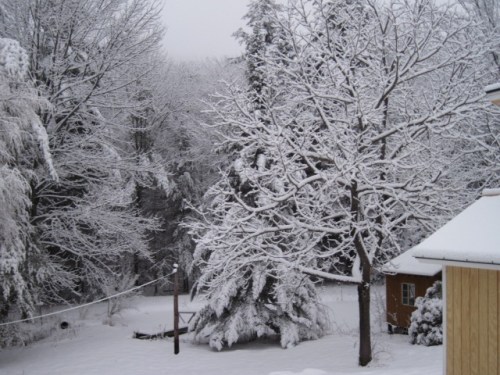


 A Druid Way