Normally I tend to breeze past self-help titles. It’s true they’re sometimes spontaneously (or cynically) fashionable, hitting whatever the current zeitgeist is at its geisty-est. For that reason they can be deeply culture-specific. What resonates in the U.S. may not catch on at all in France or Fiji. It’s also true that the slickest of the titles tend towards the simplistic. Anyone who’s read more than one knows they typically repackage highly useful and applicable age-old wisdom under new headings. Not a bad thing at all — sometimes that’s what we need, especially if the old sources fail us, and we’re looking for guidance. Some titles can serve a deep need very well.
We’ve all had the experience of clicking with a mentor or teacher who gets how we think, how we process the world. With a good match-up between student and mentor, we learn far more effectively and enjoyably. Likewise with a bad match, it’s often just hell for all concerned. Witness the Youtube popularity of good explainers and effective speakers. There’s a reason the best TED talks continue to draw big viewership stats.
And we do love our lists and numbers! Consider film and TV titles: 8 Simple Rules (for Dating My Teenage Daughter); Ten Things I Hate about You; Four Weddings and Funeral; Three’s Company; Twelve Angry Men; A Few Good Men; Five Hundred Days of Summer; Sixteen Candles; Thirteen; Seven Brides for Seven Brothers; Seven Samurai; Eight Crazy Nights; the Ocean’s series (11, 12, 13, 8). Some (or many) of these series and films may not have reached your shores, but you get the idea.
So when online I ran across Jed Diamond’s recent book 12 Rules for Good Men, no surprise, the title caught my eye. A disclaimer here — I haven’t read the book. Ultimately the book isn’t directly relevant to this post. Because after reading the summary of Diamond’s rules in reviews of the twelve things men can do to better their lives (you can see a version of the original list here), I wanted to open it up just a little and make it applicable to everyone — because it is. “Rules for Humans”. Actually, I prefer Practices. Rather than “following” or “breaking” a rule, why not pick up a practice? Try it out, see if it helps. If it does, great. If not, move on. (Who ever says that about “rules”?) Let such practices be things to get better at, one of the reasons we practice. We don’t normally “practice” rules.
Consider these Thirteen Practices of a Wise Druid:
Practice #1: Find a group (or more than one!) that supports and challenges you.
Practice #2: Investigate the various boxes you find yourself in. (Some boxes help give us needed structure! Some are too comfortable, or constricting.)
Practice #3: Accept the gifts of gender and sexuality. (We’re still just beginning to discover what these are.)
Practice #4: Embrace your billion-year human history. (Time, often, is on our side.)
Practice #5: Work with your angers and fears to release their insights and wisdom. (We’ve all got these priceless materials ready to hand. Both store tremendous energy.)
Practice #6: Learn the secrets of love. (Dogs and cats are often our best mentors.)
Practice #7: Undergo meaningful rites of passage. (We all have some in place already.)
Practice #8: Celebrate your true nature as a spiritual being. (Again, you already do. Why not enlarge!)
Practice #9: Understand and grow from your childhood. (Two endless sources of discovery: childhood and dream.)
Practice #10: Grow your nurturer to become more of the nurturer you can be. (Earth, our first nurturer …)
Practice #11: Move through and beyond repeating patterns and the blockage, depression and frustration they produce. (Harnessing the cycle.)
Practice #12: Identify your mission and play your part skillfully and joyfully. (We’re all on a mission. Beta-testing!)
What about Practice #13 — the Thirteenth of the post title? That’s doing these things in our own ways, with the stamp of our unique awen on them — the spiritual creativity that’s the birthright we all possess. (Not feeling especially creative? There’s a practice for that!) That spiritual creativity is what makes my path both recognizably human and also distinct from yours. It’s what makes any worthwhile practices part of a life-long path. It’s what makes them practices rather than rules. (Don’t look now, but it’s also what powers the other practices.)
Now the parentheticals after each practice above are my own provisional notes for where I might go next with them. Already I can feel an itch to rephrase them, personalize them, see which practices might be most beneficial — and most enjoyable. (When was the last time I experienced joy?) To see which practices I’m already doing, and how I can fine-tune them and do them more consciously and creatively and intensely. And to surprise myself with ones I can see in new ways.
It’s interesting to me that with the 13th Practice in place, the very center, counting from either direction, is occupied by Practice 7: Undergo Meaningful Rites of Passage.
This is one of the things Druidry puts before us, urging us to find our own ways to bring such practices into our lives. Some of my previous posts, and some of your comments and site searches, touch on the value and the challenge of ritual and rite and ceremony. “Meaningful” is key. Getting together is friends and family is understandably high on so many of our lists. Often the simplest of these things bring the most joy. My wife and I miss sitting around fires with a neighbor couple, something we’ve done year-round for the past several years. Nothing “huge”, but everything deeply human: the elemental presence of fire, the warmth of company and touch, conversation and good food. This is certainly part of our human heritage for tens of thousands of years (if not our “billion-year history”). This rite of passage is to honor the transient, the fleeting beauty and depth of moments that nevertheless make up most of our lives.
Druidry offers a number of forms, and also training in their use as containers for transformation. Why does transformation need to be “contained”? Often because that helps to build up the temperature, pressure, awareness, power, etc. that catalyze the transformation. Think tea kettle, forge, pump, oven, etc. Scatter or disperse these forces, and the transformation fizzles, stalls, loses momentum, dies down, darkens — pick your metaphor.
Another of the things that Druidry puts before us is a sensitivity to rhythms. So among a range of possible containers, I find myself looking at how I could connect each of these 13 practices to the moon. I think of a 13-day practice centered on a new or full moon, where I place attention on these practices, one per day. Or one per month, for a 13-moon lunar year cycle. How might I honor and explore and deepen them, using moon energy?
Same for a solar practice: either daily, with sunrise, midday, sunset and midnight, or maybe twice each year, at the solstices. Or setting aside one day each month, and meditating on these practices for (parts of) 13 hours, one per hour. A spiritual retreat. Keeping a journal of these things would be a priceless key. So would art and music and other craft that might arise from them. If you have friends, or a grove, that might like to join you, that opens up still further possibilities.
It’s Brighid’s Moon, this month of transition, north and south, east and west.
In our perhaps too-precise modern world, we note that the full moon came a few days “before” Imbolc (Lunasa, and Lugh’s Moon, to friends Down Under). But it feels likely that in pre-modern times the full moon and the festival would take place at the same time. After all, why not?!
Yes, timing matters a lot, and also not a bit, for such things.
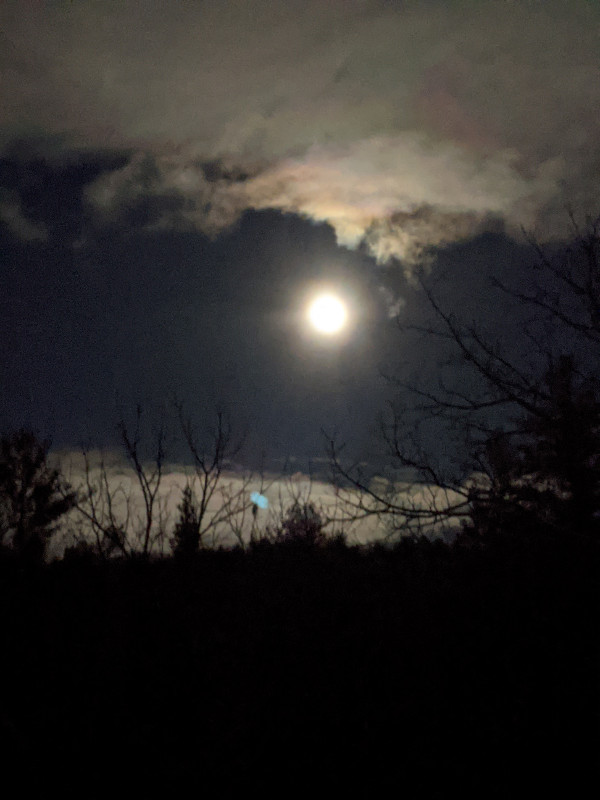
For anyone inclined to notice the moon at all, a full moon is a wonderful link to others around us. Look up and you know that almost everyone on the planet who also bothers to look can see the moon in her shining splendor within the same 24-hour period, unless the skies are cloudy. (Then we can feel the moon.)
In her Celtic Devotional Caitlin Matthews notes this is a splendid season to remember and celebrate the “midwives of the soul”. Wise counsel indeed! I’m a member of a genealogy site that you can set to email you reminders of ancestors’ birthdays, weddings, etc. — I find it’s a good way to pause several times a month (depending on how detailed your family tree is) and consider the lives of those who’ve gone before me, walking this human path through their own times of challenge and blessing. (One of my grandmothers 6 generations back died at 19 while giving birth to her third child — a brief life, but also one that led to many descendants, including me. As someone who suspects reincarnation in some form accounts for a great deal of the rebalancing in our lives over the long term, I also imagine that soul returning generations later, possibly through a “descendant doorway” which that previous and painfully short lifetime made possible. Our lives belong to, and shape, a far wider circle than we often know.)
Brighid of the Snows, Brighid of the Full Moon, Patron of poets, smiths, healers …
I’m spending half this afternoon apologizing to ghosts, writes John Murillo in one of his poems in Up Jump the Boogie. It’s what we may find ourselves doing, if we’re mindful about the past, the present, our own struggles. In another poem Murillo says, like all bards, This poem is a finger pointing at the moon … You big dummy, don’t look at my finger, I’m trying to show you the moon. I fill up yet another blogpost with words, still trying, fumblingly, awkwardly. We celebrate Imbolc with an OBOD ritual, or alone, silently, offering droplets of wine to the full moon. We bring in snowmelt and offer it at Brighid’s altar.
On Sunday evening, five of us in Vermont gathered via Zoom to celebrate using the OBOD solo rite for Imbolc. The solo rites parallel the group ones, but they’re less formal, more inward-looking, more flexible for whoever shows up. We assign roles on the spot, do some spontaneous rearranging or improvising where necessary, honoring the spirit of the rite. We’ve been doing this since for more than six months now, after a hiatus when it looked like our seed-group might not endure. Mystic River Grove, active now for over 30 years, holds its rituals online with a few dozen attending each time.
As I often do, I find ritual both intermittently frustrating and unexpectedly moving. One of our members with an inerrant ear for poetry usually has something to read for us which captures the thread and flame at the heart of the ritual, the core experience of gathering to honor the season. This time she read from Robert MacFarlane and Jackie Morris’s The Lost Spells, the second book of poems to emerge from the decision a few years back by Oxford University Press to remove words naming the natural world from a popular children’s dictionary. One reviewer of MacFarlane’s book (and apparently not a regular reader of poetry) complains, “Since when is a poem a spell?” When, we might all reply, oh when has it ever been anything else?
/|\ /|\ /|\
“There was never”, says Walt Whitman, “any more inception than there is now, Nor any more youth or age than there is now, And will never be any more perfection than there is now, Nor any more heaven or hell than there is now”.
If that’s true, it’s both bad and good news. Bad, because wow! I really need to apologize to my ghosts, my ancestral heritage. Good, because I don’t need to: I have what I need right now, just as they did and do.
On its website, OBOD offers a guide called “Treasures of the Tribe: Guidelines for OBOD Seed Groups and Groves” that anyone can download as a PDF. In addition to being a fund of hard-earned wisdom about the dynamics of groups, and an insight into the feel of the OBOD “style” and its flavor of Druidry, it offers an excellent seed for meditation and reflection and conscious action:
A useful question to ask, when difficulties arise, is: ‘Is there a gift here, trying to manifest itself?’ or: ‘What is it that is seeking transformation?’
Many of you may know author and artist Julia Cameron, whose The Artist’s Way and associated books have justifiably won her devoted readers. Here’s her entry for January 26 in The Artist’s Way Every Day*:
“Art is a form of the verb “to be.” It is not mere cleverness to point this out. At its core, life is artful and creative, each moment contains choice as much as each brush stroke in a painting, each syllable in poem, each note in a melodic line. It is because of this, its insistence on choice, that art demolishes the victim position. When bullying life demands of us some injustice: “You want to make something of it?” the artful answer is yes.
What will I make of it? The challenge for anyone alive is to re-win this artful approach every day. When I managed to center myself in it yesterday, felt its truth in my marrow, and marveled at the doors opening because of it, I sleep and wake and there it is to be re-won the next day. Now if I make a practice of it, a momentum builds over time that I can draw on — water from a well. Some days it does indeed come easier. Almost without effort there are days when I can slip back into the pose, the stance of it, like a martial arts kata. Ah, there it is again, my blood sings.
And Druidry is simply one way to do this, among many. One of the signal advantages of Druidry is that it hauls around substantially less baggage than many older spiritual paths. What was once an artful answer in many traditions has too often solidified into dogma. You must believe it, rather than practice it to find out if in fact it actually works for you. And if it doesn’t work for you, you’re bad, evil, lost, sinful, worthless, a loser, trash, garbage, rubbish, broken, useless — take your pick of abuse. Many of us have.
An artful way can be a long one. In truth it should be a long way — a lifetime’s way. Because in the end it’s the only way survivors end up traveling, each in her own way. Not my way or the highway — nothing like that. No, you find what works for you. Something is always coming to birth within us. No one else can do that work for me. Others can cheer me on, and I love them for that. They can walk with me part of the way, and I’ll cherish them for their company. They can write blogs and books, offer workshops, help us rekindle the fire when it’s fallen to ashes. They can sing to us, feed us, hold us when we cry, and remind us You got this.
Druidry from its early modern re-conceptions has (mostly) tried to be artful. Rather than a doctrine, it offers a toolkit, a spice-rack, a palette of colours. Rather than a creed, it offers songs, images, magic. Rather than priests, it offers bards. If it has weaknesses (and of course it does), one that comes to mind is a lack of spiritual guidance for those truly floundering and struggling. We have only to look at the prevalence of mental illness today and realize how many of us are suffering. Yes, individual Wise Ones can be found here and there — their own small local groups and groves know who they are. And while they can indeed offer wise counsel and compassion, most have no professional training in working with deep-seated and chronic problems. That time may come, but it is not yet now. The current stigma doesn’t cloak immorality, like it used to do. The current stigma instead clouds and paints mental illness with a most destructive brush. In a world already increasingly isolated by covid, the people who most need the rebalancing that often comes with human connection are deprived of just that necessity. Zoom and Skype and Facetime only take us so far.
/|\ /|\ /|\
A strength of Druidry, one that’s often held out to people, is that it makes no requirements about beginning. You start where you are, with the circumstances you find yourself in. Yes, it’s true that as with internet forums, the requests for help that are often most successful are those that show the petitioner has put forth some effort already. That’s all the Druidry asks — that you actually try out some of its practices. Not believe what some of its spokespeople try to conceptualize on the basis of their experiences, but begin with my own practices that will lead to my own experiences. Then, when I come across the beliefs and concepts of others, I can begin to perceive something about the experiences that underlie them — because I’ve experienced some version of the same thing.
The tolerance that comes with that kind of recognition also gives us a place to start to work with others that springs from an inner authority others recognize. We can honor and respect another’s understandings because we’re still working on our own — in the same way. We refer it back to experience. The Land teaches me something new each season, though I’ve “been through” all four seasons many times already. My dreams show me wisdom in part because I’ve listened to them in the past. I look forward to celebrating Imbolc because I know that once again I’ll discover something valuable about Brighid, about the day, about my fellow Druids if I’m on Zoom, about early February in my particular place, whether I’m in a group or solitary.
The tree is silent because that’s the only way I can hear what it’s saying.
/|\ /|\ /|\
*Cameron, Julia. The Artist’s Way Every Day: A Year of Creative Living. Tarcher/Penguin, 2009.
Looking for a sign? (It’s true you’re more likely to see one that way.)
Don’t believe in signs? (You may still encounter them anyway. Whether you notice is another matter.)
We’re constantly encountering markers and indicators of our surroundings. What I’m here calling “road ogham” can offer a parallel, an approximation of how to work with signs, if I let it.
Consider: I meet with signs when I’m on a journey, and whether or not I notice them, they can give me information about my path, my particular location at the moment, the surroundings, where I might beneficially place my attention, and much more.
At least at first, there’s nothing mysterious or magical about them. Look and I’ll see them; look somewhere else and I won’t.
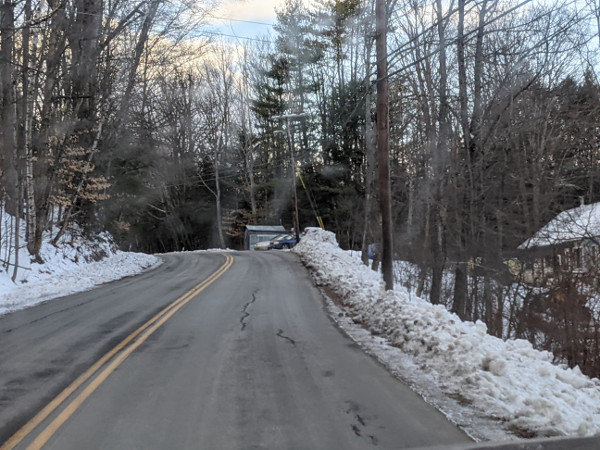
For much of my journey there may be no particular signs — the challenge then is to notice what I can observe and sense as I go. In such situations, what I attend to may well carry as much meaning as any sign: the weather, the time of day, the landscape, the road conditions, the vehicle I’m traveling in, my attitude and attention.
Sometimes the sign may mirror what the road itself is doing — the sign is clear, and accords with the path. Let me travel by night, though, and suddenly that same sign may turn out to be vital to safe passage. It signifies what’s to come if I keep going — what I can no longer see without the sign.
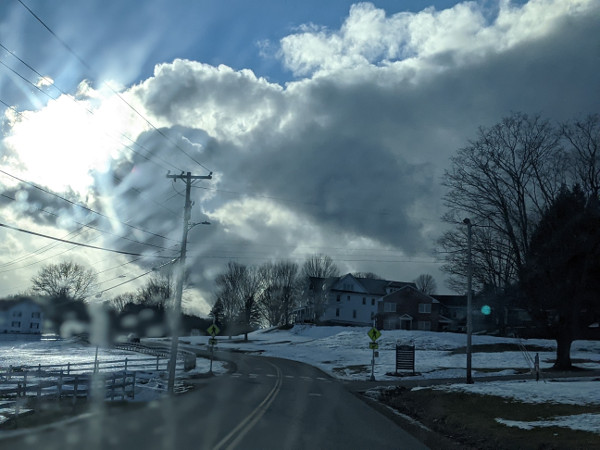
Sometimes my sight may be blurred — to the left the car windshield has streaks of pine-pitch I haven’t totally cleaned off — and other things may claim more of my attention at the outset. Here a dramatic winter sky dominates my visual field.
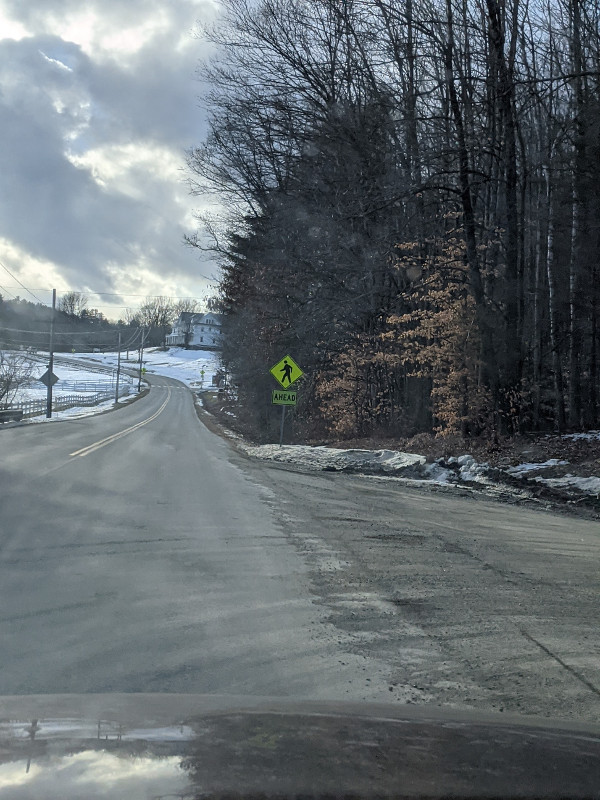
But with attention and familiarity from traveling the path previously, I notice the small sign that others may be nearby or crossing my path, or stopped in the middle of it, over a crest I can’t see beyond.
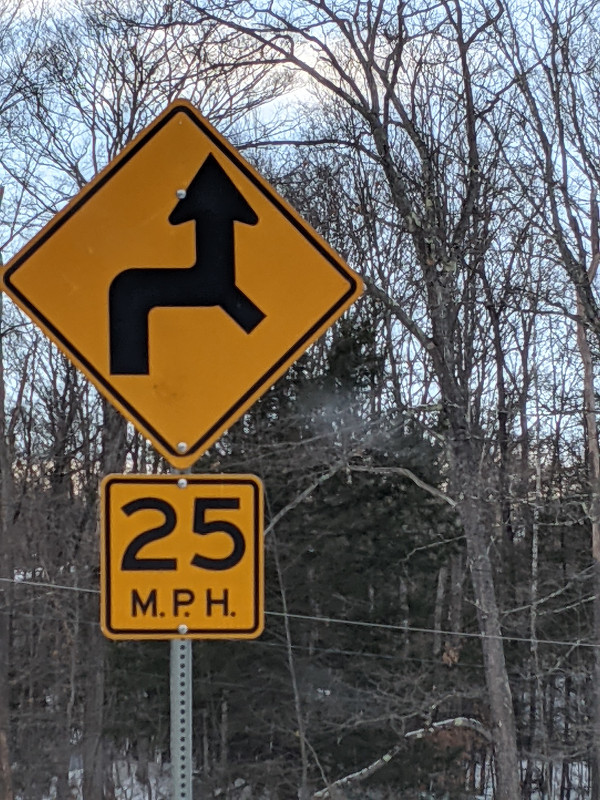
Sometimes the sign has no language attached to it — it comes solely in images or pictures.
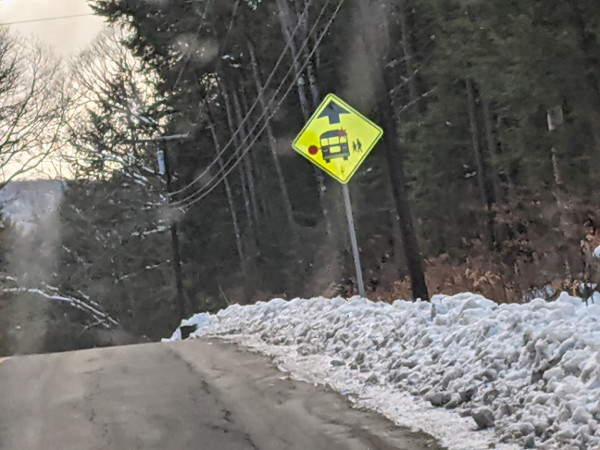
But other times I receive a sign that alerts me to a change and also conveys a sense of how to proceed — in this case, more slowly. In some way it activates the language centers — in addition to image, I hear or understand something in words as well.
Learning how to drive means learning to take signs into account. While learning to “read” our lives and landscapes isn’t exactly parallel, we still undergo an apprenticeship.
What I gain from that apprenticeship accords with what I bring to my learning. It starts where I am right now, and I build on it.
I don’t know about you, but I often have a gut feeling about the seasons. Two weeks out, as you keep reading me write here. Around two weeks before one of the “Great Eight” festivals looms on the earth’s calendar, the coming celebration begins to kindle little fires in my peripheral vision. Imbolc, Imbolc. We notice things, it seems to us, simply because they’re notice-able, but our noticing makes them also makes them more pronounced, more prominent, more accessible to our awareness.
It’s a common enough experience: get a new car, a new dog, a new god, and suddenly you notice them all around you. This should (re)alert us to our realities. We’re seekers of saliency — biologists and psychologists try to keep this fact (a whole level of irony in that) in our awareness. “I’m going to pay attention to whatever stands out for me in my world, because that’s obviously what matters”. Yes — but hard and fast on the tails of that comes a potent corollary: what do I want to discover? What do I choose to empower with my attention? And what am I pushing away and refusing and denying, because it doesn’t fit — because it may well bring (the horror of it!) change. Answering such questions is enough to keep a Druid up nights.
I’ve learned to tell when things are stirring because I start to get snarky.
“But I don’t believe in _____ “. Doesn’t matter. Or at least it doesn’t matter that much right now. Invite some direct personal experience into your life, and what you believe may take a holiday, or hibernate, or explode. Or stay exactly the same. You said you were looking for some excitement, right? Time to spin the Belief Roulette wheel. Why not? We do it with absolutely every other part of our lives. Why should our beliefs be exempt? After all, they’re often the least reliable part of us. When I’m kissing an attractive Other, their lips matter a lot more than their beliefs. Kiss a god three times and watch your beliefs do a backflip.
Google the word Imbolc for its origins and you’ll get a range of learned and folk opinion. The possible meanings can each lead to fruitful meditation and ritual. Old Irish i mbolc, modern Irish i mbolg, “in the belly” — the soon-to-be-born lambs of the season. Oimelc, an alternative name dating from the 10th century, meaning “ewe’s milk”. Old Irish imb-fholc, “to wash or cleanse oneself”, consistent with this festival of purification. English Candlemas, St. Brighid’s Day. A holiday dating “from the Neolithic period”, Wikipedia tells us, with overlays and cultural additions over time, making for a splendid richness and depth.
Go outdoors, after or before you’ve Googled, or instead, and if you’re in the Northeastern U.S. you probably see new snowfall.
Back yard, 10:16 am this morning.
I can learn at least as much Druidry exploring the transformed landscape as I can pondering the possible origins of the word Imbolc. If you live in a different climate, the same holds true. Maybe not today, but yesterday, or tomorrow.
A lovely example of our Druidry at work and play, from an online post: Want to celebrate this snowy landscape, invite something of what’s happening to earth, trees, and sky into our homes? Bring in some snow, melt it, and water the houseplants and pot-herbs with it, a winter’s blessing. Make tea or coffee with it. Save some to asperge the house with on Imbolc, or ceremonially deploy it during your Zoom ritual.
Your song and my song of Imbolc may be different, winter-song, desert song, sea-shore song, tropical song. What matters is that we listen and hear them and sing them, aloud or silently.
/|\ /|\ /|\
Greetings to Peru, newest visitor according to both the Flag Counter and WordPress analytics. Imbolc and Lunasa, Lugh and Brighid, linking the holidays as our planet is linked …
A recent post in a Druid forum asked about connecting with the natural world in winter, especially in regions where cold and snow make the outdoors less inviting unless you plan to stay active and warm hiking or skiing and so on.
Especially in cooler climates, winter draws us inward. That nudge to hibernate, to drowse and sleep and inhabit an in-between is a valid one, one we can honor and welcome, rather than resist, or apologize for, or feel somehow shamed by.
That inward focus can lead to celebrations and insights into nature through drawing, writing, music, crafting, etc. — arts that spring from our own inwardness, a whole world we often step past in the more outward-facing months of summer.
Even water drowses, moves slower, curves back on itself, dreaming of a thaw …
Planning a garden, celebrating each midday point in these short winter days, watching the dawns or sunsets, etc. can all be conscious acts of dedication and participation during winter. And incubating dreams, keeping a dream journal, working on projects or issues or questions through dreaming, including daydreaming and drowsing, can all be richly productive. Objects I’ve collected in better weather now matter more. They’re important to touch and handle frequently: stones, feathers, shells, bones, pieces of wood, etc. Contours and textures of our worlds.
And this physical touch and connection, especially now when we hunger for it during covid, can include pets, who mediate wonderfully for us with the natural world. So we talk with them, cuddle them, spend even a little time outdoors with them and watch them play in the snow, and perhaps rekindle the wonder of winter, even if we don’t choose to ski or snowshoe or hike or sled, toboggan or romp.
The natural turn towards inwardness accords with the dark and bright halves of the year. The “yang-ness” of much of Western culture prods us to give some account for ourselves, to justify our hours and days with productivity, with gains and forward movement and progress. If we’re to e-volve, we have to “turn outward”, the word itself tells us. But that’s just half of it.
Part of the natural rhythm that Druidry can help us re-establish is a more sane balance between outer and inner activity. Anyone who thinks trees and animals aren’t “active differently” in winter can apprentice themselves to the natural world to find out just what’s going on. This can be another winter activity — reading, study, inquiry, research, pondering, finding out for ourselves, as well as walking outside to smell the chill air, marvel at winter sunlight, catch all the hues of gray and white, light and dark, shade and sun.
These queries and thoughts are fitting for the new moon that’s upon us. We’re just emerging from the Dark of the Moon after all, into a New Moon. Lunar questions, lunar contemplations. The tree for the month, following the 2021 Lunar Calendar (www.thelunapress.com) is Luis, the Rowan or Mountain Ash. As I look on the Rowan in our front yard, I try to honor its lesson, follow its lead.
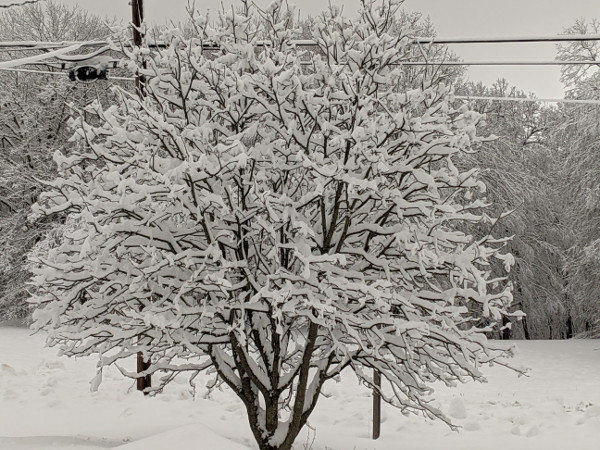
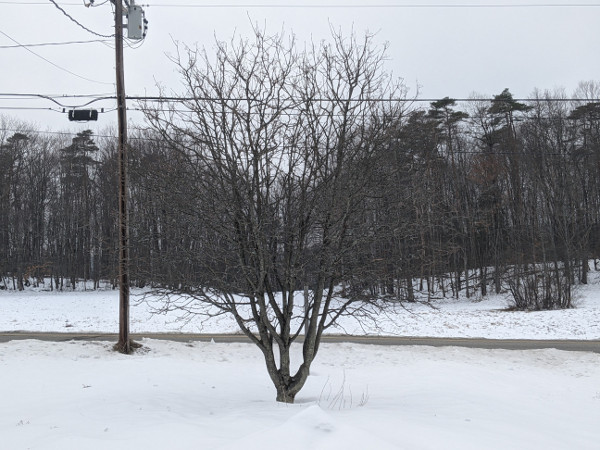
Rowan, as an image of winter’s inwardness, you do well. Hard even to make out completely, set as you are against a background of other trees. Barren, and with the camera’s foreshortening, looking like you sit directly under electrical lines.
Often it seems trees wait because they “can’t do anything else”. So it can be revealing to do a tree meditation, to listen to what is going on with a particular tree. Rowan isn’t worrying about winter, or considering the starkness of its branches against other trees, or the sky. Its sugars and life-sap have retreated from where its leaves were, but it’s no less alive for all that. I hold the Rowan twig I picked up a few years ago from a dead branch on the ground. I’ve used a woodburner to mark the Rowan ogham ᚂ on the stave, another step. On such seemingly small actions we can build steps and paths to further insight and connection.
Whether or not I “finish” a set of ogham staves, I have these gifts from several neighboring trees to hold and connect with and listen through. Rowan’s magic, magic of hemlock, oak magic …
One great gift of the Others like trees and animals (as well as people) who share our worlds is that they help draw us out of ourselves, when necessary. Caitlin Matthews’ wise book, Celtic Devotional, offers this short meditation for the Thursdays of winter: “I give thanks for the wise qualities of the evergreen trees that have stood by me this day: may you show me how my own heart can be evergreen and growing through winter’s doubt and darkness”.
This is a post that will become a page on this site, because the topics it addresses raise perennial questions. Its direct inspiration comes from discussions on Druid social media sites, and from your search terms here at A Druid Way.
/|\ /|\ /|\
If you bear in mind the popular saying “Ask three Druids and you’ll get ten answers”, you should be in good shape. This short FAQ arises out of one person’s experience, study and reflection. As with most things, a second – and third – opinion will be very useful and give you a broader and more informed perspective.
What is Druidry?
Druid author J. M. Greer gives an answer that’s held up well over time: Druidry “means following a spiritual path rooted in the green Earth … It means embracing an experiential approach to religious questions, one that abandons rigid belief systems in favor of inner development and individual contact with the realms of nature and spirit”. While beliefs matter, more important is what Druids do each day. An openness to experiences and encounters in nature forms part of the Druid perspective.
Do Druids believe ____ ?
Some probably do. Many may not. No single creed or statement of faith unites all Druids, because Druidry is an individual spiritual practice or way of life rather than a set of beliefs. In this way, it’s like asking “What do carpenters believe?” This sets it apart from many Western monotheistic faiths, and also makes it possible to be a Christian and a Druid, an agnostic and a Druid, etc.
However, it’s possible to talk about what Druids believe using general statements with “most” and “many”. Here’s a Triad that probably characterizes a large number of Druids:
Most Druids are united by a love and respect for nature, and show an attentive attitude towards its rhythms and cycles that they may express in seasonal observances like the solstices and equinoxes. Secondly, many Druids also perceive a spiritual dimension to life, though that may or may not mean belief in a god or gods. Third, many Druids also express their perspectives and experiences creatively, through craft or art, carrying on in modern forms the traditions of the ancient Bards.
Do you have to have Celtic ancestry to be a Druid?
No. The ancient Celts were a culture, or set of related cultures and languages, rather than a single genetic bloodline. Given that the Celtic peoples apparently ranged across much of Europe, from Ireland and Portugal to Germany and Italy, and possibly further east, settling and intermarrying with other peoples, this shouldn’t be too surprising. It’s true there are a few and mostly small Druid groups who require their members to demonstrate a specific ancestry — often Irish or Scottish. But our ability to love and respect and live lightly on the earth certainly doesn’t need or benefit from genetic gate-keeping. Anyone anywhere on the planet can practice Druidry starting right now.
Where do the teachings of modern Druidry come from?
A range of sources. Many traditional stories in surviving Celtic literature like the Welsh Mabinogion point to Druid practices and understandings. In several cases, they also provide teaching stories and initiatory insights which several Druid groups use in their training. While a few individuals and groups claim to preserve ancient or hereditary Druid practices and beliefs, in most cases these are the common folk wisdom of most pre-modern cultures around the world: a knowledge of herbs and natural cycles, animal and plant and star-lore. More important than how old they may be is the question: “Do they work today?”
The Renaissance recovery of Classical sources, the influences of Neo-Platonism, Arabic learning in astronomy and medicine, mathematics and alchemy and astrological lore, and the British Druid Revival beginning in the 1600s, all play their part in helping to deepen Druidry. Practices of meditation and visualization also derive from a variety of sources. Most Druid teachings emphasize learning from our own locale. The trees, plants, animals and landscape, previous inhabitants and climate all have many things to teach.
How do I become a Druid?
For anyone alive today, the path to Druidry has been made smoother and broader by books and the internet. Many Druids are great readers. Books can give you a sense of the range and depth of Druid practice, and inspire you to adapt relevant portions of it to your own life and circumstances. (See Books and Links.) The internet can connect you to active and established Druid groups, who offer events and resources for members and non-members alike. But while these sources can be helpful and inspirational, a walk around one’s home area is an excellent prime starting point. What can I learn about — and from — the trees and animals and plants in my region? Who lived here before me, and what did they know? What local geographical features like mountains or lakes or the ocean influence the weather? How do I “fit” where I live?
Can I be a Druid without joining a Druid organization?
Absolutely. Even those Druids affiliated with an organization are often “solitary” Druids for 350 days out of each year. Curiosity, a willingness to learn and study what interests you, and reverence for the earth are the marks of a Druid, not membership in any group. (See my post Druiding without An Order.)
What do we know about ancient Druids?
Direct evidence is comparatively modest. We have archaeological discoveries and the accounts of Classical authors contemporary with ancient Druids. We can make intelligent guesses from some of these sources, but much remains unknown. The single best book on the subject is Prof. Ronald Hutton’s Blood and Mistletoe: The History of the Druids in Britain.
How can anyone claim to be a Druid today, if we know so little about the ancient Druids or their practices?
Philip Carr-Gomm, former Chief of OBOD, the Order of Bards, Ovates and Druids, addresses this directly:
“Contemporary Druidry draws on a heritage of thousands of years, and yet many of its ideas and practices have only been formed over the last few hundred years. Unlike most of the established religions, which are based on doctrine formulated in the distant past, Druidry is developing its philosophy and practices in response to the spirit of the times. It is being shaped now rather than being preserved or simply passed on, and paradoxically, although it is inspired and informed by an ancient heritage, it is surprisingly free of the weight of the past. This leaves modern Druidry open to the criticism that it has been invented; but it also makes it a thoroughly contemporary spirituality that speaks directly to the needs of today” (What Do Druids Believe?, pgs. 2-3).
I love Druidry but I don’t like ____ . Can I still be a Druid?
If you already know you love Druidry, nothing more needs to be said. You’re in excellent company — the wider “Druid world” require very few things from a Druid except that love and respect for nature.
(For some people, magic or ritual are words they might put in the blank above. Stick with Druidry and you may well find out more of what they’re all about. But again, absolutely neither is any kind of requirement.)
We can apply/adapt the words of Jesus here (as in many cases): “People aren’t made for Druidry; Druidry is made for people”. Go with what truly works for you, and you’re walking a path with heart.
Are there initiations in Druidry?
Because you can be a Druid by yourself, no initiations are necessary. With that said, some Druid groups offer study materials that include self-initiations — opportunities to deepen and hallow your experiences and understanding. And some groups make initiations a prerequisite for advancing within the group.
Life presents us with a few initiations of its own that all of us experience. Practice Druidry over time, and you’ll pass through the initiations of death, sickness, loss, change, love and birth. Your Druidry can help you navigate those experiences with greater understanding, resilience, growth, and compassion for others.
I like what I’ve read about Druidry, but I don’t believe in _____ .
If you love and respect the natural world, you’re ready to practice Druidry. If you’ve read the other parts of this FAQ, you know you don’t need to believe to be a Druid — you need to practice. Many of your beliefs will come from those experiences. More encounters and reflection may help you get a clearer picture of Druidry and what it means for you. Books, experiences with groups, study, and time spent in nature can all help you clarify your next steps.
Which Druid order has the best ____ ?
The inside word on that is ___ .
What about people who say Druidry is ____ ?
You may have noticed that we live in an era where almost everything now has both ardent fans and unrelenting critics. The best way to respond (or ignore) is to practice Druidry yourself over at least a few years — then you’ll know what it is for you. The second best way is to attend some Druid events with practicing Druids, observe thoughtfully, and ask questions. The third best way is reading widely. As Druid leader, Her Majesty’s coroner (anatomical pathologist), actor, author, drag queen and popular speaker Kristoffer Hughes likes to say, “What other people think of you is none of your business” (unless you’re planning on running for office).
If you’d like an objective tool to assess any group, you’ll find Isaac Bonewits’ Cult Danger Evaluation Frame most helpful.
Can I be your student? / Will you teach me?
This blog offers more than enough enough material for you to pick up the practice of Druidry, and to locate diverse sources to answer your questions better than I can, and to guide a beginning practice. Ultimately, your best teacher is the Land you live on.
Cycles and circles invite us to return to the beginning, to the starting point, to our foundations, to the spring and font and source of what we know and do and perceive.
Grounding and centering may receive attention in your individual practice or in a group, or a ritual or ceremony may touch on it only briefly, if at all. Nevertheless, the practice remains a core tool in our spiritual toolkit, never replaced, because in so many ways it represents the heart of everything we do. We wish to connect, to re-link, to “return to our factory settings”, to recharge, to balance and harmonize and attune. The science is increasingly clear — such practices have wide-ranging value.
clearing a path to the light, to the road, to a way
Our languages often contain faint echoes of such things: “Pull yourself together. Get a grip. I really lost it” — but generally don’t offer clues on how to do the pulling, the gripping, the re-finding of what I lost.
Below are nine ways to begin to do this, to open the doors, invite the presence of spirit, and dedicate ourselves to expressing its wisdom and insight in our lives, for everyone’s benefit. Nine’s a happy number — there are many more.
Some of our greatest service to others arises when we take care of ourselves.
ONE — with sound
Many traditions have holy names, sacred words, bells, chimes, gongs, etc., that envelop the practitioner in sound. Because of the definite effects of these practices, stories and legends have often grown up around them attributing magical properties to them. Direct experimentation is usually the best guide — go with what works for you, while being open to avenues for change as needed.
Asking for a word or sound can also help. Your willingness to make the request can itself open doors that help you notice what comes to you. You may find your attention focused on a word or sound or name in your reading or your conversation during the day, or you receive a nudge to find (or make) a bell, chime, rattle, etc. The act of making can itself induce positive effects — you’re following guidance you received inwardly, which clears the path for more.
TWO — with a ritual gesture
Many people find ritual gestures help them ground and center. The act of lighting a candle or incense, casting runes, opening a holy text to a random page for its guidance, standing before an altar, crossing yourself, bowing, or performing a more elaborate series of gestures — ceremonials favored among magical groups like the Lesser Banishing Ritual of the Pentagram — all rely on the power of conscious, intentional action to bring about focus and clarity.
THREE — with attention on a focus point
Devotional attention placed on a sacred image or holy photograph is a long-favored technique. A personal contemplative practice may involve icons, statues, tarot cards, or other divination images or systems. Bringing the attention to a focus-point concentrates its energy. Many people report the sensation of being watched or stared at — we’re often sensitive to such things. Focused attention by another person generates enough energy that we feel it.
Through such practices we may also begin to discover how unfocused we often are. Such techniques increase our capacity to focus and ignore distractions. With so many faces and names on social media and in the news and in advertisements striving to grab and hold our attention to their advantage (and not necessarily ours), it can be a profound practice by itself to reclaim our attention and put it to uses that we choose, not someone else. Achieving and sustaining personal sovereignty can be a lifelong practice.
FOUR — with a prayer, chant, verbal formula, etc.
The advantage of a chant or prayer, especially one that we know by heart, is that it can help quickly generate the atmosphere and energies and focus we desire. (One downside of long practice, of course, can be eventual over-familiarity, which we can always work around with our creativity. Another practice!)
Group practices like communal prayer or chant can bring many people together quite rapidly. Similar effects come with prayers in other traditions. If you were raised in a different tradition from the one you now practice, you probably still recall some of its most common recitations, creeds, prayers, etc.
Many are interested in composing their own chants, prayers and recitations. The act of doing this can itself be a form of devotion, a practice of prayer and listening, and of grounding and centering. (If you’re beginning to realize that much if not everything we do is an opportunity for grounding and centering …)
FIVE — with a visualization
Many people believe that if they can’t see inwardly with as much clarity as their physical sight provides that they’re somehow “bad at visualization”. We forget that visualization is larger than the eyes. It’s the engagement of the whole imagination — and all of us imagine. For some it may arrive as a feeling, a tickle along the spine, something sensed with hearing, or inward presence, or sensed in a wide range of other ways. When we daydream, often we’re aware of being in a different space and place. The experience draws us in, and eventually we “come back”. From where?! Daydreaming can be one way to play with visualization, relaxing all our senses, so that we don’t censor them before they can take us to “lands away”.
SIX — with an associated physical sensation
By my bed I keep a Druid stone, one that I found on a local walk, that has featured in rituals, and that has consequently come to be a symbolic and ceremonial object for me. I can easily pick it up, feel its rough edges, sense the coolness of the granite, recall its presence at previous events, and add to its value and significance. Its flat bottom, as if it broke off from a quarry where stone-cutters worked, its density and weight and color all add to its sensory impact. Contact with it evokes previous contact. For me it is a touchstone, a measure of my days.
It’s among our more interesting human habits to collect such keepsakes and objects that call to us, and physical contact with them can help us ground and center.
SEVEN — with a direct prompt
Sometimes a direct prompt to “ground and center” can remind me to do just that. A simple printout with those three words “ground and center” posted in a prominent place, a screen saver on my computer, an automated, regular email I send to myself, a timer on my phone that helps me collect myself perhaps 3 or 4 times a day — all these can help me ground and center. If an object works and can do this, the prompt can simply be the presence of the object someplace I will notice it.
A friend of mine chooses a certain day to be an activation day. She’s on the road a lot for work, and every time she sees a road sign, she practices grounding and centering. It’s a kind of mental fasting from things we don’t need, things that can distract us. And the road signs themselves often try to do this, to rouse us from “road dreaming”, from the hypnotic state we can often enter behind the wheel: “Caution” — “Children at Play” — “Slow — “Work Zone” — “School” — “Pedestrian Crossing” — all of these are calls for our attention meant to benefit everyone. Using them as reminders to ground and center takes advantage of daily props as prompts to spiritual practice.
EIGHT — with the help of others
We can engage the companions of our days as aids in helping us. Partners, pets, guides, signs and omens, etc. can all serve as reminders. If I go to work, my return and the greeting of partner, pet, etc. can become a practice. Ground and center at the moment of our re-connection. Cats and dogs help us make it physical. Touching warm fur, feeling a nose or a tail against our skin, hearing a purr or a happy bark can all become reminders of how grounded and centered our pets are, and how they invite us to become as earthed as they are.
NINE — with food and drink
Many people have discovered the effect of food and drink on our attention and energies. A good meal can center us, make us grateful, and earth any random energies after ritual or practice. Yes, we wisely attend to the advice to avoid eating before and after ritual for this very reason. But again, our discretion and individual circumstances and experience can be our guides. Food helps close the psychic centers, especially when they’ve become over-active, or if we’re out of balance. The traditional heavy meat-centered meals of the holidays famously leave us sleepy afterwards — all the more if we normally go light on animal proteins most days, or avoid them altogether. After we receive an emotional shock or blow, food and drink can help calm us and aid us in dealing with the situation.
Ritual food, taken after a rite or ceremony or prayer, can have the same effect. Often a ceremonial or traditional meal accompanies rituals and religious practices in many traditions. Even if we’ve left behind such family traditions, almost everyone celebrates a birthday with food. We have many such openings in our daily lives to develop and extend a practice.
Here at year’s end, I’m finally getting around to reading the next-to-most-recent Mt. Haemus paper, RoMa Johnson’s “The Well and the Chapel: Confluence”. This ongoing series, sponsored by OBOD, has produced substantial papers on a range of topics since 2000, and last year’s 21st paper is of particular interest to me. Readers here know of my investigation of some of the intersections of Druidry and Christianity. In her paper, Johnson looks at five specific aspects of her topic: “Worldviews—Immanence and Imminence; Justice—Sin, Responsibility and Restoration; The Three—The Sacred Feminine and the Trinity; Immrama—The Soul’s Journey and Inspiration; and Confluence”.
Johnson also quotes Trappist monk and author Thomas Merton: “If I were more fully attentive to the word of God I would be much less troubled and disturbed by events of our time: not that I would be indifferent or passive, but I could gain strength of union with the deepest currents of history, the sacred currents, which run opposite to those on the surface a great deal of the time!”
Let me do a Druid transform of this with a few but significant tweaks, and make for myself a spiritual affirmation and guide: “When I am fully attentive to Spirit stirring throughout the worlds, I am less troubled and disturbed by events of our time: not that I am indifferent or passive, but I gain strength of union with the deepest currents of history, the sacred currents, which run opposite to those on the surface a great deal of the time”.
Often you can find this kind of spiritual wealth hidden just below the surface, as Merton’s words suggest, with a little meditation and creativity. At least, that’s one of my practices.
/|\ /|\ /|\
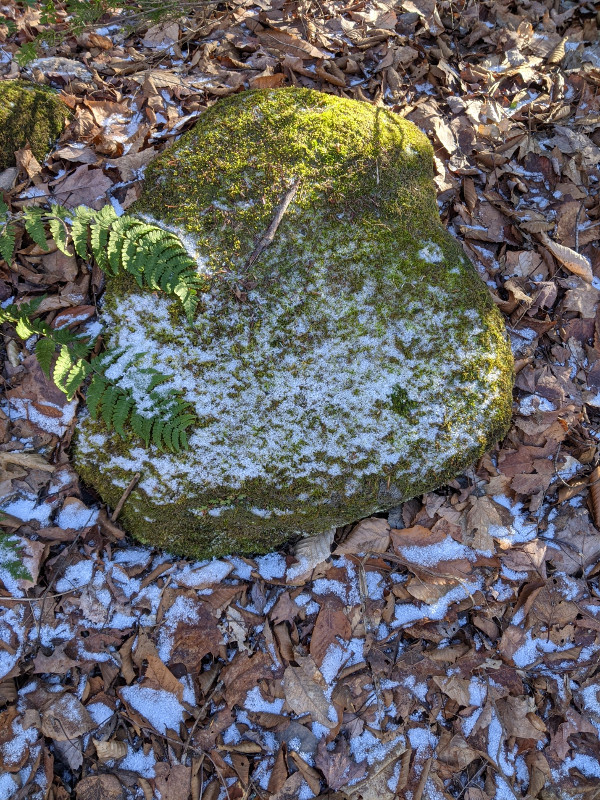
wood-snow, snow-wood …
A listing of the titles with links to transcripts of each lecture in the Mt. Haemus series provides a rich and broad source of contemplation and meditation seeds, as well as directions for study and practice. You can preview each paper, read it online, or download it for free from the OBOD site at the link above at the start of the paragraph.
More ambitious, and looking for study material for 2021? Or not a member of any Order, but looking for substance, as opposed to the ubiquitous fluff all over the Web? These 22 papers will give you a full year’s curriculum and then some, if you give yourself time to absorb them, follow up on bibliographical links, and explore their significance and implications in your own life and circumstances. The bios of the varied authors are also fascinating by themselves!
1: The Origins of Modern Druidry — Ronald Hutton 2: Druidry – Exported Possibilities and Manifestations — Gordon Cooper 3: Phallic Religion in the Druid Revival — J M Greer 4: Question, Answer and the Transmission of Wisdom in Celtic and Druidic Tradition — John and Caitlin Matthews 5: Universal Majesty, Verity and Love Infinite – A Life of George Watson Macgregor Reid — Dr. Adam Stout 6: Working with Animals — Prof Roland Rotheram 7: ‘I Would Know My Shadow and My Light’ – An exploration of Michael Tippett’s ‘The Midsummer Marriage’ and its relevance to a study of Druidism — Philip Carr-Gomm 8: Entering Faerie – Elves, Ancestors & Imagination — Dr. James Maertens 9: How Beautiful Are They – Some thoughts on Ethics in Celtic and European Mythology — Dr. Brendan Myers 10: What is a Bard? — Dr. Andy Letcher 11: Druidry & Transpersonal History — Dr. Thomas C Daffern 12: From solstice to equinox and back again – The influence of the midpoint on human health and the use of plants to modify such effects — Julian Barker 13: Magical Transformation in the Book of Taliesin and the Spoils of Annwn — Kristoffer Hughes 14: Music and the Celtic Otherworld — Dr. Karen Ralls 15: ‘Almost unmentionable in polite society’? Druidry and Archaeologists in the Later Twentieth Century — Dr. Julia Farley 16: Gathering Mistletoe – an approach to the Work of E. Graham Howe — Ian Rees 17: Tree Lore is Wisdom — Mike Darton 18: Lecture The Elementary Forms of Druidic Life – Towards a Moral Ecology of Land, Sea, and Sky — Jonathan Woolley 19: Channeling the Awen Within: An Exploratory Study of the Bardic Arts in the Modern Druid Tradition — Dr. Dana Driscoll 20: What Druidry does – a perspective on the spiritual dynamics of the OBOD course — Dr. Susan Jones 21: The Well and the Chapel: Confluence — RoMa Johnson, MDiv. 22: The Feminist Druid: Making Way for New Stories/New Work — Dr. Michelle LaFrance
As 2020 draws to a close, my thanks again to you for taking the time to read and ponder the posts here. As always, I value your comments and suggestions.
A look at five less immediately obvious aspects of practicing without an Order or group nearby: initiation, spiritual formation, community, proficiency and service. This post resonated with readers also confronting the increased isolation of most of 2020.
Among other things, this post asks two questions: “What’s your ritual goal?” and “What’s your moon?” Your goal and the time of year can both shape any moon ritual, giving you a starting point and ready imagery to work with.
Another two-parter. “As children all of us spent at least some time peering from the gates of an Otherworld into this one. That’s almost a definition of childhood. Imagination came so readily then that we thought nothing of it — it was our native tongue, our common language. We thought nothing of it because our journeys back and forth between the worlds felt completely natural, for the simple reason that they are”.
Mysteries in the older sense of the word, as Greer points out, are “the traditional name for rituals of initiation linked to seasonal cycles and based on the mythic narratives of Pagan gods and goddesses” (pg. 2).
If you’re looking for aids to meditation and a means to reduce anxiety, gain focus and know your own core being, a fonn of the Céile Dé may be for you.
Technically from 2019, but you gave it over 80% of its views in 2020 rather than when I first posted it, and it reflects our human hunger for ritual and responding to that lovely silvery light of our nearest planetary companion, and to the power of millennia of stories, poems and songs about the moon.
A page I added this year, so I’m counting it as a post. Its position as the most popular post of 2020 gives added confirmation to what we already know – the Druid- and Pagan-friendly are definitely readers. An obviously personal and idiosyncratic selection that nevertheless attempts to put good books by responsible authors into the hands of inquirers.
Blessings of the Solstice to you! From the South to the North, from the East to the West.
Five of us from Vermont’s seed group, Well of Segais, gathered for a Solstice Zoom last night. For all their quirks and e-glitches, such technologies have helped so many connect over these past months, when the need has been great. The size of a Zoom gathering, as many have discovered, seems to reach optimum around a dozen or fewer. Beyond that, unless the group has evolved good strategies for careful listening and turn taking (or had them imposed by organizers), participants can end up talking over each other. A ritual helps enjoin a more meditative pace, good for helping members sink into reflection and attention. Without a physical ritual circle, more of the work is open for doing inwardly.
During the ritual meditation, I saw each of us five braiding ribbons of light that encircled us. It’s rare that events like this bring vision with them for me — often the experience is more subtle. Beyond any accompanying intuition and emotional response at the time — useful in themselves as part of the “barometer” of an experience — the value of it lies in what I do with it. I’ve recorded it, and it will serve as a subject for contemplation. Recalling it, as I’m doing now, evokes gratitude. In the future, it’s useful confirmation, one more link in a sequence of experiences and encounters, insights and hunches, that make up the trajectory of my life. In a few months I may have forgotten it, until I re-read it: “Sunday, 20 December 2020. Alban Arthan/Yule/Solstice ritual with Well of Segais …” Though forgetting is now less likely, because I’ve grounded it by writing about it, reflecting on it.
As a visualization, it reminds me of my links to everyone else, and how we can all choose to tend such connections with care and love, or otherwise. A blessing on the power of human choice! In the middle of the next challenge I will face, it goes to form part of my toolkit. “Braid now for light, braid for love …” If any of this post resonates with you, it comes to form part of your toolkit as well. And so each gift we receive can ripple outward.
/|\ /|\ /|\
Each of the “Great Eight” seasonal festivals bears its attendant blessings. They’re not all the same, in part because we’re not the same, when we arrive at the time and place of them. Thank you for walking with me thus far, whether you’re new to this blog, or a long-time reader.
If there’s a ritual for the closing of this sequence of nine posts for Solstice, part of it surely comes in the form of the Scottish blessing that opens my “About” page on this site, which I’ll end with here. If you will, say the words aloud with me:
May the blessing of light be on you — light without and light within. May the blessed sunlight shine on you like a great peat fire, so that stranger and friend may come and warm themselves at it.
And may light shine out of the two eyes of you, like a candle set in the window of a house, bidding the wanderer come in out of the storm.
And may the blessing of the rain be on you, may it beat upon your Spirit and wash it fair and clean, and leave there a shining pool where the blue of Heaven shines, and sometimes a star.
And may the blessing of the earth be on you, soft under your feet as you pass along the roads, soft under you as you lie out on it, tired at the end of day; and may it rest easy over you when, at last, you lie out under it.
May it rest so lightly over you that your spirit may be out from under it quickly; up and off and on its way. And now may the Spirit bless you, and bless you kindly.
/|\ /|\ /|\
The next post will be the Top 10 A Druid Way Posts for 2020.
“I could be bounded in a nutshell”, exclaims Hamlet in Act II, “and count myself a king of infinite space, were it not that I have bad dreams”. All right, Hamlet: Dream better.
That’s often the kind of advice we receive. On the face of it, it’s sound, solid. But utterly useless. “If I knew how“, many find themselves thinking, “don’t you think I would?”
Maybe that’s one reason the “how” has interested me for so long. How did you get where you are? How do you go where you want to go? How do you even find out there’s a “where” worth going to? And sometimes: What can I do right now, starting today, that will make any difference at all?
As even part-time readers of this blog know (and are probably weary of hearing me say), a practice is essential for all of these things. Most likely, you’re already doing a version of it and can build on it. It certainly needn’t look like somebody else’s practice. If you do something for love, you’re already half-way there. Nobody starts from scratch. Once you have that kindling, that’s where the Secret Fire lies. As my teacher likes to say, then you start with one small thing, and do it with all the love and attention you can. It may be tying your shoes. Sometimes starting that small is just right. Build from that single step, on your way to your kingdom. Our power lies in how far we can extend that kind of dedication and devotion over time. As it opens, you get caught by the vision, by the good dream, and you’re on your way.
A practice, it needs to be said, isn’t all easy going. Sometimes you run across barren patches. In a 2012 post I wrote:
On first sight (or much later, depending on the particular script we’re following), the world can be a forbidding place. We all go through emotional and psychological winters at times. Nothing seems to provide warmth or comfort, so we hunker down and endure. And we can get so good at this kind of half-life that we mistake merely surviving for full-hearted thriving. Well-meaning friends or family who try to console us with various messages of hope or endurance (“This too shall pass”) can’t budge us from our heaviness.
“Wind and ice are the only deciders of symmetry”, writes upstate New Yorker Linda Allardt in one of her poems. “Survival makes do for grace”. The instinct to survive, one we share with our animal kin, is often what carries us through. There’s a stoicism there which can serve us, if we don’t take it and make it our only stance worth cultivating.
The Solstices are times to watch for change and chance. The hidden changes implicit in the imminent shift of energy and consciousness which Druids symbolize and celebrate in the seasonal festivals also find expression in the starkly beautiful lines of “First Sight” by British poet Philip Larkin.
Lambs that learn to walk in snow When their bleating clouds the air Meet a vast unwelcome, know Nothing but a sunless glare. Newly stumbling to and fro All they find, outside the fold, Is a wretched width of cold.
As they wait beside the ewe, Her fleeces wetly caked, there lies Hidden round them, waiting too, Earth’s immeasurable surprise. They could not grasp it if they knew, What so soon will wake and grow Utterly unlike the snow.
For that is how at least some changes arrive — immeasurable, ungraspable, unlike anything that went before. With a practice, we’re more able to work with their energy and momentum, rather than merely be swept up and along with them, or miss them entirely. In many ways, Druidry provides tools for navigating change.
A key insight I’ve found true in my experience sees expression in R. J. Stewart’s observation about magic. “The purpose of magical arts” — and here we can accurately substitute spiritual practice, or devotion to a craft or art — “is to enable the changes within the individual by which he or she may apprehend these further methods inwardly” (Living Magical Arts, pg. 3). A kind of teaching takes place through our practice. Our determination to persevere, to dig deeper, sets in motion a series of insights tailored to our particular circumstances and purposes, which gives us the experience Jesus talks about when he says “The Sabbath was made for man, not man for the Sabbath”. We find the spiritual principles that work for us because they meet us where we are.
These things can be hard to talk about for obvious reasons. Either one looks arrogant or deluded, or often enough a combination of both. But anyone with similar experiences can nod in recognition — and share their stories. J M Greer reminds us that
Druidry means following a spiritual path rooted in the green Earth … It means embracing an experiential approach to religious questions, one that abandons rigid belief systems in favor of inner development and individual contact with the realms of nature and spirit.
Until you have the experience of it (whatever it is for you), you may have a range of beliefs about it, for sure, but it’s your insight flowing from your own contact with the realms of nature and spirit that counts more, and longer. The path, the only path worth walking, the “path with heart”, is to continue that contact, to see where it leads, to trust it, because trust also opens doors that will not otherwise open. Part of Greer’s point is that any authority worth having comes from within, not from another person. Our human tendency is too often to look for the next Holy Magister 27th-Grade Ipsissimus Archdruid Deluxe Squared for “the answers”, which usually won’t be our answers anyway. (For some amusing insights on this, do a search of my posts on One Genuine Real Live Druidry — OGRELD).
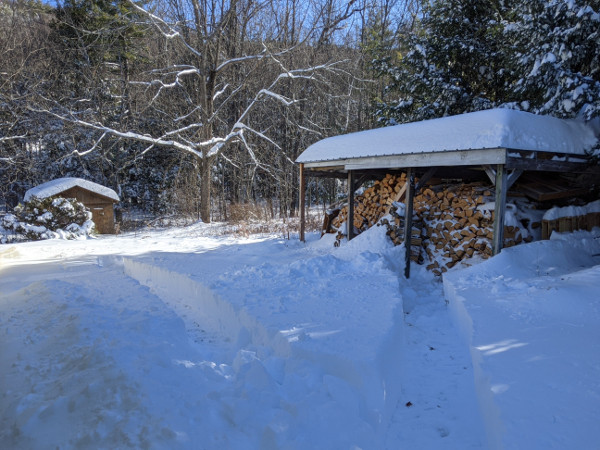
south yard, yesterday, after clearing the way to our woodshed
The most that any outside authority can do is help us recognize the fire inside us, to suggest ways of keeping it burning, to point out directions towards firewood, to guide us to lighting up the path along the way.
Our inner Sovereignty, you might say, can often look like a hearth.
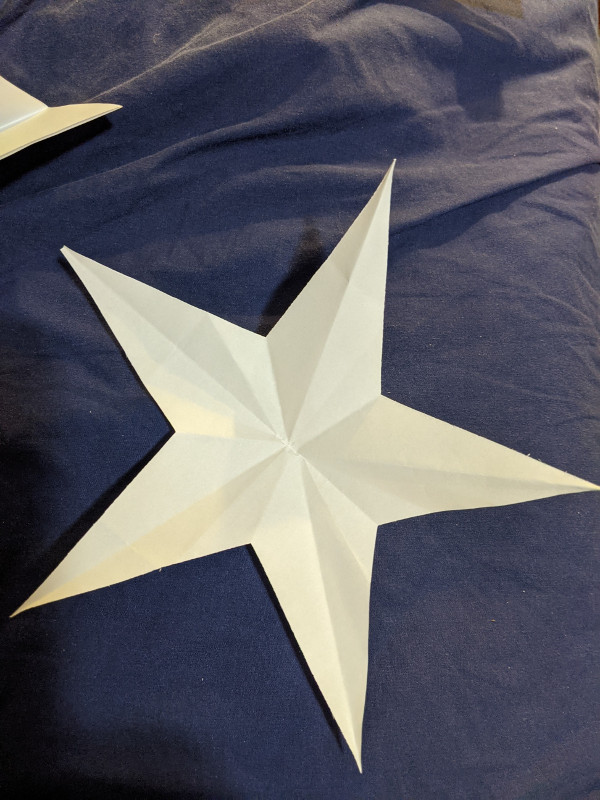
What now, after making the Star? It’s a good question. After what feels like the completion of a cycle of manifestation, it can be a challenge to identify the next steps.
Ah, Love! could thou and I with Fate conspire To grasp this sorry Scheme of Things entire, Would not we shatter it to bits—and then Re-mould it nearer to the Heart’s Desire!
says the Rubaiyat 73 of Omar Khayyam. We’re into the third Triad of the Nine Days of Solstice. What more? Well, the Bards have one corner of it, as usual. Khayyam lays it out for me in this stanza, if I’m willing to walk even some of the way with him, and listen. There’s a triad in human affairs, as in so many things: you, me, and “Fate”. Or as we could also call it, karma, the momentum of things we’ve already launched, that we’ve set in motion. The “sorry scheme of things” is one perspective on our making so far (not the only one, to be sure), and as with most human choices, once we receive what we wished for, we almost immediately aspire to something better. That’s an excellent feature of human consciousness, if I remember to treat it wisely and prudently. And yes, we can “remould it nearer to the Heart’s Desire” with the same abilities we moulded it in the first place.
The Green World is always green, whatever other colours it takes on.
The challenge for me is to decide on what plane I will do my remoulding. Try to do all of it here, I find, and I run into everyone else’s vision of Hearts’ Desire. I am indeed creating my possible futures — and so is everyone else. Our visions bump into each other, as often as not. I find that the place to focus the predominant part of my work is inwardly. Change my consciousness to match my desire, and the effects manifest far more easily than trying to the change the world first. It ripples out from each of us individually, when we do the work. That’s how the mass consciousness changes — one of us at a time, till we reach a critical inflection-point. You see it in birds preparing to migrate for the winter. Ones, and twos, and then larger practice flights, till it spreads like yeast through bread, “the whole is leavened”, and the entire flock is ready to take wing.
Jesus’s counsel to his disciples is clear: “Be of good cheer, for I have overcome the world”. The common denominator of mass consciousness, sometimes useful in brief bursts during ritual when properly tuned, isn’t something to try to sustain all the time. The apparent world isn’t the last word on much of anything. Part, just not whole. I can begin to overcome the less desirable effects of mass consciousness by breaking my agreement with it. Look at the vision of the world held out to us in most social media, and there’s not much to choose from. I can target where to place my attention, for the simple reason that “where your treasure is, there will your heart be also”. How can I even know my “heart’s desire”, let alone manifest it, “remould” things nearer to it, if everything else is tugging at my attention, away from where I need to be looking?
Holding the Star in my vision, the Four Elements and Spirit, I pick up the Work again.
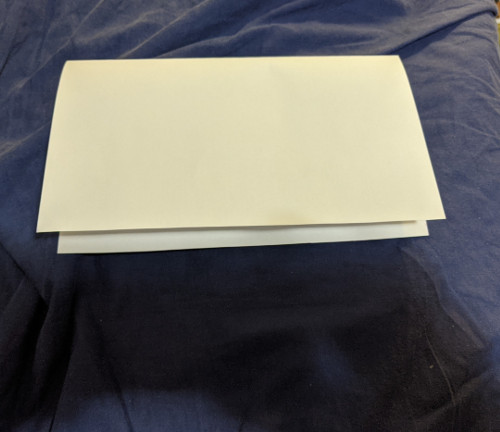
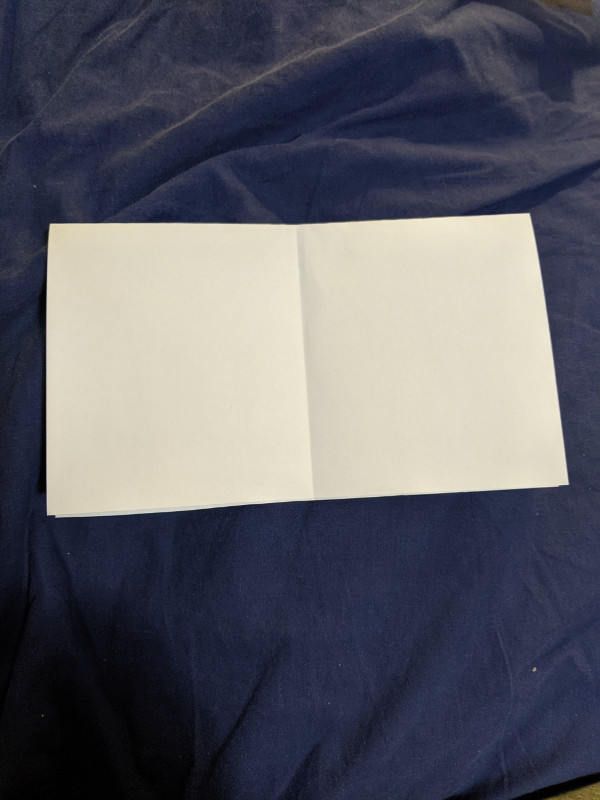
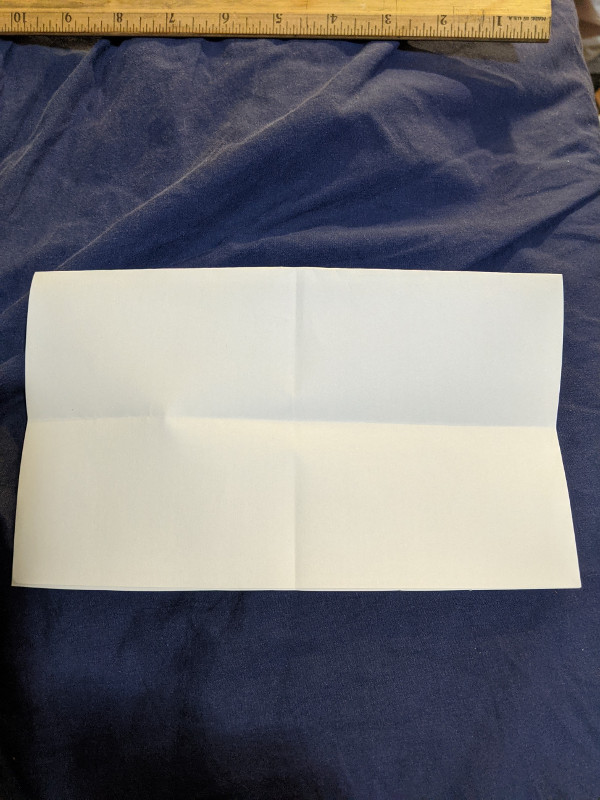
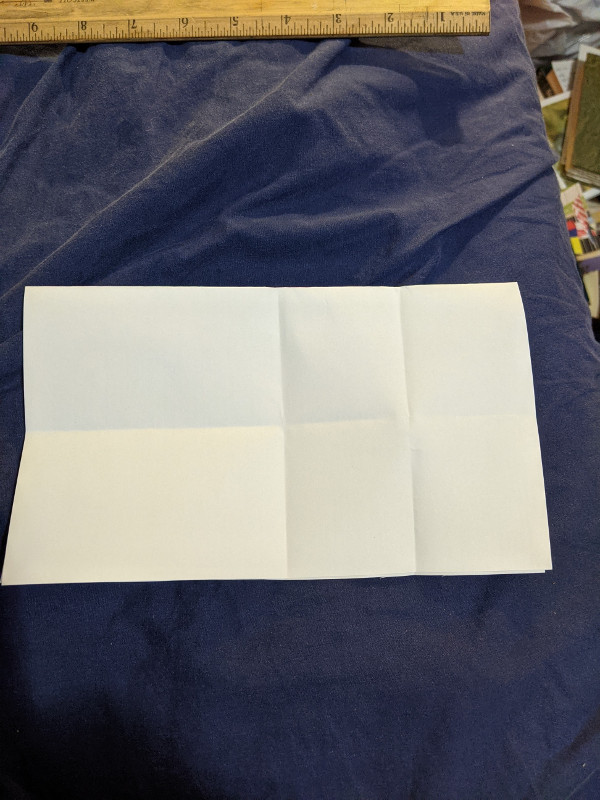
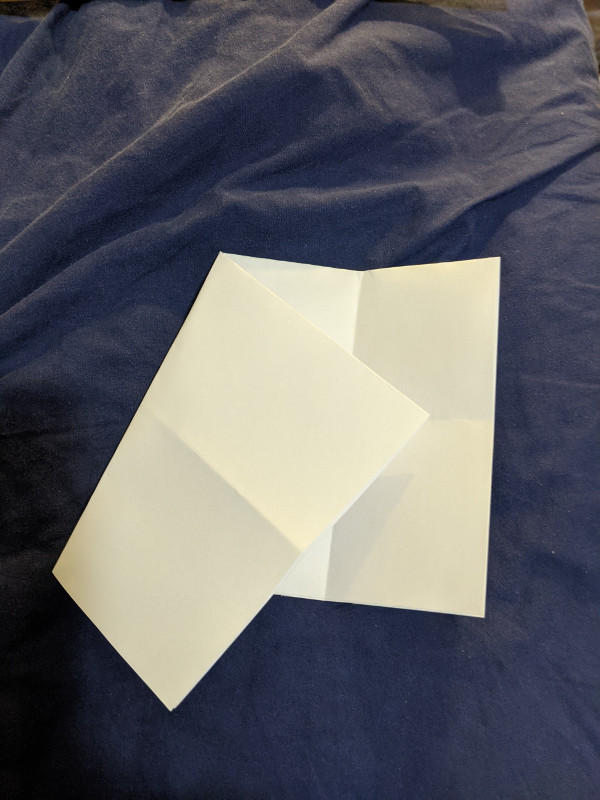
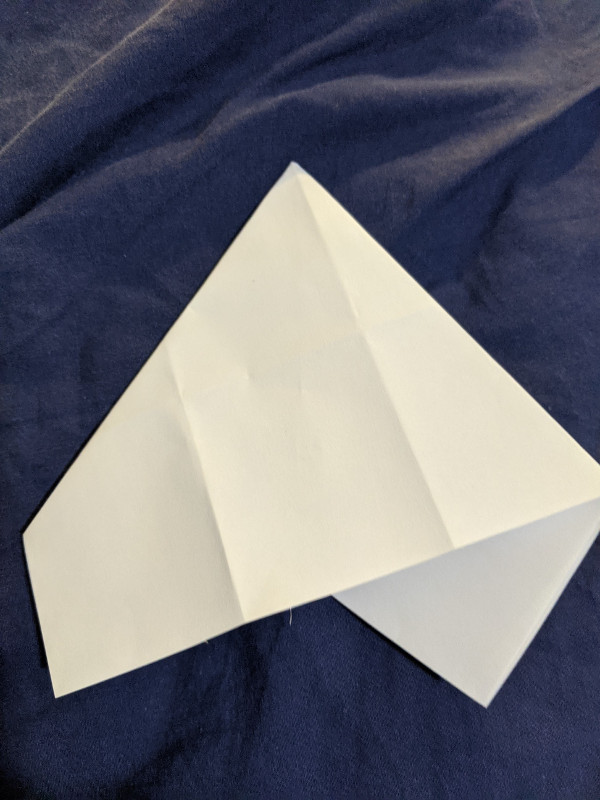
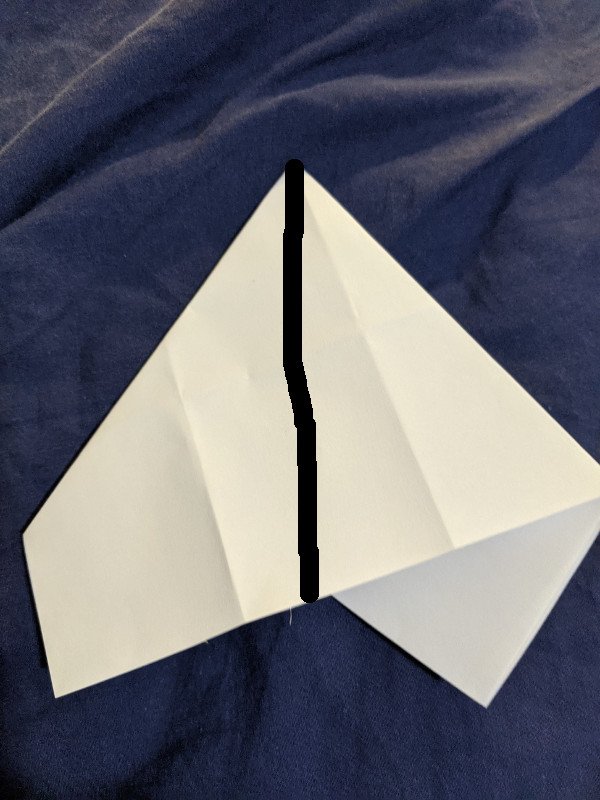
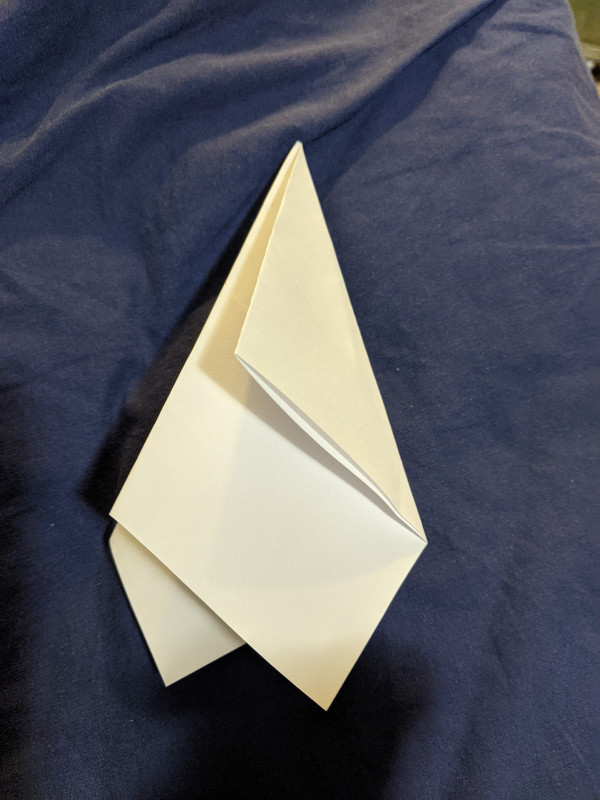
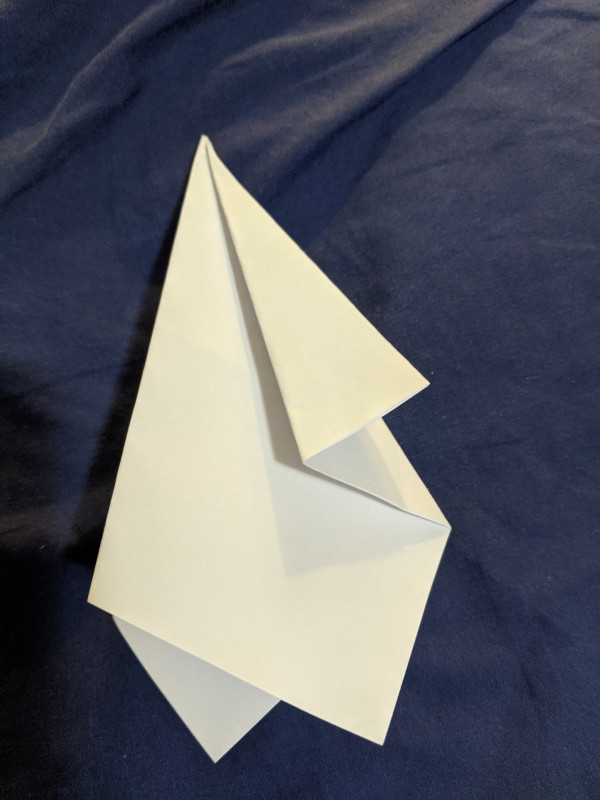
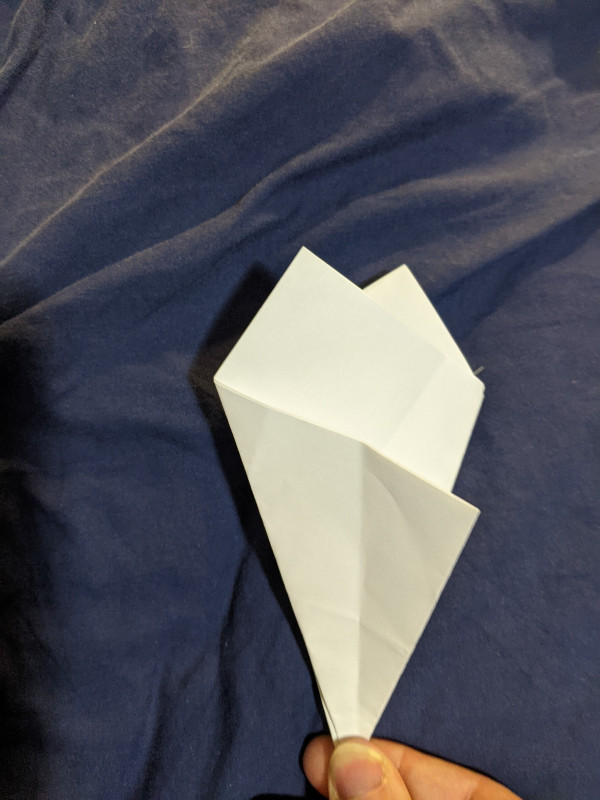
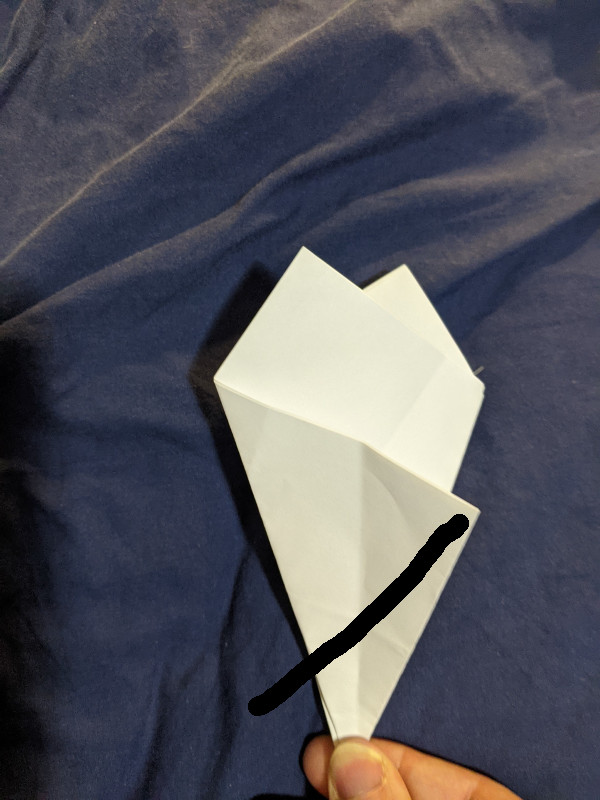
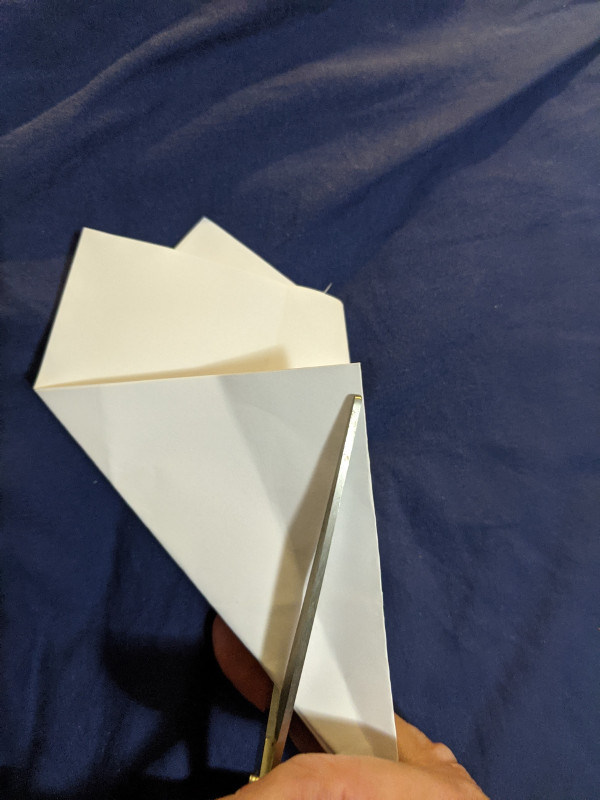
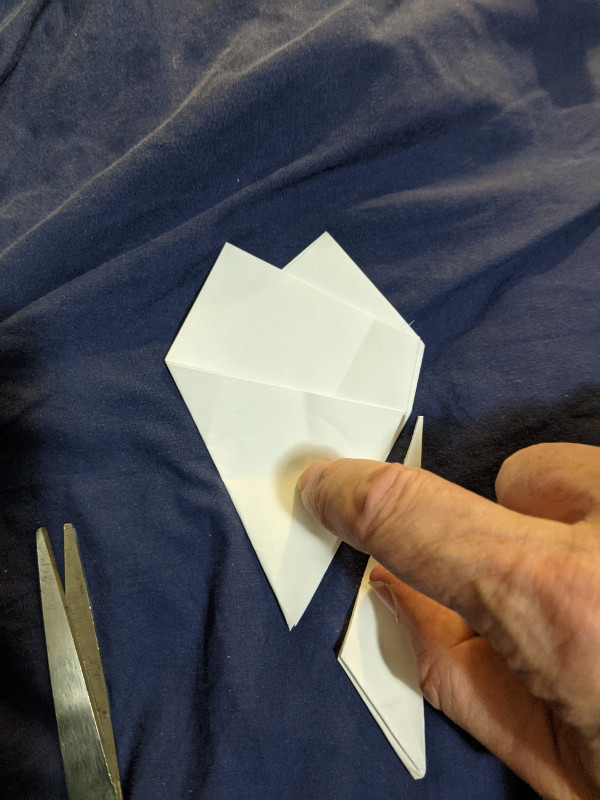
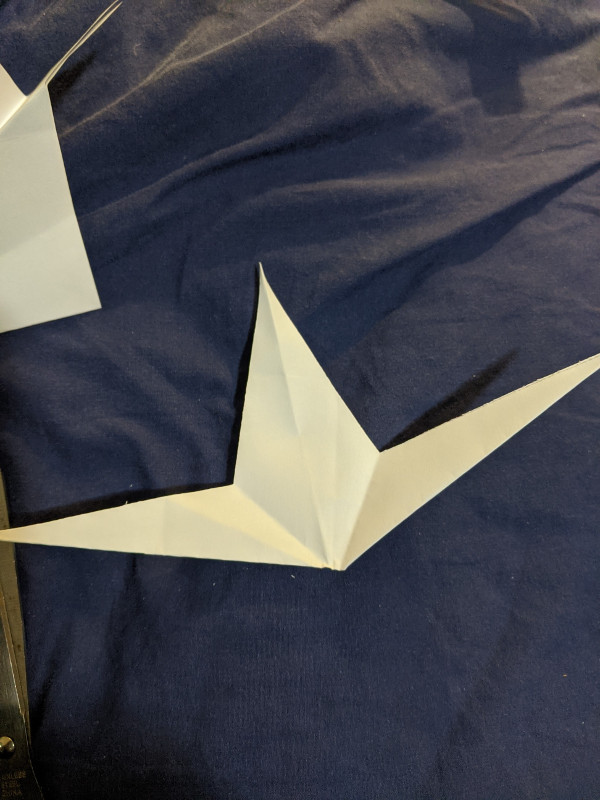
The series of pictures below illustrate the folds to make the 5-pointed Star. There are 9 folds, a good piece of symbolism, and then a single cut of scissors. It may take a few tries till it comes out right it. Start with a piece of scrap paper.
If you like, treat this as a “ritual of making”. As you practice the Nine Folds, try out a prayer, chant, rhyme, etc. This can be a fun exercise to do with a child.
AAAAA
You need a sheet of paper in the proportions of 8.5 x 10. Size is up to you. (For many, that’s almost a standard sheet of loose-leaf or photocopy paper, with the bottom 1 in/2.5 cm cut off.)
BBBBB
FOLD 1: Fold the sheet in half horizontally, top edge to bottom edge.
CCCCC
FOLD 2: Next, fold the sheet in half vertically, left edge to right edge, then open it again.
DDDDD
FOLD 3: Fold the sheet in half vertically, top to bottom, then open it up again.
EEEEE
FFFFF
FOLD 4: Fold the right edge in to the center fold, then open it again.
GGGGG
You now should have these guide-lines for the next folds.
HHHHH
FOLD 5: Fold the top left corner to the center horizontal fold crease.
IIIII
FOLD 6: Fold that same corner back on itself, flush with the left edge.
JJJJJ
KKKKK
FOLD 7: Fold the top right corner back on itself, in the same way. You should have two right triangles of the same size.
LLLLL
Turn the star over, back to front.
MMMMM
Here’s the vertical guide line for the next fold.
NNNNN
FOLD 8: Fold the star vertically to the right, back onto itself.
OOOOO
FOLD 9: Fold the top flap to the right, back onto itself. Then open it out again.
PPPPP
Turn the star 180 degrees, so the point faces down. The crease/fold about 1.5 in/3 cm above my thumb is an important guideline for the next step.
QQQQQ
Line up the scissors so you cut across the intersection of lines toward the point to the right.
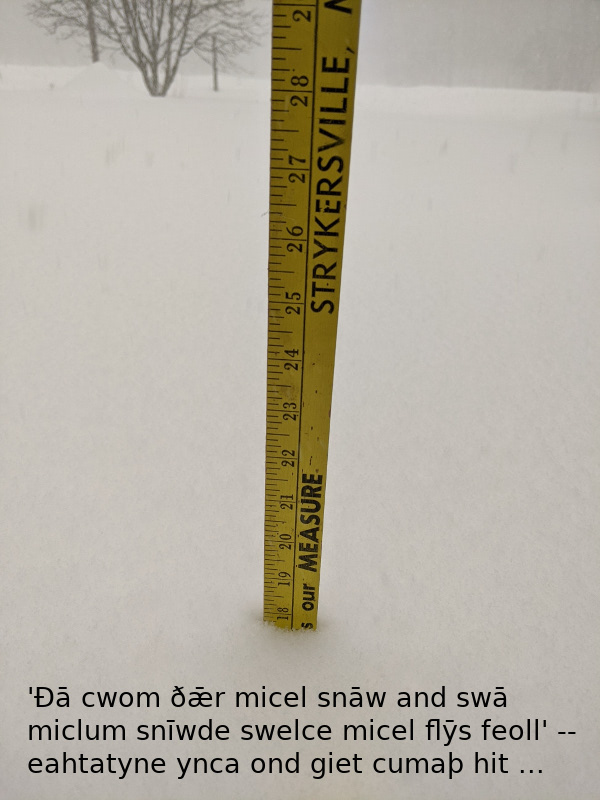
“Then came there a great snow, and so greatly it snowed as if a great fleece had fallen …” The Old English dictionary I use sometimes offers inscrutable abbreviations for its sources of quotations — in this case, simply “Nar”. But I love this description, and I’m (mostly) grateful to live in a region that experiences four distinct seasons.
18 in / 46 cm at 9:40 am this (Thursday) morning, and still coming …
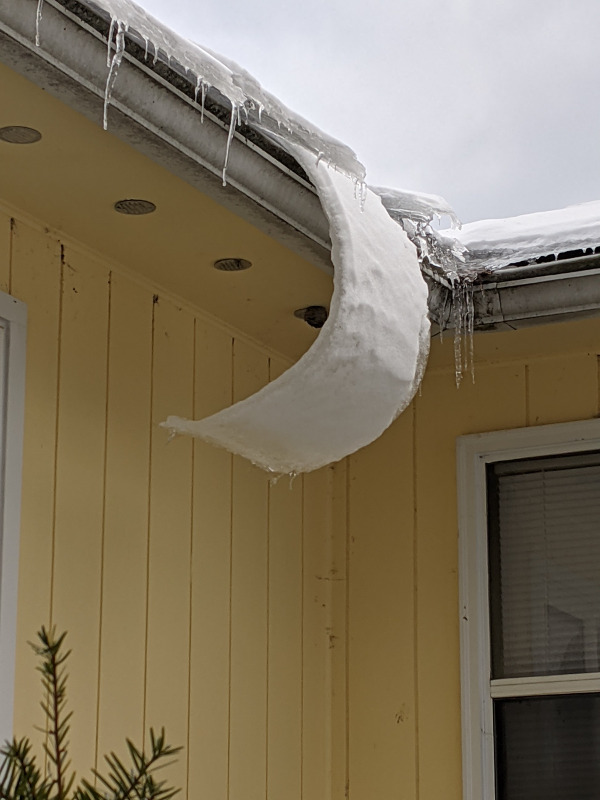
Winter’s finally arrived, ghostly guest. Somehow the whiteness of the snow at winter solstice always feels to me like an outward image of the inner fire burning all winter long. We light it, or it kindles us, at Samhain, when it leaps to and from the inner worlds, and it accompanies us right through to Beltane. I gaze at a candle-flame for a few moments, until I sense something of that world, that companion.
Snow both obliterates and illuminates, like any proper fire. Sometimes the track of spirit, of the presences in our lives, can be difficult to discern. Let snow-fire — or as a friend might write it, snow-fyre — illumine the way, and things can clarify. We see by contrasts — a powerful lesson in and of itself. In these worlds, it can take snow for us to see better.
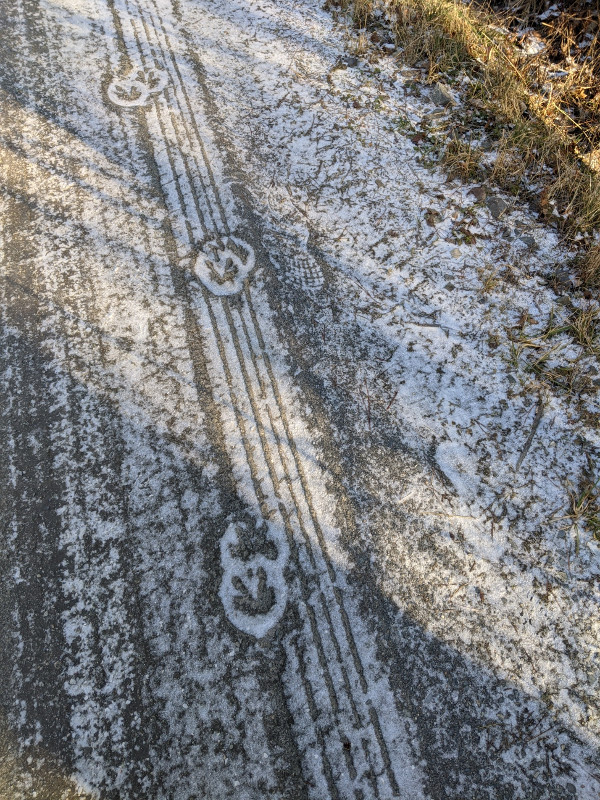
The distinctive horseshoes of neighbourhood animals, tire-tracks and human footprints
Do I step on prints made by those who’ve gone before me? Many four-leggeds do this naturally, rear feet landing nearly where the front have just been. Sometimes weather helps map the trail, the spoor of my predecessors clear to be seen. Other times I walk trusting that when I need to know, I’ll know. Way-showers, as I follow you, let me likewise help show the way to those who come after.
/|\ /|\ /|\
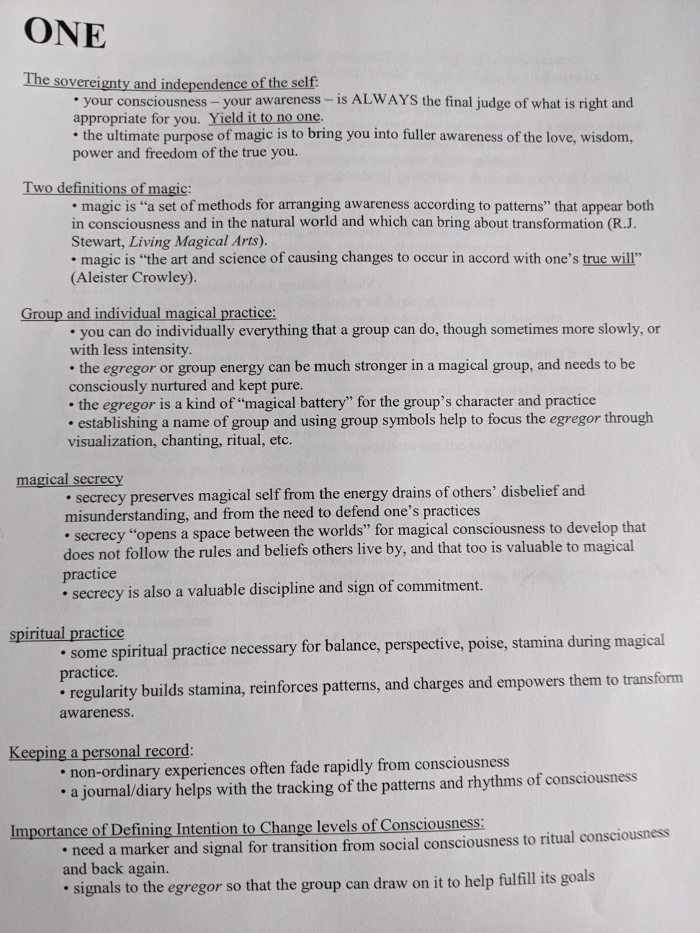
I’m posting below the first page of a rough draft for a workshop. You might find the points helpful, as I do, when you assess where you already place your energies and attention, and consider where they best belong for you, as you look ahead to the coming year.
It feels right to close by repeating the opening from the above image, a piece of dearly-bought wisdom for many: “Your consciousness — your awareness — is ALWAYS the final judge of what is right and appropriate for you. Yield it to no one“.














 A Druid Way