Archive for the ‘blessing’ Category
Today’s “Druid of the Day” also happens to be a Druid full-time: presenting Cat Treadwell, a British Druid who lives in Derbyshire, UK. (That’s “Darbyshire” for us Yanks who might actually trust English spelling, along with “clerk” and “Berkeley” as they’re pronounced in the mother country.) Cat’s out about her Druidry, her blog The Catbox is worth reading, she’s just published a book based on her experiences, and there’s a fine interview of her at the Wiccan Pagan Times. So if you’re inclined, there’s some reading for you. I won’t spoil it by discussing it here.
Most of all I honor Cat because she exemplifies the spirit in the villanelle by Theodore Roethke, “The Waking”:
The Waking
I wake to sleep, and take my waking slow.
I feel my fate in what I cannot fear.
I learn by going where I have to go.
We think by feeling. What is there to know?
I hear my being dance from ear to ear.
I wake to sleep, and take my waking slow.
Of those so close beside me, which are you?
God bless the Ground! I shall walk softly there,
And learn by going where I have to go.
Light takes the Tree; but who can tell us how?
The lowly worm climbs up a winding stair;
I wake to sleep, and take my waking slow.
Great Nature has another thing to do
To you and me, so take the lively air,
And, lovely, learn by going where to go.
This shaking keeps me steady. I should know.
What falls away is always. And is near.
I wake to sleep, and take my waking slow.
I learn by going where I have to go.
“Great Nature” always has other things to do, and doesn’t hold back but simply does them. And for three of them right now — you, me, and Cat Treadwell — I’m grateful, and offer this short post in thanksgiving.
/|\ /|\ /|\
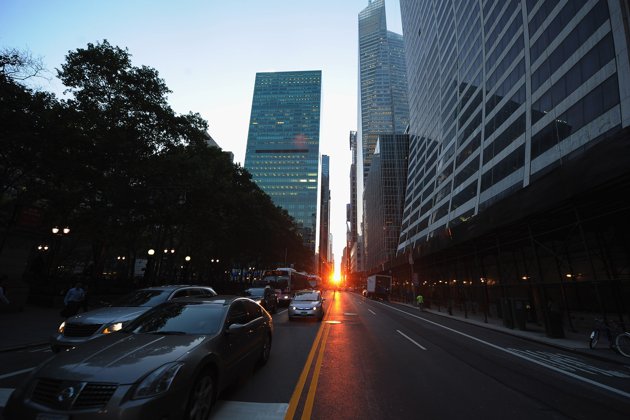
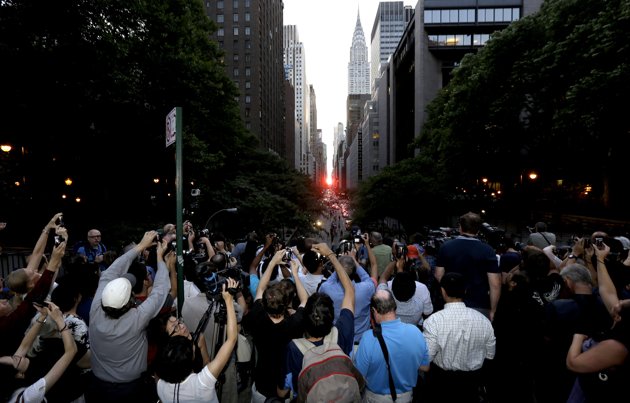
Our green world and ready contact with its natural rhythms can sometimes feel remote in urban settings. Because so many people live in one of the “mega-metro” areas on the planet, their appreciation of the natural world may often burn more brightly than it does for the small-towner who has lived all her life surrounded by cows and trees. With Tokyo, Seoul, Mexico City, New York and Mumbai heading the list at over 20 million souls each (counting their greater metro areas), it’s good to celebrate the green world particularly when it makes itself known among the girders and concrete. The first entry in my “Druid of the Day” series, just started, was a nod in that direction. Manhattanhenge is another one, and much larger:

If you follow Yahoo, you probably caught it. The caption for yesterday’s image reads “The sun sets during ‘Manhattanhenge’ on July 12, 2011 in New York City. The Manhattan Solstice is a semiannual occurrence in which the setting sun aligns west-east with the street grid of the city.” There’s a short sequence of similar images worth visiting.
We need such rhythms — to calibrate our biological clocks, to remind us how the world nourishes and sustains us, and how we need to remember it in our daily decisions — not out of piety for the Earth Mother (though nothing’s wrong with that, of course) but for the very real reason that this world is home. Whenever we can truly celebrate, our hearts open. And in a time when so much “news” doesn’t help us live better, stopping to enjoy the sun looking down the city streets is a good thing.

/|\ /|\ /|\
For those interested in astronomical details and explanations, Wikipedia’s entry for Manhattanhenge helps. The event occurs twice a year, in May and July, on either side of the planetary solstice, as the sun makes its (apparent) journey north and then south again after the solstice.
 Since my wife and I are too cheap to spend money on cable, we get most of our programming through the internet. Vermont sometimes gets tagged in people’s minds as one of the hinterlands of the U.S., though in fact it’s scheduled to have ultra high-speed internet by 2013, billed as “fastest in the nation,” and VTel (Vermont Telephone) installers are actually ahead of schedule in some areas.
One result of our cable-free existence and frequent obliviousness to whatever is “trending now” is that we often discover programs toward the end of their initial run, or well after they’ve already gone to syndication or archive status. Hulu is one of our friends, so if you’ve already watched the Canadian series “Being Erica” and you’ve moved on to newer fare, this post may not be for you. It may be a case of BTDT (been there, done that). So my electronic alter ego here with his Druidry and opinions and evident desire to pry where it’s sometimes uncomfortable (but interesting!) to pry isn’t offended if you log off and go do your laundry, or at least surf onward toward something more engaging.
==PILOT EPISODE SPOILER ALERT==
If you’re still here, the show’s pilot episode does a good job of making the series premise clear. 32-year old Erica feels she’s over-educated (a Master’s degree) and under-fulfilled (single, and with a low-level telemarketing job). The pilot brings her to a low point — she wakes up in a hospital bed after an allergic reaction, and receives a brief visit from a Dr. Tom, who leaves her with a business card that reads “the only therapy you’ll ever need.” As Erica and the audience simultaneously discover, he’s able to send his patients back through time to deal with events in their pasts that they regret. Not to “fix” them in some facile way, but to learn more fully what they have yet to teach.
Vancouver Actor Erin Karpluk, who plays Erica, reveals a wonderful vulnerability and resilience, and she develops a daughter-father chemistry with Dr. Tom, played by veteran Michael Riley. There’s also a “Canadian” flavor to the series, by which I mean something mostly vaguely felt, but nevertheless detectable at certain moments: many episodes are less politically correct, more real, better scripted and more risk-taking than the typical formulaic and “safer” equivalent might end up being in the States. There’s been abortive planning to make both U.K. and U.S. versions.
So you know I just have to make a connection about now. Ah, and here it is, right on schedule. In my experience, the past is not some fixed thing, written into concrete forever, like one false step into a bog that draws you down and suffocates you. Instead, it depends for its whole existence on you, in your present, here and now, in these circumstances and with this awareness, to understand and explore it. Change your understanding of the past, and your past itself can change in almost any sense you care to claim. Not what the “facts” are, which is almost always the least important thing*, after all (peace to all those police procedural shows and their fans!), but how they matter and still shape you today. Just as history gets revised through time, as we gain new understandings and perspectives, so too do our own experiences, choices and destinies appear new or different to us as we change. That bully in grade school turns out to have helped us develop a thicker skin, or empathy — or an unacknowledged contempt for “trailer trash,” or a keen taste for revenge that dogs our heels to this day. Pick your blessing or poison.
The future is what is fixed, the track we’re still following, and reconfirming right now with our current habits, choices and focus — fixed, and set in stone — until we “change” our pasts by knowing and owning them more fully. Seen from this perspective, “fate” is undigested, rejected past that’s come back to haunt you. Healing comes not from literally changing “what happened” — possible only through repression or selective recall — but from squeezing out of each experience every last drop of wisdom and growth we can get from it. Yes: easier said than done. Much easier, often.
But if we find our pasts too painful to deal with, we’ll not only carry them around with us anyway, regardless, but miss out on their lessons as well. As therapist Rollo May said, “Either way, it hurts.” The point is not avoidance of pain, but growth. My past comes at me whispering (or shouting, depending), “Do something with your pain, Dude.” Revisiting and re-imaging the past may sound all New-Agey and Hallmarky, but if it’s one way among many to heal, why mock it or discount it, unless you love your pain more than anything else you have? “Yes, it may be pain, but it’s mine, my darling, my precious. Go dredge your own.” Gollum much?!
This present moment is the pivot, the hinge, the point of transformation, if I’m ever going to act on those New Year’s resolutions that now seem so distant. How many of them have I achieved? (In a December post, I confess to not making any, at least not big ones, partly for this reason.) Baby steps. What’s the smallest change I can make? That’s often the best starting point, because unlike the large resolution, I really can do the small stuff, and stick with it. And then build on it. Treat it all as experiment. Document it — write it down. (Oscar Wilde says one should keep a journal so that one always has something sensational to read.) My life as lab for change. Talk about a show.
Part of the appeal of “Erica,” of course, is watching somebody else go through this. Yet this isn’t merely a voyeuristic thrill so much as it is a provocation to reflect. A significant part of the interest of the series for me is that even Erica’s therapist Dr. Tom, while often truly guru-wise with her issues, isn’t God, or some perfected being. (We often really can see and understand others’ problems more clearly than our own. The challenge is not to abuse this insight, but make the most of it in the best way for our own specific circumstances.) He still has his struggles too — deep ones, as we come to discover, ones that come play a role in Erica’s therapy, to the dismay and growth of both of them.
And my response was “How right!” A perfect being would be a bit of a pain, and might have forgotten (or never known) what it’s like, this human gig. Jesus is never more useful and accessible than when he suffers humanly: when his friend Lazarus dies and he weeps, when he gets angry and physical at the money-changers for profaning the Temple, when the fig tree has no fruit because it’s not the season, and Jesus curses it anyway, when his friends ditch him to save themselves. This human thing, he gets it.
Incidentally, I’ve never understood the Christian obsession with sin. We’re all guilty and imperfect. Check. We’ve messed up. Check. But the point is that our pasts are our teachers. They help us grow. Our “sin” is what tempers and forges and perfects us in the end. Yes, it’s a long end. We’re all slow learners, those “special ed” kids, every one of us. A sequence of lives to learn and experience and grow and love in makes sense for this reason alone. For God or any Cosmic Cop to damn us to hell for “sin” cuts off the whole reason we’re here, from this perspective. It’s like flunking everyone out of first grade because we haven’t mastered algebra yet. We’re not ready. Give us time. Life’s tough enough to break every heart, several times if necessary — and to remake it bigger. OK, here endeth the lesson.
==Final Season Spoiler Alert==
Except not quite. The fourth and final season — Hulu doesn’t carry it — of “Being Erica” comes out this month on DVD, and Amazon.ca just sent email confirmation that it’s shipped. My wife and I are looking forward to watching Erica become a therapist: “Dr. Erica” in her own right. Isn’t that part of our journey, too? Out of our experience we grow, and then we can help others along the way, specifically because of who we are, and what we’ve learned. Our imperfection and individuality are our great gifts, which we grow into ever more fully. That’s an eternity to look for, if you’re in the market for one.
/|\ /|\ /|\
*Even facts prove slippery, as any attorney, judge and gathering of eyewitnesses knows. But sometimes it’s precisely a fact that makes all the difference. Then it’s usually a fact that confirms or disproves a perspective, and so it throws us back to the centrality of perspectives and understandings once again.
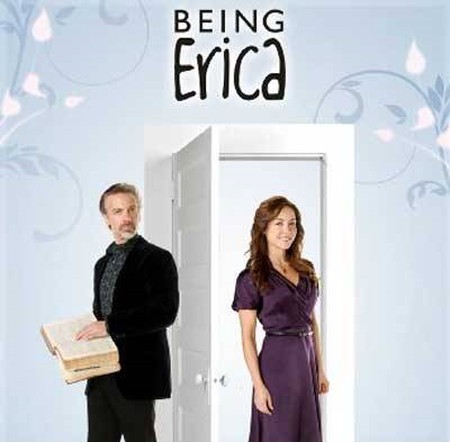
Image: Being Erica.
[Earth Mysteries 1 | 2 | 3 | 4 | 5 | 6 | 7]
The second principle or law Greer examines is the Law of Flow. Before I get to it, a word about spiritual or natural laws. In my experience, we tend to think of laws, if we think of them at all, in their human variety. I break a law every time I drive over the speed limit, and most of us have broken this or some other human law more than once in our lives. We may or may not get caught and penalized by the human institutions we’ve set up to enforce the laws we’ve established, though the majority of human laws also have some common sense built in. Driving too fast, for example, can lead to its own inherent penalties, like accidents, and besides, it wastes gas.
 But spiritual or natural law can’t be “broken,” any more than the law of gravity or inertia can be “broken.” Other higher laws may come into play which subsume lower ones, and essentially transform them, but that’s a different thing. A spiritual law exists as an observation of how reality tends to work, not as an arbitrary human agreement or compromise like the legal drinking age, or monogamy, or sales tax. Another way to say it: real laws or natural patterns are what make existence possible. We can’t veto the Law of Flow, or vote it down, or amend it, just because it’s inconvenient or annoying or makes anyone’s life easier or more difficult. There are, thank God, no high-powered lawyers or special-interest groups lobbying to change reality — not that they’d succeed. Properly understood, spiritual or natural law provides a guide for how to live harmoniously with life, rather than in stress, conflict or tension with it. How do I know this? The way any of us do: I’ve learned it the hard way, and seen it work the easy way — and both of these in my life and in others’ lives. Once it clicks and I “get” it, it’s more and more a no-brainer. Until then, my life seems to conspire to make everything as tough and painful as possible. Afterwards, it’s remarkable how much more smoothly things can go. Funny how that works.
OK, so on to the Law of Flow:
“Everything that exists is created and sustained by flows of matter, energy and information that come from the whole system to which it belongs and return to that whole system. Participating in these flows, without interfering with them, brings health and wholeness; blocking them, in an attempt to turn flows into accumulations, brings suffering and disruption to the whole system and its parts.”*
“Participating in these flows, without interfering with them,” can be a life-long quest. Lots of folks have pieces of this principle, and some of the more easily-marketed ones are available at slickly-designed websites and at New Age workshops happening near you. But note that the goal is not to accumulate wealth beyond the wildest dreams of avarice. (As Greer points out, if the so-called “Law of Attraction” really worked as advertized, the whole planet would be a single immense palace of pleasure and ease. Though who would wait on us hand and foot, wash our clothes, make our high-priced toys, or grow and cook our food, remains unclear.) Flow means drawing from system, contributing to it, and passing along its energy. “Pay it forward” wouldn’t be out of place here.
If all this sounds faintly Socialist, well, remember that as Stephen Colbert remarked, “Reality has well-known liberal bias.” It means sharing, like most of us were taught as toddlers — probably shortly after we first discovered the power and seduction of “mine!” But it could just as easily and accurately be claimed that reality has a conservative bias. After all, these are not new principles, but age-old patterns and tendencies and natural dynamics, firmly in place for eons before humans happened on the scene. To know them, and cooperate with them, is in a certain sense the ultimate conservative act. The natural world moves toward equilibrium. Anything out of balance, anything extreme, is moved back into harmony with the larger system. The flows that sustain us also shape us and link us to the system. The system is self-repairing, like the human body, and ultimately fixes itself, or attempts to, unless too much damage has occurred.
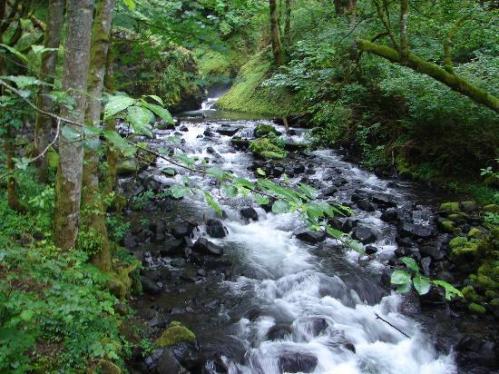
Ignorance of this law lies behind various fatuous political and economic proposals now afloat in Europe and America. Of course, what’s necessary and what’s politically possible are running further and further apart these days, and will bring their own correction and rebalancing. We just may not like it very much, until we change course and “go with the flow.” That doesn’t mean passivity, or doing it because “everybody else is doing it.” Going with the flow in the stupid sense means ignoring the current and letting ourselves be swept over the waterfall. Going with the flow in the smart sense means watching and learning from the flow, using the current to generate electricity, or mill our grain, while relying on the nature of water to buoy us up, using the flow to help carry us toward our destination. Flow is not static but dynamic, the same force that not only sustains the system, but always find the easier, quicker, optimum path: if one is not available, flow carves a new one. The Grand Canyon is flow at work over time, as are the shapes of our bodies, the curve of a bird’s wing, the curl of waves, the whorls of a seashell, the spiral arms of galaxies, the pulse of the blood in our veins. Flow is the “zone” most of us have experienced at some point, that energy state where we are balanced and in tune, able to create more easily and smoothly than at other times. Hours pass, and they seem like minutes. Praised be flow forever!
/|\ /|\ /|\
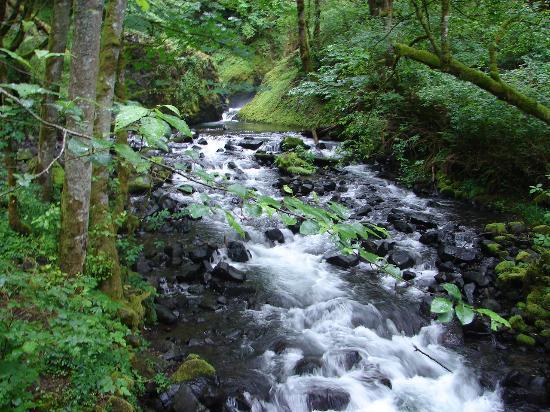
Images: river.
*Greer, John Michael. Mystery Teachings from the Living Earth. Weiser, 2012.
[Earth Mysteries 1 | 2 | 3 | 4 | 5 | 6 | 7]
Updated and edited 22 June 2017; 14 Dec 2017
Readers of this blog know I frequently quote John Michael Greer. As a writer, blogger, and leader of another Druid order, he challenges me to dig deeper into my own order and understanding of Druidry, and examine its teachings more critically, as well as ponder the implications of his cultural criticism. While his popular blog The Archdruid Report deals primarily with the consequences of Peak Oil, and offers productive strategies for thriving in the coming hard century or more of scarcity and turmoil, as we transition to a post-industrial age, most of his other writing centers on his spiritual journey until now.
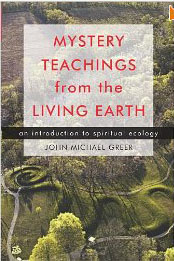
 As a case in point, his most recent book, Mystery Teachings from the Living Earth (Weiser, 2012), is a reimagining of The Kybalion*, published anonymously in 1912. Greer asserts as his book’s underlying principle that “The laws of nature are the laws of spirit; this is one of the great secrets of the Mysteries.” He reworks the seven principles of the earlier book into insightful observations about spiritual ecology, framed as spiritual law. Here’s the first one, the Law of Wholeness:
“Everything that exists is part of a whole system and depends on the health of the whole system for its own existence. It thrives only if the whole system thrives, and it cannot harm the whole system without harming itself.”
The American myth of rugged individualism and self-reliance, part of the cultural story we Yanks have told ourselves over the decades, has served its purpose, and possibly run its course: it may be more of an obstacle now, in an era when we need cooperation and interdependence more than we need stoic endurance. We’re interconnected, and what I do affects you. One of my teaching colleagues always used to laugh at the idea of non-smoking sections in restaurants. “It’s like imagining there’s a non-peeing end of the swimming pool,” he’d exclaim. “A feel-good label doesn’t make it so.” I cannot harm myself without harming the whole system. But anyone buying wholesale into the myth of individualism doesn’t want to hear that.
Rather than seeing the divine as standing outside nature, here’s a way of perceiving the universe as a single immense feedback loop. Suddenly the Golden Rule isn’t just a good moral guide, but also blindingly obvious common sense. What you do comes back to you. What goes around comes around — not because “God punishes me,” or because of “karma” or “sin” or anything other than what goes in, comes out. Computer programmers know it as GIGO: garbage in, garbage out. Maybe it’s time for LILO: love in, love out. As long as we see the world as a collection of separate, discrete individuals rather than an interconnected series of networks, we’ll kill, abuse, pollute, steal, etc. And likewise, as long as we believe that we should be free to do something that “doesn’t hurt anyone else,” we live in illusion. Everything that each of us does matters to all the rest of us. We’re interconnected, linked up to each other in astonishing ways that we’re only beginning to discover.
 At first this seems to dump all the guilt for why things suck squarely on our shoulders, and a lot of people today are sick of guilt. Rightly so: it doesn’t accomplish anything except to poison the heart and to distract us from moving forward. It’s only useful if it goads us into constructive action and that’s rarer than it should be. But guilt isn’t the same thing as responsibility. Accepting responsibility is the death of victimhood. If I begin to see that everything I do has an effect, a consequence, then my life matters in a way it may never have seemed to matter before.
To put it another way and quote a Wise One, “If nothing we do matters, then the only thing that matters is what we do.” In the midst of nihilism and cynicism and hopelessness, each word, thought, deed and feeling carries weight, shapes the universe for good or bad, and leaves a trail, a wake, a ripple, that will flow outward from my life now and also after I am gone. I matter, and so do you, simply by virtue of being alive and here in this place, now. To not choose to act, or to act foolishly and blindly is to waste a priceless opportunity to contribute to the commonwealth, the res publica, the Republic, this shared world of ours.
Who among us can deny that even small acts of kindness or cruelty committed by others have an effect on us out of all proportion to their apparent scale? Can we then imagine for a moment that our own acts don’t set in motion a similar set of ripples? We don’t have to be “big” to matter. Love has no size. Any is much. Blessed be this life, gift to others and ourselves, chance to act, to love, to participate in the Web, to leave ripples at our passing, to vibrate the strands with our existence and choices, to play on life and pluck its melody, note by note.
/|\ /|\ /|\
Image of Mystery Teachings: Amazon.com
You can read the Kybalion online and download a PDF of it.
Image: ripples.
One of the great gifts of Druidry is that when I feel like crap, and inclined to self-pity, Druid teaching reminds me it’s really not all about me. Not to say that I don’t matter, but that so many other things also do, and so I can gladly get lost in the immensity of worlds of other beings, and often enough regain perspective just from watching till the ego subsides again to some reasonable scale. Feel like crap? OK, then really feel like crap, do crap, be crap as only you can, then get it out of your system, the way you do with crap. Excrete! Crap isn’t forever. Even (or especially) recycled, it turns into something else, becomes nourishment and sustenance for beauty and glory and life. Give away your crap, gift that it can be, and let earth transmute it to feed something hungry precisely for what you can’t use, don’t want, can’t wait to get rid of. This is the gift of Earth, the alchemy this element offers. Blessed, fearful change.
Right now the neighbor’s dog, chained for an hour’s air to the railing on the front steps next door, is barking himself hoarse at something no doubt beyond his reach, but in between volleys, through the open living room window, I can also hear goldfinches calling near our niger-seed feeder. I look up to see five of them clustered on and around the tube of seed swaying from a tree-branch. It’s one of their favorite seeds, and my wife finally found a way to rig a feeder that keeps off our resident chipmunk family while still drawing birds.
Further in the distance, our neighbor up the hill has paused his Harley, which thrums and rumbles as it sits at the bottom of the hill drive on the far side of our yard. He’s doing his ritual last-minute check of gauges and gear before he heads out for an evening run. After he leaves, beyond that, the sound of a lawn mower fades in and out. And in the gaps of silence, wind in the trees. The true silence of dawn and late evening can feel like a cat curled up on itself, listening for its own purring. Then the downy woodpecker assaults the corrugated tin roof of our woodshed in quest of grubs. It sounds like gunfire, beak on metal, still startles us, though we’ve heard it maybe a dozen times over the last few months. Sometimes I think he does it for the pure rousing hell of it. I would.
 I’ve just finished a one-week intensive at Hartford Seminary, Understanding and Engaging Religious Diversity. The class ran six day-long sessions broken only by buffet meals on-site that simply continued the discussions in a slightly different mode. Remarkable group. This last Friday morning, our final meeting, one of our classmates exclaimed seriously and humorously at the same time, “Damn you, people, you just keep changing me!” In the greenhouse of close proximity, intense engagement and curiosity, we managed to go very deep. How far are we willing to go in encounter and challenge to what we think we know and believe? What, as our instructor asked us, really is our core conviction, which — if we yielded to another’s truth, or gave ours up — would leave us different people? Can we touch that and walk away unchanged? What happens if we try to come as near as possible to that boundary? What was almost equally fascinating was where people were going right after the class ended. Some to another summer workshop, two to different destinies in India, some to new chaplaincy assignments, a couple of us on to more summer classes elsewhere, a few back to work, and I to days of recovering from a nasty bout of bronchitis, time to process it all, and to write this post. Time, the pause that earth can give. Sickness and healing, its punctuation.
Muslims, a Jain, Buddhists, Pagans, Christians, several of us of multiple faiths in one person, Jew-and-Hindu, a Buddhist-Wiccan-Sikh, and so on. And the simple and lovely ritual we spoke to each other, going round in a circle that closed out our time together: “Thank you for the blessing that you bring; thank you for the blessing that you are.” Vortex that has sanctified.
/|\ /|\ /|\
Urban Dictionary (check it out if you haven’t yet visited it) obliges with this definition of “sick nasty”: “This word is to be used when no other word can be used to describe the cool factor, greatness, or overwhelming emotion of something. However, the something is neither sick, nor nasty. The combination of the words sick and nasty provide a higher connotation of coolness then even the words tight or wicked can provide. It is kind of ghetto.”
Since I’m going for the literal rather than the metaphoric, I’ll bypass the ghetto, and the slang meanings of “ill,” too, and head straight for “body in misery.” (It’s worth considering what connection coolness has with physical sickness, because when you’re in it, it’s distinctly not cool at all.)
Food poisoning can leave you half alive, no longer trusting your organs and bones. My wife and I had been out of state to attend our niece’s high school graduation, and bad food choices dropped me into my own private third level of hell (that’s for the gluttons, which seems appropriate). I won’t gross you out with gastrointestinal details: enough to say that the aftermath left me with aching joints, residual fever and chills, a nasty headache, and no desire ever to eat again. To add insult to injury, we’d scheduled medical check-ups back home the next day. Sometimes you feel rotten enough that a doctor is the last person you want to see. And on top of that, he insisted it was time I had another digital rectal exam, part of the follow-through since my prostate surgery. Necessary, maybe, but oh so evil.
OK, enough self-pity. You get the idea. This is a blog, after all, that’s supposed to provide plenty of buck (see the 5/18/12 entry). No time to slack off now.
What illness can offer, besides a physical cleansing and rebalancing (we get sick when something’s out of whack, off kilter, messed up), is clarity, humility and gratitude. At least that’s what I often get (when the worst of the symptoms have subsided), if I’m lucky.
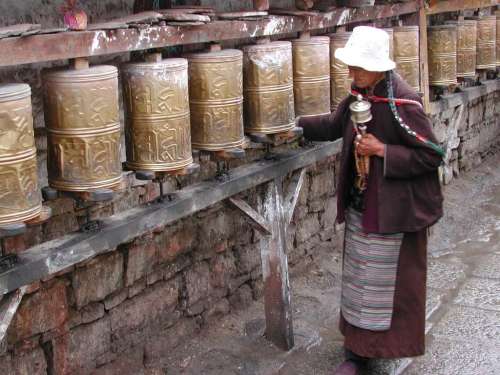 Clarity first. Flat on your back, you’ve got time to reflect. If you’re not unconscious or delirious, reasonably free of pain, and cable is unavailable, you’re thrown back on yourself. Time to make friends with the body, to coax it back to health if you can. This marvelous machine of flesh now sits in the garage, lies in drydock, has gone off-line. Time to adjust the timing belt, scrape off the barnacles, repair the hull, and reboot. You get all kinds of ideas, some of which might even be useful. You get to watch your thoughts spin like a Tibetan prayer wheel, only more gooey. And through and above and below and within it all, you realize there are limits. You get reacquainted with the fact that you will die. Your time here is limited. You can’t have it all, do it all, own it all. You get your turn, and then it’s the next person’s. What you do with your life is your gift to yourself.
And yes — I can get didactic and preachy, kinda. Bear with me.
The humility part is good. You have to rely on others. When your body’s in meltdown, somebody else has to bring the drugs and the drinks, or you don’t get them. You can’t get up without the world playing spin the bottle with your brain, or chills racking you, or legs turning to water. That backrub to ease the crying vertebrae, the cool washcloth so welcome on hot skin, the light turned off because it hurts your eyes, the curtains drawn for the same reason, the soup that’s the only thing you can keep down — all of these are gifts that either others give you, or you don’t get them. They’re out of your control. Your minute-to-minute life is discomfort, interrupted by the kindness of someone caring for you.
Which brings you to gratitude. You certainly have time for it. If you have to be sick, at least there’s some good that comes of it — later, if not right away. As you start to feel better, you recall how you took so much for granted. You resolve to try to do better. Maybe the first stirrings of belief in immortality begin here, with recovery from illness. You’re aren’t dying after all. This too shall pass. You rise again. You will live to enjoy life again.
/|\ /|\ /|\
prayer wheel
 Druid teaching, both historically and in contemporary versions, has often been expressed in triads — groups of three objects, perceptions or principles that share a link or common quality that brings them together. An example (with “check” meaning “stop” or “restrain”): “There are three things not easy to check: a cataract in full spate, an arrow from a bow, and a rash tongue.” Some of the best preserved are in Welsh, and have been collected in the Trioedd Ynys Prydein (The Triads of the Island of Britain*, pronounced roughly tree-oyth un-iss pruh-dine). The form makes them easier to remember, and memorization and mastery of triads were very likely part of Druidic training. Composing new ones offers a kind of pleasure similar to writing haiku — capturing an insight in condensed form. (One of my favorite haiku, since I’m on the subject:
Don’t worry, spiders —
I keep house
casually.
— Kobayashi Issa**, 1763-1827/translated by Robert Hass)
A great and often unrecognized triad appears in the Bible in Matthew 7:7 (an appropriately mystical-sounding number!). The 2008 edition of the New International Version renders it like this: “Keep asking, and it will be given to you. Keep searching, and you will find. Keep knocking, and the door will be opened for you.”
Apart from the obvious exhortation to persevere, there is much of value here. Are all three actions parallel or equivalent? To my mind they differ in important ways. Asking is a verbal and intellectual act. It involves thought and language. Searching, or seeking, may often be emotional — a longing for something missing, a lack or gap sensed in the soul. Knocking is concrete, physical: a hand strikes a door. All three may be necessary to locate and uncover what we desire. None of the three is raised above the other two in importance. All of them matter; all of them may be required.
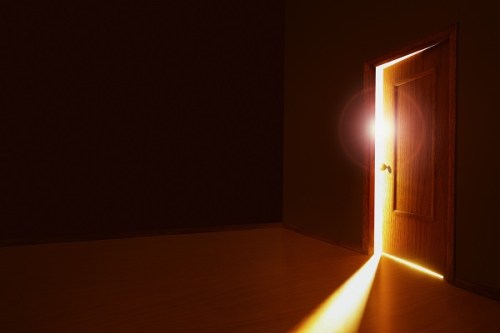 And what are we to make of this exhortation to keep trying? Many cite scripture as if belief itself were sufficient, when verses like this one make it clear that’s not always true. Spiritual achievement, like every other kind, demands effort. Little is handed to us without diligence on our part.
And though the three modes of investigation or inquiry aren’t apparently ranked, it’s long seemed to me that asking is lowest. If you’ve got nothing else, try a simple petition. It calls to mind a child asking for a treat or permission, or a beggar on a street-corner. The other two modes require more of us — actual labor, either of a quest, or of knocking on a door (and who knows how long it took to find?).
It’s possible to see the three as a progression, too — a guide to action. First, ask in order to find out where to start, at least, if you lack other guidance. With that hint, begin the quest, seeking and searching until you start “getting warm.” Once you actually locate what you’re looking for — the finding after the seeking — it’s time to knock, to try out the quest physically, get the body involved in manifesting the result of the search. Without this vital third component of the quest, the “find” may never actually make it into life where we live it every day.
Sometimes the knocking is initiated “from the other side” In Revelations, the Galilean master says, “I stand at the door and knock.” Here the key seems to be to pay attention and to open when you hear a response to all your seeking and searching. The universe isn’t deaf, though it answers in its own time, not ours. The Wise have said that the door of soul opens inward. No point in shoving up against it, or pushing and then waiting for it to give, if it doesn’t swing that way …
/|\ /|\ /|\
*The standard edition of the Welsh triads for several decades is the one shown in the illustration by Rachel Bromwitch, now in its 3rd edition. The earliest Welsh triads appearing in writing date from the 13th century.
**Issa (a pen name which means “cup of tea”) composed more than 20,000 haiku. You can read many of them conveniently gathered here.
book cover; door image.
“Thou met’st with things dying, I with things new-born” says the Shepherd in Shakespeare’s The Winter’s Tale. And his words seem a perfect description of spring. Not all is new growth. Much has died. Sometimes we remember our own dead most vividly when life returns to the world around us. We’re still here, but they will not share another spring with us, and sorrow is renewed along with the grass underfoot and the buds on the trees. A bittersweet time. A time of compost and ashes and dandelion greens in salads. A time of sunlight growing, of life rising in the spine like sap in trees. Spring, you old tonic.
Out of state and away from computers for several days, I return with a series of vivid impressions: visiting my now retired cousins in Madison, Wisconsin, seeing them on their third of an acre lot, the earth bursting with literally scores of varieties of flowers, everything up and blooming more than a month early. Their care over two decades in restoring an old and abused house to pristine condition (doing much of the dirtiest and hardest work themselves), the spaces full of lovely wood paneling and doors and moldings, and full as well of light on all sides from triple-paned windows. Above ten degrees outdoors and their furnace goes off, if they get any sun. A Druidic care for the space they live in, the house and grounds they beautify not only for themselves, but all who pass by and witness.
Longing for light. Opening blinds to a few wasps at the window, sluggish with morning cold. The hazy spring moon growing each night, that Pagan moon by which Christians reckon the date for Easter according to that strange formula of “first Sunday after the first full moon after the vernal equinox.” (A perfectly Pagan calculation, when you think about it at all, even considering that the early Church wished for Easter to follow Passover, itself subject to a combined lunar and solar calendar.) People outdoors worshiping the sun on their skin, sitting in sidewalk cafes, heads leaned back and eyes closed. Mild days and cool nights. Love of this old world, with all its pains and joys. Love renewed, spring’s gift, waiting to ripen in fruit and flower and heart.
Sometimes you have experiences that just don’t fit. They’re orphans, and like orphans, too often they’re left to fend for themselves, so they end up on the street. Or else they’re stuck in a home by some well-meaning authority, where they may subsist uncomfortably for years in places where everyone else looks and acts and talks different. There may not be enough love to go around, either, and like Oliver in Dickens’ novel Oliver Twist, they’re reduced to pleading, “Please, sir, may I have some more?”
Monday night, before the hard freeze here (19 and windy) that threatened all the burgeoning flowers and trees, I offered up a prayer. I don’t usually pray in this way, but I found myself praying for all the wordless Rooted Ones busy putting out buds and leaves and new growth in response to the warm spell that caressed so much of the U.S. “I cry to the Powers,” I found myself saying. A little more love here, please. The great willow in our back yard has pale leafy fronds. The currants are budding. Crabgrass pushes up from dead mats of last year’s growth. The stems of bushes and the twigs of trees show reddish with sap. At the same time, I took stock in what I knew in some traditions about plant spirits, the personifications of energies that help individual species thrive.* Let the devas and plant guardians sort it out. Serve the larger balance — that sort of thing. Then the nudge to pray came, so I honored it. Everyone has a role to play. Then the goddess Skaði presented herself.
All this took place while I was driving down and then back home with my wife from an out-of-state trip to CT. Bookends to the day. We’d tried to be efficient with our driving and gas use, like the good Greenies that on occasion we actually are, and schedule several appointments for the same day. So we rose early, drove through welcome morning sun and glorious light to have a thermostat and brakes replaced on our car, get eye exams and prescriptions and glasses before a sale ended on April 1, drop off a gift at a friend’s house, and get to an admissions interview for a certificate program I’m interested in. (More about that as it progresses.)
We’d scheduled ourselves fairly loosely, but still the sequence of appointments mattered for times and distances to travel to the next stop. So when the car service that we’d been assured would take no more than two hours now promised to consume most of the day, we got a loaner car from the dealership, rescheduled and shuffled some of our meetings. Ah, modern life. Maybe it’s no more than imagination, but at such times recall of past lives makes horse-and-buggy days seem idyllic and stress-free by contrast. Back then we didn’t do so much because we simply couldn’t. Does being able to do more always mean we should?
So, Skaði.** Not to belabor you with too much detail: she’s a Scandinavian goddess of winter, hunting, mountains and skiing. A sort of northern Diana of the snows, an Artemis of the cold heights and crags. I’d run across her a few years ago, when I was doing some reading and meditation in Northern traditions. She loomed in my consciousness then, briefly. Frankly I found Bragi, the god of eloquence and poetry and patron of bards, much more to my taste. But there she was, for a short time.
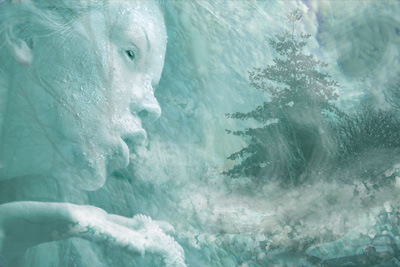 I flashed on an image of Skaði then, and she seemed — and still seems to me — quite literally cold, implacable, uninterested in humans, remote, austere, elegant in the way ice formations and mountain snows and the Himalayas are elegant — and utterly forbidding. Not someone even slightly interested in exchange, in human interaction. Now here she was. If you’ve been pursued by any of the Shining Folk, whether the Morrigan or Thor, Jesus or Apollo, you know that often enough they choose you rather than the other way around. So you make do. You pay no attention. Or you can’t help it and now you have a patron deity. Or something in between. If you’re a bloody fool, you blab about it too much, insisting, and the nice men in white coats fit you for one too. Or maybe you and Thorazine become best friends. It’s at times like this that I’m glad of the comparative anonymity of this blog. I can be that bloody fool, up to a point, and the people who need to will pass me off as just another wacko blogger. And then this post will recede behind the others, and only one or two people will happen on it in another month or two. The gods are out there, and they’re in our heads, too. Both/and. So we deal with it. And I can step back to my normal life. Or not. I’ll keep you posted.
So Skaði of the daunting demeanor wants something. I prayed to the Powers, almost in the Tolkien Valar = “Powers” sense — to anyone who was listening. Open door. Big mistake? I’m a Druid, but here’s the Northern Way inserting itself into my life. My call goes out, and Skaði picks up and we’re having this conversation in my head while I drive north on I-91 with my wife. I’ve gotten used to these kinds of things over time, as much as you can, which often isn’t so much. In a way I suppose it’s revenge — I used to laugh out loud at such accounts when I read them and shake my head at what were “obviously people’s mental projections.” Now I’ve got one saying if you want protection for your shrubbery (God help me, I’m also hearing the scene from Monty Python and the Holy Grail at this point. The Knights of Ni: “Bring me a shrubbery!”), then do something for me. What? I said. A blog post, first, then a website shrine. So here’s the blog post first. I’ll provide the shrine link when I’ve set it up.
/|\ /|\ /|\
*If you’re interested in an excellent account of this, check out The Findhorn Garden, originally published in 1976. This Scottish community, established on a barren piece of land, “inexplicably” flourished with the help of conscious cooperation with nature spirits. It’s documented in photographs and interviews. There are several books with similar titles and later dates, also published by Findhorn Community.
**The ð in her name is the “th” sound in with. I’m slowly realizing that part of my fussing over words, the urge to get it right, the annoyance at others who seem not to care about linguistic details, can be transformed to a gift. So for me part of honoring Skaði is getting her name right.
Image: Skaði. I can’t draw or paint to save my life, so when I came across this stunning representation, a shiver slalomed down my back. Skaði’s footsteps, I guess I should say. This is in the spirit of my experience of the goddess.
“I heard you saw the movie yesterday. So what’s it about?” “Jean and Bill are arguing again. What’s that about?” “OK, he tried to explain and it still doesn’t make sense to me. But you understand those kinds of things, so tell me about it.” And there’s the old-time newspaper seller’s cry: “Extra, extra! Read all about it!!”
This elusive quality of aboutness is core to so many of our ways and days. We spend years in education (and life) dividing things up into their parts and labeling them, and then at least as much time putting them back together, searching for the links and connections between them, so that we can “grasp” them, “get” them, understand them. Re-assemble and it might resemble what it used to be. We crave community, fellowship and friends along the way at least as much as we prize our American individualism and independence and self-reliance. We long for aboutness.
About is near, close, approximately, almost — good enough for daily reckoning, for horseshoes and hand-grenades. It’s about five miles. We’re about out of time. About is sometimes the guts, the innards, the details, all the juicy pieces. About is also the whole, the overview, the heart of the matter. If you know about cars or cooking, you don’t need to know every specific model or recipe to “know your way around them.” What you don’t know you can usually pick up quickly because of family similarities they share. If you under-stand, you know the sub-stance. Position yourself in the right place and time (apparently beneath what you desire to comprehend, according to the peculiar English idiom), and you’ll get the gist.
Layers, strata. This onion-like reality keeps messing us up with its levels. Its aboutness won’t stay put as just one thing, but consists of stuff piled on other stuff below it. Often you gotta dig down through the fossil layer to reach the starting point. Peel it all away, though, and sometimes all you have is peel. You may know the simple and lovely blessing — there are several versions extant:
Back of the loaf is the snowy flour,
back of the flour is the mill;
back of the mill is the wheat and the shower,
the sun and the Maker’s will.
Sometimes if you pay attention you can catch it like a melody on the wind, something that lingers behind the sunlight. We know more than we know we know. This is the natural mysticism that comes with living, however hard we may try to ignore it. This is the aboutness that underlies our lives and our days, while we scurry from one thing to another, in pursuit of happiness. So it follows us, shaking its head at our antics. It could catch up to us if we stopped, looked and listened, if we made space for it to live with us, rather than renting out a room next door, trying vainly to catch our attention.
Robert Frost is one of my go-to guys for insight, as readers of this blog discover. In “Directive” he begins with that sense of constriction, and our partial memory of a past that shines brighter because of what we’ve forgotten about its difficulties. Yes, the poem’s “about” dying New England towns and abandoned houses, but also about us:
Back out of all this now too much for us,
Back in a time made simple by the loss
Of detail, burned, dissolved, and broken off
Like graveyard marble sculpture in the weather …
If there’s a place and home for us, he goes on to say, it’s reachable only by misdirection. “You can’t get there from here,” because the “here” has no more substance than anything else. It won’t serve as a starting point. Time has wrenched it free of its moorings. Things drift.
The road there, if you’ll let a guide direct you
Who only has at heart your getting lost,
May seem as if it should have been a quarry—
Great monolithic knees the former town
Long since gave up pretense of keeping covered.
And there’s a story in a book about it …
Yes, there’s a story, maybe several stories, a hint or two that maybe somewhere else, or someone else, will do it for it us, will finally deliver to us what we’ve been seeking. The stories of art, of music, of the great myths we want to believe even when we can’t. Sometimes the hints are maddening, sometimes the only comfort we can lay hands on in our seeking.
Make yourself up a cheering song of how
Someone’s road home from work this once was,
Who may be just ahead of you on foot
Or creaking with a buggy load of grain.
Aren’t we almost there? Or is it merely illusion? Is this a path anyone else has traveled and succeeded in the end, or our own unique interstate roaring straight toward disaster? What lies are we telling ourselves today? And are we waking up to them at last? You gotta get in to get out, go the Genesis lyrics (the band, not the Bible). You have to get lost in order to be found. That experience is necessary, though painful. Not one of us is the son who stays at home. We’re all prodigals.
And if you’re lost enough to find yourself
By now, pull in your ladder road behind you
And put a sign up CLOSED to all but me.
Then make yourself at home.
Might as well get comfortable being lost, because it’s gonna last a while. Though we never can be wholly comfortable in illusions. No end in sight. The problem is that we don’t know this until the end actually IS in sight. What illusions do we need that will actually bring comfort for a time, at least? They’re not illusions until we outgrow them, live through and past them. In fact we need truths now that only later become illusions precisely because they will be too small for us anymore.
First there’s the children’s house of make-believe,
Some shattered dishes underneath a pine,
The playthings in the playhouse of the children.
Weep for what little things could make them glad.
Then for the house that is no more a house,
But only a belilaced cellar hole,
Now slowly closing like a dent in dough.
This was no playhouse but a house in earnest.
Our house in earnest, playhouse in our childhood, has collapsed, or will. Our old selves won’t do. They don’t fit. We shuffle them off like snake-skins that bear the imprint of what lived in them, down to scar and scale, and we mourn and mistake them for ourselves, another illusion, standing there in the mirror that consciousness provides.
Who then can show us the way? From this perspective, we need, not salvation, but someone to show us where we can walk on our own two feet. Not out of vanity or stiff-necked pride, but because we have to make our way ourselves. Otherwise it doesn’t stick. It vanishes like a dream on waking. Yes, others have carried us there briefly, by art or alcohol or sex or those moments of ecstasy that come on us unannounced and unsought, glimpses of home through the fog.
Tolkien has Gandalf and Pippin touch on it briefly in The Lord of the Rings:
Gandalf: The grey rain-curtain of this world rolls back, and all turns to silver glass. And then you see it.
Pippin: What? Gandalf? See what?
Gandalf: White shores … and beyond, a far green country under a swift sunrise.
Frost continues, wise old poet-guru. (Sigmund Freud once remarked, “Everywhere I go, I find that a poet has been there before me.”)
Your destination and your destiny’s
A brook that was the water of the house,
Cold as a spring as yet so near its source,
Too lofty and original to rage.
We keep flowing — we’re not meant to stay put. Heaven as stasis, as a static destination, an endpoint, a final arrival, nothing beyond, is a false heaven. Enchantments of different kinds surround us. Some deceive, and some actively conceal what we know we must have in order to live at all. Yet what we seek also and paradoxically lies hidden in plain sight. The water was “the water of the house.” It’s right here. What can we use to gather it up?
I have kept hidden in the instep arch
Of an old cedar at the waterside
A broken drinking goblet like the Grail
Under a spell so the wrong ones can’t find it,
So can’t get saved, as Saint Mark says they mustn’t.
(I stole the goblet from the children’s playhouse.)
Here are your waters and your watering place.
Drink and be whole again beyond confusion.
Be whole again. What was lost is now found. Restoration. Return to what is native to you — your watering place. This is the command that drives us onward, the quest buried in our blood and bones. Reach for it. Whole again beyond confusion.
/|\ /|\ /|\
 Goddesses are possible again — the word is spreading even to those who aren’t paying attention. The new dream is all about shapes arising where before we thought there was only darkness pooling around our fears and our faces. The old forms aren’t always the ones the goddesses are re-animating. It’s also something new this time, answer to the severity of our need. Need more, and the Goddess answers. How much we need. It’s called her forth.
Who is she? an old man asks. He’s never had truck with goddesses before. I don’t know anything about ’em. You can see it in his face, in his posture. He holds himself like a piece of cloth, something that can spread or crumple easily, at will or whim. But then who has dealt with goddesses recently? Ask around and what answer do you probably get? Yes, a good Catholic says the Rosary, prays to Mary because she’s vastly more approachable than that God made in the image of the old men of the Magisterium. Goddesses are possible, the old man says, doubting his own words, indicted along with the pedophile priests because we can no longer distinguish truth from truthiness, what is from what we wish to exist, to serve our weakness as a shield, so that we needn’t change. The Goddess opens one door after another, doors rusty on their hinges. You can hear them squeaking, maybe late at night when the only other sound is the breathing of sleepers near you in the dark. Who has dealt with goddesses before? We all have.
To breathe in the dark, awake. There you can feel the Goddess. It’s a start, a beginning like the edge of a blade, something sharp you can sense without trying. She is more than possible, more than a shape companionable in the darkness, one that doesn’t move and so isn’t a threat, isn’t alive, but rather a piece of furniture, something you can count on to stay the same as you make your way around in the dark. God the Father, in whom there is no variableness or shadow of turning, the Bible says. Everything she touches changes, say those who have encountered the Goddess. And she touches everything. So how can these two co-exist without canceling each other out, matter and anti-matter colliding and releasing some intense humongous cosmic energy to rival the Big Bang.
And the Cosmic Trickster lounging somewhere near the back door of our brains says That’s it exactly. Put God and Goddess together and you get the Big Bang, the ecstatic copulation, the first orgasm that even now continues, sustaining all that is, energy streaming out from both of them, because we need both. God without Goddess turns out to be a dry old stick, a petty tyrant peering in people’s windows and clicking his tongue at s s s i n. But ignore him long enough and he sends his grunts and heavies to round you up, to snatch you out and shove you up against a wall and shoot you, because you’re not holy enough, because you doubted, because you’re too real for the god-museum image that everybody worships and nobody lives. And tell the truth and it’s only a toss-up whether you’re on the shooting side, or the shot side. Not much difference in the end, it’s you or your best friend, opposite sides. Then neither side is worth the game.
 But the Goddess alone is no better. It’s not the Fear of Feminism you see among some men, as if the ladies will replace us gentlemen in the fine art of hypocrisy and murder. Those men, they’re afraid they’ll get what’s coming to them, because they know deep down what goes around really does come around. But it won’t be like that. Instead, it all collapses into orgy, and everything comes. The definition of a puritan, remember, is a person with the horrible fear that somebody somewhere is actually having fun. God without Goddess is a stick, but Goddess without God is a soft gooey center that melts in your hands, not in your mouth.
Goddesses are possible again because we’ve earned them. We’re opening the door we’re petrified to open, terrified to walk through, but we can’t help it because the imperative we all follow eventually is growth, and if Goddess will give when God holds back, then we need to meet and embody the divine as Goddess in order to live at all. The prod of the god/dess is love for all existence, and we cannot both love and fear. So much fear nowadays, you can smell it.
And love? The Charge of the Goddess reminds us that all acts of love and pleasure are Her rituals. This life is sacrament. Priestess and Priest, be welcome to the rite. Come before the Lord and Lady with gladness and thanksgiving. Not in obedience, but in desire to celebrate what you know to be true, that each day is a gift, that this incarnation, in spite of all its troubles, is a blessing and worth that trouble. Potest Dea. The Goddess is potent, the Goddess can. Praise God, the Goddess is.
/|\ /|\ /|\
Blue Madonna by Carlo Dolci, Ringling Museum, Sarasota, Florida.
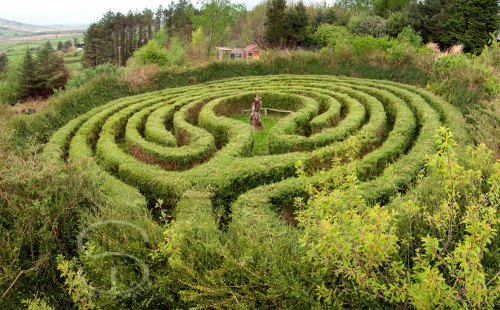
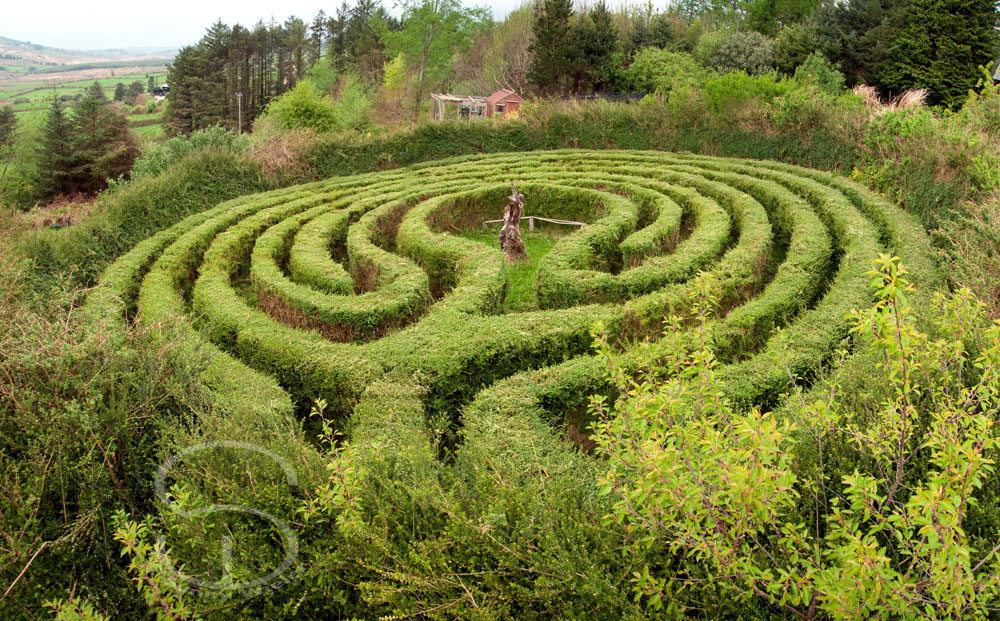
Labyrinth at Hagal’s Farm.
Edited for spelling and grammar 5 Oct 2013
[Related posts: Shinto & Shrine Druidry 1 | 2 | 3 || Shinto — Way of the Gods || Renewing the Shrine 1 | 2 || My Shinto 1 | 2 ]
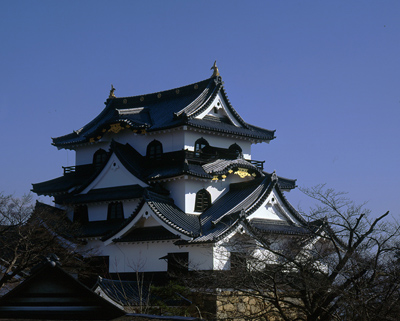
 Almost two decades ago now, in the early 1990s, my wife and I lived for a year in Hikone, a medium-sized city in central Japan, about an hour’s train ride north of Kyoto. The city’s most visible claim to fame is Hikone Castle, a 380-year-old wooden fortress that dominates the downtown skyline. But the most enduring memory I took from Japan and have never forgotten is the profound impression of its many Shinto shrines — roughly 80,000 of them, according to various sources — that dot the landscape and invite the casual visitor as well as the reverent worshiper. I usually found myself somewhere between the two. But this wasn’t ever a problem. Visitors, including foreigners, are welcome.
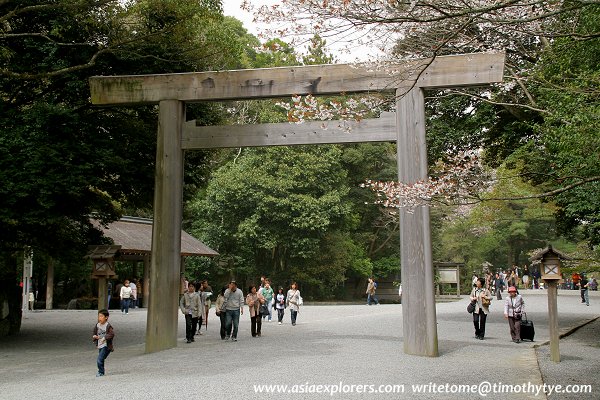
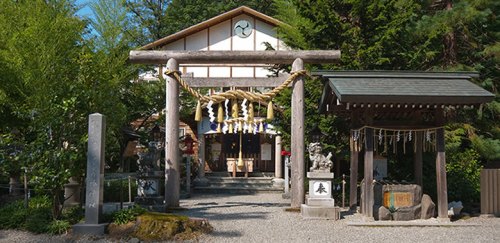
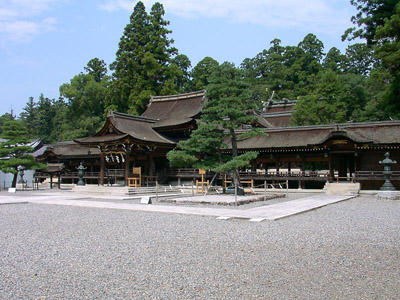
 Shinto shrines are impressive for their openness. Many (especially the smaller and rural ones) are free to visit (though of course donations are gratefully accepted), wonderfully peaceful, and lovingly tended. Not once did I see any graffiti or vandalism in the dozen or so shrines I frequented, in either countryside or city. Often enough I was the only person present, which allowed for a meditative experience of the grounds and atmosphere. Here’s a shot of the entrance to Taga Taisha, about 20 minutes from our apartment in Hikone.
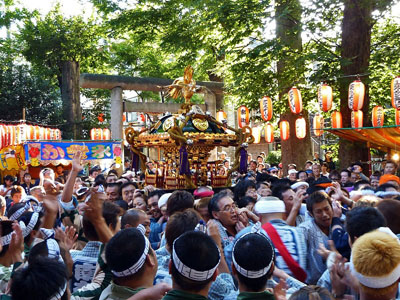
During matsuri or festivals, however, a shrine can be absolutely mobbed, and that’s a wholly different experience, also not to be missed! You can catch something of the energy of a festival in this shot below of Tenso Jinja shrine. The celebrants in the background carry a mikoshi, a portable shrine, back to Tenso Jinja after a day of parading it around the town. Usually there’s a musical accompaniment, and the bearers of the mikoshi can get very enthusiastic in their chants, drawing quite a crowd. In retrospect, the experience felt very Druidic — all that energy, all the communal good feeling, everyone included.

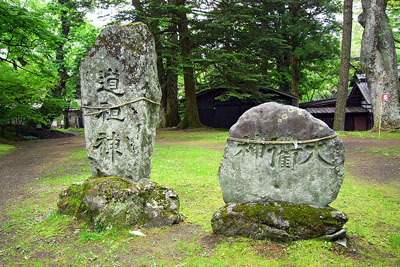
Shinto is the “way of the kami,” the Japanese word used to translate both English “god” (and “God”) as well as “spirit,” “ancestor” or “essence.” From the Shinto perspective, the world of the kami overlaps with ours. Everything has its kami, and the natural world is full of places that manifest the particularly strong presence of kami.
 Thus, natural objects pervaded with kami often receive a small marker shrine and sometimes other identifying signs, like at Hatagoiwa just off the coast in Ishikawa prefecture. Note the rope linking the large ocean rocks, as well as the small red shrine atop the larger rock.
 Shinto focuses on practice more than belief. One of its key practices is purification, so that we can participate in the world of the kami more consciously and harmoniously. For that reason, the entrance to a Shinto shrine typically includes a temizuya (literally “hand-water-spot”) or basin for ritual washing before proceeding further. Here you can see the basin and the bamboo dippers for washing.
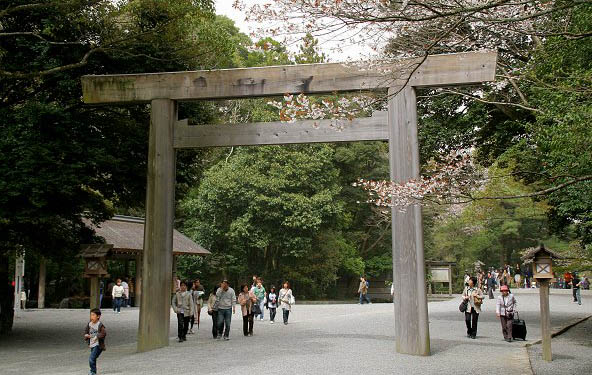
 The marker signalling the sacred space of a shrine is the torii gate, through which all visitors pass. The torii may be simple, like this wooden one at Ise, one of the oldest and most famous shrines.
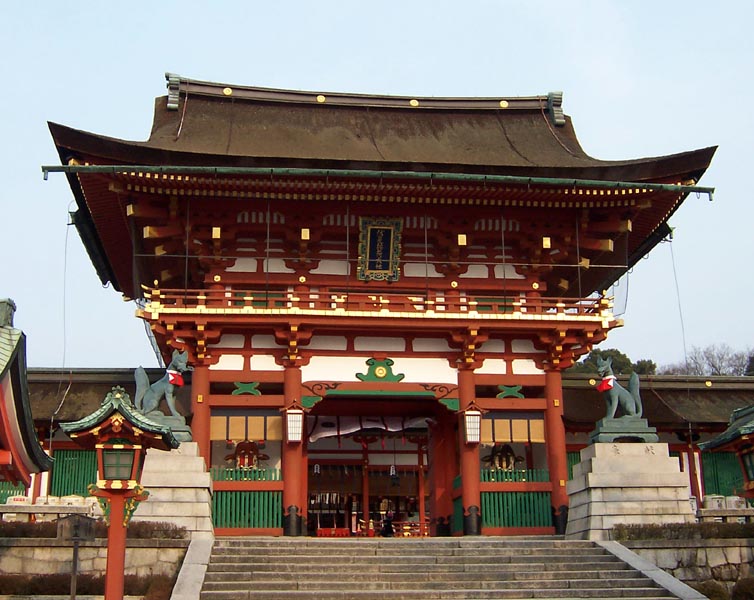
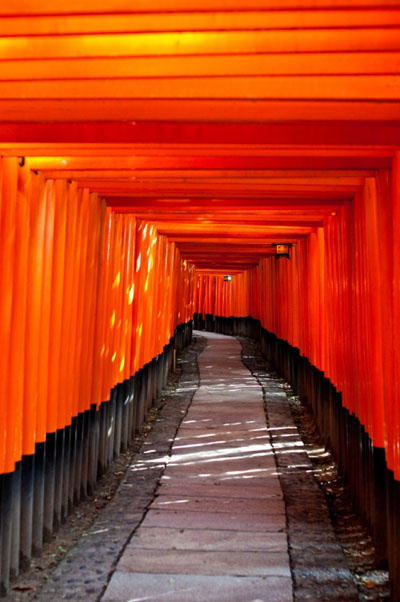
Or it can be wonderfully elaborate, like the main entrance of Fushimi-Inari Jinja near Kyoto, and inside, its sloping corridor of seemingly endless red torii.


Lest you feel this is all well and good, but for all that still remote from your life, there’s a major Shinto shrine in Washington state, near Seattle, named Tsubaki Grand Shrine. And among its kami is Kokudo Kunitama-no-Kami, who protects the North American continent.
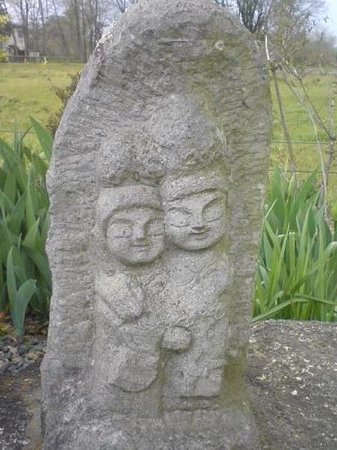
Here’s a shot of the interior of a shrine, featuring dosojin, or kami representing an ancestral married couple. Dosojin are protective spirits, and often placed along borders and boundaries.

The last shot is of a dosojin more recognizably human, marking a field border.

/|\ /|\ /|\
Images: Hikone-jo; Taga Taisha; Tenso; Hatagoiwa; Ise torii; Fushimi-Inari; Tsubaki; dosojin; dosojin2.
 One of the more useful skills I’m practicing with Druidry (we all learn our lessons from many sources, in different guises and from different teachers, throughout our lives) concerns binary thinking. It’s easier to recognize when we’re not practicing it ourselves. You’re with us or you’re against us. It’s good or it’s bad. You’re young or you’re old. Hot or cold. 1% or 99%. And so on. Next door in New Hampshire, the state license plates famously read “Live free or die.”
We can get distinctly uncomfortable around ambiguity that doesn’t fall into one or the other of two neat categories. Advertisers after all market to categories, and spend time labeling both products and consumers so they can target their products. WordPress asks for tags and categories. If you have something to sell that doesn’t fit under a label, you can have a devil of a time getting it on the shelves or in front of people’s noses. Likewise, if you want to locate something that doesn’t fit a category, it can sometimes be a long challenge to track it down.
Of course, we can see plenty of this dualistic patterning in action now on a large scale in the States, and without needing to look any further than our presidential primaries. Just tune in, and you’re sure to hear some variant of the following, especially across party lines: one candidate’s or party’s ideas and proposals constitute all Goodness and Light and Upright Living, while the other threatens our very way of life. Filled with greed, selfishness, and all signs of true evil, that Evil Other will — if we make the mistake of listening to/believing in/voting for them, deliver us individually and as a nation into the hands of utter darkness, despair and destruction.

 Of course the drift into binary or polar thinking doesn’t originate or end with politics. As author, blogger and Druid J. M. Greer notes, “Binaries exert a curious magnetism on the human mind. Once we get caught up in thoughts of yes or no, right or wrong, love or hate, truth or falsehood, or any other binary, it can be hard to realize that the two poles of the binary don’t contain all of reality … Druid philosophy offers a useful tactic in situations of this kind. When you encounter a binary, you simply look for a third factor that is not simply a midpoint between the two poles. Find the third factor and you convert the binary into a ternary, a balanced threefold relationship that allows freedom and flexibility.”*
We all know numerous proverbs and images of three-ness. “Third time’s the charm”; the three parts of a syllogism (thesis, antithesis and synthesis); beginning, middle and end; the Three Blind Mice; Brahma, Vishnu and Shiva; Father, Son and Holy Ghost; the examples are nearly endless. What they amount to is a widespread recognition of the liberating and creative power of Three. As the Tao Te Ching says (Ch. 42), “From the One comes Two, from the Two Three, and from the Three the Ten Thousand Things” of existence in this world. The key is not to stop at two if we want to create. Move on to three.
Greer amplifies the discussion of binary thinking in a post on his weekly blog. He notes that
… the hardwired habit of snap judgments in binary form is always right below the surface. In most cases all it takes is a certain amount of stress to trigger it. Any kind of stress will do, and over the years, practitioners of mass thaumaturgy have gotten very good at finding ways to make people feel stressed so that the binary reaction kicks in and can be manipulated to order.
That’s when thinking in binaries goes haywire, the middle ground becomes invisible, and people think, say, and do resoundingly stupid things because they can only see two extreme alternatives, one of which is charged to the bursting point with desire … or fear … Watch the way that many people on the American right these days insist that anybody to the left of George W. Bush is a socialist, or tfor that matter the way that some people on the American left insist that anybody to the right of Hillary Clinton is a fascist. Equally, and more to the point in our present context, think of the way the peak oil debate was stuck for so long in a binary that insisted that the extremes of continued progress and sudden catastrophic collapse were the only possible shapes of the postpetroleum future.
Binary thinking is evolutionarily useful, Greer notes, because it allows us to make snap judgments that can save our lives in crises. But in situations where more careful thinking is not only possible but necessary, our ancient wiring and programming can leave us stranded at one pole or another, in stalemate, with no sense of the way forward.
Greer continues, observing that (in various kinds of Druid and magical training) “Back in the day, beginning students used to be assigned the homework of picking up the morning paper each day, writing down the first nine binaries they encountered, and finding a third option to each binary.” This bit of training can offer a salutary unlocking and rebalancing of the debates of the day — or of any complex problem handicapped and hampered by sharply polarized thinking.
This useful little exercise [of identifying and expanding binaries] has at least three effects. First of all, it very quickly becomes apparent to the student just how much binary thinking goes on in the average human society. Second, it very quickly becomes at least as apparent to the student how much of an effort it takes, at least at first, to snap out of binary thinking. Third and most crucial is the discovery, which usually comes in short order, that once you find a third option, it’s very easy to find more—a fourth, a ninety-fourth, and so on—and they don’t have to fit between the two ends of the binary, as most beginners assume.
Ternary thinking isn’t just a liberating technique for the person who practices it. It carries with it a desirable ripple effect, for
… when a discussion is mired in reactive binary thinking, it only takes one person resolutely bringing up a third option over and over again, to pop at least some of the participants out of the binary trap, and get them thinking about other options. They may end up staying with the option they originally supported, but they’re more likely to do it in a reasoned way rather than an automatic, unthinking way. They’re also more likely to be able to recognize that the other sides of the debate also have their points, and to be able to find grounds for mutual cooperation, because they aren’t stuck in a mental automatism that loads a torrent of positive emotions onto their side of the balance and an equal and opposite torrent of negative emotions onto the other side.
Given how shrill our political dialog has become, and how intransigent and loath to compromise the principal players remain, we could use a healthy dose of such thinking. As one of the Wise has said, “God is what opposites have in common.” For me that means that the “truth” of a matter is less than likely to lie at either extreme of a binary, but somewhere else — not “in the middle” necessarily, as though God were a moderate or centrist deity. The Tao Te Ching also notes (somewhat wryly, I’ve often felt) that “Extremes do not last long.”
But beyond the political sphere, the ternary in other settings leads us directly to the Ten Thousand Things, the world of possibility and options and freedom. To give just one personal example, after my cancer surgery and the follow-up radiation months later, I was weak and suffering from uncomfortable and chronic internal radiation burns in the lower colon. “I’ve got to get better or I’ll have to quit my job,” I thought. “I can’t work like this,” when almost every bathroom visit brought blood and pain. Binary alert! I was able to arrange a medical leave, during which a change of diet, specific exercise, rest, an inspiring class I audited, and several new activities and spiritual practices have helped with healing.
One of the latter is the subtly powerful principle of “both-and.” Rather than stalling in a binary, embrace the whole. So often I hear people saying, “I’m so upset!” or “I can’t believe it!” or some other incantation. The more often they repeat it, the more forceful their mental and emotional state seems to become for them. (Our most common targets of “black magic” are typically ourselves.)
“Both-and” works like this. “I’m upset and I can also be calm.” Both are true. Rather than denying what may be a very real state or situation, include it and move outward to include more. This avoids the resistance or denial that often plagues affirmations or stubbornness or exertions of the will, as if we could force the universe to do what we’re simultaneously insisting it must not to! (I want to be calm, but “I’m so upset!”)
 Whitman, our old American proto-Druid, gets it. “I am as bad as the worst, but, thank God, I am as good as the best.” Both-and, alive and well. And as he also and famously said in “Song of Myself,” “Do I contradict myself? Very well then I contradict myself. I am large, I contain multitudes.”
The Ten Thousand Things all are moving about on their many and beautiful ways. Come walk with me, and with them.
/|\ /|\ /|\
*J. M. Greer, The Druid Magic Handbook, 19.
Images: NH license; Obama; Gingrich; Whitman.
 My wife and I returned late yesterday afternoon to a cold house — we heat only with wood — back from an overnight to Boston where we visited my wife’s cousin Sue in the hospital. She’s due to go home soon after stem-cell replacement therapy and chemo for lymphoma. So far the treatment’s working, and her toughness and optimism are heartening.
Our indoor thermometer read 49 degrees, and as we shivered in the last afternoon light and I rekindled a fire in our woodstove, I caught myself glancing a couple of times at a calendar, the way you do after a trip, to reorient yourself to times and days. Late January. The last glimmer of sun over our front yard showed a typical Vermont winter scene — new snow, bare trees, and that deceptive bright calm that makes you believe you really don’t need to bundle yourself up and protect every extremity against single-digit New England winter days. A single step outside offers a brisk corrective to that particular illusion.
Yes, frostbite lurks for the unwary, but there’s a subtle shift nonetheless. Birds know it, plumped against the cold, heads cocked and alert for anyone else finding food, and so does the ivy drowsing beside my wife’s loom.  It’s perked up recently, as if waking from its own vegetative hibernation.
Sue’s bright spirits, beyond her own brand of courage, are in keeping with the changing season. Imbolc approaches, the holiday also celebrated variously as Candlemas or St. Brigid’s Day on Feb. 1/2. The northeastern U.S. lies in the grip of winter, and yet the holiday looks forward to spring. The Irish word imbolc means “in the belly” — the fetal lambs growing and approaching the time of their birth into a larger world, full of darkness and light. Brigid draws devotees who keep shrines lit with light and fire. The Wikipedia entry nicely sums up her importance: “Saint Brigid is one of the few saints who stands on the boundary between pagan mythology, Druidism and Christian spirituality.”
Verses in her honor abound:
Fire in the forge that
shapes and tempers.
Fire of the hearth that
nourishes and heals.
Fire in the head that
incites and inspires.
You can feel the change with your eyes, on your skin, in your bones — a slightly different angle of light, longer days, a listening quality, if you go quiet enough to hear it. A reason to celebrate with light and flame.
 There’s an old Japanese saying I encountered while living and working in Tokyo two decades ago that often comes to my mind this time of year. “What is the bravest of living things? The plum tree, because it puts forth its blossoms in the snow.” There’s a bravery in certitude, a trust that, as Genesis 8 declares, “As long as the earth endures, seedtime and harvest, cold and heat, summer and winter, day and night will never cease.”
There’s deep comfort in homely things — things of home — the soapstone stove, the hearth stones that accumulate wood-ash and need sweeping a few times a day, the armfuls of oak logs I bring to feed our fire.
Late this morning as I finish the final draft of this post, the stove still ticking and pinging softly as it heats and cools with each charge of wood, the wall thermometer finally reads 67. My wife reads in bed, the sky lowers gray, and a fine snow clouds the air as it descends.
Light and blessings of the season to you.

















 A Druid Way